EP0335212A2 - Thionophosphorsäureamidester - Google Patents
Thionophosphorsäureamidester Download PDFInfo
- Publication number
- EP0335212A2 EP0335212A2 EP89104903A EP89104903A EP0335212A2 EP 0335212 A2 EP0335212 A2 EP 0335212A2 EP 89104903 A EP89104903 A EP 89104903A EP 89104903 A EP89104903 A EP 89104903A EP 0335212 A2 EP0335212 A2 EP 0335212A2
- Authority
- EP
- European Patent Office
- Prior art keywords
- formula
- optionally substituted
- ethyl
- chlorine
- spp
- Prior art date
- Legal status (The legal status is an assumption and is not a legal conclusion. Google has not performed a legal analysis and makes no representation as to the accuracy of the status listed.)
- Withdrawn
Links
- 0 CC1C(C2)C2C*C1 Chemical compound CC1C(C2)C2C*C1 0.000 description 4
Classifications
-
- C—CHEMISTRY; METALLURGY
- C07—ORGANIC CHEMISTRY
- C07F—ACYCLIC, CARBOCYCLIC OR HETEROCYCLIC COMPOUNDS CONTAINING ELEMENTS OTHER THAN CARBON, HYDROGEN, HALOGEN, OXYGEN, NITROGEN, SULFUR, SELENIUM OR TELLURIUM
- C07F9/00—Compounds containing elements of Groups 5 or 15 of the Periodic Table
- C07F9/02—Phosphorus compounds
- C07F9/06—Phosphorus compounds without P—C bonds
- C07F9/16—Esters of thiophosphoric acids or thiophosphorous acids
- C07F9/165—Esters of thiophosphoric acids
- C07F9/20—Esters of thiophosphoric acids containing P-halide groups
-
- A—HUMAN NECESSITIES
- A01—AGRICULTURE; FORESTRY; ANIMAL HUSBANDRY; HUNTING; TRAPPING; FISHING
- A01N—PRESERVATION OF BODIES OF HUMANS OR ANIMALS OR PLANTS OR PARTS THEREOF; BIOCIDES, e.g. AS DISINFECTANTS, AS PESTICIDES OR AS HERBICIDES; PEST REPELLANTS OR ATTRACTANTS; PLANT GROWTH REGULATORS
- A01N57/00—Biocides, pest repellants or attractants, or plant growth regulators containing organic phosphorus compounds
- A01N57/26—Biocides, pest repellants or attractants, or plant growth regulators containing organic phosphorus compounds having phosphorus-to-nitrogen bonds
- A01N57/28—Biocides, pest repellants or attractants, or plant growth regulators containing organic phosphorus compounds having phosphorus-to-nitrogen bonds containing acyclic or cycloaliphatic radicals
-
- C—CHEMISTRY; METALLURGY
- C07—ORGANIC CHEMISTRY
- C07F—ACYCLIC, CARBOCYCLIC OR HETEROCYCLIC COMPOUNDS CONTAINING ELEMENTS OTHER THAN CARBON, HYDROGEN, HALOGEN, OXYGEN, NITROGEN, SULFUR, SELENIUM OR TELLURIUM
- C07F9/00—Compounds containing elements of Groups 5 or 15 of the Periodic Table
- C07F9/02—Phosphorus compounds
- C07F9/06—Phosphorus compounds without P—C bonds
- C07F9/22—Amides of acids of phosphorus
- C07F9/24—Esteramides
- C07F9/2404—Esteramides the ester moiety containing a substituent or a structure which is considered as characteristic
- C07F9/2408—Esteramides the ester moiety containing a substituent or a structure which is considered as characteristic of hydroxyalkyl compounds
Definitions
- the invention relates to new thionophosphoric acid amide esters, a process for their preparation, their use as pesticides, in particular as insecticides, acaricides and nematicides, and new intermediates and a process for the preparation of such intermediates.
- R1 represents optionally substituted radicals from the series alkoxy, alkenyloxy and alkynyloxy.
- R2 and R3 are the same or different and are independently hydrogen and optionally substituted radicals from the series alkyl, cycloalkyl, alkenyl or alkynyl or together with the nitrogen atom to which they are attached form a 5- to 7-membered, saturated or unsaturated ring and X stands for halogen.
- the compounds of formula (I) have an asymmetrically substituted phosphorus atom. They can therefore exist in various optical isomer forms, which can be obtained in different proportions. In all cases they are predominantly as Racemate before.
- the invention relates to both the isomer mixtures and the individual isomers.
- the new thionophosphoric acid amide esters of the formula (I) are outstandingly distinguished by their particularly high activity as pesticides, in particular as insecticides, acaricides and nematicides.
- alkyl in the definition of R2 and R3 in the general formulas straight-chain or branched alkyl having preferably 1 to 20, particularly preferably 1 to 12, in particular 1 to 6 and very particularly preferably 1 to 4 carbon atoms.
- Examples of optionally substituted methyl, ethyl, n-propyl, i-propyl, n-butyl, sec-butyl, i-butyl, tert-butyl, n-pentyl, i-pentyl and tert-pentyl may be mentioned.
- alkenyl itself or as part of the group alkenyloxy in the definitions of R1, R2 and R3 in the general formulas is straight-chain or branched alkenyl with preferably 2 to 8, particularly preferably 2 to 6 and in particular 2 to 4 carbon atoms.
- Substituted vinyl, allyl, 2-butenyl, 3-butenyl and 1-methylallyl may be mentioned as examples.
- optionally substituted alkoxy in the definition of R1 in the general formulas straight-chain or branched alkoxy is preferred 1 to 6, in particular 1 to 4 carbon atoms to understand.
- Examples are optionally substituted methoxy, ethoxy, propoxy, butoxy and their isomers, such as. B. i-propoxy, i-, s- and tert-butoxy called, optionally substituted methoxy and ethoxy are particularly emphasized.
- alkynyl itself or as a constituent of the alkynyloxy group in the definitions R.sup.1, R.sup.2 and R.sup.3 in the general formulas is to be understood as straight-chain or branched alkynyl having preferably 2 to 6, particularly preferably 2 to 4, carbon atoms. Substituted ethynyl, 2-propynyl, 2-butynyl, 3-butynyl and 1-methyl-2-propynyl may be mentioned as examples.
- Cycloalkyl having preferably 3 to 8, in particular 3, 5 or 6, carbon atoms is an optionally substituted cycloalkyl in the definitions R 2 and R 3.
- Examples of optionally substituted cyclopropyl, cyclobutyl, cyclopentyl, cyclohexyl and cycloheptyl may be mentioned.
- substituted radicals mentioned in the definition of R1, R2 and R3 can carry one or more, preferably 1 to 3, in particular 1 or 2 identical or different substituents.
- radicals alkoxy, alkenyloxy and alkynyloxy can preferably be substituted by halogens such as fluorine, chlorine, bromine and iodine, in particular fluorine, chlorine and bromine and by C1-C4alkoxy.
- cycloalkyl Alkyl with 1 to 4 carbon atoms, such as methoxy, ethyl, n-propyl, i-propyl, n-butyl, i-butyl, sec-butyl, and tert-butyl, haloalkyl, such as trifluoromethyl and halogen.
- radicals R 1, R 2 and R 3 are preferably unsubstituted.
- Halogen in the definitions X and X1 ⁇ 1 in the general formulas and as a substituent for a group, represents fluorine, chlorine, bromine and iodine, in particular fluorine, chlorine and bromine, in the case of X in particular chlorine or bromine and in the case X1 ⁇ 1 especially for chlorine.
- R2 and R3 together with the nitrogen atom form a ring, this contains 5 to 7, preferably 5 or 6 ring members.
- the ring can contain 1 to 3 double bonds, but is preferably saturated.
- the pyrrolidine and piperidine rings may be mentioned as particularly preferred rings.
- R1 is preferably C1-C4 alkoxy, especially methoxy and ethoxy.
- R2 and R3 do not simultaneously represent hydrogen.
- R2 is preferably hydrogen and R3 is C1-C4-alkyl.
- R1 represents C1-C4-alkoxy optionally substituted by halogen and / or C1-C4-alkoxy, C2-C6-alkenyloxy and C2-C6-alkynyloxy
- R2 and R3 are the same or different and are independently hydrogen, optionally substituted by halogen and / or C1-C4-alkoxy C1-C4-alkyl; for cycloalkyl of 3 to 8 carbon atoms optionally substituted by methyl, ethyl, fluorine and / or chlorine; represent C2-C6-alkenyl and / or C2-C6-alkynyl optionally substituted by halogen and / or C1-C4-alkyl, or together with the nitrogen atom form a 5- to 6-membered, saturated or unsaturated ring and
- X represents fluorine, chlorine or bromine (preferably chlorine
- R1 represents C1-C4-alkoxy optionally substituted by halogen or C1-C4-alkoxy
- R2 represents hydrogen
- R3 represents C1-C4-alkyl optionally substituted by halogen or C1-C4-alkoxy
- X represents chlorine or bromine.
- thionophosphoric acid esters of the formula (I) which are particularly preferred are in which R1 represents optionally substituted by fluorine, chlorine, methoxy and / or ethoxy C1-C4-alkoxy, C2-C3-alkenyloxy and C2-C4-alkynyloxy, R2 and R3 are the same or different and independently of one another for hydrogen, for C1-C4-alkyl optionally substituted by fluorine, chlorine, bromine, methoxy and / or ethoxy, for optionally cycloalkyl having 3 to 6 carbon atoms substituted by methyl, ethyl, fluorine and / or chlorine; represent C2-C4-alkenyl and C2-C C-alkynyl optionally substituted by fluorine, chlorine, methyl and / or ethyl, or together with the nitrogen atom to which they are attached represent piperidyl and pyrrolidinyl and X represents fluorine, chlorine and bromine
- R1 represents C1-C4alkoxy optionally substituted by fluorine, chlorine, methoxy and / or ethoxy
- R2 represents hydrogen
- R3 represents C1-C4-alkyl optionally substituted by fluorine, chlorine, bromine, methoxy and / or ethoxy
- X represents chlorine or bromine.
- thionophosphoric acid esters with formula (I) are very particularly preferred in which R1 represents methoxy, ethoxy and chloroethoxy (preferably methoxy and ethoxy), R2 represents hydrogen, R3 represents methyl, ethyl, n-propyl, iso-propyl, iso-butyl, sec-butyl and allyl and X represents chlorine and bromine.
- Formula (II) provides a general definition of the O- (1,1-difluoro-2-halogeno-ethyl) thionophosphoric diester halides to be used as starting materials in the process according to the invention.
- X, X1 ⁇ 1 and R1 are preferably or particularly preferably those radicals which are given above in the definitions for formula (I) and formula (II).
- O- (1,1-difluoro-2-halogeno-ethyl) -thionophosphoric diester halides of the formula (II) are new and part of the present invention.
- the compounds of the formula (II) are obtained if O- (1,1-difluoro-2-halogeno-ethyl) thionophosphoric ester dihalides of the formula in which X and X1 ⁇ 1 have the meaning given above, with alcohols of the formula R1-M (V) in which R1 has the meaning given above and M represents hydrogen or an alkali metal or alkaline earth metal equivalent (for example potassium, sodium or calcium), optionally in the presence of an acid acceptor, such as collidine and optionally in the presence of a solvent, such as ether, at room temperature (cf. DE-OS 26 29 016 and DE-OS 26 30 561).
- Formula (IV) provides a general definition of the O- (1,1-difluoro-2-halogeno-ethyl) thionophosphoric ester dihalides to be used as starting materials in the process for the preparation of the compounds of the formula (II).
- X and X1 ⁇ 1 are preferably or particularly preferably those radicals which are given above in the definitions for the formula (I) and formula (II).
- the compounds of the formula (IV) are obtained if O- (1,1-difluoro-2-halogeno-ethyl) phosphoric acid ester dihalides of the formula in which X and X1 ⁇ 1 have the meaning given above, with thiophosphoryl chloride of the formula PSCl3 (VII) optionally in the presence of a diluent and optionally in the presence of a phosphorus sulfide, such as phosphorus (V) sulfide (P2S5, P4S10) or 2,4-bis- (4-methoxyphenyl) -1,3,2,4-dithiaphosphetane-2,4 -disulfide (Lawesson's reagent).
- Suitable diluents for the preparation of the new compounds of the formula (IV) are practically inert organic solvents and thiophosphoryl chloride.
- These preferably include aromatic, optionally halogenated hydrocarbons, such as toluene, xylene, chlorobenzene and o-dichlorobenzene, dichlorotoluene, mono- and dichloroxylene.
- aromatic, optionally halogenated hydrocarbons such as toluene, xylene, chlorobenzene and o-dichlorobenzene, dichlorotoluene, mono- and dichloroxylene.
- Thiophosphoryl chloride is particularly preferred.
- the process for the preparation of the new compounds of the formula (IV) is generally carried out at temperatures between 100 ° C. and 160 ° C., preferably at temperatures between 120 ° C. and 140 ° C.
- 1 mol of starting material of the formula (VI) is employed with 1 to 20 mol, preferably 1 to 6 mol of thiophosphoryl chloride and 0.0001 to 0.2 mol, preferably 0.001 to 0 .01 moles of phosphorus (V) sulfide.
- the reactions are generally carried out under normal pressure.
- the starting material of the formula (VI) is heated under reflux together with phosphorus (V) sulfide in one of the stated solvents, particularly preferably thiophosphoryl chloride, the phosphorus oxychloride formed being continuously distilled off becomes.
- the compounds of the formula (IV) obtained as crude products can be purified in a conventional manner, advantageously by fractional distillation under reduced pressure.
- the retention index (Kovats index) is used to characterize them.
- Formula (VI) provides a general definition of the O- (1,1-difluoro-2-halogeno-ethyl) -phosphoric acid dihalides to be used as starting materials.
- X and X1 ⁇ 1 are preferably or particularly preferably those radicals which are given above in the definitions for formula (I).
- the compounds of formula (VI) are known (DE-OS 25 07 779).
- the thiophosphoryl chloride of formula (VII) (PSCl3) to be used as a starting material is a generally known compound of inorganic chemistry.
- the process according to the invention for the preparation of the new compounds of the formula (I) is preferably carried out using diluents.
- aliphatic or aromatic, optionally halogenated hydrocarbons such as, for example, pentane, hexane, heptane, cyclohexane, petroleum ether, gasoline, ligroin, benzene, toluene, xylene, methylene chloride, ethylene chloride, chloroform, carbon tetrachloride, chlorobenzene and o-dichlorobenzene, ethers such as dimethyl - And dibutyl ether, glycol dimethyl ether and diglycol dimethyl ether, tetrahydrofuran and dioxane, ketones such as acetone, methyl ethyl, methyl isopropyl and methyl isobutyl ketone, esters such as methyl acetate and ethyl acetate, nitriles such as acetonitrile and propionitrile, amides such as dimethyl , Dimethylacetamide
- Acid acceptors which can be used in the process for the preparation of the new compounds of the formula (I) are all acid binders which can customarily be used for such reactions.
- Alkaline earth metal hydroxides such as e.g. Calcium hydroxide, alkali carbonates and alcoholates such as sodium and potassium carbonate, sodium and potassium methylate or ethylate, furthermore aliphatic, aromatic or heterocyclic amines, for example triethylamine, trimethylamine, dimethylaniline, dimethylbenzylamine, pyridine, collidine, 1,5-diazabicyclo- [4 , 3,0] non-5-ene (DBN), 1,8-diazabicyclo- [5,4,0] -undec-7-ene (DBU) and 1,4-diazabicyclo- [2,2,2 ] octane (DABCO).
- DBN 1,5-diazabicyclo- [4 , 3,0] non-5-ene
- DBU 1,8-d
- reaction temperatures can be varied within a substantial range in the process for the preparation of the compounds of the formula (I). In general, temperatures between 0 ° C and 100 ° C, preferably at temperatures between 20 ° C and 60 ° C.
- the reaction is generally allowed to proceed at normal pressure.
- the reactants are preferably used in an equimolar ratio. An excess of one or the other component has no significant advantages.
- the reaction is preferably carried out in one of the specified solvents in the presence of an acid acceptor.
- the batch is worked up by customary methods by filtration, washing the filtrate and distilling off the solvent.
- the new compounds are obtained in the form of oils, some of which cannot be distilled without decomposing, but by so-called “distillation”, i.e. can be freed from the last volatile components by prolonged heating under reduced pressure to a moderately elevated temperature and can be cleaned in this way.
- the retention index (Kovats index) is used to characterize them.
- the active substances are suitable for controlling animal pests, preferably arthropods and nematodes, in particular insects and arachnids, which occur in agriculture, in forests, in the protection of stored goods and materials and in the hygiene sector. They are effective against normally sensitive and resistant species as well as against all or individual stages of development.
- the pests mentioned above include: From the order of the Isopoda, for example Oniscus asellus, Armadillidium vulgare, Porcellio scaber. From the order of the Diplopoda, for example, Blaniulus guttulatus. From the order of the Chilopoda, for example, Geophilus carpophagus and Scutigera spec.
- Symphyla for example, Scutigerella immaculata.
- Thysanura for example Lepisma saccharina.
- Collembola for example Onychiurus armatus.
- Orthoptera for example Blatta orientalis, Periplaneta americana, Leucophaea maderae, Blattella germanica, Acheta domesticus, Gryllotalpa spp., Locusta migratoria migratorioides, Melanoplus differentialis, Schistocerca gregaria.
- Dermaptera for example, Forficula auricularia.
- Eurygaster spp. Dysdercus intermedius, Piesma quadrata, Cimex lectularius, Rhodnius prolixus, Triatoma spp. From the order of the Homoptera, for example, Aleurodes brassicae, Bemisia tabaci, Trialeurodes vaporariorum, Aphis gossypii, Brevicoryne brassicae, Cryptomyzus ribis, Aphis fabae, Doralis pomi, Eriosoma lanigerum, Hyalopterus arundinis, Macrosiphum avenae, Phyphodosumas, Myzus sppas spp., Euscelis bilobatus, Nephotettix cincticeps, Lecanium corni, Saissetia oleae, Laodelphax striatellus, Nilaparvata lugens, Aonidiella aurantii,
- Psylla spp From the order of the Lepidoptera, for example Pectinophora gossypiella, Bupalus piniarius, Cheimatobia brumata, Lithocolletis blancardella, Hyponomeuta padella, Plutella maculipennis, Malacosoma neustria, Euproctis chrysorrhoea, Lymantria spp.
- Hymenoptera From the order of the Hymenoptera, for example Diprion spp., Hoplocampa spp., Lasius spp., Monomorium pharaonis, Vespa spp. From the order of the Diptera, for example Aedes spp., Anopheles spp., Culex spp., Drosophila melanogaster, Musca spp., Fannia spp., Calliphora erythrocephala, Lucilia spp., Chrysomyia spp., Cuterebra spp., Gastrophilus spp., Hyppobosca ., Stomoxys spp., Oestrus spp., Hypoderma spp., Tabanus spp., Tannia spp., Bibio hortulanus, Os cinella frit, Phorbia spp., Pegomyia hyoscyami, Ceratitis capitat
- Siphonaptera for example Xenopsylla cheopis, Ceratophyllus spp ..
- Arachnida for example Scorpio maurus, Latrodectus mactans.
- Acarina for example Acarus siro, Argas spp., Ornithodorus spp., Dermanyssus gallinae, Eriophyes ribis, Phyllocoptruta oleivora, Boophilus spp., Rhipicephalus spp., Amblyomma spp., Hyalomma spp., Ixodes spp., Psoroptes spp., Psoroptes Chorioptes spp., Sarcoptes spp., Tarsonemus spp., Bryobia praetiosa, Panonychus spp., Tetranychus spp ..
- the plant parasitic nematodes include Pratylenchus spp., Radopholus similis, Ditylenchus dipsaci, Tylenchulus semipenetrans, Heterodera spp., Meloidogyne spp., Aphelenchoides spp., Longidorus spp., Xiphinema spp., Trichodorus spp.
- the active compounds of the formula (I) according to the invention are notable for excellent insecticidal activity.
- they show an excellent action against maggots such as Phorbia antiqua maggot, against aphids such as Myzus persicae and an excellent action against nematodes such as Meloidogyne incognita.
- the active compounds according to the invention are notable for excellent insecticidal activity, in particular in the control of Orthoptera species, such as e.g. Blattella germanica and Coleoptera species, e.g. Sitophilus granarius, from.
- Orthoptera species such as e.g. Blattella germanica and Coleoptera species, e.g. Sitophilus granarius, from.
- the active compounds according to the invention can also very well be used to control hygiene pests, such as e.g. Musca domestica dipteras, Aedes aegypti dipteras and Aedes aegypti larvae.
- hygiene pests such as e.g. Musca domestica dipteras, Aedes aegypti dipteras and Aedes aegypti larvae.
- the active substances can be converted into customary formulations, such as solutions, emulsions, suspensions, powders, foams, pastes, granules, aerosols, active substance-impregnated natural and synthetic substances, very fine encapsulations in polymeric substances and in coating compositions for seeds, furthermore in formulations with fuel sets, such as smoking cartridges, cans, spirals and the like, as well as ULV cold and warm mist formulations.
- customary formulations such as solutions, emulsions, suspensions, powders, foams, pastes, granules, aerosols, active substance-impregnated natural and synthetic substances, very fine encapsulations in polymeric substances and in coating compositions for seeds, furthermore in formulations with fuel sets, such as smoking cartridges, cans, spirals and the like, as well as ULV cold and warm mist formulations.
- formulations are prepared in a known manner, for example by mixing the active ingredients with extenders, that is to say liquid solvents, pressurized liquefied gases and / or solid carriers, optionally using surface-active agents, that is to say emulsifiers and / or dispersants and / or foam-generating agents.
- extenders that is to say liquid solvents, pressurized liquefied gases and / or solid carriers
- surface-active agents that is to say emulsifiers and / or dispersants and / or foam-generating agents.
- organic solvents can, for example, also be used as auxiliary solvents.
- liquid solvents aromatics, such as xylene, toluene, or alkylnaphthalenes, chlorinated aromatics or chlorinated aliphatic hydrocarbons, such as chlorobenzenes, chlorethylenes or methylene chloride, aliphatic hydrocarbons, such as cyclohexane or paraffins, for example petroleum fractions, alcohols, such as butanol or glycol as well as their ethers and esters, ketones such as acetone, methyl ethyl ketone, methyl isobutyl ketone or cyclohexanone, strongly polar solvents such as dimethylformamide and dimethyl sulfoxide, and water;
- Liquefied gaseous extenders or carriers mean liquids which are gaseous at normal temperature and under normal pressure, for example aerosol propellants such as halogenated hydrocarbons and butane, propane, nitrogen and carbon dioxide;
- Solid carrier materials are suitable: for example natural rock powders such as
- Adhesives such as carboxymethyl cellulose, natural and synthetic polymers in the form of powders, granules or latices, such as gum arabic, polyvinyl alcohol, polyvinyl acetate, and also natural phospholipids, such as cephalins and lecithins, and synthetic phospholipids can be used in the formulations.
- Other additives can be mineral and vegetable oils.
- Dyes such as inorganic pigments, e.g. Iron oxide, titanium oxide, ferrocyan blue and organic dyes such as alizarin, azo and metal phthalocyanine dyes and trace nutrients such as salts of iron, manganese, boron, copper, cobalt, molybdenum and zinc can be used.
- the formulations generally contain between 0.1 and 95 percent by weight of active compound, preferably between 0.5 and 90%.
- the active compounds can be present in their commercially available formulations and in the use forms prepared from these formulations in a mixture with other active compounds, such as insecticides, attractants, sterilants, acaricides, nematicides, fungicides, growth-regulating substances or herbicides.
- Insecticides include, for example, phosphoric acid esters, carbamates, carboxylic acid esters, chlorinated hydrocarbons, phenylureas, substances produced by microorganisms, etc.
- the active compounds can also be present in their commercially available formulations and in the use forms prepared from these formulations in a mixture with synergists.
- Synergists are compounds by which the action of the active ingredients is increased without the added synergist itself having to be active.
- the active substance content of the use forms prepared from the commercially available formulations can vary within wide ranges.
- the active substance concentration of the use forms can be from 0.0000001 to 95% by weight of active substance, preferably between 0.0001 and 1% by weight.
- the application takes place in a customary manner adapted to the application forms.
- the active ingredients When used against hygiene pests and pests of stored products, the active ingredients are distinguished by an excellent residual action on wood and clay and by a good stability to alkali on limed substrates.
- Example (II-1) the compounds of the formula listed in Table 2 below are also produced.
- Table: 2 Example No. X X1 ⁇ 1 R1 Retention index * II-2 Cl Cl -OCH3 1104 II-3 Cl Cl -OC2H5 1161 II-4 Cl Cl -OCH2CH2Cl 1362 II-5 Br Cl -OCH3 1180 * The retention indices (Kovats index) were determined by gas chromatography on a boiling point phase (dimethyl silicone).
- Example (IV-1) the compound of the formula listed in Table 3 below is also used receive: Table: 3
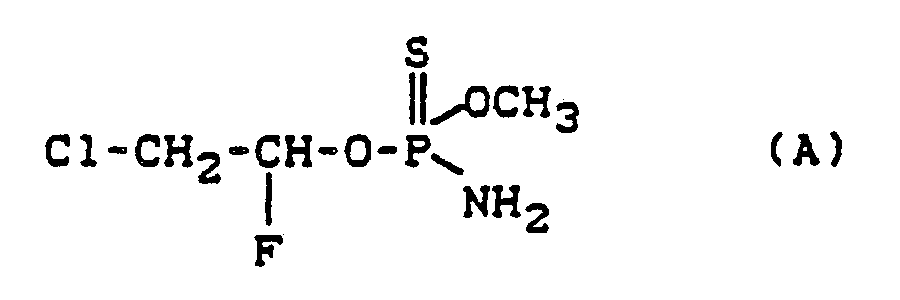
- the compound indicated below was used as the comparative compound: (Known from DE-OS 26 29 016, which corresponds to US-PS 4 159 324).
- Test insect Phorbia antiqua maggot (in the ground) Solvent: 3 parts by weight of acetone Emulsifier: 1 part by weight of alkylaryl polyglycol ether
- active compound 1 part by weight of active compound is mixed with the stated amount of solvent, the stated amount of emulsifier is added and the concentrate is diluted with water to the desired concentration.
- the active ingredient preparation is intimately mixed with the soil.
- test animals After 24 hours, the test animals are placed in the treated soil and after a further 2 to 7 days, the effectiveness of the active ingredient is determined in% by counting the dead and live test insects. The efficiency is 100% when all test insects have been killed, it is 0% when as many test insects are still alive as in the untreated control.
- Test insect Myzus persicae Solvent: 3 parts by weight of acetone Emulsifier: 1 part by weight of alkylaryl polyglycol ether
- active compound 1 part by weight of active compound is mixed with the stated amount of solvent, the stated amount of emulsifier is added and the concentrate is diluted with water to the desired concentration.
- the active ingredient preparation is intimately mixed with soil.
- the treated soil is filled into pots and planted with cabbage (Brassica oleracea).
- the active ingredient can be taken up from the soil by the plant roots and transported to the leaves.
- the root systemic effect of the active ingredient is derived from the number of killings. It is 100% if all test animals are killed and 0% if the same number of test insects are still alive as in the untreated control.
- the compound of Preparation I-2 showed an effect of 95% at an exemplary concentration of 10 ppm, while the comparison compound gave 0% effect at the same concentration.
- Test nematode Meloidogyne incognita Solvent: 3 parts by weight of acetone Emulsifier: 1 part by weight of alkylaryl polyglycol ether
- active compound 1 part by weight of active compound is mixed with the stated amount of solvent, the stated amount of emulsifier is added and the concentrate is diluted with water to the desired concentration.
- the active ingredient preparation is intimately mixed with soil that is heavily contaminated with the test nematodes.
- concentration of the active ingredient in the preparation is practically irrelevant, the only decisive factor is the amount of active ingredient per unit volume of soil, which is given in ppm.
- the treated soil is filled into pots, lettuce is sown and the pots are kept at a greenhouse temperature of 27 ° C.
- the lettuce roots are examined for nematode infestation (root galls) and the effectiveness of the active ingredient is determined in%.
- the efficiency is 100% if the infestation is completely avoided, it is 0% if the infestation is as high as that of the control plants in untreated, but equally contaminated soil.
- the compound of Preparation Example I-2 showed an effect of 100% at an exemplary concentration of 2.5 ppm, while the comparison compound gave 0% effect at the same concentration.
- Test animals Musca domestica Number of test animals: 25 Solvent: acetone
- the condition of the test animals is continuously checked. The time that is necessary for a 100% knock-down effect is determined.
- the compounds of Preparation Examples I-2 and I-7 showed an LT100 value of 90 'and at an exemplary concentration of 0.002% the compounds of Preparation Examples I-3 and I-5 at an exemplary concentration of 0.002% had an LT100 value of 55 'and 75', respectively, while the comparison compound gave an LT100 value of 240 'at the same concentration.
- Test animals Blattella germanica Number of test animals: 5 Solvent: acetone
- the condition of the test animals is checked 3 days after starting the experiments.
- the death rate is determined in%. 100% means that all test animals have been killed; 0% means that no test animals have been killed.
- Test animals Sitophilus granarius Number of test animals: 10 Solvent: acetone
- the condition of the test animals is checked 3 days after starting the experiments.
- the death rate is determined in%. 100% means that all test animals have been killed; 0% means that no test animals have been killed.
- the compounds of Preparation Examples I-2, I-3, I-5, I-6 and I-7 showed 100% kill at an exemplary concentration of 0.002%, while the comparative compound showed kill at the same concentration of 30%.
- Test animals Aedes aegypti Number of test animals: 20 Solvent: acetone
- the condition of the test animals is continuously checked. The time that is necessary for a 100% knock-down effect is determined.
- Test animals Aedes aegypti larvae Solvent: 99 parts by weight of acetone Emulsifier: 1 part by weight of benzylhydroxydiphenyl polyglycol ether
- aqueous active substance preparations are filled into glasses and then about 25 mosquito larvae are inserted into each glass.
- the death rate is determined in%. 100% means that all larvae have been killed. 0% means that no larvae have been killed at all.
Landscapes
- Chemical & Material Sciences (AREA)
- Life Sciences & Earth Sciences (AREA)
- Organic Chemistry (AREA)
- Health & Medical Sciences (AREA)
- General Health & Medical Sciences (AREA)
- Biochemistry (AREA)
- Molecular Biology (AREA)
- Pest Control & Pesticides (AREA)
- Agronomy & Crop Science (AREA)
- Plant Pathology (AREA)
- Engineering & Computer Science (AREA)
- Dentistry (AREA)
- Wood Science & Technology (AREA)
- Zoology (AREA)
- Environmental Sciences (AREA)
- Agricultural Chemicals And Associated Chemicals (AREA)
- Pharmaceuticals Containing Other Organic And Inorganic Compounds (AREA)
Abstract
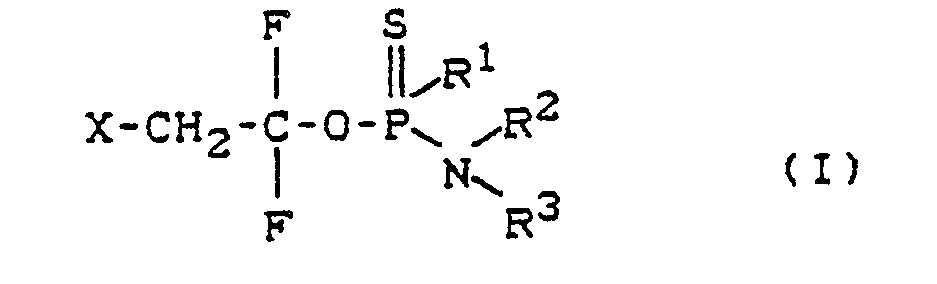
in welcher
R¹ für gegebenenfalls substituierte Reste aus der Reihe Alkoxy, Alkenyloxy und Alkinyloxy steht,
R² und R³ gleich oder verschieden sind und unabhängig voneinander für Wasserstoff und für gegebenenfalls substituierte Reste aus der Reihe Alkyl, Cycloalkyl, Alkenyl oder Alkinyl stehen
oder
gemeinsam mit dem Stickstoffatom, an welches sie gebunden sind, einen 5- bis 7-gliedrigen, gesättigten oder ungesättigten Ring bilden und
X für Halogen steht,
welche als Schädlingsbekämpfungsmittel verwendet werden können.
Description
- Die Erfindung betrifft neue Thionophosphorsäureamidester, ein Verfahren zu ihrer Herstellung, ihre Verwendung als Schädlingsbekämpfungsmittel, insbesondere als Insektizide, Akarizide und Nematizide sowie neue Zwischenprodukte und ein Verfahren zur Herstellung solcher Zwischenprodukte.
- Es ist bereits bekannt, daß bestimmte Thionophosphor(phosphon)säureamidester, wie zum Beispiel O-Methyl-O-(2-chlor-1-fluor-ethyl)-thionophosphorsäurediesteramid, pestizid wirksam sind (vgl. DE-OS 26 29 016, entsprechend US-PS 4 159 324). Die Wirkung und die Wirkungsdauer dieser bekannten Verbindungen sind jedoch, insbesondere bei niedrigen Aufwandmengen bzw. Wirkstoffkonzentrationen, nicht immer voll zufriedenstellend.
- Es wurden nun neue Thionophosphorsäureamidester der allgemeinen Formel
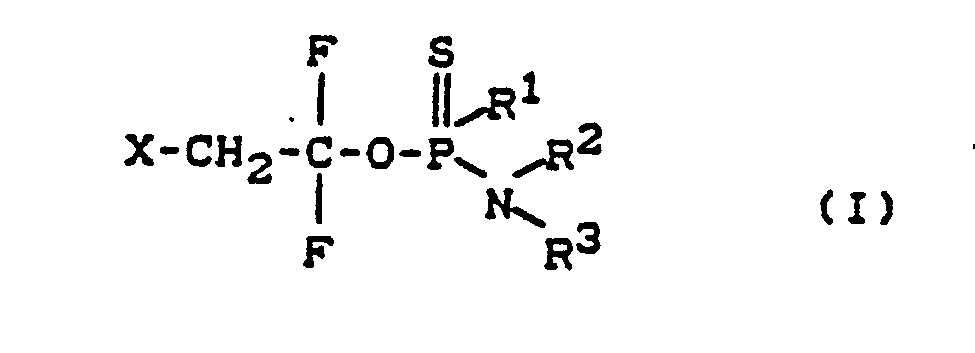
in welcher
R¹ für gegebenenfalls substituierte Reste aus der Reihe Alkoxy, Alkenyloxy und Alkinyloxy steht.
R² und R³ gleich oder verschieden sind und unabhängig voneinander für Wasserstoff und für gegebenenfalls substituierte Reste aus der Reihe Alkyl, Cycloalkyl, Alkenyl oder Alkinyl stehen
oder
gemeinsam mit dem Stickstoffatom, an welches sie gebunden sind, einen 5- bis 7-gliedrigen, gesättigten oder ungesättigten Ring bilden und
X für Halogen steht. - Die Verbindungen der Formel (I) besitzen ein asymmetrisch substituiertes Phosphoratom. Sie können daher in verschiedenen optischen Isomerenformen vorliegen, die in unterschiedlichen Mengenverhältnissen anfallen können. In allen Fällen liegen sie vorwiegend als Racemate vor. Die Erfindung betrifft sowohl die Isomerengemische als auch die einzelnen Isomeren.
- Weiterhin wurde gefunden, daß man die neuen Thionophosphorsäureamidester der Formel (I) erhält,
wenn man O-(1,1-Difluor-2-halogen-ethyl)-thionophosphorsäureesterhalogenide der Formel
X und R¹ die oben angegebene Bedeutung haben und
X¹⁻¹ für Halogen, vorzugsweise Chlor, steht,
mit Aminen der Formel
R² und R³ die oben angegebene Bedeutung haben,
gegebenenfalls in Gegenwart eines Verdünnungsmittels und gegebenenfalls in Gegenwart eines Säureakzeptors umsetzt. - Die neuen Thionophosphorsäureamidester der Formel (I) zeichnen sich in überragender Weise durch eine besonders hohe Wirksamkeit als Schädlingsbekämpfungsmittel, insbesondere als Insektizide, Akarizide und Nematizide aus.
- Die erfindungsgemäßen Stoffe stellen somit eine wertvolle Bereicherung der Technik dar.
- Als gegebenenfalls substituiertes Alkyl in der Definition von R² und R³ in den allgemeinen Formeln, steht geradkettiges oder verzweigtes Alkyl mit vorzugsweise 1 bis 20, besonders bevorzugt 1 bis 12, insbesondere 1 bis 6 und ganz besonders bevorzugt 1 bis 4 Kohlenstoffatomen. Beispielhaft seien gegebenenfalls substituiertes Methyl, Ethyl, n-Propyl, i-Propyl, n-Butyl, sec-Butyl, i-Butyl, tert-Butyl, n-Pentyl, i-Pentyl und tert-Pentyl genannt.
- Für den Begriff gegebenenfalls substituiertes Alkenyl selbst oder als Bestandteil der Gruppe Alkenyloxy in den Definitionen von R¹, R² und R³ in den allgemeinen Formeln steht geradkettiges oder verzweigtes Alkenyl mit vorzugsweise 2 bis 8, besonders bevorzugt 2 bis 6 und insbesondere 2 bis 4 Kohlenstoffatomen. Beispielhaft seien gegebenenfalls substituiertes Vinyl, Allyl, 2-Butenyl, 3-Butenyl und 1-Methylallyl genannt.
- Unter dem Begriff gegebenenfalls substituiertes Alkoxy in der Definition von R¹ in den allgemeinen Formeln ist geradkettiges oder verzweigtes Alkoxy mit vorzugsweise 1 bis 6, insbesondere 1 bis 4 Kohlenstoffatomen zu verstehen. Beispielhaft seien gegebenenfalls substituiertes Methoxy, Ethoxy, Propoxy, Butoxy sowie ihre Isomeren, wie z. B. i-Propoxy, i-, s-und tert.-Butoxy genannt, wobei gegebenenfalls substituiertes Methoxy und Ethoxy besonders hervorgehoben werden.
- Unter dem Begriff gegebenenfalls substituiertes Alkinyl selbst oder als Bestandteil der Gruppe Alkinyloxy in den Definitionen R¹, R² und R³ in den allgemeinen Formeln ist geradkettiges oder verzweigtes Alkinyl mit vorzugsweise 2 bis 6, besonders bevorzugt 2 bis 4 Kohlenstoffatomen zu verstehen. Beispielhaft seien gegebenenfalls substituiertes Ethinyl, 2-Propinyl, 2-Butinyl, 3-Butinyl und 1-Methyl-2-propinyl genannt.
- Als gegebenenfalls substituiertes Cycloalkyl in den Definitionen R² und R³ steht Cycloalkyl mit vorzugsweise 3 bis 8, insbesondere 3, 5 oder 6 Kohlenstoffatomen. Beispielhaft seien gegebenenfalls substituiertes Cyclopropyl, Cyclobutyl, Cyclopentyl, Cyclohexyl und Cycloheptyl genannt.
- Die in der Definition von R¹, R² und R³ genannten substituierten Reste können einen oder mehrere, vorzugsweise 1 bis 3, insbesondere 1 oder 2 gleiche oder verschiedene Substituenten tragen. Als bevorzugte Substituenten für Alkyl, Alkenyl und Alkinyl seien aufgeführt:
Alkoxy mit 1 bis 4 Kohlenstoffatomen, wie Methoxy, Ethoxy, n-Propoxy, i-Propoxy, n-Butoxy, i-Butoxy, sec-Butoxy, tert-Butoxy und Halogen. - Die Reste Alkoxy, Alkenyloxy und Alkinyloxy können vorzugsweise durch Halogene wie Fluor, Chlor, Brom und Iod, insbesondere Fluor, Chlor und Brom und durch C₁-C₄-Alkoxy substituiert sein.
- Als bevorzugte Substituenten für Cycloalkyl seien aufgeführt:
Alkyl mit 1 bis 4 Kohlenstoffatomen, wie Methoxy, Ethyl, n-Propyl, i-Propyl, n-Butyl, i-Butyl, sec-Butyl, und tert-Butyl, Halogenalkyl, wie z.B. Trifluormethyl und Halogen. - Bevorzugt sind die Reste R¹, R² und R³ unsubstituiert.
- Halogen, in der Definition X und X¹⁻¹ in den allgemeinen Formeln sowie als Substituenten für eine Gruppe, steht für Fluor, Chlor, Brom und Iod, insbesondere Fluor, Chlor und Brom, im Falle von X insbesondere für Chlor oder Brom und im Falle X¹⁻¹ insbesondere für Chlor.
- Wenn R² und R³ gemeinsam mit dem Stickstoffatom einen Ring bilden, enthält dieser 5 bis 7, vorzugsweise 5 oder 6 Ringglieder. Der Ring kann 1 bis 3 Doppelbindungen enthalten, vorzugsweise ist er jedoch gesättigt. Als besonders bevorzugte Ringe seien der Pyrrolidin- und der Piperidin-Ring genannt.
- In den allgemeinen Formeln steht R¹ vorzugsweise für C₁-C₄-Alkoxy, insbesondere Methoxy und Ethoxy.
- Vorzugsweise stehen in den allgemeinen Formeln R² und R³ nicht gleichzeitig für Wasserstoff.
- In den allgemeinen Formeln stehen vorzugsweise R² für Wasserstoff und R³ für C₁-C₄-Alkyl.
- Von den erfindungsgemäßen Thionophosphorsäureamidestern der Formel (I) sind diejenigen bevorzugt, in welchen
R¹ für gegebenenfalls durch Halogen und/oder C₁-C₄-Alkoxy substituiertes C₁-C₄-Alkoxy, C₂-C₆-Alkenyloxy und C₂-C₆-Alkinyloxy steht,
R² und R³ gleich oder verschieden sind und unabhängig voneinander für Wasserstoff, für gegebenenfalls durch Halogen und/oder C₁-C₄-Alkoxy substituiertes C₁-C₄-Alkyl; für gegebenenfalls durch Methyl, Ethyl, Fluor und/oder Chlor substituiertes Cycloalkyl mit 3 bis 8 Kohlenstoffatomen; für gegebenenfalls durch Halogen, und/oder C₁-C₄-Alkyl substituiertes C₂-C₆-Alkenyl und/oder C₂-C₆-Alkinyl stehen,
oder
gemeinsam mit dem Stickstoffatom einen 5- bis 6-gliedrigen, gesättigten oder ungesättigten Ring bilden und
X für Fluor, Chlor oder Brom (vorzugsweise Chlor oder Brom) steht. - Hierbei werden die Verbindungen der Formel (I) bevorzugt,
in welchen
R¹ für gegebenenfalls durch Halogen oder C₁-C₄-Alkoxy substituiertes C₁-C₄-Alkoxy steht,
R² für Wasserstoff steht,
R³ für gegebenenfalls durch Halogen oder C₁-C₄-Alkoxy substituiertes C₁-C₄-Alkyl steht und
X für Chlor oder Brom steht. - Besonders bevorzugt sind diejenigen Thionophosphorsäureamidester der Formel (I),
in welchen
R¹ für gegebenenfalls durch Fluor, Chlor, Methoxy und/oder Ethoxy substituiertes C₁-C₄-Alkoxy, C₂-C₃-Alkenyloxy und C₂-C₄-Alkinyloxy steht,
R² und R³ gleich oder verschieden sind und unabhängig voneinander für Wasserstoff, für gegebenenfalls durch Fluor, Chlor, Brom, Methoxy und/oder Ethoxy substituiertes C₁-C₄-Alkyl, für gegebenenfalls durch Methyl, Ethyl, Fluor und/oder Chlor substituiertes Cycloalkyl mit 3 bis 6 Kohlenstoffatomen; für gegebenenfalls durch Fluor, Chlor, Methyl und/oder Ethyl substituiertes C₂-C₄-Alkenyl und C₂-C₄-Alkinyl stehen,
oder
gemeinsam mit dem Stickstoffatom, an welches sie gebunden sind, für Piperidyl und Pyrrolidinyl stehen und
X für Fluor, Chlor und Brom (vorzugsweise Chlor oder Brom) steht. - Hierbei werden die Verbindungen der Formel (I) bevorzugt,
in welchen
R¹ für gegebenenfalls durch Fluor, Chlor, Methoxy und/oder Ethoxy substituiertes C₁-C₄-Alkoxy steht,
R² für Wasserstoff steht,
R³ für gegebenenfalls durch Fluor, Chlor, Brom, Methoxy und/oder Ethoxy substituiertes C₁-C₄-Alkyl steht und
X für Chlor oder Brom steht. - Ganz besonders bevorzugt sind diejenigen Thionophosphorsäureamidester mit Formel (I)
in welchen
R¹ für Methoxy, Ethoxy und Chlorethoxy (vorzugsweise für Methoxy und Ethoxy) steht,
R² für Wasserstoff steht,
R³ für Methyl, Ethyl, n-Propyl, iso-Propyl, iso-Butyl, sec-Butyl und Allyl steht und
X für Chlor und Brom steht. - Verwendet man als Ausgangsstoffe beispielsweise O-(2-Brom-1,1-difluor-ethyl)-O-ethyl-thionophosphorsäurediesterchlorid und iso-Propylamin, so kann der Reaktionsablauf des erfindungsgemäßen Verfahrens durch das folgende Formelschema wiedergegeben werden:

- Die bei dem erfindungsgemäßen Verfahren als Ausgangsstoffe zu verwendenden O-(1,1-Difluor-2-halogen-ethyl)-thionophosphorsäurediesterhalogenide sind durch die Formel (II) allgemein definiert. In dieser Formel (II) stehen X, X¹⁻¹ und R¹ vorzugsweise bzw. besonders bevorzugt für diejenigen Reste, welche oben bei den Definitionen für Formel (I) bzw. Formel (II) angegeben sind.
- Die O-(1,1-Difluor-2-halogen-ethyl)-thionophosphorsäurediesterhalogenide der Formel (II) sind neu und Teil der vorliegenden Erfindung.
- Man erhält die Verbindungen der Formel (II), wenn man O-(1,1-Difluor-2-halogen-ethyl)-thionophosphorsäureesterdihalogenide der Formel

X und X¹⁻¹ die oben angegebene Bedeutung haben,
mit Alkoholen derFormel
R¹-M (V)
in welcher
R¹ die oben angegebene Bedeutung hat und
M für Wasserstoff oder ein Alkalimetall- oder Erdalkalimetalläquivalent (z.B. Kalium, Natrium oder Calzium) steht,
gegebenenfalls in Gegenwart eines Säureakzeptors, wie beispielsweise Collidin und gegebenenfalls in Gegenwart eines Lösungsmittels, wie beispielsweise Ether, bei Raumtemperatur umsetzt (vgl. DE-OS 26 29 016 und DE-OS 26 30 561). - Die bei dem Verfahren zur Herstellung der Verbindungen der Formel (II) als Ausgangsstoffe zu verwendenden O-(1,1-Difluor-2-halogen-ethyl)-thionophosphorsäureesterdihalogenide sind durch die Formel (IV) allgemein definiert. In dieser Formel (IV) stehen X und X¹⁻¹ vorzugsweise bzw. besonders bevorzugt für diejenigen Reste, welche oben bei den Definitionen für die Formel (I) bzw. Formel (II) angegeben sind.
- Die O-(1,1-Difluor-2-halogen-ethyl)-thionophosphorsäureesterdihalogenide der Formel (IV) sind neu und Teil der vorliegenden Erfindung.
- Man erhält die Verbindungen der Formel (IV), wenn man O-(1,1-Difluor-2-halogen-ethyl)-phosphorsäureesterdihalogenide der Formel

X und X¹⁻¹ die oben angegebene Bedeutung haben,
mit Thiophosphorylchlorid der Formel
PSCl₃ (VII)
gegebenenfalls in Gegenwart eines Verdünnungsmittels und gegebenenfalls in Gegenwart eines Phosphorsulfids, wie beispielsweise Phosphor(V)sulfid (P₂S₅, P₄S₁₀) oder 2,4-bis-(4-Methoxyphenyl)-1,3,2,4-dithiaphosphetan-2,4-disulfid (Lawesson's Reagenz) umsetzt. Als Verdünnungsmittel zur Herstellung der neuen Verbindungen der Formel (IV) kommen praktisch inerte organische Lösungsmittel sowie Thiophosphorylchlorid infrage. - Hierzu gehören vorzugsweise aromatische, gegebenenfalls halogenierte Kohlenwasserstoffe, wie Toluol, Xylol, Chlorbenzol und o-Dichlorbenzol, Dichlortoluol, Mono- und Dichlorxylol. Besonders bevorzugt ist Thiophosphorylchlorid.
- Bei dem Verfahren zur Herstellung der neuen Verbindungen der Formel (IV) arbeitet man im allgemeinen bei Temperaturen zwischen 100°C und 160°C, vorzugsweise bei Temperaturen zwischen 120°C und 140°C.
- Bei der Durchführung des Verfahrens zur Herstellung der Verbindungen der Formel (IV) setzt man 1 Mol Ausgangsstoff der Formel (VI) mit 1 bis 20 Mol, vorzugsweise 1 bis 6 Mol Thiophosphorylchlorid und 0,0001 bis 0,2 Mol, vorzugsweise 0,001 bis 0,01 Mol Phosphor(V)sulfid um. Die Umsetzungen werden im allgemeinen bei Normaldruck durchgeführt.
- Bei der Durchführung des Verfahrens zur Herstellung der Verbindungen der allgemeinen Formel (IV) wird der Ausgangsstoff der Formel (VI) in einem der angegebenen Lösungsmittel, besonders bevorzugt Thiophosphorylchlorid, zusammen mit Phosphor(V)sulfid unter Rückfluß erhitzt, wobei das gebildete Phosphoroxychlorid laufend abdestilliert wird. Nach beendeter Reaktion können die als Rohprodukte anfallenden Verbindungen der Formel (IV) in konventioneller Weise gereinigt werden, vorteilhaft durch fraktionierte Destillation unter vermindertem Druck. Zu ihrer Charakterisierung dient der Retentionsindex (Kovats-Index).
- Die als Ausgangsstoffe zu verwendenden O-(1,1-Difluor-2-halogen-ethyl)-phosphorsäureesterdihalogenide sind durch die Formel (VI) allgemein definiert. In dieser Formel (VI) stehen X und X¹⁻¹ vorzugsweise bzw. besonders bevorzugt für diejenigen Reste, welche oben bei den Definitionen für Formel (I) angegeben sind.
- Die Verbindungen der Formel (VI) sind bekannt (DE-OS 25 07 779).
- Das weiterhin als Ausgangsstoff zu verwendende Thiophosphorylchlorid der Formel (VII) (PSCl₃) ist eine allgemein bekannte Verbindung der anorganischen Chemie.
- Das erfindungsgemäße Verfahren zur Herstellung der neuen Verbindungen der Formel (I) wird bevorzugt unter Verwendung von Verdünnungsmitteln durchgeführt.
- Hierzu gehören insbesondere aliphatische oder aromatische, gegebenenfalls halogenierte Kohlenwasserstoffe, wie beispielsweise Pentan, Hexan, Heptan, Cyclohexan, Petrolether, Benzin, Ligroin, Benzol, Toluol, Xylol, Methylenchlorid, Ethylenchlorid, Chloroform, Tetrachlorkohlenstoff, Chlorbenzol und o-Dichlorbenzol, Ether wie Dimethyl- und Dibutylether, Glykoldimethylether und Diglykoldimethylether, Tetrahydrofuran und Dioxan, Ketone wie Aceton, Methyl-ethyl-, Methyl-isopropyl- und Methyl-isobutyl-keton, Ester wie Essigsäuremethylester und -ethylester, Nitrile wie z.B. Acetonitrile und Propionitril, Amide wie z.B. Dimethylformamid, Dimethylacetamid und N-Methyl-pyrrolidon sowie Dimethylsulfoxid, Tetramethylensulfon und Hexamethylphosphorsäuretriamid.
- Als Säureakzeptoren können bei dem Verfahren zur Herstellung der neuen Verbindungen der Formel (I) alle üblicherweise für derartige Umsetzungen verwendbaren Säurebindemittel eingesetzt werden. Vorzugsweise in Frage kommen Erdalkalimetallhydroxide wie z.B. Calciumhydroxid, Alkalicarbonate und -alkoholate wie Natrium- und Kaliumcarbonat, Natrium- und Kaliummethylat bzw. -ethylat, ferner aliphatische, aromatische oder heterocyclishe Amine, beispielsweise Triethylamin, Trimethylamin, Dimethylanilin, Dimethylbenzylamin, Pyridin, Collidin, 1,5-Diazabicyclo-[4,3,0]-non-5-en (DBN), 1,8-Diazabicyclo-[5,4,0]-undec-7-en (DBU) und 1,4-Diazabicyclo-[2,2,2]-octan (DABCO).
- Die Reaktionstemperaturen können bei dem Verfahren zur Herstellung der Verbindungen der Formel (I) in einem größeren Bereich variiert werden. Im allgemeinen arbeitet man bei Temperaturen zwischen 0°C und 100°C, vorzugsweise bei Temperaturen zwischen 20°C und 60°C.
- Die Umsetzung läßt man im allgemeinen bei Normaldruck ablaufen. Zur Durchführung des erfindungsgemäßen Verfahrens setzt man die Reaktionsteilnehmer vorzugsweise im äquimolaren Verhältnis ein. Ein Überschuß der einen oder anderen Komponente bringt keine wesentlichen Vorteile. Die Reaktion wird vorzugsweise in einem der angegebenen Lösungsmittel in Gegenwart eines Säureakzeptors durchgeführt. Die Aufarbeiteung des Ansatzes erfolgt nach üblichen Methoden durch Filtration, Waschen des Filtrats und Abdestillieren des Lösungsmittels.
- Die neuen Verbindungen fallen in Form von Ölen an, die sich teilweise nicht unzersetzt destillieren lassen, jedoch durch sogenanntes "Andestillieren", d.h. durch längeres Erhitzen unter vermindertem Druck auf mäßig erhöhte Temperatur von den letzten flüchtigen Anteilen befreit und auf diese Weise gereinigt werden können. Zu ihrer Charakterisierung dient der Retentionsindex (Kovats-Index).
- Die Wirkstoffe eignen sich zur Bekämpfung von tierischen Schädlingen, vorzugsweise Arthropoden und Nematoden, insbesondere Insekten und Spinnentieren, die in der Landwirtschaft, in Forsten, im Vorrats- und Materialschutz sowie auf dem Hygienesektor vorkommen. Sie sind gegen normal sensible und resistente Arten sowie gegen alle oder einzelne Entwicklungsstadien wirksam. Zu den oben erwähnten Schädlingen gehören:
Aus der Ordnung der Isopoda z.B. Oniscus asellus, Armadillidium vulgare, Porcellio scaber.
Aus der Ordnung der Diplopoda z.B. Blaniulus guttulatus.
Aus der Ordnung der Chilopoda z.B. Geophilus carpophagus, Scutigera spec.
Aus der Ordnung der Symphyla z.B. Scutigerella immaculata.
Aus der Ordnung der Thysanura z.B. Lepisma saccharina.
Aus der Ordnung der Collembola z.B. Onychiurus armatus.
Aus der Ordnung der Orthoptera z.B. Blatta orientalis, Periplaneta americana, Leucophaea maderae, Blattella germanica, Acheta domesticus, Gryllotalpa spp., Locusta migratoria migratorioides, Melanoplus differentialis, Schistocerca gregaria.
Aus der Ordnung der Dermaptera z.B. Forficula auricularia.
Aus der Ordnung der Isoptera z.B. Reticulitermes spp..
Aus der Ordnung der Anoplura z.B. Phylloxera vastatrix, Pemphigus spp., Pediculus humanus corporis, Haematopinus spp., Linognathus spp.
Aus der Ordnung der Mallophaga z.B. Trichodectes spp., Damalinea spp.
Aus der Ordnung der Thysanoptera z.B. Hercinothrips femoralis, Thrips tabaci.
Aus der Ordnung der Heteroptera z.B. Eurygaster spp., Dysdercus intermedius, Piesma quadrata, Cimex lectularius, Rhodnius prolixus, Triatoma spp.
Aus der Ordnung der Homoptera z.B. Aleurodes brassicae, Bemisia tabaci, Trialeurodes vaporariorum, Aphis gossypii, Brevicoryne brassicae, Cryptomyzus ribis, Aphis fabae, Doralis pomi, Eriosoma lanigerum, Hyalopterus arundinis, Macrosiphum avenae, Myzus spp., Phorodon humuli, Rhopalosiphum padi, Empoasca spp., Euscelis bilobatus, Nephotettix cincticeps, Lecanium corni, Saissetia oleae, Laodelphax striatellus, Nilaparvata lugens, Aonidiella aurantii, Aspidiotus hederae, Pseudococcus spp. Psylla spp.
Aus der Ordnung der Lepidoptera z.B. Pectinophora gossypiella, Bupalus piniarius, Cheimatobia brumata, Lithocolletis blancardella, Hyponomeuta padella, Plutella maculipennis, Malacosoma neustria, Euproctis chrysorrhoea, Lymantria spp. Bucculatrix thurberiella, Phyllocnistis citrella, Agrotis spp., Euxoa spp., Feltia spp., Earias insulana, Heliothis spp., Spodoptera exigua, Mamestra brassicae, Panolis flammea, Prodenia litura, Spodoptera spp., Trichoplusia ni, Carpocapsa pomonella, Pieris spp., Chilo spp., Pyrausta nubilalis, Ephestia kuehniella, Galleria mellonella, Tineola bisselliella, Tinea pellionella, Hofmannophila pseudospretella, Cacoecia podana, Capua reticulana, Choristoneura fumiferana, Clysia ambiguella, Homona magnanima, Tortrix viridana.
Aus der Ordnung der Coleoptera z.B. Anobium punctatum, Rhizopertha dominica, Acanthoscelides obtectus, Acanthoscelides obtectus, Hylotrupes bajulus, Agelastica alni, Leptinotarsa decemlineata, Phaedon cochleariae, Diabrotica spp., Psylliodes chrysocephala, Epilachna varive stis, Atomaria spp., Oryzaephilus surinamensis, Antho nomus spp., Sitophilus spp., Otiorrhynchus sulcatus, Cosmopolites sordidus, Ceuthorrhynchus assimilis, Hypera postica, Dermestes spp., Trogoderma spp., Anthrenus spp., Attagenus spp., Lyctus spp., Meligethes aeneus, Ptinus spp., Niptus hololeucus, Gibbium psylloides, Tribolium spp., Tenebrio molitor, Agriotes spp., Cono derus spp., Melolontha melolontha, Amphimallon solsti tialis, Costelytra zealandica.
Aus der Ordnung der Hymenoptera z.B. Diprion spp., Hoplocampa spp., Lasius spp., Monomorium pharaonis, Vespa spp.
Aus der Ordnung der Diptera z.B. Aedes spp., Anopheles spp., Culex spp., Drosophila melanogaster, Musca spp., Fannia spp., Calliphora erythrocephala, Lucilia spp., Chrysomyia spp., Cuterebra spp., Gastrophilus spp., Hyppobosca spp., Stomoxys spp., Oestrus spp., Hypoderma spp., Tabanus spp., Tannia spp., Bibio hortulanus, Os cinella frit, Phorbia spp., Pegomyia hyoscyami, Ceratitis capitata, Dacus oleae, Tipula paludosa.
Aus der Ordnung der Siphonaptera z.B. Xenopsylla cheopis, Ceratophyllus spp..
Aus der Ordnung der Arachnida z.B. Scorpio maurus, Latrodectus mactans.
Aus der Ordnung der Acarina z.B. Acarus siro, Argas spp., Ornithodorus spp., Dermanyssus gallinae, Eriophyes ribis, Phyllocoptruta oleivora, Boophilus spp., Rhipicephalus spp., Amblyomma spp., Hyalomma spp., Ixodes spp., Psoroptes spp., Chorioptes spp., Sarcoptes spp., Tarsonemus spp., Bryobia praetiosa, Panonychus spp., Tetranychus spp.. - Zu den pflanzenparasitären Nematoden gehören Pratylenchus spp., Radopholus similis, Ditylenchus dipsaci, Tylenchulus semipenetrans, Heterodera spp., Meloidogyne spp., Aphelenchoides spp., Longidorus spp., Xiphinema spp., Trichodorus spp..
- Die erfindungsgemäßen Wirkstoffe der Formel (I) zeichnen sich durch eine hervorragende insektizide Wirksamkeit aus. Sie zeigen insbesondere beim Einsatz als Bodeninsektizide eine hervorragende Wirkung gegen Maden wie z.B. Phorbia antiqua-Maden, gegen Blattläuse, wie z.B. Myzus persicae sowie eine hervorragende Wirkung gegen Nematoden, wie z.B. Meloidogyne incognita.
- Die erfindungsgemäßen Wirkstoffe zeichnen sich durch eine hervorragende insektizide Wirksamkeit, insbesondere bei der Bekämpfung von Orthoptera-Arten, wie z.B. Blattella germanica und Coleoptera-Arten, wie z.B. Sitophilus granarius, aus.
- Die erfindungsgemäßen Wirkstoffe können auch sehr gut zur Bekämpfung von Hygieneschädlingen, wie z.B. Musca domestica-Dipteren, Aedes aegypti-Dipteren und Aedes aegypti-Larven, eingesetzt werden.
- Die Wirkstoffe können in Abhängigkeit von ihren jeweiligen physikalischen und/oder chemischen Eigenschaften in übliche Formulierungen übergeführt werden, wie Lösungen, Emulsionen, Suspensionen, Pulver, Schäume, Pasten, Granulate, Aerosole, Wirkstoff-imprägnierte Natur- und synthetische Stoffe, Feinstverkapselungen in polymeren Stoffen und in Hüllmassen für Saatgut, ferner in Formulierungen mit Brennsätzen, wie Räucherpatronen, -dosen, -spiralen u.ä., sowie ULV-Kalt- und Warmnebel-Formulierungen.
- Diese Formulierungen werden in bekannter Weise hergestellt, z.B. durch Vermischen der Wirkstoffe mit Streckmitteln, also flüssigen Lösungsmitteln, unter Druck stehenden verflüssigten Gasen und/oder festen Trägerstoffen, gegebenenfalls unter Verwendung von oberflächenaktiven Mitteln, also Emulgiermitteln und/oder Dispergiermitteln und/oder schaumerzeugenden Mitteln. Im Falle der Benutzung von Wasser als Streckmittel können z.B. auch organische Lösungsmittel als Hilfslösungsmittel verwendet werden. Als flüssige Lösungsmittel kommen im wesentlichen in Frage: Aromaten, wie Xylol, Toluol, oder Alkylnaphthaline, chlorierte Aromaten oder chlorierte aliphatische Kohlenwasserstoffe, wie Chlorbenzole, Chlorethylene oder Methylenchlorid, aliphatische Kohlenwasserstoffe, wie Cyclohexan oder Paraffine, z.B. Erdölfraktionen, Alkohole, wie Butanol oder Glycol sowie deren Ether und Ester, Ketone, wie Aceton, Methylethylketon, Methylisobutylketon oder Cyclohexanon, stark polare Lösungsmittel, wie Dimethylformamid und Dimethylsulfoxid, sowie Wasser; mit verflüssigten gasförmigen Streckmitteln oder Trägerstoffen sind solche Flüssigkeiten gemeint, welche bei normaler Temperatur und unter Normaldruck gasförmig sind, z.B. Aerosol-Treibgase, wie Halogenkohlenwasserstoffe sowie Butan, Propan, Stickstoff und Kohlendioxid; als feste Trägerstoffe kommen in Frage: z.B. natürliche Gesteinsmehle, wie Kaoline, Tonerden, Talkum, Kreide, Quarz, Attapulgit, Montmorillonit oder Diatomeenerde und synthetische Gesteinsmehle, wie hochdisperse Kieselsäure, Aluminiumoxid und Silikate; als feste Trägerstoffe für Granulate kommen in Frage: z.B. gebrochene und fraktionierte natürliche Gesteine wie Calcit, Marmor, Bims, Sepiolith, Dolomit sowie synthetische Granulate aus anorganischen und organischen Mehlen sowie Granulate aus organischem Material wie Sägemehl, Kokosnußschalen, Maiskolben und Tabakstengel; als Emulgier und/oder schaumerzeugende Mittel kommen in Frage: z.B. nichtionogene und anionische Emul gatoren, wie Polyoxyethylen-Fettsäure-Ester, Polyoxyethylen-Fettalkohol-Ether, z.B. Alkylarylpolyglykol-Ether, Alkylsulfonate, Alkylsulfate, Arylsulfonate sowie Eiweißhydrolysate; als Dispergiermittel kommen in Frage: z.B. Lignin-Sulfitablaugen und Methylcellulose.
- Es können in den Formulierungen Haftmittel wie Carboxymethylcellulose, natürliche und synthetische pulverige, körnige oder latexförmige Polymere verwendet werden, wie Gummiarabicum, Polyvinylalkohol, Polyvinylacetat, sowie natürliche Phospholipide, wie Kephaline und Lecithine, und synthetische Phospholipide. Weitere Additive können mineralische und vegetabile Öle sein.
- Es können Farbstoffe wie anorganische Pigmente, z.B. Eisenoxid, Titanoxid, Ferrocyanblau und organische Farbstoffe, wie Alizarin-, Azo- und Metallphthalocyaninfarbstoffe und Spurennährstoffe wie Salze von Eisen, Mangan, Bor, Kupfer, Kobalt, Molybdän und Zink verwendet werden.
- Die Formulierungen enthalten im allgemeinen zwischen 0,1 und 95 Gewichtsprozent Wirkstoff, vorzugsweise zwischen 0,5 und 90%.
- Die Wirkstoffe können in ihren handelsüblichen Formulierungen sowie in den aus diesen Formulierungen bereiteten Anwendungsformen in Mischung mit anderen Wirkstoffen, wie Insektiziden, Lockstoffen, Sterilantien, Akariziden, Nematiziden, Fungiziden, wachstumsregulierenden Stoffen oder Herbiziden vorliegen. Zu den Insektiziden zählen beispielsweise Phosphorsäureester, Carbamate, Carbonsäureester, chlorierte Kohlenwasserstoffe, Phenylharnstoffe, durch Mikroorganismen hergestellte Stoffe u.a..
- Die Wirkstoffe können ferner in ihren handelsüblichen Formulierungen sowie in den aus diesen Formulierungen bereiteten Anwendungsformen in Mischung mit Synergisten vorliegen. Synergisten sind Verbindungen, durch die die Wirkung der Wirkstoffe gesteigert wird, ohne daß der zugesetzte Synergist selbst aktiv wirksam sein muß.
- Der Wirkstoffgehalt der aus den handelsüblichen Formulierungen bereiteten Anwendungsformen kann in weiten Bereichen variieren. Die Wirkstoffkonzentration der Anwendungsformen kann von 0,0000001 bis zu 95 Gew.-% Wirkstoff, vorzugsweise zwischen 0,0001 und 1 Gew.-% liegen.
- Die Anwendung geschieht in einer den Anwendungsformen angepaßten üblichen Weise.
- Bei der Anwendung gegen Hygiene- und Vorratsschädlinge zeichnen sich die Wirkstoffe durch eine hervorragende Residualwirkung auf Holz und Ton sowie durch eine gute Alkalistabilität auf gekälkten Unterlagen aus.
-

- Zu einer Lösung von 22,8 g (0,075 Mol) O-Ethyl-O-(2-brom-1,1-difluor-ethyl)-thionophosphorsäurediesterchlorid in 200 ml Diethylether tropft man bei +20°C 11,1 g (0,19 Mol) Isopropylamin und rührt 16 Stunden bei Raumtemperatur. Das Reaktionsgemisch wird in Wasser gegossen, die organische Phase abgetrennt, über Magnesiumsulfat getrocknet und das Lösungsmittel unter vermindertem Druck abgezogen.
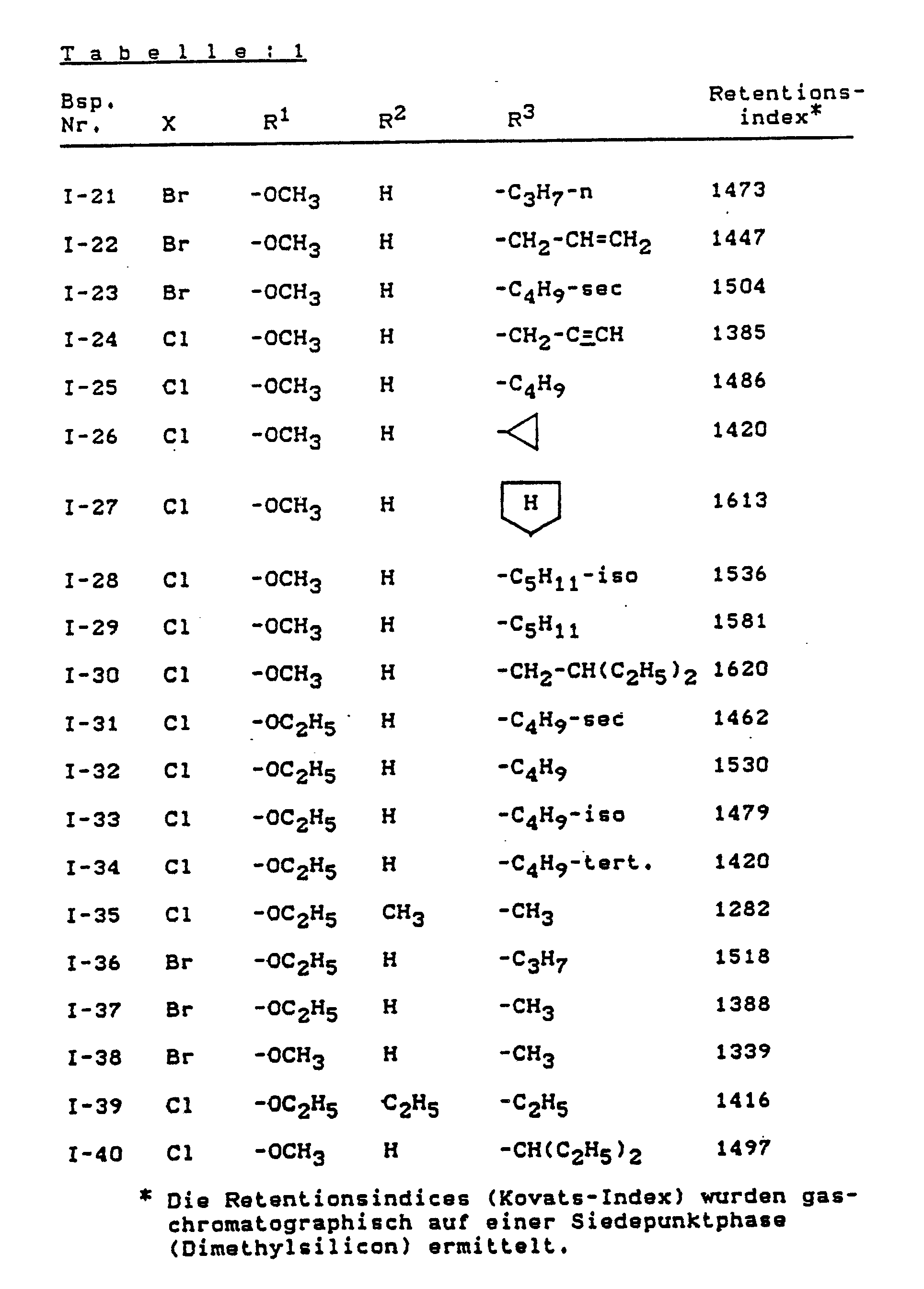
Man erhält 16,6 g (68 % der Theorie) O-Ethyl-O-(2-brom-1,1-difluor-ethyl)-thionophosphorsäurediesterisopropylamid mit dem Retentionsindex 1451*. - In analoger Weise zu Beispiel (I-1) und unter Berücksichtigung der Angaben in der Beschreibung zu dem erfindungsgemäßen Verfahren, werden die in der folgenden Tabelle 1 aufgeführten Endprodukte der Formel


-

- Eine Lösung von 88,2 g (0,3 Mol) O-(2-Brom-1,1-difluor-ethyl)-thionophosphoräureesterdichlorid in 200 ml Ether versetzt man unter Kühlung mit 100 ml (1,7 Mol) Ethanol, rührt das Gemisch 16 Stunden bei Raumtemperatur, engt ein, nimmt in Ligroin auf, wäscht 2 mal mit Wasser, trocknet die organische Phase über Magnesiumsulfat und zieht das Lösungsmittel unter vermindertem Druck ab.
Man erhält in 76 %iger Ausbeute das O-Ethyl-O-(2-brom-1,1-difluor-ethyl)-thionophosphorsäurediesterchlorid mit dem Retentionsindex 1242*. - Nach der im Beispiel (II-1) angegebenen Methode werden auch die in der folgenden Tabelle 2 aufgeführten Verbindungen der Formel

Tabelle : 2 Bsp. Nr. X X¹⁻¹ R¹ Retentionsindex* II-2 Cl Cl -OCH₃ 1104 II-3 Cl Cl -OC₂H₅ 1161 II-4 Cl Cl -OCH₂CH₂Cl 1362 II-5 Br Cl -OCH₃ 1180 * Die Retentionsindices (Kovats-Index) wurden gaschromatographisch auf einer Siedepunktphase (Dimethylsilicon) ermittelt. -
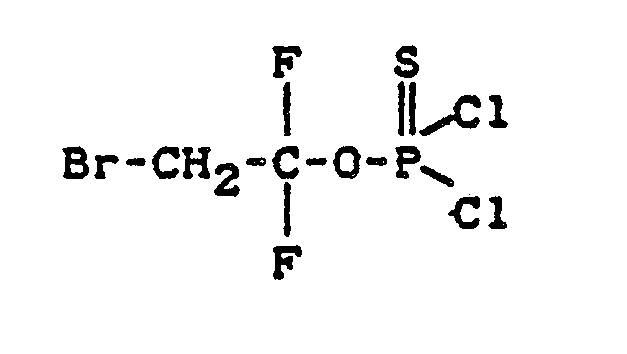
- 1667 g (6,0 Mol) O-(2-Brom-1,1-difluor-ethyl)-phosphorsäureesterdichlorid, 3257 g (19,2 Mol) Thiophosphorylchlorid und 32,7 g (0,147 Mol) Phosphor(V)sulfid, werden 5 Tage auf 140°C erhitzt und anschließend destilliert. Man erhält 1132 g (64,2 % der Theorie) O-(2-Brom-1,1-difluor-ethyl)-thionophosphorsäureesterdichlorid vom Siedepunkt 46°C / 0,3 mbar, mit dem Retentionsindex 1119*.
- Nach der im Beispiel (IV-1) angegebenen Methode wird auch die in der folgenden Tabelle 3 aufgeführte Verbindung der Formel

Tabelle : 3 Bsp. Nr. X X1-1 Retentionsindex* IV-2 Cl Cl 1037 * Die Retentionsindices (Kovats-Index) wurden gaschromatographisch auf einer Siedepunktphase (Dimethylsilicon) ermittelt. - In den nachfolgenden Verwendungsbeispielen wurde die nachstehend angegebene Verbindung als Vergleichsverbindung eingesetzt:
- Testinsekt: Phorbia antiqua-Maden (im Boden)
Lösungsmittel : 3 Gewichtsteile Aceton
Emulgator: 1 Gewichtsteil Alkylarylpolyglykolether - Zur Herstellung einer zweckmäßigen Wirkstoffzubereitung vermischt man 1 Gewichtsteil Wirkstoff mit der angegebenen Menge Lösungsmittel, gibt die angegebene Menge Emulgator zu und verdünnt das Konzentrat mit Wasser auf die gewünschte Konzentration.
- Die Wirkstoffzubereitung wird innig mit dem Boden vermischt. Dabei spielt die Konzentration des Wirkstoffes in der Zubereitung praktisch keine Rolle, entscheidend ist allein die Wirkstoffgewichtsmenge pro Volumeneinheit Boden, welche in ppm (= mg/l) angegeben wird. Man füllt den Boden in Töpfe und läßt diese bei Raumtemperatur stehen.
- Nach 24 Stunden werden die Testtiere in den behandelten Boden gegeben und nach weiteren 2 bis 7 Tagen wird der Wirkungsgrad des Wirkstoffs durch Auszählen der toten und lebenden Testinsekten in % bestimmt. Der Wirkungsgrad ist 100 %, wenn alle Testinsekten abgetötet worden sind, er ist 0 %, wenn noch genau so viele Testinsekten leben wie bei der unbehandelten Kontrolle.
- Bei diesem Test zeigten z.B. die Verbindungen der Herstellungsbeispiele I-2, I-3, I-4, I-6 und I-7 bei einer beispielhaften Konzentration von 20 ppm einen Wirkungsgrad von 100 %, während die Vergleichsverbindung bei der gleichen Konzentration nur 0 % ergab.
- Testinsekt: Myzus persicae
Lösungsmittel: 3 Gewichtsteile Aceton
Emulgator : 1 Gewichtsteil Alkylarylpolyglykolether - Zur Herstellung einer zweckmäßigen Wirkstoffzubereitung vermischt man 1 Gewichtsteil Wirkstoff mit der angegebenen Menge Lösungsmittel, gibt die angegebene Menge Emulgator zu und verdünnt das Konzentrat mit Wasser auf die gewünschte Konzentration.
- Die Wirkstoffzubereitung wird innig mit Boden vermischt. Dabei spielt die Konzentration des Wirkstoffs in der Zubereitung praktisch keine Rolle, entscheidend ist allein die Wirkstoffgewichtsmenge pro Volumeneinheit Boden, welche in ppm (= mg/l) angegeben wird. Man füllt den behandelten Boden in Töpfe und bepflanzt diese mit Kohl (Brassica oleracea). Der Wirkstoff kann so von den Pflanzenwurzeln aus dem Boden aufgenommen und in die Blätter transportiert werden.
- Für den Nachweis des wurzelsystemischen Effektes werden nach 7 Tagen ausschließlich die Blätter mit den obengenannten Testtieren besetzt. Nach weiteren 2 Tagen erfolgt die Auswertung durch Zählen oder Schätzen der toten Tiere. Aus den Abtötungszahlen wird die wurzelsystemische Wirkung des Wirkstoffs abgeleitet. Sie ist 100 %, wenn alle Testtiere abgetötet sind und 0 %, wenn noch genau so viele Testinsekten leben wie bei der unbehandelten Kontrolle.
- Bei diesem Test zeigte z.B. die Verbindung des Herstellungsbeispiele I-2 bei einer beispielhaften Konzentration von 10 ppm eine Wirkung von 95 % während die Vergleichsverbindung bei der gleichen Konzentration 0 % Wirkung ergab.
- Testnematode: Meloidogyne incognita
Lösungsmittel: 3 Gewichtsteile Aceton
Emulgator : 1 Gewichtsteil Alkylarylpolyglykolether - Zur Herstellung einer zweckmäßigen Wirkstoffzubereitung vermischt man 1 Gewichtsteil Wirkstoff mit der angegebenen Menge Lösungsmittel, gibt die angegebene Menge Emulgator zu und verdünnt das Konzentrat mit Wasser auf die gewünschte Konzentration.
- Die Wirkstoffzubereitung wird innig mit Boden vermischt, der mit den Testnematoden stark verseucht ist. Dabei spielt die Konzentration des Wirkstoffs in der Zubereitung praktisch keine Rolle, entscheidend ist allein die Wirkstoffmenge pro Volumeneinheit Boden, welche in ppm angegeben wird. Man füllt den behandelten Boden in Töpfe, sät Salat ein und hält die Töpfe bei einer Gewächshaus-Temperatur von 27 °C.
- Nach vier Wochen werden die Salatwurzeln auf Nematodenbefall (Wurzelgallen) untersucht und der Wirkungsgrad des Wirkstoffs in % bestimmt. Der Wirkungsgrad ist 100 %, wenn der Befall vollständig vermieden wird, er ist 0 %, wenn der Befall genau so hoch ist wie bei den Kontrollpflanzen in unbehandeltem, aber in gleicher Weise verseuchtem Boden.
- Bei diesem Test zeigte z.B. die Verbindung des Herstellungsbeispieles I-2 bei einer beispielhaften Konzentration von 2,5 ppm eine Wirkung von 100 %, während die Vergleichsverbindung bei der gleichen Konzentration 0 % Wirkung ergab.
- Testtiere: Musca domestica
Zahl der Testtiere: 25
Lösungsmittel: Aceton - 2 Gewichtsteile Wirkstoff werden in 1000 Volumenteilen Lösungsmittel aufgenommen. Die so erhaltene Lösung wird mit weiterem Lösungsmittel auf die gewünschten geringeren Konzentrationen verdünnt.
- 2,5 ml Wirkstofflösung werden in eine Petrischale pipettiert. Auf dem Boden der Petrischale befindet sich ein Filterpapier mit einem Durchmesser von etwa 9,5 cm. Die Petrischale bleibt so lange offen stehen, bis das Lösungsmittel vollständig verdunstet ist. Je nach Konzentration der Wirkstofflösung ist die Menge Wirkstoff pro m² Filterpapier verschieden hoch. Anschließend gibt man die angegebene Anzahl der Testtiere in die Petrischale und bedeckt sie mit einem Glasdeckel.
- Der Zustand der Testtiere wird laufend kontrolliert. Es wird diejenige Zeit ermittelt, welche für einen 100 %igen knock down-Effekt notwendig ist.
- Bei diesem Test zeigten z.B. die Verbindungen der Herstellungsbeispiele I-2 und I-7 bei einer beispielhaften Konzentration von 0,002 % einen LT₁₀₀-Wert von 90′ und die Verbindungen der Herstellungsbeispiele I-3 und I-5 bei einer beispielhaften Konzentration von 0,002 % einen LT₁₀₀-Wert von 55′ bzw. 75′, während die Vergleichsverbindung bei der gleichen Konzentration einen LT₁₀₀-Wert von 240′ ergab.
- Testtiere: Blattella germanica
Zahl der Testtiere: 5
Lösungsmittel: Aceton - 2 Gewichtsteile Wirkstoff werden in 1000 Volumenteilen Lösungsmittel aufgenommen. Die so erhaltene Lösung wird mit weiterem Lösungsmittel auf die gewünschten Konzentrationen verdünnt.
- 2,5 ml Wirkstofflösung werden in eine Petrischale pipettiert. Auf dem Boden der Petrischale befindet sich ein Filterpapier mit einem Durchmesser von etwa 9,5 cm. Die Petrischale bleibt so lange offen stehen, bis das Lösungsmittel vollständig verdunstet ist. Je nach Konzentration der Wirkstofflösung ist die Menge Wirkstoff pro m² Filterpapier verschieden hoch. Anschließend gibt man die angegebene Anzahl der Testtiere in die Petrischale und bedeckt sie mit einem Glasdeckel.
- Der Zustand der Testtiere wird 3 Tage nach Ansetzen der Versuche kontrolliert. Bestimmt wird die Abtötung in %. Dabei bedeutet 100 %, daß alle Testtiere abgetötet wurden; 0 % bedeutet, daß keine Testtiere abgetötet wurden.
- Bei diesem Test zeigten z.B. die Verbindungen der Herstellungsbeispiele I-2 und I-3 bei einer beispielhaften Konzentration von 0,002 % eine Abtötung von 100 %, während die Vergleichsverbindung bei der gleichen Konzentration 0 % Abtötung ergab.
- Testtiere: Sitophilus granarius
Zahl der Testtiere: 10
Lösungsmittel: Aceton - 2 Gewichtsteile Wirkstoff werden in 1000 Volumenteilen Lösungsmittel aufgenommen. Die so erhaltene Lösung wird mit weiterem Lösungsmittel auf die gewünschten Konzentrationen verdünnt.
- 2,5 ml Wirkstofflösung werden in eine Petrischale pipettiert. Auf dem Boden der Petrischale befindet sich ein Filterpapier mit einem Durchmesser von etwa 9,5 cm. Die Petrischale bleibt so lange offen stehen, bis das Lösungsmittel vollständig verdunstet ist. Je nach Konzentration der Wirkstofflösung ist die Menge Wirkstoff pro m² Filterpapier verschieden hoch. Anschließend gibt man die angegebene Anzahl der Testtiere in die Petrischale und bedeckt sie mit einem Glasdeckel.
- Der Zustand der Testtiere wird 3 Tage nach Ansetzen der Versuche kontrolliert. Bestimmt wird die Abtötung in %. Dabei bedeutet 100 %, daß alle Testtiere abgetötet wurden; 0 % bedeutet, daß keine Testtiere abgetötet wurden.
- Bei diesem Test zeigten z.B. die Verbindungen der Herstellungsbeispiele I-2, I-3, I-5, I-6 und I-7 bei einer beispielhaften Konzentration von 0,002 % eine Abtötung von 100 %, während die Vergleichsverbindung bei der gleichen Konzentration eine Abtötung von 30 % ergab.
- Testtiere: Aedes aegypti
Zahl der Testtiere: 20
Lösungsmittel: Aceton - 2 Gewichtsteile Wirkstoff werden in 1000 Volumenteilen Lösungsmittel aufgenommen. Die so erhaltene Lösung wird mit weiterem Lösungsmittel auf die gewünschten geringeren Konzentrationen verdünnt.
- 2,5 ml Wirkstofflösung werden in eine Petrischale pipettiert. Auf dem Boden der Petrischale befindet sich ein Filterpapier mit einem Durchmesser von etwa 9,5 cm. Die Petrischale bleibt so lange offen stehen, bis das Lösungsmittel vollständig verdunstet ist. Je nach Konzentration der Wirkstofflösung ist die Menge Wirkstoff pro m² Filterpapier verschieden hoch. Anschließend gibt man die angegebene Anzahl der Testtiere in die Petrischale und bedeckt sie mit einem Glasdeckel.
- Der Zustand der Testtiere wird laufend kontrolliert. Es wird diejenige Zeit ermittelt, welche für einen 100 %igen knock down-Effekt notwendig ist.
- Bei diesem Test zeigten z.B. die folgenden Verbindungen der Herstellungsbeispiele I-2 und I-3 bei einer beispielhaften Konzentration von 0,002 eine LT₁₀₀ von 120′, während die Vergleichsverbindung bei der gleichen Konzentration eine LT₁₀₀ von 3h (50 %) ergab.
- Testtiere: Aedes aegypti-Larven
Lösungsmittel: 99 Gewichsteile Aceton
Emulgator: 1 Gewichtsteil Benzylhydroxydiphenylpolyglykolether - Zur Herstellung einer zweckmäßigen Wirkstoffzubereitung löst man 2 Gew-Teile Wirkstoff in 1000 Volumenteilen Lösungsmittel, das Emulgator in der oben angegebenen Menge enthält. Die so erhaltene Lösung wird mit Wasser auf die gewünschten geringeren Konzentrationen verdünnt.
- Man füllt die wäßrigen Wirkstoffzubereitungen in Gläser und setzt anschließend etwa 25 Mückenlarven in jedes Glas ein.
- Nach 24 Stunden wird die Abtötung in % bestimmt. Dabei bedeutet 100 %, daß alle Larven abgetötet worden sind. 0 % bedeutet, daß überhaupt keine Larven abgetötet worden sind.
- Bei diesem Test zeigten z.B. die Verbindungen der Herstellungsbeispiele I-2, I-3, I-5, I-6 und I-7 bei einer beispielhaften Konzentration von 0,1 % eine Abtötung von 100 %, während die Vergleichsverbindung bei der gleichen Konzentration 0 % Abtötung ergab.
Claims (13)

R¹ für gegebenenfalls substituierte Reste aus der Reihe Alkoxy, ALkenyloxy und Alkinyloxy steht,
R² und R³ gleich oder verschieden sind und unabhängig voneinander für Wasserstoff und für gegebenenfalls substituierte Reste aus der Reihe Alkyl, Cycloalkyl, Alkenyl oder Alkinyl stehen
oder
gemeinsam mit dem Stickstoffatom, an welches sie gebunden sind, einen 5- bis 7-gliedrigen, gesättigten oder ungesättigten Ring bilden und
X für Halogen steht.
in welchen
R¹ für gegebenenfalls durch Halogen und/oder C₁-C₄-Alkoxy substituiertes C₁-C₄-Alkoxy, C₂-C₆-Alkenyloxy und C₂-C₆-Alkinyloxy steht,
R² und R³ gleich oder verschieden sind und unabhängig voneinander für Wasserstoff, für gegebenenfalls durch Halogen und/oder C₁-C₄-Alkoxy substituiertes C₁-C₄-Alkyl; für gegebenenfalls durch Methyl, Ethyl, Fluor und/oder Chlor substituiertes Cycloalkyl mit 3 bis 8 Kohlenstoffatomen; für gegebenenfalls durch Halogen, und/oder C₁-C₄-Alkyl substituiertes C₂-C₆-Alkenyl und C₂-C₆-Alkinyl stehen,
oder
gemeinsam mit dem Stickstoffatom einen 5- bis 6-gliedrigen, gesättigten oder ungesättigten Ring bilden und
X für Fluor, Chlor oder Brom steht.
in welchen
R¹ für gegebenenfalls durch Fluor, Chlor, Methoxy und/oder Ethoxy substituiertes C₁-C₄-Alkoxy, C₂-C₃-Alkenyloxy und C₂-C₄-Alkinyloxy steht,
R² und R³ gleich oder verschieden sind und unabhängig voneinander für Wasserstoff, für gegebenenfalls durch Fluor, Chlor, Brom, Methoxy und/oder Ethoxy substituiertes C₁-C₄-Alkyl, für gegebenenfalls durch Methyl, Ethyl, Fluor und/oder Chlor substituiertes Cycloalkyl mit 3 bis 6 Kohlenstoffatomen; für gegebenenfalls durch Fluor, Chlor, Methyl und/oder Ethyl substituiertes C₂-C₄-Alkenyl und C₂-C₄-Alkinyl stehen,
oder
gemeinsam mit dem Stickstoffatom, an welches sie gebunden sind, für Piperidyl und Pyrrolidinyl stehen und
X für Fluor, Chlor und Brom steht.


R¹ für gegebenenfalls substituierte Reste aus der Reihe Alkoxy, Alkenyloxy und Alkinyloxy steht,
R² und R³ gleich oder verschieden sind und unabhängig voneinander für Wasserstoff und für gegebenenfalls substituierte Reste aus der Reihe Alkyl, Cycloalkyl, Alkenyl oder Alkinyl stehen
oder
gemeinsam mit dem Stickstoffatom, an welches sie gebunden sind, einen 5- bis 7- gliedrigen, gesättigten oder ungesättigten Ring bilden und
X für Halogen steht,
dadurch gekennzeichnet, daß man O-(1,1-Difluor-2-halogen-ethyl)-thionophosphorsäureesterhalogenide der Formel

X und R¹ die oben angegebene Bedeutung haben und
X¹⁻¹ für Halogen steht,
mit Aminen der Formel

R² und R³ die oben angegebene Bedeutung haben,
gegebenenfalls in Gegenwart eines Verdünnungsmittels und gegebenenfalls in Gegenwart eines Säureakzeptors umsetzt.

X und R¹ die Anspruch 1 angegebene Bedeutung haben und
X¹⁻¹ für Halogen steht.
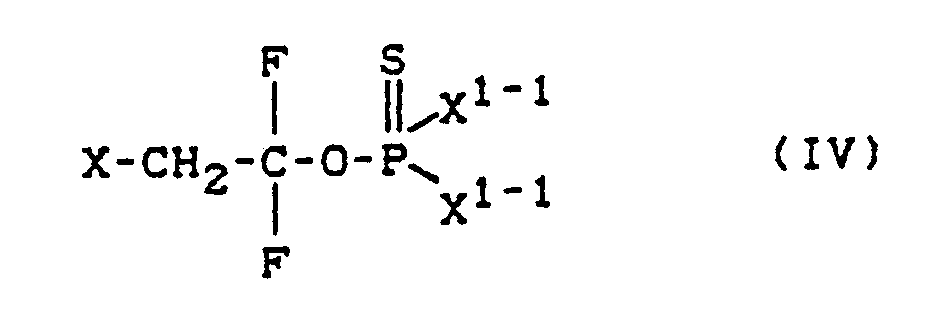
X und X¹⁻¹ die in Anspruch 10 angegebene Bedeutung haben,
mit Alkoholen der Formel
R¹-M (V)
in welcher
R¹ die oben angegebene Bedeutung hat und
M für Wasserstoff oder ein Alkalimetall- oder Erdalkalimetalläquivalent steht,
gegebenenfalls in Gegenwart eines Säureakzeptors und gegebenenfalls in Gegenwart eines Lösungsmittels bei Raumtemperatur umsetzt.

X und X¹⁻¹ für Halogen stehen.
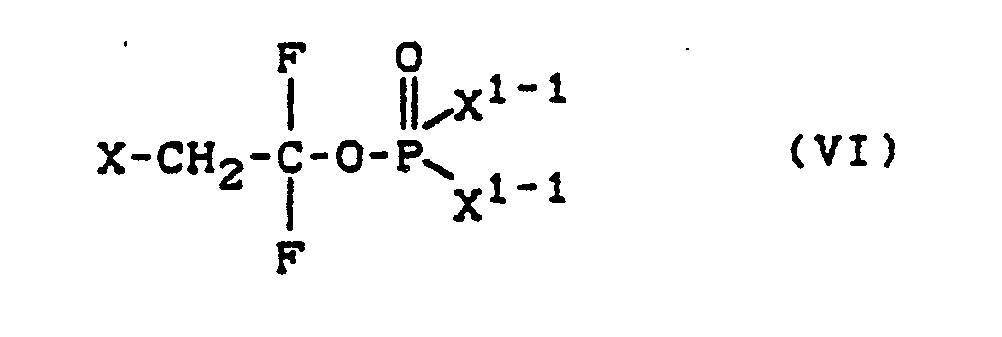
X und X¹⁻¹ die oben angegebene Bedeutung haben,
mit Thiophosphorylchlorid der Formel
PSCl₃ (VII)
gegebenenfalls in Gegenwart eines Verdünnungsmittels und gegebenenfalls in Gegenwart eines Phosphorsulfids, oder 2,4-bis-(4-Methoxyphenyl)-1,3,2,4-dithiaphosphetan-2,4-disulfid (Lawesson's Reagenz) umsetzt.
Applications Claiming Priority (2)
| Application Number | Priority Date | Filing Date | Title |
|---|---|---|---|
| DE3811006A DE3811006A1 (de) | 1988-03-31 | 1988-03-31 | Thionophosphorsaeureamidester |
| DE3811006 | 1988-03-31 |
Publications (2)
| Publication Number | Publication Date |
|---|---|
| EP0335212A2 true EP0335212A2 (de) | 1989-10-04 |
| EP0335212A3 EP0335212A3 (de) | 1990-05-30 |
Family
ID=6351166
Family Applications (1)
| Application Number | Title | Priority Date | Filing Date |
|---|---|---|---|
| EP89104903A Withdrawn EP0335212A3 (de) | 1988-03-31 | 1989-03-18 | Thionophosphorsäureamidester |
Country Status (7)
| Country | Link |
|---|---|
| US (1) | US4983594A (de) |
| EP (1) | EP0335212A3 (de) |
| JP (1) | JPH026495A (de) |
| AU (1) | AU603947B2 (de) |
| BR (1) | BR8901484A (de) |
| DE (1) | DE3811006A1 (de) |
| ZA (1) | ZA892347B (de) |
Families Citing this family (2)
| Publication number | Priority date | Publication date | Assignee | Title |
|---|---|---|---|---|
| DE4110486A1 (de) * | 1991-03-30 | 1992-10-01 | Bayer Ag | O-halogencyclopentyl-s-alkyl-(di)-thiophosphor (phosphon)-saeureester-derivate, verfahren zu ihrer herstellung und ihre verwendung als schaedlingsbekaempfungsmittel |
| DE4110485A1 (de) * | 1991-03-30 | 1992-10-01 | Bayer Ag | O-halogencyclobutyl-s-alkyl-(di)thiophosphorsaeureesteramide, verfahren zu ihrer herstellung und ihre verwendung als schaedlingsbekaempfungsmittel |
Family Cites Families (3)
| Publication number | Priority date | Publication date | Assignee | Title |
|---|---|---|---|---|
| DE2528996C2 (de) * | 1975-06-28 | 1982-12-30 | Bayer Ag, 5090 Leverkusen | 1-Fluor-2-halogen-äthyl-phosphor (phosphon)säureester, Verfahren zu ihrer Herstellung und ihre Verwendung als Insektizide, Akarizide und Nematizide |
| US4159324A (en) * | 1976-06-29 | 1979-06-26 | Bayer Aktiengesellschaft | Combating insects, acarids and nematodes with O-(1-fluoro-2-halo-ethyl)(thiono)phosphoric(phosphonic) acid ester-amides |
| DE2738508A1 (de) * | 1977-08-26 | 1979-03-01 | Bayer Ag | N-acetyl-0-(1-fluor-2-chloraethyl)- thionophosphor-(phosphon)-saeureesteramide, verfahren zu ihrer herstellung und ihre verwendung als insektizide, akarizide und nematizide |
-
1988
- 1988-03-31 DE DE3811006A patent/DE3811006A1/de not_active Withdrawn
-
1989
- 1989-03-18 EP EP89104903A patent/EP0335212A3/de not_active Withdrawn
- 1989-03-23 US US07/327,490 patent/US4983594A/en not_active Expired - Fee Related
- 1989-03-28 JP JP1074117A patent/JPH026495A/ja active Pending
- 1989-03-30 ZA ZA892347A patent/ZA892347B/xx unknown
- 1989-03-30 BR BR898901484A patent/BR8901484A/pt unknown
- 1989-03-31 AU AU32332/89A patent/AU603947B2/en not_active Expired - Fee Related
Also Published As
| Publication number | Publication date |
|---|---|
| AU603947B2 (en) | 1990-11-29 |
| BR8901484A (pt) | 1989-11-14 |
| JPH026495A (ja) | 1990-01-10 |
| DE3811006A1 (de) | 1989-10-19 |
| ZA892347B (en) | 1989-12-27 |
| AU3233289A (en) | 1989-10-05 |
| US4983594A (en) | 1991-01-08 |
| EP0335212A3 (de) | 1990-05-30 |
Similar Documents
| Publication | Publication Date | Title |
|---|---|---|
| EP0213393B1 (de) | Phosphonsäureester | |
| DE3110596A1 (de) | Phosphor(phosphon)-saeureesteramide, ihre herstellung und verwendung | |
| EP0305837B1 (de) | Thionophosphonsäureester | |
| EP0215235B1 (de) | Phosphorsäureester | |
| EP0073912B1 (de) | Oxo-chinazolin-(thiono)-phosphor(phosphon)-säureester bzw.esteramide, Verfahren zu ihrer Herstellung und ihre Verwendung als Schädlingsbekämpfungsmittel | |
| DE3520386A1 (de) | 1,3,2-oxathiaphospholan-2-sulfide enthaltende schaedlingsbekaempfungsmittel | |
| EP0167894A2 (de) | Phosphorsäureester | |
| EP0208111B1 (de) | Phosphor-enthaltende Heterocyclen | |
| EP0336187A2 (de) | Thionophosphonsäure(amid)ester | |
| EP0337159A1 (de) | Thionophosphor(phosphon)säureamidester | |
| DE3445465A1 (de) | Pyrimidinyl-thionophosphorsaeureester | |
| DE3110595A1 (de) | Phosphor (phosphon)-saeureesteramide, ihre herstellung und verwendung | |
| DE3811006A1 (de) | Thionophosphorsaeureamidester | |
| CH620690A5 (de) | ||
| EP0132676A2 (de) | Phosphor(phosphon)säureester | |
| EP0658562A1 (de) | Phosphorsäure-Derivate als Schäblingsbekämpfungsmittel | |
| EP0402709A2 (de) | (Di)(thio)phosphor(phosphon)säure(amid)ester | |
| EP0391131A2 (de) | Thiophosphorsäure-fluoralkylester | |
| EP0305840A2 (de) | Pyrimidinyl(thiono)(thiol)-phosphorsäureester | |
| EP0535461A1 (de) | Phosphorylierte Diazacycloalkane | |
| EP0353574A1 (de) | S-(Halogenalkyl)-dithiophosphor-(phosphon) säureester, Verfahren zu ihrer Herstellung und ihre Verwendung als Schädlingsbekämpfungsmittel | |
| EP0070443A1 (de) | Thionophosphonsäureester, Verfahren zu ihrer Herstellung und ihre Verwendung als Schädlingsbekämpfungsmittel | |
| EP0325940A2 (de) | (Thio)Phosphorsäure-hexafluorbutylester | |
| EP0353573A1 (de) | Dithiophosphor (phosphon) säureester, Verfahren zu ihrer Herstellung und ihre Verwendung als Schädlingsbekämpfungsmittel | |
| EP0417558A2 (de) | S-Halogenalkyl(di) (tri) (thio)phospor(phosphon)-säure(amid)-ester |
Legal Events
| Date | Code | Title | Description |
|---|---|---|---|
| PUAI | Public reference made under article 153(3) epc to a published international application that has entered the european phase |
Free format text: ORIGINAL CODE: 0009012 |
|
| 17P | Request for examination filed |
Effective date: 19890318 |
|
| AK | Designated contracting states |
Kind code of ref document: A2 Designated state(s): BE CH DE ES FR GB IT LI NL |
|
| PUAL | Search report despatched |
Free format text: ORIGINAL CODE: 0009013 |
|
| AK | Designated contracting states |
Kind code of ref document: A3 Designated state(s): BE CH DE ES FR GB IT LI NL |
|
| STAA | Information on the status of an ep patent application or granted ep patent |
Free format text: STATUS: THE APPLICATION HAS BEEN WITHDRAWN |
|
| 18W | Application withdrawn |
Withdrawal date: 19910111 |
|
| R18W | Application withdrawn (corrected) |
Effective date: 19910111 |