EP0334484B1 - Antiparasitäre Makrolid-Antibiotika - Google Patents
Antiparasitäre Makrolid-Antibiotika Download PDFInfo
- Publication number
- EP0334484B1 EP0334484B1 EP89301564A EP89301564A EP0334484B1 EP 0334484 B1 EP0334484 B1 EP 0334484B1 EP 89301564 A EP89301564 A EP 89301564A EP 89301564 A EP89301564 A EP 89301564A EP 0334484 B1 EP0334484 B1 EP 0334484B1
- Authority
- EP
- European Patent Office
- Prior art keywords
- ococh
- compound
- formula
- antibiotic
- grey
- Prior art date
- Legal status (The legal status is an assumption and is not a legal conclusion. Google has not performed a legal analysis and makes no representation as to the accuracy of the status listed.)
- Expired - Lifetime
Links
Classifications
-
- C—CHEMISTRY; METALLURGY
- C07—ORGANIC CHEMISTRY
- C07H—SUGARS; DERIVATIVES THEREOF; NUCLEOSIDES; NUCLEOTIDES; NUCLEIC ACIDS
- C07H19/00—Compounds containing a hetero ring sharing one ring hetero atom with a saccharide radical; Nucleosides; Mononucleotides; Anhydro-derivatives thereof
- C07H19/01—Compounds containing a hetero ring sharing one ring hetero atom with a saccharide radical; Nucleosides; Mononucleotides; Anhydro-derivatives thereof sharing oxygen
-
- A—HUMAN NECESSITIES
- A01—AGRICULTURE; FORESTRY; ANIMAL HUSBANDRY; HUNTING; TRAPPING; FISHING
- A01N—PRESERVATION OF BODIES OF HUMANS OR ANIMALS OR PLANTS OR PARTS THEREOF; BIOCIDES, e.g. AS DISINFECTANTS, AS PESTICIDES OR AS HERBICIDES; PEST REPELLANTS OR ATTRACTANTS; PLANT GROWTH REGULATORS
- A01N43/00—Biocides, pest repellants or attractants, or plant growth regulators containing heterocyclic compounds
- A01N43/90—Biocides, pest repellants or attractants, or plant growth regulators containing heterocyclic compounds having two or more relevant hetero rings, condensed among themselves or with a common carbocyclic ring system
-
- A—HUMAN NECESSITIES
- A61—MEDICAL OR VETERINARY SCIENCE; HYGIENE
- A61P—SPECIFIC THERAPEUTIC ACTIVITY OF CHEMICAL COMPOUNDS OR MEDICINAL PREPARATIONS
- A61P33/00—Antiparasitic agents
-
- A—HUMAN NECESSITIES
- A61—MEDICAL OR VETERINARY SCIENCE; HYGIENE
- A61P—SPECIFIC THERAPEUTIC ACTIVITY OF CHEMICAL COMPOUNDS OR MEDICINAL PREPARATIONS
- A61P33/00—Antiparasitic agents
- A61P33/10—Anthelmintics
-
- C—CHEMISTRY; METALLURGY
- C12—BIOCHEMISTRY; BEER; SPIRITS; WINE; VINEGAR; MICROBIOLOGY; ENZYMOLOGY; MUTATION OR GENETIC ENGINEERING
- C12N—MICROORGANISMS OR ENZYMES; COMPOSITIONS THEREOF; PROPAGATING, PRESERVING, OR MAINTAINING MICROORGANISMS; MUTATION OR GENETIC ENGINEERING; CULTURE MEDIA
- C12N1/00—Microorganisms; Compositions thereof; Processes of propagating, maintaining or preserving microorganisms or compositions thereof; Processes of preparing or isolating a composition containing a microorganism; Culture media therefor
- C12N1/20—Bacteria; Culture media therefor
- C12N1/205—Bacterial isolates
-
- C—CHEMISTRY; METALLURGY
- C12—BIOCHEMISTRY; BEER; SPIRITS; WINE; VINEGAR; MICROBIOLOGY; ENZYMOLOGY; MUTATION OR GENETIC ENGINEERING
- C12P—FERMENTATION OR ENZYME-USING PROCESSES TO SYNTHESISE A DESIRED CHEMICAL COMPOUND OR COMPOSITION OR TO SEPARATE OPTICAL ISOMERS FROM A RACEMIC MIXTURE
- C12P17/00—Preparation of heterocyclic carbon compounds with only O, N, S, Se or Te as ring hetero atoms
- C12P17/18—Preparation of heterocyclic carbon compounds with only O, N, S, Se or Te as ring hetero atoms containing at least two hetero rings condensed among themselves or condensed with a common carbocyclic ring system, e.g. rifamycin
- C12P17/181—Heterocyclic compounds containing oxygen atoms as the only ring heteroatoms in the condensed system, e.g. Salinomycin, Septamycin
-
- C—CHEMISTRY; METALLURGY
- C12—BIOCHEMISTRY; BEER; SPIRITS; WINE; VINEGAR; MICROBIOLOGY; ENZYMOLOGY; MUTATION OR GENETIC ENGINEERING
- C12P—FERMENTATION OR ENZYME-USING PROCESSES TO SYNTHESISE A DESIRED CHEMICAL COMPOUND OR COMPOSITION OR TO SEPARATE OPTICAL ISOMERS FROM A RACEMIC MIXTURE
- C12P19/00—Preparation of compounds containing saccharide radicals
- C12P19/44—Preparation of O-glycosides, e.g. glucosides
- C12P19/445—The saccharide radical is condensed with a heterocyclic radical, e.g. everninomycin, papulacandin
-
- C—CHEMISTRY; METALLURGY
- C12—BIOCHEMISTRY; BEER; SPIRITS; WINE; VINEGAR; MICROBIOLOGY; ENZYMOLOGY; MUTATION OR GENETIC ENGINEERING
- C12R—INDEXING SCHEME ASSOCIATED WITH SUBCLASSES C12C - C12Q, RELATING TO MICROORGANISMS
- C12R2001/00—Microorganisms ; Processes using microorganisms
- C12R2001/01—Bacteria or Actinomycetales ; using bacteria or Actinomycetales
- C12R2001/465—Streptomyces
- C12R2001/55—Streptomyces hygroscopicus
-
- Y—GENERAL TAGGING OF NEW TECHNOLOGICAL DEVELOPMENTS; GENERAL TAGGING OF CROSS-SECTIONAL TECHNOLOGIES SPANNING OVER SEVERAL SECTIONS OF THE IPC; TECHNICAL SUBJECTS COVERED BY FORMER USPC CROSS-REFERENCE ART COLLECTIONS [XRACs] AND DIGESTS
- Y10—TECHNICAL SUBJECTS COVERED BY FORMER USPC
- Y10S—TECHNICAL SUBJECTS COVERED BY FORMER USPC CROSS-REFERENCE ART COLLECTIONS [XRACs] AND DIGESTS
- Y10S435/00—Chemistry: molecular biology and microbiology
- Y10S435/8215—Microorganisms
- Y10S435/822—Microorganisms using bacteria or actinomycetales
- Y10S435/886—Streptomyces
- Y10S435/898—Streptomyces hygroscopicus
Definitions
- This invention relates to new antiparasitic agents and in particular to a series of novel macrolide antibiotics related to the milbemycins and avermectins, and to processes for their preparation and compositions thereof.
- the avermectins and milbemycins form an important group of broad spectrum antiparasitic agents possessing anthelmintic, ectoparasiticidal, insecticidal, antibacterial, antifungal and growth promoting activity with application in the areas of animal and human health, agriculture and horticulture.
- the avermectins previously known as the C-076 compounds are produced by fermentation of a strain of the microorganism Streptomyces avermitilis ATCC 31267, 31271 or 31272 under aerobic conditions in an aqueous nutrient medium containing inorganic salts and assimilable sources of carbon and nitrogen.
- the production, isolation and chemical structure of the eight individual components which make up the C-076 complex is described in British patent specification 1573955.
- the milbemycins are structurally related macrolide antibiotics lacking the sugar residues at the 13-position. They are produced by fermentation, for example using Streptomyces hygroscopicus spp aureolacrimosus B-41-146 as described in British patent specification 1390336 or using Streptomyces cyaneogriseus spp noncyanogenus NRRL 15773 as described in EP-A-0170006 or using Streptomyces thermoarchaensis NCIB 12015 as described in British patent application GB 2166436.
- N787-182 novel macrolide antibiotics
- N787-182 novel macrolide antibiotics
- the compounds possess a broad spectrum of activity against insect pests, acari, free-living nematodes and endo- and ectoparasites afflicting animals and humans.
- R, R 1 , R 2 and R 3 are as follows:- Compound R R 1 R 2 R 3 N787-182 - 1 CH 3 OH OH H N787-182 - 2 H OH OH OCOCH(CH 3 ) 2 N787-182 - 3 CH 3 OH OH OCOCH(CH 3 ) 2 N787-182 - 4 H OCOCH(CH 3 ) 2 OH H N787-182 - 5 CH 3 OCOCH(CH 3 ) 2 OH H N787-182 - 6 H OCOCH(CH 3 ) 2 OH OCOCH(CH 3 ) 2 N787-182 - 7 CH 3 OCOCH(CH 3 ) 2 OH OCOCH(CH 3 ) 2 N787-182 - 8 H H OH OCOCH(CH 3 ) 2 N787-182 - 9 H OCOCH(CH 3 ) 2 H H N787-182 - 10 CH
- the carbon skeleton of the above structure bears a close resemblance to that of the avermectins and milbemycins.
- the various individual components defined above have never previously been obtained.
- certain of the N787-182 compounds are uniquely distinguished from the known natural milbemycins and avermectins in that they possess a beta-oxygen-linked substituent at C-13 (indicated by the solid wedge bond shown in formula I). This structural feature is important for the biological activities of these compounds.
- Other details of the stereochemistry have not been completely defined but the structure shown in formula (I) is proposed by analogy with known members of this class.
- the macrolide antibiotics N787-182 factors 1-12 are produced by the submerged aerobic fermentation in aqueous nutrient media of a microorganism isolated from a soil sample taken from Kurashiki City, Okayama Prefecture, Japan.
- the microoganism is assigned to the genus Streptomyces based on cell morphology and chemistry and is considered to be a new strain of Streptomyces hygroscopicus designated herein as Streptomyces sp ATCC 53718.
- N787-182 compounds may be obtained by interconversion using published chemical procedures. For example those compounds containing a methoxy substituent at the C-5 position may be converted to the corresponding C-5 hydroxy compounds. This reaction is performed by treating the 5-methoxy compound, or a suitably protected derivative thereof, with mercuric acetate and hydrolysing the resulting 3-acetoxy enol ether with dilute acid to give the 5-keto compound. This is then reduced using, for example, sodium borohydride to yield the 5-hydroxy derivative. Appropriate reagents and reaction conditions for these steps are described in US patent 4423209. Thus, for example, N787-182 factor 12 may be converted into N787-182 factor 9 using this procedure.
- N787-182 factor 9 may be converted to N787-182 factor 12.
- factor 5 may be reacted with p-tolylchlorothionoformate in the presence of a base such as pyridine, with or without addition of an inert solvent.
- a base such as pyridine
- the resulting C-22-thionocarbonate is then reacted with tri-n-butyltin hydride in an inert solvent in the presence of a suitable radical initiator such as azobisisobutyronitrile to give factor 12.
- Those compounds lacking a substituent at C-13 may be oxidized at this position using the corresponding 5-keto compound as an intermediate.
- This may be prepared from the 5-methoxy compound by mercuric acetate treatment as described above or by oxidation of a 5-hydroxy compound, or a suitably protected derivative thereof, by manganese dioxide as described for example in EP-A-0238258.
- the 5-keto compound is then treated with selenium dioxide in a carboxylic acid as solvent such as formic acid to give a product containing a 13-beta-acyloxy substituent.
- the 13-acyloxy group may be hydrolysed to a 13-hydroxy group by treatment with an acid or base, for example using hydrochloric acid or p-toluenesulphonic acid in a suitable organic solvent such as methanol or dioxane.
- the 13-acyloxy group may be hydrolysed by treatment with a Lewis acid, such as boron trifluoride in an alcohol solvent such as methanol to give the 13-hydroxy compound.
- a Lewis acid such as boron trifluoride in an alcohol solvent such as methanol
- the 13-hydroxy group may in turn be acylated with a different carboxyl group by treatment with an acyl halide or anhydride in the presence of a base such as pyridine.
- a base such as pyridine.
- Appropriate reagents and reaction conditions are described in EP-A-0184308.
- the 5-keto group is reduced to a 5-hydroxy group using sodium borohydride as described above.
- N787-182 factor 8 may be converted to N787-182 factor 6, by way of N787-182 factor 2 as an intermediate.
- acyl group at the 13-position may be removed from N787-182 factor 4, N787-182 factor 9 or N-787-182 factor 12 to give the corresponding novel 13-hydroxy compounds.
- the ester cleavage may be achieved by several means including acid or base catalysed hydrolysis or by treatment with a reducing agent such as lithium aluminium hydride in an inert solvent such as diethyl ether or tetrahydrofuran at a temperature between -80°C and 30°C, preferably -23°C.
- a reducing agent such as lithium aluminium hydride in an inert solvent such as diethyl ether or tetrahydrofuran at a temperature between -80°C and 30°C, preferably -23°C.
- the present invention also provides a compound having the formula (I) above wherein the substituents are:- Compound R R 1 R 2 R 3 Compound 13 H OH OH H
- Preferred compounds on the basis of their antiparasitic activity are N787-182 factors 4, 6, 8 and 9.
- the microorganism was characterised by planting from a slant onto ATCC no. 172 broth and incubating for four days at 28°C on a shaker. It was then centrifuged for 20 minutes, washed three times with sterile distilled water and planted on media commonly used for identification of members of the Actinomycetales as hereinafter described. The culture was incubated at 28°C and the results were read at varying times but most were commonly taken at 14 days. The colours are described in common terminology but exact colours were determined by comparisons with colour chips from the Colour Harmony Manual , fourth edition. The methods of whole-cell amino acid and sugar analyses are those described in Becker, B et al, Appl. Microbiol ., 12 , 421-423, 1964; and in Lechevalier, M.P., J. Lab. Clin. Med ., 71 , 934-944, 1968.
- the culture is characterised by the grey spores in mass, the negative melanin reaction, and the warty spores which are arranged in spirally coiled chains.
- the spore chains may coalesce into hygroscopic masses.
- the culture utilized glucose, arabinose, fructose, inositol, mannitol, raffinose, rhamnose, sucrose, and xylose.
- the whole-cell hydrolysate indicates the presence of LL-diaminopimelic acid and the absence of diagnostic sugars.
- Cultivation and isolation of antibiotics N787-182 may be conducted under conditions similar to those generally employed to produce antibiotics by fermentation. Cultivation may take place in an aqueous nutrient medium containing suitable sources of carbon, nitrogen and trace elements for a period of several days under aerobic conditions at a temperature in the range of 24 to 36°C. As with the majority of antibiotic fermentations the amounts and proportions of N787-182 compounds will vary with changing fermentation conditions especially with regard to nutrient components, aeration conditions and pH. The mycelial product is then recovered by centrifugation or filtration and extracted with acetone or methanol.
- the solvent extract is concentrated and the desired products are extracted into a water-immiscible organic solvent, such as methylene chloride, ethyl acetate, chloroform, butanol or methylisobutyl ketone.
- a water-immiscible organic solvent such as methylene chloride, ethyl acetate, chloroform, butanol or methylisobutyl ketone.
- the solvent extract is concentrated and the crude products of formula (I) are further purified as necessary by chromatography. Final purification and separation of the individual components can be achieved by repeated column chromatography or using a technique such as reverse phase high pressure liquid chromatography (HPLC).
- HPLC reverse phase high pressure liquid chromatography
- cultivation may take place on agar plates of a suitable medium under aerobic conditions at a temperature in the range of 24 to 36°C for several days.
- the agar is then extracted with an organic solvent such as methanol, filtered and the filtrate concentrated. Further enrichment and separation of the N787-182 antibiotics of formula (I) is then carried out as described above.
- the macrolide antibiotics N787-182 are generally obtained as a mixture of compounds having the formula (I) wherein R, R 1 , R 2 and R 3 are as previously defined; however the proportions of the factors 1 - 12 can vary depending on the particular fermentation conditions employed.
- the present invention provides a process for producing the N787-182 antibiotic compounds of the formula (I) as herein defined, which comprises cultivating the microorganism Streptomyces sp ATCC 53718, or a mutant, genetically transformed or recombinant thereof having the ability to produce one or more of the N787-182 antibiotics, in submerged aqueous or solid agar culture media containing an assimilable source of carbon, nitrogen and inorganic salts, under submerged aerobic fermentation conditions until a recoverable amount of said antibiotic is obtained.
- mutant includes any mutant strain which arises spontaneously or by the application of known techniques, such as exposure to ionising radiation, ultraviolet light, and/or chemical mutagens such as N-methyl-N-nitroso-urethane, nitrosoguanidine and ethane methane sulphate, etc.
- Genetically transformed and recombinant forms include mutants and genetic variants produced by genetic engineering techniques, including for example recombination, transformation, transduction, and protoplast fusion, etc.
- the compounds of the invention are highly active antiparasitic agents having particular utility as anthelmintics, ectoparasiticides, insecticides, acaricides and animal growth promotants.
- the compounds are effective in treating a variety of conditions caused by endoparasites including, in particular, helminthiasis which is most frequently caused by a group of parasitic worms described as nematodes and which can cause severe economic losses in swine, sheep, horses and cattle as well as affecting domestic animals and poultry.
- the compounds are also effective against other nematodes which affect various species of animals including, for example, Dirofilaria in dogs and various parasites which can infect humans including gastro-intestinal parasites such as Ancylostoma , Necator , Ascaris , Strongyloides , Trichinella , Capillaria , Trichuris , Enterobius and parasites which are found in the blood or other tissues and organs such as filiarial worms and the extra intestinal stages of Strongyloides and Trichinella .
- gastro-intestinal parasites such as Ancylostoma , Necator , Ascaris , Strongyloides , Trichinella , Capillaria , Trichuris , Enterobius and parasites which are found in the blood or other tissues and organs such as filiarial worms and the extra intestinal stages of Strongyloides and Trichinella .
- the compounds are also of value in treating ectoparasite infections including in particular arthropod ectoparasites of animals and birds such as ticks, mites, lice, fleas, blowfly, biting insects and migrating dipterous larvae which can affect cattle and horses.
- the compounds are also insecticides active against household pests such as the cockroach, clothes moth, carpet beetle and the housefly as well as being useful against insect pests of stored grain and of agricultural plants such as spider mites, aphids, caterpillars and against migratory orthopterans such as locusts.
- the compounds of formula (I) are administered as a formulation appropriate to the specific use envisaged and to the particular species of host animal being treated and the parasite or insect involved.
- the compounds are preferably administered by injection, either subcutaneously or intramuscularly, alternatively they may be be administered orally in the form of a capsule, bolus, tablet or liquid drench, or they may be administered as a pour-on formulation or as an implant.
- Such formulations are prepared in a conventional manner in accordance with standard veterinary practice.
- capsules, boluses or tablets may be prepared by mixing the active ingredient with a suitable finely divided diluent or carrier, additionally containing a disintigrating agent and/or binder such as starch, lactose, talc, or magnesium stearate.
- a drench formulation may be prepared by dispersing the active ingredient in an aqueous solution together with dispersing or wetting agents and injectable formulations may be prepared in the form of a sterile solution or emulsion.
- a dose of from about 0.001 to 10 mg per Kg of animal body weight given as a single dose or in divided doses for a period of from 1 to 5 days will be satisfactory but of course there can be instances where higher or lower dosage ranges are indicated and such are within the scope of this invention.
- the compounds may be administered with the animal feedstuff and for this purpose a concentrated feed additive or premix may be prepared for mixing with the normal animal feed.
- the compounds are applied as sprays, dusts, pour-on formulations, emulsions and the like in accordance with standard agricultural practice.
- the compounds may be administered with the animal feedstuff or drinking water. Alternatively they may be administered orally in the form of a capsule, bolus, tablet or liquid drench, or parenterally by injection or as an implant. Such formulations are prepared in a conventional manner in accordance with standard veterinary practice.
- the compounds are administered as a pharmaceutically acceptable formulation in accordance with normal medical practice.
- Examples 1-9 describe the preparation, isolation and identification of the N787-182 factors 1-12 of formula (I)
- Examples 10-13 illustrate chemical transformations including the preparation of compound 13
- Examples 14 and 15 illustrate their anthelmintic and insecticidal activity.
- a mycelial preparation of Streptomyces hygroscopicus sp ATCC 53718 (2 ml) which had been stored at -80°C in 10% (v/v) aqueous glycerol was inoculated into 100 ml of a sterile medium containing beef extract (0.3 g), polypeptone (0.5 g), glucose (0.1 g), dextrin (2.4 g), yeast extract (0.5 g), calcium carbonate (0.4 g) in tap water at pH 7. This was incubated in a 300 ml Erlenmeyer flask at 28°C on a rotary shaker operating at 200 rpm for 3 days.
- a vial containing Streptomyces hygroscopicus sp ATCC 53718 mycelia stored at -70°C in 20% (v/v) aqueous glycerol (1.8 ml) was allowed to thaw and used to inoculate 50 mls of a sterile medium consisting of glucose (0.05 g), starch (1.2 g), Oxoid peptone (0.25 g) yeast extract (0.25 g), Lab Lemco (0.15 g) and calcium carbonate (0.2 g) contained in a 300 ml Erlenmeyer flask.
- Example 1 The fermentation broths were combined and the mycelium recovered by filtration. The mycelial cake was agitated with acetone and methylene chloride was added. The mixture was filtered and the solution evaporated to give a dark oil. Analysis of this material by HPLC as described in Example 1 showed that it contained a mixture of the N787-182 factors similar to that obtained in Example 1.
- the mycelium was recovered by filtration and extracted with acetone (2 x 50 litres). The solution was evaporated to give an aqueous suspension which was extracted with ethyl acetate (3 x 10 litres). This extract was evaporated to give an oily residue which was analysed and purified by an equivalent procedure to that described in Example 1. The fractions collected from the silica column chromatography were analysed by HPLC and evaporated under vacuum. Fractions containing the desired N787-182 factors were then further processed as described in the Examples 8 and 9.
- Fraction 9 as obtained by the method described in Example 1 was found to contain N787-182 factors 1, 2 and 3 by HPLC. This material (44.7 mg) was chromatographed on an Ultrasphere-ODS (5 ⁇ m) (Trademark-Beckman) HPLC column (10 x 250 mm) eluting with water:methanol 25:75 at 3 mls per minute. Fractions eluting between 12 and 15 minutes contained N787-182 - 1, between 18 and 20 minutes N787-182 - 2 and between 24 and 28 minutes N787-182 - 3. The appropriate fractions were combined, evaporated under vacuum and the components were characterised by their chromatographic and spectroscopic properties as summarised in Tables 1-6 following.
- Fraction 4 as obtained by the method described in Example 1 was found to contain N787-182 factors 5, 7, 10 and 11 by HPLC.
- This material (136 mg) was chromatographed on a C18 Zorbax ODS (8 ⁇ m) (Trademark, Dupont) HPLC column (21.2 x 250 mm) eluting with methanol:water 82:18 at 9 mls per minute.
- Fractions eluting between 30 and 32 minutes contained N787-182-5, between 40 and 44 minutes N787-182-7, between 52 and 55 minutes N787-182-10 and between 55 and 65 minutes N787-182-11.
- the appropriate fractions were combined, evaporated under vacuum and the components were characterised by their chromatographic and spectroscopic properties as summarised in Tables 1-6.
- Fraction 2 as obtained by the method described in Example 1 was found to contain N787-182-12 by HPLC.
- This material (49 mg) was chromatographed on an Ultrasphere ODS (5 ⁇ m) (Trademark - Beckman) HPLC column (10 x 250 mm) eluting with water:methanol 15:85 at 3 mls per minute. The fractions eluting between 43 and 50 minutes were combined and evaporated under vacuum.
- the crude N787-182-12 was re-purified by chromatography using the same conditions described above to give pure N787-182-12 which was characterised by its chromatographic and spectroscopic properties as summarised in Tables 1-6.
- the crude thionocarbonate product was purified by column chromatography on silica gel (10 g Kieselgel 60, 230-400 mesh, Merck) eluting initially with dichloromethane and subsequently with a mixture of dichloromethane and ethyl acetate (4:1). The desired fractions were combined, evaporated under vacuum and the residue dissolved in anhydrous toluene (2.5 ml) Tri-n-butyltin hydride (500 ⁇ l) and azobisisobutyronitrile (1 mg) were added and the mixture was heated under reflux under nitrogen for 2 hours, when thin layer chromatography indicated complete reaction.
- Anthelmintic activity was evaluated against Caenorhabditis elegans using the in vitro screening test described by K. G. Simpkin and G. L. Coles in Parasitology, 1979, 79 , 19. Antibiotic N787-182 factors 4, 6, 8 and 9 killed at least 95% of the worms at a well concentration of 0.01 parts per million.
- Thin layer chromatography -R F values for selected N787-182 factors Thin layer chromatography was performed using Merck 5735 Kieselgel 60 silica plates and developed using dichloromethane:ethyl acetate 4:1 and visualised by quenching of UV fluorescence at 254 nm.
- N787-182 Factor UV absorbance maxima (water methanol solution 1 240 (sh), 246, 255 (sh) 2 240 (sh), 246, 255 (sh) 3 240 (sh), 246, 255 (sh) 4 239 (sh), 246, 255 (sh) 5 239 (sh), 246, 255 (sh) 6 238 (sh), 244, 253 (sh) 7 239 (sh), 246, 255 (sh) 8 238 (sh), 244, 253 (sh) 9 238 (sh), 244, 253 (sh) 10 239 (sh), 245, 255 (sh) 11 239 (sh), 246, 255 (sh) 12 240 (sh), 246, 254 (s
Landscapes
- Chemical & Material Sciences (AREA)
- Life Sciences & Earth Sciences (AREA)
- Organic Chemistry (AREA)
- Health & Medical Sciences (AREA)
- Engineering & Computer Science (AREA)
- Zoology (AREA)
- Wood Science & Technology (AREA)
- General Health & Medical Sciences (AREA)
- Genetics & Genomics (AREA)
- Biotechnology (AREA)
- Bioinformatics & Cheminformatics (AREA)
- Biochemistry (AREA)
- General Engineering & Computer Science (AREA)
- Microbiology (AREA)
- General Chemical & Material Sciences (AREA)
- Chemical Kinetics & Catalysis (AREA)
- Tropical Medicine & Parasitology (AREA)
- Veterinary Medicine (AREA)
- Medicinal Chemistry (AREA)
- Pest Control & Pesticides (AREA)
- Biomedical Technology (AREA)
- Public Health (AREA)
- Pharmacology & Pharmacy (AREA)
- Molecular Biology (AREA)
- Agronomy & Crop Science (AREA)
- Animal Behavior & Ethology (AREA)
- Plant Pathology (AREA)
- Dentistry (AREA)
- Environmental Sciences (AREA)
- Virology (AREA)
- Nuclear Medicine, Radiotherapy & Molecular Imaging (AREA)
- Pharmaceuticals Containing Other Organic And Inorganic Compounds (AREA)
- Preparation Of Compounds By Using Micro-Organisms (AREA)
- Saccharide Compounds (AREA)
- Heterocyclic Carbon Compounds Containing A Hetero Ring Having Oxygen Or Sulfur (AREA)
- Medicines Containing Material From Animals Or Micro-Organisms (AREA)
- Medicines That Contain Protein Lipid Enzymes And Other Medicines (AREA)
- Agricultural Chemicals And Associated Chemicals (AREA)
- Micro-Organisms Or Cultivation Processes Thereof (AREA)
- Acyclic And Carbocyclic Compounds In Medicinal Compositions (AREA)
Claims (14)
- Antibiotische Verbindung der Formel:worin die Substituenten R, R1, R2 und R3 wie folgt sind:
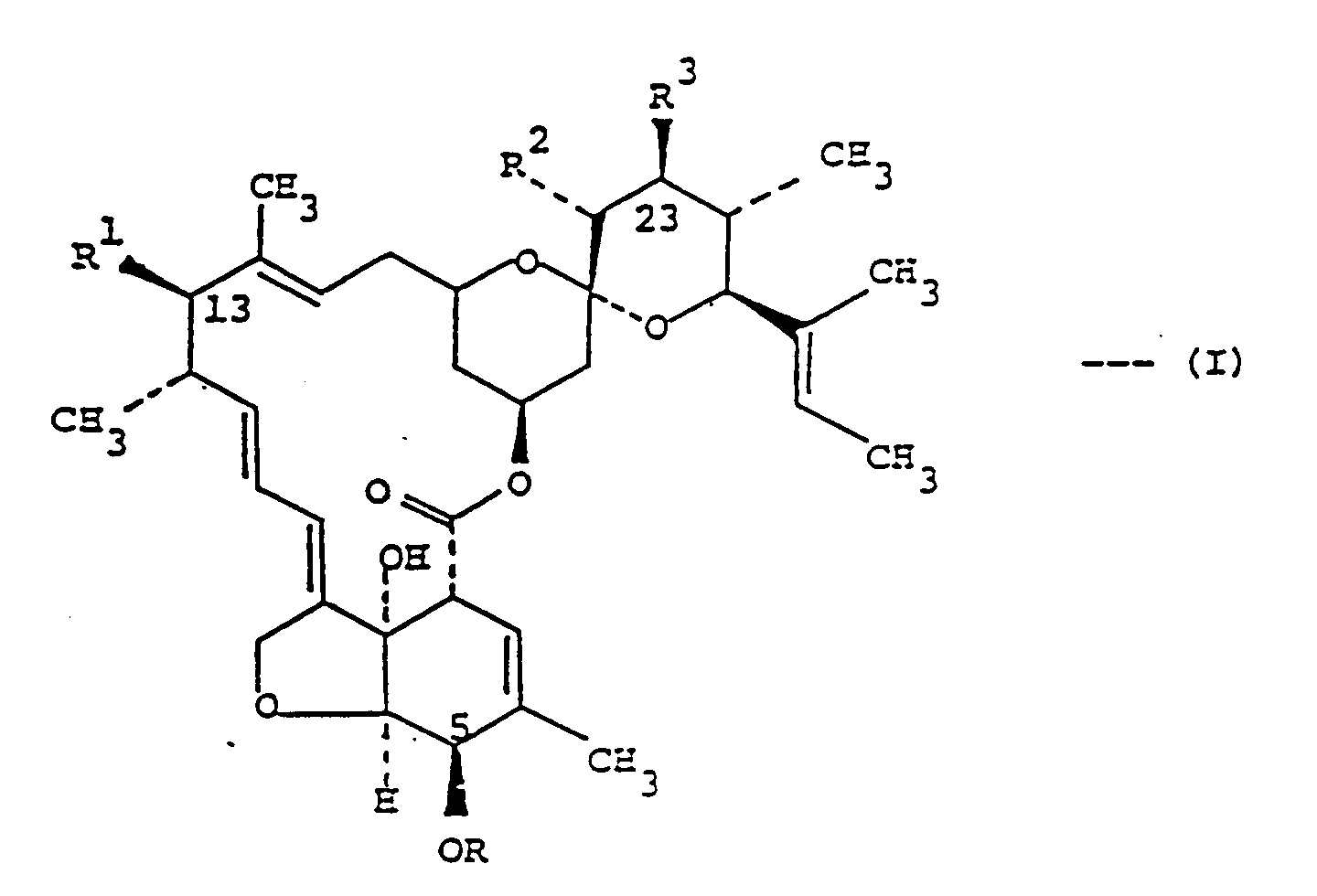
Verbindung R R1 R2 R3 N787-182-1 CH3 OH OH H N787-182-2 H OH OH OCOCH(CH3)2 N787-182-3 CH3 OH OH OCOCH(CH3)2 N787-182-4 H OCOCH(CH3)2 OH H N787-182-5 CH3 OCOCH(CH3)2 OH H N787-182-6 H OCOCH(CH3)2 OH OCOCH(CH3)2 N787-182-7 CH3 OCOCH(CH3)2 OH OCOCH(CH3)2 N787-182-8 H H OH OCOCH(CH3)2 N787-182-9 H OCOCH(CH3)2 H H N787-182-10 CH3 OCOCH(CH3)CH2CH3 OH OCOCH(CH3)2 N787-182-11 CH3 H OH OCOCH(CH3)2 N787-182-12 CH3 OCOCH(CH3)2 H H Verbindung 13 H OH OH H - Verbindung N787-182-4 der Formel (I), worin R H ist, R1 -OCOCH(CH3)2 ist, R2 OH ist und R3 H ist.
- Verbindung N787-182-6 der Formel (I), worin R H ist, R1 -OCOCH(CH3)2 ist, R2 OH ist und R3 -OCOCH(CH3)2 ist.
- Verbindung N787-182-8 der Formel (I), worin R H ist, R1 H ist, R2 OH ist und R3 -OCOCH(CH3)2 ist.
- Verbindung N787-182-9 der Formel (I), worin R H ist, R1 -OCOCH(CH3)2 ist, R2 H ist und R3 H ist.
- Verfahren zur Herstellung der Faktoren 1 bis 12 des Antibiotikums N787-182 der Formel (I), wie in Anspruch 1 definiert, das umfaßt, daß man den Mikroorganismus Streptomyces Sp ATCC 53718 oder eine Mutante, genetisch transformierte oder rekombinante Form davon mit der Fähigkeit, eines oder mehrere der N787-182-Antibiotika zu erzeugen, in wäßrigen oder festen Submers-Agar-Kulturmedien, die eine assimilierbare Quelle für Kohlenstoff, Stickstoff und anorganische Salze enthalten, unter aeroben Submers-Fermentationsbedingungen züchtet, bis eine gewinnbare Menge des N787-182-Antibiotikums erhalten wird und das Antibiotikum gewinnt und gegebenenfalls eine oder mehrere der N787-182-Faktoren isoliert und reinigt.
- Verfahren zur Herstellung der antibiotischen Verbindung 13 der Formel (I), wie in Anspruch 1 definiert, das umfaßt, daß man die Acylgruppe von Position 13 des N787-182-Faktors 4 entfernt.
- Zusammensetzung zur Verwendung zur Behandlung oder Verhütung von parasitischen Infektionen bei Tieren, einschließlich Menschen, einschließlich ektoparasitizide, insektizide, akarizide und anthelmintische Zusammensetzungen, die eine Verbindung der Formel (I), wie in einem der Ansprüche 1 bis 5 beansprucht, zusammen mit einem inerten Verdünnungsmittel oder Träger umfaßt.
- Zusammensetzung nach Anspruch 8 in Form eines oralen, injizierbaren oder Aufgußpräparats oder in Form eines Tierfutters oder einer Vormischung oder Ergänzung zur Zugabe zu Tierfutter.
- Verbindung der Formel I nach einem der Ansprüche 1 bis 5 zur Verwendung zur Behandlung oder Verhütung von parasitischen Infektionen bei Menschen und Tieren.
- Verwendung einer Verbindung der Formel (I), wie in einem der Ansprüche 1 bis 5 definiert, zur Herstellung einer Zusammensetzung zur Behandlung oder Prophylaxe von Insekten- oder Parasiteninfektionen oder -befall bei Tieren, einschließlich Menschen, und Schädlingsbefall in der Landwirtschaft oder im Gartenbau.
- Verfahren zur Bekämpfung von Insekten- oder Parasiteninfektionen oder -befall in der Landwirtschaft oder im Gartenbau, das umfaßt, daß man eine wirksame Menge einer Verbindung der Formel (I), wie in einem der Ansprüche 1 bis 4 beansprucht, auf den Organismus, der für die Infektion oder den Befall verantwortlich ist oder auf dessen Ort aufträgt.
- Biologisch reine Kultur eines Stamms der Gattung Streptomyces mit den identifizierenden Eigenschaften von ATCC 53718 oder einer mutanten, genetisch transformierten oder rekombinanten Form davon, wobei der Mikroorganismus die Antibiotikaverbindungen N787-182-(1 bis 12) von Anspruch 1 in gewinnbarer Menge bei Züchtung in einem wäßrigen Nährmedium, das assimilierbare Quellen für Kohlenstoff, Stickstoff und anorganische Salze enthält, erzeugen kann.
- Streptomyces hygroscopicus ATCC 53718.
Applications Claiming Priority (2)
| Application Number | Priority Date | Filing Date | Title |
|---|---|---|---|
| GB888804440A GB8804440D0 (en) | 1988-02-25 | 1988-02-25 | Antiparasitic agents |
| GB8804440 | 1988-02-25 |
Publications (3)
| Publication Number | Publication Date |
|---|---|
| EP0334484A2 EP0334484A2 (de) | 1989-09-27 |
| EP0334484A3 EP0334484A3 (de) | 1991-05-29 |
| EP0334484B1 true EP0334484B1 (de) | 1998-03-18 |
Family
ID=10632372
Family Applications (1)
| Application Number | Title | Priority Date | Filing Date |
|---|---|---|---|
| EP89301564A Expired - Lifetime EP0334484B1 (de) | 1988-02-25 | 1989-02-17 | Antiparasitäre Makrolid-Antibiotika |
Country Status (10)
| Country | Link |
|---|---|
| US (3) | US5510372A (de) |
| EP (1) | EP0334484B1 (de) |
| JP (1) | JPH0699437B2 (de) |
| AT (1) | ATE164161T1 (de) |
| CA (1) | CA1339965C (de) |
| DE (1) | DE68928606T2 (de) |
| DK (1) | DK169738B1 (de) |
| ES (1) | ES2113340T3 (de) |
| GB (1) | GB8804440D0 (de) |
| PT (1) | PT89806B (de) |
Families Citing this family (16)
| Publication number | Priority date | Publication date | Assignee | Title |
|---|---|---|---|---|
| GB8721371D0 (en) * | 1987-09-11 | 1987-10-21 | Glaxo Group Ltd | Chemical compounds |
| AU9785698A (en) | 1997-10-02 | 1999-04-27 | Microcide Pharmaceuticals, Inc. | Fungal efflux pump inhibitors |
| GB9807180D0 (en) | 1998-04-04 | 1998-06-03 | Ecc Int Ltd | Pigment products |
| GB9825402D0 (en) | 1998-11-19 | 1999-01-13 | Pfizer Ltd | Antiparasitic formulations |
| US6564199B1 (en) | 1999-04-01 | 2003-05-13 | Imerys Pigments, Inc. | Kaolin clay pigments, their preparation and use |
| DE10084442T1 (de) | 1999-04-01 | 2002-05-02 | Imerys Pigments Inc | Kaolin-Pigmente, ihre Herstellung und Verwendung |
| US6554892B1 (en) | 1999-07-02 | 2003-04-29 | Imerys Kaolin, Inc. | Compositions and methods for making a coarse platey, high brightness kaolin product |
| GB0020179D0 (en) | 2000-08-17 | 2000-10-04 | Imerys Minerals Ltd | Kaolin products and their use |
| GB0020182D0 (en) | 2000-08-17 | 2000-10-04 | Imerys Minerals Ltd | Particulate kaolin |
| GB0020180D0 (en) | 2000-08-17 | 2000-10-04 | Imerys Minerals Ltd | Kaolin products and their production |
| US20030085012A1 (en) | 2001-09-07 | 2003-05-08 | Jones J Philip E | Hyperplaty clays and their use in paper coating and filling, methods for making same, and paper products having improved brightness |
| CA2460692C (en) | 2001-09-17 | 2012-12-18 | Eli Lilly And Company | Pesticidal formulations |
| US6808559B2 (en) * | 2002-02-26 | 2004-10-26 | Imerys Pigments, Inc. | Kaolin clay pigments suited to rotogravure printing applications and method for preparing the same |
| JP2005521767A (ja) * | 2002-03-28 | 2005-07-21 | イメリーズ ミネラルズ リミテッド | 粒状粘土鉱物を含む難燃性ポリマー組成物 |
| EP2327410A1 (de) | 2009-10-28 | 2011-06-01 | Consiglio Nazionale Delle Ricerche - Infm Istituto Nazionale Per La Fisica Della Materia | Avermectine und Milbemycine zur Behandlung von Flavivirus Infektionen |
| CN113956212B (zh) * | 2021-10-29 | 2024-04-30 | 西南大学 | 具有抗线虫活性的thermolides类化合物及其制备方法和应用 |
Family Cites Families (22)
| Publication number | Priority date | Publication date | Assignee | Title |
|---|---|---|---|---|
| JPS4914624A (de) * | 1972-06-08 | 1974-02-08 | ||
| US3950360A (en) * | 1972-06-08 | 1976-04-13 | Sankyo Company Limited | Antibiotic substances |
| SE434277B (sv) * | 1976-04-19 | 1984-07-16 | Merck & Co Inc | Sett att framstella nya antihelmintiskt verkande foreningar genom odling av streptomyces avermitilis |
| US4200581A (en) * | 1978-08-04 | 1980-04-29 | Merck & Co., Inc. | Alkyl derivatives of C-076 compounds |
| US4412991A (en) * | 1981-08-28 | 1983-11-01 | Merck & Co., Inc. | 22-Hydroxy derivatives of C-076 compounds, pharmaceutical compositions and method of use |
| US4423209A (en) * | 1982-02-26 | 1983-12-27 | Merck & Co., Inc. | Processes for the interconversion of avermectin compounds |
| DK165119C (da) * | 1984-06-05 | 1993-03-01 | American Cyanamid Co | Antibiotiske forbindelser betegnet ll-f28249alfa, beta, gamma, delta, epsilon, zeta, eta, theta, iota, kappa, my og ny og pharmaceutisk or pharmakologisk acceptable salte deraf samt fremgangsmaade til deres fremstilling |
| ES8704545A1 (es) * | 1984-09-14 | 1987-04-01 | Glaxo Group Ltd | Un procedimiento para preparar un nuevo antibiotico por fer-mentacion |
| IL76816A (en) * | 1984-10-26 | 1989-03-31 | Sankyo Co | Process for preparing 13-hydroxy-5-ketomilbemycin |
| GB2168345B (en) * | 1984-12-14 | 1988-05-25 | Ciba Geigy Ag | Pesticidal 13b-substituted milbemycin derivatives |
| US4857509A (en) * | 1985-01-22 | 1989-08-15 | Ciba-Geigy Corporation | 13β-alkylmilbemycin derivatives for controlling parasites of animals and plants |
| US4666937A (en) * | 1985-03-04 | 1987-05-19 | Merck & Co., Inc. | Avermectin bioconversion products |
| IL78621A (en) * | 1985-04-30 | 1991-06-30 | American Cyanamid Co | Mylbemycin analogs,their preparation and pesticidal compositions containing them |
| NZ215917A (en) * | 1985-05-02 | 1989-10-27 | Merck & Co Inc | 22-oh milbemycin derivatives and parasiticidal compositions |
| JP2577734B2 (ja) * | 1986-03-12 | 1997-02-05 | アメリカン・サイアナミツド・カンパニー | マクロライド抗生物質 |
| JPS631007A (ja) * | 1986-06-20 | 1988-01-06 | Nec Corp | 電磁リレ− |
| NZ221077A (en) * | 1986-07-18 | 1990-06-26 | Ciba Geigy Ag | 13b-alkyl milbemycins and use as parasiticides |
| DE3750495T2 (de) * | 1986-07-24 | 1995-02-23 | Beecham Group Plc | Milbemycin-Derivate mit parasitenabtötender Aktivität, ein Verfahren zu ihrer Herstellung und die sie enthaltenden Zusammensetzungen. |
| ES2053797T3 (es) * | 1987-02-04 | 1994-08-01 | Ciba Geigy Ag | Procedimiento microbiano para la obtencion de derivados de milbemicina. |
| US4806527A (en) * | 1987-03-16 | 1989-02-21 | Merck & Co., Inc. | Avermectin derivatives |
| GB8709327D0 (en) * | 1987-04-21 | 1987-05-28 | Beecham Group Plc | Compounds |
| EP0325462A3 (de) * | 1988-01-22 | 1989-11-02 | Beecham Group Plc | Milbemycin-Derivate mit anthelmintischer Wirkung |
-
1988
- 1988-02-25 GB GB888804440A patent/GB8804440D0/en active Pending
-
1989
- 1989-02-17 EP EP89301564A patent/EP0334484B1/de not_active Expired - Lifetime
- 1989-02-17 DE DE68928606T patent/DE68928606T2/de not_active Expired - Fee Related
- 1989-02-17 ES ES89301564T patent/ES2113340T3/es not_active Expired - Lifetime
- 1989-02-17 AT AT89301564T patent/ATE164161T1/de not_active IP Right Cessation
- 1989-02-23 CA CA000591871A patent/CA1339965C/en not_active Expired - Fee Related
- 1989-02-23 JP JP1045010A patent/JPH0699437B2/ja not_active Expired - Lifetime
- 1989-02-23 PT PT89806A patent/PT89806B/pt not_active IP Right Cessation
- 1989-02-24 DK DK086589A patent/DK169738B1/da not_active IP Right Cessation
-
1995
- 1995-01-27 US US08/378,997 patent/US5510372A/en not_active Expired - Fee Related
- 1995-11-07 US US08/553,129 patent/US5573946A/en not_active Expired - Fee Related
- 1995-11-09 US US08/556,245 patent/US5589366A/en not_active Expired - Fee Related
Also Published As
| Publication number | Publication date |
|---|---|
| US5510372A (en) | 1996-04-23 |
| GB8804440D0 (en) | 1988-03-23 |
| DE68928606T2 (de) | 1998-07-02 |
| CA1339965C (en) | 1998-07-21 |
| JPH01272588A (ja) | 1989-10-31 |
| JPH0699437B2 (ja) | 1994-12-07 |
| ATE164161T1 (de) | 1998-04-15 |
| US5589366A (en) | 1996-12-31 |
| PT89806A (pt) | 1989-10-04 |
| US5573946A (en) | 1996-11-12 |
| DK86589A (da) | 1989-08-28 |
| ES2113340T3 (es) | 1998-05-01 |
| DE68928606D1 (de) | 1998-04-23 |
| EP0334484A3 (de) | 1991-05-29 |
| DK169738B1 (da) | 1995-02-06 |
| EP0334484A2 (de) | 1989-09-27 |
| PT89806B (pt) | 1994-04-29 |
| DK86589D0 (da) | 1989-02-24 |
Similar Documents
| Publication | Publication Date | Title |
|---|---|---|
| EP0214731B1 (de) | Avermectin- und Milbemycin-Derivate und Verfahren zu ihrer Herstellung | |
| US5510372A (en) | Antiparasitic macrolide antiobiotics | |
| US4429042A (en) | Strain of Streptomyces for producing antiparasitic compounds | |
| IE852263L (en) | Antibiotics from streptomyces | |
| IE48032B1 (en) | Selective hydrogenation products of c-076 compounds,derivatives thereof,their preparation and compositions for the treatment of parasitic infections containing the compounds | |
| EP0410615B1 (de) | Antiparasitisches Mittel | |
| AU603956B2 (en) | Avermectin and milbemycin derivatives from streptomyces avermitiosis ATCC 31267, 31271 and 31272 | |
| EP0204421B1 (de) | Antihelmintische macrocyclische Lactone und ihre fermentative Herstellung | |
| EP0308145A2 (de) | Mylbemycin-Derivate mit antiparasitärer Wirkung | |
| US4789684A (en) | Anthelmintic fermentation products of microorganisms | |
| JP3263076B2 (ja) | ストレプトマイセス アベルミチリス株によりグリコシル化されたアベルメクチン化合物 | |
| US5290804A (en) | Anthelmintic milbemycin analogs of novel microorganisms | |
| AU618136B2 (en) | Anthelmintic bioconversion products | |
| EP0050964B1 (de) | Makrozyklische Laktone, deren Herstellung und Anwendung als Parasiten tötendes Mittel, deren Zusammensetzungen und eine biologische Züchtung, welche zu ihrer Herstellung dient | |
| EP0674649B1 (de) | Antiparasitisches mittel | |
| US5840704A (en) | Antiparasitic agents and process for their preparation | |
| KR890000405B1 (ko) | 아버멕틴 및 밀베마이신 유도체의 제조방법 | |
| GB2232668A (en) | Antiparasitic compounds | |
| CA2067723A1 (en) | Antheilmintic milbemycin analogs of novel microorganisms |
Legal Events
| Date | Code | Title | Description |
|---|---|---|---|
| PUAI | Public reference made under article 153(3) epc to a published international application that has entered the european phase |
Free format text: ORIGINAL CODE: 0009012 |
|
| 17P | Request for examination filed |
Effective date: 19890224 |
|
| AK | Designated contracting states |
Kind code of ref document: A2 Designated state(s): AT BE CH DE ES FR GB GR IT LI LU NL SE |
|
| PUAL | Search report despatched |
Free format text: ORIGINAL CODE: 0009013 |
|
| AK | Designated contracting states |
Kind code of ref document: A3 Designated state(s): AT BE CH DE ES FR GB GR IT LI LU NL SE |
|
| 17Q | First examination report despatched |
Effective date: 19931119 |
|
| GRAG | Despatch of communication of intention to grant |
Free format text: ORIGINAL CODE: EPIDOS AGRA |
|
| GRAH | Despatch of communication of intention to grant a patent |
Free format text: ORIGINAL CODE: EPIDOS IGRA |
|
| GRAG | Despatch of communication of intention to grant |
Free format text: ORIGINAL CODE: EPIDOS AGRA |
|
| GRAH | Despatch of communication of intention to grant a patent |
Free format text: ORIGINAL CODE: EPIDOS IGRA |
|
| GRAH | Despatch of communication of intention to grant a patent |
Free format text: ORIGINAL CODE: EPIDOS IGRA |
|
| GRAA | (expected) grant |
Free format text: ORIGINAL CODE: 0009210 |
|
| AK | Designated contracting states |
Kind code of ref document: B1 Designated state(s): AT BE CH DE ES FR GB GR IT LI LU NL SE |
|
| REF | Corresponds to: |
Ref document number: 164161 Country of ref document: AT Date of ref document: 19980415 Kind code of ref document: T |
|
| REG | Reference to a national code |
Ref country code: CH Ref legal event code: NV Representative=s name: E. BLUM & CO. PATENTANWAELTE Ref country code: CH Ref legal event code: EP |
|
| ITF | It: translation for a ep patent filed | ||
| REF | Corresponds to: |
Ref document number: 68928606 Country of ref document: DE Date of ref document: 19980423 |
|
| REG | Reference to a national code |
Ref country code: ES Ref legal event code: FG2A Ref document number: 2113340 Country of ref document: ES Kind code of ref document: T3 |
|
| ET | Fr: translation filed | ||
| PGFP | Annual fee paid to national office [announced via postgrant information from national office to epo] |
Ref country code: GB Payment date: 19981224 Year of fee payment: 11 |
|
| PGFP | Annual fee paid to national office [announced via postgrant information from national office to epo] |
Ref country code: GR Payment date: 19990113 Year of fee payment: 11 |
|
| PGFP | Annual fee paid to national office [announced via postgrant information from national office to epo] |
Ref country code: CH Payment date: 19990119 Year of fee payment: 11 |
|
| PLBE | No opposition filed within time limit |
Free format text: ORIGINAL CODE: 0009261 |
|
| STAA | Information on the status of an ep patent application or granted ep patent |
Free format text: STATUS: NO OPPOSITION FILED WITHIN TIME LIMIT |
|
| PGFP | Annual fee paid to national office [announced via postgrant information from national office to epo] |
Ref country code: LU Payment date: 19990211 Year of fee payment: 11 Ref country code: ES Payment date: 19990211 Year of fee payment: 11 |
|
| PGFP | Annual fee paid to national office [announced via postgrant information from national office to epo] |
Ref country code: FR Payment date: 19990212 Year of fee payment: 11 |
|
| PGFP | Annual fee paid to national office [announced via postgrant information from national office to epo] |
Ref country code: SE Payment date: 19990215 Year of fee payment: 11 |
|
| PGFP | Annual fee paid to national office [announced via postgrant information from national office to epo] |
Ref country code: AT Payment date: 19990223 Year of fee payment: 11 |
|
| PGFP | Annual fee paid to national office [announced via postgrant information from national office to epo] |
Ref country code: DE Payment date: 19990225 Year of fee payment: 11 |
|
| PGFP | Annual fee paid to national office [announced via postgrant information from national office to epo] |
Ref country code: NL Payment date: 19990228 Year of fee payment: 11 |
|
| 26N | No opposition filed | ||
| PGFP | Annual fee paid to national office [announced via postgrant information from national office to epo] |
Ref country code: BE Payment date: 19990316 Year of fee payment: 11 |
|
| PG25 | Lapsed in a contracting state [announced via postgrant information from national office to epo] |
Ref country code: LU Free format text: LAPSE BECAUSE OF NON-PAYMENT OF DUE FEES Effective date: 20000217 Ref country code: GB Free format text: LAPSE BECAUSE OF NON-PAYMENT OF DUE FEES Effective date: 20000217 Ref country code: AT Free format text: LAPSE BECAUSE OF NON-PAYMENT OF DUE FEES Effective date: 20000217 |
|
| PG25 | Lapsed in a contracting state [announced via postgrant information from national office to epo] |
Ref country code: SE Free format text: LAPSE BECAUSE OF NON-PAYMENT OF DUE FEES Effective date: 20000218 Ref country code: ES Free format text: LAPSE BECAUSE OF NON-PAYMENT OF DUE FEES Effective date: 20000218 |
|
| PG25 | Lapsed in a contracting state [announced via postgrant information from national office to epo] |
Ref country code: BE Free format text: LAPSE BECAUSE OF NON-PAYMENT OF DUE FEES Effective date: 20000228 |
|
| PG25 | Lapsed in a contracting state [announced via postgrant information from national office to epo] |
Ref country code: LI Free format text: LAPSE BECAUSE OF NON-PAYMENT OF DUE FEES Effective date: 20000229 Ref country code: GR Free format text: LAPSE BECAUSE OF NON-PAYMENT OF DUE FEES Effective date: 20000229 Ref country code: CH Free format text: LAPSE BECAUSE OF NON-PAYMENT OF DUE FEES Effective date: 20000229 |
|
| BERE | Be: lapsed |
Owner name: PFIZER LTD Effective date: 20000228 |
|
| PG25 | Lapsed in a contracting state [announced via postgrant information from national office to epo] |
Ref country code: NL Free format text: LAPSE BECAUSE OF NON-PAYMENT OF DUE FEES Effective date: 20000901 |
|
| GBPC | Gb: european patent ceased through non-payment of renewal fee |
Effective date: 20000217 |
|
| EUG | Se: european patent has lapsed |
Ref document number: 89301564.4 |
|
| REG | Reference to a national code |
Ref country code: CH Ref legal event code: PL |
|
| PG25 | Lapsed in a contracting state [announced via postgrant information from national office to epo] |
Ref country code: FR Free format text: LAPSE BECAUSE OF NON-PAYMENT OF DUE FEES Effective date: 20001031 |
|
| NLV4 | Nl: lapsed or anulled due to non-payment of the annual fee |
Effective date: 20000901 |
|
| PG25 | Lapsed in a contracting state [announced via postgrant information from national office to epo] |
Ref country code: DE Free format text: LAPSE BECAUSE OF NON-PAYMENT OF DUE FEES Effective date: 20001201 |
|
| REG | Reference to a national code |
Ref country code: FR Ref legal event code: ST |
|
| REG | Reference to a national code |
Ref country code: ES Ref legal event code: FD2A Effective date: 20011010 |
|
| PG25 | Lapsed in a contracting state [announced via postgrant information from national office to epo] |
Ref country code: IT Free format text: LAPSE BECAUSE OF NON-PAYMENT OF DUE FEES;WARNING: LAPSES OF ITALIAN PATENTS WITH EFFECTIVE DATE BEFORE 2007 MAY HAVE OCCURRED AT ANY TIME BEFORE 2007. THE CORRECT EFFECTIVE DATE MAY BE DIFFERENT FROM THE ONE RECORDED. Effective date: 20050217 |