EP0332805A2 - Fliessfähige Perlglanzdispersion und deren Verwendung - Google Patents
Fliessfähige Perlglanzdispersion und deren Verwendung Download PDFInfo
- Publication number
- EP0332805A2 EP0332805A2 EP89100697A EP89100697A EP0332805A2 EP 0332805 A2 EP0332805 A2 EP 0332805A2 EP 89100697 A EP89100697 A EP 89100697A EP 89100697 A EP89100697 A EP 89100697A EP 0332805 A2 EP0332805 A2 EP 0332805A2
- Authority
- EP
- European Patent Office
- Prior art keywords
- carbon atoms
- group
- weight
- formula
- general formula
- Prior art date
- Legal status (The legal status is an assumption and is not a legal conclusion. Google has not performed a legal analysis and makes no representation as to the accuracy of the status listed.)
- Granted
Links
Classifications
-
- C—CHEMISTRY; METALLURGY
- C11—ANIMAL OR VEGETABLE OILS, FATS, FATTY SUBSTANCES OR WAXES; FATTY ACIDS THEREFROM; DETERGENTS; CANDLES
- C11D—DETERGENT COMPOSITIONS; USE OF SINGLE SUBSTANCES AS DETERGENTS; SOAP OR SOAP-MAKING; RESIN SOAPS; RECOVERY OF GLYCEROL
- C11D3/00—Other compounding ingredients of detergent compositions covered in group C11D1/00
- C11D3/0005—Other compounding ingredients characterised by their effect
- C11D3/0089—Pearlescent compositions; Opacifying agents
-
- A—HUMAN NECESSITIES
- A61—MEDICAL OR VETERINARY SCIENCE; HYGIENE
- A61K—PREPARATIONS FOR MEDICAL, DENTAL OR TOILETRY PURPOSES
- A61K8/00—Cosmetics or similar toiletry preparations
- A61K8/18—Cosmetics or similar toiletry preparations characterised by the composition
- A61K8/30—Cosmetics or similar toiletry preparations characterised by the composition containing organic compounds
- A61K8/33—Cosmetics or similar toiletry preparations characterised by the composition containing organic compounds containing oxygen
- A61K8/36—Carboxylic acids; Salts or anhydrides thereof
- A61K8/361—Carboxylic acids having more than seven carbon atoms in an unbroken chain; Salts or anhydrides thereof
-
- A—HUMAN NECESSITIES
- A61—MEDICAL OR VETERINARY SCIENCE; HYGIENE
- A61K—PREPARATIONS FOR MEDICAL, DENTAL OR TOILETRY PURPOSES
- A61K8/00—Cosmetics or similar toiletry preparations
- A61K8/18—Cosmetics or similar toiletry preparations characterised by the composition
- A61K8/30—Cosmetics or similar toiletry preparations characterised by the composition containing organic compounds
- A61K8/33—Cosmetics or similar toiletry preparations characterised by the composition containing organic compounds containing oxygen
- A61K8/37—Esters of carboxylic acids
- A61K8/375—Esters of carboxylic acids the alcohol moiety containing more than one hydroxy group
-
- A—HUMAN NECESSITIES
- A61—MEDICAL OR VETERINARY SCIENCE; HYGIENE
- A61K—PREPARATIONS FOR MEDICAL, DENTAL OR TOILETRY PURPOSES
- A61K8/00—Cosmetics or similar toiletry preparations
- A61K8/18—Cosmetics or similar toiletry preparations characterised by the composition
- A61K8/30—Cosmetics or similar toiletry preparations characterised by the composition containing organic compounds
- A61K8/40—Cosmetics or similar toiletry preparations characterised by the composition containing organic compounds containing nitrogen
- A61K8/42—Amides
-
- A—HUMAN NECESSITIES
- A61—MEDICAL OR VETERINARY SCIENCE; HYGIENE
- A61K—PREPARATIONS FOR MEDICAL, DENTAL OR TOILETRY PURPOSES
- A61K8/00—Cosmetics or similar toiletry preparations
- A61K8/18—Cosmetics or similar toiletry preparations characterised by the composition
- A61K8/30—Cosmetics or similar toiletry preparations characterised by the composition containing organic compounds
- A61K8/46—Cosmetics or similar toiletry preparations characterised by the composition containing organic compounds containing sulfur
- A61K8/463—Cosmetics or similar toiletry preparations characterised by the composition containing organic compounds containing sulfur containing sulfuric acid derivatives, e.g. sodium lauryl sulfate
-
- A—HUMAN NECESSITIES
- A61—MEDICAL OR VETERINARY SCIENCE; HYGIENE
- A61K—PREPARATIONS FOR MEDICAL, DENTAL OR TOILETRY PURPOSES
- A61K8/00—Cosmetics or similar toiletry preparations
- A61K8/18—Cosmetics or similar toiletry preparations characterised by the composition
- A61K8/30—Cosmetics or similar toiletry preparations characterised by the composition containing organic compounds
- A61K8/46—Cosmetics or similar toiletry preparations characterised by the composition containing organic compounds containing sulfur
- A61K8/466—Cosmetics or similar toiletry preparations characterised by the composition containing organic compounds containing sulfur containing sulfonic acid derivatives; Salts
-
- A—HUMAN NECESSITIES
- A61—MEDICAL OR VETERINARY SCIENCE; HYGIENE
- A61Q—SPECIFIC USE OF COSMETICS OR SIMILAR TOILETRY PREPARATIONS
- A61Q19/00—Preparations for care of the skin
- A61Q19/10—Washing or bathing preparations
-
- A—HUMAN NECESSITIES
- A61—MEDICAL OR VETERINARY SCIENCE; HYGIENE
- A61Q—SPECIFIC USE OF COSMETICS OR SIMILAR TOILETRY PREPARATIONS
- A61Q5/00—Preparations for care of the hair
- A61Q5/02—Preparations for cleaning the hair
-
- C—CHEMISTRY; METALLURGY
- C11—ANIMAL OR VEGETABLE OILS, FATS, FATTY SUBSTANCES OR WAXES; FATTY ACIDS THEREFROM; DETERGENTS; CANDLES
- C11D—DETERGENT COMPOSITIONS; USE OF SINGLE SUBSTANCES AS DETERGENTS; SOAP OR SOAP-MAKING; RESIN SOAPS; RECOVERY OF GLYCEROL
- C11D1/00—Detergent compositions based essentially on surface-active compounds; Use of these compounds as a detergent
- C11D1/86—Mixtures of anionic, cationic, and non-ionic compounds
-
- C—CHEMISTRY; METALLURGY
- C11—ANIMAL OR VEGETABLE OILS, FATS, FATTY SUBSTANCES OR WAXES; FATTY ACIDS THEREFROM; DETERGENTS; CANDLES
- C11D—DETERGENT COMPOSITIONS; USE OF SINGLE SUBSTANCES AS DETERGENTS; SOAP OR SOAP-MAKING; RESIN SOAPS; RECOVERY OF GLYCEROL
- C11D17/00—Detergent materials or soaps characterised by their shape or physical properties
- C11D17/0008—Detergent materials or soaps characterised by their shape or physical properties aqueous liquid non soap compositions
- C11D17/0013—Liquid compositions with insoluble particles in suspension
-
- A—HUMAN NECESSITIES
- A61—MEDICAL OR VETERINARY SCIENCE; HYGIENE
- A61K—PREPARATIONS FOR MEDICAL, DENTAL OR TOILETRY PURPOSES
- A61K2800/00—Properties of cosmetic compositions or active ingredients thereof or formulation aids used therein and process related aspects
- A61K2800/40—Chemical, physico-chemical or functional or structural properties of particular ingredients
- A61K2800/59—Mixtures
- A61K2800/596—Mixtures of surface active compounds
-
- C—CHEMISTRY; METALLURGY
- C11—ANIMAL OR VEGETABLE OILS, FATS, FATTY SUBSTANCES OR WAXES; FATTY ACIDS THEREFROM; DETERGENTS; CANDLES
- C11D—DETERGENT COMPOSITIONS; USE OF SINGLE SUBSTANCES AS DETERGENTS; SOAP OR SOAP-MAKING; RESIN SOAPS; RECOVERY OF GLYCEROL
- C11D1/00—Detergent compositions based essentially on surface-active compounds; Use of these compounds as a detergent
- C11D1/02—Anionic compounds
- C11D1/04—Carboxylic acids or salts thereof
-
- C—CHEMISTRY; METALLURGY
- C11—ANIMAL OR VEGETABLE OILS, FATS, FATTY SUBSTANCES OR WAXES; FATTY ACIDS THEREFROM; DETERGENTS; CANDLES
- C11D—DETERGENT COMPOSITIONS; USE OF SINGLE SUBSTANCES AS DETERGENTS; SOAP OR SOAP-MAKING; RESIN SOAPS; RECOVERY OF GLYCEROL
- C11D1/00—Detergent compositions based essentially on surface-active compounds; Use of these compounds as a detergent
- C11D1/02—Anionic compounds
- C11D1/04—Carboxylic acids or salts thereof
- C11D1/06—Ether- or thioether carboxylic acids
-
- C—CHEMISTRY; METALLURGY
- C11—ANIMAL OR VEGETABLE OILS, FATS, FATTY SUBSTANCES OR WAXES; FATTY ACIDS THEREFROM; DETERGENTS; CANDLES
- C11D—DETERGENT COMPOSITIONS; USE OF SINGLE SUBSTANCES AS DETERGENTS; SOAP OR SOAP-MAKING; RESIN SOAPS; RECOVERY OF GLYCEROL
- C11D1/00—Detergent compositions based essentially on surface-active compounds; Use of these compounds as a detergent
- C11D1/02—Anionic compounds
- C11D1/12—Sulfonic acids or sulfuric acid esters; Salts thereof
- C11D1/14—Sulfonic acids or sulfuric acid esters; Salts thereof derived from aliphatic hydrocarbons or mono-alcohols
-
- C—CHEMISTRY; METALLURGY
- C11—ANIMAL OR VEGETABLE OILS, FATS, FATTY SUBSTANCES OR WAXES; FATTY ACIDS THEREFROM; DETERGENTS; CANDLES
- C11D—DETERGENT COMPOSITIONS; USE OF SINGLE SUBSTANCES AS DETERGENTS; SOAP OR SOAP-MAKING; RESIN SOAPS; RECOVERY OF GLYCEROL
- C11D1/00—Detergent compositions based essentially on surface-active compounds; Use of these compounds as a detergent
- C11D1/02—Anionic compounds
- C11D1/12—Sulfonic acids or sulfuric acid esters; Salts thereof
- C11D1/29—Sulfates of polyoxyalkylene ethers
-
- C—CHEMISTRY; METALLURGY
- C11—ANIMAL OR VEGETABLE OILS, FATS, FATTY SUBSTANCES OR WAXES; FATTY ACIDS THEREFROM; DETERGENTS; CANDLES
- C11D—DETERGENT COMPOSITIONS; USE OF SINGLE SUBSTANCES AS DETERGENTS; SOAP OR SOAP-MAKING; RESIN SOAPS; RECOVERY OF GLYCEROL
- C11D1/00—Detergent compositions based essentially on surface-active compounds; Use of these compounds as a detergent
- C11D1/38—Cationic compounds
- C11D1/40—Monoamines or polyamines; Salts thereof
-
- C—CHEMISTRY; METALLURGY
- C11—ANIMAL OR VEGETABLE OILS, FATS, FATTY SUBSTANCES OR WAXES; FATTY ACIDS THEREFROM; DETERGENTS; CANDLES
- C11D—DETERGENT COMPOSITIONS; USE OF SINGLE SUBSTANCES AS DETERGENTS; SOAP OR SOAP-MAKING; RESIN SOAPS; RECOVERY OF GLYCEROL
- C11D1/00—Detergent compositions based essentially on surface-active compounds; Use of these compounds as a detergent
- C11D1/38—Cationic compounds
- C11D1/42—Amino alcohols or amino ethers
-
- C—CHEMISTRY; METALLURGY
- C11—ANIMAL OR VEGETABLE OILS, FATS, FATTY SUBSTANCES OR WAXES; FATTY ACIDS THEREFROM; DETERGENTS; CANDLES
- C11D—DETERGENT COMPOSITIONS; USE OF SINGLE SUBSTANCES AS DETERGENTS; SOAP OR SOAP-MAKING; RESIN SOAPS; RECOVERY OF GLYCEROL
- C11D1/00—Detergent compositions based essentially on surface-active compounds; Use of these compounds as a detergent
- C11D1/38—Cationic compounds
- C11D1/42—Amino alcohols or amino ethers
- C11D1/44—Ethers of polyoxyalkylenes with amino alcohols; Condensation products of epoxyalkanes with amines
-
- C—CHEMISTRY; METALLURGY
- C11—ANIMAL OR VEGETABLE OILS, FATS, FATTY SUBSTANCES OR WAXES; FATTY ACIDS THEREFROM; DETERGENTS; CANDLES
- C11D—DETERGENT COMPOSITIONS; USE OF SINGLE SUBSTANCES AS DETERGENTS; SOAP OR SOAP-MAKING; RESIN SOAPS; RECOVERY OF GLYCEROL
- C11D1/00—Detergent compositions based essentially on surface-active compounds; Use of these compounds as a detergent
- C11D1/38—Cationic compounds
- C11D1/52—Carboxylic amides, alkylolamides or imides or their condensation products with alkylene oxides
- C11D1/523—Carboxylic alkylolamides, or dialkylolamides, or hydroxycarboxylic amides (R1-CO-NR2R3), where R1, R2 or R3 contain one hydroxy group per alkyl group
-
- C—CHEMISTRY; METALLURGY
- C11—ANIMAL OR VEGETABLE OILS, FATS, FATTY SUBSTANCES OR WAXES; FATTY ACIDS THEREFROM; DETERGENTS; CANDLES
- C11D—DETERGENT COMPOSITIONS; USE OF SINGLE SUBSTANCES AS DETERGENTS; SOAP OR SOAP-MAKING; RESIN SOAPS; RECOVERY OF GLYCEROL
- C11D1/00—Detergent compositions based essentially on surface-active compounds; Use of these compounds as a detergent
- C11D1/66—Non-ionic compounds
- C11D1/667—Neutral esters, e.g. sorbitan esters
-
- C—CHEMISTRY; METALLURGY
- C11—ANIMAL OR VEGETABLE OILS, FATS, FATTY SUBSTANCES OR WAXES; FATTY ACIDS THEREFROM; DETERGENTS; CANDLES
- C11D—DETERGENT COMPOSITIONS; USE OF SINGLE SUBSTANCES AS DETERGENTS; SOAP OR SOAP-MAKING; RESIN SOAPS; RECOVERY OF GLYCEROL
- C11D1/00—Detergent compositions based essentially on surface-active compounds; Use of these compounds as a detergent
- C11D1/66—Non-ionic compounds
- C11D1/74—Carboxylates or sulfonates esters of polyoxyalkylene glycols
Definitions
- aqueous preparations of surfactants such as cosmetic hair and body cleansers or liquid detergents and cleaners
- surfactants are often given a pearlescent appearance.
- powdery natural substances such as mica or fish silver
- inorganic materials such as titanium dioxide pigments or metal salts of higher fatty acids were previously used.
- fatty acid glycol esters have been used alone or in combination with fatty acid alkanolamide for this purpose.
- These two materials are solid, non-crystalline substances.
- To prepare aqueous surfactant preparations with a pearlescent effect the batch must be heated above the melting point of these substances. A homogeneous solution is obtained from which, after cooling by crystallization, a pearlescent or silk gloss effect is produced.
- this process has the disadvantage that the entire production batch has to be heated to a corresponding temperature (depending on the pearlescent agent, about 60 to 80 ° C.), and a uniform pearlescence is only achieved through defined cooling and stirring conditions. This requires a lot of energy and time.
- heat-sensitive or volatile formulation constituents such as perfume oils or special active ingredients, can be metered into these preparations only after cooling. As a result, there is no possibility of continuous production of such pearlescent formulations.
- pearlescent dispersions which are combinations of the most varied pearlescent formers with surfactants, have been used, with which it is possible to produce liquid formulations with pearlescent effect without heating and also continuously.
- These pearlescent dispersions are made by adding the pearlescent Giving substance is incorporated into the aqueous solution of the surfactant above its melting temperature. Due to constant, precisely coordinated cooling and stirring conditions, pearlescent crystals with a defined particle size distribution are formed, which remain dispersed in the surfactant solution.
- the pearlescent dispersion according to the invention should contain 5 to 40, preferably 10 to 30, in particular 15 to 25,% by weight of components A to F or A to D.
- the A to B ratio should be 6: 1 to 1: 1.
- Compounds B are preferably compounds in which, according to formula II, R2 represents a hydrocarbon chain with 11 to 19 carbon atoms, R3 represents a group of the formula -C2H4OH and R4 represents a hydrogen atom.
- Component B is preferably used in a concentration of 2 to 10% by weight, in particular 3 to 5% by weight.
- the preferred use concentrations of components C and D are in each case 0.3 to 3% by weight, in particular 0.5 to 2% by weight.
- R5 is a saturated or unsaturated saturated hydrocarbon group with 12 to 20, in particular 12 to 18, carbon atoms
- R6 and R7 is simultaneously a group of the formula - (AO) w H, in particular of the formula - (C2H4O) w H, where w in each case means m or o, where the sum of m and o is in particular a number from 4 to 25.
- the carboxylic acid used is compounds of the general formula IV in which R8 represents a saturated or unsaturated hydrocarbon radical having 8 to 20 carbon atoms, A has the meaning -C2H4- and q is a number from 0 to 10.
- R8 is a hydrocarbon radical having 14 to 18 carbon atoms, and p and q have the value).
- Examples of compounds that can be considered as component A) are: Palmitic acid, stearic acid, arachic acid, behenic acid monoethylene glycol ester or monoisopropylene glycol ester; instead of the monoglycol esters, the di-, tri-, tetra- or pentaethylene glycol esters or pentapropylene glycol esters are also possible. Monoethylene glycol dipalmitate, distearate, diapachinate, dibehenate, dilignocerinate, dioleate can also be used. In the compounds mentioned, the monoethylene glycol can also be substituted by diethylene glycol, triethylene glycol, tetraethylene glycol or pentaethylene glycol. Ethylene glycol can also be replaced by isopropyl glycol.
- Examples of compounds that can be used as component B) are: Mono- or diethanolamides or also mono- or diisopropanolamides of capric acid, lauric acid, myristic acid, palmitic acid, stearic acid, arachic acid, behenic acid, lignoceric acid, oleic acid or the mixtures of fatty acids such as coconut or palm kernel fatty acids.
- Possible components D) are: Caprin, caprylic, lauric, myristic, palmitic, palmitoleic, stearic, oleic, arachidonic, behenic and caprylic, caprinyl, lauryl, myristic, palmityl, stearyl, arachinyl behenyl , Oleyl carboxymethylate, where 1 to 16 moles of ethylene oxide or 1,2-propylene oxide can be added to the alcohols on which the alkyl radicals are based before the carboxymethylation.
- the carboxymethylation can be carried out in a known manner by reacting the alcohols or the alkyl (poly) oxalkylates with chloroacetic acid and NaOH.
- component E can be used as component E): Toluene sulfonate, xylene sulfonate, cumene sulfonate, ethylbenzene sulfonate or: Methyl, ethyl, propyl, butyl, pentyl, hexyl, octyl, decyl sulfate, it being possible for the alcohols on which the alkyl radicals are based to be reacted with 1 to 5 moles of ethylene oxide or 1,2-propylene oxide before sulfation.
- the appropriate amount of water from 70 to 80.degree. C., preferably 75.degree. C., is expediently introduced and components A to E are added in any order with vigorous stirring ( ⁇ 100 rpm).
- the energy required to melt and disperse the components is supplied so that the temperature in the boiler remains in the specified range.
- Component F can then optionally be added.
- the mixture is allowed to cool to at least 50 ° C., preferably 40 ° C., with slow stirring at about 5 ° C./hour, the desired silky pearlescence being obtained.
- a suitable preservative should be added to the pearlescent dispersion.
- the present pearlescent dispersion according to the invention can be added to liquid hair and body cleaning agents, liquid dishwashing agents and liquid washing and cleaning agents at room temperature. In this way, finished products are obtained which have a very fine and intense pearlescent.
- the amount of pearlescent dispersion required for this is 0.5 to 6%, preferably 1 to 4%, in particular 1.5 to 3% by weight.
- compositions listed in the examples are readily flowable and, when added to various surfactant preparations, give excellent pearlescence, which appears particularly fine in Examples 1, 2 and 4 according to the invention.
Landscapes
- Life Sciences & Earth Sciences (AREA)
- Health & Medical Sciences (AREA)
- Animal Behavior & Ethology (AREA)
- General Health & Medical Sciences (AREA)
- Public Health (AREA)
- Veterinary Medicine (AREA)
- Chemical & Material Sciences (AREA)
- Birds (AREA)
- Epidemiology (AREA)
- Chemical Kinetics & Catalysis (AREA)
- Oil, Petroleum & Natural Gas (AREA)
- Wood Science & Technology (AREA)
- Organic Chemistry (AREA)
- Engineering & Computer Science (AREA)
- Emergency Medicine (AREA)
- Dermatology (AREA)
- Cosmetics (AREA)
- Colloid Chemistry (AREA)
- Detergent Compositions (AREA)
- Ceramic Products (AREA)
- Prostheses (AREA)
- Bidet-Like Cleaning Device And Other Flush Toilet Accessories (AREA)
- Agricultural Chemicals And Associated Chemicals (AREA)
Abstract
Description
- Zur Verbesserung des optischen Eindruckes und damit zur Steigerung des Handelswertes werden wäßrige Zubereitungen von Tensiden, wie kosmetische Haar- und Körperreinigungsmittel oder auch flüssige Wasch- und Reinigungsmittel, oft mit einem perlglänzenden Aussehen ausgestattet. Um einen solchen Perl- oder auch Seidenglanzeffekt zu erreichen, wurden früher pulverförmige Naturstoffe wie Glimmer oder Fischsilber, anorganische Materialien wie Titandioxidpigmente oder auch Metallsalze höherer Fettsäuren eingesetzt.
- Seit einiger Zeit werden für diesen Zweck Fettsäureglykolester allein oder in Kombination mit Fettsäurealkanolamid verwendet. (G. A. Nowak "Die kosmetischen Präparate" Band 2, Seite 482, Augsburg 1984). Diese beiden Materialien sind feste, nichtkristalline Substanzen. Zur Herstellung von wäßrigen Tensidzubereitungen mit Perlglanzeffekt muß der Ansatz über den Schmelzpunkt dieser Substanzen erwärmt werden. Hierbei wird eine homogene Lösung erhalten, aus der nach dem Abkühlen durch Kristallisation ein Perl- bzw. Seidenglanzeffekt entsteht. Dieses Verfahren besitzt jedoch den Nachteil, daß hierbei der gesamte Produktionsansatz auf eine entsprechende Temperatur (je nach Perlglanzbildner ca. 60 bis 80 °C) erhitzt werden muß und erst durch definierte Abkühl- und Rührbedingungen ein gleichmäßiger Perlglanz entsteht. Dies bedingt einen hohen Energie- und Zeitaufwand.
- Hierzu kommt, daß bei diesen Zubereitungen wärmeempfindliche oder flüchtige Formulierungsbestandteile, wie Parfümöle oder spezielle Wirkstoffe, erst nach dem Abkühlen zudosiert werden können. Dadurch gibt es keine Möglichkeit der kontinuierlichen Produktion solcher perlglänzender Formulierungen.
- In jüngerer Zeit werden nun sogenannte Perlglanzdispersionen, das sind Kombinationen der verschiedensten Perlglanzbildner mit Tensiden, eingesetzt, mit denen es möglich ist, flüssige Formulierungen mit Perlglanzeffekt ohne Erhitzen und auch kontinuierlich zu produzieren. Diese Perlglanzdispersionen werden hergestellt, indem die perlglanz gebende Substanz oberhalb ihrer Schmelztemperatur in die Wäßrige Lösung des Tensids eingearbeitet wird. Durch konstante, exakt abgestimmte Abkühl- und Rührbedingungen werden hierbei Perlglanzkristalle mit einer definierten Teilchengrößenverteilung gebildet, die in der Tensidlösung dispergiert bleiben.
- Die derzeit am häufigsten verwendeten Substanzen zur Herstellung dieser Perlglanzdispersionen sind Fettsäuremono- und/oder -polyglykolester, die allein oder zusammen mit Fettsäurealkanolamiden in wäßrige Lösungen von Alkylsulfaten und/oder Alkylethersulfaten als Dispergiermittel eingearbeitet werden. In den meisten Fällen werden hierbei sehr hochviskose, bei tieferen Temperaturen nicht mehr fließfähige Dispersionen erhalten. (DE-OS 16 69 152, DE-OS 35 19 080)
- Nun ist es bei Perlglanzdispersionen dieser Art erforderlich, einen recht hohen Anteil der anionischen Tenside vom Sulfat-Typ zu verwenden. Da aber die Nachfrage nach milden Präparaten immer größer wird, möchte man sich nicht solche "formulierungsfremden" Tenside durch einen Hilfsstoff, wie z. B. das Perlglanzmittel, einschleppen.
- In DE-A 34 21 161 scheint diese Aufgabe in gewisser Weise gelöst, indem eine bekannte Mischung von Fettsäureglykolester und Fettsäuremonoalkylolamid mit Hilfe einer speziellen Kombination von Sulfosuccinat und Aminoxid zu einem Perlglanzmittel verarbeitet wird. Perlglanzkonzentrate, die nach diesem Verfahren hergestellt werden (vgl. die dort aufgeführten Beispiele) haben jedoch eine für die Weiterverarbeitung unerwünscht hohe Viskosität, und der mit ihnen erzielbare Perlglanzeffekt entspricht nicht ganz dem gewohnten Standard. Ferner sind bei der Herstellung bestimmte Dosierungsreihenfolgen und Temperaturprofile einzuhalten, d. h. die Herstellungsverfahren sind aufwendig.
- Es bestand daher die Aufgabe, Perlglanzkonzentrate mit einem ausgezeichneten Perlglanzeffekt aufzufinden, die einerseits bei Raumtemperatur gut fließfähig, andererseits aber auch über lange Zeit lagerstabil sind, dabei einen möglichst geringen Anteil an milden Tensiden bzw. Dispergiermitteln enthalten und sich einfach herstellen lassen.
- Überraschend wurde gefunden, daß durch die Kombination von Fettsäuremono- oder -di(poly)glykolestern und Fettsäurealkylolamiden mit geringen Mengen einer Mischung aus ggf. oxethylierten Fettaminen und Carbonsäuren die geforderten Kriterien ausgezeichnet erfüllt werden. Die erfindungsgemäße, fließfähige Perlglanzdispersion besteht aus folgenden Komponenten:
- A) 5 bis 25, vorzugsweise 10 bis 20, Gew.-% eines Fettsäureglykolesters der allgemeinen Formel I
R₁--(O-A)n-O-X (I)
darin steht
R₁ für eine lineare oder verzweigte, gesättigte oder ungesättigte Kohlenwasserstoffkette mit 14 bis 23 Kohlenstoffatomen,
A für eine Gruppe der Formel -C₂H₄- oder C₃H₆-, vorzugsweise -C₂H₄-,
X für ein Wasserstoffatom oder eine Gruppe der allgemeinen Formel
R₁--
n für eine Zahl von 1 bis 5, vorzugsweise 1 bis 2, - B) 2 bis 15, vorzugsweise 2 bis 10, Gew.-% eines Fettsäurealkanolamides der allgemeinen Formel II

R₂ für eine lineare oder verzweigte, gesättigte oder ungesättigte Kohlenwasserstoffkette mit 9 bis 23 Kohlenstoffatomen,
R₃ und R₄ unabhängig voneinander für ein Wasserstoffatom oder eine Gruppe der Formel -C₂H₄OH oder -C₃H₆OH, - C) 0,1 bis 5 Gew.-%, vorzugsweise 0,3 bis 3 Gew.-%, eines Amins der allgemeinen Formel III
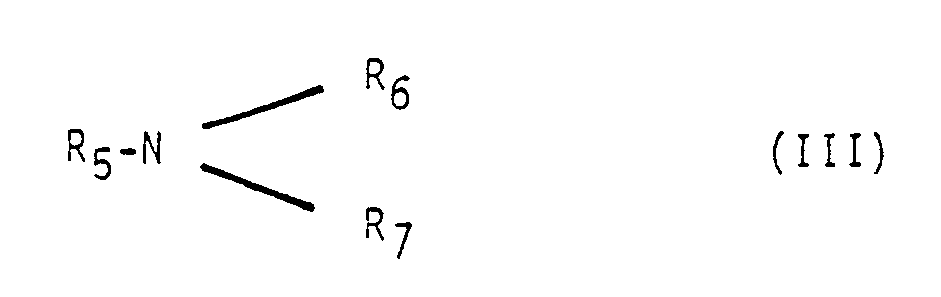
R₅ für eine lineare oder verzweigte, gesättigte oder ungesättigte Kohlenwasserstoffgruppe mit 8 bis 24 Kohlenstoffatomen,
R₆ für ein Wasserstoffatom der eine lineare oder verzweigte Kohlenstoffkette mit 1 bis 4 Kohlenstoffatomen, oder eine Gruppe der Formel -(A-O)m-H, worin A die o. a. Bedeutung hat,
R₇ für eine Gruppe der Formel -(A-O)oH oder einen Polyhydroxyalkylrest mit 3 bis 7, vorzugsweise 4 bis 6 Kohlenstoffatomen, der ggf. mit einem Mono-, Di- oder Oligosaccharid glykosidisch verknüpft ist; dabei sind
m und o jeweils unabhängig voneinander ganze Zahlen von 0 bis 40, bevorzugt 1 bis 30, wobei die Summe von m plus o eine ganze Zahl von 1 bis 50 ist. - D) 0,1 bis 5 Gew.-%, vorzugsweise 0,3 bis 3 Gew.-%, einer Carbonsäure der allgemeinen Formel IV

R₈ für eine lineare oder verzweigte, gesättigte oder ungesättigte Kohlenwasserstoffgruppe mit 7 bis 22, vorzugsweise 8 bis 20, Kohlenstoffatomen,
A für die gleiche Bedeutung wie in Formel I,
p für 0 oder 1 und
q für eine ganze Zahl zwischen 0 und 16, vorzugsweise 0 bis 10, wobei p gleich 1 ist, wenn q größer als 0 ist, - E) 0 bis 5 Gew.-%, vorzugsweise 0,1 bis 4 Gew.-%, insbesondere 0,3 bis 2,5 Gew.-% eines Sulfonates der allgemeinen Formel V


darin steht
R₉ für einen Phenylrest mit 1 bis 3 Substituenten, vorzugsweise aus der Gruppe der Kohlenwasserstoffreste, wobei die Summe der Kohlenstoffatome dieser Substituenten eine Zahl von 1 bis 9, vorzugsweise von 1 bis 6, insbesondere von 1 bis 3, ist,
R₁₀ für einen linearen oder verzweigten Kohlenwasserstoffrest mit 1 bis 10, vorzugsweise 2 bis 6, Kohlenstoffatomen,
M für ein Atomäquivalent eines ein- oder zweiwertigen Metalls, vorzugsweise eines Alkalimetalls, oder eine Ammonium- oder substituierte Ammoniumgruppe,
während A und n die in Formel I angegebene Bedeutung haben, - F) 0 bis 2 Gew.-%, vorzugsweise 0 bis 1 Gew.-%, eines ein- oder zweiwertigen Metallsalzes, vorzugsweise Alkalisulfat oder Alkalichlorid, sowie
Wasser zu der an 100 Gew.-% fehlenden Menge. - Die erfindungsgemäße Perlglanzdispersion sollte 5 bis 40, vorzugsweise 10 bis 30 insbesondere 15 bis 25 Gew.-% der Komponenten A bis F bzw. A bis D enthalten. Das Mengenverhältnis A zu B sollte 6 : 1 bis 1 : 1 betragen.
- In einer bevorzugten Ausführungsform der vorliegenden Erfindung werden vorzugsweise 10 bis 20 Gew.-%, insbesondere 14 bis 18 Gew.-% der Komponente A eingesetzt, wobei die Eigenschaften der erfindungsgemäßen Perlglanzdispersion am günstigsten sind, wenn R₁ ein Alkylrest mit 15 bis 17 Kohlenstoffatomen, X ein Rest der Formel
R₁--
und n = 1 ist. - Als Komponente B kommen bevorzugt Verbindungen zum Einsatz, in denen gemäß Formel II R₂ eine Kohlenwasserstoffkette mit 11 bis 19 Kohlenstoffatomen, R₃ eine Gruppe der Formel -C₂H₄OH und R₄ ein Wasserstoffatom darstellen. Komponente B wird vorzugsweise in einer Konzentration von 2 bis 10 Gew.-%, insbesondere von 3 bis 5 Gew.-%, eingesetzt.
- Die bevorzugten Einsatzkonzentrationen der Komponenten C und D liegen bei jeweils 0,3 bis 3 Gew.-%, insbesondere 0,5 bis 2 Gew.-%. Als Amin gemäß der allgemeinen Formel III werden erfindungsgemäß bevorzugt Verbindungen eingesetzt, in denen R₅ für eine gesättigte oder unge sättigte Kohlenwasserstoffgruppe mit 12 bis 20, insbesondere 12 bis 18, Kohlenstoffatomen, R₆ und R₇ gleichzeitig eine Gruppe der Formel -(A-O)wH, insbesondere der Formel -(C₂H₄O)wH, ist, worin w jeweils m bzw. o bedeutet, wobei die Summe von m und o insbesondere eine Zahl von 4 bis 25 ist.
- Als Carbonsäure werden in einer bevorzugten Ausführungsform der Erfindung Verbindungen gemäß der allgemeinen Formel IV eingesetzt, in denen R₈ für einen gesättigten oder ungesättigten Kohlenwasserstoffrest mit 8 bis 20 Kohlenstoffatomen steht, A die Bedeutung -C₂H₄- hat und q eine Zahl von 0 bis 10 ist. In einer besonders bevorzugten Ausführungsform ist R₈ ein Kohlenwasserstoffrest mit 14 bis 18 Kohlenstoffatomen, und p und q haben den Wert ).
- Beispiele für Verbindungen, die als Komponente A) infrage kommen, sind:
Palmitinsäure-, Stearinsäure-, Arachinsäure-, Behensäure-monoethylenglykolester oder -monoisopropylenglykolester; statt der Monoglykolester sind auch die Di-, Tri-, Tetra- oder Pentaethylenglykolester bzw. Pentapropylenglykolester möglich. Auch Monoethylenglykol- dipalmitat, -distearat, -diapachinat, -dibehenat, - dilignocerinat, -dioleat, können eingesetzt werden. In den genannten Verbindungen kann das Monoethylenglykol auch durch Diethylenglykol, Triethylenglykol, Tetraethylenglykol oder Pentaethylenglykol substituiert werden. Ebenso kann darin Ethylenglykol durch Isopropylglykol ersetzt sein. - Beispiele für Verbindungen, die als Komponente B) herangezogen werden können, sind:
Mono- oder Diethanolamide oder auch Mono- oder Diisopropanolamide der Caprinsäure, Laurinsäure, Myristinsäure, Palmitinsäure, Stearinsäure, Arachinsäure, Behensäure, Lignocerinsäure, Ölsäure oder der Mischungen von Fettsäuren wie Kokosnuß- oder Palmkernfettsäuren. - Als Komponente C) lassen sich beispielsweise einsetzen:
Capryl-, Caprinyl-, Lauryl-, Oleyl-, Myristyl-, Palmityl-, Stearyl-, Behenyl-, Talg-, Arachinyl-, Lignoarylamin, jeweils umgesetzt mit 1 bis 50, vorzugsweise 1 bis 30 Molen, Ethylenoxid oder 1,2-Propylenoxid. Als Komponente D) kommen infrage:
Caprin, Capryl-, Laurin-, Myristin-, Palmitin-, Palmitolein-, Stearin-, Öl-, Arachidon,- Behensäure sowie Capryl-, Caprinyl-, Lauryl-, Myristyl-, Palmityl-, Stearyl-, Arachinyl- Behenyl-, Oleyl-Carboxymethylat, wobei an die den Alkylresten zugrundeliegenden Alkohole vor der Carboxymethylierung 1 bis 16 Mole Ethylenoxid oder 1,2-Propylenoxid angelagert werden kann. Die Carboxymethylierung kann in bekannter Weise durch Umsatz der Alkohole bzw. der Alkyl(poly)oxalkylate mit Chloressigsäure und NaOH erfolgen. - Als Komponente E) lassen sich einsetzen:
Toluolsulfonat, Xylolsulfonat, Cumolsulfonat, Ethylbenzolsulfonat oder:
Methyl-, Ethyl-, Propyl-, Butyl-, Pentyl-, Hexyl-, Octyl-, Decylsulfat, wobei die den Alkylresten zugrundeliegenden Alkohole vor der Sulfatierung mit 1 bis 5 Molen Ethylenoxid oder 1,2-Propylenoxid umgesetzt werden können. - Zur Herstellung der erfindungsgemäßen Perlglanzdispersionen wird zweckmäßigerweise die entsprechende Menge Wasser von 70 bis 80 °C, bevorzugt 75 °C, vorgelegt und die Komponenten A bis E werden unter nicht zu heftigem Rühren (< 100 UpM) in beliebiger Reihenfolge zugegeben. Währenddessen wird die zum Schmelzen und Dispergieren der Komponenten benötigte Energie zugeführt, so daß die Temperatur im Kessel im angegebenen Bereich bleibt. Anschließend kann ggf. Komponente F zugesetzt werden. Nach einer Nachrührzeit von 0,5 bis 1 Stunde wird man unter langsamen Rühren mit ca. 5 °C/Stunde auf mindestens 50 °C, bevorzugt 40 °C, abkühlen lassen, wobei sich der gewünschte seidige Perlglanz einstellt. Um eine mikrobielle Kontamination zu vermeiden, sollte man der Perlglanzdispersion ein geeignetes Konservierungsmittel zusetzen.
- Die solchermaßen hergestellten erfindungsgemäßen Perlglanzdispersionen zeichnen sich durch die folgenden Vorteile aus:
- 1. Sie sind sehr einfach in einem Eintopfverfahren herstellbar und unkritisch in bezug auf das Kristallisationsverhalten beim Abkühlen.
- 2. Sie sind - auch unterhalb Raumtemperatur - sehr gut fließfähig, wodurch sie für eine kontinuierliche Weiterverarbeitung prädestiniert sind.
- 3. Sie haben einen sehr niedrigen Anteil an nicht perlglanzgebenden Komponenten, wodurch sich erheblich vielfältigere Einsatzmöglichkeiten ergeben.
- 4. Nicht nur die Fließfähigkeit der erfindungsgemäßen Perlglanzdispersion ist verbessert, sondern gleichzeitig erhält man einen einheitlicheren seidigeren Perlglanzeffekt.
- Die vorliegende, erfindungsgemäße Perlglanzdispersion kann bei Raumtemperatur flüssigen Haar- und Körperreinigungsmitteln, flüssigen Geschirrspülmitteln sowie flüssigen Wasch- und Reinigungsmitteln zugesetzt werden. Hierdurch werden Fertigprodukte erhalten, die einen sehr feinen und intensiven Perlglanz aufweisen. Die hierzu benötigte Menge der Perlglanzdispersion beträgt 0,5 bis 6 %, vorzugsweise 1 bis 4 %, insbesondere 1,5 bis 3 Gew.-%.
- Die folgenden Beispiele dienen zur näheren Erläuterung der erfindungsgemäßen Perlglanzdispersion. Die Mengenangaben beziehen sich jeweils auf Gewichtsprozente. Die Herstellung erfolgte in allen Fällen auf die oben beschriebene Art und Weise.
-
Komponenten Beispiel-Nr. 1 2 3 4 5 6 7 8 9 Monoethylenglykoldistearat 16 16 10 16 16 16 10 16 16 Cocosfettsäuremonoethanolamid 4 4 10 4 4 4 10 4 4 Laurylamin-10 EO 1 1 1 Talgamin-10 EO 1 1 Oleyamin-10 EO 1 Oleyamin-8 EO 1 N-Dodecylglucamin 1 1 Ölsäure 1 1 1 1 1 C₁₂₁₄-4.5EO-essigsäure*) 1 1 C₁₂₁₄-10EO-essigsäure*) 1 1 Cumolsulfonat 1 1 1 1 1 Natriumsulfat 1 1 1 1 *) Formel IV: R₈ = Lauryl und Myristyl, q = 4,5 bzw. 10 - Alle in den Beispielen aufgeführten Zusammensetzungen sind gut fließfähig und geben bei Zusatz zu verschiedenen Tensid-Zubereitungen einen hervorragenden Perlglanz, wobei dieser bei den erfindungsgemäßen Beispielen 1, 2 und 4 besonders fein erscheint.
Claims (2)
R₁-

R₁ für eine lineare oder verzweigte, gesättigte oder ungesättigte Kohlenwasserstoffkette mit 14 bis 23 Kohlenstoffatomen,
A für eine Gruppe der Formel -C₂H₄- oder
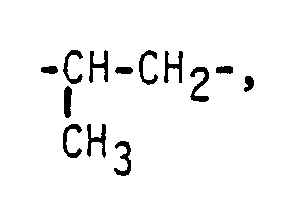
R₁-
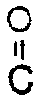
n für eine Zahl von 1 bis 5, vorzugsweise 1 bis 2, steht,

R₂ eine lineare oder verzweigte, gesättigte oder ungesättigte Kohlenwasserstoffkette mit 9 bis 23 Kohlenstoffatomen,
R₃ und R₄ unabhängig voneinander ein Wasserstoffatom oder eine Gruppe der Formel -C₂H₄OH oder


R₆ für ein Wasserstoffatom oder eine lineare oder verzweigte Kohlenstoffkette mit 1 bis 4 Kohlenstoffatomen, oder eine Gruppe der Formel -(A-O)m-H, worin A die o. a. Bedeutung hat,
R₇ für eine Gruppe der Formel -(A-O)oH oder einen Polyhydroxyalkylrest mit 3 bis 7, vorzugsweise 4 bis 6, Kohlenstoffatomen steht, der ggf. mit einem Mono-, Di- oder Oligosaccharid glykosidisch verknüpft ist, wobei
m und o jeweils unabhängig voneinander ganze Zahlen von Null bis 40, bevorzugt 1 bis 30, bedeuten, deren Summe m plus o eine ganze Zahl von 1 bis 50 sein kann,

A die gleiche Bedeutung hat, wie in Formel I,
p 0 oder 1 ist und
q für eine ganze Zahl zwischen 0 und 16 steht, wobei p gleich 1 ist, wenn q größer als 0 ist,
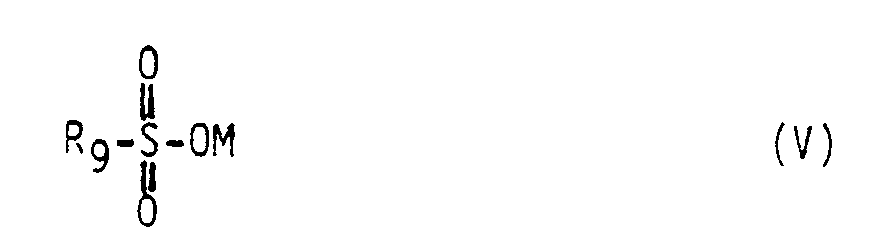
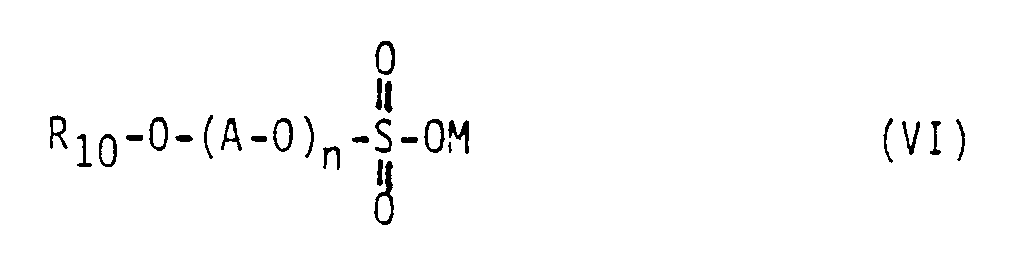
R₉ einen Phenylrest mit 1 bis 3 Substituenten, vorzugsweise aus der Gruppe der Kohlenwasserstoffreste, bedeutet, wobei die Summe der Kohlenstoffatome dieser Substituenten eine Zahl von 1 bis 9, vorzugsweise von 1 bis 6, sein kann,
R₁₀ für einen linearen oder verzweigten Kohlenwasserstoffrest mit 1 bis 10, vorzugsweise 2 bis 6, Kohlenstoffatomen,
M für ein Atomäquivalent eines ein- oder zweiwertigen Metalls, vorzugsweise eines Alkalimetalls, oder eine Ammonium- oder substituierte Ammoniumgruppe steht, während
A und n die in Formel I angegebenen Bedeutungen haben,
Priority Applications (1)
| Application Number | Priority Date | Filing Date | Title |
|---|---|---|---|
| AT89100697T ATE72966T1 (de) | 1988-03-17 | 1989-01-17 | Fliessfaehige perlglanzdispersion und deren verwendung. |
Applications Claiming Priority (2)
| Application Number | Priority Date | Filing Date | Title |
|---|---|---|---|
| DE3808881 | 1988-03-17 | ||
| DE3808881A DE3808881A1 (de) | 1988-03-17 | 1988-03-17 | Fliessfaehige perlglanzdispersion und deren verwendung |
Publications (3)
| Publication Number | Publication Date |
|---|---|
| EP0332805A2 true EP0332805A2 (de) | 1989-09-20 |
| EP0332805A3 EP0332805A3 (en) | 1990-04-25 |
| EP0332805B1 EP0332805B1 (de) | 1992-03-04 |
Family
ID=6349934
Family Applications (1)
| Application Number | Title | Priority Date | Filing Date |
|---|---|---|---|
| EP89100697A Expired - Lifetime EP0332805B1 (de) | 1988-03-17 | 1989-01-17 | Fliessfähige Perlglanzdispersion und deren Verwendung |
Country Status (7)
| Country | Link |
|---|---|
| EP (1) | EP0332805B1 (de) |
| JP (1) | JPH01293133A (de) |
| AT (1) | ATE72966T1 (de) |
| DE (2) | DE3808881A1 (de) |
| DK (1) | DK125689A (de) |
| ES (1) | ES2025046T3 (de) |
| NO (1) | NO891183L (de) |
Cited By (7)
| Publication number | Priority date | Publication date | Assignee | Title |
|---|---|---|---|---|
| EP0535693A1 (de) * | 1991-10-03 | 1993-04-07 | Kao Corporation | Flüssige Detergenszusammensetzung |
| EP0581193A3 (de) * | 1992-07-27 | 1995-05-17 | Hoechst Ag | Fliessfähige konservierungsmittelfreie Perlglanzdispersionen. |
| WO1996030475A1 (de) * | 1995-03-29 | 1996-10-03 | Henkel Kommanditgesellschaft Auf Aktien | Perlglanzkonzentrat |
| WO1997005224A1 (de) * | 1995-07-25 | 1997-02-13 | Henkel Kommanditgesellschaft Auf Aktien | Fliessfähiges perlglanzkonzentrat |
| EP2119430A1 (de) | 2007-03-12 | 2009-11-18 | Kao Corporation | Perlende zusammensetzung |
| EP3284809A1 (de) * | 2016-08-17 | 2018-02-21 | The Procter & Gamble Company | Reinigungsmittel |
| EP3571275A4 (de) * | 2017-01-20 | 2020-11-04 | Ecolab USA Inc. | Reinigungszusammensetzungen mit langkettigen anionischen tensiden |
Family Cites Families (3)
| Publication number | Priority date | Publication date | Assignee | Title |
|---|---|---|---|---|
| DE3506543A1 (de) * | 1985-02-25 | 1986-08-28 | Henkel KGaA, 4000 Düsseldorf | Haarspuelmittel mit perlglanzeffekt |
| DE3519080A1 (de) * | 1985-05-28 | 1986-12-04 | Henkel Kgaa | Fliessfaehiges perlglanzkonzentrat |
| DE3640755A1 (de) * | 1986-11-28 | 1988-06-09 | Henkel Kgaa | Fliessfaehiges perlglanzkonzentrat |
-
1988
- 1988-03-17 DE DE3808881A patent/DE3808881A1/de not_active Withdrawn
-
1989
- 1989-01-17 ES ES198989100697T patent/ES2025046T3/es not_active Expired - Lifetime
- 1989-01-17 EP EP89100697A patent/EP0332805B1/de not_active Expired - Lifetime
- 1989-01-17 AT AT89100697T patent/ATE72966T1/de not_active IP Right Cessation
- 1989-01-17 DE DE8989100697T patent/DE58900883D1/de not_active Expired - Lifetime
- 1989-03-15 DK DK125689A patent/DK125689A/da not_active Application Discontinuation
- 1989-03-15 JP JP1061073A patent/JPH01293133A/ja active Pending
- 1989-03-17 NO NO89891183A patent/NO891183L/no unknown
Cited By (14)
| Publication number | Priority date | Publication date | Assignee | Title |
|---|---|---|---|---|
| EP0535693A1 (de) * | 1991-10-03 | 1993-04-07 | Kao Corporation | Flüssige Detergenszusammensetzung |
| US5466395A (en) * | 1991-10-03 | 1995-11-14 | Kao Corporation | Liquid detergent composition |
| EP0581193A3 (de) * | 1992-07-27 | 1995-05-17 | Hoechst Ag | Fliessfähige konservierungsmittelfreie Perlglanzdispersionen. |
| WO1996030475A1 (de) * | 1995-03-29 | 1996-10-03 | Henkel Kommanditgesellschaft Auf Aktien | Perlglanzkonzentrat |
| WO1997005224A1 (de) * | 1995-07-25 | 1997-02-13 | Henkel Kommanditgesellschaft Auf Aktien | Fliessfähiges perlglanzkonzentrat |
| US6147124A (en) * | 1995-07-25 | 2000-11-14 | Henkel Kommanditgesellschaft Auf Aktien | Pourable nacreous lustre concentrate |
| EP2119430A1 (de) | 2007-03-12 | 2009-11-18 | Kao Corporation | Perlende zusammensetzung |
| EP2119430A4 (de) * | 2007-03-12 | 2013-08-14 | Kao Corp | Perlende zusammensetzung |
| US8529788B2 (en) | 2007-03-12 | 2013-09-10 | Kao Corporation | Pearlescent composition |
| EP3284809A1 (de) * | 2016-08-17 | 2018-02-21 | The Procter & Gamble Company | Reinigungsmittel |
| WO2018035191A1 (en) * | 2016-08-17 | 2018-02-22 | The Procter & Gamble Company | Cleaning composition |
| EP3571275A4 (de) * | 2017-01-20 | 2020-11-04 | Ecolab USA Inc. | Reinigungszusammensetzungen mit langkettigen anionischen tensiden |
| US11591546B2 (en) | 2017-01-20 | 2023-02-28 | Ecolab Usa Inc. | Cleaning compositions employing extended chain anionic surfactants |
| US12077726B2 (en) | 2017-01-20 | 2024-09-03 | Ecolab Usa Inc. | Cleaning compositions employing extended chain anionic surfactants |
Also Published As
| Publication number | Publication date |
|---|---|
| EP0332805B1 (de) | 1992-03-04 |
| DK125689A (da) | 1989-09-18 |
| JPH01293133A (ja) | 1989-11-27 |
| NO891183D0 (no) | 1989-03-17 |
| DK125689D0 (da) | 1989-03-15 |
| DE3808881A1 (de) | 1989-09-28 |
| ES2025046A4 (es) | 1992-03-16 |
| DE58900883D1 (de) | 1992-04-09 |
| ES2025046T3 (es) | 1993-05-01 |
| NO891183L (no) | 1989-09-18 |
| ATE72966T1 (de) | 1992-03-15 |
| EP0332805A3 (en) | 1990-04-25 |
Similar Documents
| Publication | Publication Date | Title |
|---|---|---|
| EP0569843B1 (de) | Nichtionische, fliessfähige Perlglanzdispersionen | |
| EP0268992B1 (de) | Fliessfähiges Perlglanzkonzentrat | |
| EP0376083B1 (de) | Fliessfähiges Perlglanzkonzentrat | |
| DE3686381T2 (de) | Oberflaechenaktive stoffe und deren verwendung in reinigungsmitteln. | |
| EP0570398B1 (de) | Fliessfähiges perlglanzkonzentrat | |
| EP0158174B1 (de) | Nichtionische, fliessfähige Perlglanzdispersionen | |
| EP0205922B1 (de) | Fliessfähiges Perlglanzkonzentrat | |
| EP3359632B1 (de) | Zusammensetzungen enthaltend zuckeramin und fettsäure | |
| EP0164058B1 (de) | Fliessfähige Perlglanzdispersion mit niedrigem Tensidanteil | |
| DE3724547A1 (de) | Alkanolamidfreies perlglanzkonzentrat | |
| EP0542801A1 (de) | Flüssiges, fliess- und pumpfähiges tensidkonzentrat. | |
| DE3708425A1 (de) | Pumpfaehige kationische fettalkoholdispersion | |
| EP0332805B1 (de) | Fliessfähige Perlglanzdispersion und deren Verwendung | |
| EP0817609A1 (de) | Perlglanzkonzentrat mit newton'schem viskositätsverhalten | |
| DE69008591T2 (de) | Amidierte Fettsäuremischungen und Verwendung davon als Verdickungsmittel. | |
| DE69932706T2 (de) | Verbesserte alkanolamide | |
| EP0684302A1 (de) | Wässrige, fliessfähige Perlglanzkonzentrate | |
| EP0846752A2 (de) | Fliessfähige, wässrige Perlglanzdispersion mit Behensäure als perlglanzgebender Komponente | |
| EP0492228A1 (de) | Verfahren zur Herstellung fliessfähiger wässriger Dispersionen von Betainen | |
| DE1095975B (de) | Fluessiges, undurchsichtiges Reinigungsmittel | |
| WO1996030475A1 (de) | Perlglanzkonzentrat | |
| WO1998020850A1 (de) | Verfahren zur herstellung einer fliessfähigen, wässrigen perlglanzdispersion mit fettsäure als perlglanzgebender komponente | |
| EP0728836A2 (de) | Lagerstabile, konzentrierte Tensidzusammensetzung auf der Basis von Alkylglucosiden | |
| DE4229589A1 (de) | Flüssige alkalische Reinigungsmittel mit einem Gehalt an sulfoölsauren Disalzen und deren Verwendung |
Legal Events
| Date | Code | Title | Description |
|---|---|---|---|
| PUAI | Public reference made under article 153(3) epc to a published international application that has entered the european phase |
Free format text: ORIGINAL CODE: 0009012 |
|
| AK | Designated contracting states |
Kind code of ref document: A2 Designated state(s): AT BE CH DE ES FR GB IT LI NL SE |
|
| PUAL | Search report despatched |
Free format text: ORIGINAL CODE: 0009013 |
|
| AK | Designated contracting states |
Kind code of ref document: A3 Designated state(s): AT BE CH DE ES FR GB IT LI NL SE |
|
| 17P | Request for examination filed |
Effective date: 19900410 |
|
| 17Q | First examination report despatched |
Effective date: 19910802 |
|
| GRAA | (expected) grant |
Free format text: ORIGINAL CODE: 0009210 |
|
| AK | Designated contracting states |
Kind code of ref document: B1 Designated state(s): AT BE CH DE ES FR GB IT LI NL SE |
|
| PG25 | Lapsed in a contracting state [announced via postgrant information from national office to epo] |
Ref country code: IT Free format text: LAPSE BECAUSE OF FAILURE TO SUBMIT A TRANSLATION OF THE DESCRIPTION OR TO PAY THE FEE WITHIN THE PRESCRIBED TIME-LIMIT;WARNING: LAPSES OF ITALIAN PATENTS WITH EFFECTIVE DATE BEFORE 2007 MAY HAVE OCCURRED AT ANY TIME BEFORE 2007. THE CORRECT EFFECTIVE DATE MAY BE DIFFERENT FROM THE ONE RECORDED. Effective date: 19920304 |
|
| REF | Corresponds to: |
Ref document number: 72966 Country of ref document: AT Date of ref document: 19920315 Kind code of ref document: T |
|
| REF | Corresponds to: |
Ref document number: 58900883 Country of ref document: DE Date of ref document: 19920409 |
|
| ET | Fr: translation filed | ||
| GBT | Gb: translation of ep patent filed (gb section 77(6)(a)/1977) | ||
| PLBE | No opposition filed within time limit |
Free format text: ORIGINAL CODE: 0009261 |
|
| STAA | Information on the status of an ep patent application or granted ep patent |
Free format text: STATUS: NO OPPOSITION FILED WITHIN TIME LIMIT |
|
| PG25 | Lapsed in a contracting state [announced via postgrant information from national office to epo] |
Ref country code: GB Effective date: 19930117 Ref country code: AT Effective date: 19930117 |
|
| PG25 | Lapsed in a contracting state [announced via postgrant information from national office to epo] |
Ref country code: SE Effective date: 19930118 Ref country code: ES Free format text: LAPSE BECAUSE OF NON-PAYMENT OF DUE FEES Effective date: 19930118 |
|
| PG25 | Lapsed in a contracting state [announced via postgrant information from national office to epo] |
Ref country code: CH Effective date: 19930131 Ref country code: BE Effective date: 19930131 Ref country code: LI Effective date: 19930131 |
|
| 26N | No opposition filed | ||
| REG | Reference to a national code |
Ref country code: ES Ref legal event code: FG2A Ref document number: 2025046 Country of ref document: ES Kind code of ref document: T3 |
|
| BERE | Be: lapsed |
Owner name: HULS A.G. Effective date: 19930131 |
|
| PG25 | Lapsed in a contracting state [announced via postgrant information from national office to epo] |
Ref country code: NL Effective date: 19930801 |
|
| GBPC | Gb: european patent ceased through non-payment of renewal fee |
Effective date: 19930117 |
|
| NLV4 | Nl: lapsed or anulled due to non-payment of the annual fee | ||
| PG25 | Lapsed in a contracting state [announced via postgrant information from national office to epo] |
Ref country code: FR Effective date: 19930930 |
|
| REG | Reference to a national code |
Ref country code: CH Ref legal event code: PL |
|
| PG25 | Lapsed in a contracting state [announced via postgrant information from national office to epo] |
Ref country code: DE Effective date: 19931001 |
|
| REG | Reference to a national code |
Ref country code: FR Ref legal event code: ST |
|
| EUG | Se: european patent has lapsed |
Ref document number: 89100697.5 Effective date: 19930810 |
|
| REG | Reference to a national code |
Ref country code: ES Ref legal event code: FD2A Effective date: 19990201 |