EP0332691B1 - Verfahren und anlage zur rückgewinnung von organischen stoffen und entfernung von schlachthausblutabfällen - Google Patents
Verfahren und anlage zur rückgewinnung von organischen stoffen und entfernung von schlachthausblutabfällen Download PDFInfo
- Publication number
- EP0332691B1 EP0332691B1 EP88908708A EP88908708A EP0332691B1 EP 0332691 B1 EP0332691 B1 EP 0332691B1 EP 88908708 A EP88908708 A EP 88908708A EP 88908708 A EP88908708 A EP 88908708A EP 0332691 B1 EP0332691 B1 EP 0332691B1
- Authority
- EP
- European Patent Office
- Prior art keywords
- blood
- reactors
- hand
- product
- reactor
- Prior art date
- Legal status (The legal status is an assumption and is not a legal conclusion. Google has not performed a legal analysis and makes no representation as to the accuracy of the status listed.)
- Expired - Lifetime
Links
- 239000008280 blood Substances 0.000 title claims abstract description 48
- 210000004369 blood Anatomy 0.000 title claims abstract description 48
- 238000000034 method Methods 0.000 title claims abstract description 18
- 239000011368 organic material Substances 0.000 title abstract description 3
- 239000000047 product Substances 0.000 claims abstract description 22
- 239000000706 filtrate Substances 0.000 claims abstract description 9
- 239000006185 dispersion Substances 0.000 claims abstract description 7
- 238000011282 treatment Methods 0.000 claims description 13
- RBTARNINKXHZNM-UHFFFAOYSA-K iron trichloride Chemical compound Cl[Fe](Cl)Cl RBTARNINKXHZNM-UHFFFAOYSA-K 0.000 claims description 11
- 229910021578 Iron(III) chloride Inorganic materials 0.000 claims description 10
- 230000008569 process Effects 0.000 claims description 10
- 241001465754 Metazoa Species 0.000 claims description 8
- 238000001914 filtration Methods 0.000 claims description 7
- 239000005416 organic matter Substances 0.000 claims description 7
- 239000000203 mixture Substances 0.000 claims description 6
- 235000008733 Citrus aurantifolia Nutrition 0.000 claims description 5
- KWYUFKZDYYNOTN-UHFFFAOYSA-M Potassium hydroxide Chemical compound [OH-].[K+] KWYUFKZDYYNOTN-UHFFFAOYSA-M 0.000 claims description 5
- 235000011941 Tilia x europaea Nutrition 0.000 claims description 5
- 239000004571 lime Substances 0.000 claims description 5
- 239000012065 filter cake Substances 0.000 claims description 4
- 108090000623 proteins and genes Proteins 0.000 claims description 4
- 102000004169 proteins and genes Human genes 0.000 claims description 4
- 238000011084 recovery Methods 0.000 claims description 3
- 238000003307 slaughter Methods 0.000 claims description 3
- 230000009471 action Effects 0.000 claims description 2
- 238000002156 mixing Methods 0.000 claims description 2
- 239000002245 particle Substances 0.000 claims description 2
- 239000002699 waste material Substances 0.000 claims description 2
- HEMHJVSKTPXQMS-UHFFFAOYSA-M Sodium hydroxide Chemical compound [OH-].[Na+] HEMHJVSKTPXQMS-UHFFFAOYSA-M 0.000 claims 3
- 239000000654 additive Substances 0.000 claims 1
- 239000007787 solid Substances 0.000 claims 1
- 150000003839 salts Chemical class 0.000 abstract description 19
- 229910052751 metal Inorganic materials 0.000 abstract description 8
- 239000002184 metal Substances 0.000 abstract description 8
- 238000000926 separation method Methods 0.000 description 5
- 238000012546 transfer Methods 0.000 description 5
- 230000015572 biosynthetic process Effects 0.000 description 3
- 238000005345 coagulation Methods 0.000 description 3
- 230000015271 coagulation Effects 0.000 description 3
- 230000000694 effects Effects 0.000 description 3
- 229910052500 inorganic mineral Inorganic materials 0.000 description 3
- 239000011707 mineral Substances 0.000 description 3
- 235000010755 mineral Nutrition 0.000 description 3
- XLYOFNOQVPJJNP-UHFFFAOYSA-N water Substances O XLYOFNOQVPJJNP-UHFFFAOYSA-N 0.000 description 3
- CDBYLPFSWZWCQE-UHFFFAOYSA-L Sodium Carbonate Chemical compound [Na+].[Na+].[O-]C([O-])=O CDBYLPFSWZWCQE-UHFFFAOYSA-L 0.000 description 2
- 241001080024 Telles Species 0.000 description 2
- 238000005119 centrifugation Methods 0.000 description 2
- 238000006243 chemical reaction Methods 0.000 description 2
- 238000010586 diagram Methods 0.000 description 2
- 239000007788 liquid Substances 0.000 description 2
- 239000000463 material Substances 0.000 description 2
- 230000007935 neutral effect Effects 0.000 description 2
- 229940072033 potash Drugs 0.000 description 2
- BWHMMNNQKKPAPP-UHFFFAOYSA-L potassium carbonate Substances [K+].[K+].[O-]C([O-])=O BWHMMNNQKKPAPP-UHFFFAOYSA-L 0.000 description 2
- 235000015320 potassium carbonate Nutrition 0.000 description 2
- 239000000243 solution Substances 0.000 description 2
- 238000003860 storage Methods 0.000 description 2
- 239000000126 substance Substances 0.000 description 2
- 239000002351 wastewater Substances 0.000 description 2
- 208000031295 Animal disease Diseases 0.000 description 1
- 101100536354 Drosophila melanogaster tant gene Proteins 0.000 description 1
- 241000196324 Embryophyta Species 0.000 description 1
- 240000008042 Zea mays Species 0.000 description 1
- 238000009825 accumulation Methods 0.000 description 1
- 239000011149 active material Substances 0.000 description 1
- 239000002671 adjuvant Substances 0.000 description 1
- 238000005054 agglomeration Methods 0.000 description 1
- 230000002776 aggregation Effects 0.000 description 1
- 238000013019 agitation Methods 0.000 description 1
- AZDRQVAHHNSJOQ-UHFFFAOYSA-N alumane Chemical class [AlH3] AZDRQVAHHNSJOQ-UHFFFAOYSA-N 0.000 description 1
- 239000012736 aqueous medium Substances 0.000 description 1
- 239000007864 aqueous solution Substances 0.000 description 1
- 239000007900 aqueous suspension Substances 0.000 description 1
- QVGXLLKOCUKJST-UHFFFAOYSA-N atomic oxygen Chemical compound [O] QVGXLLKOCUKJST-UHFFFAOYSA-N 0.000 description 1
- 230000005540 biological transmission Effects 0.000 description 1
- 230000000740 bleeding effect Effects 0.000 description 1
- 238000012512 characterization method Methods 0.000 description 1
- 239000003153 chemical reaction reagent Substances 0.000 description 1
- 239000003638 chemical reducing agent Substances 0.000 description 1
- 238000013461 design Methods 0.000 description 1
- 238000011161 development Methods 0.000 description 1
- 238000000855 fermentation Methods 0.000 description 1
- 230000004151 fermentation Effects 0.000 description 1
- 235000013305 food Nutrition 0.000 description 1
- 239000003205 fragrance Substances 0.000 description 1
- 238000010438 heat treatment Methods 0.000 description 1
- 238000000265 homogenisation Methods 0.000 description 1
- 238000002347 injection Methods 0.000 description 1
- 239000007924 injection Substances 0.000 description 1
- 238000002955 isolation Methods 0.000 description 1
- 235000013372 meat Nutrition 0.000 description 1
- 238000010297 mechanical methods and process Methods 0.000 description 1
- 238000006386 neutralization reaction Methods 0.000 description 1
- 210000000056 organ Anatomy 0.000 description 1
- 229910052760 oxygen Inorganic materials 0.000 description 1
- 239000001301 oxygen Substances 0.000 description 1
- 239000000843 powder Substances 0.000 description 1
- 238000003825 pressing Methods 0.000 description 1
- 238000012545 processing Methods 0.000 description 1
- 230000001737 promoting effect Effects 0.000 description 1
- 230000007115 recruitment Effects 0.000 description 1
- 210000002966 serum Anatomy 0.000 description 1
- 238000007711 solidification Methods 0.000 description 1
- 230000008023 solidification Effects 0.000 description 1
- 229910001220 stainless steel Inorganic materials 0.000 description 1
- 239000010935 stainless steel Substances 0.000 description 1
- 239000000725 suspension Substances 0.000 description 1
- 230000000659 thermocoagulation Effects 0.000 description 1
- 238000012549 training Methods 0.000 description 1
- 230000009466 transformation Effects 0.000 description 1
- 239000013598 vector Substances 0.000 description 1
- 238000005406 washing Methods 0.000 description 1
- 150000003751 zinc Chemical class 0.000 description 1
Images

Classifications
-
- A—HUMAN NECESSITIES
- A22—BUTCHERING; MEAT TREATMENT; PROCESSING POULTRY OR FISH
- A22B—SLAUGHTERING
- A22B5/00—Accessories for use during or after slaughtering
- A22B5/04—Blood-collecting apparatus; Blood-stirring devices
-
- A—HUMAN NECESSITIES
- A23—FOODS OR FOODSTUFFS; TREATMENT THEREOF, NOT COVERED BY OTHER CLASSES
- A23J—PROTEIN COMPOSITIONS FOR FOODSTUFFS; WORKING-UP PROTEINS FOR FOODSTUFFS; PHOSPHATIDE COMPOSITIONS FOR FOODSTUFFS
- A23J1/00—Obtaining protein compositions for foodstuffs; Bulk opening of eggs and separation of yolks from whites
- A23J1/06—Obtaining protein compositions for foodstuffs; Bulk opening of eggs and separation of yolks from whites from blood
Definitions
- the present invention relates to a method and an apparatus for recovering organic matter and for removing slaughterhouse blood residues.
- the blood represents a very special problem because it is a dilute aqueous mixture which degrades very quickly as soon as it comes into contact with oxygen. air, of a strongly odorous product whose very rapid natural fermentation further increases the olfactory nuisances of a biological suspension in which the vectors of animal diseases are sometimes present and can easily multiply.
- thermo-coagulation In recent years, to overcome the aforementioned drawbacks, a technique called thermo-coagulation has been implemented. This technique consists of injecting live steam into a blood stream to obtain the coagulation of proteins and then the coagulated fraction is separated from its serum by passage through a centrifuge.
- the subject of the present invention is a method and an apparatus for recovering organic materials and for eliminating residues of blood from slaughterhouses which remedy the drawbacks of the prior art.
- contacting, metering and then separation of aqueous solutions or suspensions is provided, in particular of biological liquids rich in proteins, such as blood, hydrolysates or autolysates in order to obtain coagulation and then expression of the water from the coagulates and finally the separation into two fractions: one containing all of the dry extract in the form of a filter cake containing approximately 35 to 45% of active materials with 55 to 65% of waste water, the other the filtrate containing the soluble parts, the salts or the smallest organic molecules at a rate of approximately 2% of initial dry extract in the aqueous medium.
- biological liquids rich in proteins such as blood, hydrolysates or autolysates
- the method according to the present invention provides for bringing two chemicals into contact with the solution to be treated either successively or after prior mixing.
- the present invention also provides an apparatus for recovering organic matter and eliminating blood residues from slaughterhouses, which is characterized in that it comprises an assembly consisting of at least two reactors each driven in a rotational movement, said assembly being connected on the one hand to a means of collecting products to be treated and on the other hand to two metering pumps which convey the solutions necessary for the treatment while the assembly turns and after the treatment the product passes through a device for filtration to obtain both a filter cake and a filtrate.
- Fig. 1 is a block diagram illustrating the process of the invention.
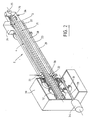
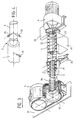
- Fig. 2 is an exploded perspective view of two superposed reactors.
- Fig. 3 is an exploded perspective view of two aligned reactors.
- Fig. 4 is a perspective view of two aligned reactors partially illustrated.
- the apparatus of the present invention is designated as a whole by 1. It comprises a set 2 containing at least two reactors 3, 4.
- the reactors 3, 4 are each controlled by geared motors 5, 6.
- a pipe 7 connects the bleed trough 8 used for collecting the blood to be treated to the first tubular reactor 3.
- a booster pump 9 is interposed between the bleed trough 8 and the first tubular reactor 3.
- a metering pump 10 delivers via a conduit 11 ferric chloride FeCl3 in the first reactor 3 while a second pump 12 delivers via a conduit 13 a strong base such as soda, potash or lime via the conduit 13 to the reactor 3.
- the blood to be treated subjected to a movement of rotation and agitation via the gearmotors 5, 6 having received one part meta salt llique and on the other hand the base is separated in a separation means 14 comprising a filtration device 15 to give on the one hand a filter cake 17 and on the other hand a filtrate 18, the filtration device 15 being itself even in the embodiment according to FIG. 1 which has just been described above driven by a geared motor 16.
- FIGS. 2 to 4 Before describing in more detail the apparatus according to the present invention as it is more particularly illustrated in FIGS. 2 to 4, the process will be described by referring once again to the block diagram of FIG. 1.
- the blood collected from the bleeding trough 8 passes through a homogenization and calibration device not shown in the drawings which comprises a sieve so as to regularize the particle size of said blood.
- the blood is then tangentially injected at the head of the first reactor 3 in which a mechanical device such as the gear motor 5 provides a constant rotational movement to form a thin layer vortex on the inner periphery of the body of the reactor 3.
- the filtered filtered blood of such a centrifugal movement receives the addition via the device 10 and the conduit 11 of a mineral metal salt in an amount of 20 to 50 g of salt per liter of blood, continuously, at room temperature.
- the addition of metallic salt, in particular ferric chloride has the effect of considerably modifying the structure of the blood which becomes an agglomerated and compact product whose transit inside the reactor can only be guaranteed by a mechanical action of the organ transfer.
- the transfer means which is described below in connection with FIGS. 2, 3 and 4 is a propeller, a piston, a turn, a spring and more generally any mechanical means of movement.
- a strong base is introduced via the device 12 and the conduit 13 in an amount of 10 to 50 g of base per kg of agglomerated blood in the second reactor 4 which is also driven in a rotational movement by means of the geared motor 6.
- the geared motor 6 is usually identical in design to the first geared motor 5 and is situated either in the extension of the latter, as illustrated in Figure 1 or it is superimposed on this first reactor as we will explain it below in conjunction with Figure 2.
- Figures 2 and 3 illustrate two particularly preferred embodiments of the invention. According to the embodiment of Figure 2 which illustrates two superimposed reactors where the outer wall of the reactor 3 serves as a centering tube for the transport and transit member, the contacting is always a few seconds because it must be done in a very thin layer, which is possible with the set of reactors 2 illustrated.
- the product to be treated in the example considered of the blood enters at 25 and leaves at 24.
- the metal salt is injected into the first reactor 3 at 26.
- the first reactor 3 comprises, over its entire length, concentric turns 20 surrounding an internal guide of centering 21.
- the first tubular reactor 3 is located above the second tubular reactor 4.
- the product to be treated having received the injection of metallic salt is brought into an annular reaction zone of the first reactor 3 where there is formation of a vortex and transfer by the turns 20 and the internal guide 21.
- the turns can be replaced by blades, lugs or fingers capable of promoting the regular transit of the material during the reaction despite the tendency to agglomeration or adhesion to the walls of the reactor (s).
- the agglomerated product resulting from the salt treatment is neutralized with level of the annular zone 29 of the second reactor 4 with the formation of a vortex and transfer of the product via both the concentric turns 22 of the second reactor 4 and the internal centering guide 23 of the second reactor 4.
- the concentric turns 20 and 22 of reactors 3 and 4 can be, for example, stainless steel turns.
- the two reactors are driven in a rotational movement by means of a motor 34 transmitting its power by a shaft 33 with lower gears 31 and upper gears 32.
- the engine assembly and transmission is housed in a control unit 30.
- the principle of implementation of the present invention simply differs in that the two reactors 3 and 4 are aligned instead of being superimposed.
- the reactor 3 is driven by a geared motor 5 while the reactor 4 is driven by a geared motor 6.
- the two geared motors 5 and 6 have supports 37 and 36 respectively.
- the driving of the motorcycle -reducer 5 is transmitted to the reactor 3 by a nozzle 19.
- 35 represents a support for the reactors 3 and 4.
- the speed of rotation of the reactors 3 and 4 is from 200 to 1000 rpm and the reactors 3 and 4 allow several m3 of blood to be treated per hour although there is no limitation as to the quantity of treatment. It is easy to understand that the reactors as illustrated in FIGS.
- each reactor 3 4 an annular zone designated by 28 for the first reactor 3 and designated by 29 in the second reactor 4, annular zones in which is printed a vortex for the transfer of the product during treatment.
- FIG. 4 simply illustrates how the product to be treated is injected at 25, the salt is introduced at 26 and the base at 27.
- the salt is introduced at 26 and the base at 27.
- the first treatment preferably ferric chloride is used, but it is also possible to use a zinc salt, an aluminum salt in appropriate amounts.
- the pH of the blood is in the range of 6.8 to 7.1 and the addition of the ferric salt according to the present invention which is preferably FeCl3 but can also be Fe2 (SO4) 3 leads to a solidification of the blood and this product then has a pH appreciably in the range of 2.
- the base which is generally lime in the product treated with the metal salt and which has therefore been acidified, obtains a dispersion of the agglomerate having two distinct phases although they are mixed. It is then possible to carry out a separation either by filtration or by centrifugation and to obtain a pulp which is a valuable product and a filtrate which can be treated and in particular rejected.
- the apparatus according to the present invention is an apparatus working in a thin layer and ensuring continuous transit.
- the present invention therefore provides a simple mechanical method and means making it possible to successively obtain the dosage of the components and the adjuvants continuously, the bringing of the products for the first treatment with the metal salt and the neutralization with the strong base finally the separation of the different phases obtained.
Landscapes
- Life Sciences & Earth Sciences (AREA)
- Engineering & Computer Science (AREA)
- Chemical & Material Sciences (AREA)
- Food Science & Technology (AREA)
- Zoology (AREA)
- Hematology (AREA)
- Health & Medical Sciences (AREA)
- General Health & Medical Sciences (AREA)
- Biochemistry (AREA)
- Polymers & Plastics (AREA)
- External Artificial Organs (AREA)
- Processing Of Solid Wastes (AREA)
- Fertilizers (AREA)
- Medicines Containing Material From Animals Or Micro-Organisms (AREA)
- Paper (AREA)
Claims (7)
Priority Applications (1)
| Application Number | Priority Date | Filing Date | Title |
|---|---|---|---|
| AT88908708T ATE78986T1 (de) | 1987-09-29 | 1988-09-29 | Verfahren und anlage zur rueckgewinnung von organischen stoffen und entfernung von schlachthausblutabfaellen. |
Applications Claiming Priority (2)
| Application Number | Priority Date | Filing Date | Title |
|---|---|---|---|
| FR8713459A FR2620901B1 (fr) | 1987-09-29 | 1987-09-29 | Procede et appareil de recuperation de matieres organiques et d'elimination de residus de sang d'abattoirs |
| FR8713459 | 1987-09-29 |
Publications (2)
| Publication Number | Publication Date |
|---|---|
| EP0332691A1 EP0332691A1 (de) | 1989-09-20 |
| EP0332691B1 true EP0332691B1 (de) | 1992-08-05 |
Family
ID=9355336
Family Applications (1)
| Application Number | Title | Priority Date | Filing Date |
|---|---|---|---|
| EP88908708A Expired - Lifetime EP0332691B1 (de) | 1987-09-29 | 1988-09-29 | Verfahren und anlage zur rückgewinnung von organischen stoffen und entfernung von schlachthausblutabfällen |
Country Status (5)
| Country | Link |
|---|---|
| EP (1) | EP0332691B1 (de) |
| AT (1) | ATE78986T1 (de) |
| DE (1) | DE3873517T2 (de) |
| FR (1) | FR2620901B1 (de) |
| WO (1) | WO1989002704A1 (de) |
Families Citing this family (1)
| Publication number | Priority date | Publication date | Assignee | Title |
|---|---|---|---|---|
| RU2484639C2 (ru) * | 2011-03-16 | 2013-06-20 | Государственное образовательное учреждение высшего профессионального образования Кемеровский технологический институт пищевой промышленности | Устройство для переработки крови сельскохозяйственных животных и его применение |
Family Cites Families (2)
| Publication number | Priority date | Publication date | Assignee | Title |
|---|---|---|---|---|
| FR2485390A1 (fr) * | 1980-06-26 | 1981-12-31 | Garap | Dispositif d'homogeneisation de liquides et application de ce dispositif au traitement et a la cuisson de cruor provenant du sang d'animaux |
| HUT40311A (en) * | 1983-06-03 | 1986-12-28 | Kiskunhalasi Aag | Process for producing protein concentrates, blood-curd and nutriments from blood and its elements |
-
1987
- 1987-09-29 FR FR8713459A patent/FR2620901B1/fr not_active Expired - Lifetime
-
1988
- 1988-09-29 DE DE8888908708T patent/DE3873517T2/de not_active Expired - Fee Related
- 1988-09-29 WO PCT/FR1988/000481 patent/WO1989002704A1/fr not_active Ceased
- 1988-09-29 EP EP88908708A patent/EP0332691B1/de not_active Expired - Lifetime
- 1988-09-29 AT AT88908708T patent/ATE78986T1/de active
Non-Patent Citations (1)
| Title |
|---|
| Journal of Agricultural and Food Chemistry, volume 30, no. 4, July-August 1982 (Washington, US) T.M. Jones et al.: "Characterization of coagulant-protein complexes produced by chemical coagulation of industrial whole animal blood", pages 715-719, see page 715 * |
Also Published As
| Publication number | Publication date |
|---|---|
| FR2620901B1 (fr) | 1990-02-02 |
| ATE78986T1 (de) | 1992-08-15 |
| DE3873517T2 (de) | 1993-03-11 |
| FR2620901A1 (fr) | 1989-03-31 |
| DE3873517D1 (de) | 1992-09-10 |
| WO1989002704A1 (fr) | 1989-04-06 |
| EP0332691A1 (de) | 1989-09-20 |
Similar Documents
| Publication | Publication Date | Title |
|---|---|---|
| US5122233A (en) | Apparatus for the treatment of mixture of brines and contaminated mineral salts | |
| CN1050217A (zh) | 从流体物料中提取含脂肪及蛋白质的物质的方法和设备 | |
| US4119619A (en) | Emulsification method for the processing of kriel to produce protein, lipids and chitin | |
| CS248009B2 (en) | Separation method of the solid materials from liquid contanings solid substances coagulated by the effect of heat and/or solid substances whose content of humidity is reducable by effect of heat and apparatus to perform this method | |
| DK141521B (da) | Fremgangsmåde til kontinuerligt under tryk at hydrolysere de ved fjerkræoparbejdning opnåede biprodukter og apparat til udøvelse af fremgangsmåden. | |
| CN110944761A (zh) | 甲壳废物处理方法 | |
| FI86068B (fi) | Foerfarande foer framstaellning av kitosan och andra produkter fraon skal av organismer, isynnerhet fraon skal av havsorganismer. | |
| KR20160034261A (ko) | 원료로부터 오염물질의 제거를 위한 방법 | |
| EP0332691A1 (de) | Verfahren und anlage zur rückgewinnung von organischen stoffen und entfernung von schlachthausblutabfällen | |
| US5918819A (en) | Devices and methods for isolating seeds of vegetables and fruits and for releasing and separating same from coats | |
| EP0270532A1 (de) | Verfahren zur erzeugung von fischfleischmaterial | |
| FR2464924A1 (fr) | Procede et installation pour la concentration des boues | |
| CN220657519U (zh) | 一种用于虾蟹废弃物处理的反应罐 | |
| CN117138719B (zh) | 一种用于虾蟹废弃物处理的反应罐 | |
| CN1257185C (zh) | 制备水处理用促凝剂的方法 | |
| US3706571A (en) | Blood separation process | |
| CN219836202U (zh) | 一种化工用废水固液分离机 | |
| CN216688160U (zh) | 蚯蚓综合提取装置 | |
| CN213253325U (zh) | 一种水产加工污水处理系统 | |
| CN114920825B (zh) | 一种鱼胶原蛋白小肽螯合钙的快速制备方法 | |
| CN219991191U (zh) | 一种屠宰污水处理设备 | |
| CN114315953B (zh) | 蚯蚓综合提取的方法 | |
| SU1449165A1 (ru) | Центрифуга | |
| US2752286A (en) | Extraction of insulin from pancreas tissue | |
| JP2003081996A (ja) | 水産生物体の油分、たんぱく質の分離法及びその回収油 |
Legal Events
| Date | Code | Title | Description |
|---|---|---|---|
| PUAI | Public reference made under article 153(3) epc to a published international application that has entered the european phase |
Free format text: ORIGINAL CODE: 0009012 |
|
| AK | Designated contracting states |
Kind code of ref document: A1 Designated state(s): AT BE CH DE FR GB IT LI LU NL SE |
|
| 17P | Request for examination filed |
Effective date: 19891004 |
|
| 17Q | First examination report despatched |
Effective date: 19901108 |
|
| GRAA | (expected) grant |
Free format text: ORIGINAL CODE: 0009210 |
|
| AK | Designated contracting states |
Kind code of ref document: B1 Designated state(s): AT BE CH DE FR GB IT LI LU NL SE |
|
| REF | Corresponds to: |
Ref document number: 78986 Country of ref document: AT Date of ref document: 19920815 Kind code of ref document: T |
|
| REF | Corresponds to: |
Ref document number: 3873517 Country of ref document: DE Date of ref document: 19920910 |
|
| ITF | It: translation for a ep patent filed | ||
| GBT | Gb: translation of ep patent filed (gb section 77(6)(a)/1977) | ||
| PLBE | No opposition filed within time limit |
Free format text: ORIGINAL CODE: 0009261 |
|
| STAA | Information on the status of an ep patent application or granted ep patent |
Free format text: STATUS: NO OPPOSITION FILED WITHIN TIME LIMIT |
|
| 26N | No opposition filed | ||
| EPTA | Lu: last paid annual fee | ||
| PGFP | Annual fee paid to national office [announced via postgrant information from national office to epo] |
Ref country code: CH Payment date: 19941014 Year of fee payment: 7 |
|
| PGFP | Annual fee paid to national office [announced via postgrant information from national office to epo] |
Ref country code: AT Payment date: 19941017 Year of fee payment: 7 |
|
| EAL | Se: european patent in force in sweden |
Ref document number: 88908708.6 |
|
| PG25 | Lapsed in a contracting state [announced via postgrant information from national office to epo] |
Ref country code: AT Effective date: 19950929 |
|
| PG25 | Lapsed in a contracting state [announced via postgrant information from national office to epo] |
Ref country code: LI Effective date: 19950930 Ref country code: CH Effective date: 19950930 |
|
| REG | Reference to a national code |
Ref country code: CH Ref legal event code: PL |
|
| REG | Reference to a national code |
Ref country code: FR Ref legal event code: TP |
|
| PGFP | Annual fee paid to national office [announced via postgrant information from national office to epo] |
Ref country code: FR Payment date: 19960826 Year of fee payment: 9 |
|
| PGFP | Annual fee paid to national office [announced via postgrant information from national office to epo] |
Ref country code: LU Payment date: 19960901 Year of fee payment: 9 |
|
| PGFP | Annual fee paid to national office [announced via postgrant information from national office to epo] |
Ref country code: GB Payment date: 19960923 Year of fee payment: 9 |
|
| PGFP | Annual fee paid to national office [announced via postgrant information from national office to epo] |
Ref country code: NL Payment date: 19960924 Year of fee payment: 9 |
|
| PGFP | Annual fee paid to national office [announced via postgrant information from national office to epo] |
Ref country code: SE Payment date: 19960927 Year of fee payment: 9 |
|
| PGFP | Annual fee paid to national office [announced via postgrant information from national office to epo] |
Ref country code: BE Payment date: 19970402 Year of fee payment: 9 |
|
| PG25 | Lapsed in a contracting state [announced via postgrant information from national office to epo] |
Ref country code: LU Free format text: LAPSE BECAUSE OF NON-PAYMENT OF DUE FEES Effective date: 19970929 Ref country code: GB Free format text: LAPSE BECAUSE OF NON-PAYMENT OF DUE FEES Effective date: 19970929 |
|
| PG25 | Lapsed in a contracting state [announced via postgrant information from national office to epo] |
Ref country code: SE Free format text: LAPSE BECAUSE OF NON-PAYMENT OF DUE FEES Effective date: 19970930 Ref country code: FR Free format text: THE PATENT HAS BEEN ANNULLED BY A DECISION OF A NATIONAL AUTHORITY Effective date: 19970930 Ref country code: BE Free format text: LAPSE BECAUSE OF NON-PAYMENT OF DUE FEES Effective date: 19970930 |
|
| BERE | Be: lapsed |
Owner name: BOZEC ROBERT FRANCOIS Effective date: 19970930 |
|
| PG25 | Lapsed in a contracting state [announced via postgrant information from national office to epo] |
Ref country code: NL Free format text: LAPSE BECAUSE OF NON-PAYMENT OF DUE FEES Effective date: 19980401 |
|
| GBPC | Gb: european patent ceased through non-payment of renewal fee |
Effective date: 19970929 |
|
| NLV4 | Nl: lapsed or anulled due to non-payment of the annual fee |
Effective date: 19980401 |
|
| EUG | Se: european patent has lapsed |
Ref document number: 88908708.6 |
|
| REG | Reference to a national code |
Ref country code: FR Ref legal event code: ST |
|
| PGFP | Annual fee paid to national office [announced via postgrant information from national office to epo] |
Ref country code: DE Payment date: 19981116 Year of fee payment: 11 |
|
| PG25 | Lapsed in a contracting state [announced via postgrant information from national office to epo] |
Ref country code: DE Free format text: LAPSE BECAUSE OF NON-PAYMENT OF DUE FEES Effective date: 20000701 |
|
| PG25 | Lapsed in a contracting state [announced via postgrant information from national office to epo] |
Ref country code: IT Free format text: LAPSE BECAUSE OF NON-PAYMENT OF DUE FEES;WARNING: LAPSES OF ITALIAN PATENTS WITH EFFECTIVE DATE BEFORE 2007 MAY HAVE OCCURRED AT ANY TIME BEFORE 2007. THE CORRECT EFFECTIVE DATE MAY BE DIFFERENT FROM THE ONE RECORDED. Effective date: 20050929 |