EP0331965A2 - Mischungen aus Polyarylensulfiden, organischen Carbonaten, weiteren Thermoplasten und Glasfasern - Google Patents
Mischungen aus Polyarylensulfiden, organischen Carbonaten, weiteren Thermoplasten und Glasfasern Download PDFInfo
- Publication number
- EP0331965A2 EP0331965A2 EP89102965A EP89102965A EP0331965A2 EP 0331965 A2 EP0331965 A2 EP 0331965A2 EP 89102965 A EP89102965 A EP 89102965A EP 89102965 A EP89102965 A EP 89102965A EP 0331965 A2 EP0331965 A2 EP 0331965A2
- Authority
- EP
- European Patent Office
- Prior art keywords
- weight
- parts
- pps
- carbonates
- bis
- Prior art date
- Legal status (The legal status is an assumption and is not a legal conclusion. Google has not performed a legal analysis and makes no representation as to the accuracy of the status listed.)
- Withdrawn
Links
Classifications
-
- C—CHEMISTRY; METALLURGY
- C08—ORGANIC MACROMOLECULAR COMPOUNDS; THEIR PREPARATION OR CHEMICAL WORKING-UP; COMPOSITIONS BASED THEREON
- C08K—Use of inorganic or non-macromolecular organic substances as compounding ingredients
- C08K7/00—Use of ingredients characterised by shape
- C08K7/02—Fibres or whiskers
- C08K7/04—Fibres or whiskers inorganic
- C08K7/14—Glass
-
- C—CHEMISTRY; METALLURGY
- C08—ORGANIC MACROMOLECULAR COMPOUNDS; THEIR PREPARATION OR CHEMICAL WORKING-UP; COMPOSITIONS BASED THEREON
- C08L—COMPOSITIONS OF MACROMOLECULAR COMPOUNDS
- C08L81/00—Compositions of macromolecular compounds obtained by reactions forming in the main chain of the macromolecule a linkage containing sulfur with or without nitrogen, oxygen or carbon only; Compositions of polysulfones; Compositions of derivatives of such polymers
- C08L81/02—Polythioethers; Polythioether-ethers
-
- C—CHEMISTRY; METALLURGY
- C08—ORGANIC MACROMOLECULAR COMPOUNDS; THEIR PREPARATION OR CHEMICAL WORKING-UP; COMPOSITIONS BASED THEREON
- C08J—WORKING-UP; GENERAL PROCESSES OF COMPOUNDING; AFTER-TREATMENT NOT COVERED BY SUBCLASSES C08B, C08C, C08F, C08G or C08H
- C08J2381/00—Characterised by the use of macromolecular compounds obtained by reactions forming in the main chain of the macromolecule a linkage containing sulfur with or without nitrogen, oxygen, or carbon only; Polysulfones; Derivatives of such polymers
- C08J2381/02—Polythioethers; Polythioether-ethers
-
- C—CHEMISTRY; METALLURGY
- C08—ORGANIC MACROMOLECULAR COMPOUNDS; THEIR PREPARATION OR CHEMICAL WORKING-UP; COMPOSITIONS BASED THEREON
- C08L—COMPOSITIONS OF MACROMOLECULAR COMPOUNDS
- C08L67/00—Compositions of polyesters obtained by reactions forming a carboxylic ester link in the main chain; Compositions of derivatives of such polymers
-
- C—CHEMISTRY; METALLURGY
- C08—ORGANIC MACROMOLECULAR COMPOUNDS; THEIR PREPARATION OR CHEMICAL WORKING-UP; COMPOSITIONS BASED THEREON
- C08L—COMPOSITIONS OF MACROMOLECULAR COMPOUNDS
- C08L69/00—Compositions of polycarbonates; Compositions of derivatives of polycarbonates
-
- C—CHEMISTRY; METALLURGY
- C08—ORGANIC MACROMOLECULAR COMPOUNDS; THEIR PREPARATION OR CHEMICAL WORKING-UP; COMPOSITIONS BASED THEREON
- C08L—COMPOSITIONS OF MACROMOLECULAR COMPOUNDS
- C08L83/00—Compositions of macromolecular compounds obtained by reactions forming in the main chain of the macromolecule a linkage containing silicon with or without sulfur, nitrogen, oxygen or carbon only; Compositions of derivatives of such polymers
- C08L83/04—Polysiloxanes
-
- H—ELECTRICITY
- H05—ELECTRIC TECHNIQUES NOT OTHERWISE PROVIDED FOR
- H05K—PRINTED CIRCUITS; CASINGS OR CONSTRUCTIONAL DETAILS OF ELECTRIC APPARATUS; MANUFACTURE OF ASSEMBLAGES OF ELECTRICAL COMPONENTS
- H05K1/00—Printed circuits
- H05K1/02—Details
- H05K1/03—Use of materials for the substrate
- H05K1/0313—Organic insulating material
- H05K1/032—Organic insulating material consisting of one material
- H05K1/0333—Organic insulating material consisting of one material containing S
-
- H—ELECTRICITY
- H05—ELECTRIC TECHNIQUES NOT OTHERWISE PROVIDED FOR
- H05K—PRINTED CIRCUITS; CASINGS OR CONSTRUCTIONAL DETAILS OF ELECTRIC APPARATUS; MANUFACTURE OF ASSEMBLAGES OF ELECTRICAL COMPONENTS
- H05K1/00—Printed circuits
- H05K1/02—Details
- H05K1/03—Use of materials for the substrate
- H05K1/0313—Organic insulating material
- H05K1/0353—Organic insulating material consisting of two or more materials, e.g. two or more polymers, polymer + filler, + reinforcement
-
- H—ELECTRICITY
- H05—ELECTRIC TECHNIQUES NOT OTHERWISE PROVIDED FOR
- H05K—PRINTED CIRCUITS; CASINGS OR CONSTRUCTIONAL DETAILS OF ELECTRIC APPARATUS; MANUFACTURE OF ASSEMBLAGES OF ELECTRICAL COMPONENTS
- H05K3/00—Apparatus or processes for manufacturing printed circuits
- H05K3/10—Apparatus or processes for manufacturing printed circuits in which conductive material is applied to the insulating support in such a manner as to form the desired conductive pattern
- H05K3/18—Apparatus or processes for manufacturing printed circuits in which conductive material is applied to the insulating support in such a manner as to form the desired conductive pattern using precipitation techniques to apply the conductive material
- H05K3/181—Apparatus or processes for manufacturing printed circuits in which conductive material is applied to the insulating support in such a manner as to form the desired conductive pattern using precipitation techniques to apply the conductive material by electroless plating
Definitions
- the invention relates to mixtures of polyarylene sulfides, preferably polyphenylene sulfide (PPS), organic carbonates, other thermoplastics and glass fibers.
- PPS polyphenylene sulfide
- Polyarylene sulfides and their preparation, as well as their mixtures with various additives, are known (e.g. US-A-3 354 129, EP-A-171 021) and are commercially available.
- Unreinforced PPS has unsatisfactory mechanical properties for applications in the injection molding area, in particular bending or tensile strength and modulus of elasticity are often not sufficient in practice. It has therefore proven to be advantageous to improve the properties of PPS, for example by reinforcing with glass fibers or by mixing with other thermoplastics.
- blends of polyarylene sulfides preferably polyphenylene sulfide (PPS) with small amounts of organic carbonates and / or polyester carbonates and / or siloxane copolycarbonates and glass fibers and optionally other additives, are distinguished by their mechanical properties, e.g. Characterize toughness, flexural strength, edge fiber expansion etc.
- Organic carbonates which can be used according to the invention, such as aromatic and aliphatic and aliphatic-aromatic monomeric carbonates, oligocarbonates and polycarbonates, are known (for example H. Schnell, Chemistry and Physics of Polycarbonates, Interscience Publishers, New York 1964) and are commercially available (for example Makrolon®). They can have a molecular weight M w up to 200,000.
- the monomeric carbonates are, for example, commercially available or can be prepared analogously by known processes.
- monomeric aromatic carbonates such as diphenyl carbonate, bis-4,4 '- (tert-butylphenyl) carbonate, bis-4,4' - (isooctylphenyl) carbonate, bis- (dodecylphenyl) carbonate and reaction products such as are obtainable by reaction of diphenols with chloroformates of monophenols, ie bis-aryl carbonates of diphenols such as, for example, bis-phenyl carbonate of bisphenol-A, are used.
- monomeric aliphatic carbonates e.g. open-chain C3-C18 carbonates, C4-C14 cyclic carbonates and cyclic ethylene carbonate are used, etc.
- the oligomeric carbonates have molecular weights M w to 10,000, preferably 9,999.
- the polycarbonates have molecular weights M w from 10,000 to 200,000.
- Si-containing oligo- and polycarbonates as mentioned for example in EP-A-17 44 93, can also be used as organic carbonates.
- Polydiorganosiloxane-polycarbonate block copolymers of this type which have a siloxane content of up to 80% by weight, preferably 5 to 70% by weight, particularly preferably 30 to 60% by weight, are particularly suitable.
- Suitable polydiorganosiloxane-polycarbonate block copolymers have, for example, average molecular weights M w from 2000 to 200,000.
- siloxane-co-polycarbonates can also lead to significantly improved mold release.
- Polyester carbonates which can be used according to the invention are known (e.g. DE-A-3 007 934) and are commercially available, e.g. B. APEC®.
- glass fibers optionally sized in the usual way, are used. They have a diameter of 1.5 to 20 microns, preferably 5 to 13 microns. Their length is 0.05 to 30 mm, preferably 1 to 10 mm. Continuous fibers can also be used and / or production processes can be selected in which the length of the fiber in the finished mixture is 0.05 to 10, preferably 0.1 to 2 mm. Continuous fibers (rovings) can also be used in processes for producing continuous fiber-reinforced unidirectional composites.
- glass balls can also be used, in particular partially, instead of the glass fibers, e.g. Ballotini glass balls; if necessary, these can also serve as additional mineral fillers in addition to the glass fibers.
- common additives e.g. Common pigments, mold release agents, e-waxes, flow aids, stabilizers, nucleating agents, etc. be added.
- the mixtures according to the invention can be used in a conventional manner e.g. be made by extrusion.
- the mixtures according to the invention can be processed in a customary manner to give moldings, semifinished products, fibers, films, profiles, etc.
- the mixtures according to the invention can generally be used advantageously where thermoplastically processable compositions are used.
- test bars for example, the dimensions 80 x 10 x 4 mm. These were examined with regard to bending strength, edge fiber expansion, elastic modulus of elasticity and impact resistance a n (reversed notched, ISO 180) as well as for heat resistance HDT.
- Example 1 As in Example 1 were mixed: PPS, glass fiber, talc and basic MgCO3 and E-wax according to Table 1.
- Example 4 PPS, glass fiber, talc, bas. Mg carbonate and e-wax mixed with the addition of polycarbonate Makrolon® M 5700.
- Example 1 Commercial PPS Tedur® with 30% glass fiber was reextruded and injection molded as in Example 1.
- Tedur® (30% glass fiber reinforced) was reextruded with the addition of 1% by weight of Makrolon® 5700.
- Tedur® was reextruded with the addition of 1% by weight of commercially available Makrolon® M 2808 polycarbonate having a solution viscosity ⁇ rel of 1.29 (measured in 0.5% methylene chloride solution at 25 ° C.).
- PPS and glass fiber were mixed as in Example 1) according to Table 2, in Examples 11 and 12 with the addition of diphenyl carbonate.
- an oligocarbonate ( M w 2,500), based on bisphenol-A and phenol.
- Example 10 60% PPS and 40% glass fiber were mixed.
- demoulding sleeves 40 mm ⁇ , 35 mm high were injection molded at a melt temperature of 320 ° C and a mold temperature of 120 ° C.
- the force required for demolding was determined hydraulically as the demolding pressure according to Table 3.
- Example 14 PPS was mixed with glass fiber, with the addition of varying amounts of copolycarbonate containing 50% by weight of siloxane block, with the relative solution viscosity ⁇ rel 1.30 (measured in 0.5% dichloromethane solution at 25 ° C.) according to table 3.
- Table 2 PPS blends and their properties Example No. 10th 11 12 13 PPS 60 59 58 58.5 glass fiber 40 40 40 40 Diphenyl carbonate - 1 2nd - Oligocarbonate - - - 1.5 Flexural strength (ISO 178) MPa 258 267 285 280 Edge fiber stretch % 1.9 2.0 2.1 2.1 Impact strength a n kJ / m2 35 37 39 40
Landscapes
- Chemical & Material Sciences (AREA)
- Health & Medical Sciences (AREA)
- Chemical Kinetics & Catalysis (AREA)
- Medicinal Chemistry (AREA)
- Polymers & Plastics (AREA)
- Organic Chemistry (AREA)
- Compositions Of Macromolecular Compounds (AREA)
- Reinforced Plastic Materials (AREA)
Abstract
Description
- Die Erfindung betrifft Mischungen aus Polyarylensulfiden, vorzugsweise Polyphenylensulfid (PPS), organischen Carbonaten, weiteren Thermoplasten und Glasfasern.
- Polyarylensulfide und ihre Herstellung, sowie deren Abmischungen mit verschiedenen Zusatzstoffen sind bekannt (z.B. US-A-3 354 129, EP-A-171 021) und handelsüblich.
- Unverstärktes PPS hat unbefriedigende mechanische Eigenschaften für Anwendungen im Spritzgußbereich, insbesondere sind Biege- oder Zugfestigkeit und Elastizitätsmodul für die Praxis häufig nicht ausreichend. Es hat sich daher als von Vorteil erwiesen, PPS z.B. durch Verstärkung mit Glasfasern oder durch Abmischung mit anderen Thermoplasten in den genannten Eigenschaften zu verbessern.
- Abmischungen von Polyarylensulfiden mit Polycarbonaten sind bekannt (z.B. Jp-POS 51-59952, EP-OS 104 543, US-PS 4 021 596.
- Für bestimmte Anwendungszwecke ist das Eigenschaftsprofil derartiger Abmischungen jedoch nicht immer ganz befriedigend.
- Es wurde nun gefunden, daß Abmischungen von Polyarylensulfiden (PAS), vorzugsweise Polyphenylensulfid (PPS) mit geringen Mengen an organischen Carbonaten und/oder Polyestercarbonaten und/oder Siloxan-copolycarbonaten und Glasfasern und gegebenenfalls weiteren Zusatzstoffen sich durch ihre mechanischen Eigenschaften, z.B. Zähigkeit, Biegefestigkeit, Randfaserdehnung usw. besonders auszeichnen.
- Gegenstand der Erfindung sind daher thermoplastische Mischungen aus
- A) 95 bis 15 Gew.-%, vorzugsweise
90 bis 15 Gew.-% einer Mischung aus
99.9 bis 75 Gew.-Teilen, vorzugsweise
99.9 bis 85 Gew.-Teilen Polyarylensulfiden, vorzugsweise PPS und
0.1 bis 25 Gew.-Teilen, vorzugsweise
0.1 bis 15 Gew.-Teilen anderen Thermoplasten wie Polyestercarbonaten und/oder organischen Carbonaten und/oder Siloxan-co-polycarbonaten, - B) 5 bis 85 Gew.-%, vorzugsweise
10 bis 85 Gew.-% Glasfasern und, - C) bezogen auf das Gewicht der Summe der Komponenten A + B, gegebenenfalls 0,1 bis 100 Gew.-% anderen mineralischen und/oder nicht mineralischen Zusatzstoffen und/oder üblichen Hilfsstoffen.
- Bevorzugte erfindungsgemäße thermoplastische Mischungen bestehen aus
- A) 45 bis 75 Gew.-% einer Mischung aus
99,7 bis 90 Gew.-Teilen Polyarylensulfiden, vorzugsweise PPS und
0,3 bis 10 Gew.-Teilen organischen Carbonaten und/oder Polyestercarbonaten und/oder Siloxan-co-polycarbonaten, - B) 55 bis 25 Gew.-% Glasfasern und,
- C) bezogen auf das Gewicht der Summe der Komponenten A + B gegebenenfalls 0,1 bis 20 Gew.-% anderen mineralischen und/oder nicht mineralischen Zusatzstoffen und/oder üblichen Hilfsstoffen.
- Besonders bevorzugte erfindungsgemäße thermoplastische Mischungen bestehen aus
- A) 50 bis 70 Gew.-% einer Mischung aus
99,5 bis 95 Gew.-Teilen Polyarylensulfiden, vorzugsweise PPS und
0,5 bis 5 Gew.-Teilen organischen Carbonaten und/oder Polyestercarbonaten und/oder Siloxan-co-polycarbonaten, - B) 50 bis 30 Gew.-% Glasfasern und,
- C) bezogen auf das Gewicht der Summe der Komponenten A + B gegebenenfalls 0.3 bis 10 Gew.-% anderen mineralischen und/oder nicht mineralischen Zusatzstoffen und/oder üblichen Hilfsstoffen.
- Erfindungsgemäß verwendbare organische Carbonate wie aromatische und aliphatische und aliphatisch-aromatische monomere Carbonate, Oligocarbonate und Polycarbonate sind bekannt (z.B. H. Schnell, Chemistry and Physics of Polycarbonates, Interscience Publishers, New York 1964) und handelsüblich (z.B. Makrolon®). Sie können ein Molekulargewicht Mw bis zu 200.000 haben.
- Die monomeren Carbonate sind z.B. handelsüblich oder können nach bekannten Verfahren analog hergestellt werden. Beispielsweise können monomere aromatische Carbonate wie Diphenylcarbonat, Bis-4,4′-(tert.-Butylphenyl)carbonat, Bis-4,4′-(isooctylphenyl)carbonat, Bis-(dodecylphenyl)carbonat und Umsetzungsprodukte wie sie z.B. durch Reaktion von Diphenolen mit Chloroformiaten von Monophenolen erhältlich sind, also Bis-arylcarbonate von Diphenolen wie beispielsweise Bis-phenylcarbonat von Bisphenol-A, verwendet werden.
- Als monomere aliphatische Carbonate können z.B. offenkettige C₃-C₁₈-Carbonate, C₄-C₁₄-cyclische Carbonate und cyclisches Ethylencarbonat verwendet werden usw..
- Die oligomeren Carbonate haben Molekulargewichte
M w bis 10.000, vorzugsweise 9.999. - Die Polycarbonate haben Molekulargewichte
M w von 10.000 bis 200.000. - Weiterhin können als organische Carbonate erfindungsgemäß auch Si-haltige Oligo- und Polycarbonate, wie beispielsweise in der EP-A-17 44 93 genannt, eingesetzt werden.
- Erfindungsgemäß können auch die aus der DE-A-3 347 071 bekannten Siloxan-co-polycarbonate (Polydiorganosiloxan-Polycarbonat-Blockcopolymere) eingesetzt werden. Diese haben in der Polymerkette aromatische Carbonatstruktureinheiten der Formel (I) und Aryloxyendgruppenhaltige Polydiorganosiloxane der Formel (II),
-O-Ar-O--O-Ar-O- (I),
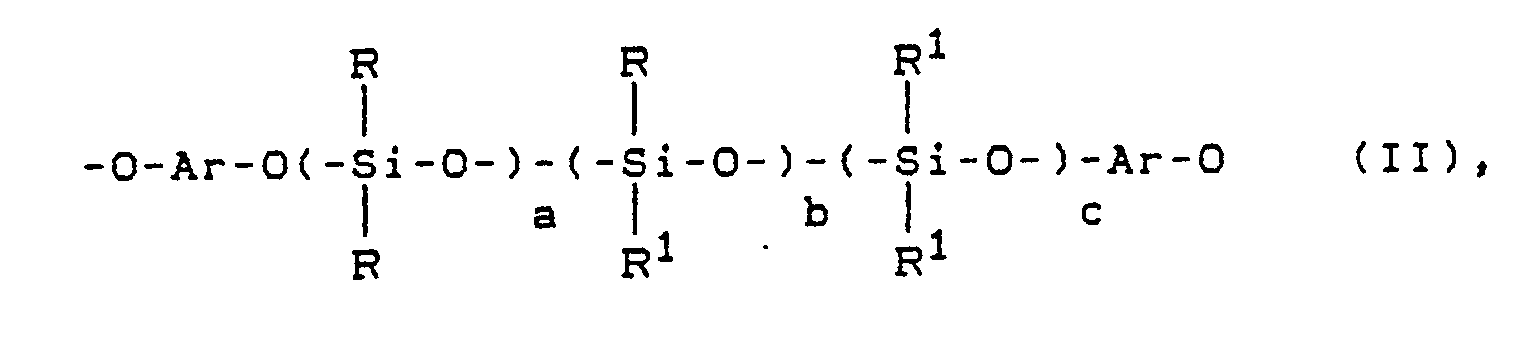
Ar gleiche oder verschiedene C₆-C₂₄-Arylenreste sind und
R und R¹ gleich oder verschieden sind und gegebenenfalls mit Halogen wie Cl, Br substituiertes C₁-C₂₀-Alkyl, C₂-C₂₀-Alkenyl, C₆-C₂₄-Aryl, bevorzugt Methyl und Phenyl bedeuten
und
die Anzahl der Diorganosiloxy-Einheiten n = (a + b + c) als Summe 5 bis 200, vorzugsweise 10 bis 150, besonders bevorzugt 20 bis 80 ist. - Gut geeignet sind hierbei derartige Polydiorganosiloxan-Polycarbonat-Blockcopolymere, die einen Siloxangehalt bis zu 80 Gew.-% aufweisen, vorzugsweise 5 bis 70 Gew.-%, besonders bevorzugt 30 bis 60 Gew.-%.
- Geeignete Polydiorganosiloxan-Polycarbonat-Blockcopolymere haben z.B. mittlere Molgewichte
M w von 2000 bis 200.000. - Der Zusatz von Siloxan-co-polycarbonaten kann außerdem zu einer deutlich verbesserten Entformbarkeit führen.
- Erfindungsgemäß verwendbare Polyestercarbonate sind bekannt (z.B. DE-A-3 007 934) und handelsüblich, z. B. APEC®.
- Erfindungsgemäß werden handelsübliche, gegebenenfalls auf übliche Art geschlichtete Glasfasern eingesetzt. Sie haben einen Durchmesser von 1,5 bis 20 µm, vorzugsweise 5 bis 13 µm. Ihre Länge beträgt 0,05 bis 30 mm, vorzugsweise 1 bis 10 mm. Es können auch Endlosfasern eingesetzt werden und/oder Herstellungsverfahren gewählt werden, bei denen die Länge der Faser in der fertigen Abmischung 0,05 bis 10, bevorzugt 0,1 bis 2 mm beträgt. Es können auch Endlosfasern (Rovings) eingesetzt werden in Verfahren zur Herstellung von endlosfaserverstärktem Unidirektionalverbund.
- Gegebenenfalls können auch - insbesondere teilweise - anstelle der Glasfasern handelsübliche Glaskugeln eingesetzt werden, z.B. Ballotini-Glaskugeln; diese können gegebenenfalls auch zusätzlich zu den Glasfasern als weitere mineralische Füllstoffe dienen.
- Als weitere, gegebenenfalls mineralische, Füllstoffe oder Zusatzstoffe seien genannt, ohne jedoch dadurch den Erfindungsbereich einschränken zu wollen: Glimmer, Talcum, Quarzmehl, Metalloxide und -sulfide wie TiO₂, ZnO, ZnS; Graphit, Ruß, Fasern, z.B. aus Quarz, Kohle u.s.w., Carbonate wie Magnesiumcarbonate, z.B. MgCO₃, CaCO₃ u.s.w., Sulfate wie CaSO₄, BaSO₄ usw.
- Als weitere, übliche Zusatzstoffe können z.B. übliche Pigmente, Entformungsmittel, E-Wachse, Fließhilfsmittel, Stabilisatoren, Nucleierungsmittel, u.s.w. zugesetzt werden.
- Die erfindungsgemäßen Mischungen können auf übliche Art und Weise z.B. durch Extrusion hergestellt werden.
- Die erfindungsgemäßen Mischungen können auf übliche Weise zu Formteilen, Halbzeug, Fasern, Folien, Profilen usw. verarbeitet werden. Die erfindungsgemäßen Mischungen können generell in vorteilhafter Weise dort verwendet werden, wo thermoplastisch verarbeitbare Massen eingesetzt werden.
- Gemischt wurden auf einem Doppelschneckenextruder ZSK 30 von Werner und Pfleiderer bei 320°C 55 Gew.-Teile PPS mit einer Schmelzviskosität von 60 Pa.s (306°C, Schubspannung = 1000/sec; hergestellt z.B. nach EP-OS 171 021) mit 45 Gew.-Teilen handelsüblicher geschlichteter Schnittglasfaser (Bayer CS 7916®).
- Die Mischung wurde granuliert und zu Prüfstäben (z. B. der Maße 80 x 10 x 4 mm) verspritzt. Diese wurden hinsichtlich Biegefestigkeit, Randfaserdehnung, Biege-E-Modul und Schlagzähigkeit an (reversed notched, ISO 180) sowie auf Wärmeformbeständigkeit HDT untersucht.
- Gemischt wurden wie in Beispiel 1 PPS und Glasfaser gemäß Tabelle 1 und zwar unter Zusatz von Polycarbonat (Makrolon® 5700) der Lösungsviskosität ηrel=1,8 (gemessen in 0,5%iger Methylenchloridlösung bei 25°C).
- Wie in Beispiel 1 wurden gemischt: PPS, Glasfaser, Talkum und basisches MgCO₃ sowie E-Wachs gemäß Tabelle 1.
- Wie in Beispiel 4 wurden PPS, Glasfaser, Talkum, bas. Mg-carbonat und E-Wachs unter Zusatz von Polycarbonat Makrolon® M 5700 gemischt.
- Handelübliches PPS Tedur® mit 30 % Glasfaser wurde wie in Beispiel 1 reextrudiert und verspritzt.
- Wie in Beispiel 6 wurde Tedur® (30% glasfaserverstärkt) reextrudiert und zwar unter Zusatz von 1 Gew.-% Makrolon® 5700.
- Handelsübliches PPS Tedur® (45% glasfaserverstärkt) wurde reextrudiert und verspritzt unter den Bedingungen aus Beispiel 1.
- Wie in Beispiel 8 wurde Tedur® reextrudiert und zwar unter Zusatz von 1 Gew.% handelsüblichem Polycarbonat Makrolon® M 2808 der Lösungsviskosität ηrel 1,29 (gemessen in 0,5%iger Methylenchloridlösung bei 25°C).
- Gemischt wurden wie in Beispiel 1) PPS und Glasfaser gemäß Tabelle 2, bei Beispielen 11 und 12 unter Zusatz von Diphenylcarbonat.
- Wie Beispiel 11, 12; jedoch wurde als organisches Carbonat ein nach üblichem Verfahren in Phasengrenzfläche hergestelltes Oligocarbonat (
M w 2.500), auf Basis von Bisphenol-A und Phenol, eingesetzt. - Wie in Beispiel 10 wurden 60 % PPS und 40 % Glasfaser gemischt. Zusätzlich zu den Prüfstäben wurden Entformungshülsen (40 mm ⌀, 35 mm hoch) gespritzt bei einer Massetemperatur von 320°C und einer Formtemperatur von 120°C. Es wurde die zum Entformen erforderliche Kraft als Entformungsdruck gemäß Tabelle 3 hydraulisch bestimmt.
- Wie in Beispiel 14 wurde PPS mit Glasfaser gemischt und zwar unter Zusatz wechselnder Mengen von 50 Gew.-% Siloxan-Block enthaltendem Copolycarbonat der relativen Lösungsviskosität ηrel 1,30 (gemessen in 0,5 %iger Dichlormethan-Lösung bei 25°C) gemäß Tabelle 3.


Tabelle 2 PPS-Mischungen und ihre Eigenschaften Beispiel Nr. 10 11 12 13 PPS 60 59 58 58,5 Glasfaser 40 40 40 40 Diphenylcarbonat - 1 2 - Oligocarbonat - - - 1,5 Biegefestigkeit (ISO 178) MPa 258 267 285 280 Randfaserdehnung % 1,9 2,0 2,1 2,1 Schlagzähigkeit an kJ/m² 35 37 39 40 - Die Angaben bezüglich der Zusammensetzungen in den Beispielen 1 bis 17 in Tabellen 1, 2 und 3 sind Gew.-Teile.
Tabelle 3 PPS-Mischungen und ihre Eigenschaften Beispiel Nr. 14 15 16 17 PPS 60 59 57 55 Glasfaser 40 40 40 40 Siloxan-co-polycarbonat a) - 1 3 5 Biegefestigkeit (SO 178) MPa 260 280 290 285 Randfaserdehnung % 1,9 2,1 2,3 2,4 Schlagzähigkeit an kJ/m² 37 41 47 50 Entformungsdruck bar 70 30 12 n.b.b) a) eingesetzt wurde ein Siloxan-co-polycarbonat mit 50 Gew.-% Polydimethylsiloxaneinheiten mit einer mittleren Blocklänge von n = 60 und 50 Gew.-% vom Bisphenol-A abgeleiteten Polycarbonateinheiten. Das Siloxan-co-polycarbonat hat eine relative Lösungsviskosität ηrel = 1,3 (in 0,5 %iger Dichlormethanlösung bei 25°C). b) n.b. = nicht bestimmt
Claims (4)
90 bis 15 Gew.-% einer Mischung aus
99.9 bis 75 Gew.-Teilen, vorzugsweise
99.9 bis 85 Gew.-Teilen Polyarylensulfiden, vorzugsweise PPS und
0.1 bis 25 Gew.-Teilen, vorzugsweise
0.1 bis 15 Gew.-Teilen anderen Thermoplasten wie Polyestercarbonaten und/oder organischer Carbonaten und/oder Siloxan-co-polycarbonaten,
10 bis 85 Gew.-% Glasfasern und,
99,7 bis 90 Gew.-Teilen Polyarylensulfiden, vorzugsweise PPS, und
0,3 bis 10 Gew-Teilen organischen Carbonaten und/oder Polyestercarbonaten und/oder Siloxan-co-polycarbonaten,
99,5 bis 95 Gew.-Teilen Polyarylensulfiden, vorzugsweise PPS und
0,5 bis 5 Gew.-Teilen organischen Carbonaten und/oder Polyestercarbonaten und/oder Siloxan-co-polycarbonaten,
Applications Claiming Priority (6)
| Application Number | Priority Date | Filing Date | Title |
|---|---|---|---|
| DE3807231 | 1988-03-05 | ||
| DE3807231 | 1988-03-05 | ||
| DE19893900260 DE3900260A1 (de) | 1988-03-05 | 1989-01-06 | Mischungen aus polyarylensulfiden, organischen carbonaten, weiteren thermoplasten und glasfasern |
| DE3900260 | 1989-01-06 | ||
| DE3901029 | 1989-01-14 | ||
| DE3901029A DE3901029A1 (de) | 1989-01-14 | 1989-01-14 | Verfahren zum metallisieren von formkoerpern aus polyarylensulfiden |
Publications (2)
| Publication Number | Publication Date |
|---|---|
| EP0331965A2 true EP0331965A2 (de) | 1989-09-13 |
| EP0331965A3 EP0331965A3 (de) | 1990-11-28 |
Family
ID=27197286
Family Applications (1)
| Application Number | Title | Priority Date | Filing Date |
|---|---|---|---|
| EP19890102965 Withdrawn EP0331965A3 (de) | 1988-03-05 | 1989-02-21 | Mischungen aus Polyarylensulfiden, organischen Carbonaten, weiteren Thermoplasten und Glasfasern |
Country Status (2)
| Country | Link |
|---|---|
| EP (1) | EP0331965A3 (de) |
| JP (1) | JPH01256568A (de) |
Cited By (1)
| Publication number | Priority date | Publication date | Assignee | Title |
|---|---|---|---|---|
| EP0379856A3 (de) * | 1989-01-14 | 1991-11-13 | Bayer Ag | Verfahren zum Metallisieren von Formkörpern aus Polyarylensulfiden |
Family Cites Families (7)
| Publication number | Priority date | Publication date | Assignee | Title |
|---|---|---|---|---|
| US4021596A (en) * | 1975-04-22 | 1977-05-03 | Phillips Petroleum Company | Polyarylene sulfide resin alloys |
| US4140671A (en) * | 1977-12-30 | 1979-02-20 | General Electric Company | Warp-resistant flame-retarded reinforced thermoplastic compositions |
| DE3205992A1 (de) * | 1982-02-19 | 1983-09-01 | Bayer Ag, 5090 Leverkusen | Farbhelle polyphenylensulfide, ihre herstellung und verwendung in mischungen mit thermoplastischen polycarbonaten und/oder thermoplastischen polyestern |
| DE3205993A1 (de) * | 1982-02-19 | 1983-09-01 | Bayer Ag, 5090 Leverkusen | Verwendung von siloxanen zur modifizierung von hochmolekularen p-polyphenylensulfiden, hochmolekulare modifizierte p-polyphenylensulfide, ihre verwendung in abmischung mit polycarbonaten und/oder polyestern und/oder polyestercarbonaten sowie die verwendung dieser abmischungen als formkoerper |
| US4528346A (en) * | 1982-09-17 | 1985-07-09 | Dainippun Ink and Chemicals, Inc. | Resin composition |
| US4689365A (en) * | 1986-05-06 | 1987-08-25 | Celanese Engineering Resins, Inc. | High temperature resistant polyester compositions |
| US4708983A (en) * | 1986-06-18 | 1987-11-24 | Phillips Petroleum Company | Arylene sulfide polymers of improved impact strength |
-
1989
- 1989-02-21 EP EP19890102965 patent/EP0331965A3/de not_active Withdrawn
- 1989-03-01 JP JP1046700A patent/JPH01256568A/ja active Pending
Cited By (2)
| Publication number | Priority date | Publication date | Assignee | Title |
|---|---|---|---|---|
| EP0379856A3 (de) * | 1989-01-14 | 1991-11-13 | Bayer Ag | Verfahren zum Metallisieren von Formkörpern aus Polyarylensulfiden |
| US5108823A (en) * | 1989-01-14 | 1992-04-28 | Bayer Aktiengesellschaft | Process for the metallization of moldings of polyarylene sulfides |
Also Published As
| Publication number | Publication date |
|---|---|
| EP0331965A3 (de) | 1990-11-28 |
| JPH01256568A (ja) | 1989-10-13 |
Similar Documents
| Publication | Publication Date | Title |
|---|---|---|
| DE68925952T2 (de) | Harzzusammensetzung auf Basis von Polycarbonat | |
| DE69224937T2 (de) | Polycarbonat-Polysiloxan-Blockcopolymere | |
| DE69528121T2 (de) | Polycarbonatharzzusammensetzung | |
| DE2920246A1 (de) | Polyestermasse fuer die herstellung von formkoerpern und die daraus hergestellten formkoerper | |
| EP0090922B1 (de) | Verwendung von Siloxanen zur Modifizierung von hochmolekularen p-Polyphenylensulfiden und hochmolekulare modifizierte p-Polyphenylensulfide | |
| DE3407811A1 (de) | Acetalharzzusammensetzung | |
| DE112018001080T5 (de) | Polycarbonat-Polyorganosiloxan-Copolymer, Polycarbonat-Harzzusammensetzung, die dieses enthält, und Formprodukt davon | |
| DE3248329A1 (de) | Polyamide mit verminderter wasseraufnahme | |
| DE69006522T2 (de) | Aromatische Polyester-Siloxan-Blockcopolymere und Verfahren zu deren Herstellung. | |
| DE69118159T2 (de) | Schlagfeste, flammhemmende, durchsichtige Mischungen aus aromatischem Polycarbonat und Poly(aryloxysiloxan) | |
| DE102009055188B4 (de) | Zusammensetzung aus Polycarbonatharz sowie verzweigtes Polycarbonatharz und Formkörper daraus | |
| DE69632665T2 (de) | Schlagzäh modifizierte, ein Siliconkautschukpulver enthaltende thermoplastische Formmassen | |
| DE69019123T2 (de) | Schlagfeste und hydrolysebeständige Mischungen von Polycarbonaten und Polyestern. | |
| EP0120296B1 (de) | Schwerentflammbare, transparente Poly-(arylether-arylsulfon)-Formmassen, Verfahren zu deren Herstellung sowie deren Verwendung | |
| DE2708381A1 (de) | Thermoplastische formmasse | |
| EP0855429A1 (de) | Thermoplastische Formmassen mit verbesserter Chemikalienresistenz | |
| KR20100050779A (ko) | 폴리카보네이트 수지 조성물 및 이의 제조방법 | |
| DE3900260A1 (de) | Mischungen aus polyarylensulfiden, organischen carbonaten, weiteren thermoplasten und glasfasern | |
| EP0396935A2 (de) | Mischungen aus Polyarylensulfiden, Glasfasern und Maleinimiden | |
| DE2904832A1 (de) | Thermoplastische massen, verfahren zu ihrer herstellung sowie ihre verwendung | |
| EP0501230B1 (de) | Mischungen aus Polyarylensulfiden, min. Füll-, bzw. anorg. oder org. Hilfsstoffen und Polymaleimiden | |
| EP0729963A1 (de) | Oxalsäureamidfunktionelle Silane und ihre Verwendung als Kunststoffadditive | |
| DE4101178A1 (de) | Mischungen aus polyarylensulfiden, dihydroxydiphenylsulfidpolycarbonaten und glasfasern | |
| EP0450178B1 (de) | Oxidiertes Polyethylen enthaltende glasfaserverstärkte Polycarbonate | |
| EP0446445A1 (de) | Mischungen aus Polyarylensulfiden, Epoxiden, Glasfasern, gegebenenfalls säureanhydridhaltigen Polymeren und gegebenenfalls weiteren Zusätzen |
Legal Events
| Date | Code | Title | Description |
|---|---|---|---|
| PUAI | Public reference made under article 153(3) epc to a published international application that has entered the european phase |
Free format text: ORIGINAL CODE: 0009012 |
|
| 17P | Request for examination filed |
Effective date: 19890221 |
|
| AK | Designated contracting states |
Kind code of ref document: A2 Designated state(s): BE DE FR GB IT NL |
|
| PUAL | Search report despatched |
Free format text: ORIGINAL CODE: 0009013 |
|
| AK | Designated contracting states |
Kind code of ref document: A3 Designated state(s): BE DE FR GB IT NL |
|
| 17Q | First examination report despatched |
Effective date: 19920220 |
|
| STAA | Information on the status of an ep patent application or granted ep patent |
Free format text: STATUS: THE APPLICATION HAS BEEN WITHDRAWN |
|
| 18W | Application withdrawn |
Withdrawal date: 19920930 |
|
| R18W | Application withdrawn (corrected) |
Effective date: 19920930 |