EP0327178B1 - A carrier material for a catalyst and a process for making such a carrier material - Google Patents
A carrier material for a catalyst and a process for making such a carrier material Download PDFInfo
- Publication number
- EP0327178B1 EP0327178B1 EP89200218A EP89200218A EP0327178B1 EP 0327178 B1 EP0327178 B1 EP 0327178B1 EP 89200218 A EP89200218 A EP 89200218A EP 89200218 A EP89200218 A EP 89200218A EP 0327178 B1 EP0327178 B1 EP 0327178B1
- Authority
- EP
- European Patent Office
- Prior art keywords
- carrier material
- metal
- compound
- group
- oxide
- Prior art date
- Legal status (The legal status is an assumption and is not a legal conclusion. Google has not performed a legal analysis and makes no representation as to the accuracy of the status listed.)
- Expired - Lifetime
Links
- 239000012876 carrier material Substances 0.000 title claims description 91
- 238000000034 method Methods 0.000 title claims description 21
- 230000008569 process Effects 0.000 title claims description 12
- 239000003054 catalyst Substances 0.000 title description 54
- PNEYBMLMFCGWSK-UHFFFAOYSA-N Alumina Chemical compound [O-2].[O-2].[O-2].[Al+3].[Al+3] PNEYBMLMFCGWSK-UHFFFAOYSA-N 0.000 claims description 93
- 238000006243 chemical reaction Methods 0.000 claims description 29
- 229910052751 metal Inorganic materials 0.000 claims description 27
- 239000002184 metal Substances 0.000 claims description 27
- 150000001875 compounds Chemical class 0.000 claims description 25
- 229910021645 metal ion Inorganic materials 0.000 claims description 24
- KCXVZYZYPLLWCC-UHFFFAOYSA-N EDTA Chemical compound OC(=O)CN(CC(O)=O)CCN(CC(O)=O)CC(O)=O KCXVZYZYPLLWCC-UHFFFAOYSA-N 0.000 claims description 17
- 230000000087 stabilizing effect Effects 0.000 claims description 17
- 239000002243 precursor Substances 0.000 claims description 16
- 150000002500 ions Chemical class 0.000 claims description 15
- 150000002602 lanthanoids Chemical group 0.000 claims description 15
- 238000001556 precipitation Methods 0.000 claims description 12
- 238000001179 sorption measurement Methods 0.000 claims description 12
- 230000008021 deposition Effects 0.000 claims description 11
- 238000010438 heat treatment Methods 0.000 claims description 11
- 229910052746 lanthanum Inorganic materials 0.000 claims description 11
- FZLIPJUXYLNCLC-UHFFFAOYSA-N lanthanum atom Chemical compound [La] FZLIPJUXYLNCLC-UHFFFAOYSA-N 0.000 claims description 11
- 150000002736 metal compounds Chemical class 0.000 claims description 11
- -1 copper aluminate Chemical class 0.000 claims description 10
- 238000001035 drying Methods 0.000 claims description 9
- 229910044991 metal oxide Inorganic materials 0.000 claims description 9
- 150000004706 metal oxides Chemical class 0.000 claims description 9
- 238000002441 X-ray diffraction Methods 0.000 claims description 8
- 239000007864 aqueous solution Substances 0.000 claims description 8
- 229910052593 corundum Inorganic materials 0.000 claims description 8
- 239000013078 crystal Substances 0.000 claims description 8
- DEFVIWRASFVYLL-UHFFFAOYSA-N ethylene glycol bis(2-aminoethyl)tetraacetic acid Chemical compound OC(=O)CN(CC(O)=O)CCOCCOCCN(CC(O)=O)CC(O)=O DEFVIWRASFVYLL-UHFFFAOYSA-N 0.000 claims description 8
- 229910001845 yogo sapphire Inorganic materials 0.000 claims description 8
- 229910052802 copper Inorganic materials 0.000 claims description 7
- 239000010949 copper Substances 0.000 claims description 7
- 230000000737 periodic effect Effects 0.000 claims description 7
- RTAQQCXQSZGOHL-UHFFFAOYSA-N Titanium Chemical compound [Ti] RTAQQCXQSZGOHL-UHFFFAOYSA-N 0.000 claims description 6
- QCWXUUIWCKQGHC-UHFFFAOYSA-N Zirconium Chemical compound [Zr] QCWXUUIWCKQGHC-UHFFFAOYSA-N 0.000 claims description 6
- 150000004645 aluminates Chemical class 0.000 claims description 6
- 238000001354 calcination Methods 0.000 claims description 6
- 229910052747 lanthanoid Inorganic materials 0.000 claims description 6
- 238000004519 manufacturing process Methods 0.000 claims description 6
- 229910052719 titanium Inorganic materials 0.000 claims description 6
- 239000010936 titanium Substances 0.000 claims description 6
- 229910052726 zirconium Inorganic materials 0.000 claims description 6
- KRKNYBCHXYNGOX-UHFFFAOYSA-K Citrate Chemical compound [O-]C(=O)CC(O)(CC([O-])=O)C([O-])=O KRKNYBCHXYNGOX-UHFFFAOYSA-K 0.000 claims description 5
- MUBZPKHOEPUJKR-UHFFFAOYSA-N Oxalic acid Chemical compound OC(=O)C(O)=O MUBZPKHOEPUJKR-UHFFFAOYSA-N 0.000 claims description 5
- RYGMFSIKBFXOCR-UHFFFAOYSA-N Copper Chemical compound [Cu] RYGMFSIKBFXOCR-UHFFFAOYSA-N 0.000 claims description 4
- 230000001590 oxidative effect Effects 0.000 claims description 4
- 239000008139 complexing agent Substances 0.000 claims description 3
- 239000005749 Copper compound Substances 0.000 claims 1
- 150000001880 copper compounds Chemical class 0.000 claims 1
- 229930002839 ionone Natural products 0.000 claims 1
- 150000002499 ionone derivatives Chemical class 0.000 claims 1
- XLYOFNOQVPJJNP-UHFFFAOYSA-N water Chemical compound O XLYOFNOQVPJJNP-UHFFFAOYSA-N 0.000 description 27
- MRELNEQAGSRDBK-UHFFFAOYSA-N lanthanum oxide Inorganic materials [O-2].[O-2].[O-2].[La+3].[La+3] MRELNEQAGSRDBK-UHFFFAOYSA-N 0.000 description 22
- 239000008367 deionised water Substances 0.000 description 21
- 229910021641 deionized water Inorganic materials 0.000 description 21
- PXHVJJICTQNCMI-UHFFFAOYSA-N Nickel Chemical compound [Ni] PXHVJJICTQNCMI-UHFFFAOYSA-N 0.000 description 18
- 239000000243 solution Substances 0.000 description 17
- QGZKDVFQNNGYKY-UHFFFAOYSA-N Ammonia Chemical compound N QGZKDVFQNNGYKY-UHFFFAOYSA-N 0.000 description 14
- 239000000725 suspension Substances 0.000 description 14
- 239000007788 liquid Substances 0.000 description 12
- 229910003158 γ-Al2O3 Inorganic materials 0.000 description 12
- GRYLNZFGIOXLOG-UHFFFAOYSA-N Nitric acid Chemical compound O[N+]([O-])=O GRYLNZFGIOXLOG-UHFFFAOYSA-N 0.000 description 11
- 229910017604 nitric acid Inorganic materials 0.000 description 11
- 229910052759 nickel Inorganic materials 0.000 description 10
- KTUFCUMIWABKDW-UHFFFAOYSA-N oxo(oxolanthaniooxy)lanthanum Chemical compound O=[La]O[La]=O KTUFCUMIWABKDW-UHFFFAOYSA-N 0.000 description 9
- 230000000694 effects Effects 0.000 description 8
- QPLDLSVMHZLSFG-UHFFFAOYSA-N Copper oxide Chemical compound [Cu]=O QPLDLSVMHZLSFG-UHFFFAOYSA-N 0.000 description 7
- VYPSYNLAJGMNEJ-UHFFFAOYSA-N Silicium dioxide Chemical compound O=[Si]=O VYPSYNLAJGMNEJ-UHFFFAOYSA-N 0.000 description 7
- 229910021529 ammonia Inorganic materials 0.000 description 7
- 229910052594 sapphire Inorganic materials 0.000 description 7
- HEMHJVSKTPXQMS-UHFFFAOYSA-M Sodium hydroxide Chemical compound [OH-].[Na+] HEMHJVSKTPXQMS-UHFFFAOYSA-M 0.000 description 6
- 239000011149 active material Substances 0.000 description 6
- 239000000463 material Substances 0.000 description 6
- BASFCYQUMIYNBI-UHFFFAOYSA-N platinum Chemical compound [Pt] BASFCYQUMIYNBI-UHFFFAOYSA-N 0.000 description 6
- 229910001868 water Inorganic materials 0.000 description 6
- 230000015572 biosynthetic process Effects 0.000 description 5
- 239000007789 gas Substances 0.000 description 5
- 238000005470 impregnation Methods 0.000 description 5
- 230000001376 precipitating effect Effects 0.000 description 5
- 239000000126 substance Substances 0.000 description 5
- IJGRMHOSHXDMSA-UHFFFAOYSA-N Atomic nitrogen Chemical compound N#N IJGRMHOSHXDMSA-UHFFFAOYSA-N 0.000 description 4
- 230000008901 benefit Effects 0.000 description 4
- 229910000428 cobalt oxide Inorganic materials 0.000 description 4
- IVMYJDGYRUAWML-UHFFFAOYSA-N cobalt(ii) oxide Chemical compound [Co]=O IVMYJDGYRUAWML-UHFFFAOYSA-N 0.000 description 4
- 150000002739 metals Chemical class 0.000 description 4
- VNWKTOKETHGBQD-UHFFFAOYSA-N methane Chemical compound C VNWKTOKETHGBQD-UHFFFAOYSA-N 0.000 description 4
- 229910000480 nickel oxide Inorganic materials 0.000 description 4
- 238000002360 preparation method Methods 0.000 description 4
- 235000012239 silicon dioxide Nutrition 0.000 description 4
- 239000006200 vaporizer Substances 0.000 description 4
- 229910020851 La(NO3)3.6H2O Inorganic materials 0.000 description 3
- MWUXSHHQAYIFBG-UHFFFAOYSA-N Nitric oxide Chemical compound O=[N] MWUXSHHQAYIFBG-UHFFFAOYSA-N 0.000 description 3
- 238000011068 loading method Methods 0.000 description 3
- CPLXHLVBOLITMK-UHFFFAOYSA-N magnesium oxide Inorganic materials [Mg]=O CPLXHLVBOLITMK-UHFFFAOYSA-N 0.000 description 3
- GNRSAWUEBMWBQH-UHFFFAOYSA-N oxonickel Chemical compound [Ni]=O GNRSAWUEBMWBQH-UHFFFAOYSA-N 0.000 description 3
- 229910052697 platinum Inorganic materials 0.000 description 3
- 239000000047 product Substances 0.000 description 3
- 239000000377 silicon dioxide Substances 0.000 description 3
- 229910052596 spinel Inorganic materials 0.000 description 3
- 239000011029 spinel Substances 0.000 description 3
- 230000006641 stabilisation Effects 0.000 description 3
- 238000011105 stabilization Methods 0.000 description 3
- 229910006415 θ-Al2O3 Inorganic materials 0.000 description 3
- XEEYBQQBJWHFJM-UHFFFAOYSA-N Iron Chemical compound [Fe] XEEYBQQBJWHFJM-UHFFFAOYSA-N 0.000 description 2
- KDLHZDBZIXYQEI-UHFFFAOYSA-N Palladium Chemical compound [Pd] KDLHZDBZIXYQEI-UHFFFAOYSA-N 0.000 description 2
- GWEVSGVZZGPLCZ-UHFFFAOYSA-N Titan oxide Chemical compound O=[Ti]=O GWEVSGVZZGPLCZ-UHFFFAOYSA-N 0.000 description 2
- XLOMVQKBTHCTTD-UHFFFAOYSA-N Zinc monoxide Chemical compound [Zn]=O XLOMVQKBTHCTTD-UHFFFAOYSA-N 0.000 description 2
- MCMNRKCIXSYSNV-UHFFFAOYSA-N Zirconium dioxide Chemical compound O=[Zr]=O MCMNRKCIXSYSNV-UHFFFAOYSA-N 0.000 description 2
- 239000000654 additive Substances 0.000 description 2
- 229910052782 aluminium Inorganic materials 0.000 description 2
- 239000004411 aluminium Substances 0.000 description 2
- XAGFODPZIPBFFR-UHFFFAOYSA-N aluminium Chemical compound [Al] XAGFODPZIPBFFR-UHFFFAOYSA-N 0.000 description 2
- JLDSOYXADOWAKB-UHFFFAOYSA-N aluminium nitrate Chemical compound [Al+3].[O-][N+]([O-])=O.[O-][N+]([O-])=O.[O-][N+]([O-])=O JLDSOYXADOWAKB-UHFFFAOYSA-N 0.000 description 2
- VXAUWWUXCIMFIM-UHFFFAOYSA-M aluminum;oxygen(2-);hydroxide Chemical compound [OH-].[O-2].[Al+3] VXAUWWUXCIMFIM-UHFFFAOYSA-M 0.000 description 2
- 230000003197 catalytic effect Effects 0.000 description 2
- 229910000420 cerium oxide Inorganic materials 0.000 description 2
- 230000008859 change Effects 0.000 description 2
- 239000007795 chemical reaction product Substances 0.000 description 2
- UBEWDCMIDFGDOO-UHFFFAOYSA-N cobalt(II,III) oxide Inorganic materials [O-2].[O-2].[O-2].[O-2].[Co+2].[Co+3].[Co+3] UBEWDCMIDFGDOO-UHFFFAOYSA-N 0.000 description 2
- 230000000052 comparative effect Effects 0.000 description 2
- XTVVROIMIGLXTD-UHFFFAOYSA-N copper(II) nitrate Chemical compound [Cu+2].[O-][N+]([O-])=O.[O-][N+]([O-])=O XTVVROIMIGLXTD-UHFFFAOYSA-N 0.000 description 2
- 230000009849 deactivation Effects 0.000 description 2
- CRHLEZORXKQUEI-UHFFFAOYSA-N dialuminum;cobalt(2+);oxygen(2-) Chemical compound [O-2].[O-2].[O-2].[O-2].[O-2].[Al+3].[Al+3].[Co+2].[Co+2] CRHLEZORXKQUEI-UHFFFAOYSA-N 0.000 description 2
- 238000002003 electron diffraction Methods 0.000 description 2
- 238000002524 electron diffraction data Methods 0.000 description 2
- 230000007062 hydrolysis Effects 0.000 description 2
- 238000006460 hydrolysis reaction Methods 0.000 description 2
- 238000010348 incorporation Methods 0.000 description 2
- FYDKNKUEBJQCCN-UHFFFAOYSA-N lanthanum(3+);trinitrate Chemical compound [La+3].[O-][N+]([O-])=O.[O-][N+]([O-])=O.[O-][N+]([O-])=O FYDKNKUEBJQCCN-UHFFFAOYSA-N 0.000 description 2
- 239000010410 layer Substances 0.000 description 2
- 239000000395 magnesium oxide Substances 0.000 description 2
- 229910052757 nitrogen Inorganic materials 0.000 description 2
- 230000003647 oxidation Effects 0.000 description 2
- 238000007254 oxidation reaction Methods 0.000 description 2
- BMMGVYCKOGBVEV-UHFFFAOYSA-N oxo(oxoceriooxy)cerium Chemical compound [Ce]=O.O=[Ce]=O BMMGVYCKOGBVEV-UHFFFAOYSA-N 0.000 description 2
- 239000011148 porous material Substances 0.000 description 2
- 230000009467 reduction Effects 0.000 description 2
- 150000003839 salts Chemical class 0.000 description 2
- 238000005245 sintering Methods 0.000 description 2
- 229910052715 tantalum Inorganic materials 0.000 description 2
- GUVRBAGPIYLISA-UHFFFAOYSA-N tantalum atom Chemical compound [Ta] GUVRBAGPIYLISA-UHFFFAOYSA-N 0.000 description 2
- 238000007669 thermal treatment Methods 0.000 description 2
- 230000007704 transition Effects 0.000 description 2
- 238000009827 uniform distribution Methods 0.000 description 2
- ZSLUVFAKFWKJRC-IGMARMGPSA-N 232Th Chemical compound [232Th] ZSLUVFAKFWKJRC-IGMARMGPSA-N 0.000 description 1
- BDDLHHRCDSJVKV-UHFFFAOYSA-N 7028-40-2 Chemical compound CC(O)=O.CC(O)=O.CC(O)=O.CC(O)=O BDDLHHRCDSJVKV-UHFFFAOYSA-N 0.000 description 1
- 239000005995 Aluminium silicate Substances 0.000 description 1
- OYPRJOBELJOOCE-UHFFFAOYSA-N Calcium Chemical compound [Ca] OYPRJOBELJOOCE-UHFFFAOYSA-N 0.000 description 1
- OKTJSMMVPCPJKN-UHFFFAOYSA-N Carbon Chemical compound [C] OKTJSMMVPCPJKN-UHFFFAOYSA-N 0.000 description 1
- VYZAMTAEIAYCRO-UHFFFAOYSA-N Chromium Chemical compound [Cr] VYZAMTAEIAYCRO-UHFFFAOYSA-N 0.000 description 1
- VGGSQFUCUMXWEO-UHFFFAOYSA-N Ethene Chemical compound C=C VGGSQFUCUMXWEO-UHFFFAOYSA-N 0.000 description 1
- 239000005977 Ethylene Substances 0.000 description 1
- FYYHWMGAXLPEAU-UHFFFAOYSA-N Magnesium Chemical compound [Mg] FYYHWMGAXLPEAU-UHFFFAOYSA-N 0.000 description 1
- 229910002651 NO3 Inorganic materials 0.000 description 1
- KJTLSVCANCCWHF-UHFFFAOYSA-N Ruthenium Chemical compound [Ru] KJTLSVCANCCWHF-UHFFFAOYSA-N 0.000 description 1
- XUIMIQQOPSSXEZ-UHFFFAOYSA-N Silicon Chemical compound [Si] XUIMIQQOPSSXEZ-UHFFFAOYSA-N 0.000 description 1
- 229910052776 Thorium Inorganic materials 0.000 description 1
- HCHKCACWOHOZIP-UHFFFAOYSA-N Zinc Chemical compound [Zn] HCHKCACWOHOZIP-UHFFFAOYSA-N 0.000 description 1
- GUJCDZNJFPGBKK-UHFFFAOYSA-N [O-2].[Al+3].[O-2].[La+3] Chemical class [O-2].[Al+3].[O-2].[La+3] GUJCDZNJFPGBKK-UHFFFAOYSA-N 0.000 description 1
- 238000010521 absorption reaction Methods 0.000 description 1
- 229910052768 actinide Inorganic materials 0.000 description 1
- 150000001255 actinides Chemical class 0.000 description 1
- 230000002411 adverse Effects 0.000 description 1
- 230000032683 aging Effects 0.000 description 1
- PZZYQPZGQPZBDN-UHFFFAOYSA-N aluminium silicate Chemical compound O=[Al]O[Si](=O)O[Al]=O PZZYQPZGQPZBDN-UHFFFAOYSA-N 0.000 description 1
- 235000012211 aluminium silicate Nutrition 0.000 description 1
- 229910000323 aluminium silicate Inorganic materials 0.000 description 1
- 230000001588 bifunctional effect Effects 0.000 description 1
- 229910001593 boehmite Inorganic materials 0.000 description 1
- 229910052791 calcium Inorganic materials 0.000 description 1
- 239000011575 calcium Substances 0.000 description 1
- 229910052799 carbon Inorganic materials 0.000 description 1
- 239000012018 catalyst precursor Substances 0.000 description 1
- 238000006555 catalytic reaction Methods 0.000 description 1
- 238000005119 centrifugation Methods 0.000 description 1
- 229910052804 chromium Inorganic materials 0.000 description 1
- 239000011651 chromium Substances 0.000 description 1
- 150000001860 citric acid derivatives Chemical class 0.000 description 1
- 239000011248 coating agent Substances 0.000 description 1
- 238000000576 coating method Methods 0.000 description 1
- 229910017052 cobalt Inorganic materials 0.000 description 1
- 239000010941 cobalt Substances 0.000 description 1
- GUTLYIVDDKVIGB-UHFFFAOYSA-N cobalt atom Chemical compound [Co] GUTLYIVDDKVIGB-UHFFFAOYSA-N 0.000 description 1
- 150000001869 cobalt compounds Chemical class 0.000 description 1
- QGUAJWGNOXCYJF-UHFFFAOYSA-N cobalt dinitrate hexahydrate Chemical compound O.O.O.O.O.O.[Co+2].[O-][N+]([O-])=O.[O-][N+]([O-])=O QGUAJWGNOXCYJF-UHFFFAOYSA-N 0.000 description 1
- XLJKHNWPARRRJB-UHFFFAOYSA-N cobalt(2+) Chemical compound [Co+2] XLJKHNWPARRRJB-UHFFFAOYSA-N 0.000 description 1
- 229910052681 coesite Inorganic materials 0.000 description 1
- 229910052906 cristobalite Inorganic materials 0.000 description 1
- 238000010908 decantation Methods 0.000 description 1
- 238000009826 distribution Methods 0.000 description 1
- 238000001493 electron microscopy Methods 0.000 description 1
- 238000001914 filtration Methods 0.000 description 1
- 229910052735 hafnium Inorganic materials 0.000 description 1
- VBJZVLUMGGDVMO-UHFFFAOYSA-N hafnium atom Chemical compound [Hf] VBJZVLUMGGDVMO-UHFFFAOYSA-N 0.000 description 1
- 238000005984 hydrogenation reaction Methods 0.000 description 1
- FAHBNUUHRFUEAI-UHFFFAOYSA-M hydroxidooxidoaluminium Chemical compound O[Al]=O FAHBNUUHRFUEAI-UHFFFAOYSA-M 0.000 description 1
- 239000003112 inhibitor Substances 0.000 description 1
- 229910052742 iron Inorganic materials 0.000 description 1
- 229910052749 magnesium Inorganic materials 0.000 description 1
- 239000011777 magnesium Substances 0.000 description 1
- AXZKOIWUVFPNLO-UHFFFAOYSA-N magnesium;oxygen(2-) Chemical compound [O-2].[Mg+2] AXZKOIWUVFPNLO-UHFFFAOYSA-N 0.000 description 1
- WPBNNNQJVZRUHP-UHFFFAOYSA-L manganese(2+);methyl n-[[2-(methoxycarbonylcarbamothioylamino)phenyl]carbamothioyl]carbamate;n-[2-(sulfidocarbothioylamino)ethyl]carbamodithioate Chemical compound [Mn+2].[S-]C(=S)NCCNC([S-])=S.COC(=O)NC(=S)NC1=CC=CC=C1NC(=S)NC(=O)OC WPBNNNQJVZRUHP-UHFFFAOYSA-L 0.000 description 1
- 230000007246 mechanism Effects 0.000 description 1
- 230000002211 methanization Effects 0.000 description 1
- 239000000203 mixture Substances 0.000 description 1
- 230000004048 modification Effects 0.000 description 1
- 238000012986 modification Methods 0.000 description 1
- 238000000465 moulding Methods 0.000 description 1
- 150000002815 nickel Chemical class 0.000 description 1
- KBJMLQFLOWQJNF-UHFFFAOYSA-N nickel(ii) nitrate Chemical compound [Ni+2].[O-][N+]([O-])=O.[O-][N+]([O-])=O KBJMLQFLOWQJNF-UHFFFAOYSA-N 0.000 description 1
- 229910052758 niobium Inorganic materials 0.000 description 1
- 239000010955 niobium Substances 0.000 description 1
- GUCVJGMIXFAOAE-UHFFFAOYSA-N niobium atom Chemical compound [Nb] GUCVJGMIXFAOAE-UHFFFAOYSA-N 0.000 description 1
- 239000003960 organic solvent Substances 0.000 description 1
- 150000003891 oxalate salts Chemical class 0.000 description 1
- 229910052763 palladium Inorganic materials 0.000 description 1
- 239000002245 particle Substances 0.000 description 1
- 239000008188 pellet Substances 0.000 description 1
- 239000000843 powder Substances 0.000 description 1
- 238000002203 pretreatment Methods 0.000 description 1
- 239000010453 quartz Substances 0.000 description 1
- 238000001953 recrystallisation Methods 0.000 description 1
- 229910052703 rhodium Inorganic materials 0.000 description 1
- 239000010948 rhodium Substances 0.000 description 1
- MHOVAHRLVXNVSD-UHFFFAOYSA-N rhodium atom Chemical compound [Rh] MHOVAHRLVXNVSD-UHFFFAOYSA-N 0.000 description 1
- 229910052707 ruthenium Inorganic materials 0.000 description 1
- 229910052706 scandium Inorganic materials 0.000 description 1
- SIXSYDAISGFNSX-UHFFFAOYSA-N scandium atom Chemical compound [Sc] SIXSYDAISGFNSX-UHFFFAOYSA-N 0.000 description 1
- 229910052710 silicon Inorganic materials 0.000 description 1
- 239000010703 silicon Substances 0.000 description 1
- 239000002356 single layer Substances 0.000 description 1
- 239000007787 solid Substances 0.000 description 1
- 238000001228 spectrum Methods 0.000 description 1
- 229910052682 stishovite Inorganic materials 0.000 description 1
- PBCFLUZVCVVTBY-UHFFFAOYSA-N tantalum pentoxide Inorganic materials O=[Ta](=O)O[Ta](=O)=O PBCFLUZVCVVTBY-UHFFFAOYSA-N 0.000 description 1
- 238000009997 thermal pre-treatment Methods 0.000 description 1
- XOLBLPGZBRYERU-UHFFFAOYSA-N tin dioxide Chemical compound O=[Sn]=O XOLBLPGZBRYERU-UHFFFAOYSA-N 0.000 description 1
- 229910001887 tin oxide Inorganic materials 0.000 description 1
- 229910052905 tridymite Inorganic materials 0.000 description 1
- 229910052727 yttrium Inorganic materials 0.000 description 1
- VWQVUPCCIRVNHF-UHFFFAOYSA-N yttrium atom Chemical compound [Y] VWQVUPCCIRVNHF-UHFFFAOYSA-N 0.000 description 1
- 229910052725 zinc Inorganic materials 0.000 description 1
- 239000011701 zinc Substances 0.000 description 1
Images

Classifications
-
- B—PERFORMING OPERATIONS; TRANSPORTING
- B01—PHYSICAL OR CHEMICAL PROCESSES OR APPARATUS IN GENERAL
- B01J—CHEMICAL OR PHYSICAL PROCESSES, e.g. CATALYSIS OR COLLOID CHEMISTRY; THEIR RELEVANT APPARATUS
- B01J23/00—Catalysts comprising metals or metal oxides or hydroxides, not provided for in group B01J21/00
- B01J23/70—Catalysts comprising metals or metal oxides or hydroxides, not provided for in group B01J21/00 of the iron group metals or copper
- B01J23/76—Catalysts comprising metals or metal oxides or hydroxides, not provided for in group B01J21/00 of the iron group metals or copper combined with metals, oxides or hydroxides provided for in groups B01J23/02 - B01J23/36
- B01J23/83—Catalysts comprising metals or metal oxides or hydroxides, not provided for in group B01J21/00 of the iron group metals or copper combined with metals, oxides or hydroxides provided for in groups B01J23/02 - B01J23/36 with rare earths or actinides
-
- B—PERFORMING OPERATIONS; TRANSPORTING
- B01—PHYSICAL OR CHEMICAL PROCESSES OR APPARATUS IN GENERAL
- B01J—CHEMICAL OR PHYSICAL PROCESSES, e.g. CATALYSIS OR COLLOID CHEMISTRY; THEIR RELEVANT APPARATUS
- B01J21/00—Catalysts comprising the elements, oxides, or hydroxides of magnesium, boron, aluminium, carbon, silicon, titanium, zirconium, or hafnium
- B01J21/06—Silicon, titanium, zirconium or hafnium; Oxides or hydroxides thereof
-
- B—PERFORMING OPERATIONS; TRANSPORTING
- B01—PHYSICAL OR CHEMICAL PROCESSES OR APPARATUS IN GENERAL
- B01J—CHEMICAL OR PHYSICAL PROCESSES, e.g. CATALYSIS OR COLLOID CHEMISTRY; THEIR RELEVANT APPARATUS
- B01J23/00—Catalysts comprising metals or metal oxides or hydroxides, not provided for in group B01J21/00
- B01J23/10—Catalysts comprising metals or metal oxides or hydroxides, not provided for in group B01J21/00 of rare earths
-
- B—PERFORMING OPERATIONS; TRANSPORTING
- B01—PHYSICAL OR CHEMICAL PROCESSES OR APPARATUS IN GENERAL
- B01J—CHEMICAL OR PHYSICAL PROCESSES, e.g. CATALYSIS OR COLLOID CHEMISTRY; THEIR RELEVANT APPARATUS
- B01J37/00—Processes, in general, for preparing catalysts; Processes, in general, for activation of catalysts
- B01J37/02—Impregnation, coating or precipitation
- B01J37/024—Multiple impregnation or coating
Definitions
- the invention relates to a carrier material essentially consisting of aluminium oxide to the surface of which a compound of an ion of a stabilizing metal has been applied, and also to a process for preparing said carrier material.
- catalysts are often used.
- their object is to accelerate the establishment of the thermodynamic equilibrium of the reaction.
- the aim is that, of the reaction products which are thermodynamically possible, preferably one specific reaction product is formed in as high a yield as possible.
- a metal or metal compound is used as the catalytically active component, the starting point often being a compound of a metal ion with the metal in a higher valency than the catalytically active form. In such cases reduction is required after the application.
- the catalytically active component is used as such, but mostly it is applied to a carrier material.
- the object of this is, on the one hand, to limit the amount of catalytically active material, and on the other, the carrier material may impart certain desirable properties to the catalyst.
- a high-porosity thermostable carrier can be used, which prevents sintering of the catalytically active component or components during a thermal pretreatment of the catalyst or in use.
- the aim will be for the surface of the carrier material proper to exhibit no catalytic activity, but so-called bifunctional catalysts are known, in which the activity of the carrier is also essential.
- the manner in which the catalytically active material is applied to the carrier may affect the catalytic activity and the stability of the material. Generally speaking, the aim will be for both activity and selectivity to be as high as possible.
- Carrier materials often used are metal oxides, in particular the various oxides of aluminium, silicon, magnesium, zirconium, titanium, zinc, and tantalum.
- metal oxides in particular the various oxides of aluminium, silicon, magnesium, zirconium, titanium, zinc, and tantalum.
- these are stable, i.e., that the surface structure and nature of the materials are not changed in an undesirable manner. This means, in the first place, that there must be no change, or a minor change only, in the crystal structure of the carrier material under the influence of high temperatures to which it may be subjected during the manufacture of the catalyst or in use.
- the catalytically active component i.e., a metal or metal compound or a precursor thereof.
- US-A-4 585 632 is concerned with catalysts comprising an alumina support to which an intermediate layer has been applied.
- This intermediate layer may, inter alia, comprise ⁇ -aluminium oxide, a silicon dioxide or an aluminium silicate, optionally in combination with an oxide of lanthanum and/or a lanthanide.
- US-A-4 6l3 584 mentions the incorporation of titanium in an aluminium oxide support by impregnation of the support with tetra-alkyl titanium compounds, followed by hydrolysis thereof. followed by hydrolysis thereof.
- the catalysts of US-A-4 585 632 and US-A-4 6l3 584 are said to have thermal stability; however, their chemical stability is insufficient.
- US-A-4 426 3l9 concerns an exhaust gas catalyst consisting of a support to which various catalytically active materials have been applied. These materials do not have sufficient thermal and chemical stability.
- US-A-4 33l 565 is also concerned with exhaust gas catalysts.
- the catalysts according to that publication have an alumina base support to which a cerium oxide coating has been applied. These carrier materials do not possess sufficient chemical stability.
- German patent application 27 39 466 describes a catalyst consisting of nickel and/or cobalt oxide, lanthanum and/or cerium oxide and aluminium oxide, which catalyst finds application in the preparation of methane-containing gases.
- the catalyst described in the publication is obtained by precipitating the various oxides, in combination or otherwise, from aqueous solutions of soluble metal salts. According to the specification, precipitating the salts in three stages is most preferred, because that leads to the best results.
- catalysts are obtained containing 60-90% by weight of nickel oxide, 5-30% by weight of aluminium oxide and 5-l0% by weight of lanthanum oxide. The good performance of this catalyst is attributed to the specific production conditions.
- German patent application 29 05 292 describes that aluminium oxide can be stabilized against conversion into ⁇ -Al2O3 by treating the material with a mixture of lanthanum oxide with silicon dioxide or tin oxide. The treatment is effected by impregnating the aluminium oxide with a solution or colloidal suspension of compounds of the metals in question, followed by drying and calcination.
- the examples show that, nevertheless, the surface area of the resulting carrier materials decreaes considerably during calcination, although some stabilization has occurred.
- nickel aluminate An illustrative example of such an undesirable reaction is the reaction of nickel-oxide with alumina to form nickel aluminate.
- nickel catalysts on alumina are mostly made in the form of a nickel oxide-on-alumina catalyst precursor, which is then subsequently reduced to nickel-on-alumina, it is of great importance that nickel aluminate is not formed or not substantially formed, because this product is extremely difficult to reduce.
- This catalyst is especially used in the methane-steam reformation, and metallic nickel is the active component.
- nickel aluminate may also be formed, which compound has a negligible activity.
- Copper-based catalysts are often applied to the carrier material in the form of an oxide, whereafter this oxide is reduced to metallic copper at elevated temperature. Under the reduction conditions, a reaction may also occur between aluminium oxide and copper(II) oxide to form copper aluminate.
- cobalt oxide as a catalyst for the oxidation of ammonia to nitrogen oxide for the production of nitric acid.
- This catalyst is cheaper than the platinum nets now used for the purpose, while the operating pressure of the process can be increased without materially reducing the service life of the catalyst, as is the case with platinum.
- the cobalt oxide must be applied to aluminium oxide.
- the cobalt oxide reacts with the aluminium oxide to form cobalt aluminate with a low activity.
- a catalytically active oxide accelerates the reaction of the aluminium oxide to ⁇ -aluminium oxide with a negligible surface area.
- the carrier is not too heavily loaded with an oxidically active component, the conversion to ⁇ -aluminium oxide is often of a greater extent than the reaction to an aluminate.
- the invention is accordingly directed to a carrier material essentially consisting of aluminium oxide, the surface of said carrier material having been stabilized by applying thereto a stabilizing element on the basis of a metal or a compound from group 3B, group 4B or the lanthanide group of the periodic table, said element being applied so that a substantially equal number of ions of the said stabilizing metal is present per 100 ⁇ 2 of surface area, which metal ions are present in sufficient numbers to avoid an unacceptable conversion of the total surface into an undesirable crystal form, so that, after a treatment at 1000 o C for 6 hours, the carrier material does not exhibit diffraction maximums in the X-ray diffraction pattern with a half-value width of less than 1.0 degree of arc (measured over the double diffraction angle), obtainable by adsorption of EDTA, EGTA, oxalate, citrate or similar complex of the relevant metal ion from aqueous solution with appropriate adjustment of pH in the range of 4-10, or applying the desired metal compound or precursor therefor by
- the half-value width of a diffraction maximum means the width at half the height of the maximum, expressed in degrees of arc.
- the invention is not to be construed as being limited by any theoretical consideration, it may be assumed that as a result of the uniform application of the above-defined element in the form of an ion to the surface of the carrier material, the surface is surprisingly converted crystallographically so that it does not, or not substantially react with the catalytically active material or the precursor therefor any longer.
- the term "uniform" is used herein to indicate that per l00 ⁇ 2 of surface substantially equal amounts of ions of stabilizing metal are present. In general it is not essential that a monolayer of stabilizing metal ions is present. Much fewer ions will suffice, provided they are uniformly distributed throughout the surface of the carrier material, and there should be a sufficient amount to prevent the crystallographic conversion of the total area into the undesirable crystal form.
- the carrier material according to the invention has the surprising advantage that the catalytically active component can be applied to its surface in finely-divided form without the occurrence of disturbing reactions with the carrier material, while also, under the usual pre-treatment conditions to be used, such as for hydrogenation, and conditions of use, the catalytically active component remains in finely-divided form. It will be clear that this gives particularly great advantages, as the utility of a catalyst is determined not only by the initial situation, but also by its stability against ageing.
- the carrier materials according to this invention it will often not be possible to identify the original carrier material and the stabilizing compound of metal ions of group 3B, group 4B or tha lanthanide group as separate compounds. Much rather it will be a matter of an incorporation of the metal ions in the lattice of the metal oxide of the carrier material.
- the proportion of the ion of the element defined above can vary within wide limits, provided the distribution is uniform. Generally speaking, this proportion will be at least 0.l% by weight, calculated as oxide, more specifically range between 0.l and 25% by weight, calculated on the carrier material. Proportions higher than 25% by weight have no advantages but do not have an adverse effect per se.
- the basic component of the carrier material according to this invention is aluminium oxide in one or more of the existing crystal modifications thereof, possibly in combination with one or more other thermostable metal oxides. If a combination with other metal oxides is used, the Al2O3 content will be at least equally high as the content of such other metal oxides. Examples of such other metal oxides are ZrO2, MgO, ZnO, TiO2, Ta2O5 and SiO2. The use of Al2O3 only is preferred.
- the carrier material according to the invention may have any form that is desirable in the art, such as powder, mouldings such as rings, pellets, and the like, or extrudates.
- the invention also relates to a process for preparing such a carrier material for a catalyst, which process comprises uniformly applying to the surface of aluminium oxide, a compound of an ion of a stabilizing metal of group 3B, group 4B or the lanthanide groups of the Periodic Table of Elements in such a manner that a substantially equal number of ions of said stabilizing metal is present per l00 ⁇ 2 of surface area which metal ions are present in sufficient numbers to avoid an unacceptable conversion of the total surface into an undesirable crystal form, so that after treatment at 1000°C for 6 hours, the carrier arterial exhibits no diffraction maximums in the X-ray diffraction pattern with a half-value width of less than 1.0 degrees of arc (measured over the double diffraction angle),obtainable by absorption of EDTA, EGTA, oxalate, citrate or similar complex of the relevant metal ion from aqueous solution with appropriate adjustment of pH in the range of 4-10, or applying the desired metal compound or precursor therefor by homogene
- these metal ions are applied by adsorption of a complex of the metal ion in aqueous solution, preferably at a constant pH.
- This adsorption can be carried out at a pH of 4-l0, with the degree of adsorption being partly determined by the choice of the pH.
- Huang and Lin Specific Adsorption of Cobalt(II) and [CO(III)EDTA] ⁇ complexes on Hydrous Oxide Surfaces, published in Adsorption from Aqueous Solution, Plenum Press, l98l, New York, pages 6l-9l. The inventors are assuming that the mechanisms proposed in that publication for the adsorption of cobalt compounds also hold for the metal ions of the 3rd and 4th subgroup as used in the present invention.
- complexing agents conventional complexing agents, known in the art, can be used, such as EDTA, EGTA, citrates, oxalates and the like.
- the metals are preferably selected from the group consisting of lanthanum, the lanthanides, zirconium and titanium.
- US-A-4 6l3 584 describes the use of organotitanium compounds. These compounds cannot be regarded as complexes. The use thereof does not lead to the advantages of the present invention, and anyway, the process to be used is rather unattractive. The process requires the use of large amounts of organic solvent or requires excessive precautions in case the organotitanium compound as such is used.
- the liquid is separated from the solid. This can be effected in known manner, such as by filtration, decantation and centrifugation.
- the moist carrier material is then generally dried to remove the liquid, and if necessary subjected to a thermal treatment to produce the desired oxide form. This thermal treatment is generally effected at a temperature of between l50 o and 600 o C for a period of half an hour to 24 hours.
- the compound of the stabilizing metal ion is applied to the metal oxide carrier material by homogeneous deposition precipitation, as described in US patent 4,ll3,658.
- the further treatment of the carrier material after the homogeneous deposition precipitation can be effected as described in relation to the first embodiment of the invention.
- the proportion of the compound of the stabilizing metal ion can be influenced by the choice of the pH, if one starts from adsorption of a complex.
- the degree of loading can be determined by the amount of compound precipitated from the solution.
- Another possibility of varying the degree of loading consists in repeating the application one or more times. In this way very high degrees of loading can be achieved, although in general this will not be required according to this invention.
- the carrier material according to the invention can advantageously be used for the preparation of all kinds of catalysts by applying catalytically active material thereto.
- Suitable catalytically active materials are, inter alia, those based on metals or compounds of metals, such as nickel, copper, cobalt, chromium, iron, manganese, platinum, palladium, rhodium and/or ruthenium.
- the pH was kept between 4 and 7 by adding dilute ammonia.
- the ultimate solution was poured into the suspension of ⁇ -Al2O3 in water.
- the pH was re-adjusted to 5 by adding dilute NHO3.
- the suspension was vigorously stirred for one hour and the pH was kept constant by injecting dilute HNO3 below the surface of the liquid.
- the suspension was filtered and washed twice with 25 ml deionized water.
- the carrier material was subsequently dried at 60 o C for l6 hours.
- the dried carrier material was calcined in the air for 51 ⁇ 2 hours at a temperature of 550 o C to convert the lanthanum complex into the oxidic form.
- the carrier material ultimately contained 3% by weight of La2O3.
- 60% was adsorbed to the ⁇ -Al2O3.
- the ultimate product was a catalyst containing l0% Co3O4 on Al2O3. 0.6 g of this catalyst was placed in a quartz reactor. The temperature was increased to l000 o C, while nitrogen was passed over the catalyst (space velocity 3000 h -l ). The catalyst was kept at this temperature for 6 hours and then cooled to room temperature. It was found that there had been no cobalt aluminate formation during the treatment at the high temperature. This was confirmed by measuring the activity of the catalyst in the non-selective oxidation of methane. After the high-temperature treatment no deactivation was observed.
- the impregnation liquid was injected into the ⁇ -Al2O3 under vacuum.
- the impregnated carrier material was dried in vacuo at room temperature and subsequently calcined in the air at 550 o C for 51 ⁇ 2 hours.
- the carrier material ultimately contained 5% by weight of La2O3.
- the carrier material was found to satisfy the stability requirement given in Example l.
- the carrier material was then dried at 60 o C for 44 hours.
- the dried carrier material was calcined in the air at a temperature of 550 o C for 51 ⁇ 2 hours to convert the lanthanum complex into the oxidic form.
- the iso-electric point of the carrier material depends on the temperature, it was expected that, at higher temperature, more La(EDTA) can be adsorbed to the surface. This proved to be the case.
- the total amount of adsorbed La(EDTA) was at 70 o C about 30% higher than at room temperature. This carrier material also satisfied the requirement of uniform distribution.
- the carrier material was then dried at 60 o C for l6 hours.
- the dried carrier material was calcined in the air for 51 ⁇ 2 hours at a temperature of 550 o C to convert the lanthanum complex into the oxidic form.
- l8.6 g of the carrier material thus prepared was suspended in 750 ml deionized water of 30 o C.
- the same procedure for applying lanthanum to the carrier was again carried out under exactly the same conditions. In this way a carrier material was obtained with a higher load (5% by weight) of the active component La than the carrier material in Example l, whereafter the La was uniformly distributed.
- the pH was kept between 4 and 7 by adding dilute ammonia dropwise.
- the total volume of the ultimate impregnation liquid was made up to l7 ml with deionized water.
- the impregnation liquid was injected, in vacuo into the ⁇ -Al2O3.
- the impregnated carrier material was dried in vacuo at 60 o C and subsequently calcined in the air at 550 o C for 51 ⁇ 2 hours.
- the carrier material ultimately contained 5% by weight of uniformly distributed La2O3.
- a carrier material was prepared starting from pseudoboehmite by the method described in Example l. By carrying out the preparation at pH 7, an ultimate load of 0.5% by weight of La2O3 was realized. Onto this carrier material, l0% by weight of Co3O4 was precipitated by the method of Example 2. The catalyst was tested by the same procedure as described in Example 2. Again, no deactivation was observed. Accordingly, it is possible for the stability of the catalyst to be enhanced by applying a proportion as low as 0.5% by weight of La2O3 uniformly to the surface of the carrier material.
- a stabilized carrier was prepared in accordance with the state of the art as described in the Thesis by Schaper (page 4l) by impregnating 20 g ⁇ -Al2O3 with a lanthanum nitrate solution, so that the ultimate carrier contains 0.5% by weight of La2O3.
- the carrier was dried overnight at 60 o C and subsequently calcined at 500 o C for 2 hours.
- This carrier material was subsequently impregnated with a copper nitrate solution so that, after drying and calcination, a catalyst was obtained which contained l0% by weight of CuO on Al2O3. (catalyst A, comparative).
- Example 9 In accordance with the method of Example l, a carrier was prepared which after drying and calcination contained 0.5% by weight of La2O3. Onto this carrier, l0% by weight of CuO was deposited by means of homogeneous deposition precipitation ( catalyst B , Example 9).
- Both catalysts were subsequently heated at l000 o C for 6 hours.
- the catalysts were characterized by means of X-ray diffraction and electron diffraction.
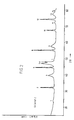
- X-ray diffraction pattern of catalyst A (Fig. l) strong peaks of ⁇ -Al2O3 were visible in addition to those of ⁇ -Al2O3.
- peaks of ⁇ -Al2O3 were visible only.
- the electron diffraction pattern of catalyst A showed, in addition to peaks of ⁇ -Al2O3 also peaks of ⁇ -Al2O3 and Cu-Al2O4 (copper aluminate).
- the electron diffraction pattern of catalyst B only showed peaks of ⁇ -Al2O3.
- catalyst A is only thermally stabilized, whereas catalyst B is also stabilized against the reaction of the active component with the carrier material.
- a non-stabilized catalyst was prepared by homogeneous deposition precipitation of copper nitrate, followed by calcination as described for catalyst B. From this non-stabilized catalyst (C), the X-ray diffraction pattern was determined (Fig. 2). The identification of the peaks is given in the following table.
Landscapes
- Chemical & Material Sciences (AREA)
- Engineering & Computer Science (AREA)
- Materials Engineering (AREA)
- Organic Chemistry (AREA)
- Chemical Kinetics & Catalysis (AREA)
- Catalysts (AREA)
Applications Claiming Priority (2)
| Application Number | Priority Date | Filing Date | Title |
|---|---|---|---|
| NL8800251 | 1988-02-02 | ||
| NL8800251A NL8800251A (nl) | 1988-02-02 | 1988-02-02 | Dragermateriaal voor een katalysator en werkwijze voor het vervaardigen van een dergelijk dragermateriaal. |
Publications (2)
| Publication Number | Publication Date |
|---|---|
| EP0327178A1 EP0327178A1 (en) | 1989-08-09 |
| EP0327178B1 true EP0327178B1 (en) | 1992-09-16 |
Family
ID=19851699
Family Applications (1)
| Application Number | Title | Priority Date | Filing Date |
|---|---|---|---|
| EP89200218A Expired - Lifetime EP0327178B1 (en) | 1988-02-02 | 1989-02-01 | A carrier material for a catalyst and a process for making such a carrier material |
Country Status (10)
| Country | Link |
|---|---|
| US (1) | US4962280A (da) |
| EP (1) | EP0327178B1 (da) |
| JP (1) | JP3050558B2 (da) |
| KR (1) | KR970001520B1 (da) |
| BR (1) | BR8900443A (da) |
| CA (1) | CA1332599C (da) |
| DE (1) | DE68902838T2 (da) |
| DK (1) | DK39989A (da) |
| ES (1) | ES2035516T3 (da) |
| NL (1) | NL8800251A (da) |
Families Citing this family (11)
| Publication number | Priority date | Publication date | Assignee | Title |
|---|---|---|---|---|
| US5334790A (en) * | 1992-02-26 | 1994-08-02 | Catalytica | Process and catalyst for partially hydrogenating aromatics to produce cycloolefins |
| US6238816B1 (en) | 1996-12-30 | 2001-05-29 | Technology Management, Inc. | Method for steam reforming hydrocarbons using a sulfur-tolerant catalyst |
| KR100398058B1 (ko) * | 2001-05-18 | 2003-09-19 | 주식회사 경동도시가스 | 수식된 θ-알루미나에 담지되어 이루어진 니켈계 개질촉매및 이를 이용한 천연가스로부터 합성가스의 제조방법 |
| US7271125B2 (en) * | 2004-01-14 | 2007-09-18 | Engelhard Corporation | Coated metal substrate |
| WO2005097319A1 (en) * | 2004-04-08 | 2005-10-20 | Sulzer Metco (Canada) Inc. | Supported catalyst for steam methane reforming and autothermal reforming reactions |
| MXPA05012893A (es) * | 2005-11-29 | 2007-11-23 | Mexicano Inst Petrol | Catalizador para la hidrodesulfuracion de residuos y crudos pesados. |
| US20070196268A1 (en) * | 2006-02-22 | 2007-08-23 | Smith John R | Thermal activation of photocatalytic generation of hydrogen |
| JP2008168228A (ja) * | 2007-01-12 | 2008-07-24 | Okayama Univ | 未燃カーボンを用いてディーゼルエンジン排ガス中の窒素酸化物を浄化するための触媒と方法 |
| EP2294002A4 (en) * | 2008-06-25 | 2012-12-26 | Hydrogen Generation Inc | IMPROVED METHOD FOR THE PRODUCTION OF HYDROGEN |
| US20110160048A1 (en) * | 2009-12-29 | 2011-06-30 | Boumendjel Nariman | Coating method for structured catalysts |
| EP2994227A2 (en) | 2013-05-09 | 2016-03-16 | SABIC Global Technologies B.V. | Clay mineral supported catalysts |
Family Cites Families (11)
| Publication number | Priority date | Publication date | Assignee | Title |
|---|---|---|---|---|
| US3226340A (en) * | 1960-05-04 | 1965-12-28 | Ethyl Corp | Catalyst compositions comprising alumina with an inner lamina of metal oxide and an outermost lamina of copper oxide |
| US4113658A (en) * | 1967-04-14 | 1978-09-12 | Stamicarbon, N.V. | Process for homogeneous deposition precipitation of metal compounds on support or carrier materials |
| US3899444A (en) * | 1972-02-07 | 1975-08-12 | Ethyl Corp | Exhaust gas catalyst support |
| JPS5331590A (en) * | 1976-09-06 | 1978-03-24 | Tokyo Gas Co Ltd | Catalysts for manufacturing methaneecontaining gas |
| US4220559A (en) * | 1978-02-14 | 1980-09-02 | Engelhard Minerals & Chemicals Corporation | High temperature-stable catalyst composition |
| US4331565A (en) * | 1980-11-28 | 1982-05-25 | General Motors Corporation | Method for forming high surface area catalyst carrier and catalyst using same |
| FR2501065B1 (fr) * | 1981-03-09 | 1986-02-07 | Pro Catalyse | Catalyseur et procede perfectionnes pour le traitement des gaz d'echappement des moteurs a combustion interne |
| DE3340569A1 (de) * | 1983-11-09 | 1985-05-23 | Sued Chemie Ag | Katalysator zur herstellung von synthesegas bzw. von wasserstoff und verfahren zu dessen herstellung |
| DE3428231A1 (de) * | 1983-12-16 | 1985-07-04 | Süd-Chemie AG, 8000 München | Verfahren zur entfernung von stickoxiden aus abgasen |
| JPS62180751A (ja) * | 1986-02-03 | 1987-08-08 | Toyota Central Res & Dev Lab Inc | 耐熱性アルミナ担体 |
| JPH0675676B2 (ja) * | 1986-12-24 | 1994-09-28 | トヨタ自動車株式会社 | 排気ガス浄化用触媒 |
-
1988
- 1988-02-02 NL NL8800251A patent/NL8800251A/nl not_active Application Discontinuation
-
1989
- 1989-01-30 DK DK039989A patent/DK39989A/da not_active Application Discontinuation
- 1989-02-01 CA CA000589735A patent/CA1332599C/en not_active Expired - Fee Related
- 1989-02-01 BR BR898900443A patent/BR8900443A/pt not_active IP Right Cessation
- 1989-02-01 ES ES198989200218T patent/ES2035516T3/es not_active Expired - Lifetime
- 1989-02-01 DE DE8989200218T patent/DE68902838T2/de not_active Expired - Lifetime
- 1989-02-01 US US07/305,158 patent/US4962280A/en not_active Expired - Lifetime
- 1989-02-01 EP EP89200218A patent/EP0327178B1/en not_active Expired - Lifetime
- 1989-02-02 JP JP1025633A patent/JP3050558B2/ja not_active Expired - Lifetime
- 1989-02-02 KR KR1019890001200A patent/KR970001520B1/ko not_active Expired - Lifetime
Also Published As
| Publication number | Publication date |
|---|---|
| JPH01288337A (ja) | 1989-11-20 |
| DK39989D0 (da) | 1989-01-30 |
| NL8800251A (nl) | 1989-09-01 |
| ES2035516T3 (es) | 1993-04-16 |
| BR8900443A (pt) | 1989-09-26 |
| EP0327178A1 (en) | 1989-08-09 |
| DE68902838D1 (de) | 1992-10-22 |
| KR970001520B1 (ko) | 1997-02-11 |
| CA1332599C (en) | 1994-10-18 |
| KR890012697A (ko) | 1989-09-18 |
| US4962280A (en) | 1990-10-09 |
| JP3050558B2 (ja) | 2000-06-12 |
| DE68902838T2 (de) | 1993-01-21 |
| DK39989A (da) | 1989-08-03 |
Similar Documents
| Publication | Publication Date | Title |
|---|---|---|
| EP0234745B1 (en) | Catalysts | |
| US4968660A (en) | Catalyst-on-carrier for the non-selective oxidation of organic compounds | |
| US5134109A (en) | Catalyst for reforming hydrocarbon with steam | |
| JP2023527419A (ja) | アンモニア分解触媒、並びにこれを用いたアンモニア分解及び水素生産方法 | |
| CA1120909A (en) | High temperature-stable catalyst composition | |
| US4738946A (en) | High temperature stable catalyst and process for preparing same | |
| US4247730A (en) | Hydrodealkylation of alkylaromatic hydrocarbons | |
| JPH0521030B2 (da) | ||
| EP0327178B1 (en) | A carrier material for a catalyst and a process for making such a carrier material | |
| CA2500646A1 (en) | Fischer-tropsch processes and catalysts using stabilized supports | |
| EP0361952A1 (en) | Catalytic washcoat | |
| CA1265119A (en) | Catalyst for combustion and process for producing same | |
| JPH0230740B2 (da) | ||
| WO2001008797A1 (en) | Thermally stable support material and method for making the same | |
| JPH0679177A (ja) | アンモニア合成触媒および合成方法 | |
| CA2359940A1 (en) | Catalyst carrier carrying nickel ruthenium and lanthanum | |
| JP3552766B2 (ja) | アンモニア合成触媒およびその調製法 | |
| EP0465061A2 (en) | Steam reforming catalyst | |
| JPH06134305A (ja) | 耐熱性触媒およびその使用方法 | |
| JP3365660B2 (ja) | ルテニウム触媒製造用含浸液及びルテニウム触媒の製造方法 | |
| EP0808800A2 (en) | Praseodymium-zirconium-oxides for catalyst and washcoat | |
| KR102952515B1 (ko) | 메탄 개질용 촉매 및 이의 제조방법 | |
| US4450099A (en) | Barium hydride modified aluminum/siliceous compositions | |
| JP3937030B2 (ja) | 触媒担体およびその製造方法 | |
| JPH0553542B2 (da) |
Legal Events
| Date | Code | Title | Description |
|---|---|---|---|
| PUAI | Public reference made under article 153(3) epc to a published international application that has entered the european phase |
Free format text: ORIGINAL CODE: 0009012 |
|
| AK | Designated contracting states |
Kind code of ref document: A1 Designated state(s): BE DE ES FR GB IT NL |
|
| 17P | Request for examination filed |
Effective date: 19890912 |
|
| 17Q | First examination report despatched |
Effective date: 19901001 |
|
| GRAA | (expected) grant |
Free format text: ORIGINAL CODE: 0009210 |
|
| AK | Designated contracting states |
Kind code of ref document: B1 Designated state(s): BE DE ES FR GB IT NL |
|
| ET | Fr: translation filed | ||
| REF | Corresponds to: |
Ref document number: 68902838 Country of ref document: DE Date of ref document: 19921022 |
|
| ITF | It: translation for a ep patent filed | ||
| REG | Reference to a national code |
Ref country code: ES Ref legal event code: FG2A Ref document number: 2035516 Country of ref document: ES Kind code of ref document: T3 |
|
| PLBE | No opposition filed within time limit |
Free format text: ORIGINAL CODE: 0009261 |
|
| STAA | Information on the status of an ep patent application or granted ep patent |
Free format text: STATUS: NO OPPOSITION FILED WITHIN TIME LIMIT |
|
| 26N | No opposition filed | ||
| PGFP | Annual fee paid to national office [announced via postgrant information from national office to epo] |
Ref country code: BE Payment date: 19950227 Year of fee payment: 7 |
|
| PG25 | Lapsed in a contracting state [announced via postgrant information from national office to epo] |
Ref country code: BE Effective date: 19960228 |
|
| BERE | Be: lapsed |
Owner name: ENGELHARD DE MEERN B.V. Effective date: 19960228 |
|
| PGFP | Annual fee paid to national office [announced via postgrant information from national office to epo] |
Ref country code: FR Payment date: 19990119 Year of fee payment: 11 |
|
| PGFP | Annual fee paid to national office [announced via postgrant information from national office to epo] |
Ref country code: GB Payment date: 19990121 Year of fee payment: 11 |
|
| PGFP | Annual fee paid to national office [announced via postgrant information from national office to epo] |
Ref country code: NL Payment date: 19990126 Year of fee payment: 11 |
|
| PGFP | Annual fee paid to national office [announced via postgrant information from national office to epo] |
Ref country code: ES Payment date: 19990216 Year of fee payment: 11 |
|
| PG25 | Lapsed in a contracting state [announced via postgrant information from national office to epo] |
Ref country code: GB Free format text: LAPSE BECAUSE OF NON-PAYMENT OF DUE FEES Effective date: 20000201 |
|
| PG25 | Lapsed in a contracting state [announced via postgrant information from national office to epo] |
Ref country code: ES Free format text: THE PATENT HAS BEEN ANNULLED BY A DECISION OF A NATIONAL AUTHORITY Effective date: 20000202 |
|
| PG25 | Lapsed in a contracting state [announced via postgrant information from national office to epo] |
Ref country code: NL Free format text: LAPSE BECAUSE OF NON-PAYMENT OF DUE FEES Effective date: 20000901 |
|
| GBPC | Gb: european patent ceased through non-payment of renewal fee |
Effective date: 20000201 |
|
| PG25 | Lapsed in a contracting state [announced via postgrant information from national office to epo] |
Ref country code: FR Free format text: LAPSE BECAUSE OF NON-PAYMENT OF DUE FEES Effective date: 20001031 |
|
| NLV4 | Nl: lapsed or anulled due to non-payment of the annual fee |
Effective date: 20000901 |
|
| REG | Reference to a national code |
Ref country code: FR Ref legal event code: ST |
|
| REG | Reference to a national code |
Ref country code: ES Ref legal event code: FD2A Effective date: 20020204 |
|
| PG25 | Lapsed in a contracting state [announced via postgrant information from national office to epo] |
Ref country code: IT Free format text: LAPSE BECAUSE OF NON-PAYMENT OF DUE FEES;WARNING: LAPSES OF ITALIAN PATENTS WITH EFFECTIVE DATE BEFORE 2007 MAY HAVE OCCURRED AT ANY TIME BEFORE 2007. THE CORRECT EFFECTIVE DATE MAY BE DIFFERENT FROM THE ONE RECORDED. Effective date: 20050201 |
|
| PGFP | Annual fee paid to national office [announced via postgrant information from national office to epo] |
Ref country code: DE Payment date: 20080331 Year of fee payment: 20 |