EP0323025A2 - Verfahren zur Zuweisung von Verhaltungs- und Löschungskriteria auf in einen elektronischen Informationsbearbeitungssystem gespeicherte elektronische Dokumente - Google Patents
Verfahren zur Zuweisung von Verhaltungs- und Löschungskriteria auf in einen elektronischen Informationsbearbeitungssystem gespeicherte elektronische Dokumente Download PDFInfo
- Publication number
- EP0323025A2 EP0323025A2 EP88311068A EP88311068A EP0323025A2 EP 0323025 A2 EP0323025 A2 EP 0323025A2 EP 88311068 A EP88311068 A EP 88311068A EP 88311068 A EP88311068 A EP 88311068A EP 0323025 A2 EP0323025 A2 EP 0323025A2
- Authority
- EP
- European Patent Office
- Prior art keywords
- document
- ownership
- criteria
- label
- labels
- Prior art date
- Legal status (The legal status is an assumption and is not a legal conclusion. Google has not performed a legal analysis and makes no representation as to the accuracy of the status listed.)
- Withdrawn
Links
Images




Classifications
-
- G—PHYSICS
- G06—COMPUTING OR CALCULATING; COUNTING
- G06F—ELECTRIC DIGITAL DATA PROCESSING
- G06F16/00—Information retrieval; Database structures therefor; File system structures therefor
- G06F16/90—Details of database functions independent of the retrieved data types
- G06F16/93—Document management systems
-
- G—PHYSICS
- G06—COMPUTING OR CALCULATING; COUNTING
- G06F—ELECTRIC DIGITAL DATA PROCESSING
- G06F2216/00—Indexing scheme relating to additional aspects of information retrieval not explicitly covered by G06F16/00 and subgroups
- G06F2216/09—Obsolescence
-
- Y—GENERAL TAGGING OF NEW TECHNOLOGICAL DEVELOPMENTS; GENERAL TAGGING OF CROSS-SECTIONAL TECHNOLOGIES SPANNING OVER SEVERAL SECTIONS OF THE IPC; TECHNICAL SUBJECTS COVERED BY FORMER USPC CROSS-REFERENCE ART COLLECTIONS [XRACs] AND DIGESTS
- Y10—TECHNICAL SUBJECTS COVERED BY FORMER USPC
- Y10S—TECHNICAL SUBJECTS COVERED BY FORMER USPC CROSS-REFERENCE ART COLLECTIONS [XRACs] AND DIGESTS
- Y10S707/00—Data processing: database and file management or data structures
- Y10S707/912—Applications of a database
- Y10S707/913—Multimedia
- Y10S707/915—Image
-
- Y—GENERAL TAGGING OF NEW TECHNOLOGICAL DEVELOPMENTS; GENERAL TAGGING OF CROSS-SECTIONAL TECHNOLOGIES SPANNING OVER SEVERAL SECTIONS OF THE IPC; TECHNICAL SUBJECTS COVERED BY FORMER USPC CROSS-REFERENCE ART COLLECTIONS [XRACs] AND DIGESTS
- Y10—TECHNICAL SUBJECTS COVERED BY FORMER USPC
- Y10S—TECHNICAL SUBJECTS COVERED BY FORMER USPC CROSS-REFERENCE ART COLLECTIONS [XRACs] AND DIGESTS
- Y10S707/00—Data processing: database and file management or data structures
- Y10S707/99931—Database or file accessing
- Y10S707/99939—Privileged access
-
- Y—GENERAL TAGGING OF NEW TECHNOLOGICAL DEVELOPMENTS; GENERAL TAGGING OF CROSS-SECTIONAL TECHNOLOGIES SPANNING OVER SEVERAL SECTIONS OF THE IPC; TECHNICAL SUBJECTS COVERED BY FORMER USPC CROSS-REFERENCE ART COLLECTIONS [XRACs] AND DIGESTS
- Y10—TECHNICAL SUBJECTS COVERED BY FORMER USPC
- Y10S—TECHNICAL SUBJECTS COVERED BY FORMER USPC CROSS-REFERENCE ART COLLECTIONS [XRACs] AND DIGESTS
- Y10S707/00—Data processing: database and file management or data structures
- Y10S707/99951—File or database maintenance
- Y10S707/99952—Coherency, e.g. same view to multiple users
- Y10S707/99953—Recoverability
Definitions
- This invention relates in general to methods for storing and deleting electronic documents in an electronic information handling system.
- the present invention is directed to an improved method for use in an interactive information handling system in which the data entry process for the descriptors that are used in the retention and deletion of documents is simple, flexible, and fail safe, and therefore avoids many of the problems that occur with the prior art document storage systems.
- Fig. 1 illustrates an information handling system comprising a network of interactive type terminals or workstations of the type shown in detail in Fig. 2.
- the network includes a plurality of terminals which are interconnected with each other and to a host central processing unit 23.
- host 23 in turn is connected via communication link 24 to a second host processing unit 25, which also connects to another network 26 of interactive workstations.
- the system operates to allow each terminal to communicate with the host and to one or more other terminals using established communication protocols, so that the various serially connected communication links are transparent to the users.
- a user at one terminal can generate a document such as a letter and send that letter to the addressee at a designated node on the network.
- each workstation on the network has a system node address and a "post office" address, and that to simplify the description, there is only one individual assigned to each node on the network.
- conventional communication services are provided by the system, such as directory listings of individual users or owners etc.
- the system shown in Fig. 1 processes information as various types of data objects such as text data objects, graphic data objects, and calendar data objects etc..
- Fig. 2 illustrates the functional components of one of the interactive type data processing terminals shown in Fig.. 1.
- the terminal comprises a processing unit 31 which includes a microprocessor block 32, a semiconductor memory 33, and a control block 34 which functions to control input/output operations in addition to the interaction between the micro processor block 32 and the memory unit 33.
- the terminal further includes a group of conventional peripheral units including a display device 36, a keyboard 37, a printer 38, a disk storage unit 39, and a modem 40. Since the details of the above described functional blocks form no part of the present invention and can be found in the prior art, only a brief function-al description of each block is set forth, along with a description of their interactions, sufficient to provide a person of ordinary skill in the art with a basis of understanding applicants' improved electronic document storage method.
- Processing unit 31 corresponds for example to the "system unit" of a personal computer system such as the IBM XT, IBM AT or an IBM PS/2 system.
- Unit 31 is provided with an operating system program which may be one of the many versions of DOS (Disk Operating System) which is normally employed to run the systems.
- DOS Disk Operating System
- the operating system program is stored in memory 33 along with one or more application programs that the user has selected to run. Depending on the capacity of memory 33 and the size of the application programs, portions of these programs, as needed, may be transferred to memory 33 from the disk storage unit 39 which may include, for example, a 30 megabyte hard disk drive and a diskette drive.
- the basic function of the disk storage unit is to store programs and data that are employed by the system and which may readily be transferred to the memory unit 33 when needed.
- the function of the diskette drive is to provide a removable storage function for entering programs and data into the system, and a vehicle for storing data in a form that is readily transportable for use on other terminals or systems.
- Display device 36 and keyboard 37 together provide for the interactive nature of the terminal, in that in normal operation, the interpretation that the system gives to a specific keystroke by the operator depends, in substantially all situations, on what is being displayed to the operator at that point in time.
- the operator by entering commands into the system, causes the system to perform a certain function.
- the system requests the entry of certain data, generally by displaying a prompt type of menu/message screen.
- the depth of the interaction between the operator and the system varies by the type of operating system and the application program, but is a necessary characteristic of terminals on which the method of the present invention may be employed.
- the terminal shown in Fig. 2 further includes a printer 38, which functions to provide hard copy output of data developed or stored in the system at some central location.
- the modem 40 functions to transfer data from the terminal of Fig. 2 to a host system through one or more communication links which may be a commercial type link or a dedicated communication link.
- Fig. 3a represents an overview of the system from the standpoint of the major interactive steps involved in storing a document that has been created by an End User (EU).
- Block 50 represents the EU.
- Blocks 51 and 52 represent programs stored at the terminal while block 53 represents local disk storage.
- Blocks 54 and 55 represent the library server function located at the host and is the central depository for stored system documents.
- the program represented by block 51 is referred to as the Dialogue Manager application and functions to provide the necessary menus and prompts to obtain information from the user. It is essentially the interface to the user from the terminal.
- the program represented by block 52 is referred to as the requester application and functions to build requests and send them to the library server.
- the function of the library server is to validate/set labels and expiration dates and to file the document.
- the flow chart of Fig 3b shows the major steps of first creating a document; second selecting the sub-action menu in order to set the document descriptors; thirdly setting the actual descriptors in the set document descriptor menu; and
- the main action menu is shown in Fig. 4a.
- the menu illustrates three separate actions that the EU can designate.
- the screen cursor is represented by an X in Fig. 4a and as illustrated is adjacent the "Create a Document" action.
- the action is selected in the normal manner by positioning the cursor adjacent the line on the menu and hitting the "enter" key.
- the system responds with a series of prompts which allows the user to create a document. For purposes of this description it can be assumed that the document is sent to another EU on the system and the author now wants to store the document.
- the sub-action menu shown in Fig 4b. includes an option to "SET DESCRIPTORS" which is selected to enter the criteria that will be used to manage the retention and automatic deletion of documents from the system.
- the screen shown in Fig. 5 is displayed to the EU.
- the end user responds to the various prompts displayed in Fig. 5 by entering a name for the document label and a name for the ownership label. It should be assumed for the moment that the respective names have been preestablished.
- the expiration dates for the document and the ownership may be provided in a number of different ways.
- a list of allowable values can be obtained by placing the cursor under the appropriate field and pressing a predesignated key such as the "HELP" key.
- the allowable values which have been preestablished then appear in a "window” or on a separate screen which permits the user to copy or just select the choice by positioning the cursor and pressing the "ENTER” key.
- Fig. 6 illustrates the screen that is provided when the end user places the cursor under the field "DOCUMENT LABEL" in Fig. 5 an presses the HELP key.
- Fig. 7 illustrates the screen that is provided when the end user places the cursor under the field "OWNERSHIP LABEL" in Fig. 5 and presses the HELP key.
- the set of allowable ownership labels that are displayed in Fig. 7 are unique to the document label BUDGET. A different set of allowable ownership labels would generally be displayed for a different document label.
- the end user has the flexibility to enter in all four criteria manually, or the end user can obtain assistance in selecting an ownership label or a document label.
- all data that is entered directly into the system by the end user is verified by the system to insure the integrity of this data.
- the entry of the criteria data automatically based on one or more criteria that have been entered manually will now be described.
- Each end user in the system has a profile that is developed by the end user and the system administrator and which is stored in the system.
- the profile has the following sections:
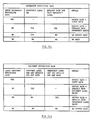
- the ownership label section shown in Fig. 8 comprises four columns: INPUT LABEL; OUTPUT LABEL; DESCRIPTION; and DEFAULT DOCUMENT LABEL.
- the INPUT LABEL column lists a set of possible input labels that, a) the end user would possibly enter directly and b) labels approved for use by another end user or used by another system that are assigned to documents that are sent to this end user that will be stored in his system.
- the OUTPUT LABEL column includes the set of approved ownership labels that are actually assigned to documents as they are stored.
- the functional relationship of the two columns is to automatically convert an unapproved ownership label to an approved ownership label.
- the last two entries cover the situation of miscellaneous labels OTHER and NONE.
- the OTHER entry is used when a label is entered but no match is found.
- the NONE entry is used when no label is entered.
- the DESCRIPTION column is self explanatory and is used only in the process of creating the profile and as an aid to understanding the labels when a profile is reviewed.
- the DEFAULT DOCUMENT LABEL column lists a set of approved document labels for each of the approved ownership labels listed in column two.
- the function of the default document label is to permit the automatic entry of a document label into the set document descriptors menu shown in Fig. 5 in those situations where the end user has elected for some reason not to enter the data directly.
- the document label section shown in Fig. 9 comprises four columns: INPUT LABEL; OUTPUT LABEL; DESCRIPTION; and DEFAULT OWNERSHIP LABEL.
- the INPUT LABEL column lists a set of possible input labels that, a) the end user would possibly enter directly and b) labels approved for use by another end user or used by another system that are assigned to documents that are sent to this end user that will be stored in the end user's system.
- the OUTPUT LABEL column includes the set of approved document labels that are actually assigned to documents as they are stored. The functional relationship of the two columns is to automatically convert an unapproved document label to an approved document label.
- the last two entries in the INPUT LABEL column cover the situation of a miscellaneous label OTHER and the situation where the end user did note enter an ownership label.
- the DESCRIPTION column is self explanatory and is used only in the process of creating the profile and as an aid to understanding the labels when a profile is reviewed.
- the DEFAULT OWNERSHIP LABEL column lists a set of approved ownership labels for each of the approved output document labels listed in column two.
- the function of the default document label is to permit the automatic entry of an ownership label into the set document descriptors menu shown in Fig. 5 in those situations where the end user has elected for some reason not to enter the data directly.
- the ownership expiration date section as shown in Fig. 10 comprises five columns: the OUTPUT OWNERSHIP LABEL column; the MINIMUM column; the MAXIMUM column; the PERMISSIBLE VALUES column; and the DEFAULT column.
- This section has two functions, namely to verify that an ownership expiration date that was entered directly by the end user is a permissible date value, and to provide a default date in the event that data is not entered directly.
- the OUTPUT OWNERSHIP LABEL column contains a set or list of approved ownership labels.
- the MINIMUM column contains an entry which indicates a minimum time period that a document containing the label in column 1 must be owned by the end user. The implication is that ownership may be maintained at least until the end of the period specified.
- the MAXIMUM column contains an entry which indicates a maximum time period that ownership may be maintained. The implication is that after the stated period, this end user does not have responsibility for the document nor control over it.
- the PERMISSIBLE VALUES column contains an entry which indicate the values that may be entered. The implication is that time periods must be expressed in predetermined units, i.e. days, not hours, between the minimum and maximum values set forth in column 2 and 3.
- the DEFAULT column contains an entry for each label in column 1 which indicates the time period that is entered automatically into the set descriptors menu of Fig. 5 when that data is not entered directly by the end user.
- the time period is converted into an expiration date by the system using the current date as the starting time for the calculation.
- the MINIMUM, MAXIMUM and PERMISSIBLE VALUES columns are employed to verify an ownership expiration date that has been entered directly by the end user.
- the DEFAULT column is employed in the process of automatic data entry when the end user has elected not to enter the expiration date directly. verify
- the document expiration date section as shown in Fig. 11 comprises five columns: the OUTPUT DOCUMENT LABEL column; the MINIMUM column; the MAXIMUM column; the PERMISSIBLE VALUES column; and the DEFAULT column.
- This section has two functions, namely to verify that a document expiration date that was entered directly by the end user is a permissible date value, and to provide a default date in the event that data is not entered directly.
- the OUTPUT DOCUMENT LABEL column contains a set or list of approved document labels.
- the MINIMUM column contains an entry which indicates a minimum time period that a document containing the label in column 1 must be maintained by the system. The implication is that the document will be maintained at least until the end of the period specified.
- the MAXIMUM column contains an entry which indicates a maximum time period that the document may be maintained by the system. The implication is that after the stated period, the document may be deleted from the system. nor control over it.
- the PERMISSIBLE VALUES column contains an entry for each label which indicates the values that may be entered. The implication is that time periods must be expressed in predetermined units, i.e. days, not hours, between the minimum and maximum values set forth in column 2 and 3.
- the DEFAULT column contains an entry for each label in column 1 which indicates the time period that is entered automatically into the set descriptors menu of Fig. 5 when that data is not entered directly by the end user.
- the time period is converted into an expiration date by the system using the current date as the starting time for the calculation.
- the MINIMUM, MAXIMUM and PERMISSIBLE VALUES columns are employed to verify a document expiration date that has been entered directly by the end user.
- the DEFAULT column is employed in the process of automatic data entry when the end user has elected not to enter the document expiration date directly.
- the TABLE OF RULES FOR EXPIRATION DATE CALCULATIONS as shown in Figs. 12 a and 12b comprise two columns: the LABEL column and the RULE column.
- the labels listed in column 1 of Fig 12a are approved ownership labels and correspond to the set of labels listed in column 1 of Fig 10.
- the Rules are established by the enterprise in accordance with the document retention strategy and reflect the understanding that the document expiration date and the ownership expiration date will generally have a quantifiable relationship for any given document type.
- the Rule tables of Figs. 12a and 12b are used to verify that the two expiration dates assigned to the document either directly by the end user or automatically by the system meet the predetermined relationship that has been established by the system.
- Figs 13a through 13d illustrate the rules for applying defaults for each of the four criteria that is entered into the set descriptors menu of Fig. 5.
- Fig. 13a sets forth the rules for applying a default ownership label and comprises four columns: the INPUT OWNERSHIP LABEL MATCHES PROFILE column; the INPUT DOCUMENT LABEL MATCHES PROFILE column; the DEFAULT OWNERSHIP LABEL EXISTS column; and the RESULT column.
- the Rules summarized in the chart are as follows:
- Rules similar to rules 14 listed above can be articulated from the other default rules tables illustrated in Figs. 13b, 13c and 13d.
- Fig. 14 is an extensive flow chart illustrating the various steps that occur in the method of the present invention to cause the automatic entry and verification of retention and deletion criteria data for each document that is stored in the system.
- the flow chart is in sufficient detail to permit a person skilled in the art to understand the sequence of steps that are performed for the different scenarios that the end user would encounter. A detailed description of the operation setting forth the steps of the flow chart is therefore considered unnecessary for an understanding of the invention.
- the output of the process is: A filed document with appropriately set labels and expiration dates, or A rejected file operation.
Landscapes
- Engineering & Computer Science (AREA)
- Databases & Information Systems (AREA)
- Theoretical Computer Science (AREA)
- General Engineering & Computer Science (AREA)
- Data Mining & Analysis (AREA)
- Physics & Mathematics (AREA)
- Business, Economics & Management (AREA)
- General Physics & Mathematics (AREA)
- General Business, Economics & Management (AREA)
- Document Processing Apparatus (AREA)
- Information Retrieval, Db Structures And Fs Structures Therefor (AREA)
- Input From Keyboards Or The Like (AREA)
- Information Transfer Between Computers (AREA)
Applications Claiming Priority (2)
| Application Number | Priority Date | Filing Date | Title |
|---|---|---|---|
| US138535 | 1987-12-23 | ||
| US07/138,535 US5107419A (en) | 1987-12-23 | 1987-12-23 | Method of assigning retention and deletion criteria to electronic documents stored in an interactive information handling system |
Publications (2)
| Publication Number | Publication Date |
|---|---|
| EP0323025A2 true EP0323025A2 (de) | 1989-07-05 |
| EP0323025A3 EP0323025A3 (de) | 1992-03-11 |
Family
ID=22482458
Family Applications (1)
| Application Number | Title | Priority Date | Filing Date |
|---|---|---|---|
| EP19880311068 Withdrawn EP0323025A3 (de) | 1987-12-23 | 1988-11-23 | Verfahren zur Zuweisung von Verhaltungs- und Löschungskriteria auf in einen elektronischen Informationsbearbeitungssystem gespeicherte elektronische Dokumente |
Country Status (5)
| Country | Link |
|---|---|
| US (1) | US5107419A (de) |
| EP (1) | EP0323025A3 (de) |
| JP (1) | JPH065510B2 (de) |
| BR (1) | BR8806831A (de) |
| CA (1) | CA1306069C (de) |
Cited By (3)
| Publication number | Priority date | Publication date | Assignee | Title |
|---|---|---|---|---|
| EP0642686A4 (de) * | 1991-11-20 | 1994-11-07 | Parcplace Systems Inc | Finalisation einer autopsie. |
| EP0566381A3 (de) * | 1992-04-15 | 1995-02-01 | Canon Kk | Anzeige der Wechselwirkung zwischen Anwendungsprogrammen und Daten. |
| WO2000058865A1 (en) * | 1999-03-31 | 2000-10-05 | International Business Machines Corporation | Automated file pruning |
Families Citing this family (78)
| Publication number | Priority date | Publication date | Assignee | Title |
|---|---|---|---|---|
| DE3889652T2 (de) * | 1987-08-28 | 1994-09-29 | Honda Motor Co Ltd | Dokumentenverarbeitungsanordnung. |
| JP3114147B2 (ja) * | 1990-09-10 | 2000-12-04 | インターナショナル・ビジネス・マシーンズ・コーポレ−ション | ドキュメントに対する処理手続きの自動開始方法及び装置 |
| US5247661A (en) * | 1990-09-10 | 1993-09-21 | International Business Machines Corporation | Method and apparatus for automated document distribution in a data processing system |
| US5428778A (en) * | 1992-02-13 | 1995-06-27 | Office Express Pty. Ltd. | Selective dissemination of information |
| US5438658A (en) * | 1992-11-13 | 1995-08-01 | International Business Machines Corporation | Method and system for time critical response management in a data processing system |
| GB2273182A (en) * | 1992-12-04 | 1994-06-08 | Ibm | Currency period of replicated data objects. |
| US5689699A (en) * | 1992-12-23 | 1997-11-18 | International Business Machines Corporation | Dynamic verification of authorization in retention management schemes for data processing systems |
| EP0606718A3 (de) * | 1992-12-30 | 1998-10-21 | AT&T Corp. | Kommunikationsprotokoll zum Schnittstelleninformationsaustausch zwischen Host und Rechnerterminal |
| US5649131A (en) * | 1992-12-30 | 1997-07-15 | Lucent Technologies Inc. | Communications protocol |
| US5448490A (en) * | 1993-03-23 | 1995-09-05 | Pitney Bowes Inc. | System and method for two level real-time control for an inserting machine |
| US5813015A (en) * | 1993-06-07 | 1998-09-22 | International Business Machine Corp. | Method and apparatus for increasing available storage space on a computer system by disposing of data with user defined characteristics |
| US6202058B1 (en) | 1994-04-25 | 2001-03-13 | Apple Computer, Inc. | System for ranking the relevance of information objects accessed by computer users |
| US5724567A (en) * | 1994-04-25 | 1998-03-03 | Apple Computer, Inc. | System for directing relevance-ranked data objects to computer users |
| US5682538A (en) * | 1994-08-12 | 1997-10-28 | Wall Data Incorporated | Automatic adaptive computer screen generation |
| WO1996007148A1 (en) * | 1994-08-26 | 1996-03-07 | Kondratiev Andrei Valentinovic | Textual or graphic data transmission system and a consumer information device for the system |
| US5659732A (en) * | 1995-05-17 | 1997-08-19 | Infoseek Corporation | Document retrieval over networks wherein ranking and relevance scores are computed at the client for multiple database documents |
| JPH08331175A (ja) * | 1995-05-31 | 1996-12-13 | Sony Corp | 情報管理方法及び装置 |
| US5813009A (en) * | 1995-07-28 | 1998-09-22 | Univirtual Corp. | Computer based records management system method |
| US5812984A (en) * | 1996-05-13 | 1998-09-22 | Goltra; Peter S. | Method for entering information into an electronic patient chart, and protocol auto-negative capabilities |
| AU4495597A (en) | 1996-09-23 | 1998-04-14 | Lowrie Mcintosh | Defining a uniform subject classification system incorporating document management/records retention functions |
| US6137864A (en) * | 1997-07-25 | 2000-10-24 | Lucent Technologies Inc. | Specifiable delete times for voice messaging |
| US6314421B1 (en) | 1998-05-12 | 2001-11-06 | David M. Sharnoff | Method and apparatus for indexing documents for message filtering |
| JP4081858B2 (ja) * | 1998-06-04 | 2008-04-30 | ソニー株式会社 | コンピュータシステム、コンピュータ端末装置、及び記録媒体 |
| US6336124B1 (en) * | 1998-10-01 | 2002-01-01 | Bcl Computers, Inc. | Conversion data representing a document to other formats for manipulation and display |
| US6823338B1 (en) | 1998-11-19 | 2004-11-23 | International Business Machines Corporation | Method, mechanism and computer program product for processing sparse hierarchical ACL data in a relational database |
| US7430714B1 (en) | 1999-04-30 | 2008-09-30 | Ricoh Company, Ltd. | Document storage system including a user interface for associating documents into groups |
| US20070260974A1 (en) * | 1999-12-27 | 2007-11-08 | Hauser Carl H | System and method for assigning a disposition to a document through information flow knowledge |
| WO2001093081A2 (en) * | 2000-06-02 | 2001-12-06 | First To File, Inc. | Computer-implemented method for securing intellectual property |
| US20020111824A1 (en) * | 2000-11-27 | 2002-08-15 | First To File, Inc. | Method of defining workflow rules for managing intellectual property |
| US20020116363A1 (en) * | 2000-11-27 | 2002-08-22 | First To File, Inc. | Method of deleting unnecessary information from a database |
| US20020161733A1 (en) * | 2000-11-27 | 2002-10-31 | First To File, Inc. | Method of creating electronic prosecution experience for patent applicant |
| US20020093528A1 (en) * | 2000-11-27 | 2002-07-18 | First To File, Inc. | User interface for managing intellectual property |
| US20020111953A1 (en) * | 2000-11-27 | 2002-08-15 | First To File, Inc. | Docketing system |
| US20020065676A1 (en) * | 2000-11-27 | 2002-05-30 | First To File, Inc. | Computer implemented method of generating information disclosure statements |
| US20020065675A1 (en) * | 2000-11-27 | 2002-05-30 | Grainger Jeffry J. | Computer implemented method of managing information disclosure statements |
| AU2002227040A1 (en) * | 2000-11-27 | 2002-06-03 | First To File, Inc. | Computer implemented method for controlling document edits |
| US20020087624A1 (en) * | 2000-12-28 | 2002-07-04 | Gateway, Inc. | Method and device for temporarily storing data |
| US20020138484A1 (en) * | 2001-03-26 | 2002-09-26 | Bialek Gerald Christopher | Business method and data structure for eliminating non-value-added data activity across a business continuum |
| US20030081001A1 (en) * | 2001-10-25 | 2003-05-01 | Munro Michael W. | Computer-assisted deletion of received electronic messages |
| US7233959B2 (en) * | 2002-06-03 | 2007-06-19 | International Business Machines Corporation | Life-cycle management engine |
| US20030204567A1 (en) * | 2002-04-26 | 2003-10-30 | International Business Machines Corporation | System and method for creating e-mail object attributes |
| US7254772B2 (en) * | 2002-07-30 | 2007-08-07 | Xerox Corporation | Systems and methods for visually representing the aging and/or expiration of electronic documents |
| WO2004017178A2 (en) * | 2002-08-19 | 2004-02-26 | Choicestream | Statistical personalized recommendation system |
| US8375008B1 (en) | 2003-01-17 | 2013-02-12 | Robert Gomes | Method and system for enterprise-wide retention of digital or electronic data |
| US8065277B1 (en) | 2003-01-17 | 2011-11-22 | Daniel John Gardner | System and method for a data extraction and backup database |
| US8943024B1 (en) | 2003-01-17 | 2015-01-27 | Daniel John Gardner | System and method for data de-duplication |
| US8630984B1 (en) | 2003-01-17 | 2014-01-14 | Renew Data Corp. | System and method for data extraction from email files |
| US7478096B2 (en) * | 2003-02-26 | 2009-01-13 | Burnside Acquisition, Llc | History preservation in a computer storage system |
| US7146388B2 (en) | 2003-10-07 | 2006-12-05 | International Business Machines Corporation | Method, system, and program for archiving files |
| US7117322B2 (en) * | 2003-09-08 | 2006-10-03 | International Business Machines Corporation | Method, system, and program for retention management and protection of stored objects |
| US7107416B2 (en) | 2003-09-08 | 2006-09-12 | International Business Machines Corporation | Method, system, and program for implementing retention policies to archive records |
| US9075851B2 (en) * | 2003-12-09 | 2015-07-07 | Emc Corporation | Method and apparatus for data retention in a storage system |
| US20050132010A1 (en) * | 2003-12-12 | 2005-06-16 | International Business Machines Corporation | Scheduled electronic mail deletions |
| US7409641B2 (en) * | 2003-12-29 | 2008-08-05 | International Business Machines Corporation | Method for replying to related messages |
| US7412437B2 (en) * | 2003-12-29 | 2008-08-12 | International Business Machines Corporation | System and method for searching and retrieving related messages |
| US8805933B2 (en) * | 2003-12-29 | 2014-08-12 | Google Inc. | System and method for building interest profiles from related messages |
| US7818680B2 (en) * | 2003-12-29 | 2010-10-19 | International Business Machines Corporation | Method for deleting related messages |
| US20060123232A1 (en) * | 2004-12-08 | 2006-06-08 | International Business Machines Corporation | Method for protecting and managing retention of data on worm media |
| US8069151B1 (en) | 2004-12-08 | 2011-11-29 | Chris Crafford | System and method for detecting incongruous or incorrect media in a data recovery process |
| US8024572B2 (en) * | 2004-12-22 | 2011-09-20 | Aol Inc. | Data storage and removal |
| US20060149725A1 (en) * | 2005-01-03 | 2006-07-06 | Ritter Gerd M | Managing electronic documents |
| US8527468B1 (en) * | 2005-02-08 | 2013-09-03 | Renew Data Corp. | System and method for management of retention periods for content in a computing system |
| US7801863B2 (en) * | 2005-03-04 | 2010-09-21 | Microsoft Corporation | Method and computer-readable medium for formula-based document retention |
| WO2007002859A2 (en) * | 2005-06-28 | 2007-01-04 | Choicestream, Inc. | Methods and apparatus for a statistical system for targeting advertisements |
| US7720825B2 (en) * | 2005-10-21 | 2010-05-18 | International Business Machines Corporation | System and method for enabling records management |
| US8150827B2 (en) * | 2006-06-07 | 2012-04-03 | Renew Data Corp. | Methods for enhancing efficiency and cost effectiveness of first pass review of documents |
| US8175989B1 (en) | 2007-01-04 | 2012-05-08 | Choicestream, Inc. | Music recommendation system using a personalized choice set |
| US20080228900A1 (en) * | 2007-03-14 | 2008-09-18 | Disney Enterprises, Inc. | Method and system for facilitating the transfer of a computer file |
| US8615490B1 (en) | 2008-01-31 | 2013-12-24 | Renew Data Corp. | Method and system for restoring information from backup storage media |
| EP2427851B1 (de) | 2009-05-05 | 2017-12-13 | Absolute Software Corporation | Unterscheidendes datenschutzsystem |
| US20110066497A1 (en) * | 2009-09-14 | 2011-03-17 | Choicestream, Inc. | Personalized advertising and recommendation |
| US20110145269A1 (en) * | 2009-12-09 | 2011-06-16 | Renew Data Corp. | System and method for quickly determining a subset of irrelevant data from large data content |
| WO2011075610A1 (en) | 2009-12-16 | 2011-06-23 | Renew Data Corp. | System and method for creating a de-duplicated data set |
| US9047228B2 (en) * | 2012-07-26 | 2015-06-02 | Sap Se | Systems and methods for data privacy and destruction |
| US9378337B2 (en) * | 2013-06-19 | 2016-06-28 | Sap Se | Data item deletion in a database system |
| US20150023723A1 (en) * | 2013-07-19 | 2015-01-22 | Minder, LLC | Systems and methods for managing and organizing documents |
| US10152753B2 (en) * | 2014-10-16 | 2018-12-11 | Hartford Fire Insurance Company | Medical risk underwriting system |
| US11526562B2 (en) * | 2019-12-16 | 2022-12-13 | Motorola Solutions, Inc. | Device, system and method for controlling document access using hierarchical paths |
Family Cites Families (22)
| Publication number | Priority date | Publication date | Assignee | Title |
|---|---|---|---|---|
| US4142234A (en) * | 1977-11-28 | 1979-02-27 | International Business Machines Corporation | Bias filter memory for filtering out unnecessary interrogations of cache directories in a multiprocessor system |
| JPH0677237B2 (ja) * | 1982-07-08 | 1994-09-28 | キヤノン株式会社 | 電子ファイル装置 |
| US4578766A (en) * | 1983-09-01 | 1986-03-25 | The United States Of America As Represented By The Secretary Of The Navy | Computer-aided process for generating camera-ready graphical artwork |
| US4658351A (en) * | 1984-10-09 | 1987-04-14 | Wang Laboratories, Inc. | Task control means for a multi-tasking data processing system |
| JPS61139825A (ja) * | 1984-12-12 | 1986-06-27 | Canon Inc | 情報フアイリング装置 |
| JPS61190751A (ja) * | 1985-02-19 | 1986-08-25 | Hitachi Maxell Ltd | デイスクドライブ装置 |
| US4873623A (en) * | 1985-04-30 | 1989-10-10 | Prometrix Corporation | Process control interface with simultaneously displayed three level dynamic menu |
| US4679137A (en) * | 1985-04-30 | 1987-07-07 | Prometrix Corporation | Process control interface system for designer and operator |
| US4805089A (en) * | 1985-04-30 | 1989-02-14 | Prometrix Corporation | Process control interface system for managing measurement data |
| US4843538A (en) * | 1985-04-30 | 1989-06-27 | Prometrix Corporation | Multi-level dynamic menu which suppresses display of items previously designated as non-selectable |
| US4974149A (en) * | 1985-08-02 | 1990-11-27 | Wang Laboratories, Inc. | Data distribution apparatus and method having a data description including information for specifying a time that a data distribution is to occur |
| US4730252A (en) * | 1985-09-24 | 1988-03-08 | International Business Machines Corp. | Document composition from parts inventory |
| US4758956A (en) * | 1986-04-25 | 1988-07-19 | Amoco Corporation | System for replacing defective portions of log data |
| US4791281A (en) * | 1986-10-16 | 1988-12-13 | C.P.C. Investment Trust | Encoding and decoding system |
| US4817018A (en) * | 1987-01-29 | 1989-03-28 | International Business Machines Corporation | Electronic calendaring method which provides for automatic assignment of alternates in requested events |
| US4807155A (en) * | 1987-01-29 | 1989-02-21 | International Business Machines Corporation | Electronic calendaring method for confirmation of resource availability during event calendaring |
| US4807154A (en) * | 1987-01-29 | 1989-02-21 | International Business Machines Corporation | Method for developing automatic replies in an interactive electronic calendaring system |
| US4785399A (en) * | 1987-03-03 | 1988-11-15 | International Business Machines Corporation | Shaping geometric objects by cumulative translational sweeps |
| US4823310A (en) * | 1987-08-10 | 1989-04-18 | Wang Laboratories, Inc. | Device for enabling concurrent access of indexed sequential data files |
| US4985855A (en) * | 1987-08-24 | 1991-01-15 | International Business Machines Corp. | Method for producing installation instructions for three dimensional assemblies |
| US4939668A (en) * | 1987-08-24 | 1990-07-03 | International Business Machines Corp. | System for designing intercommunications networks |
| US4849883A (en) * | 1987-10-28 | 1989-07-18 | International Business Machines Corp. | Professional office system printer support for personal computers |
-
1987
- 1987-12-23 US US07/138,535 patent/US5107419A/en not_active Expired - Fee Related
-
1988
- 1988-09-23 CA CA000578288A patent/CA1306069C/en not_active Expired - Lifetime
- 1988-11-19 JP JP63291132A patent/JPH065510B2/ja not_active Expired - Lifetime
- 1988-11-23 EP EP19880311068 patent/EP0323025A3/de not_active Withdrawn
- 1988-12-22 BR BR888806831A patent/BR8806831A/pt not_active Application Discontinuation
Cited By (5)
| Publication number | Priority date | Publication date | Assignee | Title |
|---|---|---|---|---|
| EP0642686A4 (de) * | 1991-11-20 | 1994-11-07 | Parcplace Systems Inc | Finalisation einer autopsie. |
| EP0566381A3 (de) * | 1992-04-15 | 1995-02-01 | Canon Kk | Anzeige der Wechselwirkung zwischen Anwendungsprogrammen und Daten. |
| US6151019A (en) * | 1992-04-15 | 2000-11-21 | Canon Kabushiki Kaisha | Method and apparatus for controlling access of stored data in a system having a plurality of information processing apparatuses connected to a network |
| US6809748B2 (en) | 1992-04-15 | 2004-10-26 | Canon Kabushiki Kaisha | Method and apparatus for setting a limitation of copy to generated data in a system having a plurality of information processing apparatuses connected to a network |
| WO2000058865A1 (en) * | 1999-03-31 | 2000-10-05 | International Business Machines Corporation | Automated file pruning |
Also Published As
| Publication number | Publication date |
|---|---|
| EP0323025A3 (de) | 1992-03-11 |
| US5107419A (en) | 1992-04-21 |
| BR8806831A (pt) | 1989-08-29 |
| JPH01173159A (ja) | 1989-07-07 |
| JPH065510B2 (ja) | 1994-01-19 |
| CA1306069C (en) | 1992-08-04 |
Similar Documents
| Publication | Publication Date | Title |
|---|---|---|
| EP0323025A2 (de) | Verfahren zur Zuweisung von Verhaltungs- und Löschungskriteria auf in einen elektronischen Informationsbearbeitungssystem gespeicherte elektronische Dokumente | |
| US4899299A (en) | Method for managing the retention of electronic documents in an interactive information handling system | |
| EP0322125B1 (de) | Bedienungsverfahren eines elektronischen Datenverarbeitungssystems zum Dokumententransfer zwischen Endbenutzern | |
| US20040205534A1 (en) | System and method for providing access to forms and maintaining the data used to complete the forms | |
| US5161214A (en) | Method and apparatus for document image management in a case processing system | |
| US5222236A (en) | Multiple integrated document assembly data processing system | |
| US5377355A (en) | Method and apparatus for automated procedure initiation in a data processing system including soliciting an evaluation vote from users automatically determined in response to identification of a functional area associated with a document | |
| US5247661A (en) | Method and apparatus for automated document distribution in a data processing system | |
| US5640577A (en) | Data processing system with automated at least partial forms completion | |
| US7194677B2 (en) | Method and system to convert paper documents to electronic documents and manage the electronic documents | |
| US5506952A (en) | Method and system for guiding the formation of a correctly structured instruction for data processing systems | |
| US5748899A (en) | Method and system for collecting and processing bar code data | |
| US10114821B2 (en) | Method and system to access to electronic business documents | |
| JPH02278458A (ja) | 電子文書承認システム | |
| EP0740258B1 (de) | Datenverwaltungssystem | |
| JPH07239854A (ja) | 画像ファイルシステム | |
| JP3676564B2 (ja) | データベース装置、データベースシステム、データベース装置の制御方法および記録媒体 | |
| US20030182286A1 (en) | System and method to save, secure and access records of discussion | |
| JP3421630B2 (ja) | 手書き文字管理装置、手書き文字管理方法、手書き文字照会システムおよび手書き文字照会方法 | |
| JPH11265389A (ja) | 共用データベース装置および共用データベースシステム | |
| WO2002010983A1 (en) | System and process for multiple variable election of files for deletion | |
| JP3350180B2 (ja) | データ処理システム | |
| JPH10143583A (ja) | ワークフロー管理システム | |
| JPH07249004A (ja) | セキュリティ管理方法およびセキュリティ管理装置 | |
| Russell et al. | Integrated Reliability and Risk Analysis System (IRRAS) Version 2. 0 user's guide |
Legal Events
| Date | Code | Title | Description |
|---|---|---|---|
| PUAI | Public reference made under article 153(3) epc to a published international application that has entered the european phase |
Free format text: ORIGINAL CODE: 0009012 |
|
| AK | Designated contracting states |
Kind code of ref document: A2 Designated state(s): BE CH DE ES FR GB IT LI NL SE |
|
| 17P | Request for examination filed |
Effective date: 19891011 |
|
| PUAL | Search report despatched |
Free format text: ORIGINAL CODE: 0009013 |
|
| AK | Designated contracting states |
Kind code of ref document: A3 Designated state(s): BE CH DE ES FR GB IT LI NL SE |
|
| 17Q | First examination report despatched |
Effective date: 19940518 |
|
| STAA | Information on the status of an ep patent application or granted ep patent |
Free format text: STATUS: THE APPLICATION IS DEEMED TO BE WITHDRAWN |
|
| 18D | Application deemed to be withdrawn |
Effective date: 19970603 |