EP0313686B1 - Filmsheet package and method of packaging filmsheets - Google Patents
Filmsheet package and method of packaging filmsheets Download PDFInfo
- Publication number
- EP0313686B1 EP0313686B1 EP87202099A EP87202099A EP0313686B1 EP 0313686 B1 EP0313686 B1 EP 0313686B1 EP 87202099 A EP87202099 A EP 87202099A EP 87202099 A EP87202099 A EP 87202099A EP 0313686 B1 EP0313686 B1 EP 0313686B1
- Authority
- EP
- European Patent Office
- Prior art keywords
- film
- stack
- sleeve
- package
- film sheet
- Prior art date
- Legal status (The legal status is an assumption and is not a legal conclusion. Google has not performed a legal analysis and makes no representation as to the accuracy of the status listed.)
- Expired - Lifetime
Links
- 238000000034 method Methods 0.000 title claims description 10
- 238000004806 packaging method and process Methods 0.000 title 1
- 238000007789 sealing Methods 0.000 claims description 20
- 238000004804 winding Methods 0.000 claims description 19
- 239000000853 adhesive Substances 0.000 claims description 9
- 239000011111 cardboard Substances 0.000 claims description 7
- 239000011087 paperboard Substances 0.000 claims description 6
- 230000003313 weakening effect Effects 0.000 claims description 6
- 230000001681 protective effect Effects 0.000 claims description 5
- 230000001070 adhesive effect Effects 0.000 claims description 3
- 238000005452 bending Methods 0.000 claims description 2
- 238000003384 imaging method Methods 0.000 claims description 2
- 230000001012 protector Effects 0.000 claims description 2
- 239000011888 foil Substances 0.000 description 5
- 238000003780 insertion Methods 0.000 description 4
- 230000037431 insertion Effects 0.000 description 4
- 229920001684 low density polyethylene Polymers 0.000 description 4
- 239000004702 low-density polyethylene Substances 0.000 description 4
- 239000000463 material Substances 0.000 description 3
- 239000004698 Polyethylene Substances 0.000 description 2
- 238000006073 displacement reaction Methods 0.000 description 2
- -1 polyethylene Polymers 0.000 description 2
- 229920000573 polyethylene Polymers 0.000 description 2
- 238000000071 blow moulding Methods 0.000 description 1
- 230000007423 decrease Effects 0.000 description 1
- 230000000694 effects Effects 0.000 description 1
- 239000000839 emulsion Substances 0.000 description 1
- 239000004744 fabric Substances 0.000 description 1
- 239000006260 foam Substances 0.000 description 1
- 230000006870 function Effects 0.000 description 1
- 229920001903 high density polyethylene Polymers 0.000 description 1
- 239000004700 high-density polyethylene Substances 0.000 description 1
- 230000000977 initiatory effect Effects 0.000 description 1
- 238000004519 manufacturing process Methods 0.000 description 1
- 239000000123 paper Substances 0.000 description 1
- 229920003023 plastic Polymers 0.000 description 1
- 239000004033 plastic Substances 0.000 description 1
- 230000002028 premature Effects 0.000 description 1
- 230000009993 protective function Effects 0.000 description 1
- 230000005855 radiation Effects 0.000 description 1
- 230000011664 signaling Effects 0.000 description 1
Images

Classifications
-
- G—PHYSICS
- G03—PHOTOGRAPHY; CINEMATOGRAPHY; ANALOGOUS TECHNIQUES USING WAVES OTHER THAN OPTICAL WAVES; ELECTROGRAPHY; HOLOGRAPHY
- G03B—APPARATUS OR ARRANGEMENTS FOR TAKING PHOTOGRAPHS OR FOR PROJECTING OR VIEWING THEM; APPARATUS OR ARRANGEMENTS EMPLOYING ANALOGOUS TECHNIQUES USING WAVES OTHER THAN OPTICAL WAVES; ACCESSORIES THEREFOR
- G03B42/00—Obtaining records using waves other than optical waves; Visualisation of such records by using optical means
- G03B42/02—Obtaining records using waves other than optical waves; Visualisation of such records by using optical means using X-rays
- G03B42/04—Holders for X-ray films
- G03B42/045—Holders for X-ray films apparatus for loading or unloading the holders
-
- G—PHYSICS
- G03—PHOTOGRAPHY; CINEMATOGRAPHY; ANALOGOUS TECHNIQUES USING WAVES OTHER THAN OPTICAL WAVES; ELECTROGRAPHY; HOLOGRAPHY
- G03C—PHOTOSENSITIVE MATERIALS FOR PHOTOGRAPHIC PURPOSES; PHOTOGRAPHIC PROCESSES, e.g. CINE, X-RAY, COLOUR, STEREO-PHOTOGRAPHIC PROCESSES; AUXILIARY PROCESSES IN PHOTOGRAPHY
- G03C3/00—Packages of films for inserting into cameras, e.g. roll-films, film-packs; Wrapping materials for light-sensitive plates, films or papers, e.g. materials characterised by the use of special dyes, printing inks, adhesives
- G03C3/003—Individual packages for X-ray film, e.g. for dental applications
Definitions
- the present invention relates to a method of producing a film sheet package for use in a magazine of a film cassette loader, and to a film sheet package obtained by such method.
- the invention relates in particular to a film sheet package for use with a magazine which comprises a box with a light-tight lid and a winding mechanism at the frontside for pulling the wrapper from a film sheet package contained in the magazine thereby to set the film sheet stack free for removal of the film sheets from the stack, one by one, through the opened lid by a suitable removal mechanism.
- the film sheet package comprises a stack of film sheets wrapped in a light-tight sleeve that is light-tightly sealed at one end and arranged for being gripped at this end by the winding mechanism of the magazine, and that is open at the opposite end, an end portion of the open end being folded back onto the package to light-tightly close the film package.
- Filmcassette loaders comprising magazines of the described kind, are used for instance in medical X-ray departments where usually a combined film cassette unloader-loader is provided for removing in daylight conditions an image-wise exposed film sheet from a film cassette and conveying it to a film processor, and for immediately reloading the empty cassette with a fresh film of the appropriate format, taken from a corresponding magazine with fresh film sheets.
- a film sheet package of the described type is disclosed in DE GMS 77 25 804.
- a film sheet package in which the open end is folded back as teached by the DE GMS shows the disadvantage that sometimes the withdrawal of the wrapper is impossible as a consequence of jamming of the end folds of the wrapper. The more pull is exerted by the winding spindle of the magazine, the more the folded open flap becomes tightened against the corresponding rear face of the stack of sheets.
- a method of producing a film sheet package for use in a film magazine of a film cassette loader said film magazine comprising a body with a light-tight lid, and a winding mechanism at the front side for pulling the sleeve from a film sheet package when the latter is positioned in the magazine thereby to set the stack of film sheets free for removal of film sheets from the stack through the opened lid by a suitable sheet removing mechanism, comprises the steps of providing a flexible protective wrapper for the stack of film sheets, placing the stack of film sheets into the wrapper, providing a light-tight sleeve that is light-tightly sealed at one end and continues, at that end, in a form of a flap for engagement by the winding mechanism, and that is open at the opposite end, pulling the sleeve over a concave loading platform, bending the stack of film sheets while in its protective wrapper, and inserting the stack into the open sleeve up to the closed end, while leaving the open end open, withdrawing the sleeve with the
- a filmpackage according to the method of the invention has the advantage that the pulling tension produced by the winding mechanism on the sleeve before the rupturable sealing means are ruptured, does not operate to increase the friction between the folded open end of the sleeve and the stack of sheets to an extent such that finally any further displacement of the sleeve over the stack becomes impossible, unless the sleeve becomes ruptured.
- the initial displacement of the sleeve by the pulling tension causes the inwardly folded lateral side ends of the open end to become pulled progressively along the lateral side faces of the stack of sheets, whereby they operate to "wedge open” or to unfold the folded free end so that friction of the sleeve with the end face of the stack of sheets is considerably reduced.
- the lateral sides of the open end of the sleeve that extends beyond the stack of film sheets are folded within the sleeve over their full length. In that way, the co-operation of the folded sides with the stack of sheets is maximum in initiating the smooth unfolding of the open end.
- a suitable form of the rupturable sealing means is one wherein the sealing means are formed by self-adhesive strips that extend lengthwise of the package and that have a central zone of weakened cross-section and free of adhesive.
- the material that is used for the sleeve is preferably a thermo-sealable plastic, that is light-tight and that combines toughness with flexibility, low elasticity, and low friction.
- Suitable materials are low density polyethylene, a laminate of low and high density polyethylene, molecularly oriented as the case may be, etc.
- Film sheet packages of the described kind usually comprise a U-shaped paperboard wrapper that serves to stiffen and to protect the stack of sheets during transport and manipulation of the package.
- the upper leg and the interconnecting leg of the paperboard wrapper have a central cut-away portion, and the lower leg has a central longitudinal weakening thereby to permit some flexing of the wrapper about its central longitudinal axis.
- a film sheet package obtainable by the method of the invention may comprise X-ray sensitive film sheets for use with cassettes with fluorescent intensifying screens as usual in the art, but such film sheet package may also comprise so-called electronic imaging film sheets, for use with a cassette that serves to load such films by daylight in an exposure apparatus wherein a film sheet becomes exposed to one or a plurality of images on the screen of a CRT, or produced by a modulated scanning beam of radiation, e.g. a laser recording beam.
- a modulated scanning beam of radiation e.g. a laser recording beam.
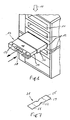
- Fig. 1 illustrates diagrammatically an automatically operating sheet film cassette loader-unloader which is generally designated by the numeral 10, and which is connected, not shown, with a processor for the processing of image-wise exposed X-ray films unloaded from their cassettes.
- Apparatus of the described kind are generally known and are used on a centralised or de-centralised basis in hospitals most of them still having one or more darkrooms at their disposal for the reloading of the magazines of the apparatus with fresh film.
- the frontside of the apparatus 10 has vertically spaced rectangular openings, the upper opening 11 being arranged for receiving a cassette to be unloaded and reloaded, and the other openings 12 being arranged for receiving magazines, such as the illustrated magazine 13, which each contain a stack of film sheets of a different format.
- the several magazines are equal to each other, but they are provided with displaceable walls at the innerside thereby to allow the exact location of different film formats in the magazine.
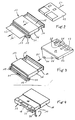
- the magazine 13 consists of a flat rectangular body 14 that has at the rear end an opening 15 (see Fig. 2) in the top wall that may be light-tightly closed by means of a sleeve-like slide 16 that may be displaced towards the right-hand side according to the view of Fig. 2, in order to light-tightly close the opening in the top wall.
- the front part 17 of the magazine is hingeable to the body 14 and may be swung from a closed position as shown in Fig. 1, into an open position as shown in Figs. 2 and 3.
- the front part has a handle 18 for carrying the magazine, and a winding spindle 19, see Figs. 2 and 3, that may be manually rotated by means of a crank 20 as illustrated in Fig. 4.
- the crank 20 is pliable and may be folded away in a recess 21 in the frontpart.
- the operator also removes the light-tight sleeve 33 of the previous film pack from the winding spindle, by pulling it in the direction of the arrow 34. To this end, the crank 20 has been disengaged from the recess 21 in order to permit the spindle to rotate freely.
- the filmpack is wrapped in a light-tight sleeve 33 that has a generally triangular, light-tightly sealed flap 26 at one end and an open but light-tightly folded end 27 at the opposite end that is kept closed by means of three rupturable sealing strips 28, and two non-rupturable strips 29.
- the top of flap 26 is provided with means for producing a pulling engagement between the flap and the winding spindle 19.
- the top is provided with a folded strip 30 of fabric adhered to the flap, the strip having a plurality of tiny loops on its outer surface.
- the central portion of the winding spindle is provided with a woven sleeve 31 bearing a plurality of tiny hooks.
- the described fastening combination is known under the Tradename VELCRO.
- the operator removes the sealing strips 29 from the package and slides the slide 16 in rearward direction in order to light-tightly close the magazine.
- the operator finally resumes the rotation of the crank 20 whereby the longitudinal tension on the wrapper is increased to such an extent that finally the sealing strips 28 are broken.
- the open end 27 is free to unfold itself as the light-tight sleeve 33 is pulled forwardly by the winding action of the spindle 19.
- the operator continues winding until he feels that the resistance to rotation of the crank decreases which is an indication for the complete removal of the sleeve from the film stack.
- the crank may be rotated for a further few revolutions in order to be sure of the complete removal of the sleeve and then the magazine, which is now ready for use, may be introduced in the apparatus 10.
- an indicator for signalling to the operator that the sleeve has been completely removed may comprise a lever for sensing the increase in diameter of the winding spindle by the wound sleeve, and for displaying the ultimate position of the lever in a small window in the front part of the magazine.
- the front end of the slide 16 becomes hooked behind the front wall of the apparatus so that further pushing on the front part 17 of the magazine causes the body structure 14 to slide within the now arrested slide 16 so that the magazine becomes opened as shown in Figs. 2 and 3 whereby its uncovered film stack becomes accessible for removing the film sheets, one by one, by an appropriate suction mechanism.
- the removal of the last film sheet of the stack is detected by mechanical sensors the levers of which can reach through openings such as 36 and 37 that are provided in the bottom leg of the paperboard wrapper 39.
- the magazine may then be removed from the apparatus and refilled as described hereinbefore.
- Apparatus as described hereinbefore are commercially available on the market under the Tradenames SCOPIX Compact S Imaging Center and CURIX Capacity Film Center, and they are manufactured by Agfa-Gevaert N.V., Mortsel-Belgium.
- Fig. 5a shows an exploded view of the content of one filmpack.
- This content consists of a stack of unwrapped X-ray film sheets 38 and a U-like cardboard wrapper 39.
- the film sheets are provided with a notch 22 that serves for the identification of the emulsion side of a film, after exposure and processing of the film.
- the cardboard wrapper has different functions. First, it must stiffen the stack of film sheets and protect the upper and lower film sheets against accidental pressure marks through the outer, flexible wrapper foil.
- the wrapper 39 has a lower leg 40 the size of which corresponds with that of the film sheets, an intermediate leg 41 the height of which corresponds with the height of the film stack, and an upper leg 42 the length of which is about half the length of the first leg.
- the leg 40 is provided with openings 36 and 37 mentioned already, and with a longitudinal weakening 43 in the form of a cut at the outside face through approximately half the thickness of the cardboard foil.
- the intermediate and the second legs each have a central interruption with a width of some centimeters.
- the weakening 43 and the central interruptions permit the package to be curved about a longitudinal axis as illustrated by line 44 in Fig. 5b, in view of the insertion of the stack in a light-tight sleeve 33.
- a stationary stack assembling member 46 consisting of a curved loading platform 47 with lateral, upstanding walls 48 and 49 having a height slightly in excess of the thickness of the filmstack and the paperboard wrapper.
- Sleeve 33 has a transverse seal 50 and a triangular-like flap 26 at one end and an open end at the opposite side.
- the sleeve has been cut from a black pigmented polyethylene tube that was made by blow molding, whereas the flap 26 was cut from an equally black pigmented polyethylene foil with a thickness slightly in excess of the thickness of the sleeve.
- the connection of the flap with the sleeve occurred through heatsealing.
- the top of the flap 26 is provided with a strip of a VELCRO fastening 30.
- the described sleeve is slid over the member 46 in the direction shown by the arrow 51.
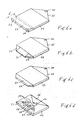
- the lateral sides 53 and 54 of the open end 27 of the sleeve 33 which extends beyond the stack of film sheets at the bottom face thereof, see Fig. 6a, are folded within the sleeve so that a configuration as shown in Fig. 6b is obtained.
- the folding of sides 53 and 54 may occur over only part of the length l of the open flap, but preferably the folding occurs over the full length of the flap as illustrated in the drawing.
- top end 56 of free end 27 is folded over 180 degrees as shown in Fig. 6c, and then the open flap is completely folded over 180 degrees and applied onto the top of the package as shown in Fig. 6d.
- the folded end 26 is secured to the package by means of three easily rupturable self-adhesive strips 28, and two difficultly rupturable strips 29.
- the strips 28 consist of a rectangular piece 55 of paper, see Fig. 7, with a central zone 57 of reduced width, and two self-adhesive end zones 58 and 59, the limits of which are indicated by broken lines. It has been shown that the central zone of reduced width, and free of adhesive, permits to obtain a well controlled rupturing force.
- the strips 29 may be conventional self-adhesive strips and their only purpose is prevent premature rupturing of the strips 28.
- the flap 26 of the package is fitted to the top of the package by means of a self-adhesive strip 60.
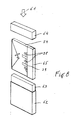
- the film pack produced as described hereinbefore is introduced into a telescope-type cardboard box 61 as illustrated in Fig. 8.
- the box comprises a bottom part 62 with a shoulder section 63 fixedly connected therewith, and a lid 64 that may telescope over the shoulder 63.
- the filmpackage is clamped in a U-like paperboard protector 65 that protects the sealing strips 28 and 29 from occasional damage during insertion of the film pack in the box 62.
- the box may then be closed and a sealing or warranty label may be stuck on the lid and the bottom part of the box.
- the inner surface of the top wall of the lid 64 may occasionally be provided with a foam cushion or the like, for obtaining a firm clamping of the package within the box.
- Film formats 8x10", 10x8", 11x14" and 14x17".
- Contents of a package 100 film sheets.
- Light-tight sleeve blow-moulded black pigmented low density polyethylene with a thickness of 0.12 mm.
- Flap 26 black pigmented low density polyethylene with a thickness of 0.20 mm.
- the winding engagement between the top of the pulling flap 26 and the winding spindle may also occur by engagement of the flap with a longitudinal slot of the spindle, by engagement of a hole punched in the flap with a hook on the spindle, by taping the flap to the spindle, etc. In both cases it is necessary to open the top part 17 of the magazine in order to effect the attaching of the flap to the spindle.
- the triangular flap 26 may be replaced by a flap having the shape of a truncated triangle, or having two or more lips or extensions applied to perform the first engagement with the winding spindle.
- the light-tight sleeve of the film pack may also be assembled from a foil, or foils, rather than cut from a blow-moulded tube as described.
- Flap 26 need not necessarily be made from a separate sheet material, but may also be obtained by cutting appropriate portions from sleeve 33.
- the easily rupturable sealing strips that provide a controlled opening force for the wrapper may be replaced by tapes that have been partly cut or perforated. There may be less than three such easily rupturable sealing strips.
- the sealing strips 28 and/or 29 may take an inclined position, such as that of the strip 60, thereby involving less risk for the strip to be damaged or peeled off, during the insertion of the film package in the box 61.
Landscapes
- Physics & Mathematics (AREA)
- General Physics & Mathematics (AREA)
- Engineering & Computer Science (AREA)
- Microelectronics & Electronic Packaging (AREA)
- Packages (AREA)
- Basic Packing Technique (AREA)
- Containers And Plastic Fillers For Packaging (AREA)
- Sheets, Magazines, And Separation Thereof (AREA)
Priority Applications (4)
| Application Number | Priority Date | Filing Date | Title |
|---|---|---|---|
| EP87202099A EP0313686B1 (en) | 1987-10-30 | 1987-10-30 | Filmsheet package and method of packaging filmsheets |
| DE8787202099T DE3784349T2 (de) | 1987-10-30 | 1987-10-30 | Filmblattpackung und verfahren zur verpackung dieser filmblaetter. |
| US07/260,315 US4909389A (en) | 1987-10-30 | 1988-10-20 | Filmsheet package and method of packaging filmsheets |
| JP63271927A JP2673361B2 (ja) | 1987-10-30 | 1988-10-27 | フイルムシートパッケージ、及びフイルムシートを包装する方法 |
Applications Claiming Priority (1)
| Application Number | Priority Date | Filing Date | Title |
|---|---|---|---|
| EP87202099A EP0313686B1 (en) | 1987-10-30 | 1987-10-30 | Filmsheet package and method of packaging filmsheets |
Publications (2)
| Publication Number | Publication Date |
|---|---|
| EP0313686A1 EP0313686A1 (en) | 1989-05-03 |
| EP0313686B1 true EP0313686B1 (en) | 1993-02-24 |
Family
ID=8197694
Family Applications (1)
| Application Number | Title | Priority Date | Filing Date |
|---|---|---|---|
| EP87202099A Expired - Lifetime EP0313686B1 (en) | 1987-10-30 | 1987-10-30 | Filmsheet package and method of packaging filmsheets |
Country Status (4)
| Country | Link |
|---|---|
| US (1) | US4909389A (enExample) |
| EP (1) | EP0313686B1 (enExample) |
| JP (1) | JP2673361B2 (enExample) |
| DE (1) | DE3784349T2 (enExample) |
Cited By (1)
| Publication number | Priority date | Publication date | Assignee | Title |
|---|---|---|---|---|
| WO2005124457A1 (en) * | 2004-06-11 | 2005-12-29 | Eastman Kodak Company | Photosensitive media cassette for an imaging device |
Families Citing this family (18)
| Publication number | Priority date | Publication date | Assignee | Title |
|---|---|---|---|---|
| EP0313686B1 (en) | 1987-10-30 | 1993-02-24 | Agfa-Gevaert N.V. | Filmsheet package and method of packaging filmsheets |
| US5048685A (en) * | 1990-09-24 | 1991-09-17 | Eastman Kodak Company | Carrier for film package |
| US5048686A (en) * | 1990-09-24 | 1991-09-17 | Eastman Kodak Company | Universal package for use in different kinds of equipment |
| US5220374A (en) * | 1991-05-22 | 1993-06-15 | Eastman Kodak Company | Film supply magazine |
| US5123536A (en) * | 1991-06-07 | 1992-06-23 | Eastman Kodak Company | Carrier for a film package |
| US5251755A (en) * | 1991-12-06 | 1993-10-12 | Eastman Kodak Company | Package having a leader secured over a pouch |
| US5199569A (en) * | 1991-12-06 | 1993-04-06 | Eastman Kodak Company | Package for sheets of X-ray film |
| US5257057A (en) * | 1992-06-22 | 1993-10-26 | Eastman Kodak Company | Magazine for a stack of film sheets |
| DE4436835C2 (de) | 1994-10-14 | 1998-04-30 | Agfa Gevaert Ag | Strichcodesystem für fotografische Blattfilme |
| CA2138192C (en) * | 1994-12-15 | 1998-08-11 | Lieven Dirx | Method for daylight loading a photographic light-sensitive material |
| US5685431A (en) * | 1996-02-27 | 1997-11-11 | L & S Bearing Co. | Packaging system for clutch sets |
| EP0811877B1 (en) * | 1996-06-06 | 2003-10-15 | Agfa-Gevaert | Cassette and method for daylight-loading a photographic sheet pack |
| DE69616569T2 (de) * | 1996-11-28 | 2002-06-27 | Agfa-Gevaert N.V., Mortsel | Stapel von thermoempfindlichen Blättern |
| US5996991A (en) * | 1996-11-28 | 1999-12-07 | Agfa-Gevaert | Thermal printer with sheet pressure means |
| US6588592B2 (en) | 2001-07-20 | 2003-07-08 | Eastman Kodak Company | Light-tight film package |
| US7063459B2 (en) * | 2004-10-28 | 2006-06-20 | Eastman Kodak Company | Dental x-ray packets having non-lead radiation shielding |
| EP2180373A1 (de) * | 2008-10-21 | 2010-04-28 | Agfa HealthCare NV | Röntgenkassette für eine Speicherleuchtstoffplatte und System mit einer solchen Röntgenkassette und einer Auslesevorrichtung |
| EP2180372B1 (de) * | 2008-10-21 | 2012-08-29 | Agfa HealthCare NV | Aufnahmevorrichtung zum Aufnehmen einer Speicherleuchtstoffplatte und Röntgenkassette |
Family Cites Families (12)
| Publication number | Priority date | Publication date | Assignee | Title |
|---|---|---|---|---|
| US1961344A (en) * | 1933-04-27 | 1934-06-05 | Jr Will J Ecker | Card case |
| FR952198A (fr) * | 1947-05-17 | 1949-11-10 | Suchard Holding | Emballage, spécialement pour le chocolat |
| US3341003A (en) * | 1964-12-17 | 1967-09-12 | Mobil Oil Corp | Dispenser pack |
| DE1786249A1 (de) * | 1968-09-06 | 1972-01-20 | Kalle Ag | Verfahren zur Herstellung eines Bucheinschlags |
| GB1361013A (en) * | 1970-07-07 | 1974-07-24 | Du Pont | Photographic film package |
| BE804908A (nl) * | 1973-09-17 | 1974-01-16 | C G R Benelux N V | Doos voor rontgenfilms |
| US4093069A (en) * | 1973-12-07 | 1978-06-06 | Agfa-Gevaert N.V. | Package for a stack of sheet materials |
| US3979051A (en) * | 1975-06-23 | 1976-09-07 | American Fiber Velope Manufacturing Company | Multi-compartment envelope |
| DE3122583C2 (de) * | 1981-06-06 | 1985-05-15 | Agfa-Gevaert Ag, 5090 Leverkusen | Vorrichtung zum Be- und Entladen von Röntgenfilmkassetten |
| DE8534241U1 (de) * | 1985-12-05 | 1986-10-02 | Agfa-Gevaert Ag, 5090 Leverkusen | Vorratsmagazin für Blattfilme |
| DE3615245C1 (en) * | 1986-05-06 | 1987-08-06 | Agfa Gevaert Ag | Supply magazine for a stack of sheet (flat) film located in a lightproof envelope |
| EP0313686B1 (en) | 1987-10-30 | 1993-02-24 | Agfa-Gevaert N.V. | Filmsheet package and method of packaging filmsheets |
-
1987
- 1987-10-30 EP EP87202099A patent/EP0313686B1/en not_active Expired - Lifetime
- 1987-10-30 DE DE8787202099T patent/DE3784349T2/de not_active Expired - Fee Related
-
1988
- 1988-10-20 US US07/260,315 patent/US4909389A/en not_active Expired - Lifetime
- 1988-10-27 JP JP63271927A patent/JP2673361B2/ja not_active Expired - Fee Related
Cited By (1)
| Publication number | Priority date | Publication date | Assignee | Title |
|---|---|---|---|---|
| WO2005124457A1 (en) * | 2004-06-11 | 2005-12-29 | Eastman Kodak Company | Photosensitive media cassette for an imaging device |
Also Published As
| Publication number | Publication date |
|---|---|
| US4909389A (en) | 1990-03-20 |
| JPH01186927A (ja) | 1989-07-26 |
| EP0313686A1 (en) | 1989-05-03 |
| DE3784349D1 (de) | 1993-04-01 |
| DE3784349T2 (de) | 1993-09-23 |
| JP2673361B2 (ja) | 1997-11-05 |
Similar Documents
| Publication | Publication Date | Title |
|---|---|---|
| US4909389A (en) | Filmsheet package and method of packaging filmsheets | |
| EP0231834B1 (en) | Sheet film package and device for loading sheet films | |
| EP0230057B1 (en) | A light-tightly packaged roll of light-sensitive material | |
| US4148395A (en) | Roll package | |
| EP0530495B1 (en) | Printing paper protecting device | |
| US3482681A (en) | Strip material magazines and method of producing same | |
| US4158409A (en) | Packing for single films | |
| US4100559A (en) | Apparatus for packaging and for using self-developing photographic film | |
| JPH0389338A (ja) | 日中装填用フィルムシート包装体 | |
| US5251755A (en) | Package having a leader secured over a pouch | |
| JPS62245248A (ja) | 積層シ−トフイルムを包装する遮光性で引き裂き可能な包装カバ− | |
| EP0477776B1 (en) | A universal package for use in different kinds of equipment | |
| EP0644457B1 (en) | A lighttight film package | |
| US5199569A (en) | Package for sheets of X-ray film | |
| EP0743556A2 (en) | Light-tight package | |
| US6312169B1 (en) | Relockable film cartridge for a photographic system | |
| US6588592B2 (en) | Light-tight film package | |
| EP0779541B1 (en) | Light-tight package | |
| US5048685A (en) | Carrier for film package | |
| US3438485A (en) | Package for film sheets | |
| EP0545332B1 (en) | Film package having a pouch and leader with different coefficients of friction | |
| EP0987592B1 (en) | Relockable film cartridge for a photographic system | |
| EP0545330A1 (en) | Package having a leader secured over a pouch | |
| US6398427B1 (en) | Relockable film cartridge for photographic film | |
| EP1146387B1 (en) | Relockable film cartridge for photographic film |
Legal Events
| Date | Code | Title | Description |
|---|---|---|---|
| PUAI | Public reference made under article 153(3) epc to a published international application that has entered the european phase |
Free format text: ORIGINAL CODE: 0009012 |
|
| AK | Designated contracting states |
Kind code of ref document: A1 Designated state(s): AT BE CH DE ES FR GB GR IT LI LU NL SE |
|
| RBV | Designated contracting states (corrected) |
Designated state(s): BE DE FR GB |
|
| 17P | Request for examination filed |
Effective date: 19890922 |
|
| 17Q | First examination report despatched |
Effective date: 19910913 |
|
| GRAA | (expected) grant |
Free format text: ORIGINAL CODE: 0009210 |
|
| AK | Designated contracting states |
Kind code of ref document: B1 Designated state(s): BE DE FR GB |
|
| REF | Corresponds to: |
Ref document number: 3784349 Country of ref document: DE Date of ref document: 19930401 |
|
| ET | Fr: translation filed | ||
| PLBE | No opposition filed within time limit |
Free format text: ORIGINAL CODE: 0009261 |
|
| STAA | Information on the status of an ep patent application or granted ep patent |
Free format text: STATUS: NO OPPOSITION FILED WITHIN TIME LIMIT |
|
| 26N | No opposition filed | ||
| PGFP | Annual fee paid to national office [announced via postgrant information from national office to epo] |
Ref country code: BE Payment date: 19950821 Year of fee payment: 9 |
|
| PG25 | Lapsed in a contracting state [announced via postgrant information from national office to epo] |
Ref country code: BE Effective date: 19961031 |
|
| BERE | Be: lapsed |
Owner name: AGFA-GEVAERT N.V. Effective date: 19961031 |
|
| REG | Reference to a national code |
Ref country code: GB Ref legal event code: 746 Effective date: 19990910 |
|
| REG | Reference to a national code |
Ref country code: FR Ref legal event code: D6 |
|
| REG | Reference to a national code |
Ref country code: GB Ref legal event code: IF02 |
|
| PGFP | Annual fee paid to national office [announced via postgrant information from national office to epo] |
Ref country code: FR Payment date: 20030827 Year of fee payment: 17 |
|
| PGFP | Annual fee paid to national office [announced via postgrant information from national office to epo] |
Ref country code: GB Payment date: 20030828 Year of fee payment: 17 |
|
| PGFP | Annual fee paid to national office [announced via postgrant information from national office to epo] |
Ref country code: DE Payment date: 20030902 Year of fee payment: 17 |
|
| PG25 | Lapsed in a contracting state [announced via postgrant information from national office to epo] |
Ref country code: GB Free format text: LAPSE BECAUSE OF NON-PAYMENT OF DUE FEES Effective date: 20041030 |
|
| PG25 | Lapsed in a contracting state [announced via postgrant information from national office to epo] |
Ref country code: DE Free format text: LAPSE BECAUSE OF NON-PAYMENT OF DUE FEES Effective date: 20050503 |
|
| GBPC | Gb: european patent ceased through non-payment of renewal fee |
Effective date: 20041030 |
|
| PG25 | Lapsed in a contracting state [announced via postgrant information from national office to epo] |
Ref country code: FR Free format text: LAPSE BECAUSE OF NON-PAYMENT OF DUE FEES Effective date: 20050630 |
|
| REG | Reference to a national code |
Ref country code: FR Ref legal event code: ST |