EP0310591B1 - Verfahren zum Züchten von homogenen Kristallen und Vorrichtung zur Durchführung des Verfahrens - Google Patents
Verfahren zum Züchten von homogenen Kristallen und Vorrichtung zur Durchführung des Verfahrens Download PDFInfo
- Publication number
- EP0310591B1 EP0310591B1 EP88890230A EP88890230A EP0310591B1 EP 0310591 B1 EP0310591 B1 EP 0310591B1 EP 88890230 A EP88890230 A EP 88890230A EP 88890230 A EP88890230 A EP 88890230A EP 0310591 B1 EP0310591 B1 EP 0310591B1
- Authority
- EP
- European Patent Office
- Prior art keywords
- growing
- tank
- solution
- crystals
- temperature
- Prior art date
- Legal status (The legal status is an assumption and is not a legal conclusion. Google has not performed a legal analysis and makes no representation as to the accuracy of the status listed.)
- Expired - Lifetime
Links
- 239000013078 crystal Substances 0.000 title claims description 82
- 238000000034 method Methods 0.000 title claims description 51
- 238000003860 storage Methods 0.000 claims description 28
- 238000010438 heat treatment Methods 0.000 claims description 16
- 238000007654 immersion Methods 0.000 claims description 12
- 239000002994 raw material Substances 0.000 claims description 10
- 239000000463 material Substances 0.000 claims description 8
- 229910052751 metal Inorganic materials 0.000 claims description 8
- 239000002184 metal Substances 0.000 claims description 8
- 239000004810 polytetrafluoroethylene Substances 0.000 claims description 7
- 229920001343 polytetrafluoroethylene Polymers 0.000 claims description 7
- 238000005086 pumping Methods 0.000 claims description 7
- NBIIXXVUZAFLBC-UHFFFAOYSA-N Phosphoric acid Chemical compound OP(O)(O)=O NBIIXXVUZAFLBC-UHFFFAOYSA-N 0.000 claims description 6
- 229910000154 gallium phosphate Inorganic materials 0.000 claims description 6
- 239000000523 sample Substances 0.000 claims description 6
- 239000011521 glass Substances 0.000 claims description 5
- 239000000203 mixture Substances 0.000 claims description 5
- NBIIXXVUZAFLBC-UHFFFAOYSA-K phosphate Chemical compound [O-]P([O-])([O-])=O NBIIXXVUZAFLBC-UHFFFAOYSA-K 0.000 claims description 5
- 235000011007 phosphoric acid Nutrition 0.000 claims description 5
- XLYOFNOQVPJJNP-UHFFFAOYSA-N water Chemical compound O XLYOFNOQVPJJNP-UHFFFAOYSA-N 0.000 claims description 5
- 238000011067 equilibration Methods 0.000 claims description 4
- 229910044991 metal oxide Inorganic materials 0.000 claims description 4
- 150000004706 metal oxides Chemical class 0.000 claims description 4
- 238000000079 presaturation Methods 0.000 claims description 4
- 230000003247 decreasing effect Effects 0.000 claims description 2
- 238000002360 preparation method Methods 0.000 claims 1
- 238000009395 breeding Methods 0.000 description 65
- 230000001488 breeding effect Effects 0.000 description 63
- 230000029087 digestion Effects 0.000 description 6
- 229910001581 alarsite Inorganic materials 0.000 description 5
- 239000002253 acid Substances 0.000 description 4
- 229910000147 aluminium phosphate Inorganic materials 0.000 description 4
- 229910052715 tantalum Inorganic materials 0.000 description 4
- GUVRBAGPIYLISA-UHFFFAOYSA-N tantalum atom Chemical compound [Ta] GUVRBAGPIYLISA-UHFFFAOYSA-N 0.000 description 4
- XUIMIQQOPSSXEZ-UHFFFAOYSA-N Silicon Chemical compound [Si] XUIMIQQOPSSXEZ-UHFFFAOYSA-N 0.000 description 3
- 229920006395 saturated elastomer Polymers 0.000 description 3
- 229910052710 silicon Inorganic materials 0.000 description 3
- 239000010703 silicon Substances 0.000 description 3
- 239000000126 substance Substances 0.000 description 3
- 230000002378 acidificating effect Effects 0.000 description 2
- 238000009529 body temperature measurement Methods 0.000 description 2
- 238000002425 crystallisation Methods 0.000 description 2
- 230000008025 crystallization Effects 0.000 description 2
- 238000011161 development Methods 0.000 description 2
- 230000000694 effects Effects 0.000 description 2
- 239000000725 suspension Substances 0.000 description 2
- 101100499944 Arabidopsis thaliana POL2A gene Proteins 0.000 description 1
- DJHGAFSJWGLOIV-UHFFFAOYSA-N Arsenic acid Chemical compound O[As](O)(O)=O DJHGAFSJWGLOIV-UHFFFAOYSA-N 0.000 description 1
- YCKRFDGAMUMZLT-UHFFFAOYSA-N Fluorine atom Chemical compound [F] YCKRFDGAMUMZLT-UHFFFAOYSA-N 0.000 description 1
- DGAQECJNVWCQMB-PUAWFVPOSA-M Ilexoside XXIX Chemical compound C[C@@H]1CC[C@@]2(CC[C@@]3(C(=CC[C@H]4[C@]3(CC[C@@H]5[C@@]4(CC[C@@H](C5(C)C)OS(=O)(=O)[O-])C)C)[C@@H]2[C@]1(C)O)C)C(=O)O[C@H]6[C@@H]([C@H]([C@@H]([C@H](O6)CO)O)O)O.[Na+] DGAQECJNVWCQMB-PUAWFVPOSA-M 0.000 description 1
- 229910000831 Steel Inorganic materials 0.000 description 1
- CBIFDJDRCNEMQB-UHFFFAOYSA-N [Al].O[As](O)(O)=O Chemical compound [Al].O[As](O)(O)=O CBIFDJDRCNEMQB-UHFFFAOYSA-N 0.000 description 1
- 230000002411 adverse Effects 0.000 description 1
- 229910052782 aluminium Inorganic materials 0.000 description 1
- 229910052785 arsenic Inorganic materials 0.000 description 1
- 229940000488 arsenic acid Drugs 0.000 description 1
- 244000052616 bacterial pathogen Species 0.000 description 1
- 229910052796 boron Inorganic materials 0.000 description 1
- 239000000919 ceramic Substances 0.000 description 1
- 239000011248 coating agent Substances 0.000 description 1
- 238000000576 coating method Methods 0.000 description 1
- 230000006835 compression Effects 0.000 description 1
- 238000007906 compression Methods 0.000 description 1
- 238000009833 condensation Methods 0.000 description 1
- 230000005494 condensation Effects 0.000 description 1
- 238000007796 conventional method Methods 0.000 description 1
- 230000007797 corrosion Effects 0.000 description 1
- 238000005260 corrosion Methods 0.000 description 1
- 230000007423 decrease Effects 0.000 description 1
- 230000001419 dependent effect Effects 0.000 description 1
- 238000010586 diagram Methods 0.000 description 1
- 238000004090 dissolution Methods 0.000 description 1
- 238000010292 electrical insulation Methods 0.000 description 1
- 238000005516 engineering process Methods 0.000 description 1
- 230000029142 excretion Effects 0.000 description 1
- 229910052731 fluorine Inorganic materials 0.000 description 1
- 239000011737 fluorine Substances 0.000 description 1
- 229920002313 fluoropolymer Polymers 0.000 description 1
- 229910052733 gallium Inorganic materials 0.000 description 1
- 230000005764 inhibitory process Effects 0.000 description 1
- 229910052742 iron Inorganic materials 0.000 description 1
- 239000007788 liquid Substances 0.000 description 1
- 238000011068 loading method Methods 0.000 description 1
- 238000004519 manufacturing process Methods 0.000 description 1
- 229910000510 noble metal Inorganic materials 0.000 description 1
- 239000004033 plastic Substances 0.000 description 1
- 229920003023 plastic Polymers 0.000 description 1
- 238000004886 process control Methods 0.000 description 1
- 150000003839 salts Chemical class 0.000 description 1
- 238000009738 saturating Methods 0.000 description 1
- 238000007789 sealing Methods 0.000 description 1
- 230000035945 sensitivity Effects 0.000 description 1
- 230000035939 shock Effects 0.000 description 1
- 229920002545 silicone oil Polymers 0.000 description 1
- 229910052708 sodium Inorganic materials 0.000 description 1
- 239000011734 sodium Substances 0.000 description 1
- 239000010959 steel Substances 0.000 description 1
- 238000012546 transfer Methods 0.000 description 1
- 238000005303 weighing Methods 0.000 description 1
Images

Classifications
-
- C—CHEMISTRY; METALLURGY
- C30—CRYSTAL GROWTH
- C30B—SINGLE-CRYSTAL GROWTH; UNIDIRECTIONAL SOLIDIFICATION OF EUTECTIC MATERIAL OR UNIDIRECTIONAL DEMIXING OF EUTECTOID MATERIAL; REFINING BY ZONE-MELTING OF MATERIAL; PRODUCTION OF A HOMOGENEOUS POLYCRYSTALLINE MATERIAL WITH DEFINED STRUCTURE; SINGLE CRYSTALS OR HOMOGENEOUS POLYCRYSTALLINE MATERIAL WITH DEFINED STRUCTURE; AFTER-TREATMENT OF SINGLE CRYSTALS OR A HOMOGENEOUS POLYCRYSTALLINE MATERIAL WITH DEFINED STRUCTURE; APPARATUS THEREFOR
- C30B7/00—Single-crystal growth from solutions using solvents which are liquid at normal temperature, e.g. aqueous solutions
-
- C—CHEMISTRY; METALLURGY
- C30—CRYSTAL GROWTH
- C30B—SINGLE-CRYSTAL GROWTH; UNIDIRECTIONAL SOLIDIFICATION OF EUTECTIC MATERIAL OR UNIDIRECTIONAL DEMIXING OF EUTECTOID MATERIAL; REFINING BY ZONE-MELTING OF MATERIAL; PRODUCTION OF A HOMOGENEOUS POLYCRYSTALLINE MATERIAL WITH DEFINED STRUCTURE; SINGLE CRYSTALS OR HOMOGENEOUS POLYCRYSTALLINE MATERIAL WITH DEFINED STRUCTURE; AFTER-TREATMENT OF SINGLE CRYSTALS OR A HOMOGENEOUS POLYCRYSTALLINE MATERIAL WITH DEFINED STRUCTURE; APPARATUS THEREFOR
- C30B29/00—Single crystals or homogeneous polycrystalline material with defined structure characterised by the material or by their shape
- C30B29/10—Inorganic compounds or compositions
-
- C—CHEMISTRY; METALLURGY
- C30—CRYSTAL GROWTH
- C30B—SINGLE-CRYSTAL GROWTH; UNIDIRECTIONAL SOLIDIFICATION OF EUTECTIC MATERIAL OR UNIDIRECTIONAL DEMIXING OF EUTECTOID MATERIAL; REFINING BY ZONE-MELTING OF MATERIAL; PRODUCTION OF A HOMOGENEOUS POLYCRYSTALLINE MATERIAL WITH DEFINED STRUCTURE; SINGLE CRYSTALS OR HOMOGENEOUS POLYCRYSTALLINE MATERIAL WITH DEFINED STRUCTURE; AFTER-TREATMENT OF SINGLE CRYSTALS OR A HOMOGENEOUS POLYCRYSTALLINE MATERIAL WITH DEFINED STRUCTURE; APPARATUS THEREFOR
- C30B29/00—Single crystals or homogeneous polycrystalline material with defined structure characterised by the material or by their shape
- C30B29/10—Inorganic compounds or compositions
- C30B29/14—Phosphates
-
- Y—GENERAL TAGGING OF NEW TECHNOLOGICAL DEVELOPMENTS; GENERAL TAGGING OF CROSS-SECTIONAL TECHNOLOGIES SPANNING OVER SEVERAL SECTIONS OF THE IPC; TECHNICAL SUBJECTS COVERED BY FORMER USPC CROSS-REFERENCE ART COLLECTIONS [XRACs] AND DIGESTS
- Y10—TECHNICAL SUBJECTS COVERED BY FORMER USPC
- Y10T—TECHNICAL SUBJECTS COVERED BY FORMER US CLASSIFICATION
- Y10T117/00—Single-crystal, oriented-crystal, and epitaxy growth processes; non-coating apparatus therefor
- Y10T117/10—Apparatus
- Y10T117/1024—Apparatus for crystallization from liquid or supercritical state
- Y10T117/1096—Apparatus for crystallization from liquid or supercritical state including pressurized crystallization means [e.g., hydrothermal]
Definitions
- the invention relates to a method for growing homogeneous crystals from a hydrothermal growing solution present in a growing container, the solubility of the crystals in the growing solution decreasing with increasing temperature (retrograde solubility) and a device for carrying out the method with at least one growing container containing a hydrothermal growing solution with holders for crystal raw material and crystal nuclei, which can be connected to at least one further container via a pipeline.
- homogeneous crystals means crystals in which the crystal and crystal nucleus have the same crystal structure and are preferably made of the same material or at least largely the same in lattice constants.
- Another disadvantage of conventional breeding methods is that during the digestion or presaturation of the breeding solution, which often lasts a few weeks, the breeding container is blocked for the actual breeding process. Disruption is to be understood as the process in which the actual growing solution, namely a mixture of metal oxide, acid and water the metal salt, dissolved in an acid-water mixture, is formed.
- a method of the type mentioned at the outset or a device for carrying out this method is known from US Pat. No. 4,382,840, where a breeding container with a horizontally adjacent breeding and saturation area is connected to a further container via a pipeline.
- a breeding container with a horizontally adjacent breeding and saturation area is connected to a further container via a pipeline.
- this cylinder-shaped container which can be heated, is the acid required for the breeding process, which after heating is pumped into the breeding vessel by means of a piston which is guided in the container and sealed to the outside, and is removed from the breeding container after the breeding process has ended.
- the disadvantage here is that the hot acid which is pumped into the breeding tank causes a majority of the seedlings to dissolve and thus be destroyed, and that the time required to set the breeding parameters must be waited until the actual start of breeding.
- AlAsO4 aluminum arsenate crystals
- AlPO4 beryllite To use seedlings
- the method mentioned does not produce homogeneous crystals, since lattice tensions occur in the region of the seedling - caused by different lattice constants of AlAsO4 and AlPO4 - which have adverse effects on the properties of the crystal.
- the process is limited to AlAsO4, AlPO4 or GaPO4 crystals, for example, cannot be achieved with it.
- the object of the invention is to propose a method for growing stalls from hydrothermal growing solutions, which avoids the disadvantages mentioned and in particular largely prevents the crystal nuclei from being consumed at the start of the growing process or the crystals formed after the growing process.
- the growing solution is disrupted outside the growing container, pre-saturated and preheated to a temperature close to the saturation temperature, in that the hot growing solution for the actual growing process is introduced into the preheated growing container provided with crystal seeds and up to a temperature, in which the crystal growth begins, is heated further, and that the hot growth solution after completion the breeding process is quickly removed from the breeding container.
- the growing container is loaded with a relatively hot growing solution and after the end of the growing process it can be quickly removed again from the autoclave, which on the one hand protects the seedlings or finished crystals in the autoclave as well as possible and on the other hand the time until the breeding equilibrium is reached is significantly shortened in the breeding vessel.
- the growing solution is equilibrated in a vessel similar to this before being introduced into the growing vessel containing the crystal nuclei, or that the growing solution is equilibrated directly in the growing vessel before the actual growing process and before the crystal nuclei are introduced into the growing vessel.
- the breeding solution can come into a thermodynamic equilibrium with the inner walls of the breeding vessel or with the internals in it before the start of breeding.
- the extent of the equilibration is controlled according to the invention by means of probe seedlings located in the breeding vessel or this similar vessel during this process.
- the growing solution in the growing container is initially spatially homogeneously heated up to a temperature at which crystal growth begins, and slowly heated further by setting a temperature gradient over time, and that the depletion area is cooled after depletion of the growing solution of saturation material or the breeding area is heated further, so that there is a spatial, preferably vertical, temperature gradient.
- vessels constructed or equipped in the same way they can be used alternately for growing the crystals and disrupting or equilibrating the growing solution.
- the growing solution to be introduced into the growing vessel is heated in a storage container under normal pressure and on its way into the growing container heating is continued until close to the saturation temperature, and after the breeding process has ended, the pump is cooled again when pumping back into the storage container.
- An excretion of crystal material on the walls of the storage container or the line between the storage container and the breeding container is largely avoided. Since different containers are used for digestion and breeding, these can also be optimally lined for the respective purpose and the breeding vessel is not blocked for breeding processes during the time in which the breeding solution is being digested or pre-saturated.
- the hot growing solution is introduced into the growing tank or removed from the growing tank with the aid of a pressure medium, preferably compressed air, it being advantageous if the growing solution is under a pressure which is above the vapor pressure of the growing solution is the saturation temperature, is introduced into the breeding tank or if the growing solution is removed from the breeding tank under the pressure which is above the vapor pressure of the growing solution at the final breeding temperature.
- a pressure medium preferably compressed air
- the pumping process is carried out under overpressure conditions, the pressure of the pressure medium preferably being 0.5 bar above the system pressure. Due to the increased pressure in the storage container, higher temperatures can already be reached there, as a result of which the temperature required for crystal growing can then be set more quickly in the growth container.
- the invention provides that in a storage container with preferably a glass inner wall, a mixture consisting of metal oxide, H3PO4 and H2O at temperatures between 100 and 140 ° C in a growth solution of metal orthophosphate in H3PO4 and H2O is unlocked and that much of the temperature difference between the temperature in the storage tank and that in the breeding area of the breeding tank, the prevailing temperature ⁇ 200 ° C is compensated by heating the breeding solution during pumping.
- the growth solution for example in the manufacture of GaPO4 crystals in the storage container, is preheated to approx.
- a device for carrying out the method with at least one growing container containing a hydrothermal growing solution with a heating device, with holders for crystal raw material and crystal nuclei, and with at least one further container, which containers are detachably connected via a pipeline, is provided according to the invention in that at least the growing container has an immersion lifter device, which immersion lifter device has an immersion tube immersed in the cultivation solution and a connection for a pressure medium, so that the cultivation solution can be transferred from one container to the other by exposure to the pressure medium.
- Compressed air can preferably be used as the pressure medium.
- several additional containers designed as storage containers can be connected to several autoclaves, so that depending on the digestion time and duration of any presaturation in the storage containers, as well as the duration of the breeding process in the breeding container, the latter is optimally used in terms of time. Since the same or higher temperatures prevail in the lower part of the growing container in which the crystal seeds are located than in the upper part of the growing container, where the crystal raw material is arranged and the growing container is heated in this area, crystal material is also in the area of the lower part of the Breeding tank deposited. As a result, drains arranged there would gradually increase, so that an immersion lifter device operated with compressed air has proven itself as an emptying and loading device.
- An essential aspect of the quality of crystals is the chemical purity of the substance and, in connection therewith, that of the growing solution.
- the effects of foreign atoms also in the ppm range, can already be noticeable during crystallization, for example as an inhibition of crystallization, favoring domains, influencing the growth rates or the growth kinetics.
- the tantalum content of a solution is fairly linearly dependent on the process time in tantalum autoclaves. It follows that the digestion of the culture solution should be carried out better in a storage vessel with glass walls. If possible, presaturation should also take place in the storage vessel and only actual cultivation in the tantalum autoclave. Since tantalum as well as silicon and sodium are incorporated to a certain extent from the growth solution into the crystal, the content of these elements in the growth solution must be kept as low as possible.
- the silicon content of growing solutions in glass vessels depends mainly on the maximum temperature reached and less on the growing time, since the storage container has lower temperatures than the growing container, it is also possible to keep the silicon content of the growing solution low.
- the most suitable material for the respective cultivation solution and the respective cultivation or digestion parameters is used for the lining of the containers, in particular corrosion-resistant, fluorine-containing plastics such as PTFE, acid-resistant ceramics, glass and noble metals.
- the internals of the growing vessel are designed according to the invention such that the holders arranged for the crystal raw material in the upper part of the growing container and forming a saturation framework and the holders arranged for the crystal nuclei in the lower part, as well as one between the upper and Baffle arranged in the lower part of the breeding container have central openings for inserting the dip tube of the dip lifter device.
- Both the holders for the crystal raw material and those for the crystal nuclei and the baffle arranged between the lower and upper part have central openings through which the immersion tube can be inserted to just above the bottom of the culture vessel when the autoclave is being filled or emptied.
- temperature measuring elements are located in this central opening.
- the baffle placed in the middle serves to maintain the vertical temperature gradient.
- the invention provides that the holders for the crystal raw material and the holders for the crystal nuclei are constructed in a modular manner and together with the baffle can be attached by rod-shaped suspensions in the assembled state, whereby according to the invention it can be provided that the Internals of the breeding vessel consist of PTFE or are coated with a fluoroplastic.
- the heating of the cultivation solution to the required cultivation temperature can be achieved according to the invention in that a heat exchanger is located in the pipeline between the cultivation container and the further container designed as a storage container for opening and / or pre-saturating the cultivation solution.
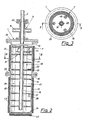
- the device shown in Fig. 1 consists of a breeding container 1, which via a pipe 2 with a storage container or further container 3 is connectable.
- a heat exchange device implemented by a heat exchanger 4 with the connections 5 and 6, which can be operated, for example, with silicone oil, is interposed for the heat transfer medium.
- the temperature gradient required in the breeding container 1 is maintained by the heating device 7, which can consist of several heating elements shown in FIG. 2, which are controlled by two external temperature measuring devices 8 and 9 assigned to the individual heating elements.
- the temperature inside the breeding container 1 is recorded in the upper part 10 by the measuring device 11 and in the lower part 12 by the measuring device 13.
- the signals of the individual temperature measuring devices are processed by a process control device, not shown here.
- the detachable pipeline 2 is connected to an immersion lifter 14 on the breeding tank 1 for pumping the breeding solution from the storage tank 3 into the breeding tank 1.
- the immersion lifter device 14 has a compressed air connection 15 with a valve 16, as well as a pressure measuring device 17 in a T-piece and a rupture disk 18 as a safety device.
- the dip tube 19 of the dip lifter device 14 can be seen in detail in FIGS. 2 and 3.
- the storage container 3 also has a heating device 20 and a compressed air connection 21 with a valve 22. It is of course also possible to connect further breeding containers, for example via the three-way valve 23 and line 24 or further storage containers via the three-way valve 25 and line 26, in order to connect the breeding vessel optimally used with regard to the respective breeding period. For safety reasons, the system is located in a collecting basin 27. The drain 28 of the rupture disk 18 opens into a condensation basin, not shown here.
- the breeding container 1 shown in FIGS. 2 and 3 is used for the church breeding of metal orthophosphates in acidic media (eg GaPO4 crystals from a GaPO4-H3PO4-H2O solution), but this is not a limitation of the device according to the invention to this group of substances should be evaluated, since the device described can in principle also be used for other crystal growing processes from hydrothermal solutions with retrograde solubility of the crystals.
- acidic media eg GaPO4 crystals from a GaPO4-H3PO4-H2O solution
- the breeding container 1 consists essentially of two PTFE-lined tubes which form the upper and lower parts 10 and 12 and are connected by a flange 29 are. In addition, all other parts of the device that come into contact with the cultivation solution are provided with PTFE linings.
- baffle 30 At the level of the parting plane of the two tubes in the region of the flange 29 there is a baffle 30 with which the hydrodynamic flow of the cultivation solution can be influenced in a targeted manner and the vertical temperature gradient can be maintained. In addition to its central bore, further bores can be arranged in the baffle 30 to influence the flow conditions.
- the saturation framework 31 with the corresponding amount of crystal raw material 32 in individual holders 33 designed as circular shells.
- the seedling holder installed in the lower part 12 of the breeding container 1 consists essentially of a base plate 34 and five annular holders 35 which are screwed to rods 45 at three points. On each of these ring-shaped holders 35, crystal seeds 36, e.g. fixed with wires 37.
- the rods 45 form three rod-shaped suspensions 38 which carry the saturation structure 31, the seedling holders 35 and the baffle 30.
- PTFE is recommended as the material for the internals of the breeding tank.
- the upper part 10 of the breeding container 1 is closed with a reducing flange 39 which carries the immersion lifter device 14 with the immersion tube 19 and the compressed air connection 15.
- a pressure p acts on the surface 44 of the culture solution, as a result of which it can be quickly removed from the culture container.
- line 2 for example a lined with PTFE and coated with steel Hose removed from flange 40 and the opening closed with a blind flange.
- the heating device 7 comprises two annular heating elements 41 and 42, each of which has its own temperature control to maintain the vertical temperature gradient.
- a floor heating element 43 can also be present.
- thermometers 11 and 13 For the temperature measurement inside by the measuring devices 11 and 13, two PTFE-coated jacket resistance thermometers are used. An O-ring compression fitting is used to seal the temperature probes, and an E-CTFE coating is used to protect the flange used for the passage. This sealing technology allows a stepless height shift of the temperature probes used.
- the cultivated solution which may be pre-saturated in the storage container 3, is heated in the storage container to approx. 120 ° C. and pumped into the approx. 160 ° preheated cultivation container, the solution being heated by the heat exchanger 4 by 25 to 30 °. If the cultivation container is to be equilibrated, there are no crystal seeds in the container apart from the probe seedlings. Only after the equilibration process has been completed - which can be determined by weighing the probe seedlings - is the growing solution pumped back into the storage container 3 via the immersion lifter device 14, after which the crystal seeds are inserted into the growing container. After the growth solution has been pumped in, the actual crystal growth then begins, a temperature difference of 5 to 30 ° C. being able to exist between the growth range and the saturation range in the growth container.
- a temperature-pressure diagram serves as an orientation for the proper process flow.
- the heating is switched off and the breeding tank is cooled down to approx. 140 ° C.
- the immersion lifter is inserted and the culture solution cooled over the Pumped heat exchanger 4 back into the storage vessel.
- the saturation structure 31, the baffle 30 and the holders 35 are removed and the crystal yield is removed.
Landscapes
- Chemical & Material Sciences (AREA)
- Engineering & Computer Science (AREA)
- Crystallography & Structural Chemistry (AREA)
- Materials Engineering (AREA)
- Metallurgy (AREA)
- Organic Chemistry (AREA)
- Inorganic Chemistry (AREA)
- Crystals, And After-Treatments Of Crystals (AREA)
- Apparatus Associated With Microorganisms And Enzymes (AREA)
Description
- Die Erfindung betrifft ein Verfahren zum Züchten von homogenen Kristallen aus einer in einem Zuchtbehälter vorliegenden hydrothermalen Zuchtlösung, wobei die Löslichkeit der Kristalle in der Zuchtlösung mit steigender Temperatur abnimmt (retrograde Löslichkeit) und eine Vorrichtung zur Durchführung des Verfahrens mit zumindest einem eine hydrothermale Zuchtlösung enthaltenden Zuchtbehälter mit Halterungen für Kristallrohmaterial und Kristallkeime, welcher über eine Rohrleitung mit zumindest einem weiteren Behälter verbindbar ist.
- Unter "homogene Kristalle" sind in diesem Zusammenhang Kristalle gemeint, bei welchen Kristall und Kristallkeim dieselbe Kristallstruktur aufweisen und vorzugsweise aus demselben Material aufgebaut sind oder sich zumindest in den Gitterkonstanten weitgehend gleichen.
- Beim Züchten von homogenen Kristallen bzw. Einkristallen aus hydrothermalen Zuchtlösungen mit retrograder Löslichkeit nach herkömmlichen Methoden treten sowohl beim Anfahren als auch beim Abstellen des Autoklaven bzw. Zuchtgefäßes Schwierigkeiten auf, welche mit der zunehmenden Löslichkeit der Kristalle bei abnehmender Temperatur zusammenhängen. Dadurch werden einerseits beim Anfahren des Autoklaven die Keimlinge aufgezehrt bzw. gehen beim Abstellen und zu langsamen Abkühlen des Autoklaven Teile der gebildeten Kristalle wieder in Lösung.
- Nachteilig ist bei herkömmlichen Zuchtverfahren auch, daß während des oft einige Wochen dauernden Aufschlusses bzw. der Vorsättigung der Zuchtlösung der Zuchtbehälter für den eigentlichen Zuchtvorgang blockiert ist. Unter Aufschluß ist dabei jener Vorgang zu verstehen, bei welchem aus einer Mischung aus Metalloxid, Säure und Wasser die eigentliche Zuchtlösung, nämlich das Metallsalz, gelöst in einem Säurewassergemisch, entsteht.
- Bei herkömmlichen Zuchtverfahren müssen meistens bei der Materialwahl für die Innenauskleidung des Autoklaven Kompromisse eingegangen werden, da diese den unterschiedlichsten thermodynamischen und mechanischen Belastungen, welche während des Aufschlusses und während des Zuchtvorganges herrschen, standhalten müssen.
- Ein Verfahren der eingangs genannten Art bzw. eine Vorrichtung zur Durchführung dieses Verfahrens ist aus der US-PS 4382840 bekannt, wo ein Zuchtbehälter mit horizontal nebeneinander angeordneten Zucht- und Sättigungsbereich mit einem weiteren Behälter über eine Rohrleitung verbunden ist. In diesem zylinderförmig ausbebildeten Behälter, welcher geheizt werden kann, befindet sich die für den Zuchtprozeß benötigte Säure, welche nach Erhitzen mittels eines im Behälter geführten, nach außen abgedichteten Kolben in das Zuchtgefäß gepumpt und nach Beendigung des Zuchtvorganges aus dem Zuchtbehälter entfernt wird.
- Nachteilig dabei ist jedoch, daß durch die heiße Säure, welche in den Zuchtbehälter gepumpt wird, ein Großteil der Keimlinge in Lösung geht und damit vernichtet wird, sowie daß bis zum eigentlichen Zuchtbeginn die zum Einstellen der Zuchtparameter benötigte Zeit zugewartet werden muß.
- Daten über geeignete Zusammensetzungen einer Zuchtlösung, sowie geeignete Zuchttemperaturen, beispielsweise für ABO₄-Kristalle, wobei A aus der Gruppe Fe, Al, Ga und B aus der Gruppe P, As stammt, sind aus der DE-OS 3309598 bekannt. Verfahrensschritte bzw. Vorkehrungen, welche das Aufzehren von Kristallkeimen in der Zuchtlösung wirksam verhindern, gehen aus dieser Schrift nicht hervor.
- In diesem Zusammenhang ist es bekannt geworden, die Zuchtlösung vor dem Einbringen in das Zuchtgefäß bei Temperaturen im Bereich der Zuchttemperatur vorzusättigen. Die wieder auf Raumtemperatur abgekühlte Zuchtlösung wird dann in das Zuchtgefäß gefüllt. Nachteilig dabei ist, daß retrograd lösliche Kristalle in Zuchtlösungen bei Raumtemperatur eine höhere Löslichkeit aufweisen als bei der Zuchttemperatur, sodaß beim Einbringen der Zuchtlösung bzw. bei Beendigung des Zuchtvorganges auch hier eine Beschädigung der Keimlinge bzw. der gebildeten Kristalle auftrifft. Zudem ist das Problem des Umpumpens der meist agressiven Zuchtlösung aus der genannten Schrift nicht zufriedenstellend gelöst, da dieser Vorgang zur Schonung der Kristallkeime und der Kristalle möglichst rasch erfolgen soll.
- Aus der FR-PS 2559166 ist schließlich ein Verfahren zum Züchten von Aluminiumarsenat-Kristallen (AlAsO₄) bekannt geworden, bei welchem die Kristalle aus einer wäßrigen Arsensäurelösung gezogen werden. Da aufgrund der retrograden Löslichkeit von AlAsO₄-Kristallen, bei Temperaturen unterhalb der Sättigungstemperatur die Kristallphase in der Zuchtlösung nicht stabil ist und die AlAsO₄-Kristallkeime aufgelöst werden, bevor die Sättigungstemperatur erreicht wird, wird im Verfahren nach der genannten FR-PS vorgeschlagen, Berlinit-Keimlinge (AlPO₄) zu verwenden, welche dieselbe Kristallstruktur wir AlAsO₄ aufweisen und der Auflösung durch die Zuchtlösung weitgehend standhalten. Nachteiligerweise entstehen durch das genannte Verfahren keine homogenen Kristalle, da im Bereich des Keimlings ― verursacht durch unterschiedliche Gitterkonstanten von AlAsO₄ und AlPO₄ ― Gitterspannungen auftreten, welche nachteilige Auswirkungen auf die Eigenschaften des Kristalles haben. Zuden ist das Verfahren auf AlAsO₄ beschränkt, AlPO₄- oder GaPO₄-Kristalle sind beispielsweise damit nicht erzielbar.
- Aufgabe der Erfindung ist es, ein Verfahren zum Züchten von Kirstallen aus hydrothermalen Zuchtlösungen vorzuschlagen, welches die angeführten Nachteile vermeidet und insbesondere ein Aufzehren der Kristallkeime bei Zuchtbeginn bzw. der gebildeten Kristalle nach dem Zuchtvorgang weitgehend verhindert.
- Diese Aufgabe wird erfindungsgemäß dadurch gelöst, daß die Zuchtlösung außerhalb des Zuchtbehälters aufgeschlossen, vorgesättigt und bis zu einer Temperatur nahe der Sättigungstemperatur, vorgeheizt wird, daß die heiße Zuchtlösung für den eigentlichen Zuchtvorgang in den mit Kristallkeimen versehenen vorgeheizten Zuchtbehälter eingebracht und bis zu einer Temperatur, bei welcher das Kristallwachstum einsetzt, weiter erhitzt wird, sowie daß die heiße Zuchtlösung nach Beendigung des Zuchtvorganges rasch aus dem Zuchtbehälter entfernt wird. Durch diese Maßnahme wird der Zuchtbehälter mit relativ heißer Zuchtlösung beschickt und nach Beendigung des Zuchtvorganges kann diese wieder rasch aus dem Autoklaven entfernt werden, wodurch einerseits die sich im Autoklaven befindlichen Keimlinge bzw. fertigen Kristalle bestmöglich geschont werden und anderseits die Zeit bis zum Erreichen des Zuchtgleichgewichtes im Zuchtgefäß wesentlich verkürzt wird.
- Erfindungsgemäß kann vorgesehen sein, daß die Zuchtlösung vor Einbringung in das die Kristallkeime beinhaltende Zuchtgefäß in einem diesem gleichartigen Gefäß äquilibriert wird bzw. daß die Zuchtlösung vor dem eigentlichen Zuchtvorgang und vor dem Einbringen der Kristallkeime in das Zuchtgefäß direkt im Zuchtgefäß äquilibriert wird.
- Durch die der Zucht vorausgehende Äquilibrierung im Zuchtgefäß selbst bzw. in einem mit diesem verbundenen, weiteren Zuchtgefäß kann die Zuchtlösung bereits vor Zuchtbeginn mit den Innenwänden des Zuchtgefäßes bzw. mit den Einbauten in diesem in ein thermodynamisches Gleichgewicht kommen.
- Das Ausmaß der Äquilibrierung wird erfindungsgemäß über während dieses Vorganges im Zuchtgefäß bzw. diesem gleichartigen Gefäß befindliche Sondenkeimlinge kontrolliert.
- In einer Weiterbildung der Erfindung ist vorgesehen, daß die Zuchtlösung im Zuchtbehälter vorerst räumlich homogen bis zu einer Temperatur, bei welcher das Kristallwachstum einsetzt, aufgeheizt und under Einstellung eines zeitlichen Temperaturgradienten langsam weiter erhitzt wird, sowie daß nach Verarmung der Zuchtlösung an Sättigungsmaterial der Sättigungsbereich gekühlt bzw. der Zuchtbereich weiter erhitzt wird, sodaß sich ein räumlicher, vorzugsweise vertikaler, Temperaturgradient ergibt. Bei gleichartig aufgebauten bzw. ausgestatteten Gefäßen können diese wechselweise zum Züchten der Kristalle und Aufschließen bzw. Äquilibrieren der Zuchtlösung verwendet werden.
- Zur Vereinfachung der Prozeßbedingungen kann in einer Weiterbildung der Erfindung vorgesehen sein, daß die in das Zuchtgefäß einzubringende Zuchtlösung in einem Lagerbehälter unter Normaldruck erwärmt wird, und auf deren Weg in den Zuchtbehälter bis nahe an die Sättigungstemperatur weiter erhitzt wird, sowie nach Beendigung des Zuchtvorganges beim Zurückpumpen in den Lagerbehälter wieder abgekühlt wird. Ein Ausscheiden von Kristallmaterial an den Wänden des Lagerbehälters bzw. der Leitung zwischen Lagerbehälter und Zuchtbehälter wird dadurch weitgehend vermieden. Da für Aufschluß un Zucht unterschiedliche Behälter verwendet werden, können diese auch für den jeweiligen Zweck optimal ausgekleidet werden und das Zuchtgefäß ist in der Zeit, in der die Zuchtlösung aufgeschlossen bzw. vorgesättigt wird, nicht für Zuchtvorgänge blockiert.
- Viele der benötigten hydrothermalen Zuchtlösungen sind sehr agressive Flüssigkeiten, beispielsweise die bei der Kristallzucht von Metallorthophosphaten in sauren Medien verwendeten Phosphorsäurelösungen, sodaß zum Umpumpen herkömmliche Pumpen nicht verwendet werden können und zusätzlich bei selbstansaugenden Pumpen der Dampfdruck der heißen Lösung unterschritten werden würde. Es ist deshalb erfindungsgemäß vorgesehen, daß die heiße Zuchtlösung mit Hilfe eines Druckmediums, vorzugsweise mit Druckluft, in den Zuchtbehälter eingebracht bzw. aus dem Zuchtbehälter entfernt wird, wobei von Vorteil ist, wenn die Zuchtlösung unter einem Druck, welcher über dem Dampfdruck der Zuchtlösung bei der Sättigungstemperatur liegt, in den Zuchtbehälter eingebracht wird bzw. wenn die Zuchtlösung unter jenem Druck, welcher über dem Dampfdruck der Zuchtlösung bei der Zuchtendtemperatur liegt, aus dem Zuchtbehälter entfernt wird. Dabei wird der Umpumpvorgang unter Überdruckverhältnissen durchgeführt, wobei der Druck des Druckmediums vorzugsweise um 0,5 bar über dem Systemdruck liegen kann. Durch den erhöhten Druck im Lagerbehälter können dort schon höhere Temperaturen erreicht werden, wodurch sich dann im Zuchtbehälter die für die Kristallzucht benötigte Temperatur rascher einstellen läßt.
- So ist beispielsweise zum Züchten von Metallorthophosphat-Einkristallen, vorzugsweise von GaPO₄-Einkristallen erfindungsgemäß vorgesehen, daß in einem Lagerbehälter mit vorzugsweise Glasinnenwand ein Gemisch bestehend aus Metalloxid, H₃PO₄ und H₂O bei Temperaturen zwischen 100 und 140°C in eine Zuchtlösung aus Metallorthophosphat in H₃PO₄ und H₂O aufgeschlossen wird und daß ein Großteil der Temperaturdifferenz zwischen der Temperatur im Lagerbehälter und der im Zuchtbereich des Zuchtbehälters anfänglich herrschenden Temperatur < 200°C durch Aufheizen der Zuchtlösung beim Umpumpen ausgeglichen wird. Typischerweise wird die Zuchtlösung, beispielsweise bei der Herstellung von GaPO₄-Kristallen im Lagerbehälter auf ca. 120°C bis 140°C vorgeheizt und mittels Druckluft vom Lagerbehälter in das Zuchtgefäß gepumpt, wobei die Zuchtlösung um 25 bis 30°C erwärmt in das auf 160°C geheizte Zuchtgefäß gelangt. Es ist natürlich auch möglich, der aufzuschließenden Zuchtlösung neben dem Metalloxid auch zumindest zum Teil das entsprechende Metallorthophosphat zuzusetzen.
- Eine Vorrichtung zur Durchführung des Verfahrens mit zumindest einem eine hydrothermale Zuchtlösung enthaltenden Zuchtbehälter mit einer Heizeinrichtung, mit Halterungen für Kristallrohmaterial und Kristallkeime, sowie mit zumindest einem weiteren Behälter, welche Behälter über eine Rohrleitung lösbar verbunden sind, ist erfindungsgemäß dadurch gegeben, daß zumindest der Zuchtbehälter eine Tauchhebereinrichtung aufweist, welche Tauchhebereinrichtung über ein in die Zuchtlösung eintauchendes Tauchrohr und über einen Anschluß für ein Druckmedium verfügt, sodaß die Zuchtlösung durch Beaufschlagung mit dem Druckmedium von einem Behälter in den anderen überführbar ist. Als Druckmedium kann vorzugsweise Druckluft verwendet werden. Bei der erfindungsgemäßen Vorrichtung können durchaus mehrere als Lagerbehälter ausgeführte weitere Behälter mit mehreren Autoklaven verbunden sein, sodaß je nach Aufschlußzeit und Dauer einer allfälligen Vorsättigung in den Lagerbehältern, sowie Dauer des Zuchtvorganges im Zuchtbehälter letzterer zeitlich optimal ausgenützt ist. Da im unteren Teil des Zuchtbehälters, in welchem sich die Kristallkeime befinden, gleiche bzw. höhere Temperaturen herrschen als im oberen Teil des Zuchtbehälters, wo das Kristallrohmaterial angeordnet ist und der Zuchtbehälter in diesem Bereich beheizt wird, wird Kristallmaterial auch im Bereich des unteren Teils des Zuchtbehälters abgeschieden. Dadurch würden dort angeordnete Abflüsse allmählich zuwachsen, sodaß sich als Entleerungs- und Beschickungsvorrichtung eine mit Druckluft betriebene Tauchhebereinrichtung bewährt hat.
- Einen wesentlichen Aspekt der Qualität von Kristallen, beispielsweise von GaPO₄-Kristallen, stellt die chemische Reinheit der Substanz und damit zusammenhängend diejenige der Zuchtlösung dar. Die Auswirkungen von Fremdatomen auch im ppm-Bereich, können bereits bei der Kristallisation merkbar sein, z.B. als Kristallisationshemmnis, Begünstigung von Domänen, Beeinflussung der Wachstumsraten bzw. der Wachstumskinetik.
- Auch bei Verwendung der Kristalle als Resonatoren oder Druckwandler können Fremdatome unter Umständen sehr störend wirken und z.B. aufgrund der schlechten elektrischen Isolation zu hohen Verlustleistungen bei Resonatoren bzw. hohen unteren Grenzfrequenzen bei Meßelementen führen. Weitere Nachteile sind geringe Schwingungsgüten, geringe Temperaturschockempfindlichkeit und geringere Homogenität.
- Es zeigt sich, daß beispielsweise der Tantalgehalt einer Lösung ziemlich linear von der Prozeßdauer in Tantal-Autoklaven abhängig ist. Daraus folgt, daß der Aufschluß der Zuchtlösung besser in einem Lagergefäß mit Glaswänden durchgeführt werden sollte. Wenn möglich, sollte auch die Vorsättigung im Lagergefäß erfolgen und nur die eigentliche Zucht im Tantal-Autoklaven. Da Tantal wie auch Silicium und Natrium in gewissem Umfang aus der Zuchtlösung in den Kristall eingebaut wird, muß der Gehalt dieser Elemente in der Zuchtlösung möglichst gering gehalten werden.
- Der Siliciumgehalt von Zuchtlösungen in Glasgefäßen ist im Gegensatz dazu hauptsächlich von der maximal erreichten Temperatur und weniger von der Zuchtdauer abhängig, da im Lagerbehälter geringere Temperaturen herrschen als im Zuchtbehälter, ist es möglich, auch den Siliciumgehalt der Zuchtlösung gering zu halten. Durch unterschiedliche Auskleidung von Zucht- und Lagerbehältern kann somit der Fremdatomgehalt der Kristalle wesentlich vermindert werden. Für die Auskleidung der Behälter wird das für die jeweilige Zuchtlösung und die jeweiligen Zucht- bzw. Aufschlußparameter geeignetste Material verwendet, wobei insbesondere korrosionsbeständige, fluorhältige Kunststoffe wie PTFE, säurefeste Keramiken, Glas, sowie Edelmetalle in Frage kommen.
- Die Einbauten des Zuchtgefäßes sind erfindungsgemäß so ausgestaltet, daß die im oberen Teil des Zuchtbehälters angeordneten, ein Sättigungsgerüst bildenden Halterungen für das Kristallrohmaterial und die im unteren Teil angeordneten Halterungen für die Kristallkeime, sowie ein zwischen oberen und unteren Teil des Zuchtbehälters angeordneten Baffle zentrale Öffnungen zum Einführen des Tauchrohres der Tauchhebereinrichtung aufweisen. Sowohl die Halterungen für das Kristallrohmaterial als auch jene für die Kristallkeime und das zwischen den unteren und oberen Teil angeordnete Baffle weisen zentrale Öffnungen auf, durch welche das Tauchrohr beim Füllen oder Entleeren des Autoklaven bis knapp über dem Boden des Zuchtgefäßes eingeführt werden kann. Während des Betriebes des Autoklaven befinden sich in dieser zentralen Öffnung Temperaturmeßelemente. Das in der Mitte angeordnete Baffle dient zum Aufrechterhalten des vertikalen Temperaturgradienten.
- Zur besseren Anpassung der Vorrichtung an verschiedene Zuchtbedingungen kann erfindungsgemäß vorgesehen sein, daß die Halterungen für das Kristallrohmaterial und die Halterungen für die Kristallkeime modulartig aufgebaut sind und mitsamt dem Baffle durch gemeinsame im zusammengebauten Zustand stangenförmige Aufhängungen befestigbar sind, wobei erfindungsgemäß vorgesehen sein kann, daß die Einbauten des Zuchtgefäßes aus PTFE bestehen oder mit einem Fluorkunststoff beschichtet sind.
- Das Aufheizen der Zuchtlösung auf die erforderliche Zuchttemperatur läßt sich erfindungsgemäß dadurch realisieren, daß sich in der Rohrleitung zwischen dem Zuchtbehälter und dem als Lagerbehälter zum Aufschließen und/oder Vorsättigen der Zuchtlösung ausgeführten weiteren Behälter ein Wärmetauscher befindet.
- Die Erfindung wird im folgenden anhand eines Ausführungsbeispieles näher erläutert.
- Es zeigen:
- Fig. 1
- ein Ausführungsbeispiel einer erfindungsgemäßen Vorrichtung in schematischer Darstellung und
- Fig. 2 und 3
- einen Zuchtbehälter der erfindungsgemäßen Vorrichtung geschnitten nach den Linien III-III bzw. II-II in den Fig. 2 und 3.
- Die in Fig. 1 dargestellte Vorrichtung besteht aus einem Zuchtbehälter 1, welcher über eine Rohrleitung 2 mit einem Lagerbehälter bzw. weiteren Behälter 3 verbindbar ist. In der Rohrleitung 2 ist eine Wärmetauscheinrichtung, realisiert durch einen beispielsweise mit Siliconöl betreibbaren Wärmetauscher 4 mit den Anschlüssen 5 und 6, für das Wärmeträgermedium zwischengeschaltet. Der im Zuchtbehälter 1 benötigte Temperaturgradient wird durch die Heizeinrichtung 7 aufrechterhalten, welche aus mehreren aus Fig. 2 ersichtlichen Heizelementen bestehen kann, die durch zwei äußere, den einzelnen Heizelementen zugeordnete Temperaturmeßeinrichtungen 8 und 9 kontrolliert werden. Die Temperatur im Inneren des Zuchtbehälters 1 wird im oberen Teil 10 durch die Meßeinrichtung 11 und im unteren Teil 12 durch die Meßeinrichtung 13 erfaßt. Die Signale der einzelnen Temperaturmeßeinrichtungen werden von einer hier nicht dargestellten Prozeßsteuereinrichtung verarbeitet.
- Die abnehmbare Rohrleitung 2 ist zum Umpumpen der Zuchtlösung aus dem Lagerbehälter 3 in den Zuchtbehälter 1 an eine Tauchhebereinrichtung 14 am Zuchtbehälter 1 angeschlossen. Die Tauchhebereinrichtung 14 weist einen Druckluftanschluß 15 mit Ventil 16, sowie in einem T-Stück eine Druckmeßeinrichtung 17 und als Sicherheitseinrichtung eine Berstscheibe 18 auf. Das Tauchrohr 19 der Tauchhebereinrichtung 14 ist im Detail in den Fig. 2 und 3 ersichtlich.
- Der Lagerbehälter 3 verfügt ebenfalls über eine Heizeinrichtung 20 und einen Druckluftanschluß 21 mit Ventil 22. Es ist natürlich auch möglich, weitere Zuchtbehälter, beispielsweise über das Dreiwegventil 23 und Leitung 24 bzw. weitere Lagerbehälter über das Dreiwegventil 25 und Leitung 26 anzuschließen, um die Zuchtgefäß im Hinblick auf die jeweilige Zuchtdauer optimal auszunützen. Aus Sicherheitsgründen steht die Anlage in einem Auffangbecken 27. Der Abfluß 28 der Berstscheibe 18 mündet in ein hier nicht dargestelltes Kondensationsbecken.
- Der in den Fig. 2 und 3 im Detail dargestellte Zuchtbehälter 1 wird für die Kirstallzucht von Metallorthophosphaten in sauren Medien (z.B. GaPO₄-Kristalle aus einer GaPO₄-H₃PO₄-H₂O-Lösung) verwendet, was jedoch nicht als Einschränkung der erfindungsgemäßen Vorrichtung auf diese Substanzgruppe gewertert werden soll, da die beschrieben Vorrichtung prinzipiell auch für andere Kristallzuchtprozesse aus hydrothermalen Lösungen mit retrograder Löslichkeit der Kristalle verwendet werden kann.
- Der Zuchtbehälter 1 besteht im wesentlichen aus zwei PTFE-ausgekleideten Rohren, welche den oberen und unteren Teil 10 und 12 bilden und durch einen Flansch 29 verbunden sind. Im übrigen sind auch alle anderen, mit der Zuchtlösung in Kontakt kommenden Teile der Vorrichtung mit PTFE-Auskleidungen versehen.
- Auf Höhe der Trennebene der beiden Rohre im Bereich der Flansches 29 befindet sich ein Baffle 30, mit dem die hydrodynamische Strömung der Zuchtlösung gezielt beeinflußt und der vertikale Temperaturgradient aufrecht erhalten werden kann. Im Baffle 30 können zusätzlich zu seiner zentralen Bohrung weitere Bohrungen zur Beeinflussung der Strömungsverhältnisse angeordnet sein.
- Im oberen Teil 10 des Zuchtgefäßes 1 befindet sich das Sättigungsgerüst 31 mit der entsprechenden Menge an Kristallrohmaterial 32 in einzelnen, als kreisförmige Schalen ausgebildeten Halterungen 33.
- Die im unteren Teil 12 des Zuchtbehälters 1 eingebaute Keimlingshalterung besteht im wesentlichen aus einer Grundplatte 34 und fünf ringförmigen Halterungen 35, die an drei Punkten mit Stäben 45 verschraubt werden. An jedem dieser ringförmigen Halterungen 35 werden vor Zuchtbeginn Kristallkeime 36, z.B. mit Drähten 37, befestigt.
- Im Zentrum der Halterungen 33 und 35 und des Baffles 30 wird eine Bereich freigehalten, welcher einerseits ein Abpumpen der Zuchtlösung mit Hilfe des Tauchrohres 19 erlaubt und andererseits im Betrieb des Autoklaven die Temperaturmessung der Zuchtlösung mit den dort in verschiedenen Höhen angebrachten Temperaturmeßeinrichtungen 11 und 13 ermöglicht. Die Stäbe 45 bilden im zusammengebauten Zustand drei stangenförmige Aufhängungen 38, welche das Sättigungsgerüst 31, die Keimlingshalterungen 35 und das Baffle 30 tragen. Als Material für die Einbauten des Zuchtbehälters empfiehlt sich PTFE.
- Der obere Teil 10 des Zuchtbehälters 1 ist mit einem Reduzierflansch 39 abgeschlossen, welcher die Tauchhebereinrichtung 14 mit dem Tauchrohr 19 und dem Druckluftanschluß 15 trägt. Beim Abpumpen der Zuchtlösung wirkt ein Druck p auf die Oberfläche 44 der Zuchtlösung, wodurch diese rasch aus dem Zuchtbehälter entfernt werden kann. Im Zuchtbetrieb wird die Leitung 2, z.B. ein mit PTFE ausgekleideter und mit Stahl ummantelter Schlauch vom Flansch 40 abgenommen und die Öffnung mit einem Blindflansch verschlossen.
- Die Heizeinrichtung 7 umfaßt zwei ringförmige Heizelemente 41 und 42, wovon jede über eine eigene Temperaturregelung zur Aufrechterhaltung des vertikalen Temperaturgradienten verfügt. Zusätzlich kann noch ein Bodenheizelement 43 vorhanden sein.
- Für die Temperaturmessung im Inneren durch die Meßeinrichtungen 11 und 13 sind zwei PTFE-umkleidete Mantelwiderstandsthermometer eingesetzt. Zur Abdichtung der Temperatursonden wird eine O-Ring-Quetschverschraubung eingesetzt, wobei als Korrosionsschutz des für die Druchführung verwendeten Flansches eine E-CTFE-Beschichtung verwendet wird. Diese Dichtungstechnik erlaubt eine stufenlose Höhenverschiebung der verwendeten Temperatursonden.
- Im folgenden wird das Anfahren und Abstellen des Autoklaven anhand eines Beispieles beschrieben.
- Die im Lagerbehälter 3 aufgeschlossene und ggf. vorgesättigte Zuchtlösung wird im Lagerbehälter auf ca. 120°C erhitzt und in den ca. 160° vorgeheizten Zuchtbehälter umgepumpt, wobei die Lösung mit Hilfe des Wärmetauschers 4 um 25 bis 30° erwärmt wird. Falls der Zuchtbehälter äquilibriert werden soll, befinden sich in diesem außer den Sondenkeimlingen vorerst keine Kristallkeime. Erst nachdem der Äquilibriervorgang abgeschlossen ist ― was durch Wägen der Sondenkeimlinge ermittelt werden kann ― wird die Zuchtlösung über die Tauchhebereinrichtung 14 in den Lagerbehälter 3 zurückgepumpt, wonach in den Zuchtbehälter die Kristallkeime eingesetzt werden. Nach dem Einpumpen der Zuchtlösung beginnt dann die eigentliche Kristallzucht, wobei zwischen Zuchtbereich und Sättigungsbereich in Zuchtbehälter ein Temperaturunterschied von 5 bis 30°C vorhanden sein kann.
- Während des Betriebes dient ein Temperatur-Druck-Diagramm als Orientierung für den ordnungsgemäßen Prozeßablauf.
- Beim Abstellung des Autoklaven wird die Heizung ausgeschaltet und der Zuchtbehälter bis auf ca. 140°C abgekühlt. Nach Ablassen des Überdruckes, beispielsweise in ein Wasserbad, wird der Tauchheber eingeführt und die Zuchtlösung gekühlt über den Wärmetauscher 4 in das Lagergefäß zurückgepumpt. Nach dem Trennen des oberen 10 vom unteren Teil 12 des Zuchtbehälters erfolgt die Demontage des Sättigungsgerüstes 31, des Baffles 30 und die Abnahme der Halterungen 35, wobei die Kristallausbeute entnommen wird.
Claims (15)
Applications Claiming Priority (2)
| Application Number | Priority Date | Filing Date | Title |
|---|---|---|---|
| AT2242/87 | 1987-09-04 | ||
| AT0224287A AT395439B (de) | 1987-09-04 | 1987-09-04 | Verfahren zum zuechten von kristallen und vorrichtung zur durchfuehrung des verfahrens |
Publications (2)
| Publication Number | Publication Date |
|---|---|
| EP0310591A1 EP0310591A1 (de) | 1989-04-05 |
| EP0310591B1 true EP0310591B1 (de) | 1991-07-24 |
Family
ID=3530661
Family Applications (1)
| Application Number | Title | Priority Date | Filing Date |
|---|---|---|---|
| EP88890230A Expired - Lifetime EP0310591B1 (de) | 1987-09-04 | 1988-09-05 | Verfahren zum Züchten von homogenen Kristallen und Vorrichtung zur Durchführung des Verfahrens |
Country Status (6)
| Country | Link |
|---|---|
| US (2) | US4946545A (de) |
| EP (1) | EP0310591B1 (de) |
| JP (1) | JPS6483590A (de) |
| CN (1) | CN1031657A (de) |
| AT (1) | AT395439B (de) |
| DE (1) | DE3863887D1 (de) |
Cited By (1)
| Publication number | Priority date | Publication date | Assignee | Title |
|---|---|---|---|---|
| CN102719878A (zh) * | 2012-06-28 | 2012-10-10 | 江南大学 | 一种大晶体连续培养装置 |
Families Citing this family (35)
| Publication number | Priority date | Publication date | Assignee | Title |
|---|---|---|---|---|
| AT398255B (de) * | 1992-09-04 | 1994-11-25 | Avl Verbrennungskraft Messtech | Hydrothermalzuchtverfahren zum züchten von grossen kristallen oder kristallschichten aus einem metallorthophosphat unter verwendung einer keimplatte |
| US5410984A (en) * | 1993-03-01 | 1995-05-02 | Bepex Corporation | System for polymer crystallization |
| WO1997032059A1 (fr) * | 1996-02-29 | 1997-09-04 | Sumitomo Sitix Corporation | Procede et appareil pour retirer un monocristal |
| US7528201B2 (en) * | 2004-12-22 | 2009-05-05 | Exxonmobil Chemical Patents Inc. | Synthesis of silicoaluminophosphate molecular sieves |
| US8353640B2 (en) * | 2008-01-22 | 2013-01-15 | Brock Usa, Llc | Load supporting panel having impact absorbing structure |
| EP2111491A2 (de) * | 2007-01-19 | 2009-10-28 | Brock International | Basis für ein rasensystem |
| US8097081B2 (en) | 2008-06-05 | 2012-01-17 | Soraa, Inc. | High pressure apparatus and method for nitride crystal growth |
| US20090301388A1 (en) * | 2008-06-05 | 2009-12-10 | Soraa Inc. | Capsule for high pressure processing and method of use for supercritical fluids |
| US9157167B1 (en) | 2008-06-05 | 2015-10-13 | Soraa, Inc. | High pressure apparatus and method for nitride crystal growth |
| US8871024B2 (en) * | 2008-06-05 | 2014-10-28 | Soraa, Inc. | High pressure apparatus and method for nitride crystal growth |
| WO2011044554A1 (en) | 2009-10-09 | 2011-04-14 | Soraa, Inc. | Method for synthesis of high quality large area bulk gallium based crystals |
| US9404197B2 (en) | 2008-07-07 | 2016-08-02 | Soraa, Inc. | Large area, low-defect gallium-containing nitride crystals, method of making, and method of use |
| US10036099B2 (en) | 2008-08-07 | 2018-07-31 | Slt Technologies, Inc. | Process for large-scale ammonothermal manufacturing of gallium nitride boules |
| US8979999B2 (en) * | 2008-08-07 | 2015-03-17 | Soraa, Inc. | Process for large-scale ammonothermal manufacturing of gallium nitride boules |
| US8987156B2 (en) | 2008-12-12 | 2015-03-24 | Soraa, Inc. | Polycrystalline group III metal nitride with getter and method of making |
| US20100147210A1 (en) * | 2008-12-12 | 2010-06-17 | Soraa, Inc. | high pressure apparatus and method for nitride crystal growth |
| US9589792B2 (en) | 2012-11-26 | 2017-03-07 | Soraa, Inc. | High quality group-III metal nitride crystals, methods of making, and methods of use |
| US8878230B2 (en) * | 2010-03-11 | 2014-11-04 | Soraa, Inc. | Semi-insulating group III metal nitride and method of manufacture |
| USRE47114E1 (en) | 2008-12-12 | 2018-11-06 | Slt Technologies, Inc. | Polycrystalline group III metal nitride with getter and method of making |
| US9543392B1 (en) | 2008-12-12 | 2017-01-10 | Soraa, Inc. | Transparent group III metal nitride and method of manufacture |
| CA2691554A1 (en) * | 2010-02-01 | 2011-08-01 | Michael Krautter | Crystal growing device |
| US9564320B2 (en) | 2010-06-18 | 2017-02-07 | Soraa, Inc. | Large area nitride crystal and method for making it |
| US8729559B2 (en) | 2010-10-13 | 2014-05-20 | Soraa, Inc. | Method of making bulk InGaN substrates and devices thereon |
| US9694158B2 (en) | 2011-10-21 | 2017-07-04 | Ahmad Mohamad Slim | Torque for incrementally advancing a catheter during right heart catheterization |
| US10029955B1 (en) | 2011-10-24 | 2018-07-24 | Slt Technologies, Inc. | Capsule for high pressure, high temperature processing of materials and methods of use |
| US10145026B2 (en) | 2012-06-04 | 2018-12-04 | Slt Technologies, Inc. | Process for large-scale ammonothermal manufacturing of semipolar gallium nitride boules |
| US9275912B1 (en) | 2012-08-30 | 2016-03-01 | Soraa, Inc. | Method for quantification of extended defects in gallium-containing nitride crystals |
| US9299555B1 (en) | 2012-09-28 | 2016-03-29 | Soraa, Inc. | Ultrapure mineralizers and methods for nitride crystal growth |
| US9650723B1 (en) | 2013-04-11 | 2017-05-16 | Soraa, Inc. | Large area seed crystal for ammonothermal crystal growth and method of making |
| CN105568359B (zh) * | 2016-01-27 | 2017-10-31 | 济南晶艺光电技术有限公司 | 水溶液晶体一体化生长炉 |
| US10174438B2 (en) | 2017-03-30 | 2019-01-08 | Slt Technologies, Inc. | Apparatus for high pressure reaction |
| US11466384B2 (en) | 2019-01-08 | 2022-10-11 | Slt Technologies, Inc. | Method of forming a high quality group-III metal nitride boule or wafer using a patterned substrate |
| EP4104201A1 (de) | 2020-02-11 | 2022-12-21 | SLT Technologies, Inc. | Verbessertes gruppe-iii-nitrid-substrat, verfahren zu seiner herstellung und verwendungsverfahren |
| US11721549B2 (en) | 2020-02-11 | 2023-08-08 | Slt Technologies, Inc. | Large area group III nitride crystals and substrates, methods of making, and methods of use |
| US12091771B2 (en) | 2020-02-11 | 2024-09-17 | Slt Technologies, Inc. | Large area group III nitride crystals and substrates, methods of making, and methods of use |
Family Cites Families (10)
| Publication number | Priority date | Publication date | Assignee | Title |
|---|---|---|---|---|
| US2459869A (en) * | 1946-08-10 | 1949-01-25 | Bell Telephone Labor Inc | Crystal growing apparatus |
| GB654486A (en) * | 1947-06-17 | 1951-06-20 | Brush Dev Co | Improvements in or relating to crystal growing means and method |
| US2647043A (en) * | 1948-09-23 | 1953-07-28 | Imber Oscar | Crystal growing apparatus |
| US2651566A (en) * | 1949-02-14 | 1953-09-08 | Int Standard Electric Corp | Methods and apparatus for growing crystals |
| US2863740A (en) * | 1957-04-25 | 1958-12-09 | Carl J Christensen | Crystal growing system |
| US4300979A (en) * | 1980-11-03 | 1981-11-17 | Bell Telephone Laboratories, Incorporated | Growth of AlPO4 crystals |
| US4382840A (en) * | 1981-01-30 | 1983-05-10 | Allied Corporation | Hydrothermal crystal growing process and apparatus |
| US4481069A (en) * | 1981-01-30 | 1984-11-06 | Allied Corporation | Hydrothermal crystal growing process |
| AT379831B (de) * | 1982-03-30 | 1986-03-10 | List Hans | Verfahren zur herstellung von kristallen |
| FR2559166B1 (fr) * | 1984-02-08 | 1986-06-13 | Centre Nat Rech Scient | Procede de croissance de cristaux d'arseniate d'aluminium |
-
1987
- 1987-09-04 AT AT0224287A patent/AT395439B/de not_active IP Right Cessation
-
1988
- 1988-08-31 US US07/238,580 patent/US4946545A/en not_active Expired - Lifetime
- 1988-09-03 CN CN88106493A patent/CN1031657A/zh active Pending
- 1988-09-05 EP EP88890230A patent/EP0310591B1/de not_active Expired - Lifetime
- 1988-09-05 DE DE8888890230T patent/DE3863887D1/de not_active Expired - Lifetime
- 1988-09-05 JP JP63222187A patent/JPS6483590A/ja active Granted
-
1990
- 1990-04-20 US US07/511,701 patent/US5098673A/en not_active Expired - Lifetime
Cited By (1)
| Publication number | Priority date | Publication date | Assignee | Title |
|---|---|---|---|---|
| CN102719878A (zh) * | 2012-06-28 | 2012-10-10 | 江南大学 | 一种大晶体连续培养装置 |
Also Published As
| Publication number | Publication date |
|---|---|
| EP0310591A1 (de) | 1989-04-05 |
| AT395439B (de) | 1992-12-28 |
| JPH0569077B2 (de) | 1993-09-30 |
| ATA224287A (de) | 1992-05-15 |
| JPS6483590A (en) | 1989-03-29 |
| DE3863887D1 (de) | 1991-08-29 |
| US5098673A (en) | 1992-03-24 |
| CN1031657A (zh) | 1989-03-15 |
| US4946545A (en) | 1990-08-07 |
Similar Documents
| Publication | Publication Date | Title |
|---|---|---|
| AT395439B (de) | Verfahren zum zuechten von kristallen und vorrichtung zur durchfuehrung des verfahrens | |
| EP0567008B1 (de) | Verfahren zur Züchtung mehrerer Einkristalle und Vorrichtung zu dessen Anwendung | |
| DE102006045707B4 (de) | Mischbehälter für flüssige Stoffe oder ähnliche | |
| DE2947200A1 (de) | Verfahren zur stabilisierung von wein o.a. getraenken und vorrichtung | |
| DE102011014208A1 (de) | Vorrichtung und Verfahren zur hydrothermalen Karbonisierung von organischem Material | |
| DE2219687A1 (de) | Vorrichtung zum Herstellen und Wachstum eines kristallinen Stoffes | |
| WO2016037800A1 (de) | Vorrichtung und verfahren zur herstellung von speiseeis | |
| EP0141237B1 (de) | Anordnung zur Kühlung einer wärmeerzeugenden Vorrichtung | |
| DE60206932T2 (de) | Verfahren und vorrichtung zur herstellung eines milchproduktes | |
| CH658675A5 (de) | Verfahren zur herstellung von kristallen. | |
| US5223040A (en) | Batch process and apparatus for crystallizing syrup | |
| EP2175867B1 (de) | Verfahren und vorrichtung zum konstanthalten eines ph-wertes einer medizinischen flüssigkeit beim ablassen aus einem behälter | |
| DE4429809A1 (de) | Verfahren zur vollautomatischen Gärprozeßregelung bei der Herstellung alkoholischer Getränke nach dem "Umpumpverfahren" | |
| DE2636909B2 (de) | Verfahren und Vorrichtung zum Ziehen eines Kristalls | |
| WO2017076488A1 (de) | Verfahren und vorrichtung zur steuerung der schaumbildung in einer entgasungsvorrichtung für flüssigkeiten und registersystem für eine solche vorrichtung | |
| DE2710969C3 (de) | Verfahren zur Herstellung einer wässerigen Eisen(III)-chlorid-sulfatlösung | |
| DE102006029830B4 (de) | Verfahren und Vorrichtung zur Herstellung pyroelektrischer Einkristalle | |
| DE4308459C2 (de) | Verfahren und Vorrichtung zum Vermehren von Hefe | |
| DE1233833B (de) | Verfahren zur Herstellung eines Einkristalls, insbesondere Halbleitereinkristalls | |
| DE102023106090A1 (de) | Temperaturbehandlungsstufe und Verfahren zum Behandeln eines Fluids sowie Behandlungsanlage zum Behandeln von Werkstücken | |
| EP1209459A1 (de) | Probenehmer und Verfahren zum Abfüllen und Abkühlen eines Fluids | |
| DE4324293C3 (de) | Verfahren und Vorrichtung zum Vermehren von Hefe | |
| EP0234199B1 (de) | Verfahren zum Gewinnen einer Lösung von schwer löslichem Kernbrennstoff, insbesondere von Plutoniumoxid oder Uran/Plutonium-Mischoxid | |
| DE1019997B (de) | Verfahren zur Kristallisation von Quarz und anderen Mineralien | |
| DE745495C (de) | Verfahren und Vorrichtung zur Herstellung von Gaerungsessig |
Legal Events
| Date | Code | Title | Description |
|---|---|---|---|
| PUAI | Public reference made under article 153(3) epc to a published international application that has entered the european phase |
Free format text: ORIGINAL CODE: 0009012 |
|
| AK | Designated contracting states |
Kind code of ref document: A1 Designated state(s): BE CH DE FR GB IT LI NL SE |
|
| 17P | Request for examination filed |
Effective date: 19890505 |
|
| 17Q | First examination report despatched |
Effective date: 19900918 |
|
| GRAA | (expected) grant |
Free format text: ORIGINAL CODE: 0009210 |
|
| AK | Designated contracting states |
Kind code of ref document: B1 Designated state(s): BE CH DE FR GB IT LI NL SE |
|
| ET | Fr: translation filed | ||
| GBT | Gb: translation of ep patent filed (gb section 77(6)(a)/1977) | ||
| REF | Corresponds to: |
Ref document number: 3863887 Country of ref document: DE Date of ref document: 19910829 |
|
| ITF | It: translation for a ep patent filed | ||
| PLBE | No opposition filed within time limit |
Free format text: ORIGINAL CODE: 0009261 |
|
| STAA | Information on the status of an ep patent application or granted ep patent |
Free format text: STATUS: NO OPPOSITION FILED WITHIN TIME LIMIT |
|
| 26N | No opposition filed | ||
| EAL | Se: european patent in force in sweden |
Ref document number: 88890230.1 |
|
| PG25 | Lapsed in a contracting state [announced via postgrant information from national office to epo] |
Ref country code: DE Free format text: LAPSE BECAUSE OF NON-PAYMENT OF DUE FEES Effective date: 20000930 |
|
| REG | Reference to a national code |
Ref country code: GB Ref legal event code: IF02 |
|
| PGFP | Annual fee paid to national office [announced via postgrant information from national office to epo] |
Ref country code: GB Payment date: 20030910 Year of fee payment: 16 |
|
| PGFP | Annual fee paid to national office [announced via postgrant information from national office to epo] |
Ref country code: BE Payment date: 20030915 Year of fee payment: 16 |
|
| PGFP | Annual fee paid to national office [announced via postgrant information from national office to epo] |
Ref country code: CH Payment date: 20030922 Year of fee payment: 16 |
|
| PGFP | Annual fee paid to national office [announced via postgrant information from national office to epo] |
Ref country code: FR Payment date: 20030929 Year of fee payment: 16 Ref country code: SE Payment date: 20030929 Year of fee payment: 16 |
|
| PGFP | Annual fee paid to national office [announced via postgrant information from national office to epo] |
Ref country code: NL Payment date: 20030930 Year of fee payment: 16 |
|
| PG25 | Lapsed in a contracting state [announced via postgrant information from national office to epo] |
Ref country code: GB Free format text: LAPSE BECAUSE OF NON-PAYMENT OF DUE FEES Effective date: 20040905 |
|
| PG25 | Lapsed in a contracting state [announced via postgrant information from national office to epo] |
Ref country code: SE Free format text: LAPSE BECAUSE OF NON-PAYMENT OF DUE FEES Effective date: 20040906 |
|
| PG25 | Lapsed in a contracting state [announced via postgrant information from national office to epo] |
Ref country code: BE Free format text: LAPSE BECAUSE OF NON-PAYMENT OF DUE FEES Effective date: 20040930 Ref country code: CH Free format text: LAPSE BECAUSE OF NON-PAYMENT OF DUE FEES Effective date: 20040930 Ref country code: LI Free format text: LAPSE BECAUSE OF NON-PAYMENT OF DUE FEES Effective date: 20040930 |
|
| BERE | Be: lapsed |
Owner name: *AVL -G. FUR VERBRENNUNGSKRAFTMASCHINEN UND MESSTE Effective date: 20040930 |
|
| PG25 | Lapsed in a contracting state [announced via postgrant information from national office to epo] |
Ref country code: NL Free format text: LAPSE BECAUSE OF NON-PAYMENT OF DUE FEES Effective date: 20050401 |
|
| GBPC | Gb: european patent ceased through non-payment of renewal fee |
Effective date: 20040905 |
|
| EUG | Se: european patent has lapsed | ||
| REG | Reference to a national code |
Ref country code: CH Ref legal event code: PL |
|
| PG25 | Lapsed in a contracting state [announced via postgrant information from national office to epo] |
Ref country code: FR Free format text: LAPSE BECAUSE OF NON-PAYMENT OF DUE FEES Effective date: 20050531 |
|
| NLV4 | Nl: lapsed or anulled due to non-payment of the annual fee |
Effective date: 20050401 |
|
| REG | Reference to a national code |
Ref country code: FR Ref legal event code: ST |
|
| PG25 | Lapsed in a contracting state [announced via postgrant information from national office to epo] |
Ref country code: IT Free format text: LAPSE BECAUSE OF NON-PAYMENT OF DUE FEES;WARNING: LAPSES OF ITALIAN PATENTS WITH EFFECTIVE DATE BEFORE 2007 MAY HAVE OCCURRED AT ANY TIME BEFORE 2007. THE CORRECT EFFECTIVE DATE MAY BE DIFFERENT FROM THE ONE RECORDED. Effective date: 20050905 |
|
| BERE | Be: lapsed |
Owner name: *AVL -G. FUR VERBRENNUNGSKRAFTMASCHINEN UND MESSTE Effective date: 20040930 |
|
| PGFP | Annual fee paid to national office [announced via postgrant information from national office to epo] |
Ref country code: DE Payment date: 20030912 Year of fee payment: 16 |
|
| PG25 | Lapsed in a contracting state [announced via postgrant information from national office to epo] |
Ref country code: DE Free format text: LAPSE BECAUSE OF NON-PAYMENT OF DUE FEES Effective date: 20040401 |
|
| PG25 | Lapsed in a contracting state [announced via postgrant information from national office to epo] |
Ref country code: DE Free format text: LAPSE BECAUSE OF NON-PAYMENT OF DUE FEES Effective date: 20010402 |