EP0309848A2 - Vorrichtung zum Trockenabscheiden von Heissgas, und Anlaufverfahren - Google Patents
Vorrichtung zum Trockenabscheiden von Heissgas, und Anlaufverfahren Download PDFInfo
- Publication number
- EP0309848A2 EP0309848A2 EP88115316A EP88115316A EP0309848A2 EP 0309848 A2 EP0309848 A2 EP 0309848A2 EP 88115316 A EP88115316 A EP 88115316A EP 88115316 A EP88115316 A EP 88115316A EP 0309848 A2 EP0309848 A2 EP 0309848A2
- Authority
- EP
- European Patent Office
- Prior art keywords
- gas
- drying chamber
- secondary drying
- mat
- chamber
- Prior art date
- Legal status (The legal status is an assumption and is not a legal conclusion. Google has not performed a legal analysis and makes no representation as to the accuracy of the status listed.)
- Withdrawn
Links
Images


Classifications
-
- B—PERFORMING OPERATIONS; TRANSPORTING
- B01—PHYSICAL OR CHEMICAL PROCESSES OR APPARATUS IN GENERAL
- B01D—SEPARATION
- B01D53/00—Separation of gases or vapours; Recovering vapours of volatile solvents from gases; Chemical or biological purification of waste gases, e.g. engine exhaust gases, smoke, fumes, flue gases, aerosols
- B01D53/34—Chemical or biological purification of waste gases
- B01D53/46—Removing components of defined structure
- B01D53/48—Sulfur compounds
- B01D53/50—Sulfur oxides
- B01D53/501—Sulfur oxides by treating the gases with a solution or a suspension of an alkali or earth-alkali or ammonium compound
-
- B—PERFORMING OPERATIONS; TRANSPORTING
- B01—PHYSICAL OR CHEMICAL PROCESSES OR APPARATUS IN GENERAL
- B01D—SEPARATION
- B01D53/00—Separation of gases or vapours; Recovering vapours of volatile solvents from gases; Chemical or biological purification of waste gases, e.g. engine exhaust gases, smoke, fumes, flue gases, aerosols
- B01D53/34—Chemical or biological purification of waste gases
- B01D53/46—Removing components of defined structure
- B01D53/68—Halogens or halogen compounds
Definitions
- the present invention relates to an apparatus for removing acidic gases, such as sulfur dioxide and hydrogen chloride gases, from a hot gas, such as the flue gas produced during the combustion of a sulfur bearing fossil fuel or refuse. More particularly, it relates to a spray dryer apparatus and process for scrubbing hot gases wherein the gas to be scrubbed is first contacted with a spray of absorbent liquid and then passed through a foraminous collecting member upon which is deposited particulate material originally entrained in the gas, as well as particulate salts formed by reaction of the absorbent with the acidic gases.
- a spray dryer apparatus and process for scrubbing hot gases wherein the gas to be scrubbed is first contacted with a spray of absorbent liquid and then passed through a foraminous collecting member upon which is deposited particulate material originally entrained in the gas, as well as particulate salts formed by reaction of the absorbent with the acidic gases.
- Sulfur oxides are produced during the combustion of sulfur bearing fossil fuels, such as oil and coal.
- Other acidic gases such as hydrogen chloride, are produced in addition to sulfur oxides during the combustion of refuse such as household garbage and industrial waste.
- the adverse effect on the environment of discharging such acidic gases into the atmosphere is well established and has led to legislation greatly restricting the amount of sulfur oxide and other gaseous pollutants which may be emitted to the atmosphere.
- U.S. Patent 4,504,451 One particular spray dryer apparatus and process well suited for use in scrubbing acidic gas from a hot flue gas is disclosed in U.S. Patent 4,504,451.
- the hot flue gas to be scrubbed is passed to a primary drying chamber and contacted therein with a spray of droplets of an absorbent liquid containing particles of an alkali or alkaline reactant.
- the droplets are partially dried in the primary drying chamber to a tacky condition before reaching a foraminous collecting member extending through a lower portion of the primary drying chamber whereon it collects as a moist, porous mat.
- the mat serves as a filter for removing particulates, including fly ash, in the gas and the remaining sulfur oxides and in the gas react with unreacted particles of reactant and reactive ingredients of the fly ash collected in the mat.
- the flue gas leaving the primary drying chamber is passed to a secondary drying chamber wherein it is again passed through the mat which is translated across the secondary drying chamber from the primary drying chamber.
- water is evaporated from the mat to dry the particulate material forming the mat thereby facilitating its subsequent removal.
- the flue gas leaving the secondary drying chamber is typically clean enough during normal steady state operation to be vented directly to the atmosphere.
- the gas leaving the secondary drying chamber may not be clean enough to vent directly to the atmosphere depending upon existing particulate emission regulations.
- a scrubbing apparatus of the mat type wherein a supplementary particulate filter means is provided during start-up operation but removed from the gas flow path during steady-state operation.
- the present invention provides an improved process and an improved spray dryer apparatus for scrubbing acidic gases, such as sulfur dioxide and hydrogen chloride gas, from a hot gas containing such acidic gases, such as a flue gas from the combustion of fossil fuel or refuse.
- acidic gases such as sulfur dioxide and hydrogen chloride gas
- the basic process to which the invention relates includes the steps of introducing the hot gas containing the acidic gases into the primary drying zone of a spray dryer having a primary drying zone and a secondary drying zone, providing a foraminous collecting member extending through a lower portion of the primary drying zone and the secondary drying zone, contacting the hot gas with droplets of an absorbent comprising a liquid and solid particles of an alkali or alkaline reactant for reacting with the acidic gases for sufficient time to partially evaporate liquid from the particle-containing droplets so as to partially dry the particle-containing droplets to the point where the surfaces of the particles are in a tacky condition, passing gas from the primary drying zone through the foraminous collecting member extending therethrough to the secondary drying zone, whereby the tacky particles are deposited on the collecting member and become bonded together to form a mat having a sufficient porosity to permit the continuous flow of gas therethrough, moving the mat from the primary zone into the secondary zone by translating the foraminous collecting member, passing the gas introduced into the secondary drying zone through the mat in the secondary drying
- a gas permeable filter means is selectively positioned prior to start-up to extend across a region of the secondary drying zone between the gas inlet thereto and the gas outlet therefrom.
- the withdrawal of the gas permeable filter means is coordinated with the movement of the mat into the secondary drying zone whereby at least a substantial portion of the gas passing through the secondary drying zone traverses at least one of either the mat or the gas permeable filter means thereby removing from the gas a substantial portion of the particulate material entrained therein.
- a spray dryer apparatus for carrying out the improved process of the present invention, the apparatus comprising a housing enclosing a primary drying chamber and a secondary drying chamber laterally adjacent to primary drying chamber and substantially separated therefrom by a division wall mounted within the housing, first duct means interconnecting the primary drying chamber and the secondary drying chamber for providing a gas flow passage therebetween, draft means connected in flow communication with the primary and secondary drying chambers for causing a flow of gas through the primary drying chamber and thence through the secondary drying chamber and thence out of the housing of the spray dryer, at least one spray means opening into the primary drying chamber for introducing a spray of an absorbent comprising solid particles of an alkali or alkaline reactant in a liquid into the drying chamber to contact the hot gas passing therethrough to react with the acidic gases in the hot gas, an endless collecting belt supported for horizontal movement sequentially through the primary drying chamber between the gas inlet thereto and the gas outlet therefrom and thence through the secondary drying chamber between the gas inlet thereto and the gas outlet thereof, drive means for a
- the process of the present invention, and the spray drying apparatus for carrying out the process of the present invention are adaptable for use in dry scrubbing acidic gases and particulate materials from a wide variety of hot gases containing same. They are particularly adaptable for use in dry scrubbing acidic gases, such as sulfur oxides and hydrogen chloride gas, and fly ash from flue gases generated from the burning of sulfur-containing fossil fuels, such as coal and lignite, as well as the flue gases generated from incinerating household refuse or industrial waste. Accordingly, the process and apparatus of the present invention will be described hereinafter in connection with such use.
- the process and apparatus of the present invention are an improvement on the basic process for dry scrubbing sulfur oxides and particulate contaminous from a hot flue gas disclosed in U.S. Patent 4,504,451, which is incorporated herein by reference, and the spray dryer apparatus described therein for carrying out the process.
- the system includes a generally vertical primary drying chamber (10) and a secondary drying chamber (100) enclosed in a single housing (2) in laterally adjacent relationship with a partition wall (48) substantially separating one chamber form the other.
- a first gas inlet duct (12) is provided in the upper region of the primary drying chamber (10) for receiving the hot flue gas containing acidic gases, such as sulfur oxides or hydrogen halide gases, into the upper portion of the primary drying chamber (10).
- hot flue gas leaving the air preheater of a fossil fuel furnace or a waste incineration furnace would have a temperature in the range of 100 to 200c.
- the upper portion of the primary drying chamber (10) serves as a spray zone.
- At least one spray nozzle or atomization means (16) is provided in the spray zone of the primary drying chamber (10) to open thereto for introducing a spray of absorbent into the hot flue gas passing through the primary drying chamber (10) from the first gas inlet (12) in the upper region thereof to the first gas outlet (14) in a lower region of the primary drying chamber (10).
- the spray means (16) are connected to a source of absorbent which comprises a solution, slurry or dispersion of an alkali or alkaline reactant in a liquid such as water.
- the absorbent is atomized in the spray means (16) to form minute droplets which contain particles of the alkali or alkaline reactant.
- an atomizing gas (3) such as compressed air, is passed about the spray means (16) to assist in the atomization of the absorbent fluid and to improve the dispersion of the droplets into the hot flue gas (1) passing through the primary drying chamber (10).
- Suitable reactants include, but are not limited to, sodium carbonate, sodium bicarbonate, sodium hydroxide, sodium sesquicarbonate, calcium oxide (lime), calcium hydroxide (slaked lime), calcium carbonate (limestone), dolimite, magnesium hydroxide, and mixtures thereof.
- the reactant particle containing liquid droplets introduced into the primary drying chamber (10) through spray means (16) are entrained in the hot flue gas introduced into the upper region of the primary drying chamber (10) through a first gas inlet (12) and flowing downwardly pass the spray nozzle means (16) towards the first gas outlet (14) in the lower region of the primary drying chamber (10).
- the sulfur oxides in the gas began to react with the reactant particles entrained in the liquid droplets and are converted to acid salts of the absorbent compounds.
- the reactant liquid droplets fall downwardly through the spray drying chamber (10) in contact with the hot flue gas, they are partially dried to a tacky condition by the hot flue gas.
- An endless collecting belt (20) is supported for horizontal movement sequentially through the lower region of the primary drying chamber (10) into and through a lower region of the secondary drying chamber (100) through a gap (50) formed in the partition wall (48) which substantially separates the primary drying chamber (10) from the secondary drying chamber (100).
- the endless collecting belt (20) comprises a foraminous collecting member of the mesh type, preferably such as a woven fabric belt as disclosed in U.S. Patent 4,116,756, which is incorporated herein by reference.
- the endless collecting belt (20) is disposed in a lower region of the primary drying chamber (10) between the first gas inlet (12) thereto and the first gas outlet (14) therefrom thereby effectively separating the spray zone portion of the primary drying chamber (10) from the suction chamber (19) thereof which is formed in the lower most region of the primary drying chamber (10) beneath the endless collecting belt (20) and about the first gas outlet (14) therefrom.
- the endless collecting belt (20) extends from the primary drying chamber (10) through the gap (50) formed in the partition wall (48) into and through the secondary drying chamber (100) between the second gas inlet (112) in the upper region of the secondary drying chamber (100) and the second gas outlet (114) in a lower region of the secondary drying chamber (100).
- the endless collecting belt (20) effectively separates the secondary drying chamber (100) into a gas receiving plenum (38) above the endless collecting belt (20) and a suction chamber (40) below the endless belt (20) in a lower most region of the secondary drying chamber (100) about the second gas outlet (112) therefrom. Therefore, the flue gas passing through the primary drying chamber (10) and the secondary drying chamber (100) must traverse the endless belt (20) in both drying chambers.
- the collecting member preferably is in form of a belt (20) trained around rollers (22,24,26 and 28) for horizontal movement through the lower portion of the primary drying chamber (10) and the secondary drying chamber (100) as hereinbefore described.
- the belt (20) is driven clockwise as viewed in the drawing at a relatively slow speed, typically 1 to 5 inches per minute, by suitable means such as a motor (not shown) connected in driving relationship to the roller (24) by a belt drive (not shown) or the like.
- the belt (20) is preferably a foraminous collecting member made from a double-layered fabric woven from a monofilament synthetic material consisting of two layers of weft yarn interconnected by a plurality of warp threads as described in U.S. Patent 4,116,756.
- the reactant particle containing liquid droplets are partially dried to a tacky condition by the flue gas as they pass downwardly throught he drying chamber (10) and are deposited upon the collecting member (20) as the flue gas passes therethrough to enter the suction chamber (19) therebelow and pass out the first gas outlet (14) into and through the connecting gas duct (34) to the second gas inlet (112) opening to the secondary drying chamber (100).
- the droplets and the particulate material therein collect on the collecting member (20) and bind together at the points of contact between particles to form a mat having sufficient porosity to permit a flue gas to flow therethrough.
- the ability of the particles to form such a bond without coalescing into a substantially impermeable mass depends primarily upon the temperature and moisture content of the particles at the time they strike the collecting member (20) and/or the particles in the already accumulating mat (30) on the collecting member (20).
- the interrelationships of these variables for spray dryers employing a porous collecting member is described in more detail in U.S. Patents 3,520,066, 3,615,723, 3,741,273 and 4,351,849, all of which are incorporated herein by reference.
- the residence time of the mat (30) in the primary spray drying zone (10) is controlled by varying the speed at which the collecting member (20) travels through the primary drying zone (10).
- the thickness of the mat increases with increasing residence time and can be up to several inches.
- the reactant particles in the mat should remain moist as long as possible to maximize the reaction with the acidic gases in the flue gas.
- the moisture content of the mat in the primary drying zone should be in the neighborhood of about 12% to 25%.
- the mat In addition to providing a bed of reactant particles for converting acidic gases in the flue gas to acid salts, the mat also serves as a filter for removing entrained particulate contaminates, such as fly ash, from the flue ash.
- the particulate contaminates are physically separated from the flue gas and become part of the mat building up on the collecting member (20) as the flue gas passes through the mat (30).
- This filtration of entrained particulate matter, both particulate matter originally in a flue gas and the reactant particles formed by reaction of the absorbent with the acidic gas reduces the capacity of auxiliary filters required for the flue gas exiting from the spray dryer (2).
- a suction blower or fan (36) is connected in the duct (34) to induce the flow of the flue gas through the mat (30) building in the primary drying chamber and provides sufficient pressure boost so that the flue gas can again pass through the mat (30) as it traverses the secondary drying chamber (100).
- the mat (30) of unreacted absorbent particles, acidic salts and other particulate matter, such as fly ash, collected on the belt (20) in the primary drying chamber (10), is traversed by the flue gas introduced into the secondary drying chamber through the second gas inlet (112).
- the flue gas again passes through the mat (30) further reaction of acidic gases therein occurs with the unreacted absorbent and any reactive ingredients in the fly ash in the mat.
- the flue gas passing through the mat (30) in the secondary drying chamber (100) flows into an exhaust chamber (40) portion of the secondary drying chamber (100) beneath the belt (20) and passes therefrom through the second gas outlet (114) to exit from the spray dryer apparatus into the flue gas outlet duct (60).
- the flue gas flowing through the gas outlet duct (60) directly to the atmosphere.
- the flue gas may be passed through a secondary particulate collector, (not shown), such as a cyclone or a bag filter, disposed in the flue gas duct (60) for removing any residual entrained particulate matter before the flue gas is exhausted to the atmosphere by the fan (62).
- the mat (30) passes into the hopper (46) wherein the mat (30) is broken into small chunks which fall through the hopper (46) to be collected for disposal.
- a portion of these chunks (44) of dried mat material may be comminuted into powder form for recycling in order to utilize any unreactant absorbent contained therein.
- the comminuted recycle powder is typically mixed with fresh powdered reactant material and dispersed in carrier liquid to form the absorbent which is introduced into the upper portion of the primary drying chamber (10) through spray means (16).
- the comminuted recycle powder may also be mixed with liquid by itself without fresh reactant to form absorbent solution.
- the mat (30) is not built-up on the belt (20). Rather, it has been found that the belt (20) must be clean without any bed build-up from previous operation. Because of pozzolonic reactions that occur in the mat (30) over several hours, mat build-up from previous operation is generally not suitable for use as an adhesive media for particulate collection during start-up, even after a short outage of only one hour. Consequently, until the mat being formed in the primary chamber (10) can move on the belt (20) into the secondary chamber (100) so as to completely span the secondary chamber (100) and begin discharging into collection trough (46), the mat (30) is largely ineffective during start-up for collecting particulate in the secondary chamber. Absent the provision of additional downstream particulate removal equipment and the cost thereof, this can be a problem in so much as a visible plume will be emitted from the stack for, potentially, up to four hours during start-up.
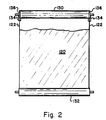
- an "artificial" bed is effectively provided in the secondary chamber (100) by selectively positioning gas permeable filter means (110) therein as best seen in Figures 2 and 3 to filter the flue gas passing therethrough until the mat (30) has built-up sufficiently on belt (20) to be effective as a particulate filter.
- the gas permeable filter means (110) serves to remove particulate material carried over from the primary drying chamber in the flue gas entering the secondary drying chamber so that the flue gas vented to the atmosphere through duct (60) will result in a low-opacity, clear plume during start-up of the spray dryer scrubber.
- the supplemental filter means (110) comprises an elongated gas permeable fabric sheet (120) which is disposed between rolls (130,132) so as to be selectively positionable across the secondary drying chamber (100) above the belt (20).
- the fabric is stretched to span between two parallel support members (122), such as wires or ropes.
- the wires or ropes are positioned above the belt (20) in the secondary chamber (100), and the fabric is seam lapped around the wire/rope along each edge.
- the wire/rope runs from a feeder roll to a take up roll.
- the feeder roll may be provided with a guide (134), and groove (135) at either end to prevent the wire/rope from moving out-of-position.
- the gas permeable fabric is a sheet of tightly woven or felted cloth.
- the cloth should desirably have a clean draft loss of 1.0 to 2.0 inches water column at a face velocity of 150 feet/minute (i.e., actual cubic feet per minute per square foot of cloth area).
- the wire/rope (122) extends suspended above the belt (20) from the feeder roll (130) to the take-up roll (132), while the cloth (120) and the wire/rope (122) which is lapped by the cloth is wound up completely on the take-up roll (132).
- the rolls (130,132) are stationary, that is, not turning during normal continuous operation when the mat (30) is fully developed.
- the cloth is rolled between feeder and take-up rolls only during start-up.
- the plant operator Prior to start-up, the plant operator initiates an action which rotates the take-up roll (132) and feeder roll (132) in a cooperative manner so as to selectively position the cloth (120) over the belt (20) in the secondary chamber (100).
- the forced draft and induced draft fans associated therewith (not shown), as well as the booster fan (62) are started.
- the flue gas temperature begins to rise and feed of the scrubbing solution or slurry is initiated to the spray nozzles (16) in an amount sufficient to maintain a desired gas temperature at the inlet to the booster fan (62).
- the total pressure drop in the gas from the inlet duct (72) to the primary chamber outlet plenum (19) increases.
- drive of the belt (20) is automatically initiated and the belt (20) begins to move slowly out of the primary chamber (10) into the secondary chamber (100) thereby beginning the movement of the mat (30) which has built-up on the portion of the belt (20) formerly positioned in the primary drying chamber (10) into the secondary drying chamber (100).
- the take-up of the supplemental fabric filter means is initiated by activating the feeder roll (130) and/or the take-up roll (132) to begin rewinding the cloth (120) about the take-up roll (132).
- the rotation of the rolls (130,132) is controlled such that the movement of the cloth (120) across the secondary drying chamber (100) onto the take-up roll (132) is synchronized with the movement of the built-up mat (30) into the secondary drying chamber (100) such that as the cloth (120) is taken-up, it is replaced as a filter means by the mat (30) moving into the secondary drying chamber.
- the cloth (120) which is selectively pre-positioned across the secondary chamber (100) prior to start-up, serves to filter out at least a substantial portion of the particulate matter carried over in the flue gas from the primary drying chamber (10) during the initial stages of start-up. Then, as the built-up mat (30) moves into the secondary drying chamber (100) on belt (20) and wind-up of the cloth (120) is begun, the cloth (120) serves in conjunction with the mat (30) to ensure that nearly all of the flue gas passing through the secondary drying chamber (100) traverses either that portion of the cloth (120) still exposed in the secondary drying chamber (100) or the mat (30) entering the secondary drying chamber (100). Once the mat (30) is fully within the secondary drying chamber (100), the cloth (120) is fully withdrawn and normal filtering via the mat (30) commences.
Landscapes
- Engineering & Computer Science (AREA)
- Chemical & Material Sciences (AREA)
- Health & Medical Sciences (AREA)
- Biomedical Technology (AREA)
- Environmental & Geological Engineering (AREA)
- Analytical Chemistry (AREA)
- General Chemical & Material Sciences (AREA)
- Oil, Petroleum & Natural Gas (AREA)
- Chemical Kinetics & Catalysis (AREA)
- Treating Waste Gases (AREA)
Applications Claiming Priority (2)
| Application Number | Priority Date | Filing Date | Title |
|---|---|---|---|
| US07/103,336 US4812295A (en) | 1987-10-01 | 1987-10-01 | Apparatus for dry scrubbing a hot gas and start-up process |
| US103336 | 1987-10-01 |
Publications (2)
| Publication Number | Publication Date |
|---|---|
| EP0309848A2 true EP0309848A2 (de) | 1989-04-05 |
| EP0309848A3 EP0309848A3 (de) | 1989-11-02 |
Family
ID=22294635
Family Applications (1)
| Application Number | Title | Priority Date | Filing Date |
|---|---|---|---|
| EP88115316A Withdrawn EP0309848A3 (de) | 1987-10-01 | 1988-09-19 | Vorrichtung zum Trockenabscheiden von Heissgas, und Anlaufverfahren |
Country Status (2)
| Country | Link |
|---|---|
| US (1) | US4812295A (de) |
| EP (1) | EP0309848A3 (de) |
Cited By (6)
| Publication number | Priority date | Publication date | Assignee | Title |
|---|---|---|---|---|
| US5336600A (en) * | 1989-10-20 | 1994-08-09 | Bio Merieux | Method and reagents for the detection of microorganisms |
| EP0700712A1 (de) * | 1994-09-12 | 1996-03-13 | Mitsubishi Jukogyo Kabushiki Kaisha | Verfahren und Vorrichtung zur nassen Rauchgasentschwefelung |
| WO2007031552A1 (en) * | 2005-09-15 | 2007-03-22 | Solvay Chemicals, Inc. | Sulfur trioxide removal from a flue gas stream |
| US7481987B2 (en) | 2005-09-15 | 2009-01-27 | Solvay Chemicals | Method of removing sulfur trioxide from a flue gas stream |
| US7854911B2 (en) | 2005-08-18 | 2010-12-21 | Solvay Chemicals, Inc. | Method of removing sulfur dioxide from a flue gas stream |
| CN104138703A (zh) * | 2014-08-06 | 2014-11-12 | 山东凯盛新材料有限公司 | 间/对苯二甲酰氯生产中废气处理工艺及装置 |
Families Citing this family (6)
| Publication number | Priority date | Publication date | Assignee | Title |
|---|---|---|---|---|
| US5117763A (en) * | 1990-08-21 | 1992-06-02 | Gustafson Leif V | Hydrating filter smokestack system |
| US20050214189A1 (en) * | 2004-03-29 | 2005-09-29 | Balingit Ronald F | Dry scrubber/collector |
| WO2010039250A1 (en) * | 2008-10-02 | 2010-04-08 | Gryphon Environmental, Llc | Suspension liquid extraction apparatus and method |
| EP2555752B1 (de) | 2010-04-09 | 2019-06-26 | Pacira Pharmaceuticals, Inc. | Verfahren zur formulierung von multivesikulären liposomen |
| US10352239B2 (en) * | 2016-09-16 | 2019-07-16 | Southwest Research Institute | Inlet filter for gas turbine engines using disposable surface adhesive |
| CN109404918B (zh) * | 2018-12-06 | 2023-10-31 | 航天神禾(北京)环保有限公司 | 一体化废物热解气化炉 |
Family Cites Families (7)
| Publication number | Priority date | Publication date | Assignee | Title |
|---|---|---|---|---|
| US2867324A (en) * | 1956-03-12 | 1959-01-06 | Hirs Gene | Filter apparatus |
| US2969148A (en) * | 1957-01-18 | 1961-01-24 | Hirs Gene | Filter apparatus |
| US2881861A (en) * | 1957-02-18 | 1959-04-14 | American Air Filter Co | Air flow seal for air filter having an expansible-contractible air cleaning web |
| US3261149A (en) * | 1962-09-10 | 1966-07-19 | Landis & Gyr Ag | Filter means for use in measuring the radio-activity of aerosols |
| US4351849A (en) * | 1966-05-26 | 1982-09-28 | Dec International | Foraminous mat products |
| US3783588A (en) * | 1971-12-20 | 1974-01-08 | Gen Electric | Polymer film electret air filter |
| US4504451A (en) * | 1983-07-14 | 1985-03-12 | Dec International, Inc. | Dry scrubbing oxides and particulate contaminants from hot gases |
-
1987
- 1987-10-01 US US07/103,336 patent/US4812295A/en not_active Expired - Lifetime
-
1988
- 1988-09-19 EP EP88115316A patent/EP0309848A3/de not_active Withdrawn
Cited By (10)
| Publication number | Priority date | Publication date | Assignee | Title |
|---|---|---|---|---|
| US5336600A (en) * | 1989-10-20 | 1994-08-09 | Bio Merieux | Method and reagents for the detection of microorganisms |
| EP0700712A1 (de) * | 1994-09-12 | 1996-03-13 | Mitsubishi Jukogyo Kabushiki Kaisha | Verfahren und Vorrichtung zur nassen Rauchgasentschwefelung |
| US5620667A (en) * | 1994-09-12 | 1997-04-15 | Mitsubishi Jukogyo Kabushiki Kaisha | Wet process flue gas desulfurization apparatus |
| CN1048649C (zh) * | 1994-09-12 | 2000-01-26 | 三菱重工业株式会社 | 湿法烟道气脱硫装置 |
| US7854911B2 (en) | 2005-08-18 | 2010-12-21 | Solvay Chemicals, Inc. | Method of removing sulfur dioxide from a flue gas stream |
| WO2007031552A1 (en) * | 2005-09-15 | 2007-03-22 | Solvay Chemicals, Inc. | Sulfur trioxide removal from a flue gas stream |
| US7481987B2 (en) | 2005-09-15 | 2009-01-27 | Solvay Chemicals | Method of removing sulfur trioxide from a flue gas stream |
| EA015416B1 (ru) * | 2005-09-15 | 2011-08-30 | Солвей Кемикалз, Инк. | Удаление триоксида серы из потока топочного газа |
| CN104138703A (zh) * | 2014-08-06 | 2014-11-12 | 山东凯盛新材料有限公司 | 间/对苯二甲酰氯生产中废气处理工艺及装置 |
| CN104138703B (zh) * | 2014-08-06 | 2016-01-20 | 山东凯盛新材料有限公司 | 间/对苯二甲酰氯生产中废气处理工艺及装置 |
Also Published As
| Publication number | Publication date |
|---|---|
| US4812295A (en) | 1989-03-14 |
| EP0309848A3 (de) | 1989-11-02 |
Similar Documents
| Publication | Publication Date | Title |
|---|---|---|
| US4812295A (en) | Apparatus for dry scrubbing a hot gas and start-up process | |
| US4956162A (en) | Process for removal of particulates and SO2 from combustion gases | |
| CA2098044C (en) | Particulate collection device with integral wet scrubber | |
| US4604269A (en) | Flue gas desulfurization process | |
| EP0077170B1 (de) | Verfahren zur Abscheidung von Stickstoffoxiden und Schwefeloxiden von Abgasen | |
| US4613487A (en) | Flue gas desulfurization process | |
| US4208381A (en) | Method and apparatus for cleaning waste flue gases | |
| EP0170355B1 (de) | Verfahren zur Emissionskontrolle von Verbrennungsgasen | |
| CN1188425A (zh) | 燃烧废气干脱硫的方法 | |
| US4504451A (en) | Dry scrubbing oxides and particulate contaminants from hot gases | |
| HU194981B (en) | Method and burning apparatus for separating harmful acid ases | |
| US4324770A (en) | Process for dry scrubbing of flue gas | |
| US4600568A (en) | Flue gas desulfurization process | |
| US4670238A (en) | Recycled sorbent flue gas desulfurization | |
| EP0204710A1 (de) | Verfahren zum entfernen von schwefeloxiden aus abgasen mit einer filterkammer als sekundärreaktor. | |
| US5439508A (en) | Process of separating halogenated dioxins and furans from exhaust gases from combustion plants | |
| US4446109A (en) | System for dry scrubbing of flue gas | |
| JPH0722673B2 (ja) | 廃ガスの浄化方法および装置 | |
| CA2116233A1 (en) | Method for purification of waste gases | |
| US5624648A (en) | Method and apparatus for cleaning flue gas | |
| US4764348A (en) | Emission control apparatus | |
| JP3256717B2 (ja) | 半乾式及び乾式脱硫装置 | |
| JPH0376963B2 (de) | ||
| EP0437941A1 (de) | Wäsche von Rauchgasen, die von fossilen Brennstoffen stammen | |
| JP2695988B2 (ja) | 廃ガスの精製法 |
Legal Events
| Date | Code | Title | Description |
|---|---|---|---|
| PUAI | Public reference made under article 153(3) epc to a published international application that has entered the european phase |
Free format text: ORIGINAL CODE: 0009012 |
|
| AK | Designated contracting states |
Kind code of ref document: A2 Designated state(s): AT BE CH DE ES FR GB GR IT LI LU NL SE |
|
| PUAL | Search report despatched |
Free format text: ORIGINAL CODE: 0009013 |
|
| AK | Designated contracting states |
Kind code of ref document: A3 Designated state(s): AT BE CH DE ES FR GB GR IT LI LU NL SE |
|
| 17P | Request for examination filed |
Effective date: 19900323 |
|
| STAA | Information on the status of an ep patent application or granted ep patent |
Free format text: STATUS: THE APPLICATION HAS BEEN WITHDRAWN |
|
| 18W | Application withdrawn |
Withdrawal date: 19901120 |
|
| R18W | Application withdrawn (corrected) |
Effective date: 19901120 |