EP0308625A2 - Kamera mit Doppelpositionsblitz - Google Patents
Kamera mit Doppelpositionsblitz Download PDFInfo
- Publication number
- EP0308625A2 EP0308625A2 EP88112396A EP88112396A EP0308625A2 EP 0308625 A2 EP0308625 A2 EP 0308625A2 EP 88112396 A EP88112396 A EP 88112396A EP 88112396 A EP88112396 A EP 88112396A EP 0308625 A2 EP0308625 A2 EP 0308625A2
- Authority
- EP
- European Patent Office
- Prior art keywords
- source
- photographic camera
- scene
- artificial illumination
- illumination
- Prior art date
- Legal status (The legal status is an assumption and is not a legal conclusion. Google has not performed a legal analysis and makes no representation as to the accuracy of the status listed.)
- Granted
Links
Images



Classifications
-
- G—PHYSICS
- G03—PHOTOGRAPHY; CINEMATOGRAPHY; ANALOGOUS TECHNIQUES USING WAVES OTHER THAN OPTICAL WAVES; ELECTROGRAPHY; HOLOGRAPHY
- G03B—APPARATUS OR ARRANGEMENTS FOR TAKING PHOTOGRAPHS OR FOR PROJECTING OR VIEWING THEM; APPARATUS OR ARRANGEMENTS EMPLOYING ANALOGOUS TECHNIQUES USING WAVES OTHER THAN OPTICAL WAVES; ACCESSORIES THEREFOR
- G03B15/00—Special procedures for taking photographs; Apparatus therefor
- G03B15/02—Illuminating scene
- G03B15/03—Combinations of cameras with lighting apparatus; Flash units
-
- G—PHYSICS
- G03—PHOTOGRAPHY; CINEMATOGRAPHY; ANALOGOUS TECHNIQUES USING WAVES OTHER THAN OPTICAL WAVES; ELECTROGRAPHY; HOLOGRAPHY
- G03B—APPARATUS OR ARRANGEMENTS FOR TAKING PHOTOGRAPHS OR FOR PROJECTING OR VIEWING THEM; APPARATUS OR ARRANGEMENTS EMPLOYING ANALOGOUS TECHNIQUES USING WAVES OTHER THAN OPTICAL WAVES; ACCESSORIES THEREFOR
- G03B2215/00—Special procedures for taking photographs; Apparatus therefor
- G03B2215/05—Combinations of cameras with electronic flash units
- G03B2215/0503—Built-in units
- G03B2215/0507—Pop-up mechanisms
Definitions
- This invention relates to a camera having a source of artificial illumination mounted for automatic movement from a first operative position wherein it assumes a low profile attitude to a second operative position.
- the present invention relates to a photographic camera having a source of artificial illumination, e.g. a variable output strobe, which is mounted for automatic movement from a first operative position to a second operative position in response to predetermined condition(s) which exist at the scene to be photographed.
- a source of artificial illumination e.g. a variable output strobe
- its output is relatively low, e.g., twenty-five precent of its maximum output, and is used basically to fill in areas of the scene which may not be fully illuminated by the ambient light.
- the second position of the source of illumination its output is increased so as to compensate for low ambient light intensity, e.g., 10 candles/foot2 or less, at the scene, or to counter the adverse effects of a scene which is predominately back-lit, i.e., the intensity of the ambient background light is greater than that of the ambient foreground light.
- low ambient light intensity e.g. 10 candles/foot2 or less
- U.S. Patent No. 4,452,520 shows a folding camera having a pop-up strobe which automatically moves from a first inoperative position to a second operative position as the camera sections or housings are moved into their extended operative postions.
- U.S. Patent Nos. 4,174,898 and 4,130,356 show cameras having pop-up strobes which move in a vertical direction to their operative positions in response to a manual actuation of a release button.
- U.S. Patent No. 4,166,680 wherein a strobe is attached to a side of a camera for manual pivotal movement between two operative positions.
- the instant invention relates to a photographic camera having a source of artificial illumination, e.g., a variable output strobe or a multiple lamp flash array in which one or more of the lamps may be fired during an exposure, and more particularly to such a camera wherein the source of artificial illumination is mounted on the camera for automatic movement from a first operative position to a second operative position in response to predetermined ambient light condition(s) which exist at the scene to be photographed.
- a source of artificial illumination e.g., a variable output strobe or a multiple lamp flash array in which one or more of the lamps may be fired during an exposure
- the source of artificial illumination is mounted on the camera for automatic movement from a first operative position to a second operative position in response to predetermined ambient light condition(s) which exist at the scene to be photographed.
- the source of artificial illumination is releasably maintained in its first position by a solenoid controlled latch.
- its axis of illumination is relatively closely adjacent to the optical axis of the camera, and thus the size of the camera is minimized.
- juxtaposition of the two axes might possibly create an undesirable phenomenon commonly referred to as "red eye” when color film is being exposed.
- This "red eye” phenomenon is considered to be at least partially attributable to the incidence into the camera's objective of the red light reflected from the retina in the eyeball of a person being illuminated by the source of artificial illumination.
- the "red eye” problem is, in part, a function of the spacing between the emission axis of the source of illumination and the optical axis of the camera's objective. It is also believed that the “red eye” phenomenon is related to the intensity of the artificial light which strikes the retina and is reflected back into the objective lens. Thus, the appearance of "red eye” in a color photograph appears to be more readily apparent to the viewer with an increase in the intensity of the artificial illumination upon the subject eyeball.
- the effects of "red eye" are minimized by providing a relatively low intensity light output by the source.
- the ambient light level is at a relatively high level when the source of artificial illumination is in the first position thus resulting in a generally smaller diameter of the subject's pupils with its attendant reduction in the amount of artificial light striking the retinas.
- the camera includes a system for measuring the intensity of the ambient light at the scene to be photographed, and it may also include means for determining if the scene is back-lit or not.
- This system is connected to the aforementioned solenoid such that it causes the latter to be momentarily energized when 1) the intensity of the ambient light falls below a predetermined value, e.g., ten candles per square foot, or 2) the scene is back-lit, i.e., the intensity of the background light is greater than that of the foreground.
- a predetermined value e.g., ten candles per square foot
- the source of artificial illumination is connectable with camera circuitry which will enable the intensity of its illumination to be increased from, e.g., 25% of maximum intensity when in said first position to as much as 100% of full flash in the second position.
- the aforementioned "red eye" phenomenon is of little if any consequence because the distance between the axes of the camera's objective lens and the source of artificial illumination is greater in the second position than in the first position. If the photographer subsequently enters an environment wherein the intensity of the ambient light is again above 10 candles/ft2, he may leave the source of artificial illumination in the second position wherein its level of illumination would be close to 25% of maximum or he has merely to push the source of artificial illumination back into its first position.
- An object of the invention is to provide a camera with a source of artificial illumination which is mounted for automatic movement from a first operative position to a second operative position in response to predetermined conditions existing at a scene to be photographed.
- Another object of the invention is to provide a camera with a source of artificial illumination having a relatively low output in a first position and a relatively higher output in a second position.
- the invention accordingly comprises the apparatus possessing the construction, combination of elements and arrangement of parts which are exemplified in the following detailed disclosure, and the scope of the application of which will be indicated in the claims.
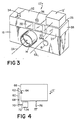
- FIG. 1 shows a camera 10 having a source of artificial illumination 12 mounted for automatic pivotal movement from a first operative position (solid line), wherein its axis of illumination SA1 is relatively close to and substantially parallel with the optical axis OA of the camera's objective lens 14, to a second operative position (broken line), wherein its axis SA2 is spaced a greater distance from the optical axis OA than in said first position.
- the camera 10 includes a front wall 16 in which the objective lens 14 is mounted. Also located in the front wall 16 is a transducer 18 for determining the camera-to-subject distance, a viewfinder window 20, and a photocell window 22.
- the front wall 16 also includes a generally rectangular section 24 which together with a rear wall 26 defines a recess or a chamber 28 for nestably receiving the source of artificial illumination 12 when it is in the first position.
- the source of artificial illumination 12 lies within the confines of the camera's exterior walls and thus minimizes the size of the camera when so located.
- the front wall section 24 is capable of transmitting light and is preferably formed 1) from a transparent material having light diffusing zones or alternatively a translucent material or 2) as a filter. Further, a forwardly facing side 30 of the source of artificial illumination may be open or it may be closed by a light diffusible wall.
- a top wall 32 of the camera 10 includes, in addition to the chamber 28, an exposure initiation button 34 and a film rewind button 36.
- the source of artificial illumination is releasably maintained in its first position by a solenoid controlled latch arrangement, as shown in Fig. 1a.
- the source of artificial illumination 12 is mounted for pivotal movement about a hinge 38 into its second position under the bias of a spring 40.
- the source of artificial illumination 12 is releasably maintained in its first position via the engagement between a latch 42 pivotally connected to the camera 10 by a pin 44, and a latch plate 46 which is attached to a wall of the source 12.
- a solenoid 48 has its armature 50 coupled to one end of the latch 46 such that upon energization of the solenoid 48 the armature 50 is momentarily extended thus causing counterclockwise rotation of the latch 42 and the release of the source 12 for movement into its second position.
- the photographer views and frames his subject and then depresses the exposure initiation button 34 into a first stage position.
- the button 34 With the button 34 in the first stage position, ambient light being reflected from the scene enters the photocell window 22 and strikes a photocell assembly (not shown) which is a part of the camera's exposure control system.
- Circuitry in the exposure control system compares the output of the photocell assembly with a predetermined value for ambient scene light intensity e.g., ten candles/ft2.
- the solenoid 48 If the output of the photocell assembly indicates a value representative of an ambient light intensity less than ten candles/ft2, it causes the solenoid 48 to be momentarily energized, thus releasing the source of artificial illumination 12 for pivotal movement into its second position under the influence of the spring 40. Suitable means (not shown) are provided for stopping the source 12 when it enters the second position. If the output of the photocell assembly is representative of a value equal to or greater than ten candles/ft2 but the scene being measured is back-lit, the solenoid 48 is also momentarily energized thus releasing the source of artificial illumination 12 for movement into its second position.
- the source of artificial illumination 12 when the scene is back-lit or its ambient light intensity is below a predetermined value, the source of artificial illumination 12 is in the second position where its output may be increased from, e.g., 25% of maximum when in the first position to upwards of 100% of the source's 12 maximum output, such increased output may be of a fixed value or may be dependent upon certain measured variables such as camera-to-scene distance and/or intensity of ambient scene light which may be received by the exposure control system.
- the photographer may further depress the button 34 to initiate photographic exposure.
- the source of artificial illumination 12 will remain latched in its operative first position wherein, with its reduced output, it will function as a fill flash.
- FIG. 2 shows the source of artificial illumination in its first position whereas Fig. 3 shows it in its second position wherein its axis of illumination SA3 is spaced further from the optical axis OA of the camera 10′ than it is when in its first position.
- the source of artificial illumination 12′ is releasably maintained in its first position by a resilient latch 60 having an end 62 which is adapted to be received by a recess 64 in a sidewall 66 of the source 12′.
- the latch 60 is pivotally mounted to camera structure via a pin 68 and has an end 70 connected to a reciprocally mounted arm 62 of a solenoid 74.
- the solenoid 74 is adapted to be momentarily energized when the button 34 enters its first stage (partially depressed) whenever the scene to be photographed is back-lit or its ambient light intensity is below ten candles/ft2. Energizing the solenoid 74 results in the arm 72 being partially withdrawn into the solenoid 74 thus removing the end 62 of the latch 60 from the recess 64 in the source 12′. Thus unlatched, the source 12′ is moved linearly by a spring 76 from its first position, wherein it is located wholly within the confines of the walls of the camera 10′, to its second position wherein it is substantially fully withdrawn from the recess 28′.
- the photographer When it is desired to return the source of artificial illumination 12′ to its first position, the photographer merely pushes downwardly on the source 12′. This action results in the end wall 66 of the source 12′ camming the upper end of the latch 60 slightly to the left until the end 64 "sees" and enters the recess 64.
- the latch 60, as well as latch 42, may be formed from any suitable resilient material that will enable it to give or bend without transferring any substantial force to the actuating member of its associated solenoid.
Landscapes
- Physics & Mathematics (AREA)
- General Physics & Mathematics (AREA)
- Stroboscope Apparatuses (AREA)
- Exposure Control For Cameras (AREA)
Applications Claiming Priority (2)
| Application Number | Priority Date | Filing Date | Title |
|---|---|---|---|
| US98981 | 1987-09-21 | ||
| US07/098,981 US4734733A (en) | 1987-09-21 | 1987-09-21 | Camera with two position strobe |
Publications (3)
| Publication Number | Publication Date |
|---|---|
| EP0308625A2 true EP0308625A2 (de) | 1989-03-29 |
| EP0308625A3 EP0308625A3 (en) | 1990-10-17 |
| EP0308625B1 EP0308625B1 (de) | 1993-12-15 |
Family
ID=22271835
Family Applications (1)
| Application Number | Title | Priority Date | Filing Date |
|---|---|---|---|
| EP88112396A Expired - Lifetime EP0308625B1 (de) | 1987-09-21 | 1988-07-29 | Kamera mit Doppelpositionsblitz |
Country Status (5)
| Country | Link |
|---|---|
| US (1) | US4734733A (de) |
| EP (1) | EP0308625B1 (de) |
| JP (1) | JP2682656B2 (de) |
| CA (1) | CA1298727C (de) |
| DE (2) | DE308625T1 (de) |
Cited By (3)
| Publication number | Priority date | Publication date | Assignee | Title |
|---|---|---|---|---|
| GB2236864B (en) * | 1989-10-06 | 1994-06-01 | Asahi Optical Co Ltd | Strobe incorporated camera |
| USRE35415E (en) * | 1989-10-06 | 1996-12-31 | Asahi Kogaku Kogyo Kabushiki Kaisha | Camera having an automatically operated built-in strobe |
| EP2312389A1 (de) | 2009-10-13 | 2011-04-20 | Dalibor Zyka | Blitzeinheithalterung mit einstellbarer Position |
Families Citing this family (11)
| Publication number | Priority date | Publication date | Assignee | Title |
|---|---|---|---|---|
| DE3889344T2 (de) * | 1987-01-13 | 1994-09-01 | Asahi Optical Co Ltd | Eingebautes Blitzlichtsystem und Kamera. |
| US5329327A (en) * | 1987-01-13 | 1994-07-12 | Asahi Kogaku Kogyo Kabushiki Kaisha | Built-in flash system |
| JPH0677123B2 (ja) * | 1987-08-28 | 1994-09-28 | 旭光学工業株式会社 | ズームレンズおよび照射角可変ストロボ装置を備えたカメラ |
| JP2592904B2 (ja) * | 1988-05-06 | 1997-03-19 | キヤノン株式会社 | カメラ |
| US5264884A (en) * | 1992-08-05 | 1993-11-23 | Eastman Kodak Company | Compact camera with deployable flash unit |
| US5276474A (en) * | 1993-01-19 | 1994-01-04 | Eastman Kodak Company | Compact camera with folding flash unit |
| US5515126A (en) * | 1994-09-28 | 1996-05-07 | Eastman Kodak Company | Convertible flash camera and method |
| JP3869005B2 (ja) * | 1995-06-22 | 2007-01-17 | 3ディブイ・システムズ・リミテッド | テレセントリック立体カメラと方法 |
| US6445884B1 (en) * | 1995-06-22 | 2002-09-03 | 3Dv Systems, Ltd. | Camera with through-the-lens lighting |
| IL114278A (en) * | 1995-06-22 | 2010-06-16 | Microsoft Internat Holdings B | Camera and method |
| JP5483954B2 (ja) * | 2009-08-18 | 2014-05-07 | キヤノン株式会社 | 移動体駆動装置 |
Family Cites Families (15)
| Publication number | Priority date | Publication date | Assignee | Title |
|---|---|---|---|---|
| JPS5529408B2 (de) * | 1972-03-15 | 1980-08-04 | ||
| US4174898A (en) * | 1974-08-13 | 1979-11-20 | Konishiroku Photo Industry Co., Ltd. | Camera |
| JPS5360821U (de) * | 1976-10-26 | 1978-05-24 | ||
| US4166680A (en) * | 1977-01-27 | 1979-09-04 | Olympus Optical Co., Ltd. | Strobo unit for camera |
| US4331400A (en) * | 1980-08-11 | 1982-05-25 | Eastman Kodak Company | Electronic strobe flash apparatus for automatic fill-in and full-flash |
| GB2070793B (en) * | 1980-02-28 | 1984-01-18 | Eastman Kodak Co | Electronic flash apparatus |
| US4407573A (en) * | 1980-06-05 | 1983-10-04 | Nippon Kogaku K.K. | Pop up flash device control for a camera |
| JPS582827A (ja) * | 1981-06-29 | 1983-01-08 | West Electric Co Ltd | フラツシユカメラ装置 |
| US4423936A (en) * | 1982-07-26 | 1984-01-03 | Polaroid Corporation | Photographic exposure control system and method |
| JPS5975232A (ja) * | 1982-10-25 | 1984-04-27 | West Electric Co Ltd | ストロボ内蔵カメラ |
| US4452520A (en) * | 1982-12-16 | 1984-06-05 | Polaroid Corporation | Lever for folding a camera having a retractable light source |
| JPS59210426A (ja) * | 1983-05-14 | 1984-11-29 | Nippon Kogaku Kk <Nikon> | 閃光装置内蔵カメラ |
| JPS6060729U (ja) * | 1983-10-03 | 1985-04-27 | 富士写真フイルム株式会社 | ストロボ内蔵広角・望遠撮影切換えカメラ |
| US4556303A (en) * | 1984-07-02 | 1985-12-03 | Eastman Kodak Company | Camera flash holder |
| JPH0656465B2 (ja) * | 1985-03-26 | 1994-07-27 | キヤノン株式会社 | 逆光対応カメラ用の自動閃光装置 |
-
1987
- 1987-09-21 US US07/098,981 patent/US4734733A/en not_active Expired - Lifetime
-
1988
- 1988-07-04 CA CA000571012A patent/CA1298727C/en not_active Expired - Fee Related
- 1988-07-29 DE DE198888112396T patent/DE308625T1/de active Pending
- 1988-07-29 DE DE88112396T patent/DE3886324T2/de not_active Expired - Fee Related
- 1988-07-29 EP EP88112396A patent/EP0308625B1/de not_active Expired - Lifetime
- 1988-08-30 JP JP63216213A patent/JP2682656B2/ja not_active Expired - Lifetime
Cited By (3)
| Publication number | Priority date | Publication date | Assignee | Title |
|---|---|---|---|---|
| GB2236864B (en) * | 1989-10-06 | 1994-06-01 | Asahi Optical Co Ltd | Strobe incorporated camera |
| USRE35415E (en) * | 1989-10-06 | 1996-12-31 | Asahi Kogaku Kogyo Kabushiki Kaisha | Camera having an automatically operated built-in strobe |
| EP2312389A1 (de) | 2009-10-13 | 2011-04-20 | Dalibor Zyka | Blitzeinheithalterung mit einstellbarer Position |
Also Published As
| Publication number | Publication date |
|---|---|
| DE3886324D1 (de) | 1994-01-27 |
| JP2682656B2 (ja) | 1997-11-26 |
| DE308625T1 (de) | 1989-07-13 |
| JPH0196631A (ja) | 1989-04-14 |
| US4734733A (en) | 1988-03-29 |
| EP0308625A3 (en) | 1990-10-17 |
| EP0308625B1 (de) | 1993-12-15 |
| CA1298727C (en) | 1992-04-14 |
| DE3886324T2 (de) | 1994-03-31 |
Similar Documents
| Publication | Publication Date | Title |
|---|---|---|
| US4734733A (en) | Camera with two position strobe | |
| CA1298129C (en) | Infrared wink ranging system | |
| US4666280A (en) | Flash shot control device for camera | |
| US5424794A (en) | Red-eye reduction system | |
| US5065177A (en) | SLR camera with auxiliary light emitter | |
| US5519466A (en) | Electronically controlled camera | |
| JPH0617963B2 (ja) | 一眼レフカメラの内蔵ストロボ機構 | |
| US4855771A (en) | Compact camera with flash unit movable to reduce red-eye | |
| US4147418A (en) | Photographic exposure control system with independent ambient and artificial illumination control modes | |
| US3760701A (en) | Photographic apparatus with delayed interlock switch | |
| US3630129A (en) | Camera mechanism for actuating mechanically fireable flash | |
| US4972217A (en) | Shutter mechanism drive having reduced mechanical noise | |
| US4894678A (en) | Preflash pseudofocus/exposure control system | |
| US4831404A (en) | Automatic focusing camera | |
| CA1100805A (en) | Exposure control system for use in photographic camera apparatus | |
| US4338011A (en) | Photographic camera apparatus | |
| US3438313A (en) | Automatic exposure control for photoflash exposures | |
| US4319817A (en) | Camera having built-in, close-up lens | |
| US5276473A (en) | Manually set bounce flash with focus shift | |
| US3535990A (en) | Photographic camera | |
| US4179199A (en) | Combination motion picture camera and viewing apparatus | |
| US4325616A (en) | Apparatus for varying the spectral filter over the photocell as a function of blade position | |
| US3680453A (en) | Photographic apparatus | |
| US4129371A (en) | Electromagnet controlled scanning shutter blade arrangement | |
| US4431286A (en) | Photographic exposure control system having selectable ambient and flash modes |
Legal Events
| Date | Code | Title | Description |
|---|---|---|---|
| PUAI | Public reference made under article 153(3) epc to a published international application that has entered the european phase |
Free format text: ORIGINAL CODE: 0009012 |
|
| AK | Designated contracting states |
Kind code of ref document: A2 Designated state(s): DE FR GB |
|
| EL | Fr: translation of claims filed | ||
| DET | De: translation of patent claims | ||
| PUAL | Search report despatched |
Free format text: ORIGINAL CODE: 0009013 |
|
| AK | Designated contracting states |
Kind code of ref document: A3 Designated state(s): DE FR GB |
|
| 17P | Request for examination filed |
Effective date: 19901210 |
|
| 17Q | First examination report despatched |
Effective date: 19921126 |
|
| GRAA | (expected) grant |
Free format text: ORIGINAL CODE: 0009210 |
|
| AK | Designated contracting states |
Kind code of ref document: B1 Designated state(s): DE FR GB |
|
| ET | Fr: translation filed | ||
| REF | Corresponds to: |
Ref document number: 3886324 Country of ref document: DE Date of ref document: 19940127 |
|
| PLBE | No opposition filed within time limit |
Free format text: ORIGINAL CODE: 0009261 |
|
| STAA | Information on the status of an ep patent application or granted ep patent |
Free format text: STATUS: NO OPPOSITION FILED WITHIN TIME LIMIT |
|
| 26N | No opposition filed | ||
| PGFP | Annual fee paid to national office [announced via postgrant information from national office to epo] |
Ref country code: FR Payment date: 19970613 Year of fee payment: 10 |
|
| PGFP | Annual fee paid to national office [announced via postgrant information from national office to epo] |
Ref country code: GB Payment date: 19970620 Year of fee payment: 10 |
|
| PGFP | Annual fee paid to national office [announced via postgrant information from national office to epo] |
Ref country code: DE Payment date: 19970623 Year of fee payment: 10 |
|
| PG25 | Lapsed in a contracting state [announced via postgrant information from national office to epo] |
Ref country code: GB Free format text: LAPSE BECAUSE OF NON-PAYMENT OF DUE FEES Effective date: 19980729 |
|
| GBPC | Gb: european patent ceased through non-payment of renewal fee |
Effective date: 19980729 |
|
| PG25 | Lapsed in a contracting state [announced via postgrant information from national office to epo] |
Ref country code: FR Free format text: LAPSE BECAUSE OF NON-PAYMENT OF DUE FEES Effective date: 19990331 |
|
| PG25 | Lapsed in a contracting state [announced via postgrant information from national office to epo] |
Ref country code: DE Free format text: LAPSE BECAUSE OF NON-PAYMENT OF DUE FEES Effective date: 19990501 |
|
| REG | Reference to a national code |
Ref country code: FR Ref legal event code: ST |