EP0307123B1 - A composite sheet material - Google Patents
A composite sheet material Download PDFInfo
- Publication number
- EP0307123B1 EP0307123B1 EP88307988A EP88307988A EP0307123B1 EP 0307123 B1 EP0307123 B1 EP 0307123B1 EP 88307988 A EP88307988 A EP 88307988A EP 88307988 A EP88307988 A EP 88307988A EP 0307123 B1 EP0307123 B1 EP 0307123B1
- Authority
- EP
- European Patent Office
- Prior art keywords
- resin
- sheet
- impregnated
- sheet material
- polytetrafluoroethylene
- Prior art date
- Legal status (The legal status is an assumption and is not a legal conclusion. Google has not performed a legal analysis and makes no representation as to the accuracy of the status listed.)
- Expired - Lifetime
Links
Images
Classifications
-
- B—PERFORMING OPERATIONS; TRANSPORTING
- B32—LAYERED PRODUCTS
- B32B—LAYERED PRODUCTS, i.e. PRODUCTS BUILT-UP OF STRATA OF FLAT OR NON-FLAT, e.g. CELLULAR OR HONEYCOMB, FORM
- B32B5/00—Layered products characterised by the non- homogeneity or physical structure, i.e. comprising a fibrous, filamentary, particulate or foam layer; Layered products characterised by having a layer differing constitutionally or physically in different parts
- B32B5/18—Layered products characterised by the non- homogeneity or physical structure, i.e. comprising a fibrous, filamentary, particulate or foam layer; Layered products characterised by having a layer differing constitutionally or physically in different parts characterised by features of a layer of foamed material
-
- B—PERFORMING OPERATIONS; TRANSPORTING
- B29—WORKING OF PLASTICS; WORKING OF SUBSTANCES IN A PLASTIC STATE IN GENERAL
- B29C—SHAPING OR JOINING OF PLASTICS; SHAPING OF MATERIAL IN A PLASTIC STATE, NOT OTHERWISE PROVIDED FOR; AFTER-TREATMENT OF THE SHAPED PRODUCTS, e.g. REPAIRING
- B29C70/00—Shaping composites, i.e. plastics material comprising reinforcements, fillers or preformed parts, e.g. inserts
- B29C70/02—Shaping composites, i.e. plastics material comprising reinforcements, fillers or preformed parts, e.g. inserts comprising combinations of reinforcements, e.g. non-specified reinforcements, fibrous reinforcing inserts and fillers, e.g. particulate fillers, incorporated in matrix material, forming one or more layers and with or without non-reinforced or non-filled layers
- B29C70/026—Shaping composites, i.e. plastics material comprising reinforcements, fillers or preformed parts, e.g. inserts comprising combinations of reinforcements, e.g. non-specified reinforcements, fibrous reinforcing inserts and fillers, e.g. particulate fillers, incorporated in matrix material, forming one or more layers and with or without non-reinforced or non-filled layers and with one or more layers of pure plastics material, e.g. foam layers
-
- B—PERFORMING OPERATIONS; TRANSPORTING
- B29—WORKING OF PLASTICS; WORKING OF SUBSTANCES IN A PLASTIC STATE IN GENERAL
- B29C—SHAPING OR JOINING OF PLASTICS; SHAPING OF MATERIAL IN A PLASTIC STATE, NOT OTHERWISE PROVIDED FOR; AFTER-TREATMENT OF THE SHAPED PRODUCTS, e.g. REPAIRING
- B29C70/00—Shaping composites, i.e. plastics material comprising reinforcements, fillers or preformed parts, e.g. inserts
- B29C70/04—Shaping composites, i.e. plastics material comprising reinforcements, fillers or preformed parts, e.g. inserts comprising reinforcements only, e.g. self-reinforcing plastics
- B29C70/26—Non-fibrous reinforcements only
-
- B—PERFORMING OPERATIONS; TRANSPORTING
- B32—LAYERED PRODUCTS
- B32B—LAYERED PRODUCTS, i.e. PRODUCTS BUILT-UP OF STRATA OF FLAT OR NON-FLAT, e.g. CELLULAR OR HONEYCOMB, FORM
- B32B15/00—Layered products comprising a layer of metal
- B32B15/04—Layered products comprising a layer of metal comprising metal as the main or only constituent of a layer, which is next to another layer of the same or of a different material
- B32B15/08—Layered products comprising a layer of metal comprising metal as the main or only constituent of a layer, which is next to another layer of the same or of a different material of synthetic resin
-
- B—PERFORMING OPERATIONS; TRANSPORTING
- B32—LAYERED PRODUCTS
- B32B—LAYERED PRODUCTS, i.e. PRODUCTS BUILT-UP OF STRATA OF FLAT OR NON-FLAT, e.g. CELLULAR OR HONEYCOMB, FORM
- B32B15/00—Layered products comprising a layer of metal
- B32B15/20—Layered products comprising a layer of metal comprising aluminium or copper
-
- B—PERFORMING OPERATIONS; TRANSPORTING
- B32—LAYERED PRODUCTS
- B32B—LAYERED PRODUCTS, i.e. PRODUCTS BUILT-UP OF STRATA OF FLAT OR NON-FLAT, e.g. CELLULAR OR HONEYCOMB, FORM
- B32B27/00—Layered products comprising a layer of synthetic resin
- B32B27/06—Layered products comprising a layer of synthetic resin as the main or only constituent of a layer, which is next to another layer of the same or of a different material
- B32B27/065—Layered products comprising a layer of synthetic resin as the main or only constituent of a layer, which is next to another layer of the same or of a different material of foam
-
- C—CHEMISTRY; METALLURGY
- C08—ORGANIC MACROMOLECULAR COMPOUNDS; THEIR PREPARATION OR CHEMICAL WORKING-UP; COMPOSITIONS BASED THEREON
- C08J—WORKING-UP; GENERAL PROCESSES OF COMPOUNDING; AFTER-TREATMENT NOT COVERED BY SUBCLASSES C08B, C08C, C08F, C08G or C08H
- C08J9/00—Working-up of macromolecular substances to porous or cellular articles or materials; After-treatment thereof
- C08J9/36—After-treatment
- C08J9/40—Impregnation
- C08J9/42—Impregnation with macromolecular compounds
-
- H—ELECTRICITY
- H05—ELECTRIC TECHNIQUES NOT OTHERWISE PROVIDED FOR
- H05K—PRINTED CIRCUITS; CASINGS OR CONSTRUCTIONAL DETAILS OF ELECTRIC APPARATUS; MANUFACTURE OF ASSEMBLAGES OF ELECTRICAL COMPONENTS
- H05K1/00—Printed circuits
- H05K1/02—Details
- H05K1/03—Use of materials for the substrate
- H05K1/0313—Organic insulating material
- H05K1/0353—Organic insulating material consisting of two or more materials, e.g. two or more polymers, polymer + filler, + reinforcement
-
- B—PERFORMING OPERATIONS; TRANSPORTING
- B29—WORKING OF PLASTICS; WORKING OF SUBSTANCES IN A PLASTIC STATE IN GENERAL
- B29K—INDEXING SCHEME ASSOCIATED WITH SUBCLASSES B29B, B29C OR B29D, RELATING TO MOULDING MATERIALS OR TO MATERIALS FOR MOULDS, REINFORCEMENTS, FILLERS OR PREFORMED PARTS, e.g. INSERTS
- B29K2027/00—Use of polyvinylhalogenides or derivatives thereof as moulding material
- B29K2027/12—Use of polyvinylhalogenides or derivatives thereof as moulding material containing fluorine
- B29K2027/18—PTFE, i.e. polytetrafluoroethylene, e.g. ePTFE, i.e. expanded polytetrafluoroethylene
-
- B—PERFORMING OPERATIONS; TRANSPORTING
- B29—WORKING OF PLASTICS; WORKING OF SUBSTANCES IN A PLASTIC STATE IN GENERAL
- B29K—INDEXING SCHEME ASSOCIATED WITH SUBCLASSES B29B, B29C OR B29D, RELATING TO MOULDING MATERIALS OR TO MATERIALS FOR MOULDS, REINFORCEMENTS, FILLERS OR PREFORMED PARTS, e.g. INSERTS
- B29K2105/00—Condition, form or state of moulded material or of the material to be shaped
- B29K2105/04—Condition, form or state of moulded material or of the material to be shaped cellular or porous
-
- B—PERFORMING OPERATIONS; TRANSPORTING
- B29—WORKING OF PLASTICS; WORKING OF SUBSTANCES IN A PLASTIC STATE IN GENERAL
- B29L—INDEXING SCHEME ASSOCIATED WITH SUBCLASS B29C, RELATING TO PARTICULAR ARTICLES
- B29L2031/00—Other particular articles
- B29L2031/34—Electrical apparatus, e.g. sparking plugs or parts thereof
- B29L2031/3425—Printed circuits
-
- B—PERFORMING OPERATIONS; TRANSPORTING
- B32—LAYERED PRODUCTS
- B32B—LAYERED PRODUCTS, i.e. PRODUCTS BUILT-UP OF STRATA OF FLAT OR NON-FLAT, e.g. CELLULAR OR HONEYCOMB, FORM
- B32B2260/00—Layered product comprising an impregnated, embedded, or bonded layer wherein the layer comprises an impregnation, embedding, or binder material
- B32B2260/04—Impregnation, embedding, or binder material
- B32B2260/046—Synthetic resin
-
- B—PERFORMING OPERATIONS; TRANSPORTING
- B32—LAYERED PRODUCTS
- B32B—LAYERED PRODUCTS, i.e. PRODUCTS BUILT-UP OF STRATA OF FLAT OR NON-FLAT, e.g. CELLULAR OR HONEYCOMB, FORM
- B32B2266/00—Composition of foam
- B32B2266/02—Organic
- B32B2266/0214—Materials belonging to B32B27/00
- B32B2266/025—Polyolefin
-
- B—PERFORMING OPERATIONS; TRANSPORTING
- B32—LAYERED PRODUCTS
- B32B—LAYERED PRODUCTS, i.e. PRODUCTS BUILT-UP OF STRATA OF FLAT OR NON-FLAT, e.g. CELLULAR OR HONEYCOMB, FORM
- B32B2307/00—Properties of the layers or laminate
- B32B2307/70—Other properties
- B32B2307/732—Dimensional properties
- B32B2307/734—Dimensional stability
-
- B—PERFORMING OPERATIONS; TRANSPORTING
- B32—LAYERED PRODUCTS
- B32B—LAYERED PRODUCTS, i.e. PRODUCTS BUILT-UP OF STRATA OF FLAT OR NON-FLAT, e.g. CELLULAR OR HONEYCOMB, FORM
- B32B2311/00—Metals, their alloys or their compounds
- B32B2311/12—Copper
-
- B—PERFORMING OPERATIONS; TRANSPORTING
- B32—LAYERED PRODUCTS
- B32B—LAYERED PRODUCTS, i.e. PRODUCTS BUILT-UP OF STRATA OF FLAT OR NON-FLAT, e.g. CELLULAR OR HONEYCOMB, FORM
- B32B2457/00—Electrical equipment
- B32B2457/08—PCBs, i.e. printed circuit boards
-
- C—CHEMISTRY; METALLURGY
- C08—ORGANIC MACROMOLECULAR COMPOUNDS; THEIR PREPARATION OR CHEMICAL WORKING-UP; COMPOSITIONS BASED THEREON
- C08J—WORKING-UP; GENERAL PROCESSES OF COMPOUNDING; AFTER-TREATMENT NOT COVERED BY SUBCLASSES C08B, C08C, C08F, C08G or C08H
- C08J2327/00—Characterised by the use of homopolymers or copolymers of compounds having one or more unsaturated aliphatic radicals, each having only one carbon-to-carbon double bond, and at least one being terminated by a halogen; Derivatives of such polymers
- C08J2327/02—Characterised by the use of homopolymers or copolymers of compounds having one or more unsaturated aliphatic radicals, each having only one carbon-to-carbon double bond, and at least one being terminated by a halogen; Derivatives of such polymers not modified by chemical after-treatment
- C08J2327/12—Characterised by the use of homopolymers or copolymers of compounds having one or more unsaturated aliphatic radicals, each having only one carbon-to-carbon double bond, and at least one being terminated by a halogen; Derivatives of such polymers not modified by chemical after-treatment containing fluorine atoms
- C08J2327/18—Homopolymers or copolymers of tetrafluoroethylene
-
- C—CHEMISTRY; METALLURGY
- C08—ORGANIC MACROMOLECULAR COMPOUNDS; THEIR PREPARATION OR CHEMICAL WORKING-UP; COMPOSITIONS BASED THEREON
- C08J—WORKING-UP; GENERAL PROCESSES OF COMPOUNDING; AFTER-TREATMENT NOT COVERED BY SUBCLASSES C08B, C08C, C08F, C08G or C08H
- C08J2421/00—Characterised by the use of unspecified rubbers
-
- C—CHEMISTRY; METALLURGY
- C08—ORGANIC MACROMOLECULAR COMPOUNDS; THEIR PREPARATION OR CHEMICAL WORKING-UP; COMPOSITIONS BASED THEREON
- C08J—WORKING-UP; GENERAL PROCESSES OF COMPOUNDING; AFTER-TREATMENT NOT COVERED BY SUBCLASSES C08B, C08C, C08F, C08G or C08H
- C08J2427/00—Characterised by the use of homopolymers or copolymers of compounds having one or more unsaturated aliphatic radicals, each having only one carbon-to-carbon double bond, and at least one being terminated by a halogen; Derivatives of such polymers
-
- C—CHEMISTRY; METALLURGY
- C08—ORGANIC MACROMOLECULAR COMPOUNDS; THEIR PREPARATION OR CHEMICAL WORKING-UP; COMPOSITIONS BASED THEREON
- C08J—WORKING-UP; GENERAL PROCESSES OF COMPOUNDING; AFTER-TREATMENT NOT COVERED BY SUBCLASSES C08B, C08C, C08F, C08G or C08H
- C08J2461/00—Characterised by the use of condensation polymers of aldehydes or ketones; Derivatives of such polymers
-
- C—CHEMISTRY; METALLURGY
- C08—ORGANIC MACROMOLECULAR COMPOUNDS; THEIR PREPARATION OR CHEMICAL WORKING-UP; COMPOSITIONS BASED THEREON
- C08J—WORKING-UP; GENERAL PROCESSES OF COMPOUNDING; AFTER-TREATMENT NOT COVERED BY SUBCLASSES C08B, C08C, C08F, C08G or C08H
- C08J2463/00—Characterised by the use of epoxy resins; Derivatives of epoxy resins
-
- C—CHEMISTRY; METALLURGY
- C08—ORGANIC MACROMOLECULAR COMPOUNDS; THEIR PREPARATION OR CHEMICAL WORKING-UP; COMPOSITIONS BASED THEREON
- C08J—WORKING-UP; GENERAL PROCESSES OF COMPOUNDING; AFTER-TREATMENT NOT COVERED BY SUBCLASSES C08B, C08C, C08F, C08G or C08H
- C08J2479/00—Characterised by the use of macromolecular compounds obtained by reactions forming in the main chain of the macromolecule a linkage containing nitrogen with or without oxygen, or carbon only, not provided for in groups C08J2461/00 - C08J2477/00
-
- Y—GENERAL TAGGING OF NEW TECHNOLOGICAL DEVELOPMENTS; GENERAL TAGGING OF CROSS-SECTIONAL TECHNOLOGIES SPANNING OVER SEVERAL SECTIONS OF THE IPC; TECHNICAL SUBJECTS COVERED BY FORMER USPC CROSS-REFERENCE ART COLLECTIONS [XRACs] AND DIGESTS
- Y10—TECHNICAL SUBJECTS COVERED BY FORMER USPC
- Y10T—TECHNICAL SUBJECTS COVERED BY FORMER US CLASSIFICATION
- Y10T428/00—Stock material or miscellaneous articles
- Y10T428/31504—Composite [nonstructural laminate]
- Y10T428/31511—Of epoxy ether
-
- Y—GENERAL TAGGING OF NEW TECHNOLOGICAL DEVELOPMENTS; GENERAL TAGGING OF CROSS-SECTIONAL TECHNOLOGIES SPANNING OVER SEVERAL SECTIONS OF THE IPC; TECHNICAL SUBJECTS COVERED BY FORMER USPC CROSS-REFERENCE ART COLLECTIONS [XRACs] AND DIGESTS
- Y10—TECHNICAL SUBJECTS COVERED BY FORMER USPC
- Y10T—TECHNICAL SUBJECTS COVERED BY FORMER US CLASSIFICATION
- Y10T428/00—Stock material or miscellaneous articles
- Y10T428/31504—Composite [nonstructural laminate]
- Y10T428/31511—Of epoxy ether
- Y10T428/31515—As intermediate layer
-
- Y—GENERAL TAGGING OF NEW TECHNOLOGICAL DEVELOPMENTS; GENERAL TAGGING OF CROSS-SECTIONAL TECHNOLOGIES SPANNING OVER SEVERAL SECTIONS OF THE IPC; TECHNICAL SUBJECTS COVERED BY FORMER USPC CROSS-REFERENCE ART COLLECTIONS [XRACs] AND DIGESTS
- Y10—TECHNICAL SUBJECTS COVERED BY FORMER USPC
- Y10T—TECHNICAL SUBJECTS COVERED BY FORMER US CLASSIFICATION
- Y10T428/00—Stock material or miscellaneous articles
- Y10T428/31504—Composite [nonstructural laminate]
- Y10T428/3154—Of fluorinated addition polymer from unsaturated monomers
- Y10T428/31544—Addition polymer is perhalogenated
-
- Y—GENERAL TAGGING OF NEW TECHNOLOGICAL DEVELOPMENTS; GENERAL TAGGING OF CROSS-SECTIONAL TECHNOLOGIES SPANNING OVER SEVERAL SECTIONS OF THE IPC; TECHNICAL SUBJECTS COVERED BY FORMER USPC CROSS-REFERENCE ART COLLECTIONS [XRACs] AND DIGESTS
- Y10—TECHNICAL SUBJECTS COVERED BY FORMER USPC
- Y10T—TECHNICAL SUBJECTS COVERED BY FORMER US CLASSIFICATION
- Y10T428/00—Stock material or miscellaneous articles
- Y10T428/31504—Composite [nonstructural laminate]
- Y10T428/31721—Of polyimide
Definitions
- the present invention concerns a composite sheet material, and in particular seeks to provide a sheet material which has good dimensional stability and shape retention, and also stable bonding characteristics.
- a composite sheet material comprising a porous, expanded polytetrafluoroethylene base sheet impregnated with a first thermosetting resin that has a lower heat-shrinkability than the base sheet, the impregnated base sheet having a bonding layer which comprises a second resin whose hardening rate or hardened state is lower than that of the impregnating resin.
- the bonding layer may have a thickness of at least three micrometers.
- the first resin may be in a semi-hardened state or a fully-hardened state.
- the second resin may be in a semi-hardened state or a virtually unhardened state.
- the first resin may be a polyimide, epoxy or polybutadiene.
- the second resin may be an epoxy, phenolic, or a copolymer of tetrafluoroethylene and hexafluoropropylene.
- the present invention provides a synthetic resin sheet which can be bonded to various types of metal sheets or foils, or which can be used for other purposes.
- the prior art of composite sheet materials includes the use of polytetrafluoroethylene resins. Such resins have superior heat resistance, chemical resistance and electrical characteristics, and are widely used in a variety of fields.
- One such polytetrafluoroethylene resin product is porous, expanded polytetrafluoroethylene disclosed in U.S.-A- Patent 3,953,566. This substance not only has the above- mentioned characteristics of polytetrafluoroethylene, but is endowed with air permeability, softness, biocompatibility and good bonding characteristics. Accordingly, this material is widely used in waterproof, water-vapour-permeable clothing, artifical blood vessels, various types of filters, and various types of industrial packing.
- the aforementioned porous, expanded polytetrafluoroethylene has fine continuous pores. Bonding of this material is achieved by an anchoring effect resulting from penetration and fixing within the fine porous structure of the resin.
- expanded polytetrafluoroethylene intrinsically has an extremely low surface energy, it is difficult to wet the polytetrafluoroethylene with various types of adhesives. As a result, the bonding strength is generally low. Accordingly, in cases where a high bonding strength is required, it is usually necessary to first etch the surface of the expanded polytetrafluoroethylene with an alkali metal or other reactant.
- the expanded polytetrafluoroethylene exhibits considerable cold flow and thermal expansion, it is generally difficult to use expanded polytetrafluoroethylene in cases where a high degree of dimensional stability is required, and these properties are especially conspicuous in the case of highly porous polytetrafluoroethylene, because this material has numerous pores in its structure. Accordingly, in cases where such highly porous polytetrafluoroethylene is to be utilised in a bonding sheet, a method is generally used in which the porous polytetrafluoroethylene is impregnated with another resin which has a high surface energy.
- the impregnating resin which has fluidity as a result of softening due to heating, migrates to the iron sheets, which have a high surface energy, so that very little impregnating resin remains on the polytetrafluoroethylene.
- porous, expanded polytetrafluoroethylene suffers from the drawback in that it generally cannot be used as a bonding structural material of the type described above.
- the present invention comprises a sheet material which is characterised by the fact that a bonding layer which has a thickness of three micrometers or greater and which consists of a resin whose hardened state or hardening rate or each is lower than that of the impregnating resin mentioned below is formed on at least one surface of a porous polytetrafluoroethylene sheet which is impregnated with a resin liquid that has a smaller heat-shrink capacity than the sheet.
- the heat-shrink capacity of porous, expanded polytetrafluoroethylene is controlled by the hardened structure of the aforementioned impregnating resin, thus ensuring dimensional stability and shape retention.
- the formation of a resin bonding layer on the aforementioned impregnated sheet containing a hardened impregnating resin as described above results in a restriction of the fluid behaviour of the adhesive component during heating, thus preventing a non-uniform distribution of the adhesive component due to such fluid behaviour.
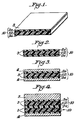
- FIG. 1 One basic configuration of the present invention is illustrated in Figure 1. Specifically, a porous, expanded polytetrafluoroethylene sheet 1 is impregnated with a syntehtic resin solution 2 which has a lower heat-shrink capacity than the sheet 1, and this resin solution 2 is hardened by heating. Furthermore, a resin bonding layer 3 is formed on one side of this impregnated sheet 10. The impregnation of the sheet and the hardening of the synthetic resin solution 2 may be performed so that extremely thin films 2a are formed on the surfaces of the sheet 1.
- the resin bonding layer 3 may be formed on both surfaces of the impregnated sheet 10 as shown in Figure 2.
- the porous, expanded polytetrafluoroethylene sheet 1 is obtained as follows: an extruded polytetrafluoroethylene film is subjected to a drawing treatment at a prescribed temperature and drawing rate, as set forth in U.S.-A-3,953,566, thus producing a porous structure in which numerous fibrilized microfibres are formed in spiderweb fashion between countless micronodes.
- the porosity of this sheet is 50 to 90%, preferably 70 to 80%.
- the mean pore diameter is 0.1 to 3 micrometers, preferably 0.2 to 0.4 micrometers, and the thickness of the sheet is 50 to 250 micrometers, preferably 50 to 150 micrometers.
- thermosetting resin liquids may be used for the synthetic resin liquid having small heat-shrink capacity with which the porous sheet 1 is impregnated.
- polyimide resins epoxy resins, polybutadiene resins, polyester resins, triazine resins, bis-maleimidotriazine resins, polyurethane resins and mixtures consisting of two or more such resins may be used.
- These resins are converted into a solution in an appropriate concentration using one or more solvents such as methyl ethyl ketone, acetone, toluene, xylene, dimethylformamide, dimethylacetamide, and N-methyl-2-pyrrolidone.
- the resin bonding layer 3 is a resin whose hardened state or hardening rate or each, is lower than that of the synthetic resin with which the aformentioned sheet 1 is impregnated.
- this resin bonding layer is in a semi-hardened or virtually unhardened state, respectively.
- an impregnating resin and a resin bonding layer which have a corresponding difference in hardening rate are used.
- resins with different hardening rates are used, e.g.
- the internal impregnated resin when this sheet is joined with an iron sheet, which has a high surface energy, and pressed under heating, the internal impregnated resin will harden with little flow occurring, while the resin bonding layer 3 will flow and wet the surface of the iron sheet.
- the resin bonding layer 3 will provide good bonding joint with the internal impregnated resin so that superior bonding stability results.
- Such a relationship can generally be obtained if the thickness of the resin covering layer is 3 micrometers or greater. However, a more desirable thickness range is 50 to 100 micrometers.
- this resin bonding layer does not necessarily have to cover the entire surface of the sheet. A stripe-form, latticeform or spot-form bonding layer pattern are also permissible.
- a porous, expanded polytetrafluoroethylene resin sheet 1 with a thickness of 100 micrometers, a mean pore diameter of 0.2 micrometers and a porosity of 80% was impregnated with a polyimide resin using N-methyl-2-pyrrolidone as a solvent at a ratio of 0,09 kg/m2 (90 g/m2), calculated in terms of resin content.
- This impregnated sheet was stretched and fixed in a frame in order to prevent heat-shrinkage of the sheet 1.
- the impregnated sheet was successively heat-treated for 40 minutes at 120°C, 20 minutes at 200°C and 10 minutes at 350°C.
- This composite sheet 10, impregnated with the aforementioned polyimide resin was then coated on both surfaces with an epoxy resin solution formed by mixing 100 parts of an epoxy resin, 4.0 parts of dicyandiamide, 15 parts of dimethylformamide, 0.2 parts of benzyldimethylamine and 80 parts of methyl ethyl ketone.
- the coated sheet 10 was then dried for 8 minutes at 150°C, producing a sheet material such as that shown in Figure 2 with an internal impregnated resin 2 that had lost virtually all fluidity, and with resin covering layers 3 possessing a high fluidity formed to a mean thickness of 40 micrometers on the external surfaces of the sheet.
- Example 2 The same porous polytetrafluoroethylene sheet 1 used in Example 1 was impregnated with an epoxy resin solution of the composition shown below at a ratio of 0,106 kg/m2 (106 g/m2). The sheet was then dried for 12 minutes to produce an impregnated sheet 10.
- Epoxy resin 100 parts Dicyandiamide 3.2 parts Dimethylbenzylamine 0.16 parts Dimethylformamide 16 parts Methyl ethyl ketone 5 parts
- the bonding between the sheets 10 and 10 was extremely strong, and the peeling strength of the copper foil 4 was 2 x 10⁵ N/m2 (2.0 kg/cm2).
- an epoxy-impregnated polytetrafluoroethylene sheet without the aforementioned resin coverings 3 was manufactured as a comparative example in conditions corresponding to the aforementioned example.
- three different pressing pressures were used: 20 x 105 N/m2 (20 kg/cm2), 40 x 105 N/m2 (40 kg/cm2) and 60 x 105 N/m2 (60 kg/cm2).
- a hot-pressing treatment was performed for 60 minutes at 180°C exactly as described above.
- the sheets were easily peeled apart immediately after bodning.
- Example 1 the same porous polytetrafluoroethylene sheet 1 used in Example 1 was impregnated with the same epoxy impregnating liquid used in Example 2 by the same method used in Example 2. Following this impregnation treatment, both sides of the sheet were coated with the same coating resin used in Example 2, without any drying treatment between impregnation and coating. The coated sheet was then dried for 10 minutes at 150°C, producing a bonding sheet with virtually no difference in hardened state between the resin of the impregnated layer and the coating resin, as a separate comparative example.
- the epoxy content of this sheet was 0.1 kg/m2 (100 g/m2).
- Example 2 The same porous polytetrafluoroethylene sheet 1 used in Example 1 was impregnated with a polybutadiene solution consisting of 100 parts of a polybutadiene, 0.3 parts of dicumyl peroxide and 30 parts of methyl ethyl ketone. The impregnated sheet was dried for 30 minutes at 160°C. This sheet was then coated by means of a roll coater with a coating solution of 100 parts of a phenol novolac type epoxy resin, 10 parts of dicyandiamide, 0.1 parts of 2-ethyle-4-methylimidazole and 50 parts of methyl ethyl ketone. After coating, the sheet was dried for 10 minutes at 150°C, producing a sheet material with a coating layer thickness of 10 micrometers.
- a polished stainless steel sheet with a thickness of 1mm was joined to the coated surface of this sheet material, and the two sheets were bonded by hot-pressing for 60 minutes at a temperature of 180°C and a pressure of 40 x 105 N/m2 (40 kg/cm2).
- the laminated material thus obtained was very strongly bonded, and showed no abnormalities, even after being treated for 60 seconds in a solder bath at 280°C.
- a porous polytetrafluoroethylene sheet 1 with a thickness of 50 micrometers, a mean pore diameter of 0.5 micrometers and a porosity of 80% was impregnated with a polyimide resin using N-methyl-2-pyrrolidone as a solvent. This impregnated sheet was fixed in a frame and successively heat-treated for 10 minutes at 150°, 120 minutes at 180°C, and 24 hours at 250°C.
- a film (thickness: 6 micrometers) of a copolymer of tetrafluoroethylene and hexafluoropropylene was fused to one surface of this polyimide-impregnated sheet 1 by pressing with hot rolls heated to 350°, thus producing a sheet material of the present invention.
- a copper foil (thickness: 18 micrometers, one surface roughened) was bonded to the abovementioned sheet material via the aforementioned copolymer film surface by hot-pressing for 10 minutes at a temperature of 350°C and a pressure of 10 x 105 N/m2 (10 kg/cm2).
- This laminated material was heat-treated for 30 seconds in a solder bath at 270°. Afterward, no substantial abnormalities were observed.
- the present invention makes it possible to obtain a sheet material which has the heat resistance, chemical resistance and electrical properties of porous polytetrafluoroethylene, and which is also endowed with dimensional stability and shape retention properties. At the same time, flow and non-uniform distribution of the adhesive is effectively prevented, so that a stable bonding strength with respect to various types of metal sheets is obtained. Accordingly, the present invention has great industrial merit, for example, in use in printed circuit boards wherein prepregs according to the invention are laminated with a metal sheet, a resin sheet, or another printed circuit board.
Landscapes
- Chemical & Material Sciences (AREA)
- Engineering & Computer Science (AREA)
- Composite Materials (AREA)
- Mechanical Engineering (AREA)
- Microelectronics & Electronic Packaging (AREA)
- Materials Engineering (AREA)
- Health & Medical Sciences (AREA)
- Chemical Kinetics & Catalysis (AREA)
- Medicinal Chemistry (AREA)
- Polymers & Plastics (AREA)
- Organic Chemistry (AREA)
- Laminated Bodies (AREA)
- Materials For Medical Uses (AREA)
Abstract
Description
- The present invention concerns a composite sheet material, and in particular seeks to provide a sheet material which has good dimensional stability and shape retention, and also stable bonding characteristics.
- According to the present invention there is provided a composite sheet material comprising a porous, expanded polytetrafluoroethylene base sheet impregnated with a first thermosetting resin that has a lower heat-shrinkability than the base sheet, the impregnated base sheet having a bonding layer which comprises a second resin whose hardening rate or hardened state is lower than that of the impregnating resin. The bonding layer may have a thickness of at least three micrometers. The first resin may be in a semi-hardened state or a fully-hardened state. The second resin may be in a semi-hardened state or a virtually unhardened state. The first resin may be a polyimide, epoxy or polybutadiene. The second resin may be an epoxy, phenolic, or a copolymer of tetrafluoroethylene and hexafluoropropylene.
- The present invention provides a synthetic resin sheet which can be bonded to various types of metal sheets or foils, or which can be used for other purposes.
- The prior art of composite sheet materials includes the use of polytetrafluoroethylene resins. Such resins have superior heat resistance, chemical resistance and electrical characteristics, and are widely used in a variety of fields. One such polytetrafluoroethylene resin product is porous, expanded polytetrafluoroethylene disclosed in U.S.-A- Patent 3,953,566. This substance not only has the above- mentioned characteristics of polytetrafluoroethylene, but is endowed with air permeability, softness, biocompatibility and good bonding characteristics. Accordingly, this material is widely used in waterproof, water-vapour-permeable clothing, artifical blood vessels, various types of filters, and various types of industrial packing.
- Specifically, the aforementioned porous, expanded polytetrafluoroethylene has fine continuous pores. Bonding of this material is achieved by an anchoring effect resulting from penetration and fixing within the fine porous structure of the resin. However, since expanded polytetrafluoroethylene intrinsically has an extremely low surface energy, it is difficult to wet the polytetrafluoroethylene with various types of adhesives. As a result, the bonding strength is generally low. Accordingly, in cases where a high bonding strength is required, it is usually necessary to first etch the surface of the expanded polytetrafluoroethylene with an alkali metal or other reactant.
- Because the expanded polytetrafluoroethylene exhibits considerable cold flow and thermal expansion, it is generally difficult to use expanded polytetrafluoroethylene in cases where a high degree of dimensional stability is required, and these properties are especially conspicuous in the case of highly porous polytetrafluoroethylene, because this material has numerous pores in its structure. Accordingly, in cases where such highly porous polytetrafluoroethylene is to be utilised in a bonding sheet, a method is generally used in which the porous polytetrafluoroethylene is impregnated with another resin which has a high surface energy.
- Such a method is known from the above-mentioned U.S. patent 3,953,566 where impregnation is disclosed to provide a porous expanded polytetrafluoroethylene with amended bonding characteristics and a high degree of dimensional stability.
- However, even in the case of materials formed by impregnating porous, expanded polytetrafluoroethylene with another resin as described above, it is extremely difficult to insure that the impregnating resin fills the entire interior of the porous structure of the polytetrafluoroethylene. Because of the poor wetting properties of polytetrafluoroethylene, polytetrafluoroethylene may be exposed at the surface of a composite material thus formed by impregnating porous polytetrafluoroethylene with another resin. If a sheet with polytetrafluoroethylene thus exposed at the surface is used for bonding purposes, the distribution of the adhesive will be nonuniform as a result of the fluid behaviour of the impregnating resin. This can lead to unsatisfactory bonding and insufficient strength. For example, in a case where two sheets of sheet iron are thermally bonded to both sides of the aforementioned impregnated polytetrafluoroethylene bonding sheet, the impregnating resin, which has fluidity as a result of softening due to heating, migrates to the iron sheets, which have a high surface energy, so that very little impregnating resin remains on the polytetrafluoroethylene.
- The above mentioned phenomenon is especially conspicuous in cases where two or more impregnated polytetrafluoroethylene bonding sheets of the type described above are used stacked together. In such cases, almost no impregnating bonding resin remains at the interfaces between the stacked impregnated polytetrafluoroethylene sheets. As a result, there may be little or no adhesive strength.
- Accordingly, although the aforementioned special properties of porous, expanded polytetrafluoroethylene are fully understood, such porous polytetrafluoroethylene suffers from the drawback in that it generally cannot be used as a bonding structural material of the type described above.
- The invention will now be particularly described, by way of example, with reference to the accompanying drawings in which:-
- Figure 1 is a perspective view, partly in cross-section, of one embodiment of the present invention;
- Figure 2 is a cross-sectional view of another embodiment of the present invention;
- Figure 3 is a cross-sectional view of the bonded structure described in Example 1 below, and
- Figure 4 is a cross-sectional view of the bonded structure described in Example 2 below.
- Specifically, the present invention comprises a sheet material which is characterised by the fact that a bonding layer which has a thickness of three micrometers or greater and which consists of a resin whose hardened state or hardening rate or each is lower than that of the impregnating resin mentioned below is formed on at least one surface of a porous polytetrafluoroethylene sheet which is impregnated with a resin liquid that has a smaller heat-shrink capacity than the sheet.
- The heat-shrink capacity of porous, expanded polytetrafluoroethylene is controlled by the hardened structure of the aforementioned impregnating resin, thus ensuring dimensional stability and shape retention. The formation of a resin bonding layer on the aforementioned impregnated sheet containing a hardened impregnating resin as described above results in a restriction of the fluid behaviour of the adhesive component during heating, thus preventing a non-uniform distribution of the adhesive component due to such fluid behaviour.
- Accordingly, a sheet which has high bonding strength, a stable shape and stable bonding characteristics is obtained.
- One basic configuration of the present invention is illustrated in Figure 1. Specifically, a porous, expanded polytetrafluoroethylene sheet 1 is impregnated with a syntehtic resin solution 2 which has a lower heat-shrink capacity than the sheet 1, and this resin solution 2 is hardened by heating. Furthermore, a
resin bonding layer 3 is formed on one side of this impregnatedsheet 10. The impregnation of the sheet and the hardening of the synthetic resin solution 2 may be performed so that extremelythin films 2a are formed on the surfaces of the sheet 1. - The
resin bonding layer 3 may be formed on both surfaces of the impregnatedsheet 10 as shown in Figure 2. - The porous, expanded polytetrafluoroethylene sheet 1 is obtained as follows: an extruded polytetrafluoroethylene film is subjected to a drawing treatment at a prescribed temperature and drawing rate, as set forth in U.S.-A-3,953,566, thus producing a porous structure in which numerous fibrilized microfibres are formed in spiderweb fashion between countless micronodes. The porosity of this sheet is 50 to 90%, preferably 70 to 80%. The mean pore diameter is 0.1 to 3 micrometers, preferably 0.2 to 0.4 micrometers, and the thickness of the sheet is 50 to 250 micrometers, preferably 50 to 150 micrometers.
- In general, various types of thermosetting resin liquids may be used for the synthetic resin liquid having small heat-shrink capacity with which the porous sheet 1 is impregnated. For example, polyimide resins, epoxy resins, polybutadiene resins, polyester resins, triazine resins, bis-maleimidotriazine resins, polyurethane resins and mixtures consisting of two or more such resins may be used. These resins are converted into a solution in an appropriate concentration using one or more solvents such as methyl ethyl ketone, acetone, toluene, xylene, dimethylformamide, dimethylacetamide, and N-methyl-2-pyrrolidone.
- The
resin bonding layer 3 is a resin whose hardened state or hardening rate or each, is lower than that of the synthetic resin with which the aformentioned sheet 1 is impregnated. When the aforementioned impregnating resin is in a hardened or semi-hardened state, this resin bonding layer is in a semi-hardened or virtually unhardened state, respectively. Alternatively, an impregnating resin and a resin bonding layer which have a corresponding difference in hardening rate are used. When resins with different hardening rates are used, e.g. when a resin with a rapid hardening rate such as an epoxy resin with a gelling time of 30 seconds or less, containing 0.4 phr 3-ethyl-4-methylimidazole as a catalyst, is used for the impregnating resin, and a resin with a slow hardening rate such as an epoxy resin with a gelling time of 400 seconds or longer, containing 0.1 phr 2-ethyl-4-methyl-imidazole, is used for the bonding layer, the internal impregnated resin will have little fluidity during heating, while the outer bonding layer(s) will be highly fluid. Accordingly, when this sheet is joined with an iron sheet, which has a high surface energy, and pressed under heating, the internal impregnated resin will harden with little flow occurring, while theresin bonding layer 3 will flow and wet the surface of the iron sheet. Theresin bonding layer 3 will provide good bonding joint with the internal impregnated resin so that superior bonding stability results. Such a relationship can generally be obtained if the thickness of the resin covering layer is 3 micrometers or greater. However, a more desirable thickness range is 50 to 100 micrometers. Furthermore, this resin bonding layer does not necessarily have to cover the entire surface of the sheet. A stripe-form, latticeform or spot-form bonding layer pattern are also permissible. - Examples of manufacture of the sheet material of the present invention are described below.
- A porous, expanded polytetrafluoroethylene resin sheet 1 with a thickness of 100 micrometers, a mean pore diameter of 0.2 micrometers and a porosity of 80% was impregnated with a polyimide resin using N-methyl-2-pyrrolidone as a solvent at a ratio of 0,09 kg/m² (90 g/m²), calculated in terms of resin content.
- This impregnated sheet was stretched and fixed in a frame in order to prevent heat-shrinkage of the sheet 1. In this state, the impregnated sheet was successively heat-treated for 40 minutes at 120°C, 20 minutes at 200°C and 10 minutes at 350°C. This
composite sheet 10, impregnated with the aforementioned polyimide resin, was then coated on both surfaces with an epoxy resin solution formed by mixing 100 parts of an epoxy resin, 4.0 parts of dicyandiamide, 15 parts of dimethylformamide, 0.2 parts of benzyldimethylamine and 80 parts of methyl ethyl ketone. Thecoated sheet 10 was then dried for 8 minutes at 150°C, producing a sheet material such as that shown in Figure 2 with an internal impregnated resin 2 that had lost virtually all fluidity, and withresin covering layers 3 possessing a high fluidity formed to a mean thickness of 40 micrometers on the external surfaces of the sheet. - Two sheets of
electrolytic copper foil 4, each of which had one roughened surface and a thickness of 70 micrometers, were placed on the respective surfaces of the sheet material obtained as described above, and these sandwiched sheets were hot-pressed for 60 minutes at a temperature of 180°C and a pressure of
(30kg/cm²), so that the sheets ofelectrolytic copper foil copper foil 4 was measured after cooling, a value of
(1.8 kg/cm²) was obtained. - The same porous polytetrafluoroethylene sheet 1 used in Example 1 was impregnated with an epoxy resin solution of the composition shown below at a ratio of 0,106 kg/m² (106 g/m²). The sheet was then dried for 12 minutes to produce an impregnated
sheet 10.Epoxy resin 100 parts Dicyandiamide 3.2 parts Dimethylbenzylamine 0.16 parts Dimethylformamide 16 parts Methyl ethyl ketone 5 parts - The abovementioned impregnated
sheet 10 was then coated on both sides with a coating resin solution of the composition shown below, and the coated sheet was dried for 4 minutes at 150°, so thatresin covering layers 3 with a mean thickness of 3 micrometers were formed.Epoxy resin 100 parts Dicyandiamide 3.2 parts Dimethylbenzylamine 0.16 parts Dimethylformamide 16 parts Xylene 100 parts - Two sheets of the sheet material thus obtained were stacked together, and these stacked sheets were sandwiched between an aluminium sheet 5 (thickness: 1mm, alumite-treated surface) and a sheet of electrolytic copper foil 4 (thickness: 35 microns, one surface roughened). These sandwiched sheets were hot-pressed for 60 minutes at a temperature of 180°C and a pressure of 40 x 10⁵ N/cm² (40 kg/cm²), producing a product of the type shown in Figure 4.
- In this product, the bonding between the
sheets copper foil 4 was 2 x 10⁵ N/m² (2.0 kg/cm²). - For comparison, an epoxy-impregnated polytetrafluoroethylene sheet without the
aforementioned resin coverings 3 was manufactured as a comparative example in conditions corresponding to the aforementioned example. In laminating and bonding aaluminium sheet 5 andcopper foil 4 to examples of these sheets as described above, three different pressing pressures were used: 20 x 10⁵ N/m² (20 kg/cm²), 40 x 10⁵ N/m² (40 kg/cm²) and 60 x 10⁵ N/m² (60 kg/cm²). Otherwise, a hot-pressing treatment was performed for 60 minutes at 180°C exactly as described above. In the resulting product, there was almost no adhesive strength between the respective sheets. The sheets were easily peeled apart immediately after bodning. - Furthermore, separately from this comparative example, the same porous polytetrafluoroethylene sheet 1 used in Example 1 was impregnated with the same epoxy impregnating liquid used in Example 2 by the same method used in Example 2. Following this impregnation treatment, both sides of the sheet were coated with the same coating resin used in Example 2, without any drying treatment between impregnation and coating. The coated sheet was then dried for 10 minutes at 150°C, producing a bonding sheet with virtually no difference in hardened state between the resin of the impregnated layer and the coating resin, as a separate comparative example.
- The epoxy content of this sheet was 0.1 kg/m² (100 g/m²). When this sheet was pressed into the same laminated structure as in Example 2, under the same laminating conditions, the bonding between the sheets was unsatisfactory, i.e. the sheets could easily be peeled apart by hand.
- The same porous polytetrafluoroethylene sheet 1 used in Example 1 was impregnated with a polybutadiene solution consisting of 100 parts of a polybutadiene, 0.3 parts of dicumyl peroxide and 30 parts of methyl ethyl ketone. The impregnated sheet was dried for 30 minutes at 160°C. This sheet was then coated by means of a roll coater with a coating solution of 100 parts of a phenol novolac type epoxy resin, 10 parts of dicyandiamide, 0.1 parts of 2-ethyle-4-methylimidazole and 50 parts of methyl ethyl ketone. After coating, the sheet was dried for 10 minutes at 150°C, producing a sheet material with a coating layer thickness of 10 micrometers.
- A polished stainless steel sheet with a thickness of 1mm was joined to the coated surface of this sheet material, and the two sheets were bonded by hot-pressing for 60 minutes at a temperature of 180°C and a pressure of 40 x 10⁵ N/m² (40 kg/cm²). The laminated material thus obtained was very strongly bonded, and showed no abnormalities, even after being treated for 60 seconds in a solder bath at 280°C.
- A porous polytetrafluoroethylene sheet 1 with a thickness of 50 micrometers, a mean pore diameter of 0.5 micrometers and a porosity of 80% was impregnated with a polyimide resin using N-methyl-2-pyrrolidone as a solvent. This impregnated sheet was fixed in a frame and successively heat-treated for 10 minutes at 150°, 120 minutes at 180°C, and 24 hours at 250°C.
- A film (thickness: 6 micrometers) of a copolymer of tetrafluoroethylene and hexafluoropropylene was fused to one surface of this polyimide-impregnated sheet 1 by pressing with hot rolls heated to 350°, thus producing a sheet material of the present invention.
- A copper foil (thickness: 18 micrometers, one surface roughened) was bonded to the abovementioned sheet material via the aforementioned copolymer film surface by hot-pressing for 10 minutes at a temperature of 350°C and a pressure of 10 x 10⁵ N/m² (10 kg/cm²).
- This laminated material was heat-treated for 30 seconds in a solder bath at 270°. Afterward, no substantial abnormalities were observed.
- As described above, the present invention makes it possible to obtain a sheet material which has the heat resistance, chemical resistance and electrical properties of porous polytetrafluoroethylene, and which is also endowed with dimensional stability and shape retention properties. At the same time, flow and non-uniform distribution of the adhesive is effectively prevented, so that a stable bonding strength with respect to various types of metal sheets is obtained. Accordingly, the present invention has great industrial merit, for example, in use in printed circuit boards wherein prepregs according to the invention are laminated with a metal sheet, a resin sheet, or another printed circuit board.
Claims (7)
- A composite sheet material comprising a porous, expanded polytetrafluoroethylene base sheet (1) impregnated with a first thermosetting resin (2) that has a lower heat-shrinkability than said base sheet (1), said impregnated base sheet having a bonding layer with a thickness of at least three micrometers which comprises a second resin (3) whose hardening rate or hardened state is lower than that of said impregnating resin.
- A composite sheet material according to claim 1 wherein said first resin (2) is in a semi-hardened state.
- A composite sheet material according to claim 1 wherein said first resin (2) is in a fully-hardened state.
- A composite sheet material according to claim 1 wherein said second resin (3) is in a semi-hardened state.
- A composite sheet material according to claim 1 wherein said second resin (3) is in a virtually unhardened state.
- A composite sheet material according to claim 1 wherein said first resin (2) is a polyimide, an epoxy or polybutadiene.
- A composite sheet material according to claim 1 wherein said second resin (3) is an epoxy, a phenolic or a copolymer of tetrafluorethylene and hexafluoropropylene.
Priority Applications (1)
| Application Number | Priority Date | Filing Date | Title |
|---|---|---|---|
| AT88307988T ATE94576T1 (en) | 1987-09-10 | 1988-08-30 | COMPOSITE FOIL MATERIAL. |
Applications Claiming Priority (2)
| Application Number | Priority Date | Filing Date | Title |
|---|---|---|---|
| JP62225387A JP2559236B2 (en) | 1987-09-10 | 1987-09-10 | Sheet material |
| JP225387/87 | 1987-09-10 |
Publications (3)
| Publication Number | Publication Date |
|---|---|
| EP0307123A2 EP0307123A2 (en) | 1989-03-15 |
| EP0307123A3 EP0307123A3 (en) | 1990-01-17 |
| EP0307123B1 true EP0307123B1 (en) | 1993-09-15 |
Family
ID=16828562
Family Applications (1)
| Application Number | Title | Priority Date | Filing Date |
|---|---|---|---|
| EP88307988A Expired - Lifetime EP0307123B1 (en) | 1987-09-10 | 1988-08-30 | A composite sheet material |
Country Status (8)
| Country | Link |
|---|---|
| US (1) | US4916017A (en) |
| EP (1) | EP0307123B1 (en) |
| JP (1) | JP2559236B2 (en) |
| AT (1) | ATE94576T1 (en) |
| AU (1) | AU600585B2 (en) |
| CA (1) | CA1294864C (en) |
| DE (1) | DE3884114T2 (en) |
| GB (1) | GB2209707A (en) |
Families Citing this family (25)
| Publication number | Priority date | Publication date | Assignee | Title |
|---|---|---|---|---|
| WO1991007278A1 (en) * | 1989-11-17 | 1991-05-30 | W.L. Gore & Associates, Inc. | Thin seam sealing tape |
| US5286618A (en) * | 1989-11-29 | 1994-02-15 | Konica Corporation | Method for providing antistatic layer |
| US5162149A (en) * | 1990-05-15 | 1992-11-10 | W. L. Gore & Associates, Inc. | Non-blocking seam tape |
| DE69132258D1 (en) * | 1990-11-14 | 2000-07-27 | Titeflex Corp | Laminates made of fluoropolymer and aluminum |
| ES2113403T3 (en) * | 1991-06-18 | 1998-05-01 | Gore W L & Ass Uk | STORAGE CONTAINER. |
| US5498467A (en) * | 1994-07-26 | 1996-03-12 | W. L. Gore & Associates, Inc. | Process for preparing selectively conductive materials by electroless metal deposition and product made therefrom |
| US5512360A (en) * | 1994-09-20 | 1996-04-30 | W. L. Gore & Associates, Inc. | PTFE reinforced compliant adhesive and method of fabricating same |
| US5538756A (en) * | 1994-09-23 | 1996-07-23 | W. L. Gore & Associates | High capacitance sheet adhesives and process for making the same |
| JPH0911397A (en) * | 1995-06-30 | 1997-01-14 | Hitachi Ltd | Copper clad laminate, manufacturing method thereof, printed circuit board, and manufacturing method thereof |
| DE19626514B4 (en) * | 1996-07-02 | 2007-01-18 | W.L. Gore & Associates Gmbh | Optical device with compressible laminate |
| US5731073A (en) * | 1996-10-01 | 1998-03-24 | W. L. Gore & Associates, Inc. | Reusable, selectively conductive, Z-axis, elastomeric composite substrate |
| US6497934B1 (en) * | 1999-08-09 | 2002-12-24 | Specialty Adhesive Film Co. | Seam tape for water repellant fabrics |
| EP1307077A4 (en) * | 2000-06-15 | 2003-06-18 | Ajinomoto Kk | Adhesive film and method for manufacturing multilayer printed wiring board comprising the same |
| US7147378B2 (en) * | 2004-02-19 | 2006-12-12 | Gore Enterprise Holdings, Inc. | Low friction, abrasion-resistant bearing materials |
| JP5370149B2 (en) * | 2007-03-30 | 2013-12-18 | 住友ベークライト株式会社 | Prepreg with carrier and manufacturing method thereof, multilayer printed wiring board, and semiconductor device |
| US8858681B2 (en) | 2007-04-23 | 2014-10-14 | W. L. Gore & Associates, Inc. | Patterned porous venting materials |
| CN101730578B (en) | 2007-04-23 | 2013-06-05 | W.L.戈尔有限公司 | Composite material |
| US7927405B2 (en) | 2007-04-23 | 2011-04-19 | Gore Enterprise Holdings, Inc | Porous composite article |
| JP5528250B2 (en) * | 2010-07-30 | 2014-06-25 | 日東電工株式会社 | Method for manufacturing printed circuit board |
| US8808848B2 (en) | 2010-09-10 | 2014-08-19 | W. L. Gore & Associates, Inc. | Porous article |
| US9145469B2 (en) | 2012-09-27 | 2015-09-29 | Ticona Llc | Aromatic polyester containing a biphenyl chain disruptor |
| JP6216608B2 (en) * | 2013-10-28 | 2017-10-18 | サトーホールディングス株式会社 | Portable printer |
| HK1244833B (en) * | 2015-03-23 | 2019-11-29 | 拓自达电线株式会社 | Method of manufacturing resin impregnated material, composite material and copper-clad laminate |
| CN109294472A (en) * | 2018-10-22 | 2019-02-01 | 江苏东台实力工业材料有限公司 | A kind of porous permeable formula adhesive tape and preparation method thereof |
| JP7284606B2 (en) * | 2019-03-22 | 2023-05-31 | 新科實業有限公司 | MEMS package, MEMS microphone and method of manufacturing MEMS package |
Family Cites Families (7)
| Publication number | Priority date | Publication date | Assignee | Title |
|---|---|---|---|---|
| CA962021A (en) * | 1970-05-21 | 1975-02-04 | Robert W. Gore | Porous products and process therefor |
| US4169184A (en) * | 1973-05-07 | 1979-09-25 | Joseph Pufahl | Adhesive coated impregnated polyurethane foam |
| JPS5251480A (en) * | 1975-10-23 | 1977-04-25 | Daikin Ind Ltd | Composite material and a process for preparing it |
| US4443511A (en) * | 1982-11-19 | 1984-04-17 | W. L. Gore & Associates, Inc. | Elastomeric waterproof laminate |
| JPS60214941A (en) * | 1984-04-10 | 1985-10-28 | 株式会社 潤工社 | Printed substrate |
| JPH0627216B2 (en) * | 1984-12-11 | 1994-04-13 | ジャパンゴアテックス株式会社 | Stretchable moisture-permeable waterproof film for clothing |
| CA1276758C (en) * | 1986-06-02 | 1990-11-27 | Kosuke Moriya | Process for making substrates for printed circuit boards |
-
1987
- 1987-09-10 JP JP62225387A patent/JP2559236B2/en not_active Expired - Fee Related
-
1988
- 1988-06-30 AU AU18685/88A patent/AU600585B2/en not_active Expired - Fee Related
- 1988-08-30 DE DE88307988T patent/DE3884114T2/en not_active Expired - Fee Related
- 1988-08-30 EP EP88307988A patent/EP0307123B1/en not_active Expired - Lifetime
- 1988-08-30 AT AT88307988T patent/ATE94576T1/en active
- 1988-08-30 GB GB8820515A patent/GB2209707A/en not_active Withdrawn
- 1988-08-31 US US07/238,748 patent/US4916017A/en not_active Expired - Fee Related
- 1988-09-09 CA CA000576906A patent/CA1294864C/en not_active Expired - Lifetime
Also Published As
| Publication number | Publication date |
|---|---|
| DE3884114D1 (en) | 1993-10-21 |
| AU1868588A (en) | 1989-03-16 |
| US4916017A (en) | 1990-04-10 |
| EP0307123A3 (en) | 1990-01-17 |
| GB2209707A (en) | 1989-05-24 |
| CA1294864C (en) | 1992-01-28 |
| DE3884114T2 (en) | 1994-01-27 |
| GB8820515D0 (en) | 1988-09-28 |
| JP2559236B2 (en) | 1996-12-04 |
| EP0307123A2 (en) | 1989-03-15 |
| ATE94576T1 (en) | 1993-10-15 |
| JPS6469341A (en) | 1989-03-15 |
| AU600585B2 (en) | 1990-08-16 |
Similar Documents
| Publication | Publication Date | Title |
|---|---|---|
| US4916017A (en) | Sheet material | |
| EP0160418B1 (en) | Printed circuit board | |
| EP0248617A2 (en) | Process for making substrates for printed circuit boards | |
| EP0374272A1 (en) | Multilayer circuit board with fluoropolymer interlayers | |
| EP0047534A2 (en) | Process for producing insulating laminates | |
| US5294487A (en) | Composite layered material containing a silicone resin substrate | |
| JPH0460818B2 (en) | ||
| US5273816A (en) | Laminate board possessing improved dimensional stability | |
| EP0873860A2 (en) | Laminate and process for producing the same | |
| EP1265470A2 (en) | Method of manufacturing a wiring board | |
| JPH0442416B2 (en) | ||
| US4738890A (en) | Resin-impregnated base and method of manufacturing same | |
| GB2216435A (en) | Prepreg sheet | |
| JPS59232846A (en) | Laminated board for electric wiring board and manufacture thereof | |
| JPH0334677B2 (en) | ||
| JPH0538783A (en) | Composite body and use therefor | |
| JPH0771839B2 (en) | Laminated board manufacturing method | |
| JP4759896B2 (en) | Manufacturing method of printed wiring board manufacturing material | |
| JPH04167311A (en) | Prepreg and its application | |
| JPS6220916B2 (en) | ||
| JPH1067027A (en) | Release film | |
| JPS5684726A (en) | Production of long copper-clad laminated sheet | |
| JPS58203015A (en) | Manufacture of laminated sheet for chemical plating | |
| JPS6053707B2 (en) | Manufacturing method of laminate for chemical plating | |
| JPS63224936A (en) | Laminated board |
Legal Events
| Date | Code | Title | Description |
|---|---|---|---|
| PUAI | Public reference made under article 153(3) epc to a published international application that has entered the european phase |
Free format text: ORIGINAL CODE: 0009012 |
|
| AK | Designated contracting states |
Kind code of ref document: A2 Designated state(s): AT BE CH DE ES FR GB GR IT LI LU NL SE |
|
| PUAL | Search report despatched |
Free format text: ORIGINAL CODE: 0009013 |
|
| AK | Designated contracting states |
Kind code of ref document: A3 Designated state(s): AT BE CH DE ES FR GB GR IT LI LU NL SE |
|
| 17P | Request for examination filed |
Effective date: 19900706 |
|
| 17Q | First examination report despatched |
Effective date: 19911029 |
|
| GRAA | (expected) grant |
Free format text: ORIGINAL CODE: 0009210 |
|
| AK | Designated contracting states |
Kind code of ref document: B1 Designated state(s): AT BE CH DE ES FR GB GR IT LI LU NL SE |
|
| PG25 | Lapsed in a contracting state [announced via postgrant information from national office to epo] |
Ref country code: NL Effective date: 19930915 Ref country code: LI Effective date: 19930915 Ref country code: GR Free format text: LAPSE BECAUSE OF FAILURE TO SUBMIT A TRANSLATION OF THE DESCRIPTION OR TO PAY THE FEE WITHIN THE PRESCRIBED TIME-LIMIT Effective date: 19930915 Ref country code: ES Free format text: THE PATENT HAS BEEN ANNULLED BY A DECISION OF A NATIONAL AUTHORITY Effective date: 19930915 Ref country code: CH Effective date: 19930915 Ref country code: BE Effective date: 19930915 Ref country code: AT Effective date: 19930915 |
|
| REF | Corresponds to: |
Ref document number: 94576 Country of ref document: AT Date of ref document: 19931015 Kind code of ref document: T |
|
| REF | Corresponds to: |
Ref document number: 3884114 Country of ref document: DE Date of ref document: 19931021 |
|
| ITF | It: translation for a ep patent filed | ||
| REG | Reference to a national code |
Ref country code: CH Ref legal event code: PL |
|
| ET | Fr: translation filed | ||
| NLV1 | Nl: lapsed or annulled due to failure to fulfill the requirements of art. 29p and 29m of the patents act | ||
| PLBE | No opposition filed within time limit |
Free format text: ORIGINAL CODE: 0009261 |
|
| STAA | Information on the status of an ep patent application or granted ep patent |
Free format text: STATUS: NO OPPOSITION FILED WITHIN TIME LIMIT |
|
| PG25 | Lapsed in a contracting state [announced via postgrant information from national office to epo] |
Ref country code: LU Free format text: LAPSE BECAUSE OF NON-PAYMENT OF DUE FEES Effective date: 19940831 |
|
| 26N | No opposition filed | ||
| EAL | Se: european patent in force in sweden |
Ref document number: 88307988.1 |
|
| PGFP | Annual fee paid to national office [announced via postgrant information from national office to epo] |
Ref country code: FR Payment date: 19970721 Year of fee payment: 10 |
|
| PGFP | Annual fee paid to national office [announced via postgrant information from national office to epo] |
Ref country code: SE Payment date: 19970722 Year of fee payment: 10 Ref country code: DE Payment date: 19970722 Year of fee payment: 10 |
|
| PGFP | Annual fee paid to national office [announced via postgrant information from national office to epo] |
Ref country code: GB Payment date: 19970728 Year of fee payment: 10 |
|
| PG25 | Lapsed in a contracting state [announced via postgrant information from national office to epo] |
Ref country code: GB Free format text: LAPSE BECAUSE OF NON-PAYMENT OF DUE FEES Effective date: 19980830 |
|
| PG25 | Lapsed in a contracting state [announced via postgrant information from national office to epo] |
Ref country code: SE Free format text: LAPSE BECAUSE OF NON-PAYMENT OF DUE FEES Effective date: 19980831 |
|
| GBPC | Gb: european patent ceased through non-payment of renewal fee |
Effective date: 19980830 |
|
| PG25 | Lapsed in a contracting state [announced via postgrant information from national office to epo] |
Ref country code: FR Free format text: LAPSE BECAUSE OF NON-PAYMENT OF DUE FEES Effective date: 19990430 |
|
| EUG | Se: european patent has lapsed |
Ref document number: 88307988.1 |
|
| PG25 | Lapsed in a contracting state [announced via postgrant information from national office to epo] |
Ref country code: DE Free format text: LAPSE BECAUSE OF NON-PAYMENT OF DUE FEES Effective date: 19990601 |
|
| REG | Reference to a national code |
Ref country code: FR Ref legal event code: ST |
|
| PG25 | Lapsed in a contracting state [announced via postgrant information from national office to epo] |
Ref country code: IT Free format text: LAPSE BECAUSE OF NON-PAYMENT OF DUE FEES Effective date: 20050830 |