EP0304057B1 - Pyridinon-Derivate und diese enthaltende fungizide Zusammenstellungen für die Landwirtschaft und Gartenbau - Google Patents
Pyridinon-Derivate und diese enthaltende fungizide Zusammenstellungen für die Landwirtschaft und Gartenbau Download PDFInfo
- Publication number
- EP0304057B1 EP0304057B1 EP19880113434 EP88113434A EP0304057B1 EP 0304057 B1 EP0304057 B1 EP 0304057B1 EP 19880113434 EP19880113434 EP 19880113434 EP 88113434 A EP88113434 A EP 88113434A EP 0304057 B1 EP0304057 B1 EP 0304057B1
- Authority
- EP
- European Patent Office
- Prior art keywords
- group
- carbon atoms
- substituted
- halogen atom
- phenyl
- Prior art date
- Legal status (The legal status is an assumption and is not a legal conclusion. Google has not performed a legal analysis and makes no representation as to the accuracy of the status listed.)
- Expired - Lifetime
Links
- 0 CC1C=CS*1 Chemical compound CC1C=CS*1 0.000 description 3
Classifications
-
- C—CHEMISTRY; METALLURGY
- C07—ORGANIC CHEMISTRY
- C07D—HETEROCYCLIC COMPOUNDS
- C07D213/00—Heterocyclic compounds containing six-membered rings, not condensed with other rings, with one nitrogen atom as the only ring hetero atom and three or more double bonds between ring members or between ring members and non-ring members
- C07D213/02—Heterocyclic compounds containing six-membered rings, not condensed with other rings, with one nitrogen atom as the only ring hetero atom and three or more double bonds between ring members or between ring members and non-ring members having three double bonds between ring members or between ring members and non-ring members
- C07D213/89—Heterocyclic compounds containing six-membered rings, not condensed with other rings, with one nitrogen atom as the only ring hetero atom and three or more double bonds between ring members or between ring members and non-ring members having three double bonds between ring members or between ring members and non-ring members with hetero atoms directly attached to the ring nitrogen atom
-
- A—HUMAN NECESSITIES
- A01—AGRICULTURE; FORESTRY; ANIMAL HUSBANDRY; HUNTING; TRAPPING; FISHING
- A01N—PRESERVATION OF BODIES OF HUMANS OR ANIMALS OR PLANTS OR PARTS THEREOF; BIOCIDES, e.g. AS DISINFECTANTS, AS PESTICIDES OR AS HERBICIDES; PEST REPELLANTS OR ATTRACTANTS; PLANT GROWTH REGULATORS
- A01N43/00—Biocides, pest repellants or attractants, or plant growth regulators containing heterocyclic compounds
- A01N43/34—Biocides, pest repellants or attractants, or plant growth regulators containing heterocyclic compounds having rings with one nitrogen atom as the only ring hetero atom
- A01N43/40—Biocides, pest repellants or attractants, or plant growth regulators containing heterocyclic compounds having rings with one nitrogen atom as the only ring hetero atom six-membered rings
-
- A—HUMAN NECESSITIES
- A01—AGRICULTURE; FORESTRY; ANIMAL HUSBANDRY; HUNTING; TRAPPING; FISHING
- A01N—PRESERVATION OF BODIES OF HUMANS OR ANIMALS OR PLANTS OR PARTS THEREOF; BIOCIDES, e.g. AS DISINFECTANTS, AS PESTICIDES OR AS HERBICIDES; PEST REPELLANTS OR ATTRACTANTS; PLANT GROWTH REGULATORS
- A01N43/00—Biocides, pest repellants or attractants, or plant growth regulators containing heterocyclic compounds
- A01N43/48—Biocides, pest repellants or attractants, or plant growth regulators containing heterocyclic compounds having rings with two nitrogen atoms as the only ring hetero atoms
- A01N43/54—1,3-Diazines; Hydrogenated 1,3-diazines
-
- A—HUMAN NECESSITIES
- A01—AGRICULTURE; FORESTRY; ANIMAL HUSBANDRY; HUNTING; TRAPPING; FISHING
- A01N—PRESERVATION OF BODIES OF HUMANS OR ANIMALS OR PLANTS OR PARTS THEREOF; BIOCIDES, e.g. AS DISINFECTANTS, AS PESTICIDES OR AS HERBICIDES; PEST REPELLANTS OR ATTRACTANTS; PLANT GROWTH REGULATORS
- A01N43/00—Biocides, pest repellants or attractants, or plant growth regulators containing heterocyclic compounds
- A01N43/48—Biocides, pest repellants or attractants, or plant growth regulators containing heterocyclic compounds having rings with two nitrogen atoms as the only ring hetero atoms
- A01N43/56—1,2-Diazoles; Hydrogenated 1,2-diazoles
-
- C—CHEMISTRY; METALLURGY
- C07—ORGANIC CHEMISTRY
- C07D—HETEROCYCLIC COMPOUNDS
- C07D213/00—Heterocyclic compounds containing six-membered rings, not condensed with other rings, with one nitrogen atom as the only ring hetero atom and three or more double bonds between ring members or between ring members and non-ring members
- C07D213/02—Heterocyclic compounds containing six-membered rings, not condensed with other rings, with one nitrogen atom as the only ring hetero atom and three or more double bonds between ring members or between ring members and non-ring members having three double bonds between ring members or between ring members and non-ring members
- C07D213/04—Heterocyclic compounds containing six-membered rings, not condensed with other rings, with one nitrogen atom as the only ring hetero atom and three or more double bonds between ring members or between ring members and non-ring members having three double bonds between ring members or between ring members and non-ring members having no bond between the ring nitrogen atom and a non-ring member or having only hydrogen or carbon atoms directly attached to the ring nitrogen atom
- C07D213/60—Heterocyclic compounds containing six-membered rings, not condensed with other rings, with one nitrogen atom as the only ring hetero atom and three or more double bonds between ring members or between ring members and non-ring members having three double bonds between ring members or between ring members and non-ring members having no bond between the ring nitrogen atom and a non-ring member or having only hydrogen or carbon atoms directly attached to the ring nitrogen atom with hetero atoms or with carbon atoms having three bonds to hetero atoms with at the most one bond to halogen, e.g. ester or nitrile radicals, directly attached to ring carbon atoms
- C07D213/62—Oxygen or sulfur atoms
- C07D213/63—One oxygen atom
- C07D213/68—One oxygen atom attached in position 4
-
- C—CHEMISTRY; METALLURGY
- C07—ORGANIC CHEMISTRY
- C07D—HETEROCYCLIC COMPOUNDS
- C07D401/00—Heterocyclic compounds containing two or more hetero rings, having nitrogen atoms as the only ring hetero atoms, at least one ring being a six-membered ring with only one nitrogen atom
- C07D401/02—Heterocyclic compounds containing two or more hetero rings, having nitrogen atoms as the only ring hetero atoms, at least one ring being a six-membered ring with only one nitrogen atom containing two hetero rings
- C07D401/04—Heterocyclic compounds containing two or more hetero rings, having nitrogen atoms as the only ring hetero atoms, at least one ring being a six-membered ring with only one nitrogen atom containing two hetero rings directly linked by a ring-member-to-ring-member bond
-
- C—CHEMISTRY; METALLURGY
- C07—ORGANIC CHEMISTRY
- C07D—HETEROCYCLIC COMPOUNDS
- C07D405/00—Heterocyclic compounds containing both one or more hetero rings having oxygen atoms as the only ring hetero atoms, and one or more rings having nitrogen as the only ring hetero atom
- C07D405/02—Heterocyclic compounds containing both one or more hetero rings having oxygen atoms as the only ring hetero atoms, and one or more rings having nitrogen as the only ring hetero atom containing two hetero rings
- C07D405/04—Heterocyclic compounds containing both one or more hetero rings having oxygen atoms as the only ring hetero atoms, and one or more rings having nitrogen as the only ring hetero atom containing two hetero rings directly linked by a ring-member-to-ring-member bond
-
- C—CHEMISTRY; METALLURGY
- C07—ORGANIC CHEMISTRY
- C07D—HETEROCYCLIC COMPOUNDS
- C07D405/00—Heterocyclic compounds containing both one or more hetero rings having oxygen atoms as the only ring hetero atoms, and one or more rings having nitrogen as the only ring hetero atom
- C07D405/02—Heterocyclic compounds containing both one or more hetero rings having oxygen atoms as the only ring hetero atoms, and one or more rings having nitrogen as the only ring hetero atom containing two hetero rings
- C07D405/06—Heterocyclic compounds containing both one or more hetero rings having oxygen atoms as the only ring hetero atoms, and one or more rings having nitrogen as the only ring hetero atom containing two hetero rings linked by a carbon chain containing only aliphatic carbon atoms
-
- C—CHEMISTRY; METALLURGY
- C07—ORGANIC CHEMISTRY
- C07D—HETEROCYCLIC COMPOUNDS
- C07D409/00—Heterocyclic compounds containing two or more hetero rings, at least one ring having sulfur atoms as the only ring hetero atoms
- C07D409/02—Heterocyclic compounds containing two or more hetero rings, at least one ring having sulfur atoms as the only ring hetero atoms containing two hetero rings
- C07D409/04—Heterocyclic compounds containing two or more hetero rings, at least one ring having sulfur atoms as the only ring hetero atoms containing two hetero rings directly linked by a ring-member-to-ring-member bond
-
- C—CHEMISTRY; METALLURGY
- C07—ORGANIC CHEMISTRY
- C07D—HETEROCYCLIC COMPOUNDS
- C07D409/00—Heterocyclic compounds containing two or more hetero rings, at least one ring having sulfur atoms as the only ring hetero atoms
- C07D409/02—Heterocyclic compounds containing two or more hetero rings, at least one ring having sulfur atoms as the only ring hetero atoms containing two hetero rings
- C07D409/06—Heterocyclic compounds containing two or more hetero rings, at least one ring having sulfur atoms as the only ring hetero atoms containing two hetero rings linked by a carbon chain containing only aliphatic carbon atoms
Definitions
- This invention relates to new 4(1H)-pyridinone derivatives which are useful as new compounds or agents having improved fungicidal activities.
- This invention also relates to an agricultural or horticultural fungicidal composition containing the new 4(1H)-pyridinone derivatives as active ingredient.
- This invention further relates to processes for the production of the new 4(1H)-pyridinone derivatives.
- 1,2,6-triphenyl-4(1H)-pyridinone derivatives show broad antibacterial and antifungal spectra against pathogenic microorganisms of various, agricultural and horticultural diseases of plants, such as rice sheath blight ( Rhizoctonia solani ), rice blast ( Pyricularia oryzae ), cucumber downy mildew ( Pseudoperonospora cubensis ), cucumber powdery mildew ( Sphaerotheca fuliginea ) and Alternaria sooty spot of chinese mustard ( Alternaria brassicicola ).
- rice sheath blight Rhizoctonia solani
- rice blast Pyricularia oryzae
- cucumber downy mildew Pseudoperonospora cubensis
- cucumber powdery mildew Sphaerotheca fuliginea
- Alternaria sooty spot of chinese mustard Alternaria brassicicola
- Japanese Patent Application first publication "Kokai” No. 65871/81 discloses 1-substituted phenyl-2,6-dimethyl-4(1H)-pyridinone derivatives. It also contains a disclosure to the effect that these derivatives are not only effective for cucumber powdery mildew ( Sphaerotheca fuliginea ) but also useful as slime control agents.
- Japanese Patent Application first publication "Kokai” No. 102504/80 discloses 2,6-diphenyl-4(1H)-pyridinone and contains a description to the effect that this compound is effective for rice blast ( Pyricularia oryzae ) and cucumber anthracnose ( Colletotrichum lagenarium ).
- Japanese journal “Yakugaku Zasshi” 90 (5), 613-617 (1970) describes a process for the production of 4(1H)-pyridinone derivatives by reactions between diketene and imines, and this article discloses some examples of the 4(1H)-pyridinone derivatives produced.
- R1 represents a cycloalkyl group having 3-6 carbon atoms; a pyridyl group which may be substituted with an alkoxy group having 1-6 carbon atoms or a halogen atom; a morpholino group; a pyrrolidino group; a piperidino group; a phenyl group which may be substituted with a halogen atom, a lower alkyl group having 1-6 carbon atoms, a lower alkoxy group having 1-6 carbon atoms, a trifluoromethyl group or a nitro group; a benzyl group which may be substituted with a halogen atom; R2 represents a hydrogen atom; an alkyl group having 1-10 carbon atoms; a cycloalkyl group having 3-6 carbon atoms; a phenyl group which
- the compound of the general formula (I) according to this invention may also be converted into their salts with an acid or a cation.
- the alkyl group as represented by the substituents R1, R2, R3, X1, X2, X3, Y and Z, as well as the alkyl group occasionally present in these substituents and others are an alkyl group, containing 1 to 10 carbon atoms, and preferably an alkyl group containing 1 to 8 carbon atoms.
- R3 is an alkyl group, it contains at least 2 carbon atoms.
- the alkyl group may include straight chain or branched chain alkyl groups, and suitable examples of which include methyl, ethyl, n-propyl, isopropyl, n-butyl, isobutyl, tert-butyl, pentyl, hexyl and heptyl.
- the lower alkyl group or the lower alkoxy group which can be used as a substituent on the substituents R1, R2, R3, X1, X2, X3, Y and Z may be an alkyl group or an alkoxy group, which may be straight chain or branched chain, having 1 to 6 carbon atoms, and preferably 1 to 4 carbon atoms.
- Typical examples of the lower alkoxy group and the lower alkoxy group may include methyl, methoxy and ethoxy.
- the cycloalkyl group as represented by the substituents R1, R2 and R3 may include cyclopropyl, cyclopentyl and cyclohexyl.
- the cycloalkenyl group as represented by the substituents R3 may include a cyclohexenyl group.
- the halogen group includes bromine, chlorine, fluorine and iodine.
- Another preferred compounds are those of the general formula (I) in which R1 is a phenyl group and R2 or R3 is a phenyl group or a substituted phenyl group.
- Still another preferred compounds include those of the general formula (I) in which one of R2 and R3 is an alkyl group and one member selected from the rest of R2 and R3 and R1 is a phenyl group.
- R1 is a phenyl group which is substituted with one, two or tree substituents, which may be the same or different when present in plural numbers, selected from a lower alkoxy group and a halogen atom
- R2 is an alkyl group, a cycloalkyl group, a phenyl group which may be substituted with a halogen atom or a pyridyl group which is substituted with a lower alkoxy group
- R3 is an alkyl group, a cycloalkyl group, a phenyl group or a thienyl group.
- R1 of the formula (I) is as described below. Compound numbers given in these Tables will be referred to in the subsequent descriptions.
- pairs of Compound 193 and Compound 194; Compound 197 and Compound 198; Compound 200 and Compound 201; Compound 204 and Compound 205; Compound 210 and Compound 211; Compound 212 and Compound 213; Compound 214 and Compound 215 are respectively in the relationship of atropisomers.
- Preferred examples of the compounds of the general formula (I) include Compounds 42, 49, 54, 85, 88, 117, 131, 132, 157, 161, 165, 166, 190, 193, 196, 200, 217 and 237. Of these, Compounds 54, 85, 88, 131, 132, 161, 165, 166 and 217 are particularly preferred.
- the compounds of this invention may each be produced by reacting a 1,5-disubstituted pentanetrione derivative represented by the general formula (II): wherein R2 and R3 have the same meanings as defined above, or a tautomer thereof, with an amine derivative represented by the general formula (III): R1-NH2 (III) wherein R1 has the same meaning as defined above.
- the reaction between the pentanetrione of the formula (II) or its tautomer and the amine derivative of the formula (III) may be conducted generally by dissolving or suspending both the reactants in a suitable solvent, for example, a hydrocarbon such as benzene, toluene or xylene, a halogenated hydrocarbon such as chlorobenzene, dichlorobenzene or chloroform, an ether such as dimethoxyethane, tetrahydrofuran or dioxane, an amide such as N,N-dimethylformamide, N,N-dimethylacetamide or N-methylpyrrolidone, dimethylsulfoxide, acetonitrile, acetic acid, or the like. It is however preferable to carry out the reaction by dissolving the reactants in xylene or chlorobenzene.
- a suitable solvent for example, a hydrocarbon such as benzene, toluene or xylene,
- reaction may be allowed to proceed with or without addition of one or more suitable reaction aids.
- suitable reaction aids may be mentioned suitable acids, for example, mineral acids such as sulfuric acid and hydrochloric acid, organic acids such as p-toluenesulfonic acid and acetic acid, and Lewis acids such as boron trifluoride, aluminum chloride and titanium tetrachloride, and polyphosphoric acid.
- the reaction may also be allowed to proceed while collecting the resultant water in a Dean-Stark trap.
- the reaction may also be conducted in the presence of a dehydrating agent such as molecular sieve.
- a dehydrating agent such as molecular sieve.
- molecular sieves 5A When p-toluenesulfonic acid is used in dimethylsulfoxide, for instance, Molecular Sieves 5A may be used.
- the molecular sieve can be used generally in an amount of 2-200 g, preferably, 50-150 g per 0.1 mole of the 1,5-disubstituted pentanetrione derivative (II).
- the reaction may be carried out at a desired temperature between the solidifying point of the solvent and its boiling point, preferably, at a temperature in a range of from 10 °C to the boiling point of the solvent.
- the acid or molecular sieve is removed respectively by washing with water and an alkali solution or by filtration or the like.
- the compound of this invention can be obtained.
- the compound of this invention may be purified by recrystallizing same from acetone, methanol, ethanol, benzene, toluene, diisopropyl ether, ethyl acetate, chloroform, hexane or the like, or subjecting same to chromatography on a silica gel column, if necessary.
- the compound of this invention can also be produced by reacting a substituted propiolate derivative represented by the general formula (IV): R3-C ⁇ CCOOC2H5 (IV) wherein R3 has the same meanings as defined above, with a ketimine derivative represented by the general formula (V): wherein R1 and R2 have the same meanings as defined above, in the presence of 0.5-5 equivalents of a Lewis acid such as aluminum chloride, titanium tetrachloride, trifluoroborate, trichloroborate or the like as a reaction aid.
- a Lewis acid such as aluminum chloride, titanium tetrachloride, trifluoroborate, trichloroborate or the like as a reaction aid.
- the substituted propiolate derivative of the formula (IV) and the ketimine derivative of the formula (V) are dissolved or suspended in a suitable solvent, for example, benzene, toluene, xylene, chlorobenzene, dimethylsulfoxide or the like.
- a suitable solvent for example, benzene, toluene, xylene, chlorobenzene, dimethylsulfoxide or the like.
- the reaction may also be carried out without any solvent. It is however preferable to dissolve both the reactants in toluene and then to add 1 equivalent of aluminum chloride.
- the reaction mixture is washed successively with an aqueous solution of hydrochloric acid, water and an alkali solution. After extraction with chloroform, the resultant chloroform solution is dried and the solvent is then distilled off to obtain the compound of this invention. If necessary, the compound of this invention can be purified by subjecting it to chromatography on a silica gel column for its crystallization and then recrystallizing same from acetone, methanol, benzene, ethyl acetate, chloroform, n-hexane or the like.
- the new compound of the formula (I) according to this invention may be applied alone or in the form of a composition. They may usually be formulated into a fungicidal composition by mixing with a liquid or solid carrier or vehicle which is conventionally used in the art. According to another aspect of this invention, therefore, there is provided a fungicidal composition for agricultural and horticultural utilities, which comprises a compound of the general formula (I) as defined hereinbefore or a salt thereof as the active ingredient, in combination with a carrier for the active ingredient.
- the new compound of this invention may be applied alone, it may usually be admixed with a carrier, optionally together with surfactant, dispersant or auxiliary agent and then formulated in a known manner, for example, into a dust, a wettable powder, an emulstifiable concentrate, fine particles or granules.
- the carriers may be mentioned solid carriers such as talc, bentonite, clay, kaolin, diatomaceous earth, white carbon, vermiculite, slaked lime, siliceous sand, ammonium sulfate and urea; and liquid carriers such as isopropyl alcohol, xylene, cyclohexanone, and methylnaphthalene.
- solid carriers such as talc, bentonite, clay, kaolin, diatomaceous earth, white carbon, vermiculite, slaked lime, siliceous sand, ammonium sulfate and urea
- liquid carriers such as isopropyl alcohol, xylene, cyclohexanone, and methylnaphthalene.
- Illustrative examples of the surfactant and dispersant may include salts of alcohol-sulfuric acid esters, alkylarylsulfonic acid salts, ligninsulfonic acid salts, diarylmethanedisulfonic acid salts, polyoxyethylene glycol ethers, polyoxyethylene alkyl aryl ethers, polyoxyethylenesorbitan monoalkylates, and so on.
- Suitable examples of the adjuvants include carboxymethylcellulose, polyethylene glycol, gum arabic, etc. These preparations can be applied after diluting same to a suitable concentration of the active ingredient, or they can be applied directly.
- the proportion of the active ingredient in the composition may be increased or decreased as needed.
- 0.1-20 wt.% of the active ingredient is preferred.
- 5-80 wt.% of the active ingredient is preferred.
- the rate of application of the fungicidally active compound of this invention may vary depending on the type of the active compound employed, the kind of disease to be controlled, the nature of occurrence of the disease, the degree of damage, environmental conditions, the preparation form to be used, etc.
- the rate of application of the active ingredient is suitably chosen in a range of 0.1-5 Kg per 10 ares, 1 g-1 Kg of the active ingredient per 10 ares is preferred.
- the concentration of the active ingredient in the diluted liquid preparation is suitably chosen in a range of 0.1-10000 ppm, preferably 10-3000 ppm.
- the fungicidal compounds of this invention have excellent properties. They show broad antibacterial and antifungal spectra against pathogenic microorganisms of various, agricultural and horticultural diseases of plants, such as rice sheath blight ( Rhizoctonia solani ), rice blast ( Pyricularia oryzae ), cucumber downy mildew ( Pseudoperonospora cubensis ), cucumber powdery mildew ( Sphaerotheca fuliginea ), cucumber gray mold ( Botrytis cinerea ) and Alternaria sooty spot of Chinese mustard ( Alternaria brassicicola ).
- the compounds of this invention exhibit outstanding activity to control rice sheath blight ( Rhizoctonia solani ).
- the new compounds of this invention are of high safety, due to their low toxicity to crops, warm-blooded animals, and a variety of fish and shellfish.
- Cucumber seed (variety: Sagami hanjiro) were sown at a rate of 12 seeds each in PVC (polyvinyl chloride) -made pots of 9 cm X 9 cm. The seeds were allowed to grow in a greenhouse for 7 days.
- a wettable powder containing a test compound and formulated in accordance with the procedure of Example 17 was diluted with water to concentration of 500 ppm of active ingredient, and the aqueous preparation obtained was then applied at a rate of 10 ml per pot to the cucumber seedlings at their cotyledonous stage. After dried in the air, the seedlings were inoculated with a spore suspension of cucumber downy mildew fungi and then placed in a moist chamber at 20-22 °C. On the seventh day after the inoculation, the extent of lesion was rated in accordance with the following standards and equation to estimate the degree of development of disease and the control value.
- Cucumber seeds (variety: Sagami Hanjiro) were sown at a rate of 12 seeds each in PVC-made pots of 9 cm x 9 cm. The seeds were allowed to grow for 7 days in a greenhouse.
- a wettable powder containing a test compound and formulated in accordance with the procedure of Example 2 was diluted with water to a concentration of 500 ppm of the active ingredient, and the aqueous preparation obtained was then sprayed at a rate of 10 ml per pot to the cucumber seedlings at their cotyledonous stage. After dried in the air, the seedlings were inoculated with a suspension of homogenized hypha of cucumber gray mold fungi and then placed in a moist chamber at 20-23 °C. On the fourth day after the inoculation, the overall extent of development of disease in each pot was rated in accordance with the following standard.
- Cucumber seeds (variety: Sagami Hanjiro) were sown at a rate of 12 seeds each in PVC-made pots of 9 cm x 9 cm.The seeds were allowed to germinate and grow for 7 days in a greenhouse.
- a wettable powder containing a test compound of Example 17 was diluted with water to a concentration of 500 ppm of the active ingredient, and aqueous preparation obtained was then sprayed at a rate of 10 ml per pot to the cucumber seedlings at their cotyledonous stage. After dried in the air, the seedlings were inoculated with a spore of cucumber mildew fungi and then placed in a greenhouse at 25-30 °C. On the tenth day after the inoculation, the overall extent of development of disease in each pot was rated in accordance with the following standard.
- Rice seeds (variety: Kinmaze) were sown at a rate of 15 grains each in unglazed pots having a diameter of 7 cm. The seeds were allowed to grow for 4-5 weeks in a greenhouse.
- a wettable powder containing a test compound and formulated in accordance with the procedure of Example 17 was diluted with water to a concentration of 500 ppm of the active ingredient, and the aqueous preparation obtained was then sprayed at a rate of 10 ml per pot to the rice seedling at their 5 leaf stage.
- Seeds of Chinese mustard were sown at a rate of 12 seeds each in PVC-made pots of 9 cm x 9 cm. The seeds were allowed to grow for 7 days in a greenhouse.
- a wettable powder containing test compound and formulated in accordance with the procedure of Example 11 was diluted with water to concentration of 500 ppm of the active ingredient, and the aqueous preparation obtained was then sprayed at a rate of 10 ml per pot to the seedlings of the Chinese mustard at their cotyledon stage. After dried in the air, the seedlings were inoculated with a spore suspension of Alternaria sooty spot fungi and then placed in a moist chamber at 30 °C. On the third day after the inoculation, the average number of lesions per leaf was determined to estimate the control value in accordance with the following equation. Test results of rating evaluated in accordance with the following evaluation standard are given in Table 7 below.
- Unhulled rice seeds (variety: Aichi Asahi) were sown at a rate of 20 grains each in white porcelain pots having a diameter of 9 cm. The seeds were allowed to germinate and grow for 3-4 weeks in a greenhouse.
- a wettable powder containing a test compounds and formulated in accordance with the procedure of Example 17 was diluted with water to a concentration of 500 ppm of the active ingredient, and the aqueous preparation obtained was then sprayed at a rate of 10 ml per pot to the rice seedlings at their 4 leaf stage. After dried in the air, the seedlings were inoculated with a spore suspension of rice blast fungi and then placed in a moist chamber at 25 °C. On the fifth day after the inoculation, the number of lesions was counted to evaluate the control value.
- Tests 1 to 6 were respectively repeated using some compounds of this invention as indicated in Table 9 shown below.
- the control value (%) for the respective plant disease was evaluated in the same manner as Tests 1, 4, 5 and 6, or the infection index was evaluated in the same manner as in Tests 2 and 3 above.
- test results obtained are rated in accordance with the following evaluation standards:
Landscapes
- Chemical & Material Sciences (AREA)
- Organic Chemistry (AREA)
- Life Sciences & Earth Sciences (AREA)
- Agronomy & Crop Science (AREA)
- Pest Control & Pesticides (AREA)
- Plant Pathology (AREA)
- Health & Medical Sciences (AREA)
- Engineering & Computer Science (AREA)
- Dentistry (AREA)
- General Health & Medical Sciences (AREA)
- Wood Science & Technology (AREA)
- Zoology (AREA)
- Environmental Sciences (AREA)
- Plural Heterocyclic Compounds (AREA)
- Pyridine Compounds (AREA)
Claims (14)
- Pyridinonderivat, dargestellt durch die allgemeine Formel (I),

worin R² ein Wasserstoffatom; eine Alkylgruppe mit 1 - 10 Kohlenstoffatomen; eine Cycloalkylgruppe mit 3 bis 6 Kohlenstoffatomen; eine Phenylgruppe, die mit einem Halogenatom substituiert sein kann; eine Naphthylgruppe; eine Pyridylgruppe, die mit einer Niedrigalkoxygruppe mit 1 bis 6 Kohlenstoffatomen substituiert sein kann, eine Thienylgruppe, die mit einer Niedrigalkylgruppe mit 1 bis 6 Kohlenstoffatomen substituiert sein kann, eine Furylgruppe, die mit einer Niedrigalkylgruppe mit 1 bis 6 Kohlenstoffatomen substituiert sein kann; einer Pyridin-1-oxidgruppe; einer 1,3,5-Trimethylpyrazol-4-ylgruppe ist;
worin R³ ein Wasserstoffatom; eine Alkylgruppe mit 2 bis 10 Kohlenstoffatomen; eine Cycloalkylgruppe mit 3 - 6 Kohlenstoffatomen; eine Cycloalkenylgruppe mit 6 Kohlenstoffatomen; eine Phenylgruppe, die mit einem Halogenatom substituiert sein kann; eine Pyridylgruppe, die mit einer Niedrigalkoxygruppe mit 1 - 6 Kohlenstoffatomen oxidiert sein kann, eine Furylgruppe, die mit einer Niedrigalkylgruppe mit 1 - 6 Kohlenstoffatomen substituiert sein kann; eine Naphthylgruppe; eine Thienylgruppe, die mit einer Niedrigalkylgruppe mit 1 - 6 Kohlenstoffatomen substituiert sein kann; oder einer 3-Thienylmethylgruppe ist;
mit dem Vorbehalt, daß R¹, R² und R³ nicht gleichzeitig eine unsubstitueirte oder substituierte Phenylgruppe sind. - Verbindung mit der Formel, die in Anspruch 1 gezeigt ist, worin R¹ eine Alkylgruppe mit 1 - 10 Kohlenstoffatomen; eine Cycloalkylgruppe mit 3 - 6 Kohlenstoffatomen; eine Pyridylgruppe, die mit einer Niedrigalkoxygruppe mit 1 - 4 Kohlenstoffatomen, einer Niedrigalkylgruppe mit 1 - 4 Kohlenstoffatomen oder einem Halogenatom substituiert sein kann; eine Perhydroazepin-1-yl-Gruppe; eine Morpholinogruppe; eine Pyrrolidinogruppe; eine Pyrimidylgruppe, die mit einem Halogenatom substituiert sein kann, eine Furylmethylgruppe oder eine Piperidinogruppe ist;
worin R² eine Phenylgruppe ist,
worin R³ eine substituierte oder unsubstituierte Phenylgruppe der Formel ist:
- Verbindung nach Anspruch 1, worin R¹ eine substituierte oder unsubstitierte Phenylgruppe der Formel ist:

worin R² eine Phenylgruppe, eine Pyridin-1-oxidgruppe oder eine Furylgruppe ist, die mit einer Niedrigalkylgruppe mit 1 - 6 Kohlenstoffatomen substituiert sein kann;
worin R³ eine Phenylgruppe, eine Pyridylgruppe, die mit einer Niedrigalkoxygruppe mit 1 - 6 Kohlenstoffatomen substituiert sein kann, oder eine Furylgruppe ist, die mit einer Niedrigalkoxygruppe mit 1 - 6 Kohlenstoffatomen substituiert sein kann. - Verbindung nach Anspruch 1,
worin R¹ eine substituierte oder unsubstituierte Phenylgruppe der Formel ist,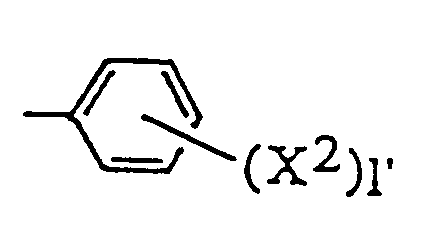
worin R² eine substituierte oder unsubstituierte Phenylgruppe der Formel ist:
worin R³ ein Wasserstoffatom oder eine Alkylgruppe mit 2 - 7 Kohlenstoffatomen ist. - Verbindung mit der Formel, die in Anspruch 1 gezeigt ist, worin R¹ eine Benzylgruppe, die mit einem Halogenatom substituiert sein kann, oder eine substituierte oder unsubstituierte Phenylgruppe der Formel ist:

worin R² ein Wasserstoffatom, eine Alkylgrupe mit 1 bis 10 Kohlenstoffatomen, die mit einer Niedrigalkoxygruppe mit 1 bis 4 Kohlenstoffatomen substituiert sein kann, eine Phenylgruppe, die mit einem Halogenatom substituiert sein kann, eine Pyridylgruppe, die mit einer Niedrigalkoxygruppe mit 1 - 4 Kohlenstoffatomen substituiert sein kann, eine Thienylgruppe, die mit einer Niedrigalkylgrupe mit 1- 4 Kohlenstoffatomen substituiert sein kann, eine Cycloalkylgruppe mit 3 - 6 Kohlenstoffatomen, eine Styrylgruppe oder eine 1,3,5-Trimethylpyrazol-4-yl Gruppe ist;
worin R³ eine Alkylgruppe mit 2 - 10 Kohlenstoffatomen; eine Thienylgruppe, die mit einer Niedrigalkylgruppe mit 1 - 4 Kohlenstoffatomen substituiert sein kann, eine Phenylgruppe, die mit einem Halogenatom substituiert sein kann, eine Cycloalkylgruppe mit 3 - 6 Kohlenstoffatomen, eine Cycloalkenylgruppe mit 6 Kohlenstoffatomen, eine Naphthylgruppe oder eine 3-Thienylmethylgruppe ist;
mit dem Vorbehalt, daß R¹, R² und R³ nicht gleichzeitig eine unsubstituierte oder substituierte Phenylgruppe sind, und daß R² die Alkylgruppe oder die Cycloalkylgurppe ist, wenn R³ die Alkylgruppe ist. - Verbindung nach Anspruch 1, worin zumindest eines von R¹, R² und R³ eine Phenylgruppe ist.
- Verbindung nach Anspruch 6, worin R¹ eine mono-, di- oder tri-substituierte Phenylgruppe ist.
- Verbindung nach Anspruch 7, worin R¹ eine halogen- oder methoxysubstituierte Phenylgruppe ist.
- Verbindung nach Anspruch 6, worin eines von R² und R³ eine Alkylgruppe mit 2 bis 7 Kohlenstoffatomen ist und ein Teil, ausgewählt aus dem Rest von R² und R³ und R¹, eine substituierte Phenylgruppe ist.
- Verbindung nach Anspruch 1, worin zwei von R¹, R² und R³ Phenylgruppen sind.
- Verbindung nach Anspruch 10, worin R¹ eine Phenylgruppe ist, und worin R² und R³ eine Phenylgruppe oder eine substituierte Phenylgruppe ist.
- Fungizide Zusammensetzung für die Landwirtschaft oder den Gartenbau, umfassend eine fungizid wirksame Menge eines Pyridinonderivates, dargestellt durch die allgemeine Formel (I)
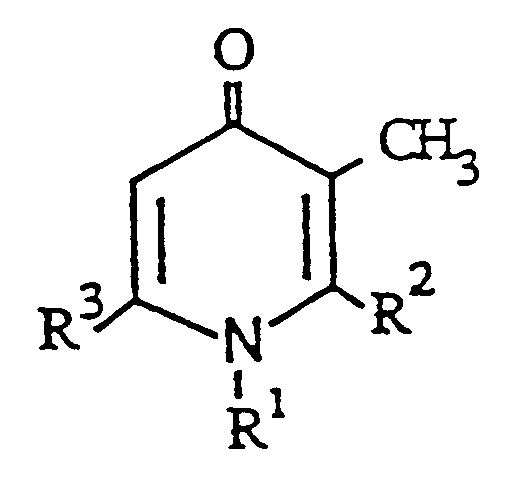
worin R² ein Wasserstoffatom; eine Alkylgruppe mit 1 - 10 Kohlenstoffatomen; eine Cycloalkylgruppe mit 3 bis 6 Kohlenstoffatomen; eine Phenylgruppe, die mit einem Halogenatom substituiert sein kann; eine Naphthylgruppe; eine Pyridylgruppe, die mit einer Niedrigalkoxygruppe mit 1 bis 6 Kohlenstoffatomen substituiert sein kann; eine Thienylgruppe, die mit einer Niedrigalkylgruppe mit 1 bis 6 Kohlenstoffatomen substituiert sein kann; eine Furylgruppe, die mit einer Niedrigalkylgruppe mit 1 bis 4 Kohlenstoffatomen substituiert sein kann; eine Pyridin-1-oxidgruppe; eine 1,3,5-Trimethylpyrazol-4-ylgruppe ist.
worin R³ ein Wasserstoffatom; eine Alkylgruppe mit 2 bis 10 Kohlenstoffatomen; eine Cycloalkylgruppe mit 3 - 6 Kohlenstoffatomen; eine Cycloalkenylgruppe mit 6 Kohlenstoffatomen; eine Phenylgruppe, die mit einem Halogenatom substituiert sein kann; eine Pyridylgruppe, die mit einer Niedrigalkoxygruppe mit 1 - 4 Kohlenstoffatomen oxidiert sein kann; eine Furylgruppe, die mit einer Niedrigalkylgruppe mit 1 - 4 Kohlenstoffatomen substituiert sein kann; eine Naphthylgruppe; eine Thienylgruppe, die mit einer Niedrigalkylgruppe mit 1 - 4 Kohlenstoffatomen substituiert sein kann; oder eine 3-Thienylmethylgruppe ist;
mit dem Vorbehalt, daß R¹, R² und R³ nicht gleichzeitig eine unsubstituierte oder substituierte Phenylgruppe sind;
und einen landwirtschaftlich oder gartenbaulich akzeptablen Träger. - Landwirtschaftlich oder gartenbaulich fungizide Zusammensetzung, umfassend eine fungizid effektive Menge eines Pyridinonderivates mit der in Anspruch 12 gezeigten Formel, worin R¹, R² und R³ Bedeutungen entsprechend einem der Patentansprüche 2 bis 11 haben.
- Verfahren zur Herstellung eines Pyridinonderivates nach einem der Ansprüche 1 bis 11, umfassend die Reaktion einer Pentantrionverbindung, dargestellt durch die allgemeine Formel (II):

R¹-NH₂ (III)
worin R¹ die gleichen Bedeutungen wie oben definiert hat.
Applications Claiming Priority (14)
| Application Number | Priority Date | Filing Date | Title |
|---|---|---|---|
| JP20437587 | 1987-08-18 | ||
| JP204376/87 | 1987-08-18 | ||
| JP62204376A JP2536767B2 (ja) | 1987-08-18 | 1987-08-18 | 4(1h)−ピリジノン誘導体及び農園芸用殺菌剤 |
| JP204375/87 | 1987-08-18 | ||
| JP255735/87 | 1987-10-09 | ||
| JP25573587 | 1987-10-09 | ||
| JP26047387 | 1987-10-15 | ||
| JP260473/87 | 1987-10-15 | ||
| JP19163688A JPH01146868A (ja) | 1987-08-18 | 1988-07-30 | 4(1h)−ピリジノン誘導体及び農園芸用殺菌剤 |
| JP191637/88 | 1988-07-30 | ||
| JP191636/88 | 1988-07-30 | ||
| JP19163788A JPH01207273A (ja) | 1987-10-09 | 1988-07-30 | 4(1h)−ピリジノン誘導体及び農園芸用殺菌剤 |
| JP196316/88 | 1988-08-06 | ||
| JP19631688A JPH01207274A (ja) | 1987-10-15 | 1988-08-06 | 4(1h)−ピリジノン誘導体及び農園芸用殺菌剤 |
Publications (3)
| Publication Number | Publication Date |
|---|---|
| EP0304057A2 EP0304057A2 (de) | 1989-02-22 |
| EP0304057A3 EP0304057A3 (en) | 1989-11-15 |
| EP0304057B1 true EP0304057B1 (de) | 1994-04-20 |
Family
ID=27566445
Family Applications (1)
| Application Number | Title | Priority Date | Filing Date |
|---|---|---|---|
| EP19880113434 Expired - Lifetime EP0304057B1 (de) | 1987-08-18 | 1988-08-18 | Pyridinon-Derivate und diese enthaltende fungizide Zusammenstellungen für die Landwirtschaft und Gartenbau |
Country Status (2)
| Country | Link |
|---|---|
| EP (1) | EP0304057B1 (de) |
| DE (1) | DE3889167T2 (de) |
Cited By (1)
| Publication number | Priority date | Publication date | Assignee | Title |
|---|---|---|---|---|
| TWI793113B (zh) * | 2017-04-10 | 2023-02-21 | 日商三井化學Agro股份有限公司 | 吡啶酮化合物及以吡啶酮化合物作為有效成分的農園藝用殺菌劑 |
Families Citing this family (2)
| Publication number | Priority date | Publication date | Assignee | Title |
|---|---|---|---|---|
| US5403934A (en) * | 1990-03-12 | 1995-04-04 | Burroughs Wellcome Co. | Heterocyclic compounds |
| GB9005518D0 (en) * | 1990-03-12 | 1990-05-09 | Wellcome Found | Heterocyclic compounds |
-
1988
- 1988-08-18 EP EP19880113434 patent/EP0304057B1/de not_active Expired - Lifetime
- 1988-08-18 DE DE19883889167 patent/DE3889167T2/de not_active Expired - Fee Related
Cited By (1)
| Publication number | Priority date | Publication date | Assignee | Title |
|---|---|---|---|---|
| TWI793113B (zh) * | 2017-04-10 | 2023-02-21 | 日商三井化學Agro股份有限公司 | 吡啶酮化合物及以吡啶酮化合物作為有效成分的農園藝用殺菌劑 |
Also Published As
| Publication number | Publication date |
|---|---|
| EP0304057A2 (de) | 1989-02-22 |
| DE3889167T2 (de) | 1994-09-08 |
| DE3889167D1 (de) | 1994-05-26 |
| EP0304057A3 (en) | 1989-11-15 |
Similar Documents
| Publication | Publication Date | Title |
|---|---|---|
| EP0239391B1 (de) | 1,2,6-Triphenyl-4(1H)-pyridinon und Pyridinthionderivate, ihre Herstellung und Verwendungen | |
| US4985432A (en) | 5H-1,3,4-thiadiazolo(3,2-A)pyrimidin-5-one derivatives and agricultural-horticultural fungicide composition containing the same | |
| US4943314A (en) | Pyridine-3-carboxamide derivatives having plant growth inhibiting activity | |
| EP0199281A2 (de) | Pyridazinonderivate, deren Herstellung und insektizide, akarizide, nematizide, fungizide Zusammensetzungen | |
| EP0315502A1 (de) | Substituierte Carbonsäure-Derivate, Verfahren zu ihrer Herstellung und diese enthaltende Fungizide für Acker- und Gartenbau | |
| US5387575A (en) | Pyrimidine derivatives, process for preparing the same and herbicide using the same | |
| US4792565A (en) | Pyrazolecarbonylamine derivatives and agricultural and horticultural fungicides containing said compounds | |
| CA1295335C (en) | Fluorophthalimides | |
| EP0330939A2 (de) | Acrylsäure-morpholide, ihre Herstellung und Verwendung | |
| EP0304057B1 (de) | Pyridinon-Derivate und diese enthaltende fungizide Zusammenstellungen für die Landwirtschaft und Gartenbau | |
| US4496559A (en) | 2-Selenopyridine-N-oxide derivatives and their use as fungicides and bactericides | |
| EP0331529A2 (de) | Diphenyläther-Derivate, Verfahren zu deren Herstellung und diese als wirksamen Stoff enthaltende Insektizide und Acarizide | |
| GB2088872A (en) | 1-benzylimidazole derivatives | |
| EP0278610A2 (de) | Pyridinyl-s-triazin-Derivate, Verfahren zur Herstellung davon und ihre Verwendung als wirksame Bestandteile für ein pilztötendes Mittel | |
| EP0368749B1 (de) | Substituierte Karbonsäuren, ihre Herstellung und Verwendung | |
| JP2536767B2 (ja) | 4(1h)−ピリジノン誘導体及び農園芸用殺菌剤 | |
| JPS59184177A (ja) | 殺菌活性を有するフラン誘導体 | |
| JPH08301846A (ja) | カルバゾール誘導体、その製造方法及びこれを有効成分とする農薬用殺菌剤 | |
| JPH01207273A (ja) | 4(1h)−ピリジノン誘導体及び農園芸用殺菌剤 | |
| US5202329A (en) | Pyrimidinyloxy(thio)quinoline derivative, and agri-horticultural fungicide comprising the derivative as active ingredient | |
| KR900006117B1 (ko) | 1,2,6-트리페닐-4(1h)-피리디논 유도체, 그의 제법 및 용도 | |
| EP0125029A1 (de) | Als Herbizid wirkende Derivate des Tetrahydrobenzothiazols | |
| JPH01207274A (ja) | 4(1h)−ピリジノン誘導体及び農園芸用殺菌剤 | |
| JPS62192353A (ja) | 殺菌活性を有する新規なチオ化合物 | |
| JPH01146868A (ja) | 4(1h)−ピリジノン誘導体及び農園芸用殺菌剤 |
Legal Events
| Date | Code | Title | Description |
|---|---|---|---|
| PUAI | Public reference made under article 153(3) epc to a published international application that has entered the european phase |
Free format text: ORIGINAL CODE: 0009012 |
|
| AK | Designated contracting states |
Kind code of ref document: A2 Designated state(s): BE CH DE FR GB IT LI NL |
|
| PUAL | Search report despatched |
Free format text: ORIGINAL CODE: 0009013 |
|
| AK | Designated contracting states |
Kind code of ref document: A3 Designated state(s): BE CH DE FR GB IT LI NL |
|
| 17P | Request for examination filed |
Effective date: 19900419 |
|
| 17Q | First examination report despatched |
Effective date: 19920312 |
|
| ITTA | It: last paid annual fee | ||
| GRAA | (expected) grant |
Free format text: ORIGINAL CODE: 0009210 |
|
| AK | Designated contracting states |
Kind code of ref document: B1 Designated state(s): BE CH DE FR GB IT LI NL |
|
| PG25 | Lapsed in a contracting state [announced via postgrant information from national office to epo] |
Ref country code: NL Effective date: 19940420 Ref country code: BE Effective date: 19940420 |
|
| ET | Fr: translation filed | ||
| REF | Corresponds to: |
Ref document number: 3889167 Country of ref document: DE Date of ref document: 19940526 |
|
| ITF | It: translation for a ep patent filed | ||
| NLV1 | Nl: lapsed or annulled due to failure to fulfill the requirements of art. 29p and 29m of the patents act | ||
| PLBE | No opposition filed within time limit |
Free format text: ORIGINAL CODE: 0009261 |
|
| STAA | Information on the status of an ep patent application or granted ep patent |
Free format text: STATUS: NO OPPOSITION FILED WITHIN TIME LIMIT |
|
| 26N | No opposition filed | ||
| PGFP | Annual fee paid to national office [announced via postgrant information from national office to epo] |
Ref country code: GB Payment date: 19950719 Year of fee payment: 8 |
|
| PGFP | Annual fee paid to national office [announced via postgrant information from national office to epo] |
Ref country code: FR Payment date: 19950720 Year of fee payment: 8 |
|
| PGFP | Annual fee paid to national office [announced via postgrant information from national office to epo] |
Ref country code: CH Payment date: 19950815 Year of fee payment: 8 |
|
| PGFP | Annual fee paid to national office [announced via postgrant information from national office to epo] |
Ref country code: DE Payment date: 19950821 Year of fee payment: 8 |
|
| PG25 | Lapsed in a contracting state [announced via postgrant information from national office to epo] |
Ref country code: GB Effective date: 19960818 |
|
| PG25 | Lapsed in a contracting state [announced via postgrant information from national office to epo] |
Ref country code: LI Effective date: 19960831 Ref country code: CH Effective date: 19960831 |
|
| GBPC | Gb: european patent ceased through non-payment of renewal fee |
Effective date: 19960818 |
|
| REG | Reference to a national code |
Ref country code: CH Ref legal event code: PL |
|
| PG25 | Lapsed in a contracting state [announced via postgrant information from national office to epo] |
Ref country code: FR Effective date: 19970430 |
|
| PG25 | Lapsed in a contracting state [announced via postgrant information from national office to epo] |
Ref country code: DE Effective date: 19970501 |
|
| REG | Reference to a national code |
Ref country code: FR Ref legal event code: ST |
|
| PG25 | Lapsed in a contracting state [announced via postgrant information from national office to epo] |
Ref country code: IT Free format text: LAPSE BECAUSE OF NON-PAYMENT OF DUE FEES;WARNING: LAPSES OF ITALIAN PATENTS WITH EFFECTIVE DATE BEFORE 2007 MAY HAVE OCCURRED AT ANY TIME BEFORE 2007. THE CORRECT EFFECTIVE DATE MAY BE DIFFERENT FROM THE ONE RECORDED. Effective date: 20050818 |