EP0301278B1 - A particle-dispersing agent - Google Patents
A particle-dispersing agent Download PDFInfo
- Publication number
- EP0301278B1 EP0301278B1 EP88110705A EP88110705A EP0301278B1 EP 0301278 B1 EP0301278 B1 EP 0301278B1 EP 88110705 A EP88110705 A EP 88110705A EP 88110705 A EP88110705 A EP 88110705A EP 0301278 B1 EP0301278 B1 EP 0301278B1
- Authority
- EP
- European Patent Office
- Prior art keywords
- degradation
- grain protein
- minutes
- acid
- prepared
- Prior art date
- Legal status (The legal status is an assumption and is not a legal conclusion. Google has not performed a legal analysis and makes no representation as to the accuracy of the status listed.)
- Expired - Lifetime
Links
Classifications
-
- A—HUMAN NECESSITIES
- A23—FOODS OR FOODSTUFFS; TREATMENT THEREOF, NOT COVERED BY OTHER CLASSES
- A23C—DAIRY PRODUCTS, e.g. MILK, BUTTER OR CHEESE; MILK OR CHEESE SUBSTITUTES; PREPARATION THEREOF
- A23C20/00—Cheese substitutes
- A23C20/02—Cheese substitutes containing neither milk components, nor caseinate, nor lactose, as sources of fats, proteins or carbohydrates
- A23C20/025—Cheese substitutes containing neither milk components, nor caseinate, nor lactose, as sources of fats, proteins or carbohydrates mainly containing proteins from pulses or oilseeds
-
- C—CHEMISTRY; METALLURGY
- C09—DYES; PAINTS; POLISHES; NATURAL RESINS; ADHESIVES; COMPOSITIONS NOT OTHERWISE PROVIDED FOR; APPLICATIONS OF MATERIALS NOT OTHERWISE PROVIDED FOR
- C09K—MATERIALS FOR MISCELLANEOUS APPLICATIONS, NOT PROVIDED FOR ELSEWHERE
- C09K23/00—Use of substances as emulsifying, wetting, dispersing, or foam-producing agents
-
- A—HUMAN NECESSITIES
- A61—MEDICAL OR VETERINARY SCIENCE; HYGIENE
- A61K—PREPARATIONS FOR MEDICAL, DENTAL OR TOILETRY PURPOSES
- A61K8/00—Cosmetics or similar toiletry preparations
- A61K8/02—Cosmetics or similar toiletry preparations characterised by special physical form
- A61K8/04—Dispersions; Emulsions
- A61K8/044—Suspensions
-
- A—HUMAN NECESSITIES
- A23—FOODS OR FOODSTUFFS; TREATMENT THEREOF, NOT COVERED BY OTHER CLASSES
- A23D—EDIBLE OILS OR FATS, e.g. MARGARINES, SHORTENINGS OR COOKING OILS
- A23D7/00—Edible oil or fat compositions containing an aqueous phase, e.g. margarines
- A23D7/005—Edible oil or fat compositions containing an aqueous phase, e.g. margarines characterised by ingredients other than fatty acid triglycerides
- A23D7/0053—Compositions other than spreads
-
- A—HUMAN NECESSITIES
- A23—FOODS OR FOODSTUFFS; TREATMENT THEREOF, NOT COVERED BY OTHER CLASSES
- A23D—EDIBLE OILS OR FATS, e.g. MARGARINES, SHORTENINGS OR COOKING OILS
- A23D7/00—Edible oil or fat compositions containing an aqueous phase, e.g. margarines
- A23D7/005—Edible oil or fat compositions containing an aqueous phase, e.g. margarines characterised by ingredients other than fatty acid triglycerides
- A23D7/0056—Spread compositions
-
- A—HUMAN NECESSITIES
- A23—FOODS OR FOODSTUFFS; TREATMENT THEREOF, NOT COVERED BY OTHER CLASSES
- A23J—PROTEIN COMPOSITIONS FOR FOODSTUFFS; WORKING-UP PROTEINS FOR FOODSTUFFS; PHOSPHATIDE COMPOSITIONS FOR FOODSTUFFS
- A23J3/00—Working-up of proteins for foodstuffs
- A23J3/30—Working-up of proteins for foodstuffs by hydrolysis
- A23J3/32—Working-up of proteins for foodstuffs by hydrolysis using chemical agents
- A23J3/34—Working-up of proteins for foodstuffs by hydrolysis using chemical agents using enzymes
- A23J3/346—Working-up of proteins for foodstuffs by hydrolysis using chemical agents using enzymes of vegetable proteins
-
- A—HUMAN NECESSITIES
- A23—FOODS OR FOODSTUFFS; TREATMENT THEREOF, NOT COVERED BY OTHER CLASSES
- A23L—FOODS, FOODSTUFFS OR NON-ALCOHOLIC BEVERAGES, NOT OTHERWISE PROVIDED FOR; PREPARATION OR TREATMENT THEREOF
- A23L11/00—Pulses, i.e. fruits of leguminous plants, for production of food; Products from legumes; Preparation or treatment thereof
- A23L11/40—Pulse curds
- A23L11/45—Soy bean curds, e.g. tofu
-
- A—HUMAN NECESSITIES
- A23—FOODS OR FOODSTUFFS; TREATMENT THEREOF, NOT COVERED BY OTHER CLASSES
- A23L—FOODS, FOODSTUFFS OR NON-ALCOHOLIC BEVERAGES, NOT OTHERWISE PROVIDED FOR; PREPARATION OR TREATMENT THEREOF
- A23L33/00—Modifying nutritive qualities of foods; Dietetic products; Preparation or treatment thereof
- A23L33/10—Modifying nutritive qualities of foods; Dietetic products; Preparation or treatment thereof using additives
- A23L33/17—Amino acids, peptides or proteins
- A23L33/18—Peptides; Protein hydrolysates
-
- A—HUMAN NECESSITIES
- A61—MEDICAL OR VETERINARY SCIENCE; HYGIENE
- A61K—PREPARATIONS FOR MEDICAL, DENTAL OR TOILETRY PURPOSES
- A61K8/00—Cosmetics or similar toiletry preparations
- A61K8/18—Cosmetics or similar toiletry preparations characterised by the composition
- A61K8/30—Cosmetics or similar toiletry preparations characterised by the composition containing organic compounds
- A61K8/64—Proteins; Peptides; Derivatives or degradation products thereof
- A61K8/645—Proteins of vegetable origin; Derivatives or degradation products thereof
-
- A—HUMAN NECESSITIES
- A61—MEDICAL OR VETERINARY SCIENCE; HYGIENE
- A61Q—SPECIFIC USE OF COSMETICS OR SIMILAR TOILETRY PREPARATIONS
- A61Q19/00—Preparations for care of the skin
-
- C—CHEMISTRY; METALLURGY
- C09—DYES; PAINTS; POLISHES; NATURAL RESINS; ADHESIVES; COMPOSITIONS NOT OTHERWISE PROVIDED FOR; APPLICATIONS OF MATERIALS NOT OTHERWISE PROVIDED FOR
- C09K—MATERIALS FOR MISCELLANEOUS APPLICATIONS, NOT PROVIDED FOR ELSEWHERE
- C09K23/00—Use of substances as emulsifying, wetting, dispersing, or foam-producing agents
- C09K23/16—Amines or polyamines
-
- C—CHEMISTRY; METALLURGY
- C09—DYES; PAINTS; POLISHES; NATURAL RESINS; ADHESIVES; COMPOSITIONS NOT OTHERWISE PROVIDED FOR; APPLICATIONS OF MATERIALS NOT OTHERWISE PROVIDED FOR
- C09K—MATERIALS FOR MISCELLANEOUS APPLICATIONS, NOT PROVIDED FOR ELSEWHERE
- C09K23/00—Use of substances as emulsifying, wetting, dispersing, or foam-producing agents
- C09K23/30—Proteins; Protein hydrolysates
-
- A—HUMAN NECESSITIES
- A23—FOODS OR FOODSTUFFS; TREATMENT THEREOF, NOT COVERED BY OTHER CLASSES
- A23V—INDEXING SCHEME RELATING TO FOODS, FOODSTUFFS OR NON-ALCOHOLIC BEVERAGES AND LACTIC OR PROPIONIC ACID BACTERIA USED IN FOODSTUFFS OR FOOD PREPARATION
- A23V2002/00—Food compositions, function of food ingredients or processes for food or foodstuffs
Definitions
- the present invention relates to the use of a protein partial degradation product. More particularly, the invention relates to the use of a protein partial degradation product useful for reducing viscosity of an aqueous dispersion wherein various water-insoluble or sparingly soluble, inorganic and/or organic particles are suspended, accelerating suspension and dispersion of the various particles, and preventing sedimentation of the suspended particles.
- Aqueous dispersions wherein various organic and/or inorganic particles are suspended in aqueous medium are used for various purposes.
- the organic and/or inorganic particles, the subjects to be dispersed are, for example, those organic particles for food stuffs, such as cocoa powder, fruit pulp, solid matters of miso (bean paste), solid matters of soup, etc., as well as those inorganic particles such as calcium carbonate, sachin white, talc, red oxide, magnesium hydroxide, zinc white, barium sulfate, kaolin, clay, etc.
- paint & varnish As actual embodiments of the aqueous dispersions, there can be mentioned paint & varnish; fillers; neutralizing agents for desulfurization of exhausted smoke; material dispersions for ceramics; various food stuffs such as juice, chocolate milk, chocolate syrup, cocoa, miso soup, soup, zenzai (thick red bean-meal soup with sugar), shiruko (red-bean soup with sugar), etc; cosmetics such as pigment-containing foundation, milky lotion, etc.; pharmaceutical medicines such as emulsion, suspension, contrast medium, etc.; quasi-drug such as toothpaste, etc.; and the like.
- various food stuffs such as juice, chocolate milk, chocolate syrup, cocoa, miso soup, soup, zenzai (thick red bean-meal soup with sugar), shiruko (red-bean soup with sugar), etc
- cosmetics such as pigment-containing foundation, milky lotion, etc.
- pharmaceutical medicines such as emulsion, suspension, contrast medium, etc.
- quasi-drug such as toothpaste,
- Such various aqueous dispersions may be in the form of liquid or slurry, depending on the property and amount of the suspended particles.
- the aqueous dispersions become, in many cases, a slurry having a high viscosity, which is difficult to handle on use, transportation, storage, etc. Further, in some cases, the state of suspension of the particles is unstable and the particles gradually precipitate and finally separate.
- miso soup, shiruko, zenai, cocoa, soup, etc. are frequently sold in the form of dry powder, i.e., the so-called instant food stuffs, because of the preservability and the easiness of handling.
- instant food stuffs there has been a problem of dispersibility of the powder or the contents in these food stuffs.
- dispersibility of the powder or the contents in these food stuffs For example, by merely pouring hot water to an instant miso soup, there arose an inconvenience that the suspended miso particles precipitated within a shorter time compared with the case using raw miso.
- sucrose/fatty acid esters, sorbitan/fatty acid esters, or the like to instant food stuffs (Japanese Patent Publications No. Sho 46-28157 and No. Sho 45-29423, Japanese Unexamined Patent Publication No. Sho 53-66473, etc.).
- the flowable preparation (aqueous suspension) prepared caused aggregation and/or separation of the active ingredient particles or, when such preparation or a wettable preparation was diluted with water, the active ingredient particles and the carrier precipitated. Therefore, nonionic, anionic, cationic or other surface active agents and viscosity-increasing agents such as CMC (carboxymethylcellulose), PVA (polyvinyl alcohol), etc., have been hitherto used.
- US-A-3 889 001 discloses partially hydrolysed grain.
- proteins such as soy protein or sesame protein, having an average molecular weight of 300 to 15000.
- Hydrolisation can be effected by any known protein hydrolysing procedure suitable to reduce the molecular size of the protein accordingly. Treatment with an edible bacterial proteinase is, however, preferred. Hydrolysation is effected in an aqueous solution of an enzyme having proteinase activity at a temperature of 25°C - 60°C for a period of 2 minutes to 7 hours (420 minutes).
- emulsifiers such as fatty acid esters of polyhydric alcohols or lecithin are added.
- GB-A-1 231 652 discloses a process of preparing aerating proteins which comprises chemically hydrolyzing oil-free vegetable protein to give a first hydrolyzed protein having a predetermined degradation as hereinbefore defined, and then further hydrolyzing said first hydrolyzed protein with pepsin to obtain a second hydrolyzed protein which in the presence of water and sugar whips at a rapid rate to produce aerated products of low density.
- the present invention intends to provide a novel use of a grain partial degradation product for dispersing solid, water-insoluble or sparingly water-soluble particles in an aqueous medium.
- Particle-dispersing agents comprising, for example, the above-mentioned polymers of polyphosphoric acid series, polyacrylic acid series or other series or the widely used surface active agents cannot be said completely harmless against human bodies, animals and plants, and accordingly there is a limitation in their application to aqueous dispersions used for food stuffs, cosmetics, agricultural chemicals and pharmaceutical medicines.
- the above-mentioned sucrose/fatty acid esters, etc. have been used as a dispersing agent for not only food stuffs but also cosmetics, pharmaceutical medicines, etc.
- the purpose of the present invention resides in providing a particle-dispersing agent which is quite safe and harmless, even when it were taken in human body, which does not cause any environmental pollution or any damage on plants because of its good susceptibility for biolysis, even when it flowed into a river or the like, and which has yet an excellent particle-dispersing effect.
- the present invention provides the use of a grain protein partial degradation product prepared by
- the protein partial degradation products used in the present invention are suitably those having a weight average molecular weight Mw of 500 - 110000 as determined according to the Gel filtration method, and those having a Mw of 700 - 90000 are preferred in view of the particle-dispersing effect.
- Mw of 500 protein partial degradation products consist substantially of amino acids and oligomers thereof and accordingly are not suitable because of their low particle-dispersing effect.
- Mw of more than 110000 protein partial degradation products approach the undegraded protein in their properties and accordingly are not suitable because of their low particle-dispersing effect.
- the molecular weights here are determined according to the Gel filtration method using sodium polystyrenesulfonates having a molecular weight of 1600, 6500, 16000, 65000 or 88000, as the standard substance, and Sephadex G-75 or G-100 (from Pharmacia Ltd.) as the carrier.
- the term "grain protein” means a protein contained in grain, and the “grain” here means the seed of wheat and barley, corns (for example, maize), beans (for example, soya beans) and the like.
- wheat protein contains glutenin and gliadin as the main components and is usually called wheat gluten
- maize protein contains zein as the main component and is usually called maize gluten. They each are a known substances which can be obtained from the corresponding grain by separation and extraction according to the usual manner.
- wheat protein For example, to obtain wheat protein (wheat gluten), wheat flour is kneaded stiffly by adding a small amount of water and then kneaded in a large amount of water whereby starch is suspended in water and the gluten-containing portion remains as a sticky lump. By repeating this operation several times while replacing the water with new one, wheat protein is obtained as a grayish brown sticky lump.
- wheat gluten is commercially available in the form of dry powder. Other commercially available maize gluten, soya bean protein, etc., may also be used in convenience.
- proteins may be used in the form of either crude products or purified products. However, it is preferable to use a product containing the protein in an amount of 70% or more.
- the partial degradation products used according to the present invention can be prepared by subjecting the above-mentioned grain protein to a degradation treatment with alkali, acid, proteinase, reducing agent or oxidizing agent.
- the above degradation treatment with alkali is suitably effected by heating the subject in a dilute aqueous alkaline solution.
- it is suitable to heat an aqueous solution or dispersion of the subject to be degraded at ca. 60 - 180°C for ca. 10 - 600 minutes while stirring in the presence of an alkaline agent such as sodium hydroxide, potassium hydroxide, calcium hydroxide, sodium carbonate, potassium carbonate, etc.
- an alkaline agent such as sodium hydroxide, potassium hydroxide, calcium hydroxide, sodium carbonate, potassium carbonate, etc.
- an alkaline agent such as sodium hydroxide, potassium hydroxide, calcium hydroxide, sodium carbonate, potassium carbonate, etc.
- the amount of an alkaline agent used is preferably 0.1 - 6g per 20g of the subject to be degraded.
- the degradation treatment with acid is suitably effected by heating the subject in a dilute aqueous acid solution.
- a dilute aqueous acid solution usually, it is suitable to heat an aqueous solution or dispersion of the subject to be degraded at ca. 60 - 120°C for ca. 10 - 600 minutes while stirring in the presence of an inorganic acid such as hydrochloric acid, sulfuric acid, etc., or an organic acid such as acetic acid, etc.
- the quantitative conditions here are preferably the same as those mentioned above for the alkaline hydrolysis.
- the degradation treatment with proteinase is suitably effected in a dilute aqueous solution of an enzyme having protease activity. Usually, it is effected by keeping an aqueous solution or dispersion of the subject to be degraded at ca. 10 - 60°C for ca. 60 - 600 minutes in the presence of a small amount of an enzyme such as pepsin, alkali protease, papain, etc., under the optimal pH condition for the enzyme.
- the quantitative conditions here are preferably the same as those described above, except that 0.02 - 5g of the enzyme is used per 20g of the subject to be degraded.
- the degradation treatment with reducing agent or oxidizing agent is suitably effected in a dilute aqueous solution of the reducing agent or the oxidizing agent.
- it is effected by keeping an aqueous solution or dispersion of the subject to be degraded at ca. 10 - 100°C for 10 - 600 minutes in the presence of a small amount of a reducing agent such as a sulfite, a thiol compound, erysorbic acid, hydrazine, etc., or an oxidizing agent such as hydrogen peroxide, a hypochlorite, etc.
- the quantitative conditions here are preferably the same as those described above, except that 0.1 - 5g of the reducing agent or the oxidizing agent is used per 20g of the subject to be degraded.
- a partial degradation product obtained by a single degradation with either one of the above-mentioned alkali, acid, proteinase, reducing agent and oxidizing agent but also a partial degradation product obtained by a combination of two kinds of degradations each with the above-mentioned acid, proteinase, reducing agent or oxidizing agent, can be used.
- the combination of two kinds of degradations is shown concretely by Examples given hereinafter.
- the solution containing a grain protein partial degradation product thus obtained can be used as it is, for dispersing solid, water-insoluble or sparingly water-soluble particles, it is also possible to use the grain protein partial degradation product in the form of powder which is obtained by drying the solution.
- the amount of addition may vary depending on the kind, concentration, purpose, etc., of the aqueous dispersion to which it is applied. However, it is usually preferred to add the protein partial degradation product in an amount of 0.02 - 20% (by weight) per suspended particles, in view of the dispersion stability.
- the protein partial degradation product to powdery food stuffs such as cocoa, instant miso soup, instant soup, instant zenzai, instant shiruko, etc., to accelerate dispersion of the contents of the powdery food stuffs into water and prevent sedimentation of the suspended particles (solid matters) for a long time.
- the protein partial degradation product prevents aggregation and/or separation of the active ingredient particles in flowable preparations for a long time, as it is used on preparing the preparations, and accelerates dispersion of the active ingredient particles and the carrier into water and prevents sedimentation of the particles for a long time, as the preparations mentioned above or wettable preparations containing it are diluted with water.
- the protein partial degradation product is useful, because of its non-toxic, odorless and tasteless properties, not only as a particle-dispersing agent for reducing viscosity or a particle-dispersing agent for stabilizing suspension in the fields of various food stuffs containing the above-described powdery food stuffs, cosmetics, pharmaceutical medicines, etc., but also as a dispersing agent for agricultural chemicals, a particle-dispersing agent for concrete or cement, or a dispersing agent for the materials or the pigments in the fields of paper & pulp industry, paint industry, ceramic industry, etc.
- various other additives for example, surface active agents, preservatives, other dispersing agents, etc.
- surface active agents for example, surface active agents, preservatives, other dispersing agents, etc.
- other kinds of dispersing agents and viscosity-increasing agents such as gum arabic, pectin, CMC, gum xanthenic, alginic acid, other polysaccharides, etc.
- other synthetic high molecular compounds such as polyacrylic acid, polyvinyl alcohol, etc., and various conventionally used surface active agents may also be used in the particle-dispersing agent of the present invention.
- the grain protein partial degradation product is used for various food stuffs or for agricultural chemicals, it is a preferable embodiment to use a polyhydric alcohol/fatty acid ester type surface active agent such as a sucrose/fatty acid ester and a glycerol/fatty acid ester, and/or lecithin, in combination with the protein partial degradation product.
- a polyhydric alcohol/fatty acid ester type surface active agent such as a sucrose/fatty acid ester and a glycerol/fatty acid ester, and/or lecithin
- the protein partial degradation product and the surface active agent in a ratio of 6:1 - 1:6 (by weight), preferably 4:1 - 1:4, which gives a synergetic dispersing effect.
- preservatives such as ethanol, propionic acid, lactic acid, sorbic acid, dehydroacetic acid, butyl p-hydroxybenzoate, sodium chloride, etc.
- preservatives such as ethanol, propionic acid, lactic acid, sorbic acid, dehydroacetic acid, butyl p-hydroxybenzoate, sodium chloride, etc.
- Test samples 8 to 10 of the present invention Twenty grams of the same wheat gluten as used in Example 1 were added to each of flasks containing 100g of hydrochloric acid equivalent to 1g, 2g or 4g of hydrogen chloride. Each of the mixtures was heated to 100°C for 60 minutes under stirring, neutralized by sodium hydroxide and diluted with pure water into a total weight of 200g to obtain Test samples 8 to 10 of the present invention.
- Example 11 (Preparation of a partial degradation product of wheat gluten by treatment with enzyme)
- Test sample 11 of the present invention having an average molecular weight of 60,000.
- Test sample 12 of the present invention having an average molecular weight of 79,000.
- Example 13 Preparation of a partial degradation product of wheat gluten by treatment with oxidizing agent
- Test sample 13 of the present invention having an average molecular weight of 67,000.
- Example 14 (Preparation of a partial degradation product of maize gluten by treatment with alkali)
- Maize gluten (from Nihon Shokuhin Kako Co., Ltd., JAPAN) as the starting material was put into the same partial degradation treatment with alkali as that employed in Example 5, whereby Test sample 14 of the present invention having an average molecular weight of 25,600 was obtained.
- Example 15 (Preparation of a partial degradation product of soya bean protein by treatment with alkali)
- Example 16 (Preparation of a partial degradation product of wheat gluten treated with acid, followed with reducing agent)
- Test sample 16 having an average molecular weight of 53,000.
- Example 17 (Preparation of a partial degradation product of wheat gluten treated with acid, followed with enzyme)
- a reagent of hydrochloric acid was added to 100g of a 10% aqueous solution of a partial degradation product of wheat gluten obtained by treatment with acid under the same condition as in Example 8 to obtain an aqueous solution of pH 1.5.
- 0.1g of pepsin was added to the solution.
- the mixture was warmed at 37°C for 90 minutes, neutralized by sodium hydroxide and diluted with pure water into a total weight of 200g to obtain Test sample 17 of the present invention having an average molecular weight of 46,000.
- Example 18 (Preparation of a partial degradation product of wheat gluten treated with reducing agent followed with enzyme)
- a reagent of hydrochloric acid was added to 100g of a 10% aqueous solution of a partial degradation product of wheat gluten obtained by treatment with reducing agent under the same condition as in Example 12 to obtain an aqueous solution of pH 1.5.
- 0.1g of pepsin was added to the solution.
- the mixture was warmed at 37°C for 90 minutes , neutralized by sodium hydroxide and diluted with pure water into a total weight of 200g to obtain Test sample 18 of the present invention having an average molecular weight of 35,000.
- Tests were carried out on Test samples and Comparative test samples of the present invention.
- Test 1 (Test of the property which decreases viscosity of calcium carbonate slurry)
- a total weight 260g of a Test sample of the present invention and city water was put into the National M1 type mixer and 250g of calcium carbonate (light calcium carbonate from Takehara Kagaku Kogyo Co., Ltd., JAPAN) were added. The mixture was mixed for 2 minutes to obtain a 50% by weight slurry.
- calcium carbonate light calcium carbonate from Takehara Kagaku Kogyo Co., Ltd., JAPAN
- the slurry was transferred in a beaker and determined its viscosity using the DVH-B type viscometer from TOKYO KEIKI CO., LTD., JAPAN.
- Test 2 (Test of the property which decreases viscosity of kaolin slurry)
- a total weight 200g of a Test sample and city water was put into the National M1 type mixer and 300g of kaolin in the form of powder (from Tsuchiya Kaolin Kogyo Co., Ltd., JAPAN) were added. The resultant was mixed for 2 minutes to obtain a 50% by weight slurry.
- the slurry was transferred in a beaker and determined its viscosity using the DVH-B type viscometer from TOKYO KEIKI CO., LTD., JAPAN.
- the test results are shown in Table 3.
- the symbols of W, C and B shown in Table 3 mean wheat gluten, maize gluten and soya bean protein, respectively and the blanks in Table 3 mean "not measured” or "not tested”.
- Test samples of the present invention produce an excellent particle dispersing effect.
- a commercially available instant miso powder (“Asage” from Kabushiki Kaisha Nagatanien Honpo, JAPAN) was first removed its dried additives such as dried vegetables. To 10g of the resultant was added a predetermined amount of a Test sample of the present invention. The mixture was fully mixed and put in a 200 ml measuring cylinder. 180 ml of boiled water were added under stirring and left to stand. After standing for 15 minutes the appearance and the settling state of the above mixture were observed.
- Test samples were used in this test after they were filtered by using a filter (trade name: Ultrafilter O 0010 076 E from Advantec Toyo Co., Ltd., JAPAN) to remove substance having a molecular weight smaller than 1,000 and then spray-dried using the Yamato Model GB-21 spray-dryer.
- a filter trade name: Ultrafilter O 0010 076 E from Advantec Toyo Co., Ltd., JAPAN
- Comparative test samples used in this test are the same ones as used in Tests 1 and 2.
- Test samples of the present invention have an excellent effect to the dispersibility of the instant miso powder and further a combination use of Test sample of the present invention and sucrose fatty acid ester or soya bean lecithin not only has an excellent effect to the same but also shows a synergistic effect.
- Test sample was added to 5g of a commercially available cocoa powder (Van Houten cocoa containing 22 to 24% of cocoa butter). The mixture was fully mixed and poured into a 100 ml graduated cylinder containing 95g of cold water at 5°C. The cylinder was turned upside down 20 times and then left at room temperature for 10 minutes. The floating portion of the added cocoa was removed and its weight was measured. The dispersibility of cocoa was expressed by the value of the percentage of the cocoa dispersing in water, which can be calculated from the weight values of the added cocoa and its floating portion. The results are shown in Table 5.
- Test samples of the present invention are excellent as dispersing agents improving the dispersibility of cocoa and further a combination use of Test sample and palmitic acid monoglyceride synergistically improves the dispersibility of cocoa.
- test sample or a Comparative test sample was dispersed or dissolved in city water. The resultant was put into a ball mill and Tsumacide (m-tolylmethylcarbamate) of a solid insecticide, DCPA (3′,4′-dichloropropionanilide) of a solid herbicide or MBTC (methylene bisthiocyanate) of a solid bactericide was added. Glass beads of 1mm diameter were put into the ball mill and the mixture was water-ground for 8 hours to obtain the preparations 1 to 17. Comparative test samples 1 and 2 are the same ones as used in Tests 1 and 2.
- the settling rate is calculated using the following formula.
- Test samples of the present invention used are the ones desalted and dried as in Test 3.
Landscapes
- Life Sciences & Earth Sciences (AREA)
- Chemical & Material Sciences (AREA)
- Engineering & Computer Science (AREA)
- Health & Medical Sciences (AREA)
- Food Science & Technology (AREA)
- Polymers & Plastics (AREA)
- Organic Chemistry (AREA)
- Materials Engineering (AREA)
- Nutrition Science (AREA)
- Molecular Biology (AREA)
- Animal Behavior & Ethology (AREA)
- Veterinary Medicine (AREA)
- Public Health (AREA)
- Botany (AREA)
- General Health & Medical Sciences (AREA)
- Agronomy & Crop Science (AREA)
- Oil, Petroleum & Natural Gas (AREA)
- Birds (AREA)
- Epidemiology (AREA)
- Biochemistry (AREA)
- Chemical Kinetics & Catalysis (AREA)
- Dispersion Chemistry (AREA)
- Mycology (AREA)
- Dermatology (AREA)
- Proteomics, Peptides & Aminoacids (AREA)
- General Chemical & Material Sciences (AREA)
- Agricultural Chemicals And Associated Chemicals (AREA)
- Emulsifying, Dispersing, Foam-Producing Or Wetting Agents (AREA)
- Compounds Of Alkaline-Earth Elements, Aluminum Or Rare-Earth Metals (AREA)
- Medicinal Preparation (AREA)
- Cosmetics (AREA)
- General Preparation And Processing Of Foods (AREA)
- Silicates, Zeolites, And Molecular Sieves (AREA)
- Compositions Of Macromolecular Compounds (AREA)
Description
- The present invention relates to the use of a protein partial degradation product. More particularly, the invention relates to the use of a protein partial degradation product useful for reducing viscosity of an aqueous dispersion wherein various water-insoluble or sparingly soluble, inorganic and/or organic particles are suspended, accelerating suspension and dispersion of the various particles, and preventing sedimentation of the suspended particles.
- Aqueous dispersions wherein various organic and/or inorganic particles are suspended in aqueous medium are used for various purposes. The organic and/or inorganic particles, the subjects to be dispersed, are, for example, those organic particles for food stuffs, such as cocoa powder, fruit pulp, solid matters of miso (bean paste), solid matters of soup, etc., as well as those inorganic particles such as calcium carbonate, sachin white, talc, red oxide, magnesium hydroxide, zinc white, barium sulfate, kaolin, clay, etc. As actual embodiments of the aqueous dispersions, there can be mentioned paint & varnish; fillers; neutralizing agents for desulfurization of exhausted smoke; material dispersions for ceramics; various food stuffs such as juice, chocolate milk, chocolate syrup, cocoa, miso soup, soup, zenzai (thick red bean-meal soup with sugar), shiruko (red-bean soup with sugar), etc; cosmetics such as pigment-containing foundation, milky lotion, etc.; pharmaceutical medicines such as emulsion, suspension, contrast medium, etc.; quasi-drug such as toothpaste, etc.; and the like.
- Such various aqueous dispersions may be in the form of liquid or slurry, depending on the property and amount of the suspended particles. When the particle-concentration is high, the aqueous dispersions become, in many cases, a slurry having a high viscosity, which is difficult to handle on use, transportation, storage, etc. Further, in some cases, the state of suspension of the particles is unstable and the particles gradually precipitate and finally separate.
- Therefore, with the purpose of reducing the viscosity of the aqueous dispersions in slurry state and maintaining stability of the suspension of particles, a method of adding polyphosphates, polymers or copolymers of acrylic or methacrylic acid series, or their salts to such dispersions has been hitherto effected, and these additives are in general called the particle-dispersing agent. It has also been proposed recently to use maleic acid (or fumaric acid)/acrylic acid (or methacrylic acid) copolymers and acrylic acid (or methacrylic acid) copolymers, as the particle-dispersing agent for inorganic pigments dispersions (Japanese Unexamined Patent Publication No. Sho 61-81464).
- On the other hand, in the field of food stuffs, miso soup, shiruko, zenai, cocoa, soup, etc., are frequently sold in the form of dry powder, i.e., the so-called instant food stuffs, because of the preservability and the easiness of handling. However, there has been a problem of dispersibility of the powder or the contents in these food stuffs. For example, by merely pouring hot water to an instant miso soup, there arose an inconvenience that the suspended miso particles precipitated within a shorter time compared with the case using raw miso. Also with respect to other instant food stuffs, it was difficult to disperse the contents with water or chilled water within a short time.
- To dissolve such inconvenience or difficulty, it has been proposed to add sucrose/fatty acid esters, sorbitan/fatty acid esters, or the like to instant food stuffs (Japanese Patent Publications No. Sho 46-28157 and No. Sho 45-29423, Japanese Unexamined Patent Publication No. Sho 53-66473, etc.).
- Also in the field of agricultural chemicals, there has been an inconvenience that, when the active ingredient was a solid sparingly soluble in water, the flowable preparation (aqueous suspension) prepared caused aggregation and/or separation of the active ingredient particles or, when such preparation or a wettable preparation was diluted with water, the active ingredient particles and the carrier precipitated. Therefore, nonionic, anionic, cationic or other surface active agents and viscosity-increasing agents such as CMC (carboxymethylcellulose), PVA (polyvinyl alcohol), etc., have been hitherto used.
- US-A-3 889 001 discloses partially hydrolysed grain. proteins, such as soy protein or sesame protein, having an average molecular weight of 300 to 15000. Hydrolisation can be effected by any known protein hydrolysing procedure suitable to reduce the molecular size of the protein accordingly. Treatment with an edible bacterial proteinase is, however, preferred. Hydrolysation is effected in an aqueous solution of an enzyme having proteinase activity at a temperature of 25°C - 60°C for a period of 2 minutes to 7 hours (420 minutes). Furthermore, emulsifiers such as fatty acid esters of polyhydric alcohols or lecithin are added.
- GB-A-1 231 652 discloses a process of preparing aerating proteins which comprises chemically hydrolyzing oil-free vegetable protein to give a first hydrolyzed protein having a predetermined degradation as hereinbefore defined, and then further hydrolyzing said first hydrolyzed protein with pepsin to obtain a second hydrolyzed protein which in the presence of water and sugar whips at a rapid rate to produce aerated products of low density.
- The present invention intends to provide a novel use of a grain partial degradation product for dispersing solid, water-insoluble or sparingly water-soluble particles in an aqueous medium.
- Particle-dispersing agents comprising, for example, the above-mentioned polymers of polyphosphoric acid series, polyacrylic acid series or other series or the widely used surface active agents cannot be said completely harmless against human bodies, animals and plants, and accordingly there is a limitation in their application to aqueous dispersions used for food stuffs, cosmetics, agricultural chemicals and pharmaceutical medicines. On the other hand, the above-mentioned sucrose/fatty acid esters, etc., have been used as a dispersing agent for not only food stuffs but also cosmetics, pharmaceutical medicines, etc. However, there has been a problem that their particle-dispersing effect was insufficient and, in addition, they were economically disadvantageous.
- The purpose of the present invention resides in providing a particle-dispersing agent which is quite safe and harmless, even when it were taken in human body, which does not cause any environmental pollution or any damage on plants because of its good susceptibility for biolysis, even when it flowed into a river or the like, and which has yet an excellent particle-dispersing effect.
- Various reports have been hitherto made as to the properties of grain protein partial degradation products, especially of hydrolyzates by acid or enzyme. However, any description on their particle-dispersing action is not given in the reports, as far as we know. For example, it is described in Japanese Unexamined Patent Publication No. Sho 50-95443 that the slightly acidic gluten powder obtained by acidifying wheat gluten under a pH of 2.0 - 6.0 is superior as an additive for food materials, compared with one obtained by treatment with a reducing agent. In this Publication, however, any concrete effect as the additive is not disclosed at all. Further, in Japanese Unexamined Patent Publication No. Sho 60-237939, partially hydrolysed wheat gluten obtained by hydrolysis of wheat gluten with enzyme is disclosed, and there is given a disclosure to the effect that the partially hydrolysed wheat gluten can be used as a substitute for caseinates in the production of imitations of cheese. However, any disclosure is not given in this Publication, as to particle-dispersing agents.
- Thus, the present invention provides the use of a grain protein partial degradation product prepared by
- (i) a single degradation of a grain protein with either one of an alkali, acid, proteinase, reducing agent and oxidizing agent, or
- (ii) a combination of two kinds of degradation of a grain protein each with an acid, proteinase, reducing agent or oxidizing agent,
- The protein partial degradation products used in the present invention are suitably those having a weight average molecular weight Mw of 500 - 110000 as determined according to the Gel filtration method, and those having a Mw of 700 - 90000 are preferred in view of the particle-dispersing effect. With a Mw of less than 500, protein partial degradation products consist substantially of amino acids and oligomers thereof and accordingly are not suitable because of their low particle-dispersing effect. On the other hand, with a Mw of more than 110000, protein partial degradation products approach the undegraded protein in their properties and accordingly are not suitable because of their low particle-dispersing effect. By the way, the molecular weights here are determined according to the Gel filtration method using sodium polystyrenesulfonates having a molecular weight of 1600, 6500, 16000, 65000 or 88000, as the standard substance, and Sephadex G-75 or G-100 (from Pharmacia Ltd.) as the carrier.
- In the present invention, the term "grain protein" means a protein contained in grain, and the "grain" here means the seed of wheat and barley, corns (for example, maize), beans (for example, soya beans) and the like. Among proteins contained in such grains, wheat protein contains glutenin and gliadin as the main components and is usually called wheat gluten, and maize protein contains zein as the main component and is usually called maize gluten. They each are a known substances which can be obtained from the corresponding grain by separation and extraction according to the usual manner. For example, to obtain wheat protein (wheat gluten), wheat flour is kneaded stiffly by adding a small amount of water and then kneaded in a large amount of water whereby starch is suspended in water and the gluten-containing portion remains as a sticky lump. By repeating this operation several times while replacing the water with new one, wheat protein is obtained as a grayish brown sticky lump. For the preparation of the partial degradation products of the present invention, although such lump can be used as it is, a product obtained by drying, further purifying or partial modifying of the lump may also be used. Wheat gluten is commercially available in the form of dry powder. Other commercially available maize gluten, soya bean protein, etc., may also be used in convenience.
- These proteins may be used in the form of either crude products or purified products. However, it is preferable to use a product containing the protein in an amount of 70% or more.
- The partial degradation products used according to the present invention can be prepared by subjecting the above-mentioned grain protein to a degradation treatment with alkali, acid, proteinase, reducing agent or oxidizing agent.
- The above degradation treatment with alkali is suitably effected by heating the subject in a dilute aqueous alkaline solution. Usually, it is suitable to heat an aqueous solution or dispersion of the subject to be degraded at ca. 60 - 180°C for ca. 10 - 600 minutes while stirring in the presence of an alkaline agent such as sodium hydroxide, potassium hydroxide, calcium hydroxide, sodium carbonate, potassium carbonate, etc. As the aqueous solution or dispersion of the subject to be degraded, one containing 2 - 40% (by weight) of the subject is preferably used. The amount of an alkaline agent used is preferably 0.1 - 6g per 20g of the subject to be degraded.
- The degradation treatment with acid is suitably effected by heating the subject in a dilute aqueous acid solution. Usually, it is suitable to heat an aqueous solution or dispersion of the subject to be degraded at ca. 60 - 120°C for ca. 10 - 600 minutes while stirring in the presence of an inorganic acid such as hydrochloric acid, sulfuric acid, etc., or an organic acid such as acetic acid, etc. The quantitative conditions here are preferably the same as those mentioned above for the alkaline hydrolysis.
- The degradation treatment with proteinase is suitably effected in a dilute aqueous solution of an enzyme having protease activity. Usually, it is effected by keeping an aqueous solution or dispersion of the subject to be degraded at ca. 10 - 60°C for ca. 60 - 600 minutes in the presence of a small amount of an enzyme such as pepsin, alkali protease, papain, etc., under the optimal pH condition for the enzyme. The quantitative conditions here are preferably the same as those described above, except that 0.02 - 5g of the enzyme is used per 20g of the subject to be degraded.
- The degradation treatment with reducing agent or oxidizing agent is suitably effected in a dilute aqueous solution of the reducing agent or the oxidizing agent. Usually, it is effected by keeping an aqueous solution or dispersion of the subject to be degraded at ca. 10 - 100°C for 10 - 600 minutes in the presence of a small amount of a reducing agent such as a sulfite, a thiol compound, erysorbic acid, hydrazine, etc., or an oxidizing agent such as hydrogen peroxide, a hypochlorite, etc. The quantitative conditions here are preferably the same as those described above, except that 0.1 - 5g of the reducing agent or the oxidizing agent is used per 20g of the subject to be degraded.
- In the present invention, not only a partial degradation product obtained by a single degradation with either one of the above-mentioned alkali, acid, proteinase, reducing agent and oxidizing agent, but also a partial degradation product obtained by a combination of two kinds of degradations each with the above-mentioned acid, proteinase, reducing agent or oxidizing agent, can be used. The combination of two kinds of degradations is shown concretely by Examples given hereinafter.
- Although the solution containing a grain protein partial degradation product thus obtained can be used as it is, for dispersing solid, water-insoluble or sparingly water-soluble particles, it is also possible to use the grain protein partial degradation product in the form of powder which is obtained by drying the solution. On using the protein partial degradation product for dispersing solid, water-insoluble or sparingly water-soluble particles, the amount of addition may vary depending on the kind, concentration, purpose, etc., of the aqueous dispersion to which it is applied. However, it is usually preferred to add the protein partial degradation product in an amount of 0.02 - 20% (by weight) per suspended particles, in view of the dispersion stability. By adding the protein partial degradation product in such a concentration, it is possible on the basis of its dispersing effect to reduce the viscosity of various aqueous dispersion which are in highly viscous slurry state, or to prevent sedimentation of the suspended particles in unstable aqueous dispersions and obtain aqueous dispersions whose state of suspension is stabilized.
- For example, it is possible, by addition of a small amount of the protein partial degradation product, to reduce the viscosity of a calcium carbonate slurry containing 50% (by weight) of calcium carbonate and the viscosity of a kaolin slurry containing 60% (by weight) of kaolin, each to 6 Pas (6000 cps) or less.
- Further, it is possible, by addition of the protein partial degradation product to powdery food stuffs such as cocoa, instant miso soup, instant soup, instant zenzai, instant shiruko, etc., to accelerate dispersion of the contents of the powdery food stuffs into water and prevent sedimentation of the suspended particles (solid matters) for a long time.
- As for agricultural chemicals, the protein partial degradation product prevents aggregation and/or separation of the active ingredient particles in flowable preparations for a long time, as it is used on preparing the preparations, and accelerates dispersion of the active ingredient particles and the carrier into water and prevents sedimentation of the particles for a long time, as the preparations mentioned above or wettable preparations containing it are diluted with water.
- Thus, the protein partial degradation product is useful, because of its non-toxic, odorless and tasteless properties, not only as a particle-dispersing agent for reducing viscosity or a particle-dispersing agent for stabilizing suspension in the fields of various food stuffs containing the above-described powdery food stuffs, cosmetics, pharmaceutical medicines, etc., but also as a dispersing agent for agricultural chemicals, a particle-dispersing agent for concrete or cement, or a dispersing agent for the materials or the pigments in the fields of paper & pulp industry, paint industry, ceramic industry, etc.
- In the grain protein partial degradation product used according to the present invention for dispersing solid, water-insoluble or sparingly water-soluble particles, various other additives (for example, surface active agents, preservatives, other dispersing agents, etc.) which do not interfere its effect may be included in accordance with the use of it. Especially, other kinds of dispersing agents and viscosity-increasing agents, such as gum arabic, pectin, CMC, gum xanthenic, alginic acid, other polysaccharides, etc., may co-exist in the grain protein partial degradation product used according to the present invention. Further, other synthetic high molecular compounds such as polyacrylic acid, polyvinyl alcohol, etc., and various conventionally used surface active agents may also be used in the particle-dispersing agent of the present invention.
- Particularly when the grain protein partial degradation product is used for various food stuffs or for agricultural chemicals, it is a preferable embodiment to use a polyhydric alcohol/fatty acid ester type surface active agent such as a sucrose/fatty acid ester and a glycerol/fatty acid ester, and/or lecithin, in combination with the protein partial degradation product. In that case, it is more preferable to use the protein partial degradation product and the surface active agent in a ratio of 6:1 - 1:6 (by weight), preferably 4:1 - 1:4, which gives a synergetic dispersing effect. Further, conventionally used preservatives such as ethanol, propionic acid, lactic acid, sorbic acid, dehydroacetic acid, butyl p-hydroxybenzoate, sodium chloride, etc., may be used in combination with the protein partial degradation product, this being also a preferred embodiment.
- The present invention is explained in detail by following Examples and Tests.
- Twenty grams of wheat gluten (a reagent from Wako Pure Chemicals Co., Ltd., JAPAN) were added to each of 7 flasks containing 100g of an aqueous solution of sodium hydroxide in the range of 0.2 to 4g. Each of the mixture was fully mixed under stirring and heated at a temperature of 80°C to 150°C for a period of 30 to 60 minutes. Each of the mixtures was neutralized by hydrochloric acid and diluted with pure water into a total weight of 200g to obtain Test samples 1 to 7 of the present invention.
- Conditions for partial degradation and average molecular weights (as Mw measured by Gel Filtration Method) of the degradation products are shown in Table 1.
Table 1 Test sample No. Addition of NaOH (g) Temperature (°C) Time (min) Average molecular weight (Mw) 1 0.2 80 30 101,000 2 0.5 80 30 80,500 3 1 80 30 72,000 4 1 100 60 61,000 5 2 100 60 47,000 6 4 100 60 20,200 7 4 150 360 1,300 - Twenty grams of the same wheat gluten as used in Example 1 were added to each of flasks containing 100g of hydrochloric acid equivalent to 1g, 2g or 4g of hydrogen chloride. Each of the mixtures was heated to 100°C for 60 minutes under stirring, neutralized by sodium hydroxide and diluted with pure water into a total weight of 200g to obtain Test samples 8 to 10 of the present invention.
- Conditions for partial degradation and average molecular weights of the degradation products are shown in Table 2.
Table 2 Test sample No. Addition of hydrochloric acid (g) Temperature (°C) Time (min) Average molecular weight (Mw) 8 1 100 60 91,000 9 2 100 60 64,000 10 4 100 60 47,000 - Twenty grams of the same wheat gluten as used in Example 1 were added to a flask containing 150g of 0.1N hydrochloric acid to obtain an aqueous solution of pH 1.5. 0.2g of pepsin was added to the solution. The mixture was warmed at 37°C for 90 minutes, neutralized by sodium hydroxide and diluted with pure water into a total weight of 200g to obtain Test sample 11 of the present invention having an average molecular weight of 60,000.
- Twenty grams of the same wheat gluten as used in Example 1 were added to 100g of an aqueous solution containing 4g of sodium sulfite. The mixture was stirred at 30°C for 60 minutes and diluted with pure water into a total weight of 200g to obtain Test sample 12 of the present invention having an average molecular weight of 79,000.
- Twenty grams of the same wheat gluten as used in Example 1 were added to 100g of an aqueous solution containing 1g of H₂O₂. The mixture was heated to 40°C for 60 minutes under stirring and sodium thiosulfate equivalent to the remaining H₂O₂ was added for masking H₂O₂. The mixture was diluted with pure water into a total weight of 200g to obtain Test sample 13 of the present invention having an average molecular weight of 67,000.
- Maize gluten (from Nihon Shokuhin Kako Co., Ltd., JAPAN) as the starting material was put into the same partial degradation treatment with alkali as that employed in Example 5, whereby Test sample 14 of the present invention having an average molecular weight of 25,600 was obtained.
-
- Using a soya bean protein prepared by defatting a commercially available dried soya bean curd with acetone, as a starting material, the partial degradation treatment with alkali were performed under the same condition as that employed in Example 5, whereby Test sample 15 having an average molecular weight of 24,000 was obtained.
- Fifty grams of a pure water solution containing 2g of sodium sulfite (a reducing agent) were added to 100g of a 10% aqueous solution of a partial degradation product of wheat gluten obtained by treatment with acid under the same condition as in Example 8. The mixture was warmed at 30°C for 60 minutes and diluted with pure water into a total weight to obtain Test sample 16 having an average molecular weight of 53,000.
- A reagent of hydrochloric acid was added to 100g of a 10% aqueous solution of a partial degradation product of wheat gluten obtained by treatment with acid under the same condition as in Example 8 to obtain an aqueous solution of pH 1.5. 0.1g of pepsin was added to the solution. The mixture was warmed at 37°C for 90 minutes, neutralized by sodium hydroxide and diluted with pure water into a total weight of 200g to obtain Test sample 17 of the present invention having an average molecular weight of 46,000.
- A reagent of hydrochloric acid was added to 100g of a 10% aqueous solution of a partial degradation product of wheat gluten obtained by treatment with reducing agent under the same condition as in Example 12 to obtain an aqueous solution of pH 1.5. 0.1g of pepsin was added to the solution. The mixture was warmed at 37°C for 90 minutes , neutralized by sodium hydroxide and diluted with pure water into a total weight of 200g to obtain Test sample 18 of the present invention having an average molecular weight of 35,000.
- The following Tests were carried out on Test samples and Comparative test samples of the present invention.
- A total weight 260g of a Test sample of the present invention and city water was put into the National M1 type mixer and 250g of calcium carbonate (light calcium carbonate from Takehara Kagaku Kogyo Co., Ltd., JAPAN) were added. The mixture was mixed for 2 minutes to obtain a 50% by weight slurry.
- The slurry was transferred in a beaker and determined its viscosity using the DVH-B type viscometer from TOKYO KEIKI CO., LTD., JAPAN.
- A total weight 200g of a Test sample and city water was put into the National M1 type mixer and 300g of kaolin in the form of powder (from Tsuchiya Kaolin Kogyo Co., Ltd., JAPAN) were added. The resultant was mixed for 2 minutes to obtain a 50% by weight slurry.
- The slurry was transferred in a beaker and determined its viscosity using the DVH-B type viscometer from TOKYO KEIKI CO., LTD., JAPAN. The test results are shown in Table 3. The symbols of W, C and B shown in Table 3 mean wheat gluten, maize gluten and soya bean protein, respectively and the blanks in Table 3 mean "not measured" or "not tested".

- It can be seen from the above test results that Test samples of the present invention produce an excellent particle dispersing effect.
- A commercially available instant miso powder ("Asage" from Kabushiki Kaisha Nagatanien Honpo, JAPAN) was first removed its dried additives such as dried vegetables. To 10g of the resultant was added a predetermined amount of a Test sample of the present invention. The mixture was fully mixed and put in a 200 ml measuring cylinder. 180 ml of boiled water were added under stirring and left to stand. After standing for 15 minutes the appearance and the settling state of the above mixture were observed.
- Test samples were used in this test after they were filtered by using a filter (trade name: Ultrafilter O 0010 076 E from Advantec Toyo Co., Ltd., JAPAN) to remove substance having a molecular weight smaller than 1,000 and then spray-dried using the Yamato Model GB-21 spray-dryer.
- Comparative test samples used in this test are the same ones as used in Tests 1 and 2.
- The results are shown in Table 4. The symbols of evaluation criteria in Table 4 have the following means.
- ⓞ
- Scarcely settles (< 10 V/V%)
- ○
- Slightly settles (10 to 30 V/V%)
- △
- Almost settles (30 to 50 V/V%)
- X
- Completely settles (> 50 V/V%)
- It can be seen from the results in Table 4 that Test samples of the present invention have an excellent effect to the dispersibility of the instant miso powder and further a combination use of Test sample of the present invention and sucrose fatty acid ester or soya bean lecithin not only has an excellent effect to the same but also shows a synergistic effect.
- A prescribed amount of Test sample was added to 5g of a commercially available cocoa powder (Van Houten cocoa containing 22 to 24% of cocoa butter). The mixture was fully mixed and poured into a 100 ml graduated cylinder containing 95g of cold water at 5°C. The cylinder was turned upside down 20 times and then left at room temperature for 10 minutes. The floating portion of the added cocoa was removed and its weight was measured. The dispersibility of cocoa was expressed by the value of the percentage of the cocoa dispersing in water, which can be calculated from the weight values of the added cocoa and its floating portion. The results are shown in Table 5.

- It can be seen from the results in Table 5 that Test samples of the present invention are excellent as dispersing agents improving the dispersibility of cocoa and further a combination use of Test sample and palmitic acid monoglyceride synergistically improves the dispersibility of cocoa.
- A test sample or a Comparative test sample was dispersed or dissolved in city water. The resultant was put into a ball mill and Tsumacide (m-tolylmethylcarbamate) of a solid insecticide, DCPA (3′,4′-dichloropropionanilide) of a solid herbicide or MBTC (methylene bisthiocyanate) of a solid bactericide was added. Glass beads of 1mm diameter were put into the ball mill and the mixture was water-ground for 8 hours to obtain the preparations 1 to 17. Comparative test samples 1 and 2 are the same ones as used in Tests 1 and 2.
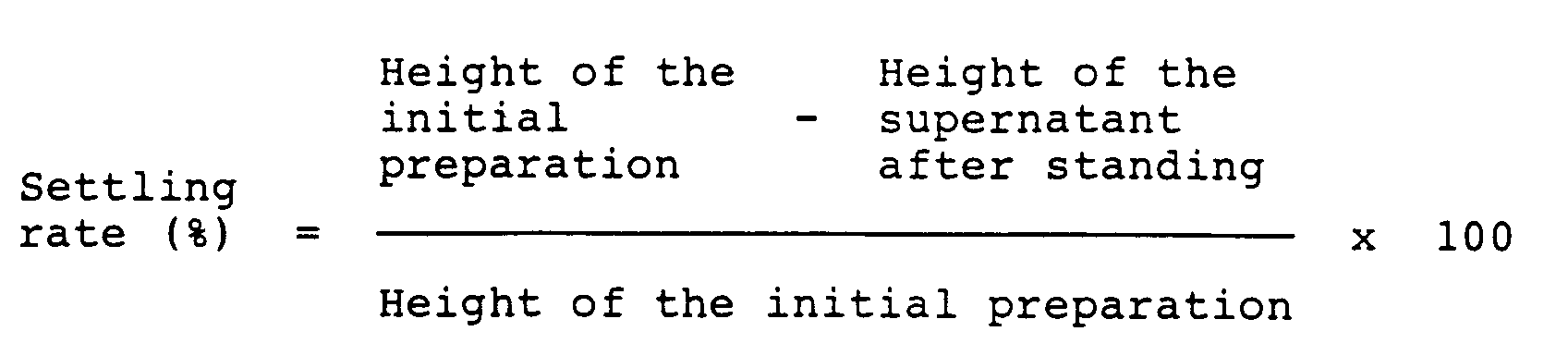
- A preparation was put into a 50 ml measuring cylinder. After it was left to stand at 25°C for 4 weeks, the settling rate of the preparation which shows its stability was measured. Conditions for preparing the preparations and the test results are shown in Table 6.


- The settling rate is calculated using the following formula.
- Of all of the preparations except the preparations containing MBTC as a agent to be tested, their viscosities were also determined immediately after preparing and after standing.
- Two l of a 2,000 ppm aqueous solution of each of Test samples of the present invention and such conventional surface active agents as sodium dodecylbenzenesulfonate, lauryltrimethylammonium chloride and polyoxyethylenenonylphenylether (n = 10) were separately sprayed to a young seedling of tomato grown for about 25 days after seeding. The young seedlings were kept in a humid atmosphere for 6 days and the degree of damage of them from the sprayed agents was observed. The results are shown in Table 7.
- Test samples of the present invention used are the ones desalted and dried as in Test 3.


Claims (9)
- Use of a grain protein partial degradation product prepared by(i) a single degradation of a grain protein with either one of an alkali, acid, proteinase, reducing agent and oxidizing agent, or(ii) a combination of two kinds of degradation of a grain protein each with an acid, proteinase, reducing agent or oxidizing agent,and having a weight average molecular weight of 500 - 110,000, for dispersing solid, water-insoluble or sparingly water-soluble particles in an aqueous medium.
- The use of claim 1 in which the grain protein is a protein of wheat gluten, maize gluten or soya bean.
- The use of claim 1 in which the grain protein partial degradation product has a weight average molecular weight of 700 - 90,000.
- The use of claim 1 in which the water-insoluble or sparingly soluble particles are inorganic particles such as calcium carbonate, sachin white, talc, red oxide, magnesium hydroxide, zinc white, barium sulfate, kaolin or clay, or organic particles such as cocoa powder, fruit pulp, solid matters of miso (bean paste), solid matters of soup, powdery agricultural chemicals or powdery pharmaceutical medicines.
- The use of claim 1 in which the grain protein partial product is as prepared by a degradation with a dilute aqueous alkaline solution at a temperature of 60 to 180°C for a period of 10 to 600 minutes.
- The use of claim 1 in which the grain protein partial product is as prepared by degradation with a dilute aqueous acid solution at a temperature of 60 to 120°C for a period of 10 to 600 minutes.
- The use of claim 1 in which the grain protein partial product is as prepared by degradation with proteinase in an aqueous solution of an enzyme having protease activity at a temperature of 10 to 60°C for a period of 60 to 600 minutes.
- The use of claim 1 in which the grain protein partial product is as prepared by degradation with a dilute aqueous solution of a reducing agent at a temperature of 10 to 100°C for a period of 10 to 600 minutes.
- The use of claim 1 in which the grain protein partial product is as prepared by degradation with a dilute aqueous solution of an oxidizing agent at a temperature of 10 to 100°C for a period of 10 to 600 minutes.
Applications Claiming Priority (2)
| Application Number | Priority Date | Filing Date | Title |
|---|---|---|---|
| JP18863987 | 1987-07-27 | ||
| JP188639/87 | 1987-07-27 |
Publications (3)
| Publication Number | Publication Date |
|---|---|
| EP0301278A2 EP0301278A2 (en) | 1989-02-01 |
| EP0301278A3 EP0301278A3 (en) | 1989-08-23 |
| EP0301278B1 true EP0301278B1 (en) | 1992-10-14 |
Family
ID=16227229
Family Applications (1)
| Application Number | Title | Priority Date | Filing Date |
|---|---|---|---|
| EP88110705A Expired - Lifetime EP0301278B1 (en) | 1987-07-27 | 1988-07-05 | A particle-dispersing agent |
Country Status (4)
| Country | Link |
|---|---|
| EP (1) | EP0301278B1 (en) |
| JP (1) | JPH0777603B2 (en) |
| KR (1) | KR960000583B1 (en) |
| DE (1) | DE3875298T2 (en) |
Cited By (1)
| Publication number | Priority date | Publication date | Assignee | Title |
|---|---|---|---|---|
| CN107296044A (en) * | 2017-07-11 | 2017-10-27 | 北京清源保生物科技有限公司 | A kind of botanical pesticide surfactant and preparation method and application |
Families Citing this family (18)
| Publication number | Priority date | Publication date | Assignee | Title |
|---|---|---|---|---|
| CA2174939C (en) * | 1993-10-11 | 1999-09-21 | The United States Of America, Represented By The Secretary Of The Department Of Agriculture | Sprayable gluten-based formulation for pest control |
| US5523083A (en) * | 1993-10-11 | 1996-06-04 | The United States Of America As Represented By The Secretary Of Agriculture | Sprayabale gluten-based formulation for pest control |
| JP3507201B2 (en) * | 1995-07-13 | 2004-03-15 | 太平洋セメント株式会社 | Cement composition |
| DE19645657A1 (en) * | 1996-11-06 | 1998-05-28 | Rhone Poulenc Rorer Gmbh | Phospholipid composition, method of making such a composition and use thereof |
| JP5121095B2 (en) * | 2001-03-30 | 2013-01-16 | 小林製薬株式会社 | Gel composition |
| JP2003321352A (en) * | 2002-04-24 | 2003-11-11 | Nisshin Pharma Inc | Coenzyme Q10-containing composition |
| JP3441450B1 (en) | 2002-08-16 | 2003-09-02 | 伸欣 倉岡 | Frozen Japanese buckwheat noodles or boiled noodles |
| US7201934B2 (en) * | 2002-10-15 | 2007-04-10 | Cargill, Incorporated | Dispersible cocoa products |
| EP2052622A1 (en) | 2007-10-26 | 2009-04-29 | Basic Supply Group B.V. | Method for the preparation of a spray dried fat powder |
| JP5555192B2 (en) * | 2010-04-28 | 2014-07-23 | 日揮触媒化成株式会社 | Novel pentasil-type zeolite and synthesis method thereof |
| FR2960129B1 (en) * | 2010-05-20 | 2014-10-10 | Roquette Freres | PROCESS FOR THE PREPARATION OF ALKALINE HYDROLYSATES OF PLANT PROTEINS |
| FR2975259B1 (en) * | 2011-05-16 | 2014-01-31 | Roquette Freres | INDUSTRIAL PROCESS FOR THE PREPARATION OF ALKALINE HYDROLYSATES OF PLANT PROTEINS |
| CN102715273A (en) * | 2012-05-25 | 2012-10-10 | 苏州金记食品有限公司 | Venetian cloth used for manufacturing bean curd sheets and having embroidered Chinese characters |
| FI125288B (en) * | 2012-08-14 | 2015-08-14 | Tuula Sontag-Strohm | Process for reducing the content of gluten protein in a fraction of a cereal |
| CN103636813B (en) * | 2013-12-23 | 2014-10-22 | 道真仡佬族苗族自治县绿磨坊风味食品有限公司 | Process for producing and processing grey bean curd fruits |
| CN108479721B (en) * | 2018-05-02 | 2020-09-11 | 江苏省农业科学院 | Formaldehyde adsorption material and application thereof |
| KR102471366B1 (en) * | 2020-10-16 | 2022-11-29 | 영진아이엔디(주) | Plasma scrubber system for processing semiconductor waste gas to save water and method thereof |
| CN115140755B (en) * | 2022-07-14 | 2023-11-10 | 桂林卓瑞食品原料有限公司 | Preparation method of porous calcium carbonate |
Family Cites Families (7)
| Publication number | Priority date | Publication date | Assignee | Title |
|---|---|---|---|---|
| GB1231652A (en) * | 1968-01-25 | 1971-05-12 | ||
| GB1276693A (en) * | 1969-06-30 | 1972-06-07 | Riken Vitamin Oil Co Ltd | Process for preparing powders of lipophilic food emulsifiers |
| US3889001A (en) * | 1973-08-20 | 1975-06-10 | Gen Foods Corp | Hydrolyzed protein in non-dairy whipped topping |
| JPS5814813A (en) * | 1981-07-20 | 1983-01-27 | Akira Ito | Cooling device of ultraviolet hardening device |
| US4370267A (en) * | 1981-08-10 | 1983-01-25 | A. E. Staley Manufacturing Company | Fractionation and isolation of 7S and 11S protein from isoelectrically precipitated vegetable protein mixtures |
| JPS5926636A (en) * | 1982-07-30 | 1984-02-10 | Hino Motors Ltd | Air suspension device |
| JPS6049642A (en) * | 1983-08-29 | 1985-03-18 | Nec Corp | Inspecting apparatus for semiconductor device |
-
1988
- 1988-05-06 JP JP63110901A patent/JPH0777603B2/en not_active Expired - Fee Related
- 1988-07-05 EP EP88110705A patent/EP0301278B1/en not_active Expired - Lifetime
- 1988-07-05 DE DE8888110705T patent/DE3875298T2/en not_active Expired - Fee Related
- 1988-07-06 KR KR1019880008449A patent/KR960000583B1/en not_active Expired - Fee Related
Cited By (2)
| Publication number | Priority date | Publication date | Assignee | Title |
|---|---|---|---|---|
| CN107296044A (en) * | 2017-07-11 | 2017-10-27 | 北京清源保生物科技有限公司 | A kind of botanical pesticide surfactant and preparation method and application |
| CN107296044B (en) * | 2017-07-11 | 2021-03-30 | 北京清源保生物科技有限公司 | Plant-source pesticide surfactant and preparation method and application thereof |
Also Published As
| Publication number | Publication date |
|---|---|
| EP0301278A2 (en) | 1989-02-01 |
| KR890001627A (en) | 1989-03-28 |
| EP0301278A3 (en) | 1989-08-23 |
| JPH01127032A (en) | 1989-05-19 |
| JPH0777603B2 (en) | 1995-08-23 |
| DE3875298T2 (en) | 1993-04-22 |
| KR960000583B1 (en) | 1996-01-09 |
| DE3875298D1 (en) | 1992-11-19 |
Similar Documents
| Publication | Publication Date | Title |
|---|---|---|
| EP0301278A2 (en) | A particle-dispersing agent | |
| EP0298419B1 (en) | A protein partial degradation product, process for preparing it and its use | |
| KR100402359B1 (en) | Protein adhesive binders and preparation methods | |
| AU2009302084B2 (en) | Process for producing protein microparticles | |
| US5274079A (en) | Protein partial degradation products that are useful as surface active agents and dispersing agents | |
| JPH0428342B2 (en) | ||
| KR20020062948A (en) | Food additive slurry compositions and powder compositions and food compositions containing the same | |
| US5366661A (en) | Method for forming a stabilized aqueous dispersion of inorganic particles or organic particles for food stuffs | |
| US5273773A (en) | Protein partial degradation products | |
| JP2934658B2 (en) | Chlorella extract powder manufacturing method | |
| JP7707167B2 (en) | Gelatin compositions, processes for making such compositions, and uses thereof | |
| KR100187343B1 (en) | Binder and product made by using the same | |
| FI61789C (en) | REFERENCE TO A FRAME RELEASE | |
| JP2946022B2 (en) | Aqueous calcium carbonate suspension composition and method for producing the same | |
| FI20175869A1 (en) | Method for modifying spring material | |
| JPH01281134A (en) | Dissolution promoter for hardly-soluble surfactant | |
| JPH01262773A (en) | Quality improving agent for liquid seasoning | |
| US3656963A (en) | Hydrolyzed protein of reduced dustiness and process | |
| KR20210126701A (en) | Granular composition containing milk-derived protein, manufacturing method thereof, and method for improving dispersibility of granular composition containing milk-derived protein | |
| JPWO1999062935A1 (en) | Reaction product of carboxylic acid and amino acid or amino acid condensate and method for producing the same | |
| CA1094869A (en) | Acidic proteinaceous beverage | |
| JP2512521B2 (en) | Stabilizer for emulsified oily foods | |
| GB1596505A (en) | Food manufacture | |
| JPH0746958B2 (en) | Quality improver for starchy foods | |
| JP3109699B2 (en) | Lecithin preparation |
Legal Events
| Date | Code | Title | Description |
|---|---|---|---|
| PUAI | Public reference made under article 153(3) epc to a published international application that has entered the european phase |
Free format text: ORIGINAL CODE: 0009012 |
|
| AK | Designated contracting states |
Kind code of ref document: A2 Designated state(s): BE DE ES FR GB IT NL |
|
| PUAL | Search report despatched |
Free format text: ORIGINAL CODE: 0009013 |
|
| AK | Designated contracting states |
Kind code of ref document: A3 Designated state(s): BE DE ES FR GB IT NL |
|
| 17P | Request for examination filed |
Effective date: 19891027 |
|
| 17Q | First examination report despatched |
Effective date: 19910419 |
|
| GRAA | (expected) grant |
Free format text: ORIGINAL CODE: 0009210 |
|
| AK | Designated contracting states |
Kind code of ref document: B1 Designated state(s): BE DE ES FR GB IT NL |
|
| PG25 | Lapsed in a contracting state [announced via postgrant information from national office to epo] |
Ref country code: IT Free format text: LAPSE BECAUSE OF FAILURE TO SUBMIT A TRANSLATION OF THE DESCRIPTION OR TO PAY THE FEE WITHIN THE PRE;WARNING: LAPSES OF ITALIAN PATENTS WITH EFFECTIVE DATE BEFORE 2007 MAY HAVE OCCURRED AT ANY TIME BEFORE 2007. THE CORRECT EFFECTIVE DATE MAY BE DIFFERENT FROM THE ONE RECORDED.SCRIBED TIME-LIMIT Effective date: 19921014 Ref country code: ES Free format text: THE PATENT HAS BEEN ANNULLED BY A DECISION OF A NATIONAL AUTHORITY Effective date: 19921014 Ref country code: BE Effective date: 19921014 |
|
| REF | Corresponds to: |
Ref document number: 3875298 Country of ref document: DE Date of ref document: 19921119 |
|
| ET | Fr: translation filed | ||
| PLBE | No opposition filed within time limit |
Free format text: ORIGINAL CODE: 0009261 |
|
| STAA | Information on the status of an ep patent application or granted ep patent |
Free format text: STATUS: NO OPPOSITION FILED WITHIN TIME LIMIT |
|
| 26N | No opposition filed | ||
| PGFP | Annual fee paid to national office [announced via postgrant information from national office to epo] |
Ref country code: FR Payment date: 19970527 Year of fee payment: 10 |
|
| PGFP | Annual fee paid to national office [announced via postgrant information from national office to epo] |
Ref country code: DE Payment date: 19970626 Year of fee payment: 10 Ref country code: GB Payment date: 19970626 Year of fee payment: 10 |
|
| PGFP | Annual fee paid to national office [announced via postgrant information from national office to epo] |
Ref country code: NL Payment date: 19970731 Year of fee payment: 10 |
|
| PG25 | Lapsed in a contracting state [announced via postgrant information from national office to epo] |
Ref country code: GB Free format text: LAPSE BECAUSE OF NON-PAYMENT OF DUE FEES Effective date: 19980705 |
|
| PG25 | Lapsed in a contracting state [announced via postgrant information from national office to epo] |
Ref country code: NL Free format text: LAPSE BECAUSE OF NON-PAYMENT OF DUE FEES Effective date: 19990201 |
|
| GBPC | Gb: european patent ceased through non-payment of renewal fee |
Effective date: 19980705 |
|
| PG25 | Lapsed in a contracting state [announced via postgrant information from national office to epo] |
Ref country code: FR Free format text: LAPSE BECAUSE OF NON-PAYMENT OF DUE FEES Effective date: 19990331 |
|
| NLV4 | Nl: lapsed or anulled due to non-payment of the annual fee |
Effective date: 19990201 |
|
| PG25 | Lapsed in a contracting state [announced via postgrant information from national office to epo] |
Ref country code: DE Free format text: LAPSE BECAUSE OF NON-PAYMENT OF DUE FEES Effective date: 19990501 |
|
| REG | Reference to a national code |
Ref country code: FR Ref legal event code: ST |