EP0299778A2 - Elektrochemischer Mikrosensor und Sensorzeile - Google Patents
Elektrochemischer Mikrosensor und Sensorzeile Download PDFInfo
- Publication number
- EP0299778A2 EP0299778A2 EP88306479A EP88306479A EP0299778A2 EP 0299778 A2 EP0299778 A2 EP 0299778A2 EP 88306479 A EP88306479 A EP 88306479A EP 88306479 A EP88306479 A EP 88306479A EP 0299778 A2 EP0299778 A2 EP 0299778A2
- Authority
- EP
- European Patent Office
- Prior art keywords
- electrode
- well
- back surface
- substrate
- set forth
- Prior art date
- Legal status (The legal status is an assumption and is not a legal conclusion. Google has not performed a legal analysis and makes no representation as to the accuracy of the status listed.)
- Withdrawn
Links
Images

Classifications
-
- G—PHYSICS
- G01—MEASURING; TESTING
- G01N—INVESTIGATING OR ANALYSING MATERIALS BY DETERMINING THEIR CHEMICAL OR PHYSICAL PROPERTIES
- G01N27/00—Investigating or analysing materials by the use of electric, electrochemical, or magnetic means
- G01N27/26—Investigating or analysing materials by the use of electric, electrochemical, or magnetic means by investigating electrochemical variables; by using electrolysis or electrophoresis
- G01N27/403—Cells and electrode assemblies
Definitions
- the present invention relates to microelectrochemical sensors useful for detecting various chemicals, including vaporous and gaseous species and dissolved species, in very low concentrations.
- the micro-electrochemical sensors themselves are formulated by integrated circuit (IC) engineering techniques and can be extremely small in size, namely, as small as one-fifth to one-sixth the size of the smallest previously known sensors. Among numerous other uses, they may be utilized to analyze blood chemistry, in vivo.
- IC integrated circuit
- a sample be it a liquid sample or a gaseous sample, for one or more constituents.
- S.J. Pace as set forth in U.S Patent 4,225,410, discloses a disposable integrated miniaturized array of chemical sensors for analyzing concurrently a number of analytes in a fluid sample.
- Each sensor of the array is a complete electrochemical cell having its own reference and indicator electrodes and is selective with respect to a particular analyte, The sensors are all formed on top of the surface of a substrate which is prepared by press forming powdered alumina with appropriate through holes and imprints for the electrochemical circuit. Because of the manufacturing techniques such sensors and sensor arrays must be relatively large and are more properly describable as minisensors rather than microsensors.
- ion selective electrode is set forth which is used along with a separate reference electrode.
- the ion-selective membrane of the electrode sits on a conductor embedded in a plastic substrate, This is basically a small ion-selective electrode with the membrane sitting on top of a conductor and without an internal reference electrolyte or true reference electrode. Further, construction of such an electrode design in micro sizes appears to be beyond the current state of the art.
- microelectrochemical sensors and sensor arrays incorporating both amperometric and potentiometric elements, which operate at room temperature and consume little power, which provide versatile, multi-purpose-multi-channel, real time monitoring of vapors, gases, molecules and ions, which are micro-portable and field rugged, which have fast response times at ambient temperature, which are free of interferences from such parameters as oxygen deficiency and humidity, which can be produced inexpensively using sophisticated modern micro-fabrication technologies, which have high specificity and high selectivity, for example, parts-per-billion level detection of such gases CO, NO, N0 2 , H 2 S, S0 2 , and N 2 H 4 and parts-per-million detection of such gases as HCN, C1 2 , H 2 , 0 2 , C 2 HsOH, HCHO, C 3 H 3 N, 0 3 , C 2 H 2 , C 2 H 4 , CH 4 , C 2 H 6 , C 3 H 8 , and
- the present invention is directed to solving one or more of the problems as set forth above.
- a microelectrochemical electrode structure comprises a monolithic substrate having a front surface and a back surface facing generally away from one another.
- a first well extends into the substrate from the front surface towards the back surface and ends in a first well bottom.
- a first passage extends into the substrate from the back surface to the first well bottom.
- a first electrolytic cell including a first electrode is located wholly between the front and back surfaces of the substrate.
- a first conductor is located in the first passage and electrically communicates the first electrode to adjacent the back surface.
- an electrolytic medium is in the first well.
- a barrier covers the first well, the barrier having an outfacing surface and an infacing surface.
- the infacing surface is in flow contact with the electrolytic medium.
- the barrier provides entry into the electrolytic medium of a selected moiety in response to contact of a selected species with the outfacing surface.
- the barrier is at least substantially impermeable to the electrolytic medium.
- Another embodiment of the present invention is a sensor array including a plurality of such first electrode structures in the substrate.
- each electrode structure can have more than one electrode in the first well.
- An electrode structure in accordance with the present invention is characterized by extremely small size, is operable at room temperature, utilizes low power, is field rugged, has a fast response time, is not sensitive to interferences due to oxygen deficiency or differences in humidity, can be readily mass produced using sophisticated microfabrication technologies, has high specificity and high selectivity, can have very short signal lines to signal amplification circuitry integrated and embedded in the back side of the substrate thereby providing a high signal-to-noise ratio, and is useful in accordance with specific embodiments to detect vapors, dissolved ions and dissolved nonionic species (including dissolved gases).
- the structure is also very well suited to having a pressure element incorporated in an array therewith.
- a resistive or capacitive sensor is so similar to the structure created for the chemical sensitive elements it only requires a few more processing steps to also include a pressure element on the same substrate. In some applications (e.g., biomedical) such added features are very beneficial.
- a single substrate can have an array of one or more electrode structures, each sensitive for one or several of a number of different chemical species. And, the entire sensor array can be so small that it can be readily positioned in, for example, a catheter in the blood stream and can be used to give a constant readout of such chemicals as C0 2 , 0 2 , K + , H + , and the like.
- integrated circuitry electronics on the back surface of the substrate removed from the electrochemistry whereby one can amplify the signals and/or obtain electrical output signals which are specifically indictive of the concentration of one or of a number of species.
- the electrode structure of the present invention can be designed to exhibit substantially Nernstian slopes for ionic species.
- the amperometric electrode structures of the present invention can be designed to exhibit substantially linear dependency on concentration.
- the bottom of the first well can be chosen to be at different distances from the front and back surfaces of the substrate for different intended applications.
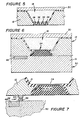
- the present invention provides a microelectrochemical electrode structure 10 including an electrolytic cell 11, one embodiment of which is illustrated in Figure 1.
- the electrode structure 10 includes a monolithic substrate 12 having a front surface 14 and a back surface 16 facing generally away from one another.
- the substrate 12 can be made of any of a number of materials but it is particularly advantageous to make the substrate 12 out of a semiconductor material such as silicon, silicon carbide, gallium arsenide, or the like.
- the invention is more general in that the substrate 12 may also be made of a plastic material, a refractory oxide, or substantially any other material.
- a silicon dioxide layer 13 can be formed by contacting a silicon substrate with wet oxygen at elevated temperature, e.g., about 1000°C.
- the substrate 12 be monolithic i.e., a unitary structure formed of a single material, as this allows particularly easy construction and eliminates or greatly reduces problems of prior art devices.
- Particular problems which are eliminated or greatly reduced include: (1) securing various chemistries to the electrodes especially when multilayered structures are required; (2) affixing the membranes that cover the chemistries in the wells; (3) leakage of electrolyte to the electronics; (4) the depositing of thick electrolytic mediums which are sometimes necessary; (5) encapsulation problems; (6) light sensitivity problems; (7) lack of versatility to do, for example, current as well as voltage measurements; (8) high cost; (9) incompatibilities of various chemistries with IC processing.
- the electrochemical analysis which can be made in accordance with the methods of and/or using the sensors of the present invention includes voltammetric, potentiometric, coulombic, conductometric and AC analysis.
- a first well 18 extends into the substrate 12 from the front surface 14 and extends towards the back surface 16. All of the needed chemicals of the cell 11 are within the first well 18.
- the first well 18 ends in a first well bottom 20.
- a first passage 22 extends into the substrate 12 from the back surface 16 to the first well bottom 20.
- the first well 18 can be formed by any of a number of techniques, including, particularly, anisotropic etching carried out in accordance with the techniques of the semiconductor industry (in which instance the (100) face of the silicon corresponds to the front surface 14).
- Such a process includes such steps as cleaning the substrate 12, applying a photoresist layer, prebaking the layer, exposing the photoresist, developing the photoresist, rinsing the substrate 12, drying the substrate 12, and post baking it.
- Methods for carrying out each of such steps are known in the IC art and descriptions of such techniques may be found in, for example, "Integrated Circuit Engineering” by A.B. Glaser and G.E. Subak-Sharpe, Addison-Wesley Publishing Company, Reading, Massachusettes, 1977. In this same text are found explanations of etching, oxidation of silicon, formation of a silicon nitride insulating layer, and the like.
- An alternative way of forming well 18 (and passage 22 as well) is by laser drilling.
- the silicon wet anistropic etching technique has two major advantages over laser drilling. One, it is a parallel process whereby many holes can be made at once. Two, the surfaces are smooth and very well defined. The advantage of laser drilling is that it can provide straight but not smooth walled holes when such are desirable.
- a first electrode 24 is provided which is, very importantly, wholly between the front surface 14 and the back surface 16 and which extends at least to the first well 18. This is very important as this enables the securing of subsequent layers in a straight-forward fashion, makes the accommodation of the electrolytic medium in general easier (for example, eliminates spilling using an ink jet printer type of chemistry filling device), and allows for an easier fixing of additional barriers. Also better encapsulation is provided.
- a first conductor 26 is provided in the first passage 22 and serves for electrically communicating the first electrode 24 to adjacent the back surface 16 of the substrate 12.
- the first conductor 26 is suitably an electronic, as opposed to an ionic, conductor.
- a well facing end 27 of the conductor 26 can play the role of the electrode 24. This feature makes the fabrication of the sensor 10 dramatically simpler. Often, however, the sensor electrode metal will need additional backup layers (e.g., aluminum or titanium) for strength and/or economy.
- the first passage 22 can be made by any of the known techniques of the semiconductor art. For example, such techniques as anisotropic etching, laser drilling, aluminum thermomigration, and the like are useful.
- the first conductor 26 can be provided in the first passage 22, again by the techniques of the semiconductor art.
- the first conductor 26 can be provided by such techniques as aluminum thermomigration, metal deposition, (evaporation or sputtering), electroless plating, electron beam evaporation, mechanical positioning of metal rods, melting in place with vacuum application, or the like.
- Aluminum thermomigration is a useful technique to make the metal contacts. This technique has the advantage of providing the hole and conductor in a single operation. In practice, however, the thermomigration technique is quite difficult and wet anistropic etching followed by metal deposition is currently preferable.
- Electrode structures 10 can be formed These include, for example, the Ag/AgCI reference electrode, platinum, platinum black, silver, gold, iridium, palladium, palladium/silver, iridum dioxide, platinum black/paladium, platinum oxide, and mixtures thereof, electronically conductive polymers, and generally any of the electrodes normally utilized in electrochemical measurements.
- Table 1 sets forth, as examples only, a short list of gases, and electrochemical systems which have been used to determine them.
- an electrolytic medium 28 is provided in the first well 18.
- the electrolytic medium 28 can be a liquid but more preferably is in the nature of a hydrogel, a plasticized polymeric membrane for potentiometric elements, an ion selective membrane, or a solid polymer electrolyte.
- the needed materials for the various electrode structures 10 can be placed in the appropriate wells 18 as follows: pure metals if they need to be deposited from the front can be sputtered or evaporated, electron-beam or ohmic evaporation may be used, insoluble deposits of metal salts can be formed by chemical or electrochemical treatment of metals in situ. They can be deposited from the back as previously set forth.
- For providing the hydrogel one has the choice of lift off technology or ink-jet printer like technology.
- Solid polymeric electrolytes can be put in place in the same manner as hydrogels.
- ion-selective membranes can be placed in the appropriate well(s) in the same manner as can hydrogels. Further, liquid membranes can be provided in the same manner.
- Composite membranes which include enzyme based membranes, tissue cultures, living organisms, antigen-antibody and generally biocatalyst materials can also be placed in the well in the same manner.
- thermodynamic selectivity is the reduction of N0 2 that occurs at low potentials (Sedlak and Blurton, 1986).
- the N0 2 sensor (with sensing electrode operated at low potentials) is selective for N0 2 , having no signal for the NO that may be present.
- This N0 2 selectivity results from control of the sensing electrode's potential in a range such that no NO reactivity is observed.
- the potential of the electrochemical cell has been compared to the temperature of a catalyst surface (Blurton and Stetter, 1977), which also may be used for control of the catalyst reactivity. Control of the potential is accomplished in many sensors by using three electrodes and a potentiostatic circuit.
- the concentration of the desired component can be determined selectivity by the differential pulse voltammetry (DPV) technique.
- DSV differential pulse voltammetry
- the DPV technique in addition to an improved signal-to-noise ratio, can provide potential-controlled selectivity to an electrochemical sensor through precise measurements of Ep eak values, which are closely related to the thermodynamic potentials given in Table 2 and are characteristic to each gas species.
- solid electrolytes including solid polymeric electrolytes such as Nafion (a trademark of DuPont) which is part of a class of solid polymeric ion exchangers which conduct ions upon exposure to water.
- solid polymeric electrolytes such as Nafion (a trademark of DuPont) which is part of a class of solid polymeric ion exchangers which conduct ions upon exposure to water.
- membranes made from polystyrene with fixed negative sites (sulfonate, carboxylate or phosphonate) or fixed positive sites (quaternary ammonium or quaternary phosphonium). Selection as far as ions are concerned with these materials is almost exclusively on the basis of charge and for ions with the same charge discrimination is very slight. For amperometric sensing the use of these materials is relatively new.
- solid polymeric electrolytes besides Nafion are sulfonated styrene-divinyl benzene resins and divinyl napthalene sulfonic acid polymer.
- Such polymers are characterized chemically and physically in that they have a hydrophobic nature with ionic (hydrophilic) clusters inside. They conduct ions upon hydration. They exclude co-ions up to the Donnan failure point at which stage ions of both types can penetrate into the resin. Neutral molecules can diffuse readily through such membranes and especially large organic molecules can dissolve within the more hydrophobic resins.
- Resins can also be used as reference solutions (see, for example, French patent publication No. 2,158,905). These ion exchange resins have been used as the electrolytic medium for a potentiometric C0 2 sensor (see, for example, U.S. Patent 3,730,868).
- membranes can comprise a polymeric binder or support impregnated with a solution of an ion selective carrier or ionophore in a solvent for the ionophore.
- Membranes of this type can be tailored to sense particular ions selectively. For example, for sodium the antibiotic nonactin can be used as the ionophore in a PVC matrix plasticized with dioctyl sebacate. For potassium, valinomycine would replace the nonactin.
- Useful gels for incorporation within the sensor structure include, without limitation: methylcellulose, polyvinyl alcohol, agar, carboxycellulose, gelatin, agarose, deionized gelatin, polyacrylamide, polyvinyl pyrrolidone, hydroxyethylacrylate, hydroxyethylmethacrylate, and polyacrylic acid. They are characterized in that they constitute thickened (more viscous) solutions. They are hydrophilic in natural and include synthetic polymeric film forming materials.
- the electrolytic medium 28 can come from a solution being analyzed. In most cases where the electrolytic medium 28 is present, however, it is provided during the construction of the electrode structure 10. Often it will be undesirable to allow a solution being analyzed to mix with and/or directly contact the electrolytic medium 28.
- the barrier 30 has an outfacing surface 32 and an infacing surface 34 and the infacing surface 34 is in f!ow contact with the electrolytic medium 28 so as to provide a full conductive path. Indeed, the barrier 30 can be at least partially within the first well 18.
- the barrier 30 provides entry into the electrolytic medium 28 of a selected moiety in response to contact of a selected species with the outfacing surface 32 of the barrier 30. Either the selected species will pass through the barrier 30 and will then constitute the selected moiety, or contact of the selected species with the barrier 30 will lead to the introduction of a different moiety into the electrolytic medium 28.
- the barrier 30 is generally at least substantially impermeable to the electrolytic medium 28 to prevent escape and/or mixing with the analyte solution exterior of the barrier 30.
- the barrier 30 would not be present, or would be permeable to a solution being analyzed, in those instances when the solution constitutes the electrolytic medium 28.
- the barrier 30 may encapsulate the entire electrode structure 10 including the front surface 14 and the back surface 16. Alternatively, the barrier 30 may only cover the first well 18, or the first well 18 and part or all of the front surface 14. It may be desirable to encapsulate the remainder of the electrode structure 10, or even all of the electrode structure 10 including the barrier 30, as a protection against contamination. Generally, an inert encapsulating layer (not shown) will serve the purpose. The encapsulating layer, when present, must provide access (via, for example, pores or holes therethrough) to the first well 18 or to the barrier 30 covering the first well 18. It can be formulated as can the barrier 30.
- the barrier 30 can comprise a gas pervious liquid impervious membrane. This is useful in the situation wherein the sensor is used in a liquid to detect dissolved gases, for example, if the electrode structure 10 is utilized in blood.
- teflon membranes silicone rubber membranes, silicon polycarbonate rubber membranes, mylar, nylon 6, polyvinyl alcohol, polyvinyl chloride, methylcellulose, cellulose acetate, high density polyethylene, polystyrene, natural rubber, fluorosilicone, dimethylsilicon rubber, any appropriately perforate photoresist polymer, and dimethylsilicon. It is generally preferred that the membranes utilized be solution castable so as to make fabrication of the membrane more easily accomplished.
- the barrier 30 can be placed over appropriate of the wells 18 by, for example: solution casting, separate casting on a different substrate and physical transfer, heat shrinking in place, solution casting utilizing an ink-jet printer, spin coating, or dip coating. If the barrier is in the nature of uniform latex microspheres, made for example of polystyrene, styrene-butydiene, or teflon, such microspheres can be placed in position utilizing the ink-jet technique, by dipping, by solvent spraying, or the like. If the barrier is of the nature of or includes activated carbon or similar materials it can be placed in position by ink-jet printing, solvent casting, or the like. If the barrier includes, for example, permanganate coated alumina or other substance which serves to remove nitric oxide, it can be placed in position similarly to the carbon particles.
- the microelectrochemical electrode structure 10 just described may serve as a working or sensing electrode, a reference electrode, or a counter or auxiliary electrode.
- a single substrate 12 may have one or more each of a sensing electrode cell 29, a reference electrode cell 31, and a counter electrode cell 33 thereon with appropriate provision, e.g., salt bridges 35,37, being made for ionic conductivity between the various electrode cells, or more particularly between the various electrolytic mediums 28,39,41 contacting the various electrodes.
- the salt bridges 35,37 are necessary when barrier 30 is a barrier for all ions.
- the substrate 12 will also include a reference electrode 36 in ionic electrical communication with the first electrode 24.
- the reference electrode 36 will also be electrically isolated from the sensing electrode 24 other than via the electrolytic medium 28.
- the substrate is silicon an appropriate silicon dioxide or silicon nitride layer 13 can be conventionally deposited or formed in the first well 18 and in the first passage 22.
- the reference electrode 36 can also be provided with its own different electrolytic medium 39 ( Figure 2) containing the species which determine the reference electrode potential.
- the counter electrode 42 can be provided with a separate electrolytic medium 41 ( Figure 2). In the embodiment illustrated in Figures 3 and 4 the sensing electrode 24 and the reference electrode 36 are each in the first well 18.
- the substrate 12 has a second passage 38 extending from the back surface 16 of the substrate 12 to the reference electrode 36 in the first or sensor well bottom 20.
- a second conductor 40 is in the second passage 38 and serves for electrically communicating the reference electrode 36 to adjacent the back surface 16 of the substrate 12. If the substrate is silicon the silicon dioxide or silicon nitride layer 13 also extends along the second passage 38.
- a counter electrode 42 is provided in those instances when such is necessary, for example, for making non-potiometric measurements.
- the counter electrode 42 (see Figure 3) is in ionic electrical communication with the electrolytic medium 28 and is electrically isolated from the sensing electrode 24, and from the reference electrode 36 (when such is present), other than via the electrolytic medium 28.
- the counter electrode 42 may be in the same well 18 as is the sensing electrode 24, as illustrated, for example, in the embodiments of Figures 3 and 4. And, the counter electrode 42 can, be in the same well as is the reference electrode 36 as in the embodiment of Figure 3.
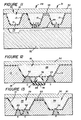
- the counter electrode 42 may be in the same well 18 as is the sensing electrode 24, that is it may be in the first well 18. This embodiment is seen in Figures 3, 4, 11, 12 and 13.
- the substrate 12 has a third passage 44 extending from the back surface 16 thereof to the first well bottom 20.
- a third conductor 46 is located in the third passage 44 and electronically communicates the counter electrode 42 to adjacent the back surface 16 of the substrate 12.
- the counter electrode 42 also plays the role of reference electrode 40.
- the silicon dioxide or silicon nitride layer 13 provides needed insulation.
- FIG. 5 illustrates such a structure.
- the well 18 can be in the nature of a trench in which electrophoresis is carried out by providing a potential gradient along the length of the trench.
- Appropriate sensing electrodes 24 are speaced along the bottom of the trench whereby various species can be determined.
- Appropriate reference 36 and/or counter electrodes 42 are also provided along the bottom of the trench.
- Electronic circuitry 48 can advantageously be included in certain embodiments of the present invention in the substrate 12 adjacent the back surface 16 thereof.
- Such electronic circuitry 48 is adapted for, and serves for, processing signals from one or more of the sensing electrode 24, the reference electrode 36, and the counter electrode 42.
- the electronic circuitry 48 can be formulated by conventional integrated circuit fabrication techniques. Generally the circuitry will serve to convert the signals from high impedance to low impedance and may also amplify the signals from the electrodes, and, if desired, perform computational tasks and present the data in condition for display or printing out, for example as concentrations of the species being detected.
- the length(s) of the conductor(s) 26,40 and/or 46 in such instances can be kept extremely short leading to a very high signal-to-noise ratio and, therefore, increased sensitivity. Note also that the chemistry in the first well 18 is completely isolated from the electronic circuitry 48 whereby the integrity of the latter is protected.
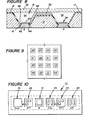
- the electronic circuitry 48 can instead be on a separate semiconductor substrate 50 (see Figure 6) which abuts the back surface 16 of the substrate 12. This provides encapsulation and protection of the electronic circuitry 48.
- Figure 7 is an enlarged view of a portion of Figure 6. It illustrates the use of a bump bonding techniques to make the needed electrical connection between the conductor (26,20 and/or 46) and the electronic circuitry 48.
- the bump bonding site 52 is spaced from the electrode (24,36 and/or 42) whereby the contents of the cells (29,31,33) are not damaged by heat during bump bonding. Also, this allows good bump bonding contact to be made whereby the resulting bond has good mechanical strength.
- the bump bonding is carried out by pressing the bumps 54,56 together and heating the substrate 50.
- the bumps 54,56 can be of very different thickness. Good results have been obtained with the bump 54 of silver and about 2000 Angstroms thisck and with bump 56 of copper and about 10 microns thick.
- Figure 7 also illustrates the technique of providing the first electrode 24 by depositing a small amount of an electrode material, e.g., platinum, silver, etc., followed by depositing the first conductor 26,40,46.
- an electrode material e.g., platinum, silver, etc.
- the first electrode 24 forms a portion of the bottom 20 of the first well 18.
- a support material e.g., a polymer such as a polyimide.
- the reference electrode 36 is of the nature described above.
- the working or sensing electrode structure 24, on the other hand, is in the nature of an ion-selective membrane 58 (as described previously) covering a sensing electrode base 60 which is attached to a sensing conductor 62 in a passage 64 which leads from a bottom 66 of the sensing electrode well 18 to the back surface 16 of the substrate 12.
- the analyte medium makes the electrolytic contact between the ion-selective membrane 58 and the reference electrode 36.
- the barrier 30 is ion transparent or can be omitted.
- the electrolytic medium 39 is not the same material as is the ion-selective membrane 58.
- any of a number of ion selective membranes 58 can be used.
- such membranes are disclosed by M.A. Arnold and R.L Solsky Anal. Chem. 1986, 58, 84R - 101 R, M.E. Meyerhoff and Y.M. Fratecelli, Anal. Chem. 1982, 54, 27R - 44R, M.A. Arnold and M.E. Meyerhoff, Anal. Chem. 1984, 20R - 48R, and J. Koryta, Analytica Chimica Acta, 159, 1984, 1-46.
- each reference cell 31 is surrounded by, and can serve as the reference cell 31 for, several different sensing cells 29.
- sensing cell 29 on any substrate 12 more than one sensing cell 29 can be utilized for each chemical species being analyzed. That is, there can be two or five, or ten, or any desired number of sensing cells 29 which detect, for example, carbon monoxide. This provides extra selectivity by means of chemometrics, redundancy, and reliability in case any of the carbon monoxide sensing cells 29 fail whereby the electrode structure 10 would continue to operate.
- Chemometrics is the technique of mathematically treating data from a plurality of sensors to improve the selectivity of the analytical results (see, for example, Stetter, J.R., Jurs, P.C., and Rose, S.L., Anal. Chem. Vol. 58, pp 860-866 (1986)).
- Figure 10 illustrates an embodiment of the invention wherein a plurality of sensing cells 29 are provided, some of which can be for different constituents than others, e.g., oxygen, carbon dioxide and K + .
- a single reference cell 31 is also present as is a pressure sensor 70.
- the various cells 29,31 and the pressure sensor 70 are arranged linearly whereby the total lateral extension (width) of the array 72 of electrode structures 10 can be restricted to be no more than about 300 microns.
- the length of the array of the various cells 29,31 and the pressure sensor 70 is determined by the number of such cells (plus the pressure sensor 70) and can be restricted to be no more than about 150 microns multiplied by the number of cells plus the number of pressure sensors 70.
- the pressure sensor 70 can be a conventional piezoresistive-type pressure sensor of the nature described in, for example, Borky, J.M., IEEE Trans. On. Elect. Dev. Vol. ED-26, No. 12, December 1979.
- microelectronic chemical sensors allows the quantitative detection of different gases and organic vapors to further increase selectivity, to include redundancy, to increase reliability, and to permit use of chemometrix. Also, it is possible to include different types of sensors within such an array. For example, the internal temperature of a sensor can be monitored to compensate for known parameter changes with temperature. Also, a microhumidity sensor can be incorporated.
- Each microelectronic chemical sensor can comprise a different electrocatalyst coating so that each sensor is as specific as possible to a certain gas or vapor.
- a sensor comprising an array of optimized microsensors exhibits a maximum selectivity to a given mixture of gases and/or vapors.
- the presence of extra sensor elements with the same configuration and catalysts allows not only for averaging the signals of identical elements but also for correcting signals of dissimilar elements.
- Unraveling vapor spectral data from an array of microsensors in a gas or vapor detection system is possible with a microcomputer that uses innovative signal-processing techniques to overcome inherent limitations of the single sensor elements. Pattern-recognition methods can be used to determine the uniqueness of the information obtained and the capacity of each of the channels for classification. Recently, such a pattern recognition analysis of data from an electrochemical sensor array has been successfully applied for the detection of hazardous gases and vapors (Stetter, Jurs and Rose, 1986).
- the array containing n individual sensors that are operated amperometrically yields n channels of data for an unknown chemical species detected.
- the n-channels sensor responses for each compound are normalized so that the strongest channel equals 1 (or -1, if a negative number).
- This normalized set of response is termed a pattern vector as follows:
- Figure 11 illustrates a portion of the embodiment of the linear array of Figure 10 and shows the structure of the pressure sensor 70.
- a flexing membrane 71 which can flex into a cavity 73 between a support 75, which may be made of any convenient material, e.g., glass, plastic or a semiconductor such as silicon.
- Element P is the pressure element.
- Piezoresistors can be diffused in the back of the thin silicon membrane and all electronics are protected with, for example, a Mallory bonded glass piece (the support 75).
- the cavity 73 in the support 75 provides space for the electronics and can be evacuated to make an absolute pressure sensor possible.
- Figure 12 shows an embodiment of the invention wherein each of the sensing electrode 24 and the counter electrode 42 are in the first well 18.
- the reference electrode 36 communicates with the first well 18 via a pinhole 76 whereby the chemistry of the reference electrode cell 31 is kept separate from but communicates electrically with the electrolytic medium 28 in the first well 18.
- the reference electrode 36 is adjacent the back side 16 of the substrate 12 and is closed off by an enclosure 78 which may be merely an extension of the reference electrode 36, or which can alternatively be of a different material.
- the original filling of the reference cell 31 is from the back side 16 of the substrate 12.
- Figure 13 shows an embodiment of the invention wherein the sensing and counter electrodes 24,42 are in a single well 79, while the reference electrode 36 is in a separate well 81.
- An appropriate salt bridge 83 or its equivalent, provides ionic conductance between the electrolytic mediums 28 and 39. This is a typical structure for conductometric and voltammetric measurements, for example, a Clark oxygen sensor.
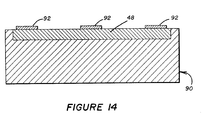
- the electronic circuitry 48 on a separate member 90 (see Figure 14) which, via appropriate contacts 92 can form temporary electrical contact with the appropriate conductors 26,40 and/or 46 (for example, as seen in Figure 2) during determination of the concentration or presence of one or more species.
- a single member 90 can provide the needed electronic circuitry 48 for a plurality of electrode structures 10. Also, if the electrode structure 10 is used in an environment where it must be more or less permanently installed and where it has only a short useful lifetime, only the electrode structure 10 need be replaced and not the electronic circuitry 48 (since the latter need only be exposed to the environment during the actual time of measurement).
- the first well 18 can be made any convenient depth. It is preferred that the first well 18 extends sufficiently towards the back surface 16 of the substrate 12 whereby the first electrode 24 is sufficiently deeply positioned within the first well 18 whereby electrochemical reaction of the selected moiety at the first electrode 24 provides a substantially Nernstian slope. In general, this means that the first well 18 should be sufficiently deep so that the electrolytic medium 28 (when present), or the membrane portion of the ion-selective electrode (when present), while remaining entirely within the first well 18, extends above the first electrode 24 a distance of at least about 40 microns.
- the first well 18 extends towards the back surface 16 of the substrate 12 from about 40 to about 200 microns.
- the back surface 16 of the substrate should be close enough to the bottom of the well so that shunting does not occur between respective conductors.
- the back surface 16 can be from about 10 to about 100 microns from the first well bottom 20. This assures very short contacts and also allows inexpensive anisotropic etching techniques (which provide tapered passages, as illustrated) to be used to form the first passage 22, and, if necessary, the second passage 38 and/or the third passage 44.
- the etching is anisotropic in such an instance the widths of the passages 22, 38 and 44 at the back surface 16 could otherwise become so wide that the conductors 26, 40 and/or 46 met before or at the back surface 16. If laser drilling is used to form the passages 22,38 and/or 44 this problem does not exist but laser drilling will not produce as many cells per unit time since either the laser must be repositioned to drill each passage.
- the sensor well 18 extends from about 60 to about 125 microns towards the back surface 16 and it is preferred that the back surface 16 is from about 10 to about 40 microns from the sensor well bottom 20.
- a particularly preferred structure is one wherein the sensor well 18 is approximately 100 microns deep and the back surface 16 is about 25 microns from the sensor well bottom 20. The same preferences hold with respect to the size of the reference well and the counter well, if such is present.
- a thinner electrolytic medium 28 over the sensing electrode 24 can be more appropriate, for example, between 20 and 50 microns.
- the first well 18 and other wells as well can be only partially filled with the appropriate electrolytic medium 28,39,41.
- the pH response of an lrO 2 electrode was tested in physiological saline solution in the pH range 6.0 - 8.0.
- the measuring cell consisted of a 1 ⁇ m thick IrO 2 electrode separated from a Ag/Cl electrode by 50 ⁇ m.
- the electrodes were fabricated on the surface of a silicon substrate coated with silicon dioxide. Adhesion layers were used of 100 Angstroms Ti for IrO 2 and 50 Angstroms each of Ti and Pd for Ag.
- AgCI was formed by bringing Ag in contact with a 1% FeC1 3 solution for two minutes. The potential of the Ag/AgCI electrode was first checked against a saturated calomel electrode and it agreed with the literature value. The response of the IrO 2 electrode was then measured using this Ag/AgCl electrode reference.
- the lr0 2 electrodes of Example 1 which gave near-Nerstian response were used in the fabrication of C0 2 electrodes.
- a 5% solution of poly(hydroxy ethyl methacrylate) in 950/0 ethanol was painted onto the IrO 2 -AgAgCl electrode area. The solvent was allowed to evaporate.
- the dried polymer was equilibrated with 10- 3 M NaHC0 3 + 0.1 M NaCI.
- the gel and the electrolyte were then allowed to dry up. 4.75% polysiloxane-polycarbonate solution was painted on top of the gel. Again, the solvent was allowed to dry completely.
- the completed electrode was checked for its response to C0 2 . Different concentrations of C0 2 were generated by adding known volumes of 0.1M NaHC0 3 solution to 0.1M HCI. It was assumed that all NaHCOs was converted to C0 2 .
- the change in potential of the electrodes was as follows:
- the response time of the electrode was approximately 60 seconds.
- the response time and detection limit can be improved by controlling the thickness of the polymer membrane and the composition and thickness of the hydrogel. No attempt was done to optimize them in the planar structure.
- the senor was completed by casting a silicone/polycarbonate membrane over the whole structure. It was observed that the electrode decreased after this step.
- a practical example of the current invention is a sensor for pH, C0 2 and 0 2 in blood.
- the sensing well 29 which is intended for pH sensing has besides the general outlook of Figure 4 the following specifics.
- One electrode in the pH sensing well 29 consists of iridium dioxide and one electrode consists of Ag/AgCI.
- the lr0 2 electrode is made by reactive sputtering through a silicon mask from the back of substrate 12.
- a promotion layer titanium is also sputtered on, as well as an iridium layer to make a better performing iridium/iridum dioxide electrode.
- Ag is used to back up these layers.
- the order of the depositions just mentioned is as follows:
- the oxygen electrolytic sensing cell 29 is made in one of two fashions:
- the material of the barrier 30 identified as a good choice for the C0 2 and 0 2 element is a block copolymer of polycarbonate with silicone rubber.
- This product e.g., General Electric MEM-213
- MEM-213 can be heat sealed and is heat shrinkable. It can be easily solution cast.
- the solvents used to cast this membrane are, for example, toluene or dichloromethane.
- the membrane can be locally laser cut or it can be locally dissolved.
- the C0 2 cell 29 contains the same electrodes as the pH cell 29 except that in this case we do have an electrolytic medium, a buffer, covered by the same membrane as mentioned with respect to the oxygen cell.
- the present invention provides a microelectrochemical electrode structure 10, and arrays thereof on a substrate 12.
- Such electrode structure 10 and arrays of electrode structures 10 on a single substrate 12 are useable for detecting low concentrations of gaseous, ionic and nonionic species.
Landscapes
- Chemical & Material Sciences (AREA)
- Life Sciences & Earth Sciences (AREA)
- Health & Medical Sciences (AREA)
- Biochemistry (AREA)
- General Physics & Mathematics (AREA)
- Electrochemistry (AREA)
- Physics & Mathematics (AREA)
- Analytical Chemistry (AREA)
- Molecular Biology (AREA)
- General Health & Medical Sciences (AREA)
- Chemical Kinetics & Catalysis (AREA)
- Immunology (AREA)
- Pathology (AREA)
- Investigating Or Analyzing Materials By The Use Of Electric Means (AREA)
- Measurement Of The Respiration, Hearing Ability, Form, And Blood Characteristics Of Living Organisms (AREA)
- Investigating Or Analysing Biological Materials (AREA)
- Catalysts (AREA)
Applications Claiming Priority (2)
| Application Number | Priority Date | Filing Date | Title |
|---|---|---|---|
| US07/073,805 US4874500A (en) | 1987-07-15 | 1987-07-15 | Microelectrochemical sensor and sensor array |
| US73805 | 1987-07-15 |
Publications (2)
| Publication Number | Publication Date |
|---|---|
| EP0299778A2 true EP0299778A2 (de) | 1989-01-18 |
| EP0299778A3 EP0299778A3 (de) | 1991-03-13 |
Family
ID=22115904
Family Applications (1)
| Application Number | Title | Priority Date | Filing Date |
|---|---|---|---|
| EP19880306479 Withdrawn EP0299778A3 (de) | 1987-07-15 | 1988-07-15 | Elektrochemischer Mikrosensor und Sensorzeile |
Country Status (4)
| Country | Link |
|---|---|
| US (1) | US4874500A (de) |
| EP (1) | EP0299778A3 (de) |
| JP (1) | JPH01112149A (de) |
| CA (1) | CA1298873C (de) |
Cited By (31)
| Publication number | Priority date | Publication date | Assignee | Title |
|---|---|---|---|---|
| EP0284518A3 (en) * | 1987-03-27 | 1989-11-29 | Isao Karube | Miniaturized oxygen electrode and miniaturized biosensor and production process thereof |
| EP0319198A3 (de) * | 1987-12-01 | 1990-05-16 | University College Cardiff Consultants Ltd. | Mikroumgebungsfühler-Vorrichtung |
| EP0433261A1 (de) * | 1989-12-14 | 1991-06-19 | Monsanto Company | Festkörper pH-Sensor |
| EP0455508A1 (de) * | 1990-05-04 | 1991-11-06 | THE GENERAL ELECTRIC COMPANY, p.l.c. | Sensoreinrichtungen |
| EP0494382A1 (de) * | 1990-12-10 | 1992-07-15 | Ppg Industries, Inc. | Kathode einer Schichtschaltung und elektrochemische Zelle zum Messen des Sauerstoffgehaltes von Flüssigkeiten |
| WO1992021020A1 (de) * | 1991-05-10 | 1992-11-26 | Meinhard Knoll | Verfahren zur herstellung von miniaturisierten chemo- und biosensorelementen mit ionenselektiver membran sowie von trägern für diese elemente |
| EP0512070A4 (en) * | 1990-01-26 | 1993-06-09 | Commtech International | Multi-analyte sensing electrolytic cell |
| EP0613952A1 (de) * | 1993-03-01 | 1994-09-07 | Disetronic Ag | Sensorarray |
| WO1995025275A1 (de) * | 1994-03-12 | 1995-09-21 | Meinhard Knoll | Miniaturisierte durchflussmesskammer mit integrierten chemo- und/oder biosensorelementen |
| WO1995029401A1 (en) * | 1994-04-25 | 1995-11-02 | Forskarpatent I Linköping Ab | Measuring of bloodgases |
| EP0597203A3 (en) * | 1992-09-14 | 1995-12-13 | Siemens Ag | Reference electrode. |
| EP0810432A1 (de) * | 1996-05-31 | 1997-12-03 | Siemens Aktiengesellschaft | Verfahren zur Herstellung einer Kombination eines Drucksensors und eines elektrochemischen Sensors |
| AT403528B (de) * | 1989-04-04 | 1998-03-25 | Urban Gerald | Mikro-mehrelektrodenstruktur für elektrochemische anwendungen und verfahren zu ihrer herstellung |
| EP0833149A1 (de) * | 1996-09-25 | 1998-04-01 | Kyoto Daiichi Kagaku Co., Ltd. | Verfahren zur Ionenkonzentrationsmessung |
| EP0772043A3 (de) * | 1995-10-31 | 1998-04-22 | Ciba Corning Diagnostics Corp. | Fluorelastomerdichtung für Fühler von Blutbestandteilen |
| EP1030174A3 (de) * | 1999-02-19 | 2001-01-03 | Micronas GmbH | Messeinrichtung sowie Verfahren zu deren Herstellung |
| WO2001001120A3 (de) * | 1999-06-25 | 2001-05-17 | Meinhard Knoll | Universaler wandler |
| WO2001025769A3 (en) * | 1999-10-01 | 2001-08-30 | Sophion Bioscience As | A substrate and a method for determining and/or monitoring electrophysiological properties of ion channels |
| WO2001080728A1 (de) * | 2000-04-26 | 2001-11-01 | SIMONS, Hans-Jürgen | Vorrichtung zur automatischen bestimmung des glucosegehalts des blutes |
| US6682649B1 (en) | 1999-10-01 | 2004-01-27 | Sophion Bioscience A/S | Substrate and a method for determining and/or monitoring electrophysiological properties of ion channels |
| WO2004029610A1 (de) * | 2002-09-19 | 2004-04-08 | Infineon Technologies Ag | Schaltkreis-anordnung mit integrierter referenz-elektrode und verfahren zum herstellen dieser schaltkreis-anordnung |
| EP1284158A3 (de) * | 2001-08-07 | 2004-04-14 | Eidgenössische Technische Hochschule Zürich | Mikrosensor-System zur Überwachung von biologischen und chemischen Prozessen |
| WO2005105292A1 (en) * | 2004-04-30 | 2005-11-10 | Gatlik Gmbh | High throughput storage-retrieval and screening platform for research applications based on electro or acoustic sensors |
| WO2009052022A1 (en) * | 2007-10-19 | 2009-04-23 | Hach Company | Multiple-electrode ionic probe |
| WO2010080327A1 (en) * | 2008-12-19 | 2010-07-15 | Hach Company | Photo-electro-chemical oxygen demand sensor, fluid sensor system, and method for determining one or more characteristics of a foreign material in a fluid |
| US8328720B2 (en) | 2007-08-10 | 2012-12-11 | Infotonics Technology Center, Inc. | MEMS interstitial prothrombin time test |
| US10244981B2 (en) | 2011-03-30 | 2019-04-02 | SensiVida Medical Technologies, Inc. | Skin test image analysis apparatuses and methods thereof |
| CN110361430A (zh) * | 2018-04-09 | 2019-10-22 | 恩德莱斯和豪瑟尔分析仪表两合公司 | 用于电位传感器的传感元件 |
| DE102013112202B4 (de) | 2012-11-09 | 2021-08-05 | Infineon Technologies Ag | Sensoreinrichtung, Verfahren und Sensor zur Bestimmung einer relativen Konzentration einer ersten Art von Ionen in Relation zu einer zweiten Art von Ionen, die in einem Flüssigkeitstropfen gelöst sind |
| WO2023041635A1 (en) * | 2021-09-17 | 2023-03-23 | Merck Patent Gmbh | Electrochemical probe |
| EP4682529A1 (de) * | 2024-07-18 | 2026-01-21 | Chung Shan Medical University | Chip zur elektrochemischen detektion |
Families Citing this family (239)
| Publication number | Priority date | Publication date | Assignee | Title |
|---|---|---|---|---|
| US5108926A (en) * | 1987-09-08 | 1992-04-28 | Board Of Regents, The University Of Texas System | Apparatus for the precise positioning of cells |
| US5225374A (en) * | 1988-05-13 | 1993-07-06 | The United States Of America As Represented By The Secretary Of The Navy | Method of fabricating a receptor-based sensor |
| US5111221A (en) * | 1988-05-13 | 1992-05-05 | United States Of America As Represented By The Secretary Of The Navy | Receptor-based sensor |
| US5252294A (en) * | 1988-06-01 | 1993-10-12 | Messerschmitt-Bolkow-Blohm Gmbh | Micromechanical structure |
| US6955915B2 (en) | 1989-06-07 | 2005-10-18 | Affymetrix, Inc. | Apparatus comprising polymers |
| US6309822B1 (en) | 1989-06-07 | 2001-10-30 | Affymetrix, Inc. | Method for comparing copy number of nucleic acid sequences |
| US6346413B1 (en) | 1989-06-07 | 2002-02-12 | Affymetrix, Inc. | Polymer arrays |
| US6919211B1 (en) | 1989-06-07 | 2005-07-19 | Affymetrix, Inc. | Polypeptide arrays |
| US6551784B2 (en) | 1989-06-07 | 2003-04-22 | Affymetrix Inc | Method of comparing nucleic acid sequences |
| US6379895B1 (en) | 1989-06-07 | 2002-04-30 | Affymetrix, Inc. | Photolithographic and other means for manufacturing arrays |
| US6040138A (en) | 1995-09-15 | 2000-03-21 | Affymetrix, Inc. | Expression monitoring by hybridization to high density oligonucleotide arrays |
| US5143854A (en) | 1989-06-07 | 1992-09-01 | Affymax Technologies N.V. | Large scale photolithographic solid phase synthesis of polypeptides and receptor binding screening thereof |
| US5424186A (en) | 1989-06-07 | 1995-06-13 | Affymax Technologies N.V. | Very large scale immobilized polymer synthesis |
| US5744101A (en) | 1989-06-07 | 1998-04-28 | Affymax Technologies N.V. | Photolabile nucleoside protecting groups |
| US6406844B1 (en) | 1989-06-07 | 2002-06-18 | Affymetrix, Inc. | Very large scale immobilized polymer synthesis |
| US5800992A (en) | 1989-06-07 | 1998-09-01 | Fodor; Stephen P.A. | Method of detecting nucleic acids |
| GB8927377D0 (en) * | 1989-12-04 | 1990-01-31 | Univ Edinburgh | Improvements in and relating to amperometric assays |
| JPH03183943A (ja) * | 1989-12-14 | 1991-08-09 | Hitachi Ltd | 酸素センサ |
| US6506558B1 (en) | 1990-03-07 | 2003-01-14 | Affymetrix Inc. | Very large scale immobilized polymer synthesis |
| US5172205A (en) * | 1990-09-26 | 1992-12-15 | Nissan Motor Co., Ltd. | Piezoresistive semiconductor device suitable for use in a pressure sensor |
| EP0834576B1 (de) | 1990-12-06 | 2002-01-16 | Affymetrix, Inc. (a Delaware Corporation) | Detektion von Nukleinsäuresequenzen |
| US5593852A (en) | 1993-12-02 | 1997-01-14 | Heller; Adam | Subcutaneous glucose electrode |
| CA2050057A1 (en) | 1991-03-04 | 1992-09-05 | Adam Heller | Interferant eliminating biosensors |
| US5281323A (en) * | 1991-03-20 | 1994-01-25 | Fujitsu Limited | Electrolyte composition for screen printing and miniaturized oxygen electrode and production process thereof |
| US5492611A (en) * | 1991-03-20 | 1996-02-20 | Fujitsu Limited | Miniaturized oxygen electrode |
| US5573649A (en) * | 1991-03-20 | 1996-11-12 | Fujitsu Limited | Miniaturized oxygen electrode and process of producing same |
| US5326450A (en) * | 1991-03-20 | 1994-07-05 | Fujitsu Limited | Miniaturized oxygen electrode |
| US6943034B1 (en) | 1991-11-22 | 2005-09-13 | Affymetrix, Inc. | Combinatorial strategies for polymer synthesis |
| US6468740B1 (en) | 1992-11-05 | 2002-10-22 | Affymetrix, Inc. | Cyclic and substituted immobilized molecular synthesis |
| US6864101B1 (en) | 1991-11-22 | 2005-03-08 | Affymetrix, Inc. | Combinatorial strategies for polymer synthesis |
| DE69233087T2 (de) * | 1991-11-22 | 2003-12-24 | Affymetrix, Inc. (N.D.Ges.D.Staates Delaware) | Verfahren zur Herstellung von Polymerarrays |
| US5331310A (en) * | 1992-04-06 | 1994-07-19 | Transducer Research, Inc. | Amperometric carbon monoxide sensor module for residential alarms |
| US5330634A (en) * | 1992-08-28 | 1994-07-19 | Via Medical Corporation | Calibration solutions useful for analyses of biological fluids and methods employing same |
| EP0588153B1 (de) * | 1992-09-14 | 1996-12-27 | Siemens Aktiengesellschaft | Gassensor |
| US5290240A (en) * | 1993-02-03 | 1994-03-01 | Pharmetrix Corporation | Electrochemical controlled dispensing assembly and method for selective and controlled delivery of a dispensing fluid |
| US5368704A (en) * | 1993-08-06 | 1994-11-29 | Teknekron Corporation | Micro-electrochemical valves and method |
| US7378236B1 (en) | 1994-06-17 | 2008-05-27 | The Board Of Trustees Of The Leland Stanford Junior University | Method for analyzing gene expression patterns |
| US7323298B1 (en) | 1994-06-17 | 2008-01-29 | The Board Of Trustees Of The Leland Stanford Junior University | Microarray for determining the relative abundances of polynuceotide sequences |
| US8236493B2 (en) | 1994-10-21 | 2012-08-07 | Affymetrix, Inc. | Methods of enzymatic discrimination enhancement and surface-bound double-stranded DNA |
| US5641644A (en) * | 1994-12-09 | 1997-06-24 | Board Of Regents, The University Of Texas System | Method and apparatus for the precise positioning of cells |
| US5554269A (en) * | 1995-04-11 | 1996-09-10 | Gas Research Institute | Nox sensor using electrochemical reactions and differential pulse voltammetry (DPV) |
| US5744697A (en) * | 1995-08-16 | 1998-04-28 | J And N Associates, Inc. | Gas sensor with conductive housing portions |
| EP0880598A4 (de) | 1996-01-23 | 2005-02-23 | Affymetrix Inc | Verfahren zur analyse von nukleinsäure |
| US5798556A (en) * | 1996-03-25 | 1998-08-25 | Motorola, Inc. | Sensor and method of fabrication |
| FR2748605B1 (fr) * | 1996-05-07 | 1998-08-07 | Gerard Lemaire | Procede de fabrication d'un generateur elementaire de pile ou d'accumulateur intelligent |
| US5916425A (en) * | 1996-05-16 | 1999-06-29 | Sendx Medical, Inc. | Electronic wiring substrate with subminiature thru-holes |
| US6146510A (en) * | 1996-05-16 | 2000-11-14 | Sendx Medical, Inc. | Sensor cartridge for a fluid analyte analyzer |
| US6022463A (en) * | 1996-05-16 | 2000-02-08 | Sendx Medical, Inc. | Sensors with subminiature through holes |
| US7070590B1 (en) | 1996-07-02 | 2006-07-04 | Massachusetts Institute Of Technology | Microchip drug delivery devices |
| US6110354A (en) | 1996-11-01 | 2000-08-29 | University Of Washington | Microband electrode arrays |
| ES2184236T3 (es) | 1997-02-06 | 2003-04-01 | Therasense Inc | Sensor in vitro de analitos de pequeño volumen. |
| US6699667B2 (en) | 1997-05-14 | 2004-03-02 | Keensense, Inc. | Molecular wire injection sensors |
| US6060327A (en) | 1997-05-14 | 2000-05-09 | Keensense, Inc. | Molecular wire injection sensors |
| US7220550B2 (en) * | 1997-05-14 | 2007-05-22 | Keensense, Inc. | Molecular wire injection sensors |
| US5865860A (en) * | 1997-06-20 | 1999-02-02 | Imra America, Inc. | Process for filling electrochemical cells with electrolyte |
| US6358384B1 (en) * | 1997-07-10 | 2002-03-19 | National Draeger Incorporated | Electrochemical sensor for detecting a predetermined gas |
| US6098523A (en) * | 1997-07-10 | 2000-08-08 | Draeger Safety, Inc. | Testing apparatus for gas sensors |
| US6027760A (en) * | 1997-12-08 | 2000-02-22 | Gurer; Emir | Photoresist coating process control with solvent vapor sensor |
| WO1999031503A1 (de) | 1997-12-17 | 1999-06-24 | Horst Vogel | Positionierung und elektrophysiologische charakterisierung einzelner zellen und rekonstituierter membransysteme auf mikrostrukturierten trägern |
| US7244349B2 (en) | 1997-12-17 | 2007-07-17 | Molecular Devices Corporation | Multiaperture sample positioning and analysis system |
| US20020144905A1 (en) | 1997-12-17 | 2002-10-10 | Christian Schmidt | Sample positioning and analysis system |
| US6103033A (en) | 1998-03-04 | 2000-08-15 | Therasense, Inc. | Process for producing an electrochemical biosensor |
| US6134461A (en) | 1998-03-04 | 2000-10-17 | E. Heller & Company | Electrochemical analyte |
| CA2325886C (en) * | 1998-04-09 | 2009-07-21 | California Institute Of Technology | Electronic techniques for analyte detection |
| US6949816B2 (en) | 2003-04-21 | 2005-09-27 | Motorola, Inc. | Semiconductor component having first surface area for electrically coupling to a semiconductor chip and second surface area for electrically coupling to a substrate, and method of manufacturing same |
| US9066695B2 (en) | 1998-04-30 | 2015-06-30 | Abbott Diabetes Care Inc. | Analyte monitoring device and methods of use |
| US8688188B2 (en) | 1998-04-30 | 2014-04-01 | Abbott Diabetes Care Inc. | Analyte monitoring device and methods of use |
| US6175752B1 (en) | 1998-04-30 | 2001-01-16 | Therasense, Inc. | Analyte monitoring device and methods of use |
| US8465425B2 (en) | 1998-04-30 | 2013-06-18 | Abbott Diabetes Care Inc. | Analyte monitoring device and methods of use |
| US8346337B2 (en) | 1998-04-30 | 2013-01-01 | Abbott Diabetes Care Inc. | Analyte monitoring device and methods of use |
| US8974386B2 (en) | 1998-04-30 | 2015-03-10 | Abbott Diabetes Care Inc. | Analyte monitoring device and methods of use |
| US8480580B2 (en) | 1998-04-30 | 2013-07-09 | Abbott Diabetes Care Inc. | Analyte monitoring device and methods of use |
| GB9812783D0 (en) | 1998-06-12 | 1998-08-12 | Cenes Ltd | High throuoghput screen |
| US6678556B1 (en) * | 1998-07-13 | 2004-01-13 | Genetronics, Inc. | Electrical field therapy with reduced histopathological change in muscle |
| US7922709B2 (en) * | 1998-07-13 | 2011-04-12 | Genetronics, Inc. | Enhanced delivery of naked DNA to skin by non-invasive in vivo electroporation |
| US6010461A (en) * | 1998-09-01 | 2000-01-04 | Sitek, Inc. | Monolithic silicon intra-ocular pressure sensor and method therefor |
| US6338790B1 (en) | 1998-10-08 | 2002-01-15 | Therasense, Inc. | Small volume in vitro analyte sensor with diffusible or non-leachable redox mediator |
| US6545264B1 (en) | 1998-10-30 | 2003-04-08 | Affymetrix, Inc. | Systems and methods for high performance scanning |
| DE19924856A1 (de) * | 1999-05-31 | 2000-12-21 | Intermedical S A H | Elektrochemischer Sensor |
| SE9902474D0 (sv) * | 1999-06-30 | 1999-06-30 | Amersham Pharm Biotech Ab | Polymer valves |
| US6265750B1 (en) * | 1999-07-15 | 2001-07-24 | Teledyne Technologies Incorporated | Electrochemical gas sensor and method of making the same |
| ES2154241B1 (es) * | 1999-08-23 | 2001-10-01 | Consejo Superior Investigacion | Microsistema multisensor basado en silicio. |
| US6305214B1 (en) | 1999-08-26 | 2001-10-23 | Sensor Tek, Llc | Gas sensor and methods of forming a gas sensor assembly |
| US6645359B1 (en) * | 2000-10-06 | 2003-11-11 | Roche Diagnostics Corporation | Biosensor |
| US6662439B1 (en) | 1999-10-04 | 2003-12-16 | Roche Diagnostics Corporation | Laser defined features for patterned laminates and electrodes |
| US7073246B2 (en) * | 1999-10-04 | 2006-07-11 | Roche Diagnostics Operations, Inc. | Method of making a biosensor |
| US6770503B1 (en) | 1999-10-21 | 2004-08-03 | The Charles Stark Draper Laboratory, Inc. | Integrated packaging of micromechanical sensors and associated control circuits |
| WO2001034291A2 (en) | 1999-11-09 | 2001-05-17 | Sri International | High-throughput synthesis, screening and characterization of combinatorial libraries |
| US7033840B1 (en) | 1999-11-09 | 2006-04-25 | Sri International | Reaction calorimeter and differential scanning calorimeter for the high-throughput synthesis, screening and characterization of combinatorial libraries |
| US6623620B2 (en) | 1999-11-22 | 2003-09-23 | Hathaway Brown School | Method for detecting or monitoring sulfur dioxide with an electrochemical sensor |
| JP2003516343A (ja) * | 1999-12-10 | 2003-05-13 | マサチューセッツ インスティテュート オブ テクノロジー | 分子を送達するマイクロチップ素子およびその製作方法 |
| US6434420B1 (en) | 2000-01-31 | 2002-08-13 | Integrated Biosensing Technologies | Biopotential electrode sensory component |
| US6438413B1 (en) | 2000-01-31 | 2002-08-20 | Integrated Biosensing Technologies | Biopotential sensor electrode system |
| US6434421B1 (en) | 2000-01-31 | 2002-08-13 | Integrated Biosensing Technologies | Biopotential sensor electrode |
| US6551838B2 (en) | 2000-03-02 | 2003-04-22 | Microchips, Inc. | Microfabricated devices for the storage and selective exposure of chemicals and devices |
| US6770322B1 (en) * | 2000-03-03 | 2004-08-03 | Ysi Incorporated | Method of making a platform for use in a sensor in a microfluidic device |
| US6551496B1 (en) | 2000-03-03 | 2003-04-22 | Ysi Incorporated | Microstructured bilateral sensor |
| US6740225B2 (en) * | 2000-03-07 | 2004-05-25 | Hathaway Brown School | Method for determining the amount of chlorine and bromine in water |
| US7892974B2 (en) * | 2000-04-11 | 2011-02-22 | Cree, Inc. | Method of forming vias in silicon carbide and resulting devices and circuits |
| US7125786B2 (en) * | 2000-04-11 | 2006-10-24 | Cree, Inc. | Method of forming vias in silicon carbide and resulting devices and circuits |
| US6475889B1 (en) | 2000-04-11 | 2002-11-05 | Cree, Inc. | Method of forming vias in silicon carbide and resulting devices and circuits |
| GB0009960D0 (en) * | 2000-04-25 | 2000-06-14 | Oncoprobe Limited | Electrochemical sensing |
| EP1301585A2 (de) * | 2000-07-13 | 2003-04-16 | The Ohio State University Research Foundation | Multimere biopolymere als strukturelle elemente, sensoren und antriebe in mikrosystemen |
| US20040092860A1 (en) * | 2000-07-26 | 2004-05-13 | Dev Nagendu B. | Skin and muscle-targeted gene therapy by pulsed electrical field |
| US7067046B2 (en) | 2000-08-04 | 2006-06-27 | Essen Instruments, Inc. | System for rapid chemical activation in high-throughput electrophysiological measurements |
| US6939451B2 (en) * | 2000-09-19 | 2005-09-06 | Aclara Biosciences, Inc. | Microfluidic chip having integrated electrodes |
| US6540890B1 (en) * | 2000-11-01 | 2003-04-01 | Roche Diagnostics Corporation | Biosensor |
| US6849168B2 (en) * | 2000-11-13 | 2005-02-01 | Kval, Inc. | Electrochemical microsensor package |
| US6560471B1 (en) | 2001-01-02 | 2003-05-06 | Therasense, Inc. | Analyte monitoring device and methods of use |
| US6441503B1 (en) * | 2001-01-03 | 2002-08-27 | Amkor Technology, Inc. | Bond wire pressure sensor die package |
| RU2221217C2 (ru) * | 2001-03-26 | 2004-01-10 | Раховский Вадим Израилович | Устройство для прецизионного измерения расстояний |
| US6683463B2 (en) * | 2001-03-27 | 2004-01-27 | Southwest Research Institute | Sensor array for electrochemical corrosion monitoring |
| US7041468B2 (en) | 2001-04-02 | 2006-05-09 | Therasense, Inc. | Blood glucose tracking apparatus and methods |
| US6896778B2 (en) * | 2001-06-04 | 2005-05-24 | Epocal Inc. | Electrode module |
| US6814844B2 (en) | 2001-08-29 | 2004-11-09 | Roche Diagnostics Corporation | Biosensor with code pattern |
| US6663615B1 (en) | 2001-09-04 | 2003-12-16 | The Ohio State University | Dual stage microvalve and method of use |
| DE10143517A1 (de) * | 2001-09-05 | 2003-03-27 | Hte Ag The High Throughput Exp | Verfahren und Vorrichtung zur Analyse eines fluiden Mediums |
| US8506550B2 (en) * | 2001-09-07 | 2013-08-13 | Medtronic Minimed, Inc. | Method and system for non-vascular sensor implantation |
| US6616614B2 (en) | 2001-09-18 | 2003-09-09 | Keimar Corporation | Apparatus and method for ascertaining cardiac output and other parameters |
| US8465466B2 (en) * | 2001-10-23 | 2013-06-18 | Medtronic Minimed, Inc | Method and system for non-vascular sensor implantation |
| US7770436B2 (en) * | 2001-10-31 | 2010-08-10 | Rheosense, Inc. | Micro rheometer for measuring flow viscosity and elasticity for micron sample volumes |
| GB0203860D0 (en) * | 2002-02-19 | 2002-04-03 | Alphasense Ltd | Electrochemical cell |
| US7101472B2 (en) * | 2002-03-13 | 2006-09-05 | The Charles Stark Draper Laboratory, Inc. | Microfluidic ion-selective electrode sensor system |
| US7407570B2 (en) * | 2002-03-13 | 2008-08-05 | The Charles Stark Draper Laboratory, Inc. | Disposable, self-administered electrolyte test |
| US6866758B2 (en) * | 2002-03-21 | 2005-03-15 | Roche Diagnostics Corporation | Biosensor |
| US20040077104A1 (en) * | 2002-07-09 | 2004-04-22 | Valentino Montegrande | Antigen detection device |
| US20040099531A1 (en) * | 2002-08-15 | 2004-05-27 | Rengaswamy Srinivasan | Methods and apparatus for electrochemically testing samples for constituents |
| EP1445609B1 (de) | 2002-08-23 | 2006-11-22 | Kabushiki Kaisha Toshiba | Basensequenzierungselektroden, Basensequenzierungsvorrichtung und Basensequenzierungsverfahren |
| US7736309B2 (en) * | 2002-09-27 | 2010-06-15 | Medtronic Minimed, Inc. | Implantable sensor method and system |
| US20040079636A1 (en) * | 2002-10-25 | 2004-04-29 | Chin Hsia | Biomedical ion sensitive semiconductor sensor and sensor array |
| US7381184B2 (en) | 2002-11-05 | 2008-06-03 | Abbott Diabetes Care Inc. | Sensor inserter assembly |
| US8090542B2 (en) * | 2002-11-14 | 2012-01-03 | Dharmacon Inc. | Functional and hyperfunctional siRNA |
| AU2003303597A1 (en) | 2002-12-31 | 2004-07-29 | Therasense, Inc. | Continuous glucose monitoring system and methods of use |
| US8066639B2 (en) | 2003-06-10 | 2011-11-29 | Abbott Diabetes Care Inc. | Glucose measuring device for use in personal area network |
| JP4447009B2 (ja) | 2003-06-20 | 2010-04-07 | エフ ホフマン−ラ ロッシュ アクチェン ゲゼルシャフト | スロットベント開口を有するテストストリップ |
| US7630747B2 (en) * | 2003-09-09 | 2009-12-08 | Keimar, Inc. | Apparatus for ascertaining blood characteristics and probe for use therewith |
| WO2005037917A1 (en) * | 2003-10-20 | 2005-04-28 | Zenon Environmental Inc. | System and method for synthesizing a polymer membrane |
| USD914881S1 (en) | 2003-11-05 | 2021-03-30 | Abbott Diabetes Care Inc. | Analyte sensor electronic mount |
| US8414489B2 (en) * | 2003-11-13 | 2013-04-09 | Medtronic Minimed, Inc. | Fabrication of multi-sensor arrays |
| EP1557665A1 (de) * | 2004-01-21 | 2005-07-27 | CSEM Centre Suisse d'Electronique et de Microtechnique SA | Elektrodenanordnung für einen elektrochemischen Sensor |
| EP1718198A4 (de) | 2004-02-17 | 2008-06-04 | Therasense Inc | Verfahren und system zur bereitstellung einer datenkommunikation in einem kontinuierlichen blutzuckerüberwachungs- und managementsystem |
| JP4241459B2 (ja) * | 2004-03-24 | 2009-03-18 | 株式会社デンソー | 物理量センサの電源回路 |
| WO2005100969A2 (en) * | 2004-04-09 | 2005-10-27 | Southwest Research Institute | Improved method for measuring localized corrosion rate with a multi-electrode array sensor |
| GB0414546D0 (en) * | 2004-06-29 | 2004-08-04 | Oxford Biosensors Ltd | Electrode for electrochemical sensor |
| DE102004042729B4 (de) * | 2004-09-03 | 2018-02-01 | Robert Bosch Gmbh | Bio-Chip mit einem Elektrodenarray auf einem Substrat |
| US7883464B2 (en) | 2005-09-30 | 2011-02-08 | Abbott Diabetes Care Inc. | Integrated transmitter unit and sensor introducer mechanism and methods of use |
| US9572534B2 (en) | 2010-06-29 | 2017-02-21 | Abbott Diabetes Care Inc. | Devices, systems and methods for on-skin or on-body mounting of medical devices |
| US9259175B2 (en) | 2006-10-23 | 2016-02-16 | Abbott Diabetes Care, Inc. | Flexible patch for fluid delivery and monitoring body analytes |
| US9351669B2 (en) | 2009-09-30 | 2016-05-31 | Abbott Diabetes Care Inc. | Interconnect for on-body analyte monitoring device |
| US8512243B2 (en) | 2005-09-30 | 2013-08-20 | Abbott Diabetes Care Inc. | Integrated introducer and transmitter assembly and methods of use |
| US8333714B2 (en) | 2006-09-10 | 2012-12-18 | Abbott Diabetes Care Inc. | Method and system for providing an integrated analyte sensor insertion device and data processing unit |
| US10226207B2 (en) | 2004-12-29 | 2019-03-12 | Abbott Diabetes Care Inc. | Sensor inserter having introducer |
| US8571624B2 (en) | 2004-12-29 | 2013-10-29 | Abbott Diabetes Care Inc. | Method and apparatus for mounting a data transmission device in a communication system |
| US7731657B2 (en) | 2005-08-30 | 2010-06-08 | Abbott Diabetes Care Inc. | Analyte sensor introducer and methods of use |
| US20090105569A1 (en) | 2006-04-28 | 2009-04-23 | Abbott Diabetes Care, Inc. | Introducer Assembly and Methods of Use |
| US9743862B2 (en) | 2011-03-31 | 2017-08-29 | Abbott Diabetes Care Inc. | Systems and methods for transcutaneously implanting medical devices |
| US9788771B2 (en) | 2006-10-23 | 2017-10-17 | Abbott Diabetes Care Inc. | Variable speed sensor insertion devices and methods of use |
| US9398882B2 (en) | 2005-09-30 | 2016-07-26 | Abbott Diabetes Care Inc. | Method and apparatus for providing analyte sensor and data processing device |
| US7697967B2 (en) | 2005-12-28 | 2010-04-13 | Abbott Diabetes Care Inc. | Method and apparatus for providing analyte sensor insertion |
| CN100468029C (zh) * | 2005-03-03 | 2009-03-11 | 清华大学 | 标准漏孔及其制作方法 |
| US8112240B2 (en) | 2005-04-29 | 2012-02-07 | Abbott Diabetes Care Inc. | Method and apparatus for providing leak detection in data monitoring and management systems |
| US9521968B2 (en) | 2005-09-30 | 2016-12-20 | Abbott Diabetes Care Inc. | Analyte sensor retention mechanism and methods of use |
| US7664607B2 (en) | 2005-10-04 | 2010-02-16 | Teledyne Technologies Incorporated | Pre-calibrated gas sensor |
| US7766829B2 (en) | 2005-11-04 | 2010-08-03 | Abbott Diabetes Care Inc. | Method and system for providing basal profile modification in analyte monitoring and management systems |
| US8728289B2 (en) * | 2005-12-15 | 2014-05-20 | Medtronic, Inc. | Monolithic electrodes and pH transducers |
| JP5021678B2 (ja) | 2005-12-27 | 2012-09-12 | バイエル・ヘルスケア・エルエルシー | 少なくとも一つの電極を有する基板を用いる電気化学センサーシステム及び同システムの形成方法 |
| WO2007120363A2 (en) | 2005-12-28 | 2007-10-25 | Abbott Diabetes Care, Inc. | Medical device insertion |
| US11298058B2 (en) | 2005-12-28 | 2022-04-12 | Abbott Diabetes Care Inc. | Method and apparatus for providing analyte sensor insertion |
| JP2007194385A (ja) * | 2006-01-19 | 2007-08-02 | Stanley Electric Co Ltd | 半導体発光装置及び半導体発光装置の製造方法 |
| US7563623B2 (en) * | 2006-02-22 | 2009-07-21 | Fujifilm Corporation | Biosensor |
| US7620438B2 (en) | 2006-03-31 | 2009-11-17 | Abbott Diabetes Care Inc. | Method and system for powering an electronic device |
| US8226891B2 (en) | 2006-03-31 | 2012-07-24 | Abbott Diabetes Care Inc. | Analyte monitoring devices and methods therefor |
| US20070275035A1 (en) * | 2006-05-24 | 2007-11-29 | Microchips, Inc. | Minimally Invasive Medical Implant Devices for Controlled Drug Delivery |
| WO2007143225A2 (en) | 2006-06-07 | 2007-12-13 | Abbott Diabetes Care, Inc. | Analyte monitoring system and method |
| WO2008030582A2 (en) * | 2006-09-07 | 2008-03-13 | University Of Utah Research Foundation | Nanopore based ion-selective electrodes |
| WO2008057744A2 (en) * | 2006-11-01 | 2008-05-15 | Sensorcon, Inc. | Sensors and methods of making the same |
| ITNO20060012A1 (it) * | 2006-11-03 | 2008-05-04 | Consige Sas Di Merlini Silvia & C | Procedimento per la preparazione di hydrogel con alcossidi |
| US8732188B2 (en) | 2007-02-18 | 2014-05-20 | Abbott Diabetes Care Inc. | Method and system for providing contextual based medication dosage determination |
| US8930203B2 (en) | 2007-02-18 | 2015-01-06 | Abbott Diabetes Care Inc. | Multi-function analyte test device and methods therefor |
| US8123686B2 (en) | 2007-03-01 | 2012-02-28 | Abbott Diabetes Care Inc. | Method and apparatus for providing rolling data in communication systems |
| US8456301B2 (en) | 2007-05-08 | 2013-06-04 | Abbott Diabetes Care Inc. | Analyte monitoring system and methods |
| US8461985B2 (en) | 2007-05-08 | 2013-06-11 | Abbott Diabetes Care Inc. | Analyte monitoring system and methods |
| US7928850B2 (en) | 2007-05-08 | 2011-04-19 | Abbott Diabetes Care Inc. | Analyte monitoring system and methods |
| US8665091B2 (en) | 2007-05-08 | 2014-03-04 | Abbott Diabetes Care Inc. | Method and device for determining elapsed sensor life |
| WO2008150917A1 (en) | 2007-05-31 | 2008-12-11 | Abbott Diabetes Care, Inc. | Insertion devices and methods |
| EP2471457A1 (de) * | 2007-06-07 | 2012-07-04 | Microchips, Inc. | Elektrochemische Biosensoren und Anordnungen |
| DE102007039291A1 (de) * | 2007-08-20 | 2009-02-26 | Osram Opto Semiconductors Gmbh | Optoelektronisches Halbleitermodul und Verfahren zur Herstellung eines solchen |
| GB0724736D0 (en) * | 2007-12-19 | 2008-01-30 | Oxford Nanolabs Ltd | Formation of layers of amphiphilic molecules |
| JP5366432B2 (ja) * | 2008-05-09 | 2013-12-11 | 株式会社船井電機新応用技術研究所 | ガス検出システム |
| US8181531B2 (en) * | 2008-06-27 | 2012-05-22 | Edwin Carlen | Accessible stress-based electrostatic monitoring of chemical reactions and binding |
| US20100010328A1 (en) * | 2008-07-11 | 2010-01-14 | Nguyen Harry D | Probes and sensors for ascertaining blood characteristics and methods and devices for use therewith |
| US9011670B2 (en) * | 2008-08-14 | 2015-04-21 | The Charles Stark Draper Laboratory, Inc. | Three-dimensional metal ion sensor arrays on printed circuit boards |
| WO2010027957A2 (en) * | 2008-09-03 | 2010-03-11 | Keimar, Inc. | Systems for characterizing physiologic parameters and methods for use therewith |
| US20100121210A1 (en) * | 2008-10-15 | 2010-05-13 | University Of Memphis Research Foundation | Method and device for detection ofanalyte in vapor or gaseous sample |
| WO2010056101A1 (en) * | 2008-11-13 | 2010-05-20 | Advanced Bio-Med Tools Sdn. Bhd. | An oxygen sensor |
| US8103456B2 (en) | 2009-01-29 | 2012-01-24 | Abbott Diabetes Care Inc. | Method and device for early signal attenuation detection using blood glucose measurements |
| US20100198034A1 (en) | 2009-02-03 | 2010-08-05 | Abbott Diabetes Care Inc. | Compact On-Body Physiological Monitoring Devices and Methods Thereof |
| US9226701B2 (en) | 2009-04-28 | 2016-01-05 | Abbott Diabetes Care Inc. | Error detection in critical repeating data in a wireless sensor system |
| US9184490B2 (en) | 2009-05-29 | 2015-11-10 | Abbott Diabetes Care Inc. | Medical device antenna systems having external antenna configurations |
| KR101257221B1 (ko) * | 2009-07-22 | 2013-04-29 | 성균관대학교산학협력단 | 세포 거동의 실시간 광학적 관찰이 가능한 투명성 세포 기반 센서, 이의 제조방법 및 이를 이용한 다중검출 센서칩 |
| WO2011026148A1 (en) | 2009-08-31 | 2011-03-03 | Abbott Diabetes Care Inc. | Analyte monitoring system and methods for managing power and noise |
| EP2473098A4 (de) | 2009-08-31 | 2014-04-09 | Abbott Diabetes Care Inc | Analytsignalverarbeitungsvorrichtung und -verfahren |
| WO2011041469A1 (en) | 2009-09-29 | 2011-04-07 | Abbott Diabetes Care Inc. | Method and apparatus for providing notification function in analyte monitoring systems |
| MY150721A (en) * | 2009-10-24 | 2014-02-28 | Mimos Berhad | Method of fabricating integrated reference electrode |
| USD924406S1 (en) | 2010-02-01 | 2021-07-06 | Abbott Diabetes Care Inc. | Analyte sensor inserter |
| EP4248866A3 (de) | 2010-03-24 | 2023-12-20 | Abbott Diabetes Care, Inc. | Einsetzvorrichtungen für medizinische vorrichtungen und verfahren zum einsetzen und verwenden von medizinischen vorrichtungen |
| CN103080724B (zh) | 2010-04-26 | 2016-04-13 | 电流感应器公司 | 便携式粘度计 |
| US11064921B2 (en) | 2010-06-29 | 2021-07-20 | Abbott Diabetes Care Inc. | Devices, systems and methods for on-skin or on-body mounting of medical devices |
| US9980669B2 (en) | 2011-11-07 | 2018-05-29 | Abbott Diabetes Care Inc. | Analyte monitoring device and methods |
| DK3831283T3 (da) | 2011-12-11 | 2023-05-30 | Abbott Diabetes Care Inc | Analytsensorindretninger, forbindelser og fremgangsmåder |
| US9182436B1 (en) | 2012-01-05 | 2015-11-10 | Sandia Corporation | Passive absolute age and temperature history sensor |
| GB201202519D0 (en) | 2012-02-13 | 2012-03-28 | Oxford Nanopore Tech Ltd | Apparatus for supporting an array of layers of amphiphilic molecules and method of forming an array of layers of amphiphilic molecules |
| EP2880432A4 (de) | 2012-08-05 | 2016-03-02 | Univ Ramot | Platzierbarer sensor und verfahren zu seiner verwendung |
| US9968306B2 (en) | 2012-09-17 | 2018-05-15 | Abbott Diabetes Care Inc. | Methods and apparatuses for providing adverse condition notification with enhanced wireless communication range in analyte monitoring systems |
| GB201313121D0 (en) | 2013-07-23 | 2013-09-04 | Oxford Nanopore Tech Ltd | Array of volumes of polar medium |
| DE102013204197A1 (de) * | 2013-03-12 | 2014-10-02 | Robert Bosch Gmbh | Mikroelektrochemischer Sensor und Verfahren zum Betreiben eines mikroelektrochemischen Sensors |
| EP3155399B1 (de) | 2014-04-11 | 2020-12-02 | Rheosense Inc. | Viskometer und verfahren zur verwendung davon |
| US9291543B1 (en) | 2014-06-23 | 2016-03-22 | Sandia Corporation | PC board mount corrosion sensitive sensor |
| US9658190B2 (en) | 2014-12-18 | 2017-05-23 | Genia Technologies, Inc. | Printed electrode |
| CA2984939A1 (en) | 2015-05-14 | 2016-11-17 | Abbott Diabetes Care Inc. | Compact medical device inserters and related systems and methods |
| US10213139B2 (en) | 2015-05-14 | 2019-02-26 | Abbott Diabetes Care Inc. | Systems, devices, and methods for assembling an applicator and sensor control device |
| CN107849510A (zh) * | 2015-10-22 | 2018-03-27 | 松下知识产权经营株式会社 | 电化学测定器件以及电化学测定系统 |
| DE102015225176A1 (de) * | 2015-12-15 | 2017-06-22 | Robert Bosch Gmbh | Mikromechanische Feststoffelektrolyt-Sensorvorrichtung |
| US12188893B2 (en) | 2016-08-30 | 2025-01-07 | Analog Devices International Unlimited Company | Electrochemical sensor, and a method of forming an electrochemical sensor |
| US10620151B2 (en) * | 2016-08-30 | 2020-04-14 | Analog Devices Global | Electrochemical sensor, and a method of forming an electrochemical sensor |
| US11268927B2 (en) | 2016-08-30 | 2022-03-08 | Analog Devices International Unlimited Company | Electrochemical sensor, and a method of forming an electrochemical sensor |
| WO2018136898A1 (en) | 2017-01-23 | 2018-07-26 | Abbott Diabetes Care Inc. | Systems, devices and methods for analyte sensor insertion |
| GB2568895B (en) | 2017-11-29 | 2021-10-27 | Oxford Nanopore Tech Ltd | Microfluidic device |
| US11022579B2 (en) | 2018-02-05 | 2021-06-01 | Analog Devices International Unlimited Company | Retaining cap |
| GB2574048B (en) | 2018-05-24 | 2021-06-16 | Oxford Nanopore Tech Ltd | Nanopore sensor component with electrostatic discharge protection |
| US12521041B2 (en) | 2018-12-21 | 2026-01-13 | Abbott Diabetes Care Inc. | Systems, devices, and methods for analyte sensor insertion |
| US11789006B2 (en) | 2019-03-12 | 2023-10-17 | Oxford Nanopore Technologies Plc | Nanopore sensing device, components and method of operation |
| WO2021138505A1 (en) * | 2019-12-30 | 2021-07-08 | The Regents Of The University Of California | Multi-gas detection with cs-fet arrays for food quality assessment |
| WO2022013551A1 (en) | 2020-07-17 | 2022-01-20 | Oxford Nanopore Technologies Limited | Nanopore sensing device |
| US12239463B2 (en) | 2020-08-31 | 2025-03-04 | Abbott Diabetes Care Inc. | Systems, devices, and methods for analyte sensor insertion |
| US12569168B2 (en) | 2020-09-15 | 2026-03-10 | Abbott Diabetes Care Inc. | Systems, devices, and methods for analyte monitoring |
| TWI759927B (zh) * | 2020-10-28 | 2022-04-01 | 國立清華大學 | 感測單元與感測裝置 |
| CN117677414A (zh) | 2021-05-10 | 2024-03-08 | 电流感应器公司 | 具有减小的死体积和高动态范围的粘度计 |
| US20240280535A1 (en) * | 2021-06-14 | 2024-08-22 | President And Fellows Of Harvard College | Local sensing and control of ph for parallelized synthesis |
Family Cites Families (24)
| Publication number | Priority date | Publication date | Assignee | Title |
|---|---|---|---|---|
| US3663409A (en) * | 1970-05-14 | 1972-05-16 | Beckman Instruments Inc | Pressure compensation of membranetype sensors |
| US4062750A (en) * | 1974-12-18 | 1977-12-13 | James Francis Butler | Thin film electrochemical electrode and cell |
| US4020830A (en) * | 1975-03-12 | 1977-05-03 | The University Of Utah | Selective chemical sensitive FET transducers |
| JPS5825221B2 (ja) * | 1977-12-12 | 1983-05-26 | 株式会社クラレ | Fet比較電極 |
| US4214968A (en) * | 1978-04-05 | 1980-07-29 | Eastman Kodak Company | Ion-selective electrode |
| US4225410A (en) * | 1978-12-04 | 1980-09-30 | Technicon Instruments Corporation | Integrated array of electrochemical sensors |
| US4259164A (en) * | 1979-08-13 | 1981-03-31 | Eastman Kodak Company | Silver/silver halide electrodes comprising chromium or nickel |
| US4340457A (en) * | 1980-01-28 | 1982-07-20 | Kater John A R | Ion selective electrodes |
| NL8001420A (nl) * | 1980-03-10 | 1981-10-01 | Cordis Europ | Voor een elektrochemische meting toepasbare elektrode omvattend samenstel, in het bijzonder een als een isfet uitgevoerd samenstel, en werkwijze ter vervaardiging van het samenstel. |
| JPS5766347A (en) * | 1980-10-09 | 1982-04-22 | Hitachi Ltd | Detector for mixture gas |
| US4455213A (en) * | 1980-12-29 | 1984-06-19 | Beckman Instruments, Inc. | Pressure equalization system for membrane type amperometric sensors |
| DE3109224C2 (de) * | 1981-03-05 | 1986-09-18 | Auergesellschaft Gmbh, 1000 Berlin | Schaltungsanordnung zum Nachweis von Gasanteilen in einer zu überwachenden Gasatmosphäre |
| GB2096825A (en) * | 1981-04-09 | 1982-10-20 | Sibbald Alastair | Chemical sensitive semiconductor field effect transducer |
| JPS58156848A (ja) * | 1982-03-15 | 1983-09-17 | Fuji Photo Film Co Ltd | イオン選択電極及びその製造法 |
| JPS58162851A (ja) * | 1982-03-24 | 1983-09-27 | Hitachi Ltd | ガス検出装置 |
| US4556474A (en) * | 1982-10-28 | 1985-12-03 | Eastman Kodak Company | Device for determining ionic analyte activity |
| US4542640A (en) * | 1983-09-15 | 1985-09-24 | Clifford Paul K | Selective gas detection and measurement system |
| US4487679A (en) * | 1984-03-15 | 1984-12-11 | Eastman Kodak Company | Potassium ion-selective electrode |
| US4571293A (en) * | 1984-05-10 | 1986-02-18 | Fuji Photo Film Co., Ltd. | Ion selective electrode and method of preparation thereof |
| US4562723A (en) * | 1984-07-27 | 1986-01-07 | Hubner Hans J | Method of and apparatus for the measurement of subterranean atmospheric parameters |
| US4549951A (en) * | 1984-09-11 | 1985-10-29 | Sentech Medical Corporation | Ion selective electrode |
| EP0218694A1 (de) * | 1985-04-19 | 1987-04-22 | The Regents Of The University Of California | Durchsichtiges vielfaches sauerstoffühlernetz |
| US4592824A (en) * | 1985-09-13 | 1986-06-03 | Centre Suisse D'electronique Et De Microtechnique S.A. | Miniature liquid junction reference electrode and an integrated solid state electrochemical sensor including the same |
| US4713165A (en) * | 1986-07-02 | 1987-12-15 | Ilex Corporation | Sensor having ion-selective electrodes |
-
1987
- 1987-07-15 US US07/073,805 patent/US4874500A/en not_active Expired - Lifetime
-
1988
- 1988-07-15 JP JP63177955A patent/JPH01112149A/ja active Pending
- 1988-07-15 CA CA000572179A patent/CA1298873C/en not_active Expired - Lifetime
- 1988-07-15 EP EP19880306479 patent/EP0299778A3/de not_active Withdrawn
Cited By (44)
| Publication number | Priority date | Publication date | Assignee | Title |
|---|---|---|---|---|
| EP0284518A3 (en) * | 1987-03-27 | 1989-11-29 | Isao Karube | Miniaturized oxygen electrode and miniaturized biosensor and production process thereof |
| EP0319198A3 (de) * | 1987-12-01 | 1990-05-16 | University College Cardiff Consultants Ltd. | Mikroumgebungsfühler-Vorrichtung |
| AT403528B (de) * | 1989-04-04 | 1998-03-25 | Urban Gerald | Mikro-mehrelektrodenstruktur für elektrochemische anwendungen und verfahren zu ihrer herstellung |
| EP0433261A1 (de) * | 1989-12-14 | 1991-06-19 | Monsanto Company | Festkörper pH-Sensor |
| EP0512070A4 (en) * | 1990-01-26 | 1993-06-09 | Commtech International | Multi-analyte sensing electrolytic cell |
| EP0455508A1 (de) * | 1990-05-04 | 1991-11-06 | THE GENERAL ELECTRIC COMPANY, p.l.c. | Sensoreinrichtungen |
| US5194133A (en) * | 1990-05-04 | 1993-03-16 | The General Electric Company, P.L.C. | Sensor devices |
| EP0494382A1 (de) * | 1990-12-10 | 1992-07-15 | Ppg Industries, Inc. | Kathode einer Schichtschaltung und elektrochemische Zelle zum Messen des Sauerstoffgehaltes von Flüssigkeiten |
| US5611902A (en) * | 1990-12-10 | 1997-03-18 | Ppg Industries, Inc. | Cathode in a layered circuit and electrochemical cell for measurement of oxygen in fluids |
| WO1992021020A1 (de) * | 1991-05-10 | 1992-11-26 | Meinhard Knoll | Verfahren zur herstellung von miniaturisierten chemo- und biosensorelementen mit ionenselektiver membran sowie von trägern für diese elemente |
| US5393401A (en) * | 1991-05-10 | 1995-02-28 | Knoll; Meinhard | Method of manufacturing miniaturized components of chemical and biological detection sensors that employ ion-selective membranes, and supports for such components |
| EP0597203A3 (en) * | 1992-09-14 | 1995-12-13 | Siemens Ag | Reference electrode. |
| US5694932A (en) * | 1993-03-01 | 1997-12-09 | Disetronic Licensing Ag | Sensor array |
| EP0613952A1 (de) * | 1993-03-01 | 1994-09-07 | Disetronic Ag | Sensorarray |
| WO1995025275A1 (de) * | 1994-03-12 | 1995-09-21 | Meinhard Knoll | Miniaturisierte durchflussmesskammer mit integrierten chemo- und/oder biosensorelementen |
| US5846392A (en) * | 1994-03-12 | 1998-12-08 | Knoll; Meinhard | Miniaturized circulatory measuring chamber with integrated chemo- and/or biosensor elements |
| WO1995029401A1 (en) * | 1994-04-25 | 1995-11-02 | Forskarpatent I Linköping Ab | Measuring of bloodgases |
| US5921922A (en) * | 1994-04-25 | 1999-07-13 | Forskarpatent I Linkoping Ab | Measuring of bloodgases |
| EP0772043A3 (de) * | 1995-10-31 | 1998-04-22 | Ciba Corning Diagnostics Corp. | Fluorelastomerdichtung für Fühler von Blutbestandteilen |
| EP0810432A1 (de) * | 1996-05-31 | 1997-12-03 | Siemens Aktiengesellschaft | Verfahren zur Herstellung einer Kombination eines Drucksensors und eines elektrochemischen Sensors |
| US5918110A (en) * | 1996-05-31 | 1999-06-29 | Siemens Aktiengesellschaft | Method for manufacturing a combination of a pressure sensor and an electrochemical sensor |
| EP0833149A1 (de) * | 1996-09-25 | 1998-04-01 | Kyoto Daiichi Kagaku Co., Ltd. | Verfahren zur Ionenkonzentrationsmessung |
| EP1030174A3 (de) * | 1999-02-19 | 2001-01-03 | Micronas GmbH | Messeinrichtung sowie Verfahren zu deren Herstellung |
| US6471838B1 (en) | 1999-02-19 | 2002-10-29 | Micronas Gmbh | Measuring device and process for its manufacture |
| WO2001001120A3 (de) * | 1999-06-25 | 2001-05-17 | Meinhard Knoll | Universaler wandler |
| AU780157B2 (en) * | 1999-10-01 | 2005-03-03 | Sophion Bioscience A/S | A substrate and a method for determining and/or monitoring electrophysiological properties of ion channels |
| WO2001025769A3 (en) * | 1999-10-01 | 2001-08-30 | Sophion Bioscience As | A substrate and a method for determining and/or monitoring electrophysiological properties of ion channels |
| US6682649B1 (en) | 1999-10-01 | 2004-01-27 | Sophion Bioscience A/S | Substrate and a method for determining and/or monitoring electrophysiological properties of ion channels |
| WO2001080728A1 (de) * | 2000-04-26 | 2001-11-01 | SIMONS, Hans-Jürgen | Vorrichtung zur automatischen bestimmung des glucosegehalts des blutes |
| EP1284158A3 (de) * | 2001-08-07 | 2004-04-14 | Eidgenössische Technische Hochschule Zürich | Mikrosensor-System zur Überwachung von biologischen und chemischen Prozessen |
| WO2004029610A1 (de) * | 2002-09-19 | 2004-04-08 | Infineon Technologies Ag | Schaltkreis-anordnung mit integrierter referenz-elektrode und verfahren zum herstellen dieser schaltkreis-anordnung |
| WO2005105292A1 (en) * | 2004-04-30 | 2005-11-10 | Gatlik Gmbh | High throughput storage-retrieval and screening platform for research applications based on electro or acoustic sensors |
| US8328720B2 (en) | 2007-08-10 | 2012-12-11 | Infotonics Technology Center, Inc. | MEMS interstitial prothrombin time test |
| CN101828107B (zh) * | 2007-10-19 | 2014-07-23 | 哈赫公司 | 多电极离子探头 |
| WO2009052022A1 (en) * | 2007-10-19 | 2009-04-23 | Hach Company | Multiple-electrode ionic probe |
| US8608925B2 (en) | 2007-10-19 | 2013-12-17 | Hach Company | Multiple-electrode ionic probe |
| WO2010080327A1 (en) * | 2008-12-19 | 2010-07-15 | Hach Company | Photo-electro-chemical oxygen demand sensor, fluid sensor system, and method for determining one or more characteristics of a foreign material in a fluid |
| US10244981B2 (en) | 2011-03-30 | 2019-04-02 | SensiVida Medical Technologies, Inc. | Skin test image analysis apparatuses and methods thereof |
| DE102013112202B4 (de) | 2012-11-09 | 2021-08-05 | Infineon Technologies Ag | Sensoreinrichtung, Verfahren und Sensor zur Bestimmung einer relativen Konzentration einer ersten Art von Ionen in Relation zu einer zweiten Art von Ionen, die in einem Flüssigkeitstropfen gelöst sind |
| DE102013112202B8 (de) | 2012-11-09 | 2022-01-13 | Infineon Technologies Ag | Sensoreinrichtung, Verfahren und Sensor zur Bestimmung einer relativen Konzentration einer ersten Art von Ionen in Relation zu einer zweiten Art von Ionen, die in einem Flüssigkeitstropfen gelöst sind |
| CN110361430A (zh) * | 2018-04-09 | 2019-10-22 | 恩德莱斯和豪瑟尔分析仪表两合公司 | 用于电位传感器的传感元件 |
| US11391688B2 (en) | 2018-04-09 | 2022-07-19 | Endress+Hauser Conducta Gmbh+Co. Kg | Sensor element for a potentiometric sensor |
| WO2023041635A1 (en) * | 2021-09-17 | 2023-03-23 | Merck Patent Gmbh | Electrochemical probe |
| EP4682529A1 (de) * | 2024-07-18 | 2026-01-21 | Chung Shan Medical University | Chip zur elektrochemischen detektion |
Also Published As
| Publication number | Publication date |
|---|---|
| EP0299778A3 (de) | 1991-03-13 |
| CA1298873C (en) | 1992-04-14 |
| JPH01112149A (ja) | 1989-04-28 |
| US4874500A (en) | 1989-10-17 |
Similar Documents
| Publication | Publication Date | Title |
|---|---|---|
| US4874500A (en) | Microelectrochemical sensor and sensor array | |
| US4900405A (en) | Surface type microelectronic gas and vapor sensor | |
| CA2072885C (en) | Polarographic chemical sensor with external reference electrode | |
| US6790341B1 (en) | Microband electrode arrays | |
| US4377446A (en) | Carbon dioxide measurement | |
| Niwa | Electroanalysis with interdigitated array microelectrodes | |
| US7378852B2 (en) | Measuring device having a plurality of potentiometric electrode pairs situated on a substrate | |
| EP0868662B1 (de) | Mit mikroprocess hergestellte ionendurchlässige verbundmembran für amperometrische messungen | |
| KR970705022A (ko) | 개스 농도의 측정 방법 및 이를 실행하기 위한 미세 제작된 센서 | |
| KR20010092830A (ko) | 평면형 기준 전극 | |
| Bartoszewicz et al. | Calibration free solid contact electrodes with two PVC based membranes | |
| US5384031A (en) | Reference electrode | |
| CN109142490A (zh) | 全固态钠离子选择性传感器及其制备和应用 | |
| US5489371A (en) | Sensor for electrochemical measurements | |
| Yu et al. | An independently addressable microbiosensor array: What are the limits of sensing element density? | |
| JP3194090B2 (ja) | 電気化学的センサー | |
| WO1990015323A1 (en) | Surface type microelectronic gas and vapor sensor | |
| EP0683390A1 (de) | Amperometrische ionenselektive Elektrode | |
| WO1999001758A1 (en) | Electrochemical sensor for the detection of hydrogen chloride and method of use thereof | |
| US6955750B2 (en) | Electrochemical sensor compensated for relative humidity | |
| KR102933420B1 (ko) | 바이오 센서 및 이의 제조방법 | |
| WO1999030144A1 (en) | Sensor devices and analytical method | |
| Zachara et al. | Design and performance of some microflow-cell potentiometric transducers | |
| Kahlert | Micro-reference electrodes | |
| JPS61170647A (ja) | 環境感知装置および化学的あるいはイオンの種の活動度測定方法 |
Legal Events
| Date | Code | Title | Description |
|---|---|---|---|
| PUAI | Public reference made under article 153(3) epc to a published international application that has entered the european phase |
Free format text: ORIGINAL CODE: 0009012 |
|
| AK | Designated contracting states |
Kind code of ref document: A2 Designated state(s): AT BE CH DE ES FR GB GR IT LI LU NL SE |
|
| PUAL | Search report despatched |
Free format text: ORIGINAL CODE: 0009013 |
|
| AK | Designated contracting states |
Kind code of ref document: A3 Designated state(s): AT BE CH DE ES FR GB GR IT LI LU NL SE |
|
| 17P | Request for examination filed |
Effective date: 19910819 |
|
| 17Q | First examination report despatched |
Effective date: 19930519 |
|
| STAA | Information on the status of an ep patent application or granted ep patent |
Free format text: STATUS: THE APPLICATION IS DEEMED TO BE WITHDRAWN |
|
| 18D | Application deemed to be withdrawn |
Effective date: 19930930 |