EP0296249B1 - Method and apparatus for recovering and reusing resist composition - Google Patents
Method and apparatus for recovering and reusing resist composition Download PDFInfo
- Publication number
- EP0296249B1 EP0296249B1 EP88900587A EP88900587A EP0296249B1 EP 0296249 B1 EP0296249 B1 EP 0296249B1 EP 88900587 A EP88900587 A EP 88900587A EP 88900587 A EP88900587 A EP 88900587A EP 0296249 B1 EP0296249 B1 EP 0296249B1
- Authority
- EP
- European Patent Office
- Prior art keywords
- resist composition
- viscosity
- tank
- solvent
- recovery tank
- Prior art date
- Legal status (The legal status is an assumption and is not a legal conclusion. Google has not performed a legal analysis and makes no representation as to the accuracy of the status listed.)
- Expired - Lifetime
Links
Images
Classifications
-
- G—PHYSICS
- G03—PHOTOGRAPHY; CINEMATOGRAPHY; ANALOGOUS TECHNIQUES USING WAVES OTHER THAN OPTICAL WAVES; ELECTROGRAPHY; HOLOGRAPHY
- G03F—PHOTOMECHANICAL PRODUCTION OF TEXTURED OR PATTERNED SURFACES, e.g. FOR PRINTING, FOR PROCESSING OF SEMICONDUCTOR DEVICES; MATERIALS THEREFOR; ORIGINALS THEREFOR; APPARATUS SPECIALLY ADAPTED THEREFOR
- G03F7/00—Photomechanical, e.g. photolithographic, production of textured or patterned surfaces, e.g. printing surfaces; Materials therefor, e.g. comprising photoresists; Apparatus specially adapted therefor
- G03F7/16—Coating processes; Apparatus therefor
- G03F7/162—Coating on a rotating support, e.g. using a whirler or a spinner
-
- H—ELECTRICITY
- H10—SEMICONDUCTOR DEVICES; ELECTRIC SOLID-STATE DEVICES NOT OTHERWISE PROVIDED FOR
- H10P—GENERIC PROCESSES OR APPARATUS FOR THE MANUFACTURE OR TREATMENT OF DEVICES COVERED BY CLASS H10
- H10P72/00—Handling or holding of wafers, substrates or devices during manufacture or treatment thereof
- H10P72/04—Apparatus for manufacture or treatment
- H10P72/0448—Apparatus for applying a liquid, a resin, an ink or the like
-
- Y—GENERAL TAGGING OF NEW TECHNOLOGICAL DEVELOPMENTS; GENERAL TAGGING OF CROSS-SECTIONAL TECHNOLOGIES SPANNING OVER SEVERAL SECTIONS OF THE IPC; TECHNICAL SUBJECTS COVERED BY FORMER USPC CROSS-REFERENCE ART COLLECTIONS [XRACs] AND DIGESTS
- Y10—TECHNICAL SUBJECTS COVERED BY FORMER USPC
- Y10T—TECHNICAL SUBJECTS COVERED BY FORMER US CLASSIFICATION
- Y10T137/00—Fluid handling
- Y10T137/2496—Self-proportioning or correlating systems
- Y10T137/2499—Mixture condition maintaining or sensing
- Y10T137/2506—By viscosity or consistency
Definitions
- This invention relates to recovering and reusing, while applying resist composition onto silicon wafers to form thin films thereon, the resist composition scattered from spinner and no longer usable on the silicon wafer.
- this invention relates to a process and apparatus for recovering the scattered unused resist composition as mentioned above for reuse.
- Resist compositions are used in large volumes for example in semiconductor industries or printing industries.
- resist compositions are used to manufacture integrated circuits, e.g. by the spin-coating technique whereby they are applied, by means of a spinner or the like, to silicon wafers to form thin films.
- spin-coating technique whereby they are applied, by means of a spinner or the like, to silicon wafers to form thin films.
- more than 90% of the resist composition used is scattered without being coated on silicon wafers, resulting in waste liquid of no use.
- the waste liquid is collected and commissioned to industrial waste disposal undertakers for disposal.
- the present invention provides a process and an apparatus as mentioned below, which make it possible to recover and reuse resist composition scatters in silicon wafer coating.
- the process according to the present invention comprises:
- the present invention also provides an apparatus to be used for the process mentioned above.
- the apparatus comprises a resist composition recovering tank characterized by being provided with the following means and lines a) - e) :
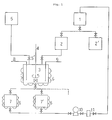
- Fig. 1 in the attached drawing is a schematic representation of the process and apparatus of the present invention.
- 1 is a coating chamber where a resist composition is applied by means of a spinner to a silicon wafer to form its thin films thereon.
- the resist composition scattered from the spinner without being used on the silicon wafer during application of the resist composition to the wafer in the coating chamber, hereinafter referred to as "waste liquid composition” is collected and introduced into a preliminary recovery tank 2.
- the waste liquid composition is then led from the preliminary recovery tank 2 into a recovery tank 3.
- the recovery tank 3 is provided with a means 6 to maintain it under a constant temperature condition and a means 4 to homogenize the waste liquid composition and to measure constantly its viscosity.
- the viscosity measuring means 4 so interlocks with an opening/closing means for a valve 5′ with which to control the solvent supply from a solvent supply tank 5, through a means to transmit the viscosity measurement result in the form of electric signals to the opening/closing means, that the valve 5′ opens or closes in response to the viscosity level of the waste liquid composition.
- the valve 5′ opens, when the viscosity of the waste liquid composition in the recovery tank 3 is higher than a predetermined viscosity, to initiate the solvent feed, and it closes, when the viscosity of the waste liquid composition has reached the predetermined viscosity, to discontinue the solvent feed.
- the recovery tank 3 is preferably provided with a thermometer 8 with which to measure the temperature of the composition.
- the resist composition in the context of the present invention refers to those resist compositions widely used in semiconductor industries or printing industries, including photosensitive resins dissolved in solvents.
- Resin components in such compositions include generally commercially available negative- or positive-photoresists and electron rays or X-rays resists; for example, negative-type photoresists such as OMR-83 and -85 (Tokyo Ohka Kogyo), CIR-701 and -707 and CBR-M901 (Japan Synthetic Rubber), KMR-747 (Nagase Sangyo) and WAYCOAT IC-T3 and SC (Fuji Hunt); positive-type photo-resists such as OFPR-800 and -5000, TSMR-8800 (Tokyo Ohka Kogyo), PFR-3600 and -3003B (Japan Synthetic Rubber) and NPR-809 and -820 (Nagase Sangyo), HPR-204 (Fuji Hunt) and MPR-1350J and
- glycol ethers such as ethylene glycol monomethyl ether (methyl cellosolve), diethylene glycol monomethyl ether, ethylene glycol monoethyl ether (ethyl cellosolve), diethylene glycol monoethyl ether and diethylene glycol dibutyl ether
- cellosolve esters such as methyl cellosolve acetate, ethyl cellosolve acetate and butyl cellosolve acetate
- aromatic hydrocarbons such as toluene and xylene
- ketones such as methyl ethyl ketone, methyl isobutyl ketone, cyclohexanone, acetonylacetone, acetophenone and isophor
- solvents may be used either alone or in combination. It is preferred to use such hydrocarbon solvents as xylene for negative-type photoresists, and 2-ethoxyethyl acetate (cellosolve acetate), either alone or in mixture with xylene and butyl acetate, for positive-type photoresists.
- hydrocarbon solvents as xylene for negative-type photoresists
- 2-ethoxyethyl acetate either alone or in mixture with xylene and butyl acetate
- the amount of such organic solvents used in resist compositions cannot be specified since it depends upon various factors, for example, the type and concentration of the resin component and the required resist film thickness.
- the general resin component-to-solvent ratio is 100 parts by weight to 100-2,000, preferably 300-1,500, parts by weight.
- the solvent to be used for the treatment mentioned above is identical in kind or composition with a single or mixed solvent in the resist composition initially used for forming its thin films on silicon wafers, and the above mentioned "predetermined viscosity" is used to mean the viscosity of the initially used resist composition.
- the resist composition now with a predetermined viscosity is introduced into a storage tank 7 where it is stored for reuse. From the storage tank 7 the resist composition is forwarded, whenever its use is required, to the coating chamber 1 for repeated use in silicon wafer coating, after passed through a filter 11 for removal of undesirable fine particles and the like possibly present in the composition. If necessary, and preferably, a plurality of storage tanks are installed (as indicated by 7′).
- the preliminary recovery tank 2 mentioned above is not essential to the process and apparatus according to the present invention, but it is preferred to install this as far as it renders possible continuous operation of the process of the invention.
- the volume of the waste liquid composition to be introduced into the recovery tank 3 is adjusted by means of a volumeter 9.
- volumeter 9 are preferably used those units capable of electrically sensing the liquid volume, for example, such liquid level sensors or electrostatic sensors as are normally used for liquid volume measurement.
- the volume thus recognized through perception by the volumeter 9 is so transmitted as electric signals as to control the waste liquid composition transfer from the preliminary recovery tank 2 to the recovery tank 3.
- Another preliminary recovery tank 2′ may be installed in order to adjust the volume of waste liquid volume transferred.
- the waste liquid composition is kept at a constant temperature using a thermostatic means 6.
- thermostatic means 6 is normally used an electrical means to keep the interior of the recovery tank 3 at a constant temperature.
- the waste liquid composition kept at a constant temperature is continuously subject to measurement for its viscosity by a viscosity measuring means 4.
- the valve 5′ for solvent supply is made to open or close in accordance with the viscosity measured.
- a viscosity measuring means 4 using a rotation viscometer is so interlocked with a means to transmit measurement results obtained therewith as electric signals to a valve 5′ opening/closing means.
- the above mentioned waste liquid composition recovered after used in the coating operation has an elevated viscosity as a result of solvent evaporation.
- the transfer of waste liquid compositions or solvents in the system according to the present invention can be achieved by choosing an appropriate method from among those means usually employed for their transfer, such as with a pump 10 or through pressure feed using nitrogen gas.
- the resist composition whose viscosity has been adjusted in the recovery tank 3 is transferred to storage tanks (7,7′) where it is stored for reuse.
- the present invention brings about excellent results, for example reduction in labor and cost, in addition to efficient utilization of resources.
Landscapes
- Physics & Mathematics (AREA)
- General Physics & Mathematics (AREA)
- Photosensitive Polymer And Photoresist Processing (AREA)
- Exposure Of Semiconductors, Excluding Electron Or Ion Beam Exposure (AREA)
- Application Of Or Painting With Fluid Materials (AREA)
Abstract
Description
- This invention relates to recovering and reusing, while applying resist composition onto silicon wafers to form thin films thereon, the resist composition scattered from spinner and no longer usable on the silicon wafer.
- More particularly, this invention relates to a process and apparatus for recovering the scattered unused resist composition as mentioned above for reuse.
- Resist compositions are used in large volumes for example in semiconductor industries or printing industries. For example, resist compositions are used to manufacture integrated circuits, e.g. by the spin-coating technique whereby they are applied, by means of a spinner or the like, to silicon wafers to form thin films. With this technique to coat silicon wafers, however, more than 90% of the resist composition used is scattered without being coated on silicon wafers, resulting in waste liquid of no use. As a matter of fact, the waste liquid is collected and commissioned to industrial waste disposal undertakers for disposal.
- From the standpoint of efficient utilization of resources, we have made extensive studies on process and apparatus for recovering for reuse such resist compositions otherwise disposed of as waste liquid, and succeeded in providing a process for recovering for reuse such resist composition waste liquid as mentioned above as well as an apparatus therefor.
- Thus, the present invention provides a process and an apparatus as mentioned below, which make it possible to recover and reuse resist composition scatters in silicon wafer coating.
- The process according to the present invention comprises:
- 1) collecting resist composition scattered from spinner;
- 2) introducing the resist composition into a recovery tank maintained under a constant temperature (thermostatic) condition;
- 3) measuring the viscosity of the recovered resist composition in the recovery tank;
- 4) introducing, in accordance with the result of the measurement, a solvent until the resist composition shows a predetermined viscosity;
- 5) discontinuing the solvent supply at the point of time when the resist composition has reached the predetermined viscosity;
- 6) transferring the resist composition with the predetermined viscosity to a storage tank; and
- 7) forwarding, whenever necessary, the resist composition from the storage tank to a coating chamber for reuse in silicon wafer coating.
- The present invention also provides an apparatus to be used for the process mentioned above.
- The apparatus according to the invention comprises a resist composition recovering tank characterized by being provided with the following means and lines a) - e) :
- a) a means to maintain the tank under a constant temperature condition;
- b) a means to measure the viscosity of the resist composition introduced as waste liquid, i.e. composition scattered from the spinner without being used;
- c) a transmittal means to transmit the result of the measurement by the viscosity measuring means to the opening/closing action of a valve placed in a passage through which to feed solvent replenishments in such a manner that the valve opens when the result of the measurement of the composition's viscosity is higher than a predetermined viscosity and closes when it has reached the predetermined viscosity;
- d) a line through which to introduce thereinto the resist composition recovered as waste liquid; and
- e) a line through which to discharge therefrom the resist composition with the predetermined viscosity.
- The process and apparatus according to the present invention will now be illustrated in more detail with reference to the attached drawing.
- Fig. 1 in the attached drawing is a schematic representation of the process and apparatus of the present invention.
- In the drawing, 1 is a coating chamber where a resist composition is applied by means of a spinner to a silicon wafer to form its thin films thereon. The resist composition scattered from the spinner without being used on the silicon wafer during application of the resist composition to the wafer in the coating chamber, hereinafter referred to as "waste liquid composition", is collected and introduced into a
preliminary recovery tank 2. The waste liquid composition is then led from thepreliminary recovery tank 2 into arecovery tank 3. Therecovery tank 3 is provided with ameans 6 to maintain it under a constant temperature condition and a means 4 to homogenize the waste liquid composition and to measure constantly its viscosity. The viscosity measuring means 4 so interlocks with an opening/closing means for avalve 5′ with which to control the solvent supply from asolvent supply tank 5, through a means to transmit the viscosity measurement result in the form of electric signals to the opening/closing means, that thevalve 5′ opens or closes in response to the viscosity level of the waste liquid composition. Thus, thevalve 5′ opens, when the viscosity of the waste liquid composition in therecovery tank 3 is higher than a predetermined viscosity, to initiate the solvent feed, and it closes, when the viscosity of the waste liquid composition has reached the predetermined viscosity, to discontinue the solvent feed. Therecovery tank 3 is preferably provided with athermometer 8 with which to measure the temperature of the composition. - The resist composition in the context of the present invention refers to those resist compositions widely used in semiconductor industries or printing industries, including photosensitive resins dissolved in solvents. Resin components in such compositions include generally commercially available negative- or positive-photoresists and electron rays or X-rays resists; for example, negative-type photoresists such as OMR-83 and -85 (Tokyo Ohka Kogyo), CIR-701 and -707 and CBR-M901 (Japan Synthetic Rubber), KMR-747 (Nagase Sangyo) and WAYCOAT IC-T3 and SC (Fuji Hunt); positive-type photo-resists such as OFPR-800 and -5000, TSMR-8800 (Tokyo Ohka Kogyo), PFR-3600 and -3003B (Japan Synthetic Rubber) and NPR-809 and -820 (Nagase Sangyo), HPR-204 (Fuji Hunt) and MPR-1350J and -111 (Shipley); electron rays or X-rays resists such as CMS (Toso), MES (Japan Synthetic Rubber), EBR-9 (Toray) and OEBR-1000 (Tokyo Ohka Kogyo).
- As solvents for such resin components are used, depending upon the type of the resin component, glycol ethers, glycol ether esters, aromatic hydrocarbons, ketones, ethers, fatty acids, alcohols, esters, lactones and the like. Suitable solvents include, for example, glycol ethers such as ethylene glycol monomethyl ether (methyl cellosolve), diethylene glycol monomethyl ether, ethylene glycol monoethyl ether (ethyl cellosolve), diethylene glycol monoethyl ether and diethylene glycol dibutyl ether; cellosolve esters such as methyl cellosolve acetate, ethyl cellosolve acetate and butyl cellosolve acetate; aromatic hydrocarbons such as toluene and xylene; ketones such as methyl ethyl ketone, methyl isobutyl ketone, cyclohexanone, acetonylacetone, acetophenone and isophorone; ethers such as benzyl ethyl ether, 1,2-butoxyethane and dihexyl ethers; fatty acids such as caproic acid and caprylic acid; alcohols such as 1-octanol, 1-nonanol, 1-decanol and benzylalcohol; esters such as ethyl acetate, butyl acetate, 2-ethylhexyl acetate, benzyl acetate, benzyl benzoate, diethyl oxalate, dibutyl oxalate, diethyl malonate, dibutyl maleate, diethyl maleate, dimethyl phthalate, ethylene carbonate and propylene carbonate; and lactones such as γ-butyrolactone.
- These solvents may be used either alone or in combination. It is preferred to use such hydrocarbon solvents as xylene for negative-type photoresists, and 2-ethoxyethyl acetate (cellosolve acetate), either alone or in mixture with xylene and butyl acetate, for positive-type photoresists. In view of the influence of cellosolve solvents on the human health recently coming into question, use of different solvent mixtures has been proposed.
- The amount of such organic solvents used in resist compositions cannot be specified since it depends upon various factors, for example, the type and concentration of the resin component and the required resist film thickness. By way of example, in resist compositions with positive-type photoresists as the resin component, the general resin component-to-solvent ratio is 100 parts by weight to 100-2,000, preferably 300-1,500, parts by weight.
- The solvent to be used for the treatment mentioned above is identical in kind or composition with a single or mixed solvent in the resist composition initially used for forming its thin films on silicon wafers, and the above mentioned "predetermined viscosity" is used to mean the viscosity of the initially used resist composition.
- After viscosity adjustment in the above described
recovery tank 3, the resist composition now with a predetermined viscosity is introduced into astorage tank 7 where it is stored for reuse. From thestorage tank 7 the resist composition is forwarded, whenever its use is required, to thecoating chamber 1 for repeated use in silicon wafer coating, after passed through afilter 11 for removal of undesirable fine particles and the like possibly present in the composition. If necessary, and preferably, a plurality of storage tanks are installed (as indicated by 7′). - The
preliminary recovery tank 2 mentioned above is not essential to the process and apparatus according to the present invention, but it is preferred to install this as far as it renders possible continuous operation of the process of the invention. The volume of the waste liquid composition to be introduced into therecovery tank 3 is adjusted by means of avolumeter 9. Assuch volumeter 9 are preferably used those units capable of electrically sensing the liquid volume, for example, such liquid level sensors or electrostatic sensors as are normally used for liquid volume measurement. The volume thus recognized through perception by thevolumeter 9 is so transmitted as electric signals as to control the waste liquid composition transfer from thepreliminary recovery tank 2 to therecovery tank 3. - Another
preliminary recovery tank 2′ may be installed in order to adjust the volume of waste liquid volume transferred. - In the
recovery tank 3, the waste liquid composition is kept at a constant temperature using athermostatic means 6. As suchthermostatic means 6 is normally used an electrical means to keep the interior of therecovery tank 3 at a constant temperature. The waste liquid composition kept at a constant temperature is continuously subject to measurement for its viscosity by a viscosity measuring means 4. Thevalve 5′ for solvent supply is made to open or close in accordance with the viscosity measured. Thus, for example, a viscosity measuring means 4 using a rotation viscometer is so interlocked with a means to transmit measurement results obtained therewith as electric signals to avalve 5′ opening/closing means. The above mentioned waste liquid composition recovered after used in the coating operation has an elevated viscosity as a result of solvent evaporation. In order to add solvent thereto to make its viscosity identical with that of the original resist composition, fresh solvent is supplied into therecovery tank 3. The formulation as to the kind and composition of the solvent is determined in accordance with the solvent formulation for the original resist composition. If the viscosity of the waste liquid composition in the recovery tank has reached that of the original resist composition,then the signals from the viscosity measuring means 4 are transmitted to a valve opening/closing means to close thevalve 5′ resulting in discontinuation of the solvent supply to therecovery tank 3. In the foregoing, the transfer of waste liquid compositions or solvents in the system according to the present invention can be achieved by choosing an appropriate method from among those means usually employed for their transfer, such as with apump 10 or through pressure feed using nitrogen gas. The resist composition whose viscosity has been adjusted in therecovery tank 3 is transferred to storage tanks (7,7′) where it is stored for reuse. - According to the process and apparatus of the present invention, almost all the resist composition scattered during coating with a spinner can be recovered without being disposed of and regenerated through viscosity adjustment into a resist composition with a predetermined formulation. Thus the present invention brings about excellent results, for example reduction in labor and cost, in addition to efficient utilization of resources.
Claims (2)
- A process for recovering and reusing resist composition, characterized by comprising collecting resist composition scattered from spinner during application of the resist composition onto silicon wafers and otherwise no longer used to be disposed of as waste liquid; introducing the resist composition into a recovery tank maintained under a constant temperature condition; introducing, while measuring the viscosity of the resist composition in the recovery tank, a solvent into the recovery tank in accordance with the measured viscosity until the resist composition shows a predetermined viscosity; discontinuing the solvent supply when the viscosity of the resist composition has reached the predetermined one; transferring the resist composition with the predetermined viscosity to a storage tank; and taking out, whenever necessary, the resist composition from the storage tank for reuse.
- A tank for recovering resist composition used in application onto silicon wafers, characterized by being provided witha) a means by which to maintain the interior of the tank at a constant temperature;b) a means by which to measure the viscosity of the resist composition introduced into the tank;c) a line through which to feed a solvent into the tank;d) a line through which to introduce thereinto the resist composition;e) a line through which to discharge therefrom the resist composition;f) a means to open the solvent feed line described above in c) when the viscosity as measured by the viscosity measuring means described above in b) is higher than a predetermined viscosity, and to close the same when it has reached the predetermined viscosity.
Applications Claiming Priority (3)
| Application Number | Priority Date | Filing Date | Title |
|---|---|---|---|
| JP30776786A JP2527318B2 (en) | 1986-12-25 | 1986-12-25 | Method and apparatus for recovering and reusing resist composition |
| JP307767/86 | 1986-12-25 | ||
| PCT/JP1987/001035 WO1988005179A1 (en) | 1986-12-25 | 1987-12-25 | Method and apparatus for recovering and reusing resist composition |
Publications (3)
| Publication Number | Publication Date |
|---|---|
| EP0296249A1 EP0296249A1 (en) | 1988-12-28 |
| EP0296249A4 EP0296249A4 (en) | 1991-01-16 |
| EP0296249B1 true EP0296249B1 (en) | 1994-08-31 |
Family
ID=17973024
Family Applications (1)
| Application Number | Title | Priority Date | Filing Date |
|---|---|---|---|
| EP88900587A Expired - Lifetime EP0296249B1 (en) | 1986-12-25 | 1987-12-25 | Method and apparatus for recovering and reusing resist composition |
Country Status (6)
| Country | Link |
|---|---|
| US (2) | US4967782A (en) |
| EP (1) | EP0296249B1 (en) |
| JP (1) | JP2527318B2 (en) |
| KR (1) | KR950014608B1 (en) |
| DE (1) | DE3750475T2 (en) |
| WO (1) | WO1988005179A1 (en) |
Cited By (2)
| Publication number | Priority date | Publication date | Assignee | Title |
|---|---|---|---|---|
| CN100504602C (en) * | 2004-05-14 | 2009-06-24 | 财团法人工业技术研究院 | Method for monitoring regenerated photoresist, photoresist regeneration process and system |
| CN108661987A (en) * | 2018-05-30 | 2018-10-16 | 雷沃重工股份有限公司 | Act on the alarm system and method for hydraulic system |
Families Citing this family (14)
| Publication number | Priority date | Publication date | Assignee | Title |
|---|---|---|---|---|
| US5289222A (en) * | 1992-06-26 | 1994-02-22 | Semiconductor Systems, Inc. | Drain arrangement for photoresist coating apparatus |
| JP3116297B2 (en) * | 1994-08-03 | 2000-12-11 | 東京エレクトロン株式会社 | Processing method and processing apparatus |
| TW306011B (en) * | 1995-04-19 | 1997-05-21 | Tokyo Electron Co Ltd | |
| JP3721016B2 (en) | 1999-09-30 | 2005-11-30 | 宮崎沖電気株式会社 | Resist processing equipment |
| US6907432B1 (en) | 2000-11-28 | 2005-06-14 | Shipley Company, L.L.C. | Method and system for recycling materials |
| KR20020065105A (en) * | 2001-02-05 | 2002-08-13 | 동안엔지니어링 주식회사 | method of reutilization of recovered and concentrated Si particles in sawing wastewater among the semiconductor rinsing wastewater |
| US6740163B1 (en) * | 2001-06-15 | 2004-05-25 | Seagate Technology Llc | Photoresist recirculation and viscosity control for dip coating applications |
| SG116641A1 (en) * | 2004-04-26 | 2005-11-28 | Matsushita Electric Industrial Co Ltd | Method and apparatus for recycling ultraviolet curing resin, and method for manufacturing optical recording medium using that recycling method. |
| KR101424275B1 (en) * | 2004-11-08 | 2014-08-13 | 브레우어 사이언스 인코포레이션 | Apparatus for coating the outer edge of a substrate during a microelectronic manufacturing process |
| JP2006210751A (en) * | 2005-01-31 | 2006-08-10 | Mitsubishi Chemical Engineering Corp | Thinner recycling supply equipment |
| JP2007072138A (en) * | 2005-09-06 | 2007-03-22 | Tokyo Ohka Kogyo Co Ltd | Resist liquid manufacturing method and resist film using the same |
| DE202005020274U1 (en) * | 2005-12-23 | 2006-02-23 | Bohnet, Saskia | Coating plant for wafers |
| US10354858B2 (en) * | 2013-12-31 | 2019-07-16 | Texas Instruments Incorporated | Process for forming PZT or PLZT thinfilms with low defectivity |
| JP7050140B1 (en) * | 2020-12-21 | 2022-04-07 | 株式会社デンソーテン | Mixing equipment and method |
Citations (1)
| Publication number | Priority date | Publication date | Assignee | Title |
|---|---|---|---|---|
| JPS599654A (en) * | 1982-07-09 | 1984-01-19 | Hitachi Ltd | System for injecting photoresist at constant temperature |
Family Cites Families (12)
| Publication number | Priority date | Publication date | Assignee | Title |
|---|---|---|---|---|
| US2711750A (en) * | 1950-09-15 | 1955-06-28 | Austin S Norcross | Apparatus for controlling the viscosity of a processing liquid |
| US2848353A (en) * | 1954-10-21 | 1958-08-19 | Edward O Norris | Method and apparatus for spraying articles including separation and recirculation of coating material |
| US2968638A (en) * | 1959-02-18 | 1961-01-17 | Joseph G Meckler | Paint reclaiming |
| JPS496974A (en) * | 1972-03-13 | 1974-01-22 | ||
| JPS5746544B2 (en) * | 1975-02-03 | 1982-10-04 | ||
| JPS52118306A (en) * | 1976-03-30 | 1977-10-04 | Isao Tanaka | Apparatus for recoverying resin left photoosensitive in molding photoosensitive resin printing plate |
| CA1163489A (en) * | 1980-10-31 | 1984-03-13 | David L. Atwell | Process for making an imaging medium solution by heating a combination including a dye dispersion and a nitrocellulose solution |
| JPS57166721A (en) * | 1981-04-06 | 1982-10-14 | Nec Corp | Surface acoustic wave dispersion type delay line |
| JPS57166033A (en) * | 1981-04-06 | 1982-10-13 | Toshiba Corp | Applying device for resist with adjusting mechanism for quantity of exhaust gas |
| US4426877A (en) * | 1982-03-03 | 1984-01-24 | Srivatsa Sanjay R | Method and apparatus for recovering oil from waste oil emulsion |
| JPS58166721A (en) * | 1982-03-29 | 1983-10-01 | Oki Electric Ind Co Ltd | Extra-high accuracy resist spinner |
| DE3332457C2 (en) * | 1983-09-08 | 1986-06-05 | Wolfgang Dipl.-Ing. 8941 Memmingerberg Richter | Process for recovering paint material from the overspray produced during spray painting and arrangement for carrying out the process |
-
1986
- 1986-12-25 JP JP30776786A patent/JP2527318B2/en not_active Expired - Fee Related
-
1987
- 1987-12-25 KR KR1019880700846A patent/KR950014608B1/en not_active Expired - Fee Related
- 1987-12-25 EP EP88900587A patent/EP0296249B1/en not_active Expired - Lifetime
- 1987-12-25 DE DE3750475T patent/DE3750475T2/en not_active Expired - Fee Related
- 1987-12-25 US US07/251,224 patent/US4967782A/en not_active Expired - Lifetime
- 1987-12-25 WO PCT/JP1987/001035 patent/WO1988005179A1/en not_active Ceased
-
1989
- 1989-10-23 US US07/425,335 patent/US5084483A/en not_active Expired - Fee Related
Patent Citations (1)
| Publication number | Priority date | Publication date | Assignee | Title |
|---|---|---|---|---|
| JPS599654A (en) * | 1982-07-09 | 1984-01-19 | Hitachi Ltd | System for injecting photoresist at constant temperature |
Cited By (2)
| Publication number | Priority date | Publication date | Assignee | Title |
|---|---|---|---|---|
| CN100504602C (en) * | 2004-05-14 | 2009-06-24 | 财团法人工业技术研究院 | Method for monitoring regenerated photoresist, photoresist regeneration process and system |
| CN108661987A (en) * | 2018-05-30 | 2018-10-16 | 雷沃重工股份有限公司 | Act on the alarm system and method for hydraulic system |
Also Published As
| Publication number | Publication date |
|---|---|
| KR890700264A (en) | 1989-03-10 |
| WO1988005179A1 (en) | 1988-07-14 |
| KR950014608B1 (en) | 1995-12-11 |
| DE3750475T2 (en) | 1994-12-15 |
| EP0296249A4 (en) | 1991-01-16 |
| US5084483A (en) | 1992-01-28 |
| US4967782A (en) | 1990-11-06 |
| JP2527318B2 (en) | 1996-08-21 |
| DE3750475D1 (en) | 1994-10-06 |
| EP0296249A1 (en) | 1988-12-28 |
| JPS63161453A (en) | 1988-07-05 |
Similar Documents
| Publication | Publication Date | Title |
|---|---|---|
| US4967782A (en) | Process and apparatus for recovering and reusing resist composition | |
| JP3093975B2 (en) | Resist stripper management system | |
| EP0159428B1 (en) | Anti-reflective coating | |
| FI76647B (en) | FOERFARANDE OCH ANORDNING FOER BEHANDLING AV BILDENLIGT EXPONERADE STRAOLNINGSKAENSLIGA SKIVOR. | |
| KR0131698B1 (en) | Apparatus for managing a stripping solution of resist | |
| JP3914722B2 (en) | Water-based resist stripping solution management apparatus and water-based resist stripping solution management method | |
| JP2004327747A (en) | Chemical coating device | |
| US5858466A (en) | Photoresist supply system with air venting | |
| WO2007074862A1 (en) | Cleaning liquid for photolithography and method of circulation and use of the same | |
| KR19990036502A (en) | Resist stripping solution management device | |
| JP3751435B2 (en) | Resist regeneration system and resist regeneration method | |
| US20080135498A1 (en) | Method and apparatus for filter conditioning | |
| JP2602179B2 (en) | Resist stripper management system | |
| US5571644A (en) | Method and apparatus for developing resist | |
| JPS62186266A (en) | developing device | |
| JPH08176505A (en) | Degassing method for polyimide varnish | |
| JPH02118662A (en) | Developing processing method | |
| EP0156369B1 (en) | Toners treated with polymeric quaternary ammonium salts and slip agent and process | |
| JPH0637001A (en) | Resist coating and developing device | |
| JPH0217968A (en) | Coating device and coating method employing said device | |
| JPS6210997Y2 (en) | ||
| JPH11169775A (en) | Resist coating equipment | |
| JPS6035072Y2 (en) | Printing plate processing equipment | |
| JPH0332781B2 (en) | ||
| CN100504602C (en) | Method for monitoring regenerated photoresist, photoresist regeneration process and system |
Legal Events
| Date | Code | Title | Description |
|---|---|---|---|
| PUAI | Public reference made under article 153(3) epc to a published international application that has entered the european phase |
Free format text: ORIGINAL CODE: 0009012 |
|
| AK | Designated contracting states |
Kind code of ref document: A1 Designated state(s): DE FR GB NL |
|
| 17P | Request for examination filed |
Effective date: 19881216 |
|
| A4 | Supplementary search report drawn up and despatched |
Effective date: 19901128 |
|
| AK | Designated contracting states |
Kind code of ref document: A4 Designated state(s): DE FR GB NL |
|
| 17Q | First examination report despatched |
Effective date: 19931008 |
|
| GRAA | (expected) grant |
Free format text: ORIGINAL CODE: 0009210 |
|
| AK | Designated contracting states |
Kind code of ref document: B1 Designated state(s): DE FR GB NL |
|
| REF | Corresponds to: |
Ref document number: 3750475 Country of ref document: DE Date of ref document: 19941006 |
|
| ET | Fr: translation filed | ||
| PLBE | No opposition filed within time limit |
Free format text: ORIGINAL CODE: 0009261 |
|
| STAA | Information on the status of an ep patent application or granted ep patent |
Free format text: STATUS: NO OPPOSITION FILED WITHIN TIME LIMIT |
|
| 26N | No opposition filed | ||
| PGFP | Annual fee paid to national office [announced via postgrant information from national office to epo] |
Ref country code: GB Payment date: 20011203 Year of fee payment: 15 |
|
| PGFP | Annual fee paid to national office [announced via postgrant information from national office to epo] |
Ref country code: NL Payment date: 20011220 Year of fee payment: 15 |
|
| REG | Reference to a national code |
Ref country code: GB Ref legal event code: IF02 |
|
| PGFP | Annual fee paid to national office [announced via postgrant information from national office to epo] |
Ref country code: FR Payment date: 20020129 Year of fee payment: 15 |
|
| PGFP | Annual fee paid to national office [announced via postgrant information from national office to epo] |
Ref country code: DE Payment date: 20020130 Year of fee payment: 15 |
|
| PG25 | Lapsed in a contracting state [announced via postgrant information from national office to epo] |
Ref country code: GB Free format text: LAPSE BECAUSE OF NON-PAYMENT OF DUE FEES Effective date: 20021225 |
|
| PG25 | Lapsed in a contracting state [announced via postgrant information from national office to epo] |
Ref country code: NL Free format text: LAPSE BECAUSE OF NON-PAYMENT OF DUE FEES Effective date: 20030701 Ref country code: DE Free format text: LAPSE BECAUSE OF NON-PAYMENT OF DUE FEES Effective date: 20030701 |
|
| GBPC | Gb: european patent ceased through non-payment of renewal fee |
Effective date: 20021225 |
|
| NLV4 | Nl: lapsed or anulled due to non-payment of the annual fee |
Effective date: 20030701 |
|
| PG25 | Lapsed in a contracting state [announced via postgrant information from national office to epo] |
Ref country code: FR Free format text: LAPSE BECAUSE OF NON-PAYMENT OF DUE FEES Effective date: 20030901 |
|
| REG | Reference to a national code |
Ref country code: FR Ref legal event code: ST |