EP0284084B1 - Stark süsse L-Aspartyl-3-(bicycloalkyl)-L-alaninalkylester - Google Patents
Stark süsse L-Aspartyl-3-(bicycloalkyl)-L-alaninalkylester Download PDFInfo
- Publication number
- EP0284084B1 EP0284084B1 EP88104825A EP88104825A EP0284084B1 EP 0284084 B1 EP0284084 B1 EP 0284084B1 EP 88104825 A EP88104825 A EP 88104825A EP 88104825 A EP88104825 A EP 88104825A EP 0284084 B1 EP0284084 B1 EP 0284084B1
- Authority
- EP
- European Patent Office
- Prior art keywords
- formula
- carbons
- process according
- ring
- vicinal
- Prior art date
- Legal status (The legal status is an assumption and is not a legal conclusion. Google has not performed a legal analysis and makes no representation as to the accuracy of the status listed.)
- Expired - Lifetime
Links
- 0 CCC(CCC1)C(*C(C(C2)C2[C@]2[C@](C)CCCC2)=C)[C@]1C(C1)C1C1=CCCCCC1 Chemical compound CCC(CCC1)C(*C(C(C2)C2[C@]2[C@](C)CCCC2)=C)[C@]1C(C1)C1C1=CCCCCC1 0.000 description 12
Classifications
-
- C—CHEMISTRY; METALLURGY
- C07—ORGANIC CHEMISTRY
- C07K—PEPTIDES
- C07K5/00—Peptides containing up to four amino acids in a fully defined sequence; Derivatives thereof
- C07K5/04—Peptides containing up to four amino acids in a fully defined sequence; Derivatives thereof containing only normal peptide links
- C07K5/06—Dipeptides
-
- C—CHEMISTRY; METALLURGY
- C07—ORGANIC CHEMISTRY
- C07K—PEPTIDES
- C07K5/00—Peptides containing up to four amino acids in a fully defined sequence; Derivatives thereof
- C07K5/04—Peptides containing up to four amino acids in a fully defined sequence; Derivatives thereof containing only normal peptide links
- C07K5/06—Dipeptides
- C07K5/06104—Dipeptides with the first amino acid being acidic
- C07K5/06113—Asp- or Asn-amino acid
-
- A—HUMAN NECESSITIES
- A23—FOODS OR FOODSTUFFS; TREATMENT THEREOF, NOT COVERED BY OTHER CLASSES
- A23L—FOODS, FOODSTUFFS OR NON-ALCOHOLIC BEVERAGES, NOT OTHERWISE PROVIDED FOR; PREPARATION OR TREATMENT THEREOF
- A23L27/00—Spices; Flavouring agents or condiments; Artificial sweetening agents; Table salts; Dietetic salt substitutes; Preparation or treatment thereof
- A23L27/30—Artificial sweetening agents
Definitions
- the sweetener L-aspartyl-L-phenylalanine methyl ester (Formula 1) is known to be about 180 times sweeter than sucrose, weight to weight. Other peptides with increased sweetening power are also known to the art. See, for example, R.H. Mazur et al., J. Am. Chem. Soc. 91 : 2684-2691 (1969) ; Zanno et al., U.S. 4,572,799; Zanno et al., U.S. 4,571,308 ; Zanno et al., U.S. 4,603,012 ; H. Iwamura, J. Med. Chem. 24 : 572-583 (1981); L.B.P.
- EP-A-201,077 which relates to L-aminodicarboxylic acid alkanes as artificial sweeteners, discloses in lines 9-10 on page 46 L-aspartyl-2-amino-4-(fenchyl)butanoic acid methyl ester as a starting material.
- a German patent application is referred to which discloses L-aspartyl-3-fenchylalanine methyl ester as a sweetening agent.
- the reference to the German patent application is wrong and should be to Dutch patent application No. 7207426.
- an object of the invention is the preparation of a high intensity sweetener, in which a suitable glucogenic bicycloalkyl group is attached to a dipeptide moiety in a manner which avoids the drawbacks of the prior art compounds.
- R 1 is a substituted or an unsubstituted bicycloalkyl ring, said ring having 7 to 8 carbon atoms, the 2- position ring carbon atom is bound to the alanine moiety, the two carbon atoms of the ring that are vicinal to the 2-position carbon are each substituted by a hydrogen or lower alkyl of 1-5 carbons, the total number of alkyl groups bound to the vicinal carbons is less than three, and R 2 is a lower alkyl group of 1-5 carbon atoms.
- the bicycloalkyl ring may be substituted at positions other than said vicinal carbon by lower alkyl of 1 to 5 carbons.
- only one of the vicinal carbons is alkyl substituted, the alkyl groups bound to the vicinal carbons have 1 to 3 carbon atoms, wherein methyl is most preferred, and the nonvicinal carbon substituents for the bicycloalkyl ring are alkyl.
- R 2 is methyl. All enantiomers, diastereomers and optical mixtures of the R 1 group are included within the invention. "2R" configuration enantiomers of the R i group are especially preferred.
- R 1 is a bornyl, camphanyl, pinanyl, norbornyl, 1-methylnorbornyl, 3-methylnorbornyl, bicyclo [2.2.2] octyl, or 7,7-dimethylnorbornyl ring.
- the R I moiety is an optical isomer or.mixture of optical isomers, or has an R chiral configuration at the 2-position carbon.
- examples of these most preferred embodiments include (2R)-exo norbomyl, (2R)-endo norbomyl ; (1R)-exo/endo pinanyl ; (2R)-exo/endo bornyl ; and 2R-exo and 2R-endo 7,7-dimethylnorbornyl.
- Another embodiment is an edible salt of the compound of formula 3.
- the invention also includes a method of using the compound of formula 3 as a high intensity sweetener, and a method of sweetening substances by adding an effective amount of the compound to an orally ingestible substance.
- the compounds of the invention can be used for sweetening edible products such as foods and beverages.
- the new sweeteners of this invention are characterized by the presence of a bicyclo [2.2.1] heptyl, a bicyclo [3.1.1] heptyl or a bicyclo [2.2.2] octyl substituent attached to the C3 of L-alanine in the dipeptide L-asp-L-ala(OCH 3 ).
- the alkyl substitution at the secondary and/or tertiary carbons of the bicyclic substituent usually increases the sweetness intensity of the basic structure, provided that the broader pattem of substitution is such that only one of the two carbons adjacent (vicinal) to the 2-position carbon bearing the amino acid side chain is fully substituted at any time.
- the preferred compounds of the present invention are those enantiomers wherein R 1 has "R" configuration at the carbon 2 position of the bicyclic ring, because they are intensely sweet. Optically pure compounds will have sweetness differing accordingly from the results presented in Table II.
- the sweeteners of this invention may be used to provide desirable properties of sweetness in any orally ingestable product.
- the sweeteners could be used in beverages such as fruit juices or drinks or carbonated soft drinks, in frozen desserts, jellies, chewing gum, dentifrices, medications or any other orally ingestible substance.
- the sweeteners of this invention are sweeter than sucrose, less caloric, and less likely to cause dental caries.
- the sweeteners of this invention may also be blended with other sweeteners known to the art. They can be used in the form of edible salts of the compound of formula 3. Examples of such salts include sulfates, malates, carbonates, phosphates, citrates, benzoates and the like.
- the intensely sweet alpha-L-aspartyl-D,L-bicycloalkyl-3-alanine methyl esters of the invention may be synthesized by the following general reaction pathway :
- the bicyclic methanol of formula 5 is reacted with an agent which will form a facile leaving group on the hydroxy of the bicyclic methanol.
- agents which will form a facile leaving group on the hydroxy of the bicyclic methanol. Examples are tosyl, brosyl, mesyl and the like.
- the compound of formula 5 can be tosylated using p-toluenesulfonyl chloride/pyridine.
- the tosylate or other derivative of formula 6 is displaced by the anion of dimethylmalonate.
- the diester of formula 7 is hydrolyzed and following acidification the corresponding diacid of formula 8 is obtained.
- the diacid is halogenated, e.g., chlorinated, iodinated or preferably brominated, followed by heating to decarboxylate the diacid.
- the haloacid e.g. bromoacid of formula 9 is converted to the amino acid of formula 10 by treatment with aqueous ammonia.
- this amino acid is esterified by treatment with methanolic hydrochloric acid giving the amino ester hydrochloride of formula 11.
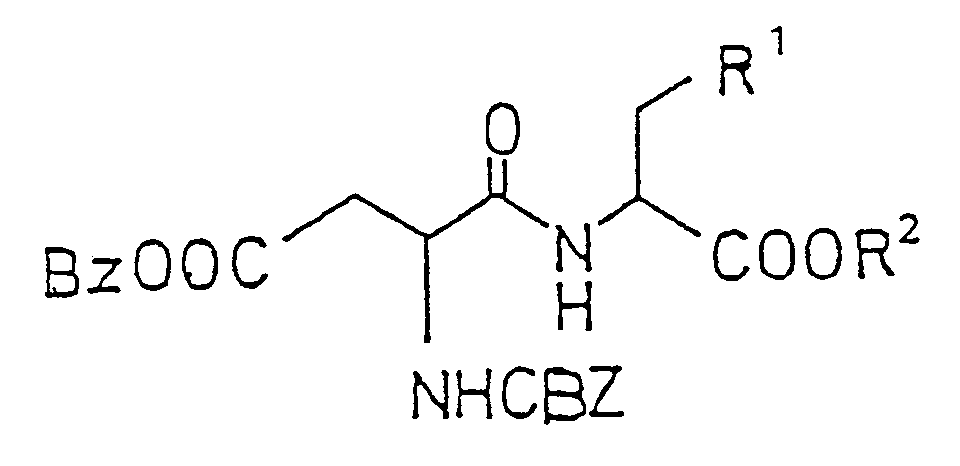
- the amino ester formula 11 is coupled to N-carbobenzyloxy-L-aspartic acid-beta-benzyl ester by the mixed anhydride method or by any other appropriate peptide formation procedure such as those utilizing carbodiimide, acid chloride, pivaloyloxy and the like, to give the protected dipeptide methyl ester of formula 12.
- the protecting groups are removed by hydrogenolysis using a palladium catalyst to give the sweet compound formula 13.
- the bicyclic methanols of formula 5 may be obtained either from commercial sources or various synthetic sequences known to the art. These starting alcohols may contain several asymmetric centers which will result in the preparation of a final sweetener of formula 13 which contains a number of stereoisomers.
- Precursors to the alcohols offormula 5, like the corresponding exocyclic olefins R CH 2 , can also be used as intermediates for the elaboration of the amino acid side chain.
- the hydroboration of such olefins with the sterically hindered hydroborating reagent 9-borabicyclo [3.3.1] nonane (9-BBN) is expected to give the tricoor- dinate boron adduct, an intermediate that can be condensed with acetoxyimino glycines (M.J. O'Donnell and J.B. Falmagne, J. Chem Soc Chem. Commun 1985, 1168-69) to yield the intermediate of formula 11 after acid workup.
- Step 1 Endo-R,S-norbornylmethyl tosylate.
- Step 2 Dimethyl (endo-R,S-norbornylmethyl) malonate.
- Step 3 Endo-R,S-norbornylmethylmalonic acid.
- Step 4 2-Bromo-3-(endo-R,S-norbornyl) propionic acid.
- Step 5 D,L-(Endo-R,S-norbornyl)-3-alanine.
- Step 6 D,L-(Endo-R,S-norbornyl)-3-alanine methyl ester hydrochloride.
- Step 7 N-Carbobenzyloxy-beta-benzyl-L-aspartyl-D,L-(endo-R,S-norbomyl)-3-alanine methyl ester.
- Step 8 L-Aspartyl-D,L-(endo-R,S-norbornyl)-3-alanine methyl ester.
- L-Aspartyl-D,L-(endo-R,S-norbornyl)-3-alanine methyl ester (1.5 g) is dissolved in 500 ml of water and the volume adjusted to one liter.
- Citric acid (1 g), phosphoric acid (2 g), caramel color (10 g), cola flavoring (10 g), and a benzoate preservative (2 g) are dissolved in the liter solution of sweetener.
- the resulting cola concentrate is diluted with 3 liters of water to provide a single strength beverage. Carbonation produces a satisfying effervescent carbonated cola drink.
Landscapes
- Chemical & Material Sciences (AREA)
- Organic Chemistry (AREA)
- Life Sciences & Earth Sciences (AREA)
- Health & Medical Sciences (AREA)
- Proteomics, Peptides & Aminoacids (AREA)
- Molecular Biology (AREA)
- Genetics & Genomics (AREA)
- Medicinal Chemistry (AREA)
- General Health & Medical Sciences (AREA)
- Biophysics (AREA)
- Biochemistry (AREA)
- Engineering & Computer Science (AREA)
- Nutrition Science (AREA)
- Food Science & Technology (AREA)
- Polymers & Plastics (AREA)
- Seasonings (AREA)
- Peptides Or Proteins (AREA)
- Non-Alcoholic Beverages (AREA)
- Medicinal Preparation (AREA)
Claims (14)




Priority Applications (1)
| Application Number | Priority Date | Filing Date | Title |
|---|---|---|---|
| AT88104825T ATE64742T1 (de) | 1987-03-27 | 1988-03-25 | Stark suesse l-aspartyl-3-(bicycloalkyl)-lalaninalkylester. |
Applications Claiming Priority (2)
| Application Number | Priority Date | Filing Date | Title |
|---|---|---|---|
| US32129 | 1987-03-27 | ||
| US07/032,129 US4788069A (en) | 1987-03-27 | 1987-03-27 | Intensely sweet L-aspartyl-3-(bicycloalkyl)-L-alanine alkyl esters |
Publications (3)
| Publication Number | Publication Date |
|---|---|
| EP0284084A2 EP0284084A2 (de) | 1988-09-28 |
| EP0284084A3 EP0284084A3 (en) | 1989-08-09 |
| EP0284084B1 true EP0284084B1 (de) | 1991-06-26 |
Family
ID=21863259
Family Applications (1)
| Application Number | Title | Priority Date | Filing Date |
|---|---|---|---|
| EP88104825A Expired - Lifetime EP0284084B1 (de) | 1987-03-27 | 1988-03-25 | Stark süsse L-Aspartyl-3-(bicycloalkyl)-L-alaninalkylester |
Country Status (23)
| Country | Link |
|---|---|
| US (1) | US4788069A (de) |
| EP (1) | EP0284084B1 (de) |
| JP (1) | JPH0613551B2 (de) |
| KR (1) | KR910009056B1 (de) |
| CN (1) | CN88101653A (de) |
| AR (1) | AR242587A1 (de) |
| AT (1) | ATE64742T1 (de) |
| AU (1) | AU611909B2 (de) |
| CA (1) | CA1321675C (de) |
| DE (2) | DE3863374D1 (de) |
| EG (1) | EG18489A (de) |
| ES (1) | ES2010642B3 (de) |
| FI (1) | FI884255A7 (de) |
| GB (1) | GB2226556B (de) |
| GR (2) | GR890300159T1 (de) |
| IE (1) | IE60934B1 (de) |
| IL (1) | IL85744A0 (de) |
| NZ (1) | NZ224047A (de) |
| PH (1) | PH25135A (de) |
| PT (1) | PT87087B (de) |
| TR (1) | TR23381A (de) |
| WO (1) | WO1988007522A1 (de) |
| ZA (1) | ZA881987B (de) |
Families Citing this family (2)
| Publication number | Priority date | Publication date | Assignee | Title |
|---|---|---|---|---|
| WO1991002711A2 (en) * | 1989-08-21 | 1991-03-07 | The Coca-Cola Company | 7,7-dimethylnorbornane derivatives |
| AT402925B (de) * | 1995-05-26 | 1997-09-25 | Chemie Linz Gmbh | L-aspartyl-l-thienylalaninmethylester, verfahren zu deren herstellung und verwendung als süssstoff |
Citations (1)
| Publication number | Priority date | Publication date | Assignee | Title |
|---|---|---|---|---|
| NL7207426A (de) * | 1971-07-12 | 1973-01-16 |
Family Cites Families (17)
| Publication number | Priority date | Publication date | Assignee | Title |
|---|---|---|---|---|
| CH489571A (de) * | 1967-09-07 | 1970-04-30 | Ciba Geigy | Verfahren zur Herstellung von wasserunlöslichen Azofarbstoffen |
| BE758860A (fr) * | 1969-11-12 | 1971-05-12 | Squibb & Sons Inc | Dipeptides |
| GB1299265A (en) * | 1970-06-04 | 1972-12-13 | Ici Ltd | (alpha-CARBOXY)GLYCYL DIPEPTIDE DERIVATIVES |
| CH589609A5 (de) * | 1972-03-29 | 1977-07-15 | Takeda Chemical Industries Ltd | |
| AU472355B2 (en) * | 1972-07-17 | 1976-05-20 | Takeda Chemical Industries, Ltd | Dipeptide esters and production thereof |
| US4633006A (en) * | 1983-12-29 | 1986-12-30 | General Foods Corporation | 3-hydroxy-4-alkyloxyphenyl aliphatic carboxylates |
| US4626442A (en) * | 1983-12-29 | 1986-12-02 | General Foods Corporation | 3-hydroxy-4-alkyloxyphenyl heterocyclic aromatic carboxylates |
| US4883888A (en) * | 1984-07-13 | 1989-11-28 | The Procter & Gamble Company | Oxa-fenchyl amines useful for preparing high intensity sweeteners |
| CA1276394C (en) * | 1984-07-13 | 1990-11-13 | John M. Janusz | Alpha-l-aspartyl-d-phenylglycine esters and amides useful as high intensity sweeteners |
| US4638071A (en) * | 1984-12-27 | 1987-01-20 | General Foods Corporation | Cycloalkyl ethers and thioethers of dipeptides |
| US4622417A (en) * | 1984-12-27 | 1986-11-11 | General Foods Corporation | L-aminodicarboxylic-(O-cycloalkyl)-L-aminocarboxylate alkyl ester sweeteners |
| US4636396A (en) * | 1985-04-15 | 1987-01-13 | General Foods Corporation | Foodstuff with L-aminodicarboxylic acid gem-diamines |
| US4572799A (en) * | 1985-04-15 | 1986-02-25 | General Foods Corporation | L-Aminodicarboxylic acid amides |
| US4603012A (en) * | 1985-05-06 | 1986-07-29 | General Foods Corporation | L-aminodicarboxylic acid alkanes |
| US4571308A (en) * | 1985-05-06 | 1986-02-18 | General Foods Corporation | L-Aminodicarboxylic acid aminoalkenoic acid ester amides |
| US4634792A (en) * | 1985-05-06 | 1987-01-06 | General Foods Corporation | L-aminodicarboxylic acid aminoalkenoic acid ester amides |
| US4622232A (en) * | 1985-05-06 | 1986-11-11 | General Foods Corporation | L-aminodicarboxylic acid alkanes |
-
1987
- 1987-03-27 US US07/032,129 patent/US4788069A/en not_active Expired - Fee Related
-
1988
- 1988-03-15 IL IL85744A patent/IL85744A0/xx unknown
- 1988-03-15 IE IE75888A patent/IE60934B1/en not_active IP Right Cessation
- 1988-03-17 AR AR88310336A patent/AR242587A1/es active
- 1988-03-21 ZA ZA881987A patent/ZA881987B/xx unknown
- 1988-03-22 EG EG162/88A patent/EG18489A/xx active
- 1988-03-24 GB GB8918486A patent/GB2226556B/en not_active Expired - Lifetime
- 1988-03-24 JP JP63503741A patent/JPH0613551B2/ja not_active Expired - Lifetime
- 1988-03-24 AU AU16828/88A patent/AU611909B2/en not_active Ceased
- 1988-03-24 KR KR1019880701379A patent/KR910009056B1/ko not_active Expired
- 1988-03-24 WO PCT/US1988/000937 patent/WO1988007522A1/en not_active Ceased
- 1988-03-25 PH PH36688A patent/PH25135A/en unknown
- 1988-03-25 ES ES88104825T patent/ES2010642B3/es not_active Expired - Lifetime
- 1988-03-25 PT PT87087A patent/PT87087B/pt not_active IP Right Cessation
- 1988-03-25 DE DE8888104825T patent/DE3863374D1/de not_active Expired - Lifetime
- 1988-03-25 CA CA000562455A patent/CA1321675C/en not_active Expired - Fee Related
- 1988-03-25 NZ NZ224047A patent/NZ224047A/xx unknown
- 1988-03-25 AT AT88104825T patent/ATE64742T1/de not_active IP Right Cessation
- 1988-03-25 EP EP88104825A patent/EP0284084B1/de not_active Expired - Lifetime
- 1988-03-25 TR TR240/88A patent/TR23381A/xx unknown
- 1988-03-25 DE DE198888104825T patent/DE284084T1/de active Pending
- 1988-03-26 CN CN198888101653A patent/CN88101653A/zh active Pending
- 1988-09-15 FI FI884255A patent/FI884255A7/fi not_active Application Discontinuation
-
1991
- 1991-07-31 GR GR89300159T patent/GR890300159T1/el unknown
- 1991-07-31 GR GR90401099T patent/GR3002400T3/el unknown
Patent Citations (1)
| Publication number | Priority date | Publication date | Assignee | Title |
|---|---|---|---|---|
| NL7207426A (de) * | 1971-07-12 | 1973-01-16 |
Also Published As
| Publication number | Publication date |
|---|---|
| IE880758L (en) | 1989-09-27 |
| ES2010642B3 (es) | 1991-12-01 |
| DE3863374D1 (de) | 1991-08-01 |
| IL85744A0 (en) | 1988-08-31 |
| AR242587A1 (es) | 1993-04-30 |
| GB2226556B (en) | 1991-03-27 |
| IE60934B1 (en) | 1994-09-07 |
| ZA881987B (en) | 1988-09-13 |
| GB8918486D0 (en) | 1990-02-21 |
| AU1682888A (en) | 1988-11-02 |
| KR910009056B1 (ko) | 1991-10-28 |
| JPH01501940A (ja) | 1989-07-06 |
| EP0284084A2 (de) | 1988-09-28 |
| GR3002400T3 (en) | 1992-12-30 |
| KR890700571A (ko) | 1989-04-25 |
| EG18489A (en) | 1993-02-28 |
| FI884255A7 (fi) | 1988-09-28 |
| EP0284084A3 (en) | 1989-08-09 |
| CA1321675C (en) | 1993-08-24 |
| PT87087B (pt) | 1992-07-31 |
| NZ224047A (en) | 1989-09-27 |
| AU611909B2 (en) | 1991-06-27 |
| FI884255A0 (fi) | 1988-09-15 |
| CN88101653A (zh) | 1988-10-26 |
| GR890300159T1 (en) | 1991-07-31 |
| US4788069A (en) | 1988-11-29 |
| ATE64742T1 (de) | 1991-07-15 |
| PT87087A (pt) | 1988-04-01 |
| JPH0613551B2 (ja) | 1994-02-23 |
| ES2010642A4 (es) | 1989-12-01 |
| DE284084T1 (de) | 1989-12-28 |
| PH25135A (en) | 1991-02-19 |
| WO1988007522A1 (en) | 1988-10-06 |
| TR23381A (tr) | 1989-12-28 |
| GB2226556A (en) | 1990-07-04 |
Similar Documents
| Publication | Publication Date | Title |
|---|---|---|
| EP0128654B1 (de) | Von GEM-Diaminoalkan abgeleitete Süssstoffe | |
| EP0168112A2 (de) | Alpha-L-aspartyl-D-Phenylglycin Ester und Amide welche als hoch intensive Süssstoffe dienen | |
| Oka et al. | Glidobactins A, B and C, new antitumor antibiotics II. Structure elucidation | |
| CA1259448A (en) | Aminomalonyl alanine compounds and use as dietary sweeteners | |
| US5298272A (en) | Bridged carboxylic ortho ester sweetener | |
| WO1985000809A1 (en) | The synthesis of cyclopropane amino acids and peptides | |
| EP0284084B1 (de) | Stark süsse L-Aspartyl-3-(bicycloalkyl)-L-alaninalkylester | |
| EP0201844A1 (de) | L-Aminodicarbonsäure-Alkane und diese enthaltende essbare Zusammensetzung | |
| DE69938352T2 (de) | N-alkylaspartyldipeptidester-derivate und süssstoffe | |
| US4758443A (en) | Thietanyl-substituted amides and use thereof as sweeteners | |
| US4883888A (en) | Oxa-fenchyl amines useful for preparing high intensity sweeteners | |
| EP0199257A2 (de) | Ester von L-Aminodicarboxylsäure und eine geniessbare, sie als Süssstoff enthaltende Zusammensetzung | |
| US4677126A (en) | Oxa-fenchyl esters and amides of alpha-L-aspartyl-D-phenylglycine | |
| DE3650564T2 (de) | Dipeptide-Analoge von Aspertam und Verfahren zur deren Herstellung, sowie eine neue Herstellung von Aspertam | |
| EP0168881B1 (de) | Oxa-fenchylester und -amide von alpha-L-asparaginsäure-D-phenylglycin | |
| JPH0570638B2 (de) | ||
| EP0310341B1 (de) | N-(L-aspartyl)aminoalkohol-Derivate und diese enthaltende Süssmittel | |
| NO164102B (no) | L-aspartyl-l-alanin-alkylester-forbindelser med intens soethet. | |
| CA1285282C (en) | Thietanyl-substituted amides | |
| EP0258032B1 (de) | Verfahren und Zwischenverbindungen für N-(S-3-Alkyl-heptanoyl)-D-gamma-glutamyl-glycyl-D-alanine | |
| US5134225A (en) | Processes and intermediates for N-(S-3-alkyl-heptanoyl)-D-gamma-glutamyl-D-alanine | |
| JPS62142199A (ja) | ジペプチド類および方法 | |
| FR2467194A2 (fr) | Acide 3-amino-2-hydroxy-4-p-hydroxy-phenyl butanoique et ses derives |
Legal Events
| Date | Code | Title | Description |
|---|---|---|---|
| PUAI | Public reference made under article 153(3) epc to a published international application that has entered the european phase |
Free format text: ORIGINAL CODE: 0009012 |
|
| AK | Designated contracting states |
Kind code of ref document: A2 Designated state(s): AT BE CH DE ES FR GR IT LI LU NL SE |
|
| PUAL | Search report despatched |
Free format text: ORIGINAL CODE: 0009013 |
|
| AK | Designated contracting states |
Kind code of ref document: A3 Designated state(s): AT BE CH DE ES FR GR IT LI LU NL SE |
|
| ITCL | It: translation for ep claims filed |
Representative=s name: ING. C. GREGORJ S.P.A. |
|
| TCNL | Nl: translation of patent claims filed | ||
| 17P | Request for examination filed |
Effective date: 19890803 |
|
| TCAT | At: translation of patent claims filed | ||
| EL | Fr: translation of claims filed | ||
| 17Q | First examination report despatched |
Effective date: 19891106 |
|
| DET | De: translation of patent claims | ||
| GRAA | (expected) grant |
Free format text: ORIGINAL CODE: 0009210 |
|
| AK | Designated contracting states |
Kind code of ref document: B1 Designated state(s): AT BE CH DE ES FR GR IT LI LU NL SE |
|
| REF | Corresponds to: |
Ref document number: 64742 Country of ref document: AT Date of ref document: 19910715 Kind code of ref document: T |
|
| ITF | It: translation for a ep patent filed | ||
| REF | Corresponds to: |
Ref document number: 3863374 Country of ref document: DE Date of ref document: 19910801 |
|
| ET | Fr: translation filed | ||
| PLBE | No opposition filed within time limit |
Free format text: ORIGINAL CODE: 0009261 |
|
| STAA | Information on the status of an ep patent application or granted ep patent |
Free format text: STATUS: NO OPPOSITION FILED WITHIN TIME LIMIT |
|
| 26N | No opposition filed | ||
| REG | Reference to a national code |
Ref country code: GR Ref legal event code: FG4A Free format text: 3002400 |
|
| EPTA | Lu: last paid annual fee | ||
| PGFP | Annual fee paid to national office [announced via postgrant information from national office to epo] |
Ref country code: GR Payment date: 19941228 Year of fee payment: 8 |
|
| PGFP | Annual fee paid to national office [announced via postgrant information from national office to epo] |
Ref country code: BE Payment date: 19941230 Year of fee payment: 8 |
|
| PGFP | Annual fee paid to national office [announced via postgrant information from national office to epo] |
Ref country code: AT Payment date: 19950105 Year of fee payment: 8 |
|
| PGFP | Annual fee paid to national office [announced via postgrant information from national office to epo] |
Ref country code: SE Payment date: 19950116 Year of fee payment: 8 |
|
| PGFP | Annual fee paid to national office [announced via postgrant information from national office to epo] |
Ref country code: ES Payment date: 19950117 Year of fee payment: 8 |
|
| EAL | Se: european patent in force in sweden |
Ref document number: 88104825.0 |
|
| PGFP | Annual fee paid to national office [announced via postgrant information from national office to epo] |
Ref country code: LU Payment date: 19950201 Year of fee payment: 8 |
|
| PGFP | Annual fee paid to national office [announced via postgrant information from national office to epo] |
Ref country code: CH Payment date: 19950221 Year of fee payment: 8 |
|
| PGFP | Annual fee paid to national office [announced via postgrant information from national office to epo] |
Ref country code: FR Payment date: 19950321 Year of fee payment: 8 |
|
| PGFP | Annual fee paid to national office [announced via postgrant information from national office to epo] |
Ref country code: DE Payment date: 19950330 Year of fee payment: 8 |
|
| PGFP | Annual fee paid to national office [announced via postgrant information from national office to epo] |
Ref country code: NL Payment date: 19950331 Year of fee payment: 8 |
|
| PG25 | Lapsed in a contracting state [announced via postgrant information from national office to epo] |
Ref country code: LU Free format text: LAPSE BECAUSE OF NON-PAYMENT OF DUE FEES Effective date: 19960325 Ref country code: AT Effective date: 19960325 |
|
| PG25 | Lapsed in a contracting state [announced via postgrant information from national office to epo] |
Ref country code: SE Effective date: 19960326 Ref country code: ES Free format text: LAPSE BECAUSE OF NON-PAYMENT OF DUE FEES Effective date: 19960326 |
|
| PG25 | Lapsed in a contracting state [announced via postgrant information from national office to epo] |
Ref country code: LI Effective date: 19960331 Ref country code: CH Effective date: 19960331 Ref country code: BE Effective date: 19960331 |
|
| BERE | Be: lapsed |
Owner name: THE COCA-COLA CY Effective date: 19960331 |
|
| PG25 | Lapsed in a contracting state [announced via postgrant information from national office to epo] |
Ref country code: GR Free format text: THE PATENT HAS BEEN ANNULLED BY A DECISION OF A NATIONAL AUTHORITY Effective date: 19960930 |
|
| PG25 | Lapsed in a contracting state [announced via postgrant information from national office to epo] |
Ref country code: NL Effective date: 19961001 |
|
| REG | Reference to a national code |
Ref country code: GR Ref legal event code: MM2A Free format text: 3002400 |
|
| REG | Reference to a national code |
Ref country code: CH Ref legal event code: PL |
|
| PG25 | Lapsed in a contracting state [announced via postgrant information from national office to epo] |
Ref country code: FR Effective date: 19961129 |
|
| NLV4 | Nl: lapsed or anulled due to non-payment of the annual fee |
Effective date: 19961001 |
|
| PG25 | Lapsed in a contracting state [announced via postgrant information from national office to epo] |
Ref country code: DE Effective date: 19961203 |
|
| EUG | Se: european patent has lapsed |
Ref document number: 88104825.0 |
|
| REG | Reference to a national code |
Ref country code: FR Ref legal event code: ST |
|
| REG | Reference to a national code |
Ref country code: ES Ref legal event code: FD2A Effective date: 19990503 |
|
| PG25 | Lapsed in a contracting state [announced via postgrant information from national office to epo] |
Ref country code: IT Free format text: LAPSE BECAUSE OF NON-PAYMENT OF DUE FEES;WARNING: LAPSES OF ITALIAN PATENTS WITH EFFECTIVE DATE BEFORE 2007 MAY HAVE OCCURRED AT ANY TIME BEFORE 2007. THE CORRECT EFFECTIVE DATE MAY BE DIFFERENT FROM THE ONE RECORDED. Effective date: 20050325 |