EP0276558B1 - Insektizide Äther - Google Patents
Insektizide Äther Download PDFInfo
- Publication number
- EP0276558B1 EP0276558B1 EP19870311027 EP87311027A EP0276558B1 EP 0276558 B1 EP0276558 B1 EP 0276558B1 EP 19870311027 EP19870311027 EP 19870311027 EP 87311027 A EP87311027 A EP 87311027A EP 0276558 B1 EP0276558 B1 EP 0276558B1
- Authority
- EP
- European Patent Office
- Prior art keywords
- carbon atoms
- formula
- compound
- alkyl
- halo
- Prior art date
- Legal status (The legal status is an assumption and is not a legal conclusion. Google has not performed a legal analysis and makes no representation as to the accuracy of the status listed.)
- Expired
Links
- 0 CCOC(*)C(F)(F)F Chemical compound CCOC(*)C(F)(F)F 0.000 description 5
- ZEZOIRFVLXEXBC-UHFFFAOYSA-N CCN1CCC1 Chemical compound CCN1CCC1 ZEZOIRFVLXEXBC-UHFFFAOYSA-N 0.000 description 1
Classifications
-
- C—CHEMISTRY; METALLURGY
- C07—ORGANIC CHEMISTRY
- C07D—HETEROCYCLIC COMPOUNDS
- C07D307/00—Heterocyclic compounds containing five-membered rings having one oxygen atom as the only ring hetero atom
- C07D307/02—Heterocyclic compounds containing five-membered rings having one oxygen atom as the only ring hetero atom not condensed with other rings
- C07D307/34—Heterocyclic compounds containing five-membered rings having one oxygen atom as the only ring hetero atom not condensed with other rings having two or three double bonds between ring members or between ring members and non-ring members
- C07D307/38—Heterocyclic compounds containing five-membered rings having one oxygen atom as the only ring hetero atom not condensed with other rings having two or three double bonds between ring members or between ring members and non-ring members with substituted hydrocarbon radicals attached to ring carbon atoms
- C07D307/40—Radicals substituted by oxygen atoms
- C07D307/42—Singly bound oxygen atoms
-
- A—HUMAN NECESSITIES
- A01—AGRICULTURE; FORESTRY; ANIMAL HUSBANDRY; HUNTING; TRAPPING; FISHING
- A01N—PRESERVATION OF BODIES OF HUMANS OR ANIMALS OR PLANTS OR PARTS THEREOF; BIOCIDES, e.g. AS DISINFECTANTS, AS PESTICIDES OR AS HERBICIDES; PEST REPELLANTS OR ATTRACTANTS; PLANT GROWTH REGULATORS
- A01N31/00—Biocides, pest repellants or attractants, or plant growth regulators containing organic oxygen or sulfur compounds
- A01N31/08—Oxygen or sulfur directly attached to an aromatic ring system
- A01N31/14—Ethers
-
- A—HUMAN NECESSITIES
- A01—AGRICULTURE; FORESTRY; ANIMAL HUSBANDRY; HUNTING; TRAPPING; FISHING
- A01N—PRESERVATION OF BODIES OF HUMANS OR ANIMALS OR PLANTS OR PARTS THEREOF; BIOCIDES, e.g. AS DISINFECTANTS, AS PESTICIDES OR AS HERBICIDES; PEST REPELLANTS OR ATTRACTANTS; PLANT GROWTH REGULATORS
- A01N37/00—Biocides, pest repellants or attractants, or plant growth regulators containing organic compounds containing a carbon atom having three bonds to hetero atoms with at the most two bonds to halogen, e.g. carboxylic acids
- A01N37/36—Biocides, pest repellants or attractants, or plant growth regulators containing organic compounds containing a carbon atom having three bonds to hetero atoms with at the most two bonds to halogen, e.g. carboxylic acids containing at least one carboxylic group or a thio analogue, or a derivative thereof, and a singly bound oxygen or sulfur atom attached to the same carbon skeleton, this oxygen or sulfur atom not being a member of a carboxylic group or of a thio analogue, or of a derivative thereof, e.g. hydroxy-carboxylic acids
- A01N37/38—Biocides, pest repellants or attractants, or plant growth regulators containing organic compounds containing a carbon atom having three bonds to hetero atoms with at the most two bonds to halogen, e.g. carboxylic acids containing at least one carboxylic group or a thio analogue, or a derivative thereof, and a singly bound oxygen or sulfur atom attached to the same carbon skeleton, this oxygen or sulfur atom not being a member of a carboxylic group or of a thio analogue, or of a derivative thereof, e.g. hydroxy-carboxylic acids having at least one oxygen or sulfur atom attached to an aromatic ring system
-
- C—CHEMISTRY; METALLURGY
- C07—ORGANIC CHEMISTRY
- C07C—ACYCLIC OR CARBOCYCLIC COMPOUNDS
- C07C255/00—Carboxylic acid nitriles
-
- C—CHEMISTRY; METALLURGY
- C07—ORGANIC CHEMISTRY
- C07C—ACYCLIC OR CARBOCYCLIC COMPOUNDS
- C07C39/00—Compounds having at least one hydroxy or O-metal group bound to a carbon atom of a six-membered aromatic ring
- C07C39/24—Halogenated derivatives
- C07C39/26—Halogenated derivatives monocyclic monohydroxylic containing halogen bound to ring carbon atoms
- C07C39/27—Halogenated derivatives monocyclic monohydroxylic containing halogen bound to ring carbon atoms all halogen atoms being bound to ring carbon atoms
-
- C—CHEMISTRY; METALLURGY
- C07—ORGANIC CHEMISTRY
- C07C—ACYCLIC OR CARBOCYCLIC COMPOUNDS
- C07C43/00—Ethers; Compounds having groups, groups or groups
- C07C43/02—Ethers
- C07C43/20—Ethers having an ether-oxygen atom bound to a carbon atom of a six-membered aromatic ring
- C07C43/225—Ethers having an ether-oxygen atom bound to a carbon atom of a six-membered aromatic ring containing halogen
-
- C—CHEMISTRY; METALLURGY
- C07—ORGANIC CHEMISTRY
- C07C—ACYCLIC OR CARBOCYCLIC COMPOUNDS
- C07C43/00—Ethers; Compounds having groups, groups or groups
- C07C43/02—Ethers
- C07C43/20—Ethers having an ether-oxygen atom bound to a carbon atom of a six-membered aromatic ring
- C07C43/23—Ethers having an ether-oxygen atom bound to a carbon atom of a six-membered aromatic ring containing hydroxy or O-metal groups
-
- C—CHEMISTRY; METALLURGY
- C07—ORGANIC CHEMISTRY
- C07C—ACYCLIC OR CARBOCYCLIC COMPOUNDS
- C07C43/00—Ethers; Compounds having groups, groups or groups
- C07C43/02—Ethers
- C07C43/257—Ethers having an ether-oxygen atom bound to carbon atoms both belonging to six-membered aromatic rings
- C07C43/29—Ethers having an ether-oxygen atom bound to carbon atoms both belonging to six-membered aromatic rings containing halogen
-
- C—CHEMISTRY; METALLURGY
- C07—ORGANIC CHEMISTRY
- C07C—ACYCLIC OR CARBOCYCLIC COMPOUNDS
- C07C43/00—Ethers; Compounds having groups, groups or groups
- C07C43/02—Ethers
- C07C43/257—Ethers having an ether-oxygen atom bound to carbon atoms both belonging to six-membered aromatic rings
- C07C43/295—Ethers having an ether-oxygen atom bound to carbon atoms both belonging to six-membered aromatic rings containing hydroxy or O-metal groups
-
- C—CHEMISTRY; METALLURGY
- C07—ORGANIC CHEMISTRY
- C07C—ACYCLIC OR CARBOCYCLIC COMPOUNDS
- C07C45/00—Preparation of compounds having >C = O groups bound only to carbon or hydrogen atoms; Preparation of chelates of such compounds
- C07C45/004—Preparation of compounds having >C = O groups bound only to carbon or hydrogen atoms; Preparation of chelates of such compounds by reaction with organometalhalides
-
- C—CHEMISTRY; METALLURGY
- C07—ORGANIC CHEMISTRY
- C07C—ACYCLIC OR CARBOCYCLIC COMPOUNDS
- C07C49/00—Ketones; Ketenes; Dimeric ketenes; Ketonic chelates
- C07C49/76—Ketones containing a keto group bound to a six-membered aromatic ring
- C07C49/84—Ketones containing a keto group bound to a six-membered aromatic ring containing ether groups, groups, groups, or groups
-
- C—CHEMISTRY; METALLURGY
- C07—ORGANIC CHEMISTRY
- C07D—HETEROCYCLIC COMPOUNDS
- C07D303/00—Compounds containing three-membered rings having one oxygen atom as the only ring hetero atom
- C07D303/02—Compounds containing oxirane rings
- C07D303/08—Compounds containing oxirane rings with hydrocarbon radicals, substituted by halogen atoms, nitro radicals or nitroso radicals
Definitions
- This invention relates to novel fluorinated ethers, useful as insecticides and acaricides, to processes and intermediates for their preparation, to insecticidal and acaricidal compositions comprising them and to methods of combating and controlling insect and acarine pests therewith.
- Insecticidal activity is disclosed for 3,3-difluorinated 2-arylpropyl ethers in European Patent Application No. 0179018-A.
- the present applicants have demonstrated insecticidal properties for certain 3,3,3-trifluorinated 2-phenylpropyl ethers.
- the invention provides compounds of formula (I) : wherein X is selected from hydrogen, halo, hydroxy, alkoxy of up to four carbon atoms and acyloxy of up to four carbon atoms, Z represents a fluoroalkyl group of one or two carbon atoms, Y represents a substituted aryl group where each substituent is selected from halo, alkyl of up to six carbon atoms, aryl, aralkyl of up to four carbon atoms in the alkyl moiety, aryloxy and arylamino, and either
- Preferred compounds according to the invention are those according to formula I as described hereinbefore wherein X is selected from hydrogen, halo and hydroxy, Z represents the trifluoromethyl group, Y represents an aryl group selected from phenyl, pyridyl and furyl, substituted with one or more substituents selected from fluoro, methyl, phenyl, benzyl, phenoxy, chlorophenoxy, fluorophenoxy, bromophenoxy and fluoroanilino, and either
- Particularly preferred compounds according to the invention are those according to formula (I) as described hereinbefore wherein X is selected from hydrogen, fluoro and chloro, Z represents trifluoromethyl, Y represents a phenoxyphenyl group in which each phenyl group may be unsubstituted or substituted with halogen, and R, W 1 , W 2 and W 3 have any of the meanings given hereinbefore, with the proviso that one of W 1 , W 2 and W 3 represents a substituent in the 4-position selected from chloro, fluoro, methoxy, ethoxy, trifluoromethyl, trifluoromethoxy and difluoromethoxy.
- the compounds of formula I include one or two centres at which asymmetric substitution may occur. Each compound may therefore exist in a number of isomeric forms. All of the compounds listed in Table I are in the form of racemic mixtures of all possible isomer combinations, but it is to be understood that the invention includes within its scope not only such racemic isomer mixtures, but also any single isomer or isomer mixture of an invention compound.
- a compound of formula IB may be converted to the corresponding compounds of formula IB, IC, IE and IF by reaction with an appropriate reagent, and the compounds of formula IC may be converted to the compounds of formula IA by reductive dechlorination, using for example a trialkyltin hydride as a reducing agent.
- a compound of formula IB can be obtained by treating a compound of formula ID with a fluorinating agent such as diethylaminosulphur trifluoride (DAST), as follows :
- DAST diethylaminosulphur trifluoride
- a compound of formula IC can be obtained by treating the corresponding compound of formula ID with a chlorinating agent such as thionyl chloride; a compound of fomula IG may be formed as a side produce of this reaction, presumably by dehydration of the hydroxy compound, the two products being separable by chromatographic means if required.
- a chlorinating agent such as thionyl chloride
- the compounds of formula IE and IF can be obtained by conventional O-alkylation and O-acylation techniques from the corresponding compounds of formula ID.
- reaction with a base such as sodium hydride in an aprotic solvent and an alkyl halide gives the compound of formula IE, for example:
- the compound of formula IF may be obtained by treating the corresponding compound of formula ID with an acyl halide or acyl anhydride in the presence of a base and a solvent, such as pyridine (py) containing a catalytic amount of 4-dimethylaminopyridine (DMAP), for example :
- the compounds of formula IA may also be prepared by reacting an alcohol of Formula : with a benzyl derivative of formula Y-CH(R)-Hal where Hal represents chloro or bromo, or a benzyl derivative of formula Y-CH(R)-Q where Q represents a displaceable group such as -O-S0 2 -CH 3 -(methanesulphonate) or -0-S0 2 -C 6H 4.-CH 3 (p-toluenesulphonate).
- the reaction preferably takes place in the presence of a base such as, for example, aqueous sodium hydroxide solution, and optionally in a two phase system in the presence of a quaternary ammonium salt which functions as a phase transfer catalyst.
- the alcohols of formula V may be prepared by reduction of the acids of Formula : in the form of an ester thereof, eg, a lower alkyl ester such as the ethyl ester.
- Suitable reducing agents for the esters include aluminium hydrides such as lithium aluminium hydride or diisobutylaluminium hydride (DIBAL), but the actual choice is dependent upon the robustness of the substituents in the group Ar in the presence of the particular reducing agent used.
- the acids of formula VI may be prepared by various procedures.
- One process (which may be generally applicable with appropriate variation), which is illustrated in detail in the Examples hereinafter, is set out in outline in the following Scheme :
- the compound of Formula (VII) may also be obtained by reacting a ketone of Formula : with chlorodifluoroacetic acid (in the form of a salt, eg, the sodium salt) and triphenylphosphine, by a procedure similar to that shown in J.Org.Chem. (1967), vol.32, page 1311.
- chlorodifluoroacetic acid in the form of a salt, eg, the sodium salt
- triphenylphosphine triphenylphosphine
- esters of Formula VIII may also be prepared by reacting an aryl substituted malonate with a bromofluoromethane by a process similar to that shown in Tetrahedron Letters (1984), vol.25, page 1329:
- the alcohols of formula V may be prepared by direct reduction of the corresponding epoxides of formula IV using, for example, catalytic hydrogenation or boranetetrahydrofuran/boron trifluoride-diethyl ether complex, thus :
- Those compounds of formulae II, III and IV wherein each of W 1 , W 2 and W 3 represents a substituent other than hydrogen are believed not to have been described before.
- the invention provides each of the compounds of formulae : wherein W 1 , W 2 and W 3 are independently selected from halo, alkyl of up to six carbon atoms, alkoxy of up to six carbon atoms, alkoxyalkyl of up to a total of six carbon atoms, haloalkyl of up to six carbon atoms and haloalkoxy of up to six carbon atoms, and Hal represents a halogen atom.
- the invention provides compounds of formulae : wherein W 1 , W 2 and W 3 are independently selected from halo, alkyl of up to six carbon atoms, alkoxy of up to six carbon atoms, alkoxyalkyl of up to a total of six carbon atoms, haloalkyl of up to six carbon atoms, and haloalkoxy of up to six carbon atoms, and Q 1 represents hydrogen or alkyl of up to four carbon atoms, such as methyl or ethyl.
- R is a cyano group
- R represents hydrogen (which may themselves be prepared by methods analogous to any of those described hereinabove for alternative values of R) by a - bromination using, for example, N-bromosuccinimide (NBS) in the presence of a radical initiator such as a, a'-Azo-bis-isobutyronitrile (AIBN), followed by displacement of the bromine atom using, for example, cuprous cyanide:
- N-bromosuccinimide N-bromosuccinimide
- AIBN a radical initiator
- displacement of the bromine atom using, for example, cuprous cyanide:
- the compounds of formula (I) may be used to combat and control infestations of insect and acarine pests.
- the insect and acarine pests which may be combated and controlled by the use of the invention compounds include those pests associated with agriculture (which term includes the growing of crops for food and fibre products, horticulture and animal husbandry), forestry, the storage of products of vegetable origin, such as fruit, grain and timber, and also those pests associated with the transmission of diseases of man and animals.
- compositions which include in addition to the insecticidally active ingredient or ingredients of formula (I) suitable inert diluent or carrier materials, and/or surface active agents.
- the compounds of the invention may be the sole active ingredient of the composition or they may be admixed with one or more additional active ingredients such as insecticides, insecticide synergist, herbicides, fungicides or plant growth regulators where appropriate.
- Suitable additional active ingredients for inclusion in admixture with the compounds of the invention may be compounds which will broaden the spectrum of activity of the compounds of the invention or increase their persistence in the location of the pest. They may synergise the activity of the compounds of the invention or complement the activity for example by increasing the speed of effect, improving knockdown or overcoming repellency. Additionally multi-component mixtures of this type may help to overcome or prevent the development of resistance to individual components.
- insecticide insecticide, herbicide or fungicide included in the mixture will depend upon its intended utility and the type of complementary action required.
- suitable insecticides include the following:
- insecticides having particular targets may be employed in the mixture if appropriate for the intended utility of the mixture.
- selective insecticides for particular crops for example stemborer specific insecticides for use in rice such as cartap or buprofezin, can be employed.
- insecticides or acaricides specific for particular insect species/stages for example ovolarvicides such as clofentezine, amitraz, chlordimeform, flubenzimine, hexythiazox and tetradifon, motilicides such as dicofol or propargite, adulticides such as bromopropylate, chlorobenzilate, or insect growth regulators such as hydramethylon, cyromazine, methoprene, chlorofluazuron and diflubenzuron may also be included in the compositions.
- ovolarvicides such as clofentezine, amitraz, chlordimeform, flubenzimine, hexythiazox and tetradifon
- motilicides such as dicofol or propargite
- adulticides such as bromopropylate, chlorobenzilate
- insect growth regulators such as hydramethylon, cyromazine, methop
- suitable insecticide synergists for use in the compositions include piperonyl butoxide, sesamex, and dodecyl imidazole.
- Suitable herbicides, fungicides and plant growth regulators for inclusion in the compositions will depend upon the intended target and the effect required.
- An example of a rice selective herbicide which can be included is propanil, an example of a plant growth regulator for use in cotton is "Pix", and examples of fungicides for use in rice include blasticides such as blasticidin-S.
- the choice of other ingredients to be used in mixture with the active ingredient will often be within the normal skill of the formulator, and will be made from known alternatives depending upon the total effect to be achieved.
- the ratio of the compound of the invention to any other active ingredient in the composition will depend upon a number of factors including the type of insect pests to be controlled, and the effects required from the mixture. However in general, the additional active ingredient of the composition will be applied at about the rate it would usually be employed if used on its own, or at a lower rate if synergism occurs.
- compositions may be in the form of dusting powders wherein the active ingredient is mixed with a solid diluent or carrier, for example kaolin, bentonite, kieselguhr, or talc, or they may be in the form of granules, wherein the active ingredient is absorbed in a porous granular material, for example pumice.
- a solid diluent or carrier for example kaolin, bentonite, kieselguhr, or talc
- granules wherein the active ingredient is absorbed in a porous granular material, for example pumice.
- compositions may be in the form of liquid preparations to be used as dips, sprays or aerosols.
- Dips and sprays are generally aqueous dispersions or emulsions of the active ingredient in the presence of one or more known wetting agents, dispersing agents or emulsifying agents (surface active agents).
- Aerosol compositions may contain the active ingredient or ingredients, a propellant and an inert diluent, for example odourless kerosene or alkylated benzenes.
- aerosol compositions may contain from 0.005% to 4% of active ingredient or ingredients, the remainder of the composition comprising a solvent, selected from odourless kerosine and alkylated benzenes, and a propellant. Aerosol compositions may optionally incorporate other additives, for example perfumes or corrosion inhibitors.
- Wetting agents, dispersing agents and emulsifying agents may be of the cationic, anionic or non-ionic type.
- Suitable agents of the cationic type include, for example, quaternary ammonium compounds, for example cetyltrimethyl ammonium bromide.
- Suitable agents of the anionic type include, for example, soaps, salts of aliphatic monoesters or sulphuric acid, for example sodium lauryl sulphate, salts of sulphonated aromatic compounds, for example sodium dodecylbenzenesulphonate, sodium, calcium or ammonium lignosulphonate, or butylnaphthalene sulphonate, and a mixture of the sodium salts of diisopropyl- and triisopropylnaphthalene sulphonates.
- Suitable agents of the non-ionic type include, for example, the condensation products of ethylene oxide with fatty alcohols such as oleyl alcohol or cetyl alcohol, or with alkyl phenols such as octyl phenol, nonyl phenol and octyl cresol.
- Other non-ionic agents are the partial esters derived from long chain fatty acids and hexitol anhydrides, the condensation products of the said partial esters with ethylene oxide, and the lecithins.
- compositions may be prepared by dissolving the active ingredient in a suitable solvent, for example, a ketonic solvent such as diacetone alcohol, or an aromatic solvent such as trimethylbenzene and optionally adding the mixture so obtained to water which may contain one or more known wetting, dispersing or emulsifying agents.
- a suitable solvent for example, a ketonic solvent such as diacetone alcohol, or an aromatic solvent such as trimethylbenzene and optionally adding the mixture so obtained to water which may contain one or more known wetting, dispersing or emulsifying agents.
- Suitable organic solvents are dimethyl formamide, ethylene dichloride, isopropyl alcohol, propylene glycol and other glycols, diacetone alcohol, toluene, kerosene, white oil, methyl naphthalene, xylenes and trichloroethylene, N-methyl-2-pyrrolidone and tetrahydrofurfuryl alcohol (THFA).
- compositions which are to be used in the form of aqueous dispersions or emulsions are generally supplied in the form of a concentrate containing a high proportion of the active ingredient or ingredients, the said concentrate to be diluted with water before use.
- These concentrates are often required to withstand storage for prolonged periods and after such storage, to be capable of dilution with water to form aqueous preparations which remain homogenous for a sufficient time to enable them to be applied by conventional spray equipment.
- the concentrates may contain 1-99% by weight of the active ingredient or ingredients.
- When diluted to form aqueous preparations such preparations may contain varying amounts of the active ingredient depending upon the purpose for which they are to be used.
- an aqueous preparation containing between 0.0001 % and 0.1 % by weight of the active ingredient is particularly useful.
- compositions are applied to the pests, to the locus of the pests, to the habitat of the pests, or to growing plants liable to infestation by the pests, by any of the known means of applying pesticidal compositions, for example, by dusting or spraying.
- compositions of formula (I) and compositions comprising them are very toxic to wide varieties of insect, acarine and other invertebrate pests, including, for example, the following:
- the compounds according to formula (I) and compositions comprising them have been shown to be useful for the control of lepidopteran pests, for example Spodoptera spp. and Heliothis spp. and public health pests such as flies, mosquitos and cockroaches. They are particularly useful for the control of acarine pests such as Tetranychus spp. and Panonychus spp. and pests of maize and rice such as Chilo spp. (stem borers), Nilaparvata spp. and Nephotettix spp. (plant and leaf hoppers).
- Some of the compounds are of particular value for the control of pests of rice because they show high levels of activity against these pests at rates which are not toxic to fish, thus enabling their use in paddy rice where fish are cultivated in the paddy. They may also be useful in combating insect and acarine pests which infest domestic animals, such as Lucilia sericata, and ixodid ticks such as Boophilus spp., Ixodes spp., Amblyomma spp., Rhipicephalus spp. and Dermaceutor spp. They are effective in combating both susceptible and resistant strains of these pests in their adult, larval and intermediate stages of growth, and may be applied to the infested host animal by topical, oral or parenteral administration.
- insect and acarine pests which infest domestic animals, such as Lucilia sericata, and ixodid ticks such as Boophilus spp., Ixodes spp., Amblyomma s
- This Example illustrates the stages in the preparation of 3,5-difluoro-4-ethoxy-a,a,a-trifluoroacetophenone.
- the residual oil was purified by chromatography on a silica gel support, eluting with n-hexane containing 10% by volume ethyl acetate, to give a yellow oil (10 g).
- This oil was distilled under reduced pressure (ca 20 mm Hg) using a Kugelrohr apparatus to give 3,5-difluoro-4-ethoxy-a,a,a,- trifluoroacetophenone as a colourless oil (6.5 g).
- the first major fraction was characterised as (RS)-1,1,1-trifluoro-2-chloro-2-(3,5-difluoro-4-ethoxyphenyl)-3-(3-phenoxybenzyloxy)propane (0.2g-90% pure by gas liquid chromatography).
- This Example illustrates the preparation of (RS)-1,1,1-trifluoro-2-(4-ethoxyphenyl)prop-2-ene oxide.
- Trimethylsulphoxonium iodide (8.1 g) was added to a stirred solution of 4-ethoxy- a,a,a-trifluoroacetophenone (8g, prepared according to the method described in Example 3 of UK Patent Application No. 2178739) in t-butanol (25 cm 3 ).
- potassium hydroxide pellets (2g) were added, and the reaction mixture was heated at the reflux temperature for one hour. The mixture was cooled, and poured into a dilute aqueous solution of hydrochloric acid. The aqueous mixture was extracted eight times with diethyl ether and the combined extracts were dried over anhydrous magnesium sulphate.
- This Example illustrates the preparation of (RS)-1,1,1-trifluoro-2-(4-ethoxyphenyl)propan-3-ol.
- the mesylate (0.19g) was dissolved in dichloromethane (3 cm 3 ) and treated sequentially with 1,1,1-trifluoro-2-(4-ethoxyphenyl)propan-3-ol (0.08g), tetra-n-butylammonium hydrogen sulphate (0.015g) and 40% aqueous sodium hydroxide solution.
- This Example illustrates the preparation of (RS)-1,1,1-trifluoro-2-(4-ethoxyphenyl)-3-(3-phenoxyben- zyloxy)propane from (RS)-1,1,1-trifluoro-2-(4-ethoxyphenyl)propan-3-ol.
- the residual oil (0.75 g) was purified by chromatography on a silica gel column eluted with a mixture of hexane (23 parts by volume) and ethyl acetate (2 parts by volume) to yield (RS)-1,1,1-trifluoro-2-(4-ethoxyphenyl)-3-(3-phenox- ybenzyloxy)propane (0.21 g) as a viscous oil.
- This Example illustrates the stages in the preparation of (2RS)-1,1,1-trifluoro-2-(4-ethoxyphenyl)-3-[(RS)-a-cyano-3-phenoxybenzyloxy]propane (Compound No. 90).
- This Example illustrates the insecticidal and acaricidal properties of the Products of this invention.
- the activity of the Product was determined using a variety of insect and acarine pests.
- the Product was used in the form of liquid preparations containing 500 parts per million (ppm) by weight of the Product.
- the preparations were made by dissolving the Product in acetone and diluting the solutions with water containing 0.01% by weight of a wetting agent sold under the trade name "LISSAPOL” NX until the liquid preparations contained the required concentration of the Product.
- "Lissapol” is a Registered Trade Mark.
- test procedure adopted with regard to each pest was basically the same and comprised. supporting a number of the pests on a medium which was usually a host plant or a foodstuff on which the pests feed, and treating either or both the pests and the medium with the preparations. The mortality of the pests was then assessed at periods usually varying from one to three days after the treatment.
- results of the tests are given in Table III for each of the Products, at the rate in parts per million given in the second column as a grading of mortality designated as A, B or C wherein A indicates 80-100% mortality or knockdown (70-100% in the case of Spodoptera exigua), B indicates 50-79% mortality or knockdown (50-69% in the case of Spodoptera exigua) and C indicates less than 50% mortality or knockdown.
- Table III the pest organism used is designated by a letter code and the pest species, the support medium or food, and the type and duration of test is given in Table II.
Landscapes
- Chemical & Material Sciences (AREA)
- Organic Chemistry (AREA)
- Life Sciences & Earth Sciences (AREA)
- Agronomy & Crop Science (AREA)
- Pest Control & Pesticides (AREA)
- Plant Pathology (AREA)
- Health & Medical Sciences (AREA)
- Engineering & Computer Science (AREA)
- Dentistry (AREA)
- General Health & Medical Sciences (AREA)
- Wood Science & Technology (AREA)
- Zoology (AREA)
- Environmental Sciences (AREA)
- Chemical Kinetics & Catalysis (AREA)
- Organic Low-Molecular-Weight Compounds And Preparation Thereof (AREA)
- Agricultural Chemicals And Associated Chemicals (AREA)
Claims (15)
- Verbindung der Formel,
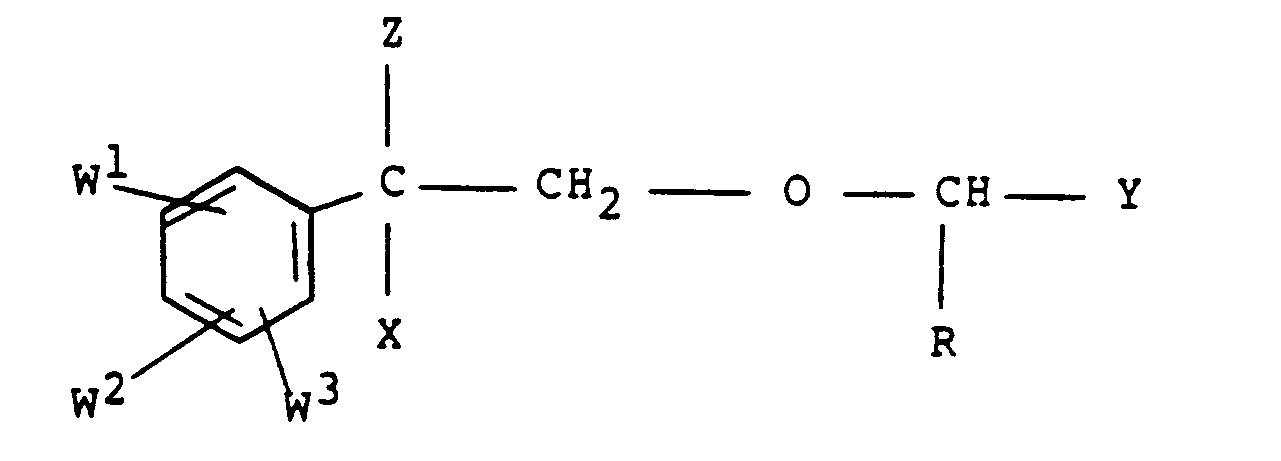 (i) R für Wasserstoff steht und W1, W2 und W3 unabhängig ausgewählt sind aus Halogen, Alkyl mit bis zu 6 Kohlenstoffatomen, Alkoxy mit bis zu 6 Kohlenstoffatomen, Alkoxyalkyl mit bis zu insgesamt 6 Kohlenstoffatomen, Halogenoalkyl mit bis zu 6 Kohlenstoffatomen und Halogenoalkoxy mit bis zu 6 Kohlenstoffatomen oder(ii) R ausgewählt ist aus Methyl, Trifluoromethyl, Cyano und Ethinyl und W1, W2 und W3 unabhängig ausgewählt sind aus Wasserstoff, Halogen, Alkyl mit bis zu 6 Kohlenstoffatomen, Alkoxy mit bis zu 6 Kohlenstoffatomen, Alkoxyalkyl mit bis zu insgesamt 6 Kohlenstoffatomen, Halogenoalkyl mit bis zu 6 Kohlenstoffatomen und Halogenoalkoxy mit bis zu 6 Kohlenstoffatomen.
 - 2. Verbindung nach Anspruch 1, worin X ausgewählt ist aus Wasserstoff, Halogen und Hydroxy, Z für die Trifluoromethyl-Gruppe steht, Y für eine Aryl-Gruppe steht, die ausgewählt ist aus Phenyl, Pyridyl und Furyl und substituiert ist mit einem oder mehreren Substituenten, die ausgewählt sind aus Fluoro, Methyl, Phenyl, Benzyl, Phenoxy, Chlorophenoxy, Fluorophenoxy, Bromophenoxy und Fluoroanilino, und entweder(i) R für Wasserstoff steht und W1, W2 und W3 unabhängig ausgewählt sind aus Fluoro, Chloro, Bromo, Alkyl mit bis zu 4 Kohlenstoffatomen, Alkoxy mit bis zu 4 Kohlenstoffatomen, Alkoxyalkyl mit bis zu insgesamt 4 Kohlenstoffatomen, Halogenoalkyl mit bis zu 2 Kohlenstoffatomen und Halogenoalkoxy mit bis zu 2 Kohlenstoffatomen oder(ii) R ausgewählt ist aus Methyl, Trifluoromethyl, Cyano und Ethinyl und W1, W2 und W3 unabhängig ausgewählt sind aus Wasserstoff, Fluoro, Chloro, Bromo, Alkyl mit bis zu 4 Kohlenstoffatomen, Alkoxy mit bis zu 4 Kohlenstoffatomen, Alkoxyalkyl mit bis zu insgesamt 4 Kohlenstoffatomen, Halogenoalkyl mit bis zu 2 Kohlenstoffatomen und Halogenoalkoxy mit bis zu 2 Kohlenstoffatomen.
- 3. Verbindung nach Anspruch 1, worin X ausgewählt ist aus Wasserstoff, Fluoro und Chloro, Z für Trifluoromethyl steht, Y für eine Phenoxyphenyl-Gruppe steht, worin jede Phenyl-Gruppe unsubstituiert ist oder durch Halogen substituiert sein kann, und R, W1, W2 und W3 die in Anspruch 1 angegebenen Bedeutungen besitzen, mit der Maßgabe, daß eines der Symbole W1, W2 und W3 für einen Substituenten in der 4-Stellung steht, der ausgewählt ist aus Chloro, Fluoro, Methoxy, Ethoxy, Trifluoromethyl, Trifluoromethoxy und Difluoromethoxy.
- 4. Insecticide und acaricide Zusammensetzung, welche eine insecticid und acaricid wirksame Menge einer Verbindung nach Anspruch 1 gemeinsam mit einem insecticid und acaricid inerten Verdünnungs-oder Trägermittel enthält.
- 5. Verfahren zur Bekämpfung von Insekten- und Milbenschädlingen an einem bestimmten Ort, bei welchem auf den Ort eine insecticid und acaricid wirksame Menge einer Zusammensetzung nach Anspruch 2 aufgebracht wird.
- 6. Verfahren zur Herstellung eines Produkts der Formel,
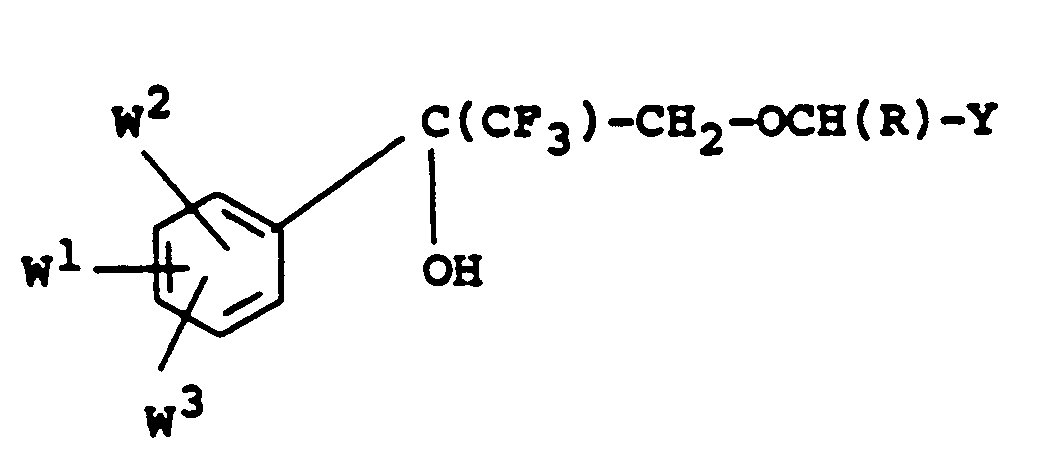
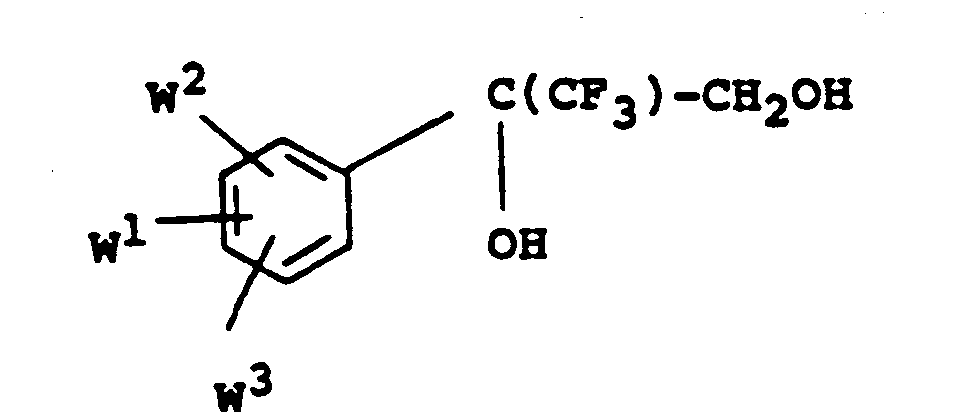 Y-CH(R)-Hal
oder (ii) eine Verbindung der Formel Y-CH(R)-OH
oder (iii) eine Verbindung der Formel Y-CH(R)-OH
umgesetzt wird und hierauf gegebenenfalls das Produkt(a) durch Umsetzung mit einem Fluorierungsmittel in eine Verbindung der Formel (b) durch Umsetzung mit einem anorganischen Säurechlorid in eine Verbindung der Formel
 (c) durch Umsetzung mit einem Alkylhalogenid und einer Base in ein O-Alkyl-Derivat oder(d) oder durch Umsetzung mit einem Acylchlorid oder einem Acylanhydrid in ein O-Acyl-Derivat umgewandelt wird, wobei Hal für Chlor oder Brom steht.
 - 7. Verfahren zur Herstellung einer Verbindung der Formel,


- 8. Verfahren zur Herstellung einer Verbindung der Formel,

 Y-CH(R)-Q
umgesetzt wird,
wobei Q für Chlor oder Brom steht oder Q für eine Gruppe der Formel -OS02CH3 oder eine Gruppe der Formel
- 9. Verbindung der Formel,
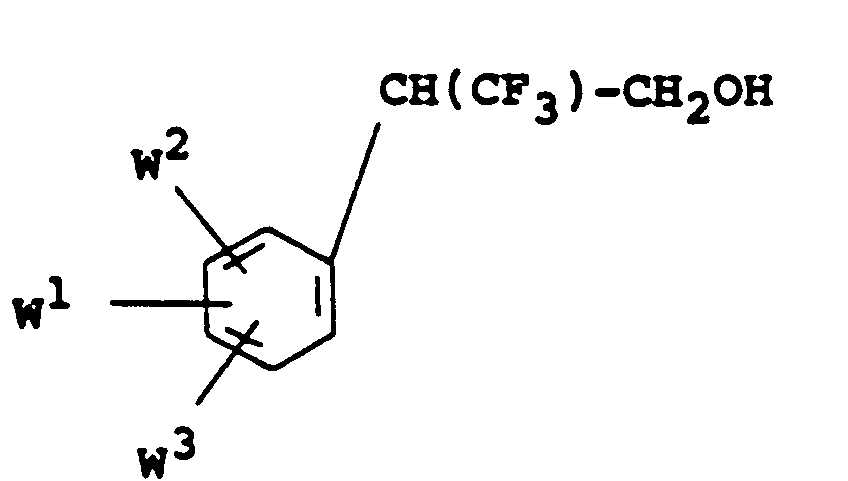
- 10. Verbindung der Formel,

- 11. Verbindung der Formel,

- 12. Verbindung der Formel,

- 13. Verbindung der Formel,
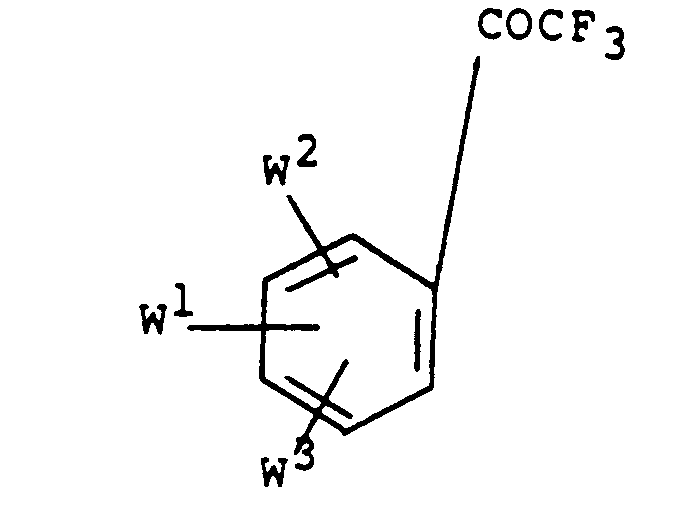
- 14. Verbindung der Formel

- 15. Verfahren zur Herstellung eines Produkts der Formel,
 (i) eine Verbindung der Formel
 (ii) eine gemäß dem Verfahren der Stufe (i) hergestellte Verbindung der Formel
Priority Applications (1)
| Application Number | Priority Date | Filing Date | Title |
|---|---|---|---|
| AT87311027T ATE78018T1 (de) | 1987-01-08 | 1987-12-15 | Insektizide aether. |
Applications Claiming Priority (4)
| Application Number | Priority Date | Filing Date | Title |
|---|---|---|---|
| GB878700393A GB8700393D0 (en) | 1987-01-08 | 1987-01-08 | Insecticidal ethers |
| GB878700394A GB8700394D0 (en) | 1987-01-08 | 1987-01-08 | Insecticidal ethers |
| GB8700393 | 1987-01-08 | ||
| GB8700394 | 1987-01-08 |
Publications (3)
| Publication Number | Publication Date |
|---|---|
| EP0276558A2 EP0276558A2 (de) | 1988-08-03 |
| EP0276558A3 EP0276558A3 (en) | 1988-10-19 |
| EP0276558B1 true EP0276558B1 (de) | 1992-07-08 |
Family
ID=26291765
Family Applications (1)
| Application Number | Title | Priority Date | Filing Date |
|---|---|---|---|
| EP19870311027 Expired EP0276558B1 (de) | 1987-01-08 | 1987-12-15 | Insektizide Äther |
Country Status (6)
| Country | Link |
|---|---|
| EP (1) | EP0276558B1 (de) |
| CN (1) | CN88100088A (de) |
| AU (1) | AU605224B2 (de) |
| BR (1) | BR8800043A (de) |
| DE (1) | DE3780291T2 (de) |
| GB (1) | GB2199825B (de) |
Families Citing this family (4)
| Publication number | Priority date | Publication date | Assignee | Title |
|---|---|---|---|---|
| BG48681A3 (bg) * | 1982-12-14 | 1991-04-15 | Ciba - Geigy Ag | Фунгицидно средство |
| GB8702717D0 (en) * | 1987-02-06 | 1987-03-11 | Ici Plc | Insecticidal compounds |
| GB8822793D0 (en) * | 1988-09-28 | 1988-11-02 | Ici Plc | Insecticidal compounds |
| DE3907784A1 (de) * | 1989-03-10 | 1990-09-13 | Hoechst Ag | Heteroaryl-aryl-buten- und -butanderivate, verfahren zu ihrer herstellung, sie enthaltende mittel und ihre verwendung als schaedlingsbekaempfungsmittel |
Family Cites Families (5)
| Publication number | Priority date | Publication date | Assignee | Title |
|---|---|---|---|---|
| DE2616479C2 (de) * | 1976-04-14 | 1986-12-04 | Brickl, Rolf, Dr., 7951 Warthausen | Substituierte Fluoracylresorcine, Verfahren zu ihrer Herstellung und diese enthaltende Arzneimittel und Kosmetika |
| US4518604A (en) * | 1983-07-25 | 1985-05-21 | Pfizer Inc. | Antifungal 1-aryl-2-(1H-1,2,4-triazol-1yl)-1-perfluoroalkylethyl halides |
| DE3438483A1 (de) * | 1984-10-17 | 1986-04-17 | Schering AG, Berlin und Bergkamen, 1000 Berlin | Substituierte benzylether, schaedlingsbekaempfungsmittel enthaltend diese verbindungen sowie verfahren zu ihrer herstellung |
| GB8520027D0 (en) * | 1985-08-09 | 1985-09-18 | Ici Plc | Insecticidal ethers |
| DE3602169A1 (de) * | 1986-01-22 | 1987-07-23 | Schering Ag | Neue alkan- und alkoxyalkanderivate, verfahren zu ihrer herstellung und diese verbindungen enthaltende insektizide und akarizide mittel |
-
1987
- 1987-12-15 GB GB8729242A patent/GB2199825B/en not_active Expired - Lifetime
- 1987-12-15 EP EP19870311027 patent/EP0276558B1/de not_active Expired
- 1987-12-15 DE DE19873780291 patent/DE3780291T2/de not_active Expired - Fee Related
- 1987-12-23 AU AU82997/87A patent/AU605224B2/en not_active Ceased
-
1988
- 1988-01-07 BR BR8800043A patent/BR8800043A/pt not_active Application Discontinuation
- 1988-01-08 CN CN198888100088A patent/CN88100088A/zh active Pending
Also Published As
| Publication number | Publication date |
|---|---|
| AU8299787A (en) | 1988-07-14 |
| EP0276558A2 (de) | 1988-08-03 |
| CN88100088A (zh) | 1988-10-05 |
| GB2199825A (en) | 1988-07-20 |
| BR8800043A (pt) | 1988-08-02 |
| DE3780291T2 (de) | 1993-01-07 |
| AU605224B2 (en) | 1991-01-10 |
| DE3780291D1 (de) | 1992-08-13 |
| GB8729242D0 (en) | 1988-01-27 |
| GB2199825B (en) | 1991-04-17 |
| EP0276558A3 (en) | 1988-10-19 |
Similar Documents
| Publication | Publication Date | Title |
|---|---|---|
| US5196610A (en) | Insecticidal ethers | |
| EP0273549B1 (de) | Insektizide thioäther und ihre Derivate | |
| US4937388A (en) | Insecticidal ethers | |
| US5017606A (en) | Fluorobenzyl esters | |
| US5026727A (en) | Insecticidal compounds | |
| EP0276558B1 (de) | Insektizide Äther | |
| US4891450A (en) | Process for intermediates for insecticidal compounds | |
| US4853414A (en) | Halogenated esters | |
| EP0220810B1 (de) | Insektizide Äther | |
| US4792563A (en) | Insecticidal ethers | |
| US4788348A (en) | Insecticidal alkenes | |
| US5091416A (en) | Insecticidal compounds | |
| US5225607A (en) | Insecticidal ethers | |
| GB2243830A (en) | An insecticidal cyclopropane carboxylic acid ester | |
| EP0298590B1 (de) | Halogenierte Ester | |
| GB2205096A (en) | Insecticidal ethers | |
| GB2204582A (en) | Insecticidal ethers | |
| GB2210878A (en) | Insecticidal ether compounds | |
| GB2233650A (en) | Insecticidal ether | |
| GB2219582A (en) | Insecticidal 2-cyclyl-3, 3-difluoropropyl ethers | |
| GB2219290A (en) | Insecticidal fluoroalkyl-benzene and -pyridine derivatives |
Legal Events
| Date | Code | Title | Description |
|---|---|---|---|
| PUAI | Public reference made under article 153(3) epc to a published international application that has entered the european phase |
Free format text: ORIGINAL CODE: 0009012 |
|
| AK | Designated contracting states |
Kind code of ref document: A2 Designated state(s): AT BE CH DE ES FR GB GR IT LI LU NL SE |
|
| PUAL | Search report despatched |
Free format text: ORIGINAL CODE: 0009013 |
|
| AK | Designated contracting states |
Kind code of ref document: A3 Designated state(s): AT BE CH DE ES FR GB GR IT LI LU NL SE |
|
| 17P | Request for examination filed |
Effective date: 19890329 |
|
| 17Q | First examination report despatched |
Effective date: 19901023 |
|
| RBV | Designated contracting states (corrected) |
Designated state(s): AT BE CH DE ES FR GR IT LI LU NL SE |
|
| GRAA | (expected) grant |
Free format text: ORIGINAL CODE: 0009210 |
|
| AK | Designated contracting states |
Kind code of ref document: B1 Designated state(s): AT BE CH DE ES FR GR IT LI LU NL SE |
|
| PG25 | Lapsed in a contracting state [announced via postgrant information from national office to epo] |
Ref country code: IT Free format text: LAPSE BECAUSE OF FAILURE TO SUBMIT A TRANSLATION OF THE DESCRIPTION OR TO PAY THE FEE WITHIN THE PRE;WARNING: LAPSES OF ITALIAN PATENTS WITH EFFECTIVE DATE BEFORE 2007 MAY HAVE OCCURRED AT ANY TIME BEFORE 2007. THE CORRECT EFFECTIVE DATE MAY BE DIFFERENT FROM THE ONE RECORDED.SCRIBED TIME-LIMIT Effective date: 19920708 Ref country code: NL Effective date: 19920708 Ref country code: SE Effective date: 19920708 Ref country code: BE Effective date: 19920708 Ref country code: AT Effective date: 19920708 Ref country code: GR Free format text: LAPSE BECAUSE OF FAILURE TO SUBMIT A TRANSLATION OF THE DESCRIPTION OR TO PAY THE FEE WITHIN THE PRESCRIBED TIME-LIMIT Effective date: 19920708 |
|
| REF | Corresponds to: |
Ref document number: 78018 Country of ref document: AT Date of ref document: 19920715 Kind code of ref document: T |
|
| REF | Corresponds to: |
Ref document number: 3780291 Country of ref document: DE Date of ref document: 19920813 |
|
| ET | Fr: translation filed | ||
| PG25 | Lapsed in a contracting state [announced via postgrant information from national office to epo] |
Ref country code: ES Free format text: LAPSE BECAUSE OF FAILURE TO SUBMIT A TRANSLATION OF THE DESCRIPTION OR TO PAY THE FEE WITHIN THE PRESCRIBED TIME-LIMIT Effective date: 19921019 |
|
| PGFP | Annual fee paid to national office [announced via postgrant information from national office to epo] |
Ref country code: FR Payment date: 19921111 Year of fee payment: 6 |
|
| PGFP | Annual fee paid to national office [announced via postgrant information from national office to epo] |
Ref country code: CH Payment date: 19921116 Year of fee payment: 6 |
|
| PGFP | Annual fee paid to national office [announced via postgrant information from national office to epo] |
Ref country code: DE Payment date: 19921125 Year of fee payment: 6 |
|
| NLV1 | Nl: lapsed or annulled due to failure to fulfill the requirements of art. 29p and 29m of the patents act | ||
| PG25 | Lapsed in a contracting state [announced via postgrant information from national office to epo] |
Ref country code: LU Free format text: LAPSE BECAUSE OF NON-PAYMENT OF DUE FEES Effective date: 19921231 |
|
| PLBE | No opposition filed within time limit |
Free format text: ORIGINAL CODE: 0009261 |
|
| STAA | Information on the status of an ep patent application or granted ep patent |
Free format text: STATUS: NO OPPOSITION FILED WITHIN TIME LIMIT |
|
| 26N | No opposition filed | ||
| PG25 | Lapsed in a contracting state [announced via postgrant information from national office to epo] |
Ref country code: LI Effective date: 19931231 Ref country code: CH Effective date: 19931231 |
|
| PG25 | Lapsed in a contracting state [announced via postgrant information from national office to epo] |
Ref country code: FR Effective date: 19940831 |
|
| REG | Reference to a national code |
Ref country code: CH Ref legal event code: PL |
|
| PG25 | Lapsed in a contracting state [announced via postgrant information from national office to epo] |
Ref country code: DE Effective date: 19940901 |
|
| REG | Reference to a national code |
Ref country code: FR Ref legal event code: ST |