EP0273607B1 - Widerstandsschweissgerät - Google Patents
Widerstandsschweissgerät Download PDFInfo
- Publication number
- EP0273607B1 EP0273607B1 EP87310681A EP87310681A EP0273607B1 EP 0273607 B1 EP0273607 B1 EP 0273607B1 EP 87310681 A EP87310681 A EP 87310681A EP 87310681 A EP87310681 A EP 87310681A EP 0273607 B1 EP0273607 B1 EP 0273607B1
- Authority
- EP
- European Patent Office
- Prior art keywords
- electrode
- wire
- block
- guide surface
- wheel
- Prior art date
- Legal status (The legal status is an assumption and is not a legal conclusion. Google has not performed a legal analysis and makes no representation as to the accuracy of the status listed.)
- Expired - Lifetime
Links
- 238000003466 welding Methods 0.000 title claims abstract description 29
- 239000000463 material Substances 0.000 claims abstract description 18
- 239000011261 inert gas Substances 0.000 claims description 5
- 238000001816 cooling Methods 0.000 claims description 3
- 238000007254 oxidation reaction Methods 0.000 claims description 3
- QSHDDOUJBYECFT-UHFFFAOYSA-N mercury Chemical compound [Hg] QSHDDOUJBYECFT-UHFFFAOYSA-N 0.000 abstract description 7
- 229910052753 mercury Inorganic materials 0.000 abstract description 7
- 229910052751 metal Inorganic materials 0.000 description 17
- 239000002184 metal Substances 0.000 description 17
- 238000000576 coating method Methods 0.000 description 3
- 230000000694 effects Effects 0.000 description 3
- IJGRMHOSHXDMSA-UHFFFAOYSA-N Atomic nitrogen Chemical compound N#N IJGRMHOSHXDMSA-UHFFFAOYSA-N 0.000 description 2
- VYZAMTAEIAYCRO-UHFFFAOYSA-N Chromium Chemical group [Cr] VYZAMTAEIAYCRO-UHFFFAOYSA-N 0.000 description 2
- RYGMFSIKBFXOCR-UHFFFAOYSA-N Copper Chemical compound [Cu] RYGMFSIKBFXOCR-UHFFFAOYSA-N 0.000 description 2
- PXHVJJICTQNCMI-UHFFFAOYSA-N Nickel Chemical compound [Ni] PXHVJJICTQNCMI-UHFFFAOYSA-N 0.000 description 2
- 229910000831 Steel Inorganic materials 0.000 description 2
- 239000011248 coating agent Substances 0.000 description 2
- 238000010438 heat treatment Methods 0.000 description 2
- 230000003068 static effect Effects 0.000 description 2
- 239000010959 steel Substances 0.000 description 2
- 239000005028 tinplate Substances 0.000 description 2
- XLYOFNOQVPJJNP-UHFFFAOYSA-N water Substances O XLYOFNOQVPJJNP-UHFFFAOYSA-N 0.000 description 2
- CWYNVVGOOAEACU-UHFFFAOYSA-N Fe2+ Chemical compound [Fe+2] CWYNVVGOOAEACU-UHFFFAOYSA-N 0.000 description 1
- 101100042271 Mus musculus Sema3b gene Proteins 0.000 description 1
- ATJFFYVFTNAWJD-UHFFFAOYSA-N Tin Chemical compound [Sn] ATJFFYVFTNAWJD-UHFFFAOYSA-N 0.000 description 1
- HCHKCACWOHOZIP-UHFFFAOYSA-N Zinc Chemical compound [Zn] HCHKCACWOHOZIP-UHFFFAOYSA-N 0.000 description 1
- 239000003795 chemical substances by application Substances 0.000 description 1
- 229910052804 chromium Inorganic materials 0.000 description 1
- 239000011651 chromium Substances 0.000 description 1
- 229910017052 cobalt Inorganic materials 0.000 description 1
- 239000010941 cobalt Substances 0.000 description 1
- GUTLYIVDDKVIGB-UHFFFAOYSA-N cobalt atom Chemical compound [Co] GUTLYIVDDKVIGB-UHFFFAOYSA-N 0.000 description 1
- 239000002131 composite material Substances 0.000 description 1
- 238000010276 construction Methods 0.000 description 1
- 239000002826 coolant Substances 0.000 description 1
- 239000000112 cooling gas Substances 0.000 description 1
- QDOXWKRWXJOMAK-UHFFFAOYSA-N dichromium trioxide Chemical compound O=[Cr]O[Cr]=O QDOXWKRWXJOMAK-UHFFFAOYSA-N 0.000 description 1
- 238000006073 displacement reaction Methods 0.000 description 1
- 238000009826 distribution Methods 0.000 description 1
- 230000005611 electricity Effects 0.000 description 1
- 239000007789 gas Substances 0.000 description 1
- 238000004519 manufacturing process Methods 0.000 description 1
- 239000011159 matrix material Substances 0.000 description 1
- 150000002739 metals Chemical class 0.000 description 1
- 238000000034 method Methods 0.000 description 1
- 229910052759 nickel Inorganic materials 0.000 description 1
- 229910052757 nitrogen Inorganic materials 0.000 description 1
- 230000003647 oxidation Effects 0.000 description 1
- 239000007787 solid Substances 0.000 description 1
- 239000011135 tin Substances 0.000 description 1
- 229910052718 tin Inorganic materials 0.000 description 1
- UONOETXJSWQNOL-UHFFFAOYSA-N tungsten carbide Chemical compound [W+]#[C-] UONOETXJSWQNOL-UHFFFAOYSA-N 0.000 description 1
- 229910052725 zinc Inorganic materials 0.000 description 1
- 239000011701 zinc Substances 0.000 description 1
Images


Classifications
-
- B—PERFORMING OPERATIONS; TRANSPORTING
- B23—MACHINE TOOLS; METAL-WORKING NOT OTHERWISE PROVIDED FOR
- B23K—SOLDERING OR UNSOLDERING; WELDING; CLADDING OR PLATING BY SOLDERING OR WELDING; CUTTING BY APPLYING HEAT LOCALLY, e.g. FLAME CUTTING; WORKING BY LASER BEAM
- B23K11/00—Resistance welding; Severing by resistance heating
- B23K11/06—Resistance welding; Severing by resistance heating using roller electrodes
- B23K11/061—Resistance welding; Severing by resistance heating using roller electrodes for welding rectilinear seams
- B23K11/062—Resistance welding; Severing by resistance heating using roller electrodes for welding rectilinear seams for welding longitudinal seams of tubes
- B23K11/063—Lap welding
-
- B—PERFORMING OPERATIONS; TRANSPORTING
- B23—MACHINE TOOLS; METAL-WORKING NOT OTHERWISE PROVIDED FOR
- B23K—SOLDERING OR UNSOLDERING; WELDING; CLADDING OR PLATING BY SOLDERING OR WELDING; CUTTING BY APPLYING HEAT LOCALLY, e.g. FLAME CUTTING; WORKING BY LASER BEAM
- B23K11/00—Resistance welding; Severing by resistance heating
- B23K11/30—Features relating to electrodes
- B23K11/309—Wire electrodes
-
- B—PERFORMING OPERATIONS; TRANSPORTING
- B23—MACHINE TOOLS; METAL-WORKING NOT OTHERWISE PROVIDED FOR
- B23K—SOLDERING OR UNSOLDERING; WELDING; CLADDING OR PLATING BY SOLDERING OR WELDING; CUTTING BY APPLYING HEAT LOCALLY, e.g. FLAME CUTTING; WORKING BY LASER BEAM
- B23K2101/00—Articles made by soldering, welding or cutting
- B23K2101/04—Tubular or hollow articles
- B23K2101/12—Vessels
- B23K2101/125—Cans
Definitions
- This invention relates to resistance welding apparatus of a kind in which contact pressure, between a pair of metal surfaces joined, is imposed through the medium of an intermediate electrode wire guided by an electrode wheel on each side of the metal surfaces.
- This kind of welding apparatus is particularly useful for welding steel sheet materials that have a metallic coating such as zinc, tin or chromium bearing layers (TFS) because the intermediate wire electrode is progressed around the electrode wheels to present a clean contact surface during welding and then take away any contaminating oxides or fused coating.
- a metallic coating such as zinc, tin or chromium bearing layers (TFS)
- TFS chromium bearing layers
- Particularly successful machines are sold by SOUDRONIC AG of Switzerland and described in British Patent 1.426,356 to which the reader is directed for further details.
- This kind of apparatus is widely used in the can making industry in which rectangular blanks of tinplate or TFS are roll formed to a cylinder having an overlapped side seam which is mash welded to make a can body.
- European patent application No. 0041893 considers the problem arising when relatively small can bodies are being welded, namely the fact that the space inside the can body can only accommodate an electrode wheel that is smaller than the outside electrode wheel so that the difference in amplitude between the ridges and hollows along the weld, as created by each weld pulse, is accentuated on the interior surface of the weld.
- An internal electrode comprising support means to support an internal welding wheel which preferably rotates and a support roll is so arranged that the electrode wire passes across the welding wheel at which welding takes place, and continues its passage to the support roll while remaining in contact with the weld to improve the geometry of the weld and therefore its homogeneity.
- French Patent published Application No. 2553320 considers the distribution of energy arising in a lap welding process when the external electrode wheel is bigger than the internal welding wheel.
- the Applicants have surmised that the asymmetry of the contact surfaces may lead to problems with the quality of the spot welds, because energy released at the interface between the electrode with a smaller radius of curvature and the edge which it contacts is greater than the energy released at the interface between the second edge of the body and the electrode with a greater radius of curvature.
- the material thickness t of each metal margin overlapped is reduced in the finished weld to a total wall thickness of about 1.5 t, this model is reasonable and leads to the conclusion that the maximum heating effect will be off-centre from the can metal to can metal contact at which it is needed. Accordingly, it is proposed in French Patent Application No 2 553 320 that the resistance of the coatings on the sheet metal to be welded should be selected to compensate for the difference between the internal and external contact areas.
- the prior art apparatus uses costly mercury contacts to deliver electricity to the rotating electrode wheels. As one of the wheels is inside the can bodies being made there is a risk that any leakage of mercury will seriously contaminate a can interior.
- the present invention sets out firstly to avoid use of a mercury contact; to permit reduction of the bulk of the internal electrode so that can bodies of smaller diameters such as say 45 or even 35 mm may be welded; and to balance the weld geometry.
- Swiss Patent No A-648 781 on which is based the first part of claim 1, describes an apparatus for resistance welding an elongate seam in tubular article.
- the apparatus comprises a wheel electrode outside the article, a stationary electrode held by holding means inside the article, and an electrode wire arranged to pass over the electrodes to provide surfaces of contact between electrodes and the seam material.
- the stationary electrode includes a stationary block having a guide surface of like curvature to that of the outer electrode wheel so that the contact area of a wire passsng over the guide surface with the seam material is substantially equal to the contact area of wire passing over the external wheel with the exterior of the seam material.
- the stationary block is however, relatively unsophisticated and cannot constrain the electrodes wire against lateral displacement.
- the present invention provides apparatus for resistance welding an elongate sema in tubular article, said apparatus comprising a whell electrode outside the article, a stationary electrode held by holding means, inside the article and an electrode wire arranged to pass over the electrodes to provide surfaces of contact between electrodes and the seam material
- the stationary electrode includes a stationary block having a guide surface of like curvature to that of the outer electrode wheel so that the contact area of a wire passing over the guide surface with the seam material is substantially equal to the contact area of the wire passing over the external wheel with the exterior of the seam material, characterised in that block comprises a wear plate profiled to the desired curvature and a pair of separate side wall plates or walls flanking the wear plate to give laterial restraint to the wire at least one side plate or inert gas to shroud the guide surface during welding and so inhibit oxydation.
- a preferably horizontal or gradually sloping portion may follow the curved guide surface of the solid block in a tangential direction so that the weld is smoothed.
- the block is mounted in a holding means which also supports a freely rotating roller round which the electrode wire turns to return under the block for re-use or disposal.
- the block or the supporting means or both may be cooled by cooling means.
- the wire After use at the welding position on the block the wire may be returned under the block to pass through a guiding groove in the underside of the electrode for re-reeling or re-use.
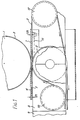
- FIG. 1 is a cut-away side view of an internal electrode similar to that described in European Patent Publication 0041893A1;
- Fig. 2 is a similar view of an internal electrode according to this invention;
- Fig. 3 is a perspective view of a first embodiment of a guide block (This embodiment is not covered by the claims);
- Fig. 4 is a perspective view of a second embodiment of a guide block;
- Fig. 5 is a sectioned side view of the guide blocks of Figs. 3 and 4;
- Fig. 6 is a plan view of the internal electrode of Fig. 2 but slightly modified by addition of an end cap;
- Fig. 1 is a cut-away side view of an internal electrode similar to that described in European Patent Publication 0041893A1;
- Fig. 2 is a similar view of an internal electrode according to this invention;
- Fig. 3 is a perspective view of a first embodiment of a guide block (This embodiment is not covered by the claims);
- Fig. 4
- FIG. 7 is a side view of the internal electrode of Fig. 6;
- Fig. 8 is a fragmentary section on line EE in Fig. 2;
- Fig. 9 is a fragmentary section on line DD in Fig. 2; and
- Figs. 10a and 10b are diagrammatic views permitting comparison of the weld geometry of prior art and the present invention.
- Fig. 10a shows an upper welding wheel 1 which typically has a diameter of 85 mm, a lower welding roll 2 which typically has a diameter of 62 mm.
- a continuous electrode wire 3 is wound round each roll so that the lap joint layers of metal 4, 5 are pinched between the wire on upper and lower rolls to create a mash weld.
- each layer 4, 5 of metal has a thickness "t" commonly in the range 0.15 mm to 0.35 mm for ferrous based sheet metals such as tinplate or chrome/chrome oxide coated steels called TFS. After welding the finished weld thickness is typically about 1.5 t.
- Fig. 10a it will be seen that the portion of wire 3 on the upper or larger roll 1 makes a greater arc of contact than the portion of wire on the lower or smaller roll 2 so the current density at R1 between metal 4 and wire on upper roll 1 is less than the current density at R2 between the metal 5 and the wire on the lower roll 2. Furthermore the current path "I", as drawn is asymmetric so the heat generated is not centred on the metal 4 to metal 5 contact R3 as is desirable.
- Fig. 10b the rotating lower roll 2 of Fig. 10a has been replaced by a stationary electrode 6 having an arcuate surface over which the electrode wire 3 slides to make contact during welding.
- the arcuate surface substantially replicates the curvature of the upper roll 1 so that the metal to wire contact resistances R are equalised.
- the curvatures of upper roll 1 and stationary electrode 6 being substantially equal, the contact areas are also equal so that the current path 12 is symmetrical so the heating effect is centred on the metal 4 to metal 5 contact R3 as is desirable.
- Fig. 1 shows prior art apparatus during welding of the side seam of a can body 7.
- Components corresponding to like components in Fig. 10a are denoted by the same part numbers.
- a first electrode wheel 1 is supported in a frame (not shown) above the line of travel of the can body 7, from left to right as shown in Fig. 1.
- the external or first electrode wheel 1 cooperates with an internal or second electrode wheel 2 which is supported for rotation in an internal electrode frame 8 mounted on a mandrel 9 shown in part only.
- the frame 8 also supports a guide roll 10 from the underside of which wire 3 is fed to the topside of roll 2 and onwards across a support rail 11 to a turn roll 12 which returns the wire across the underside of roll 2 for re-reeling or re-use.
- the outer electrode wheel 1 is larger in diameter than the inner roll 2. Both the inner electrode wheel 2 and outer electrode wheel 1 not only rotate to deliver electrode wire 3 to the roll pinch zone at which welding takes place but also delivers electrical power for resistance welding.
- the inner roll 2 is mounted on a stationary shaft and mercury contact bearings deliver current from the stationary shaft to the rotating wheel so it will be seen from Fig. 1 that any leakage of mercury from the inner bearing will contaminate the interior of the can body.
- FIG. 2 The apparatus shown in Fig. 2 is similar to that shown in Fig. 1 so like functioning components are denoted by the same part numbers, namely an external electrode wheel 1 moving an electrode wire 3 and an internal electrode comprising the frame 8 in which a guide roll 10 guides the wire 3 up over a support rail 11 to a turn wheel 12 which returns the wire.
- an external electrode wheel 1 moving an electrode wire 3
- an internal electrode comprising the frame 8 in which a guide roll 10 guides the wire 3 up over a support rail 11 to a turn wheel 12 which returns the wire.
- Fig. 2 uses a stationary contact block 6 instead of a roll so that no mercury contact is required.
- a similar grooved block 13 is mounted on the underside of the frame 8 to guide returned wire from the turn roll 12 to the re-reeling position.
- Fig. 3 shows a block 6 machined from a single piece of metal to have a body 14, a guide surface 15 and side flanges 16, 17 to restrain lateral movement as the wire 3 passes along the guide surface 15.
- Fig. 4 shows a construction of the block 6, according to the invention, which comprises a guide plate portion 15a typically 1.9 mm wide and fixed between a pair of side plates 16a, 17a of similar thickness by means of countersunk screws. Whilst pre-assembly by means of the screws 18 may be convenient, the final fitting of cap screws through holes 19, to fix the block to the support 34, may be all that is necessary.
- the side plates 16a have passages formed in them to permit delivery of inert gas to shroud the weld.
- Fig. 5 shows the profile of the guide surface 15 to have a curvature of radius R which is substantially equal to the radius of the outer electrode wheel 1. Therefore the contact areas of wire guided in block 6 and wire on the wheel 1 with the material to be welded are substantially equalised as discussed with reference to Fig. 10b.
- any material chosen for manufacture of block 6 it is necessary for any material chosen for manufacture of block 6 to (a) resist wear caused by the copper wire sliding over it; (b) have a low coefficient of friction, preferably about 0.1; and (c) to have a low contact resistance with respect to copper wire, preferably less than 250 micro ohms.
- One suitable material for the block 6 or the guide portion 15a is cemented tungsten carbide in a matrix of cobalt or preferably nickel which has a lower electrical resistance. However, other materials may be suitable.
- plan view Fig. 6 and side view Fig. 7 serve to show the internal electrode in sufficient detail to permit understanding of the relative positions of the guide roll 10, block 6 and turn roll 12.
- This angle of inclination may be achieved on mounting or may be machined into the groove of the block 6 of Fig. 3 or alternatively machined into the side plate 16 of the composite block of Fig. 4.
- the frame 8 comprises four parts.
- a first part 20 houses a bearing 21 and is adapted for fixing to a welding arm portion not shown.
- a second frame part 22 is fixed by studs 23 to the first part 20 at approximately the centre of a support 34 which supports the block 6.
- This location joint is chosen to facilitate assembly of the support 34 to the frame 8 and connection of water cooling and inert gas supply lines (not shown).
- the support 34 has round stems 24 which fit in the frame part 20, 22 in like manner to the prior art roll and axle which it replaces.
- a side block 32 is fixed to the support 34 by means of cap screws 33 which also fix the block 6 to the support 34.
- the side block 32 may abut the frame members or, as shown in Figs. 6 and 7, abut the support rail 11 to prevent rotation.
- Fig. 9 the lateral relationship of the side block 32 to the block 6 is clearly shown. Also shown in Fig. 9 are passages 26 for water or other coolant. Passages 27 for nitrogen or other inert gas used to shroud the weld to minimise oxidation may be provided in block 6 as is best seen in Fig. 4 but may, if desired, extend into the rail 11 as shown in Fig. 8.
- a third frame part 25 connects the second part to a fourth part or end cap 28, the joint between the third and fourth parts being centred on the bearing of the turn roll 12.
- the third frame part 25 also provides fixing points for fixing the support rail 11.
- the support rail 11 can be seen to comprise a substantially flat surface 30 alongside which there extends a flange 31 which delivers shrouding gas through passages 27.
- the "inside" stationary electrode 6 has a periphery made up of four distinct arcs of differing curvature A1 A2 A3 A4.
- Arc A1 is that of the support surface 15a in Figs. 3/4 and of a radius approximate by half the diameter of upper roll 1 (e.g. 42.5 mm radius).
- Arcs A2 and A3 are so arranged that the wire is always at a tangent to each arc.
- this static electrode is symmetrical so arcs A1 and A3 are identical and arcs A2 and A4 are also identical.
- arcs A1, A2 and part of A3 and A4 all create a frictional drag on the progress of the wire.
- one or several rolls may be introduced if desired, for example at the start of each arc or alternatively a single fairly large turn roll close spaced to block 6 of arc A1.
- Arc A1 may, if desired, include a curved portion followed by a substantially horizontal or slightly sloping ramp to maintain wire contact after welding as shown by dashed lines in Fig. 5.
- any support rail surface provided should extend in a direction tangential to the curvature of the block 6.
Landscapes
- Mechanical Engineering (AREA)
- Engineering & Computer Science (AREA)
- Lining Or Joining Of Plastics Or The Like (AREA)
- Apparatuses And Processes For Manufacturing Resistors (AREA)
- Arc Welding In General (AREA)
- Details Of Resistors (AREA)
- Butt Welding And Welding Of Specific Article (AREA)
- Electrical Discharge Machining, Electrochemical Machining, And Combined Machining (AREA)
- Conductive Materials (AREA)
- Discharge Heating (AREA)
- Extrusion Moulding Of Plastics Or The Like (AREA)
- Parts Printed On Printed Circuit Boards (AREA)
- Thermistors And Varistors (AREA)
Claims (5)
- Vorrichtung zum Widerstandsschweißen einer länglichen Naht eines röhrenförmigen Gegenstandes, mit einem außerhalb des Gegenstandes (7) angeordneten Elektroden-Rad (1), einer durch Haltemittel (8) in dem Gegenstand (7) gehaltenen Festelektrode (6) und mit einem Elektrodendraht (3), der dergestalt angeordnet ist, daß er über die Elektroden (1,6) führbar ist; um kontaktoberflächen zwischen den Elektroden (1,6) und dem Nahtmaterial (7) zu schaffen, wobei die Festelektrode (6) einen feststehenden Block umfaßt, der eine Führungsoberfläche (15) der gleichen Krümmung wie die des äußeren Elektroden-Rades (1) aufweist, so daß der Kontaktbereich eines Drahtes (3), der über die Führungsoberfläche mit dem Nahtmaterial (7) geführt wird, im wesentlichen gleich dem Kontaktbereich des Drahtes (3) ist, der über das äußere Rad (1) mit dem Äußeren des Nahtmaterials (7) geführt wird, dadurch gekennzeichnet, daß der besagte Block eine Verschleißplatte (15a), die zu der gewünschten Krümmung gearbeitet ist, und ein Paar von getrennten Seitenplatten oder Wänden (16a; 17a) umfaßt, die der Verschleißplatte (15a) seitlich benachbart angeordnet sind, um dem Draht (3) eine seitliche Zwangsführung auf mindestens einer Seitenplatte oder Wand (16a, 17a) zu geben, die einen Durchlaß (27) zur Zuführung eines Inertgases zu schaffen, um die Führungsoberfläche (15) während des Schweißens einzuhüllen und so Oxydation zu verhindern.
- Vorrichtung nach Anspruch 1, dadurch gekennzeichnet, daß der Block (6) durch Kühlmittel kühlbar ist, die in dem Block (6) oder in den Haltemitteln (8) angeordnet sind.
- Vorrichtung nach einem der Ansprüche 1 oder 2, dadurch gekennzeichnet, daß die Haltemittel (8) auch eine frei rotierende Walze (12) stützen, um die der Draht (3) gewunden ist, um unter dem Block (6) zurückzulaufen.
- Vorrichtung nach einem der vorstehenden Ansprüche, dadurch gekennzeichnet, daß der Draht (3) nach dem Schweißen durch eine Nut in der Unterseite der Festelektrode (6) zurückläuft.
- Vorrichtung nach einem der vorstehenden Ansprüche, dadurch gekennzeichnet, daß sich ein horizontaler oder leicht ansteigender Abschnitt von der Führungsoberfläche (15) des Blockes (6) in einer im wesentlichen tangential zur Krümmung der Führungsoberfläche (15) verlaufenden Richtung erstreckt.
Priority Applications (1)
| Application Number | Priority Date | Filing Date | Title |
|---|---|---|---|
| AT87310681T ATE64705T1 (de) | 1986-12-17 | 1987-12-04 | Widerstandsschweissgeraet. |
Applications Claiming Priority (2)
| Application Number | Priority Date | Filing Date | Title |
|---|---|---|---|
| GB8630157A GB2198674B (en) | 1986-12-17 | 1986-12-17 | Resistance welding apparatus |
| GB8630157 | 1986-12-17 |
Publications (2)
| Publication Number | Publication Date |
|---|---|
| EP0273607A1 EP0273607A1 (de) | 1988-07-06 |
| EP0273607B1 true EP0273607B1 (de) | 1991-06-26 |
Family
ID=10609159
Family Applications (1)
| Application Number | Title | Priority Date | Filing Date |
|---|---|---|---|
| EP87310681A Expired - Lifetime EP0273607B1 (de) | 1986-12-17 | 1987-12-04 | Widerstandsschweissgerät |
Country Status (8)
| Country | Link |
|---|---|
| US (1) | US5017749A (de) |
| EP (1) | EP0273607B1 (de) |
| JP (1) | JPS63165081A (de) |
| AT (1) | ATE64705T1 (de) |
| DE (1) | DE3771050D1 (de) |
| ES (1) | ES2022900B3 (de) |
| GB (1) | GB2198674B (de) |
| ZA (1) | ZA879393B (de) |
Families Citing this family (7)
| Publication number | Priority date | Publication date | Assignee | Title |
|---|---|---|---|---|
| US5891734A (en) * | 1994-08-01 | 1999-04-06 | Abbott Laboratories | Method for performing automated analysis |
| DE59606011D1 (de) * | 1995-09-04 | 2000-11-23 | Elpatronic Ag Bergdietikon | Verfahren und Vorrichtung zum Rollnahtschweissen von Behältern |
| DE19930336A1 (de) * | 1999-07-02 | 2001-01-04 | Patent Treuhand Ges Fuer Elektrische Gluehlampen Mbh | Verfahren zum Wiederstandsschweißen von Metallteilen |
| US8506732B2 (en) * | 2009-08-07 | 2013-08-13 | Radyne Corporation | Heat treatment of helical springs or similarly shaped articles by electric resistance heating |
| WO2011028333A1 (en) * | 2009-09-03 | 2011-03-10 | Thermal Structures, Inc. | Planetary resistance welding device and methods therefor |
| JP6194526B2 (ja) * | 2013-06-05 | 2017-09-13 | 高周波熱錬株式会社 | 板状ワークの加熱方法及び加熱装置並びにホットプレス成形方法 |
| DE102016105610B4 (de) | 2016-03-24 | 2020-10-08 | Infineon Technologies Ag | Halbleiterbauelement mit einer Graphenschicht und ein Verfahren zu dessen Herstellung |
Family Cites Families (7)
| Publication number | Priority date | Publication date | Assignee | Title |
|---|---|---|---|---|
| CH412139A (de) * | 1963-08-05 | 1966-04-30 | Schlatter Ag | Elektrodenrolle für Nahtschweissmaschinen |
| FR2483824A1 (fr) * | 1980-06-05 | 1981-12-11 | Carnaud Emballage Sa | Machine a souder, notamment pour corps de boite de boite de conserve, et corps de boite obtenu a l'aide d'une telle machine |
| CH648781A5 (en) * | 1980-09-19 | 1985-04-15 | Elpatronic Ag | Electric resistance seam welder |
| ATE30393T1 (de) * | 1982-11-13 | 1987-11-15 | Schuler Gmbh L | Vorrichtung zum elektrischen widerstandsl|ngsnaht-quetschnahtschweissen. |
| JPS60213367A (ja) * | 1984-04-06 | 1985-10-25 | Toyo Seikan Kaisha Ltd | 溶接缶胴の製造方法 |
| JPS6150074A (ja) * | 1984-08-20 | 1986-03-12 | Fujitsu Ltd | 短絡検出制御回路 |
| CH665793A5 (de) * | 1985-02-01 | 1988-06-15 | Elpatronic Ag | Maschine zum schweissen von laengsnaehten an gerundeten blechgebinde-zargen. |
-
1986
- 1986-12-17 GB GB8630157A patent/GB2198674B/en not_active Expired - Lifetime
-
1987
- 1987-12-04 EP EP87310681A patent/EP0273607B1/de not_active Expired - Lifetime
- 1987-12-04 ES ES87310681T patent/ES2022900B3/es not_active Expired - Lifetime
- 1987-12-04 DE DE8787310681T patent/DE3771050D1/de not_active Expired - Lifetime
- 1987-12-04 AT AT87310681T patent/ATE64705T1/de not_active IP Right Cessation
- 1987-12-11 US US07/131,823 patent/US5017749A/en not_active Expired - Fee Related
- 1987-12-15 ZA ZA879393A patent/ZA879393B/xx unknown
- 1987-12-17 JP JP62317647A patent/JPS63165081A/ja active Pending
Also Published As
| Publication number | Publication date |
|---|---|
| ZA879393B (en) | 1988-06-17 |
| ATE64705T1 (de) | 1991-07-15 |
| JPS63165081A (ja) | 1988-07-08 |
| ES2022900B3 (es) | 1991-12-16 |
| GB8630157D0 (en) | 1987-01-28 |
| GB2198674A (en) | 1988-06-22 |
| DE3771050D1 (de) | 1991-08-01 |
| EP0273607A1 (de) | 1988-07-06 |
| US5017749A (en) | 1991-05-21 |
| GB2198674B (en) | 1990-01-31 |
Similar Documents
| Publication | Publication Date | Title |
|---|---|---|
| CA1039817A (en) | Method and apparatus for seam welding overlapped edges | |
| US4219717A (en) | Method of connecting metallic parts by means of arc fusion welding | |
| US5389761A (en) | Method and apparatus for cleaning metal pieces prior to resistive seam welding or laser lap seam welding | |
| EP0273607B1 (de) | Widerstandsschweissgerät | |
| US6781083B1 (en) | Weld overlay system | |
| CN211162541U (zh) | 一种板材卷圆后焊接设备 | |
| JP3011868B2 (ja) | 自動溶接装置のトーチ角度調整装置 | |
| EP0038646A1 (de) | Verfahren zur Herstellung geschweisster Dosenkörper | |
| JP2593233B2 (ja) | 液体用タンクの製造方法 | |
| RU2144453C1 (ru) | Способ и устройство для шовной контактной сварки емкостей | |
| US5841090A (en) | Method and apparatus for the seam welding of containers | |
| US3739134A (en) | Process for tack welding and finishing spiral weld pipe | |
| CN100473751C (zh) | 盘形辊及其制造方法 | |
| KR100293190B1 (ko) | 코일용접부사행제어장치 | |
| JP3657123B2 (ja) | キャスクのバスケット収納筒の取付け方法および装置 | |
| JP2006205171A (ja) | 溶接装置及びそれを用いた溶接方法 | |
| JP3226691B2 (ja) | 片面溶接用裏当て装置 | |
| RU2117560C1 (ru) | Способ автоматической электродуговой наплавки под слоем флюса изделий | |
| CA1177419A (en) | Method of producing container bodies and container bodies produced thereby | |
| JPH11188485A (ja) | 溶接缶胴の製造方法 | |
| JPS6150074B2 (de) | ||
| JPS625711B2 (de) | ||
| JPS6124258B2 (de) | ||
| JPH03264164A (ja) | ロール肉盛溶接方法及び肉盛溶接ロール | |
| JP2862371B2 (ja) | 複合管用金属管の製造装置 |
Legal Events
| Date | Code | Title | Description |
|---|---|---|---|
| PUAI | Public reference made under article 153(3) epc to a published international application that has entered the european phase |
Free format text: ORIGINAL CODE: 0009012 |
|
| 17P | Request for examination filed |
Effective date: 19871211 |
|
| AK | Designated contracting states |
Kind code of ref document: A1 Designated state(s): AT BE CH DE ES FR GB GR IT LI LU NL SE |
|
| RAP1 | Party data changed (applicant data changed or rights of an application transferred) |
Owner name: MB GROUP PLC |
|
| 17Q | First examination report despatched |
Effective date: 19900518 |
|
| RAP1 | Party data changed (applicant data changed or rights of an application transferred) |
Owner name: CMB PACKAGING (UK) LIMITED |
|
| RAP1 | Party data changed (applicant data changed or rights of an application transferred) |
Owner name: CMB FOODCAN PLC |
|
| GRAA | (expected) grant |
Free format text: ORIGINAL CODE: 0009210 |
|
| AK | Designated contracting states |
Kind code of ref document: B1 Designated state(s): AT BE CH DE ES FR GR IT LI LU NL SE |
|
| PG25 | Lapsed in a contracting state [announced via postgrant information from national office to epo] |
Ref country code: SE Effective date: 19910626 Ref country code: GR Free format text: LAPSE BECAUSE OF FAILURE TO SUBMIT A TRANSLATION OF THE DESCRIPTION OR TO PAY THE FEE WITHIN THE PRESCRIBED TIME-LIMIT Effective date: 19910626 |
|
| REF | Corresponds to: |
Ref document number: 64705 Country of ref document: AT Date of ref document: 19910715 Kind code of ref document: T |
|
| ET | Fr: translation filed | ||
| REF | Corresponds to: |
Ref document number: 3771050 Country of ref document: DE Date of ref document: 19910801 |
|
| ITF | It: translation for a ep patent filed | ||
| PGFP | Annual fee paid to national office [announced via postgrant information from national office to epo] |
Ref country code: FR Payment date: 19911107 Year of fee payment: 5 |
|
| PGFP | Annual fee paid to national office [announced via postgrant information from national office to epo] |
Ref country code: AT Payment date: 19911112 Year of fee payment: 5 |
|
| PGFP | Annual fee paid to national office [announced via postgrant information from national office to epo] |
Ref country code: DE Payment date: 19911121 Year of fee payment: 5 Ref country code: CH Payment date: 19911121 Year of fee payment: 5 |
|
| PGFP | Annual fee paid to national office [announced via postgrant information from national office to epo] |
Ref country code: BE Payment date: 19911127 Year of fee payment: 5 |
|
| PGFP | Annual fee paid to national office [announced via postgrant information from national office to epo] |
Ref country code: LU Payment date: 19911202 Year of fee payment: 5 |
|
| PGFP | Annual fee paid to national office [announced via postgrant information from national office to epo] |
Ref country code: ES Payment date: 19911230 Year of fee payment: 5 |
|
| PGFP | Annual fee paid to national office [announced via postgrant information from national office to epo] |
Ref country code: NL Payment date: 19911231 Year of fee payment: 5 |
|
| EPTA | Lu: last paid annual fee | ||
| PLBE | No opposition filed within time limit |
Free format text: ORIGINAL CODE: 0009261 |
|
| STAA | Information on the status of an ep patent application or granted ep patent |
Free format text: STATUS: NO OPPOSITION FILED WITHIN TIME LIMIT |
|
| 26N | No opposition filed | ||
| PG25 | Lapsed in a contracting state [announced via postgrant information from national office to epo] |
Ref country code: LU Free format text: LAPSE BECAUSE OF NON-PAYMENT OF DUE FEES Effective date: 19921204 Ref country code: AT Effective date: 19921204 |
|
| PG25 | Lapsed in a contracting state [announced via postgrant information from national office to epo] |
Ref country code: ES Free format text: LAPSE BECAUSE OF EXPIRATION OF PROTECTION Effective date: 19921205 |
|
| PG25 | Lapsed in a contracting state [announced via postgrant information from national office to epo] |
Ref country code: LI Effective date: 19921231 Ref country code: CH Effective date: 19921231 Ref country code: BE Effective date: 19921231 |
|
| BERE | Be: lapsed |
Owner name: CMB FOODCAN P.L.C. Effective date: 19921231 |
|
| PG25 | Lapsed in a contracting state [announced via postgrant information from national office to epo] |
Ref country code: NL Effective date: 19930701 |
|
| NLV4 | Nl: lapsed or anulled due to non-payment of the annual fee | ||
| PG25 | Lapsed in a contracting state [announced via postgrant information from national office to epo] |
Ref country code: FR Effective date: 19930831 |
|
| REG | Reference to a national code |
Ref country code: CH Ref legal event code: PL |
|
| PG25 | Lapsed in a contracting state [announced via postgrant information from national office to epo] |
Ref country code: DE Effective date: 19930901 |
|
| REG | Reference to a national code |
Ref country code: FR Ref legal event code: ST |
|
| REG | Reference to a national code |
Ref country code: ES Ref legal event code: FD2A Effective date: 20010301 |
|
| PG25 | Lapsed in a contracting state [announced via postgrant information from national office to epo] |
Ref country code: IT Free format text: LAPSE BECAUSE OF NON-PAYMENT OF DUE FEES;WARNING: LAPSES OF ITALIAN PATENTS WITH EFFECTIVE DATE BEFORE 2007 MAY HAVE OCCURRED AT ANY TIME BEFORE 2007. THE CORRECT EFFECTIVE DATE MAY BE DIFFERENT FROM THE ONE RECORDED. Effective date: 20051204 |