EP0272548A2 - Verfahren zur Herstellung von Eisen(III)oxid und Ammoniumsalzen und Vorrichtung zur Durchführung des Verfahrens - Google Patents
Verfahren zur Herstellung von Eisen(III)oxid und Ammoniumsalzen und Vorrichtung zur Durchführung des Verfahrens Download PDFInfo
- Publication number
- EP0272548A2 EP0272548A2 EP87118265A EP87118265A EP0272548A2 EP 0272548 A2 EP0272548 A2 EP 0272548A2 EP 87118265 A EP87118265 A EP 87118265A EP 87118265 A EP87118265 A EP 87118265A EP 0272548 A2 EP0272548 A2 EP 0272548A2
- Authority
- EP
- European Patent Office
- Prior art keywords
- iron
- ferric oxide
- gaseous
- gases
- salts
- Prior art date
- Legal status (The legal status is an assumption and is not a legal conclusion. Google has not performed a legal analysis and makes no representation as to the accuracy of the status listed.)
- Granted
Links
Images
Classifications
-
- C—CHEMISTRY; METALLURGY
- C01—INORGANIC CHEMISTRY
- C01C—AMMONIA; CYANOGEN; COMPOUNDS THEREOF
- C01C1/00—Ammonia; Compounds thereof
- C01C1/24—Sulfates of ammonium
-
- C—CHEMISTRY; METALLURGY
- C01—INORGANIC CHEMISTRY
- C01C—AMMONIA; CYANOGEN; COMPOUNDS THEREOF
- C01C1/00—Ammonia; Compounds thereof
- C01C1/16—Halides of ammonium
-
- C—CHEMISTRY; METALLURGY
- C01—INORGANIC CHEMISTRY
- C01C—AMMONIA; CYANOGEN; COMPOUNDS THEREOF
- C01C1/00—Ammonia; Compounds thereof
- C01C1/16—Halides of ammonium
- C01C1/164—Ammonium chloride
-
- C—CHEMISTRY; METALLURGY
- C01—INORGANIC CHEMISTRY
- C01C—AMMONIA; CYANOGEN; COMPOUNDS THEREOF
- C01C1/00—Ammonia; Compounds thereof
- C01C1/22—Sulfites of ammonium
-
- C—CHEMISTRY; METALLURGY
- C01—INORGANIC CHEMISTRY
- C01G—COMPOUNDS CONTAINING METALS NOT COVERED BY SUBCLASSES C01D OR C01F
- C01G49/00—Compounds of iron
- C01G49/02—Oxides; Hydroxides
- C01G49/06—Ferric oxide [Fe2O3]
-
- C—CHEMISTRY; METALLURGY
- C09—DYES; PAINTS; POLISHES; NATURAL RESINS; ADHESIVES; COMPOSITIONS NOT OTHERWISE PROVIDED FOR; APPLICATIONS OF MATERIALS NOT OTHERWISE PROVIDED FOR
- C09C—TREATMENT OF INORGANIC MATERIALS, OTHER THAN FIBROUS FILLERS, TO ENHANCE THEIR PIGMENTING OR FILLING PROPERTIES ; PREPARATION OF CARBON BLACK ; PREPARATION OF INORGANIC MATERIALS WHICH ARE NO SINGLE CHEMICAL COMPOUNDS AND WHICH ARE MAINLY USED AS PIGMENTS OR FILLERS
- C09C1/00—Treatment of specific inorganic materials other than fibrous fillers; Preparation of carbon black
- C09C1/22—Compounds of iron
- C09C1/24—Oxides of iron
-
- C—CHEMISTRY; METALLURGY
- C01—INORGANIC CHEMISTRY
- C01P—INDEXING SCHEME RELATING TO STRUCTURAL AND PHYSICAL ASPECTS OF SOLID INORGANIC COMPOUNDS
- C01P2006/00—Physical properties of inorganic compounds
- C01P2006/32—Thermal properties
- C01P2006/33—Phase transition temperatures
Definitions
- the present invention is related to a process for obtaining ferric oxide and ammonium salts from aqueous solutions of iron salts which have been prepared with such purposes, or from liquid industrial waste containing them.
- the invention further relates to an apparatus for carrying out said process.
- Chlorides and/or sulphates are preferred amongst the iron salts.
- Iron oxide of mineral origin has been used in ancient times in its red, yellow and brown varieties.
- yellow oxide which is a hydrated ferric oxide
- scrap steel was submerged into a slurry of an iron hydroxide and ferrous sulphate solution, air-oxidized and heated.
- the thus obtained yellow oxide was subject to calcination in rotating ovens, yielding a range of red ferric oxides of higher quality than the former oxides. This is one of the yet presently employed methods.
- This invention relates to the treatment of iron salt solutions to produce iron oxides having different shades of violet (browns, reds and violets) and, more particularly, to the preferable utilization of chlorides or sulphates and, amongst them, specially those resulting from the scaling in iron roll-out processes.
- the process leads to the production of pigment-type red iron oxide in its several shades; further resulting pure ammonium chloride, sulphate and sulphite as by-products.
- the present invention intends solving the problem through a process wherein the iron chloride or sulphate is converted into ammonium chloride or sulphate and sulphite and ferric oxide.
- the raw material there is waste solutions based on hydrochloric or sulphuric acid and containing iron chlorides or sulphates are subject to treatment.
- the object of the present invention is to provide a process enabling the simultaneous and separate recovery of ions iron chloride or sulphate contained in the feeding solution, in the form of ammonium chloride or sulphate and sulphite and ferric oxide, respectively.
- the preferred working process and apparatus according to the invention hereinbelow described are employed.
- the process which protection is applied for comprises heating of a dew or spray of the iron chloride or sulphate, in the presence of gaseous ammonia, water and an oxidizing means, usually air, within a temperature range permitting the formation of ferric oxide as sediment and vaporized ammonium chloride or sulphate and sulphite, thus rendering their separation easier, and, in a further step, recovering the ammonium chloride or sulphate and sulphite from the gaseous phase by cooling a saturated aqueous solution and crystallization and/or washing.
- the process of the invention comprises:
- the reaction is carried out at temperatures related to pressure, to achieve the separation of the ammonium chloride.
- temperatures related to pressure For instance, when working under atmospheric temperature and pressure, the temperature should not be lower than the sublimation temperature of the chloride under said conditions.
- the process preferably comprises the steps of spraying the aqueous solution in a reaction vessel whereinto gaseous ammonia and air (oxygen) are introduced, said reaction vessel being at a temperature range between 80 and 900°C, either by prior warming-up of the feeding gases or external heating through its walls.
- An important advantage of the present invention is that the ammonium chloride, sulphate or sulphite are separated in the vapor form from the ferric oxide, thus facilitating the obtention of the latter, free of impurities.
- This desirable condition is achieved by the temperature reached by the products before leaving the reaction chamber, which is higher than the sublimation temperature of said ammonium salts.
- An important fact of the invention is also constituted by the direct obtention of said ferric oxide, free of impurities, and in the form of a very fine powder, in several shades, which is achieved through an adequate regulation of the operating conditions, specially of the temperature, and of the oxidizing ability of the gaseous means since, as the temperature rises, red-violaceous shades are obtained and, with low temperatures, high brown and red-orange shades are achieved. This renders the process highly versatile and permits the obtention of the different qualities intended for commercial use.
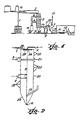
- Figure 1 schematically shows the preferred equipment permitting the process to be carried out under the conditions of the present application, which does not mean a particular restriction of the invention.
- Figure 2 illustrates in detail the reaction vessel wherewith said equipment is composed, and which also constitutes a component of this invention. Dryers, for instance of a similar mechanical structure, are known, but their object is not identical.
- the reaction vessel of this invention makes possible reactions to take place in aerosol phase wherein liquids and/or gases and/or solids are involved.
- the raw material (iron chloride, sulphate or sulphite solution in water) having a concentration comprised between 5% w/w and that of the solution saturation at the selected temperature, is conducted through line (2) up to a continuous reaction vessel (5) tailored to produce several physical and chemical transformations leading to the production of ferric oxide, as main product, and ammonium chloride, sulphate or sulphite, as by-products.
- the reaction vessel comprises a zone wherein the spray or dew of the iron chloride or sulphate solution takes place in an atmosphere, mainly of gaseous ammonia, feeded through line(1).
- This zone works at temperatures between 40 and 400°C, thus permitting a contact time of the mist droplets with the gaseous means of 0.1 to 10 seconds.
- the ammonia injection is done in such a manner that the dispersed solution is surrounded. Once the gaseous ammonia and the dispersion droplets have reacted, the latter will enter the evaporation zone.
- a mixture of warm air and combustion gases (or any of them alone) is injected through line (3) to evaporate the aqueous solvent and to produce solid particles consisting in an aggregate of corresponding ammonium salt and iron oxides having different oxidation and hydration degrees.
- a further stream of warm air and combustion gases or any of them separately, are horizontally introduced through (4) and tangentially to the vesell wall, with the purpose of completing the dehydration of the solid aggregates and the oxidation of the ferrous oxide to ferric oxide, and facilitate the separation of the solid products.
- the temperature at which this process is complete ranges from 350 up to 900°C, and the contact time between the solid particles and the warm gases should not be lower than one second.
- the section bottom is preferably conical, designed in such a manner to obtain a cyclonal effect with the injected gases and an outlet thereof by means of a central intake leading them, together with fine particles, to a solid-gas separation system.
- the latter can be constituted by a battery of cyclons, as shown in (7), or by any other equipment of conventional use in said step.
- the ferric oxide separated in (5) and (7) through lines (6) and (8), respectively, is collected by means of a conventional solid transportation system (14), which drives them through (18) to the storage and packaging steps.
- the gaseous stream separated by cyclons (7) contains water, combustion gases, air and the corresponding ammonium salts and/or decomposition products thereof and yet carries a small quantity of fine particles. A great deal of well known alternatives are known for the separation of these products.
- the scheme of Figure 1 illustrates one of these alternatives, wherein the remaining fine particles of iron oxide are eliminated through the use of a washing tower (9).
- the gaseous stream Prior to this step, the gaseous stream is cooled to allow this production alternative by injection of sprayed water through (27), thus making possible the solid ammonium chloride, sulphate or sulphite to precipitate as gas-driveable microcrystals.
- tower (9) as washing stream fed through (13) there is employed a non-saturated ammonium chloride, sulphate or sulphite which absorbs the gaseous ammonium chloride, sulphate or sulphite mixed up with the gases coming from the battery of cyclons, and holds the fine particles of ferric oxide.
- This solution is pumped while warm through a filter (10), to separate the pigment residues, and is introduced into a crystallizer (11).
- the remaining gases mainly composed of nitrogen, water, carbon dioxide and oxygen, are set free to the atmosphere through (17).
- the last mentioned equipment permits the crystallization of the corresponding ammonium salts to occur by cooling of the solution coming from the washing tower.
- the ammonium salt crystals are separated through (19) from the mother liquors, poor in ammonium chloride, sulphate or sulphite, are recirculated through (13) to the washing tower for further recovering ammonium salt.
- the crystals are optionally subject to a water wash.
- the solid product is driven to a conventional drying step, prior to its storage and/or packaging.
- the filtered, recirculated product can be partially drained, and water can be added in its place.
- the crystallization could be effected by means of any known method,for instance a crystallization caused by evaporation of the solution water, or any other similar alternative.
- cooling and solid recovery step can be included at the outlet of the gases coming from the cyclons (7), always by conventional methods, either by a wet route similar to that employed in the tower (9), or by dry route such as, for instance, cyclons, sleeve filters, electrostatic precipitators, etc.
- Figure 2 illustrates a novel reaction vessel which is a further object of the present invention and which represents the reaction vessel (5) of Figure 1 of the equipment conceived for the production of iron oxide from ferrous salt solutions.
- the main body is constituted by a vertical cylinder having a conical bottom (5) in which upper section has a cover (26) bearing two main devices:
- the cylindrical body is formed by several coupling modules (20) (21) (22), for the regulation of the reactor total height, as well as the location of each of them, in this way allowing different uses.
- the modules such as (22) contribute only to increase the reactor height, and therefore they increase the stay time in the area in which they are located.
- the modules of type (21) has a surrounding sleeve, for receiving through the conduit (3) a flow of hot air, combustion gases or both, which enter the cylindrical body through a plurality of perforations placed along the perimeter.
- Said device allows hot gases to enter for drying the drops containing the precipitated ferrous hydroxide, and generated according to the above mentioned description. At the same time, they are positionned in such a manner that, depending on the size of the drops which are formed by the pulverization, they allow said drops to totally absorb the ammonia required for the ferrous hydroxide precipitation before completing their path.
- the module of type (20) has a tangential hot gases inlet (4), designed for completing the above descripted process, and in order to give the gases and the solids a helicoidal movement for their primary separation by means of a cyclonic effect produced by the conical bottom (23) and the outlet center opening (19).
- the gases evacuated through (19) are led to a cyclonic system in order to complete the separation of solids.
- the equipment can be made of stainless steel AISI 316L, AISI 316 titanium-rich, Hastelloy C, or other metals or metallic corrosion-resistant alloys from acids and chlorides and/or sulfates and sulfites. It can also be made of carbon steel sheet or other materials, its interior part coated with metallic corrosion-resistant surfaces, or with refractory materials, with or without intermediate layers that separate them from the external cover.
- the obtained ferric oxide can be used for paintings, cements, ceramics, plastics, rubber, paper, cosmetics, electronic, etc.
- the resulting ammonium chloride can be obtained with suitable qualities for its use as fertilizers, for electrical batteries or piles, the cleaning previous to a welding, galvanizing and in pharmaceutical uses, etc.
- the resulting ammonium sulphite quality is suitable for photography.
- the hot air injected in the lower part (4) was introduced tangentially to produce a cyclonic movement within the reactor which helps the separation of the ferric oxide from the remaining gases (air, water, vapour, ammonium chloride).
- ammonium chloride was obtained in the form of crystals and the rest remainded in the mother liquid (which was recycled).
- the ferric oxide was obtained in (6), (7), (8) and in the filter sludge (19).
- reaction gases were captured and dissolved in water, obtaining a solution of ammonium sulphates and sulphites whose ratios vary according to the conditions of ammonia excess, temperature within the pipe and humidity.
- the ferric oxide remained within the pipe.
Landscapes
- Chemical & Material Sciences (AREA)
- Organic Chemistry (AREA)
- Inorganic Chemistry (AREA)
- Compounds Of Iron (AREA)
- Treating Waste Gases (AREA)
- Organic Low-Molecular-Weight Compounds And Preparation Thereof (AREA)
- Gas Separation By Absorption (AREA)
Priority Applications (1)
| Application Number | Priority Date | Filing Date | Title |
|---|---|---|---|
| AT87118265T ATE63732T1 (de) | 1986-12-17 | 1987-12-09 | Verfahren zur herstellung von eisen(iii)oxid und ammoniumsalzen und vorrichtung zur durchfuehrung des verfahrens. |
Applications Claiming Priority (2)
| Application Number | Priority Date | Filing Date | Title |
|---|---|---|---|
| AR306206 | 1986-12-17 | ||
| AR306206A AR240445A1 (es) | 1986-12-17 | 1986-12-17 | Procedimiento para fabricar oxido ferrico y sales de amonio |
Publications (3)
| Publication Number | Publication Date |
|---|---|
| EP0272548A2 true EP0272548A2 (de) | 1988-06-29 |
| EP0272548A3 EP0272548A3 (en) | 1988-07-27 |
| EP0272548B1 EP0272548B1 (de) | 1991-05-22 |
Family
ID=3478458
Family Applications (1)
| Application Number | Title | Priority Date | Filing Date |
|---|---|---|---|
| EP87118265A Expired - Lifetime EP0272548B1 (de) | 1986-12-17 | 1987-12-09 | Verfahren zur Herstellung von Eisen(III)oxid und Ammoniumsalzen und Vorrichtung zur Durchführung des Verfahrens |
Country Status (8)
| Country | Link |
|---|---|
| US (2) | US4935219A (de) |
| EP (1) | EP0272548B1 (de) |
| JP (1) | JPS63310732A (de) |
| AR (1) | AR240445A1 (de) |
| AT (1) | ATE63732T1 (de) |
| DE (2) | DE272548T1 (de) |
| ES (1) | ES2003321B3 (de) |
| GR (2) | GR880300147T1 (de) |
Families Citing this family (4)
| Publication number | Priority date | Publication date | Assignee | Title |
|---|---|---|---|---|
| GB9023433D0 (en) * | 1990-10-27 | 1990-12-12 | Interox Chemicals Ltd | Peroxoacid manufacture |
| US5401485A (en) * | 1994-03-15 | 1995-03-28 | Shell Oil Company | Reduction of residual chloride in iron oxides |
| US11498836B1 (en) * | 2019-06-14 | 2022-11-15 | L3 Développement de procédés Inc. | Method for the production of iron oxide pigment or pigment intermediate and hydrochloric acid |
| CN113697841B (zh) * | 2020-05-21 | 2023-06-02 | 江西理工大学 | 一种低温分解法制备稀土氧化物的方法 |
Family Cites Families (16)
| Publication number | Priority date | Publication date | Assignee | Title |
|---|---|---|---|---|
| US1607206A (en) * | 1924-10-24 | 1926-11-16 | Neill Oswald Stuart | Production of ferric oxide |
| GB376719A (en) * | 1930-01-22 | 1932-07-14 | Goldschmidt Ag Th | Process for utilising ferrous sulphate |
| US1994702A (en) * | 1933-02-23 | 1935-03-19 | Arch W Harris | Utilization of waste pickling acids |
| US2155119A (en) * | 1935-08-13 | 1939-04-18 | American Lurgi Corp | Process of and apparatus for the thermal decomposition of substances or mixtures of same |
| US2529874A (en) * | 1947-09-27 | 1950-11-14 | Mellon Inst Of Ind Res | Process for manufacturing ammonium salts and magnetic iron oxide from solutions of ferrous salts |
| FR1050678A (fr) * | 1952-02-08 | 1954-01-11 | Ets Kuhlmann | Procédé de préparation de sels ammoniacaux et de composes métalliques oxydés, en phase solide |
| NZ117394A (de) * | 1954-12-08 | |||
| US3361525A (en) * | 1961-11-03 | 1968-01-02 | Laporte Titanium Ltd | Manufacture of oxides of the elements titanium, zirconium, iron, aluminum and silicon |
| US3351427A (en) * | 1963-11-01 | 1967-11-07 | Cabot Corp | Vapor phase process for producing metal oxides |
| US3600817A (en) * | 1969-11-28 | 1971-08-24 | Siemens Ag | Processing apparatus for effecting interaction between, and subsequent separation or gaseous and solid or liquid particulate substances |
| US3734761A (en) * | 1971-01-21 | 1973-05-22 | Nat Lead Co | Process for producing titanium dioxide product containing aluminum oxide |
| US4073874A (en) * | 1973-04-28 | 1978-02-14 | Mitsubishi Kinzoku K.K. | Recovery of chlorine from iron chloride |
| JPS5034452U (de) * | 1973-06-09 | 1975-04-12 | ||
| US4120941A (en) * | 1974-10-31 | 1978-10-17 | Halomet Ag | Process for the oxidation of halides |
| US4436681A (en) * | 1982-05-17 | 1984-03-13 | Barczak Virgil J | Process for producing iron oxide weighting material from iron chloride solutions |
| JPS59222244A (ja) * | 1983-05-30 | 1984-12-13 | Mitsubishi Heavy Ind Ltd | サイクロン |
-
1986
- 1986-12-17 AR AR306206A patent/AR240445A1/es active
-
1987
- 1987-12-09 DE DE198787118265T patent/DE272548T1/de active Pending
- 1987-12-09 EP EP87118265A patent/EP0272548B1/de not_active Expired - Lifetime
- 1987-12-09 DE DE8787118265T patent/DE3770252D1/de not_active Expired - Fee Related
- 1987-12-09 ES ES87118265T patent/ES2003321B3/es not_active Expired - Lifetime
- 1987-12-09 AT AT87118265T patent/ATE63732T1/de not_active IP Right Cessation
- 1987-12-15 JP JP62315424A patent/JPS63310732A/ja active Pending
- 1987-12-15 US US07/133,448 patent/US4935219A/en not_active Expired - Lifetime
-
1988
- 1988-08-04 US US07/235,486 patent/US5028401A/en not_active Expired - Fee Related
- 1988-12-16 GR GR88300147T patent/GR880300147T1/el unknown
-
1991
- 1991-06-10 GR GR91400773T patent/GR3002095T3/el unknown
Also Published As
| Publication number | Publication date |
|---|---|
| EP0272548A3 (en) | 1988-07-27 |
| US4935219A (en) | 1990-06-19 |
| EP0272548B1 (de) | 1991-05-22 |
| ES2003321A4 (es) | 1988-11-01 |
| GR880300147T1 (en) | 1988-12-16 |
| AR240445A1 (es) | 1990-04-30 |
| US5028401A (en) | 1991-07-02 |
| DE3770252D1 (de) | 1991-06-27 |
| GR3002095T3 (en) | 1992-12-30 |
| ES2003321B3 (es) | 1991-11-16 |
| JPS63310732A (ja) | 1988-12-19 |
| DE272548T1 (de) | 1988-11-03 |
| ATE63732T1 (de) | 1991-06-15 |
Similar Documents
| Publication | Publication Date | Title |
|---|---|---|
| US2155119A (en) | Process of and apparatus for the thermal decomposition of substances or mixtures of same | |
| JP3507545B2 (ja) | 硫黄酸化物の吸収及び硫酸アンモニウムの生成の同時処理方法 | |
| US3784680A (en) | Cyclical process for recovery of elemental sulfur from waste gases | |
| US5498790A (en) | Regeneration of sulfuric acid from sulfate by-products of 2-hydroxy-4-(methylthio)butyric acid manufacture | |
| US5417955A (en) | Manufacture of ferric sulfate and hydrochloric acid from ferrous chloride | |
| US3579296A (en) | Dual cycle treatment of sulfur dioxide containing flue gas and the like | |
| DE1442999B1 (de) | Verfahren zur Herstellung von feinverteiltem amorphem Siliciumdioxid | |
| US4935219A (en) | Process for obtaining ferric oxide and ammonium salts | |
| JP3935203B2 (ja) | 硝酸ウラニルの直接熱脱硝による三酸化ウランを得る方法 | |
| CN109354072A (zh) | 一种碱循环法无害化生产氧化铁红颜料工艺 | |
| US4248851A (en) | Promoted oxidation of aqueous ferrous chloride solution | |
| JPH04228406A (ja) | 発煙硫酸および硫酸の製造方法 | |
| CA2259939C (en) | Process of producing sulfuric acid | |
| GB2271986A (en) | Treatment of waste containing metal chlorides to produce hydrogen chloride | |
| CA1140730A (en) | Process for producing magnesium oxide from an aqueous magnesium sulphate solution | |
| US3647367A (en) | Method for making anhydrous magnesium chloride | |
| EP0387492B1 (de) | Verfahren zur Herstellung von Natriumaluminat | |
| JPS5943402B2 (ja) | 硫酸の製造方法 | |
| US3812242A (en) | Process for the simultaneous production of sulphur dioxide and concentrated aqueous sulphuric acid | |
| SU1313857A1 (ru) | Способ переработки сернокислого железосодержащего раствора | |
| EP0085666A2 (de) | Verfahren zum Bearbeiten von Schwefelsäure, die eine Anzahl Metallsulfate enthält | |
| US4264570A (en) | Method of producing magnesium sulphate | |
| US1269441A (en) | Method of treating waste pickle liquor. | |
| US2439404A (en) | Production of alkali metal and alkaline earth metal hydroxides | |
| JPH0751444B2 (ja) | ウラニル化合物をaduを経てuo2に転化する方法 |
Legal Events
| Date | Code | Title | Description |
|---|---|---|---|
| PUAI | Public reference made under article 153(3) epc to a published international application that has entered the european phase |
Free format text: ORIGINAL CODE: 0009012 |
|
| PUAL | Search report despatched |
Free format text: ORIGINAL CODE: 0009013 |
|
| AK | Designated contracting states |
Kind code of ref document: A2 Designated state(s): AT BE CH DE ES FR GB GR IT LI NL SE |
|
| AK | Designated contracting states |
Kind code of ref document: A3 Designated state(s): AT BE CH DE ES FR GB GR IT LI NL SE |
|
| TCAT | At: translation of patent claims filed | ||
| ITCL | It: translation for ep claims filed |
Representative=s name: RICCARDI SERGIO & CO. |
|
| EL | Fr: translation of claims filed | ||
| TCNL | Nl: translation of patent claims filed | ||
| DET | De: translation of patent claims | ||
| 17P | Request for examination filed |
Effective date: 19881117 |
|
| 17Q | First examination report despatched |
Effective date: 19891130 |
|
| GRAA | (expected) grant |
Free format text: ORIGINAL CODE: 0009210 |
|
| AK | Designated contracting states |
Kind code of ref document: B1 Designated state(s): AT BE CH DE ES FR GB GR IT LI NL SE |
|
| REF | Corresponds to: |
Ref document number: 63732 Country of ref document: AT Date of ref document: 19910615 Kind code of ref document: T |
|
| ITF | It: translation for a ep patent filed | ||
| REF | Corresponds to: |
Ref document number: 3770252 Country of ref document: DE Date of ref document: 19910627 |
|
| ET | Fr: translation filed | ||
| PLBE | No opposition filed within time limit |
Free format text: ORIGINAL CODE: 0009261 |
|
| STAA | Information on the status of an ep patent application or granted ep patent |
Free format text: STATUS: NO OPPOSITION FILED WITHIN TIME LIMIT |
|
| 26N | No opposition filed | ||
| REG | Reference to a national code |
Ref country code: GR Ref legal event code: FG4A Free format text: 3002095 |
|
| PGFP | Annual fee paid to national office [announced via postgrant information from national office to epo] |
Ref country code: FR Payment date: 19931217 Year of fee payment: 7 |
|
| PGFP | Annual fee paid to national office [announced via postgrant information from national office to epo] |
Ref country code: NL Payment date: 19931231 Year of fee payment: 7 |
|
| PGFP | Annual fee paid to national office [announced via postgrant information from national office to epo] |
Ref country code: GB Payment date: 19940607 Year of fee payment: 7 |
|
| PGFP | Annual fee paid to national office [announced via postgrant information from national office to epo] |
Ref country code: CH Payment date: 19940623 Year of fee payment: 7 |
|
| PGFP | Annual fee paid to national office [announced via postgrant information from national office to epo] |
Ref country code: DE Payment date: 19940624 Year of fee payment: 7 |
|
| PGFP | Annual fee paid to national office [announced via postgrant information from national office to epo] |
Ref country code: AT Payment date: 19940629 Year of fee payment: 7 |
|
| PGFP | Annual fee paid to national office [announced via postgrant information from national office to epo] |
Ref country code: SE Payment date: 19940630 Year of fee payment: 7 Ref country code: ES Payment date: 19940630 Year of fee payment: 7 |
|
| PGFP | Annual fee paid to national office [announced via postgrant information from national office to epo] |
Ref country code: BE Payment date: 19940713 Year of fee payment: 7 |
|
| PG25 | Lapsed in a contracting state [announced via postgrant information from national office to epo] |
Ref country code: GB Effective date: 19941209 Ref country code: AT Effective date: 19941209 |
|
| PG25 | Lapsed in a contracting state [announced via postgrant information from national office to epo] |
Ref country code: SE Effective date: 19941210 Ref country code: ES Free format text: LAPSE BECAUSE OF EXPIRATION OF PROTECTION Effective date: 19941210 |
|
| PGFP | Annual fee paid to national office [announced via postgrant information from national office to epo] |
Ref country code: GR Payment date: 19941230 Year of fee payment: 8 |
|
| PG25 | Lapsed in a contracting state [announced via postgrant information from national office to epo] |
Ref country code: LI Effective date: 19941231 Ref country code: CH Effective date: 19941231 Ref country code: BE Effective date: 19941231 |
|
| EAL | Se: european patent in force in sweden |
Ref document number: 87118265.5 |
|
| BERE | Be: lapsed |
Owner name: S.A. QUIMICA SUDAMERICANA Effective date: 19941231 |
|
| PG25 | Lapsed in a contracting state [announced via postgrant information from national office to epo] |
Ref country code: NL Effective date: 19950701 |
|
| GBPC | Gb: european patent ceased through non-payment of renewal fee |
Effective date: 19941209 |
|
| PG25 | Lapsed in a contracting state [announced via postgrant information from national office to epo] |
Ref country code: FR Effective date: 19950831 |
|
| REG | Reference to a national code |
Ref country code: CH Ref legal event code: PL |
|
| NLV4 | Nl: lapsed or anulled due to non-payment of the annual fee |
Effective date: 19950701 |
|
| PG25 | Lapsed in a contracting state [announced via postgrant information from national office to epo] |
Ref country code: DE Effective date: 19950901 |
|
| EUG | Se: european patent has lapsed |
Ref document number: 87118265.5 |
|
| REG | Reference to a national code |
Ref country code: FR Ref legal event code: ST |
|
| PG25 | Lapsed in a contracting state [announced via postgrant information from national office to epo] |
Ref country code: GR Free format text: THE PATENT HAS BEEN ANNULLED BY A DECISION OF A NATIONAL AUTHORITY Effective date: 19960630 |
|
| REG | Reference to a national code |
Ref country code: GR Ref legal event code: MM2A Free format text: 3002095 |
|
| REG | Reference to a national code |
Ref country code: ES Ref legal event code: FD2A Effective date: 20010201 |
|
| PG25 | Lapsed in a contracting state [announced via postgrant information from national office to epo] |
Ref country code: IT Free format text: LAPSE BECAUSE OF NON-PAYMENT OF DUE FEES;WARNING: LAPSES OF ITALIAN PATENTS WITH EFFECTIVE DATE BEFORE 2007 MAY HAVE OCCURRED AT ANY TIME BEFORE 2007. THE CORRECT EFFECTIVE DATE MAY BE DIFFERENT FROM THE ONE RECORDED. Effective date: 20051209 |