EP0268397B1 - Eléments d'électrode à base de carbone-plastique - Google Patents
Eléments d'électrode à base de carbone-plastique Download PDFInfo
- Publication number
- EP0268397B1 EP0268397B1 EP87309484A EP87309484A EP0268397B1 EP 0268397 B1 EP0268397 B1 EP 0268397B1 EP 87309484 A EP87309484 A EP 87309484A EP 87309484 A EP87309484 A EP 87309484A EP 0268397 B1 EP0268397 B1 EP 0268397B1
- Authority
- EP
- European Patent Office
- Prior art keywords
- graphite
- bipolar
- composite
- resin
- mixture
- Prior art date
- Legal status (The legal status is an assumption and is not a legal conclusion. Google has not performed a legal analysis and makes no representation as to the accuracy of the status listed.)
- Expired - Lifetime
Links
- 239000004033 plastic Substances 0.000 title description 6
- 229920003023 plastic Polymers 0.000 title description 6
- OKTJSMMVPCPJKN-UHFFFAOYSA-N Carbon Chemical compound [C] OKTJSMMVPCPJKN-UHFFFAOYSA-N 0.000 claims abstract description 74
- 239000010439 graphite Substances 0.000 claims abstract description 51
- 229910002804 graphite Inorganic materials 0.000 claims abstract description 51
- 239000002245 particle Substances 0.000 claims abstract description 42
- 239000000203 mixture Substances 0.000 claims abstract description 29
- 229920005989 resin Polymers 0.000 claims abstract description 26
- 239000011347 resin Substances 0.000 claims abstract description 26
- 239000002131 composite material Substances 0.000 claims abstract description 23
- 238000009826 distribution Methods 0.000 claims abstract description 13
- 238000000748 compression moulding Methods 0.000 claims abstract description 9
- 238000000465 moulding Methods 0.000 claims abstract description 7
- 238000003490 calendering Methods 0.000 claims abstract description 6
- 239000004215 Carbon black (E152) Substances 0.000 claims abstract description 5
- 229930195733 hydrocarbon Natural products 0.000 claims abstract description 5
- 150000002430 hydrocarbons Chemical class 0.000 claims abstract description 5
- 239000011230 binding agent Substances 0.000 claims abstract description 4
- 229910052799 carbon Inorganic materials 0.000 claims description 21
- 229920002981 polyvinylidene fluoride Polymers 0.000 claims description 11
- 229920005992 thermoplastic resin Polymers 0.000 claims description 11
- 239000000853 adhesive Substances 0.000 claims description 7
- 230000001070 adhesive effect Effects 0.000 claims description 7
- ZMXDDKWLCZADIW-UHFFFAOYSA-N N,N-Dimethylformamide Chemical compound CN(C)C=O ZMXDDKWLCZADIW-UHFFFAOYSA-N 0.000 claims description 6
- 238000000034 method Methods 0.000 claims description 6
- -1 polytetrafluoroethylene Polymers 0.000 claims description 6
- 229920002313 fluoropolymer Polymers 0.000 claims description 5
- 239000004811 fluoropolymer Substances 0.000 claims description 5
- 238000007654 immersion Methods 0.000 claims description 5
- 238000007580 dry-mixing Methods 0.000 claims description 4
- 238000004519 manufacturing process Methods 0.000 claims description 4
- 238000012216 screening Methods 0.000 claims description 4
- 229920001169 thermoplastic Polymers 0.000 claims description 4
- 239000004416 thermosoftening plastic Substances 0.000 claims description 4
- 230000004580 weight loss Effects 0.000 claims description 3
- 229920001343 polytetrafluoroethylene Polymers 0.000 claims 2
- 239000004810 polytetrafluoroethylene Substances 0.000 claims 2
- 238000001035 drying Methods 0.000 claims 1
- 239000007788 liquid Substances 0.000 claims 1
- 238000007906 compression Methods 0.000 abstract description 6
- 230000006835 compression Effects 0.000 abstract description 6
- VNDYJBBGRKZCSX-UHFFFAOYSA-L zinc bromide Chemical compound Br[Zn]Br VNDYJBBGRKZCSX-UHFFFAOYSA-L 0.000 description 24
- 210000004027 cell Anatomy 0.000 description 20
- GDTBXPJZTBHREO-UHFFFAOYSA-N bromine Chemical compound BrBr GDTBXPJZTBHREO-UHFFFAOYSA-N 0.000 description 12
- 239000000126 substance Substances 0.000 description 12
- 229940102001 zinc bromide Drugs 0.000 description 12
- WKBOTKDWSSQWDR-UHFFFAOYSA-N Bromine atom Chemical compound [Br] WKBOTKDWSSQWDR-UHFFFAOYSA-N 0.000 description 11
- 229910052794 bromium Inorganic materials 0.000 description 11
- 239000006229 carbon black Substances 0.000 description 8
- 239000000463 material Substances 0.000 description 6
- 239000003792 electrolyte Substances 0.000 description 5
- BQCIDUSAKPWEOX-UHFFFAOYSA-N 1,1-Difluoroethene Chemical compound FC(F)=C BQCIDUSAKPWEOX-UHFFFAOYSA-N 0.000 description 4
- 229920006370 Kynar Polymers 0.000 description 4
- 239000000758 substrate Substances 0.000 description 4
- HCHKCACWOHOZIP-UHFFFAOYSA-N Zinc Chemical compound [Zn] HCHKCACWOHOZIP-UHFFFAOYSA-N 0.000 description 3
- 210000003850 cellular structure Anatomy 0.000 description 3
- 239000008139 complexing agent Substances 0.000 description 3
- 238000013461 design Methods 0.000 description 3
- 229910021397 glassy carbon Inorganic materials 0.000 description 3
- 239000011148 porous material Substances 0.000 description 3
- 229910052725 zinc Inorganic materials 0.000 description 3
- 239000011701 zinc Substances 0.000 description 3
- 239000004698 Polyethylene Substances 0.000 description 2
- 239000004743 Polypropylene Substances 0.000 description 2
- 229920006362 Teflon® Polymers 0.000 description 2
- 238000001816 cooling Methods 0.000 description 2
- 238000005516 engineering process Methods 0.000 description 2
- 238000009472 formulation Methods 0.000 description 2
- 229910052736 halogen Inorganic materials 0.000 description 2
- 239000012528 membrane Substances 0.000 description 2
- 229910052751 metal Inorganic materials 0.000 description 2
- 239000002184 metal Substances 0.000 description 2
- 229920000573 polyethylene Polymers 0.000 description 2
- 229920001155 polypropylene Polymers 0.000 description 2
- 125000001453 quaternary ammonium group Chemical group 0.000 description 2
- 239000000376 reactant Substances 0.000 description 2
- 150000003839 salts Chemical class 0.000 description 2
- 239000002904 solvent Substances 0.000 description 2
- KXGFMDJXCMQABM-UHFFFAOYSA-N 2-methoxy-6-methylphenol Chemical compound [CH]OC1=CC=CC([CH])=C1O KXGFMDJXCMQABM-UHFFFAOYSA-N 0.000 description 1
- CPELXLSAUQHCOX-UHFFFAOYSA-M Bromide Chemical compound [Br-] CPELXLSAUQHCOX-UHFFFAOYSA-M 0.000 description 1
- 239000002033 PVDF binder Substances 0.000 description 1
- 238000010521 absorption reaction Methods 0.000 description 1
- 230000000712 assembly Effects 0.000 description 1
- 238000000429 assembly Methods 0.000 description 1
- 238000006243 chemical reaction Methods 0.000 description 1
- 230000000052 comparative effect Effects 0.000 description 1
- 239000004020 conductor Substances 0.000 description 1
- 229920001577 copolymer Polymers 0.000 description 1
- 238000005260 corrosion Methods 0.000 description 1
- 230000007797 corrosion Effects 0.000 description 1
- 238000011161 development Methods 0.000 description 1
- 238000010586 diagram Methods 0.000 description 1
- 238000009792 diffusion process Methods 0.000 description 1
- 230000000694 effects Effects 0.000 description 1
- 239000007772 electrode material Substances 0.000 description 1
- 238000004146 energy storage Methods 0.000 description 1
- 150000002367 halogens Chemical class 0.000 description 1
- 238000010438 heat treatment Methods 0.000 description 1
- 229920001519 homopolymer Polymers 0.000 description 1
- 238000002347 injection Methods 0.000 description 1
- 239000007924 injection Substances 0.000 description 1
- 238000004898 kneading Methods 0.000 description 1
- 229920001568 phenolic resin Polymers 0.000 description 1
- 239000005011 phenolic resin Substances 0.000 description 1
- 229920000642 polymer Polymers 0.000 description 1
- 239000002861 polymer material Substances 0.000 description 1
- 238000013341 scale-up Methods 0.000 description 1
- 125000006850 spacer group Chemical group 0.000 description 1
- 238000013112 stability test Methods 0.000 description 1
- 238000003860 storage Methods 0.000 description 1
- BFKJFAAPBSQJPD-UHFFFAOYSA-N tetrafluoroethene Chemical group FC(F)=C(F)F BFKJFAAPBSQJPD-UHFFFAOYSA-N 0.000 description 1
- 238000012546 transfer Methods 0.000 description 1
Images

Classifications
-
- H—ELECTRICITY
- H01—ELECTRIC ELEMENTS
- H01M—PROCESSES OR MEANS, e.g. BATTERIES, FOR THE DIRECT CONVERSION OF CHEMICAL ENERGY INTO ELECTRICAL ENERGY
- H01M12/00—Hybrid cells; Manufacture thereof
- H01M12/08—Hybrid cells; Manufacture thereof composed of a half-cell of a fuel-cell type and a half-cell of the secondary-cell type
- H01M12/085—Zinc-halogen cells or batteries
-
- H—ELECTRICITY
- H01—ELECTRIC ELEMENTS
- H01M—PROCESSES OR MEANS, e.g. BATTERIES, FOR THE DIRECT CONVERSION OF CHEMICAL ENERGY INTO ELECTRICAL ENERGY
- H01M4/00—Electrodes
- H01M4/86—Inert electrodes with catalytic activity, e.g. for fuel cells
- H01M4/96—Carbon-based electrodes
-
- H—ELECTRICITY
- H01—ELECTRIC ELEMENTS
- H01M—PROCESSES OR MEANS, e.g. BATTERIES, FOR THE DIRECT CONVERSION OF CHEMICAL ENERGY INTO ELECTRICAL ENERGY
- H01M8/00—Fuel cells; Manufacture thereof
- H01M8/02—Details
- H01M8/0202—Collectors; Separators, e.g. bipolar separators; Interconnectors
- H01M8/0204—Non-porous and characterised by the material
- H01M8/0213—Gas-impermeable carbon-containing materials
-
- Y—GENERAL TAGGING OF NEW TECHNOLOGICAL DEVELOPMENTS; GENERAL TAGGING OF CROSS-SECTIONAL TECHNOLOGIES SPANNING OVER SEVERAL SECTIONS OF THE IPC; TECHNICAL SUBJECTS COVERED BY FORMER USPC CROSS-REFERENCE ART COLLECTIONS [XRACs] AND DIGESTS
- Y02—TECHNOLOGIES OR APPLICATIONS FOR MITIGATION OR ADAPTATION AGAINST CLIMATE CHANGE
- Y02E—REDUCTION OF GREENHOUSE GAS [GHG] EMISSIONS, RELATED TO ENERGY GENERATION, TRANSMISSION OR DISTRIBUTION
- Y02E60/00—Enabling technologies; Technologies with a potential or indirect contribution to GHG emissions mitigation
- Y02E60/10—Energy storage using batteries
-
- Y—GENERAL TAGGING OF NEW TECHNOLOGICAL DEVELOPMENTS; GENERAL TAGGING OF CROSS-SECTIONAL TECHNOLOGIES SPANNING OVER SEVERAL SECTIONS OF THE IPC; TECHNICAL SUBJECTS COVERED BY FORMER USPC CROSS-REFERENCE ART COLLECTIONS [XRACs] AND DIGESTS
- Y02—TECHNOLOGIES OR APPLICATIONS FOR MITIGATION OR ADAPTATION AGAINST CLIMATE CHANGE
- Y02E—REDUCTION OF GREENHOUSE GAS [GHG] EMISSIONS, RELATED TO ENERGY GENERATION, TRANSMISSION OR DISTRIBUTION
- Y02E60/00—Enabling technologies; Technologies with a potential or indirect contribution to GHG emissions mitigation
- Y02E60/30—Hydrogen technology
- Y02E60/50—Fuel cells
-
- Y—GENERAL TAGGING OF NEW TECHNOLOGICAL DEVELOPMENTS; GENERAL TAGGING OF CROSS-SECTIONAL TECHNOLOGIES SPANNING OVER SEVERAL SECTIONS OF THE IPC; TECHNICAL SUBJECTS COVERED BY FORMER USPC CROSS-REFERENCE ART COLLECTIONS [XRACs] AND DIGESTS
- Y02—TECHNOLOGIES OR APPLICATIONS FOR MITIGATION OR ADAPTATION AGAINST CLIMATE CHANGE
- Y02P—CLIMATE CHANGE MITIGATION TECHNOLOGIES IN THE PRODUCTION OR PROCESSING OF GOODS
- Y02P70/00—Climate change mitigation technologies in the production process for final industrial or consumer products
- Y02P70/50—Manufacturing or production processes characterised by the final manufactured product
-
- Y—GENERAL TAGGING OF NEW TECHNOLOGICAL DEVELOPMENTS; GENERAL TAGGING OF CROSS-SECTIONAL TECHNOLOGIES SPANNING OVER SEVERAL SECTIONS OF THE IPC; TECHNICAL SUBJECTS COVERED BY FORMER USPC CROSS-REFERENCE ART COLLECTIONS [XRACs] AND DIGESTS
- Y10—TECHNICAL SUBJECTS COVERED BY FORMER USPC
- Y10T—TECHNICAL SUBJECTS COVERED BY FORMER US CLASSIFICATION
- Y10T428/00—Stock material or miscellaneous articles
- Y10T428/30—Self-sustaining carbon mass or layer with impregnant or other layer
Definitions
- the present invention relates to a method of making a bipolar element for electrochemical cells, comprising the steps of: dry mixing electrically conductive graphite particles and thermoplastic resin particles, said graphite and said resin being in a weight ratio of from 1:5 to 1:1, and compression moulding said mixture to form said bipolar element.
- An exemplary zinc bromide battery consists of a stack of flow frame assemblies wherein a carbon bipolar electrode is bonded into each frame.
- the flow channels in the frames direct electrolyte past the anode and cathode side of each electrode.
- One side of each electrode is usually a flat surface on which zinc is deposited and consumed while the other side of the electrode may comprise a carbon felt to support the bromine evolution and consumption reactions.
- a porous separator is maintained between the positive and negative sides of the adjacent electrodes to prevent bromine from diffusing from the positive electrolyte to the negative electrolyte, each of which is maintained in a separate flow system.
- bromine is stored as a complex with a quaternary ammonium bromide salt so that up to four bromine molecules can reversibly complex with the salt.
- the unbrominated quaternary salt is soluble in aqueous electrolyte while the polybromide complex is insoluble and separates out in a heavier oil-like phase.
- the organic complexing agent flows in a separate flow loop and is not pumped through the cell stack.
- U.S. Patent No. 4 551 267 discloses an electrode for a metal-halogen battery where the electrode is formed from a composition consisting essentially of a base resin polymer, carbon black, and graphite, with absorptive active carbon added.
- the active carbon is added to suppress diffusion of the halogen, such as bromine.
- the proportions of resin, carbon black, graphite and active carbon are 50%, 30%, 20%, and 10%.
- a comparative example containing no active carbon is described as consisting of 50% resin, 20% carbon black, and 30% graphite.
- the resin used is polyethylene in all the examples disclosed, and polypropylene and ethylene-propylene copolymer are mentioned generally.
- Bipolar current collector-separators for electromechanical cells containing graphite and thermoplastic fluoropolymers are disclosed in U.S. Patents Nos. 4 214 969 and 4 339 332.
- a bipolar plate substrate for an electrochemical cell containing glassy carbon and a plastic such as polyvinylidene fluoride homopolymer is disclosed in U.S. Patent No. 4 098 967.
- the above patents, however, are not directed to bipolar electrodes which meet the requirements of low cost, durability, and good electrical performance in a zinc bromide battery for large industrial application.
- a method of the type defined hereinbefore at the beginning is characterised in that said graphite has a particle size distribution of 0 to 45 ⁇ m, said graphite further being heat-treated at a temperature of at least 800°C for 2 hours; and by the steps of screening the mixture to form a particle mixture of average particle size of 0 to 45 ⁇ m; and compression moulding said screened mixture under a pressure of at least 400 kg/cm2 (3.92 ⁇ 104 KPa) at 190°C to form said bipolar element.
- the present invention provides bipolar electrodes which have improved stability to a stringent electrochemical cell environment, particularly to a zinc-bromide cell environment, and the bipolar electrodes may be scaled up to large industrial applications while maintaining or improving physical strength, chemical stability to electrochemical cell environment, electrical performance, and component longevity.
- a combination of a bipolar electrode and carbon felt for use in electrochemical cells is provided.
- the bipolar elements comprise a pressure-molded composite of heat-treated electrically conductive graphite particles having a particle size distribution (before molding) of 0 to 45 ⁇ m the graphite being heat-treated at a temperature of at least 800°C for 2 hours prior to forming the composite; and thermoplastic resin particles, the graphite and resin in the composite being in a weight ratio of from 1:5 to 1:1, i.e., there being from one to five times as much resin as graphite by weight.
- the composite has less than 4.0% weight loss and less than 0.1% dimensional increase in length upon immersion at 60°C into polybromide oil for 1600 hours.
- the composite is formed by pressure-molding a mixture comprising the graphite and resin at 400kg/cm2 (3.92 ⁇ 104 KPa) at 190°C.
- An assembly can be provided comprising the above described bipolar current collecting element and a composite felt held in interfacial contact with each other with an adhesive.
- a preferred method according to the invention provides a pressure-molded bipolar electrode element which is a composite of heat treated electrically conductive graphite particles and thermoplastic resin particles, in a weight ratio of from 1:5 to 1:1.
- the bipolar element is characterised by improved chemical stability to conditions within an electrochemical cell, particularly within zinc bromide electrochemical cell. This has improved stability as manifested by chemical stability in polybromide oil utilised in a zinc bromide cell, as for example, described in U.S. Patent No. 4 162 351. At a temperature of 60°C upon immersion into this oil for 1600 hours, the electrodes are characterised by less than 4.0% weight loss and less than 0.1% dimensional increase in length.
- the bipolar electrodes are also characterised by excellent physical strength and chemical characteristics for an electrochemical cell.
- the bipolar electrodes are characterised, after immersion in polybromide oil at 60°C for 2300 hours, by resistivity of less than 0.8 ohm-cm and a flexural strength of at least 2400 psi (168.7 kg/cm2) (1.65 ⁇ 104 KPa).
- One component of the bipolar electrodes is graphite having a particle size distribution of 0 to 45 ⁇ m.
- the graphite is also heat treated at a temperature of at least 800°C for 2 hours prior to being processed into a composite. It is critical that the graphite have the above characteristics and be heat treated in order to obtain the proper chemical, electrical and physical characteristics in accordance with the invention.
- Graphite meeting the above characteristics of particle size distribution is available commercially from Asbury Graphite Mills, Inc. (Asbury, N.J.).
- the thermoplastic resin particles may be any thermoplastic fluoropolymer, and in particular a polyvinylidene difluoride.
- Fluoropolymer resins such as tetrafluoroethylene, and the like, are commercially available and may be utilised in place of polyvinylidene difluoride although the polyvinylidene difluoride is preferable.
- a suitable polyvinylidene difluoride is available under the trade name Kynar, from PennWalt Corporation.
- the particle size distribution of the thermoplastic resin particles is also critical, and have a particle size distribution in the range of about 0 to 45 ⁇ m.
- the heat treated graphite particles will be dry mixed with the thermoplastic resin particles and compression moulded into a composite under 400 kg/cm2 3.92 ⁇ 104 KPa or higher pressure at 190°C with gradual cooling.
- the composite will contain graphite particles and resin particles in the weight ratio of 1:5 to 1:1.
- the preferred weight ratio is 1:1.
- the bipolar electrode may be formed into an assembly with a composite carbon felt.
- the carbon felt will be held in interfacial contact with the bipolar electrode by an adhesive material which is stable to the conditions within the electrochemical cell.
- this adhesive will comprise carbon (carbon black or graphite), polyvinylidene difluoride resin and dimethylformamide. Carbon black is the preferred carbon in the adhesive.
- the composite carbon felt will be attached to the positive face of the bipolar electrode with the electrically conductive adhesive material. The attachment of this felt improves the performance over a loose assembly of the felt and the bipolar electrode.
- the bipolar electrodes made in accordance with the present invention with the above described graphite exhibit a lower surface area than, for instance, an electrode made with carbon black and therefore exhibits less of a tendency for bromine absorption.
- the thermoplastic resin shields the graphite particles from the effect of bromine and is heat resistant.
- FIG. 1 is a schematic exploded view diagram of a cell component of an electrochemical battery for use in zinc bromide technology.
- Frame 10 is a typical flow frame showing the positive side of the frame which is utilised to hold cell components.
- Flow frame 10 is usually made from heat and chemical resistant injection moulded material such a polypropylene.
- Bipolar electrodes 12A and 12B are plates made in accordance with the present invention. Bonded to plate 12A is a carbon felt cathode substrate 14.
- the assembly of the bipolar electrode 12A and carbon felt cathode substrate 14 comprises a preferred assembly according to the present invention. Adjacent to the carbon felt 14 is the catholyte flow. Then partially shown is a filled gasket 16 area of the separator followed by the separator membrane 18.
- anode grid spacer 20 Bonded to separator membrane 18 is the anode grid spacer 20, which is adjacent to a space for the flow of anolyte. Finally, there is the bipolar electrode 12B for the next adjacent cell, with the cell stack continuing, depending upon the number of cells desired in the battery stack.
- the carbon felt cathode substrate 14 is an open structure which allows flowthrough of the catholyte.
- the felt will be about 97% porous. It has been found that an effective mean pore diameter in the felt of about 86 microns is preferable with a preferred range of porosity being 88% of pores distributed between 10 and 70 microns pore diameter.
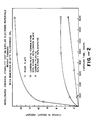
- FIG. 2 there is shown a graph of the results of an accelerated chemical stability test of three composite materials (molded 15 inch by 15 inch pieces) (38.1 ⁇ 38.1 cm): a rigid carbon/carbonized resin plate (represented by square data points) consisting of a sheet of phenolic resin heat treated to form a vitreous carbon; a plate formed by compression molding a mixture of 60% by weight Kynar and 40% by weight carbon black (data points represented by circles); and a plate according to the present invention formed from compression molding a mixture of 50% by weight Kynar and 50% by weight graphite having the characteristics as described herein (datapoints represented by triangles).
- a rigid carbon/carbonized resin plate represented by square data points
- a plate formed by compression molding a mixture of 60% by weight Kynar and 40% by weight carbon black
- a plate according to the present invention formed from compression molding a mixture of 50% by weight Kynar and 50% by weight graphite having the characteristics as described herein (datapoints represented by triangles).
- the three plates were immersed in 60°C polybromide oil (a quaternary ammonium bromide salt used to complex bromide in zinc bromide cells) at 60° for 1600 hours.
- the increase in weight of each of the plates in terms of weight percentage is shown versus exposure time.
- the plate made in accordance with the present invention exhibited a less than 4% increase in weight indicating an improved weight stability.
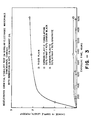
- FIG. 3 there is shown a graph of accelerated chemical stability of the same three plates as described in connection with Figure 2 under the same conditions except that changes in the length of the samples are compared.
- the electrode made in accordance with the present invention (data points represented by triangles) exhibited less than a 0.1% dimensional increase in length, indicating improved dimensional stability.
- the graphite is first subjected to the step of heat treatment 30 at a temperature of at least 800°C for a period of at least 2 hours. Then the heat treated graphite is subjected to the step 32 of screening to ensure the particle size distribution of 0 to 45 ⁇ m. The graphite is then dry mixed in step 34 with the appropriate amount of the thermoplastic resin particles. The mixture is then screened in step 36 to ensure that the resin particles in the mixture are within the size distribution range of 0 to 45 ⁇ m. The dry blend of graphite and resin is then compression molded in step 38 under pressure of at least 400 kg/cm2 (3.92 ⁇ 104 KPa) at 190°C with cooling in a conventional compression mold apparatus.
- a binder material is added to the dry mix.
- this will be a perfluorinated polymer material, preferably Teflon®. This will be added in an amount of about 2 weight percent of the total mixture.
- a hydrocarbon carrier such as Solvent 340 (Shell) in step 40 then calendered into sheets in step 42.
- the sheets are then dried in step 44 and submitted to the compression molding step 38 as described above.
- Solvent 340 Shell
- the graphite was previously screened through a 325 mesh screen to ensure the particle size distribution of 0 to 45 ⁇ m.
- the wet mixture was calendered between rollers to form sheets.
- the sheets were dried at 20°C for 168 hours then placed into a compression mold and molded into 15X15 inch (38.1 ⁇ 38.1 cm) plates under 400 kg/cm2 (3.92 ⁇ 104 KPa) pressure at 190°C.
- the mold was gradually cooled during compression.
- the formed plates had a compressed thickness of 40 mils (0.10 cm).
Landscapes
- Chemical & Material Sciences (AREA)
- Chemical Kinetics & Catalysis (AREA)
- Electrochemistry (AREA)
- General Chemical & Material Sciences (AREA)
- Engineering & Computer Science (AREA)
- Manufacturing & Machinery (AREA)
- Sustainable Energy (AREA)
- Sustainable Development (AREA)
- Life Sciences & Earth Sciences (AREA)
- Inert Electrodes (AREA)
- Battery Electrode And Active Subsutance (AREA)
- Hybrid Cells (AREA)
- Investigating Or Analyzing Materials By The Use Of Electric Means (AREA)
- Measurement Of The Respiration, Hearing Ability, Form, And Blood Characteristics Of Living Organisms (AREA)
- Electrochromic Elements, Electrophoresis, Or Variable Reflection Or Absorption Elements (AREA)
- Electrodes For Compound Or Non-Metal Manufacture (AREA)
Claims (12)
- Procédé de production d'un élément bipolaire pour des cellules électrochimiques, comprenant les étapes consistant :
à mélanger à sec (34) des particules de graphite électriquement conductrices et des particules d'une résine thermoplastique, ledit graphite et ladite résine étant présents en un rapport pondéral de 1:5 à 1:1 ; et à mouler par compression ledit mélange pour former ledit élément bipolaire, caractérisé en ce que ledit graphite possède une distribution des diamètres de particules de 0 à 45 µm, ledit graphite étant en outre soumis à un traitement thermique (30) à une température d'au moins 800°C pendant 2 heures ; et les étapes consistant à tamiser (36) le mélange pour former un mélange de particules ayant un diamètre moyen de particules de 0 à 45 µm ; et à mouler par compression (38) ledit mélange tamisé sous une pression d'au moins 400 kg/cm² (3,92x10⁴ kPa) à 190°C pour former ledit élément bipolaire. - Procédé suivant la revendication 1, caractérisé en ce que les particules de résine thermoplastique consistent en particules d'un polymère de difluorure de vinylidène.
- Procédé suivant la revendication 1 ou 2, caractérisé en ce que le mélange à sec (34) est effectué avec une quantité allant jusqu'à 2 % en poids d'un liant perfluorohydrocarboné ; et en ce qu'il comprend les étapes consistant à former (40) un mélange humide du mélange en particules avec un véhicule hydrocarboné liquide et à transformer ledit mélange humide en feuilles par calandre (42) ; à sécher (44) lesdites feuilles ; et à mouler par compression (38) lesdites feuilles.
- Procédé suivant la revendication 3, caractérisé en ce que le liant perfluorohydrocarboné consiste en polytétrafluoréthylène.
- Elément d'électrode bipolaire pour des cellules électrochimiques, comprenant :
un composite (12A) moulé sous pression, constitué de particules de graphite électriquement conductrices et de particules d'une résine de polymère fluoré thermoplastique, ledit graphite et ladite résine dans ledit composite (12A) étant présents en un rapport pondéral de 1:5 à 1:1 ; caractérisé en ce que les particules de graphite possèdent une distribution des diamètres de particules, avant moulage, de 0 à 45 µm, ledit graphite est soumis à un traitement thermique (30) à une température d'au moins 800°C dans l'air pendant 2 heures avant formation dudit composite (12A) ; les particules de résine de polymère fluoré thermoplastique possèdent une distribution des diamètres de particules, avant moulage, de 0 à 45 µm ; ledit composite présentant une perte de poids inférieure à 4,0 % et un accroissement de longueur inférieur à 0,1 % par immersion à 60°C dans une huile de polybromure pendant 1600 heures ; et ledit composite (12A) étant formé par moulage sous pression (38) d'un mélange comprenant ledit graphite et ladite résine, sous une pression égale ou supérieure à 400 kg/cm² (3,92x10⁴ kPa) et à une température de 190°C. - Elément bipolaire suivant la revendication 5, caractérisé par une résistivité inférieure à 0,8 ohm-cm et une résistance à la flexion d'au moins 2400 lb/in² (168,7 kg/cm²) (1,65x10⁴ kPa) lors d'une immersion à 60°C dans une huile de polybromure pendant au moins 2300 heures.
- Elément bipolaire suivant la revendication 5, caractérisé en ce qu'il comprend jusqu'à 2 % en poids d'un perfluorohydrocarbure, le graphite, la résine et le perfluorohydrocarbure étant calandrés (42) avec un véhicule hydrocarboné en pièces préformées avant d'être soumis au moulage sous pression (38).
- Elément bipolaire suivant la revendication 7, caractérisé en ce que le perfluorohydrocarbure consiste en polytétrafluoréthylène.
- Elément bipolaire suivant la revendication 5, caractérisé en ce que la résine thermoplastique consiste en un polymère de difluorure de vinylidène.
- Elément bipolaire suivant la revendication 9, caractérisé en ce que le graphite et la résine dans le composite (12A) sont présents en un rapport pondéral égal à 1:1.
- Assemblage bipolaire comprenant un élément bipolaire (12A) suivant la revendication 5 et un feutre de carbone composite (14), ledit feutre (14) et ledit élément (12A) étant maintenus en contact interfacial au moyen d'un adhésif.
- Assemblage bipolaire suivant la revendication 11, caractérisé en ce que l'adhésif est formé de carbone, d'une résine de polymère de difluorure de vinylidène, et de diméthylformamide.
Priority Applications (1)
| Application Number | Priority Date | Filing Date | Title |
|---|---|---|---|
| AT87309484T ATE77003T1 (de) | 1986-11-20 | 1987-10-27 | Kohlenstoff-plastik-elektrodenelemente. |
Applications Claiming Priority (2)
| Application Number | Priority Date | Filing Date | Title |
|---|---|---|---|
| US933466 | 1986-11-20 | ||
| US06/933,466 US4758473A (en) | 1986-11-20 | 1986-11-20 | Stable carbon-plastic electrodes and method of preparation thereof |
Publications (2)
| Publication Number | Publication Date |
|---|---|
| EP0268397A1 EP0268397A1 (fr) | 1988-05-25 |
| EP0268397B1 true EP0268397B1 (fr) | 1992-06-03 |
Family
ID=25464019
Family Applications (1)
| Application Number | Title | Priority Date | Filing Date |
|---|---|---|---|
| EP87309484A Expired - Lifetime EP0268397B1 (fr) | 1986-11-20 | 1987-10-27 | Eléments d'électrode à base de carbone-plastique |
Country Status (6)
| Country | Link |
|---|---|
| US (1) | US4758473A (fr) |
| EP (1) | EP0268397B1 (fr) |
| JP (1) | JPS63138659A (fr) |
| AT (1) | ATE77003T1 (fr) |
| CA (1) | CA1282920C (fr) |
| DE (1) | DE3779570T2 (fr) |
Cited By (1)
| Publication number | Priority date | Publication date | Assignee | Title |
|---|---|---|---|---|
| EP4484616A4 (fr) * | 2022-03-22 | 2025-07-02 | Fuji Die Co | Électrode et son procédé de fabrication |
Families Citing this family (51)
| Publication number | Priority date | Publication date | Assignee | Title |
|---|---|---|---|---|
| FR2574803B1 (fr) * | 1984-12-18 | 1987-01-30 | Occidental Chem Co | Materiau thermoplastique conducteur de l'electricite et procede de fabrication d'un tel materiau |
| US4920017A (en) * | 1986-11-20 | 1990-04-24 | Electric Power Research Institute, Inc. | Porous and porous-nonporous composites for battery electrodes |
| JP3012240B2 (ja) * | 1987-09-25 | 2000-02-21 | 東洋紡績株式会社 | 分極性電極材の製造方法 |
| DE3809758A1 (de) * | 1988-03-23 | 1989-10-05 | Dietrich Dipl Chem Dr Schuster | Organisches elektrodenmaterial, verfahren zu seiner herstellung und anwendung |
| WO1991010619A1 (fr) * | 1990-01-11 | 1991-07-25 | Koa Oil Company, Limited | Production d'articles moules en graphite elastiques |
| AU649894B2 (en) * | 1991-11-25 | 1994-06-02 | Shigeyuki Yasuda | Electric power generating element |
| CN1086929A (zh) * | 1992-09-04 | 1994-05-18 | 单一检索有限公司 | 挠性塑料电极及其制造方法 |
| AU673003B2 (en) * | 1992-09-04 | 1996-10-24 | Jd Holding Inc. | Flexible, conducting plastic electrode and process for its preparation |
| US5344727A (en) * | 1993-06-21 | 1994-09-06 | General Motors Corporation | Bipolar battery electrode |
| US5556627A (en) * | 1994-10-12 | 1996-09-17 | Bipolar Technologies, Inc. | Bipolar battery cells, batteries and methods |
| US5582622A (en) * | 1994-10-12 | 1996-12-10 | Bipolar Technologies, Inc. | Methods of making bipolar battery plates comprising carbon and a fluoroelastomer |
| US5582937A (en) * | 1994-10-12 | 1996-12-10 | Bipolar Technologies, Inc. | Bipolar battery cells, batteries and methods |
| WO1996012313A1 (fr) * | 1994-10-12 | 1996-04-25 | Bipolar Technologies Corporation | Cellules pour batteries bipolaires, batteries et procedes |
| DE19542721A1 (de) * | 1995-11-16 | 1997-05-22 | Sgl Technik Gmbh | Verfahren zur Herstellen von Formkörpern aus Kunststoff-Füllstoff-Mischungen mit einem hohen Gehalt an Füllstoffen |
| JP3359220B2 (ja) * | 1996-03-05 | 2002-12-24 | キヤノン株式会社 | リチウム二次電池 |
| GB2337150B (en) | 1998-05-07 | 2000-09-27 | Nat Power Plc | Carbon based electrodes |
| US6572997B1 (en) | 2000-05-12 | 2003-06-03 | Hybrid Power Generation Systems Llc | Nanocomposite for fuel cell bipolar plate |
| FR2812119B1 (fr) * | 2000-07-24 | 2002-12-13 | Commissariat Energie Atomique | Materiau composite conducteur et electrode pour pile a combustible utilisant ce materiau mis en forme par thermo- compression |
| FR2812120B1 (fr) | 2000-07-24 | 2006-11-03 | Commissariat Energie Atomique | Materiau composite conducteur et electrode pour pile a combustible utilisant ce materiau |
| WO2003047684A2 (fr) * | 2001-12-04 | 2003-06-12 | University Of Southern California | Procede de modifications intracellulaires dans des cellules vivantes au moyen de champs electriques pulses |
| US20030219646A1 (en) * | 2002-05-23 | 2003-11-27 | Lecostaouec Jean-Francois | Carbon fiber reinforced plastic bipolar plates with continuous electrical pathways |
| US6979513B2 (en) * | 2002-06-28 | 2005-12-27 | Firefly Energy Inc. | Battery including carbon foam current collectors |
| US7033703B2 (en) * | 2002-12-20 | 2006-04-25 | Firefly Energy, Inc. | Composite material and current collector for battery |
| US7341806B2 (en) * | 2002-12-23 | 2008-03-11 | Caterpillar Inc. | Battery having carbon foam current collector |
| US20100014215A1 (en) * | 2004-04-02 | 2010-01-21 | Maxwell Technologies, Inc. | Recyclable dry particle based electrode and methods of making same |
| US20110165318A9 (en) * | 2004-04-02 | 2011-07-07 | Maxwell Technologies, Inc. | Electrode formation by lamination of particles onto a current collector |
| US7295423B1 (en) * | 2003-07-09 | 2007-11-13 | Maxwell Technologies, Inc. | Dry particle based adhesive electrode and methods of making same |
| US7342770B2 (en) * | 2003-07-09 | 2008-03-11 | Maxwell Technologies, Inc. | Recyclable dry particle based adhesive electrode and methods of making same |
| US20070122698A1 (en) * | 2004-04-02 | 2007-05-31 | Maxwell Technologies, Inc. | Dry-particle based adhesive and dry film and methods of making same |
| US20060147712A1 (en) * | 2003-07-09 | 2006-07-06 | Maxwell Technologies, Inc. | Dry particle based adhesive electrode and methods of making same |
| US7508651B2 (en) * | 2003-07-09 | 2009-03-24 | Maxwell Technologies, Inc. | Dry particle based adhesive and dry film and methods of making same |
| US7352558B2 (en) * | 2003-07-09 | 2008-04-01 | Maxwell Technologies, Inc. | Dry particle based capacitor and methods of making same |
| US7791860B2 (en) * | 2003-07-09 | 2010-09-07 | Maxwell Technologies, Inc. | Particle based electrodes and methods of making same |
| US7920371B2 (en) * | 2003-09-12 | 2011-04-05 | Maxwell Technologies, Inc. | Electrical energy storage devices with separator between electrodes and methods for fabricating the devices |
| US7495349B2 (en) * | 2003-10-20 | 2009-02-24 | Maxwell Technologies, Inc. | Self aligning electrode |
| US7384433B2 (en) | 2004-02-19 | 2008-06-10 | Maxwell Technologies, Inc. | Densification of compressible layers during electrode lamination |
| US7090946B2 (en) | 2004-02-19 | 2006-08-15 | Maxwell Technologies, Inc. | Composite electrode and method for fabricating same |
| US7227737B2 (en) * | 2004-04-02 | 2007-06-05 | Maxwell Technologies, Inc. | Electrode design |
| US7440258B2 (en) * | 2005-03-14 | 2008-10-21 | Maxwell Technologies, Inc. | Thermal interconnects for coupling energy storage devices |
| US7492574B2 (en) | 2005-03-14 | 2009-02-17 | Maxwell Technologies, Inc. | Coupling of cell to housing |
| ATE517445T1 (de) * | 2005-03-31 | 2011-08-15 | Firefly Energy Inc | Stromträger für eine energiespeichervorrichtung |
| US7572551B1 (en) | 2005-06-27 | 2009-08-11 | Greatbatch Ltd. | Electrode active blanks and methods of making |
| US8518573B2 (en) * | 2006-09-29 | 2013-08-27 | Maxwell Technologies, Inc. | Low-inductive impedance, thermally decoupled, radii-modulated electrode core |
| US20080201925A1 (en) | 2007-02-28 | 2008-08-28 | Maxwell Technologies, Inc. | Ultracapacitor electrode with controlled sulfur content |
| US20080204973A1 (en) * | 2007-02-28 | 2008-08-28 | Maxwell Technologies, Inc. | Ultracapacitor electrode with controlled iron content |
| US8399134B2 (en) * | 2007-11-20 | 2013-03-19 | Firefly Energy, Inc. | Lead acid battery including a two-layer carbon foam current collector |
| CN101567452B (zh) * | 2009-04-20 | 2011-05-11 | 清华大学 | 一种液流电池的复合材料双极板制备方法 |
| KR20160125378A (ko) * | 2014-02-24 | 2016-10-31 | 세키스이가가쿠 고교가부시키가이샤 | 탄소 재료, 수지 복합 재료 및 그들의 제조 방법 |
| US10403887B2 (en) * | 2014-02-26 | 2019-09-03 | Redflow R&D Pty Ltd. | Bipolar battery electrode having improved carbon surfaces and method of manufacturing same |
| CN107331879A (zh) * | 2017-07-04 | 2017-11-07 | 清华大学 | 一种液流电池双极板的连续化制造方法 |
| WO2025214813A1 (fr) | 2024-04-12 | 2025-10-16 | Boosting Innovation In Poliba S.C. A R.L. | Formulation composite de polymère-carbone biosourcés pour électrodes et dispositifs de conversion et de stockage d'énergie électrochimique |
Family Cites Families (12)
| Publication number | Priority date | Publication date | Assignee | Title |
|---|---|---|---|---|
| BE408093A (fr) * | 1934-03-14 | |||
| US3589942A (en) * | 1966-12-22 | 1971-06-29 | Cons Natural Gas Svc | Bipolar collector plates |
| US3565694A (en) * | 1969-03-17 | 1971-02-23 | Yardney International Corp | Bipolar electrode and method of making same |
| CA1051512A (fr) * | 1973-05-23 | 1979-03-27 | Royce E. Biddick | Electrode bipolaire utilisant un substrat de plastique electriquement conducteur contenant du carbone vitreux |
| US4124747A (en) * | 1974-06-04 | 1978-11-07 | Exxon Research & Engineering Co. | Conductive polyolefin sheet element |
| US4125680A (en) * | 1977-08-18 | 1978-11-14 | Exxon Research & Engineering Co. | Bipolar carbon-plastic electrode structure-containing multicell electrochemical device and method of making same |
| US4162351A (en) * | 1977-10-12 | 1979-07-24 | Electric Power Research Institute, Inc. | Metal-halogen cell operation with storage of halogen via organic complexation external to the electrochemical cell |
| US4214969A (en) * | 1979-01-02 | 1980-07-29 | General Electric Company | Low cost bipolar current collector-separator for electrochemical cells |
| US4294893A (en) * | 1979-05-21 | 1981-10-13 | Centro Ricerche Fiat S.P.A. | Graphite-resin composite electrode structure, and a process for its manufacture |
| US4339322A (en) * | 1980-04-21 | 1982-07-13 | General Electric Company | Carbon fiber reinforced fluorocarbon-graphite bipolar current collector-separator |
| US4482614A (en) * | 1982-11-15 | 1984-11-13 | Gel, Inc. | Zinc-bromine battery with long term stability |
| JPS59138067A (ja) * | 1983-01-27 | 1984-08-08 | Meidensha Electric Mfg Co Ltd | 金属−ハロゲン電池のプラスチツク電極 |
-
1986
- 1986-11-20 US US06/933,466 patent/US4758473A/en not_active Expired - Fee Related
-
1987
- 1987-10-26 CA CA000550214A patent/CA1282920C/fr not_active Expired - Lifetime
- 1987-10-27 EP EP87309484A patent/EP0268397B1/fr not_active Expired - Lifetime
- 1987-10-27 DE DE8787309484T patent/DE3779570T2/de not_active Expired - Fee Related
- 1987-10-27 AT AT87309484T patent/ATE77003T1/de not_active IP Right Cessation
- 1987-11-20 JP JP62293852A patent/JPS63138659A/ja active Pending
Non-Patent Citations (1)
| Title |
|---|
| CHEMICAL ABSTRACTS, vol. 101, no. 26, December 24, 1984, Columbus, Ohio USA MEIDENSHA ELECTRIC MFG. CO. LTD "Plastic electrode" page 154, column 2, abstract-no. 233 257h * |
Cited By (1)
| Publication number | Priority date | Publication date | Assignee | Title |
|---|---|---|---|---|
| EP4484616A4 (fr) * | 2022-03-22 | 2025-07-02 | Fuji Die Co | Électrode et son procédé de fabrication |
Also Published As
| Publication number | Publication date |
|---|---|
| DE3779570T2 (de) | 1993-01-28 |
| US4758473A (en) | 1988-07-19 |
| ATE77003T1 (de) | 1992-06-15 |
| JPS63138659A (ja) | 1988-06-10 |
| CA1282920C (fr) | 1991-04-16 |
| DE3779570D1 (de) | 1992-07-09 |
| EP0268397A1 (fr) | 1988-05-25 |
Similar Documents
| Publication | Publication Date | Title |
|---|---|---|
| EP0268397B1 (fr) | Eléments d'électrode à base de carbone-plastique | |
| US4510219A (en) | Battery plate containing filler with conductive coating | |
| US5348817A (en) | Bipolar lead-acid battery | |
| US4086397A (en) | Electrochemical cell and cathode for same | |
| RU2182737C2 (ru) | Электрохимический топливный элемент (варианты), узел мембрана - электрод (варианты), композиция (варианты), способ получения электрохимического топливного элемента и способ получения узла мембрана - электрод (варианты) | |
| EP1066656B1 (fr) | Matrices conductrice d'ions et leurs utilisations | |
| AU779425B2 (en) | Electrochemical electrode for fuel cell | |
| US9105933B2 (en) | Gas diffusion electrode, method of producing same, membrane electrode assembly comprising same and method of producing membrane electrode assembly comprising same | |
| CA1278032C (fr) | Electrode cathodique | |
| CA2051441A1 (fr) | Elements conducteurs contenant de l'oxyde metallique conducteur | |
| Scrosati | Conducting polymers: advanced materials for new design, rechargeable lithium batteries | |
| KR20030022126A (ko) | 연료 전지 쌍극판용 나노복합물 | |
| US4625395A (en) | Battery plate containing filler with conductive coating | |
| US4731310A (en) | Cathodic electrode | |
| US4060668A (en) | Primary electrochemical cell | |
| EP0228573B1 (fr) | Electrode soumise à un traitement de surface et une batterie secondaire du type inc-halogène la contenant | |
| EP3425704B1 (fr) | Batterie secondaire de navette au fluorure | |
| US3553022A (en) | Electrochemical cell | |
| Baochen et al. | Large-scale polyaniline batteries | |
| US4920017A (en) | Porous and porous-nonporous composites for battery electrodes | |
| US4818741A (en) | Porous and porous-nonporous composites for battery electrodes | |
| EP1880440B1 (fr) | Microcouches à stabilité oxydative de couches de diffusion gazeuse | |
| CA1171903A (fr) | Pile a combustible | |
| CN100492749C (zh) | 生产电化学元件用隔膜/电极组件的方法 | |
| Brilmyer | Impact of separator design on battery performance in traction applications |
Legal Events
| Date | Code | Title | Description |
|---|---|---|---|
| PUAI | Public reference made under article 153(3) epc to a published international application that has entered the european phase |
Free format text: ORIGINAL CODE: 0009012 |
|
| AK | Designated contracting states |
Kind code of ref document: A1 Designated state(s): AT BE CH DE ES FR GB GR IT LI LU NL SE |
|
| 17P | Request for examination filed |
Effective date: 19881121 |
|
| 17Q | First examination report despatched |
Effective date: 19900525 |
|
| GRAA | (expected) grant |
Free format text: ORIGINAL CODE: 0009210 |
|
| AK | Designated contracting states |
Kind code of ref document: B1 Designated state(s): AT BE CH DE ES FR GB GR IT LI LU NL SE |
|
| ITF | It: translation for a ep patent filed | ||
| PG25 | Lapsed in a contracting state [announced via postgrant information from national office to epo] |
Ref country code: SE Effective date: 19920603 Ref country code: GR Free format text: LAPSE BECAUSE OF FAILURE TO SUBMIT A TRANSLATION OF THE DESCRIPTION OR TO PAY THE FEE WITHIN THE PRESCRIBED TIME-LIMIT Effective date: 19920603 Ref country code: BE Effective date: 19920603 Ref country code: AT Effective date: 19920603 |
|
| REF | Corresponds to: |
Ref document number: 77003 Country of ref document: AT Date of ref document: 19920615 Kind code of ref document: T |
|
| REF | Corresponds to: |
Ref document number: 3779570 Country of ref document: DE Date of ref document: 19920709 |
|
| ET | Fr: translation filed | ||
| PG25 | Lapsed in a contracting state [announced via postgrant information from national office to epo] |
Ref country code: ES Free format text: LAPSE BECAUSE OF FAILURE TO SUBMIT A TRANSLATION OF THE DESCRIPTION OR TO PAY THE FEE WITHIN THE PRESCRIBED TIME-LIMIT Effective date: 19920914 |
|
| PG25 | Lapsed in a contracting state [announced via postgrant information from national office to epo] |
Ref country code: GB Effective date: 19921027 |
|
| PG25 | Lapsed in a contracting state [announced via postgrant information from national office to epo] |
Ref country code: LU Free format text: LAPSE BECAUSE OF NON-PAYMENT OF DUE FEES Effective date: 19921031 Ref country code: LI Effective date: 19921031 Ref country code: CH Effective date: 19921031 |
|
| PLBE | No opposition filed within time limit |
Free format text: ORIGINAL CODE: 0009261 |
|
| STAA | Information on the status of an ep patent application or granted ep patent |
Free format text: STATUS: NO OPPOSITION FILED WITHIN TIME LIMIT |
|
| PG25 | Lapsed in a contracting state [announced via postgrant information from national office to epo] |
Ref country code: NL Effective date: 19930501 |
|
| 26N | No opposition filed | ||
| NLV4 | Nl: lapsed or anulled due to non-payment of the annual fee | ||
| GBPC | Gb: european patent ceased through non-payment of renewal fee |
Effective date: 19921027 |
|
| PG25 | Lapsed in a contracting state [announced via postgrant information from national office to epo] |
Ref country code: FR Effective date: 19930630 |
|
| REG | Reference to a national code |
Ref country code: CH Ref legal event code: PL |
|
| PG25 | Lapsed in a contracting state [announced via postgrant information from national office to epo] |
Ref country code: DE Effective date: 19930701 |
|
| REG | Reference to a national code |
Ref country code: FR Ref legal event code: ST |
|
| PG25 | Lapsed in a contracting state [announced via postgrant information from national office to epo] |
Ref country code: IT Free format text: LAPSE BECAUSE OF NON-PAYMENT OF DUE FEES;WARNING: LAPSES OF ITALIAN PATENTS WITH EFFECTIVE DATE BEFORE 2007 MAY HAVE OCCURRED AT ANY TIME BEFORE 2007. THE CORRECT EFFECTIVE DATE MAY BE DIFFERENT FROM THE ONE RECORDED. Effective date: 20051027 |