EP0252589A2 - Digitales Kommunikationssystem - Google Patents
Digitales Kommunikationssystem Download PDFInfo
- Publication number
- EP0252589A2 EP0252589A2 EP87304174A EP87304174A EP0252589A2 EP 0252589 A2 EP0252589 A2 EP 0252589A2 EP 87304174 A EP87304174 A EP 87304174A EP 87304174 A EP87304174 A EP 87304174A EP 0252589 A2 EP0252589 A2 EP 0252589A2
- Authority
- EP
- European Patent Office
- Prior art keywords
- carrier wave
- phase
- information symbol
- signal
- quaternary
- Prior art date
- Legal status (The legal status is an assumption and is not a legal conclusion. Google has not performed a legal analysis and makes no representation as to the accuracy of the status listed.)
- Withdrawn
Links
Images

Classifications
-
- H—ELECTRICITY
- H04—ELECTRIC COMMUNICATION TECHNIQUE
- H04L—TRANSMISSION OF DIGITAL INFORMATION, e.g. TELEGRAPHIC COMMUNICATION
- H04L27/00—Modulated-carrier systems
- H04L27/18—Phase-modulated carrier systems, i.e. using phase-shift keying
- H04L27/20—Modulator circuits; Transmitter circuits
- H04L27/2032—Modulator circuits; Transmitter circuits for discrete phase modulation, e.g. in which the phase of the carrier is modulated in a nominally instantaneous manner
- H04L27/2053—Modulator circuits; Transmitter circuits for discrete phase modulation, e.g. in which the phase of the carrier is modulated in a nominally instantaneous manner using more than one carrier, e.g. carriers with different phases
- H04L27/206—Modulator circuits; Transmitter circuits for discrete phase modulation, e.g. in which the phase of the carrier is modulated in a nominally instantaneous manner using more than one carrier, e.g. carriers with different phases using a pair of orthogonal carriers, e.g. quadrature carriers
- H04L27/2067—Modulator circuits; Transmitter circuits for discrete phase modulation, e.g. in which the phase of the carrier is modulated in a nominally instantaneous manner using more than one carrier, e.g. carriers with different phases using a pair of orthogonal carriers, e.g. quadrature carriers with more than two phase states
- H04L27/2085—Modulator circuits; Transmitter circuits for discrete phase modulation, e.g. in which the phase of the carrier is modulated in a nominally instantaneous manner using more than one carrier, e.g. carriers with different phases using a pair of orthogonal carriers, e.g. quadrature carriers with more than two phase states with more than one phase shift per symbol period
-
- H—ELECTRICITY
- H04—ELECTRIC COMMUNICATION TECHNIQUE
- H04L—TRANSMISSION OF DIGITAL INFORMATION, e.g. TELEGRAPHIC COMMUNICATION
- H04L27/00—Modulated-carrier systems
- H04L27/18—Phase-modulated carrier systems, i.e. using phase-shift keying
- H04L27/22—Demodulator circuits; Receiver circuits
- H04L27/233—Demodulator circuits; Receiver circuits using non-coherent demodulation
- H04L27/2331—Demodulator circuits; Receiver circuits using non-coherent demodulation wherein the received signal is demodulated using one or more delayed versions of itself
Definitions
- the present invention relates to a digital communication system. More particularly, it relates to a digital communication system employed in mobile radio communication which is immune from multipath interference.
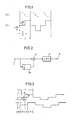
- Fig. 1 is a diagram for explaining a ⁇ /2-DSK signal
- Fig. 2 is a diagram showing a T/2 (T: 1 time slot) differential detector
- Fig. 3 is a diagram showing the relation between a D wave and a U wave
- Fig. 4 is a diagram showing demodulation outputs in sections b and d and a section c in the ⁇ /2-DSK signal.
- the ⁇ /2-DSK signal shown in Fig. 1 is such that the phase of a carrier wave is shifted by + ⁇ /2 during a period of T/2 in the first half of a time slot and further by ⁇ /2 during a period of T/2 in the second half thereof clockwise or counterclockwise, in correspondence to a digital binary information symbol.
- a T/2 delay circuit shown in Fig. 2 is employed.
- the ⁇ /2-DSK signal is applied to an input terminal 1
- the ⁇ /2-DSK signal is applied to a T/2 delay circuit 3a and a multiplier 2.
- An output of the multiplier 2 is outputted through a low pass filter 4 to an output terminal 5.
- the ⁇ /2-DSK signal is such that the phase of the carrier wave is shifted by + ⁇ /2 during a period of T/2 in the first half and further by + ⁇ /2 during a period of T/2 in the second half with respect to a binary information symbol "1", while the phase of the carrier wave is shifted by - ⁇ /2 during a period of T/2 in the first half and further by - ⁇ /2 during a period of T/2 in the second half with respect to a binary information symbol "0".
- a demodulation output e(t) is represented by the following expressions: where cos ⁇ /2 is referred to as the amplitude coefficient, ⁇ represents the relative amplitude ratio of the U wave to the D wave and ⁇ represents the carrier phase difference between the D wave and the U wave.
- cos ⁇ /2 is referred to as the amplitude coefficient
- ⁇ represents the relative amplitude ratio of the U wave to the D wave
- ⁇ represents the carrier phase difference between the D wave and the U wave.
- the demodulation outputs in the sections b and d and in the section c are in compensating relation with respect to the change of the carrier phase difference ⁇ , so that one is decreased while the other is increased.
- the bit error rate is remarkably improved, as compared with the BPSK signal.
- the phase is shifted per 1/2 time slot, the bandwidth of a signal expands, which has presented a problem especially in application to a communication system in which the bandwidth of transmission media must be strictly limited.
- a primary object of the present invention is to provide a digital communication system in which expansion of the bandwidth at the identical transmission rate can be controlled at a low level.
- the present invention is concerned with a digital communication system employing a signal which shifts the carrier phase in correspondence to a digital information symbol, where the digital information symbol is multi-valued and the corresponding phase shift is performed in double steps per time slot in correspondence to each multi-valued information symbol.
- the phase shift per unit time in the case of the identical transmission rate can be decreased to 1/n, as compared with a ⁇ /2-DSK system, so that expansion of the bandwidth can be decreased to 1/n.
- the multi-valued information symbol is a quaternary information symbol (11, 01, 00, 10) and the phase shift per 1/2 time slot corresponding to the quaternary information symbol is represented by ( ⁇ /4, (3/4) ⁇ , (5/4) ⁇ , (7/4) ⁇ ).
- Fig. 5 is a diagram for explaining a quaternary DSK signal employed in an embodiment of the present invention
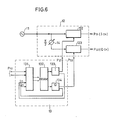
- Fig. 6 is a schematic block diagram showing an example of a quaternary DSK signal generator for generating the quaternary DSK signal.
- a carrier wave signal generator 11 generates a carrier wave signal, the carrier wave signal being applied to an I ⁇ Q modulator 12.
- the I ⁇ Q modulator 12 comprises a ⁇ /2 phase shifter 121, an I CH switching circuit 122 and a Q CH switching circuit 123.
- the ⁇ /2 phase shifter 121 shifts, by ⁇ /2 rad, the phase of a carrier wave applied from the carrier wave signal generator 11.
- the I CH switching circuit 122 switches an I CH carrier wave into the phase 0, the phase ⁇ or the amplitude 0 in correspondence to an I CH modulating signal applied through a terminal P21.
- the Q CH switching circuit 123 switches a Q CH carrier wave into the phase 0, the phase ⁇ or the amplitude 0 in correspondence to a Q CH modulating signal applied through a terminal P22.
- the I CH switching circuit 122 and the Q CH switching circuit 123 comprise a double-balanced modulator, in which the I CH carrier wave is controlled such that it is the phase 0 at +1, the phase ⁇ at -1 and the amplitude 0 at 0.
- the quaternary DSK signal generator further comprises a modulating signal generator 13.
- the modulating signal generator 13 comprises an address generator 131, a RAM 132, an I CH driver 133 and a Q CH driver 134.
- the address generator 131 generates an addressing signal showing how the I CH switching circuit 122 and the Q CH switching circuit 123 are to be controlled, in response to a quaternary information signal applied through a terminal P10 and based on the control state of the above described I CH switching circuit 122 and the Q CH switching circuit 123 corresponding to the preceding quaternary information signals.
- the RAM 132 is addressed by the addressing signal generated in the address generator 131. Instructions stored in advance in the RAM 132 are read out in response to the addressing signal applied from the address generator.
- the I CH driver 133 and the Q CH driver 134 convert the instructions read out from the RAM 132 in the form of control signals required for the above described I CH switching circuit 122 and the Q CH switching circuit 123.
- the amount of phase shift per 1/2 time slot corresponding to each quaternary information symbol is selected as shown in Fig. 5B and the phase shift of the carrier wave corresponding to a quaternary information signal (11, 10, 01, 10, 00, 11) shown in Fig. 5A(a) is shown in Fig. 5A(b).
- Such a signal is generated by forming orthogonal signals (the I CH carrier wave and the Q CH carrier wave) in the following manner. More specifically, in Fig. 5B, if a quaternary information symbol "11" is inputted when the I CH carrier wave is the phase 0 and the Q CH carrier wave is the amplitude 0, the carrier wave is controlled such that the I CH carrier wave remains in the phase 0 and the Q CH carrier wave changes from the amplitude 0 to the phase 0 in the first period of 1/2 time slot, and the I CH carrier wave changes from the phase 0 to the amplitude 0 and the Q CH carrier wave remains in the phase 0 in the second period of 1/2 time slot.
- the I CH carrier wave and the Q CH carrier wave thus obtained are combined.
- Fig. 5B if a quaternary information symbol "11" is inputted when the I CH carrier wave is the phase 0 and the Q CH carrier wave is the amplitude 0, the carrier wave is controlled such that the I CH carrier wave remains in the phase 0 and the Q CH carrier wave
- the carrier wave is controlled such that the I CH carrier wave changes from the amplitude 0 to the phase ⁇ and Q CH carrier wave remains in the amplitude 0 in the first period of 1/2 time slot, and the I CH carrier wave remains in the phase ⁇ and the Q CH carrier wave changes from the phase ⁇ to the amplitude 0 in the second period of 1/2 time slot.
- the I CH carrier wave and the Q CH carrier wave corresponding to the quaternary information symbols in the preceding adjacent time slots are the phase ⁇ or the amplitude 0, and how the phases of the I CH carrier wave and the Q CH carrier wave in the present time slot are to be changed by the quaternary information symbol of the present time slot.
- the carrier wave signal generated from the carrier wave signal generator 11 is applied to the I CH switching circuit 122, and the Q CH switching circuit 123 with the phase shifted, by ⁇ /2 rad, by the ⁇ /2 phase shifter 121.
- the RAM 132 is addressed by the addressing signal from the address generator 131, so that the instructions for controlling the I CH switching circuit 122 and the Q CH switching circuit 123 are read out from the RAM 132.
- the I CH driver 133 and the Q CH driver 134 control the I CH switching circuit 122 and the Q CH switching circuit 123 in response to the instructions.
- the address generator 131 generates the addressing signal in response to the quaternary information symbol in the present time slot and signals from the I CH driver 133 and the Q CH driver 134 in the preceding time slots, so that a memory cell in the RAM 132 corresponding to the addressing signal is addressed.
- the RAM 132 stores in advance the quaternary information symbol in the present time slot and signals to be generated from the I CH driver 133 and the Q CH driver 134 in response to the I CH carrier wave and the Q CH carrier wave in the preceding time slots.
- the RAM 132 outputs the signals based on the instructions and applies the same to the I CH driver 133 and the Q CH driver 134.
- the I CH driver 133 controls the I CH switching circuit 122 and the Q CH driver 134 controls the Q CH switching circuit 123, so that the predetermined I CH carrier wave and Q CH carrier wave are obtained.
- Fig. 7 is a schematic block diagram showing an example of a T/2 delay circuit for demodulating a multi-valued DSK signal generated.
- the multi-valued DSK signal inputted to an input terminal 1 is applied to a T/2 delay circuit 3b, a multiplier 2a for I CH and a multiplier 2b for Q CH .
- the T/2 delay circuit 3b delays, by T/2, the multi-valued DSK signal, the output of the T/2 delay circuit 3b being applied to a first phase shifter 3c and a second phase shifter 3d.
- the second phase shifter 3d applies the amount of phase shift which is larger, by ⁇ /2 rad, than that of the first phase shifter 3c.
- the multiplier 2a for I CH multiplies the output of the T/2 delay circuit 3b by the multi-valued DSK signal, the product being outputted to an output terminal 5a through a low pass filter 4a as the I CH carrier wave.
- the multiplier 2b for Q CH multiplies the output of the second phase shifter 3d by the multi-valued DSK signal, the product being outputted to an output terminal 5b through the low pass filter 4b as the Q CH carrier wave.
- the first phase shifter 3c and the second phase shifter 3d are adjusted such that the phase difference between signals outputted from the T/2 delay circuits 3b in the I CH multiplier 2a and the Q CH multiplier 2b is ⁇ /2 rad, resulting in the respective operations of the multipliers 2a and 2b having orthogonal relation.
- the upper half and the lower half of the circuit shown in Fig. 7 constitute the T/2 differential detectors, respectively, which are responsive to signals out of phase by ⁇ /2 rad in operation thereof.
- a signal obtained in the upper half of the circuit shown in Fig. 7 corresponds to an input signal which is delayed, by ⁇ /2 rad, from a signal obtained in the lower half.
- the signal obtained in the upper half corresponds to a signal of an I axis shown in Fig. 5B and the signal obtained in the lower half corresponds to a signal of the Q axis shown in Fig. 5B.
- the quaternary information symbol is obtained from change in the I CH carrier wave and the Q CH carrier wave in the first half and the second half of a time slot.
- multi-valued (more than quaternary) information symbol can be used.
- the digital information is represented by the multi-valued information symbol and the phase shift corresponding to each multi-valued information symbol is performed two times per 1/2 time slot in correspondence to each multi-valued information symbol, the effect of a DSK communication system can be obtained while controlling expansion of the bandwidth.
Landscapes
- Engineering & Computer Science (AREA)
- Computer Networks & Wireless Communication (AREA)
- Signal Processing (AREA)
- Digital Transmission Methods That Use Modulated Carrier Waves (AREA)
Applications Claiming Priority (2)
| Application Number | Priority Date | Filing Date | Title |
|---|---|---|---|
| JP61111673A JPS62265836A (ja) | 1986-05-13 | 1986-05-13 | デイジタル通信方式 |
| JP111673/86 | 1986-05-13 |
Publications (2)
| Publication Number | Publication Date |
|---|---|
| EP0252589A2 true EP0252589A2 (de) | 1988-01-13 |
| EP0252589A3 EP0252589A3 (de) | 1988-03-16 |
Family
ID=14567284
Family Applications (1)
| Application Number | Title | Priority Date | Filing Date |
|---|---|---|---|
| EP87304174A Withdrawn EP0252589A3 (de) | 1986-05-13 | 1987-05-11 | Digitales Kommunikationssystem |
Country Status (4)
| Country | Link |
|---|---|
| US (1) | US4841547A (de) |
| EP (1) | EP0252589A3 (de) |
| JP (1) | JPS62265836A (de) |
| CA (1) | CA1269716A (de) |
Cited By (4)
| Publication number | Priority date | Publication date | Assignee | Title |
|---|---|---|---|---|
| WO1999013622A1 (en) * | 1997-09-05 | 1999-03-18 | Ericsson Inc. | Apparatus for providing increased data rates within existing modulation systems |
| WO2006126907A1 (fr) * | 2005-05-25 | 2006-11-30 | Ilya Davidovich Zolotarev | Procede de transmission de messages discrets dans des systemes de telecommunication utilisant une manipulation de phase a positions multiples |
| RU2367104C2 (ru) * | 2005-05-25 | 2009-09-10 | Илья Давыдович Золотарев | Способ передачи дискретных сообщений в системах телекоммуникации с использованием многопозиционной фазовой манипуляции |
| RU2393640C1 (ru) * | 2008-12-17 | 2010-06-27 | Общество с ограниченной ответственностью научно-производственное объединение "Челбас" | Модулятор дискретного сигнала по временному положению |
Families Citing this family (2)
| Publication number | Priority date | Publication date | Assignee | Title |
|---|---|---|---|---|
| US8417195B2 (en) * | 2005-09-12 | 2013-04-09 | Magellan Technology Pty Limited | Method and apparatus adapted to transmit data |
| RU2677358C1 (ru) * | 2018-01-12 | 2019-01-16 | Сергей Александрович Турко | Модулятор дискретного сигнала по временному положению |
Family Cites Families (4)
| Publication number | Priority date | Publication date | Assignee | Title |
|---|---|---|---|---|
| FR2394921A1 (fr) * | 1977-06-13 | 1979-01-12 | Poitevin Jean Pierre | Modulateur a quatre phases a sauts decales |
| US4174505A (en) * | 1978-04-26 | 1979-11-13 | Digital Communications Corporation | Directional PSK modulation and demodulation system |
| FR2469063B1 (fr) * | 1979-10-31 | 1987-10-23 | Brossard Pierre | Modulations binaires a deplacement de phase et modulateurs |
| US4726038A (en) * | 1985-01-22 | 1988-02-16 | Fumio Ikegami | Digital communication system |
-
1986
- 1986-05-13 JP JP61111673A patent/JPS62265836A/ja active Pending
-
1987
- 1987-05-08 CA CA000536724A patent/CA1269716A/en not_active Expired
- 1987-05-08 US US07/047,319 patent/US4841547A/en not_active Expired - Lifetime
- 1987-05-11 EP EP87304174A patent/EP0252589A3/de not_active Withdrawn
Non-Patent Citations (2)
| Title |
|---|
| IEEE GLOBAL TELECOMMUNICATIONS CONFERENCE, GLOBECOM'85, New Orleans, 2nd-5th December 1985, vol. 3, pages 36.4.1-36.4.5, IEEE, New York, US; S. YOSHIDA et al.: "A Novel anti-multipath modulation technique dsk" * |
| NATIONAL TELECOMMUNICATIONS CONFERENCE, Washington, DC, 2 7th-29th November 1979, vol. 2, pages 33.5.1-33.5.5, IEEE, New York, US; E.J. NOSSEN et al.: "Unidirectional phase shift keying" * |
Cited By (5)
| Publication number | Priority date | Publication date | Assignee | Title |
|---|---|---|---|---|
| WO1999013622A1 (en) * | 1997-09-05 | 1999-03-18 | Ericsson Inc. | Apparatus for providing increased data rates within existing modulation systems |
| US6118827A (en) * | 1997-09-05 | 2000-09-12 | Ericsson Inc. | Apparatus for providing increased data rates within existing modulation systems |
| WO2006126907A1 (fr) * | 2005-05-25 | 2006-11-30 | Ilya Davidovich Zolotarev | Procede de transmission de messages discrets dans des systemes de telecommunication utilisant une manipulation de phase a positions multiples |
| RU2367104C2 (ru) * | 2005-05-25 | 2009-09-10 | Илья Давыдович Золотарев | Способ передачи дискретных сообщений в системах телекоммуникации с использованием многопозиционной фазовой манипуляции |
| RU2393640C1 (ru) * | 2008-12-17 | 2010-06-27 | Общество с ограниченной ответственностью научно-производственное объединение "Челбас" | Модулятор дискретного сигнала по временному положению |
Also Published As
| Publication number | Publication date |
|---|---|
| JPS62265836A (ja) | 1987-11-18 |
| EP0252589A3 (de) | 1988-03-16 |
| CA1269716A (en) | 1990-05-29 |
| US4841547A (en) | 1989-06-20 |
Similar Documents
| Publication | Publication Date | Title |
|---|---|---|
| EP0232626B1 (de) | Übertragungsmethode eines digitalen Signals mit verbesserten Fehlerrateeigenschaften bei Mehrwegübertragung | |
| US5285479A (en) | Quadrature modulation circuit | |
| CA1236168A (en) | Digital radio communication system utilizing quadrature modulated carrier waves | |
| US4849990A (en) | Digital communication system | |
| EP0504890B1 (de) | Demodulator zur Demodulierung eines pi/4-umgetasteten DQPSK-Signals | |
| US5550506A (en) | DQPSK demodulator capable of improving a symbol error rate without decreasing a transmission rate | |
| EP0246055B1 (de) | Digitales Kommunikationssystem | |
| US4397036A (en) | Diversity system | |
| GB2240674A (en) | Demodulator for PI/4 shifted QPSK signal | |
| US4528512A (en) | Timing synchronizing circuit for demodulators | |
| US4841547A (en) | Digital communication system | |
| US6198763B1 (en) | Transmitter and receiver for spread-spectrum communication | |
| US5448201A (en) | Clock recovery circuit in π/4 shift quadriphase PSK demodulator | |
| US4726038A (en) | Digital communication system | |
| US5841815A (en) | Data receiver for correcting a phase of a received phase-modulated signal | |
| US4498050A (en) | Demodulation device for composite PSK-PSK modulated waves | |
| US4631486A (en) | M-phase PSK vector processor demodulator | |
| EP0940005B1 (de) | Verfahren und gerät zur verwendung mit phasenmodulierten signalen | |
| AU731683B2 (en) | Diversity apparatus with improved ability of reproducing carrier wave in synchronous detection | |
| EP0620666B1 (de) | System zur differentiellen kontinuierlichen Phasenumtastung für Mehrwegumgebung | |
| JPH0225306B2 (de) | ||
| US5982200A (en) | Costas loop carrier recovery circuit using square-law circuits | |
| JPH07177057A (ja) | スペクトル拡散変調及び/又は復調装置 | |
| JPH0832487A (ja) | スペクトル拡散通信システム | |
| EP0215166A2 (de) | Digitales Kommunikationssystem |
Legal Events
| Date | Code | Title | Description |
|---|---|---|---|
| PUAI | Public reference made under article 153(3) epc to a published international application that has entered the european phase |
Free format text: ORIGINAL CODE: 0009012 |
|
| AK | Designated contracting states |
Kind code of ref document: A2 Designated state(s): DE FR GB SE |
|
| PUAL | Search report despatched |
Free format text: ORIGINAL CODE: 0009013 |
|
| AK | Designated contracting states |
Kind code of ref document: A3 Designated state(s): DE FR GB SE |
|
| 17P | Request for examination filed |
Effective date: 19880615 |
|
| 17Q | First examination report despatched |
Effective date: 19900626 |
|
| STAA | Information on the status of an ep patent application or granted ep patent |
Free format text: STATUS: THE APPLICATION IS DEEMED TO BE WITHDRAWN |
|
| 18D | Application deemed to be withdrawn |
Effective date: 19910108 |
|
| RIN1 | Information on inventor provided before grant (corrected) |
Inventor name: IKEGAMI, FUMIO Inventor name: TAKEUCHI, TSUTOMU Inventor name: ARIYAVISITAKUL, SIRIKIAT Inventor name: YOSHIDA, SUSUMU |