EP0251677A2 - Graphite intercalation compound electrodes for rechargeable batteries and a method for the manufacture of the same - Google Patents
Graphite intercalation compound electrodes for rechargeable batteries and a method for the manufacture of the same Download PDFInfo
- Publication number
- EP0251677A2 EP0251677A2 EP87305617A EP87305617A EP0251677A2 EP 0251677 A2 EP0251677 A2 EP 0251677A2 EP 87305617 A EP87305617 A EP 87305617A EP 87305617 A EP87305617 A EP 87305617A EP 0251677 A2 EP0251677 A2 EP 0251677A2
- Authority
- EP
- European Patent Office
- Prior art keywords
- electrode
- graphite
- substrate
- metal
- pyrolytic
- Prior art date
- Legal status (The legal status is an assumption and is not a legal conclusion. Google has not performed a legal analysis and makes no representation as to the accuracy of the status listed.)
- Granted
Links
- OKTJSMMVPCPJKN-UHFFFAOYSA-N Carbon Chemical compound [C] OKTJSMMVPCPJKN-UHFFFAOYSA-N 0.000 title claims abstract description 77
- 239000010439 graphite Substances 0.000 title claims abstract description 71
- 229910002804 graphite Inorganic materials 0.000 title claims abstract description 71
- 238000000034 method Methods 0.000 title claims abstract description 22
- 238000004519 manufacturing process Methods 0.000 title claims abstract description 20
- 150000001875 compounds Chemical class 0.000 title claims description 7
- 230000002687 intercalation Effects 0.000 title description 2
- 238000009830 intercalation Methods 0.000 title description 2
- 239000000758 substrate Substances 0.000 claims abstract description 39
- 229910052751 metal Inorganic materials 0.000 claims abstract description 21
- 239000002184 metal Substances 0.000 claims abstract description 21
- 230000003197 catalytic effect Effects 0.000 claims abstract description 9
- 239000000463 material Substances 0.000 claims abstract description 9
- 239000011149 active material Substances 0.000 claims abstract description 5
- 239000007772 electrode material Substances 0.000 claims abstract description 4
- 230000008021 deposition Effects 0.000 claims abstract description 3
- 238000005979 thermal decomposition reaction Methods 0.000 claims abstract description 3
- PXHVJJICTQNCMI-UHFFFAOYSA-N Nickel Chemical compound [Ni] PXHVJJICTQNCMI-UHFFFAOYSA-N 0.000 claims description 22
- XEEYBQQBJWHFJM-UHFFFAOYSA-N Iron Chemical group [Fe] XEEYBQQBJWHFJM-UHFFFAOYSA-N 0.000 claims description 12
- 229910052759 nickel Inorganic materials 0.000 claims description 11
- 239000007858 starting material Substances 0.000 claims description 8
- 239000000956 alloy Substances 0.000 claims description 7
- 229910045601 alloy Inorganic materials 0.000 claims description 7
- 229910052799 carbon Inorganic materials 0.000 claims description 6
- 229910017052 cobalt Inorganic materials 0.000 claims description 6
- 239000010941 cobalt Substances 0.000 claims description 6
- GUTLYIVDDKVIGB-UHFFFAOYSA-N cobalt atom Chemical compound [Co] GUTLYIVDDKVIGB-UHFFFAOYSA-N 0.000 claims description 6
- 229910052742 iron Inorganic materials 0.000 claims description 6
- 150000002739 metals Chemical class 0.000 claims description 6
- 229910052783 alkali metal Inorganic materials 0.000 claims description 4
- 150000001340 alkali metals Chemical class 0.000 claims description 4
- 229910052784 alkaline earth metal Inorganic materials 0.000 claims description 3
- 150000001342 alkaline earth metals Chemical class 0.000 claims description 3
- 150000001491 aromatic compounds Chemical class 0.000 claims description 3
- 229910052736 halogen Inorganic materials 0.000 claims description 3
- 150000002366 halogen compounds Chemical class 0.000 claims description 3
- 150000002367 halogens Chemical class 0.000 claims description 3
- 229910052761 rare earth metal Inorganic materials 0.000 claims description 3
- 150000002910 rare earth metals Chemical class 0.000 claims description 3
- 229910052723 transition metal Inorganic materials 0.000 claims description 3
- 150000003624 transition metals Chemical class 0.000 claims description 3
- 239000002253 acid Substances 0.000 claims description 2
- QVGXLLKOCUKJST-UHFFFAOYSA-N atomic oxygen Chemical compound [O] QVGXLLKOCUKJST-UHFFFAOYSA-N 0.000 claims description 2
- 239000001301 oxygen Substances 0.000 claims description 2
- 229910052760 oxygen Inorganic materials 0.000 claims description 2
- UHOVQNZJYSORNB-UHFFFAOYSA-N Benzene Chemical compound C1=CC=CC=C1 UHOVQNZJYSORNB-UHFFFAOYSA-N 0.000 description 30
- 238000006243 chemical reaction Methods 0.000 description 16
- XKRFYHLGVUSROY-UHFFFAOYSA-N Argon Chemical compound [Ar] XKRFYHLGVUSROY-UHFFFAOYSA-N 0.000 description 12
- WHXSMMKQMYFTQS-UHFFFAOYSA-N Lithium Chemical compound [Li] WHXSMMKQMYFTQS-UHFFFAOYSA-N 0.000 description 10
- 229910052744 lithium Inorganic materials 0.000 description 10
- 239000007789 gas Substances 0.000 description 9
- 238000012360 testing method Methods 0.000 description 8
- 238000007599 discharging Methods 0.000 description 7
- 229910052786 argon Inorganic materials 0.000 description 6
- 239000010408 film Substances 0.000 description 6
- 150000002430 hydrocarbons Chemical class 0.000 description 6
- 239000002019 doping agent Substances 0.000 description 5
- 230000005587 bubbling Effects 0.000 description 4
- 238000005229 chemical vapour deposition Methods 0.000 description 4
- 238000010586 diagram Methods 0.000 description 4
- 239000003792 electrolyte Substances 0.000 description 4
- 238000005087 graphitization Methods 0.000 description 4
- YXFVVABEGXRONW-UHFFFAOYSA-N Toluene Chemical compound CC1=CC=CC=C1 YXFVVABEGXRONW-UHFFFAOYSA-N 0.000 description 3
- 239000013078 crystal Substances 0.000 description 3
- 238000010438 heat treatment Methods 0.000 description 3
- 239000011229 interlayer Substances 0.000 description 3
- 239000010410 layer Substances 0.000 description 3
- MHCFAGZWMAWTNR-UHFFFAOYSA-M lithium perchlorate Chemical compound [Li+].[O-]Cl(=O)(=O)=O MHCFAGZWMAWTNR-UHFFFAOYSA-M 0.000 description 3
- 229910001486 lithium perchlorate Inorganic materials 0.000 description 3
- XNMQEEKYCVKGBD-UHFFFAOYSA-N 2-butyne Chemical compound CC#CC XNMQEEKYCVKGBD-UHFFFAOYSA-N 0.000 description 2
- YEJRWHAVMIAJKC-UHFFFAOYSA-N 4-Butyrolactone Chemical compound O=C1CCCO1 YEJRWHAVMIAJKC-UHFFFAOYSA-N 0.000 description 2
- PAYRUJLWNCNPSJ-UHFFFAOYSA-N Aniline Chemical compound NC1=CC=CC=C1 PAYRUJLWNCNPSJ-UHFFFAOYSA-N 0.000 description 2
- XTHFKEDIFFGKHM-UHFFFAOYSA-N Dimethoxyethane Chemical compound COCCOC XTHFKEDIFFGKHM-UHFFFAOYSA-N 0.000 description 2
- IAZDPXIOMUYVGZ-UHFFFAOYSA-N Dimethylsulphoxide Chemical compound CS(C)=O IAZDPXIOMUYVGZ-UHFFFAOYSA-N 0.000 description 2
- ISWSIDIOOBJBQZ-UHFFFAOYSA-N Phenol Chemical compound OC1=CC=CC=C1 ISWSIDIOOBJBQZ-UHFFFAOYSA-N 0.000 description 2
- JUJWROOIHBZHMG-UHFFFAOYSA-N Pyridine Chemical compound C1=CC=NC=C1 JUJWROOIHBZHMG-UHFFFAOYSA-N 0.000 description 2
- KAESVJOAVNADME-UHFFFAOYSA-N Pyrrole Chemical compound C=1C=CNC=1 KAESVJOAVNADME-UHFFFAOYSA-N 0.000 description 2
- PPBRXRYQALVLMV-UHFFFAOYSA-N Styrene Chemical compound C=CC1=CC=CC=C1 PPBRXRYQALVLMV-UHFFFAOYSA-N 0.000 description 2
- WYURNTSHIVDZCO-UHFFFAOYSA-N Tetrahydrofuran Chemical compound C1CCOC1 WYURNTSHIVDZCO-UHFFFAOYSA-N 0.000 description 2
- YTPLMLYBLZKORZ-UHFFFAOYSA-N Thiophene Chemical compound C=1C=CSC=1 YTPLMLYBLZKORZ-UHFFFAOYSA-N 0.000 description 2
- 238000002441 X-ray diffraction Methods 0.000 description 2
- 238000013459 approach Methods 0.000 description 2
- 239000011230 binding agent Substances 0.000 description 2
- 230000015572 biosynthetic process Effects 0.000 description 2
- 239000004020 conductor Substances 0.000 description 2
- 230000006866 deterioration Effects 0.000 description 2
- 239000000835 fiber Substances 0.000 description 2
- 239000011521 glass Substances 0.000 description 2
- 229930195733 hydrocarbon Natural products 0.000 description 2
- -1 lithium as an anode Chemical class 0.000 description 2
- 230000008018 melting Effects 0.000 description 2
- 238000002844 melting Methods 0.000 description 2
- VNWKTOKETHGBQD-UHFFFAOYSA-N methane Chemical compound C VNWKTOKETHGBQD-UHFFFAOYSA-N 0.000 description 2
- VLKZOEOYAKHREP-UHFFFAOYSA-N n-Hexane Chemical compound CCCCCC VLKZOEOYAKHREP-UHFFFAOYSA-N 0.000 description 2
- VIKNJXKGJWUCNN-XGXHKTLJSA-N norethisterone Chemical compound O=C1CC[C@@H]2[C@H]3CC[C@](C)([C@](CC4)(O)C#C)[C@@H]4[C@@H]3CCC2=C1 VIKNJXKGJWUCNN-XGXHKTLJSA-N 0.000 description 2
- RUOJZAUFBMNUDX-UHFFFAOYSA-N propylene carbonate Chemical compound CC1COC(=O)O1 RUOJZAUFBMNUDX-UHFFFAOYSA-N 0.000 description 2
- BBEAQIROQSPTKN-UHFFFAOYSA-N pyrene Chemical compound C1=CC=C2C=CC3=CC=CC4=CC=C1C2=C43 BBEAQIROQSPTKN-UHFFFAOYSA-N 0.000 description 2
- 239000002296 pyrolytic carbon Substances 0.000 description 2
- 239000002904 solvent Substances 0.000 description 2
- 239000000126 substance Substances 0.000 description 2
- UWTUEMKLYAGTNQ-OWOJBTEDSA-N (e)-1,2-dibromoethene Chemical group Br\C=C\Br UWTUEMKLYAGTNQ-OWOJBTEDSA-N 0.000 description 1
- OURODNXVJUWPMZ-UHFFFAOYSA-N 1,2-diphenylanthracene Chemical compound C1=CC=CC=C1C1=CC=C(C=C2C(C=CC=C2)=C2)C2=C1C1=CC=CC=C1 OURODNXVJUWPMZ-UHFFFAOYSA-N 0.000 description 1
- WNXJIVFYUVYPPR-UHFFFAOYSA-N 1,3-dioxolane Chemical compound C1COCO1 WNXJIVFYUVYPPR-UHFFFAOYSA-N 0.000 description 1
- JWUJQDFVADABEY-UHFFFAOYSA-N 2-methyltetrahydrofuran Chemical compound CC1CCCO1 JWUJQDFVADABEY-UHFFFAOYSA-N 0.000 description 1
- RZVAJINKPMORJF-UHFFFAOYSA-N Acetaminophen Chemical compound CC(=O)NC1=CC=C(O)C=C1 RZVAJINKPMORJF-UHFFFAOYSA-N 0.000 description 1
- NLHHRLWOUZZQLW-UHFFFAOYSA-N Acrylonitrile Chemical compound C=CC#N NLHHRLWOUZZQLW-UHFFFAOYSA-N 0.000 description 1
- RYGMFSIKBFXOCR-UHFFFAOYSA-N Copper Chemical compound [Cu] RYGMFSIKBFXOCR-UHFFFAOYSA-N 0.000 description 1
- XDTMQSROBMDMFD-UHFFFAOYSA-N Cyclohexane Chemical compound C1CCCCC1 XDTMQSROBMDMFD-UHFFFAOYSA-N 0.000 description 1
- UFHFLCQGNIYNRP-UHFFFAOYSA-N Hydrogen Chemical compound [H][H] UFHFLCQGNIYNRP-UHFFFAOYSA-N 0.000 description 1
- 150000001334 alicyclic compounds Chemical class 0.000 description 1
- 125000001931 aliphatic group Chemical group 0.000 description 1
- HSFWRNGVRCDJHI-UHFFFAOYSA-N alpha-acetylene Natural products C#C HSFWRNGVRCDJHI-UHFFFAOYSA-N 0.000 description 1
- 239000004411 aluminium Substances 0.000 description 1
- 229910052782 aluminium Inorganic materials 0.000 description 1
- XAGFODPZIPBFFR-UHFFFAOYSA-N aluminium Chemical compound [Al] XAGFODPZIPBFFR-UHFFFAOYSA-N 0.000 description 1
- JRXXLCKWQFKACW-UHFFFAOYSA-N biphenylacetylene Chemical group C1=CC=CC=C1C#CC1=CC=CC=C1 JRXXLCKWQFKACW-UHFFFAOYSA-N 0.000 description 1
- 239000012159 carrier gas Substances 0.000 description 1
- 238000007796 conventional method Methods 0.000 description 1
- 229910052802 copper Inorganic materials 0.000 description 1
- 239000010949 copper Substances 0.000 description 1
- 230000007812 deficiency Effects 0.000 description 1
- 238000006297 dehydration reaction Methods 0.000 description 1
- 238000006356 dehydrogenation reaction Methods 0.000 description 1
- 238000006704 dehydrohalogenation reaction Methods 0.000 description 1
- 210000001787 dendrite Anatomy 0.000 description 1
- 238000000151 deposition Methods 0.000 description 1
- 238000011161 development Methods 0.000 description 1
- 238000010790 dilution Methods 0.000 description 1
- 239000012895 dilution Substances 0.000 description 1
- 239000008151 electrolyte solution Substances 0.000 description 1
- 238000005516 engineering process Methods 0.000 description 1
- 125000002534 ethynyl group Chemical group [H]C#C* 0.000 description 1
- 238000001704 evaporation Methods 0.000 description 1
- 230000008020 evaporation Effects 0.000 description 1
- 238000011049 filling Methods 0.000 description 1
- GVEPBJHOBDJJJI-UHFFFAOYSA-N fluoranthrene Natural products C1=CC(C2=CC=CC=C22)=C3C2=CC=CC3=C1 GVEPBJHOBDJJJI-UHFFFAOYSA-N 0.000 description 1
- 239000011888 foil Substances 0.000 description 1
- YUWFEBAXEOLKSG-UHFFFAOYSA-N hexamethylbenzene Chemical compound CC1=C(C)C(C)=C(C)C(C)=C1C YUWFEBAXEOLKSG-UHFFFAOYSA-N 0.000 description 1
- 239000001257 hydrogen Substances 0.000 description 1
- 229910052739 hydrogen Inorganic materials 0.000 description 1
- WABPQHHGFIMREM-UHFFFAOYSA-N lead(0) Chemical compound [Pb] WABPQHHGFIMREM-UHFFFAOYSA-N 0.000 description 1
- 239000007788 liquid Substances 0.000 description 1
- MCVFFRWZNYZUIJ-UHFFFAOYSA-M lithium;trifluoromethanesulfonate Chemical compound [Li+].[O-]S(=O)(=O)C(F)(F)F MCVFFRWZNYZUIJ-UHFFFAOYSA-M 0.000 description 1
- 239000008204 material by function Substances 0.000 description 1
- 238000005259 measurement Methods 0.000 description 1
- 239000012046 mixed solvent Substances 0.000 description 1
- 239000000203 mixture Substances 0.000 description 1
- 238000012986 modification Methods 0.000 description 1
- 230000004048 modification Effects 0.000 description 1
- 150000002894 organic compounds Chemical class 0.000 description 1
- 239000011368 organic material Substances 0.000 description 1
- 239000003960 organic solvent Substances 0.000 description 1
- 150000002926 oxygen Chemical class 0.000 description 1
- 229930015698 phenylpropene Natural products 0.000 description 1
- 239000000843 powder Substances 0.000 description 1
- 230000002250 progressing effect Effects 0.000 description 1
- HJWLCRVIBGQPNF-UHFFFAOYSA-N prop-2-enylbenzene Chemical compound C=CCC1=CC=CC=C1 HJWLCRVIBGQPNF-UHFFFAOYSA-N 0.000 description 1
- 239000005297 pyrex Substances 0.000 description 1
- UMJSCPRVCHMLSP-UHFFFAOYSA-N pyridine Natural products COC1=CC=CN=C1 UMJSCPRVCHMLSP-UHFFFAOYSA-N 0.000 description 1
- 239000010453 quartz Substances 0.000 description 1
- 238000000926 separation method Methods 0.000 description 1
- VYPSYNLAJGMNEJ-UHFFFAOYSA-N silicon dioxide Inorganic materials O=[Si]=O VYPSYNLAJGMNEJ-UHFFFAOYSA-N 0.000 description 1
- 238000000859 sublimation Methods 0.000 description 1
- 230000008022 sublimation Effects 0.000 description 1
- HXJUTPCZVOIRIF-UHFFFAOYSA-N sulfolane Chemical compound O=S1(=O)CCCC1 HXJUTPCZVOIRIF-UHFFFAOYSA-N 0.000 description 1
- 238000003786 synthesis reaction Methods 0.000 description 1
- YLQBMQCUIZJEEH-UHFFFAOYSA-N tetrahydrofuran Natural products C=1C=COC=1 YLQBMQCUIZJEEH-UHFFFAOYSA-N 0.000 description 1
- 239000010409 thin film Substances 0.000 description 1
- 229930192474 thiophene Natural products 0.000 description 1
- 229930195735 unsaturated hydrocarbon Natural products 0.000 description 1
- 238000005292 vacuum distillation Methods 0.000 description 1
- 238000007740 vapor deposition Methods 0.000 description 1
- XLYOFNOQVPJJNP-UHFFFAOYSA-N water Substances O XLYOFNOQVPJJNP-UHFFFAOYSA-N 0.000 description 1
Images


Classifications
-
- H—ELECTRICITY
- H01—ELECTRIC ELEMENTS
- H01M—PROCESSES OR MEANS, e.g. BATTERIES, FOR THE DIRECT CONVERSION OF CHEMICAL ENERGY INTO ELECTRICAL ENERGY
- H01M4/00—Electrodes
- H01M4/02—Electrodes composed of, or comprising, active material
- H01M4/13—Electrodes for accumulators with non-aqueous electrolyte, e.g. for lithium-accumulators; Processes of manufacture thereof
- H01M4/133—Electrodes based on carbonaceous material, e.g. graphite-intercalation compounds or CFx
-
- B—PERFORMING OPERATIONS; TRANSPORTING
- B82—NANOTECHNOLOGY
- B82Y—SPECIFIC USES OR APPLICATIONS OF NANOSTRUCTURES; MEASUREMENT OR ANALYSIS OF NANOSTRUCTURES; MANUFACTURE OR TREATMENT OF NANOSTRUCTURES
- B82Y30/00—Nanotechnology for materials or surface science, e.g. nanocomposites
-
- C—CHEMISTRY; METALLURGY
- C01—INORGANIC CHEMISTRY
- C01B—NON-METALLIC ELEMENTS; COMPOUNDS THEREOF; METALLOIDS OR COMPOUNDS THEREOF NOT COVERED BY SUBCLASS C01C
- C01B32/00—Carbon; Compounds thereof
- C01B32/20—Graphite
- C01B32/205—Preparation
-
- C—CHEMISTRY; METALLURGY
- C01—INORGANIC CHEMISTRY
- C01B—NON-METALLIC ELEMENTS; COMPOUNDS THEREOF; METALLOIDS OR COMPOUNDS THEREOF NOT COVERED BY SUBCLASS C01C
- C01B32/00—Carbon; Compounds thereof
- C01B32/20—Graphite
- C01B32/21—After-treatment
- C01B32/22—Intercalation
-
- C—CHEMISTRY; METALLURGY
- C23—COATING METALLIC MATERIAL; COATING MATERIAL WITH METALLIC MATERIAL; CHEMICAL SURFACE TREATMENT; DIFFUSION TREATMENT OF METALLIC MATERIAL; COATING BY VACUUM EVAPORATION, BY SPUTTERING, BY ION IMPLANTATION OR BY CHEMICAL VAPOUR DEPOSITION, IN GENERAL; INHIBITING CORROSION OF METALLIC MATERIAL OR INCRUSTATION IN GENERAL
- C23C—COATING METALLIC MATERIAL; COATING MATERIAL WITH METALLIC MATERIAL; SURFACE TREATMENT OF METALLIC MATERIAL BY DIFFUSION INTO THE SURFACE, BY CHEMICAL CONVERSION OR SUBSTITUTION; COATING BY VACUUM EVAPORATION, BY SPUTTERING, BY ION IMPLANTATION OR BY CHEMICAL VAPOUR DEPOSITION, IN GENERAL
- C23C16/00—Chemical coating by decomposition of gaseous compounds, without leaving reaction products of surface material in the coating, i.e. chemical vapour deposition [CVD] processes
- C23C16/22—Chemical coating by decomposition of gaseous compounds, without leaving reaction products of surface material in the coating, i.e. chemical vapour deposition [CVD] processes characterised by the deposition of inorganic material, other than metallic material
- C23C16/26—Deposition of carbon only
-
- D—TEXTILES; PAPER
- D01—NATURAL OR MAN-MADE THREADS OR FIBRES; SPINNING
- D01F—CHEMICAL FEATURES IN THE MANUFACTURE OF ARTIFICIAL FILAMENTS, THREADS, FIBRES, BRISTLES OR RIBBONS; APPARATUS SPECIALLY ADAPTED FOR THE MANUFACTURE OF CARBON FILAMENTS
- D01F9/00—Artificial filaments or the like of other substances; Manufacture thereof; Apparatus specially adapted for the manufacture of carbon filaments
- D01F9/08—Artificial filaments or the like of other substances; Manufacture thereof; Apparatus specially adapted for the manufacture of carbon filaments of inorganic material
- D01F9/12—Carbon filaments; Apparatus specially adapted for the manufacture thereof
- D01F9/127—Carbon filaments; Apparatus specially adapted for the manufacture thereof by thermal decomposition of hydrocarbon gases or vapours or other carbon-containing compounds in the form of gas or vapour, e.g. carbon monoxide, alcohols
- D01F9/1271—Alkanes or cycloalkanes
- D01F9/1272—Methane
-
- D—TEXTILES; PAPER
- D01—NATURAL OR MAN-MADE THREADS OR FIBRES; SPINNING
- D01F—CHEMICAL FEATURES IN THE MANUFACTURE OF ARTIFICIAL FILAMENTS, THREADS, FIBRES, BRISTLES OR RIBBONS; APPARATUS SPECIALLY ADAPTED FOR THE MANUFACTURE OF CARBON FILAMENTS
- D01F9/00—Artificial filaments or the like of other substances; Manufacture thereof; Apparatus specially adapted for the manufacture of carbon filaments
- D01F9/08—Artificial filaments or the like of other substances; Manufacture thereof; Apparatus specially adapted for the manufacture of carbon filaments of inorganic material
- D01F9/12—Carbon filaments; Apparatus specially adapted for the manufacture thereof
- D01F9/127—Carbon filaments; Apparatus specially adapted for the manufacture thereof by thermal decomposition of hydrocarbon gases or vapours or other carbon-containing compounds in the form of gas or vapour, e.g. carbon monoxide, alcohols
- D01F9/1273—Alkenes, alkynes
- D01F9/1275—Acetylene
-
- D—TEXTILES; PAPER
- D01—NATURAL OR MAN-MADE THREADS OR FIBRES; SPINNING
- D01F—CHEMICAL FEATURES IN THE MANUFACTURE OF ARTIFICIAL FILAMENTS, THREADS, FIBRES, BRISTLES OR RIBBONS; APPARATUS SPECIALLY ADAPTED FOR THE MANUFACTURE OF CARBON FILAMENTS
- D01F9/00—Artificial filaments or the like of other substances; Manufacture thereof; Apparatus specially adapted for the manufacture of carbon filaments
- D01F9/08—Artificial filaments or the like of other substances; Manufacture thereof; Apparatus specially adapted for the manufacture of carbon filaments of inorganic material
- D01F9/12—Carbon filaments; Apparatus specially adapted for the manufacture thereof
- D01F9/127—Carbon filaments; Apparatus specially adapted for the manufacture thereof by thermal decomposition of hydrocarbon gases or vapours or other carbon-containing compounds in the form of gas or vapour, e.g. carbon monoxide, alcohols
- D01F9/1276—Aromatics, e.g. toluene
-
- D—TEXTILES; PAPER
- D01—NATURAL OR MAN-MADE THREADS OR FIBRES; SPINNING
- D01F—CHEMICAL FEATURES IN THE MANUFACTURE OF ARTIFICIAL FILAMENTS, THREADS, FIBRES, BRISTLES OR RIBBONS; APPARATUS SPECIALLY ADAPTED FOR THE MANUFACTURE OF CARBON FILAMENTS
- D01F9/00—Artificial filaments or the like of other substances; Manufacture thereof; Apparatus specially adapted for the manufacture of carbon filaments
- D01F9/08—Artificial filaments or the like of other substances; Manufacture thereof; Apparatus specially adapted for the manufacture of carbon filaments of inorganic material
- D01F9/12—Carbon filaments; Apparatus specially adapted for the manufacture thereof
- D01F9/127—Carbon filaments; Apparatus specially adapted for the manufacture thereof by thermal decomposition of hydrocarbon gases or vapours or other carbon-containing compounds in the form of gas or vapour, e.g. carbon monoxide, alcohols
- D01F9/133—Apparatus therefor
-
- H—ELECTRICITY
- H01—ELECTRIC ELEMENTS
- H01M—PROCESSES OR MEANS, e.g. BATTERIES, FOR THE DIRECT CONVERSION OF CHEMICAL ENERGY INTO ELECTRICAL ENERGY
- H01M10/00—Secondary cells; Manufacture thereof
- H01M10/05—Accumulators with non-aqueous electrolyte
- H01M10/052—Li-accumulators
- H01M10/0525—Rocking-chair batteries, i.e. batteries with lithium insertion or intercalation in both electrodes; Lithium-ion batteries
-
- H—ELECTRICITY
- H01—ELECTRIC ELEMENTS
- H01M—PROCESSES OR MEANS, e.g. BATTERIES, FOR THE DIRECT CONVERSION OF CHEMICAL ENERGY INTO ELECTRICAL ENERGY
- H01M4/00—Electrodes
- H01M4/02—Electrodes composed of, or comprising, active material
- H01M4/36—Selection of substances as active materials, active masses, active liquids
- H01M4/58—Selection of substances as active materials, active masses, active liquids of inorganic compounds other than oxides or hydroxides, e.g. sulfides, selenides, tellurides, halogenides or LiCoFy; of polyanionic structures, e.g. phosphates, silicates or borates
- H01M4/583—Carbonaceous material, e.g. graphite-intercalation compounds or CFx
-
- H—ELECTRICITY
- H01—ELECTRIC ELEMENTS
- H01M—PROCESSES OR MEANS, e.g. BATTERIES, FOR THE DIRECT CONVERSION OF CHEMICAL ENERGY INTO ELECTRICAL ENERGY
- H01M4/00—Electrodes
- H01M4/86—Inert electrodes with catalytic activity, e.g. for fuel cells
- H01M4/96—Carbon-based electrodes
-
- C—CHEMISTRY; METALLURGY
- C01—INORGANIC CHEMISTRY
- C01P—INDEXING SCHEME RELATING TO STRUCTURAL AND PHYSICAL ASPECTS OF SOLID INORGANIC COMPOUNDS
- C01P2002/00—Crystal-structural characteristics
- C01P2002/70—Crystal-structural characteristics defined by measured X-ray, neutron or electron diffraction data
- C01P2002/78—Crystal-structural characteristics defined by measured X-ray, neutron or electron diffraction data by stacking-plane distances or stacking sequences
-
- H—ELECTRICITY
- H01—ELECTRIC ELEMENTS
- H01M—PROCESSES OR MEANS, e.g. BATTERIES, FOR THE DIRECT CONVERSION OF CHEMICAL ENERGY INTO ELECTRICAL ENERGY
- H01M4/00—Electrodes
- H01M4/02—Electrodes composed of, or comprising, active material
- H01M4/36—Selection of substances as active materials, active masses, active liquids
- H01M4/58—Selection of substances as active materials, active masses, active liquids of inorganic compounds other than oxides or hydroxides, e.g. sulfides, selenides, tellurides, halogenides or LiCoFy; of polyanionic structures, e.g. phosphates, silicates or borates
- H01M4/583—Carbonaceous material, e.g. graphite-intercalation compounds or CFx
- H01M4/587—Carbonaceous material, e.g. graphite-intercalation compounds or CFx for inserting or intercalating light metals
-
- Y—GENERAL TAGGING OF NEW TECHNOLOGICAL DEVELOPMENTS; GENERAL TAGGING OF CROSS-SECTIONAL TECHNOLOGIES SPANNING OVER SEVERAL SECTIONS OF THE IPC; TECHNICAL SUBJECTS COVERED BY FORMER USPC CROSS-REFERENCE ART COLLECTIONS [XRACs] AND DIGESTS
- Y02—TECHNOLOGIES OR APPLICATIONS FOR MITIGATION OR ADAPTATION AGAINST CLIMATE CHANGE
- Y02E—REDUCTION OF GREENHOUSE GAS [GHG] EMISSIONS, RELATED TO ENERGY GENERATION, TRANSMISSION OR DISTRIBUTION
- Y02E60/00—Enabling technologies; Technologies with a potential or indirect contribution to GHG emissions mitigation
- Y02E60/10—Energy storage using batteries
-
- Y—GENERAL TAGGING OF NEW TECHNOLOGICAL DEVELOPMENTS; GENERAL TAGGING OF CROSS-SECTIONAL TECHNOLOGIES SPANNING OVER SEVERAL SECTIONS OF THE IPC; TECHNICAL SUBJECTS COVERED BY FORMER USPC CROSS-REFERENCE ART COLLECTIONS [XRACs] AND DIGESTS
- Y02—TECHNOLOGIES OR APPLICATIONS FOR MITIGATION OR ADAPTATION AGAINST CLIMATE CHANGE
- Y02E—REDUCTION OF GREENHOUSE GAS [GHG] EMISSIONS, RELATED TO ENERGY GENERATION, TRANSMISSION OR DISTRIBUTION
- Y02E60/00—Enabling technologies; Technologies with a potential or indirect contribution to GHG emissions mitigation
- Y02E60/30—Hydrogen technology
- Y02E60/50—Fuel cells
Definitions
- This invention relates to electrodes, and is applicable to electrodes of a rechargeable battery, wherein an active material for said electrode is pyrolytic graphite into which alkali metals, alkaline earth metals, rare earth metals, or transition metals are intercalated as an electron-donor type dopant, or halogens, halogen compounds, or oxygen acids are as an electron-acceptor type dopant.
- It also relates to a method for the manufacture of pyrolytic graphite, and in particular to forming pyrolytic graphite with high enough crystallinity to form intercalation compounds with above-mentioned dopants.
- the invention also relates to batteries.
- graphite can be introduced with both electron-donating substances and electron-accepting substances, graphite is expected as an excellent material for use as the electrode material of secondary batteries.
- graphite since graphite is ordinarily in the form of a powder, film, foil, fiber, etc., it is difficult to form the desired shape of electrode, and also a complicated procedure is needed to fix these kinds of materials on the substrate of the electrode, which will act as the current-collector.
- a binding agent, an electrically conductive material, etc. are needed as supplementary materials to form an electrode and so there are the disadvantages that the capacity per unit weight or unit volume will decrease.
- a method, in accordance with the present invention, for manufacturing pyrolytic graphite with high crystallinity comprises the deposition of graphite directly onto a catalytic substrate by thermal decomposition of a carbon-containing compound at relatively low temperatures.
- the carbon-containing compound may, for example, be an aromatic compound or an unsaturated compound.
- the substrate mentioned above is iron, cobalt, nickel, or an alloy of these metals.
- An electrode of this invention comprises graphite as an active material and an electrode substrate as a current collector unified, said graphite being pyrolytic grapahite that is deposited on a metal electrode substrate with catalytic properties by the method mentioned above so as to cover said metal electrode substrate.
- the substrate mentioned above is iron, cobalt, nickel, or an alloy of these metals.
- the pyrolytic graphite mentioned above is doped with an alkali metal, alkaline earth metal, rare earth metal, or transition metal.
- the pyrolytic graphite mentioned above is doped with a halogen, halogen compound, or oxygen acid.
- the invention also includes a battery comprising a pair of positive and negative electrodes, at least one of which is made of graphite as its electrode active material, said graphite being the pyrolytic graphite mentioned above, which is deposited on a metal electrode substrate with catalytic properties by the method mentioned above so as to cover said metal electrode substrate.
- the metal electrode substrate is iron, cobalt, nickel, or an alloy of these metals.
- the invention disclosed herein makes possible the objects of (1) providing a method for the manufacture of a thin film of pyrolytic graphite, which can be used as functional materials and functional elements by the use of anisotropy thereof; (2) providing a method for the manufacture of graphite in which a metal with catalytic properties is used for the substrate so that graphitization is promoted at relatively low temperatures, resulting in pyrolytic graphite that has high crystallinity; (3) providing an electrode that has a very large electrical capacity because the graphite covering the substrate is highly ordered and adheres very well to the substrate, and compared to the graphite electrodes manufactured by conventional methods, doping and undoping is easily done; (4) providing an electrode that is strong in its charge-discharge cycle and resistant to being overcharged; (5) providing an electrode that has high filling density, since neither further additional conductive material nor binder is required; (6) providing an electrode that active material of which is effectively used because the thin graphite film is formed directly on the substrate so that the internal resistance can be low; (7)
- FIG 1 is a block diagram showing the apparatus for the production of the graphite electrode of this invention.
- hydrocarbons and hydrocarbon compounds one part of which is substituted by a variety of specific groups are used, such as aliphatic hydrocarbs (preferably, unsaturated hydrocarbons), aromatic compounds, and alicyclic compounds. These are thermally-decomposed at about 1000°C or below.
- hydrocarbons and hydrocarbon compounds are, for example, acetylene, diphenylacetylene, acrylonitrile, 1,2-dibromoethylene, 2-butyne, benzene, toluene, pyridine, aniline, phenol, diphenylanthracene, pyrene, hexamethylbenzene, styrene, allylbenzene, cyclohexane, n-hexane, pyrrole, and thiophene.
- the above-mentioned hydrocarbon compound is supplied to the reaction tube by the ordinary-pressure bubbling method, evaporation, or sublimation.
- the ordinary-pressure bubbling method hydrogen or argon gas is used as the carrier gas.
- Figure 1 shows the structure of the apparatus used with the ordinary-pressure bubbling method.
- the reduced pressure CVD method can also be used with this apparatus, in which the thickness of the film of graphite obtained is more uniform than that obtained by the ordinary-pressure bubbling method.
- the amount of the starting material supplied to the reaction tube is adjusted to a few milli moles or less per hours.
- a nickel substrate is employed here, as one example.
- argon gas is supplied from an argon gas control system 2 so as to bubble the benzene. Then, benzene molecules are supplied to a quartz reaction tube 4 through a Pyrex glass tube 3. At this time, the liquid benzene in the container 1 is maintained at a fixed temperature, and the flow rate of the argon gas is controlled by valves 5 so that the amount of benzene molecules to be supplied into the reaction tube 4 is controlled at a few milli moles per hour.
- reaction tube 4 there is provided a sample holder 7 on which a nickel substrate for growth is placed.
- a furnace 8 surrounding the outside of reaction tube 4. This furnace 8 keeps the electrode substrate in reaction tube 4 at about 1000°C or below.
- the gas in reaction tube 4 is taken via a gas-ejection pipe 9 into a gas ejection system 10, and thus the gas is removed from the reaction tube 4.
- the benzene molecules introduced into the reaction tube 4 are thermally-decomposed at a temperature of about 1000°C or below, and then are grown on the substrate.
- the pyrolytic graphite that is grown has excellent crystallinity because of the catalytic effects of the nickel used as the substrate, and graphitization can be achieved at low temperatures that do not cause deterioration or melting of the electrode substrate. Also, the film of pyrolytic graphite that is formed covers the nickel substrate firmly. This example of the manufacturing process of this invention causes graphitization to occur at temperatures lower than in the conventional formation methods for graphitic materials, so the desired graphite electrode can be obtained.
- the manufacturing method by the selection of the starting material, the amount of the starting material that is supplied, the supply rate, and the reaction temperature, it is possible to control freely the thickness and the degree of crystallinity of the graphite film that is formed on the substrate.
- the mean interlayer separation determined by the Bragg equation is 3.36 ⁇ 0.01 ⁇ (0.336nm ⁇ 0.001 nm).
- the size of the unit crystal in the c-axis direction determined by the following equation (1) is 350 ⁇ (35 nm).
- test sample electrode A was connected at a point of a nickel of the graphite electrode made in this way, and this was used as test sample electrode A.
- the test sample electrode A is, as shown in Figure 3, immersed in an electrolytic bath, which is provided with lithium metal as the couinter-electrode, and a charging and discharging test, in which atoms of lithium as the dopant are incorporated into and removed from the sample electrode A, is carried out.
- the reference numeral 12 is the test sample electrode A made from the graphite electrode of this example
- 13 is the counter-electrode
- 14 is the reference electrode, which is of lithium
- 15 is an electrolytic solution of propylene carbonate containing 1 M lithium perchlorate
- 16 is the electrolytic bath.
- Figure 4 is of curves showing changes in the electric potential of each graphite electrode based on that of the lithium reference electrode at 25°C when a variety of graphite electrodes are doped or undoped with lithium.
- the curve A in Figure 4 shows changes in the electric potential when the graphite electrode of this example is used.
- Curve A the area in which the potential approaches 0 volts indicates doping (i.e., charging), and the area in which the potential approaches high voltages indicates undoping (i.e., discharging).
- Figure 5 shows changes in the discharging capacity of the graphite electrode in a charging and discharging test in which the graphite electrode of this example is charged and discharged with a fixed current flow in the range of 0 to 2.5 volts, with respect to the lithium reference electrode.
- the curve in Figure 5 is a characteristic curve for this example, which clearly indicates that there is almost no deterioration in the capacity even with repeated charging and discharging, and thus the characteristics on repeated charging and discharging of the electrode are extremely satisfactory.
- lithium perchlorate 1 M lithium perchlorate was used as an electrolyte and propylene carbonate was used as a solvent for the electrolyte.
- electrolyte not only the electrolyte specified in this example, but also other electrolytes can be used alone or in a mixture, such as lithium perchlorate, lithium hexafluoroarsenate, lithium borofluoride, lithium trifluoromethanesulfonate, etc.
- Dimethylsulfoxide, ⁇ -butyrolactone, sulfolane, tetrahydrofuran, 2-methyltetrahydrofuran, 1,2-dimethoxyethane, 1,3-dioxolane, and other organic solvents, and water can be used as a single solvent or as a mixed solvent.
- the pyrolytic graphite of the graphite electrode obtained by the manufacturing method shown in this example of this invention has interlayer spacing in the range of 3.35 to 3.55 ⁇ (0.335 nm to 0.355 nm) depending on the supply rate of the starting material and the reaction temperature. Any of the graphite electrodes made from any of the pyrolytic graphites mentioned above have a large electrical capacity and satisfactory characteristics on charge-discharge repeat.
- the manufacture of the graphite electrode that has the electrode characteristics mentioned above is not limited to the manufacturing method of this example, but such an electrode can also be manufactured by the optimized CVD method, etc., with the use of resistance heating or high-frequency conductive heating.
Landscapes
- Chemical & Material Sciences (AREA)
- Engineering & Computer Science (AREA)
- Chemical Kinetics & Catalysis (AREA)
- General Chemical & Material Sciences (AREA)
- Physics & Mathematics (AREA)
- Organic Chemistry (AREA)
- Inorganic Chemistry (AREA)
- Electrochemistry (AREA)
- Thermal Sciences (AREA)
- Textile Engineering (AREA)
- Materials Engineering (AREA)
- Geology (AREA)
- General Life Sciences & Earth Sciences (AREA)
- Life Sciences & Earth Sciences (AREA)
- Nanotechnology (AREA)
- Composite Materials (AREA)
- Condensed Matter Physics & Semiconductors (AREA)
- General Physics & Mathematics (AREA)
- Crystallography & Structural Chemistry (AREA)
- Manufacturing & Machinery (AREA)
- Mechanical Engineering (AREA)
- Metallurgy (AREA)
- Battery Electrode And Active Subsutance (AREA)
- Secondary Cells (AREA)
Abstract
Description
- This invention relates to electrodes, and is applicable to electrodes of a rechargeable battery, wherein an active material for said electrode is pyrolytic graphite into which alkali metals, alkaline earth metals, rare earth metals, or transition metals are intercalated as an electron-donor type dopant, or halogens, halogen compounds, or oxygen acids are as an electron-acceptor type dopant.
- It also relates to a method for the manufacture of pyrolytic graphite, and in particular to forming pyrolytic graphite with high enough crystallinity to form intercalation compounds with above-mentioned dopants.
- The invention also relates to batteries.
- In recent years, attention has been paid to secondary batteries that use an alkali metal such as lithium as an anode, with the advance of micro-technology and request for power economization in electric appliances. However, the practical application of a simple metal to secondary batteries is very difficult. A simple metal used for the electrodes, after only a couple of cycles of electrical charge-discharge, grows dendrite which causes internal short-circuits. On the other hand, materials such as alloys with low melting points, and organic materials have been found to be able to be doped or undoped more efficiently with metal atoms such as lithium. Especially, the development of secondary batteries that make us of the electrochemical introduction of dopant between the layers of compounds with a layered structure such as graphite is progressing with special vigour.
- In particular, since graphite can be introduced with both electron-donating substances and electron-accepting substances, graphite is expected as an excellent material for use as the electrode material of secondary batteries. However, since graphite is ordinarily in the form of a powder, film, foil, fiber, etc., it is difficult to form the desired shape of electrode, and also a complicated procedure is needed to fix these kinds of materials on the substrate of the electrode, which will act as the current-collector. In these cases, a binding agent, an electrically conductive material, etc., are needed as supplementary materials to form an electrode and so there are the disadvantages that the capacity per unit weight or unit volume will decrease.
- It may be possible to deposit pyrolytic carbon on a conductive substrate of aluminium, copper, etc., by the chemical vapor-deposition (CVD) method, etc., so as to form an electrode. However, such carbon deposits are only slightly graphitized, so it is not possible to solve the problems that are described above. Because, for the synthesis of graphite, in general, a long period of treatment in a manufacturing step at high temperature and high pressure is needed. For example, when methane is the starting material, it is decomposed at about 2000°C or more, and in addition, heat treatment at a high temperature of near 3500°C and high pressure is used for the purpose of achieving graphitization. However, no conductive electrode substrates for batteries exist that can with stand such high temperatures.
- On the other hand, there has been another method to prepare pyrolytic carbon at relatively low temperatures, utilizing dehydrogenation reactions, dehydrohalogenation reactions, decarboylation reactions, dehydration reactions of selected organic compounds as the starting materials. However, there are no examples of carbon deposit with high crystallinity having been achieved. To make use of the structureal anisotropy of graphite for the host layered material to be intercalated with lithium atoms, it is necessary to establish crystalline graphite at low temperatures.
- A method, in accordance with the present invention, for manufacturing pyrolytic graphite with high crystallinity, which aims to overcome the above-discussed and numerous other disadvantages and deficiencies of the prior art, comprises the deposition of graphite directly onto a catalytic substrate by thermal decomposition of a carbon-containing compound at relatively low temperatures.
- The carbon-containing compound may, for example, be an aromatic compound or an unsaturated compound.
- In a preferred embodiment, the substrate mentioned above is iron, cobalt, nickel, or an alloy of these metals.
- An electrode of this invention comprises graphite as an active material and an electrode substrate as a current collector unified, said graphite being pyrolytic grapahite that is deposited on a metal electrode substrate with catalytic properties by the method mentioned above so as to cover said metal electrode substrate.
- In a preferred embodiment, the substrate mentioned above is iron, cobalt, nickel, or an alloy of these metals.
- In a more preferred embodiment, the pyrolytic graphite mentioned above is doped with an alkali metal, alkaline earth metal, rare earth metal, or transition metal.
- In a more preferred embodiment, the pyrolytic graphite mentioned above is doped with a halogen, halogen compound, or oxygen acid.
- The invention also includes a battery comprising a pair of positive and negative electrodes, at least one of which is made of graphite as its electrode active material, said graphite being the pyrolytic graphite mentioned above, which is deposited on a metal electrode substrate with catalytic properties by the method mentioned above so as to cover said metal electrode substrate.
- In a preferred embodiment, the metal electrode substrate is iron, cobalt, nickel, or an alloy of these metals.
- Thus, the invention disclosed herein makes possible the objects of (1) providing a method for the manufacture of a thin film of pyrolytic graphite, which can be used as functional materials and functional elements by the use of anisotropy thereof; (2) providing a method for the manufacture of graphite in which a metal with catalytic properties is used for the substrate so that graphitization is promoted at relatively low temperatures, resulting in pyrolytic graphite that has high crystallinity; (3) providing an electrode that has a very large electrical capacity because the graphite covering the substrate is highly ordered and adheres very well to the substrate, and compared to the graphite electrodes manufactured by conventional methods, doping and undoping is easily done; (4) providing an electrode that is strong in its charge-discharge cycle and resistant to being overcharged; (5) providing an electrode that has high filling density, since neither further additional conductive material nor binder is required; (6) providing an electrode that active material of which is effectively used because the thin graphite film is formed directly on the substrate so that the internal resistance can be low; (7) providing an electrode that is produced at low cost, because the manufacturing processes are simplified; (8) providing an electrode that can be shaped into a film form because the vapor deposition method is used, making it possible to cover a substrate of any shape with a graphite; and (9) providing a miniature battery by the use of the above-mentioned electrode, which is excellent in its charge and discharge cycle characteristics, and widely useful in a variety of fields.
- This invention may be better understood and its numerous objects and advantages will become apparent to those skilled in the art by reference to the accompanying drawings as follows:
- Figure 1 is a block diagram showing an apparatus for the manufacture of a graphite electrode of this invention.
- Figure 2 is a diagram showing an example of the results of X-ray diffraction of the pyrolytic graphite of the graphite electrode of this invention.
- Figure 3 is a diagram showing an apparatus for the measurement of the electrode characteristics of the graphite electrode of this invention.
- Figure 4 shows charge-discharge characteristic curves of the graphite electrode of this invention and other graphitic material.
- Figure 5 shows the dependence of discharge-capacities on the charge-discharge cycle number of the graphite electrode of this invention.
- Figure 1 is a block diagram showing the apparatus for the production of the graphite electrode of this invention. As a starting material, hydrocarbons and hydrocarbon compounds one part of which is substituted by a variety of specific groups are used, such as aliphatic hydrocarbs (preferably, unsaturated hydrocarbons), aromatic compounds, and alicyclic compounds. These are thermally-decomposed at about 1000°C or below. The above-mentioned hydrocarbons and hydrocarbon compounds are, for example, acetylene, diphenylacetylene, acrylonitrile, 1,2-dibromoethylene, 2-butyne, benzene, toluene, pyridine, aniline, phenol, diphenylanthracene, pyrene, hexamethylbenzene, styrene, allylbenzene, cyclohexane, n-hexane, pyrrole, and thiophene.
- According to the kind of hydrocarbon compound that is used, the above-mentioned hydrocarbon compound is supplied to the reaction tube by the ordinary-pressure bubbling method, evaporation, or sublimation. Whichever method is used, it is possible to obtain pyrolytic graphite of high orientation and layer order, as will be described below. With the ordinary-pressure bubbling method, hydrogen or argon gas is used as the carrier gas. Figure 1 shows the structure of the apparatus used with the ordinary-pressure bubbling method. The reduced pressure CVD method can also be used with this apparatus, in which the thickness of the film of graphite obtained is more uniform than that obtained by the ordinary-pressure bubbling method. The amount of the starting material supplied to the reaction tube is adjusted to a few milli moles or less per hours. As an underlying electrode substrate on which the pyrolytic graphite is formed, a nickel substrate is employed here, as one example.
- Below, the steps in manufacturing are explained.
- To a container 1, which contains benzene that has been carefully refined by vacuum distillation, argon gas is supplied from an argon
gas control system 2 so as to bubble the benzene. Then, benzene molecules are supplied to aquartz reaction tube 4 through a Pyrex glass tube 3. At this time, the liquid benzene in the container 1 is maintained at a fixed temperature, and the flow rate of the argon gas is controlled by valves 5 so that the amount of benzene molecules to be supplied into thereaction tube 4 is controlled at a few milli moles per hour. Elsewhere, argon gas flows through a dilution line 6, and immediately before being supplied to thereaction tube 4, the number density of the benzene molecules in the argon gas in the glass tube 3 and the flow rate are made optimum. Inreaction tube 4, there is provided asample holder 7 on which a nickel substrate for growth is placed. There is afurnace 8 surrounding the outside ofreaction tube 4. Thisfurnace 8 keeps the electrode substrate inreaction tube 4 at about 1000°C or below. When benzene molecules are supplied to the inside of thereaction tube 4, these benzene molecules are thermally-decomposed within thereaction tube 4 to form pyrolytic graphite, which is then deposited gradually on the substrate for growth. The gas inreaction tube 4 is taken via a gas-ejection pipe 9 into agas ejection system 10, and thus the gas is removed from thereaction tube 4. The benzene molecules introduced into thereaction tube 4 are thermally-decomposed at a temperature of about 1000°C or below, and then are grown on the substrate. - According to the above-mentioned manufacturing process, the pyrolytic graphite that is grown has excellent crystallinity because of the catalytic effects of the nickel used as the substrate, and graphitization can be achieved at low temperatures that do not cause deterioration or melting of the electrode substrate. Also, the film of pyrolytic graphite that is formed covers the nickel substrate firmly. This example of the manufacturing process of this invention causes graphitization to occur at temperatures lower than in the conventional formation methods for graphitic materials, so the desired graphite electrode can be obtained. Moreover, in this manufacturing method, by the selection of the starting material, the amount of the starting material that is supplied, the supply rate, and the reaction temperature, it is possible to control freely the thickness and the degree of crystallinity of the graphite film that is formed on the substrate.
- The crystallinity of the pyrolytic graphite that is obtained by the manufacturing method of this invention was evaluated by X-ray diffractometer. Figure 2 shows the X-ray diffraction for this graphite with the CuKαrays.
- From diffraction angle corresponding to (002) reflection peak, the mean interlayer separation determined by the Bragg equation is 3.36 ± 0.01 Å (0.336nm ± 0.001 nm).

- From half-width value of the peak, β , the size of the unit crystal in the c-axis direction determined by the following equation (1) is 350 Å (35 nm).
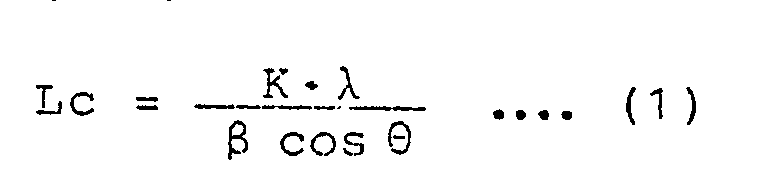
- According to the manufacturing method of this invention, at relatiavely low temperatures of about 1000°C or less, pyrolytic graphite with an interlayer distance of about the same as that of graphitic crystal (d = 3.35 Å (0.335 nm)) and with high crystal unit, in which c-axis orientation of carbon layer perpendicular to the surface of the substrate is achieved.
- A lead wire was connected at a point of a nickel of the graphite electrode made in this way, and this was used as test sample electrode A. The test sample electrode A is, as shown in Figure 3, immersed in an electrolytic bath, which is provided with lithium metal as the couinter-electrode, and a charging and discharging test, in which atoms of lithium as the dopant are incorporated into and removed from the sample electrode A, is carried out. In Figure 3, the
reference numeral 12 is the test sample electrode A made from the graphite electrode of this example, 13 is the counter-electrode, and 14 is the reference electrode, which is of lithium, 15 is an electrolytic solution of propylene carbonate containing 1 M lithium perchlorate, and 16 is the electrolytic bath. Figure 4 is of curves showing changes in the electric potential of each graphite electrode based on that of the lithium reference electrode at 25°C when a variety of graphite electrodes are doped or undoped with lithium. The curve A in Figure 4 shows changes in the electric potential when the graphite electrode of this example is used. In Curve A, the area in which the potential approaches 0 volts indicates doping (i.e., charging), and the area in which the potential approaches high voltages indicates undoping (i.e., discharging). Figure 5 shows changes in the discharging capacity of the graphite electrode in a charging and discharging test in which the graphite electrode of this example is charged and discharged with a fixed current flow in the range of 0 to 2.5 volts, with respect to the lithium reference electrode. The curve in Figure 5 is a characteristic curve for this example, which clearly indicates that there is almost no deterioration in the capacity even with repeated charging and discharging, and thus the characteristics on repeated charging and discharging of the electrode are extremely satisfactory. - It is therefore possible to use those mentioned above as an anode for a nonaqueous lithium rechargeable battery.
- In this example, 1 M lithium perchlorate was used as an electrolyte and propylene carbonate was used as a solvent for the electrolyte. However, not only the electrolyte specified in this example, but also other electrolytes can be used alone or in a mixture, such as lithium perchlorate, lithium hexafluoroarsenate, lithium borofluoride, lithium trifluoromethanesulfonate, etc. Dimethylsulfoxide, γ -butyrolactone, sulfolane, tetrahydrofuran, 2-methyltetrahydrofuran, 1,2-dimethoxyethane, 1,3-dioxolane, and other organic solvents, and water can be used as a single solvent or as a mixed solvent.
- The pyrolytic graphite of the graphite electrode obtained by the manufacturing method shown in this example of this invention has interlayer spacing in the range of 3.35 to 3.55 Å (0.335 nm to 0.355 nm) depending on the supply rate of the starting material and the reaction temperature. Any of the graphite electrodes made from any of the pyrolytic graphites mentioned above have a large electrical capacity and satisfactory characteristics on charge-discharge repeat.
- The manufacture of the graphite electrode that has the electrode characteristics mentioned above is not limited to the manufacturing method of this example, but such an electrode can also be manufactured by the optimized CVD method, etc., with the use of resistance heating or high-frequency conductive heating.
- Commercially available graphite fibers were held by a current collecting net, resulting in a test sample electrode B. The test sample electrode B was placed within the electrolytic bath as shown in Figure 3, in which a charge-discharge test was carried out in the same way as in the above-mentioned example. Curve B of Figure 4 is the curve of changes in the electric potential of the carbon electrode obtained by the support by the current collecting net. The results show that compared to the electrode of the above-mentioned example, the electrode of this control example has a small discharging capacity and is not suitable for use as an electrode.
- It is understood that various other modifications will be apparent to and can be readily made by those skilled in the art without departing from the scope and spirit of this invention. Accordingly, it is not intended that the scope of the claims appended hereto be limited to the description as set forth herein, but rather that the claims be construed as encompassing all the features of patentable novelty that reside in the present invention, including all features that would be treated as equivalents thereof by those skilled in the art to which this invention pertains.
Claims (9)
Applications Claiming Priority (4)
| Application Number | Priority Date | Filing Date | Title |
|---|---|---|---|
| JP149049/86 | 1986-06-24 | ||
| JP61149049A JPS634069A (en) | 1986-06-24 | 1986-06-24 | Production of thermally decomposed graphite |
| JP62079248A JPH07118308B2 (en) | 1987-03-31 | 1987-03-31 | Electrode |
| JP79248/87 | 1987-03-31 |
Publications (3)
| Publication Number | Publication Date |
|---|---|
| EP0251677A2 true EP0251677A2 (en) | 1988-01-07 |
| EP0251677A3 EP0251677A3 (en) | 1989-09-27 |
| EP0251677B1 EP0251677B1 (en) | 1993-08-18 |
Family
ID=26420285
Family Applications (1)
| Application Number | Title | Priority Date | Filing Date |
|---|---|---|---|
| EP87305617A Expired - Lifetime EP0251677B1 (en) | 1986-06-24 | 1987-06-24 | Graphite intercalation compound electrodes for rechargeable batteries and a method for the manufacture of the same |
Country Status (3)
| Country | Link |
|---|---|
| US (2) | US4863818A (en) |
| EP (1) | EP0251677B1 (en) |
| DE (1) | DE3787056T2 (en) |
Cited By (9)
| Publication number | Priority date | Publication date | Assignee | Title |
|---|---|---|---|---|
| EP0267791A3 (en) * | 1986-11-11 | 1989-08-23 | Sharp Kabushiki Kaisha | A secondary battery using nonaqueous electrolytes |
| EP0239410A3 (en) * | 1986-03-27 | 1989-09-27 | Sharp Kabushiki Kaisha | An electrode and a battery with the same |
| EP0334501A1 (en) * | 1988-03-04 | 1989-09-27 | Sharp Kabushiki Kaisha | Process for producing graphite electrodes |
| EP0346088A1 (en) * | 1988-06-08 | 1989-12-13 | Sharp Kabushiki Kaisha | Electrode and method for its production |
| EP0419090A1 (en) * | 1989-09-06 | 1991-03-27 | Sharp Kabushiki Kaisha | Carbon electrode |
| EP0484304A1 (en) * | 1990-10-24 | 1992-05-06 | Her Majesty The Queen, In Right Of The Province Of British Columbia | Electrolyte solution sequestering agents for electrochemical cells having carbonaceous electrodes |
| EP0500359A1 (en) * | 1991-02-22 | 1992-08-26 | Sharp Kabushiki Kaisha | Graphite structure carbon or its intercalation compound and process for preparing the same |
| US5158578A (en) * | 1989-12-19 | 1992-10-27 | Sharp Kabushiki Kaisha | Process for preparing carbon electrode |
| FR2715508A1 (en) * | 1994-01-21 | 1995-07-28 | Renata Ag | Primary or secondary electrochemical generator with nanoparticulate electrode. |
Families Citing this family (27)
| Publication number | Priority date | Publication date | Assignee | Title |
|---|---|---|---|---|
| JP3052314B2 (en) * | 1989-08-31 | 2000-06-12 | 三菱化学株式会社 | Lithium battery |
| JP2884746B2 (en) * | 1990-09-03 | 1999-04-19 | 松下電器産業株式会社 | Non-aqueous electrolyte secondary battery |
| GB9022267D0 (en) * | 1990-10-13 | 1990-11-28 | British Petroleum Co Plc | Process for depositing a coating on a fibre |
| JP2643035B2 (en) * | 1991-06-17 | 1997-08-20 | シャープ株式会社 | Carbon negative electrode for non-aqueous secondary battery and method for producing the same |
| EP0555080B1 (en) * | 1992-02-04 | 1996-05-15 | Sharp Kabushiki Kaisha | Carbon composite electrode material |
| DE4310321C2 (en) * | 1992-03-31 | 1995-07-06 | Ricoh Kk | Non-aqueous secondary battery |
| US5510212A (en) * | 1993-01-13 | 1996-04-23 | Delnick; Frank M. | Structural micro-porous carbon anode for rechargeable lithium ion batteries |
| US5776610A (en) * | 1993-02-03 | 1998-07-07 | Sharp Kabushiki Kaisha | Carbon composite electrode material and method of making thereof |
| JP2991884B2 (en) * | 1993-02-16 | 1999-12-20 | シャープ株式会社 | Non-aqueous secondary battery |
| JP3188032B2 (en) * | 1993-03-30 | 2001-07-16 | 三洋電機株式会社 | Lithium secondary battery |
| US5426006A (en) * | 1993-04-16 | 1995-06-20 | Sandia Corporation | Structural micro-porous carbon anode for rechargeable lithium-ion batteries |
| JPH08148185A (en) * | 1994-06-28 | 1996-06-07 | Sharp Corp | Non-aqueous secondary battery and negative electrode for non-aqueous secondary battery |
| JP3204291B2 (en) * | 1994-07-21 | 2001-09-04 | シャープ株式会社 | Carbon body electrode for non-aqueous secondary battery, method for producing the same, and non-aqueous secondary battery using the same |
| US5750288A (en) * | 1995-10-03 | 1998-05-12 | Rayovac Corporation | Modified lithium nickel oxide compounds for electrochemical cathodes and cells |
| AU1147597A (en) * | 1995-12-07 | 1997-06-27 | Sandia Corporation | Methods of preparation of carbon materials for use as electrodes in rechargeable batteries |
| JP3541913B2 (en) * | 1996-11-27 | 2004-07-14 | 株式会社デンソー | Non-aqueous electrolyte secondary battery |
| KR100269918B1 (en) * | 1997-08-28 | 2000-10-16 | 김순택 | Active material for negative electrode of lithium series secondary battery and manufacturing method thereof |
| US6042964A (en) * | 1998-02-20 | 2000-03-28 | The United States Of America As Represented By The Administrator Of The National Aeronautics And Space Administration | Thermally regenerative battery with intercalatable electrodes and selective heating means |
| CH710862B1 (en) | 1999-11-26 | 2016-09-15 | Imerys Graphite & Carbon Switzerland Sa | Process for the production of graphite powders with increased bulk density. |
| CN1278439C (en) * | 2001-10-08 | 2006-10-04 | 蒂米卡尔股份公司 | Electrochemical cell |
| US7754041B2 (en) * | 2006-07-31 | 2010-07-13 | 3M Innovative Properties Company | Pleated filter with bimodal monolayer monocomponent media |
| US9356281B2 (en) * | 2008-05-20 | 2016-05-31 | GM Global Technology Operations LLC | Intercalation electrode based on ordered graphene planes |
| US9388048B1 (en) * | 2008-10-08 | 2016-07-12 | University Of Southern California | Synthesis of graphene by chemical vapor deposition |
| CN102074438B (en) * | 2009-11-25 | 2012-09-26 | 中国科学院电子学研究所 | Graphite composite multistage depressed collector and manufacturing method thereof |
| TWI592509B (en) * | 2013-10-14 | 2017-07-21 | 國立清華大學 | Graphene film manufacturing method |
| US9715945B2 (en) * | 2014-12-22 | 2017-07-25 | Spectre Enterprises, Inc. | Fusion reactor |
| CN114221057A (en) * | 2021-12-09 | 2022-03-22 | 贵州安达科技能源股份有限公司 | Modification method for lithium ion battery recycled graphite, modified graphite, negative electrode material and lithium ion battery |
Family Cites Families (27)
| Publication number | Priority date | Publication date | Assignee | Title |
|---|---|---|---|---|
| US2239414A (en) * | 1938-08-30 | 1941-04-22 | Rca Corp | Coating metal with graphitic carbon |
| US2719355A (en) * | 1952-10-03 | 1955-10-04 | Rca Corp | Carbonized metal and method of making it |
| US3130073A (en) * | 1960-04-02 | 1964-04-21 | Philips Corp | Method of providing molybdenum wire with a carbon coating |
| US3320093A (en) * | 1963-04-01 | 1967-05-16 | Air Prod & Chem | Method of forming a carbon containing fuel cell electrode |
| FR1402831A (en) * | 1963-09-03 | 1965-06-18 | Inst Francais Du Petrole | oxygen electrode and its manufacture |
| US3340011A (en) * | 1963-12-16 | 1967-09-05 | Universal Oil Prod Co | Hydrogen production |
| US3410746A (en) * | 1964-03-12 | 1968-11-12 | Space Age Materials Corp | Grain-oriented pyrolytic graphite forms and method of making same |
| US3361638A (en) * | 1967-04-07 | 1968-01-02 | Atomic Energy Commission Usa | Pyrolytic graphite and nuclear fuel particles coated therewith |
| US3769084A (en) * | 1968-12-25 | 1973-10-30 | Hitachi Ltd | Method for forming carbon coating and composite article with a carbonaceous coating thereon |
| CA923274A (en) * | 1969-12-29 | 1973-03-27 | Araki Tadashi | Method for producing isotropic pyrolysis carbon |
| US4018943A (en) * | 1970-08-24 | 1977-04-19 | Universal Oil Products Company | Method of forming a conducting material for a conducting device |
| US3892890A (en) * | 1972-05-12 | 1975-07-01 | Hitachi Ltd | Process for forming carbon coatings |
| SU452864A1 (en) * | 1972-08-11 | 1974-12-05 | Предприятие П/Я В-2287 | Method of making electrical contact |
| JPS49104143A (en) * | 1973-01-22 | 1974-10-02 | ||
| US4029844A (en) * | 1973-04-24 | 1977-06-14 | Atlantic Research Corporation | Rocket nozzle comprising pyrolytic graphite-silicon carbide inserts |
| US4009323A (en) * | 1975-05-12 | 1977-02-22 | The United States Of America As Represented By The Secretary Of The Navy | Storage battery comprising positive electrode of a graphite and lithium fluoride compound |
| US3990915A (en) * | 1975-08-05 | 1976-11-09 | Exxon Research And Engineering Company | Primary cell for electric batteries |
| JPS549730A (en) * | 1977-06-24 | 1979-01-24 | Matsushita Electric Industrial Co Ltd | Active material on positive electrode of battery |
| US4294898A (en) * | 1980-05-05 | 1981-10-13 | International Business Machines Corporation | Solid state battery |
| US4497788A (en) * | 1982-10-18 | 1985-02-05 | General Motors Corporation | Process for growing graphite fibers |
| JPS59187622A (en) * | 1983-04-05 | 1984-10-24 | Agency Of Ind Science & Technol | Graphite filament having high electrical conductivity and its preparation |
| DE3588167T2 (en) * | 1984-06-12 | 1998-03-12 | Mitsubishi Chem Corp | Secondary batteries containing pseudo-graphite produced by pyrolysis as the electrode material |
| JPS617567A (en) * | 1984-06-22 | 1986-01-14 | Hitachi Ltd | Secondary battery and its manufacturing method |
| US4645713A (en) * | 1985-01-25 | 1987-02-24 | Agency Of Industrial Science & Technology | Method for forming conductive graphite film and film formed thereby |
| US4863814A (en) * | 1986-03-27 | 1989-09-05 | Sharp Kabushiki Kaisha | Electrode and a battery with the same |
| JPH0815074B2 (en) * | 1986-11-11 | 1996-02-14 | シャープ株式会社 | Method for manufacturing carbon body electrode |
| JPS63124372A (en) * | 1986-11-11 | 1988-05-27 | Sharp Corp | Nonaqueous electrolyte battery |
-
1987
- 1987-06-23 US US07/065,508 patent/US4863818A/en not_active Expired - Lifetime
- 1987-06-24 DE DE87305617T patent/DE3787056T2/en not_active Expired - Fee Related
- 1987-06-24 EP EP87305617A patent/EP0251677B1/en not_active Expired - Lifetime
-
1988
- 1988-10-31 US US07/264,598 patent/US4968527A/en not_active Expired - Lifetime
Cited By (13)
| Publication number | Priority date | Publication date | Assignee | Title |
|---|---|---|---|---|
| EP0239410A3 (en) * | 1986-03-27 | 1989-09-27 | Sharp Kabushiki Kaisha | An electrode and a battery with the same |
| EP0267791A3 (en) * | 1986-11-11 | 1989-08-23 | Sharp Kabushiki Kaisha | A secondary battery using nonaqueous electrolytes |
| EP0334501A1 (en) * | 1988-03-04 | 1989-09-27 | Sharp Kabushiki Kaisha | Process for producing graphite electrodes |
| US5080930A (en) * | 1988-06-08 | 1992-01-14 | Sharp Kabushiki Kaisha | Thermal cvd for the production of an electrode comprising a graphite composition |
| US4978600A (en) * | 1988-06-08 | 1990-12-18 | Sharp Kabushiki Kaisha | Electrode and a method for the production of the same |
| EP0346088A1 (en) * | 1988-06-08 | 1989-12-13 | Sharp Kabushiki Kaisha | Electrode and method for its production |
| EP1014462A3 (en) * | 1988-06-08 | 2002-06-26 | Sharp Kabushiki Kaisha | A method of producing a graphite material for use as a negative electrode of a non-aqueous secondary battery |
| EP0419090A1 (en) * | 1989-09-06 | 1991-03-27 | Sharp Kabushiki Kaisha | Carbon electrode |
| US5158578A (en) * | 1989-12-19 | 1992-10-27 | Sharp Kabushiki Kaisha | Process for preparing carbon electrode |
| EP0484304A1 (en) * | 1990-10-24 | 1992-05-06 | Her Majesty The Queen, In Right Of The Province Of British Columbia | Electrolyte solution sequestering agents for electrochemical cells having carbonaceous electrodes |
| EP0500359A1 (en) * | 1991-02-22 | 1992-08-26 | Sharp Kabushiki Kaisha | Graphite structure carbon or its intercalation compound and process for preparing the same |
| FR2715508A1 (en) * | 1994-01-21 | 1995-07-28 | Renata Ag | Primary or secondary electrochemical generator with nanoparticulate electrode. |
| US5569561A (en) * | 1994-01-21 | 1996-10-29 | Renata A.G. | Primary or secondary electrochemical generator having a nanoparticulate electrode |
Also Published As
| Publication number | Publication date |
|---|---|
| EP0251677A3 (en) | 1989-09-27 |
| US4968527A (en) | 1990-11-06 |
| DE3787056D1 (en) | 1993-09-23 |
| EP0251677B1 (en) | 1993-08-18 |
| DE3787056T2 (en) | 1994-02-03 |
| US4863818A (en) | 1989-09-05 |
Similar Documents
| Publication | Publication Date | Title |
|---|---|---|
| EP0251677B1 (en) | Graphite intercalation compound electrodes for rechargeable batteries and a method for the manufacture of the same | |
| EP0239410B1 (en) | An electrode and a battery with the same | |
| EP2088221B1 (en) | Non-aqueous electrolyte secondary battery negative electrode material, making method, lithium ion secondary battery, and electrochemical capacitor | |
| US5965296A (en) | Nonaqueous secondary battery and a method of manufacturing a negative electrode active material | |
| EP0346088B1 (en) | Electrode and method for its production | |
| EP0267791B1 (en) | A secondary battery using nonaqueous electrolytes | |
| US20040175622A9 (en) | Method of preparing electrode composition having a carbon-containing-coated metal oxide, electrode composition and electrochemical cell | |
| EP0434402B1 (en) | Process for preparing a carbon electrode | |
| JP2592143B2 (en) | Carbon electrode for non-aqueous lithium secondary battery and method for producing the same | |
| JPS63121265A (en) | Nonaqueous battery | |
| EP0273562B1 (en) | A method for the production of a carbon electrode | |
| EP3291337B1 (en) | Electrode, method for fabricating the same, and metal ion battery employing the same | |
| JPH09147839A (en) | Manufacturing method of negative electrode for non-aqueous electrolyte secondary battery | |
| CN112789748A (en) | Method for producing an anode for a lithium ion battery | |
| JPH0756795B2 (en) | Electrode for non-aqueous secondary battery | |
| JP2004207252A (en) | Anode materials for non-aqueous solvent secondary batteries | |
| JP2785909B2 (en) | Non-aqueous secondary battery | |
| JPS63245855A (en) | Electrode and battery | |
| JP2656003B2 (en) | Non-aqueous secondary battery | |
| JP3581631B2 (en) | Anode materials for non-aqueous solvent secondary batteries | |
| JP3172669B2 (en) | Non-aqueous lithium secondary battery | |
| JPH0828238B2 (en) | Non-aqueous secondary battery | |
| JP2702829B2 (en) | Negative electrode for battery and manufacturing method thereof | |
| JPH10199533A (en) | Non-aqueous secondary battery and method of manufacturing the same | |
| JPH07153446A (en) | Electrode and manufacturing method thereof |
Legal Events
| Date | Code | Title | Description |
|---|---|---|---|
| PUAI | Public reference made under article 153(3) epc to a published international application that has entered the european phase |
Free format text: ORIGINAL CODE: 0009012 |
|
| 17P | Request for examination filed |
Effective date: 19870714 |
|
| AK | Designated contracting states |
Kind code of ref document: A2 Designated state(s): DE FR GB |
|
| PUAL | Search report despatched |
Free format text: ORIGINAL CODE: 0009013 |
|
| AK | Designated contracting states |
Kind code of ref document: A3 Designated state(s): DE FR GB |
|
| 17Q | First examination report despatched |
Effective date: 19910620 |
|
| GRAA | (expected) grant |
Free format text: ORIGINAL CODE: 0009210 |
|
| AK | Designated contracting states |
Kind code of ref document: B1 Designated state(s): DE FR GB |
|
| REF | Corresponds to: |
Ref document number: 3787056 Country of ref document: DE Date of ref document: 19930923 |
|
| ET | Fr: translation filed | ||
| PLBE | No opposition filed within time limit |
Free format text: ORIGINAL CODE: 0009261 |
|
| STAA | Information on the status of an ep patent application or granted ep patent |
Free format text: STATUS: NO OPPOSITION FILED WITHIN TIME LIMIT |
|
| 26N | No opposition filed | ||
| REG | Reference to a national code |
Ref country code: GB Ref legal event code: IF02 |
|
| PGFP | Annual fee paid to national office [announced via postgrant information from national office to epo] |
Ref country code: GB Payment date: 20020619 Year of fee payment: 16 |
|
| PGFP | Annual fee paid to national office [announced via postgrant information from national office to epo] |
Ref country code: DE Payment date: 20020702 Year of fee payment: 16 |
|
| PG25 | Lapsed in a contracting state [announced via postgrant information from national office to epo] |
Ref country code: GB Free format text: LAPSE BECAUSE OF NON-PAYMENT OF DUE FEES Effective date: 20030624 |
|
| PG25 | Lapsed in a contracting state [announced via postgrant information from national office to epo] |
Ref country code: DE Free format text: LAPSE BECAUSE OF NON-PAYMENT OF DUE FEES Effective date: 20040101 |
|
| GBPC | Gb: european patent ceased through non-payment of renewal fee |
Effective date: 20030624 |
|
| PGFP | Annual fee paid to national office [announced via postgrant information from national office to epo] |
Ref country code: FR Payment date: 20040608 Year of fee payment: 18 |
|
| PG25 | Lapsed in a contracting state [announced via postgrant information from national office to epo] |
Ref country code: FR Free format text: LAPSE BECAUSE OF NON-PAYMENT OF DUE FEES Effective date: 20060228 |
|
| REG | Reference to a national code |
Ref country code: FR Ref legal event code: ST Effective date: 20060228 |