EP0249922B1 - Verfahren zur statischen Operationsverarbeitung mit Hochgeschwindigkeit und dieses Verfahren umfassendes Bilddatenverbeitungsgerät - Google Patents
Verfahren zur statischen Operationsverarbeitung mit Hochgeschwindigkeit und dieses Verfahren umfassendes Bilddatenverbeitungsgerät Download PDFInfo
- Publication number
- EP0249922B1 EP0249922B1 EP87108608A EP87108608A EP0249922B1 EP 0249922 B1 EP0249922 B1 EP 0249922B1 EP 87108608 A EP87108608 A EP 87108608A EP 87108608 A EP87108608 A EP 87108608A EP 0249922 B1 EP0249922 B1 EP 0249922B1
- Authority
- EP
- European Patent Office
- Prior art keywords
- bit
- weight
- histogram
- accordance
- designated
- Prior art date
- Legal status (The legal status is an assumption and is not a legal conclusion. Google has not performed a legal analysis and makes no representation as to the accuracy of the status listed.)
- Expired - Lifetime
Links
Images




Classifications
-
- G—PHYSICS
- G06—COMPUTING OR CALCULATING; COUNTING
- G06F—ELECTRIC DIGITAL DATA PROCESSING
- G06F17/00—Digital computing or data processing equipment or methods, specially adapted for specific functions
- G06F17/10—Complex mathematical operations
-
- G—PHYSICS
- G06—COMPUTING OR CALCULATING; COUNTING
- G06F—ELECTRIC DIGITAL DATA PROCESSING
- G06F17/00—Digital computing or data processing equipment or methods, specially adapted for specific functions
- G06F17/10—Complex mathematical operations
- G06F17/18—Complex mathematical operations for evaluating statistical data, e.g. average values, frequency distributions, probability functions, regression analysis
-
- G—PHYSICS
- G06—COMPUTING OR CALCULATING; COUNTING
- G06F—ELECTRIC DIGITAL DATA PROCESSING
- G06F9/00—Arrangements for program control, e.g. control units
-
- G—PHYSICS
- G06—COMPUTING OR CALCULATING; COUNTING
- G06V—IMAGE OR VIDEO RECOGNITION OR UNDERSTANDING
- G06V10/00—Arrangements for image or video recognition or understanding
- G06V10/40—Extraction of image or video features
- G06V10/50—Extraction of image or video features by performing operations within image blocks; by using histograms, e.g. histogram of oriented gradients [HoG]; by summing image-intensity values; Projection analysis
-
- G—PHYSICS
- G06—COMPUTING OR CALCULATING; COUNTING
- G06V—IMAGE OR VIDEO RECOGNITION OR UNDERSTANDING
- G06V10/00—Arrangements for image or video recognition or understanding
- G06V10/70—Arrangements for image or video recognition or understanding using pattern recognition or machine learning
- G06V10/74—Image or video pattern matching; Proximity measures in feature spaces
- G06V10/75—Organisation of the matching processes, e.g. simultaneous or sequential comparisons of image or video features; Coarse-fine approaches, e.g. multi-scale approaches; using context analysis; Selection of dictionaries
- G06V10/758—Involving statistics of pixels or of feature values, e.g. histogram matching
Definitions
- the present invention relates to a method for realizing high-speed statistic operation processing such as covariance operation processing between two image data, and an image data processing apparatus for embodying the method.
- Covariance ⁇ AB between pixel groups EA ij and ⁇ Bij (where i and j respectively indicate a row position and a column position) respectively corresponding to two image data A and B in which density data Adij and B dij of pixels A ij and B ij can be expressed by 8-bit data, can be expressed by the following equation (1) if the number of pixels of image data A and B is given as N and density averages of image data A and B are respectively given as ⁇ A and ⁇ B: where since then,
- This histogram can be obtained using a 16-bit histogram processor.
- the histogram processor Since the histogram processor is used for various image data processing operations as is known, it is inevitable hardware for the image data processing apparatus. Therefore, a method for obtaining ⁇ A ij d ijB dij using the histogram processor is advantageous in view of an effective operation of hardware of the image data processing apparatus.
- the 16-bit histogram processor used in this method has a complicated hardware arrangement, and requires 2 8 x 2 8 , i.e., 64K data entry in order to store a histogram operation result of 8-bit image data A and B. Therefore, an arithmetic operation volume is considerable, and a high-speed operation cannot be performed.
- the present invention as claimed has been made in consideration of the above situation and has as its object to provide a method for carrying out a statistic operation between first and second image data at high speed in a data processing apparatus.
- the first image data is constituted by pixel group ⁇ A ij consisting of N pixels A ij (N is a positive integer; i and j respectively indicate a row position and a column position), and density data A dij of each pixel A ij is expressed by 2mn-bit data (n and m are positive integers).
- the second image data is constituted by pixel group EBij consisting of N pixels Bij (N is said positive integer; i and j respectively indicate a row position and a column position), and density data Bdij of each pixel Bij is expressed by 2mn-bit data (n and m are said positive integers).
- the method comprises:
- the apparatus comprises:
- the apparatus of the present invention can be applied to a statistic operation (average, variance, and covariance) associated with image data exceeding 2m bits, and can contribute to the high-speed operation of this type.
- Fig. 1 is a block diagram showing an arrangement of an image data processing apparatus according to a first embodiment of the present invention.
- calculation control section 11 connected to system bus 19 controls the overall operation, and executes calculation processing.
- Image memories 14 and 15, and histogram processor 16 are connected to each other through image bus 20. They are also connected to control section 11 through system bus 19 as well as main memory 12.
- Image memories 14 and 15 respectively store image data A and B consisting of pixels A ij and B ij whose density data is expressed by n(2m) bits.
- the data length of image bus 20 is also 8 bits.
- Main memory 12 has histogram storage area 21 for storing the histogram operation results of processor 16 and register area 22 for holding the intermediate results of the operation.
- Storage area 21 consists of 16 blocks as shown in Fig. 2, and in each block, the number of entries is 256. The number of entries corresponds to the number of bits of density data.
- Control section 11 comprises controller 31 and calculation section 32 for arithmetic operation unit 41 and E operation unit 42.
- Controller 31 generates various processing commands in accordance with an input statistic operation command.
- controller 31 When an average operation command is input, controller 31 generates a 2m weight processing command including a 2m histogram processing command.
- controller 31 When a covariance operation command is input, controller 31 generates a EAB processing command, an average processing command, and a arithmetic operation command.
- the EAB processing command consists of an upper correlation weight processing command including an upper histogram processing command, a lower correlation weight processing command including a lower histogram processing cammand, and an addition command.
- the average processing command causes controller 31 to generate the 2m weight processing command including the 2m histogram processing command, as in the average operation command.
- Processor 16 reads out density data of each pixel from a designated image memory in accordance with the histogram operation command, i.e., the upper histogram processing command, the lower histogram processing command, or the 2m histogram processing command, and executes the histogram operation.
- the obtained histogram operation result is stored in histogram storage area 21 of main memory 12.
- Processor 16 reads out image data A or B from designated image memory 14 or 15 in accordance with the 2m histogram processing command, and executes an 8-bit histogram operation.
- Processor 16 also executes a histogram operation between an upper or lower 4-bit portion of image data A stored in image memory A and image data B stored in image memory 15 in accordance with the upper or lower histogram processing command.
- Image data A and B are respectively stored in image memories 14 and 15.
- Image data A is constituted by pixel group ⁇ A ij (i and j respectively indicate a row position and a column position).
- Density data A dij of each pixel A ij is divided into upper and lower 4-bit portions.
- step S2 an average processing command is generated.
- the 2m histogram processing command of the average processing command for image data A is output to histogram processor 16.
- the 2m histogram processing command is designated to use density data A dij of image data A and to set bit "0" for the remaining 4-bit portion.
- density data A dij for image data A is transferred from image memory 14 to processor 16 via image bus 20.
- Resultant histogram h A (k A ) is stored in histogram storage area 21 of main memory 12 via system bus 19.
- E operation unit 42 calculates average UA for image data A from equation (6) using transferred histogram h A (k A ). Calculated UA is stored in register area 22 of main memory 12.
- step S4 the average processing command for image data B is output to processor 16 in the same manner as for image data A.
- image data B is transferred from image memory 15 to processor 16 in the same manner as image data A, and histogram h B (k B ) is calculated.
- Calculated histogram h B (k B ) is transferred to histogram storage area 21 of memory 12 via system bus 19.
- average ⁇ B is calculated from equation (6) by utilizing transferred histogram h B (k B ).
- Calculated average ⁇ B is stored in register area 22 as in average ⁇ A.
- image data B is transferred to processor 16. If the 2m histogram processing command for image data B is generated while average ⁇ A is calculated, covariance ⁇ AB can be calculated at a higher speed.
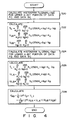
- step S6 the upper correlation weight processing command is output to 12-bit histogram processor 16 in order to calculate a weight for upper 4-bit portion a uij of density data A dij of pixel A ij and density data B dij of pixel B ij .
- the upper histogram processing command of the upper correlation weight processing command is instructed via system bus 19.
- density data A dij of image data A and density data B dij of image data B are fetched by processor 16 from image memories 14 and 15.
- Processor 16 executes a histogram operation for obtaining histogram h u (2 8 k u + k B ) from transferred upper 4-bit portion a uij of image data A and image data B.
- Resultant histogram h u (2 8 k u + k B ) is stored in storage area 21 of memory 12.
- An mth entry of an sth block of storage area 21 stores the number of pixels whose density is k B of pixels B ij at the same position as pixels A ij which have value k u of upper 4 bits of density data A dij-
- E operation unit 42 calculates upper correlation weight TU from equation (5) by utilizing stored histogram h u -(2 8 k u + k B ) in accordance with the upper correlation weight processing command. Obtained value TU is stored in register area 22.
- step S10 the lower histogram processing command of the lower correlation weight processing command generated according to the covariance operation command is generated in the same manner as upper 4-bit portion a uij so as to calculate histogram h L (2 8 k L + k B ) of lower 4-bit portion a lij of density data A dij of image data A and image data B.
- density data A dij of pixels A ij of pixel group EA ij and density data B dij of pixels B ij of pixel group ⁇ B ij stored in image memory 15 are sequentially transferred to processer 16 via image bus 20, and histogram h L (2 8 k L + k B ) is calculated.
- image data A and B are transferred to processor 16 so as to obtain a histogram for lower 4-bit portion a lij - If the histogram processing command is generated while value TU is being calculated, covariance AB can be calculated at a higher speed. At this time, even if the histogram operation is completed, if the operation for obtaining value TU is not completed, the histogram operation result can be stored in histogram storage area 21 after completion of the operation of value T u .
- arithmetic operation unit 41 calculates covariance ⁇ AB by utilizing equation (7) using data ⁇ a, ⁇ B , T u , and T L stored in register area 22 in accordance with the a arithmetic processing command generated according to the covariance operation command.
- a command for executing an operation of 2 4 TU + TL is referred to as an addition processing command.
- the upper correlation weight processing command including the upper histogram processing command, the lower correlation weight processing command including the lower histogram processing command, and the addition processing command are referred to as the EAB processing command as a whole.
- Covariance ⁇ AB of 8-bit image data A and B can be obtained using the 12-bit processor, as described above.
- averages ⁇ A and ⁇ B for image data A and B are calculated in accordance with the 2m weight processing command.
- averages ⁇ A and ⁇ B can be calculated by utilizing the histogram operation results of 12-bit histogram processor 16.
- a second embodiment for realizing it will be described below.
- an average processing command includes an upper weight processing command, and a lower weight processing command.
- average ⁇ A of image data A ij can be calculated by dividing the total sum of density data of pixels A ij by total number N of pixels. Therefore, by utilizing the histogram, the weights of pixels are multiplied, and the product is divided by pixel number N, thereby calculating average ⁇ . More specifically, if density data A dij of image data A is expressed by equation (3), average ⁇ A can be: Similarly, average ⁇ B can be:
- equation (7) can be rewritten as:
- step S20 the upper correlation weight processing command is generated in accordance with the input convariance operation command in the same manner as in the first embodiment.
- Histogram processor 16 reads out upper 4-bit portion a uij of image data A stored in image memory 14 and density data B dij of image data B stored in image memory 15 in accordance with an upper histogram processing command of the upper correlation weight processing command, and executes a histogram operation.
- Calculated histogram h u (2 8 k u + k B ) is stored in histogram storage area 21 of main memory 12.
- E operation unit 42 calculates upper correlation weight TU in accordance with the generated upper correlation weight processing command, and calculates upper A weight U UA and upper B weight U UB in accordance with the generated upper weight processing command.
- a lower correlation weight processing command is output to processor 16 in the same manner as for upper 4-bit portion a uij .
- Processor 16 calculates histogram h L (2 8 k L + k B ) for a Lij and B dij in accordance with the lower histogram processing command of the lower correlation weight processing command.
- Resultant histogram h L (2 8 k L + k B ) is stored in area 21.
- step S26 by utilizing the stored histogram, lower correlation weight T L is calculated in accordance with the generated lower correlation weight processing command, and lower A weight U LA and lower B weight U LB is calculated in accordance with the lower weight processing command of the generated average processing command.
- Calculated values T L , U LA , and U LB are stored in register area 22.
- step S28 arithmetic operation unit 41 calculates covariance AB based on equation (11) from values T u , U UA , and U UB obtained in step S22 and values T L , U LA , and U LB obtained in step S26, in accordance with the a arithmetic operation command generated according to the covariance operation command.
- the covariance can be calculated faster than the operation of the first embodiment.
- the covariance is calculated.
- density data for pixels A ij can be read out twice from image memory 14 or 15.
- Resultant ⁇ AB is made as ⁇ A 2.
- a third embodiment of an image data processing apparatus which can execute a statistic operation associated with image data A and B whose density data is expressed by 16 bits or more, e.g., an operation for calculating an average, variance, and a covariance, will be described hereinafater.
- calculation control section 111 controls the overall operation, and executes calculation processing.
- n(2m)-bit image memories 114 and 115, histogram processor section 116 including 3m-bit histogram processors 116-1 and 116-2, and main memory 112 are connected to section 111 via system bus 119.
- Image memories 114 and 115 and histogram processors 116-1 and 116-2 are connected to each other through image bus 120 having a 16-bit data length.
- Memory 112 has histogram storage areas 121-1 and 121-2 for respectively storing histogram operation results from processors 116-1 and 116-2.
- Memory 112 has register area 122 for storing data necessary for controlling intermediate operation results, and the like.
- Section 111 comprises controller 131 for generating various processing commands in accordance with an input statistic operation command, and calculation unit 132 for executing calculation processing.
- Calculation unit 132 comprises arithmetic operation unit 141 and E operation section 142 including E operation units 142-1 and 142-2.
- controller 131 receives an average operation command, it generates a total 2m-bit average processing command including a 2m histogram processing command and a total ⁇ . arithmetic operation command.
- controller 131 receives a covariance operation command, it generates a total EAB processing command, a total 2m-bit weight processing command, and a total a arithmetic operation command.
- Density data A dij and B dij of pixels A ij and B ij of image data A and B whose density is expressed by n(2m) bits are classified in units of 8 bits. If lower pth 8-bit portions of the density data are respectively given as ap ij and bp ij , density data A dij and B dij can be expressed by:
- average ⁇ a can be expressed by: Average ⁇ B can be expressed as follows in the same manner as in average ⁇ A: where ⁇ 2A , ⁇ 1A , ⁇ 2B , and ⁇ 1B are average values obtained from equation (6).
- average ⁇ A can be expressed by:
- Average ⁇ B can be expressed as follows in the same manner as average ⁇ A: where ⁇ 3A, ⁇ 2A, ⁇ 1A , ⁇ 3B, ⁇ 2B , and ⁇ 1B are averages obtained from equation (6).
- the average operation command for image data A is input as the statistic operation command.
- a total 2m-bit average processing command is generated in step S30.
- the total 2m-bit average processing command includes the 2m-bit average processing command including the 2m histogram processing command for each of the 2m-bit portion ap ij .
- the 2m-bit average processing command is output to histogram processor 116-1.
- step S34 8-bit portion a 3ij designated by variables p and q is read out by processor 116-1. Readout 8-bit portion a 3ij is subjected to processing in step S36. This step executes various processing operations of 8-bit image data in the first or second embodiment, and is called an 8-bit image data processing module.
- the covariance operation command is input as the statistic operation command.
- the total ⁇ AB processing command, the total 2m-bit weight processing command, and the total arithmetic processing command are generted in step S30.
- the upper histogram processing command included in the upper correlation weight processing command of the ⁇ AB processing command for 2m-bit portions ap ij and bq ij of the total ⁇ AB processing command and the lower histogram processing command included in the lower correlation weight processing command thereof are respectively output to histogram processors 116-1 and 116-2.
- n 1 and n 2 are set to be 3. More specifically, initial values of variables p and q are 3.
- Y is determined in step S32. 8-bit portions a 3ij and b 3ij designated by variables p and q are read out, and are supplied to histogram processors 116-1 and 116-2, respectively.
- step S36 histogram h u (2 8 k u + k B ) is calculated from an upper 4-bit portion of data a 3ij and data b 3ij by processor 116-1, and histogram h L (2 8 k L + k B ) is calculated from a lower 4-bit portion of data a 3ij and data b 3ij by processor 116-2, and they are stored in storage areas 121-1 and 121-2, respectively.
- Units 142-1 and 142-2 respectively calculate upper and lower correlation weights T u33 and T L33 based on equation (5) using the histograms stored in storage areas 121-1 and 121-2, in accordance with the upper or lower correlation weight processing command.
- variable q is 3
- variable q is decremented by 1 in step S40, and steps S32 to S36 are repeated.
- upper and lower correlation weights T U31 and T L31 for 8-bit portions a 3ij and b 1ij are calculated. Calculated upper and lower correlation weights T U32 , T L32 , T U31 , and T L31 are strored in register area 122.
- step S44 variable p is decremented by 1 to be 2.
- Variable q is set to be n 2 , i.e., 3.
- upper and lower correlation weights Tu23, T L23 , Tu22, T L22 , T U21 , and T L21 for 8-bit portions a 2ij and b 3ij , 8-bit portions a 2ij and b 2ij , and 8- bit portions a 2ij and b 1ij are calculated.
- step S38 and S42 Since variables p and q are 1, Y is determined in step S38 and S42, and step S46 is executed. Since the input command is the covariance operation command, N is determined in step S46, and Y is determined in step S50 for the same reason. Therefore, the flow advances to step S52.
- arithmetic operation unit 141 calculates covariance ⁇ AB from equation (21) in accordance with the total ⁇ arithmetic processing command.
- step S56 is executed. It is checked in step S56 if p ⁇ q. If N in step S56, the flow advances to step S38. If Y in step S56, the 8-bit image data processing module is executed. In this case, the order of 8-bit portions ap ij and aq ij designated by variables p and q does not influence the operation result. Finally, N is determined in step S50, and step S54 is executed. Then, variance A 2 is calculated from equation (22).
Landscapes
- Engineering & Computer Science (AREA)
- Physics & Mathematics (AREA)
- Theoretical Computer Science (AREA)
- General Physics & Mathematics (AREA)
- Data Mining & Analysis (AREA)
- Mathematical Physics (AREA)
- Software Systems (AREA)
- Mathematical Optimization (AREA)
- Computational Mathematics (AREA)
- Pure & Applied Mathematics (AREA)
- Databases & Information Systems (AREA)
- Mathematical Analysis (AREA)
- General Engineering & Computer Science (AREA)
- Multimedia (AREA)
- Computer Vision & Pattern Recognition (AREA)
- Algebra (AREA)
- General Health & Medical Sciences (AREA)
- Probability & Statistics with Applications (AREA)
- Bioinformatics & Cheminformatics (AREA)
- Evolutionary Biology (AREA)
- Life Sciences & Earth Sciences (AREA)
- Medical Informatics (AREA)
- Operations Research (AREA)
- Bioinformatics & Computational Biology (AREA)
- Evolutionary Computation (AREA)
- Computing Systems (AREA)
- Artificial Intelligence (AREA)
- Health & Medical Sciences (AREA)
- Image Analysis (AREA)
- Image Processing (AREA)
- Complex Calculations (AREA)
Claims (20)


Applications Claiming Priority (2)
| Application Number | Priority Date | Filing Date | Title |
|---|---|---|---|
| JP139815/86 | 1986-06-16 | ||
| JP61139815A JPS62296270A (ja) | 1986-06-16 | 1986-06-16 | 画像処理装置 |
Publications (3)
| Publication Number | Publication Date |
|---|---|
| EP0249922A2 EP0249922A2 (de) | 1987-12-23 |
| EP0249922A3 EP0249922A3 (de) | 1991-04-24 |
| EP0249922B1 true EP0249922B1 (de) | 1993-09-01 |
Family
ID=15254096
Family Applications (1)
| Application Number | Title | Priority Date | Filing Date |
|---|---|---|---|
| EP87108608A Expired - Lifetime EP0249922B1 (de) | 1986-06-16 | 1987-06-15 | Verfahren zur statischen Operationsverarbeitung mit Hochgeschwindigkeit und dieses Verfahren umfassendes Bilddatenverbeitungsgerät |
Country Status (5)
| Country | Link |
|---|---|
| US (1) | US4837841A (de) |
| EP (1) | EP0249922B1 (de) |
| JP (1) | JPS62296270A (de) |
| KR (1) | KR900008787B1 (de) |
| DE (1) | DE3787216T2 (de) |
Families Citing this family (2)
| Publication number | Priority date | Publication date | Assignee | Title |
|---|---|---|---|---|
| DE4028010C2 (de) * | 1989-09-05 | 2003-11-06 | Canon Kk | Bilddaten-Konvertierungsverfahren und Bildverarbeitungsvorrichtung |
| US9547881B2 (en) * | 2015-01-29 | 2017-01-17 | Qualcomm Incorporated | Systems and methods for calculating a feature descriptor |
Family Cites Families (4)
| Publication number | Priority date | Publication date | Assignee | Title |
|---|---|---|---|---|
| FR2293011A1 (fr) * | 1974-09-16 | 1976-06-25 | France Etat | Perfectionnements aux procedes et dispositifs de normalisation d'images numeriques |
| JPS5944667B2 (ja) * | 1978-03-28 | 1984-10-31 | 株式会社東芝 | パタ−ン認識装置 |
| US4227177A (en) * | 1978-04-27 | 1980-10-07 | Dialog Systems, Inc. | Continuous speech recognition method |
| JPS5876899A (ja) * | 1981-10-31 | 1983-05-10 | 株式会社東芝 | 音声区間検出装置 |
-
1986
- 1986-06-16 JP JP61139815A patent/JPS62296270A/ja active Granted
-
1987
- 1987-06-12 US US07/061,285 patent/US4837841A/en not_active Expired - Fee Related
- 1987-06-15 EP EP87108608A patent/EP0249922B1/de not_active Expired - Lifetime
- 1987-06-15 DE DE87108608T patent/DE3787216T2/de not_active Expired - Fee Related
- 1987-06-16 KR KR1019870006062A patent/KR900008787B1/ko not_active Expired
Also Published As
| Publication number | Publication date |
|---|---|
| US4837841A (en) | 1989-06-06 |
| DE3787216D1 (de) | 1993-10-07 |
| JPS62296270A (ja) | 1987-12-23 |
| EP0249922A3 (de) | 1991-04-24 |
| EP0249922A2 (de) | 1987-12-23 |
| KR900008787B1 (ko) | 1990-11-29 |
| JPH0480425B2 (de) | 1992-12-18 |
| DE3787216T2 (de) | 1993-12-16 |
| KR890000987A (ko) | 1989-03-17 |
Similar Documents
| Publication | Publication Date | Title |
|---|---|---|
| CN101842809B (zh) | 信息处理装置及信息处理方法 | |
| US5093870A (en) | Smoothing method and apparatus for smoothing contour of character | |
| US6067536A (en) | Neural network for voice and pattern recognition | |
| EP0173098A2 (de) | Verfahren und Gerät zum Folgen einer Musterkontur | |
| EP0249922B1 (de) | Verfahren zur statischen Operationsverarbeitung mit Hochgeschwindigkeit und dieses Verfahren umfassendes Bilddatenverbeitungsgerät | |
| US5142593A (en) | Apparatus and method for classifying feature data at a high speed | |
| US5587808A (en) | Image processing apparatus for identifying character, photo and dot images in image area | |
| EP0241001A2 (de) | Informationsverarbeitendes Gerät mit einer Maskierungsfunktion | |
| US5400154A (en) | Hybrid interpolation and non-interpolation method and apparatus for image enlarging and contracting | |
| US5283840A (en) | Method and apparatus for extracting image data | |
| JPS58134745A (ja) | 文字、画像デ−タ圧縮方式 | |
| US5365602A (en) | Integrated half-tone screening and enlarging using an enlargement mapping pattern having linked, unique pattern segments | |
| JP2835719B2 (ja) | 画像処理装置 | |
| US5809180A (en) | Data conversion system for line-narrowing a pattern | |
| US4802090A (en) | Histogramming of pixel values on a distributed processing system | |
| US5267184A (en) | Apparatus and method for generating a figure by sequential segment approximation of a parametric cubic curve | |
| CN114529514B (zh) | 基于图结构的深度数据质量评价方法及装置 | |
| JP3253707B2 (ja) | 画像処理装置 | |
| US4435836A (en) | Technique for extracting features from images | |
| US5764855A (en) | Method for fuzzifying input signals present at the inputs of a fuzzy processor by using input membership functions | |
| EP0278528B1 (de) | Gebietsdurchsuchungssystem | |
| JP2003333348A (ja) | 色信号拡張装置および色信号拡張方法 | |
| JP2840706B2 (ja) | 画像処理方法 | |
| JPH01277976A (ja) | 画像処理装置 | |
| JP2862387B2 (ja) | 超高速画像処理システムのフィルタリング処理方式 |
Legal Events
| Date | Code | Title | Description |
|---|---|---|---|
| PUAI | Public reference made under article 153(3) epc to a published international application that has entered the european phase |
Free format text: ORIGINAL CODE: 0009012 |
|
| 17P | Request for examination filed |
Effective date: 19870710 |
|
| AK | Designated contracting states |
Kind code of ref document: A2 Designated state(s): DE FR GB |
|
| PUAL | Search report despatched |
Free format text: ORIGINAL CODE: 0009013 |
|
| AK | Designated contracting states |
Kind code of ref document: A3 Designated state(s): DE FR GB |
|
| 17Q | First examination report despatched |
Effective date: 19930118 |
|
| GRAA | (expected) grant |
Free format text: ORIGINAL CODE: 0009210 |
|
| AK | Designated contracting states |
Kind code of ref document: B1 Designated state(s): DE FR GB |
|
| REF | Corresponds to: |
Ref document number: 3787216 Country of ref document: DE Date of ref document: 19931007 |
|
| ET | Fr: translation filed | ||
| PLBE | No opposition filed within time limit |
Free format text: ORIGINAL CODE: 0009261 |
|
| STAA | Information on the status of an ep patent application or granted ep patent |
Free format text: STATUS: NO OPPOSITION FILED WITHIN TIME LIMIT |
|
| 26N | No opposition filed | ||
| PGFP | Annual fee paid to national office [announced via postgrant information from national office to epo] |
Ref country code: GB Payment date: 19970606 Year of fee payment: 11 |
|
| PGFP | Annual fee paid to national office [announced via postgrant information from national office to epo] |
Ref country code: FR Payment date: 19970610 Year of fee payment: 11 |
|
| PGFP | Annual fee paid to national office [announced via postgrant information from national office to epo] |
Ref country code: DE Payment date: 19970620 Year of fee payment: 11 |
|
| PG25 | Lapsed in a contracting state [announced via postgrant information from national office to epo] |
Ref country code: GB Free format text: LAPSE BECAUSE OF NON-PAYMENT OF DUE FEES Effective date: 19980615 |
|
| GBPC | Gb: european patent ceased through non-payment of renewal fee |
Effective date: 19980615 |
|
| PG25 | Lapsed in a contracting state [announced via postgrant information from national office to epo] |
Ref country code: FR Free format text: LAPSE BECAUSE OF NON-PAYMENT OF DUE FEES Effective date: 19990226 |
|
| PG25 | Lapsed in a contracting state [announced via postgrant information from national office to epo] |
Ref country code: DE Free format text: LAPSE BECAUSE OF NON-PAYMENT OF DUE FEES Effective date: 19990401 |
|
| REG | Reference to a national code |
Ref country code: FR Ref legal event code: ST |