EP0248564B1 - Optische Wellenleiter und deren Herstellung - Google Patents
Optische Wellenleiter und deren Herstellung Download PDFInfo
- Publication number
- EP0248564B1 EP0248564B1 EP87304500A EP87304500A EP0248564B1 EP 0248564 B1 EP0248564 B1 EP 0248564B1 EP 87304500 A EP87304500 A EP 87304500A EP 87304500 A EP87304500 A EP 87304500A EP 0248564 B1 EP0248564 B1 EP 0248564B1
- Authority
- EP
- European Patent Office
- Prior art keywords
- fibre
- dopant
- glass
- semiconductor
- colloidal particles
- Prior art date
- Legal status (The legal status is an assumption and is not a legal conclusion. Google has not performed a legal analysis and makes no representation as to the accuracy of the status listed.)
- Expired - Lifetime
Links
Images

Classifications
-
- G—PHYSICS
- G02—OPTICS
- G02F—OPTICAL DEVICES OR ARRANGEMENTS FOR THE CONTROL OF LIGHT BY MODIFICATION OF THE OPTICAL PROPERTIES OF THE MEDIA OF THE ELEMENTS INVOLVED THEREIN; NON-LINEAR OPTICS; FREQUENCY-CHANGING OF LIGHT; OPTICAL LOGIC ELEMENTS; OPTICAL ANALOGUE/DIGITAL CONVERTERS
- G02F1/00—Devices or arrangements for the control of the intensity, colour, phase, polarisation or direction of light arriving from an independent light source, e.g. switching, gating or modulating; Non-linear optics
- G02F1/35—Non-linear optics
- G02F1/365—Non-linear optics in an optical waveguide structure
-
- C—CHEMISTRY; METALLURGY
- C03—GLASS; MINERAL OR SLAG WOOL
- C03B—MANUFACTURE, SHAPING, OR SUPPLEMENTARY PROCESSES
- C03B37/00—Manufacture or treatment of flakes, fibres, or filaments from softened glass, minerals, or slags
- C03B37/01—Manufacture of glass fibres or filaments
- C03B37/012—Manufacture of preforms for drawing fibres or filaments
- C03B37/01205—Manufacture of preforms for drawing fibres or filaments starting from tubes, rods, fibres or filaments
- C03B37/01211—Manufacture of preforms for drawing fibres or filaments starting from tubes, rods, fibres or filaments by inserting one or more rods or tubes into a tube
-
- C—CHEMISTRY; METALLURGY
- C03—GLASS; MINERAL OR SLAG WOOL
- C03B—MANUFACTURE, SHAPING, OR SUPPLEMENTARY PROCESSES
- C03B37/00—Manufacture or treatment of flakes, fibres, or filaments from softened glass, minerals, or slags
- C03B37/01—Manufacture of glass fibres or filaments
- C03B37/012—Manufacture of preforms for drawing fibres or filaments
- C03B37/01265—Manufacture of preforms for drawing fibres or filaments starting entirely or partially from molten glass, e.g. by dipping a preform in a melt
- C03B37/01274—Manufacture of preforms for drawing fibres or filaments starting entirely or partially from molten glass, e.g. by dipping a preform in a melt by extrusion or drawing
-
- C—CHEMISTRY; METALLURGY
- C03—GLASS; MINERAL OR SLAG WOOL
- C03C—CHEMICAL COMPOSITION OF GLASSES, GLAZES OR VITREOUS ENAMELS; SURFACE TREATMENT OF GLASS; SURFACE TREATMENT OF FIBRES OR FILAMENTS MADE FROM GLASS, MINERALS OR SLAGS; JOINING GLASS TO GLASS OR OTHER MATERIALS
- C03C13/00—Fibre or filament compositions
- C03C13/04—Fibre optics, e.g. core and clad fibre compositions
-
- C—CHEMISTRY; METALLURGY
- C03—GLASS; MINERAL OR SLAG WOOL
- C03C—CHEMICAL COMPOSITION OF GLASSES, GLAZES OR VITREOUS ENAMELS; SURFACE TREATMENT OF GLASS; SURFACE TREATMENT OF FIBRES OR FILAMENTS MADE FROM GLASS, MINERALS OR SLAGS; JOINING GLASS TO GLASS OR OTHER MATERIALS
- C03C3/00—Glass compositions
- C03C3/32—Non-oxide glass compositions, e.g. binary or ternary halides, sulfides or nitrides of germanium, selenium or tellurium
- C03C3/321—Chalcogenide glasses, e.g. containing S, Se, Te
-
- G—PHYSICS
- G02—OPTICS
- G02B—OPTICAL ELEMENTS, SYSTEMS OR APPARATUS
- G02B6/00—Light guides; Structural details of arrangements comprising light guides and other optical elements, e.g. couplings
- G02B6/02—Optical fibres with cladding with or without a coating
-
- G—PHYSICS
- G02—OPTICS
- G02F—OPTICAL DEVICES OR ARRANGEMENTS FOR THE CONTROL OF LIGHT BY MODIFICATION OF THE OPTICAL PROPERTIES OF THE MEDIA OF THE ELEMENTS INVOLVED THEREIN; NON-LINEAR OPTICS; FREQUENCY-CHANGING OF LIGHT; OPTICAL LOGIC ELEMENTS; OPTICAL ANALOGUE/DIGITAL CONVERTERS
- G02F1/00—Devices or arrangements for the control of the intensity, colour, phase, polarisation or direction of light arriving from an independent light source, e.g. switching, gating or modulating; Non-linear optics
- G02F1/35—Non-linear optics
- G02F1/355—Non-linear optics characterised by the materials used
- G02F1/3551—Crystals
-
- C—CHEMISTRY; METALLURGY
- C03—GLASS; MINERAL OR SLAG WOOL
- C03B—MANUFACTURE, SHAPING, OR SUPPLEMENTARY PROCESSES
- C03B2201/00—Type of glass produced
- C03B2201/06—Doped silica-based glasses
- C03B2201/30—Doped silica-based glasses doped with metals, e.g. Ga, Sn, Sb, Pb or Bi
-
- C—CHEMISTRY; METALLURGY
- C03—GLASS; MINERAL OR SLAG WOOL
- C03B—MANUFACTURE, SHAPING, OR SUPPLEMENTARY PROCESSES
- C03B2201/00—Type of glass produced
- C03B2201/06—Doped silica-based glasses
- C03B2201/30—Doped silica-based glasses doped with metals, e.g. Ga, Sn, Sb, Pb or Bi
- C03B2201/40—Doped silica-based glasses doped with metals, e.g. Ga, Sn, Sb, Pb or Bi doped with transition metals other than rare earth metals, e.g. Zr, Nb, Ta or Zn
-
- C—CHEMISTRY; METALLURGY
- C03—GLASS; MINERAL OR SLAG WOOL
- C03B—MANUFACTURE, SHAPING, OR SUPPLEMENTARY PROCESSES
- C03B2205/00—Fibre drawing or extruding details
- C03B2205/02—Upward drawing
Definitions
- This invention relates to a method of preparing optical wave guiding structures, eg multimode and monomode glass fibres. At least a selected portion of the structure contains a dopant, eg a semiconductor, in colloidal form.
- a dopant eg a semiconductor
- the structures which contain colloidal semiconductors have a refractive index which is intensity dependent.
- semiconductor doped glasses have been examined for non-linear properties. These materials consist of oxide glasses in which semiconductor crystallites are dispersed and these glasses are available as optical filters. The band gap and dimensions of the dispersed semiconductor crystallites determines the cut-off wave length of the filter. This can be varied by suitable choice of the semiconductor, and processing conditions. Ironside et al, in a paper "Wave guide fabrication in non-linear semiconductor glasses” ECOC 85 (Venice) especially at page 237, have proposed to make planar wave-guiding structures by ion-exchange with suitable glasses of this type.
- This invention comprises a glass optical fibre, eg a monomode fibre, wherein either the core or the cladding or both core and cladding take the form of a continuous glass phase having dispersed therein colloidal particles.
- a glass optical fibre eg a monomode fibre
- the core or the cladding or both core and cladding take the form of a continuous glass phase having dispersed therein colloidal particles.
- colloidal particles preferably have sizes in the range 1 to 1000nm.
- Suitable semiconductors include wherein w, x, y, a and b are 0 to 1 inclusive.
- the invention also comprises devices which include a fibre according to the invention.
- Such devices preferably comprise an un-jointed length of fibre having at least one active region and at least one passive region wherein, in the or each passive region, the semiconductor is dissolved in the glass continuous phase and, in the or each active region, the semiconductor is colloidally dispersed.
- This preferred form confines the non-linear activity to the region(s) where it is desired, ie to the active region(s) where the particles are present. It also avoids losses because there are no joints between the active region(s) and the feeder(s).
- the fibres according to the invention are fabricated by the conventional drawing of a preform which contains the semiconductor either dispersed or dissolved. If the semiconductor is dissolved, or if it dissolves during processing, then it is necessary to precipitate it as a colloid in the final fibre. This precipitation may be achieved by:-
- the treatment is applied only to the active region or regions.
- Some of the semiconductor dopants which are used in the invention are well known as colourants for glass and, in particular, as additives for filter glasses which have a well defined cut-off wave length. (Some semiconductors, eg those having band gaps of 0.27 to 0.4 ev such as PbSe and PbS have cut-offs at wavelengths in the region of 3 ⁇ m and these appear black to the eye).
- the preform comprises a rod 11 which is situated in the bore of a tubular member 10.
- the tubular member 10 has an enlarged portion 12 which functions as a handle during processing.
- the rod 11 has a head 13 which can be accommodated in the enlarged portion 12 but which prevents the rod 11 entering too far into the tube 10 during drawing.
- the rod 11 and the inner face of the tube 10 are mechanically polished to facilitate fusion.
- the assembly can be heated to drawing temperature (which causes the tube 11 to shrink onto the rod 10) and drawn into fibre.
- Figure 2 shows a modification in which there is an outer tube 20 which serves to provide a protective layer during processing and also in the final product.
- the basic mechanics are conventional, eg the "rod-in-tube” process.
- either the tube 10 or rod 11 contains the dopant which is either (a) retained as a colloid throughout or (b) dissolved eg to give a solid phase supersaturated solution in the fibre.
- At least portions of said fibre are treated, eg for a suitable time at a suitable temperature, so as to cause some (or all) of the dissolved dopant to precipitate as a colloid.
- any dopant which remains dissolved has little or no effect on the useful properties.
- it is important to precipitate enough of the dopant there is no need to precipitate all of it. For convenience some will usually be left in solution.
- the three-layer version of Figure 2 is particularly appropriate for doped cladding.
- Tube 10 has a bore diameter of 4.5mm and 7mm outer diameter formed of a sodium/calcium silicate glass. It was bought from Gallenkamp Ltd.
- Rod 11 has a diameter of 3mm and it was formed of Schott filter glass OG 530 which is a potassium/zinc silicate glass doped with colloidal cadmium sulphoselenide. Since rod 11 has a diameter of 3mm and the bore of tube 10 a diameter of 4.5mm there is an annulus about 750 ⁇ m.
- This assembly was heated to about 1000°C (at which temperature both rod 11 and tube 10 became very fluid). This caused tube 10 to shrink onto rod 11 and it also caused the colloidal dopant to dissolve.
- the hot-work was drawn by hand to fibre of total diameter 250 ⁇ m with a core of 150 ⁇ m diameter.
- the transmission properties of the fibre were compared with the transmission properties of the untreated rod.
- the rod acted as a filter with a cut-off at short wave lengths (note this is the commercial purpose of filter glass OG 530) but the drawn fibre did not. This indicates that the colloidal particles had dissolved (which destroys the filtering effect and the non-linear effect).
- the fibre also had a high transparency which confirms the lack of particles.
- the core consists of a supersaturated (solid) solution of the semiconductor in the glass phase.
- the yellow colour typical of the filter re-appeared implying that the semiconductor had re-precipitated.
- Fibre with a dopant in the cladding can also be made but using the three-layer structure illustrated in Figure 2. This would result in a fibre with an outer layer which protects the fibre during the re-precipitation of the colloid. Fibre with a semiconductor colloid in the cladding is particularly useful for making intensity dependent switches.
- the source glass used in this example was Hoya filter glass H 640 which is a sodium/potassium/zinc silicate glass which contains about 0.5 to 1 weight % of colloidal cadmium sulphoselenide.
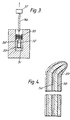
- the melt 33 was contained in a platinum/gold crucible 32 which stands on a support block 31.
- a cooling coil 35 is located above the mouth of crucible 32.
- the height of the colling coil 35, ie its height above the crucible 32 is adjustable by means not shown.
- Figure 3 shows a silica rod 34 which is in the course of production.
- the rod 34 is attached to the end of a silica bar 36 which is held in movable clamp 37.
- the cross section of bar 36 is small enough so that it can be inserted into the crucible 33 via cooling coil 35.
- the method of preparing rod 34 is as follows:
- the melt 33 in the crucible 32 contains the semiconductor in the dissolved state.
- the bar 36 is lowered through cooling coil 35 until it just touches the surface of the melt 33.
- melt 33 adheres and, therefore, a portion of the melt is drawn upwards.
- the cooling coil 35 reduced the temperature of this portion so that it cools to a solid rod.
- the temperature of the solid rod is not high enough to prevent precipitation of the dissolved semiconductor. Thus it contains a supersaturated solution of the semiconductor.
- the diameter of the rod 34 is controlled by:
- Figure 4 shows a rod 34, prepared as described above, located in the bore of a capillary tube 38 which is contained inside an outer sleeve 39. At its top end the assembly is bent and fused so that its components are secured together. The length of the assembly was about 1m.
- rod 34 is made of a potassium/zinc silicate glass which contains dissolved cadmium sulphoselenide. Its diameter is 0.1mm.
- Capillary 38 is made of sodium-calcium silicate glass. Its outer diameter is 6.0mm and its bore diameter is 1.5mm.
- Sleeve 39 is made of sodium calcium silicate glass. Its outer diameter is 10mm and its bore diameter is 8.0mm.
- These draw ratios are conveniently produced by feeding the assembly at a rate of 2 to 20mm/min and pulling fibre at a rate of 10 to 60m/min.
- absorption cut-offs are given below in tables I and II. Absorption measurements were made on lengths of fibre 10mm long. The fibre transmits at higher wavelengths and it becomes strongly absorbent at lower wavelengths.
- the cut-off is specified as two values, ie in the form A/B.
- A is the (longer) wavelength in nm at which attenuation becomes noticeable.
- B is the (shorter) wavelength in nm at which attenuation is approximately 20dB.
- the notation "A/B" indicates the location and sharpness of the cut-off edge.
- Samples of the assembly shown in Figure 4 were also drawn into fibre at lower temperatures, eg 950°C. At these lower temperatures the semiconductor was precipitated as a colloid.
- the rate of drawing was 8mm/min for the preform and 30m.min for the fibre, giving a fibre with diameter of 0.16mm.
- the size of the colloidal particles of the semiconductor was about 20 to 30nm.
- double crucible The well known technique called "double crucible” is also applicable to making fibre according to the invention.
- This technique uses concentric crucibles which contain molten glass, ie one crucible for each region of the fibre.
- the crucibles are associated with a concentric die and the fibre structure is drawn directly from the melt.
- the crucibles may be continuously recharged during drawing, eg by lowering rods into the melts to maintain a constant level.
- the fibre drawing can be carried out using doped, preferably semiconductor doped, glass in one or more of the crucibles.
- dopant dissolves and the drawing is carried out under such conditions that the dopant remains in solution, ie fibre containing a supersaturated solution of dopant is produced. (Keeping the dopant in solution is achieved provided that the rate of cooling of the fibre is kept fast enough).
Landscapes
- Physics & Mathematics (AREA)
- Chemical & Material Sciences (AREA)
- Engineering & Computer Science (AREA)
- Nonlinear Science (AREA)
- Optics & Photonics (AREA)
- Life Sciences & Earth Sciences (AREA)
- Geochemistry & Mineralogy (AREA)
- Materials Engineering (AREA)
- Organic Chemistry (AREA)
- General Physics & Mathematics (AREA)
- General Chemical & Material Sciences (AREA)
- Manufacturing & Machinery (AREA)
- General Life Sciences & Earth Sciences (AREA)
- Chemical Kinetics & Catalysis (AREA)
- Crystallography & Structural Chemistry (AREA)
- Glass Compositions (AREA)
- Optical Integrated Circuits (AREA)
- Optical Couplings Of Light Guides (AREA)
Claims (19)
- Optische Faser mit einem Glaskern und einer Glasummantelung,
dadurch gekennzeichnet,
daß sowohl der Kern als auch die Ummantelung die Form einer kontinuierlichen Glasphase einnehmen, in der kolloidale Partikel eines Dotierungsstoffes dispergiert sind. - Optische Glasfaser mit einem Glaskern und einer Glasummantelung,
dadurch gekennzeichnet,
daß der Kern in Form einer kontinuierlichen Glasphase vorliegt, in der kolloidale Partikel eines Dotierungsstoffes dispergiert sind. - Optische Glasfaser mit einem Glaskern und einer Glasummantelung,
dadurch gekennzeichnet,
daß die Ummantelung in Form einer kontinuierlichen Glasphase vorliegt, in der kolloidale Partikel eines Dotierungsstoffes dispergiert sind. - Faser nach einem der vorhergehenden Ansprüche, die zumindest einen aktiven Bereich und zumindest einen passiven Bereich aufweist, wobei der aktive Bereich bzw. die aktiven Bereiche den Dotierungsstoff als kolloidale Partikel aufweisen und der passive Bereich oder die passiven Bereiche den Dotierungsstoff gelöst aufweisen.
- Faser nach einem der Ansprüche 1 bis 3, bei der im wesentlichen die gesamte Länge der Faser den Dotierungsstoff als kolloidale Partikel aufweist.
- Faser nach einem der vorhergehenden Ansprüche, bei der der Dotierungsstoff ein Halbleiter ist.
- Faser nach Anspruch 6, bei der der Halbleiter einen Bandabstand von 3,8 bis 0,27 eV hat.
- Faser nach Anspruch 7, bei der der Bandabstand 2,5 bis 1,4 eV beträgt.
- Faser nach einem der Ansprüche 6 bis 8, bei der der Halbleiter aus Zusammensetzungen der Formelngewählt wird, wobei w, x, y, a und b alle im Bereich zwischen einschließlich 0 und 1 liegen.

- Faser nach einem der vorhergehenden Ansprüche, die eine Einmodenfaser ist.
- Faser nach einem der vorhergehenden Ansprüche, bei der die kolloidalen Partikel eine Größe im Bereich zwischen 1 und 1000 nm haben.
- Verfahren zur Herstellung von Wellenleiterstrukturen, wobei das Verfahren den Schritt aufweist des Bereitstellens einer optischen Wellenleiterstruktur, die einen Glaspfadbereich aufweist, der wirkmäßig mit zumindest einem das Glas einschließenden Bereich verbunden ist, wobei entweder der Pfadbereich und/oder der einschließende Bereich einen gelösten Dotierungsstoff aufweisen und zumindest ein ausgewählter Bereich der Struktur behandelt wird, um den Dotierungsstoff als kolloidale Partikel auszufällen.
- Verfahren nach Anspruch 12, bei dem der gelöste Dotierungsstoff in Form einer übersättigten Lösung des Dotierungsstoffs im Glas vorliegt.
- Verfahren nach einem der Ansprüche 12 oder 13, bei dem die Behandlung das Erwärmen der ausgewählten Bereiche auf eine Temperatur umfaßt, bei der der Dotierungsstoff als kolloidale Partikel ausfällt.
- Verfahren nach einem der Ansprüche 12 bis 14, bei dem der Dotierungsstoff ein Halbleiter ist.
- Verfahren nach Anspruch 15, bei dem der Halbleiter aus Zusammensetzungen der Formelnausgewält wird, wobei w, x, y, und B alle im Bereich zwischen einschließlich 0 und 1 liegen.

- Verfahren nach einem der Ansprüche 12 bis 16, bei dem die Wellenleiterstruktur eine Faser ist, der Pfadbereich der Kern ist und der einschließende Bereich die den Kern umgebende Ummantelung ist.
- Verfahren zur Herstellung einer Faser nach einem der Ansprüche 1 bis 11, wobei das Verfahren umfaßt Ziehen mehrerer Glaszusammensetzungen in eine optische Faser, wobei zumindest eine der Glaszusammensetzungen einen Dotierungsstoff enthält, der sich bei den Ziehbedingungen löst oder gelöst verbleibt, und anschließendem Erwärmen zumindest ausgewählter Bereiche der Faser auf eine Temperatur, bei der der Dotierungsstoff als kolloidale Partikel ausfällt.
- Verfahren zur Herstellung einer Faser nach einem der Ansprüche 1 bis 11, wobei das Verfahren umfaßt Herstellen einer Faservorform, die einen im Vorläufer des Kerns und/oder im Vorläufer der Ummantelung enthaltenen Dotierungsstoff aufweist, und Ziehen des Vorläufers in eine Faser unter Bedingungen, bei denen der Dotierungsstoff als Kolloid ausfällt.
Applications Claiming Priority (4)
| Application Number | Priority Date | Filing Date | Title |
|---|---|---|---|
| GB8613525 | 1986-06-04 | ||
| GB868613525A GB8613525D0 (en) | 1986-06-04 | 1986-06-04 | Optical fibres |
| GB8706461 | 1987-03-18 | ||
| GB878706461A GB8706461D0 (en) | 1987-03-18 | 1987-03-18 | Optical waveguides |
Publications (2)
| Publication Number | Publication Date |
|---|---|
| EP0248564A1 EP0248564A1 (de) | 1987-12-09 |
| EP0248564B1 true EP0248564B1 (de) | 1994-10-26 |
Family
ID=26290855
Family Applications (1)
| Application Number | Title | Priority Date | Filing Date |
|---|---|---|---|
| EP87304500A Expired - Lifetime EP0248564B1 (de) | 1986-06-04 | 1987-05-20 | Optische Wellenleiter und deren Herstellung |
Country Status (6)
| Country | Link |
|---|---|
| US (1) | US4974933A (de) |
| EP (1) | EP0248564B1 (de) |
| AT (1) | ATE113395T1 (de) |
| CA (1) | CA1294802C (de) |
| DE (1) | DE3750686T2 (de) |
| ES (1) | ES2062980T3 (de) |
Families Citing this family (16)
| Publication number | Priority date | Publication date | Assignee | Title |
|---|---|---|---|---|
| GB2220079B (en) * | 1988-06-21 | 1992-08-12 | Stc Plc | Optically controlled optical power divider |
| US5023139A (en) * | 1989-04-04 | 1991-06-11 | Research Corporation Technologies, Inc. | Nonlinear optical materials |
| JPH0365526A (ja) * | 1989-07-31 | 1991-03-20 | Hoya Corp | 微粒子分散ガラスの製造方法 |
| GB2241348A (en) * | 1990-02-20 | 1991-08-28 | British Telecomm | Optical modulator |
| US5117472A (en) * | 1990-12-28 | 1992-05-26 | At&T Bell Laboratories | Optical coupler with mode-mixing refractive microparticles |
| US6241819B1 (en) * | 1993-04-20 | 2001-06-05 | North American Philips Corp. | Method of manufacturing quantum sized doped semiconductor particles |
| US5573571A (en) * | 1994-12-01 | 1996-11-12 | Lucent Technologies Inc. | Method for making optical fiber preforms and optical fibers fabricated therefrom |
| US5948196A (en) * | 1995-08-09 | 1999-09-07 | Owens Corning Fiberglas Technology, Inc. | Layered ceramic reinforcing fibers for use in composites |
| KR20020073748A (ko) * | 2001-03-16 | 2002-09-28 | (주)옵토네스트 | 수정된 화학기상증착법에 의한 광섬유모재 제조방법 및이를 이용하여 제조된 비선형광섬유 |
| FR2839063B1 (fr) * | 2002-04-29 | 2005-01-07 | Cit Alcatel | Procede de fabrication de preformes de fibres optiques |
| DE10331103B4 (de) * | 2002-07-04 | 2008-06-26 | Schott Ag | Doppeltiegel für Glas-Ziehverfahren und Verfahren zum Herstellen von Glasfasern oder zugehörigen Vorformen mit dem Doppeltiegel |
| US7455476B2 (en) * | 2003-12-18 | 2008-11-25 | Kmc Enterprises, Inc. | Method of reconstructing a bituminous-surfaced pavement |
| US9952719B2 (en) | 2012-05-24 | 2018-04-24 | Corning Incorporated | Waveguide-based touch system employing interference effects |
| US20140210770A1 (en) | 2012-10-04 | 2014-07-31 | Corning Incorporated | Pressure sensing touch systems and methods |
| US9134842B2 (en) * | 2012-10-04 | 2015-09-15 | Corning Incorporated | Pressure sensing touch systems and methods |
| CN106495090A (zh) * | 2016-11-24 | 2017-03-15 | 天津城建大学 | 锥形光纤表面制备单层胶体球阵列结构的方法 |
Family Cites Families (29)
| Publication number | Priority date | Publication date | Assignee | Title |
|---|---|---|---|---|
| US3254031A (en) * | 1962-06-27 | 1966-05-31 | Eastman Kodak Co | Borate glass for laser use |
| US3571737A (en) * | 1968-06-07 | 1971-03-23 | Bell Telephone Labor Inc | Transmission line |
| DE1928947A1 (de) * | 1968-06-29 | 1970-01-02 | Philips Nv | Glas fuer ein faseroptisches Element |
| US3894857A (en) * | 1968-07-06 | 1975-07-15 | Nippon Selfoc Co Ltd | Process for exchanging alkali ions for thallium ions in a glass fiber |
| US3599106A (en) * | 1968-11-06 | 1971-08-10 | American Optical Corp | High intensity-high coherence laser system |
| US3636473A (en) * | 1969-03-06 | 1972-01-18 | American Optical Corp | Composite glass laser rod |
| US3808549A (en) * | 1972-03-30 | 1974-04-30 | Corning Glass Works | Optical waveguide light source |
| US3785834A (en) * | 1972-06-09 | 1974-01-15 | Owens Illinois Inc | Glasses,glass-ceramics and process for making same |
| US3938974A (en) * | 1973-04-27 | 1976-02-17 | Macedo Pedro B | Method of producing optical wave guide fibers |
| FR2238679B1 (de) * | 1973-07-26 | 1978-06-30 | Auzel Francois | |
| US3864113A (en) * | 1973-10-19 | 1975-02-04 | Corning Glass Works | Method of Producing Glass by Flame Hydrolysis |
| US4040890A (en) * | 1975-06-27 | 1977-08-09 | Bell Telephone Laboratories, Incorporated | Neodymium oxide doped yttrium aluminum garnet optical fiber |
| US3971645A (en) * | 1975-09-12 | 1976-07-27 | Bell Telephone Laboratories, Incorporated | Method of making compound-glass optical waveguides fabricated by a metal evaporation technique |
| US4149772A (en) * | 1975-09-22 | 1979-04-17 | Northern Electric Company Limited | Optical fibre having low mode dispersion |
| FR2339266A1 (fr) * | 1976-01-26 | 1977-08-19 | Commissariat Energie Atomique | Dispositif amplificateur de lumiere |
| DE7706786U1 (de) * | 1977-03-05 | 1977-06-08 | Jenaer Glaswerk Schott & Gen., 6500 Mainz | Lichtleitfaser mit querlicht |
| US4283213A (en) * | 1979-10-22 | 1981-08-11 | International Telephone And Telegraph Corporation | Method of fabrication of single mode optical fibers or waveguides |
| US4422719A (en) * | 1981-05-07 | 1983-12-27 | Space-Lyte International, Inc. | Optical distribution system including light guide |
| US4419115A (en) * | 1981-07-31 | 1983-12-06 | Bell Telephone Laboratories, Incorporated | Fabrication of sintered high-silica glasses |
| US4715679A (en) * | 1981-12-07 | 1987-12-29 | Corning Glass Works | Low dispersion, low-loss single-mode optical waveguide |
| US4516826A (en) * | 1983-04-21 | 1985-05-14 | At&T Technologies, Inc. | Single mode lightguide fiber having a trapezoidal refractive index profile |
| US4618211A (en) * | 1984-03-12 | 1986-10-21 | At&T Bell Laboratories | Optical fiber tap with activatable chemical species |
| US4637025A (en) * | 1984-10-22 | 1987-01-13 | Polaroid Corporation | Super radiant light source |
| US4597787A (en) * | 1984-11-13 | 1986-07-01 | Ispra Fibroptics Industries Herzlia Ltd. | Manufacture of optical fibre preforms |
| JPS62502748A (ja) * | 1985-06-03 | 1987-10-22 | ヒユ−ズ・エアクラフト・カンパニ− | 光フアイバプレフオ−ムにド−バントを導入する方法 |
| US4780877A (en) * | 1985-07-26 | 1988-10-25 | Polaroid Corporation | Optical fiber laser |
| WO1987001246A1 (en) * | 1985-08-13 | 1987-02-26 | Robert Joseph Mears | Fibre-optic lasers and amplifiers |
| US4666486A (en) * | 1985-09-24 | 1987-05-19 | Hutta Joseph J | Process for making bulk heavy metal fluoride glasses |
| JPS62158135A (ja) * | 1985-12-28 | 1987-07-14 | Hoya Corp | フアラデ−回転シングルモ−ド光フアイバ− |
-
1987
- 1987-05-19 CA CA000537388A patent/CA1294802C/en not_active Expired - Lifetime
- 1987-05-20 EP EP87304500A patent/EP0248564B1/de not_active Expired - Lifetime
- 1987-05-20 AT AT87304500T patent/ATE113395T1/de active
- 1987-05-20 DE DE3750686T patent/DE3750686T2/de not_active Expired - Lifetime
- 1987-05-20 ES ES87304500T patent/ES2062980T3/es not_active Expired - Lifetime
- 1987-05-22 US US07/052,979 patent/US4974933A/en not_active Expired - Lifetime
Non-Patent Citations (1)
| Title |
|---|
| Indroduction to Cooloid and Surface Chemistry by Duncan J. Shaw, pages 1 and 4 * |
Also Published As
| Publication number | Publication date |
|---|---|
| CA1294802C (en) | 1992-01-28 |
| ES2062980T3 (es) | 1995-01-01 |
| EP0248564A1 (de) | 1987-12-09 |
| US4974933A (en) | 1990-12-04 |
| DE3750686D1 (de) | 1994-12-01 |
| DE3750686T2 (de) | 1995-03-16 |
| ATE113395T1 (de) | 1994-11-15 |
Similar Documents
| Publication | Publication Date | Title |
|---|---|---|
| US4974933A (en) | Optical waveguides and their manufacture | |
| CA1277404C (en) | Apparatus comprising raman-active optical fiber | |
| DE60025823T2 (de) | Optische wellenleiterfaser mit niedrigem wasserpeak und verfahren zu ihrer herstellung | |
| CA1096672A (en) | Infrared transmitting fiber optical waveguide extruded from halides | |
| DE69602938T2 (de) | Optische wellenleitervorrichtung | |
| DE2349906B2 (de) | Glasfaser-Übertragungsleitung | |
| US4380588A (en) | Glass for infrared ray-transmitting optical fibers and optical fibers formed from said glass | |
| DE102008007871B4 (de) | Photostrukturierbares Glas für optische Bauelemente, daraus hergestelltes photostrukturiertes Glaselement sowie Verwendungen und Verfahren zur Herstellung des Glases und des Glaselements | |
| JP2006522367A (ja) | 光学素子および光学素子を作る方法 | |
| DE2300013B2 (de) | Verfahren zur Herstellung optischer Wellenleiter | |
| CA2288888A1 (en) | Fluorinated rare earth doped glass and glass-ceramic articles | |
| DE2418168A1 (de) | Optische uebertragungsleitung aus glas | |
| DE69109423T2 (de) | Verfahren zur Herstellung eines optischen Quarz-Wellenleiters. | |
| WO2001031367A3 (en) | Method for making nanocrystalline glass-ceramic fibers | |
| US5305414A (en) | Low loss glass and optical fibers therefrom | |
| US4452508A (en) | Graded index optical fibres | |
| US4445754A (en) | Glass optical fibres and glass compositions therefor | |
| DE69715566T2 (de) | Aktive optische Einmoden-Fasern und Verfahren zu deren Herstellung | |
| EP0711734A1 (de) | Verfahren zum Einbringen eines Kernes, Vorrichtung zum Herstellen von optischen Faservorformen und die daraus hergestellten optischen Fasern | |
| EP0716048B1 (de) | Verfahren zur Herstellung von Vorformen für optische Fasern und daraus hergestellte optische Fasern | |
| US5178658A (en) | Method for forming an optical waveguide by selective volatization | |
| EP0181595A2 (de) | Dielektrischer Wellenleiter mit Chlordopierung | |
| WO2003093884A2 (en) | A method and apparatus relating to optical fibres | |
| EP1207140A1 (de) | Verfahren zur Herstellung von elektrisch steuerbaren Elementen aus optischen fasern | |
| Starodubov et al. | Molten-core fibers with broadband infrared halide materials |
Legal Events
| Date | Code | Title | Description |
|---|---|---|---|
| PUAI | Public reference made under article 153(3) epc to a published international application that has entered the european phase |
Free format text: ORIGINAL CODE: 0009012 |
|
| AK | Designated contracting states |
Kind code of ref document: A1 Designated state(s): AT BE CH DE ES FR GB GR IT LI LU NL SE |
|
| 17P | Request for examination filed |
Effective date: 19871231 |
|
| RAP3 | Party data changed (applicant data changed or rights of an application transferred) |
Owner name: BRITISH TELECOMMUNICATIONS PUBLIC LIMITED COMPANY |
|
| 17Q | First examination report despatched |
Effective date: 19900613 |
|
| GRAA | (expected) grant |
Free format text: ORIGINAL CODE: 0009210 |
|
| AK | Designated contracting states |
Kind code of ref document: B1 Designated state(s): AT BE CH DE ES FR GB GR IT LI LU NL SE |
|
| PG25 | Lapsed in a contracting state [announced via postgrant information from national office to epo] |
Ref country code: GR Free format text: LAPSE BECAUSE OF FAILURE TO SUBMIT A TRANSLATION OF THE DESCRIPTION OR TO PAY THE FEE WITHIN THE PRESCRIBED TIME-LIMIT Effective date: 19941026 Ref country code: BE Effective date: 19941026 Ref country code: AT Effective date: 19941026 |
|
| REF | Corresponds to: |
Ref document number: 113395 Country of ref document: AT Date of ref document: 19941115 Kind code of ref document: T |
|
| ITF | It: translation for a ep patent filed | ||
| REF | Corresponds to: |
Ref document number: 3750686 Country of ref document: DE Date of ref document: 19941201 |
|
| REG | Reference to a national code |
Ref country code: ES Ref legal event code: FG2A Ref document number: 2062980 Country of ref document: ES Kind code of ref document: T3 |
|
| EAL | Se: european patent in force in sweden |
Ref document number: 87304500.9 |
|
| ET | Fr: translation filed | ||
| PG25 | Lapsed in a contracting state [announced via postgrant information from national office to epo] |
Ref country code: LU Free format text: LAPSE BECAUSE OF NON-PAYMENT OF DUE FEES Effective date: 19950531 |
|
| PLBE | No opposition filed within time limit |
Free format text: ORIGINAL CODE: 0009261 |
|
| STAA | Information on the status of an ep patent application or granted ep patent |
Free format text: STATUS: NO OPPOSITION FILED WITHIN TIME LIMIT |
|
| 26N | No opposition filed | ||
| PGFP | Annual fee paid to national office [announced via postgrant information from national office to epo] |
Ref country code: ES Payment date: 19980513 Year of fee payment: 12 |
|
| PG25 | Lapsed in a contracting state [announced via postgrant information from national office to epo] |
Ref country code: ES Free format text: LAPSE BECAUSE OF EXPIRATION OF PROTECTION Effective date: 19990521 |
|
| REG | Reference to a national code |
Ref country code: GB Ref legal event code: 732E |
|
| REG | Reference to a national code |
Ref country code: ES Ref legal event code: FD2A Effective date: 20010601 |
|
| REG | Reference to a national code |
Ref country code: GB Ref legal event code: IF02 |
|
| PGFP | Annual fee paid to national office [announced via postgrant information from national office to epo] |
Ref country code: NL Payment date: 20020415 Year of fee payment: 16 |
|
| PGFP | Annual fee paid to national office [announced via postgrant information from national office to epo] |
Ref country code: SE Payment date: 20020418 Year of fee payment: 16 |
|
| PG25 | Lapsed in a contracting state [announced via postgrant information from national office to epo] |
Ref country code: SE Free format text: LAPSE BECAUSE OF NON-PAYMENT OF DUE FEES Effective date: 20030521 |
|
| PG25 | Lapsed in a contracting state [announced via postgrant information from national office to epo] |
Ref country code: NL Free format text: LAPSE BECAUSE OF NON-PAYMENT OF DUE FEES Effective date: 20031201 |
|
| EUG | Se: european patent has lapsed | ||
| NLV4 | Nl: lapsed or anulled due to non-payment of the annual fee |
Effective date: 20031201 |
|
| PG25 | Lapsed in a contracting state [announced via postgrant information from national office to epo] |
Ref country code: IT Free format text: LAPSE BECAUSE OF NON-PAYMENT OF DUE FEES;WARNING: LAPSES OF ITALIAN PATENTS WITH EFFECTIVE DATE BEFORE 2007 MAY HAVE OCCURRED AT ANY TIME BEFORE 2007. THE CORRECT EFFECTIVE DATE MAY BE DIFFERENT FROM THE ONE RECORDED. Effective date: 20050520 |
|
| PGFP | Annual fee paid to national office [announced via postgrant information from national office to epo] |
Ref country code: FR Payment date: 20060411 Year of fee payment: 20 |
|
| PGFP | Annual fee paid to national office [announced via postgrant information from national office to epo] |
Ref country code: GB Payment date: 20060412 Year of fee payment: 20 |
|
| PGFP | Annual fee paid to national office [announced via postgrant information from national office to epo] |
Ref country code: CH Payment date: 20060413 Year of fee payment: 20 |
|
| PGFP | Annual fee paid to national office [announced via postgrant information from national office to epo] |
Ref country code: DE Payment date: 20060419 Year of fee payment: 20 |
|
| REG | Reference to a national code |
Ref country code: GB Ref legal event code: PE20 |
|
| REG | Reference to a national code |
Ref country code: CH Ref legal event code: PL |
|
| PG25 | Lapsed in a contracting state [announced via postgrant information from national office to epo] |
Ref country code: GB Free format text: LAPSE BECAUSE OF EXPIRATION OF PROTECTION Effective date: 20070519 |