EP0246971A2 - Dateneingabevorrichtung für ein Datenverarbeitungssystem - Google Patents
Dateneingabevorrichtung für ein Datenverarbeitungssystem Download PDFInfo
- Publication number
- EP0246971A2 EP0246971A2 EP87401131A EP87401131A EP0246971A2 EP 0246971 A2 EP0246971 A2 EP 0246971A2 EP 87401131 A EP87401131 A EP 87401131A EP 87401131 A EP87401131 A EP 87401131A EP 0246971 A2 EP0246971 A2 EP 0246971A2
- Authority
- EP
- European Patent Office
- Prior art keywords
- cursor
- mode
- keyboard
- key
- data
- Prior art date
- Legal status (The legal status is an assumption and is not a legal conclusion. Google has not performed a legal analysis and makes no representation as to the accuracy of the status listed.)
- Withdrawn
Links
Images
Classifications
-
- G—PHYSICS
- G06—COMPUTING OR CALCULATING; COUNTING
- G06F—ELECTRIC DIGITAL DATA PROCESSING
- G06F3/00—Input arrangements for transferring data to be processed into a form capable of being handled by the computer; Output arrangements for transferring data from processing unit to output unit, e.g. interface arrangements
- G06F3/01—Input arrangements or combined input and output arrangements for interaction between user and computer
- G06F3/03—Arrangements for converting the position or the displacement of a member into a coded form
- G06F3/033—Pointing devices displaced or positioned by the user, e.g. mice, trackballs, pens or joysticks; Accessories therefor
- G06F3/038—Control and interface arrangements therefor, e.g. drivers or device-embedded control circuitry
-
- B—PERFORMING OPERATIONS; TRANSPORTING
- B41—PRINTING; LINING MACHINES; TYPEWRITERS; STAMPS
- B41J—TYPEWRITERS; SELECTIVE PRINTING MECHANISMS, i.e. MECHANISMS PRINTING OTHERWISE THAN FROM A FORME; CORRECTION OF TYPOGRAPHICAL ERRORS
- B41J5/00—Devices or arrangements for controlling character selection
- B41J5/08—Character or syllable selected by means of keys or keyboards of the typewriter type
- B41J5/10—Arrangements of keyboards, e.g. key button disposition
-
- G—PHYSICS
- G06—COMPUTING OR CALCULATING; COUNTING
- G06F—ELECTRIC DIGITAL DATA PROCESSING
- G06F3/00—Input arrangements for transferring data to be processed into a form capable of being handled by the computer; Output arrangements for transferring data from processing unit to output unit, e.g. interface arrangements
- G06F3/01—Input arrangements or combined input and output arrangements for interaction between user and computer
- G06F3/02—Input arrangements using manually operated switches, e.g. using keyboards or dials
- G06F3/023—Arrangements for converting discrete items of information into a coded form, e.g. arrangements for interpreting keyboard generated codes as alphanumeric codes, operand codes or instruction codes
- G06F3/0233—Character input methods
- G06F3/0235—Character input methods using chord techniques
-
- G—PHYSICS
- G06—COMPUTING OR CALCULATING; COUNTING
- G06F—ELECTRIC DIGITAL DATA PROCESSING
- G06F3/00—Input arrangements for transferring data to be processed into a form capable of being handled by the computer; Output arrangements for transferring data from processing unit to output unit, e.g. interface arrangements
- G06F3/01—Input arrangements or combined input and output arrangements for interaction between user and computer
- G06F3/03—Arrangements for converting the position or the displacement of a member into a coded form
- G06F3/033—Pointing devices displaced or positioned by the user, e.g. mice, trackballs, pens or joysticks; Accessories therefor
-
- G—PHYSICS
- G06—COMPUTING OR CALCULATING; COUNTING
- G06F—ELECTRIC DIGITAL DATA PROCESSING
- G06F3/00—Input arrangements for transferring data to be processed into a form capable of being handled by the computer; Output arrangements for transferring data from processing unit to output unit, e.g. interface arrangements
- G06F3/01—Input arrangements or combined input and output arrangements for interaction between user and computer
- G06F3/03—Arrangements for converting the position or the displacement of a member into a coded form
- G06F3/033—Pointing devices displaced or positioned by the user, e.g. mice, trackballs, pens or joysticks; Accessories therefor
- G06F3/0354—Pointing devices displaced or positioned by the user, e.g. mice, trackballs, pens or joysticks; Accessories therefor with detection of two-dimensional [2D] relative movements between the device, or an operating part thereof, and a plane or surface, e.g. 2D mice, trackballs, pens or pucks
- G06F3/03543—Mice or pucks
-
- G—PHYSICS
- G06—COMPUTING OR CALCULATING; COUNTING
- G06F—ELECTRIC DIGITAL DATA PROCESSING
- G06F40/00—Handling natural language data
- G06F40/20—Natural language analysis
- G06F40/274—Converting codes to words; Guess-ahead of partial word inputs
-
- G—PHYSICS
- G06—COMPUTING OR CALCULATING; COUNTING
- G06F—ELECTRIC DIGITAL DATA PROCESSING
- G06F2203/00—Indexing scheme relating to G06F3/00 - G06F3/048
- G06F2203/033—Indexing scheme relating to G06F3/033
- G06F2203/0333—Ergonomic shaped mouse for one hand
Definitions
- the present invention relates to a device for entering data into a computer system.
- the keyboards are more or less complicated and include, in addition, alphanumeric keys of a usual typewriter keyboard, function keys which are specific according to the work to be done with the keyboard.
- the user must place the cursor at the location of the modification by pressing the corresponding movement key (s); then, once the cursor is thus placed, it must either erase the parts to be deleted, strike the new words or groups of words to insert them, etc. Again, there is a change in the position of the hands when passing from the alphanumeric keyboard to the cursor movement control keys then back to the alphanumeric keyboard. These changes in hand positions significantly revitalize typing in word processing.
- cursor movement device which replaces the four cursor movement control keys with a box provided with a ball which is rolled so as to move the cursor at sight.
- This cursor movement control device is very practical because it allows the cursor to be moved very quickly and very efficiently.
- This device can be used for different applications in word processing or for graphic applications (drawing of figures and tables).
- the user brings up on the screen the icons from which he chooses the one corresponding to the drawing part to be drawn (lines, rectangles, squares, triangles, circles, broken lines, etc.). He makes his choice by placing the cursor on the chosen icon. This movement is done by moving the ball of the device.
- the user returns to the drawing (still on the screen) and displays the image of the icon on the drawing, with the desired dimensions.
- the object of the present invention is to remedy the drawbacks of known means and proposes to create a data input device in a computer system making it possible to introduce alphanumeric data or graphic data into a system using a particularly simple means, not requiring visual control of the position of the hands and allowing the user to only look at the screen, to arrive at an extremely fast entry of alphanumeric and / or graphic data.
- the invention relates to a manual device for entering data into a computer system, characterized in that it consists of a - a mobile unit capable of being connected to the computer system, carrying on its upper face a harmonic keyboard, - on its underside, a cursor control ball making it possible to move the cursor on the screen by the movement of the ball, - a device for controlling the operating mode of the device to switch it from operating in cursor mode to operating in keyboard mode or vice versa.
- the manual device makes it possible to enter data in a particularly efficient, simple and rapid manner because, without leaving the device with the hand and by keeping their position with the hand and the fingers, the user can use of this device to enter data for the keyboard (alphanumeric or graphic data) and practically simultaneously switch to cursor mode and move the cursor to immediately make a correction on the data it has just entered.
- the user does not have to move his hand to actuate the cursor keys or the ball controlling the movement of the cursor and return to the alphanumeric keyboard as in known systems.
- the cursor remains on the drawing at a certain location.
- the mode key By pressing the mode key, the user can use the keyboard to choose the icon he wishes, then press the mode key again and bring up the icon image at the cursor location, location that has not changed. This represents a considerable time saving since in execution of the drawings on screen, the designer is constantly obliged to pass from the drawing to the icons and to return.
- the mode control member is preferably a button, in particular a button associated with the thumb.
- this key could also be a key associated with the palm of the hand, which would either limit to two the number of keys intended for the thumb, or would offer a possibility of additional key to be actuated by the thumb.
- the mode control key associated with the thumb is distinct from the keys of the harmonic keyboard and, in particular, this key is found in alignment or in the group of keys actuated by the thumb and in a separate position. or away from the keys corresponding to the other keys on the keyboard.
- the device comprises means for displaying the state of the device, for example a small display device by diodes or by liquid crystals.
- the device according to the invention which can be controlled without the user having to look at it, allows the latter to verify the entry of the data on the screen. He has also with a free hand.
- the device shown corresponds to a device intended for right-handers
- the invention makes it possible to produce, under the same conditions, a device intended for left-handers.
- the device comprises a means of recording information, for example on diskette, which makes it possible to use the device as a means of "shorthand" for taking notes during conferences or the like, and this when the device is not connected to a computer system.
- This device can also be connected to available control screens, for example a teletel screen.
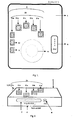
- the data entry device in a computer system consists of a box 1 carrying, on its upper surface 2, a harmonic keyboard 3 and on its lower face a ball 4.
- the harmonic keyboard 3 provided on the upper face, is a keyboard allowing the introduction alphanumeric, graphic and order signs by pressing a key or a combination of keys representing these signs.
- the ball 4 on the lower face constitutes the cursor control member which makes it possible to move the cursor on the control screen as a function of the rotation of the ball. This rotation of the ball is obtained by displacement of the housing 1 on the surface on which it rests. The rotation of this ball transmits in a known manner its movement to two orthogonal rollers and whose rotation in one direction or the other is the equivalent of the actuation of one or two keys for moving the cursor of a usual keyboard.
- the device comprises a mode control member 5 which makes it possible to control the operation of the device either in cursor mode or in keyboard mode.
- the upper face of the housing 1 includes a display means 6 making it possible to display the operating state of the device either the cursor mode, or the keyboard mode, or even the specific mode of the keyboard, for example capital letters, etc. ..
- the keyboard 3 is made up of keys divided into alphanumeric or graphic keys 31 (31A, 31B, 31C, 31D, 31E) intended to be actuated by the five fingers of the hand, the key 31E being that actuated by the thumb.
- the keyboard also includes a control key 32.
- the mode control member 5 is a key intended to be actuated by the thumb.
- This key 5 is grouped with the keys 31E, 32 and 5 so as to be in the zone of action of the thumb, the hand remaining immobile.
- the keys 31E, 32, 5 are aligned or placed in an arc centered on the pivot point of the thumb.
- the keys 31, 32 and 5 are arranged ergonometrically so that the position of the hand does not have to change to actuate the keys.
- the keys 31 and 32 are the keys of a harmonic keyboard. This means that these keys, taken either individually or in pairs or more, represent letters or alphanumeric or graphic symbols.
- the display device 6 which displays the state of the device is important so that in case of doubt, the user can check the state in which the device is located.
- the device comprises on its front face a socket 7 for example an RS 332C type socket for connecting the device to the computer system as well as a connection 8 for supplying the device when it this is used independently.
- a socket 7 for example an RS 332C type socket for connecting the device to the computer system as well as a connection 8 for supplying the device when it this is used independently.
- the user presses the mode control key 5 to put the device in keyboard mode, then using the keys 31, he introduces the words, symbols, etc ...
- the user of the device 1 corresponds on a computer system to the use of a traditional pencil.
- the device according to the invention can be compared to a "computer pencil". Indeed, as the reader can follow a text with the tip of his pencil then arrive at the appropriate place and insert with the same pencil the desired modifications, the use of the device, according to the invention, can, using the same device and without changing the position of his hand or changing its place on the device, write a text, then read it again using the cursor and stop the cursor at the appropriate place to always, using the same device, introduce additions, deletions or corrections at the cursor location.
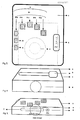
- Figures 3, 5 show a second embodiment of the device according to the invention. This embodiment differs from the embodiment of Figures 1 and 2 by the addition of a recording means on floppy disk.
- Figure 3 shows location 8 of the diskette.
- Figure 4 shows the slot 9 for inserting the floppy disk in the rear face.
- the device is similar to that described above.
Landscapes
- Engineering & Computer Science (AREA)
- Theoretical Computer Science (AREA)
- General Engineering & Computer Science (AREA)
- Physics & Mathematics (AREA)
- General Physics & Mathematics (AREA)
- Human Computer Interaction (AREA)
- Health & Medical Sciences (AREA)
- Artificial Intelligence (AREA)
- Audiology, Speech & Language Pathology (AREA)
- Computational Linguistics (AREA)
- General Health & Medical Sciences (AREA)
- Input From Keyboards Or The Like (AREA)
Applications Claiming Priority (2)
| Application Number | Priority Date | Filing Date | Title |
|---|---|---|---|
| FR8607196 | 1986-05-21 | ||
| FR8607196A FR2599163A1 (fr) | 1986-05-21 | 1986-05-21 | Dispositif d'entree de donnees dans un systeme informatique |
Publications (2)
| Publication Number | Publication Date |
|---|---|
| EP0246971A2 true EP0246971A2 (de) | 1987-11-25 |
| EP0246971A3 EP0246971A3 (de) | 1988-10-19 |
Family
ID=9335419
Family Applications (1)
| Application Number | Title | Priority Date | Filing Date |
|---|---|---|---|
| EP87401131A Withdrawn EP0246971A3 (de) | 1986-05-21 | 1987-05-20 | Dateneingabevorrichtung für ein Datenverarbeitungssystem |
Country Status (2)
| Country | Link |
|---|---|
| EP (1) | EP0246971A3 (de) |
| FR (1) | FR2599163A1 (de) |
Cited By (11)
| Publication number | Priority date | Publication date | Assignee | Title |
|---|---|---|---|---|
| WO1989005496A1 (en) * | 1987-12-02 | 1989-06-15 | Soft Image Systems Limited | Inputs to computer by non-physical link |
| EP0372955A3 (de) * | 1988-12-08 | 1991-04-03 | Kirk F. Mackenzie | Positionseingabevorrichtung für einen Rechner |
| FR2688609A1 (fr) * | 1992-03-13 | 1993-09-17 | Waldmann Jean | Combine clavier numerique + souris. |
| EP0497502A3 (de) * | 1991-02-01 | 1994-03-16 | Home Row Inc | |
| EP0712066A1 (de) * | 1994-11-14 | 1996-05-15 | AT&T Corp. | Computerschnittstellensystem |
| EP0752639A1 (de) * | 1995-07-07 | 1997-01-08 | Sun Microsystems, Inc. | Chordale Tastatur mit integrierter Maus |
| WO1998009446A3 (en) * | 1996-08-26 | 1998-04-16 | Seng Beng Ho | A browsing system and method for computer information |
| US5909207A (en) * | 1996-08-26 | 1999-06-01 | E-Book Systems Pte Ltd | Browsing system and method for computer information |
| WO1999028836A3 (en) * | 1997-11-28 | 1999-07-15 | Cybergene Ab | Arrangement and method for the analysis of nucleotide sequences |
| US6064384A (en) * | 1996-08-26 | 2000-05-16 | E-Brook Systems Pte Ltd | Computer user interface system and method having book image features |
| US6407757B1 (en) | 1997-12-18 | 2002-06-18 | E-Book Systems Pte Ltd. | Computer-based browsing method and computer program product for displaying information in an electronic book form |
Family Cites Families (2)
| Publication number | Priority date | Publication date | Assignee | Title |
|---|---|---|---|---|
| DE3340749A1 (de) * | 1983-11-10 | 1985-05-23 | Udo Eckhardt | Tragbares datenerfassungs- und datenuebertragungssteuergeraet |
| GB2161755B (en) * | 1984-06-15 | 1988-05-18 | Univ Dundee | Computer peripheral device |
-
1986
- 1986-05-21 FR FR8607196A patent/FR2599163A1/fr active Pending
-
1987
- 1987-05-20 EP EP87401131A patent/EP0246971A3/de not_active Withdrawn
Cited By (13)
| Publication number | Priority date | Publication date | Assignee | Title |
|---|---|---|---|---|
| WO1989005496A1 (en) * | 1987-12-02 | 1989-06-15 | Soft Image Systems Limited | Inputs to computer by non-physical link |
| EP0372955A3 (de) * | 1988-12-08 | 1991-04-03 | Kirk F. Mackenzie | Positionseingabevorrichtung für einen Rechner |
| EP0497502A3 (de) * | 1991-02-01 | 1994-03-16 | Home Row Inc | |
| FR2688609A1 (fr) * | 1992-03-13 | 1993-09-17 | Waldmann Jean | Combine clavier numerique + souris. |
| EP0712066A1 (de) * | 1994-11-14 | 1996-05-15 | AT&T Corp. | Computerschnittstellensystem |
| EP0752639A1 (de) * | 1995-07-07 | 1997-01-08 | Sun Microsystems, Inc. | Chordale Tastatur mit integrierter Maus |
| WO1998009446A3 (en) * | 1996-08-26 | 1998-04-16 | Seng Beng Ho | A browsing system and method for computer information |
| US5909207A (en) * | 1996-08-26 | 1999-06-01 | E-Book Systems Pte Ltd | Browsing system and method for computer information |
| US6064384A (en) * | 1996-08-26 | 2000-05-16 | E-Brook Systems Pte Ltd | Computer user interface system and method having book image features |
| WO1999028836A3 (en) * | 1997-11-28 | 1999-07-15 | Cybergene Ab | Arrangement and method for the analysis of nucleotide sequences |
| US6407757B1 (en) | 1997-12-18 | 2002-06-18 | E-Book Systems Pte Ltd. | Computer-based browsing method and computer program product for displaying information in an electronic book form |
| US7079111B2 (en) | 1997-12-18 | 2006-07-18 | E-Book Systems Pte Ltd | Computer based browsing computer program product, system and method |
| US7555724B2 (en) | 1997-12-18 | 2009-06-30 | E-Book Systems Pte Ltd. | Computer based browsing computer program product, system and method |
Also Published As
| Publication number | Publication date |
|---|---|
| EP0246971A3 (de) | 1988-10-19 |
| FR2599163A1 (fr) | 1987-11-27 |
Similar Documents
| Publication | Publication Date | Title |
|---|---|---|
| CA2501118C (en) | Method of combining data entry of handwritten symbols with displayed character data | |
| ES2997370T3 (en) | Multilingual character input device | |
| US20040108994A1 (en) | Touch-type key input apparatus | |
| AU2008222600A1 (en) | Method system and apparatus for entering text on a computing device | |
| CN101414213A (zh) | 人类语言、文字、符号点划式人机界面 | |
| FR2599163A1 (fr) | Dispositif d'entree de donnees dans un systeme informatique | |
| WO2010009841A2 (fr) | Système d'interface pour saisir une suite de caractères | |
| Tidwell | A pattern language for human-computer interface design | |
| Wang | Mac OS X for Absolute Beginners | |
| JPS5824469A (ja) | 文字キ−ボ−ド | |
| Kissell | Take Control of Automating Your Mac | |
| JP2005275635A (ja) | 仮名文字入力方法および仮名文字入力プログラム | |
| WO2001096997A1 (fr) | Appareil electronique comprenant un clavier de commande individuel et pour la commande d'autres appareils | |
| JP5460343B2 (ja) | 学習装置、学習帳表示方法及び学習帳表示プログラム | |
| Gookin | Word 2013 for dummies | |
| CN105426109A (zh) | 一种滑行输入文字的方法 | |
| JP5357066B2 (ja) | 学習装置、学習帳登録方法及び学習帳登録プログラム | |
| FR2515108A1 (fr) | Dispositif de commande pour machines a ecrire electroniques | |
| JP3146079B2 (ja) | 文字・図形編集装置 | |
| Pogue | Mac OS X Lion: The Missing Manual | |
| Gupta | Comdex Computer Course Kit (With Cd) | |
| Perry | Sams Teach Yourself Microsoft Windows XP in 24 Hours | |
| AU2013270614A1 (en) | Method system and apparatus for entering text on a computing device | |
| JPH1173421A (ja) | 表示装置 | |
| FR2857112A1 (fr) | Clavier pour ordinateur et logiciel pilote pour un tel clavier |
Legal Events
| Date | Code | Title | Description |
|---|---|---|---|
| PUAI | Public reference made under article 153(3) epc to a published international application that has entered the european phase |
Free format text: ORIGINAL CODE: 0009012 |
|
| AK | Designated contracting states |
Kind code of ref document: A2 Designated state(s): AT BE CH DE ES GB GR IT LI LU NL SE |
|
| PUAL | Search report despatched |
Free format text: ORIGINAL CODE: 0009013 |
|
| AK | Designated contracting states |
Kind code of ref document: A3 Designated state(s): AT BE CH DE ES GB GR IT LI LU NL SE |
|
| STAA | Information on the status of an ep patent application or granted ep patent |
Free format text: STATUS: THE APPLICATION IS DEEMED TO BE WITHDRAWN |
|
| 18D | Application deemed to be withdrawn |
Effective date: 19890420 |