EP0243710A2 - Flexible finned heat exchanger - Google Patents
Flexible finned heat exchanger Download PDFInfo
- Publication number
- EP0243710A2 EP0243710A2 EP87104809A EP87104809A EP0243710A2 EP 0243710 A2 EP0243710 A2 EP 0243710A2 EP 87104809 A EP87104809 A EP 87104809A EP 87104809 A EP87104809 A EP 87104809A EP 0243710 A2 EP0243710 A2 EP 0243710A2
- Authority
- EP
- European Patent Office
- Prior art keywords
- sheet
- heat exchanger
- fins
- chips
- coolant
- Prior art date
- Legal status (The legal status is an assumption and is not a legal conclusion. Google has not performed a legal analysis and makes no representation as to the accuracy of the status listed.)
- Withdrawn
Links
Images




Classifications
-
- H—ELECTRICITY
- H10—SEMICONDUCTOR DEVICES; ELECTRIC SOLID-STATE DEVICES NOT OTHERWISE PROVIDED FOR
- H10W—GENERIC PACKAGES, INTERCONNECTIONS, CONNECTORS OR OTHER CONSTRUCTIONAL DETAILS OF DEVICES COVERED BY CLASS H10
- H10W40/00—Arrangements for thermal protection or thermal control
- H10W40/40—Arrangements for thermal protection or thermal control involving heat exchange by flowing fluids
- H10W40/43—Arrangements for thermal protection or thermal control involving heat exchange by flowing fluids by flowing gases, e.g. forced air cooling
-
- F—MECHANICAL ENGINEERING; LIGHTING; HEATING; WEAPONS; BLASTING
- F28—HEAT EXCHANGE IN GENERAL
- F28F—DETAILS OF HEAT-EXCHANGE AND HEAT-TRANSFER APPARATUS, OF GENERAL APPLICATION
- F28F19/00—Preventing the formation of deposits or corrosion, e.g. by using filters or scrapers
- F28F19/02—Preventing the formation of deposits or corrosion, e.g. by using filters or scrapers by using coatings, e.g. vitreous or enamel coatings
- F28F19/06—Preventing the formation of deposits or corrosion, e.g. by using filters or scrapers by using coatings, e.g. vitreous or enamel coatings of metal
-
- F—MECHANICAL ENGINEERING; LIGHTING; HEATING; WEAPONS; BLASTING
- F28—HEAT EXCHANGE IN GENERAL
- F28F—DETAILS OF HEAT-EXCHANGE AND HEAT-TRANSFER APPARATUS, OF GENERAL APPLICATION
- F28F21/00—Constructions of heat-exchange apparatus characterised by the selection of particular materials
- F28F21/08—Constructions of heat-exchange apparatus characterised by the selection of particular materials of metal
- F28F21/081—Heat exchange elements made from metals or metal alloys
- F28F21/085—Heat exchange elements made from metals or metal alloys from copper or copper alloys
-
- F—MECHANICAL ENGINEERING; LIGHTING; HEATING; WEAPONS; BLASTING
- F28—HEAT EXCHANGE IN GENERAL
- F28F—DETAILS OF HEAT-EXCHANGE AND HEAT-TRANSFER APPARATUS, OF GENERAL APPLICATION
- F28F3/00—Plate-like or laminated elements; Assemblies of plate-like or laminated elements
- F28F3/02—Elements or assemblies thereof with means for increasing heat-transfer area, e.g. with fins, with recesses, with corrugations
- F28F3/04—Elements or assemblies thereof with means for increasing heat-transfer area, e.g. with fins, with recesses, with corrugations the means being integral with the element
- F28F3/048—Elements or assemblies thereof with means for increasing heat-transfer area, e.g. with fins, with recesses, with corrugations the means being integral with the element in the form of ribs integral with the element or local variations in thickness of the element, e.g. grooves, microchannels
-
- H—ELECTRICITY
- H10—SEMICONDUCTOR DEVICES; ELECTRIC SOLID-STATE DEVICES NOT OTHERWISE PROVIDED FOR
- H10W—GENERIC PACKAGES, INTERCONNECTIONS, CONNECTORS OR OTHER CONSTRUCTIONAL DETAILS OF DEVICES COVERED BY CLASS H10
- H10W40/00—Arrangements for thermal protection or thermal control
- H10W40/70—Fillings or auxiliary members in containers or in encapsulations for thermal protection or control
- H10W40/77—Auxiliary members characterised by their shape
- H10W40/774—Pistons, e.g. spring-loaded members
-
- F—MECHANICAL ENGINEERING; LIGHTING; HEATING; WEAPONS; BLASTING
- F28—HEAT EXCHANGE IN GENERAL
- F28F—DETAILS OF HEAT-EXCHANGE AND HEAT-TRANSFER APPARATUS, OF GENERAL APPLICATION
- F28F2255/00—Heat exchanger elements made of materials having special features or resulting from particular manufacturing processes
- F28F2255/02—Flexible elements
-
- F—MECHANICAL ENGINEERING; LIGHTING; HEATING; WEAPONS; BLASTING
- F28—HEAT EXCHANGE IN GENERAL
- F28F—DETAILS OF HEAT-EXCHANGE AND HEAT-TRANSFER APPARATUS, OF GENERAL APPLICATION
- F28F2255/00—Heat exchanger elements made of materials having special features or resulting from particular manufacturing processes
- F28F2255/14—Heat exchanger elements made of materials having special features or resulting from particular manufacturing processes molded
Definitions
- This invention relates to a heat exchanger for transference of heat from an array of electronic circuit chips and, more particularly, to a flexible sheet having cooling fins thereon to be placed directly on the array of chips.
- Arrays of electronic circuit chips are interconnected to provide vast electronic circuits. Such circuits may be employed in computers and other electronic systems utilizing very large numbers of electronic circuit components.
- the many transistors and other circuit components present within a circuit chip dissipate heat in response to activation with current from an electric power supply. In order for the circuits to function properly, the heat must be removed to maintain proper operating temperature for the circuits.
- cooling which has been proposed is the use of a metal plate held against circuit chips by springs, as is disclosed by Cutchaw, U.S. patent 4,381,032.
- Another form of heat exchanger for cooling electronic circuits provides for passages within which liquid coolant is circulated, the coolant contacting a flexible wall which presses against the circuitry to be cooled, as shown in Wilson et al, U.S. patent 4,072,188.
- Another form of heat exchanger employs coated metallic dendrites which are held by springs against a circuit chip, as disclosed in Babuka et al, U.S. patent 4,254,431.
- Yet another form of heat exchanger employs a pillow structure formed of film and filled with a thermal liquid material for extracting heat from an electric circuit, as is disclosed in Spaight, U.S. patent 4,092,697. Also a malleable dimpled wafer is deformed by pressure between a heat source such as an electronic circuit and a heat sink, as is disclosed in Rhoades et al, U.S. patent 4,151,547.
- a theoretical discussion of cooling considerations is presented in an article in the IEEE Electron Device Letters, "High Performance Heat Sinking For VLSI" by D.B. Tuckerman and R.F.W. Pease, Vol. EDL-2, No. 5, May 1981, pp. 126-129.
- heat exchanger which, in accordance with the invention as claimed, is formed as a flexible sheet of thermally conductive material, and is provided with a set of fins of thermally conductive material upstanding upon the flexible sheet.
- the sheet is large enough to encompass an array of circuit chips disposed on a common substrate and can completely blanket the array of chips.
- the sheet can be attached to the substrate, by use of suitable adhesives, so as to hermetically seal the chips against any contamination by a fluid coolant.
- the sheet may be provided with corrugations at locations between the sites of the chips so as to provide for greater flexibility and the capacity for fully aligning each portion of the sheet with the corresponding surface of a chip.
- the fins are arranged in the direction of coolant flow, thereby to transfer more effectively the heat of the chip to the coolant.
- the fins are arranged in a staggered array to promote the flow of coolant and contact between the coolant and the fins.
- the thickness of the fins is approximately equal to the spacing between fins which, in turn, is approximately equal to the thickness of the sheet, typically 0.05 mm.
- the material used in the construction of the heat exchanger is dependent on the nature of the coolant.
- the sheet and fins of the heat exchanger may be constructed of copper which provides for good thermal conductivity and, in addition, is flexible at sheet thicknesses in the range of 0.012-0.125 mm.
- the copper of the fins is coated with a metal such as nickel which prevents corrosion of the heat exchanger by the water. Chromium or its alloys may also be used to coat the heat exchanger.
- a thermally conducting grease may be used as a thermally conducting grease.
- a spring loaded plate may be applied against the tops of the fins to urge the heat exchanger structure against the array of chips, thereby to promote good thermal conductivity between the heat exchanger and the chips.
- Important features of the invention are the establishment of fine groove forced convection cooling, a flexible hermetically sealing sheet, and a fabrication of the exchanger by photolithographic techniques as are employed in the production of printed circuits.
- the thickness of the fins and width of the grooves are both equal approximately to 0.05 mm, such dimensions being well suited for the transference of heat from the fins to a liquid coolant such as water.
- the chips may be mounted to a substrate by means of fragile connections in the form of solder balls, which balls may be broken by excessive stress upon a chip.
- the flexible sheet in addition to protecting the circuit chips from contaminants by hermetic sealing, also relieves the foregoing stresses between chips so as to protect the connections between the chips and the substrate.
- the convenience of manufacture of the heat exchanger by photolithographic technology is attainable because of the small fin and groove dimensions, noted above, which dimensions are suitable for masking and additive plating to form the cooling structure of the fins and grooves.
- an electronic system 20 is formed as an array of circuit chips 22 disposed on a common substrate 24. Electrical connections between the chips 22 are accomplished by well-known conductors (not shown) within the substrate 24 and a set of soft metal solder ball connections 26 (known as C4's) located between terminals of the chips 22 and the conductors of the substrate 24. Heat generated within the chips 22 by electric currents flowing within the circuits of the chips 22 is removed by means of a fluid coolant provided by a chiller 28 and conveyed therefrom to the chips 22 by a supply conduit 30 and a return conduit 32. A duct 34, partially shown in FIGS. 1 and 3, guides the coolant past the chips 22 between the conduits 30 and 32. The chips 22 of FIG.
- 1 may represent only a portion of the system 20, additional chips (not shown on the FIG.) also being provided with supply and return conduits (not shown) which conduits in combination with the conduits 30 and 32 constitute a manifold for conducting coolant between the chiller 28 and the electronic system 20.
- the cooling of the chips 22 is accomplished more efficiently by the use of a heat exchanger 36 comprising a flexible sheet 38 of thermally conductive material with fins 40 of thermally conductive material extending away from the sheet 38.
- the sheet 38 is shown covering the chips 22, with a part of the sheet 38 being cut away to show partially two of the chips 22. Due to the flexibility of the sheet 38, the heat exchanger 36 covers the chips 22 and the substrate 24 in the manner of a blanket. The flexibility of the sheet 38 provides for the relief of stress exerted on the chips 22, otherwise due to the cooling system.
- solder ball connections 26 have a diameter of only 0.125 mm, and are susceptible to fracture. The foregoing stresses cannot be transmitted via the sheet 38 to another chip because of the flexing action of the sheet 38. This protects the connections 26.
- a suitable thermally conductive material for construction of the heat exchanger 36 is a flexible metal, such as copper.
- the configuration of the fins 40 upstanding from the metal sheet may by referred to as a "metal velvet" because one side of the sheet has a fine fin structure while the opposite side of the sheet is smooth.
- the heat exchanger 36 may have relatively large fins for air cooling, the "velvet" effect of the smaller fins for water cooling is advantageous because the smaller fin size, fin thickness and groove width of 0.05 mm, enhances the transfer of heat from the fins to water.
- the fins 40 are oriented in a regular array to form grooves 42 between the fins 40 which are aligned along the direction of coolant flow so as to guide the coolant among the fins 40.
- the fins 40 are located on the sheet 38 only at those locations corresponding to sites of the chips 22.
- the flexibility of the sheet 38 permits the heat exchanger 36 to conform to the individual orientations of the surfaces of the chips 22 for enhanced conduction of heat from each chip 22 to the coolant.
- a pressure plate 46 may be applied to the top ends of the fins 40 and pressed against the heat exchanger 36 by a spring 48 secured to the ducts 34 of the cooling manifold.
- the pressure exerted by the spring 48 is sufficiently small so as to preclude any bending of the fins 40, but is sufficiently large to promote thermal contact between the sheet 38 and the top surface of a chip 22, such as the middle chip depicted in FIG. 3 with the pressure plate 46.
- the fins 40 may be arranged in rows and columns, as shown in FIG. 2, or alternatively, may be located in a staggered array as shown diagrammatically in FIG. 4. In both cases, the orientation of the fins 40 follows the lines of coolant flow so as to provide for good conduction of heat from the fins 40 into the coolant.
- the spacing between the fins 40 is approximately equal to the thickness of an individual fin, thereby to minimize the build up of any thermal boundary layer within the coolant, as the coolant flows past the fins 40.
- the material of the heat exchanger may be coated with a coating 50 to protect the material 52 from any corrosive effects of the coolant.
- the coating 50 is not required with non-corrosive coolants.
- the coolant is air
- a suitable material for the heat exchanger 36 is copper. Because air is not corrosive, an anodized coating or even no coating may be sufficient.
- the copper should be coated with a coating 50 of nickel to prevent corrosion of the copper by the water.
- a portion of one of the fins 40 is partially cut away to show the coating 50 upon a base material 52 of copper.
- the base material 52 and the nickel coating 50 may be seen in the sectioned portion of the sheet 28.
- Another suitable material for construction of the heat exchanger 36 is stainless steel. While the stainless steel is not as good a thermal conductor as copper, it is resistant to corrosive coolants, and may be used without a coating.
- a low-temperature soft metal alloy solder between the chip 22 and the sheet 38 for best heat conductivity.
- a thin layer of other thermally conductive material may be placed between the chip 22 and the sheet 38, suitable material being a well-known grease or oil with zinc oxide.
- suitable materials include a soft silicone elastomer which may include thermally conductive particles such as silicon carbide.
- the spacing and sizes of the fins 40 are selected in accordance with the particular coolant to be employed.
- the fins 40 can extend away from the sheet 38 a distance of almost 25 mm, and may be spaced apart with a spacing of 3 mm.
- the fins may be spaced apart by 0.05 mm, and may have a thickness of 0.05 mm, the individual fin extending along the direction of coolant flow for a distance of 0.3 mm.
- a particular advantage in the use of the heat exchanger 36 of the invention is the fact that it can be placed on a relatively large array of chips 22, for example an array of 100 chips, without the requirement for any precise dimensional alignment, due to the flexibility of the heat exchanger 36.
- An additional feature is attained by adhesively securing the perimeter of the sheet 38 to the substrate 24, thereby to hermetically seal all of the chips 22 from the coolant.
- the thickness of the metal sheet 38 is selected in accordance with the specific material employed in the construction of the heat exchanger 36, a thickness in the range of 0.02 - 0.25 mm being suitable for copper.
- a thickness on the order of 0.05 - 0.08 mm of copper provides good thermal conduction in the fins 40.
- the Cu base preferably should be absent, and then the nickel overcoat alone should form a flexible sheet. In the positioning of the fins 40 at the site of a chip 22, typically fifty of the fins are located at the site of one chip 22.
- the chips 22 may be placed on a substrate in the form of a ceramic tile having a size of typically 10 cm by 10 cm.
- the sheet 38 is made sufficiently large to cover the entire tile, thus greatly facilitating the manufacturing process for construction of the system 20.
- both the substrate 24 and the chips 22 are rigid, it is advantageous to employ a heat exchanger which is so constructed as to avoid introduction of stresses and strains between the chips and the substrate so as to avoid cracking the solder ball connections 26.
- the heat exchanger 36 of the invention does not apply stresses by virtue of its flexible construction.
- the heat exchanger is most readily fabricated in a manner analogous to the processes used to fabricate printed circuits. Start with a smooth aluminum mandrel, shaped for the corrugations. Apply a mask, and selectively plate copper fins at each chip location. Overcoat these fins and mandrel by electroless deposition of a thin layer of amorphous nickel. Etch away the mandrel with an alkali solution. Thus over each chip are Cu fins covered with a layer of nickel. Between the chips is a thin layer of nickel, shaped with corrugations.
- the heat exchanger 36 is readily manufactured by the processes portrayed in FIGS. 5 and 6.
- a mold 54 is provided with voids 56 having the shape of a fin 40.
- the heat exchanger 36 is cast by pouring molten metal 58 from a ladle 60 into the mold 54. Thereafter, the mold is cooled to solidify the metal. Upon removal of the mold from the metal, there is attained the heat exchanger 36 with integrally formed fins 40 upon the sheet 38. Only a portion of the mold 54 is shown to facilitate the description. However, it is to be understood that a larger mold would include voids for forming the corrugations 44 in a large sheet of the heat exchanger. Thereby, the entire heat exchanger 36 can be formed in a single manufacturing process.
- the manufacturing process begins with the preparation of a sheet 62 of thermally conducting material such as copper.
- a mask 64 is developed upon the upper surface of the sheet 62, the mask 64 being provided with voids 66 having the shape of a fin 40.
- metal such as copper
- a source 68 is provided by a source 68 and deposited by chemical vapor deposition to build up fins 40 within the voids 66 of the mask 64.
- the mask 64 is removed, by conventional means, and a further source 70 is employed for depositing a coating, such as a nickel coating upon the completed assembly to provide the coated sheet 38 and fins 40 of the heat exchanger 36.
- Corrugations may be placed within the sheet 38 by a mechanical process such as swagging employing a preformed anvil, or similar mechanical form (not shown) to form the corrugations.
- a heat exchanger 36 can be fabricated in a sufficiently large size to cover a relatively large array of the chips 22.
- FIGS. 7 - 8 show an electronic system 72, similar to the system 20 (FIG. 1) formed as an array of circuit chips 74 disposed on a common substrate 76. Cooling of the chips 74 is accomplished by a heat exchanger 78 constructed in accordance with a further embodiment of the invention wherein separate sets of cooling fins 80 are connected to a flexible sheet 82 with the aid of semi-rigid pads 84 formed of a thermally conductive material such as copper.
- the fins 80 are formed of copper to provide good conduction of heat from the chips 74 to streams of cooling air, indicated by arrows.
- the sheet 82 is formed of an electrically insulating plastic material such as a polycarbonate marketed under the trademark name of "Kapton".
- the cooling air is conducted via a conduit 86 (FIG. 8) and guided via a plenum 88 to individual sets of the fins 80.
- Springs 90 (only one of which is shown in FIG. 8) are located between the respective sets of fins 80 and a wall 92 of the conduit 86 for pressing the pads 84 against the corresponding chips 74 to secure good thermal contact between the pads 84 and the chips 74.
- a layer 94 of a thermally conductive grease is disposed between each pad 84 and its corresponding chip 74 to attain still further thermal conductivity between the chips 74 and the pads 84.
- This embodiment of the invention provides for a rigid connection between the fins 80 and the pads 84, the rigid connection allowing for a much greater height to the fins 80 than is practicable for the fins 40 of FIG. 3.
- the extra height is particularly advantageous for the case of air cooling wherein a larger contact region, between fin and coolant, should be employed than in the case of liquid coolant.
- the heat exchanger 78 may be constructed, by way of example, by forming a laminate of copper sheet and the plastic sheet 82, positioning the fins 80 in contact with the copper sheet via apertures 96 (FIG. 8) in the sheet 82, and securing the fins 80 to the copper sheet as by low temperature soldering, 150 degrees Celsius.
- the soldering is done at a temperature which is sufficiently low so as not to damage the plastic material of the sheet 82. Thereafter, the copper sheet is etched to form troughs 98 which define the individual pads 84 and electrically insulate the pads 84 from each other.
- an array of assemblies of pads 84 with their respective set of fins 80 may be formed by conventional means, and then the set of fins 80 are passed through the apertures 96 in the plastic sheet 82. Thereafter, the pads 84 are bonded to the sheet 82 to form the heat exchanger 78.
- the flexibility of the sheet 82 allows each of the pads 84 to lie upon the surface of the corresponding chip 74 independently of chip height and orientation relative to the substrate 76. Also, the sheet 82 pneumatically seals the chips 74 in the same fashion as has been described above with respect to the embodiment of FIG. 1.
- FIG. 9 shows a simplified view of an electronic system 100 comprising a set of electronic circuit chips 102 disposed on a common substrate 104 containing electrical conductors (not shown) for making electrical connections among the circuits of the chips 102.
- a set of C4 solder balls serve as connections 106 between terminals of the chip circuits and the conductors of the substrate 104.
- the system 100 includes a heat exchanger 108 constructed in accordance with a further embodiment of the invention and comprising a set of fin assemblies 110 each of which is formed of a set of fins 112 and a base 114 which supports the fins 112.
- Each of the fin assemblied 110 rests upon a corresponding one of the chips 102, and is thermally coupled thereto by means of a layer 116 of thermally conductive grease or soft solder or other highly thermally conducting interfaces.
- a flexible sheet 118 of thermally conductive material, such as amorphous nickel, is deposited upon the fin array assemblies 100 so as to form intimate contact therewith.
- Each fin assembly 110 is formed of a thermally conductive material such as copper or silicon.
- an electronic system 120 which, like the system 100 of FIG. 9, also comprises a substrate 104 with a set of circuit chips 102 connected thereto by connections 106.
- the system 120 includes a heat exchanger 122 which is an alternative embodiment of the heat exchanger 108 of FIG. 9.
- the heat exchanger 122 comprises a set of fin assemblies 124 each of which is formed of a set of fins 126 and a base 128 which supports the fins 126.
- Each of the fin assemblies 124 is positioned above a corresponding one of the chips 102, and rests upon a flexible sheet 130 disposed between the fin assemblies 124 and the chips 102.
- each fin assembly 124 is thermally coupled through the sheet 130 to the corresponding chip 102 by means of a layer 116 of thermally conductive grease.
- the sheet 130 is formed of thermally conductive material, such as amorphous nickel.
- Each fin assembly 124 is formed of a thermally conductive material such as copper or silicon.
- the fins 110 and 124 are constructed first, by selective copper plating, and then the amorphous nickel is deposited on the fins to form the exchanger 108, or upon an array of the assemblies 124 to form the exchanger 122.
- the deposition of the amorphous nickel is accomplished with the aid of a mandrel which holds the fins 110 or 124 in their respective arrays.
- the nickel is deposited upon the fin assemblies and upon the mandrel by electroless deposition, after which the fin assemblies are removed from the mandrel to complete formation of the heat exchanger 108 or 122.
- the sheets of the heat exchangers hermetically seal the chips 102.
- the bases 114 and 128 rigidly support their respective fins 112 and 126 so as to accommodate short or tall fins as may be required for a particular coolant such as air or water.
- the flexibility of the respective sheets 118 or 130 permit the fin assemblies 110 or 124, respectively, to be individually positioned in accordance with the height and orientation of the respective chips 102 relative to the substrate 104.
- a coolant is to be delivered by a conduit (not shown) such as that disclosed previously in FIGS. 1 or 8.
- the assembly 132 comprises a circuit chip 134 supported by a substrate 136, and cooled by a heat exchanger 138 having a set of fins 140 supported on a base 142.
- a frame 144 comprises circumferential sidewalls 146 positioned for encircling the substrate 136, and further comprises a flexible sheet 148 supported by the sidewalls 146 and bonded to flanges 150 which are directed inwardly from the tops of the sidewalls 146.
- the base 142 is bonded to the sheet 148 and, upon a joining of the frame 144 to the substrate 136, is sufficiently flexible to extend downward to the top surface of the chip 134 for alignment of the base 142 with the chip 134.
- the sheet 148 is fabricated of a thermally conductive material such as copper, and contacts both the chip 134 and the base 142 to provide for the conduction of heat from the chip 134 to the heat exchanger 138.
- the fins 140 may be formed as a square array of pins wherein each pin has a diameter of 2.4 mm and a height of 3 cm.
- the base 142 is approximately 2.3 mm thick and has a central stud portion 164 which extends downward an additional 2.3 mm.
- the base 142 and the fins 140 upstanding therefrom are formed as an integral assembly of a thermally conductive material such as copper.
- the construction begins, as shown in FIG. 11, by positioning the heat exchanger 138 with the frame 144 and the sheet 148 attached thereto above the substrate 136 and the chip 134 thereon.
- a layer 152 of thermally enhanced grease is applied to the top surface of the chip 134, and then the frame 144 is lowered to loosely contact the peripheral portions of the substrate 136, as shown in FIG. 12.
- the substrate 136 sets within shoulders 154 formed within the sidewalls 146.
- the heat exchanger 138 is lowered still further, by flexing of the sheet 148, and squeezing the grease to contact the chip 134.
- the layer 152 of grease between the sheet 148 and the chip 134 provides for thermal conduction therebetween upon a pressing of the base 142 against the sheet 148 and the chip 134.
- the base 142 is bonded at 156 to the tops of the sidewalls 146 to rigidly secure the heat exchanger 138 in position relative to the chip 134.
- Bottom skirt portions of the sidewalls 146 may also be bonded at 158 to the substrate 136 to hermetically seal the chip 134.
- circuit module assembly 132 may include plural chips, each of which is connected by C4 solder-ball connections 160 to conductors (not shown) within the substrate 136, thereby to function in the manner of the system 20 of FIG. 1.
- Pins 162 extending downward from the substrate 136 permit connection with other modules (not shown) of the circuit assembly.
- the heat exchanger should be divided into plural segments to closely contact each of a plurality of chips.
Landscapes
- Engineering & Computer Science (AREA)
- Physics & Mathematics (AREA)
- Thermal Sciences (AREA)
- Mechanical Engineering (AREA)
- General Engineering & Computer Science (AREA)
- Cooling Or The Like Of Semiconductors Or Solid State Devices (AREA)
- Cooling Or The Like Of Electrical Apparatus (AREA)
Abstract
Description
- This invention relates to a heat exchanger for transference of heat from an array of electronic circuit chips and, more particularly, to a flexible sheet having cooling fins thereon to be placed directly on the array of chips.
- Arrays of electronic circuit chips are interconnected to provide vast electronic circuits. Such circuits may be employed in computers and other electronic systems utilizing very large numbers of electronic circuit components. In particular, it is noted that the many transistors and other circuit components present within a circuit chip dissipate heat in response to activation with current from an electric power supply. In order for the circuits to function properly, the heat must be removed to maintain proper operating temperature for the circuits.
- One form of cooling which has been proposed is the use of a metal plate held against circuit chips by springs, as is disclosed by Cutchaw, U.S. patent 4,381,032. Another form of heat exchanger for cooling electronic circuits provides for passages within which liquid coolant is circulated, the coolant contacting a flexible wall which presses against the circuitry to be cooled, as shown in Wilson et al, U.S. patent 4,072,188. Another form of heat exchanger employs coated metallic dendrites which are held by springs against a circuit chip, as disclosed in Babuka et al, U.S. patent 4,254,431. Yet another form of heat exchanger employs a pillow structure formed of film and filled with a thermal liquid material for extracting heat from an electric circuit, as is disclosed in Spaight, U.S. patent 4,092,697. Also a malleable dimpled wafer is deformed by pressure between a heat source such as an electronic circuit and a heat sink, as is disclosed in Rhoades et al, U.S. patent 4,151,547. A theoretical discussion of cooling considerations is presented in an article in the IEEE Electron Device Letters, "High Performance Heat Sinking For VLSI" by D.B. Tuckerman and R.F.W. Pease, Vol. EDL-2, No. 5, May 1981, pp. 126-129.
- A problem arises in that the foregoing heat-exchanger structures are either complex, or require complex manufacturing procedures in assembling the heat exchanger with the electric circuits to be cooled. In view of the large number of circuit chips to be employed in an electronic system, and the small size of the chips which are on the order of approximately a few millimeters square, any reduction in the complexity of the heat exchanger and in the assembly procedures can significantly reduce manufacturing costs, and may even permit the use of still higher power dissipation in the electric circuits. Presently available heat exchangers do not provide these advantages.
- The aforementioned aspects and other features of the invention are attained by a construction of heat exchanger which, in accordance with the invention as claimed, is formed as a flexible sheet of thermally conductive material, and is provided with a set of fins of thermally conductive material upstanding upon the flexible sheet. The sheet is large enough to encompass an array of circuit chips disposed on a common substrate and can completely blanket the array of chips. The sheet can be attached to the substrate, by use of suitable adhesives, so as to hermetically seal the chips against any contamination by a fluid coolant. In addition, the sheet may be provided with corrugations at locations between the sites of the chips so as to provide for greater flexibility and the capacity for fully aligning each portion of the sheet with the corresponding surface of a chip.
- The fins are arranged in the direction of coolant flow, thereby to transfer more effectively the heat of the chip to the coolant. In one embodiment of the invention, the fins are arranged in a staggered array to promote the flow of coolant and contact between the coolant and the fins. In a further embodiment of the invention, the thickness of the fins is approximately equal to the spacing between fins which, in turn, is approximately equal to the thickness of the sheet, typically 0.05 mm.
- The material used in the construction of the heat exchanger is dependent on the nature of the coolant. For example, in the case of air used as the fluid coolant, the sheet and fins of the heat exchanger may be constructed of copper which provides for good thermal conductivity and, in addition, is flexible at sheet thicknesses in the range of 0.012-0.125 mm. In the case of a more corrosive coolant, such as water, the copper of the fins is coated with a metal such as nickel which prevents corrosion of the heat exchanger by the water. Chromium or its alloys may also be used to coat the heat exchanger.
- Good thermal conductivity between the sheet and the underlying circuit chip is attained by use of a thermally conducting grease. In addition, if desired, a spring loaded plate may be applied against the tops of the fins to urge the heat exchanger structure against the array of chips, thereby to promote good thermal conductivity between the heat exchanger and the chips.
- Important features of the invention are the establishment of fine groove forced convection cooling, a flexible hermetically sealing sheet, and a fabrication of the exchanger by photolithographic techniques as are employed in the production of printed circuits. In the fabrication of the fins and grooves, the thickness of the fins and width of the grooves are both equal approximately to 0.05 mm, such dimensions being well suited for the transference of heat from the fins to a liquid coolant such as water. It is noted that in the construction of circuit assemblies involving multiple chips and fin assemblies coupled thereto, there are stresses associated with the attachment of a fin assembly to a chip. Also, the chips may be mounted to a substrate by means of fragile connections in the form of solder balls, which balls may be broken by excessive stress upon a chip. The flexible sheet, in addition to protecting the circuit chips from contaminants by hermetic sealing, also relieves the foregoing stresses between chips so as to protect the connections between the chips and the substrate. The convenience of manufacture of the heat exchanger by photolithographic technology is attainable because of the small fin and groove dimensions, noted above, which dimensions are suitable for masking and additive plating to form the cooling structure of the fins and grooves.
- The aforementioned aspects and other features of the invention are explained in the following description, taken in connection with the accompanying drawings wherein:
- FIG. 1 is an isometric view, partially schematic, of a heat exchanger embodying the invention being used for cooling an array of circuit chips, the figure also showing a manifold for conducting coolant to fins of the heat exchanger;
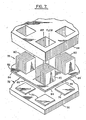
- FIG. 2 is an enlarged fragmentary view of a portion of the heat exchanger of the invention;
- FIG. 3 is a side view, partially schematic, of the heat exchanger of the invention, the view showing corrugations in a sheet of the heat exchanger for improved flexibility;
- FIG. 4 is a diagrammatic view of a staggered arrangement of fins in an alternative embodiment of the heat exchanger of FIGS. 1-3;
- FIG. 5 shows one method of manufacture involving the casting of the metal heat exchanger in a mold;
- FIG. 6 is an alternative method of manufacture involving masking and deposition of the metal material;
- FIG. 7 is an exploded view of an alternative embodiment of the invention wherein pads are placed at the base of cooling fins;
- FIG. 8 is an elevation sectional view of the embodiment of FIG. 7;
- FIG. 9 shows a further construction of the invention wherein a fin and base assembly is secured beneath a flexible sheet;
- FIG. 10 shows an alternative construction of the invention wherein a fin and base assembly is is secured on top of a flexible sheet;
- FIGS. 11-14 show steps in the construction of a further embodiment of the invention wherein a base and fin assembly make contact with a flexible sheet held by a frame above a circuit chip.
- With reference to FIGS. 1-3, an
electronic system 20 is formed as an array ofcircuit chips 22 disposed on acommon substrate 24. Electrical connections between thechips 22 are accomplished by well-known conductors (not shown) within thesubstrate 24 and a set of soft metal solder ball connections 26 (known as C4's) located between terminals of thechips 22 and the conductors of thesubstrate 24. Heat generated within thechips 22 by electric currents flowing within the circuits of thechips 22 is removed by means of a fluid coolant provided by achiller 28 and conveyed therefrom to thechips 22 by asupply conduit 30 and areturn conduit 32. Aduct 34, partially shown in FIGS. 1 and 3, guides the coolant past thechips 22 between theconduits chips 22 of FIG. 1 may represent only a portion of thesystem 20, additional chips (not shown on the FIG.) also being provided with supply and return conduits (not shown) which conduits in combination with theconduits chiller 28 and theelectronic system 20. - In accordance with the invention, the cooling of the
chips 22 is accomplished more efficiently by the use of aheat exchanger 36 comprising aflexible sheet 38 of thermally conductive material withfins 40 of thermally conductive material extending away from thesheet 38. In FIG. 1, thesheet 38 is shown covering thechips 22, with a part of thesheet 38 being cut away to show partially two of thechips 22. Due to the flexibility of thesheet 38, theheat exchanger 36 covers thechips 22 and thesubstrate 24 in the manner of a blanket. The flexibility of thesheet 38 provides for the relief of stress exerted on thechips 22, otherwise due to the cooling system. It is noted that the foregoingsolder ball connections 26 have a diameter of only 0.125 mm, and are susceptible to fracture. The foregoing stresses cannot be transmitted via thesheet 38 to another chip because of the flexing action of thesheet 38. This protects theconnections 26. - A suitable thermally conductive material for construction of the
heat exchanger 36 is a flexible metal, such as copper. The configuration of thefins 40 upstanding from the metal sheet may by referred to as a "metal velvet" because one side of the sheet has a fine fin structure while the opposite side of the sheet is smooth. Wile theheat exchanger 36 may have relatively large fins for air cooling, the "velvet" effect of the smaller fins for water cooling is advantageous because the smaller fin size, fin thickness and groove width of 0.05 mm, enhances the transfer of heat from the fins to water. - As shown in FIG. 2, the
fins 40 are oriented in a regular array to formgrooves 42 between thefins 40 which are aligned along the direction of coolant flow so as to guide the coolant among thefins 40. Thefins 40 are located on thesheet 38 only at those locations corresponding to sites of thechips 22. At the locations on thesheet 38 corresponding to spaces between thechips 22, as shown in FIG. 3, it is advantageous to construct acorrugation 44 within thesheet 38 to increase the flexibility thereof to insure a better conformal fit of the underside of thesheet 38 to the top surfaces of thechips 22. In particular, is is noted that the flexibility of thesheet 38 permits theheat exchanger 36 to conform to the individual orientations of the surfaces of thechips 22 for enhanced conduction of heat from eachchip 22 to the coolant. - If desired, as shown in FIG. 3, a
pressure plate 46 may be applied to the top ends of thefins 40 and pressed against theheat exchanger 36 by aspring 48 secured to theducts 34 of the cooling manifold. The pressure exerted by thespring 48 is sufficiently small so as to preclude any bending of thefins 40, but is sufficiently large to promote thermal contact between thesheet 38 and the top surface of achip 22, such as the middle chip depicted in FIG. 3 with thepressure plate 46. - With respect to the arrangement of the
fins 40, thefins 40 may be arranged in rows and columns, as shown in FIG. 2, or alternatively, may be located in a staggered array as shown diagrammatically in FIG. 4. In both cases, the orientation of thefins 40 follows the lines of coolant flow so as to provide for good conduction of heat from thefins 40 into the coolant. - In the embodiment of FIG. 2, the spacing between the
fins 40 is approximately equal to the thickness of an individual fin, thereby to minimize the build up of any thermal boundary layer within the coolant, as the coolant flows past thefins 40. - As shown in FIG. 2, the material of the heat exchanger may be coated with a
coating 50 to protect the material 52 from any corrosive effects of the coolant. Thecoating 50 is not required with non-corrosive coolants. For example, in the case where the coolant is air, a suitable material for theheat exchanger 36 is copper. Because air is not corrosive, an anodized coating or even no coating may be sufficient. However, in the case where the coolant is water, the copper should be coated with acoating 50 of nickel to prevent corrosion of the copper by the water. In FIG. 2, a portion of one of thefins 40 is partially cut away to show thecoating 50 upon abase material 52 of copper. Also, thebase material 52 and thenickel coating 50 may be seen in the sectioned portion of thesheet 28. Another suitable material for construction of theheat exchanger 36 is stainless steel. While the stainless steel is not as good a thermal conductor as copper, it is resistant to corrosive coolants, and may be used without a coating. - During the emplacement of the
sheet 38 upon the top surface of thechips 22, it is preferable to employ a low-temperature soft metal alloy solder between thechip 22 and thesheet 38 for best heat conductivity. In the event that a lesser thermal conductivity is adequate, then a thin layer of other thermally conductive material may be placed between thechip 22 and thesheet 38, suitable material being a well-known grease or oil with zinc oxide. Other suitable materials include a soft silicone elastomer which may include thermally conductive particles such as silicon carbide. - The spacing and sizes of the
fins 40 are selected in accordance with the particular coolant to be employed. For example, in the case of a fluorocarbon coolant, thefins 40 can extend away from the sheet 38 a distance of almost 25 mm, and may be spaced apart with a spacing of 3 mm. On the other hand, in the case of a water coolant, the fins may be spaced apart by 0.05 mm, and may have a thickness of 0.05 mm, the individual fin extending along the direction of coolant flow for a distance of 0.3 mm. - A particular advantage in the use of the
heat exchanger 36 of the invention is the fact that it can be placed on a relatively large array ofchips 22, for example an array of 100 chips, without the requirement for any precise dimensional alignment, due to the flexibility of theheat exchanger 36. An additional feature is attained by adhesively securing the perimeter of thesheet 38 to thesubstrate 24, thereby to hermetically seal all of thechips 22 from the coolant. The thickness of themetal sheet 38 is selected in accordance with the specific material employed in the construction of theheat exchanger 36, a thickness in the range of 0.02 - 0.25 mm being suitable for copper. In the case of square ships measuring 4.5 millimeters on a side, and being arranged with a pitch of eight millimeters, a thickness on the order of 0.05 - 0.08 mm of copper provides good thermal conduction in thefins 40. Between the fin arrays, the Cu base preferably should be absent, and then the nickel overcoat alone should form a flexible sheet. In the positioning of thefins 40 at the site of achip 22, typically fifty of the fins are located at the site of onechip 22. - It is noted that, in the construction of the
electronic system 20, thechips 22 may be placed on a substrate in the form of a ceramic tile having a size of typically 10 cm by 10 cm. For such application, thesheet 38 is made sufficiently large to cover the entire tile, thus greatly facilitating the manufacturing process for construction of thesystem 20. It is further noted that since both thesubstrate 24 and the chips 22 (typically fabricated of silicon) are rigid, it is advantageous to employ a heat exchanger which is so constructed as to avoid introduction of stresses and strains between the chips and the substrate so as to avoid cracking thesolder ball connections 26. Theheat exchanger 36 of the invention does not apply stresses by virtue of its flexible construction. - The heat exchanger is most readily fabricated in a manner analogous to the processes used to fabricate printed circuits. Start with a smooth aluminum mandrel, shaped for the corrugations. Apply a mask, and selectively plate copper fins at each chip location. Overcoat these fins and mandrel by electroless deposition of a thin layer of amorphous nickel. Etch away the mandrel with an alkali solution. Thus over each chip are Cu fins covered with a layer of nickel. Between the chips is a thin layer of nickel, shaped with corrugations.
- In an alternative process, the
heat exchanger 36 is readily manufactured by the processes portrayed in FIGS. 5 and 6. In FIG. 5, amold 54 is provided withvoids 56 having the shape of afin 40. Theheat exchanger 36 is cast by pouringmolten metal 58 from aladle 60 into themold 54. Thereafter, the mold is cooled to solidify the metal. Upon removal of the mold from the metal, there is attained theheat exchanger 36 with integrally formedfins 40 upon thesheet 38. Only a portion of themold 54 is shown to facilitate the description. However, it is to be understood that a larger mold would include voids for forming thecorrugations 44 in a large sheet of the heat exchanger. Thereby, theentire heat exchanger 36 can be formed in a single manufacturing process. - In another alternative process, in FIG. 6, the manufacturing process begins with the preparation of a
sheet 62 of thermally conducting material such as copper. Amask 64 is developed upon the upper surface of thesheet 62, themask 64 being provided withvoids 66 having the shape of afin 40. Thereupon, metal, such as copper, is provided by asource 68 and deposited by chemical vapor deposition to build upfins 40 within thevoids 66 of themask 64. Thereupon, themask 64 is removed, by conventional means, and afurther source 70 is employed for depositing a coating, such as a nickel coating upon the completed assembly to provide thecoated sheet 38 andfins 40 of theheat exchanger 36. Corrugations may be placed within thesheet 38 by a mechanical process such as swagging employing a preformed anvil, or similar mechanical form (not shown) to form the corrugations. Here too, aheat exchanger 36 can be fabricated in a sufficiently large size to cover a relatively large array of thechips 22. - FIGS. 7 - 8 show an
electronic system 72, similar to the system 20 (FIG. 1) formed as an array ofcircuit chips 74 disposed on acommon substrate 76. Cooling of thechips 74 is accomplished by aheat exchanger 78 constructed in accordance with a further embodiment of the invention wherein separate sets of coolingfins 80 are connected to aflexible sheet 82 with the aid ofsemi-rigid pads 84 formed of a thermally conductive material such as copper. Thefins 80 are formed of copper to provide good conduction of heat from thechips 74 to streams of cooling air, indicated by arrows. Thesheet 82 is formed of an electrically insulating plastic material such as a polycarbonate marketed under the trademark name of "Kapton". The cooling air is conducted via a conduit 86 (FIG. 8) and guided via aplenum 88 to individual sets of thefins 80. Springs 90 (only one of which is shown in FIG. 8) are located between the respective sets offins 80 and awall 92 of theconduit 86 for pressing thepads 84 against the correspondingchips 74 to secure good thermal contact between thepads 84 and thechips 74. Alayer 94 of a thermally conductive grease is disposed between eachpad 84 and itscorresponding chip 74 to attain still further thermal conductivity between thechips 74 and thepads 84. - This embodiment of the invention provides for a rigid connection between the
fins 80 and thepads 84, the rigid connection allowing for a much greater height to thefins 80 than is practicable for thefins 40 of FIG. 3. The extra height is particularly advantageous for the case of air cooling wherein a larger contact region, between fin and coolant, should be employed than in the case of liquid coolant. Theheat exchanger 78 may be constructed, by way of example, by forming a laminate of copper sheet and theplastic sheet 82, positioning thefins 80 in contact with the copper sheet via apertures 96 (FIG. 8) in thesheet 82, and securing thefins 80 to the copper sheet as by low temperature soldering, 150 degrees Celsius. The soldering is done at a temperature which is sufficiently low so as not to damage the plastic material of thesheet 82. Thereafter, the copper sheet is etched to formtroughs 98 which define theindividual pads 84 and electrically insulate thepads 84 from each other. - By way of alternative mode of construction, an array of assemblies of
pads 84 with their respective set offins 80 may be formed by conventional means, and then the set offins 80 are passed through theapertures 96 in theplastic sheet 82. Thereafter, thepads 84 are bonded to thesheet 82 to form theheat exchanger 78. The flexibility of thesheet 82 allows each of thepads 84 to lie upon the surface of thecorresponding chip 74 independently of chip height and orientation relative to thesubstrate 76. Also, thesheet 82 pneumatically seals thechips 74 in the same fashion as has been described above with respect to the embodiment of FIG. 1. - FIG. 9 shows a simplified view of an
electronic system 100 comprising a set ofelectronic circuit chips 102 disposed on acommon substrate 104 containing electrical conductors (not shown) for making electrical connections among the circuits of thechips 102. A set of C4 solder balls serve asconnections 106 between terminals of the chip circuits and the conductors of thesubstrate 104. Thesystem 100 includes aheat exchanger 108 constructed in accordance with a further embodiment of the invention and comprising a set offin assemblies 110 each of which is formed of a set offins 112 and a base 114 which supports thefins 112. Each of thefin assemblied 110 rests upon a corresponding one of thechips 102, and is thermally coupled thereto by means of alayer 116 of thermally conductive grease or soft solder or other highly thermally conducting interfaces. Aflexible sheet 118 of thermally conductive material, such as amorphous nickel, is deposited upon thefin array assemblies 100 so as to form intimate contact therewith. Eachfin assembly 110 is formed of a thermally conductive material such as copper or silicon. - In FIG. 10, there is shown an
electronic system 120 which, like thesystem 100 of FIG. 9, also comprises asubstrate 104 with a set ofcircuit chips 102 connected thereto byconnections 106. Thesystem 120 includes aheat exchanger 122 which is an alternative embodiment of theheat exchanger 108 of FIG. 9. Theheat exchanger 122 comprises a set offin assemblies 124 each of which is formed of a set offins 126 and a base 128 which supports thefins 126. Each of thefin assemblies 124 is positioned above a corresponding one of thechips 102, and rests upon aflexible sheet 130 disposed between thefin assemblies 124 and thechips 102. Thebase 128 of eachfin assembly 124 is thermally coupled through thesheet 130 to thecorresponding chip 102 by means of alayer 116 of thermally conductive grease. Thesheet 130 is formed of thermally conductive material, such as amorphous nickel. Eachfin assembly 124 is formed of a thermally conductive material such as copper or silicon. - In the construction of the
heat exchangers fins exchanger 108, or upon an array of theassemblies 124 to form theexchanger 122. The deposition of the amorphous nickel is accomplished with the aid of a mandrel which holds thefins heat exchanger chips 102. In both embodiments, thebases respective fins respective sheets fin assemblies respective chips 102 relative to thesubstrate 104. With both embodiments, a coolant is to be delivered by a conduit (not shown) such as that disclosed previously in FIGS. 1 or 8. - The foregoing embodiments of the invention employ the inventive concept of providing a flexible mechanical connection between a heat exchanger and circuit chips so as to enable the supporting structure of a set of cooling fins to make intimate thermal contact with a surface of a chip independently of the orientation and height of the chip relative to both a substrate and the other chips. This concept will be further demonstrated with respect to an additional embodiment of the invention to be disclosed in FIGS. 11 - 14.
- With reference to FIGS. 11 - 14, there is presented a set of steps in the construction of a
circuit module 132. Theassembly 132 comprises acircuit chip 134 supported by asubstrate 136, and cooled by aheat exchanger 138 having a set offins 140 supported on abase 142. Aframe 144 comprisescircumferential sidewalls 146 positioned for encircling thesubstrate 136, and further comprises aflexible sheet 148 supported by thesidewalls 146 and bonded toflanges 150 which are directed inwardly from the tops of thesidewalls 146. Thebase 142 is bonded to thesheet 148 and, upon a joining of theframe 144 to thesubstrate 136, is sufficiently flexible to extend downward to the top surface of thechip 134 for alignment of the base 142 with thechip 134. - The
sheet 148 is fabricated of a thermally conductive material such as copper, and contacts both thechip 134 and the base 142 to provide for the conduction of heat from thechip 134 to theheat exchanger 138. By way of example in the construction of theheat exchanger 138, thefins 140 may be formed as a square array of pins wherein each pin has a diameter of 2.4 mm and a height of 3 cm. Thebase 142 is approximately 2.3 mm thick and has acentral stud portion 164 which extends downward an additional 2.3 mm. Thebase 142 and thefins 140 upstanding therefrom are formed as an integral assembly of a thermally conductive material such as copper. - The construction begins, as shown in FIG. 11, by positioning the
heat exchanger 138 with theframe 144 and thesheet 148 attached thereto above thesubstrate 136 and thechip 134 thereon. Alayer 152 of thermally enhanced grease is applied to the top surface of thechip 134, and then theframe 144 is lowered to loosely contact the peripheral portions of thesubstrate 136, as shown in FIG. 12. Thesubstrate 136 sets withinshoulders 154 formed within thesidewalls 146. In FIG. 13, theheat exchanger 138 is lowered still further, by flexing of thesheet 148, and squeezing the grease to contact thechip 134. Thelayer 152 of grease between thesheet 148 and thechip 134 provides for thermal conduction therebetween upon a pressing of the base 142 against thesheet 148 and thechip 134. Finally, as shown in FIG. 14, thebase 142 is bonded at 156 to the tops of thesidewalls 146 to rigidly secure theheat exchanger 138 in position relative to thechip 134. Bottom skirt portions of thesidewalls 146 may also be bonded at 158 to thesubstrate 136 to hermetically seal thechip 134. - While only one
chip 134 is shown in thecircuit module assembly 132, it is understood that thecircuit module 132 may include plural chips, each of which is connected by C4 solder-ball connections 160 to conductors (not shown) within thesubstrate 136, thereby to function in the manner of thesystem 20 of FIG. 1.Pins 162 extending downward from thesubstrate 136 permit connection with other modules (not shown) of the circuit assembly. The heat exchanger should be divided into plural segments to closely contact each of a plurality of chips. Separate heat exchangers (not shown) would then be mounted on thesheet 148 with therespective stud portions 164 of thebases 142 being positioned in registration with the corresponding chips, and bonded to thesheet 148 with thermal solder bonds such as a thermal solder bond at 164 shown for theassembly 132 in FIG. 11. - It is to be understood that the above described embodiments of the invention are illustrative only, and that modifications therof may occur to those skilled in the art. Accordingly, this invention is not to be regarded as limited to the embodiments disclosed herein, but is to be limited only as defined by the appended claims.
Claims (12)
a flexible sheet (38, 82 + 84, 118, 130, 148) of thermally conductive material sufficiently large to cover the array of chips and sufficiently flexible to conform to individual orientations of the chips to make thermal contact therewith; and
a set of thermally conductive fins (40, 80, 112, 126, 140) upstanding from said sheet, said fins being oriented in the direction of a desired flow of coolant for guiding the coolant among the fins for extraction of heat therefrom.
metallic structure means (28, 30, 32, 34, 86, 88) are provided to channel coolant fluid and to conduct heat.
depositing a layer (62) of metal;
masking said metal layer with a mask (64) defining the shapes (66) of fins;
depositing additional metal on said masked metal layer to form fins (40) upon the metal layer; and
removing said mask leaving the heat exchanger (36).
a flexible sheet (148) of thermally conductive material sufficiently large to cover the chip and sufficiently flexible to conform to orientations of the chip to make thermal contact therewith;
a fin assembly (140, 142) extending normally from said sheet, said fin assembly having fins directed for contacting a coolant for extraction of heat therefrom; and
a frame (144) for supporting said sheet, said frame being configured for mating with a peripheral region of said substrate (136); and wherein
said sheet (148) is sufficiently compliant to distend from a position spaced apart from said chip to contact said chip upon a contacting of said fin assembly (142) with said frame (144).
Applications Claiming Priority (2)
| Application Number | Priority Date | Filing Date | Title |
|---|---|---|---|
| US06/858,318 US4730666A (en) | 1986-04-30 | 1986-04-30 | Flexible finned heat exchanger |
| US858318 | 1986-04-30 |
Publications (2)
| Publication Number | Publication Date |
|---|---|
| EP0243710A2 true EP0243710A2 (en) | 1987-11-04 |
| EP0243710A3 EP0243710A3 (en) | 1989-11-29 |
Family
ID=25328017
Family Applications (1)
| Application Number | Title | Priority Date | Filing Date |
|---|---|---|---|
| EP87104809A Withdrawn EP0243710A3 (en) | 1986-04-30 | 1987-04-01 | Flexible finned heat exchanger |
Country Status (3)
| Country | Link |
|---|---|
| US (1) | US4730666A (en) |
| EP (1) | EP0243710A3 (en) |
| JP (1) | JPH0779142B2 (en) |
Cited By (10)
| Publication number | Priority date | Publication date | Assignee | Title |
|---|---|---|---|---|
| WO1990005381A1 (en) * | 1988-10-31 | 1990-05-17 | Unisys Corporation | Liquid cooled multi-chip integrated circuit module |
| DE4312057A1 (en) * | 1993-04-13 | 1993-10-14 | Siegmund Maettig | Device for cooling highly integrated multi-chip modules for data processing systems with high computing power |
| DE4210834A1 (en) * | 1992-04-01 | 1993-10-14 | Siemens Nixdorf Inf Syst | Heat sink for integrated circuit micro-chip thin film package - uses cooling plate with cooling channels open to membrane sealed to underside of plate inside facing IC micro-package |
| GB2271468A (en) * | 1992-10-06 | 1994-04-13 | Hewlett Packard Co | Mechanically floating multi-chip substrate |
| US5323292A (en) * | 1992-10-06 | 1994-06-21 | Hewlett-Packard Company | Integrated multi-chip module having a conformal chip/heat exchanger interface |
| US5353867A (en) * | 1992-03-31 | 1994-10-11 | Akzo Nobel Nv | Heat exchanger, a method of manufacturing same, and applications |
| US5396403A (en) * | 1993-07-06 | 1995-03-07 | Hewlett-Packard Company | Heat sink assembly with thermally-conductive plate for a plurality of integrated circuits on a substrate |
| US5430611A (en) * | 1993-07-06 | 1995-07-04 | Hewlett-Packard Company | Spring-biased heat sink assembly for a plurality of integrated circuits on a substrate |
| WO2005096377A1 (en) * | 2004-03-31 | 2005-10-13 | Hydrocool Pty Limited | A heat exchanger |
| AU2005228057B2 (en) * | 2004-03-31 | 2010-02-18 | Hydrocool Pty Limited | A heat exchanger |
Families Citing this family (29)
| Publication number | Priority date | Publication date | Assignee | Title |
|---|---|---|---|---|
| US4964458A (en) * | 1986-04-30 | 1990-10-23 | International Business Machines Corporation | Flexible finned heat exchanger |
| JPS63134268U (en) * | 1987-02-13 | 1988-09-02 | ||
| US4960634A (en) * | 1990-03-14 | 1990-10-02 | International Business Machines Corporation | Epoxy composition of increased thermal conductivity and use thereof |
| US5014117A (en) * | 1990-03-30 | 1991-05-07 | International Business Machines Corporation | High conduction flexible fin cooling module |
| US5265670A (en) * | 1990-04-27 | 1993-11-30 | International Business Machines Corporation | Convection transfer system |
| JPH07114250B2 (en) * | 1990-04-27 | 1995-12-06 | インターナショナル・ビジネス・マシーンズ・コーポレイション | Heat transfer system |
| US5291371A (en) * | 1990-04-27 | 1994-03-01 | International Business Machines Corporation | Thermal joint |
| US5201866A (en) * | 1992-02-03 | 1993-04-13 | International Business Machines Corporation | Structure for dissipation of heat having slidably engaged fins for conformal disposition against a heat generating surface |
| US5265321A (en) * | 1992-09-22 | 1993-11-30 | Microelectronics And Computer Technology Corporation | Integrated circuit structure with heat exchanger elements secured thereto and method of making |
| US5309321A (en) * | 1992-09-22 | 1994-05-03 | Microelectronics And Computer Technology Corporation | Thermally conductive screen mesh for encapsulated integrated circuit packages |
| US5344795A (en) * | 1992-09-22 | 1994-09-06 | Microelectronics And Computer Technology Corporation | Method for encapsulating an integrated circuit using a removable heatsink support block |
| JP3007497B2 (en) * | 1992-11-11 | 2000-02-07 | 三菱電機株式会社 | Semiconductor integrated circuit device, its manufacturing method, and its mounting method |
| JPH06213588A (en) * | 1992-12-04 | 1994-08-02 | American Teleph & Telegr Co <Att> | Optimization of constitution of circuit pack and its heat sink |
| US5653280A (en) * | 1995-11-06 | 1997-08-05 | Ncr Corporation | Heat sink assembly and method of affixing the same to electronic devices |
| US20030066632A1 (en) * | 2001-10-09 | 2003-04-10 | Charles J. Bishop | Corrosion-resistant heat exchanger |
| WO2006112027A1 (en) | 2005-04-15 | 2006-10-26 | Fujitsu Limited | Heat sink, circuit board and electronic device |
| JP4928749B2 (en) * | 2005-06-30 | 2012-05-09 | 株式会社東芝 | Cooling system |
| US7673389B2 (en) * | 2005-07-19 | 2010-03-09 | International Business Machines Corporation | Cold plate apparatus and method of fabrication thereof with a controlled heat transfer characteristic between a metallurgically bonded tube and heat sink for facilitating cooling of an electronics component |
| US8289710B2 (en) | 2006-02-16 | 2012-10-16 | Liebert Corporation | Liquid cooling systems for server applications |
| US7849914B2 (en) * | 2006-05-02 | 2010-12-14 | Clockspeed, Inc. | Cooling apparatus for microelectronic devices |
| JP4675283B2 (en) * | 2006-06-14 | 2011-04-20 | トヨタ自動車株式会社 | Heat sink and cooler |
| US8176972B2 (en) * | 2006-08-31 | 2012-05-15 | International Business Machines Corporation | Compliant vapor chamber chip packaging |
| US8120169B2 (en) * | 2008-02-26 | 2012-02-21 | Fairchild Semiconductor Corporation | Thermally enhanced molded leadless package |
| TW201028639A (en) * | 2009-01-20 | 2010-08-01 | Wistron Corp | Heat fin, heat sink and the method for increasing heat dissipation of the heat fin |
| US20110253347A1 (en) * | 2010-04-19 | 2011-10-20 | Steve Harrington | Vacuum Pumped Liquid Cooling System for Computers |
| US8820351B1 (en) * | 2013-06-25 | 2014-09-02 | Chilldyne, Inc. | No drip hot swap connector and method of use |
| US20160025426A1 (en) * | 2014-07-22 | 2016-01-28 | Hamilton Sundstrand Space Systems International, Inc. | Heat transfer plate |
| US10175005B2 (en) * | 2015-03-30 | 2019-01-08 | Infinera Corporation | Low-cost nano-heat pipe |
| US11348856B2 (en) * | 2019-12-20 | 2022-05-31 | Micron Technology, Inc. | Thermal cooling element for memory devices of a memory sub-system |
Family Cites Families (18)
| Publication number | Priority date | Publication date | Assignee | Title |
|---|---|---|---|---|
| CH342661A (en) * | 1956-08-11 | 1959-11-30 | Bbc Brown Boveri & Cie | Cooler for cooling a semiconductor element |
| US3877062A (en) * | 1966-09-14 | 1975-04-08 | Siemens Ag | Method for producing metal structures upon semiconductor surfaces |
| US3864728A (en) * | 1970-11-20 | 1975-02-04 | Siemens Ag | Semiconductor components having bimetallic lead connected thereto |
| US3860949A (en) * | 1973-09-12 | 1975-01-14 | Rca Corp | Semiconductor mounting devices made by soldering flat surfaces to each other |
| US4072188A (en) * | 1975-07-02 | 1978-02-07 | Honeywell Information Systems Inc. | Fluid cooling systems for electronic systems |
| JPS5266376A (en) * | 1975-11-29 | 1977-06-01 | Hitachi Ltd | Device and manufacture of resin body type semiconductor |
| US4069498A (en) * | 1976-11-03 | 1978-01-17 | International Business Machines Corporation | Studded heat exchanger for integrated circuit package |
| US4092697A (en) * | 1976-12-06 | 1978-05-30 | International Business Machines Corporation | Heat transfer mechanism for integrated circuit package |
| GB1598174A (en) * | 1977-05-31 | 1981-09-16 | Ibm | Cooling electrical apparatus |
| US4151547A (en) * | 1977-09-07 | 1979-04-24 | General Electric Company | Arrangement for heat transfer between a heat source and a heat sink |
| US4222090A (en) * | 1977-11-25 | 1980-09-09 | Jaffe Richard A | Micromodular electronic package |
| US4132856A (en) * | 1977-11-28 | 1979-01-02 | Burroughs Corporation | Process of forming a plastic encapsulated molded film carrier CML package and the package formed thereby |
| US4254431A (en) * | 1979-06-20 | 1981-03-03 | International Business Machines Corporation | Restorable backbond for LSI chips using liquid metal coated dendrites |
| US4341432A (en) * | 1979-08-06 | 1982-07-27 | Cutchaw John M | Liquid cooled connector for integrated circuit packages |
| US4263965A (en) * | 1980-01-21 | 1981-04-28 | International Business Machines Corporation | Leaved thermal cooling module |
| US4381032A (en) * | 1981-04-23 | 1983-04-26 | Cutchaw John M | Apparatus for cooling high-density integrated circuit packages |
| US4574876A (en) * | 1981-05-11 | 1986-03-11 | Extracorporeal Medical Specialties, Inc. | Container with tapered walls for heating or cooling fluids |
| US4451540A (en) * | 1982-08-30 | 1984-05-29 | Isotronics, Inc. | System for packaging of electronic circuits |
-
1986
- 1986-04-30 US US06/858,318 patent/US4730666A/en not_active Expired - Fee Related
-
1987
- 1987-01-20 JP JP62009218A patent/JPH0779142B2/en not_active Expired - Lifetime
- 1987-04-01 EP EP87104809A patent/EP0243710A3/en not_active Withdrawn
Cited By (12)
| Publication number | Priority date | Publication date | Assignee | Title |
|---|---|---|---|---|
| WO1990005381A1 (en) * | 1988-10-31 | 1990-05-17 | Unisys Corporation | Liquid cooled multi-chip integrated circuit module |
| US5353867A (en) * | 1992-03-31 | 1994-10-11 | Akzo Nobel Nv | Heat exchanger, a method of manufacturing same, and applications |
| DE4210834A1 (en) * | 1992-04-01 | 1993-10-14 | Siemens Nixdorf Inf Syst | Heat sink for integrated circuit micro-chip thin film package - uses cooling plate with cooling channels open to membrane sealed to underside of plate inside facing IC micro-package |
| GB2271468A (en) * | 1992-10-06 | 1994-04-13 | Hewlett Packard Co | Mechanically floating multi-chip substrate |
| US5323292A (en) * | 1992-10-06 | 1994-06-21 | Hewlett-Packard Company | Integrated multi-chip module having a conformal chip/heat exchanger interface |
| GB2271468B (en) * | 1992-10-06 | 1996-12-11 | Hewlett Packard Co | Mechanically floating multi-chip substrate |
| US5608610A (en) * | 1992-10-06 | 1997-03-04 | Hewlett-Packard Company | Mechanically floating multi-chip substrate |
| DE4312057A1 (en) * | 1993-04-13 | 1993-10-14 | Siegmund Maettig | Device for cooling highly integrated multi-chip modules for data processing systems with high computing power |
| US5396403A (en) * | 1993-07-06 | 1995-03-07 | Hewlett-Packard Company | Heat sink assembly with thermally-conductive plate for a plurality of integrated circuits on a substrate |
| US5430611A (en) * | 1993-07-06 | 1995-07-04 | Hewlett-Packard Company | Spring-biased heat sink assembly for a plurality of integrated circuits on a substrate |
| WO2005096377A1 (en) * | 2004-03-31 | 2005-10-13 | Hydrocool Pty Limited | A heat exchanger |
| AU2005228057B2 (en) * | 2004-03-31 | 2010-02-18 | Hydrocool Pty Limited | A heat exchanger |
Also Published As
| Publication number | Publication date |
|---|---|
| US4730666A (en) | 1988-03-15 |
| JPH0779142B2 (en) | 1995-08-23 |
| JPS62260346A (en) | 1987-11-12 |
| EP0243710A3 (en) | 1989-11-29 |
Similar Documents
| Publication | Publication Date | Title |
|---|---|---|
| US4730666A (en) | Flexible finned heat exchanger | |
| US4964458A (en) | Flexible finned heat exchanger | |
| US5022462A (en) | Flexible finned heat exchanger | |
| US4758926A (en) | Fluid-cooled integrated circuit package | |
| US4860444A (en) | Method of assembling a fluid-cooled integrated circuit package | |
| EP0196054B1 (en) | Semiconductor module cooling structure | |
| KR930005491B1 (en) | Device for cooling integrated circuit chip | |
| US7538425B2 (en) | Power semiconductor package having integral fluid cooling | |
| EP0409918B1 (en) | Liquid cooled multi-chip integrated circuit module | |
| US6014313A (en) | Packaging structure for integrated circuits | |
| US4631636A (en) | High density packaging technique for electronic systems | |
| US5751062A (en) | Cooling device of multi-chip module | |
| CA1228173A (en) | Cooling system for electronic circuit device | |
| US5177667A (en) | Thermal conduction module with integral impingement cooling | |
| JPS596565A (en) | Heat conductive structure | |
| KR920008251B1 (en) | Apparatus which cools an electro-device | |
| JPS59217345A (en) | Heat sink assembly | |
| WO1996016532A1 (en) | Compliant thermal connectors, methods and assemblies | |
| JPH05109955A (en) | Integrated circuit chip cooling device | |
| US20100302734A1 (en) | Heatsink and method of fabricating same | |
| US7645641B2 (en) | Cooling device with a preformed compliant interface | |
| US6111315A (en) | Semiconductor package with offset die pad | |
| CN222051743U (en) | A multi-chip packaging structure | |
| US20250329602A1 (en) | Semiconductor device and lattice-shaped fin | |
| CN121368387A (en) | Direct liquid cooling power chip structure and manufacturing method thereof |
Legal Events
| Date | Code | Title | Description |
|---|---|---|---|
| PUAI | Public reference made under article 153(3) epc to a published international application that has entered the european phase |
Free format text: ORIGINAL CODE: 0009012 |
|
| AK | Designated contracting states |
Kind code of ref document: A2 Designated state(s): DE FR GB |
|
| 17P | Request for examination filed |
Effective date: 19880224 |
|
| PUAL | Search report despatched |
Free format text: ORIGINAL CODE: 0009013 |
|
| AK | Designated contracting states |
Kind code of ref document: A3 Designated state(s): DE FR GB |
|
| 17Q | First examination report despatched |
Effective date: 19920203 |
|
| STAA | Information on the status of an ep patent application or granted ep patent |
Free format text: STATUS: THE APPLICATION IS DEEMED TO BE WITHDRAWN |
|
| 18D | Application deemed to be withdrawn |
Effective date: 19921223 |
|
| RIN1 | Information on inventor provided before grant (corrected) |
Inventor name: ZINGHER,ARTHER R. Inventor name: FLINT, EPHRAIM B. Inventor name: GREBE, KURT R. Inventor name: GRUBER, PETER A. |