EP0243319A2 - Gegen Lichteinwirkung stabilisierte Thermoplasten - Google Patents
Gegen Lichteinwirkung stabilisierte Thermoplasten Download PDFInfo
- Publication number
- EP0243319A2 EP0243319A2 EP87810249A EP87810249A EP0243319A2 EP 0243319 A2 EP0243319 A2 EP 0243319A2 EP 87810249 A EP87810249 A EP 87810249A EP 87810249 A EP87810249 A EP 87810249A EP 0243319 A2 EP0243319 A2 EP 0243319A2
- Authority
- EP
- European Patent Office
- Prior art keywords
- tert
- butyl
- stabilized
- bis
- light
- Prior art date
- Legal status (The legal status is an assumption and is not a legal conclusion. Google has not performed a legal analysis and makes no representation as to the accuracy of the status listed.)
- Withdrawn
Links
Classifications
-
- C—CHEMISTRY; METALLURGY
- C08—ORGANIC MACROMOLECULAR COMPOUNDS; THEIR PREPARATION OR CHEMICAL WORKING-UP; COMPOSITIONS BASED THEREON
- C08F—MACROMOLECULAR COMPOUNDS OBTAINED BY REACTIONS ONLY INVOLVING CARBON-TO-CARBON UNSATURATED BONDS
- C08F10/00—Homopolymers and copolymers of unsaturated aliphatic hydrocarbons having only one carbon-to-carbon double bond
-
- C—CHEMISTRY; METALLURGY
- C08—ORGANIC MACROMOLECULAR COMPOUNDS; THEIR PREPARATION OR CHEMICAL WORKING-UP; COMPOSITIONS BASED THEREON
- C08K—Use of inorganic or non-macromolecular organic substances as compounding ingredients
- C08K5/00—Use of organic ingredients
- C08K5/16—Nitrogen-containing compounds
- C08K5/34—Heterocyclic compounds having nitrogen in the ring
- C08K5/3412—Heterocyclic compounds having nitrogen in the ring having one nitrogen atom in the ring
- C08K5/3432—Six-membered rings
- C08K5/3435—Piperidines
-
- C—CHEMISTRY; METALLURGY
- C08—ORGANIC MACROMOLECULAR COMPOUNDS; THEIR PREPARATION OR CHEMICAL WORKING-UP; COMPOSITIONS BASED THEREON
- C08K—Use of inorganic or non-macromolecular organic substances as compounding ingredients
- C08K5/00—Use of organic ingredients
- C08K5/16—Nitrogen-containing compounds
- C08K5/34—Heterocyclic compounds having nitrogen in the ring
Definitions
- the invention relates to thermoplastics stabilized against the action of light, in particular polyolefins.
- the stabilization is carried out by adding the succinic acid ester or glutaric acid ester of 2,2,6,6-tetramethylpiperidinol-4.
- thermoplastics are damaged by exposure to light, the short-wave component (UV) of the light being the most important factor.
- the light damage is particularly severe in the case of polyolefins, particularly in the case of polypropylene.
- Such polymers must be stabilized against the effects of light for outdoor applications.
- light stabilizers today e.g. Hydroxybenztriazoles, hydroxybenzophenones, nickel compounds, oxalanilides or arylbenzoates.
- the most effective light stabilizers known today are the sterically hindered amines, among which the 2,2,6,6-tetramethylpiperidine derivatives are the best known.
- An example of this is the di- (2,2,6,6-tetramethyl-4-piperidinyl) sebacate, which is commercially available under the name Tinuvin® 770.
- succinic acid ester and the glutaric acid ester of 2,2,6,6-tetramethylpiperidinol-4 are particularly suitable as light stabilizers for thermoplastics.
- these compounds are more effective than comparable known light stabilizers, for example than the corresponding sebacic acid ester.
- These compounds have the formula wherein is in 2 or 3.
- the invention therefore relates to light-stabilized thermoplastic polymers which, as light stabilizers, contain di- (2,2,6,6-tetramethyl-4-piperidinyl) succinate or di- (2,2,6,6-tetramethyl-4-piperidinyl) ) -glutarate included.
- JP-A-84/53545 the use of di- (2,2,6,6-tetramethyl-4-piperidinyl) succinate as light stabilizer for latices of synthetic rubbers containing TiO2 is proposed.
- the connection is mentioned there, but not described in detail.
- Both compounds can be prepared by the process of US Pat. No. 3,840,494 by transesterification of 4-hydroxy-2,2,6,6-tetramethylpiperidine with a dialkyl succinate or glutarate.
- the homologous di- (1,2,2,6,6-pentamethyl-4-piperidinyl) succinate is also mentioned in US Pat. No. 3,840,494. However, because of its low melting point, this compound is not very suitable as a stabilizer for thermoplastic polymers.
- the di- (2,2,6,6-tetramethyl-4-piperidinyl) succinate melts at 118 ° C
- the di- (2,2,6,6-tetramethyl-4-piperidinyl) glutarate melts at 83- 84 ° C, which enables dry mixing with the powdered or granulated thermoplastic polymer.
- the amount of light stabilizer added is expediently 0.01 to 5% by weight, preferably 0.025 to 2% by weight, based on the polymer to be stabilized.
- the addition can take place before, during or after the polymerization, but before or during the shaping.
- the stabilizer can e.g. are mixed with the powdered polymers or added to the melt of the polymer according to the usual methods for this.
- the stabilizer can also be in the form of a master batch, e.g. Contains 5-25% of the stabilizer.
- stabilizers In addition to the stabilizer according to the invention, other known stabilizers can also be added to the polymer. Examples of this are the following classes of stabilizers:
- Alkylated monophenols for example 2,6-di-tert-butyl-4-methylphenol, 2-tert-butyl-4,6-dimethylphenol, 2,6-di-tert-butyl-4-ethylphenol, 2,6-di- tert-butyl-4-n-butylphenol, 2,6-di-tert-butyl-4-i-butylphenol, 2,6-di-cyclopentyl-4-methylphenol, 2- ( ⁇ -methylcyclohexyl) -4,6- dimethylphenol, 2,6-di-octadecyl-4-methylphenol, 2,4,6-tricyclohexylphenol, 2,6-di-tert-butyl-4-methoxymethylphenol.
- 2,6-di-tert-butyl-4-methylphenol for example 2,6-di-tert-butyl-4-methylphenol, 2-tert-butyl-4,6-dimethylphenol, 2,6-di-ter
- Alkylated hydroquinones e.g. 2,6-di-tert-butyl-4-methoxyphenol, 2,5-di-tert-butyl-hydroquinone, 2,5-di-tert-amyl-hydroquinone, 2,6-diphenyl-4- octadecyloxyphenol.
- Hydroxylated thiodiphenyl ethers for example 2,2 ⁇ -thio-bis- (6-tert-butyl-4-methylphenol), 2,2 ⁇ -thio-bis- (4-octylphenol), 4,4 ⁇ -thio-bis- (6- tert.butyl-3-methylphenol), 4,4'-thio-bis- (6-tert.butyl-2-methylphenol).
- Alkylidene bisphenols for example 2,2 ⁇ -methylene-bis- (6-tert.butyl-4-methylphenol), 2,2 ⁇ -methylene-bis- (6-tert.butyl-4-ethylphenol), 2,2 ⁇ -methylene -bis- [4-methyl-6- ( ⁇ -methylcyclohexyl) phenol], 2,2 ⁇ -methylene-bis- (4-methyl-6-cyclohexylphenol), 2,2 ⁇ -methylene-bis- (6-nonyl- 4-methylphenol), 2,2 ⁇ -ethylidene-bis- (4,6-di-tert-butylphenol), 2,2 ⁇ -ethylidene-bis- (4,6-di-tert-butylphenol), 2,2,-ethylidene -bis- (6-tert.butyl-4-isobutylphenol), 2,2 ⁇ -methylene-bis- [6- ( ⁇ -methylbenzyl) -4-nonylphenol], 2,2 ⁇ -methylene-bis- [
- benzyl compounds for example 1,3,5-tri- (3,5-di-tert-butyl-4-hydroxybenzyl) -2,4,6-trimethylbenzene, di- (3,5-di-tert-butyl-4 -hydroxybenzyl) sulfide, 3,5-di-tret.butyl-4-hydroxybenzyl-mercaptoacetic acid isoocyte ester, bis- (4-tert.butyl-3-hydroxy-2,6-dimethylbenzyl) dithiol terephthalate, 1.3 , 5-tris (3,5-di-tert-butyl-4-hydroxybenzyl) isocyanurate, 1,3,5-tris (4-tert-butyl-3-hydroxy-2,6-dimethylbenzyl) - isocyanurate, 3,5-di-tert-butyl-4-hydroxybenzyl-phosphonic acid dioctadecyl ester, 3,5-di-tert-butyl-4
- esters of ⁇ - (3,5-di-tert-butyl-4-hydroxyphenyl) propionic acid with mono- or polyhydric alcohols such as with methanol, octadecanol, 1,6-hexanediol, neopentyl glycol, thiodiethylene glycol, diethylene glycol, triethylene glycol, pentaerythritol , Tris-hydroxyethyl isocyanurate, di-hydroxyethyl oxalic acid diamide.
- esters of ⁇ - (5-tert-butyl-4-hydroxy-3-methylphenyl) propionic acid with mono- or polyhydric alcohols for example with methanol, octadecanol, 1,6-hexanediol, neopentyl glycol, thiodiethylene glycol, diethylene glycol, Trithylenglycol, pentaerythritol , Tris-hydroxyethyl isocyanurate, di-hydroxyethyl-oxyalsiamide.
- ⁇ - (3,5-di-tert-butyl-4-hydroxyphenyl) propionic acid such as N, N ⁇ -di- (3,5-di-tert-butyl-4-hydroxyphenylpropionyl) hexamethylene diamine, N, N ⁇ -di- (3,5-di-tert-butyl-4-hydroxyphenylpropionyl) trimethylene diamine, N, N ⁇ -di- (3,5-di-tert-butyl-4-hydroxyphenylpropionyl) hydrazine.
- 2- (2 ⁇ -Hydroxyphenyl) benzotriazoles such as 5 ⁇ -methyl-, 3 ⁇ , 5 ⁇ -di-tert-butyl-, 5 ⁇ -tert-butyl-, 5 ⁇ - (1,1,3,3-tetramethyl-butyl ) -, 5-chloro-3 ⁇ , 5 ⁇ -di-tert.butyl-, 5-chloro-3 ⁇ -tert.butyl-5 ⁇ -methyl-, 3 ⁇ -sec-butyl-5 ⁇ -tert.butyl, 4 ⁇ -octoxy-, 3 ⁇ , 5 ⁇ -di-tert-amyl, 3 ⁇ , 5 ⁇ -bis ( ⁇ , ⁇ -dimethylbenzyl) derivative.
- 2-hydroxybenzophenones such as, for example, 4-hydroxy, 4-methoxy, 4-octoxy, 4-decyloxy, 4-dodecyloxy, 4-benzyloxy, 4,2 ⁇ , 4 ⁇ -trihydroxy, 2 ⁇ -hydroxy 4,4 ⁇ -dimethoxy derivative.
- Esters of optionally substituted benzoic acids such as 4-tert-butylphenyl salicylate, phenyl salicylate, octylphenyl salicylate, dibenzoylresorcinol, bis- (4-tert.butylbenzoyl) resorcinol, benzoylresorcinol, 3,5-di-tert.butyl-4-hydroxybenzoic acid 2,4-di-tert-butylphenyl ester, 3,5-di-tert-butyl-4-hydroxybenzoic acid hexadecyl ester.
- benzoic acids such as 4-tert-butylphenyl salicylate, phenyl salicylate, octylphenyl salicylate, dibenzoylresorcinol, bis- (4-tert.butylbenzoyl) resorcinol, benzoylresorcinol, 3,5-di-tert.butyl-4
- Acrylates such as, for example, ⁇ -cyano- ⁇ , ⁇ -diphenylacrylic acid ethyl or isooctyl ester, ⁇ -carbomethoxy-cinnamic acid methyl ester, ⁇ -cyano- ⁇ -methyl-p-methoxy-cinnamic acid methyl ester or -butyl ester, ⁇ -carbomethoxy-p- methoxy cinnamic acid methyl ester, N- ( ⁇ -carbomethoxy- ⁇ -cyanovinyl) -2-methyl-indoline.
- Nickel compounds such as nickel complexes of 2,2 ⁇ -thio-bis- [4- (1,1,3,3-tetramethylbutyl) phenol], such as the 1: 1 or the 1: 2 complex, optionally with additional ligands , such as n-butylamine, triethanolamine or N-cyclohexyl-diethanolamine, nickel dibutyldithiocarbamate, nickel salts of 4-hydroxy-3,5-di-tert-butylbenzylphosphonic acid monoalkyl esters, such as methyl or ethyl esters, nickel complexes of ketoximes, such as 2 -Hydroxy-4-methyl-phenyl-undecylketonoxim, nickel complexes of 1-phenyl-4-lauroyl-5-hydroxypyrazole, optionally with additional ligands.
- additional ligands such as n-butylamine, triethanolamine or N-cyclohexyl-diethanolamine, nickel dibut
- Sterically hindered amines such as, for example, bis (2,2,6,6-tetramethylpiperidyl) sebacate, bis (1,2,2,6,6-pentamethylpiperidyl) sebacate, n-butyl-3,5-di- tert-butyl-4-hydroxybenzyl-malonic acid bis (1,2,2,6,6-pentamethylpiperidyl) ester, tris (2,2,6,6-ttramethyl-4-piperidyl) nitrilotriacetate, tetrakis ( 2,2,6,6-tetramethyl-4-piperidyl) -1,2,3,4-butanetetracarboxylic acid, 1,1 ⁇ - (1,2-ethanediyl) -bis- (3,3,5,5-tetramethyl- piperazinone).
- Oxalic acid diamides such as 4,4'-di-octyloxy-oxanilide, 2,2 ⁇ -di-octyloxy-5,5 ⁇ -di-tert.butyl-oxanilide, 2,2 ⁇ -di-dodecyloxy-5,5 ⁇ -di-tert.
- butyl-oxanilide 2-ethoxy-2 ⁇ -ethyl-oxanilide, N, N ⁇ -bis- (3-dimethylaminopropyl) -oxalamide, 2-ethoxy-5-tert-butyl-2 ⁇ -ethyl-oxanilide and its mixture with 2-ethoxy -2 ⁇ -ethyl-5,4 ⁇ -di-tert.butyl-oxanilide, mixtures of o- and p-methoxy- as well as of o- and p-ethoxy-di-substituted oxanilides.
- Metal deactivators such as, for example, N, N ⁇ -diphenyloxalic acid diamide, N-salicylal-N ⁇ -salicyloylhydrazine, N, N ⁇ -bis-salicyloylhydrazine, N, N ⁇ -bis- (3,5-di-tert-butyl-4-hydroxyphenylpropionyl) - hydrazine, 3-salicyloylamino-1,2,4-triazole, bis-benzylidene-oxalic acid dihydrazide.
- N, N ⁇ -diphenyloxalic acid diamide such as, for example, N, N ⁇ -diphenyloxalic acid diamide, N-salicylal-N ⁇ -salicyloylhydrazine, N, N ⁇ -bis-salicyloylhydrazine, N, N ⁇ -bis- (3,5-di-tert-butyl-4-hydroxyphenylpropionyl)
- phosphites and phosphonites such as triphenyl phosphite, diphenylalkyl phosphites , phenyl dialkyl phosphites , tri- (nonylphenyl) phosphite, trilauryl phosphite, trioctadecyl phosphite, distearyl-pentaerythritol diphosphite, tris (2,4-di-tert.butylphenyl) -ditphitophosphite, di-phitophosphite Di- (2,4-di-tert.butylphenyl) pentaerythritol diphosphite, tristearyl sorbitol triphorphite, tetrakis (2,4-di-tert.butylphenyl) -4,4 ⁇ -biphenylene diphosphonite, 3,9-bis- (2,4-di-tert.
- Peroxide-destroying compounds such as esters of ⁇ -thio-dipropionic acid, for example the lauryl, stearyl, myristyl or tridecyl ester, mercaptobenzimidazole, the zinc salt of 2-mercaptobenzimidazole, zinc dibutyl dithiocarbamate, dioctadecyl disulfide, penta ⁇ -dodecylmercapto) propionate.
- esters of ⁇ -thio-dipropionic acid for example the lauryl, stearyl, myristyl or tridecyl ester, mercaptobenzimidazole, the zinc salt of 2-mercaptobenzimidazole, zinc dibutyl dithiocarbamate, dioctadecyl disulfide, penta ⁇ -dodecylmercapto) propionate.
- Polyamide stabilizers such as copper salts in combination with iodides and / or phosphorus compounds and salts of divalent manganese.
- Basic co-stabilizers such as melamine, polyvinylpyrrolidone, dicyandiamide, triallyl cyanurate, urea derivatives, hydrazine derivatives, amines, polyamides, polyurethanes, alkali and alkaline earth metal salts of higher fatty acids, for example Ca stearate, Zn stearate, Mg stearate , Na ricinoleate, K-palmitate, antimony catecholate or tin catecholate.
- Basic co-stabilizers such as melamine, polyvinylpyrrolidone, dicyandiamide, triallyl cyanurate, urea derivatives, hydrazine derivatives, amines, polyamides, polyurethanes, alkali and alkaline earth metal salts of higher fatty acids, for example Ca stearate, Zn stearate, Mg stearate , Na ricinoleate, K-palmitate, anti
- the use of known stabilizers can lead to particularly favorable stabilization effects, which is particularly the case when UV absorbers and / or phenolic antioxidants are used.
- phenolic antioxidants, phosphites or phosphonites and alkaline earth salts of higher fatty acids in the stabilization of polyolefins.
- the amount of the individual costabilizers added is likewise expediently 0.01 to 5% by weight, preferably 0.025 to 2% by weight, based on the polymer.
- additives common in plastics technology such as Pigments, fillers, reinforcing agents, lubricants, flame retardants, antistatic agents, blowing agents or plasticizers can be added.
- plastics stabilized in this way can be used in a wide variety of forms, e.g. as foils, fibers, tapes, plates, vessels, tubes or other profiles.
- Example 1 Preparation of di- (2,2,6,6-tetramethyl-4-piperidinyl) succinate.
- the contents of the flask are diluted with 500 ml petrol (boiling point 110-140 ° C) and washed warm (60-70 ° C) in the separating funnel three times with 100 ml water. On cooling, the reaction product crystallizes from the organic phase as colorless crystals.
- the di- (2,2,6,6-tetramethyl-4-piperidinyl) succinate obtained melts at 118 ° C.
- Example 2 The procedure is as in Example 1 using 160.2 g (1 mol) of dimethyl glutarate instead of the succinic acid ester.
- the crude product (evaporation residue of the organic phase) is crystallized from 1200 ml of gasoline with a boiling range of 110-140 ° C.
- the crystals melt at 83-84 ° C.
- 100 parts of polypropylene powder [melt index 2.4 g / 10 min. (230 ° C, 2160 g)] are mixed in a drum mixer with 0.05 parts of pentaerythrityl tetrakis [ ⁇ - (3,5-di-tert-butyl-4-hydroxiphenyl) propionate], 0.05 parts of tris (2,4-di-tert.butylphenyl) phosphite, 0.1 part of Ca stearate and 0.05 part of the light stabilizer mixed and then granulated in an extruder at a temperature of 180 to 220 ° C.
- the granules obtained are processed in a second extruder with a slot die (temperature 220 to 260 ° C) into a film, which is cut into ribbons, which are then stretched and wound up at elevated temperature in a ratio of 1: 6 (titer of the ribbons: 700 to 900 den; tensile strength: 5.5 to 6.5 g / den.
- the polypropylene tapes produced in this way are applied without tension to sample carriers and exposed in the Weather-O-Meter WRC 600. After different times, 5 test pieces are removed and their tensile strength is determined.
- the measure of the protective effect of the individual light stabilizers is the exposure time after which the tear resistance of the ribbons has decreased to 50% of the initial value. The values obtained are listed in Table 1.
- Example 3 The procedure is as in Example 3, but the polypropylene tapes are exposed in a Weather-O-Meter Ci 65 at a black panel temperature of 63 ⁇ 3 ° C.
- 100 parts of polypropylene powder [melt index 2.4 g / 10 min 230 ° C / 2160 g)] are mixed in a drum mixer with 0.05 part of pentaerythrityl tetrakis [ ⁇ - (3,5-di-tert-butyl-4-hydroxiphenyl ) -propionate], 0.05 part of tris (2,4-di-tert.butylphenyl) phosphite, 0.1 part of Ca stearate, 0.1 part of phthalocyanine blue and 0.2 part of light stabilizer and then mixed in an extruder granulated at a temperature of 200 to 220 ° C.
- the granules obtained are injected into 2 mm thick platelets in an automatic injection molding machine at a temperature of 190 to 220 ° C.
- the polypropylene plates thus produced are exposed in the Weather-O-Meter 65 WR at a black panel temperature of 63 ⁇ 3 ° C (ASTM G 26-77).
- the samples are examined visually for chalking at regular intervals.
- the exposure time until chalking begins is a measure of the protective effect of the individual light stabilizers.
- Table 3 The results are shown in Table 3.
- Example 6 Light protection of polypropylene injection molded platelets
- Example 5 The procedure is as in Example 5, but only 0.05 part of phthalocyanine blue and only 0.05 part of light stabilizer are used per 100 parts of polypropylene.
- the processing into platelets takes place in the injection molding machine at 250-260 ° C.
- the plates are exposed in a Weather-O-Meter Ci 65.
- the evaluation is carried out as in Example 5.
Landscapes
- Chemical & Material Sciences (AREA)
- Health & Medical Sciences (AREA)
- Chemical Kinetics & Catalysis (AREA)
- Medicinal Chemistry (AREA)
- Polymers & Plastics (AREA)
- Organic Chemistry (AREA)
- Compositions Of Macromolecular Compounds (AREA)
Abstract
Description
- Die Erfindung betrifft gegen Lichteinwirkung stabilisierte Thermoplasten, insbesondere Polyolefine. Die Stabilisierung erfolgt hierbei durch Zusatz des Bernsteinsäureesters oder Glutarsäureesters des 2,2,6,6-Tetramethylpiperidinol-4.
- Es ist bekannt, dass die meisten Thermoplasten durch Lichteinwirkung geschädigt werden, wobei vor allem der kurzwellige Anteil (UV) des Lichtes massgeblich ist. Besonders stark ist die Lichtschädigung bei Polyolefinen, insbesondere bei Polypropylen. Solche Polymere müssen für Aussenanwendungen gegen Lichteinwirkung stabilisiert werden. Hierfür gibt es heute eine Reihre von wirkungsvollen handelsüblichen Lichtschutzmitteln, wie z.B. Hydroxybenztriazole, Hydroxybenzophenone, Nickelverbindungen, Oxalanilide oder Arylbenzoate. Die wirkungsvollsten Lichtschutzmittel, die heute bekannt sind, sind jedoch die sterisch gehinderten Amine, unter denen die 2,2,6,6-Tetramethylpiperidinderivate die bekanntesten sind. Ein Beispiel hierfür ist das Di-(2,2,6,6-tetramethyl-4-piperidinyl)-sebacat, das unter dem Namen Tinuvin® 770 im Handel ist.
- Es wurde nun gefunden, dass sich der Bernsteinsäureester und der Glutarsäureester des 2,2,6,6-Tetramethylpiperidinol-4 besonders gut als Lichtschutzmittel für Thermoplasten eignen. In einzelnen Substraten sind diese Verbindungen wirksamer als vergleichbare bekannte Lichtschutzmittel, beispielsweise als der entsprechende Sebacinsäureester. Diese Verbindungen haben die Formel
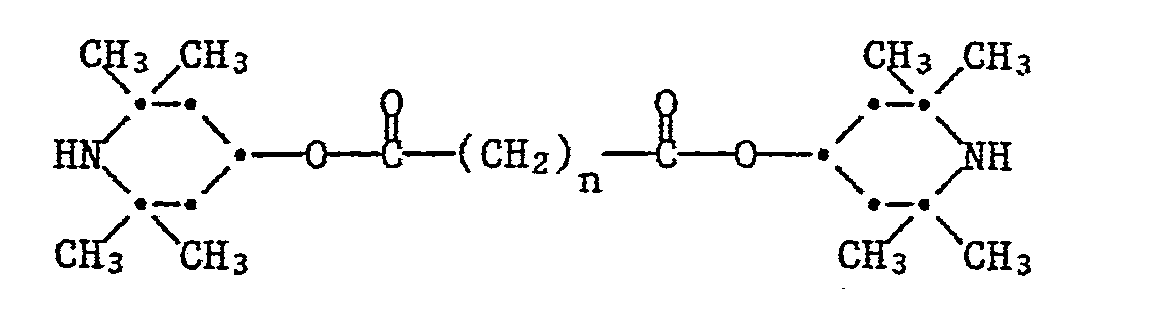
- Gegenstand der Erfindung sind daher gegen Lichteinwirkugn stabilisierte thermoplastische Polymere, die als Lichtschutzmittel Di-(2,2,6,6-tetramethyl-4-piperidinyl)-succinat oder Di-(2,2,6,6-tetramethyl-4-piperidinyl)-glutarat enthalten. Bevorzugt enthalten die Polymeren das Succinat (n=2).
- In der JP-A-84/53545 wird die Verwendung von Di-(2,2,6,6-tetramethyl-4-piperidinyl)-succinat als Lichtschutzmittel für Latices synthetischer Kautschuke, welche TiO₂ enthalten, vorgeschlagen. Die Verbindung ist dort genannt, aber nicht näher beschrieben. Beide Verbindungen können nach dem Verfahren der US-A-3,840,494 durch Umesterung von 4-Hydroxy-2,2,6,6-tetramethylpiperidin mit einem Dialkyl-succinat bzw. -glutarat hergestellt werden. In der US-A-3,840,494 ist auch das homologe Di-(1,2,2,6,6-pentamethyl-4-piperidinyl)-succinat genannt. Diese Verbindung ist jedoch wegen ihres niedrigen Schmelzpunktes als Stabilisator für thermoplastische Polymere wenig geeignet. Demhingegen schmilzt das Di-(2,2,6,6-tetramethyl-4-piperidinyl)-succinat bei 118°C, das Di-(2,2,6,6-tetramethyl-4-piperidinyl)-glutarat bei 83-84°C, wodurch das trockene Mischen mit dem gepulverten oder granulierten thermoplastischen Polymer möglich ist.
- Beispiele für thermoplastische Polymere, die mit diesen Verbindungen stabilisiert werden können, sind
- 1. Polymere von Monoolefinen, beispielsweise Polyethylen, Polypropylen, Polyisobutylen, Polybuten-1, Polymethylpenten-1, sowie Polymerisate von Cycloolefinen wie z.B. von Cyclopenten oder Norbornen.
- 2. Mischungen der unter 1) genannten Polymeren, z.B. Mischungen von Polypropylen mit Polyisobutylen mit Polyethylen oder mit EPDM.
- 3. Copolymere von Monoolefinen untereinander oder mit anderen Vinylmonomeren, wie z.B. Ethylen-Propylen-Copolymere, Propylen-Buten-1-Copolymere, Propylen-Isobutylen-Copolymere, Ethylen-Buten-1-Copolymere, Ethylen-Alkylacrylat-Copolymere, Ethylen-Alkylmethacrylat-Copolymere, Ethylen-Vinylacetat-Copolymere oder Ethylen-Acrylsäure-Copolymere und deren Salze (Ionomere).
- 4. Polystyrol, Poly-(p-methylstyrol), und Styrol-Copolymere mit anderen Vinylmonomeren, wie z.B. Styrol-Acrylnitril, Styrol-Alkylmethacrylat, Styrol-Maleinanhydrid, Styrol-Acrylnitril-Methylacrylat;
- 5. Halogenhaltige Polyere, wie z.B. Polychloropren, Chlorkautschuk, chloriertes oder chlorsulfoniertes Polyethylen, Epichlorhydrinhomo- und -copolymere, insbesondere Polymere aus halogenhaltigen Vinylverbindungen, wie z.B. Polyvinylchlorid, Polyvinylidenchlorid, Polyvinylfluorid, Polyvinylidenfluorid; sowie deren Copolymere, wie Vinylchlorid-Vinylidenchlorid, Vinylchlorid-Vinylacetat oder Vinylidenchlorid-Vinylacetat.
- 6. Polymere, die sich von α,β-ungesättigten Säuren und deren Derivaten ableiten, wie Polyacrylate und Polymethacrylate, Polyacrylamide und Polyacrylnitrile.
- 7. Copolymere der unter 6) genannten Monomeren untereinander oder mit anderen ungesättigten Monomeren, wie z.B. Acrylnitril-Alkylacrylat-Copolymere, Acrylnitril-Alkoxyalkylacrylat-Copolymere oder Acrylnitril-Vinylhalogenid-Copolymere.
- 8. Polymere, die sich von ungesättigten Alkoholen und Aminen bzw. deren Acylderivaten oder Acetalen ableiten, wie Polyvinylalkohol, Polyvinylacetat, -stearat, -benzoat, -maleat, Polyvinylbutyral, Polyallylphthalat, Polyallylmelamin.
- 9. Homo- und Copolymere von cyclischen Ethern, wie Polyalkylenglykole, Polyethylenoxyd, Polypropylenoxyd oder deren Copolymere mit Bisglycidylethern.
- 10. Polyacetale, wie Polyoxymethylen, sowie solche Polyoxymethylene, die Comonomere, wie z.B. Ethylenoxid, enthalten.
- 11. Polyphenyloxide und -sulfide und deren Mischungen mit Styrolpolymeren.
- 12. Polyurethane, die sich von Polyethern oder Polyestern mit endständigen Hydroxylgruppen einerseits und aliphatischen oder aromatischen Polyisocyanaten andererseits ableiten, sowie deren Vorprodukte.
- 13. Polyamide und Copolyamide, die sich von Diaminen und Dicarbonsäuren und/oder von Aminocarbonsäuren oder den entsprechenden Lactamen ableiten, wie Polyamid 4, Polyamid 6, Polyamid 6/6, Polyamid 6/10, Polyamid 11, Polyamid 12, Poly-2,4,4-trimethylhexamethylenterephthalamid, Poly-m-phenylen-isophthalamid, sowie deren Block-Copolymere mit Polyethern, wie z.B. mit Polyethylenglykol, Polypropylenglykol oder Polytetramethylenglykol.
- 14. Polyharnstoffe, Polyimide, Polyamid-imide und Polybenzimidazole.
- 15. Polyester, die sich von Dicarbonsäuren und Dialkoholen und/oder von Hydroxycarbonsäuren oder den entsprechenden Lactonen ableiten, wie Polyethylenterephthalat, Polybutylenterephthalat, Poly-1,4-di methylolcyclohexanterephthalat, Polyhydroxybenzoate, sowie Block-Polyether-ester, die sich von Polyethern mit Hydroxylendgruppen ableiten.
- 16. Polycarbonate und Polyestercarbonate.
- 17. Polysulfone, Polyethersulfone und Polyetherketone.
- Von besonderer Bedeutung ist die Stabilisierung von Polyolefinen und Olefincopolymeren, wie sie oben unter 1-3 aufgezählt sind, insbesondere aber die Stabilisierung von Polypropylen und Propylencopolymeren. Die Zusatzmenge an Lichtschutzmittel beträgt zweckmässig 0,01 bis 5 Gew.-%, bevorzugt 0,025 bis 2 Gew.-%, bezogen auf das zu stabilisierende Polymer.
- Der Zusatz kann vor, während oder nach der Polymerisation erfolgen, jedoch vor oder während der Formgebung. Der Stabilisator kann z.B. mit den pulverförmigen Polymeren vermischt werden oder zur Schmelze des Polymeren zugesetzt werden nach den hierfür üblichen Methoden. Der Stabilisator kann auch in Form eines Masterbatch, der z.B. 5-25 % des Stabilisators enthält, zugemischt werden.
- Ausser dem erfindungsgemässen Stabilisator können dem Polymeren auch noch andere, bekannte Stabilisatoren zugesetzt werden. Beispiele hierfür sind die folgenden Klassen von Stabilisatoren:
- 1.1. Alkylierte Monophenole, z.B. 2,6-Di-tert.butyl-4-methylphenol, 2-Tert.butyl-4,6-dimethylphenol, 2,6-Di-tert.butyl-4-ethylphenol, 2,6-Di-tert.butyl-4-n-butylphenol, 2,6-Di-tert.butyl-4-i-butylphenol, 2,6-Di-cyclopentyl-4-methylphenol, 2-(α-Methylcyclohexyl)-4,6-dimethylphenol, 2,6-Di-octadecyl-4-methylphenol, 2,4,6-Tricyclohexylphenol, 2,6-Di-tert.butyl-4-methoxymethylphenol.
- 1.2. Alkylierte Hydrochinone, z.B. 2,6-Di-tert.butyl-4-methoxyphenol, 2,5-Di-tert.butyl-hydrochinon, 2,5-Di-tert.amyl-hydrochinon, 2,6-Diphenyl-4-octadecyloxyphenol.
- 1.3. Hydroxylierte Thiodiphenylether, z.B. 2,2ʹ-Thio-bis-(6-tert.-butyl-4-methylphenol), 2,2ʹ-Thio-bis-(4-octylphenol), 4,4ʹ-Thio-bis-(6-tert.butyl-3-methylphenol), 4,4ʹ-Thio-bis-(6-tert.butyl-2-methylphenol).
- 1.4. Alkyliden-Bisphenole, z.B. 2,2ʹ-Methylen-bis-(6-tert.butyl-4-methylphenol), 2,2ʹ-Methylen-bis-(6-tert.butyl-4-ethylphenol), 2,2ʹ-Methylen-bis-[4-methyl-6-(α-methylcyclohexyl)-phenol], 2,2ʹ-Methylen-bis-(4-methyl-6-cyclohexylphenol), 2,2ʹ-Methylen-bis-(6-nonyl-4-methylphenol), 2,2ʹ-Ethyliden-bis-(4,6-di-tert.butylphenol), 2,2ʹ-Ethyliden-bis-(4,6- di-tert.butylphenol), 2,2ʹ-Ethyliden-bis-(6-tert.butyl-4-isobutylphenol), 2,2ʹ-Methylen-bis-[6-(α-methylbenzyl)-4-nonylphenol], 2,2ʹ-Methylen-bis-[6-(α,α-dimethylbenzyl)-4-nonylphenol], 4,4ʹ-Methylen-bis-(2,6-di-tert.-butylphenol), 4,4ʹ-Methylen-bis-(6-tert.butyl-2-methylphenol), 1,1-Bis-(5-tert.butyl-4-hydroxy-2-methylphenyl)-butan, 2,6-Di-(3-tert.butyl-5-methyl-2-hydroxybenzyl)-4-methylphenol, 1,1,3-Tris-(5-tert.butyl-4-hydroxy-2-methylphenyl)-butan, 1,1-Bis-(5-tert.butyl-4-hydroxy-2-methylphenyl)-3-n-dodecylmercaptobutan, Ethylenglycol-bis-[3,3-bis-(3ʹ-tert.butyl-4ʹ-hydroxyphenyl)-butyrat], Di-(3-tert.butyl-4-hydroxy-5-methylphenyl)-dicyclopentadien, Di-[2-(3ʹ-tert.butyl-2ʹ-hydroxy-5ʹ-methyl-benzyl)-6-tert.butyl-4-methyl-phenyl]-terephthalat.
- 1.5 Benzylverbindungen, z.B. 1,3,5-Tri-(3,5-di-tert.butyl-4-hydroxybenzyl)-2,4,6-trimethylbenzol, Di-(3,5-di-tert.butyl-4-hydroxybenzyl)-sulfid, 3,5-Di-tret.butyl-4-hydroxybenzyl-mercaptoessigsäure-isoocytylester, Bis-(4-tert.butyl-3-hydroxy-2,6-dimethylbenzyl)dithiol-terephthalat, 1,3,5-Tris-(3,5-di-tert.butyl-4-hydroxybenzyl)-isocyanurat, 1,3,5-Tris-(4-tert.butyl-3-hydroxy-2,6-dimethylbenzyl)- isocyanurat, 3,5-Di-tert.butyl-4-hydroxybenzyl-phosphonsäure-dioctadecylester, 3,5-Di-tert.butyl-4-hydroxybenzyl-phosphonsäure-monoethylester, Calcium-salz.
- 1.6. Acylaminophenole, z.B. 4-Hydroxy-laurinsäureanilid, 4-Hydroxystearinsäureanilid, 2,4-Bis-octylmercapto-6-(3,5-di-tert.butyl-4-hydroxyanilino)-s-triazin, N-(3,5-di-tert.butyl-4-hydroxyphenyl)-carbaminsäureoctylester.
- 1.7. Ester der β-(3,5-Di-tert.butyl-4-hydroxyphenyl)-propionsäure mit ein- oder mehrwertigen Alkoholen, wie z.B. mit Methanol, Octadecanol, 1,6-Hexandiol, Neopentylglycol, Thiodiethylenglycol, Diethylenglycol, Triethylenglycol, Pentaerythrit, Tris-hydroxyethylisocyanurat, Di-hydroxyethyl-oxalsäurediamid.
- 1.8. Ester der β-(5-tert.Butyl-4-hydroxy-3-methylphenyl)-propionsäure mit ein- oder mehrwertigen Alkoholen, wie z.B. mit Methanol, Octadecanol, 1,6-Hexandiol, Neopentylglycol, Thiodiethylenglycol, Diethylenglycol, Trithylenglycol, Pentaerythrit, Tris-hydroxyethylisocyanurat, Di-hydroxyethyl-oxyalsäurediamid.
- 1.9. Amide der β-(3,5-Di-tert.butyl-4-hydroxyphenyl)-propionsäure, wie z.B. N,Nʹ-Di-(3,5-di-tert.butyl-4-hydroxyphenylpropionyl)-hexamethylendiamin, N,Nʹ-Di-(3,5-di-tert.butyl-4-hydroxyphenylpropionyl)-trimethylendiamin, N,Nʹ-Di-(3,5-di-tert.butyl-4-hydroxyphenylpropionyl)-hydrazin.
- 2.1. 2-(2ʹ-Hydroxyphenyl)-benztriazole, wie z.B. das 5ʹ-Methyl-, 3ʹ,5ʹ-Di-tert.butyl-, 5ʹ-tert.Butyl-, 5ʹ-(1,1,3,3-Tetramethyl-butyl)-, 5-Chlor-3ʹ,5ʹ-di-tert.butyl-, 5-Chlor-3ʹ-tert.butyl-5ʹ-methyl-, 3ʹ-sec.Butyl-5ʹ-tert.butyl, 4ʹ-Octoxy-, 3ʹ,5ʹ-Di-tert.-amyl-, 3ʹ,5ʹ-Bis-(α,α-dimethylbenzyl)-Derivat.
- 2.2. 2-Hydroxybenzophenone, wie z.B. das 4-Hydroxy-, 4-Methoxy-, 4-Octoxy-, 4-Decyloxy-, 4-Dodecyloxy-, 4-Benzyloxy-, 4,2ʹ,4ʹ-Trihydroxy-, 2ʹ-Hydroxy-4,4ʹ-dimethoxy-Derivat.
- 2.3. Ester von gegebenenfalls substituierten Benzoesäuren, wie z.B. 4-tert.Butyl-phenylsalicylat, Phenylsalicylat, Octylphenylsalicylat, Dibenzoylresorcin, Bis-(4-tert.butylbenzoyl)-resorcin, Benzoylresorcin, 3,5-Di-tert.butyl-4-hydroxybenzoesäure-2,4-di-tert.butylphenylester, 3,5-Di-tert.butyl-4-hydroxybenzoesäurehexadecylester.
- 2.4. Acrylate, wie z.B. α-Cyan-β,β-diphenylacrylsäure-ethylester bzw. -isooctylester, α-Carbomethoxy-zimtsäuremethylester, α-Cyano-β-methyl-p-methoxy-zimtsäuremethylester bzw. -butylester, α-Carbomethoxy-p-methoxy-zimtsäure-methylester, N-(β-Carbomethoxy-β-cyanovinyl)-2-methyl-indolin.
- 2.5. Nickelverbindungen, wie z.B. Nickelkomplexe des 2,2ʹ-Thio-bis-[4-(1,1,3,3-tetramethylbutyl)-phenols], wie der 1:1- oder der 1:2-Komplex, gegebenenfalls mit zusätzlichen Liganden, wie n-Butylamin, Triethanolamin oder N-Cyclohexyl-diethanolamin, Nickeldibutyldithiocarbamat, Nickelsalze von 4-Hydroxy-3,5-di-tert.butylbenzyl-phosphonsäure-monoalkylester, wie vom Methyl- oder Ethylester, Nickelkomplexe von Ketoximen, wie von 2-Hydroxy-4-methyl-phenyl-undecylketonoxim, Nickelkomplexe des 1-Phenyl-4-lauroyl-5-hydroxypyrazols, gegebenenfalls mit zusätzlichen Liganden.
- 2.6. Sterisch gehinderte Amine, wie z.B. Bis-(2,2,6,6-tetramethylpiperidyl)-sebacat, Bis-(1,2,2,6,6-pentamethylpiperidyl)-sebacat, n-Butyl-3,5-di-tert.butyl-4-hydroxybenzyl-malonsäure-bis(1,2,2,6,6-pentamethylpiperidyl)-ester, Tris-(2,2,6,6-ttramethyl-4-piperidyl)-nitrilotriacetat, Tetrakis-(2,2,6,6-tetramethyl-4-piperidyl)-1,2,3,4-butantetracarbonsäure, 1,1ʹ-(1,2-Ethandiyl)-bis-(3,3,5,5-tetramethyl-piperazinon).
- 2.7. Oxalsäurediamide, wie z.B. 4,4ʹ-Di-octyloxy-oxanilid, 2,2ʹ-Di-octyloxy-5,5ʹ-di-tert.butyl-oxanilid, 2,2ʹ-Di-dodecyloxy-5,5ʹ-di-tert.butyl-oxanilid, 2-Ethoxy-2ʹ-ethyl-oxanilid, N,Nʹ-Bis-(3-dimethylaminopropyl)-oxalamid, 2-Ethoxy-5-tert.butyl-2ʹ-ethyl-oxanilid und dessen Gemisch mit 2-Ethoxy-2ʹ-ethyl-5,4ʹ-di-tert.butyl-oxanilid, Gemische von o-und p-Methoxy- sowie von o- und p-Ethoxy-di-substituierten Oxaniliden.
- 3. Metalldesaktivatoren, wie z.B. N,Nʹ-Diphenyloxalsäurediamid, N-Salicylal-Nʹ-salicyloylhydrazin, N,Nʹ-Bis-salicyloylhydrazin, N,Nʹ-Bis-(3,5-di-tert.butyl-4-hydroxyphenylpropionyl)-hydrazin, 3-Salicyloylamino-1,2,4-triazol, Bis-benzyliden-oxalsäuredihydrazid.
- 4. Phosphite und Phosphonite, wie z.B. Triphenylphosphit, Diphenylalkylphosphite, Phenyldialkylphosphite, Tri-(nonylphenyl)-phosphit, Trilaurylphosphit, Trioctadecylphosphit, Distearyl-pentaerythritdiphosphit, Tris-(2,4-di-tert.butylphenyl)-phosphit, Diisodecylpentaerythrit-diphosphit, Di-(2,4-di-tert.butylphenyl)-pentaerythritdiphosphit, Tristearyl-sorbit-triphorphit, Tetrakis-(2,4-di-tert.butylphenyl)-4,4ʹ-biphenylen-diphosphonit, 3,9-Bis-(2,4-di-tert.butylphenoxy-2,4,8,10-tetraoxa-3,9-diphosphaspiro[5.5]undecan.
- 5. Peroxidzerstörende Verbindungen, wie z.B. Ester der β-Thio-dipropionsäure, beispielsweise der Lauryl-, Stearyl-, Myristyl- oder Tridecylester, Mercaptobenzimidazol, das Zinksalz des 2-Mercaptobenzimidazols, Zink-dibutyl-dithiocarbamat, Dioctadecyldisulfid, Pentaerythrit-tetrakis-(β-dodecylmercapto)-propionat.
- 6. Polyamidstabilisatoren, wie z.B. Kupfersalze in Kombination mit Jodiden und/oder Phosphorverbindungen und Salze des zweiwertigen Mangans.
- 7. Basische Co-Stabilisatoren, wie z.B. Melamin, Polyvinylpyrrolidon, Dicyandiamid, Triallylcyanurat, Hanstoff-Derivate, Hydrazin-Derivate, Amine, Polyamide, Polyurethane, Alkali- und Erdalkalisalze höherer Fettsäuren, beispielsweise Ca-Stearat, Zn-Stearat, Mg-Stearat, Na-Ricinoleat, K-Palmitat, Antimonbrenzcatechinat oder Zinnbrenzcatechinat.
- Die Mitverwendung bekannter Stabilisatoren kann zu besonders günstigen Stabilisierungseffekten führen, was besonders bei der Mitverwendung von UV-Absorbern und/oder phenolischen Antioxidantien der Fall ist. Von besonderer Bedeutung ist die Mitverwendung von phenolischen Antioxidantien, von Phosphiten oder Phosphoniten und von Erdalkalisalzen höherer Fettsäuren bei der Stabilisierung von Polyolefinen. Die Zusatzmenge der einzelnen Costabilisatoren beträgt ebenfalls zweckmässig 0,01 bis 5 Gew.-%, vorzugsweise 0,025 bis 2 Gew.-%, bezogen auf das Polymer.
- Weiterhin können sonstige in der Kunststoff-Technologie übliche Zusätze, wie z.B. Pigmente, Füllstoffe, Verstärkungsmittel, Gleitmittel, Flammschutzmittel, Antistatika, Treibmittel oder Weichmacher zugesetzt werden.
- Die so stabilisierten Kunststoffe können in verschiedenster Form angewendet werden, z.B. als Folien, Fasern, Bändchen, Platten, Gefässe, Rohre oder sonstige Profile.
- Die folgenden Beispiele beschreiben die Herstellung der genannten Verbindungen und ihre Verwendung in Thermoplasten. Teile bedeuten darin Gewichtsteile und % Gewichts-%, soweit nicht anders vermerkt.
- 322,3 g (2,05 Mol) 4-Hydroxy-2,2,6,6-tetramethylpiperidin und 146,1 g (1 Mol) Bernsteinsäuredimethylester werden in 300 ml Xylol auf 80°C erhitzt. Bei dieser Temperatur gibt man 1,2 g Lithiumamid zum Reaktionsgemisch und steigert die Temperatur bis auf 120-125°C. Unter schwachem Stickstoffstrom wird nun langsam ein Gemisch aus Methanol and Xylol abdestilliert. Nach ca. 10 Stuenden destilliert praktisch kein Methanol mehr ab, was das Ende der Umesterung anzeigt. Der Kolbeninhalt wird mit 500 ml Benzin (Siedegrenze 110-140°C) verdünnt und noch warm (60-70°C) im Scheidetrichter dreimal mit je 100 ml Wasser gewaschen. Aus der organischen Phase kristallisiert das Reaktionsprodukt beim Abkühlen als farblose Kristalle. Das erhaltene Di-(2,2,6,6-tetramethyl-4-piperidinyl)-succinat schmilzt bei 118°C.
- Es wird wie in Beispiel 1 verfahren unter Verwendung von 160,2 g (1 Mol) Glutarsäuredimethylester anstelle des Bernsteinsäureesters. Das Rohprodukt (Eindampfrest der organischen Phase) wird aus 1200 ml Benzin des Siedebereiches 110-140°C kristallisiert. Die Kristalle schmelzen bei 83-84°C.
- 100 Teile Polypropylenpulver [Schmelzindex 2,4 g/10 min. (230°C, 2160 g)] werden in einem Trommelmischer mit 0,05 Teilen Pentaerythrityl-tetrakis-[β-(3,5-di-tert.butyl-4-hydroxiphenyl)-propionat], 0,05 Teilen Tris-(2,4-di-tert.butylphenyl)-phosphit, 0,1 Teilen Ca-Stearat und 0,05 Teilen des Lichtschutzmittels gemischt und anschliessend in einem Extruder bei einer Temperatur von 180 bis 220°C granuliert.
- Das erhaltene Granulat wird in einem zweiten Extruder mit Breitschlitzdüse (Temperatur 220 bis 260°C) zu einer Folie verarbeitet, die in Bändchen geschnitten wird, welche anschliessend bei erhöhter Temperatur im Verhältnis 1:6 verstreckt und aufgewickelt werden (Titer der Bändchen: 700 bis 900 den; Reissfestigkeit: 5,5 bis 6,5 g/den.
- Die so hergestellten Polypropylenbändchen werden spannungslos auf Probenträger aufgebracht und im Weather-O-Meter WRC 600 belichtet. Nach verschiedenen Zeiten werden je 5 Prüflinge entnommen und ihre Reissfestigkeit bestimmt. Als Mass für die Schutzwirkung der einzelnen Lichtschutzmittel gilt die Belichtungszeit, nach der die Reissfestigkeit der Bändchen auf 50 % des Ausgangswertes zurückgegangen ist. Die erhaltenen Werte sind in Tabelle 1 aufgeführt.
-

- Es wird wie in Beispiel 3 verfahren, jedoch werden die Polypropylen-Bändchen in einem Weather-O-Meter Ci 65 belichtet bei einer Schwarztafel-Temperatur von 63 ± 3°C.
-

- 100 Teile Polypropylenpulver [Schmelzindex 2,4 g/10 min 230°C/2160 g)] werden in einem Trommelmischer mit 0,05 Teilen Pentaerythrityl-tetrakis-[β-(3,5-di-tert.butyl-4-hydroxiphenyl)-propionat], 0,05 Teilen Tris-(2,4-di-tert.butylphenyl)-phosphit, 0,1 Teilen Ca-Stearat, 0,1 Teilen Phthalocyaninblau und 0,2 Teilen Lichtschutzmittel gemischt und anschliessend in einem Extruder bei einer Temperatur von 200 bis 220°C granuliert.
- Das erhaltene Granulat wird in einem Spritzgussautomaten, bei einer Temperatur von 190 bis 220°C, zu 2 mm dicken Plättchen gespritzt.
- Die so hergestellten Polypropylenplättchen werden im Weather-O-Meter 65 WR bei einer Schwarztafeltemperatur von 63 ± 3°C (ASTM G 26-77) belichtet. In regelmässigen Zeitabständen werden die Proben visuell auf Kreidung untersucht. Als Mass für die Schutzwirkung der einzelnen Lichtschutzmittel gilt die Belichtungszeit bis zur beginnenden Verkreidung. Die Ergebnisse sind in Tabelle 3 aufgeführt.
-

- Es wird wie in Beispiel 5 verfahren, jedoch werden auf 100 Teile Polypropylen nur 0,05 Teile Phthalocyaninblau und nur 0,05 Teile Lichtschutzmittel verwendet. Die Vrarbeitung zu Plättchen erfolgt im Spritzgussautomaten bei 250-260°C. Die Plättchen werden in einem Weather-O-Meter Ci 65 belichtet. Die Beurteilung erfolgt wie im Beispiel 5.
-

Claims (9)
Applications Claiming Priority (2)
| Application Number | Priority Date | Filing Date | Title |
|---|---|---|---|
| CH1690/86 | 1986-04-25 | ||
| CH169086 | 1986-04-25 |
Publications (2)
| Publication Number | Publication Date |
|---|---|
| EP0243319A2 true EP0243319A2 (de) | 1987-10-28 |
| EP0243319A3 EP0243319A3 (de) | 1989-02-15 |
Family
ID=4216331
Family Applications (1)
| Application Number | Title | Priority Date | Filing Date |
|---|---|---|---|
| EP87810249A Withdrawn EP0243319A3 (de) | 1986-04-25 | 1987-04-21 | Gegen Lichteinwirkung stabilisierte Thermoplasten |
Country Status (11)
| Country | Link |
|---|---|
| US (1) | US5028645A (de) |
| EP (1) | EP0243319A3 (de) |
| JP (1) | JPS62260842A (de) |
| KR (1) | KR900008336B1 (de) |
| AU (1) | AU588454B2 (de) |
| BR (1) | BR8701966A (de) |
| CA (1) | CA1304868C (de) |
| CS (1) | CS276724B6 (de) |
| DD (1) | DD263295A5 (de) |
| RU (1) | RU1838344C (de) |
| ZA (1) | ZA872920B (de) |
Cited By (7)
| Publication number | Priority date | Publication date | Assignee | Title |
|---|---|---|---|---|
| EP0352221A1 (de) * | 1988-06-14 | 1990-01-24 | Ciba-Geigy Ag | Verfahren zum fotochemischen Stabilisieren von ungefärbten und gefärbten Polypropylenfasern |
| EP0409771A3 (en) * | 1989-06-27 | 1991-06-12 | Ciba-Geigy Ag | Process of photochemical and thermal stabilization of polyamide fibres, dyeable by acid and basic dyes, and of their mixtures amongst themselves and with other fibres |
| EP0378054A3 (de) * | 1989-01-05 | 1991-11-21 | Ciba-Geigy Ag | Verfahren zur fotochemischen Stabilisierung von ungefärbten und zu färbenden Lederimitaten |
| US5457143A (en) * | 1991-06-04 | 1995-10-10 | Ciba-Geigy Corporation | Stabilization of polymeric organic materials by using synergistic mixtures comprising sterically hindered cyclic amines and derivatives of 3-pyrazolidinone or 1,2,4-triazolidine-3,5-dione |
| US5489633A (en) * | 1993-06-01 | 1996-02-06 | Basf Aktiengesellschaft | Molding materials having stress cracking resistance and based on PMMA/SAN blends |
| US5496875A (en) * | 1993-07-16 | 1996-03-05 | Ciba-Geigy Corporation | Derivatives of 2,2,6,6-tetramethyl-4-piperidinol for use as light stabilizers, heat stabilizers and oxidation stabilizers for organic materials |
| FR2749319A1 (fr) * | 1996-05-28 | 1997-12-05 | Ciba Geigy Ag | Melange stabilisant, composition le contenant et procede l'utilisant pour stabiliser une matiere organique |
Families Citing this family (4)
| Publication number | Priority date | Publication date | Assignee | Title |
|---|---|---|---|---|
| DE50107928D1 (de) * | 2000-08-16 | 2005-12-08 | Lanxess Deutschland Gmbh | Alterungsschutzmittel auf basis von phenolischen salzen |
| MY145338A (en) * | 2003-12-04 | 2012-01-31 | Dow Global Technologies Inc | Stabilized polyethylene material |
| EP2439240A1 (de) * | 2010-10-06 | 2012-04-11 | Henkel AG & Co. KGaA | Strahlungshärtbare Zusammensetzung |
| EP3538599A1 (de) | 2016-11-09 | 2019-09-18 | Borealis AG | Polypropylenzusammensetzung |
Family Cites Families (10)
| Publication number | Priority date | Publication date | Assignee | Title |
|---|---|---|---|---|
| US3640928A (en) * | 1968-06-12 | 1972-02-08 | Sankyo Co | Stabilization of synthetic polymers |
| NL154241C (de) * | 1971-01-29 | 1900-01-01 | ||
| US4021432A (en) * | 1971-11-30 | 1977-05-03 | Ciba-Geigy Corporation | Piperidine derivatives |
| DK144796C (da) * | 1975-03-21 | 1982-10-25 | Montefibre Spa | Stabiliseret alkenpolymerformstof eller-genstand og stabiliseringsmiddel til brug ved fremstillingen deraf |
| US4203890A (en) * | 1976-03-29 | 1980-05-20 | Ciba-Geigy Corporation | Hindered piperidine carboxylic acids, metal salts thereof and stabilized compositions |
| JPS5365418A (en) * | 1976-11-24 | 1978-06-10 | Teijin Ltd | Production of modified polyester fibers |
| US4520171A (en) * | 1982-05-05 | 1985-05-28 | Hercules Incorporated | Polymeric hindered amines |
| NZ208423A (en) * | 1983-10-26 | 1987-05-29 | Becton Dickinson Co | Sterilised, radiation-stabilised semi-crystalline polymer articles |
| CA1254339A (en) * | 1984-03-13 | 1989-05-16 | Yoichi Kawai | Radiation-stable polypropylene resin composition |
| EP0214099A3 (de) * | 1985-08-28 | 1988-09-21 | Ciba-Geigy Ag | Stabilisierung von vernetzten Ethylenpolymeren |
-
1987
- 1987-04-21 EP EP87810249A patent/EP0243319A3/de not_active Withdrawn
- 1987-04-23 CA CA000535319A patent/CA1304868C/en not_active Expired - Lifetime
- 1987-04-23 CS CS872877A patent/CS276724B6/cs unknown
- 1987-04-23 DD DD87302069A patent/DD263295A5/de not_active IP Right Cessation
- 1987-04-23 KR KR1019870003917A patent/KR900008336B1/ko not_active Expired
- 1987-04-24 BR BR8701966A patent/BR8701966A/pt unknown
- 1987-04-24 RU SU874202433A patent/RU1838344C/ru active
- 1987-04-24 AU AU71958/87A patent/AU588454B2/en not_active Ceased
- 1987-04-24 JP JP62101723A patent/JPS62260842A/ja active Pending
- 1987-04-24 ZA ZA872920A patent/ZA872920B/xx unknown
-
1989
- 1989-08-08 US US07/391,656 patent/US5028645A/en not_active Expired - Fee Related
Cited By (11)
| Publication number | Priority date | Publication date | Assignee | Title |
|---|---|---|---|---|
| EP0352221A1 (de) * | 1988-06-14 | 1990-01-24 | Ciba-Geigy Ag | Verfahren zum fotochemischen Stabilisieren von ungefärbten und gefärbten Polypropylenfasern |
| US5057562A (en) * | 1988-06-14 | 1991-10-15 | Ciba-Geigy Corporation | Process for the photochemical stabilization of undyed and dyed polypropylene fibres |
| EP0378054A3 (de) * | 1989-01-05 | 1991-11-21 | Ciba-Geigy Ag | Verfahren zur fotochemischen Stabilisierung von ungefärbten und zu färbenden Lederimitaten |
| EP0409771A3 (en) * | 1989-06-27 | 1991-06-12 | Ciba-Geigy Ag | Process of photochemical and thermal stabilization of polyamide fibres, dyeable by acid and basic dyes, and of their mixtures amongst themselves and with other fibres |
| US5221287A (en) * | 1989-06-27 | 1993-06-22 | Ciba-Geigy Corporation | Process for the photochemical and thermal stabilization of polyamide fibres having an affinity for acid and basic dyes, and of blends of said fibres with on another and with other fibres |
| US5457143A (en) * | 1991-06-04 | 1995-10-10 | Ciba-Geigy Corporation | Stabilization of polymeric organic materials by using synergistic mixtures comprising sterically hindered cyclic amines and derivatives of 3-pyrazolidinone or 1,2,4-triazolidine-3,5-dione |
| US5489633A (en) * | 1993-06-01 | 1996-02-06 | Basf Aktiengesellschaft | Molding materials having stress cracking resistance and based on PMMA/SAN blends |
| US5496875A (en) * | 1993-07-16 | 1996-03-05 | Ciba-Geigy Corporation | Derivatives of 2,2,6,6-tetramethyl-4-piperidinol for use as light stabilizers, heat stabilizers and oxidation stabilizers for organic materials |
| FR2749319A1 (fr) * | 1996-05-28 | 1997-12-05 | Ciba Geigy Ag | Melange stabilisant, composition le contenant et procede l'utilisant pour stabiliser une matiere organique |
| NL1006140C2 (nl) * | 1996-05-28 | 2000-07-07 | Ciba Sc Holding Ag | Mengsels van polyalkylpiperidine-4-yldicarbonzuuresters als stabilisatoren voor organische materialen. |
| BE1012526A5 (fr) * | 1996-05-28 | 2000-12-05 | Ciba Sc Holding Ag | Melange stabilisant, composition le contenant et procede l'utilisant pour stabiliser une matiere organique. |
Also Published As
| Publication number | Publication date |
|---|---|
| CA1304868C (en) | 1992-07-07 |
| DD263295A5 (de) | 1988-12-28 |
| CS8702877A2 (en) | 1990-09-12 |
| JPS62260842A (ja) | 1987-11-13 |
| US5028645A (en) | 1991-07-02 |
| RU1838344C (ru) | 1993-08-30 |
| ZA872920B (en) | 1987-12-30 |
| AU588454B2 (en) | 1989-09-14 |
| BR8701966A (pt) | 1988-02-02 |
| AU7195887A (en) | 1987-10-29 |
| KR870010089A (ko) | 1987-11-30 |
| EP0243319A3 (de) | 1989-02-15 |
| CS276724B6 (en) | 1992-08-12 |
| KR900008336B1 (ko) | 1990-11-15 |
Similar Documents
| Publication | Publication Date | Title |
|---|---|---|
| EP0290386B1 (de) | Stabilisierung von organischen Polymeren gegen Lichtabbau | |
| EP0252877B1 (de) | Synergistisches Stabilisatorgemisch | |
| EP0500496B1 (de) | Stabilisierte Polymere mit Heteroatomen in der Hauptkette | |
| EP0080431B1 (de) | Synergistisches Gemisch von niedermolekularen und hochmolekularen Polyalkylpiperidinen | |
| DE3811117A1 (de) | Lichtschutzmittelgemisch | |
| EP0119160A1 (de) | N-substituierte (4-Hydroxyphenylthiomethyl)-amine oder -ureide | |
| EP0107615A1 (de) | Mit Bis- oder Tris-(polyalkylpiperidinyl-amino)-1,3,5-triazine stabilisierte Polyolefine | |
| JPH04233958A (ja) | 着色したポリオレフィンの再循環の方法 | |
| EP0244362B1 (de) | Mit Aminoxysilanen stabilisierte Zusammensetzungen | |
| DD263295A5 (de) | Gegen lichteinwirkung stabilisiertes thermoplastisches polymer | |
| EP0240462B1 (de) | Substituierte Aminoxypropanoate | |
| EP0140297A2 (de) | Thiocarbamat Stabilisatoren | |
| DE3923492A1 (de) | Kunststoff-formmasse | |
| DE3500016A1 (de) | Synergistische mischungen | |
| EP0421932A1 (de) | Stabilisiertes organisches Material | |
| EP0324106B1 (de) | Verwendung einer Polyolefinformmasse für Dauerkontakt mit extrahierenden Medien | |
| EP0252003B1 (de) | Substituierte Aminoxysuccinate und deren Verwendung als Stabilisatoren | |
| EP0249577B1 (de) | Langketten-(4-Hydroxyphenyl)propionat-Derivate als Stabilisatoren | |
| EP0155909B1 (de) | Neue Polyalkylpiperidinderivate von cyclischen Phosphiten | |
| EP0109932B1 (de) | Verfahren zur Herstellung von oligomeren Polyesteramiden mit Seitengruppen enthaltend einen sterisch gehinderten Aminrest | |
| EP0421928B1 (de) | Hydroxyphenylcarbonsäureester als Stabilisatoren | |
| EP0230401B1 (de) | Aminoxypyrrolidin-2,5-dione | |
| DE3805786C2 (de) | Piperidin-Verbindungen | |
| EP0114785B1 (de) | Polymere, sterisch gehinderte Phosphonatstabilisatoren | |
| EP0240463A2 (de) | Substituierte Aminoxypropionamide |
Legal Events
| Date | Code | Title | Description |
|---|---|---|---|
| PUAI | Public reference made under article 153(3) epc to a published international application that has entered the european phase |
Free format text: ORIGINAL CODE: 0009012 |
|
| 17P | Request for examination filed |
Effective date: 19870423 |
|
| AK | Designated contracting states |
Kind code of ref document: A2 Designated state(s): AT BE CH DE ES FR GB IT LI NL SE |
|
| PUAL | Search report despatched |
Free format text: ORIGINAL CODE: 0009013 |
|
| AK | Designated contracting states |
Kind code of ref document: A3 Designated state(s): AT BE CH DE ES FR GB IT LI NL SE |
|
| RAP1 | Party data changed (applicant data changed or rights of an application transferred) |
Owner name: CIBA-GEIGY AG Owner name: SANKYO COMPANY LIMITED |
|
| 17Q | First examination report despatched |
Effective date: 19910402 |
|
| STAA | Information on the status of an ep patent application or granted ep patent |
Free format text: STATUS: THE APPLICATION IS DEEMED TO BE WITHDRAWN |
|
| 18D | Application deemed to be withdrawn |
Effective date: 19931104 |
|
| RIN1 | Information on inventor provided before grant (corrected) |
Inventor name: GUGUMUS, FRANCOIS, DR. Inventor name: RODY, JEAN, DR. |