EP0243256B1 - Zusammenstellungen für Thermistoren mit negativen Temperaturkoeffizienten - Google Patents
Zusammenstellungen für Thermistoren mit negativen Temperaturkoeffizienten Download PDFInfo
- Publication number
- EP0243256B1 EP0243256B1 EP87400895A EP87400895A EP0243256B1 EP 0243256 B1 EP0243256 B1 EP 0243256B1 EP 87400895 A EP87400895 A EP 87400895A EP 87400895 A EP87400895 A EP 87400895A EP 0243256 B1 EP0243256 B1 EP 0243256B1
- Authority
- EP
- European Patent Office
- Prior art keywords
- copper
- atomic percent
- nickel
- barium
- composition
- Prior art date
- Legal status (The legal status is an assumption and is not a legal conclusion. Google has not performed a legal analysis and makes no representation as to the accuracy of the status listed.)
- Expired - Lifetime
Links
- 239000000203 mixture Substances 0.000 title claims abstract description 37
- PXHVJJICTQNCMI-UHFFFAOYSA-N Nickel Chemical compound [Ni] PXHVJJICTQNCMI-UHFFFAOYSA-N 0.000 claims abstract description 50
- 239000010949 copper Substances 0.000 claims abstract description 31
- 229910052802 copper Inorganic materials 0.000 claims abstract description 27
- 229910052759 nickel Inorganic materials 0.000 claims abstract description 25
- RYGMFSIKBFXOCR-UHFFFAOYSA-N Copper Chemical compound [Cu] RYGMFSIKBFXOCR-UHFFFAOYSA-N 0.000 claims abstract description 24
- 229910052788 barium Inorganic materials 0.000 claims abstract description 23
- DSAJWYNOEDNPEQ-UHFFFAOYSA-N barium atom Chemical compound [Ba] DSAJWYNOEDNPEQ-UHFFFAOYSA-N 0.000 claims abstract description 23
- 229910052712 strontium Inorganic materials 0.000 claims abstract description 14
- CIOAGBVUUVVLOB-UHFFFAOYSA-N strontium atom Chemical compound [Sr] CIOAGBVUUVVLOB-UHFFFAOYSA-N 0.000 claims abstract description 13
- WPBNNNQJVZRUHP-UHFFFAOYSA-L manganese(2+);methyl n-[[2-(methoxycarbonylcarbamothioylamino)phenyl]carbamothioyl]carbamate;n-[2-(sulfidocarbothioylamino)ethyl]carbamodithioate Chemical compound [Mn+2].[S-]C(=S)NCCNC([S-])=S.COC(=O)NC(=S)NC1=CC=CC=C1NC(=S)NC(=O)OC WPBNNNQJVZRUHP-UHFFFAOYSA-L 0.000 claims abstract description 12
- 150000001768 cations Chemical class 0.000 claims abstract description 10
- 229910052791 calcium Inorganic materials 0.000 claims description 13
- 239000011575 calcium Substances 0.000 claims description 13
- OYPRJOBELJOOCE-UHFFFAOYSA-N Calcium Chemical compound [Ca] OYPRJOBELJOOCE-UHFFFAOYSA-N 0.000 claims description 12
- AMWRITDGCCNYAT-UHFFFAOYSA-L hydroxy(oxo)manganese;manganese Chemical compound [Mn].O[Mn]=O.O[Mn]=O AMWRITDGCCNYAT-UHFFFAOYSA-L 0.000 claims description 11
- QPLDLSVMHZLSFG-UHFFFAOYSA-N Copper oxide Chemical compound [Cu]=O QPLDLSVMHZLSFG-UHFFFAOYSA-N 0.000 claims description 10
- 239000000843 powder Substances 0.000 claims description 9
- 239000011572 manganese Substances 0.000 claims description 7
- 239000005751 Copper oxide Substances 0.000 claims description 5
- 229910000431 copper oxide Inorganic materials 0.000 claims description 5
- 229910052748 manganese Inorganic materials 0.000 claims description 4
- 229910000480 nickel oxide Inorganic materials 0.000 claims description 4
- GNRSAWUEBMWBQH-UHFFFAOYSA-N oxonickel Chemical compound [Ni]=O GNRSAWUEBMWBQH-UHFFFAOYSA-N 0.000 claims description 4
- 159000000009 barium salts Chemical class 0.000 claims description 3
- 238000002156 mixing Methods 0.000 claims description 3
- 150000003839 salts Chemical class 0.000 claims description 3
- PWHULOQIROXLJO-UHFFFAOYSA-N Manganese Chemical compound [Mn] PWHULOQIROXLJO-UHFFFAOYSA-N 0.000 claims description 2
- 238000001035 drying Methods 0.000 claims description 2
- 238000004519 manufacturing process Methods 0.000 claims description 2
- 238000003825 pressing Methods 0.000 claims description 2
- 159000000008 strontium salts Chemical class 0.000 claims description 2
- AYJRCSIUFZENHW-UHFFFAOYSA-L barium carbonate Chemical compound [Ba+2].[O-]C([O-])=O AYJRCSIUFZENHW-UHFFFAOYSA-L 0.000 claims 2
- 229910052925 anhydrite Inorganic materials 0.000 claims 1
- TZCXTZWJZNENPQ-UHFFFAOYSA-L barium sulfate Inorganic materials [Ba+2].[O-]S([O-])(=O)=O TZCXTZWJZNENPQ-UHFFFAOYSA-L 0.000 claims 1
- 159000000007 calcium salts Chemical class 0.000 claims 1
- 229910052923 celestite Inorganic materials 0.000 claims 1
- 238000012216 screening Methods 0.000 claims 1
- 230000032683 aging Effects 0.000 description 8
- 238000000034 method Methods 0.000 description 7
- 238000005245 sintering Methods 0.000 description 7
- MUBZPKHOEPUJKR-UHFFFAOYSA-N Oxalic acid Chemical compound OC(=O)C(O)=O MUBZPKHOEPUJKR-UHFFFAOYSA-N 0.000 description 5
- 230000007423 decrease Effects 0.000 description 4
- 239000000919 ceramic Substances 0.000 description 3
- 229910018054 Ni-Cu Inorganic materials 0.000 description 2
- 229910018481 Ni—Cu Inorganic materials 0.000 description 2
- MCMNRKCIXSYSNV-UHFFFAOYSA-N Zirconium dioxide Chemical compound O=[Zr]=O MCMNRKCIXSYSNV-UHFFFAOYSA-N 0.000 description 2
- QVGXLLKOCUKJST-UHFFFAOYSA-N atomic oxygen Chemical compound [O] QVGXLLKOCUKJST-UHFFFAOYSA-N 0.000 description 2
- 229910001422 barium ion Inorganic materials 0.000 description 2
- QVQLCTNNEUAWMS-UHFFFAOYSA-N barium oxide Chemical class [Ba]=O QVQLCTNNEUAWMS-UHFFFAOYSA-N 0.000 description 2
- 238000000354 decomposition reaction Methods 0.000 description 2
- 230000003247 decreasing effect Effects 0.000 description 2
- 239000001301 oxygen Substances 0.000 description 2
- 229910052760 oxygen Inorganic materials 0.000 description 2
- 239000002245 particle Substances 0.000 description 2
- 239000000126 substance Substances 0.000 description 2
- QCDFBFJGMNKBDO-UHFFFAOYSA-N Clioquinol Chemical compound C1=CN=C2C(O)=C(I)C=C(Cl)C2=C1 QCDFBFJGMNKBDO-UHFFFAOYSA-N 0.000 description 1
- JPVYNHNXODAKFH-UHFFFAOYSA-N Cu2+ Chemical compound [Cu+2] JPVYNHNXODAKFH-UHFFFAOYSA-N 0.000 description 1
- 229910018651 Mn—Ni Inorganic materials 0.000 description 1
- VEQPNABPJHWNSG-UHFFFAOYSA-N Nickel(2+) Chemical compound [Ni+2] VEQPNABPJHWNSG-UHFFFAOYSA-N 0.000 description 1
- 239000004372 Polyvinyl alcohol Substances 0.000 description 1
- BQCADISMDOOEFD-UHFFFAOYSA-N Silver Chemical compound [Ag] BQCADISMDOOEFD-UHFFFAOYSA-N 0.000 description 1
- GXUARMXARIJAFV-UHFFFAOYSA-L barium oxalate Chemical class [Ba+2].[O-]C(=O)C([O-])=O GXUARMXARIJAFV-UHFFFAOYSA-L 0.000 description 1
- 239000011324 bead Substances 0.000 description 1
- 239000011230 binding agent Substances 0.000 description 1
- BRPQOXSCLDDYGP-UHFFFAOYSA-N calcium oxide Chemical compound [O-2].[Ca+2] BRPQOXSCLDDYGP-UHFFFAOYSA-N 0.000 description 1
- ODINCKMPIJJUCX-UHFFFAOYSA-N calcium oxide Inorganic materials [Ca]=O ODINCKMPIJJUCX-UHFFFAOYSA-N 0.000 description 1
- 239000000292 calcium oxide Substances 0.000 description 1
- 238000001311 chemical methods and process Methods 0.000 description 1
- 229910001431 copper ion Inorganic materials 0.000 description 1
- 238000005516 engineering process Methods 0.000 description 1
- 238000000227 grinding Methods 0.000 description 1
- 238000010438 heat treatment Methods 0.000 description 1
- 239000011261 inert gas Substances 0.000 description 1
- 150000002500 ions Chemical class 0.000 description 1
- 239000007788 liquid Substances 0.000 description 1
- 229910001437 manganese ion Inorganic materials 0.000 description 1
- ZAUUZASCMSWKGX-UHFFFAOYSA-N manganese nickel Chemical compound [Mn].[Ni] ZAUUZASCMSWKGX-UHFFFAOYSA-N 0.000 description 1
- 229910001453 nickel ion Inorganic materials 0.000 description 1
- 229920002451 polyvinyl alcohol Polymers 0.000 description 1
- 238000002360 preparation method Methods 0.000 description 1
- 239000004065 semiconductor Substances 0.000 description 1
- 238000007873 sieving Methods 0.000 description 1
- 229910052709 silver Inorganic materials 0.000 description 1
- 239000004332 silver Substances 0.000 description 1
- 229910001427 strontium ion Inorganic materials 0.000 description 1
- IATRAKWUXMZMIY-UHFFFAOYSA-N strontium oxide Chemical class [O-2].[Sr+2] IATRAKWUXMZMIY-UHFFFAOYSA-N 0.000 description 1
- XLYOFNOQVPJJNP-UHFFFAOYSA-N water Substances O XLYOFNOQVPJJNP-UHFFFAOYSA-N 0.000 description 1
Images
Classifications
-
- H—ELECTRICITY
- H01—ELECTRIC ELEMENTS
- H01C—RESISTORS
- H01C7/00—Non-adjustable resistors formed as one or more layers or coatings; Non-adjustable resistors made from powdered conducting material or powdered semi-conducting material with or without insulating material
- H01C7/04—Non-adjustable resistors formed as one or more layers or coatings; Non-adjustable resistors made from powdered conducting material or powdered semi-conducting material with or without insulating material having negative temperature coefficient
- H01C7/042—Non-adjustable resistors formed as one or more layers or coatings; Non-adjustable resistors made from powdered conducting material or powdered semi-conducting material with or without insulating material having negative temperature coefficient mainly consisting of inorganic non-metallic substances
- H01C7/043—Oxides or oxidic compounds
Definitions
- the present invention relates to compositions for thermistors with negative temperature coefficient, more particularly compositions for thermistors with negative temperature coefficient having a low resistivity, this resistivity being stable over time.
- compositions for thermistors with negative temperature coefficient more particularly compositions for thermistors with negative temperature coefficient having a low resistivity, this resistivity being stable over time.
- Such a composition comprising manganese, nickel and copper oxides is known from BE-A 475 405.
- CTN thermistors compositions for thermistors with a negative temperature coefficient based on semiconductor oxides
- thermistors of this type have a resistivity between 1,000 a.cm and 100,000 ⁇ .cm.
- the present invention therefore aims to remedy this drawback by proposing new compositions for NTC thermistors of low resistivity, namely less than 25a.cm with a resistivity of high stability over time at a temperature of approximately 125 ° C.
- the subject of the present invention is a composition for NTC thermistors based on oxides, comprising at least four cations including manganese, nickel and copper, characterized in a first embodiment in that, the fourth cation being barium or strontium, the composition comprises 40 to 67.7% in atomic percentage of manganese, 20 to 33% in atomic percentage of nickel, 12 to 20% in atomic percentage of copper and 0.4 to 7% in atomic percentage of barium or strontium, the composition comprising 100% by atomic percentage and characterized in a second embodiment in that, the fourth cation being calcium, the composition comprises 45 to 67.2% in atomic percentage of manganese, 20 to 33% by atomic percentage of nickel, 12 to 20% by atomic percentage of copper and 0.8 to 2% by atomic percentage of calcium, the composition comprising 100% by atomic percentage.
- the percentage of the element chosen from barium, calcium and strontium was chosen so as to obtain a resistivity of less than approximately 25a.cm with an AR / R variation ⁇ 3% after approximately 1000 hours.
- calcium decreases the electrical resistivity.
- the percentage of copper should be limited to 20% to avoid sintering problems. On the other hand, for a percentage of copper less than 12%, the desired percentage of aging cannot be obtained.
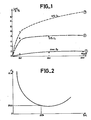
- the nickel level was chosen taking into account the fact that, in a manganese-nickel system, the resistivity decreases with an increase in the nickel rate passing through a minimum at a nickel rate of 22% in atomic percentage and that beyond this point, the resistivity increases again with the nickel content, as shown on the curve in FIG. 2.
- the nickel content will be between 20 and 33%, the upper limit being determined by the manufacturing process used. In fact, in the case of a conventional powder mixing process, the nickel content must not exceed 24% if the desired resistivity is to be obtained. In the case of a chemical process, the atomic percentage of Ni can be 33% while giving good results.
- the manganese ions are brought in the form of manganese oxide, the nickel ions in the form of nickel oxide, the copper ions in the form of copper oxide and the barium ions in the form of barium salt or oxide.
- the manganese oxide will be in the form Mn0 2 , Mn 2 0 3 , Mns0 4 or a mixture of these elements, the nickel oxide in the NiO form, copper oxide in the form CuO, Cu 2 0, the barium salt or oxide in the form BaS0 4 , BaNOa, BaCO 3 , the salt or calcium oxide in the form CaS0 4 , CaNOa, CaCOa, strontium salt or oxide in the form SrS0 4 , SrNO 3 , SrCO 3 .
- other types of oxides or salts can be envisaged.
- the CTN thermistors having the compositions given above are produced using a powder technique known per se which consists in mixing the oxide powders in a grinder mixer, in drying them, in sieving them and in pressing them in the form of a disc in a known manner, then subjecting them to sintering at a temperature preferably between 1180 ° C. and 1250 ° C., the sintering preferably being carried out in a plateau of at least one hour.
- the sintering temperature is important in the context of the present invention in order to obtain good stability of the resistivity over time.
- the CTN thermistors having the compositions given above are obtained chemically, that is to say by heating a mixed oxalate of manganese, nickel, copper and barium or strontium or calcium, or a hydrate said oxalate, in an atmosphere consisting of a mixture of an inert gas and oxygen having a reduced partial pressure of oxygen at the decomposition temperature of the oxalate, the temperature is maintained until complete decomposition of the oxalate, the product obtained is heated in an inert atmosphere to a temperature between 420 ° C and 800 ° C for a time sufficient to obtain particles having the dimensions of the specific surface desired, then the compositions are transformed ceramic particles according to the usual methods.
- Tests 1 to 10 of Table I and those of the other tables were carried out on thermistors prepared using the same process, namely a conventional process for the preparation of ceramics. Only the proportions between the various components or the sintering temperature have been modified as will be explained in each table. Tests 11 and 12 in Table 1 were carried out using the chemical method.
- each thermistor has been prepared in a conventional manner. Powders of Mna0 4 , NiO, CuO and BaCO 3 or SrCOs or CaCO s incorporated in predetermined proportions so that the atomic percentages of the ions Mn, Ni, Cu and Ba or Sr or Ca are in accordance with the present invention been mixed and ground by liquid (water) in a mill containing zirconia beads, for example in a "Turbula" mill. The grinding was carried out for approximately two hours. A solution containing a polyvinyl alcohol binder is added to the slip for 1/4 hour. The composition thus obtained was dried in an oven at 120 ° C, then sieved through a 315 micron sieve.
- the composition thus sieved was pressed in the form of discs using a hydraulic machine of known type under a pressure of between 3 and 4 tonnes / cm 2.
- the discs thus obtained are sintered at a temperature between 1180 ° C and 1250 ° C , with a stop time of a total duration of one hour.
- the sintering temperature is chosen as a function of the copper content, so as to obtain a resistivity and an A R / R ratio corresponding to those fixed.
- the powders are prepared in the following manner: the manganese, nickel, copper and barium oxalates are mixed in the proportions corresponding to the formulas indicated in Table I, Examples 11 and 12. L 'mixed oxalate obtained is thermally decomposed at 700 ° C. The powder is shaped identically to the powder process previously described. The discs thus obtained are sintered at a temperature of 1180 ° C for two hours.
- the discs are then covered with silver electrodes in a known manner and heat treated at 550 ° C.
- Table 1 gives the influence of the barium level on a composition containing 15% Cu and 22% Ni.
- the resistivity increases slightly with the barium content for a constant copper content.
- the stability of ceramics containing barium is significantly improved since with a barium content of 0.4%, a relative change in resistance of 1.9% is obtained after 1000 hours.
- Table II represents the influence of the percentage of copper when the percentage of barium is 1.6% and that of nickel 22%.
- Table III represents the influence of the sintering temperature on certain compositions of the type of those tested in Table II.
- Tables IV and V are identical to Table I and represent respectively the influence of the strontium rate and the calcium rate on the electrical characteristics of the NTC thermistors developed from the Mn, Ni, Cu system. In these tables, the thermistors are obtained using powder technology.
Landscapes
- Engineering & Computer Science (AREA)
- Microelectronics & Electronic Packaging (AREA)
- Physics & Mathematics (AREA)
- Electromagnetism (AREA)
- Thermistors And Varistors (AREA)
- Compositions Of Oxide Ceramics (AREA)
Claims (5)
Priority Applications (1)
| Application Number | Priority Date | Filing Date | Title |
|---|---|---|---|
| AT87400895T ATE57788T1 (de) | 1986-04-25 | 1987-04-17 | Zusammenstellungen fuer thermistoren mit negativen temperaturkoeffizienten. |
Applications Claiming Priority (2)
| Application Number | Priority Date | Filing Date | Title |
|---|---|---|---|
| FR8606026A FR2598021B1 (fr) | 1986-04-25 | 1986-04-25 | Compositions pour thermistances a coefficient de temperature negatif |
| FR8606026 | 1986-04-25 |
Publications (2)
| Publication Number | Publication Date |
|---|---|
| EP0243256A1 EP0243256A1 (de) | 1987-10-28 |
| EP0243256B1 true EP0243256B1 (de) | 1990-10-24 |
Family
ID=9334633
Family Applications (1)
| Application Number | Title | Priority Date | Filing Date |
|---|---|---|---|
| EP87400895A Expired - Lifetime EP0243256B1 (de) | 1986-04-25 | 1987-04-17 | Zusammenstellungen für Thermistoren mit negativen Temperaturkoeffizienten |
Country Status (4)
| Country | Link |
|---|---|
| EP (1) | EP0243256B1 (de) |
| AT (1) | ATE57788T1 (de) |
| DE (1) | DE3765684D1 (de) |
| FR (1) | FR2598021B1 (de) |
Families Citing this family (2)
| Publication number | Priority date | Publication date | Assignee | Title |
|---|---|---|---|---|
| FR2652675B1 (fr) * | 1989-10-03 | 1994-01-28 | Lcc Cie Europ Composants Electro | Composition pour thermistances a coefficient de temperature negatif et de tres faible resistivite electrique. |
| CN111606693A (zh) * | 2020-06-01 | 2020-09-01 | 东阳市聚冉电子科技有限公司 | 一种高温负温度系数热敏电阻材料的制备方法 |
Family Cites Families (4)
| Publication number | Priority date | Publication date | Assignee | Title |
|---|---|---|---|---|
| DE914748C (de) * | 1941-08-10 | 1954-07-08 | Western Electric Co | Elektrisches Widerstandsmaterial |
| BE475405A (de) * | 1942-03-27 | |||
| FR1129167A (fr) * | 1955-07-19 | 1957-01-16 | Csf | Perfectionnements aux thermistances |
| US4324702A (en) * | 1979-11-02 | 1982-04-13 | Matsushita Electric Industrial Co., Ltd. | Oxide thermistor compositions |
-
1986
- 1986-04-25 FR FR8606026A patent/FR2598021B1/fr not_active Expired - Fee Related
-
1987
- 1987-04-17 DE DE8787400895T patent/DE3765684D1/de not_active Expired - Fee Related
- 1987-04-17 EP EP87400895A patent/EP0243256B1/de not_active Expired - Lifetime
- 1987-04-17 AT AT87400895T patent/ATE57788T1/de not_active IP Right Cessation
Also Published As
| Publication number | Publication date |
|---|---|
| FR2598021B1 (fr) | 1990-10-19 |
| ATE57788T1 (de) | 1990-11-15 |
| DE3765684D1 (de) | 1990-11-29 |
| FR2598021A1 (fr) | 1987-10-30 |
| EP0243256A1 (de) | 1987-10-28 |
Similar Documents
| Publication | Publication Date | Title |
|---|---|---|
| EP1010186B1 (de) | Varistoren auf basis von durch mechanische zerkleinerung hergestellten nanokristallpulvern | |
| EP0866040A1 (de) | Manganoxid-Material mit Mn03 als Matrix | |
| FR2462018A1 (fr) | Cathode a reserve | |
| EP0243256B1 (de) | Zusammenstellungen für Thermistoren mit negativen Temperaturkoeffizienten | |
| CA2702021A1 (fr) | Utilisation de la technique de frittage flash pour la synthese et la densification d'iodoapatites | |
| FR2490210A1 (fr) | Melange de depart pour une composition fortement resistante, encre serigraphiable constituee avec et circuits electriques ainsi realises | |
| US4659588A (en) | Method of producing optical recording medium | |
| EP0290311B1 (de) | Sinterverbundmaterial für elektrische Kontakte und Kontaktpastille mit Anwendung des genannten Materials | |
| FR2620864A1 (fr) | Materiaux supraconducteurs et leur procede de preparation | |
| EP0088009A1 (de) | Temperaturstabile dielektrische keramische Zusammensetzung auf Basis von Bariumtitanat und Kondensator mit dieser Zusammensetzung | |
| EP0218278B1 (de) | Verfahren zur Herstellung einer katalytischen Schicht für eine Brennstoffzellenelektrode | |
| EP0067092B1 (de) | Dielektrische Keramikzusammensetzung auf der Basis von Bariumtitanat, Lithiumoxid und Kupferfluorid, Kondensator diese Zusammensetzung verwendend und Verfahren zur Herstellung der Zusammensetzung | |
| EP0034512A2 (de) | Heizungselement für indirekt geheizte Kathoden, Herstellungsverfahren eines solchen Elements und indirekt geheizte Kathode, die solch ein Element enthält | |
| FR2652675A1 (fr) | Composition pour thermistances a coefficient de temperature negatif et de tres faible resistivite electrique. | |
| FR2644779A1 (fr) | Composition ceramique a constante dielectrique elevee | |
| EP0079385A1 (de) | Abgeschirmtes heizelement und dessen herstellungsverfahren | |
| EP0067736A1 (de) | Dielektrische Keramikzusammensetzung auf der Basis von Bariumtitanat, Lithiumoxid und Cadmiumfluorid, diese Zusammensetzung verwendender Kondensator und Verfahren zur Herstellung der Zusammensetzung | |
| FR2678605A1 (fr) | Composition de ceramique dielectrique. | |
| FR2620865A1 (fr) | Procede de preparation de supraconducteurs et produits ainsi obtenus | |
| EP0394107B1 (de) | Dielektrische keramische Zusammensetzung auf der Basis von Ferriten und Verfahren zu ihrer Herstellung | |
| CA2299167C (fr) | Varistances a base de poudres nanocristallines produites par broyage mecanique intense | |
| RU2159970C1 (ru) | Способ изготовления электрического контакта из композиции серебро-оксид цинка | |
| EP0375518A1 (de) | Dielektrische Keramikzusammensetzung mit hoher Dielektrizitätskonstante und Beständigkeit und Kondensator | |
| EP0229555B1 (de) | Ferroelektrische Werkstoffzusammensetzung | |
| EP2016596B1 (de) | Verwendung von b2o3 in einer halbleitenden keramik auf der basis von zinnoxid zur verringerung des leckstroms und zur stabilisierung der elektrischen eigenschaften |
Legal Events
| Date | Code | Title | Description |
|---|---|---|---|
| PUAI | Public reference made under article 153(3) epc to a published international application that has entered the european phase |
Free format text: ORIGINAL CODE: 0009012 |
|
| AK | Designated contracting states |
Kind code of ref document: A1 Designated state(s): AT BE DE FR GB |
|
| 17P | Request for examination filed |
Effective date: 19871109 |
|
| 17Q | First examination report despatched |
Effective date: 19890202 |
|
| GRAA | (expected) grant |
Free format text: ORIGINAL CODE: 0009210 |
|
| AK | Designated contracting states |
Kind code of ref document: B1 Designated state(s): AT BE DE FR GB |
|
| REF | Corresponds to: |
Ref document number: 57788 Country of ref document: AT Date of ref document: 19901115 Kind code of ref document: T |
|
| REF | Corresponds to: |
Ref document number: 3765684 Country of ref document: DE Date of ref document: 19901129 |
|
| GBT | Gb: translation of ep patent filed (gb section 77(6)(a)/1977) | ||
| PLBE | No opposition filed within time limit |
Free format text: ORIGINAL CODE: 0009261 |
|
| STAA | Information on the status of an ep patent application or granted ep patent |
Free format text: STATUS: NO OPPOSITION FILED WITHIN TIME LIMIT |
|
| 26N | No opposition filed | ||
| PGFP | Annual fee paid to national office [announced via postgrant information from national office to epo] |
Ref country code: GB Payment date: 19940321 Year of fee payment: 8 |
|
| PGFP | Annual fee paid to national office [announced via postgrant information from national office to epo] |
Ref country code: DE Payment date: 19940326 Year of fee payment: 8 |
|
| PGFP | Annual fee paid to national office [announced via postgrant information from national office to epo] |
Ref country code: BE Payment date: 19940406 Year of fee payment: 8 |
|
| PGFP | Annual fee paid to national office [announced via postgrant information from national office to epo] |
Ref country code: AT Payment date: 19940429 Year of fee payment: 8 |
|
| PG25 | Lapsed in a contracting state [announced via postgrant information from national office to epo] |
Ref country code: GB Effective date: 19950417 Ref country code: AT Effective date: 19950417 |
|
| PG25 | Lapsed in a contracting state [announced via postgrant information from national office to epo] |
Ref country code: BE Effective date: 19950430 |
|
| BERE | Be: lapsed |
Owner name: CIE EUROPEENNE DE COMPOSANTS ELECTRONIQUES LCC Effective date: 19950430 |
|
| GBPC | Gb: european patent ceased through non-payment of renewal fee |
Effective date: 19950417 |
|
| PG25 | Lapsed in a contracting state [announced via postgrant information from national office to epo] |
Ref country code: DE Effective date: 19960103 |
|
| PGFP | Annual fee paid to national office [announced via postgrant information from national office to epo] |
Ref country code: FR Payment date: 19970422 Year of fee payment: 11 |
|
| PG25 | Lapsed in a contracting state [announced via postgrant information from national office to epo] |
Ref country code: FR Free format text: THE PATENT HAS BEEN ANNULLED BY A DECISION OF A NATIONAL AUTHORITY Effective date: 19980430 |
|
| REG | Reference to a national code |
Ref country code: FR Ref legal event code: ST |