EP0242445A2 - Vorrichtung mit zwei aus einer einzigen Quelle stammenden Lasererregungsbündeln - Google Patents
Vorrichtung mit zwei aus einer einzigen Quelle stammenden Lasererregungsbündeln Download PDFInfo
- Publication number
- EP0242445A2 EP0242445A2 EP86117397A EP86117397A EP0242445A2 EP 0242445 A2 EP0242445 A2 EP 0242445A2 EP 86117397 A EP86117397 A EP 86117397A EP 86117397 A EP86117397 A EP 86117397A EP 0242445 A2 EP0242445 A2 EP 0242445A2
- Authority
- EP
- European Patent Office
- Prior art keywords
- light
- laser
- excitation
- lines
- cells
- Prior art date
- Legal status (The legal status is an assumption and is not a legal conclusion. Google has not performed a legal analysis and makes no representation as to the accuracy of the status listed.)
- Withdrawn
Links
- 230000005284 excitation Effects 0.000 title claims abstract description 40
- 230000009977 dual effect Effects 0.000 title claims abstract description 18
- 238000000684 flow cytometry Methods 0.000 claims abstract description 26
- 238000005286 illumination Methods 0.000 claims abstract description 15
- 230000003595 spectral effect Effects 0.000 claims description 11
- 239000007788 liquid Substances 0.000 claims description 6
- 238000012544 monitoring process Methods 0.000 claims description 6
- 230000001276 controlling effect Effects 0.000 claims 2
- XKRFYHLGVUSROY-UHFFFAOYSA-N Argon Chemical compound [Ar] XKRFYHLGVUSROY-UHFFFAOYSA-N 0.000 description 39
- 239000002245 particle Substances 0.000 description 31
- 210000004027 cell Anatomy 0.000 description 24
- 229910052786 argon Inorganic materials 0.000 description 20
- 230000003287 optical effect Effects 0.000 description 15
- 238000000034 method Methods 0.000 description 8
- 238000000926 separation method Methods 0.000 description 6
- 238000004458 analytical method Methods 0.000 description 5
- MPLHNVLQVRSVEE-UHFFFAOYSA-N texas red Chemical compound [O-]S(=O)(=O)C1=CC(S(Cl)(=O)=O)=CC=C1C(C1=CC=2CCCN3CCCC(C=23)=C1O1)=C2C1=C(CCC1)C3=[N+]1CCCC3=C2 MPLHNVLQVRSVEE-UHFFFAOYSA-N 0.000 description 5
- 238000002834 transmittance Methods 0.000 description 5
- 108010004729 Phycoerythrin Proteins 0.000 description 4
- 108010004469 allophycocyanin Proteins 0.000 description 4
- 230000004888 barrier function Effects 0.000 description 4
- 238000013461 design Methods 0.000 description 4
- MHMNJMPURVTYEJ-UHFFFAOYSA-N fluorescein-5-isothiocyanate Chemical compound O1C(=O)C2=CC(N=C=S)=CC=C2C21C1=CC=C(O)C=C1OC1=CC(O)=CC=C21 MHMNJMPURVTYEJ-UHFFFAOYSA-N 0.000 description 4
- 238000001943 fluorescence-activated cell sorting Methods 0.000 description 4
- 230000005540 biological transmission Effects 0.000 description 3
- 230000001413 cellular effect Effects 0.000 description 3
- 239000006185 dispersion Substances 0.000 description 3
- 239000012530 fluid Substances 0.000 description 3
- 238000011835 investigation Methods 0.000 description 3
- 238000011527 multiparameter analysis Methods 0.000 description 3
- 230000000087 stabilizing effect Effects 0.000 description 3
- VYPSYNLAJGMNEJ-UHFFFAOYSA-N Silicium dioxide Chemical compound O=[Si]=O VYPSYNLAJGMNEJ-UHFFFAOYSA-N 0.000 description 2
- GWEVSGVZZGPLCZ-UHFFFAOYSA-N Titan oxide Chemical compound O=[Ti]=O GWEVSGVZZGPLCZ-UHFFFAOYSA-N 0.000 description 2
- 239000003086 colorant Substances 0.000 description 2
- 230000007812 deficiency Effects 0.000 description 2
- 238000000295 emission spectrum Methods 0.000 description 2
- 238000001914 filtration Methods 0.000 description 2
- 238000011002 quantification Methods 0.000 description 2
- RYGMFSIKBFXOCR-UHFFFAOYSA-N Copper Chemical compound [Cu] RYGMFSIKBFXOCR-UHFFFAOYSA-N 0.000 description 1
- 239000006096 absorbing agent Substances 0.000 description 1
- 238000010521 absorption reaction Methods 0.000 description 1
- 238000009825 accumulation Methods 0.000 description 1
- 238000013459 approach Methods 0.000 description 1
- -1 argon ion Chemical class 0.000 description 1
- 230000008859 change Effects 0.000 description 1
- 239000003153 chemical reaction reagent Substances 0.000 description 1
- 230000001427 coherent effect Effects 0.000 description 1
- 239000010949 copper Substances 0.000 description 1
- 229910052802 copper Inorganic materials 0.000 description 1
- 230000003247 decreasing effect Effects 0.000 description 1
- 230000001419 dependent effect Effects 0.000 description 1
- 238000001514 detection method Methods 0.000 description 1
- 238000011161 development Methods 0.000 description 1
- 238000001917 fluorescence detection Methods 0.000 description 1
- 238000002955 isolation Methods 0.000 description 1
- 238000005086 pumping Methods 0.000 description 1
- 230000005855 radiation Effects 0.000 description 1
- 238000011160 research Methods 0.000 description 1
- 230000004044 response Effects 0.000 description 1
- 210000001995 reticulocyte Anatomy 0.000 description 1
- PYWVYCXTNDRMGF-UHFFFAOYSA-N rhodamine B Chemical group [Cl-].C=12C=CC(=[N+](CC)CC)C=C2OC2=CC(N(CC)CC)=CC=C2C=1C1=CC=CC=C1C(O)=O PYWVYCXTNDRMGF-UHFFFAOYSA-N 0.000 description 1
- 235000012239 silicon dioxide Nutrition 0.000 description 1
- 239000000377 silicon dioxide Substances 0.000 description 1
- 238000001228 spectrum Methods 0.000 description 1
- 239000000758 substrate Substances 0.000 description 1
- 239000004408 titanium dioxide Substances 0.000 description 1
- 238000001429 visible spectrum Methods 0.000 description 1
Images


Classifications
-
- H—ELECTRICITY
- H01—ELECTRIC ELEMENTS
- H01S—DEVICES USING THE PROCESS OF LIGHT AMPLIFICATION BY STIMULATED EMISSION OF RADIATION [LASER] TO AMPLIFY OR GENERATE LIGHT; DEVICES USING STIMULATED EMISSION OF ELECTROMAGNETIC RADIATION IN WAVE RANGES OTHER THAN OPTICAL
- H01S3/00—Lasers, i.e. devices using stimulated emission of electromagnetic radiation in the infrared, visible or ultraviolet wave range
- H01S3/23—Arrangements of two or more lasers not provided for in groups H01S3/02 - H01S3/22, e.g. tandem arrangements of separate active media
- H01S3/2383—Parallel arrangements
-
- G—PHYSICS
- G01—MEASURING; TESTING
- G01N—INVESTIGATING OR ANALYSING MATERIALS BY DETERMINING THEIR CHEMICAL OR PHYSICAL PROPERTIES
- G01N15/00—Investigating characteristics of particles; Investigating permeability, pore-volume or surface-area of porous materials
- G01N15/10—Investigating individual particles
- G01N15/14—Optical investigation techniques, e.g. flow cytometry
- G01N15/1425—Optical investigation techniques, e.g. flow cytometry using an analyser being characterised by its control arrangement
- G01N15/1427—Optical investigation techniques, e.g. flow cytometry using an analyser being characterised by its control arrangement with the synchronisation of components, a time gate for operation of components, or suppression of particle coincidences
-
- H—ELECTRICITY
- H01—ELECTRIC ELEMENTS
- H01S—DEVICES USING THE PROCESS OF LIGHT AMPLIFICATION BY STIMULATED EMISSION OF RADIATION [LASER] TO AMPLIFY OR GENERATE LIGHT; DEVICES USING STIMULATED EMISSION OF ELECTROMAGNETIC RADIATION IN WAVE RANGES OTHER THAN OPTICAL
- H01S3/00—Lasers, i.e. devices using stimulated emission of electromagnetic radiation in the infrared, visible or ultraviolet wave range
- H01S3/10—Controlling the intensity, frequency, phase, polarisation or direction of the emitted radiation, e.g. switching, gating, modulating or demodulating
- H01S3/13—Stabilisation of laser output parameters, e.g. frequency or amplitude
-
- G—PHYSICS
- G01—MEASURING; TESTING
- G01N—INVESTIGATING OR ANALYSING MATERIALS BY DETERMINING THEIR CHEMICAL OR PHYSICAL PROPERTIES
- G01N15/00—Investigating characteristics of particles; Investigating permeability, pore-volume or surface-area of porous materials
- G01N15/10—Investigating individual particles
- G01N15/14—Optical investigation techniques, e.g. flow cytometry
- G01N15/149—Optical investigation techniques, e.g. flow cytometry specially adapted for sorting particles, e.g. by their size or optical properties
-
- G—PHYSICS
- G01—MEASURING; TESTING
- G01N—INVESTIGATING OR ANALYSING MATERIALS BY DETERMINING THEIR CHEMICAL OR PHYSICAL PROPERTIES
- G01N15/00—Investigating characteristics of particles; Investigating permeability, pore-volume or surface-area of porous materials
- G01N15/10—Investigating individual particles
- G01N15/14—Optical investigation techniques, e.g. flow cytometry
- G01N15/1434—Optical arrangements
- G01N2015/1438—Using two lasers in succession
-
- G—PHYSICS
- G01—MEASURING; TESTING
- G01N—INVESTIGATING OR ANALYSING MATERIALS BY DETERMINING THEIR CHEMICAL OR PHYSICAL PROPERTIES
- G01N15/00—Investigating characteristics of particles; Investigating permeability, pore-volume or surface-area of porous materials
- G01N15/10—Investigating individual particles
- G01N15/14—Optical investigation techniques, e.g. flow cytometry
- G01N2015/1477—Multiparameters
-
- G—PHYSICS
- G01—MEASURING; TESTING
- G01N—INVESTIGATING OR ANALYSING MATERIALS BY DETERMINING THEIR CHEMICAL OR PHYSICAL PROPERTIES
- G01N15/00—Investigating characteristics of particles; Investigating permeability, pore-volume or surface-area of porous materials
- G01N15/10—Investigating individual particles
- G01N15/14—Optical investigation techniques, e.g. flow cytometry
- G01N2015/1497—Particle shape
-
- G—PHYSICS
- G01—MEASURING; TESTING
- G01N—INVESTIGATING OR ANALYSING MATERIALS BY DETERMINING THEIR CHEMICAL OR PHYSICAL PROPERTIES
- G01N21/00—Investigating or analysing materials by the use of optical means, i.e. using sub-millimetre waves, infrared, visible or ultraviolet light
- G01N21/62—Systems in which the material investigated is excited whereby it emits light or causes a change in wavelength of the incident light
- G01N21/63—Systems in which the material investigated is excited whereby it emits light or causes a change in wavelength of the incident light optically excited
- G01N21/64—Fluorescence; Phosphorescence
- G01N2021/6417—Spectrofluorimetric devices
- G01N2021/6421—Measuring at two or more wavelengths
-
- G—PHYSICS
- G01—MEASURING; TESTING
- G01N—INVESTIGATING OR ANALYSING MATERIALS BY DETERMINING THEIR CHEMICAL OR PHYSICAL PROPERTIES
- G01N21/00—Investigating or analysing materials by the use of optical means, i.e. using sub-millimetre waves, infrared, visible or ultraviolet light
- G01N21/17—Systems in which incident light is modified in accordance with the properties of the material investigated
- G01N21/47—Scattering, i.e. diffuse reflection
- G01N21/49—Scattering, i.e. diffuse reflection within a body or fluid
- G01N21/53—Scattering, i.e. diffuse reflection within a body or fluid within a flowing fluid, e.g. smoke
-
- G—PHYSICS
- G01—MEASURING; TESTING
- G01N—INVESTIGATING OR ANALYSING MATERIALS BY DETERMINING THEIR CHEMICAL OR PHYSICAL PROPERTIES
- G01N21/00—Investigating or analysing materials by the use of optical means, i.e. using sub-millimetre waves, infrared, visible or ultraviolet light
- G01N21/62—Systems in which the material investigated is excited whereby it emits light or causes a change in wavelength of the incident light
- G01N21/63—Systems in which the material investigated is excited whereby it emits light or causes a change in wavelength of the incident light optically excited
- G01N21/64—Fluorescence; Phosphorescence
- G01N21/6428—Measuring fluorescence of fluorescent products of reactions or of fluorochrome labelled reactive substances, e.g. measuring quenching effects, using measuring "optrodes"
-
- H—ELECTRICITY
- H01—ELECTRIC ELEMENTS
- H01S—DEVICES USING THE PROCESS OF LIGHT AMPLIFICATION BY STIMULATED EMISSION OF RADIATION [LASER] TO AMPLIFY OR GENERATE LIGHT; DEVICES USING STIMULATED EMISSION OF ELECTROMAGNETIC RADIATION IN WAVE RANGES OTHER THAN OPTICAL
- H01S2301/00—Functional characteristics
- H01S2301/08—Generation of pulses with special temporal shape or frequency spectrum
-
- H—ELECTRICITY
- H01—ELECTRIC ELEMENTS
- H01S—DEVICES USING THE PROCESS OF LIGHT AMPLIFICATION BY STIMULATED EMISSION OF RADIATION [LASER] TO AMPLIFY OR GENERATE LIGHT; DEVICES USING STIMULATED EMISSION OF ELECTROMAGNETIC RADIATION IN WAVE RANGES OTHER THAN OPTICAL
- H01S3/00—Lasers, i.e. devices using stimulated emission of electromagnetic radiation in the infrared, visible or ultraviolet wave range
- H01S3/05—Construction or shape of optical resonators; Accommodation of active medium therein; Shape of active medium
- H01S3/08—Construction or shape of optical resonators or components thereof
- H01S3/08086—Multiple-wavelength emission
- H01S3/0809—Two-wavelenghth emission
Definitions
- the present invention relates to a dual laser excitation apparatus with a single laser source, and more particularly, concerns a flow cytometry apparatus for determining characteristics of cells or the like.
- lasers are employed as light sources.
- One such application of lasers is in flow cytometry apparatuses.
- a flow cytometry apparatus cells or other particles are passed in a liquid flow stream so that one or more characteristics of the cells under investigation may be determined.
- Cellular analysis by reliance on optical investigation is a commonly used technique in flow cytometry apparatuses.
- an incident beam of light is directed at the stream of cells as they pass through the apparatus.
- the passing cells scatter the light as they pass through the light beam. Scattered light has served as a function of cell shape, index of refraction, opacity, roughness and the like.
- fluorescence emitted by labeled cells which have been excited as a result of passing through the excitation energy of the incident light beam is detectable for identification of specifically labeled cells.
- Lasers have been used as the source of the incident beam of illumination in flow cytometry apparatuses.
- Multi-parameter analysis of cells is a tool which provides significantly more information about individual cells in order to understand the characteristics of such cells.
- One technique for improving multi-parameter analysis is the multiple fluorescence detection with respect to the cells under investigation.
- a single light source such as a laser
- the increased need for multiple labels and the requirement that the absorption of the label match the wavelength of the laser has brought about development of systems which employ two lasers in order to excite two or more distinguishable fluorescent markers. Apparatuses utilizing two lasers for cellular analysis are described, for example, in U.S. Patent No. 3,826,364 and 4,284,4l2.
- Dual laser systems also permits the multi-parameter cell analysis and sorting with three or four different fluorochromes.
- One such dual laser system known as the FACS 440 Cell Sorter manufactured and sold by Becton Dickinson Immunocytometry Systems, Mt. View, California, relies upon a common lens system for collecting fluorescence emission from all fluorochromes, after which individual colors are separated by means of appropriate combinations of dichroic filters, mirrors and beam splitters.
- This flow cytometry system is described in commonly assigned patent application Serial No. 482,345 (EP-A-121 262).
- the two laser excitation sources have sufficient separation both spectrally and spatially.
- spectral separation it is meant that the second laser excitation wavelength should be outside the acceptance window of the emission filters for cells excited by the first laser.
- spatial separation is achieved by directing the two lasers so that the respective focal points on the cell stream are vertically displaced by about 200-250 microns.
- the pulses from the two lasers are thus time-separated.
- Spatial separation occurs by placing a high reflectance mirror in the optical emission path near a magnified image of the stream. This so-called split mirror is positioned so that emission from the first laser passes beyond the mirror's edge, while emission from the second laser is intercepted and reflected into an alternate path.
- Further spectral separation of the individual emission channels in the two spatially separated beams is accomplished by placing an appropriate dichroic in each light beam.
- Adequate spectral separation of the excitation light sources has been obtained by using a visible laser, such as an argon laser, in single line mode as a primary laser, and a dye laser with a multi-line argon pump as the secondary laser.
- the primary laser may be adjusted to one of the visible argon lines between, for example, 457.9 nm and 5l4.5 nm, while the secondary laser uses a dye, such as for example, R6G which may be adjusted to output a line between 580 nm and 640 nm.
- the primary laser which may, for example, be set at 488 nm, excites two fluorochromes, such as fluorescein isothiocyanate (FITC) and phycoerythrin (PE) which emit fluorescence at 520 nm and 575 nm, respectively.
- the dye laser which may, for example, be set 598 nm, excites two additional stains such as Texas red (TR) and allo-phycocyanin (A-PC) with corresponding emission peaks at 625 nm and 660 nm, respectively.
- any system which spectrally splits up a single pump into two separate sources can accept feedback from only one of the final output lines as input current control.
- at least one of the incident sources will be less stable than the normal dual laser system.
- present systems which make no provision for independent focusing of the argon and dye optical paths onto the cell stream, result in a less than optimum focus of one of the two beams.
- the need for independent focus adjustment is occasioned by the substantially unequal output beam divergence of the respective pump and dye lasers.
- One dye laser system which is manufactured by Coherent Inc. of Palo Alto, California, has a pump output divergence of 0.00048 radians at 488 nm, and a dye output divergence of 0.00l5 radians at 600 nm. Such a system cannot be simultaneously focused by a single lens, even a well corrected achromat.
- the dual laser excitation apparatus of the present invention comprises a first laser for providing a first beam of light with a plurality of energy lines. Means are provided for dividing the first beam of light into two portions. Dispersive means separates spectral lines of one portion of the divided light beam and directs at least one of the spectrally separated lines to a first area of illumination. A second laser is positioned to receive the other portion of the divided light beam and is adapted to be energized thereby to produce a second beam of light directed to a second area of illumination.
- a flow cytometry apparatus determines one or more characteristics of particles or the like flowing in a liquid stream.
- the flow cytometry apparatus comprises means for moving particles, substantially one at a time, in a liquid flow stream.
- Means provides a first beam of light with a plurality of energy lines.
- Means divides the first beam of light into two portions.
- Means separates spectral lines of one portion of the divided light beam and directs at least one of the spectrally separated lines toward the particles moving in the stream to provide a first area of illumination therefor.
- Means receives the other portion of the divided light beam and is energized thereby to produce a second beam of light directed toward the particles moving in the stream to provide a second area of illumination therefor.
- Means detects light with respect to each moving particle and associates the detected light with one or more characteristics of each particle. Further means are preferably included for intercepting and sensing a small portion of said spectrally separated lines and for adjusting said detecting means to compensate for observed intensity fluctuations.
- the present invention provides a versatile, efficient two-line system, both lines of which are easily and independently adjustable, while utilizing a single argon laser as both a primary excitation source and as the pump for a secondary excitation source.
- the present invention realizes performance substantially equivalent to that of a full-blown dual laser system using two separate lasers, while relying on a single dye laser system plus additional optics and elements.
- Significant economic savings are realized by constructing a dye laser system in accordance with the present invention.
- the dual line system of the present invention is intended primarily for three and four color fluorescence applications where, as mentioned above, the primary line may be set at 488 nm to excite FITC and PE, and the secondary line may be set at approximately 598 nm to excite either TR or TR and A-PC. Furthermore, as an indication that the present invention represents a complete dual line system, provisions are made for the operator to be able to easily change excitation wavelengths of either the primary or secondary lines for other applications. For example, for DNA applications a commonly used stain may be excited with the 457.9 argon line. In addition, RNA content may be determined by counting reticulocytes using a known reagent which is also excited at 457.9 nm. Other applications prefer the 5l4.5 nm line, and so on.
- the optical and flow elements of Fig. l represent the major components of a flow cytometry instrument for flowing particles in a liquid stream, substantially one at a time, in order to analyze those particles for specific characteristics thereof.
- the elements of the device of Fig. l may be included in a FACS fluorescence-activated cell sorter manufactured and sold by Becton Dickinson Immunocytometry Systems, Mt. View, California.
- the FACS Cell Sorter analyzes and separates cell populations on the basis of light scatter and fluorescence in a wide variety of research laboratory applications.
- laser l2 be a multi-line laser, such as an argon ion laser.
- a suitable multi-line argon laser may be adjusted to provide output lines at discreet wavelengths between 457.9 and 5l4.5 nm.
- lasers at other wavelengths may also be utilized for purposes of the present invention.
- the output of multi-line laser l2 be vertically polarized and in the TEMoo mode. These characteristics allow some of the pump lines of laser l2 to be directly available for a primary excitation line.
- Light beam l6 emerging from laser l2 strikes a long pass dichroic l8 which transmits some of the light and also reflects some of the light.
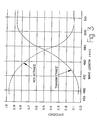
- the transmission and reflectance characteristics of the long pass dichroic are illustrated in Fig. 3, where it can be seen that both transmittance and reflectance performance of the dichroic is dependent on the wavelengths of the light striking the dichroic.
- Light reflected off dichroic l8 is designated by numeral l9 while light transmitted through dichroic l8 is designated by numeral 20.
- a pair of internally reflecting turning prisms 2l is provided so that light beam l9 is directed to a light dispersing element 22.
- element 22 be a very fine-lined, deeply modulated, diffraction grating as part of a monochromator configuration for separating spectral lines from the pump laser, as will be described more fully hereinafter. From grating element 22, the diffracted argon line of interest is isolated by means of an intermediate focusing/collimating lens and slit system 24 and directed to lens 32 for focusing at region 28 in the stream of flowing particles.
- dye laser 29 approximately two thirds of the pump output energy strongly favoring the longer wavelengths (as seen in Fig. 3) is transmitted and is used to pump a dye laser 29.
- Output of dye laser 29 is selected to cover a region of the visible spectrum so as to be substantially separated in wavelength from the spectral region of laser l2.
- One such laser which satisfies this requirement is a rhodamine 6-G dye laser which has a primary emission at approximately 598 nm.
- the output lines from dye laser 29 may be directed by means of internally reflecting prisms 23 toward lens 32 with a slight downward trajectory relative to the argon beam so as to be focused onto region 34 in the stream of flowing particles.
- a nozzle 40 incorporated within flow cytometry device l0 of the present invention, facilitates the flowing of particles within the fluid stream 38.
- the utilization of a nozzle of this type is well-known and is described, for example, in U.S. Patent No. 3,826,364.
- the two laser-particle-stream intersections, designated by numerals 28 and 34 are spaced approximately 200-250 microns apart.
- the fluid stream later breaks into droplets 4l which may be deflected for cell sorting.
- a particle flowing in stream 38 first flows through focused light region 28 after the particle emerges from nozzle 40.
- Unscattered laser light passing through light region 28 strikes the light-scatter obscuration bar 42 on the optical axis of the light-scatter channel.
- Scattered light, collected by the lens 44 passes through a first iris 45 which determines the maximum angle of scattered light collected.
- first iris 45 is a beam splitting mirror 46 which reflects a percentage of the incident light toward scatter detector 48, and transmits the remaining percentage of the incident light onto a light absorber (not shown).
- a second iris 49 functions as a field stop to restrict the source of scattered light to the point of intersection represented by focal region 28. After passing through filter 50, the scattered light is detected in detector 48.
- This detector functions electrically to assess the size of the particles flowing in the fluid stream according to well-known techniques. It is understood that the light scatter features herein described are merely included to round out the features of a typical flow cytometry device which may rely upon light scatter to obtain information from particles passing through the light beams.
- light from dye laser 29 is also directed at flowing stream 38 to focal region 34, which is vertically displaced from focal region 28 along the vertical axis of the stream.
- Light from the dye laser scattered by a particle is picked up by the scatter-channel optics, but is preferably blocked from detector 48 by the dielectric filter placed in the scatter channel.
- illumination provided by the different wavelength operation of the lasers is available for sequential excitation of fluorochromes having substantially separated emission spectra.
- At least one, but preferably two or more, immunofluorescent stains having different emission spectra are excited by the excitation energy provided by the light energy of each laser.
- the two independent laser beams intersect stream 38 at focal regions 28 and 34 vertically spaced so that a particle crosses region 28 first, and then region 34.
- two pairs of optical signals may be generated by the particles passing through the light beams. These pairs of signals are preferably spaced in time by the time required for the particle to travel from the first beam intersection point to the second beam intersection point.
- This time spacing permits the pairs of signals to be separately analyzed giving signals proportional to the fluorescence emissions of the particles when excited at the two different excitation wavelengths.
- Fluorescence radiation emitted from the particles is directed around obscuration bar 54 which blocks refracted light from the separated beams. All fluorescence signals are focused by lens 55 near a first beam splitter 56.
- beam splitter 56 is a high reflectance mirror positioned in the optical path in such a way that only emission from region 34 is intercepted and reflected, while emission from region 28 passes below beam splitter 56 into an alternate path.
- dichroic mirror 57 The purpose of dichroic mirror 57 is to separate two different colors traveling along the fluorescence light path so that they may be analyzed separately.
- dichroic mirror 57 would be selected to separate, for example, the different color wavelengths of particles excited in region 28.
- wavelengths in the green region would be transmitted through dichroic mirror 57 and then through a barrier filter 59 which is designed to transmit wavelengths of only one color region, in this instance, green. Green light then enters a fluorescence detector 60.
- dichroic mirror 57 Light encountering dichroic mirror 57 in the yellow region, for example, would be reflected by the dichroic mirror through a barrier filter 6l which transmits wavelengths of only one color region in this case, yellow. A fluorescence detector 62 then receives this yellow light.
- Light focused in light region 34 also provides excitation energy at a single wavelength sufficient to excite up to two fluorochromes different from those excited in light region 28.
- this light encounters another dichroic mirror 58.
- the second dichroic mirror 58 is selected to separate the wavelengths of two different regions of the color spectrum. For example, both red and far red signals may be generated as a result of the particles passing through excitation region 34. Wavelengths in the red region would be transmitted through dichroic mirror 58 and then through a barrier filter 63 which is designed to transmit wavelengths of only the red region.
- This light is then directed to a fluorescence detector 64. Wavelengths in the far red region would be reflected by dichroic mirror 58 through a barrier filter 65, whereupon this light enters fluorescence detector 66. Accordingly, it can be seen that light from two lasers, each of which may excite two or more fluorochromes at the respective wavelengths of operation of each, allows the detection and quantification of multiple subpopulations of particles in a sample during a single pass of that sample in a flow cytometry device such as described.
- Fluorescence detectors 60,62,64 and 66 are provided to preferably receive the four separated green, yellow, red and far red light paths, respectively. These fluorescence detectors may be low-noise photomultiplier tubes or the like which convert optical signals into electrical signals. Although not shown in Fig. l, these electrical signals are then fed electrically to be processed by the electronics of the flow cytometry device for analysis or other purposes. Various displays, information presentation, accumulation or recordation may be provided in the flow cytometry device. Similarly, the particles having specific characteristics may be separated and sorted in accordance with the techniques taught in U.S. Patent No. 3,826,364.
- Fig. 2 taken in conjunction with Fig. l.
- dichroic l8 intercepts the multi-line pump in the space between the pump head and the dye head. It is preferred that dichroic l8 be composed of a simple high-low dielectric stack of non-absorbing layers. The number of layers, of course, depends upon the design requirements of the apparatus.
- the desired excitation line of the primary laser is preferably set at 488 nm, while the excitation line of the secondary, dye laser is set at 598 nm.
- the transmittance through dichroic l8, for example at 5l4.5 nm should be high so that the dye laser efficiency is not significantly decreased.
- Approximately ideal reflectance specifications would be between l0% and l5% at 5l4.5 nm, between 40% and 50% at 488 nm, and greater than 95% at 458 nm.
- One design which functions satisfactorily to meet the specifications includes a dichroic with a stack of between ll and l5 non-absorbing layers, each made from titanium dioxide and/or silicon dioxide. With 3 watts of pump power, the resultant power levels of the various argon lines after reflection and transmission are illustrated in Fig. 2.
- Reflecting prisms 2l are mounted within apparatus l0 so as to be turnable to adjust the position of reflected beam l9 onto diffraction grating 22.
- the diffraction grating is also adjustably mounted within the flow cytometry apparatus. It is preferred that the diffraction grating be a flat, reflection type with about l500 to 2000 lines per millimeter. It may be either a ruled grating with a 500 nm blaze or a holographically recorded modulated grating.
- a Bausch and Lomb ruled grating with l700 lines per millimeter provides efficiencies at 458,488 and 5l4 nm of 86%, 84% and 77%, respectively, for linearly polarized light with the vector parallel to the grating lines.
- the wavelength may be changed by simply rotating grating 22 about an axis parallel to the lines. Such rotation may be performed by an operator of the apparatus turning a simple micrometer lead screw as an external adjustment.
- lens assembly 24 From grating 22, light is directed to a lens assembly, designated by numeral 24.
- This lens assembly includes a first air-spaced achromatic lens 25. Light is focused by this lens to a diffraction limited spot on a slit 26 whose width is preferably between two and three times wider than the l/e2 width of the focal waist.
- the lens focal length is 48 mm
- the focal waist at 488 nm is approximately 20 microns
- the slit width is approximately 50 microns.
- a second lens 27 is included in lens assembly 24 which can be adjusted so that the output beam divergence of the filtered laser line is appropriate for focusing simultaneously with the dye laser beam onto the stream of flowing particles 38 by means of lens 32.
- the monochromator optics such as the prisms and lens entrance and exit surfaces, are all anti-reflection coated for 0.995 or greater transmittance at the argon wavelength.
- the diffraction grating whether a holographically recorded or ruled type, may be replicated on a copper substrate so that the energy densities, even with a 5.0 watt pump, should not present a threshold problem.
- the slit-function half widths of the present invention may be compared with the bandwidth of narrow line interference filters.
- the present system may have a half width of 0.5 nm and an 84% peak efficiency at 488 nm.
- An interference filter with a l0 nm half width normally has a peak efficiency of 40 to 50%.
- Such an interference filter with a l nm bandwidth has an efficiency of from l5 to 30%. Accordingly, the grating monochromator scheme of the present invention provides significantly higher efficiencies than interference filters.
- the preferred configuration of a diffraction grating with l700 lines per millimeter and a 3.0 watt multi-line argon pump provides an output at 488 nm of approximately 320 mw, and at 598 nm from the dye laser of approximately 280 mw.
- adjusting the primary line to 457.9 nm results in an approximate output of l50 mw, which is still quite respectable. If a 5.0 watt multi-line argon pump is used, over 500 mw at 488 nm and 598 nm, and over 250 mw at 457.9 nm, could be expected.
- a diode monitoring and feedback system commonly referred to as "light control" is used.
- a small amount of light is picked off at the output of the laser and continuously monitored by a photodiode detector.
- the variation of this signal is then used as feedback to control the input current of the laser.
- the total integrated output power is quite constant with time.
- optical pickoff elements are included for separately monitoring a small amount of the output light from each beam.
- a small amount of reflected light l9 coming from diffraction grating 22, is picked off after passing through slit 26, and continuously monitored by a diode detector 75.
- the multi-line pickoff at the laser output is removed, and the observed intensity variations of photodiode 75 may be used to control the input current of multi-line pump l2. Accordingly, short wavelength excitation may be stabilized as a result of the feedback to the multi-line argon pump.
- a small amount of the output beam of dye laser 29 is picked off and monitored by diode detector 77.
- the variation of the signal at detector 77 is fed forward to control the gain of photomultipliers 64 and 66 which are measuring emission from the secondary (dye laser) line. It should be noted that the roles of diode detectors 75 and 77 may be reversed, with the signal at 77 being used as feedback to control the input current of the multi-line laser l2, and the signal at diode 75 used to feedforward to vary the gain of detectors 60,62 and 48 (Fig. l) which measure fluorescence and scatter from the short wavelength excitation line.
- a further option retains the multi-line "light control" system of the pump laser l2, but in addition feeds forward from both separated beams to the appropriate detectors.
- pump laser l2 stabilizes itself with multi-line feedback before any beam splitting occurs, and relative fluctuations in single line output of the split beams are accommodated by feedforward from each single wavelength line.
- the output of photodiode 75 would feedforward to the gains of detectors 60,62 and 48 (Fig. l)
- the output of photodiode 77 FIG. 2 would feedforward to the gains of detectors 64 and 66 (Fig. l). Because the response of the laser output power as a function of changes in input current is rather slow, such feedforward systems could be expected to have performance advantages in terms of perceived stability over the usual feedback systems.
- the dispersing system may also consist of several prisms arranged so that their dispersions add, and so that the incident angles approach Brewster's angle, for high transmittance.
- the prism system might tend to be more complicated and expensive, and might not provide as much linear dispersion as the preferred diffraction grating scheme.
- primary laser l2 may be adjusted to one of the visible argon lines between 457.9 nm and 5l4.5 nm, while secondary laser 29, utilizing a dye known as rhodamine-6-G, may be independently adjusted to output a line between 580 nm and 640 nm.
- the primary laser set at 488 nm, excites two fluorochromes such as FITC and PE which emit fluorescence at 520 nm and 575 nm, respectively.
- the dye laser independently set at 598 nm, excites two additional stains known as TR and A-PC with corresponding emission peaks at 625 nm and 660 nm.
- the present invention provides a high dispersion, high efficiency monochromator scheme for separating spectral lines from the pump laser.
- This technique offers an economical method of creating a dual line excitation system for multi-parameter analysis.
- the present invention offers performance advantages over previously known systems, which use interference filters, in terms of efficiency, ease of wavelength adjustment, stability and reliability.
Landscapes
- Physics & Mathematics (AREA)
- Electromagnetism (AREA)
- Engineering & Computer Science (AREA)
- Plasma & Fusion (AREA)
- Optics & Photonics (AREA)
- Chemical & Material Sciences (AREA)
- Life Sciences & Earth Sciences (AREA)
- Health & Medical Sciences (AREA)
- Dispersion Chemistry (AREA)
- Analytical Chemistry (AREA)
- Biochemistry (AREA)
- General Health & Medical Sciences (AREA)
- General Physics & Mathematics (AREA)
- Immunology (AREA)
- Pathology (AREA)
- Lasers (AREA)
- Investigating, Analyzing Materials By Fluorescence Or Luminescence (AREA)
- Investigating Or Analysing Biological Materials (AREA)
Applications Claiming Priority (2)
| Application Number | Priority Date | Filing Date | Title |
|---|---|---|---|
| US06/852,007 US4710635A (en) | 1986-04-14 | 1986-04-14 | Dual laser excitation from single laser source |
| US852007 | 1992-03-16 |
Publications (2)
| Publication Number | Publication Date |
|---|---|
| EP0242445A2 true EP0242445A2 (de) | 1987-10-28 |
| EP0242445A3 EP0242445A3 (de) | 1989-11-15 |
Family
ID=25312274
Family Applications (1)
| Application Number | Title | Priority Date | Filing Date |
|---|---|---|---|
| EP86117397A Withdrawn EP0242445A3 (de) | 1986-04-14 | 1986-12-13 | Vorrichtung mit zwei aus einer einzigen Quelle stammenden Lasererregungsbündeln |
Country Status (3)
| Country | Link |
|---|---|
| US (1) | US4710635A (de) |
| EP (1) | EP0242445A3 (de) |
| JP (1) | JPS62250360A (de) |
Cited By (2)
| Publication number | Priority date | Publication date | Assignee | Title |
|---|---|---|---|---|
| US5666374A (en) * | 1993-07-02 | 1997-09-09 | Telefonakitebolaget Lm Ericsson | Tunable optical arrangement |
| WO2021167777A1 (en) * | 2020-02-19 | 2021-08-26 | Becton, Dickinson And Company | Strobed laser excitation systems and methods of use thereof |
Families Citing this family (46)
| Publication number | Priority date | Publication date | Assignee | Title |
|---|---|---|---|---|
| GB8815011D0 (en) * | 1988-06-23 | 1988-07-27 | Aubusson R C | Programmable line-marking system for multi-purpose sports areas |
| US5760900A (en) * | 1989-03-18 | 1998-06-02 | Canon Kabushiki Kaisha | Method and apparatus for optically measuring specimen |
| US5265172A (en) * | 1989-10-13 | 1993-11-23 | Texas Instruments Incorporated | Method and apparatus for producing optical flow using multi-spectral images |
| GB9015793D0 (en) * | 1990-07-18 | 1990-09-05 | Medical Res Council | Confocal scanning optical microscope |
| US5127730A (en) * | 1990-08-10 | 1992-07-07 | Regents Of The University Of Minnesota | Multi-color laser scanning confocal imaging system |
| US6399397B1 (en) | 1992-09-14 | 2002-06-04 | Sri International | Up-converting reporters for biological and other assays using laser excitation techniques |
| US5736410A (en) | 1992-09-14 | 1998-04-07 | Sri International | Up-converting reporters for biological and other assays using laser excitation techniques |
| US6159686A (en) * | 1992-09-14 | 2000-12-12 | Sri International | Up-converting reporters for biological and other assays |
| US5674698A (en) * | 1992-09-14 | 1997-10-07 | Sri International | Up-converting reporters for biological and other assays using laser excitation techniques |
| US5847400A (en) * | 1996-02-01 | 1998-12-08 | Molecular Dynamics, Inc. | Fluorescence imaging system having reduced background fluorescence |
| ATE298084T1 (de) | 1997-01-31 | 2005-07-15 | Horticulture & Food Res Inst | Optische vorrichtung und methode |
| US6071689A (en) | 1997-12-31 | 2000-06-06 | Xy, Inc. | System for improving yield of sexed embryos in mammals |
| US6149867A (en) | 1997-12-31 | 2000-11-21 | Xy, Inc. | Sheath fluids and collection systems for sex-specific cytometer sorting of sperm |
| JP4215397B2 (ja) * | 1998-05-14 | 2009-01-28 | ルミネックス コーポレイション | 多重分析物診断システム |
| US7208265B1 (en) | 1999-11-24 | 2007-04-24 | Xy, Inc. | Method of cryopreserving selected sperm cells |
| US7713687B2 (en) | 2000-11-29 | 2010-05-11 | Xy, Inc. | System to separate frozen-thawed spermatozoa into x-chromosome bearing and y-chromosome bearing populations |
| CA2468774C (en) | 2000-11-29 | 2015-06-30 | George E. Seidel | System for in-vitro fertilization with spermatozoa separated into x-chromosome and y-chromosome bearing populations |
| JP4712212B2 (ja) * | 2001-03-28 | 2011-06-29 | 株式会社トプコン | レーザ照準装置 |
| US6892464B2 (en) * | 2002-03-13 | 2005-05-17 | Kabushiki Kaisha Topcon | Laser sighting device |
| US8486618B2 (en) | 2002-08-01 | 2013-07-16 | Xy, Llc | Heterogeneous inseminate system |
| MXPA05001100A (es) | 2002-08-01 | 2005-04-28 | Xy Inc | Sistema de separacion de baja presion para celulas de esperma. |
| MXPA05001654A (es) | 2002-08-15 | 2005-10-18 | Xy Inc | Citometro de flujo de alta resolucion. |
| US7169548B2 (en) | 2002-09-13 | 2007-01-30 | Xy, Inc. | Sperm cell processing and preservation systems |
| EP1608963B1 (de) | 2003-03-28 | 2009-12-30 | Inguran, LLC | Vorrichtung und verfahren zur bereitstellung von geschlechts-sortierten tierspermien |
| CA2566749C (en) | 2003-05-15 | 2017-02-21 | Xy, Inc. | Efficient haploid cell sorting for flow cytometer systems |
| US20050196826A1 (en) * | 2004-03-05 | 2005-09-08 | Sherrill James V. | Self calibrating detection |
| MXPA06011345A (es) | 2004-03-29 | 2006-12-15 | Monsanto Technology Llc | Suspensiones de espermatozoides para usar en inseminacion. |
| BRPI0513685A (pt) | 2004-07-22 | 2008-05-13 | Monsanto Technology Llc | processo para enriquecimento de uma população de células de esperma |
| US7110192B2 (en) * | 2005-01-12 | 2006-09-19 | Dako Denmark A/S | System and method for a composite lens for a flow cytometer |
| JP5841315B2 (ja) | 2010-04-28 | 2016-01-13 | ソニー株式会社 | 微小粒子分析装置 |
| WO2013019491A1 (en) | 2011-08-01 | 2013-02-07 | Denovo Sciences | Cell capture system and method of use |
| US9174216B2 (en) | 2013-03-13 | 2015-11-03 | DeNovo Science, Inc. | System for capturing and analyzing cells |
| US9404864B2 (en) | 2013-03-13 | 2016-08-02 | Denovo Sciences, Inc. | System for imaging captured cells |
| US10466160B2 (en) | 2011-08-01 | 2019-11-05 | Celsee Diagnostics, Inc. | System and method for retrieving and analyzing particles |
| US9752181B2 (en) | 2013-01-26 | 2017-09-05 | Denovo Sciences, Inc. | System and method for capturing and analyzing cells |
| US9707562B2 (en) | 2013-03-13 | 2017-07-18 | Denovo Sciences, Inc. | System for capturing and analyzing cells |
| US9856535B2 (en) | 2013-05-31 | 2018-01-02 | Denovo Sciences, Inc. | System for isolating cells |
| US10391490B2 (en) | 2013-05-31 | 2019-08-27 | Celsee Diagnostics, Inc. | System and method for isolating and analyzing cells |
| US10391492B2 (en) | 2017-08-29 | 2019-08-27 | Celsee Diagnostics, Inc. | System and method for isolating and analyzing cells |
| US10633693B1 (en) | 2019-04-16 | 2020-04-28 | Celsee Diagnostics, Inc. | System and method for leakage control in a particle capture system |
| AU2020267743B2 (en) | 2019-05-07 | 2023-04-06 | Bio-Rad Laboratories, Inc. | System and method for automated single cell processing |
| US11273439B2 (en) | 2019-05-07 | 2022-03-15 | Bio-Rad Laboratories, Inc. | System and method for target material retrieval from microwells |
| CN118291246A (zh) | 2019-06-14 | 2024-07-05 | 伯乐实验室有限公司 | 用于自动化单细胞处理和分析的系统和方法 |
| US11504719B2 (en) | 2020-03-12 | 2022-11-22 | Bio-Rad Laboratories, Inc. | System and method for receiving and delivering a fluid for sample processing |
| WO2022204564A2 (en) | 2021-03-25 | 2022-09-29 | Iovance Biotherapeutics, Inc. | Methods and compositions for t-cell coculture potency assays and use with cell therapy products |
| EP4444910A4 (de) | 2021-12-10 | 2025-11-05 | Bio Rad Laboratories Inc | Zusammensetzungen, verfahren und systeme zur probenverarbeitung mit morphologisch anpassbaren funktionalisierten partikeln |
Family Cites Families (8)
| Publication number | Priority date | Publication date | Assignee | Title |
|---|---|---|---|---|
| US3731110A (en) * | 1971-07-12 | 1973-05-01 | Laser system for producing wavelength-tunable optical radiation | |
| US3826364A (en) * | 1972-05-22 | 1974-07-30 | Univ Leland Stanford Junior | Particle sorting method and apparatus |
| US4071298A (en) * | 1974-06-27 | 1978-01-31 | Stanford Research Institute | Laser Raman/fluorescent device for analyzing airborne particles |
| US4284412A (en) * | 1979-07-13 | 1981-08-18 | Ortho Diagnostics, Inc. | Method and apparatus for automated identification and enumeration of specified blood cell subclasses |
| US4475236A (en) * | 1981-11-12 | 1984-10-02 | Ortho Diagnostic Systems Inc. | Method for counting overlapping cell populations in a distribution histogram |
| JPS59184862A (ja) * | 1983-04-05 | 1984-10-20 | ベクトン・ディッキンソン・アンド・カンパニ− | 試料内細胞の複数副次集団を識別する方法と装置 |
| US4609286A (en) * | 1984-04-16 | 1986-09-02 | Becton, Dickinson And Company | Dispersion prism for separation of wavelengths of spectrally rich light in a flow cytometry apparatus |
| US4622468A (en) * | 1985-07-15 | 1986-11-11 | Sequoia-Turner Corporation | Fluorescence intensity compensation method and device |
-
1986
- 1986-04-14 US US06/852,007 patent/US4710635A/en not_active Expired - Lifetime
- 1986-12-13 EP EP86117397A patent/EP0242445A3/de not_active Withdrawn
-
1987
- 1987-02-23 JP JP62039986A patent/JPS62250360A/ja active Granted
Cited By (3)
| Publication number | Priority date | Publication date | Assignee | Title |
|---|---|---|---|---|
| US5666374A (en) * | 1993-07-02 | 1997-09-09 | Telefonakitebolaget Lm Ericsson | Tunable optical arrangement |
| WO2021167777A1 (en) * | 2020-02-19 | 2021-08-26 | Becton, Dickinson And Company | Strobed laser excitation systems and methods of use thereof |
| US11709125B2 (en) | 2020-02-19 | 2023-07-25 | Becton, Dickinson And Company | Strobed laser excitation systems and methods of use thereof |
Also Published As
| Publication number | Publication date |
|---|---|
| JPS62250360A (ja) | 1987-10-31 |
| JPH0473748B2 (de) | 1992-11-24 |
| EP0242445A3 (de) | 1989-11-15 |
| US4710635A (en) | 1987-12-01 |
Similar Documents
| Publication | Publication Date | Title |
|---|---|---|
| US4710635A (en) | Dual laser excitation from single laser source | |
| US11002659B2 (en) | Optical detector for a particle sorting system | |
| EP2724146B1 (de) | Absorptionsspektrumsabtastende durchflusszytometrie | |
| EP3485252B1 (de) | Optisches detektionssystem für flusszytometer und flusszytometersystem | |
| US6813017B1 (en) | Apparatus and method employing incoherent light emitting semiconductor devices as particle detection light sources in a flow cytometer | |
| EP2034291B1 (de) | Lichtstrahlungsgerät, Feinpartikel-Analysegerät und Lichtstrahlungsverfahren | |
| US4498766A (en) | Light beam focal spot elongation in flow cytometry devices | |
| US4545677A (en) | Prismatic beam expander for light beam shaping in a flow cytometry apparatus | |
| US7990525B2 (en) | Flow cytometer and flow cytometry | |
| US7800754B2 (en) | Optical arrangement for a flow cytometer | |
| JPS59184841A (ja) | サンプル中の白血球のサブクラスを識別する方法および装置 | |
| US20170350806A1 (en) | Multichannel Excitation and Emission for Miniaturized, Planar Fluorescence Activated Cell Sorting | |
| WO2019181205A1 (ja) | 情報処理装置、情報処理システム及び情報処理方法 | |
| US12510476B2 (en) | Particle analysis system, information processing method, and program | |
| Arndt‐Jovin et al. | A dual laser flow sorter utilizing a CW pumped dye laser | |
| EP3521807B1 (de) | Mikropartikelmessvorrichtung und mikropartikelmessverfahren | |
| CN116908077B (zh) | 一种流式细胞仪及其控制方法 | |
| WO2021090708A1 (ja) | 光学測定装置及び情報処理システム | |
| JP7780798B2 (ja) | マイクロチップ、微粒子分析装置及び計測装置 | |
| Severin et al. | A new flow chamber and processing electronics for combined laser and mercury arc illumination in an impulscytophotometer flow cytometer | |
| CN219657449U (zh) | 一种用于细胞分选仪的激光装置 | |
| CN120283154B (zh) | 用于通过分割由单一非相干光源发射的光束进行荧光和散射测量的光学流式细胞仪 | |
| Telford | How Flow Cytometers Work: An Introduction for Biomedical Scientists | |
| CN120283154A (zh) | 用于通过分割由单一非相干光源发射的光束进行荧光和散射测量的光学流式细胞仪 | |
| JPH0464590B2 (de) |
Legal Events
| Date | Code | Title | Description |
|---|---|---|---|
| PUAI | Public reference made under article 153(3) epc to a published international application that has entered the european phase |
Free format text: ORIGINAL CODE: 0009012 |
|
| AK | Designated contracting states |
Kind code of ref document: A2 Designated state(s): BE CH DE ES FR GB IT LI NL SE |
|
| PUAL | Search report despatched |
Free format text: ORIGINAL CODE: 0009013 |
|
| AK | Designated contracting states |
Kind code of ref document: A3 Designated state(s): BE CH DE ES FR GB IT LI NL SE |
|
| 17P | Request for examination filed |
Effective date: 19900428 |
|
| 17Q | First examination report despatched |
Effective date: 19910510 |
|
| STAA | Information on the status of an ep patent application or granted ep patent |
Free format text: STATUS: THE APPLICATION IS DEEMED TO BE WITHDRAWN |
|
| 18D | Application deemed to be withdrawn |
Effective date: 19930324 |
|
| RIN1 | Information on inventor provided before grant (corrected) |
Inventor name: CHUPP, VERNON L. |