EP0242220A2 - Système d'expression de gènes - Google Patents
Système d'expression de gènes Download PDFInfo
- Publication number
- EP0242220A2 EP0242220A2 EP87303397A EP87303397A EP0242220A2 EP 0242220 A2 EP0242220 A2 EP 0242220A2 EP 87303397 A EP87303397 A EP 87303397A EP 87303397 A EP87303397 A EP 87303397A EP 0242220 A2 EP0242220 A2 EP 0242220A2
- Authority
- EP
- European Patent Office
- Prior art keywords
- acting
- trans
- gene
- vector
- dna segment
- Prior art date
- Legal status (The legal status is an assumption and is not a legal conclusion. Google has not performed a legal analysis and makes no representation as to the accuracy of the status listed.)
- Granted
Links
- 230000014509 gene expression Effects 0.000 title claims abstract description 33
- 108090000623 proteins and genes Proteins 0.000 claims abstract description 83
- 108020004414 DNA Proteins 0.000 claims abstract description 52
- 230000001105 regulatory effect Effects 0.000 claims abstract description 32
- 239000013604 expression vector Substances 0.000 claims abstract description 25
- 108091023040 Transcription factor Proteins 0.000 claims abstract description 24
- 239000013598 vector Substances 0.000 claims abstract description 24
- 238000004519 manufacturing process Methods 0.000 claims abstract description 17
- 244000005700 microbiome Species 0.000 claims abstract description 14
- 241000193830 Bacillus <bacterium> Species 0.000 claims abstract description 13
- 238000000034 method Methods 0.000 claims abstract description 11
- 102000004169 proteins and genes Human genes 0.000 claims abstract description 11
- 230000004936 stimulating effect Effects 0.000 claims abstract description 4
- SRBFZHDQGSBBOR-IOVATXLUSA-N D-xylopyranose Chemical compound O[C@@H]1COC(O)[C@H](O)[C@H]1O SRBFZHDQGSBBOR-IOVATXLUSA-N 0.000 claims description 46
- 235000014469 Bacillus subtilis Nutrition 0.000 claims description 41
- PYMYPHUHKUWMLA-UHFFFAOYSA-N arabinose Natural products OCC(O)C(O)C(O)C=O PYMYPHUHKUWMLA-UHFFFAOYSA-N 0.000 claims description 23
- SRBFZHDQGSBBOR-UHFFFAOYSA-N beta-D-Pyranose-Lyxose Natural products OC1COC(O)C(O)C1O SRBFZHDQGSBBOR-UHFFFAOYSA-N 0.000 claims description 23
- 244000063299 Bacillus subtilis Species 0.000 claims description 13
- 241000194103 Bacillus pumilus Species 0.000 claims description 5
- 102000040945 Transcription factor Human genes 0.000 claims description 4
- 150000001875 compounds Chemical class 0.000 claims description 3
- 241000193752 Bacillus circulans Species 0.000 claims 3
- 108091062157 Cis-regulatory element Proteins 0.000 claims 2
- 230000001131 transforming effect Effects 0.000 abstract description 2
- 239000013612 plasmid Substances 0.000 description 22
- 241000588724 Escherichia coli Species 0.000 description 16
- 239000000047 product Substances 0.000 description 16
- 239000000872 buffer Substances 0.000 description 13
- 210000004027 cell Anatomy 0.000 description 12
- 101150031048 xynB gene Proteins 0.000 description 12
- 244000052616 bacterial pathogen Species 0.000 description 10
- 238000013518 transcription Methods 0.000 description 10
- 230000035897 transcription Effects 0.000 description 10
- 101150038987 xylR gene Proteins 0.000 description 10
- 101100373342 Botryotinia fuckeliana (strain B05.10) xyn11A gene Proteins 0.000 description 8
- 101100506054 Cellulomonas fimi cex gene Proteins 0.000 description 8
- 102000004190 Enzymes Human genes 0.000 description 8
- 108090000790 Enzymes Proteins 0.000 description 8
- FAPWRFPIFSIZLT-UHFFFAOYSA-M Sodium chloride Chemical compound [Na+].[Cl-] FAPWRFPIFSIZLT-UHFFFAOYSA-M 0.000 description 8
- 229940088598 enzyme Drugs 0.000 description 8
- 239000012634 fragment Substances 0.000 description 8
- 239000000203 mixture Substances 0.000 description 8
- 101150021205 xlnB gene Proteins 0.000 description 8
- KCXVZYZYPLLWCC-UHFFFAOYSA-N EDTA Chemical compound OC(=O)CN(CC(O)=O)CCN(CC(O)=O)CC(O)=O KCXVZYZYPLLWCC-UHFFFAOYSA-N 0.000 description 7
- LFQSCWFLJHTTHZ-UHFFFAOYSA-N Ethanol Chemical compound CCO LFQSCWFLJHTTHZ-UHFFFAOYSA-N 0.000 description 6
- PEDCQBHIVMGVHV-UHFFFAOYSA-N Glycerine Chemical compound OCC(O)CO PEDCQBHIVMGVHV-UHFFFAOYSA-N 0.000 description 6
- 239000013611 chromosomal DNA Substances 0.000 description 6
- 108010064037 prorennin Proteins 0.000 description 6
- 239000000243 solution Substances 0.000 description 6
- 230000012010 growth Effects 0.000 description 5
- 238000002360 preparation method Methods 0.000 description 5
- 239000006228 supernatant Substances 0.000 description 5
- IJGRMHOSHXDMSA-UHFFFAOYSA-N Atomic nitrogen Chemical compound N#N IJGRMHOSHXDMSA-UHFFFAOYSA-N 0.000 description 4
- HEDRZPFGACZZDS-UHFFFAOYSA-N Chloroform Chemical compound ClC(Cl)Cl HEDRZPFGACZZDS-UHFFFAOYSA-N 0.000 description 4
- KFZMGEQAYNKOFK-UHFFFAOYSA-N Isopropanol Chemical compound CC(C)O KFZMGEQAYNKOFK-UHFFFAOYSA-N 0.000 description 4
- ISWSIDIOOBJBQZ-UHFFFAOYSA-N Phenol Chemical compound OC1=CC=CC=C1 ISWSIDIOOBJBQZ-UHFFFAOYSA-N 0.000 description 4
- 239000007983 Tris buffer Substances 0.000 description 4
- 230000003698 anagen phase Effects 0.000 description 4
- 230000033228 biological regulation Effects 0.000 description 4
- AIYUHDOJVYHVIT-UHFFFAOYSA-M caesium chloride Chemical compound [Cl-].[Cs+] AIYUHDOJVYHVIT-UHFFFAOYSA-M 0.000 description 4
- 238000005119 centrifugation Methods 0.000 description 4
- ZMMJGEGLRURXTF-UHFFFAOYSA-N ethidium bromide Chemical compound [Br-].C12=CC(N)=CC=C2C2=CC=C(N)C=C2[N+](CC)=C1C1=CC=CC=C1 ZMMJGEGLRURXTF-UHFFFAOYSA-N 0.000 description 4
- 239000001963 growth medium Substances 0.000 description 4
- 230000006698 induction Effects 0.000 description 4
- 210000002977 intracellular fluid Anatomy 0.000 description 4
- 239000011780 sodium chloride Substances 0.000 description 4
- 230000009466 transformation Effects 0.000 description 4
- LENZDBCJOHFCAS-UHFFFAOYSA-N tris Chemical compound OCC(N)(CO)CO LENZDBCJOHFCAS-UHFFFAOYSA-N 0.000 description 4
- 101150115746 xynC gene Proteins 0.000 description 4
- QKNYBSVHEMOAJP-UHFFFAOYSA-N 2-amino-2-(hydroxymethyl)propane-1,3-diol;hydron;chloride Chemical compound Cl.OCC(N)(CO)CO QKNYBSVHEMOAJP-UHFFFAOYSA-N 0.000 description 3
- WQZGKKKJIJFFOK-GASJEMHNSA-N Glucose Natural products OC[C@H]1OC(O)[C@H](O)[C@@H](O)[C@@H]1O WQZGKKKJIJFFOK-GASJEMHNSA-N 0.000 description 3
- 102000016943 Muramidase Human genes 0.000 description 3
- 108010014251 Muramidase Proteins 0.000 description 3
- 108010062010 N-Acetylmuramoyl-L-alanine Amidase Proteins 0.000 description 3
- 108091005804 Peptidases Proteins 0.000 description 3
- 239000004365 Protease Substances 0.000 description 3
- 102100037486 Reverse transcriptase/ribonuclease H Human genes 0.000 description 3
- HEMHJVSKTPXQMS-UHFFFAOYSA-M Sodium hydroxide Chemical compound [OH-].[Na+] HEMHJVSKTPXQMS-UHFFFAOYSA-M 0.000 description 3
- 239000008103 glucose Substances 0.000 description 3
- 239000004325 lysozyme Substances 0.000 description 3
- 229960000274 lysozyme Drugs 0.000 description 3
- 235000010335 lysozyme Nutrition 0.000 description 3
- 230000007246 mechanism Effects 0.000 description 3
- WTLKTXIHIHFSGU-UHFFFAOYSA-N 2-nitrosoguanidine Chemical compound NC(N)=NN=O WTLKTXIHIHFSGU-UHFFFAOYSA-N 0.000 description 2
- 101100162670 Bacillus subtilis (strain 168) amyE gene Proteins 0.000 description 2
- 101100290837 Bacillus subtilis (strain 168) metAA gene Proteins 0.000 description 2
- UXVMQQNJUSDDNG-UHFFFAOYSA-L Calcium chloride Chemical compound [Cl-].[Cl-].[Ca+2] UXVMQQNJUSDDNG-UHFFFAOYSA-L 0.000 description 2
- QNAYBMKLOCPYGJ-UWTATZPHSA-N D-alanine Chemical compound C[C@@H](N)C(O)=O QNAYBMKLOCPYGJ-UWTATZPHSA-N 0.000 description 2
- QNAYBMKLOCPYGJ-UHFFFAOYSA-N D-alpha-Ala Natural products CC([NH3+])C([O-])=O QNAYBMKLOCPYGJ-UHFFFAOYSA-N 0.000 description 2
- 102000004163 DNA-directed RNA polymerases Human genes 0.000 description 2
- 108090000626 DNA-directed RNA polymerases Proteins 0.000 description 2
- 101710121765 Endo-1,4-beta-xylanase Proteins 0.000 description 2
- DHMQDGOQFOQNFH-UHFFFAOYSA-N Glycine Chemical compound NCC(O)=O DHMQDGOQFOQNFH-UHFFFAOYSA-N 0.000 description 2
- 101100095205 Lactococcus lactis subsp. lactis scrB gene Proteins 0.000 description 2
- TWRXJAOTZQYOKJ-UHFFFAOYSA-L Magnesium chloride Chemical compound [Mg+2].[Cl-].[Cl-] TWRXJAOTZQYOKJ-UHFFFAOYSA-L 0.000 description 2
- 108020002230 Pancreatic Ribonuclease Proteins 0.000 description 2
- 102000005891 Pancreatic ribonuclease Human genes 0.000 description 2
- 230000003115 biocidal effect Effects 0.000 description 2
- 230000015572 biosynthetic process Effects 0.000 description 2
- 239000001110 calcium chloride Substances 0.000 description 2
- 229910001628 calcium chloride Inorganic materials 0.000 description 2
- 238000010367 cloning Methods 0.000 description 2
- 238000012217 deletion Methods 0.000 description 2
- 230000037430 deletion Effects 0.000 description 2
- 230000002068 genetic effect Effects 0.000 description 2
- 230000007062 hydrolysis Effects 0.000 description 2
- 238000006460 hydrolysis reaction Methods 0.000 description 2
- 239000000411 inducer Substances 0.000 description 2
- 239000007788 liquid Substances 0.000 description 2
- 239000002609 medium Substances 0.000 description 2
- 101150003180 metB gene Proteins 0.000 description 2
- 229910052757 nitrogen Inorganic materials 0.000 description 2
- 108091008146 restriction endonucleases Proteins 0.000 description 2
- 101150082821 sacA gene Proteins 0.000 description 2
- 239000006152 selective media Substances 0.000 description 2
- 238000002415 sodium dodecyl sulfate polyacrylamide gel electrophoresis Methods 0.000 description 2
- 235000000346 sugar Nutrition 0.000 description 2
- 150000008163 sugars Chemical class 0.000 description 2
- 230000002103 transcriptional effect Effects 0.000 description 2
- LWIHDJKSTIGBAC-UHFFFAOYSA-K tripotassium phosphate Chemical compound [K+].[K+].[K+].[O-]P([O-])([O-])=O LWIHDJKSTIGBAC-UHFFFAOYSA-K 0.000 description 2
- 238000001262 western blot Methods 0.000 description 2
- 229920001221 xylan Polymers 0.000 description 2
- 150000004823 xylans Chemical class 0.000 description 2
- MLJYKRYCCUGBBV-YTWAJWBKSA-N 4-nitrophenyl beta-D-xyloside Chemical compound O[C@@H]1[C@@H](O)[C@H](O)CO[C@H]1OC1=CC=C([N+]([O-])=O)C=C1 MLJYKRYCCUGBBV-YTWAJWBKSA-N 0.000 description 1
- 239000004382 Amylase Substances 0.000 description 1
- 241000194108 Bacillus licheniformis Species 0.000 description 1
- 241000276408 Bacillus subtilis subsp. subtilis str. 168 Species 0.000 description 1
- 108091005658 Basic proteases Proteins 0.000 description 1
- 241001646716 Escherichia coli K-12 Species 0.000 description 1
- 239000004471 Glycine Substances 0.000 description 1
- 108091028043 Nucleic acid sequence Proteins 0.000 description 1
- 229910019142 PO4 Inorganic materials 0.000 description 1
- 108090000787 Subtilisin Proteins 0.000 description 1
- 108010056079 Subtilisins Proteins 0.000 description 1
- 102000005158 Subtilisins Human genes 0.000 description 1
- 229930006000 Sucrose Natural products 0.000 description 1
- CZMRCDWAGMRECN-UGDNZRGBSA-N Sucrose Chemical compound O[C@H]1[C@H](O)[C@@H](CO)O[C@@]1(CO)O[C@@H]1[C@H](O)[C@@H](O)[C@H](O)[C@@H](CO)O1 CZMRCDWAGMRECN-UGDNZRGBSA-N 0.000 description 1
- 108700040099 Xylose isomerases Proteins 0.000 description 1
- 230000002159 abnormal effect Effects 0.000 description 1
- 239000002253 acid Substances 0.000 description 1
- 150000007513 acids Chemical class 0.000 description 1
- 239000011543 agarose gel Substances 0.000 description 1
- 150000001413 amino acids Chemical class 0.000 description 1
- 229960000723 ampicillin Drugs 0.000 description 1
- AVKUERGKIZMTKX-NJBDSQKTSA-N ampicillin Chemical compound C1([C@@H](N)C(=O)N[C@H]2[C@H]3SC([C@@H](N3C2=O)C(O)=O)(C)C)=CC=CC=C1 AVKUERGKIZMTKX-NJBDSQKTSA-N 0.000 description 1
- 239000003242 anti bacterial agent Substances 0.000 description 1
- 229940088710 antibiotic agent Drugs 0.000 description 1
- 101150085125 apr gene Proteins 0.000 description 1
- AVVWPBAENSWJCB-DGPNFKTASA-N beta-D-galactofuranose Chemical compound OC[C@@H](O)[C@@H]1O[C@@H](O)[C@H](O)[C@H]1O AVVWPBAENSWJCB-DGPNFKTASA-N 0.000 description 1
- 244000309466 calf Species 0.000 description 1
- 229940041514 candida albicans extract Drugs 0.000 description 1
- 230000001413 cellular effect Effects 0.000 description 1
- 229960005091 chloramphenicol Drugs 0.000 description 1
- WIIZWVCIJKGZOK-RKDXNWHRSA-N chloramphenicol Chemical compound ClC(Cl)C(=O)N[C@H](CO)[C@H](O)C1=CC=C([N+]([O-])=O)C=C1 WIIZWVCIJKGZOK-RKDXNWHRSA-N 0.000 description 1
- 238000010276 construction Methods 0.000 description 1
- 238000007796 conventional method Methods 0.000 description 1
- 230000003247 decreasing effect Effects 0.000 description 1
- 230000002950 deficient Effects 0.000 description 1
- 238000011161 development Methods 0.000 description 1
- 230000018109 developmental process Effects 0.000 description 1
- 230000029087 digestion Effects 0.000 description 1
- 230000000694 effects Effects 0.000 description 1
- 239000002158 endotoxin Substances 0.000 description 1
- 230000007613 environmental effect Effects 0.000 description 1
- 229960005542 ethidium bromide Drugs 0.000 description 1
- 108010092809 exonuclease Bal 31 Proteins 0.000 description 1
- 238000002474 experimental method Methods 0.000 description 1
- 230000004927 fusion Effects 0.000 description 1
- 108020001507 fusion proteins Proteins 0.000 description 1
- 102000037865 fusion proteins Human genes 0.000 description 1
- 101150060566 galF gene Proteins 0.000 description 1
- 101150045500 galK gene Proteins 0.000 description 1
- 238000001502 gel electrophoresis Methods 0.000 description 1
- 238000003306 harvesting Methods 0.000 description 1
- 230000002209 hydrophobic effect Effects 0.000 description 1
- 238000011534 incubation Methods 0.000 description 1
- 230000000977 initiatory effect Effects 0.000 description 1
- 238000003780 insertion Methods 0.000 description 1
- 230000037431 insertion Effects 0.000 description 1
- 229910001629 magnesium chloride Inorganic materials 0.000 description 1
- 239000000463 material Substances 0.000 description 1
- 238000012986 modification Methods 0.000 description 1
- 230000004048 modification Effects 0.000 description 1
- 239000000178 monomer Substances 0.000 description 1
- 244000052769 pathogen Species 0.000 description 1
- 230000001717 pathogenic effect Effects 0.000 description 1
- 239000008188 pellet Substances 0.000 description 1
- NBIIXXVUZAFLBC-UHFFFAOYSA-K phosphate Chemical compound [O-]P([O-])([O-])=O NBIIXXVUZAFLBC-UHFFFAOYSA-K 0.000 description 1
- 239000010452 phosphate Substances 0.000 description 1
- 230000035479 physiological effects, processes and functions Effects 0.000 description 1
- 229920000642 polymer Polymers 0.000 description 1
- 229910000160 potassium phosphate Inorganic materials 0.000 description 1
- 235000011009 potassium phosphates Nutrition 0.000 description 1
- 230000002797 proteolythic effect Effects 0.000 description 1
- 230000003248 secreting effect Effects 0.000 description 1
- 239000013606 secretion vector Substances 0.000 description 1
- 230000028070 sporulation Effects 0.000 description 1
- 239000000758 substrate Substances 0.000 description 1
- 239000005720 sucrose Substances 0.000 description 1
- 239000000725 suspension Substances 0.000 description 1
- 238000012360 testing method Methods 0.000 description 1
- 231100000331 toxic Toxicity 0.000 description 1
- 230000002588 toxic effect Effects 0.000 description 1
- 101150079396 trpC2 gene Proteins 0.000 description 1
- 239000012137 tryptone Substances 0.000 description 1
- 238000011144 upstream manufacturing Methods 0.000 description 1
- XLYOFNOQVPJJNP-UHFFFAOYSA-N water Substances O XLYOFNOQVPJJNP-UHFFFAOYSA-N 0.000 description 1
- 239000012138 yeast extract Substances 0.000 description 1
Images




Classifications
-
- C—CHEMISTRY; METALLURGY
- C12—BIOCHEMISTRY; BEER; SPIRITS; WINE; VINEGAR; MICROBIOLOGY; ENZYMOLOGY; MUTATION OR GENETIC ENGINEERING
- C12N—MICROORGANISMS OR ENZYMES; COMPOSITIONS THEREOF; PROPAGATING, PRESERVING, OR MAINTAINING MICROORGANISMS; MUTATION OR GENETIC ENGINEERING; CULTURE MEDIA
- C12N9/00—Enzymes; Proenzymes; Compositions thereof; Processes for preparing, activating, inhibiting, separating or purifying enzymes
- C12N9/14—Hydrolases (3)
- C12N9/48—Hydrolases (3) acting on peptide bonds (3.4)
- C12N9/50—Proteinases, e.g. Endopeptidases (3.4.21-3.4.25)
- C12N9/52—Proteinases, e.g. Endopeptidases (3.4.21-3.4.25) derived from bacteria or Archaea
- C12N9/54—Proteinases, e.g. Endopeptidases (3.4.21-3.4.25) derived from bacteria or Archaea bacteria being Bacillus
-
- C—CHEMISTRY; METALLURGY
- C07—ORGANIC CHEMISTRY
- C07K—PEPTIDES
- C07K14/00—Peptides having more than 20 amino acids; Gastrins; Somatostatins; Melanotropins; Derivatives thereof
- C07K14/195—Peptides having more than 20 amino acids; Gastrins; Somatostatins; Melanotropins; Derivatives thereof from bacteria
- C07K14/32—Peptides having more than 20 amino acids; Gastrins; Somatostatins; Melanotropins; Derivatives thereof from bacteria from Bacillus (G)
-
- C—CHEMISTRY; METALLURGY
- C12—BIOCHEMISTRY; BEER; SPIRITS; WINE; VINEGAR; MICROBIOLOGY; ENZYMOLOGY; MUTATION OR GENETIC ENGINEERING
- C12N—MICROORGANISMS OR ENZYMES; COMPOSITIONS THEREOF; PROPAGATING, PRESERVING, OR MAINTAINING MICROORGANISMS; MUTATION OR GENETIC ENGINEERING; CULTURE MEDIA
- C12N15/00—Mutation or genetic engineering; DNA or RNA concerning genetic engineering, vectors, e.g. plasmids, or their isolation, preparation or purification; Use of hosts therefor
- C12N15/09—Recombinant DNA-technology
- C12N15/63—Introduction of foreign genetic material using vectors; Vectors; Use of hosts therefor; Regulation of expression
- C12N15/74—Vectors or expression systems specially adapted for prokaryotic hosts other than E. coli, e.g. Lactobacillus, Micromonospora
- C12N15/75—Vectors or expression systems specially adapted for prokaryotic hosts other than E. coli, e.g. Lactobacillus, Micromonospora for Bacillus
-
- C—CHEMISTRY; METALLURGY
- C12—BIOCHEMISTRY; BEER; SPIRITS; WINE; VINEGAR; MICROBIOLOGY; ENZYMOLOGY; MUTATION OR GENETIC ENGINEERING
- C12N—MICROORGANISMS OR ENZYMES; COMPOSITIONS THEREOF; PROPAGATING, PRESERVING, OR MAINTAINING MICROORGANISMS; MUTATION OR GENETIC ENGINEERING; CULTURE MEDIA
- C12N9/00—Enzymes; Proenzymes; Compositions thereof; Processes for preparing, activating, inhibiting, separating or purifying enzymes
- C12N9/14—Hydrolases (3)
- C12N9/48—Hydrolases (3) acting on peptide bonds (3.4)
- C12N9/50—Proteinases, e.g. Endopeptidases (3.4.21-3.4.25)
- C12N9/64—Proteinases, e.g. Endopeptidases (3.4.21-3.4.25) derived from animal tissue
- C12N9/6421—Proteinases, e.g. Endopeptidases (3.4.21-3.4.25) derived from animal tissue from mammals
- C12N9/6478—Aspartic endopeptidases (3.4.23)
- C12N9/6481—Pepsins (3.4.23.1; 3.4.23.2; 3.4.23.3)
-
- C—CHEMISTRY; METALLURGY
- C07—ORGANIC CHEMISTRY
- C07K—PEPTIDES
- C07K2319/00—Fusion polypeptide
-
- Y—GENERAL TAGGING OF NEW TECHNOLOGICAL DEVELOPMENTS; GENERAL TAGGING OF CROSS-SECTIONAL TECHNOLOGIES SPANNING OVER SEVERAL SECTIONS OF THE IPC; TECHNICAL SUBJECTS COVERED BY FORMER USPC CROSS-REFERENCE ART COLLECTIONS [XRACs] AND DIGESTS
- Y10—TECHNICAL SUBJECTS COVERED BY FORMER USPC
- Y10S—TECHNICAL SUBJECTS COVERED BY FORMER USPC CROSS-REFERENCE ART COLLECTIONS [XRACs] AND DIGESTS
- Y10S435/00—Chemistry: molecular biology and microbiology
- Y10S435/8215—Microorganisms
- Y10S435/822—Microorganisms using bacteria or actinomycetales
- Y10S435/832—Bacillus
-
- Y—GENERAL TAGGING OF NEW TECHNOLOGICAL DEVELOPMENTS; GENERAL TAGGING OF CROSS-SECTIONAL TECHNOLOGIES SPANNING OVER SEVERAL SECTIONS OF THE IPC; TECHNICAL SUBJECTS COVERED BY FORMER USPC CROSS-REFERENCE ART COLLECTIONS [XRACs] AND DIGESTS
- Y10—TECHNICAL SUBJECTS COVERED BY FORMER USPC
- Y10S—TECHNICAL SUBJECTS COVERED BY FORMER USPC CROSS-REFERENCE ART COLLECTIONS [XRACs] AND DIGESTS
- Y10S435/00—Chemistry: molecular biology and microbiology
- Y10S435/8215—Microorganisms
- Y10S435/822—Microorganisms using bacteria or actinomycetales
- Y10S435/832—Bacillus
- Y10S435/839—Bacillus subtilis
Definitions
- This invention relates generally to gene expression systems comprising an expression vector and a "trans-acting DNA segment", where the expression vector comprises the gene or genes to be expressed and one or more cis-acting regulatory elements which are responsive to a trans-acting factor produced by said "trans-acting DNA segment”: More specifically the invention relates to such gene expression systems where said "trans-acting DNA segment” and said cis-acting regulatory elements comprise one or more segments of the genome from a Bacillus species.
- Gene expression systems where the expression of a specific gene is regulated in the transcriptional phase by the binding of a repressor-molecule to the DNA sequence comprising the operator for the gene concerned, thus preventing RNA polymerase from binding to the promotor, and induction occurs through the binding of an inducer to the repressor molecule, which causes a conformational shift in the repressor, decreasing the affinity of the repressor for the operator, are well known in Eschericia coli.
- Such operator-repressor control systems as for example the lac operon has for a number of years been used for the expression of foreign genes in E. coli.
- B. subtilis is not a pathogen, and it does not produce endotoxins. Also it possesses a secretory system that releases proteins into the culture medium in large quantities. Its genetic map is well characterized, and a great deal of information on large-scale cultivation of B. subtilis is available since the organism is widely used in industri.
- the gene expression systems hitherto known in bacilli that work on the transcriptional level are, however, not regulated by induction, but use a different mechanism. Gene regulation in these organisms is controlled by 5-factors, which are proteins that bind to the RNA polymerase and determine the recognition site for RNA initiation. Such systems cannot easily be used for the controlled expression of a foreign gene.
- Gene expression depends on environmental conditions which determine cellular physiology. In many cases, optimal culture conditions for product formation are not identical with optimal growth conditions, and in some cases the foreign gene products may even be toxic to the host organism.
- the invention provides for a novel gene expression system comprising an expression vector and a transacting DNA segment, the expression vector comprising the gene or genes to be expressed and one or more cis-acting regulatory elements which are responsive to a trans-acting factor produced by said "trans- acting DNA segment", and wherein said "trans-acting DNA segment”s and cis-acting regulatory elements are obtainable from the genome of a Bacillus species.
- the invention provides for a method for stimulating the production of a gene product, which comprises:
- the invention provides for a vector for use in expressing gene products, comprising DNA coding for the gene product or products and one or more cis-acting regulatory elements which respond to a trans-acting transcription factor which is coded for by a DNA segment obtainable from a Bacillus species, and which DNA segment may be included in the vector.
- the invention provides for a vector for use in expressing gene products, comprising a DNA segment obtainable from a Bacillus species and coding for a trans-acting transcription factor which represses one or more cis-acting regulatory elements that are coupled to DNA coding for the gene product or products, and which DNA coding for the gene product or products and one or more cis-acting regulatory elements may be included in the vector.
- the invention provides for novel microorganisms transformed with a vector according to the third or fourth aspect above.
- the invention provides for the use of the novel gene expression system of the invention for the production of transformed microorganisms, and the use of such transformed microorganisms for the production of gene products heterologous to the original microorganism.
- the invention relates in its first aspect to a novel gene expression system comprising an expression vector and a transacting DNA segment, the expression vector comprising the gene or genes to be expressed and one or more cis-acting regulatory elements which are responsive to a trans-acting factor produced by said "trans-acting DNA segment", and wherein said "trans-acting DNA segment”s and cis-acting regulatory elements are obtainable from the genome of a Bacillus species.
- One system originates from Bacillus subtilis and comprises in its native state two cis-acting regulatory elements (promotor-operators) each regulating the transcription of two genes, and one DNA segment coding for a trans-acting factor (repressor gene) to which the two promotor-operators are responsive.
- the system regulates the production of the enzymes necessary for the growth on xylose and xylose-polymers of Bacillus subtilis, and the repressor molecule is derepressed by the presence of xylose in the medium.
- the repressor gene was situated between the two regulated operons, and that the transcription was in the opposite direction of the transcription of the two operons.
- One embodiment of the system of the invention thus contemplates a gene expression system, wherein the expression vector comprises one cis-acting regulatory element which is responsive to said transacting factor.
- the repressor gene is already present, and it is consequently not necessary to insert the repressor gene in a vector used to transform bacilli.
- the invention allows for the simultaneous production of at least two different heterologous gene products by employing an expression vector comprising two different cis-acting regulatory elements which both are responsive to said trans-acting factor.
- the "trans-acting DNA segment" is situated in the expression vector.
- the system has been shown to be operative also in microorganisms of other genus such as in E. coli, only in that case a promotor native to the pertinent microorganism must be inserted in front of the bacillus operator.
- the structure and base sequence of the gene expression system of the invention from B. subtilis that is inducable with xylose has been determined, and thereby it was found that the gene coding for the repressor, xylR, has the following base sequence: and that the two promotor-operator sequences, P 1 O 1 and P 2 0 2 are as follows: (the arrows indicate the binding sites for the operators 01 and 0 2 ) .
- DNA from the Bacillus subtilis strain DN497 was digested partially with the restriction enzyme BglII and fragments from 2 to 10 kb were isolated from a 1% agarose gel. The DNA was then ligated with BamHI-cut, dephosphorylated plasmid pBR322 (from New England Biolabs) and thereafter transformed into E. coli MC1000 r - m +. Selection was carried out on ampicillin plates and the transformants were sprayed with a 2mM solution of 4-methyl-umbelleferyl-D-xyloside (from Sigma).
- Colonies carrying the xynB gene coding for the enzyme 1,4-D-xylosidase were detected as fluorescent when exposed to UV-light due to hydrolysis of the substrate.
- the gene xynB was found on a 8.4 kb fragment, mapped more precisely, and sequenced. It was shown to be the last gene in a two-cistronic operon where the first gene (xynC) codes for a protein with long stretches of hydrophobic ainoacids.
- xynC DNA downstream of xynC was shown to repress this transcription but only in the absence of xylose. This indicated that a repressor gene (xylR) was present on the initial clone. SDS-page gel electrophoresis showed that the cloned DNA contained another gene that was regulated in the same way as xynB but transcribed from its own promoter. This was shown to be the gene coding for the enzyme xylose isomerase (xylA).
- the xylR gene lies between xynB and xylA and is read from the other strand on the DNA (Fig. 1).
- the gene is 1152 bp long which means that the repressor monomer consists of 384 aino acids.
- the two promoters controlled by the repressor was mapped by the enzyme Sl as described by Gilman and Chamberlain (1983), Cell, 35, 285 - 93.
- Fig. 1 The structure of the xylose regulon is shown on Fig. 1 which also contains a restriction map of the regulon, and wherein the direction of transcription is indicated with arrows.
- promotor-operators P 1 O 1 , P 2 0 2 , and the repressor gene xylR were used in the construction of a number of vectors used to transform various microorganisms in order to demonstrate the operativeness of the gene expression system of the invention.
- the examples are in no way to be construed as limiting for the invention.
- Preparation of plasmids and chromosomal DNA and transformation of Bacillus subtilis and E. coli were conducted according to the following general procedures. Digestion with restriction enzymes, Bal 31 nuclease treatment, oligo-DNA-linker insertion and ligation with T4-ligase of DNA were performed with enzymes from New England Biolabs under the conditions suggested by the supplier.
- QBl130:dal, metB5, sacA331, amyE was obtained from the Bacillus Genetic Stock Center, Columbus, Ohio.
- DN608: dal-1, metB, sacA, amyE was an aro , dal-1 transformant of QBl133 with chromosomal DNA from QB1130.
- SHa28 metB, sacA, amyE, xynB, was made by congression into DN608 with chromosomal DNA from DN497 and that has a 4 bp deletion in xynB (a disrupted PstI site).
- SHal65 A protease weak nitrosoguanidin mutant of DN497.
- E. coli MC1000: F lacX74 galF, galK, (leu-ara)7697 (Casa-blaban, M.J., and Cohen, S.N. (1980), J. Mol. Biol. 7697, 138, 179 - 207). This strain was made r-m+ by conventional methods.
- Competent Bacillus subtilis cells were prepared according to Yasbin et al. (J. Bacteriol. 121: 296 - 304, 1975). Cells were then harvested by centrifugation (7000 rpm, 3 min.), resuspended in one tenth volume of supernatant including 20% glycerol, frozen in liquid nitrogen and stored at -70°C. For transformation, frozen cells were thawed at 42°C and mixed with one volume buffer (Spizizen's minimal medium (Spizizen, Proc. Natl. Acad. Sci. USA 44:1072 - 78, 1958)) with 0.4% glucose, 0.04 M MgCl 2 and 0.002 M EDTA). DNA was added and the mixture incubated with shaking at 37°C for 20 min. Cells were then plated on appropriate selective media.
- the culture was chilled, left 15 min. on ice, spun for 15 min. at 3000 rpm (in a Sorvall GS3 rotor), resuspended in 200 ml cold 0.1 M CaCl 2 , left on ice for 20 min., spun for 10 min. at 3000 rpm, resuspended in 5 ml cold 0.1 M CaCl 2 and left on ice for 20 hours.
- Plasmids from 5 ml B. subtilis in LB were prepared as in section IV except: 1: volumes of buffers were reduced four fold. 2: 0.5 ml phenol and 0.5 ml chloroform are added after Buffer 3.
- a restriction map is shown of one of the basic vectors pSX 50 used in the following examples. As indicated in the figure it comprises the promotor-operator P 1 O 1 on a 322 MspI to BglII (converted to ClaI) fragment, a B. pumilus xynB gene on a 2.5 kb ClaI to SalI fragment, and the B. subtilis xylR gene on a 1380 bp BamHI to SphI fragment from 134 bp before the xy1R start to 82 bp after its stop. All inserted into the plasmid pDN 1050 (2.5 kb).
- Fig. 3 shows the corresponding restriction map of the other basic vector pSX 56. As indicated it comprises the B. subtilis xylR gene and the promotor-operator P 2 0 2 on a 1475 bp EcorI to ClaI fragment from 215 bp before the xylR start to 82 bp after its stop together with the same xynB gene as in pSX 50. Also inserted into the plasmid pDN 1050 (2.65 kb).
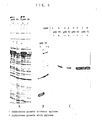
- B. subtilis SHa28 (xynB ) transformed with either of these two plasmids shows an increase by a factor of 150 to 200 in xylosidase activity as measured by the hydrolysis of p-nitrophenyl-beta-D-xylopyranoside (Sigma), when grown on 0.2% xylose compared to growth without xylose.
- the results of this test is shown on Fig. 4 A, where the hatched areas indicate the xylosidase content of the intracellular fluid from cells grown with xylose (+) and the adjacent empty areas indicate the absence of xylosidase in the intracellular fluid from cells grown without xylose (-).
- the xynB ClaI-BamH fragment on pSX 50 was replaced by the apr gene from Bacillus licheniformis coding for the extracellular alkaline protease subtilisin Carlsberg to obtain the plasmid pSX55 (Fig. 5).
- Fig. 4 B shows supernatants of SHa28 transformed with this plasmid grown with and without xylose. No subtilisin band can be seen without xylose, whereas it is the predominant band when the cells are grown in the presence of 0.2% xylose.
- the calf prochymosin gene was fused to the B. pumilus xynB gene resulting in a gene that codes for a fusion protein that consists of the first 12 amino acids from xylosidase followed by prochymosin.
- This fusion gene was cloned into ClaI-HindIII on pSX 50 and pSX 56 to obtain the plasmids pSX 52 and pSX 59 (Fig. 6 and 7).
- the E. coli rrnB terminator was cloned into pSX 52 behind the prochymosin gene to obtain the plasmid pSX 62 (Fig. 8) that was used to transform SHa 165. Lanes 5 and 6 in Fig. 4 C show that this increases the amount of prochymosin markedly (about 40% of total protein).
Landscapes
- Health & Medical Sciences (AREA)
- Chemical & Material Sciences (AREA)
- Life Sciences & Earth Sciences (AREA)
- Genetics & Genomics (AREA)
- Engineering & Computer Science (AREA)
- Organic Chemistry (AREA)
- Wood Science & Technology (AREA)
- Bioinformatics & Cheminformatics (AREA)
- Zoology (AREA)
- Biomedical Technology (AREA)
- Molecular Biology (AREA)
- Biotechnology (AREA)
- Biochemistry (AREA)
- General Engineering & Computer Science (AREA)
- General Health & Medical Sciences (AREA)
- Medicinal Chemistry (AREA)
- Microbiology (AREA)
- Biophysics (AREA)
- Gastroenterology & Hepatology (AREA)
- Proteomics, Peptides & Aminoacids (AREA)
- Physics & Mathematics (AREA)
- Plant Pathology (AREA)
- Micro-Organisms Or Cultivation Processes Thereof (AREA)
- Saccharide Compounds (AREA)
- Preparation Of Compounds By Using Micro-Organisms (AREA)
- Nitrogen And Oxygen Or Sulfur-Condensed Heterocyclic Ring Systems (AREA)
Priority Applications (1)
| Application Number | Priority Date | Filing Date | Title |
|---|---|---|---|
| AT87303397T ATE91715T1 (de) | 1986-04-17 | 1987-04-16 | Genexpressionssystem. |
Applications Claiming Priority (2)
| Application Number | Priority Date | Filing Date | Title |
|---|---|---|---|
| DK1777/86 | 1986-04-17 | ||
| DK177786A DK160947C (da) | 1986-04-17 | 1986-04-17 | Gen-udtrykkelsessystem |
Publications (3)
| Publication Number | Publication Date |
|---|---|
| EP0242220A2 true EP0242220A2 (fr) | 1987-10-21 |
| EP0242220A3 EP0242220A3 (en) | 1989-05-03 |
| EP0242220B1 EP0242220B1 (fr) | 1993-07-21 |
Family
ID=8107985
Family Applications (1)
| Application Number | Title | Priority Date | Filing Date |
|---|---|---|---|
| EP87303397A Expired - Lifetime EP0242220B1 (fr) | 1986-04-17 | 1987-04-16 | Système d'expression de gènes |
Country Status (7)
| Country | Link |
|---|---|
| US (1) | US5036002A (fr) |
| EP (1) | EP0242220B1 (fr) |
| JP (1) | JPS63157987A (fr) |
| AT (1) | ATE91715T1 (fr) |
| DE (1) | DE3786586T2 (fr) |
| DK (1) | DK160947C (fr) |
| ES (1) | ES2058108T3 (fr) |
Cited By (2)
| Publication number | Priority date | Publication date | Assignee | Title |
|---|---|---|---|---|
| WO1989009823A1 (fr) * | 1988-04-05 | 1989-10-19 | 3I Research Exploitation Ltd. | Cassette regulatrice pour vecteurs d'expression |
| EP0347915A3 (fr) * | 1988-06-23 | 1991-03-20 | The Rockefeller University | Méthode et agents inhibiteurs de la synthèse des lipoprotéines de basse densité |
Families Citing this family (11)
| Publication number | Priority date | Publication date | Assignee | Title |
|---|---|---|---|---|
| CN1192106C (zh) | 1995-06-23 | 2005-03-09 | 丹尼斯科成分公司(丹尼斯科公司) | 分离突变体及克隆互补基因的新方法 |
| JP3958884B2 (ja) | 1998-09-11 | 2007-08-15 | 株式会社林原生物化学研究所 | 非還元性糖質生成酵素及びトレハロース遊離酵素ならびに該酵素を用いる糖質の製造方法 |
| EP1183343B2 (fr) | 1999-05-20 | 2013-11-27 | Novozymes A/S | Enzymes de subtilase des sous-groupes i-s1 et i-s2 possedant au moins un residu supplementaire d'acide amine entre les positions 125 et 126 |
| WO2000071688A1 (fr) | 1999-05-20 | 2000-11-30 | Novozymes A/S | Enzymes subtilases des sous-groupes i-s1 et i-s2 comprenant au moins un reste d'acide amine additionnel entre les positions 126 et 127 |
| AU4392900A (en) | 1999-05-20 | 2000-12-12 | Novozymes A/S | Subtilase enzymes of the i-s1 and i-s2 sub-groups having at least one additionalamino acid residue between positions 127 and 128 |
| EP1183342B2 (fr) | 1999-05-20 | 2012-06-13 | Novozymes A/S | Enzymes subtilases des -sous groupes i-s1 et i-s2 possedant au moins un residu acide amine supplementaire entre les positions 128 et 129 |
| WO2000071687A1 (fr) | 1999-05-20 | 2000-11-30 | Novozymes A/S | Enzymes subtilases des sous-groupes i-s1 et i-s2 possedant au moins un residu d'acide amine additionnel entre les positions 129 et 130 |
| US6238273B1 (en) | 1999-08-31 | 2001-05-29 | Micron Technology, Inc. | Methods for predicting polishing parameters of polishing pads and methods and machines for planarizing microelectronic substrate assemblies in mechanical or chemical-mechanical planarization |
| GB0116798D0 (en) | 2001-07-10 | 2001-08-29 | Secr Defence | Expression system |
| DK200101090A (da) | 2001-07-12 | 2001-08-16 | Novozymes As | Subtilase variants |
| JP4764825B2 (ja) * | 2003-10-31 | 2011-09-07 | アプライド マテリアルズ インコーポレイテッド | 研磨終点検知システム及び摩擦センサを使用する方法 |
Family Cites Families (4)
| Publication number | Priority date | Publication date | Assignee | Title |
|---|---|---|---|---|
| DE3484078D1 (de) * | 1983-06-27 | 1991-03-14 | Genentech Inc | Uebertragbare induzierbare kontrollsysteme, diese enthaltende expressionsvektoren, mit diesen transformierte mikroorganismen und ihre verwendung bei der expression von exogenem protein. |
| JPS6075286A (ja) * | 1983-09-28 | 1985-04-27 | Hirosuke Okada | キシラナ−ゼ遺伝子を有する組み換え体プラスミドおよびそれにより形質転換されたBacillus属菌 |
| GB2166743B (en) * | 1984-11-13 | 1989-01-05 | Solvay | Process for a thermo-inducible gene expression in gram positive bacteria and bacillus subtilis strains containing plasmids which induce such an expression |
| JPH09198978A (ja) * | 1996-01-23 | 1997-07-31 | Advantest Corp | 光導電スイッチ |
-
1986
- 1986-04-17 DK DK177786A patent/DK160947C/da not_active IP Right Cessation
-
1987
- 1987-04-16 ES ES87303397T patent/ES2058108T3/es not_active Expired - Lifetime
- 1987-04-16 AT AT87303397T patent/ATE91715T1/de not_active IP Right Cessation
- 1987-04-16 DE DE87303397T patent/DE3786586T2/de not_active Expired - Fee Related
- 1987-04-16 EP EP87303397A patent/EP0242220B1/fr not_active Expired - Lifetime
- 1987-04-17 US US07/039,298 patent/US5036002A/en not_active Expired - Lifetime
- 1987-04-17 JP JP62095024A patent/JPS63157987A/ja active Pending
Cited By (2)
| Publication number | Priority date | Publication date | Assignee | Title |
|---|---|---|---|---|
| WO1989009823A1 (fr) * | 1988-04-05 | 1989-10-19 | 3I Research Exploitation Ltd. | Cassette regulatrice pour vecteurs d'expression |
| EP0347915A3 (fr) * | 1988-06-23 | 1991-03-20 | The Rockefeller University | Méthode et agents inhibiteurs de la synthèse des lipoprotéines de basse densité |
Also Published As
| Publication number | Publication date |
|---|---|
| DE3786586D1 (de) | 1993-08-26 |
| DK160947C (da) | 1991-10-21 |
| US5036002A (en) | 1991-07-30 |
| EP0242220A3 (en) | 1989-05-03 |
| DE3786586T2 (de) | 1993-10-28 |
| JPS63157987A (ja) | 1988-06-30 |
| DK160947B (da) | 1991-05-06 |
| ES2058108T3 (es) | 1994-11-01 |
| DK177786A (da) | 1988-02-16 |
| DK177786D0 (da) | 1986-04-17 |
| EP0242220B1 (fr) | 1993-07-21 |
| ATE91715T1 (de) | 1993-08-15 |
Similar Documents
| Publication | Publication Date | Title |
|---|---|---|
| EP0242220B1 (fr) | Système d'expression de gènes | |
| Diderichsen et al. | Cloning of a maltogenic alpha-amylase from Bacillus stearothermophilus | |
| US4666848A (en) | Polypeptide expression using a portable temperature sensitive control cassette with a positive retroregulatory element | |
| DK169996B1 (da) | Fremgangsmåde til effektiv indføring af DNA i en industriel Bacillus-stammevært, fremgangsmåde til fremstilling af et polypeptid i en sådan vært, plasmid, genetisk manipuleret industriel Bacillus-mikroorganisme og anvendelse af en sådan mikroorganisme | |
| CA1292197C (fr) | Methode de stabilisation d'elements extra-chromosomaux dans les bacteries pendant la culture | |
| US4710473A (en) | DNA plasmids | |
| US4931390A (en) | Expression of the cloned lysostaphin gene | |
| US4792523A (en) | 3'Expression enhancing fragments and method | |
| US5032510A (en) | Method for expression and secretion in bacillus | |
| US5232840A (en) | Enhanced protein production in bacteria by employing a novel ribosome binding site | |
| US5011772A (en) | High yield protein production system | |
| IWASAKI et al. | Molecular cloning of a xylanase gene from Streptomyces sp. No. 36a and its expression in streptomycetes | |
| US5017477A (en) | Enhancing DNA sequencies derived from the sacQ gene | |
| Panbangred et al. | Expression of a xylanase gene of Bacillus pumilus in Escherichia coli and Bacillus subtilis | |
| EP0176320B1 (fr) | Méthode d'expression et sécrétion en Bacillus | |
| EP0130074A1 (fr) | Système de contrôle transférables et inductibles, vecteurs d'expression les contenants, micro-organismes transformés avec ceux-là, et leur utilisation dans l'expression de la protéine exogène | |
| Petit et al. | Hypersecretion of a cellulase from Clostridium thermocellum in Bacillus subtilis by induction of chromosomal DNA amplification | |
| EP0216080B1 (fr) | Plasmides et transformants | |
| EP0174785B1 (fr) | Elément rétrorégulateur positif, plasmide et cellules contenant ledit élément et leur production, méthode pour le renforcement de l'expression génétique utilisant ledit élément et méthode pour le renforcement de la demi-vie de l'ARN utilisant ledit élément | |
| EP0681027A2 (fr) | Vecteur plasmide et utilisation pour la production de protéines hétérologues | |
| Reid et al. | Industrial applications of a cloned neutral protease gene in Bacillus subtilis | |
| Wanker et al. | Expression of the Bacillus subtilis levanase gene in Escherichia coli and Saccharomyces cerevisiae | |
| US5246839A (en) | Secretion plasmid comprising the kilgene | |
| Wang | GENE ORGANIZATION AND REGULATION OF THE BACILLUS SUBTILIS RNA POLYMERASE MAJOR SIGMA (SIGMA (43)) OPERON (PRIMASE, PROMOTERS, DNA-E, RPO-D) | |
| DK159282B (da) | Fremgangsmaade til stabilisering af extra-kromosomale elementer i en vaekstbakterie under dyrkning, transformerede bakterier samt en fremgangsmaade til fremstilling af et oensket produkt i saadanne transformerede bakterier |
Legal Events
| Date | Code | Title | Description |
|---|---|---|---|
| PUAI | Public reference made under article 153(3) epc to a published international application that has entered the european phase |
Free format text: ORIGINAL CODE: 0009012 |
|
| AK | Designated contracting states |
Kind code of ref document: A2 Designated state(s): AT BE CH DE ES FR GB GR IT LI LU NL SE |
|
| PUAL | Search report despatched |
Free format text: ORIGINAL CODE: 0009013 |
|
| AK | Designated contracting states |
Kind code of ref document: A3 Designated state(s): AT BE CH DE ES FR GB GR IT LI LU NL SE |
|
| 17P | Request for examination filed |
Effective date: 19890721 |
|
| RAP1 | Party data changed (applicant data changed or rights of an application transferred) |
Owner name: NOVO-NORDISK A/S |
|
| RAP1 | Party data changed (applicant data changed or rights of an application transferred) |
Owner name: NOVO NORDISK A/S |
|
| 17Q | First examination report despatched |
Effective date: 19911028 |
|
| GRAA | (expected) grant |
Free format text: ORIGINAL CODE: 0009210 |
|
| AK | Designated contracting states |
Kind code of ref document: B1 Designated state(s): AT BE CH DE ES FR GB GR IT LI LU NL SE |
|
| PG25 | Lapsed in a contracting state [announced via postgrant information from national office to epo] |
Ref country code: GR Free format text: LAPSE BECAUSE OF FAILURE TO SUBMIT A TRANSLATION OF THE DESCRIPTION OR TO PAY THE FEE WITHIN THE PRESCRIBED TIME-LIMIT Effective date: 19930721 |
|
| REF | Corresponds to: |
Ref document number: 91715 Country of ref document: AT Date of ref document: 19930815 Kind code of ref document: T |
|
| REF | Corresponds to: |
Ref document number: 3786586 Country of ref document: DE Date of ref document: 19930826 |
|
| ITF | It: translation for a ep patent filed | ||
| ET | Fr: translation filed | ||
| PG25 | Lapsed in a contracting state [announced via postgrant information from national office to epo] |
Ref country code: LU Free format text: LAPSE BECAUSE OF NON-PAYMENT OF DUE FEES Effective date: 19940430 |
|
| PLBE | No opposition filed within time limit |
Free format text: ORIGINAL CODE: 0009261 |
|
| STAA | Information on the status of an ep patent application or granted ep patent |
Free format text: STATUS: NO OPPOSITION FILED WITHIN TIME LIMIT |
|
| 26N | No opposition filed | ||
| REG | Reference to a national code |
Ref country code: ES Ref legal event code: FG2A Ref document number: 2058108 Country of ref document: ES Kind code of ref document: T3 |
|
| EAL | Se: european patent in force in sweden |
Ref document number: 87303397.1 |
|
| REG | Reference to a national code |
Ref country code: GB Ref legal event code: 732E |
|
| REG | Reference to a national code |
Ref country code: GB Ref legal event code: IF02 |
|
| PGFP | Annual fee paid to national office [announced via postgrant information from national office to epo] |
Ref country code: SE Payment date: 20030404 Year of fee payment: 17 |
|
| PGFP | Annual fee paid to national office [announced via postgrant information from national office to epo] |
Ref country code: FR Payment date: 20030408 Year of fee payment: 17 |
|
| PGFP | Annual fee paid to national office [announced via postgrant information from national office to epo] |
Ref country code: AT Payment date: 20030411 Year of fee payment: 17 |
|
| PGFP | Annual fee paid to national office [announced via postgrant information from national office to epo] |
Ref country code: GB Payment date: 20030416 Year of fee payment: 17 Ref country code: CH Payment date: 20030416 Year of fee payment: 17 |
|
| PGFP | Annual fee paid to national office [announced via postgrant information from national office to epo] |
Ref country code: DE Payment date: 20030424 Year of fee payment: 17 |
|
| PGFP | Annual fee paid to national office [announced via postgrant information from national office to epo] |
Ref country code: NL Payment date: 20030429 Year of fee payment: 17 Ref country code: ES Payment date: 20030429 Year of fee payment: 17 |
|
| PGFP | Annual fee paid to national office [announced via postgrant information from national office to epo] |
Ref country code: BE Payment date: 20030617 Year of fee payment: 17 |
|
| PG25 | Lapsed in a contracting state [announced via postgrant information from national office to epo] |
Ref country code: GB Free format text: LAPSE BECAUSE OF NON-PAYMENT OF DUE FEES Effective date: 20040416 Ref country code: AT Free format text: LAPSE BECAUSE OF NON-PAYMENT OF DUE FEES Effective date: 20040416 |
|
| PG25 | Lapsed in a contracting state [announced via postgrant information from national office to epo] |
Ref country code: SE Free format text: LAPSE BECAUSE OF NON-PAYMENT OF DUE FEES Effective date: 20040417 Ref country code: ES Free format text: LAPSE BECAUSE OF NON-PAYMENT OF DUE FEES Effective date: 20040417 |
|
| PG25 | Lapsed in a contracting state [announced via postgrant information from national office to epo] |
Ref country code: LI Free format text: LAPSE BECAUSE OF NON-PAYMENT OF DUE FEES Effective date: 20040430 Ref country code: CH Free format text: LAPSE BECAUSE OF NON-PAYMENT OF DUE FEES Effective date: 20040430 Ref country code: BE Free format text: LAPSE BECAUSE OF NON-PAYMENT OF DUE FEES Effective date: 20040430 |
|
| BERE | Be: lapsed |
Owner name: *NOVO NORDISK A/S Effective date: 20040430 |
|
| PG25 | Lapsed in a contracting state [announced via postgrant information from national office to epo] |
Ref country code: NL Free format text: LAPSE BECAUSE OF NON-PAYMENT OF DUE FEES Effective date: 20041101 |
|
| PG25 | Lapsed in a contracting state [announced via postgrant information from national office to epo] |
Ref country code: DE Free format text: LAPSE BECAUSE OF NON-PAYMENT OF DUE FEES Effective date: 20041103 |
|
| EUG | Se: european patent has lapsed | ||
| GBPC | Gb: european patent ceased through non-payment of renewal fee |
Effective date: 20040416 |
|
| REG | Reference to a national code |
Ref country code: CH Ref legal event code: PL |
|
| PG25 | Lapsed in a contracting state [announced via postgrant information from national office to epo] |
Ref country code: FR Free format text: LAPSE BECAUSE OF NON-PAYMENT OF DUE FEES Effective date: 20041231 |
|
| NLV4 | Nl: lapsed or anulled due to non-payment of the annual fee |
Effective date: 20041101 |
|
| REG | Reference to a national code |
Ref country code: FR Ref legal event code: ST |
|
| PG25 | Lapsed in a contracting state [announced via postgrant information from national office to epo] |
Ref country code: IT Free format text: LAPSE BECAUSE OF NON-PAYMENT OF DUE FEES Effective date: 20050416 |
|
| REG | Reference to a national code |
Ref country code: ES Ref legal event code: FD2A Effective date: 20040417 |