EP0241004B1 - Chromophore Peptide, Verfahren zu ihrer Herstellung und ihre Verwendung zum Nachweis der peptidylglycin-alpha-amidierenden Monooxygenase - Google Patents
Chromophore Peptide, Verfahren zu ihrer Herstellung und ihre Verwendung zum Nachweis der peptidylglycin-alpha-amidierenden Monooxygenase Download PDFInfo
- Publication number
- EP0241004B1 EP0241004B1 EP87105182A EP87105182A EP0241004B1 EP 0241004 B1 EP0241004 B1 EP 0241004B1 EP 87105182 A EP87105182 A EP 87105182A EP 87105182 A EP87105182 A EP 87105182A EP 0241004 B1 EP0241004 B1 EP 0241004B1
- Authority
- EP
- European Patent Office
- Prior art keywords
- denotes
- formula
- gly
- dis
- compound
- Prior art date
- Legal status (The legal status is an assumption and is not a legal conclusion. Google has not performed a legal analysis and makes no representation as to the accuracy of the status listed.)
- Expired - Lifetime
Links
Classifications
-
- C—CHEMISTRY; METALLURGY
- C07—ORGANIC CHEMISTRY
- C07K—PEPTIDES
- C07K5/00—Peptides containing up to four amino acids in a fully defined sequence; Derivatives thereof
- C07K5/04—Peptides containing up to four amino acids in a fully defined sequence; Derivatives thereof containing only normal peptide links
- C07K5/06—Dipeptides
- C07K5/06008—Dipeptides with the first amino acid being neutral
- C07K5/06017—Dipeptides with the first amino acid being neutral and aliphatic
- C07K5/06026—Dipeptides with the first amino acid being neutral and aliphatic the side chain containing 0 or 1 carbon atom, i.e. Gly or Ala
-
- C—CHEMISTRY; METALLURGY
- C07—ORGANIC CHEMISTRY
- C07K—PEPTIDES
- C07K5/00—Peptides containing up to four amino acids in a fully defined sequence; Derivatives thereof
- C07K5/04—Peptides containing up to four amino acids in a fully defined sequence; Derivatives thereof containing only normal peptide links
- C07K5/08—Tripeptides
- C07K5/0802—Tripeptides with the first amino acid being neutral
- C07K5/0804—Tripeptides with the first amino acid being neutral and aliphatic
- C07K5/0806—Tripeptides with the first amino acid being neutral and aliphatic the side chain containing 0 or 1 carbon atoms, i.e. Gly, Ala
-
- C—CHEMISTRY; METALLURGY
- C12—BIOCHEMISTRY; BEER; SPIRITS; WINE; VINEGAR; MICROBIOLOGY; ENZYMOLOGY; MUTATION OR GENETIC ENGINEERING
- C12Q—MEASURING OR TESTING PROCESSES INVOLVING ENZYMES, NUCLEIC ACIDS OR MICROORGANISMS; COMPOSITIONS OR TEST PAPERS THEREFOR; PROCESSES OF PREPARING SUCH COMPOSITIONS; CONDITION-RESPONSIVE CONTROL IN MICROBIOLOGICAL OR ENZYMOLOGICAL PROCESSES
- C12Q1/00—Measuring or testing processes involving enzymes, nucleic acids or microorganisms; Compositions therefor; Processes of preparing such compositions
- C12Q1/26—Measuring or testing processes involving enzymes, nucleic acids or microorganisms; Compositions therefor; Processes of preparing such compositions involving oxidoreductase
-
- Y—GENERAL TAGGING OF NEW TECHNOLOGICAL DEVELOPMENTS; GENERAL TAGGING OF CROSS-SECTIONAL TECHNOLOGIES SPANNING OVER SEVERAL SECTIONS OF THE IPC; TECHNICAL SUBJECTS COVERED BY FORMER USPC CROSS-REFERENCE ART COLLECTIONS [XRACs] AND DIGESTS
- Y02—TECHNOLOGIES OR APPLICATIONS FOR MITIGATION OR ADAPTATION AGAINST CLIMATE CHANGE
- Y02P—CLIMATE CHANGE MITIGATION TECHNOLOGIES IN THE PRODUCTION OR PROCESSING OF GOODS
- Y02P20/00—Technologies relating to chemical industry
- Y02P20/50—Improvements relating to the production of bulk chemicals
- Y02P20/55—Design of synthesis routes, e.g. reducing the use of auxiliary or protecting groups
-
- Y—GENERAL TAGGING OF NEW TECHNOLOGICAL DEVELOPMENTS; GENERAL TAGGING OF CROSS-SECTIONAL TECHNOLOGIES SPANNING OVER SEVERAL SECTIONS OF THE IPC; TECHNICAL SUBJECTS COVERED BY FORMER USPC CROSS-REFERENCE ART COLLECTIONS [XRACs] AND DIGESTS
- Y10—TECHNICAL SUBJECTS COVERED BY FORMER USPC
- Y10S—TECHNICAL SUBJECTS COVERED BY FORMER USPC CROSS-REFERENCE ART COLLECTIONS [XRACs] AND DIGESTS
- Y10S530/00—Chemistry: natural resins or derivatives; peptides or proteins; lignins or reaction products thereof
- Y10S530/802—Chromogenic or luminescent peptides
Definitions
- the invention relates to chromophoric peptides of the general formula I. where R is Gly-OH or NH 2 and DIS is 5-dimethylamino-naphthalene-1-sulfonyl, and their salts.
- Particularly suitable salts are alkali and alkaline earth salts, salts with amines and salts with inorganic or organic acids such as, for example, hydrochloric acid, hydrobromic acid, sulfuric acid, maleic acid or fumaric acid.
- the peptidylglycine-a-amidating monooxygenase is an important enzyme that forms the corresponding peptidamides from peptides with C-terminal glycine (peptidylglycine).
- the amidated form is more active in many peptide hormones, such as gonadoliberin, thyreoliberin, secretin or calcitonin.
- gonadoliberin thyreoliberin
- secretin secretin or calcitonin.
- calcitonin peptide hormones
- TRH thyro-tropin-releasing factor
- This monooxygenase is dependent on ascorbic acid, copper ions and oxygen and is formed where peptide amides are also excreted. So far, the peptidylglycine-a-amidating monooxygenase has mainly been found in the pituitary gland and in the central nervous system. This enzyme can also be detected in plasma. In peptide amide-forming tumors, the activity of the enzyme in the plasma is greatly increased and can therefore serve as a marker for certain endocrine tumors.
- the activity of this enzyme can be determined by converting measured (GS Wand, RL Ney, RE Mains, BA Eipper, Neuroendocrinology 41 (1985) 482-489; BA Eipper, AC Myers and RE Mains, Endocrinology 116 (1985) 2497-2504; GS Wand, RL Ney, S. Baylin, B. Eipper and RE Mains, Metabolism 34 (1985) 1044-1052).
- the DIS-D-Ala-Pro-Gly-OH according to the invention also has the advantage that the incorporation of the proline results in a C-terminal degradation is complicated by carboxypeptidases.
- the DIS-D-Ala-Pro-NH 2 serves as a comparison.
- Suitable carboxyl protective groups R 2 are described, for example, in Schröder, Lübke, The Peptides, Volume I, New York 1965, pages 72-75 or TW Greene, "Protective Groups in Organic Synthesis", Wiley-Interscience, New York 1981. Lower alkyl groups, such as methyl, ethyl or tert-butyl and aralkyl groups, such as benzyl or p-nitrobenzyl; tert-butyl is preferred.
- the protective group is split off from the intermediates of the formula IV in which R 1 stands for Gly-R 2 and DIS and R 2 are as defined above, depending on the type of protective group, is carried out by alkaline or acidic hydrolysis or by hydrogenolysis.
- the substrate DIS-D-Ala-Pro-Gly-OH is preferably obtained from the corresponding tert-butyl ester by an acid treatment.
- the peptides of the above-mentioned formula III can be prepared according to the general methods of peptide chemistry, for example by coupling corresponding, optionally protected fragments in the presence of dicyclohexylcarbodiimide and optionally 1-hydroxy-1 H-benzotriazole in a suitable solvent (cf. Chem. Ber. 103 [1970 ] 788, 2024).
- the ethyl acetate phase is shaken out successively with saturated aqueous NaHCO 3 solution, KHS0 4 / K 2 S0 4 buffer and water, dried over Na 2 S0 4 and concentrated.
- the substance is chromatographed on 300 g of silica gel (1st CH 2 Cl 2 / acetone in a 9: 1 ratio; 2nd CH 2 Cl 2 / CH 3 0H in a 9.6: 0.4 ratio). Yield of pure amorphous substance: 10.3 g.
- the ethyl acetate phase is washed successively with saturated aqueous NaHCO 3 solution and KHS0 4 / K 2 S0 4 buffer and water, dried over Na 2 S0 4 and concentrated.
- the residue is digested several times with petroleum ether and then chromatographed over 180 g of silica gel (CH 2 Cl 2 / CH 3 OH in the ratio 9.5: 0.5). Yield of pure peptide: 6.74 g of colorless amorphous substance.
- the enzyme tests are carried out in a pH 7.4 buffer.
- 100 ⁇ l of this buffer solution are incubated with 100 ⁇ l of the PAM-containing solution and stopped after 3 hours at 37 ° C by adding 700 ⁇ l CH 2 CI 2 .
- the peptide amide is selectively converted into the organic phase by briefly shaking (extraction yield: approx. 60%).
Landscapes
- Chemical & Material Sciences (AREA)
- Organic Chemistry (AREA)
- Life Sciences & Earth Sciences (AREA)
- Health & Medical Sciences (AREA)
- Proteomics, Peptides & Aminoacids (AREA)
- General Health & Medical Sciences (AREA)
- Biochemistry (AREA)
- Genetics & Genomics (AREA)
- Molecular Biology (AREA)
- Biophysics (AREA)
- Zoology (AREA)
- Engineering & Computer Science (AREA)
- Wood Science & Technology (AREA)
- Medicinal Chemistry (AREA)
- Physics & Mathematics (AREA)
- Analytical Chemistry (AREA)
- Biotechnology (AREA)
- Immunology (AREA)
- Microbiology (AREA)
- Bioinformatics & Cheminformatics (AREA)
- General Engineering & Computer Science (AREA)
- Peptides Or Proteins (AREA)
- Measuring Or Testing Involving Enzymes Or Micro-Organisms (AREA)
Description
- Die Erfindung betrifft chromophore Peptide der allgemeinen Formel I

- Als Salze kommen insbesondere Alkali- und Erdalkalisalze, Salze mit Aminen und Salze mit anorganischen oder organischen Säuren wie beispielsweise Salzsäure, Bromwasserstoffsäure, Schwefelsäure, Maleinsäure oder Fumarsäure in Betracht.
- Die peptidylglycin-a-amidierende Monooxygenase (PAM) ist ein wichtiges Enzym, das aus Peptiden mit C-terminalem Glycin (Peptidylglycin) die entsprechenden Peptidamide bildet. Bei vielen Peptidhormonen, wie z.B. beim Gonadoliberin, Thyreoliberin, Secretin oder Calcitonin ist die amidierte Form aktiver. Allerdings werden nur Peptide mit neutralen C-terminalen Aminosäuren amidiert (A.F. Bradbury, M.D.A. Finnie und D.G. Smyth, Nature 298 (1982) 686-688).

- Diese Monooxygenase ist abhängig von Ascorbinsäure, Kupferionen und Sauerstoff und wird dort gebildet, wo auch Peptidamide ausgeschieden werden. Bisher wurde die peptidylglycin-a-amidierende Monooxygenase vor allem in der Hypophyse und im zentralen Nervensystem gefunden. Aber auch im Plasma läßt sich dieses Enzym nachweisen. Bei peptidamid-bildenden Tumoren ist die Aktivität des Enzyms im Plasma stark erhöht und kann somit als Marker für bestimmte endocrine Tumoren dienen.
- Die Aktivität dieses Enzyms kann durch Umwandlung vongemessen werden (G.S. Wand, R.L. Ney, R.E. Mains, B.A. Eipper, Neuroendocrinology 41 (1985) 482-489; B.A. Eipper, A.C. Myers und R.E. Mains, Endocrinology 116 (1985) 2497-2504; G.S. Wand, R.L. Ney, S. Baylin, B. Eipper und R.E. Mains, Metabolism 34 (1985) 1044-1052).

- Um nicht radioaktiv arbeiten zu müssen, wurde nach einem neuen Weg zur Bestimmung der peptidylglycin-a-amidierenden Aktivität gesucht.
- Diese Aufgabe wurde gelöst durch ein fluoreszierendes Substrat, das mittels chromatographischer Methoden (DC, HPLC) abgetrennt und identifiziert werden kann. Das erfindungsgemäße DIS-D-Ala-Pro-Gly-OH hat neben dem Vorteil seiner fluoreszierenden 5-Dimethylamino-naphthalin-1-sulfonyl-(DIS-) Gruppe auch noch den Vorzug, daß durch den Einbau des Prolins ein C-terminaler Abbau durch Carboxypeptidasen erschwert ist. Das DIS-D-Ala-Pro-NH2 dient als Vergleich.
- Die Erfindung betrifft weiterhin ein Verfahren zur Herstellung eines Peptids der Formel I, das dadurch gekennzeichnet ist, daß man eine Verbindung der Formel 11


- in welcher
- R1 Gly-R oder NH2 und
- R2 eine Carboxylschutzgruppe bedeuten,
- im Falle, daß R1 Gly-R2 bedeutet, die Carboxylschutzgruppe von den so erhaltenen Verbindungen der Formel IV-unter Bildung der freien Carboxylfunktion abspaltet, und das so erhaltene Peptid der Formel I gegebenenfalls in seine Salze überführt.
- Geeignete Carboxylschutzgruppen R2 sind beispielsweise in Schröder, Lübke, The Peptides, Volume I, New York 1965, Seiten 72-75 oder T.W. Greene, "Protective Groups in Organic Synthesis", Wiley-Interscience, New York 1981 beschrieben. Infrage kommen Niederalkylgruppen, wie Methyl, Ethyl oder tert.-Butyl und Aralkylgruppen, wie Benzyl oder p-Nitrobenzyl; bevorzugt ist tert.-Butyl. Die Abspaltung der Schutzgruppe aus den Zwischenprodukten der Formel IV
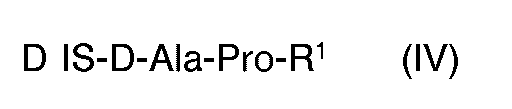
- Die Erfindung betrifft des weiteren ein Verfahren zum qualitativen oder quantitativen Nachweis der peptidylglycin-a-amidierenden Monooxygenase, das dadurch gekennzeichnet ist, daß man eine Lösung der Formel I, worin R Gly-OH bedeutet mit der die peptidylglycin-a-amidierenden Monooxygenase enthaltenden Analysenprobe inkubiert, die entstandene Verbindung der Formel I, worin R NH2 bedeutet, abtrennt und deren Menge quantitativ bestimmt, die Verwendung einer Verbindung der Formel I zum qualitativen oder quantitativen Nachweis der peptidylglycin-a-amidierenden Monooxygenasen, Mittel enthaltend eine Verbindung der Formel I sowie Zwischenprodukte der Formel IV,
- in welcher
- DIS 5-Dimethylamino-naphthalin-1-sulfonyl,
- R1 Gly-R2 und
- R2 eine Carboxylschutzgruppe bedeuten.
- Das Enzym (PAM) wurde nach einer Methode von Eipper et al. (Peptides 4 (1983) 921-928) aus Rinderhypophysen isoliert. Dabei wurden frische Hypophysen in Trispuffer homogenisiert, das Homogenat über eine Percoll-Gradientenzentrifugation aufgetrennt und die Vesikelfraktion isoliert. In dieser Fraktion konnte die höchste Aktivität nachgewiesen werden. Durch Ammonsulfat-Fällung und konsekutive Gelfiltration (Glembotski, Arch. Biochem. Biophys. 241 (1985) 673-683) konnte die Aktivität weiter angereichert werden. Die Versuche mit dem erfindungsgemäßen Substrat der Formel I (R = Gly-OH) und der Vergleichssubstanz der Formel I (R = NH2) wurden sowohl mit den Rohfraktionen als auch mit den angereicherten Fraktionen durchgeführt.
- Die nachstehenden Beispiele dienen zur Erläuterung der Erfindung, ohne daß diese darauf beschränkt wäre.
- Zu einer Lösung von 11,4 g Z-D-Ala-OH, 13,5 g H-Pro-Gly-OBut·HCI und 6,9 g HOBt in 100 ml Dimethylformamid gibt man bei 0°C 6,54 ml N-Ethylmorpholin und 10,7 g DCC. Man rührt 1 Stunde bei O ° C, 4 Stunden bei Raumtemperatur und läßt über Nacht bei Raumtemperatur stehen. Der Niederschlag wird abgesaugt und das Filtrat eingeengt. Der Rückstand wird zwischen Essigester und Wasser verteilt. Die Essigesterphase wird nacheinander mit gesättigter wäßriger NaHCO3-Lösung, KHS04/K2S04-Puffer und Wasser ausgeschüttelt, über Na2S04 getrocknet und eingeengt. Die Substanz wird auf 300 g Kieselgel chromatographiert (1. CH2C12/Aceton im Verhältnis 9:1; 2. CH2CI2/CH30H im Verhältnis 9,6:0,4). Ausbeute an reiner amorpher Substanz: 10,3 g.
- 10 g Z-D-Ala-Pro-Gly-OBut werden in 100 ml Methanol gelöst und mit Pd-Katalysator unter pH-Kontrolle (Autotitrator mit methanolischer HCI bei pH 4,5) hydriert. Nachdem alles hydriert ist (DC-Kontrolle in CH2Cl2/CH3OH im Verhältnis 9:1) wird der Katalysator abgesaugt und das Filtrat eingeengt. Es bleiben 6,2 g einer farblosen amorphen Substanz zurück.
- Zu einer Suspension von 1,68 g (5 mmol) H-D-Ala-Pro-Gly-OBut. HCI und 1,4 g (5,2 mmol) DIS-Chlorid in 25 ml abs. Tetrahydrofuran gibt man bei -5 ° C 1,4 ml (10 mmol) Triethylamin. Man läßt 1 Stunde bei 0 ° C und 4 Stunden bei Raumtemperatur rühren und läßt über Nacht bei Raumtemperatur stehen. Der Niederschlag wird abgesaugt und das Filtrat eingeengt. Der Rückstand wird in Essigester gelöst. Die Lösung wird nacheinander mit gesättigter wäßriger NaHCO3-Lösung und Wasser ausgeschüttelt, über Na2S04 getrocknet und eingeengt. Ausbeute: 3,5 g amorphe Substanz.
- Eine Lösung von 3,5 g DIS-D-Ala-Pro-Gly-OBut in 10 ml 90 %iger Trifluoressigsäure läßt man 1 Stunde bei Raumtemperatur stehen. Danach engt man die Lösung im Vakuum ein. Es bleiben 3,2 g einer amorphen Substanz zurück. Zur Reinigung werden 300 mg über eine Kieselgelsäule (40 x 4 cm) chromatographiert. Elutionsmittel: CH2CI2/CH30H/CH3COOH/H20 im Verhältnis 9:1:0,1:0,1. Die Fraktionen mit der reinen Substanz werden eingeengt. Der Rückstand wird in Wasser gelöst und gefriergetrocknet. Ausbeute: 191 mg; [α]24 D= -51,8° ° (c = 1, in 5%igerwäßriger Essigsäure). 1H-NMR (270 MHz) in 2H-DMSO: Charakteristische Signale bei 0 = 1,0 [d, 3H, -CH3 (Ala)]; 2,83 [2s, 6H, -N-(CH3)2 (DIS)]; 3,7 [d, 2H, -CH2- (Gly)]; 7,25-8,5 [d, m, 8H (2 = NH und 6 arom. H von DIS)].
- Zu einer Lösung von 11,2 g (50 mmol) Z-D-Ala-OH, 7,53 g (50 mmol) H-Pro-NH2'HCI und 6,8 g (50 mmol) HOBt in 100 ml Dimethylformamid gibt man bei 0 ° C 6,4 ml (50 mmol) N-Ethylmorpholin und 11,4 g (55 mmol) Dicyclohexylcarbodiimid (DCC). Man läßt 1 Stunde bei 0 ° C und 5 Stunden bei Raumtemperatur rühren und läßt über Nacht bei Raumtemperatur stehen. Der Niederschlag wird abgesaugt und das Filtrat eingeengt. Der Rückstand wird zwischen Essigester und Wasser verteilt. Die Essigesterphase wird nacheinander mit gesättigter wäßriger NaHCO3-Lösung und KHS04/K2S04-Puffer und Wasser gewaschen, über Na2S04 getrocknet und eingeengt. Der Rückstand wird mit Petrolether mehrmals digeriert und anschließend über 180 g Kieselgel chromatographiert (CH2Cl2/CH3OH im Verhältnis 9,5:0,5). Ausbeute an reinem Peptid: 6,74 g farblose amorphe Substanz.
- 6,4 g (20 mmol) Z-D-Ala-Pro-NH2 werden in Methanol gelöst und wie bei 1 b katalytisch hydriert. Der Rückstand wird mit Ether verrieben. Ausbeute: 4,11 g einer farblosen Substanz.
- Zu einer Suspension von 0,442 g (2 mmol) H-D-Ala-Pro-NH2 und 0,6 g (2,2 mmol) DIS-Chlorid in 15 ml abs. Tetrahydrofuran gibt man bei 0 ° C 0,56 ml (4 mmol) Triethylamin. Man läßt 1 Stunde bei 0 ° C und 5 Stunden bei Raumtemperatur rühren und läßt über Nacht bei Raumtemperatur stehen. Aufarbeitung wie bei 1c. Reinigung an Kieselgel (40 x 4 cm; Elutionsmittel CH2CI2/CH30H im Verhältnis 9,5:0,5). Ausbeuten an reiner Substanz: 0,23 g [α]24D = -18,4 ° (c =1, in 5%iger wäßriger Essigsäure). 1H-NMR (270 MHz) in 2H-DMSO: Charakteristische Signale bei 0 = 0,97 [d, 3H, -CH3 (Ala)]; 2,83 [2s, 6H, -N(CH3)2 (DIS)]; 6,9-8,5 [d, m, 9H, 3 = NH und 6 arom. H von DIS].
- Die Enzymtests werden in einem Puffer von pH 7,4 durchgeführt. Der wäßrige Puffer besteht aus der Puffersubstanz N-[Tris-(hydroxymethyl)-methyl]-2-amino-ethansulfonsäure (100 mM), CUS04 (3 µM), Peptidsubstrat der Formel I (R = Gly-OH) (50 µM) und Katalase aus Rinderleber (100 µg/ml). 100 µl dieser Pufferlösung werden mit 100 µl der PAM-haltigen Lösung inkubiert und nach 3 Stunden bei 37 ° C durch Zugabe von 700 µl CH2CI2 gestoppt. Durch kurzes Ausschütteln wird das Peptidamid selektiv in die organische Phase überführt (Extraktionsausbeute: ca. 60 %). Nach Zentrifugation und Abnahme der organischen Phase wird diese in einer Vakuumzentrifuge eingedampft und in einem konstanten Volumen CH2CI2 wieder aufgenommen. Zur Vermeidung von Photo-Reaktionen des lichtempfindlichen Substrats werden alle Operationen unter Lichtausschluß durchgeführt. Die erhaltenen Lösungen werden mit einem Autospotter auf HPTLC-Platten (Merck Si 60) aufgetragen und mit Hilfe eines Laufmittelgemisches (CH2Cl2/CH3OH/H2O/CH3COOH im Verhältnis 90:10:1:1) getrennt. Die Quantifizierung des entstandenen Amids der Formel I (R = NH2) mit einem Dünnschichtscanner wird ermöglicht durch gleichzeitiges Auftragen des Peptidamids der Formel II in unterschiedlicher Konzentration als Referenz.
- Zeitabhängigkeit des Umsatzes von DIS-D-Ala-Pro-Gly-OH mit PAM-Aktivität:

- Nach 3 Stunden sind ca. 5 % des Substrates der Formel I (R = Gly-OH) umgesetzt bei einem Umsatz von 0,29 ng/Stunde pro 1 µg zugesetztes Protein mit PAM-Aktivität.
Claims (6)


Priority Applications (1)
| Application Number | Priority Date | Filing Date | Title |
|---|---|---|---|
| AT87105182T ATE84047T1 (de) | 1986-04-11 | 1987-04-08 | Chromophore peptide, verfahren zu ihrer herstellung und ihre verwendung zum nachweis der peptidylglycin-alpha-amidierenden monooxygenase. |
Applications Claiming Priority (2)
| Application Number | Priority Date | Filing Date | Title |
|---|---|---|---|
| DE19863612302 DE3612302A1 (de) | 1986-04-11 | 1986-04-11 | Chromophore peptide, verfahren zu ihrer herstellung und ihre verwendung zum nachweis der peptidylglycin-(alpha)-amidierenden monooxygenase |
| DE3612302 | 1986-04-11 |
Publications (3)
| Publication Number | Publication Date |
|---|---|
| EP0241004A2 EP0241004A2 (de) | 1987-10-14 |
| EP0241004A3 EP0241004A3 (en) | 1989-03-01 |
| EP0241004B1 true EP0241004B1 (de) | 1992-12-30 |
Family
ID=6298512
Family Applications (1)
| Application Number | Title | Priority Date | Filing Date |
|---|---|---|---|
| EP87105182A Expired - Lifetime EP0241004B1 (de) | 1986-04-11 | 1987-04-08 | Chromophore Peptide, Verfahren zu ihrer Herstellung und ihre Verwendung zum Nachweis der peptidylglycin-alpha-amidierenden Monooxygenase |
Country Status (8)
| Country | Link |
|---|---|
| US (1) | US4900658A (de) |
| EP (1) | EP0241004B1 (de) |
| JP (1) | JPS62242698A (de) |
| AT (1) | ATE84047T1 (de) |
| DE (2) | DE3612302A1 (de) |
| DK (1) | DK185087A (de) |
| GR (1) | GR3007428T3 (de) |
| PT (1) | PT84655B (de) |
Families Citing this family (2)
| Publication number | Priority date | Publication date | Assignee | Title |
|---|---|---|---|---|
| DE69124274T2 (de) * | 1990-02-27 | 1997-08-14 | Agency Ind Science Techn | Oligopeptide, sie enthaltende pharmazeutische und Futterzusammensetzung und Benützung von Oligopeptiden |
| FR2871464B1 (fr) * | 2004-06-15 | 2006-09-08 | Centre Nat Rech Scient Cnrse | Collections de composes tracables et leurs utilisations |
Family Cites Families (5)
| Publication number | Priority date | Publication date | Assignee | Title |
|---|---|---|---|---|
| US4203967A (en) * | 1977-01-13 | 1980-05-20 | Hoffmann-La Roche Inc. | Diagnostic test for malabsorption |
| US4222743A (en) * | 1978-07-20 | 1980-09-16 | Wang Wei Kung | Method and apparatus for detecting biological particles by fluorescent stain |
| US4563305A (en) * | 1981-01-07 | 1986-01-07 | University Of Miami | Radiolabelled substrates for assaying mammalian enzymes |
| US4708934A (en) * | 1984-09-27 | 1987-11-24 | Unigene Laboratories, Inc. | α-amidation enzyme |
| US4758520A (en) * | 1986-03-10 | 1988-07-19 | Oread Laboratories, Inc. | Chemiluminescence method for assaying compounds containing primary amino groups using 1-cyano-2-substituted benz(f)- or naphth(f)-isoindole fluorescers |
-
1986
- 1986-04-11 DE DE19863612302 patent/DE3612302A1/de not_active Withdrawn
-
1987
- 1987-04-08 DE DE8787105182T patent/DE3783254D1/de not_active Expired - Fee Related
- 1987-04-08 AT AT87105182T patent/ATE84047T1/de not_active IP Right Cessation
- 1987-04-08 EP EP87105182A patent/EP0241004B1/de not_active Expired - Lifetime
- 1987-04-09 US US07/036,468 patent/US4900658A/en not_active Expired - Fee Related
- 1987-04-10 PT PT84655A patent/PT84655B/pt not_active IP Right Cessation
- 1987-04-10 DK DK185087A patent/DK185087A/da not_active Application Discontinuation
- 1987-04-10 JP JP62087251A patent/JPS62242698A/ja active Pending
-
1993
- 1993-03-23 GR GR930400201T patent/GR3007428T3/el unknown
Also Published As
| Publication number | Publication date |
|---|---|
| DE3783254D1 (de) | 1993-02-11 |
| PT84655B (pt) | 1989-11-30 |
| EP0241004A3 (en) | 1989-03-01 |
| ATE84047T1 (de) | 1993-01-15 |
| GR3007428T3 (de) | 1993-07-30 |
| JPS62242698A (ja) | 1987-10-23 |
| DK185087D0 (da) | 1987-04-10 |
| US4900658A (en) | 1990-02-13 |
| EP0241004A2 (de) | 1987-10-14 |
| PT84655A (de) | 1987-05-01 |
| DK185087A (da) | 1987-10-12 |
| DE3612302A1 (de) | 1987-10-15 |
Similar Documents
| Publication | Publication Date | Title |
|---|---|---|
| DE2552570C3 (de) | Tri- und Tetrapeptide und deren Verwendung zur Bestimmung von Serinproteasen | |
| EP0025190B1 (de) | Chromogene Verbindungen und ihre Verwendung als Enzymsubstrate | |
| EP0056951B1 (de) | Verfahren zur Herstellung von Humaninsulin oder dessen Derivaten aus Schweineinsulin oder dessen Derivaten | |
| EP0025897B1 (de) | Neue Peptide und Verfahren zu ihrer Herstellung | |
| EP0288965A2 (de) | Peptide mit Phospholipase A2- hemmender Wirkung | |
| EP0164654A2 (de) | Verfahren zur Herstellung von Pentapeptiden mit Wirkung auf das Immunsystem und Zwischenprodukte dieses Verfahrens | |
| DE2753653A1 (de) | Tetrapeptide, verfahren zu ihrer herstellung sowie ihre verwendung zur bestimmung von serinproteasen | |
| US4237047A (en) | Peptide derivative | |
| EP0014911B1 (de) | Dipeptid (pyro)Glu-His(Dnp)-OH und Verfahren zur Herstellung von LH-RH und LH-RH-Analoga unter Verwendung dieses Dipeptids | |
| EP0394194B1 (de) | Geschützte Aminosäuren und Verfahren zu ihrer Herstellung | |
| YOSHINO et al. | Promoting effect of pentamethylbenzene on the deprotection of O-benzyltyrosine and Nε-benzyloxycarbonyllysine with trifluoroacetic acid | |
| DE3875359T2 (de) | Dipeptide, verfahren zur herstellung und verwendung in der bestimmung von proteasen. | |
| EP0241004A2 (de) | Chromophore Peptide, Verfahren zu ihrer Herstellung und ihre Verwendung zum Nachweis der peptidylglycin-alpha-amidierenden Monooxygenase | |
| AT389517B (de) | Chromophore peptide, verfahren zu ihrer herstellung und ihre verwendung zum nachweis der peptidylglycin-alpha-amidierenden monooxygenase | |
| EP0090388B1 (de) | Chromophore Peptide, Verfahren zu ihrer Herstellung, diese enthaltende Mittel und ihre Verwendung zum Nachweis von DD-Carboxypeptidasen | |
| DE2706490A1 (de) | Neue carbonsaeureester | |
| EP1809655B1 (de) | Verfahren zur gezielten herstellung von lysobactinfragmenten | |
| US4507232A (en) | Peptide derivatives | |
| EP0080194A1 (de) | Neue Peptide und Verfahren zu ihrer Herstellung | |
| DE3886656T2 (de) | Lösungssynthese eines Oktapeptids. | |
| EP0003122A1 (de) | Verfahren zur Herstellung cysteinhaltiger Peptide | |
| DE1941511C2 (de) | Calcitonin-Analoga und ihre α-Desamino- und N↑α↑-Acylaminoderivate, diese Peptide enthaltende pharmazeutische Präparate, und synthetische Verfahren zu ihrer Herstellung sowie zur Herstellung von Calcitonin M | |
| EP0001075B1 (de) | Teilgeschützte Human-Insulin-A-Kette und Verfahren zu ihrer Herstellung | |
| EP0258784A2 (de) | Chromogene Verbindungen, Verfahren zu deren Herstellung und ihre Verwendung | |
| DE69030102T2 (de) | Chromogenes substrat |
Legal Events
| Date | Code | Title | Description |
|---|---|---|---|
| PUAI | Public reference made under article 153(3) epc to a published international application that has entered the european phase |
Free format text: ORIGINAL CODE: 0009012 |
|
| AK | Designated contracting states |
Kind code of ref document: A2 Designated state(s): AT BE CH DE ES FR GB GR IT LI LU NL SE |
|
| PUAL | Search report despatched |
Free format text: ORIGINAL CODE: 0009013 |
|
| AK | Designated contracting states |
Kind code of ref document: A3 Designated state(s): AT BE CH DE ES FR GB GR IT LI LU NL SE |
|
| 17P | Request for examination filed |
Effective date: 19890701 |
|
| 17Q | First examination report despatched |
Effective date: 19920326 |
|
| GRAA | (expected) grant |
Free format text: ORIGINAL CODE: 0009210 |
|
| AK | Designated contracting states |
Kind code of ref document: B1 Designated state(s): AT BE CH DE ES FR GB GR IT LI LU NL SE |
|
| REF | Corresponds to: |
Ref document number: 84047 Country of ref document: AT Date of ref document: 19930115 Kind code of ref document: T |
|
| ITF | It: translation for a ep patent filed | ||
| REF | Corresponds to: |
Ref document number: 3783254 Country of ref document: DE Date of ref document: 19930211 |
|
| ET | Fr: translation filed | ||
| PGFP | Annual fee paid to national office [announced via postgrant information from national office to epo] |
Ref country code: FR Payment date: 19930315 Year of fee payment: 7 |
|
| PGFP | Annual fee paid to national office [announced via postgrant information from national office to epo] |
Ref country code: CH Payment date: 19930317 Year of fee payment: 7 |
|
| PGFP | Annual fee paid to national office [announced via postgrant information from national office to epo] |
Ref country code: GB Payment date: 19930319 Year of fee payment: 7 |
|
| PGFP | Annual fee paid to national office [announced via postgrant information from national office to epo] |
Ref country code: SE Payment date: 19930322 Year of fee payment: 7 |
|
| PGFP | Annual fee paid to national office [announced via postgrant information from national office to epo] |
Ref country code: LU Payment date: 19930324 Year of fee payment: 7 |
|
| PGFP | Annual fee paid to national office [announced via postgrant information from national office to epo] |
Ref country code: AT Payment date: 19930326 Year of fee payment: 7 |
|
| PGFP | Annual fee paid to national office [announced via postgrant information from national office to epo] |
Ref country code: ES Payment date: 19930406 Year of fee payment: 7 |
|
| GBT | Gb: translation of ep patent filed (gb section 77(6)(a)/1977) |
Effective date: 19930305 |
|
| PGFP | Annual fee paid to national office [announced via postgrant information from national office to epo] |
Ref country code: BE Payment date: 19930414 Year of fee payment: 7 |
|
| PGFP | Annual fee paid to national office [announced via postgrant information from national office to epo] |
Ref country code: NL Payment date: 19930430 Year of fee payment: 7 Ref country code: GR Payment date: 19930430 Year of fee payment: 7 |
|
| PGFP | Annual fee paid to national office [announced via postgrant information from national office to epo] |
Ref country code: DE Payment date: 19930624 Year of fee payment: 7 |
|
| REG | Reference to a national code |
Ref country code: GR Ref legal event code: FG4A Free format text: 3007428 |
|
| EPTA | Lu: last paid annual fee | ||
| PLBE | No opposition filed within time limit |
Free format text: ORIGINAL CODE: 0009261 |
|
| STAA | Information on the status of an ep patent application or granted ep patent |
Free format text: STATUS: NO OPPOSITION FILED WITHIN TIME LIMIT |
|
| 26N | No opposition filed | ||
| PG25 | Lapsed in a contracting state [announced via postgrant information from national office to epo] |
Ref country code: LU Free format text: LAPSE BECAUSE OF NON-PAYMENT OF DUE FEES Effective date: 19940408 Ref country code: GB Effective date: 19940408 Ref country code: AT Effective date: 19940408 |
|
| PG25 | Lapsed in a contracting state [announced via postgrant information from national office to epo] |
Ref country code: SE Effective date: 19940409 Ref country code: ES Free format text: LAPSE BECAUSE OF NON-PAYMENT OF DUE FEES Effective date: 19940409 |
|
| PG25 | Lapsed in a contracting state [announced via postgrant information from national office to epo] |
Ref country code: LI Effective date: 19940430 Ref country code: CH Effective date: 19940430 Ref country code: BE Effective date: 19940430 |
|
| BERE | Be: lapsed |
Owner name: HOECHST A.G. Effective date: 19940430 |
|
| PG25 | Lapsed in a contracting state [announced via postgrant information from national office to epo] |
Ref country code: GR Free format text: THE PATENT HAS BEEN ANNULLED BY A DECISION OF A NATIONAL AUTHORITY Effective date: 19941031 |
|
| PG25 | Lapsed in a contracting state [announced via postgrant information from national office to epo] |
Ref country code: NL Effective date: 19941101 |
|
| GBPC | Gb: european patent ceased through non-payment of renewal fee |
Effective date: 19940408 |
|
| NLV4 | Nl: lapsed or anulled due to non-payment of the annual fee | ||
| PG25 | Lapsed in a contracting state [announced via postgrant information from national office to epo] |
Ref country code: FR Effective date: 19941229 |
|
| REG | Reference to a national code |
Ref country code: CH Ref legal event code: PL |
|
| PG25 | Lapsed in a contracting state [announced via postgrant information from national office to epo] |
Ref country code: DE Effective date: 19950103 |
|
| EUG | Se: european patent has lapsed |
Ref document number: 87105182.7 Effective date: 19941110 |
|
| REG | Reference to a national code |
Ref country code: FR Ref legal event code: ST |
|
| REG | Reference to a national code |
Ref country code: GR Ref legal event code: MM2A Free format text: 3007428 |
|
| REG | Reference to a national code |
Ref country code: ES Ref legal event code: FD2A Effective date: 20010910 |
|
| PG25 | Lapsed in a contracting state [announced via postgrant information from national office to epo] |
Ref country code: IT Free format text: LAPSE BECAUSE OF NON-PAYMENT OF DUE FEES;WARNING: LAPSES OF ITALIAN PATENTS WITH EFFECTIVE DATE BEFORE 2007 MAY HAVE OCCURRED AT ANY TIME BEFORE 2007. THE CORRECT EFFECTIVE DATE MAY BE DIFFERENT FROM THE ONE RECORDED. Effective date: 20050408 |