EP0240015B1 - Carbostyril derivatives, process for preparing them, pharmaceutical composition, and use - Google Patents
Carbostyril derivatives, process for preparing them, pharmaceutical composition, and use Download PDFInfo
- Publication number
- EP0240015B1 EP0240015B1 EP87104873A EP87104873A EP0240015B1 EP 0240015 B1 EP0240015 B1 EP 0240015B1 EP 87104873 A EP87104873 A EP 87104873A EP 87104873 A EP87104873 A EP 87104873A EP 0240015 B1 EP0240015 B1 EP 0240015B1
- Authority
- EP
- European Patent Office
- Prior art keywords
- group
- carbostyril
- formula
- phenyl
- salt
- Prior art date
- Legal status (The legal status is an assumption and is not a legal conclusion. Google has not performed a legal analysis and makes no representation as to the accuracy of the status listed.)
- Expired - Lifetime
Links
- LISFMEBWQUVKPJ-UHFFFAOYSA-N quinolin-2-ol Chemical class C1=CC=C2NC(=O)C=CC2=C1 LISFMEBWQUVKPJ-UHFFFAOYSA-N 0.000 title claims description 183
- 239000008194 pharmaceutical composition Substances 0.000 title claims description 17
- 238000004519 manufacturing process Methods 0.000 title claims 17
- -1 1,2,3,5-tetrazolyl Chemical group 0.000 claims description 291
- 150000001875 compounds Chemical class 0.000 claims description 199
- 125000001997 phenyl group Chemical group [H]C1=C([H])C([H])=C(*)C([H])=C1[H] 0.000 claims description 108
- 125000001424 substituent group Chemical group 0.000 claims description 106
- 125000004169 (C1-C6) alkyl group Chemical group 0.000 claims description 85
- 150000003839 salts Chemical class 0.000 claims description 85
- 125000000217 alkyl group Chemical group 0.000 claims description 73
- 125000002887 hydroxy group Chemical group [H]O* 0.000 claims description 60
- 239000011203 carbon fibre reinforced carbon Substances 0.000 claims description 58
- 125000003277 amino group Chemical group 0.000 claims description 53
- 125000003178 carboxy group Chemical group [H]OC(*)=O 0.000 claims description 52
- 125000000623 heterocyclic group Chemical group 0.000 claims description 41
- 125000005843 halogen group Chemical group 0.000 claims description 34
- 125000004191 (C1-C6) alkoxy group Chemical group 0.000 claims description 32
- 125000004435 hydrogen atom Chemical group [H]* 0.000 claims description 32
- 125000004434 sulfur atom Chemical group 0.000 claims description 27
- 125000004076 pyridyl group Chemical group 0.000 claims description 26
- 125000004430 oxygen atom Chemical group O* 0.000 claims description 25
- 229910052717 sulfur Inorganic materials 0.000 claims description 24
- 125000003282 alkyl amino group Chemical group 0.000 claims description 20
- 125000003170 phenylsulfonyl group Chemical group C1(=CC=CC=C1)S(=O)(=O)* 0.000 claims description 20
- 125000004890 (C1-C6) alkylamino group Chemical group 0.000 claims description 19
- 125000003356 phenylsulfanyl group Chemical group [*]SC1=C([H])C([H])=C([H])C([H])=C1[H] 0.000 claims description 16
- 238000002360 preparation method Methods 0.000 claims description 16
- 125000001376 1,2,4-triazolyl group Chemical group N1N=C(N=C1)* 0.000 claims description 14
- 125000004093 cyano group Chemical group *C#N 0.000 claims description 14
- 125000002883 imidazolyl group Chemical group 0.000 claims description 14
- 125000000753 cycloalkyl group Chemical group 0.000 claims description 13
- 125000004043 oxo group Chemical group O=* 0.000 claims description 13
- 125000004149 thio group Chemical group *S* 0.000 claims description 13
- 125000004454 (C1-C6) alkoxycarbonyl group Chemical group 0.000 claims description 11
- 125000002947 alkylene group Chemical group 0.000 claims description 11
- 125000002755 pyrazolinyl group Chemical group 0.000 claims description 11
- 125000006700 (C1-C6) alkylthio group Chemical group 0.000 claims description 10
- AVXURJPOCDRRFD-UHFFFAOYSA-N Hydroxylamine Chemical compound ON AVXURJPOCDRRFD-UHFFFAOYSA-N 0.000 claims description 10
- 125000003785 benzimidazolyl group Chemical group N1=C(NC2=C1C=CC=C2)* 0.000 claims description 10
- 125000000882 C2-C6 alkenyl group Chemical group 0.000 claims description 9
- 230000001590 oxidative effect Effects 0.000 claims description 9
- 125000000168 pyrrolyl group Chemical group 0.000 claims description 9
- 125000006552 (C3-C8) cycloalkyl group Chemical group 0.000 claims description 8
- DWBNOTBXXTUIFU-UHFFFAOYSA-N 6-[2-(1-phenylimidazol-2-yl)ethanethioyl]-3,4-dihydro-1h-quinolin-2-one Chemical compound C=1C=C2NC(=O)CCC2=CC=1C(=S)CC1=NC=CN1C1=CC=CC=C1 DWBNOTBXXTUIFU-UHFFFAOYSA-N 0.000 claims description 8
- 125000004433 nitrogen atom Chemical group N* 0.000 claims description 8
- 125000003226 pyrazolyl group Chemical group 0.000 claims description 8
- 125000002769 thiazolinyl group Chemical group 0.000 claims description 8
- 125000001781 1,3,4-oxadiazolyl group Chemical group 0.000 claims description 7
- 125000002541 furyl group Chemical group 0.000 claims description 7
- 125000000714 pyrimidinyl group Chemical group 0.000 claims description 7
- 125000005493 quinolyl group Chemical group 0.000 claims description 6
- 125000005947 C1-C6 alkylsulfonyloxy group Chemical group 0.000 claims description 5
- 125000003453 indazolyl group Chemical group N1N=C(C2=C1C=CC=C2)* 0.000 claims description 5
- 125000003387 indolinyl group Chemical group N1(CCC2=CC=CC=C12)* 0.000 claims description 5
- 125000003406 indolizinyl group Chemical group C=1(C=CN2C=CC=CC12)* 0.000 claims description 5
- 125000001041 indolyl group Chemical group 0.000 claims description 5
- 125000004594 isoindolinyl group Chemical group C1(NCC2=CC=CC=C12)* 0.000 claims description 5
- 125000000904 isoindolyl group Chemical group C=1(NC=C2C=CC=CC12)* 0.000 claims description 5
- 125000001422 pyrrolinyl group Chemical group 0.000 claims description 5
- 125000000335 thiazolyl group Chemical group 0.000 claims description 5
- 125000004520 1,3,4-thiadiazolyl group Chemical group 0.000 claims description 4
- 239000004480 active ingredient Substances 0.000 claims description 4
- 125000000259 cinnolinyl group Chemical group N1=NC(=CC2=CC=CC=C12)* 0.000 claims description 4
- 125000005956 isoquinolyl group Chemical group 0.000 claims description 4
- 125000001786 isothiazolyl group Chemical group 0.000 claims description 4
- 125000004592 phthalazinyl group Chemical group C1(=NN=CC2=CC=CC=C12)* 0.000 claims description 4
- 125000004309 pyranyl group Chemical group O1C(C=CC=C1)* 0.000 claims description 4
- 125000003373 pyrazinyl group Chemical group 0.000 claims description 4
- 125000002098 pyridazinyl group Chemical group 0.000 claims description 4
- 125000001567 quinoxalinyl group Chemical group N1=C(C=NC2=CC=CC=C12)* 0.000 claims description 4
- 125000001544 thienyl group Chemical group 0.000 claims description 4
- 125000005279 aryl sulfonyloxy group Chemical group 0.000 claims description 3
- 239000003814 drug Substances 0.000 claims description 3
- 229910052739 hydrogen Inorganic materials 0.000 claims description 3
- 239000001257 hydrogen Substances 0.000 claims description 3
- 125000004593 naphthyridinyl group Chemical group N1=C(C=CC2=CC=CN=C12)* 0.000 claims description 3
- 229910052757 nitrogen Inorganic materials 0.000 claims description 3
- 125000002294 quinazolinyl group Chemical group N1=C(N=CC2=CC=CC=C12)* 0.000 claims description 3
- AJBVCGROXNQILZ-UHFFFAOYSA-N 6-[3-(1,2,4-triazol-1-yl)propoxy]-3,4-dihydro-1h-quinolin-2-one Chemical compound C=1C=C2NC(=O)CCC2=CC=1OCCCN1C=NC=N1 AJBVCGROXNQILZ-UHFFFAOYSA-N 0.000 claims description 2
- 206010003210 Arteriosclerosis Diseases 0.000 claims description 2
- 206010018367 Glomerulonephritis chronic Diseases 0.000 claims description 2
- 230000001154 acute effect Effects 0.000 claims description 2
- 208000021328 arterial occlusion Diseases 0.000 claims description 2
- 208000011775 arteriosclerosis disease Diseases 0.000 claims description 2
- 230000001684 chronic effect Effects 0.000 claims description 2
- 238000000502 dialysis Methods 0.000 claims description 2
- 238000002513 implantation Methods 0.000 claims description 2
- 208000031225 myocardial ischemia Diseases 0.000 claims description 2
- 201000008383 nephritis Diseases 0.000 claims description 2
- 210000000056 organ Anatomy 0.000 claims description 2
- 230000002265 prevention Effects 0.000 claims description 2
- 238000007363 ring formation reaction Methods 0.000 claims description 2
- 125000006727 (C1-C6) alkenyl group Chemical group 0.000 claims 3
- WXWCXJXUZIPJMK-UHFFFAOYSA-N 6-[3-(1,2,4-triazol-1-yl)propoxy]-1h-quinolin-2-one Chemical compound C=1C=C2NC(=O)C=CC2=CC=1OCCCN1C=NC=N1 WXWCXJXUZIPJMK-UHFFFAOYSA-N 0.000 claims 2
- WOZOLTIMCXLEIQ-UHFFFAOYSA-N 7-[3-(1,2,4-triazol-1-yl)propoxy]-1h-quinolin-2-one Chemical compound C1=C2NC(=O)C=CC2=CC=C1OCCCN1C=NC=N1 WOZOLTIMCXLEIQ-UHFFFAOYSA-N 0.000 claims 2
- 125000002962 imidazol-1-yl group Chemical group [*]N1C([H])=NC([H])=C1[H] 0.000 claims 2
- 125000004299 tetrazol-5-yl group Chemical group [H]N1N=NC(*)=N1 0.000 claims 2
- NAWXUBYGYWOOIX-SFHVURJKSA-N (2s)-2-[[4-[2-(2,4-diaminoquinazolin-6-yl)ethyl]benzoyl]amino]-4-methylidenepentanedioic acid Chemical compound C1=CC2=NC(N)=NC(N)=C2C=C1CCC1=CC=C(C(=O)N[C@@H](CC(=C)C(O)=O)C(O)=O)C=C1 NAWXUBYGYWOOIX-SFHVURJKSA-N 0.000 claims 1
- RAXXELZNTBOGNW-UHFFFAOYSA-N 1H-imidazole Chemical group C1=CNC=N1 RAXXELZNTBOGNW-UHFFFAOYSA-N 0.000 claims 1
- VUGSXECEHCJZPF-UHFFFAOYSA-N 6-[3-(1-pyridin-3-ylimidazol-2-yl)sulfanylpropoxy]-3,4-dihydro-1h-quinolin-2-one Chemical compound C=1C=C2NC(=O)CCC2=CC=1OCCCSC1=NC=CN1C1=CC=CN=C1 VUGSXECEHCJZPF-UHFFFAOYSA-N 0.000 claims 1
- QGZZJOSOKCSSTF-UHFFFAOYSA-N 7-[3-(1,2,4-triazol-1-yl)propoxy]-3,4-dihydro-1h-quinolin-2-one Chemical compound C1=C2NC(=O)CCC2=CC=C1OCCCN1C=NC=N1 QGZZJOSOKCSSTF-UHFFFAOYSA-N 0.000 claims 1
- CWRVKFFCRWGWCS-UHFFFAOYSA-N Pentrazole Chemical group C1CCCCC2=NN=NN21 CWRVKFFCRWGWCS-UHFFFAOYSA-N 0.000 claims 1
- 125000002636 imidazolinyl group Chemical group 0.000 claims 1
- 125000000842 isoxazolyl group Chemical group 0.000 claims 1
- 238000006243 chemical reaction Methods 0.000 description 128
- OKKJLVBELUTLKV-UHFFFAOYSA-N Methanol Chemical compound OC OKKJLVBELUTLKV-UHFFFAOYSA-N 0.000 description 78
- LFQSCWFLJHTTHZ-UHFFFAOYSA-N Ethanol Chemical compound CCO LFQSCWFLJHTTHZ-UHFFFAOYSA-N 0.000 description 72
- 239000002904 solvent Substances 0.000 description 70
- ZMXDDKWLCZADIW-UHFFFAOYSA-N N,N-Dimethylformamide Chemical compound CN(C)C=O ZMXDDKWLCZADIW-UHFFFAOYSA-N 0.000 description 63
- HEDRZPFGACZZDS-UHFFFAOYSA-N Chloroform Chemical compound ClC(Cl)Cl HEDRZPFGACZZDS-UHFFFAOYSA-N 0.000 description 62
- RTZKZFJDLAIYFH-UHFFFAOYSA-N Diethyl ether Chemical compound CCOCC RTZKZFJDLAIYFH-UHFFFAOYSA-N 0.000 description 51
- 238000000034 method Methods 0.000 description 49
- 235000019441 ethanol Nutrition 0.000 description 40
- YXFVVABEGXRONW-UHFFFAOYSA-N Toluene Chemical compound CC1=CC=CC=C1 YXFVVABEGXRONW-UHFFFAOYSA-N 0.000 description 39
- UHOVQNZJYSORNB-UHFFFAOYSA-N Benzene Chemical compound C1=CC=CC=C1 UHOVQNZJYSORNB-UHFFFAOYSA-N 0.000 description 36
- XLYOFNOQVPJJNP-UHFFFAOYSA-N water Substances O XLYOFNOQVPJJNP-UHFFFAOYSA-N 0.000 description 35
- YMWUJEATGCHHMB-UHFFFAOYSA-N Dichloromethane Chemical compound ClCCl YMWUJEATGCHHMB-UHFFFAOYSA-N 0.000 description 33
- KFZMGEQAYNKOFK-UHFFFAOYSA-N Isopropanol Chemical compound CC(C)O KFZMGEQAYNKOFK-UHFFFAOYSA-N 0.000 description 33
- 150000007514 bases Chemical class 0.000 description 31
- KWYUFKZDYYNOTN-UHFFFAOYSA-M Potassium hydroxide Chemical compound [OH-].[K+] KWYUFKZDYYNOTN-UHFFFAOYSA-M 0.000 description 30
- WYURNTSHIVDZCO-UHFFFAOYSA-N Tetrahydrofuran Chemical compound C1CCOC1 WYURNTSHIVDZCO-UHFFFAOYSA-N 0.000 description 30
- HEMHJVSKTPXQMS-UHFFFAOYSA-M Sodium hydroxide Chemical compound [OH-].[Na+] HEMHJVSKTPXQMS-UHFFFAOYSA-M 0.000 description 29
- IAZDPXIOMUYVGZ-UHFFFAOYSA-N Dimethylsulphoxide Chemical compound CS(C)=O IAZDPXIOMUYVGZ-UHFFFAOYSA-N 0.000 description 28
- 239000000203 mixture Substances 0.000 description 25
- 239000000243 solution Substances 0.000 description 24
- 239000002253 acid Substances 0.000 description 23
- GQHTUMJGOHRCHB-UHFFFAOYSA-N 2,3,4,6,7,8,9,10-octahydropyrimido[1,2-a]azepine Chemical compound C1CCCCN2CCCN=C21 GQHTUMJGOHRCHB-UHFFFAOYSA-N 0.000 description 21
- QTBSBXVTEAMEQO-UHFFFAOYSA-N Acetic acid Chemical compound CC(O)=O QTBSBXVTEAMEQO-UHFFFAOYSA-N 0.000 description 21
- 125000004432 carbon atom Chemical group C* 0.000 description 21
- 239000011541 reaction mixture Substances 0.000 description 21
- UIIMBOGNXHQVGW-UHFFFAOYSA-M Sodium bicarbonate Chemical compound [Na+].OC([O-])=O UIIMBOGNXHQVGW-UHFFFAOYSA-M 0.000 description 20
- 235000002639 sodium chloride Nutrition 0.000 description 20
- 210000001772 blood platelet Anatomy 0.000 description 17
- 239000013078 crystal Substances 0.000 description 17
- 125000003545 alkoxy group Chemical group 0.000 description 16
- XEKOWRVHYACXOJ-UHFFFAOYSA-N Ethyl acetate Chemical compound CCOC(C)=O XEKOWRVHYACXOJ-UHFFFAOYSA-N 0.000 description 15
- ZMANZCXQSJIPKH-UHFFFAOYSA-N Triethylamine Chemical compound CCN(CC)CC ZMANZCXQSJIPKH-UHFFFAOYSA-N 0.000 description 15
- 150000001732 carboxylic acid derivatives Chemical class 0.000 description 15
- 238000002844 melting Methods 0.000 description 15
- 230000008018 melting Effects 0.000 description 15
- FVAUCKIRQBBSSJ-UHFFFAOYSA-M sodium iodide Chemical compound [Na+].[I-] FVAUCKIRQBBSSJ-UHFFFAOYSA-M 0.000 description 15
- 239000007858 starting material Substances 0.000 description 15
- YLQBMQCUIZJEEH-UHFFFAOYSA-N tetrahydrofuran Natural products C=1C=COC=1 YLQBMQCUIZJEEH-UHFFFAOYSA-N 0.000 description 15
- VEXZGXHMUGYJMC-UHFFFAOYSA-N Hydrochloric acid Chemical compound Cl VEXZGXHMUGYJMC-UHFFFAOYSA-N 0.000 description 14
- CDBYLPFSWZWCQE-UHFFFAOYSA-L Sodium Carbonate Chemical compound [Na+].[Na+].[O-]C([O-])=O CDBYLPFSWZWCQE-UHFFFAOYSA-L 0.000 description 14
- 239000003054 catalyst Substances 0.000 description 14
- 239000003795 chemical substances by application Substances 0.000 description 14
- 230000000694 effects Effects 0.000 description 14
- 150000002170 ethers Chemical class 0.000 description 14
- 150000002429 hydrazines Chemical class 0.000 description 14
- 230000002401 inhibitory effect Effects 0.000 description 14
- CTQNGGLPUBDAKN-UHFFFAOYSA-N O-Xylene Chemical compound CC1=CC=CC=C1C CTQNGGLPUBDAKN-UHFFFAOYSA-N 0.000 description 13
- 150000001298 alcohols Chemical class 0.000 description 13
- 150000004945 aromatic hydrocarbons Chemical class 0.000 description 13
- 239000003826 tablet Substances 0.000 description 13
- 239000008096 xylene Substances 0.000 description 13
- CSCPPACGZOOCGX-UHFFFAOYSA-N Acetone Chemical compound CC(C)=O CSCPPACGZOOCGX-UHFFFAOYSA-N 0.000 description 12
- LYCAIKOWRPUZTN-UHFFFAOYSA-N Ethylene glycol Chemical compound OCCO LYCAIKOWRPUZTN-UHFFFAOYSA-N 0.000 description 12
- BWHMMNNQKKPAPP-UHFFFAOYSA-L potassium carbonate Chemical compound [K+].[K+].[O-]C([O-])=O BWHMMNNQKKPAPP-UHFFFAOYSA-L 0.000 description 12
- NLKNQRATVPKPDG-UHFFFAOYSA-M potassium iodide Chemical compound [K+].[I-] NLKNQRATVPKPDG-UHFFFAOYSA-M 0.000 description 12
- VZGDMQKNWNREIO-UHFFFAOYSA-N tetrachloromethane Chemical compound ClC(Cl)(Cl)Cl VZGDMQKNWNREIO-UHFFFAOYSA-N 0.000 description 12
- RYHBNJHYFVUHQT-UHFFFAOYSA-N 1,4-Dioxane Chemical compound C1COCCO1 RYHBNJHYFVUHQT-UHFFFAOYSA-N 0.000 description 11
- 210000004369 blood Anatomy 0.000 description 11
- 239000008280 blood Substances 0.000 description 11
- GNOIPBMMFNIUFM-UHFFFAOYSA-N hexamethylphosphoric triamide Chemical compound CN(C)P(=O)(N(C)C)N(C)C GNOIPBMMFNIUFM-UHFFFAOYSA-N 0.000 description 11
- XTHFKEDIFFGKHM-UHFFFAOYSA-N Dimethoxyethane Chemical compound COCCOC XTHFKEDIFFGKHM-UHFFFAOYSA-N 0.000 description 10
- JUJWROOIHBZHMG-UHFFFAOYSA-N Pyridine Chemical compound C1=CC=NC=C1 JUJWROOIHBZHMG-UHFFFAOYSA-N 0.000 description 10
- WQDUMFSSJAZKTM-UHFFFAOYSA-N Sodium methoxide Chemical compound [Na+].[O-]C WQDUMFSSJAZKTM-UHFFFAOYSA-N 0.000 description 10
- QAOWNCQODCNURD-UHFFFAOYSA-N Sulfuric acid Chemical compound OS(O)(=O)=O QAOWNCQODCNURD-UHFFFAOYSA-N 0.000 description 10
- 150000008065 acid anhydrides Chemical class 0.000 description 10
- 239000003638 chemical reducing agent Substances 0.000 description 10
- 239000003480 eluent Substances 0.000 description 10
- 150000002148 esters Chemical class 0.000 description 10
- 238000010438 heat treatment Methods 0.000 description 10
- 239000007800 oxidant agent Substances 0.000 description 10
- 235000011118 potassium hydroxide Nutrition 0.000 description 10
- 238000010898 silica gel chromatography Methods 0.000 description 10
- 229910000030 sodium bicarbonate Inorganic materials 0.000 description 10
- 235000017557 sodium bicarbonate Nutrition 0.000 description 10
- WEVYAHXRMPXWCK-UHFFFAOYSA-N Acetonitrile Chemical compound CC#N WEVYAHXRMPXWCK-UHFFFAOYSA-N 0.000 description 9
- QGJOPFRUJISHPQ-UHFFFAOYSA-N Carbon disulfide Chemical compound S=C=S QGJOPFRUJISHPQ-UHFFFAOYSA-N 0.000 description 9
- 238000002347 injection Methods 0.000 description 9
- 239000007924 injection Substances 0.000 description 9
- 239000002798 polar solvent Substances 0.000 description 9
- 235000011121 sodium hydroxide Nutrition 0.000 description 9
- 0 C[C@@](*)CC(CC=C1O)C(CC[C@@]2C)=C1NC2=O Chemical compound C[C@@](*)CC(CC=C1O)C(CC[C@@]2C)=C1NC2=O 0.000 description 8
- KEAYESYHFKHZAL-UHFFFAOYSA-N Sodium Chemical compound [Na] KEAYESYHFKHZAL-UHFFFAOYSA-N 0.000 description 8
- 125000003342 alkenyl group Chemical group 0.000 description 8
- 125000004453 alkoxycarbonyl group Chemical group 0.000 description 8
- 125000004414 alkyl thio group Chemical group 0.000 description 8
- 150000008282 halocarbons Chemical class 0.000 description 8
- BASFCYQUMIYNBI-UHFFFAOYSA-N platinum Chemical compound [Pt] BASFCYQUMIYNBI-UHFFFAOYSA-N 0.000 description 8
- FYSNRJHAOHDILO-UHFFFAOYSA-N thionyl chloride Chemical compound ClS(Cl)=O FYSNRJHAOHDILO-UHFFFAOYSA-N 0.000 description 8
- JOXIMZWYDAKGHI-UHFFFAOYSA-N toluene-4-sulfonic acid Chemical compound CC1=CC=C(S(O)(=O)=O)C=C1 JOXIMZWYDAKGHI-UHFFFAOYSA-N 0.000 description 8
- PXHVJJICTQNCMI-UHFFFAOYSA-N Nickel Chemical compound [Ni] PXHVJJICTQNCMI-UHFFFAOYSA-N 0.000 description 7
- KDLHZDBZIXYQEI-UHFFFAOYSA-N Palladium Chemical compound [Pd] KDLHZDBZIXYQEI-UHFFFAOYSA-N 0.000 description 7
- 235000011054 acetic acid Nutrition 0.000 description 7
- 239000007864 aqueous solution Substances 0.000 description 7
- 229910000029 sodium carbonate Inorganic materials 0.000 description 7
- 235000017550 sodium carbonate Nutrition 0.000 description 7
- 239000000126 substance Substances 0.000 description 7
- SCYULBFZEHDVBN-UHFFFAOYSA-N 1,1-Dichloroethane Chemical compound CC(Cl)Cl SCYULBFZEHDVBN-UHFFFAOYSA-N 0.000 description 6
- ZWEHNKRNPOVVGH-UHFFFAOYSA-N 2-Butanone Chemical compound CCC(C)=O ZWEHNKRNPOVVGH-UHFFFAOYSA-N 0.000 description 6
- WFDIJRYMOXRFFG-UHFFFAOYSA-N Acetic anhydride Chemical compound CC(=O)OC(C)=O WFDIJRYMOXRFFG-UHFFFAOYSA-N 0.000 description 6
- GUBGYTABKSRVRQ-XLOQQCSPSA-N Alpha-Lactose Chemical compound O[C@@H]1[C@@H](O)[C@@H](O)[C@@H](CO)O[C@H]1O[C@@H]1[C@@H](CO)O[C@H](O)[C@H](O)[C@H]1O GUBGYTABKSRVRQ-XLOQQCSPSA-N 0.000 description 6
- VTYYLEPIZMXCLO-UHFFFAOYSA-L Calcium carbonate Chemical compound [Ca+2].[O-]C([O-])=O VTYYLEPIZMXCLO-UHFFFAOYSA-L 0.000 description 6
- PEDCQBHIVMGVHV-UHFFFAOYSA-N Glycerine Chemical compound OCC(O)CO PEDCQBHIVMGVHV-UHFFFAOYSA-N 0.000 description 6
- GUBGYTABKSRVRQ-QKKXKWKRSA-N Lactose Natural products OC[C@H]1O[C@@H](O[C@H]2[C@H](O)[C@@H](O)C(O)O[C@@H]2CO)[C@H](O)[C@@H](O)[C@H]1O GUBGYTABKSRVRQ-QKKXKWKRSA-N 0.000 description 6
- SJRJJKPEHAURKC-UHFFFAOYSA-N N-Methylmorpholine Chemical compound CN1CCOCC1 SJRJJKPEHAURKC-UHFFFAOYSA-N 0.000 description 6
- NBIIXXVUZAFLBC-UHFFFAOYSA-N Phosphoric acid Chemical compound OP(O)(O)=O NBIIXXVUZAFLBC-UHFFFAOYSA-N 0.000 description 6
- DNIAPMSPPWPWGF-UHFFFAOYSA-N Propylene glycol Chemical compound CC(O)CO DNIAPMSPPWPWGF-UHFFFAOYSA-N 0.000 description 6
- PMZURENOXWZQFD-UHFFFAOYSA-L Sodium Sulfate Chemical compound [Na+].[Na+].[O-]S([O-])(=O)=O PMZURENOXWZQFD-UHFFFAOYSA-L 0.000 description 6
- FAPWRFPIFSIZLT-UHFFFAOYSA-M Sodium chloride Chemical compound [Na+].[Cl-] FAPWRFPIFSIZLT-UHFFFAOYSA-M 0.000 description 6
- 229920002472 Starch Polymers 0.000 description 6
- 230000002776 aggregation Effects 0.000 description 6
- 238000004220 aggregation Methods 0.000 description 6
- 239000002026 chloroform extract Substances 0.000 description 6
- 239000012024 dehydrating agents Substances 0.000 description 6
- 230000026030 halogenation Effects 0.000 description 6
- 238000005658 halogenation reaction Methods 0.000 description 6
- 230000007062 hydrolysis Effects 0.000 description 6
- 238000006460 hydrolysis reaction Methods 0.000 description 6
- 239000008101 lactose Substances 0.000 description 6
- VLKZOEOYAKHREP-UHFFFAOYSA-N n-Hexane Chemical compound CCCCCC VLKZOEOYAKHREP-UHFFFAOYSA-N 0.000 description 6
- 229910000027 potassium carbonate Inorganic materials 0.000 description 6
- 235000011181 potassium carbonates Nutrition 0.000 description 6
- 239000008107 starch Substances 0.000 description 6
- 235000019698 starch Nutrition 0.000 description 6
- 238000003756 stirring Methods 0.000 description 6
- CSNNHWWHGAXBCP-UHFFFAOYSA-L Magnesium sulfate Chemical compound [Mg+2].[O-][S+2]([O-])([O-])[O-] CSNNHWWHGAXBCP-UHFFFAOYSA-L 0.000 description 5
- 229910052783 alkali metal Inorganic materials 0.000 description 5
- 238000009835 boiling Methods 0.000 description 5
- 239000002775 capsule Substances 0.000 description 5
- 238000001704 evaporation Methods 0.000 description 5
- 230000008020 evaporation Effects 0.000 description 5
- 239000000284 extract Substances 0.000 description 5
- 238000001914 filtration Methods 0.000 description 5
- 239000012046 mixed solvent Substances 0.000 description 5
- 229920000137 polyphosphoric acid Polymers 0.000 description 5
- UMJSCPRVCHMLSP-UHFFFAOYSA-N pyridine Natural products COC1=CC=CN=C1 UMJSCPRVCHMLSP-UHFFFAOYSA-N 0.000 description 5
- 238000006722 reduction reaction Methods 0.000 description 5
- QDRKDTQENPPHOJ-UHFFFAOYSA-N sodium ethoxide Chemical compound [Na+].CC[O-] QDRKDTQENPPHOJ-UHFFFAOYSA-N 0.000 description 5
- 239000012312 sodium hydride Substances 0.000 description 5
- 229910000104 sodium hydride Inorganic materials 0.000 description 5
- 235000009518 sodium iodide Nutrition 0.000 description 5
- 239000000725 suspension Substances 0.000 description 5
- QPFMBZIOSGYJDE-UHFFFAOYSA-N 1,1,2,2-tetrachloroethane Chemical compound ClC(Cl)C(Cl)Cl QPFMBZIOSGYJDE-UHFFFAOYSA-N 0.000 description 4
- BMYNFMYTOJXKLE-UHFFFAOYSA-N 3-azaniumyl-2-hydroxypropanoate Chemical compound NCC(O)C(O)=O BMYNFMYTOJXKLE-UHFFFAOYSA-N 0.000 description 4
- RYGMFSIKBFXOCR-UHFFFAOYSA-N Copper Chemical compound [Cu] RYGMFSIKBFXOCR-UHFFFAOYSA-N 0.000 description 4
- WQZGKKKJIJFFOK-GASJEMHNSA-N Glucose Natural products OC[C@H]1OC(O)[C@H](O)[C@@H](O)[C@@H]1O WQZGKKKJIJFFOK-GASJEMHNSA-N 0.000 description 4
- XEEYBQQBJWHFJM-UHFFFAOYSA-N Iron Chemical compound [Fe] XEEYBQQBJWHFJM-UHFFFAOYSA-N 0.000 description 4
- LRHPLDYGYMQRHN-UHFFFAOYSA-N N-Butanol Chemical compound CCCCO LRHPLDYGYMQRHN-UHFFFAOYSA-N 0.000 description 4
- XBDQKXXYIPTUBI-UHFFFAOYSA-M Propionate Chemical compound CCC([O-])=O XBDQKXXYIPTUBI-UHFFFAOYSA-M 0.000 description 4
- 238000003436 Schotten-Baumann reaction Methods 0.000 description 4
- DTQVDTLACAAQTR-UHFFFAOYSA-N Trifluoroacetic acid Chemical compound OC(=O)C(F)(F)F DTQVDTLACAAQTR-UHFFFAOYSA-N 0.000 description 4
- KXKVLQRXCPHEJC-UHFFFAOYSA-N acetic acid trimethyl ester Natural products COC(C)=O KXKVLQRXCPHEJC-UHFFFAOYSA-N 0.000 description 4
- 150000007513 acids Chemical class 0.000 description 4
- 150000001340 alkali metals Chemical class 0.000 description 4
- VSCWAEJMTAWNJL-UHFFFAOYSA-K aluminium trichloride Chemical compound Cl[Al](Cl)Cl VSCWAEJMTAWNJL-UHFFFAOYSA-K 0.000 description 4
- 230000003110 anti-inflammatory effect Effects 0.000 description 4
- 239000011324 bead Substances 0.000 description 4
- WTEOIRVLGSZEPR-UHFFFAOYSA-N boron trifluoride Chemical compound FB(F)F WTEOIRVLGSZEPR-UHFFFAOYSA-N 0.000 description 4
- MVPPADPHJFYWMZ-UHFFFAOYSA-N chlorobenzene Chemical compound ClC1=CC=CC=C1 MVPPADPHJFYWMZ-UHFFFAOYSA-N 0.000 description 4
- 229910017052 cobalt Inorganic materials 0.000 description 4
- 239000010941 cobalt Substances 0.000 description 4
- GUTLYIVDDKVIGB-UHFFFAOYSA-N cobalt atom Chemical compound [Co] GUTLYIVDDKVIGB-UHFFFAOYSA-N 0.000 description 4
- 238000001816 cooling Methods 0.000 description 4
- SBZXBUIDTXKZTM-UHFFFAOYSA-N diglyme Chemical compound COCCOCCOC SBZXBUIDTXKZTM-UHFFFAOYSA-N 0.000 description 4
- 239000003085 diluting agent Substances 0.000 description 4
- XBDQKXXYIPTUBI-UHFFFAOYSA-N dimethylselenoniopropionate Natural products CCC(O)=O XBDQKXXYIPTUBI-UHFFFAOYSA-N 0.000 description 4
- USIUVYZYUHIAEV-UHFFFAOYSA-N diphenyl ether Chemical compound C=1C=CC=CC=1OC1=CC=CC=C1 USIUVYZYUHIAEV-UHFFFAOYSA-N 0.000 description 4
- GCFHZZWXZLABBL-UHFFFAOYSA-N ethanol;hexane Chemical compound CCO.CCCCCC GCFHZZWXZLABBL-UHFFFAOYSA-N 0.000 description 4
- 239000008103 glucose Substances 0.000 description 4
- 239000008187 granular material Substances 0.000 description 4
- 239000010410 layer Substances 0.000 description 4
- 239000012280 lithium aluminium hydride Substances 0.000 description 4
- TVMXDCGIABBOFY-UHFFFAOYSA-N octane Chemical compound CCCCCCCC TVMXDCGIABBOFY-UHFFFAOYSA-N 0.000 description 4
- 150000007524 organic acids Chemical class 0.000 description 4
- 230000000144 pharmacologic effect Effects 0.000 description 4
- XHXFXVLFKHQFAL-UHFFFAOYSA-N phosphoryl trichloride Chemical compound ClP(Cl)(Cl)=O XHXFXVLFKHQFAL-UHFFFAOYSA-N 0.000 description 4
- 229920001223 polyethylene glycol Polymers 0.000 description 4
- 239000011736 potassium bicarbonate Substances 0.000 description 4
- 235000015497 potassium bicarbonate Nutrition 0.000 description 4
- 229910000028 potassium bicarbonate Inorganic materials 0.000 description 4
- TYJJADVDDVDEDZ-UHFFFAOYSA-M potassium hydrogencarbonate Chemical compound [K+].OC([O-])=O TYJJADVDDVDEDZ-UHFFFAOYSA-M 0.000 description 4
- 229940086066 potassium hydrogencarbonate Drugs 0.000 description 4
- 239000000843 powder Substances 0.000 description 4
- 239000000047 product Substances 0.000 description 4
- ODZPKZBBUMBTMG-UHFFFAOYSA-N sodium amide Chemical compound [NH2-].[Na+] ODZPKZBBUMBTMG-UHFFFAOYSA-N 0.000 description 4
- 239000012279 sodium borohydride Substances 0.000 description 4
- 229910000033 sodium borohydride Inorganic materials 0.000 description 4
- WNWHHMBRJJOGFJ-UHFFFAOYSA-N 16-methylheptadecan-1-ol Chemical class CC(C)CCCCCCCCCCCCCCCO WNWHHMBRJJOGFJ-UHFFFAOYSA-N 0.000 description 3
- HZNVUJQVZSTENZ-UHFFFAOYSA-N 2,3-dichloro-5,6-dicyano-1,4-benzoquinone Chemical compound ClC1=C(Cl)C(=O)C(C#N)=C(C#N)C1=O HZNVUJQVZSTENZ-UHFFFAOYSA-N 0.000 description 3
- 239000005995 Aluminium silicate Substances 0.000 description 3
- 244000060011 Cocos nucifera Species 0.000 description 3
- 235000013162 Cocos nucifera Nutrition 0.000 description 3
- XDTMQSROBMDMFD-UHFFFAOYSA-N Cyclohexane Chemical compound C1CCCCC1 XDTMQSROBMDMFD-UHFFFAOYSA-N 0.000 description 3
- 108010010803 Gelatin Proteins 0.000 description 3
- 239000002841 Lewis acid Substances 0.000 description 3
- JLTDJTHDQAWBAV-UHFFFAOYSA-N N,N-dimethylaniline Chemical compound CN(C)C1=CC=CC=C1 JLTDJTHDQAWBAV-UHFFFAOYSA-N 0.000 description 3
- MUBZPKHOEPUJKR-UHFFFAOYSA-N Oxalic acid Chemical compound OC(=O)C(O)=O MUBZPKHOEPUJKR-UHFFFAOYSA-N 0.000 description 3
- ZLMJMSJWJFRBEC-UHFFFAOYSA-N Potassium Chemical compound [K] ZLMJMSJWJFRBEC-UHFFFAOYSA-N 0.000 description 3
- 229910000147 aluminium phosphate Inorganic materials 0.000 description 3
- 235000012211 aluminium silicate Nutrition 0.000 description 3
- 230000000767 anti-ulcer Effects 0.000 description 3
- 239000011230 binding agent Substances 0.000 description 3
- 235000014121 butter Nutrition 0.000 description 3
- 229910000019 calcium carbonate Inorganic materials 0.000 description 3
- 235000010216 calcium carbonate Nutrition 0.000 description 3
- 239000000969 carrier Substances 0.000 description 3
- 230000003197 catalytic effect Effects 0.000 description 3
- 239000001913 cellulose Substances 0.000 description 3
- 229920002678 cellulose Polymers 0.000 description 3
- KRKNYBCHXYNGOX-UHFFFAOYSA-N citric acid Chemical compound OC(=O)CC(O)(C(O)=O)CC(O)=O KRKNYBCHXYNGOX-UHFFFAOYSA-N 0.000 description 3
- 229910052802 copper Inorganic materials 0.000 description 3
- 239000010949 copper Substances 0.000 description 3
- 239000000839 emulsion Substances 0.000 description 3
- 239000008273 gelatin Substances 0.000 description 3
- 229920000159 gelatin Polymers 0.000 description 3
- 235000019322 gelatine Nutrition 0.000 description 3
- 235000011852 gelatine desserts Nutrition 0.000 description 3
- 235000011187 glycerol Nutrition 0.000 description 3
- 230000002140 halogenating effect Effects 0.000 description 3
- NLYAJNPCOHFWQQ-UHFFFAOYSA-N kaolin Chemical compound O.O.O=[Al]O[Si](=O)O[Si](=O)O[Al]=O NLYAJNPCOHFWQQ-UHFFFAOYSA-N 0.000 description 3
- 150000002576 ketones Chemical class 0.000 description 3
- 150000007517 lewis acids Chemical class 0.000 description 3
- 229910001511 metal iodide Inorganic materials 0.000 description 3
- UKVIEHSSVKSQBA-UHFFFAOYSA-N methane;palladium Chemical compound C.[Pd] UKVIEHSSVKSQBA-UHFFFAOYSA-N 0.000 description 3
- 239000003921 oil Substances 0.000 description 3
- 235000019198 oils Nutrition 0.000 description 3
- 125000003884 phenylalkyl group Chemical group 0.000 description 3
- 239000006187 pill Substances 0.000 description 3
- 239000011780 sodium chloride Substances 0.000 description 3
- CXWXQJXEFPUFDZ-UHFFFAOYSA-N tetralin Chemical compound C1=CC=C2CCCCC2=C1 CXWXQJXEFPUFDZ-UHFFFAOYSA-N 0.000 description 3
- IMNIMPAHZVJRPE-UHFFFAOYSA-N triethylenediamine Chemical compound C1CN2CCN1CC2 IMNIMPAHZVJRPE-UHFFFAOYSA-N 0.000 description 3
- UOCLXMDMGBRAIB-UHFFFAOYSA-N 1,1,1-trichloroethane Chemical compound CC(Cl)(Cl)Cl UOCLXMDMGBRAIB-UHFFFAOYSA-N 0.000 description 2
- ZXSQEZNORDWBGZ-UHFFFAOYSA-N 1,3-dihydropyrrolo[2,3-b]pyridin-2-one Chemical compound C1=CN=C2NC(=O)CC2=C1 ZXSQEZNORDWBGZ-UHFFFAOYSA-N 0.000 description 2
- ZFFBIQMNKOJDJE-UHFFFAOYSA-N 2-bromo-1,2-diphenylethanone Chemical compound C=1C=CC=CC=1C(Br)C(=O)C1=CC=CC=C1 ZFFBIQMNKOJDJE-UHFFFAOYSA-N 0.000 description 2
- LJGHYPLBDBRCRZ-UHFFFAOYSA-N 3-(3-aminophenyl)sulfonylaniline Chemical group NC1=CC=CC(S(=O)(=O)C=2C=C(N)C=CC=2)=C1 LJGHYPLBDBRCRZ-UHFFFAOYSA-N 0.000 description 2
- LULAYUGMBFYYEX-UHFFFAOYSA-N 3-chlorobenzoic acid Chemical compound OC(=O)C1=CC=CC(Cl)=C1 LULAYUGMBFYYEX-UHFFFAOYSA-N 0.000 description 2
- VHYFNPMBLIVWCW-UHFFFAOYSA-N 4-Dimethylaminopyridine Chemical compound CN(C)C1=CC=NC=C1 VHYFNPMBLIVWCW-UHFFFAOYSA-N 0.000 description 2
- KCBWAFJCKVKYHO-UHFFFAOYSA-N 6-(4-cyclopropyl-6-methoxypyrimidin-5-yl)-1-[[4-[1-propan-2-yl-4-(trifluoromethyl)imidazol-2-yl]phenyl]methyl]pyrazolo[3,4-d]pyrimidine Chemical compound C1(CC1)C1=NC=NC(=C1C1=NC=C2C(=N1)N(N=C2)CC1=CC=C(C=C1)C=1N(C=C(N=1)C(F)(F)F)C(C)C)OC KCBWAFJCKVKYHO-UHFFFAOYSA-N 0.000 description 2
- MQDORDQNFDUHIG-UHFFFAOYSA-N 6-[1-hydroxy-2-(1-phenylimidazol-2-yl)sulfanylethyl]-3,4-dihydro-1h-quinolin-2-one Chemical compound C=1C=C2NC(=O)CCC2=CC=1C(O)CSC1=NC=CN1C1=CC=CC=C1 MQDORDQNFDUHIG-UHFFFAOYSA-N 0.000 description 2
- MBZDIXVWZYHFHY-UHFFFAOYSA-N 6-[2-(1-phenylimidazol-2-yl)sulfinylacetyl]-3,4-dihydro-1h-quinolin-2-one Chemical compound C=1C=C2NC(=O)CCC2=CC=1C(=O)CS(=O)C1=NC=CN1C1=CC=CC=C1 MBZDIXVWZYHFHY-UHFFFAOYSA-N 0.000 description 2
- QEGMGKJDHRCSBF-UHFFFAOYSA-N 6-[3-[2-(1,2,4-triazol-1-yl)ethyl]-1,4-dioxan-2-yl]-3,4-dihydro-1H-quinolin-2-one Chemical compound C1OC(C(CCN2N=CN=C2)OC1)C=1C=C2CCC(NC2=CC=1)=O QEGMGKJDHRCSBF-UHFFFAOYSA-N 0.000 description 2
- KWOLFJPFCHCOCG-UHFFFAOYSA-N Acetophenone Chemical compound CC(=O)C1=CC=CC=C1 KWOLFJPFCHCOCG-UHFFFAOYSA-N 0.000 description 2
- 229920001817 Agar Polymers 0.000 description 2
- 241000490494 Arabis Species 0.000 description 2
- 229910015900 BF3 Inorganic materials 0.000 description 2
- WKBOTKDWSSQWDR-UHFFFAOYSA-N Bromine atom Chemical group [Br] WKBOTKDWSSQWDR-UHFFFAOYSA-N 0.000 description 2
- RGSFGYAAUTVSQA-UHFFFAOYSA-N Cyclopentane Chemical compound C1CCCC1 RGSFGYAAUTVSQA-UHFFFAOYSA-N 0.000 description 2
- QOSSAOTZNIDXMA-UHFFFAOYSA-N Dicylcohexylcarbodiimide Chemical compound C1CCCCC1N=C=NC1CCCCC1 QOSSAOTZNIDXMA-UHFFFAOYSA-N 0.000 description 2
- LCGLNKUTAGEVQW-UHFFFAOYSA-N Dimethyl ether Chemical compound COC LCGLNKUTAGEVQW-UHFFFAOYSA-N 0.000 description 2
- ROSDSFDQCJNGOL-UHFFFAOYSA-N Dimethylamine Chemical compound CNC ROSDSFDQCJNGOL-UHFFFAOYSA-N 0.000 description 2
- VZCYOOQTPOCHFL-OWOJBTEDSA-N Fumaric acid Chemical compound OC(=O)\C=C\C(O)=O VZCYOOQTPOCHFL-OWOJBTEDSA-N 0.000 description 2
- 241000206672 Gelidium Species 0.000 description 2
- UFHFLCQGNIYNRP-UHFFFAOYSA-N Hydrogen Chemical compound [H][H] UFHFLCQGNIYNRP-UHFFFAOYSA-N 0.000 description 2
- MHAJPDPJQMAIIY-UHFFFAOYSA-N Hydrogen peroxide Chemical compound OO MHAJPDPJQMAIIY-UHFFFAOYSA-N 0.000 description 2
- WTDHULULXKLSOZ-UHFFFAOYSA-N Hydroxylamine hydrochloride Chemical compound Cl.ON WTDHULULXKLSOZ-UHFFFAOYSA-N 0.000 description 2
- DGAQECJNVWCQMB-PUAWFVPOSA-M Ilexoside XXIX Chemical compound C[C@@H]1CC[C@@]2(CC[C@@]3(C(=CC[C@H]4[C@]3(CC[C@@H]5[C@@]4(CC[C@@H](C5(C)C)OS(=O)(=O)[O-])C)C)[C@@H]2[C@]1(C)O)C)C(=O)O[C@H]6[C@@H]([C@H]([C@@H]([C@H](O6)CO)O)O)O.[Na+] DGAQECJNVWCQMB-PUAWFVPOSA-M 0.000 description 2
- PCLIMKBDDGJMGD-UHFFFAOYSA-N N-bromosuccinimide Chemical compound BrN1C(=O)CCC1=O PCLIMKBDDGJMGD-UHFFFAOYSA-N 0.000 description 2
- OFBQJSOFQDEBGM-UHFFFAOYSA-N Pentane Chemical compound CCCCC OFBQJSOFQDEBGM-UHFFFAOYSA-N 0.000 description 2
- KFSLWBXXFJQRDL-UHFFFAOYSA-N Peracetic acid Chemical compound CC(=O)OO KFSLWBXXFJQRDL-UHFFFAOYSA-N 0.000 description 2
- 102000004861 Phosphoric Diester Hydrolases Human genes 0.000 description 2
- 108090001050 Phosphoric Diester Hydrolases Proteins 0.000 description 2
- NQRYJNQNLNOLGT-UHFFFAOYSA-N Piperidine Chemical compound C1CCNCC1 NQRYJNQNLNOLGT-UHFFFAOYSA-N 0.000 description 2
- 229920001214 Polysorbate 60 Polymers 0.000 description 2
- SMWDFEZZVXVKRB-UHFFFAOYSA-N Quinoline Chemical compound N1=CC=CC2=CC=CC=C21 SMWDFEZZVXVKRB-UHFFFAOYSA-N 0.000 description 2
- 239000007868 Raney catalyst Substances 0.000 description 2
- 229910000564 Raney nickel Inorganic materials 0.000 description 2
- 241000700159 Rattus Species 0.000 description 2
- CZMRCDWAGMRECN-UGDNZRGBSA-N Sucrose Chemical compound O[C@H]1[C@H](O)[C@@H](CO)O[C@@]1(CO)O[C@@H]1[C@H](O)[C@@H](O)[C@H](O)[C@@H](CO)O1 CZMRCDWAGMRECN-UGDNZRGBSA-N 0.000 description 2
- 229930006000 Sucrose Natural products 0.000 description 2
- XSQUKJJJFZCRTK-UHFFFAOYSA-N Urea Chemical compound NC(N)=O XSQUKJJJFZCRTK-UHFFFAOYSA-N 0.000 description 2
- 230000002378 acidificating effect Effects 0.000 description 2
- 235000010419 agar Nutrition 0.000 description 2
- 150000001338 aliphatic hydrocarbons Chemical class 0.000 description 2
- 125000005278 alkyl sulfonyloxy group Chemical group 0.000 description 2
- 239000012298 atmosphere Substances 0.000 description 2
- 239000000440 bentonite Substances 0.000 description 2
- 229910000278 bentonite Inorganic materials 0.000 description 2
- SVPXDRXYRYOSEX-UHFFFAOYSA-N bentoquatam Chemical compound O.O=[Si]=O.O=[Al]O[Al]=O SVPXDRXYRYOSEX-UHFFFAOYSA-N 0.000 description 2
- SRSXLGNVWSONIS-UHFFFAOYSA-N benzenesulfonic acid Chemical compound OS(=O)(=O)C1=CC=CC=C1 SRSXLGNVWSONIS-UHFFFAOYSA-N 0.000 description 2
- 229940092714 benzenesulfonic acid Drugs 0.000 description 2
- WQZGKKKJIJFFOK-VFUOTHLCSA-N beta-D-glucose Chemical compound OC[C@H]1O[C@@H](O)[C@H](O)[C@@H](O)[C@@H]1O WQZGKKKJIJFFOK-VFUOTHLCSA-N 0.000 description 2
- 230000003115 biocidal effect Effects 0.000 description 2
- ILAHWRKJUDSMFH-UHFFFAOYSA-N boron tribromide Chemical compound BrB(Br)Br ILAHWRKJUDSMFH-UHFFFAOYSA-N 0.000 description 2
- QARVLSVVCXYDNA-UHFFFAOYSA-N bromobenzene Chemical compound BrC1=CC=CC=C1 QARVLSVVCXYDNA-UHFFFAOYSA-N 0.000 description 2
- RDHPKYGYEGBMSE-UHFFFAOYSA-N bromoethane Chemical compound CCBr RDHPKYGYEGBMSE-UHFFFAOYSA-N 0.000 description 2
- 125000000484 butyl group Chemical group [H]C([*])([H])C([H])([H])C([H])([H])C([H])([H])[H] 0.000 description 2
- PFKFTWBEEFSNDU-UHFFFAOYSA-N carbonyldiimidazole Chemical compound C1=CN=CN1C(=O)N1C=CN=C1 PFKFTWBEEFSNDU-UHFFFAOYSA-N 0.000 description 2
- 150000001244 carboxylic acid anhydrides Chemical class 0.000 description 2
- 238000010531 catalytic reduction reaction Methods 0.000 description 2
- UXTMROKLAAOEQO-UHFFFAOYSA-N chloroform;ethanol Chemical compound CCO.ClC(Cl)Cl UXTMROKLAAOEQO-UHFFFAOYSA-N 0.000 description 2
- 238000007796 conventional method Methods 0.000 description 2
- 235000014113 dietary fatty acids Nutrition 0.000 description 2
- 239000012153 distilled water Substances 0.000 description 2
- 239000003937 drug carrier Substances 0.000 description 2
- 239000000194 fatty acid Substances 0.000 description 2
- 229930195729 fatty acid Natural products 0.000 description 2
- 150000004820 halides Chemical class 0.000 description 2
- ZSIAUFGUXNUGDI-UHFFFAOYSA-N hexan-1-ol Chemical compound CCCCCCO ZSIAUFGUXNUGDI-UHFFFAOYSA-N 0.000 description 2
- 238000005984 hydrogenation reaction Methods 0.000 description 2
- 230000001077 hypotensive effect Effects 0.000 description 2
- 239000005457 ice water Substances 0.000 description 2
- 239000012442 inert solvent Substances 0.000 description 2
- 229910052500 inorganic mineral Inorganic materials 0.000 description 2
- 229910052741 iridium Inorganic materials 0.000 description 2
- GKOZUEZYRPOHIO-UHFFFAOYSA-N iridium atom Chemical compound [Ir] GKOZUEZYRPOHIO-UHFFFAOYSA-N 0.000 description 2
- JVTAAEKCZFNVCJ-UHFFFAOYSA-N lactic acid Chemical compound CC(O)C(O)=O JVTAAEKCZFNVCJ-UHFFFAOYSA-N 0.000 description 2
- 239000007942 layered tablet Substances 0.000 description 2
- 239000000314 lubricant Substances 0.000 description 2
- 239000000463 material Substances 0.000 description 2
- BDAGIHXWWSANSR-UHFFFAOYSA-N methanoic acid Natural products OC=O BDAGIHXWWSANSR-UHFFFAOYSA-N 0.000 description 2
- 229920000609 methyl cellulose Polymers 0.000 description 2
- 239000001923 methylcellulose Substances 0.000 description 2
- 235000010755 mineral Nutrition 0.000 description 2
- 239000011707 mineral Substances 0.000 description 2
- 150000007522 mineralic acids Chemical class 0.000 description 2
- 229910052759 nickel Inorganic materials 0.000 description 2
- LQNUZADURLCDLV-UHFFFAOYSA-N nitrobenzene Chemical compound [O-][N+](=O)C1=CC=CC=C1 LQNUZADURLCDLV-UHFFFAOYSA-N 0.000 description 2
- QIQXTHQIDYTFRH-UHFFFAOYSA-N octadecanoic acid Chemical compound CCCCCCCCCCCCCCCCCC(O)=O QIQXTHQIDYTFRH-UHFFFAOYSA-N 0.000 description 2
- 235000005985 organic acids Nutrition 0.000 description 2
- MUMZUERVLWJKNR-UHFFFAOYSA-N oxoplatinum Chemical compound [Pt]=O MUMZUERVLWJKNR-UHFFFAOYSA-N 0.000 description 2
- 229910052763 palladium Inorganic materials 0.000 description 2
- VLTRZXGMWDSKGL-UHFFFAOYSA-N perchloric acid Chemical compound OCl(=O)(=O)=O VLTRZXGMWDSKGL-UHFFFAOYSA-N 0.000 description 2
- 239000000546 pharmaceutical excipient Substances 0.000 description 2
- UHZYTMXLRWXGPK-UHFFFAOYSA-N phosphorus pentachloride Chemical compound ClP(Cl)(Cl)(Cl)Cl UHZYTMXLRWXGPK-UHFFFAOYSA-N 0.000 description 2
- 229910052697 platinum Inorganic materials 0.000 description 2
- 229910003446 platinum oxide Inorganic materials 0.000 description 2
- NTTOTNSKUYCDAV-UHFFFAOYSA-N potassium hydride Chemical compound [KH] NTTOTNSKUYCDAV-UHFFFAOYSA-N 0.000 description 2
- 229910000105 potassium hydride Inorganic materials 0.000 description 2
- 239000012286 potassium permanganate Substances 0.000 description 2
- BDERNNFJNOPAEC-UHFFFAOYSA-N propan-1-ol Chemical compound CCCO BDERNNFJNOPAEC-UHFFFAOYSA-N 0.000 description 2
- 235000019260 propionic acid Nutrition 0.000 description 2
- 125000006239 protecting group Chemical group 0.000 description 2
- IUVKMZGDUIUOCP-BTNSXGMBSA-N quinbolone Chemical compound O([C@H]1CC[C@H]2[C@H]3[C@@H]([C@]4(C=CC(=O)C=C4CC3)C)CC[C@@]21C)C1=CCCC1 IUVKMZGDUIUOCP-BTNSXGMBSA-N 0.000 description 2
- 229910052703 rhodium Inorganic materials 0.000 description 2
- 239000010948 rhodium Substances 0.000 description 2
- MHOVAHRLVXNVSD-UHFFFAOYSA-N rhodium atom Chemical compound [Rh] MHOVAHRLVXNVSD-UHFFFAOYSA-N 0.000 description 2
- 229920006395 saturated elastomer Polymers 0.000 description 2
- JPJALAQPGMAKDF-UHFFFAOYSA-N selenium dioxide Chemical compound O=[Se]=O JPJALAQPGMAKDF-UHFFFAOYSA-N 0.000 description 2
- RMAQACBXLXPBSY-UHFFFAOYSA-N silicic acid Chemical compound O[Si](O)(O)O RMAQACBXLXPBSY-UHFFFAOYSA-N 0.000 description 2
- 235000012239 silicon dioxide Nutrition 0.000 description 2
- LKZMBDSASOBTPN-UHFFFAOYSA-L silver carbonate Substances [Ag].[O-]C([O-])=O LKZMBDSASOBTPN-UHFFFAOYSA-L 0.000 description 2
- 229910001958 silver carbonate Inorganic materials 0.000 description 2
- 239000011734 sodium Substances 0.000 description 2
- 229910052708 sodium Inorganic materials 0.000 description 2
- 239000005720 sucrose Substances 0.000 description 2
- 239000000829 suppository Substances 0.000 description 2
- 208000024891 symptom Diseases 0.000 description 2
- UGNWTBMOAKPKBL-UHFFFAOYSA-N tetrachloro-1,4-benzoquinone Chemical compound ClC1=C(Cl)C(=O)C(Cl)=C(Cl)C1=O UGNWTBMOAKPKBL-UHFFFAOYSA-N 0.000 description 2
- VZCYOOQTPOCHFL-UHFFFAOYSA-N trans-butenedioic acid Natural products OC(=O)C=CC(O)=O VZCYOOQTPOCHFL-UHFFFAOYSA-N 0.000 description 2
- WJKHJLXJJJATHN-UHFFFAOYSA-N triflic anhydride Chemical compound FC(F)(F)S(=O)(=O)OS(=O)(=O)C(F)(F)F WJKHJLXJJJATHN-UHFFFAOYSA-N 0.000 description 2
- GETQZCLCWQTVFV-UHFFFAOYSA-N trimethylamine Chemical compound CN(C)C GETQZCLCWQTVFV-UHFFFAOYSA-N 0.000 description 2
- 239000000080 wetting agent Substances 0.000 description 2
- JIAARYAFYJHUJI-UHFFFAOYSA-L zinc dichloride Chemical compound [Cl-].[Cl-].[Zn+2] JIAARYAFYJHUJI-UHFFFAOYSA-L 0.000 description 2
- BJEPYKJPYRNKOW-REOHCLBHSA-N (S)-malic acid Chemical compound OC(=O)[C@@H](O)CC(O)=O BJEPYKJPYRNKOW-REOHCLBHSA-N 0.000 description 1
- FTTATHOUSOIFOQ-UHFFFAOYSA-N 1,2,3,4,6,7,8,8a-octahydropyrrolo[1,2-a]pyrazine Chemical compound C1NCCN2CCCC21 FTTATHOUSOIFOQ-UHFFFAOYSA-N 0.000 description 1
- XGINAUQXFXVBND-UHFFFAOYSA-N 1,2,6,7,8,8a-hexahydropyrrolo[1,2-a]pyrimidine Chemical compound N1CC=CN2CCCC21 XGINAUQXFXVBND-UHFFFAOYSA-N 0.000 description 1
- LZDKZFUFMNSQCJ-UHFFFAOYSA-N 1,2-diethoxyethane Chemical compound CCOCCOCC LZDKZFUFMNSQCJ-UHFFFAOYSA-N 0.000 description 1
- LDVVTQMJQSCDMK-UHFFFAOYSA-N 1,3-dihydroxypropan-2-yl formate Chemical compound OCC(CO)OC=O LDVVTQMJQSCDMK-UHFFFAOYSA-N 0.000 description 1
- AZQWKYJCGOJGHM-UHFFFAOYSA-N 1,4-benzoquinone Chemical compound O=C1C=CC(=O)C=C1 AZQWKYJCGOJGHM-UHFFFAOYSA-N 0.000 description 1
- ILROLYQPRYHHFG-UHFFFAOYSA-N 1-$l^{1}-oxidanylprop-2-en-1-one Chemical group [O]C(=O)C=C ILROLYQPRYHHFG-UHFFFAOYSA-N 0.000 description 1
- OGFAWKRXZLGJSK-UHFFFAOYSA-N 1-(2,4-dihydroxyphenyl)-2-(4-nitrophenyl)ethanone Chemical compound OC1=CC(O)=CC=C1C(=O)CC1=CC=C([N+]([O-])=O)C=C1 OGFAWKRXZLGJSK-UHFFFAOYSA-N 0.000 description 1
- OGROQCNXGQUGTC-UHFFFAOYSA-N 1-(3-bromopropyl)-1,2,4-triazole Chemical compound BrCCCN1C=NC=N1 OGROQCNXGQUGTC-UHFFFAOYSA-N 0.000 description 1
- GWRUOCUZLLZCRO-UHFFFAOYSA-N 1-ethyl-6-[3-(1,2,4-triazol-1-yl)propoxy]-3,4-dihydroquinolin-2-one Chemical compound C=1C=C2N(CC)C(=O)CCC2=CC=1OCCCN1C=NC=N1 GWRUOCUZLLZCRO-UHFFFAOYSA-N 0.000 description 1
- IXPNQXFRVYWDDI-UHFFFAOYSA-N 1-methyl-2,4-dioxo-1,3-diazinane-5-carboximidamide Chemical compound CN1CC(C(N)=N)C(=O)NC1=O IXPNQXFRVYWDDI-UHFFFAOYSA-N 0.000 description 1
- VBICKXHEKHSIBG-UHFFFAOYSA-N 1-monostearoylglycerol Chemical compound CCCCCCCCCCCCCCCCCC(=O)OCC(O)CO VBICKXHEKHSIBG-UHFFFAOYSA-N 0.000 description 1
- UMAPFAAAQBMYNJ-UHFFFAOYSA-N 1-n,2-n-dimethylbenzene-1,2-diamine Chemical group CNC1=CC=CC=C1NC UMAPFAAAQBMYNJ-UHFFFAOYSA-N 0.000 description 1
- 125000004343 1-phenylethyl group Chemical group [H]C1=C([H])C([H])=C(C([H])=C1[H])C([H])(*)C([H])([H])[H] 0.000 description 1
- XYPISWUKQGWYGX-UHFFFAOYSA-N 2,2,2-trifluoroethaneperoxoic acid Chemical compound OOC(=O)C(F)(F)F XYPISWUKQGWYGX-UHFFFAOYSA-N 0.000 description 1
- 125000004206 2,2,2-trifluoroethyl group Chemical group [H]C([H])(*)C(F)(F)F 0.000 description 1
- 125000004778 2,2-difluoroethyl group Chemical group [H]C([H])(*)C([H])(F)F 0.000 description 1
- HEWZVZIVELJPQZ-UHFFFAOYSA-N 2,2-dimethoxypropane Chemical compound COC(C)(C)OC HEWZVZIVELJPQZ-UHFFFAOYSA-N 0.000 description 1
- NIVVZQHYCVOXOF-UHFFFAOYSA-N 2-(1-phenylimidazol-2-yl)ethanethioyl chloride Chemical compound ClC(=S)CC1=NC=CN1C1=CC=CC=C1 NIVVZQHYCVOXOF-UHFFFAOYSA-N 0.000 description 1
- XNWFRZJHXBZDAG-UHFFFAOYSA-N 2-METHOXYETHANOL Chemical compound COCCO XNWFRZJHXBZDAG-UHFFFAOYSA-N 0.000 description 1
- ZYHQGITXIJDDKC-UHFFFAOYSA-N 2-[2-(2-aminophenyl)ethyl]aniline Chemical group NC1=CC=CC=C1CCC1=CC=CC=C1N ZYHQGITXIJDDKC-UHFFFAOYSA-N 0.000 description 1
- 125000006276 2-bromophenyl group Chemical group [H]C1=C([H])C(Br)=C(*)C([H])=C1[H] 0.000 description 1
- 125000004974 2-butenyl group Chemical group C(C=CC)* 0.000 description 1
- GLVYLTSKTCWWJR-UHFFFAOYSA-N 2-carbonoperoxoylbenzoic acid Chemical compound OOC(=O)C1=CC=CC=C1C(O)=O GLVYLTSKTCWWJR-UHFFFAOYSA-N 0.000 description 1
- 125000000143 2-carboxyethyl group Chemical group [H]OC(=O)C([H])([H])C([H])([H])* 0.000 description 1
- 125000004182 2-chlorophenyl group Chemical group [H]C1=C([H])C(Cl)=C(*)C([H])=C1[H] 0.000 description 1
- 125000004777 2-fluoroethyl group Chemical group [H]C([H])(F)C([H])([H])* 0.000 description 1
- 125000004198 2-fluorophenyl group Chemical group [H]C1=C([H])C(F)=C(*)C([H])=C1[H] 0.000 description 1
- 125000006040 2-hexenyl group Chemical group 0.000 description 1
- 125000006304 2-iodophenyl group Chemical group [H]C1=C([H])C(I)=C(*)C([H])=C1[H] 0.000 description 1
- 125000004204 2-methoxyphenyl group Chemical group [H]C1=C([H])C(*)=C(OC([H])([H])[H])C([H])=C1[H] 0.000 description 1
- LXBGSDVWAMZHDD-UHFFFAOYSA-N 2-methyl-1h-imidazole Chemical compound CC1=NC=CN1 LXBGSDVWAMZHDD-UHFFFAOYSA-N 0.000 description 1
- YOETUEMZNOLGDB-UHFFFAOYSA-N 2-methylpropyl carbonochloridate Chemical compound CC(C)COC(Cl)=O YOETUEMZNOLGDB-UHFFFAOYSA-N 0.000 description 1
- 125000006024 2-pentenyl group Chemical group 0.000 description 1
- 125000000094 2-phenylethyl group Chemical group [H]C1=C([H])C([H])=C(C([H])=C1[H])C([H])([H])C([H])([H])* 0.000 description 1
- 125000003903 2-propenyl group Chemical group [H]C([*])([H])C([H])=C([H])[H] 0.000 description 1
- 125000004362 3,4,5-trichlorophenyl group Chemical group [H]C1=C(Cl)C(Cl)=C(Cl)C([H])=C1* 0.000 description 1
- 125000005809 3,4,5-trimethoxyphenyl group Chemical group [H]C1=C(OC([H])([H])[H])C(OC([H])([H])[H])=C(OC([H])([H])[H])C([H])=C1* 0.000 description 1
- 125000004189 3,4-dichlorophenyl group Chemical group [H]C1=C([H])C(Cl)=C(Cl)C([H])=C1* 0.000 description 1
- 125000003762 3,4-dimethoxyphenyl group Chemical group [H]C1=C([H])C(OC([H])([H])[H])=C(OC([H])([H])[H])C([H])=C1* 0.000 description 1
- YNJSNEKCXVFDKW-UHFFFAOYSA-N 3-(5-amino-1h-indol-3-yl)-2-azaniumylpropanoate Chemical compound C1=C(N)C=C2C(CC(N)C(O)=O)=CNC2=C1 YNJSNEKCXVFDKW-UHFFFAOYSA-N 0.000 description 1
- JYLNVJYYQQXNEK-UHFFFAOYSA-N 3-amino-2-(4-chlorophenyl)-1-propanesulfonic acid Chemical compound OS(=O)(=O)CC(CN)C1=CC=C(Cl)C=C1 JYLNVJYYQQXNEK-UHFFFAOYSA-N 0.000 description 1
- 125000006275 3-bromophenyl group Chemical group [H]C1=C([H])C(Br)=C([H])C(*)=C1[H] 0.000 description 1
- 125000004975 3-butenyl group Chemical group C(CC=C)* 0.000 description 1
- NHQDETIJWKXCTC-UHFFFAOYSA-N 3-chloroperbenzoic acid Chemical compound OOC(=O)C1=CC=CC(Cl)=C1 NHQDETIJWKXCTC-UHFFFAOYSA-N 0.000 description 1
- 125000004179 3-chlorophenyl group Chemical group [H]C1=C([H])C(*)=C([H])C(Cl)=C1[H] 0.000 description 1
- 125000004180 3-fluorophenyl group Chemical group [H]C1=C([H])C(*)=C([H])C(F)=C1[H] 0.000 description 1
- 125000006291 3-hydroxybenzyl group Chemical group [H]OC1=C([H])C([H])=C([H])C(=C1[H])C([H])([H])* 0.000 description 1
- 125000004208 3-hydroxyphenyl group Chemical group [H]OC1=C([H])C([H])=C([H])C(*)=C1[H] 0.000 description 1
- 125000006305 3-iodophenyl group Chemical group [H]C1=C([H])C(I)=C([H])C(*)=C1[H] 0.000 description 1
- 125000006497 3-methoxybenzyl group Chemical group [H]C1=C([H])C(=C([H])C(OC([H])([H])[H])=C1[H])C([H])([H])* 0.000 description 1
- 125000004207 3-methoxyphenyl group Chemical group [H]C1=C([H])C(*)=C([H])C(OC([H])([H])[H])=C1[H] 0.000 description 1
- VXEUGLRMYAXWKM-UHFFFAOYSA-N 3-phenyl-1h-imidazole-2-thione Chemical compound S=C1NC=CN1C1=CC=CC=C1 VXEUGLRMYAXWKM-UHFFFAOYSA-N 0.000 description 1
- 125000006201 3-phenylpropyl group Chemical group [H]C1=C([H])C([H])=C(C([H])=C1[H])C([H])([H])C([H])([H])C([H])([H])* 0.000 description 1
- OSWFIVFLDKOXQC-UHFFFAOYSA-N 4-(3-methoxyphenyl)aniline Chemical compound COC1=CC=CC(C=2C=CC(N)=CC=2)=C1 OSWFIVFLDKOXQC-UHFFFAOYSA-N 0.000 description 1
- 125000004800 4-bromophenyl group Chemical group [H]C1=C([H])C(*)=C([H])C([H])=C1Br 0.000 description 1
- 125000004860 4-ethylphenyl group Chemical group [H]C1=C([H])C(=C([H])C([H])=C1*)C([H])([H])C([H])([H])[H] 0.000 description 1
- 125000001255 4-fluorophenyl group Chemical group [H]C1=C([H])C(*)=C([H])C([H])=C1F 0.000 description 1
- 125000004203 4-hydroxyphenyl group Chemical group [H]OC1=C([H])C([H])=C(*)C([H])=C1[H] 0.000 description 1
- 125000006306 4-iodophenyl group Chemical group [H]C1=C([H])C(*)=C([H])C([H])=C1I 0.000 description 1
- 125000004172 4-methoxyphenyl group Chemical group [H]C1=C([H])C(OC([H])([H])[H])=C([H])C([H])=C1* 0.000 description 1
- 125000006418 4-methylphenylsulfonyl group Chemical group 0.000 description 1
- NSPMIYGKQJPBQR-UHFFFAOYSA-N 4H-1,2,4-triazole Chemical compound C=1N=CNN=1 NSPMIYGKQJPBQR-UHFFFAOYSA-N 0.000 description 1
- JSZANYIMLYEQBG-UHFFFAOYSA-N 6-(2-bromobutanoyl)-3,4-dihydro-1h-quinolin-2-one Chemical compound N1C(=O)CCC2=CC(C(=O)C(Br)CC)=CC=C21 JSZANYIMLYEQBG-UHFFFAOYSA-N 0.000 description 1
- SUKDPTKEKHZBDT-UHFFFAOYSA-N 6-(2-chloroacetyl)-3,4-dihydro-1h-quinolin-2-one Chemical compound N1C(=O)CCC2=CC(C(=O)CCl)=CC=C21 SUKDPTKEKHZBDT-UHFFFAOYSA-N 0.000 description 1
- QGUBSLIHNLPAAL-UHFFFAOYSA-N 6-(3-bromopropoxy)-3,4-dihydro-1h-quinolin-2-one Chemical compound N1C(=O)CCC2=CC(OCCCBr)=CC=C21 QGUBSLIHNLPAAL-UHFFFAOYSA-N 0.000 description 1
- MOCQEWYNVLOSBY-UHFFFAOYSA-N 6-(4-chlorobutanoyl)-3,4-dihydro-1h-quinolin-2-one Chemical compound N1C(=O)CCC2=CC(C(=O)CCCCl)=CC=C21 MOCQEWYNVLOSBY-UHFFFAOYSA-N 0.000 description 1
- VUYNSESKCZLZCB-UHFFFAOYSA-N 6-[2-(1-phenylimidazol-2-yl)sulfonylacetyl]-3,4-dihydro-1h-quinolin-2-one Chemical compound C=1C=C2NC(=O)CCC2=CC=1C(=O)CS(=O)(=O)C1=NC=CN1C1=CC=CC=C1 VUYNSESKCZLZCB-UHFFFAOYSA-N 0.000 description 1
- IZJVCOQNYOQNIR-UHFFFAOYSA-N 6-[3-(1,2,4-triazol-1-yl)propylsulfanyl]-3,4-dihydro-1h-quinolin-2-one Chemical compound C=1C=C2NC(=O)CCC2=CC=1SCCCN1C=NC=N1 IZJVCOQNYOQNIR-UHFFFAOYSA-N 0.000 description 1
- QUXRWEVVBGKGLH-UHFFFAOYSA-N 6-[3-(2-chloroethyl)-1,4-dioxan-2-yl]-3,4-dihydro-1H-quinolin-2-one Chemical compound C1OC(C(CCCl)OC1)C=1C=C2CCC(NC2=CC=1)=O QUXRWEVVBGKGLH-UHFFFAOYSA-N 0.000 description 1
- ZBEPSYAMQWPLBE-UHFFFAOYSA-N 6-[3-(2-methylimidazol-1-yl)propoxy]-3,4-dihydro-1h-quinolin-2-one Chemical compound CC1=NC=CN1CCCOC1=CC=C(NC(=O)CC2)C2=C1 ZBEPSYAMQWPLBE-UHFFFAOYSA-N 0.000 description 1
- YWXTWDCMQZNTLC-UHFFFAOYSA-N 6-[3-(5-cyclohexyl-1,3,4-oxadiazol-2-yl)propoxy]-1h-quinolin-2-one Chemical compound C=1C=C2NC(=O)C=CC2=CC=1OCCCC(O1)=NN=C1C1CCCCC1 YWXTWDCMQZNTLC-UHFFFAOYSA-N 0.000 description 1
- WYECNBMSYDRJIU-UHFFFAOYSA-N 6-[4-(1,2,4-triazol-1-yl)butanoyl]-3,4-dihydro-1h-quinolin-2-one Chemical compound C=1C=C2NC(=O)CCC2=CC=1C(=O)CCCN1C=NC=N1 WYECNBMSYDRJIU-UHFFFAOYSA-N 0.000 description 1
- MBJMWZQDQAMLQU-UHFFFAOYSA-N 6-[n-hydroxy-c-[(1-phenylimidazol-2-yl)sulfanylmethyl]carbonimidoyl]-3,4-dihydro-1h-quinolin-2-one Chemical compound C=1C=C2NC(=O)CCC2=CC=1C(=NO)CSC1=NC=CN1C1=CC=CC=C1 MBJMWZQDQAMLQU-UHFFFAOYSA-N 0.000 description 1
- BXDVDIDSJBMUMU-UHFFFAOYSA-N 6-sulfanyl-3,4-dihydro-1h-quinolin-2-one Chemical compound N1C(=O)CCC2=CC(S)=CC=C21 BXDVDIDSJBMUMU-UHFFFAOYSA-N 0.000 description 1
- ZCYVEMRRCGMTRW-UHFFFAOYSA-N 7553-56-2 Chemical group [I] ZCYVEMRRCGMTRW-UHFFFAOYSA-N 0.000 description 1
- 241000416162 Astragalus gummifer Species 0.000 description 1
- UXVMQQNJUSDDNG-UHFFFAOYSA-L Calcium chloride Chemical compound [Cl-].[Cl-].[Ca+2] UXVMQQNJUSDDNG-UHFFFAOYSA-L 0.000 description 1
- 239000004215 Carbon black (E152) Substances 0.000 description 1
- BVKZGUZCCUSVTD-UHFFFAOYSA-L Carbonate Chemical compound [O-]C([O-])=O BVKZGUZCCUSVTD-UHFFFAOYSA-L 0.000 description 1
- 229920002134 Carboxymethyl cellulose Polymers 0.000 description 1
- 229920002261 Corn starch Polymers 0.000 description 1
- PXXNTAGJWPJAGM-VCOUNFBDSA-N Decaline Chemical compound C=1([C@@H]2C3)C=C(OC)C(OC)=CC=1OC(C=C1)=CC=C1CCC(=O)O[C@H]3C[C@H]1N2CCCC1 PXXNTAGJWPJAGM-VCOUNFBDSA-N 0.000 description 1
- KCXVZYZYPLLWCC-UHFFFAOYSA-N EDTA Chemical compound OC(=O)CN(CC(O)=O)CCN(CC(O)=O)CC(O)=O KCXVZYZYPLLWCC-UHFFFAOYSA-N 0.000 description 1
- 238000005727 Friedel-Crafts reaction Methods 0.000 description 1
- DCXXMTOCNZCJGO-UHFFFAOYSA-N Glycerol trioctadecanoate Natural products CCCCCCCCCCCCCCCCCC(=O)OCC(OC(=O)CCCCCCCCCCCCCCCCC)COC(=O)CCCCCCCCCCCCCCCCC DCXXMTOCNZCJGO-UHFFFAOYSA-N 0.000 description 1
- 229920000084 Gum arabic Polymers 0.000 description 1
- 229910021578 Iron(III) chloride Inorganic materials 0.000 description 1
- 241001466453 Laminaria Species 0.000 description 1
- AMQJEAYHLZJPGS-UHFFFAOYSA-N N-Pentanol Chemical compound CCCCCO AMQJEAYHLZJPGS-UHFFFAOYSA-N 0.000 description 1
- 229910017852 NH2NH2 Inorganic materials 0.000 description 1
- 239000002202 Polyethylene glycol Substances 0.000 description 1
- OFOBLEOULBTSOW-UHFFFAOYSA-N Propanedioic acid Natural products OC(=O)CC(O)=O OFOBLEOULBTSOW-UHFFFAOYSA-N 0.000 description 1
- KJTLSVCANCCWHF-UHFFFAOYSA-N Ruthenium Chemical compound [Ru] KJTLSVCANCCWHF-UHFFFAOYSA-N 0.000 description 1
- 229920001800 Shellac Polymers 0.000 description 1
- VYPSYNLAJGMNEJ-UHFFFAOYSA-N Silicium dioxide Chemical compound O=[Si]=O VYPSYNLAJGMNEJ-UHFFFAOYSA-N 0.000 description 1
- 235000021355 Stearic acid Nutrition 0.000 description 1
- KDYFGRWQOYBRFD-UHFFFAOYSA-N Succinic acid Natural products OC(=O)CCC(O)=O KDYFGRWQOYBRFD-UHFFFAOYSA-N 0.000 description 1
- QAOWNCQODCNURD-UHFFFAOYSA-L Sulfate Chemical compound [O-]S([O-])(=O)=O QAOWNCQODCNURD-UHFFFAOYSA-L 0.000 description 1
- 108010069102 Thromboxane-A synthase Proteins 0.000 description 1
- 229910021627 Tin(IV) chloride Inorganic materials 0.000 description 1
- 229920001615 Tragacanth Polymers 0.000 description 1
- HCHKCACWOHOZIP-UHFFFAOYSA-N Zinc Chemical compound [Zn] HCHKCACWOHOZIP-UHFFFAOYSA-N 0.000 description 1
- GHVZOJONCUEWAV-UHFFFAOYSA-N [K].CCO Chemical compound [K].CCO GHVZOJONCUEWAV-UHFFFAOYSA-N 0.000 description 1
- CWVZGJORVTZXFW-UHFFFAOYSA-N [benzyl(dimethyl)silyl]methyl carbamate Chemical compound NC(=O)OC[Si](C)(C)CC1=CC=CC=C1 CWVZGJORVTZXFW-UHFFFAOYSA-N 0.000 description 1
- 230000003187 abdominal effect Effects 0.000 description 1
- 239000003655 absorption accelerator Substances 0.000 description 1
- 150000001242 acetic acid derivatives Chemical class 0.000 description 1
- WETWJCDKMRHUPV-UHFFFAOYSA-N acetyl chloride Chemical compound CC(Cl)=O WETWJCDKMRHUPV-UHFFFAOYSA-N 0.000 description 1
- 239000012346 acetyl chloride Substances 0.000 description 1
- 230000003213 activating effect Effects 0.000 description 1
- 230000002411 adverse Effects 0.000 description 1
- 229910000288 alkali metal carbonate Inorganic materials 0.000 description 1
- 150000008041 alkali metal carbonates Chemical class 0.000 description 1
- 229910000102 alkali metal hydride Inorganic materials 0.000 description 1
- 150000008046 alkali metal hydrides Chemical class 0.000 description 1
- 150000008044 alkali metal hydroxides Chemical class 0.000 description 1
- 229910001516 alkali metal iodide Inorganic materials 0.000 description 1
- 229910052784 alkaline earth metal Inorganic materials 0.000 description 1
- BJEPYKJPYRNKOW-UHFFFAOYSA-N alpha-hydroxysuccinic acid Natural products OC(=O)C(O)CC(O)=O BJEPYKJPYRNKOW-UHFFFAOYSA-N 0.000 description 1
- 150000001412 amines Chemical class 0.000 description 1
- 150000001413 amino acids Chemical class 0.000 description 1
- 125000004202 aminomethyl group Chemical group [H]N([H])C([H])([H])* 0.000 description 1
- 229940095564 anhydrous calcium sulfate Drugs 0.000 description 1
- 239000000730 antalgic agent Substances 0.000 description 1
- 230000002785 anti-thrombosis Effects 0.000 description 1
- 239000002220 antihypertensive agent Substances 0.000 description 1
- 210000002376 aorta thoracic Anatomy 0.000 description 1
- 239000010425 asbestos Substances 0.000 description 1
- TZCXTZWJZNENPQ-UHFFFAOYSA-L barium sulfate Inorganic materials [Ba+2].[O-]S([O-])(=O)=O TZCXTZWJZNENPQ-UHFFFAOYSA-L 0.000 description 1
- 239000002585 base Substances 0.000 description 1
- 150000004054 benzoquinones Chemical class 0.000 description 1
- 125000001797 benzyl group Chemical group [H]C1=C([H])C([H])=C(C([H])=C1[H])C([H])([H])* 0.000 description 1
- 230000037396 body weight Effects 0.000 description 1
- 238000006664 bond formation reaction Methods 0.000 description 1
- QDWJUBJKEHXSMT-UHFFFAOYSA-N boranylidynenickel Chemical compound [Ni]#B QDWJUBJKEHXSMT-UHFFFAOYSA-N 0.000 description 1
- KGBXLFKZBHKPEV-UHFFFAOYSA-N boric acid Chemical compound OB(O)O KGBXLFKZBHKPEV-UHFFFAOYSA-N 0.000 description 1
- 239000004327 boric acid Substances 0.000 description 1
- GDTBXPJZTBHREO-UHFFFAOYSA-N bromine Substances BrBr GDTBXPJZTBHREO-UHFFFAOYSA-N 0.000 description 1
- 229910052794 bromium Inorganic materials 0.000 description 1
- 125000005997 bromomethyl group Chemical group 0.000 description 1
- 239000000872 buffer Substances 0.000 description 1
- KDYFGRWQOYBRFD-NUQCWPJISA-N butanedioic acid Chemical compound O[14C](=O)CC[14C](O)=O KDYFGRWQOYBRFD-NUQCWPJISA-N 0.000 description 1
- FCCCRBDJBTVFSJ-UHFFFAOYSA-N butanehydrazide Chemical compound CCCC(=O)NN FCCCRBDJBTVFSJ-UHFFFAOYSA-N 0.000 description 1
- 125000004744 butyloxycarbonyl group Chemical group 0.000 description 1
- AXCZMVOFGPJBDE-UHFFFAOYSA-L calcium dihydroxide Chemical compound [OH-].[OH-].[Ca+2] AXCZMVOFGPJBDE-UHFFFAOYSA-L 0.000 description 1
- 239000000920 calcium hydroxide Substances 0.000 description 1
- 229910001861 calcium hydroxide Inorganic materials 0.000 description 1
- 239000001506 calcium phosphate Substances 0.000 description 1
- 229910000389 calcium phosphate Inorganic materials 0.000 description 1
- 235000011010 calcium phosphates Nutrition 0.000 description 1
- 239000004202 carbamide Substances 0.000 description 1
- 235000013877 carbamide Nutrition 0.000 description 1
- 150000001718 carbodiimides Chemical class 0.000 description 1
- BVKZGUZCCUSVTD-UHFFFAOYSA-N carbonic acid Chemical class OC(O)=O BVKZGUZCCUSVTD-UHFFFAOYSA-N 0.000 description 1
- 239000001768 carboxy methyl cellulose Substances 0.000 description 1
- 235000010948 carboxy methyl cellulose Nutrition 0.000 description 1
- 125000002057 carboxymethyl group Chemical group [H]OC(=O)C([H])([H])[*] 0.000 description 1
- 239000008112 carboxymethyl-cellulose Substances 0.000 description 1
- 239000000496 cardiotonic agent Substances 0.000 description 1
- 230000003177 cardiotonic effect Effects 0.000 description 1
- 210000003169 central nervous system Anatomy 0.000 description 1
- KXZJHVJKXJLBKO-UHFFFAOYSA-N chembl1408157 Chemical compound N=1C2=CC=CC=C2C(C(=O)O)=CC=1C1=CC=C(O)C=C1 KXZJHVJKXJLBKO-UHFFFAOYSA-N 0.000 description 1
- 229910052801 chlorine Inorganic materials 0.000 description 1
- 125000001309 chloro group Chemical group Cl* 0.000 description 1
- OQNGCCWBHLEQFN-UHFFFAOYSA-N chloroform;hexane Chemical compound ClC(Cl)Cl.CCCCCC OQNGCCWBHLEQFN-UHFFFAOYSA-N 0.000 description 1
- 125000004218 chloromethyl group Chemical group [H]C([H])(Cl)* 0.000 description 1
- 235000012000 cholesterol Nutrition 0.000 description 1
- 150000001841 cholesterols Chemical class 0.000 description 1
- 235000015165 citric acid Nutrition 0.000 description 1
- 239000011248 coating agent Substances 0.000 description 1
- 238000000576 coating method Methods 0.000 description 1
- 239000003086 colorant Substances 0.000 description 1
- 230000001276 controlling effect Effects 0.000 description 1
- 229910000365 copper sulfate Inorganic materials 0.000 description 1
- ARUVKPQLZAKDPS-UHFFFAOYSA-L copper(II) sulfate Chemical compound [Cu+2].[O-][S+2]([O-])([O-])[O-] ARUVKPQLZAKDPS-UHFFFAOYSA-L 0.000 description 1
- DOBRDRYODQBAMW-UHFFFAOYSA-N copper(i) cyanide Chemical compound [Cu+].N#[C-] DOBRDRYODQBAMW-UHFFFAOYSA-N 0.000 description 1
- GBRBMTNGQBKBQE-UHFFFAOYSA-L copper;diiodide Chemical compound I[Cu]I GBRBMTNGQBKBQE-UHFFFAOYSA-L 0.000 description 1
- 239000008120 corn starch Substances 0.000 description 1
- 239000006071 cream Substances 0.000 description 1
- 150000001924 cycloalkanes Chemical class 0.000 description 1
- 125000001995 cyclobutyl group Chemical group [H]C1([H])C([H])([H])C([H])(*)C1([H])[H] 0.000 description 1
- 125000000582 cycloheptyl group Chemical group [H]C1([H])C([H])([H])C([H])([H])C([H])([H])C([H])(*)C([H])([H])C1([H])[H] 0.000 description 1
- HUYREUUJFLHEDE-UHFFFAOYSA-N cyclohexanecarbohydrazide Chemical compound NNC(=O)C1CCCCC1 HUYREUUJFLHEDE-UHFFFAOYSA-N 0.000 description 1
- UKJLNMAFNRKWGR-UHFFFAOYSA-N cyclohexatrienamine Chemical group NC1=CC=C=C[CH]1 UKJLNMAFNRKWGR-UHFFFAOYSA-N 0.000 description 1
- 125000000113 cyclohexyl group Chemical group [H]C1([H])C([H])([H])C([H])([H])C([H])(*)C([H])([H])C1([H])[H] 0.000 description 1
- 125000000640 cyclooctyl group Chemical group [H]C1([H])C([H])([H])C([H])([H])C([H])([H])C([H])(*)C([H])([H])C([H])([H])C1([H])[H] 0.000 description 1
- 125000001511 cyclopentyl group Chemical group [H]C1([H])C([H])([H])C([H])([H])C([H])(*)C1([H])[H] 0.000 description 1
- 125000001559 cyclopropyl group Chemical group [H]C1([H])C([H])([H])C1([H])* 0.000 description 1
- 238000010908 decantation Methods 0.000 description 1
- 238000006356 dehydrogenation reaction Methods 0.000 description 1
- 239000002274 desiccant Substances 0.000 description 1
- 239000012973 diazabicyclooctane Substances 0.000 description 1
- 125000006222 dimethylaminomethyl group Chemical group [H]C([H])([H])N(C([H])([H])[H])C([H])([H])* 0.000 description 1
- FPAFDBFIGPHWGO-UHFFFAOYSA-N dioxosilane;oxomagnesium;hydrate Chemical compound O.[Mg]=O.[Mg]=O.[Mg]=O.O=[Si]=O.O=[Si]=O.O=[Si]=O.O=[Si]=O FPAFDBFIGPHWGO-UHFFFAOYSA-N 0.000 description 1
- YWEUIGNSBFLMFL-UHFFFAOYSA-N diphosphonate Chemical compound O=P(=O)OP(=O)=O YWEUIGNSBFLMFL-UHFFFAOYSA-N 0.000 description 1
- 229940079593 drug Drugs 0.000 description 1
- 239000002702 enteric coating Substances 0.000 description 1
- 238000009505 enteric coating Methods 0.000 description 1
- 238000005886 esterification reaction Methods 0.000 description 1
- CCIVGXIOQKPBKL-UHFFFAOYSA-M ethanesulfonate Chemical compound CCS([O-])(=O)=O CCIVGXIOQKPBKL-UHFFFAOYSA-M 0.000 description 1
- 125000003754 ethoxycarbonyl group Chemical group C(=O)(OCC)* 0.000 description 1
- OAYLNYINCPYISS-UHFFFAOYSA-N ethyl acetate;hexane Chemical compound CCCCCC.CCOC(C)=O OAYLNYINCPYISS-UHFFFAOYSA-N 0.000 description 1
- XCPXPFNKTCFWTA-UHFFFAOYSA-N ethyl carbonobromidate Chemical compound CCOC(Br)=O XCPXPFNKTCFWTA-UHFFFAOYSA-N 0.000 description 1
- RIFGWPKJUGCATF-UHFFFAOYSA-N ethyl chloroformate Chemical compound CCOC(Cl)=O RIFGWPKJUGCATF-UHFFFAOYSA-N 0.000 description 1
- 125000001495 ethyl group Chemical group [H]C([H])([H])C([H])([H])* 0.000 description 1
- 150000004665 fatty acids Chemical class 0.000 description 1
- 239000000945 filler Substances 0.000 description 1
- 239000000706 filtrate Substances 0.000 description 1
- 229910052731 fluorine Inorganic materials 0.000 description 1
- 125000001153 fluoro group Chemical group F* 0.000 description 1
- 235000011194 food seasoning agent Nutrition 0.000 description 1
- 235000019253 formic acid Nutrition 0.000 description 1
- 238000009472 formulation Methods 0.000 description 1
- 239000001530 fumaric acid Substances 0.000 description 1
- 235000011087 fumaric acid Nutrition 0.000 description 1
- 239000000499 gel Substances 0.000 description 1
- 108010025899 gelatin film Proteins 0.000 description 1
- 239000011521 glass Substances 0.000 description 1
- 125000005456 glyceride group Chemical group 0.000 description 1
- DMEGYFMYUHOHGS-UHFFFAOYSA-N heptamethylene Natural products C1CCCCCC1 DMEGYFMYUHOHGS-UHFFFAOYSA-N 0.000 description 1
- 125000004836 hexamethylene group Chemical group [H]C([H])([*:2])C([H])([H])C([H])([H])C([H])([H])C([H])([H])C([H])([H])[*:1] 0.000 description 1
- 125000004051 hexyl group Chemical group [H]C([H])([H])C([H])([H])C([H])([H])C([H])([H])C([H])([H])C([H])([H])* 0.000 description 1
- 125000003707 hexyloxy group Chemical group [H]C([H])([H])C([H])([H])C([H])([H])C([H])([H])C([H])([H])C([H])([H])O* 0.000 description 1
- 125000005935 hexyloxycarbonyl group Chemical group 0.000 description 1
- IXCSERBJSXMMFS-UHFFFAOYSA-N hydrogen chloride Substances Cl.Cl IXCSERBJSXMMFS-UHFFFAOYSA-N 0.000 description 1
- 229910000041 hydrogen chloride Inorganic materials 0.000 description 1
- 239000008172 hydrogenated vegetable oil Substances 0.000 description 1
- 239000004615 ingredient Substances 0.000 description 1
- 239000003112 inhibitor Substances 0.000 description 1
- 229910052740 iodine Inorganic materials 0.000 description 1
- 239000003456 ion exchange resin Substances 0.000 description 1
- 229920003303 ion-exchange polymer Polymers 0.000 description 1
- 229910052742 iron Inorganic materials 0.000 description 1
- RBTARNINKXHZNM-UHFFFAOYSA-K iron trichloride Chemical compound Cl[Fe](Cl)Cl RBTARNINKXHZNM-UHFFFAOYSA-K 0.000 description 1
- 125000001449 isopropyl group Chemical group [H]C([H])([H])C([H])(*)C([H])([H])[H] 0.000 description 1
- 125000005928 isopropyloxycarbonyl group Chemical group [H]C([H])([H])C([H])(OC(*)=O)C([H])([H])[H] 0.000 description 1
- 239000004310 lactic acid Substances 0.000 description 1
- 235000014655 lactic acid Nutrition 0.000 description 1
- 150000002632 lipids Chemical class 0.000 description 1
- 125000000040 m-tolyl group Chemical group [H]C1=C([H])C(*)=C([H])C(=C1[H])C([H])([H])[H] 0.000 description 1
- VZCYOOQTPOCHFL-UPHRSURJSA-N maleic acid Chemical compound OC(=O)\C=C/C(O)=O VZCYOOQTPOCHFL-UPHRSURJSA-N 0.000 description 1
- 239000011976 maleic acid Substances 0.000 description 1
- 239000001630 malic acid Substances 0.000 description 1
- 235000011090 malic acid Nutrition 0.000 description 1
- AUHZEENZYGFFBQ-UHFFFAOYSA-N mesitylene Substances CC1=CC(C)=CC(C)=C1 AUHZEENZYGFFBQ-UHFFFAOYSA-N 0.000 description 1
- 125000001827 mesitylenyl group Chemical group [H]C1=C(C(*)=C(C([H])=C1C([H])([H])[H])C([H])([H])[H])C([H])([H])[H] 0.000 description 1
- 229910052751 metal Inorganic materials 0.000 description 1
- 239000002184 metal Substances 0.000 description 1
- 229910000000 metal hydroxide Inorganic materials 0.000 description 1
- 150000004692 metal hydroxides Chemical class 0.000 description 1
- 239000003863 metallic catalyst Substances 0.000 description 1
- 125000001160 methoxycarbonyl group Chemical group [H]C([H])([H])OC(*)=O 0.000 description 1
- QQHNGZNHRRLNKI-UHFFFAOYSA-N methyl carbonobromidate Chemical compound COC(Br)=O QQHNGZNHRRLNKI-UHFFFAOYSA-N 0.000 description 1
- XMJHPCRAQCTCFT-UHFFFAOYSA-N methyl chloroformate Chemical compound COC(Cl)=O XMJHPCRAQCTCFT-UHFFFAOYSA-N 0.000 description 1
- ZQWPRMPSCMSAJU-UHFFFAOYSA-N methyl cyclohexanecarboxylate Chemical compound COC(=O)C1CCCCC1 ZQWPRMPSCMSAJU-UHFFFAOYSA-N 0.000 description 1
- 125000002496 methyl group Chemical group [H]C([H])([H])* 0.000 description 1
- 239000004292 methyl p-hydroxybenzoate Substances 0.000 description 1
- 235000010270 methyl p-hydroxybenzoate Nutrition 0.000 description 1
- 235000010981 methylcellulose Nutrition 0.000 description 1
- 125000001570 methylene group Chemical group [H]C([H])([*:1])[*:2] 0.000 description 1
- LXCFILQKKLGQFO-UHFFFAOYSA-N methylparaben Chemical compound COC(=O)C1=CC=C(O)C=C1 LXCFILQKKLGQFO-UHFFFAOYSA-N 0.000 description 1
- PSZYNBSKGUBXEH-UHFFFAOYSA-N naphthalene-1-sulfonic acid Chemical compound C1=CC=C2C(S(=O)(=O)O)=CC=CC2=C1 PSZYNBSKGUBXEH-UHFFFAOYSA-N 0.000 description 1
- 229910000480 nickel oxide Inorganic materials 0.000 description 1
- HZPNKQREYVVATQ-UHFFFAOYSA-L nickel(2+);diformate Chemical group [Ni+2].[O-]C=O.[O-]C=O HZPNKQREYVVATQ-UHFFFAOYSA-L 0.000 description 1
- 150000002825 nitriles Chemical class 0.000 description 1
- 125000003261 o-tolyl group Chemical group [H]C1=C([H])C(*)=C(C([H])=C1[H])C([H])([H])[H] 0.000 description 1
- OQCDKBAXFALNLD-UHFFFAOYSA-N octadecanoic acid Natural products CCCCCCCC(C)CCCCCCCCC(O)=O OQCDKBAXFALNLD-UHFFFAOYSA-N 0.000 description 1
- 230000003287 optical effect Effects 0.000 description 1
- 235000006408 oxalic acid Nutrition 0.000 description 1
- GNRSAWUEBMWBQH-UHFFFAOYSA-N oxonickel Chemical compound [Ni]=O GNRSAWUEBMWBQH-UHFFFAOYSA-N 0.000 description 1
- HBEQXAKJSGXAIQ-UHFFFAOYSA-N oxopalladium Chemical compound [Pd]=O HBEQXAKJSGXAIQ-UHFFFAOYSA-N 0.000 description 1
- 125000003854 p-chlorophenyl group Chemical group [H]C1=C([H])C(*)=C([H])C([H])=C1Cl 0.000 description 1
- 125000001037 p-tolyl group Chemical group [H]C1=C([H])C(=C([H])C([H])=C1*)C([H])([H])[H] 0.000 description 1
- 229910003445 palladium oxide Inorganic materials 0.000 description 1
- 239000012188 paraffin wax Substances 0.000 description 1
- 239000006072 paste Substances 0.000 description 1
- 125000001147 pentyl group Chemical group C(CCCC)* 0.000 description 1
- 125000001148 pentyloxycarbonyl group Chemical group 0.000 description 1
- 239000002304 perfume Substances 0.000 description 1
- 150000004965 peroxy acids Chemical class 0.000 description 1
- 235000019271 petrolatum Nutrition 0.000 description 1
- 239000003208 petroleum Substances 0.000 description 1
- 239000000825 pharmaceutical preparation Substances 0.000 description 1
- NMHMNPHRMNGLLB-UHFFFAOYSA-N phloretic acid Chemical compound OC(=O)CCC1=CC=C(O)C=C1 NMHMNPHRMNGLLB-UHFFFAOYSA-N 0.000 description 1
- 150000003904 phospholipids Chemical class 0.000 description 1
- DLYUQMMRRRQYAE-UHFFFAOYSA-N phosphorus pentoxide Inorganic materials O1P(O2)(=O)OP3(=O)OP1(=O)OP2(=O)O3 DLYUQMMRRRQYAE-UHFFFAOYSA-N 0.000 description 1
- FAIAAWCVCHQXDN-UHFFFAOYSA-N phosphorus trichloride Chemical compound ClP(Cl)Cl FAIAAWCVCHQXDN-UHFFFAOYSA-N 0.000 description 1
- 239000004033 plastic Substances 0.000 description 1
- 229920003023 plastic Polymers 0.000 description 1
- 239000000244 polyoxyethylene sorbitan monooleate Substances 0.000 description 1
- 235000010482 polyoxyethylene sorbitan monooleate Nutrition 0.000 description 1
- 229920001296 polysiloxane Polymers 0.000 description 1
- 229920000053 polysorbate 80 Polymers 0.000 description 1
- 239000001267 polyvinylpyrrolidone Substances 0.000 description 1
- 235000013855 polyvinylpyrrolidone Nutrition 0.000 description 1
- 229920000036 polyvinylpyrrolidone Polymers 0.000 description 1
- 230000009090 positive inotropic effect Effects 0.000 description 1
- NNFCIKHAZHQZJG-UHFFFAOYSA-N potassium cyanide Chemical compound [K+].N#[C-] NNFCIKHAZHQZJG-UHFFFAOYSA-N 0.000 description 1
- KMUONIBRACKNSN-UHFFFAOYSA-N potassium dichromate Chemical compound [K+].[K+].[O-][Cr](=O)(=O)O[Cr]([O-])(=O)=O KMUONIBRACKNSN-UHFFFAOYSA-N 0.000 description 1
- BDAWXSQJJCIFIK-UHFFFAOYSA-N potassium methoxide Chemical compound [K+].[O-]C BDAWXSQJJCIFIK-UHFFFAOYSA-N 0.000 description 1
- 239000003755 preservative agent Substances 0.000 description 1
- 125000002924 primary amino group Chemical group [H]N([H])* 0.000 description 1
- 125000001436 propyl group Chemical group [H]C([*])([H])C([H])([H])C([H])([H])[H] 0.000 description 1
- 239000004405 propyl p-hydroxybenzoate Substances 0.000 description 1
- 235000010232 propyl p-hydroxybenzoate Nutrition 0.000 description 1
- 125000004742 propyloxycarbonyl group Chemical group 0.000 description 1
- QELSKZZBTMNZEB-UHFFFAOYSA-N propylparaben Chemical compound CCCOC(=O)C1=CC=C(O)C=C1 QELSKZZBTMNZEB-UHFFFAOYSA-N 0.000 description 1
- ZDYVRSLAEXCVBX-UHFFFAOYSA-N pyridinium p-toluenesulfonate Chemical compound C1=CC=[NH+]C=C1.CC1=CC=C(S([O-])(=O)=O)C=C1 ZDYVRSLAEXCVBX-UHFFFAOYSA-N 0.000 description 1
- 125000001453 quaternary ammonium group Chemical group 0.000 description 1
- 238000001953 recrystallisation Methods 0.000 description 1
- 210000000664 rectum Anatomy 0.000 description 1
- 229910052895 riebeckite Inorganic materials 0.000 description 1
- 238000005096 rolling process Methods 0.000 description 1
- 229910052707 ruthenium Inorganic materials 0.000 description 1
- 238000005070 sampling Methods 0.000 description 1
- 239000000741 silica gel Substances 0.000 description 1
- 229910002027 silica gel Inorganic materials 0.000 description 1
- 229960001866 silicon dioxide Drugs 0.000 description 1
- LFAGQMCIGQNPJG-UHFFFAOYSA-N silver cyanide Chemical compound [Ag+].N#[C-] LFAGQMCIGQNPJG-UHFFFAOYSA-N 0.000 description 1
- 229940098221 silver cyanide Drugs 0.000 description 1
- 235000020374 simple syrup Nutrition 0.000 description 1
- XGVXKJKTISMIOW-ZDUSSCGKSA-N simurosertib Chemical compound N1N=CC(C=2SC=3C(=O)NC(=NC=3C=2)[C@H]2N3CCC(CC3)C2)=C1C XGVXKJKTISMIOW-ZDUSSCGKSA-N 0.000 description 1
- 235000010413 sodium alginate Nutrition 0.000 description 1
- 239000000661 sodium alginate Substances 0.000 description 1
- 229940005550 sodium alginate Drugs 0.000 description 1
- KIEOKOFEPABQKJ-UHFFFAOYSA-N sodium dichromate Chemical compound [Na+].[Na+].[O-][Cr](=O)(=O)O[Cr]([O-])(=O)=O KIEOKOFEPABQKJ-UHFFFAOYSA-N 0.000 description 1
- HRZFUMHJMZEROT-UHFFFAOYSA-L sodium disulfite Chemical compound [Na+].[Na+].[O-]S(=O)S([O-])(=O)=O HRZFUMHJMZEROT-UHFFFAOYSA-L 0.000 description 1
- 229940001584 sodium metabisulfite Drugs 0.000 description 1
- 235000010262 sodium metabisulphite Nutrition 0.000 description 1
- DAJSVUQLFFJUSX-UHFFFAOYSA-M sodium;dodecane-1-sulfonate Chemical compound [Na+].CCCCCCCCCCCCS([O-])(=O)=O DAJSVUQLFFJUSX-UHFFFAOYSA-M 0.000 description 1
- 239000008117 stearic acid Substances 0.000 description 1
- 125000001174 sulfone group Chemical group 0.000 description 1
- 125000003375 sulfoxide group Chemical group 0.000 description 1
- 239000004094 surface-active agent Substances 0.000 description 1
- 239000000454 talc Substances 0.000 description 1
- 229910052623 talc Inorganic materials 0.000 description 1
- 235000012222 talc Nutrition 0.000 description 1
- 125000000999 tert-butyl group Chemical group [H]C([H])([H])C(*)(C([H])([H])[H])C([H])([H])[H] 0.000 description 1
- 238000010998 test method Methods 0.000 description 1
- 238000002560 therapeutic procedure Methods 0.000 description 1
- 238000005979 thermal decomposition reaction Methods 0.000 description 1
- 125000000101 thioether group Chemical group 0.000 description 1
- HPGGPRDJHPYFRM-UHFFFAOYSA-J tin(iv) chloride Chemical compound Cl[Sn](Cl)(Cl)Cl HPGGPRDJHPYFRM-UHFFFAOYSA-J 0.000 description 1
- 235000010487 tragacanth Nutrition 0.000 description 1
- 239000000196 tragacanth Substances 0.000 description 1
- 229940116362 tragacanth Drugs 0.000 description 1
- QORWJWZARLRLPR-UHFFFAOYSA-H tricalcium bis(phosphate) Chemical compound [Ca+2].[Ca+2].[Ca+2].[O-]P([O-])([O-])=O.[O-]P([O-])([O-])=O QORWJWZARLRLPR-UHFFFAOYSA-H 0.000 description 1
- DGCFCIXSJPYNLX-UHFFFAOYSA-N trichloromethylsulfonyl trichloromethanesulfonate Chemical compound ClC(Cl)(Cl)S(=O)(=O)OS(=O)(=O)C(Cl)(Cl)Cl DGCFCIXSJPYNLX-UHFFFAOYSA-N 0.000 description 1
- ITMCEJHCFYSIIV-UHFFFAOYSA-N triflic acid Chemical compound OS(=O)(=O)C(F)(F)F ITMCEJHCFYSIIV-UHFFFAOYSA-N 0.000 description 1
- 125000002023 trifluoromethyl group Chemical group FC(F)(F)* 0.000 description 1
- YFTHZRPMJXBUME-UHFFFAOYSA-N tripropylamine Chemical compound CCCN(CCC)CCC YFTHZRPMJXBUME-UHFFFAOYSA-N 0.000 description 1
- 239000012000 urushibara nickel Substances 0.000 description 1
- 230000000304 vasodilatating effect Effects 0.000 description 1
- PXXNTAGJWPJAGM-UHFFFAOYSA-N vertaline Natural products C1C2C=3C=C(OC)C(OC)=CC=3OC(C=C3)=CC=C3CCC(=O)OC1CC1N2CCCC1 PXXNTAGJWPJAGM-UHFFFAOYSA-N 0.000 description 1
- 125000000391 vinyl group Chemical group [H]C([*])=C([H])[H] 0.000 description 1
- 229920002554 vinyl polymer Polymers 0.000 description 1
- 238000005303 weighing Methods 0.000 description 1
- 239000003871 white petrolatum Substances 0.000 description 1
- 229910052725 zinc Inorganic materials 0.000 description 1
- 239000011701 zinc Substances 0.000 description 1
- 239000011592 zinc chloride Substances 0.000 description 1
- 235000005074 zinc chloride Nutrition 0.000 description 1
Classifications
-
- C—CHEMISTRY; METALLURGY
- C07—ORGANIC CHEMISTRY
- C07D—HETEROCYCLIC COMPOUNDS
- C07D401/00—Heterocyclic compounds containing two or more hetero rings, having nitrogen atoms as the only ring hetero atoms, at least one ring being a six-membered ring with only one nitrogen atom
- C07D401/02—Heterocyclic compounds containing two or more hetero rings, having nitrogen atoms as the only ring hetero atoms, at least one ring being a six-membered ring with only one nitrogen atom containing two hetero rings
- C07D401/12—Heterocyclic compounds containing two or more hetero rings, having nitrogen atoms as the only ring hetero atoms, at least one ring being a six-membered ring with only one nitrogen atom containing two hetero rings linked by a chain containing hetero atoms as chain links
-
- A—HUMAN NECESSITIES
- A61—MEDICAL OR VETERINARY SCIENCE; HYGIENE
- A61K—PREPARATIONS FOR MEDICAL, DENTAL OR TOILETRY PURPOSES
- A61K31/00—Medicinal preparations containing organic active ingredients
- A61K31/33—Heterocyclic compounds
- A61K31/395—Heterocyclic compounds having nitrogen as a ring hetero atom, e.g. guanethidine or rifamycins
- A61K31/435—Heterocyclic compounds having nitrogen as a ring hetero atom, e.g. guanethidine or rifamycins having six-membered rings with one nitrogen as the only ring hetero atom
- A61K31/47—Quinolines; Isoquinolines
-
- C—CHEMISTRY; METALLURGY
- C07—ORGANIC CHEMISTRY
- C07D—HETEROCYCLIC COMPOUNDS
- C07D401/00—Heterocyclic compounds containing two or more hetero rings, having nitrogen atoms as the only ring hetero atoms, at least one ring being a six-membered ring with only one nitrogen atom
- C07D401/14—Heterocyclic compounds containing two or more hetero rings, having nitrogen atoms as the only ring hetero atoms, at least one ring being a six-membered ring with only one nitrogen atom containing three or more hetero rings
-
- C—CHEMISTRY; METALLURGY
- C07—ORGANIC CHEMISTRY
- C07D—HETEROCYCLIC COMPOUNDS
- C07D405/00—Heterocyclic compounds containing both one or more hetero rings having oxygen atoms as the only ring hetero atoms, and one or more rings having nitrogen as the only ring hetero atom
- C07D405/02—Heterocyclic compounds containing both one or more hetero rings having oxygen atoms as the only ring hetero atoms, and one or more rings having nitrogen as the only ring hetero atom containing two hetero rings
- C07D405/12—Heterocyclic compounds containing both one or more hetero rings having oxygen atoms as the only ring hetero atoms, and one or more rings having nitrogen as the only ring hetero atom containing two hetero rings linked by a chain containing hetero atoms as chain links
-
- C—CHEMISTRY; METALLURGY
- C07—ORGANIC CHEMISTRY
- C07D—HETEROCYCLIC COMPOUNDS
- C07D417/00—Heterocyclic compounds containing two or more hetero rings, at least one ring having nitrogen and sulfur atoms as the only ring hetero atoms, not provided for by group C07D415/00
- C07D417/02—Heterocyclic compounds containing two or more hetero rings, at least one ring having nitrogen and sulfur atoms as the only ring hetero atoms, not provided for by group C07D415/00 containing two hetero rings
- C07D417/12—Heterocyclic compounds containing two or more hetero rings, at least one ring having nitrogen and sulfur atoms as the only ring hetero atoms, not provided for by group C07D415/00 containing two hetero rings linked by a chain containing hetero atoms as chain links
Definitions
- the present invention relates to carbostyril derivatives and salts thereof. More particularly, the invention relates to the carbostyril derivatives and salts thereof, processes for preparing the same, and a pharmaceutical composition for inhibiting of thrombocyte adhesion containing said carbostyril derivative or salt thereof as the active ingredient.
- Japanese patent Kokai (laid-open) No. 54-30183 teaches a carbostyril derivative represented by the formula: which possess antibiotic activity, anti-inflammatory activity, activity for inhibiting aggregation of platelets and activity for lowering the contents of lipids, particularly cholesterols, phospholipids and triglicerides in the blood.
- Japanese patent Kokai (laid-open) No. 54-30180 teaches a carbostyril derivative represented by the formula: which possess antibiotic activity, anti-inflammatory activity and the activity for inhibiting platelets aggregation.
- US-A 4,277,479 teaches a carbostyril derivative represented by the formula: Said compounds possess activity for inhibiting the aggregation of platelets, anti-inflammatory activity, anti-ulcerative activity, vasodilating activity and inhibiting phosphodiesterase activity.
- Japanese patent Kokai (laid-open) No. 57-9780 discloses carbostyril derivatives represented by the general formula: Said carbostyril derivative possesses the activity for inhibiting platelets aggregation, inhibiting phosphodiesterase activity, anti-ulcerative activity, cardiotonic activity, anti-inflammatory activity, hypotensive activity and controlling the central nervous system.
- Japanese patent Kokai (laid-open) No. 57-159778 discloses carbostyril derivatives represented by the formula: Said carbostyril derivative possesses activity for inhibiting aggregation of platelets, activity for inhibiting thromboxane-synthetase and hypotensive activity.
- DE-A-2,806,721 teaches a carbostyril derivative represented by the formula: Said carbostyril derivative possesses positive inotropic activity and anti-thrombosis activity.
- the reference discloses activity for inhibiting aggregation of platelets as the pharmacological test results, but it does not teach the activity for inhibiting adhesion of thrombocytes at all.
- An object of the present invention is to provide carbostyril derivatives and salt thereof represented by the general formulas (1 a), (1 b) and (1 c).
- Another object of the present invention is to provide processes for preparing carbostyril derivatives and salts thereof represented by the general formula (1).
- Further object of the present invention is to provide a pharmaceutical composition for inhibiting adhesion of thrombocytes containing said carbostyril derivative or salt thereof as the active ingredient.
- the invention is directed to the use of a carbostyril derivative or salt thereof represented by the general formula (1), wherein R is an unsaturated heterocyclic residual group selected from 1,2,4-triazolyl, imidazolyl, 1,2,3,5-tetrazolyl, 1,2,3,4-tetrazolyl, pyrrolyl, benzimidazolyl, 1,3,4-triazolyl, imidazolynyl, pyridyl, pyrimidinyl, pyrazolyl, pyrazolinyl, thiazolyl, thiazolinyl, 1,3,4-oxadiazolyl, 1,3,4-thiadiazolyl, thienyl, furyl, pyranyl, isothiazolyl, isooxazolyl, pyrazinyl, pyridazinyl, indolyl, isoindolyl, 3H-indolyl, indolizinyl,
- the invention comprises a carbostyril derivative or salt thereof represented by the general formula 1 a), wherein R is an unsaturated heterocyclic residual group as defined in claim 1 said unsaturated heterocyclic residual group may have 1 to 3 substituents, on the heterocyclic residual ring, selected from an oxo group; a thio group; a phenyl group; a phenyl group which may have 1 to 3 substituents on the phenyl ring selected from a C 1 -C 6 alkyl group, a halo-Ci-C 6 alkyl group, a halogen atom, a hydroxy group, an amino group, a lower alkylamino group, a carboxy group and a C 1 -C 6 alkoxy group; a C 3 -C 8 cycloalkyl group; a phenylthio group; a C 1 -C 6 alkyl group; a C 1 -C 6 alkyl group having 1 to 2
- the proviso in claim 2 excludes the portions being known from DE-A-2806721.
- the provisio in new claim 3 excludes the portions being known from Japanese Kokai patents (laid open) Nos.: 57-154129 and 54-12384.
- a lower alkyl group means a straight or branched alkyl group having 1 to 6 carbon atoms, and the examples including, methyl, ethyl, propyl, isopropyl, butyl, tert-butyl, pentyl and hexyl groups and the like.
- a halo-lower alkyl group means a straight or branched alkyl group having 1 to 6 carbon atoms having 1 to 3 halogen atoms as the substituents, and the examples including, chloromethyl, bromomethyl, iodomethyl, trifluoromethyl, 2-fluoroethyl, 2,2-difluoroethyl, 2,2,2-trifluoroethyl, 3-chloropropyl, 4-chlorobutyl, 3,4-dichlorobutyl, 3-fluoropentyl, 2,3,4-trifluoropentyl, 2,3-dichlorohexyl and 6,6-dibromohexyl groups.
- a halogen atom means a fluorine atom, a chlorine atom, a bromine atom and an iodine atom.
- a lower alkylamino group means an amino group having 1 or 2 straight or branched alkyl groups having 1 to 6 carbon atoms as the substituents, and the examples including, methylamino, ethylamino, propylamino, tert-butylamino, pentylamino, hexylamino, dimethylamino, diethylamino, di-n-propylamino, di-n-butylamino, dipentylamino, dihexylamino, N-methyl-N-n-butylamino, N-methyl-N-pentylamino and N-ethyl-N-hexylamino groups.
- a lower alkoxy group means a straight or branched alkoxy group having 1 to 6 carbon atoms, and examples including, methoxy, ethoxy, propoxy, isopropoxy, butoxy, tert-butoxy, pentyloxy and hexyloxy groups.
- a cycloalkyl group means a cycloalkyl group having 3 to 8 carbon atoms, and the examples including, cyclopropyl, cyclobutyl, cyclopentyl, cyclohexyl, cycloheptyl and cyclooctyl groups.
- a lower alkyl group having 1 or 2 substituents selected from the group consisting of an amino group, a lower alkylamino group and a carboxyl group means a straight or branched alkyl group having 1 to 6 carbon atoms having 1 to 2 substituents selected from the group consisting of an amino group, a straight or branched alkylamino group having 1 to 6 carbon atoms and a carboxyl group, and the examples including, aminomethyl, 2-methylamino, 1-ethylaminoethyl, 3-propylaminopropyl, 4-tert-butylaminobutyl, 1,1-dimethy!-2-penty!aminoethy!, 5-hexylaminopentyl, 6-dimethylaminohexyl, dimethylaminomethyl, 2-diethylaminoethyl, 1-di-n-propylaminoethyl, 3-di-n-butylaminopropyl,
- a lower alkoxycarbonyl group means a straight or branched alkoxycarbonyl group having 1 to 6 carbon atoms, and the examples including, methoxycarbonyl, ethoxycarbonyl, propoxycarbonyl, isopropoxycarbonyl, butoxycarbonyl, pentyloxycarbonyl and hexyloxycarbonyl groups.
- a phenyl-lower alkyl group means a phenylalkyl group in which the alkyl moiety is a straight or branched alkyl group having 1 to 6 carbon atoms, and the examples including, benzyl, 2-phenylethyl, 1-phenylethyl, 3-phenylpropyl, 4-phenylbutyl, 1,1-dimethyl-2-phenylethyl,5-phenylpentyl and 6-phenylhexyl and 2-methyl-3-phenylpropyl groups.
- a lower alkoxy-substituted-phenyl-lower alkyl group means a phenylalkyl group in which the alkyl moiety is a straight or branched alkyl group having 1 to 6 carbon atoms, and 1 to 3 straight or branched alkoxy groups having 1 to 6 carbon atoms are substituted on the phenyl ring, and the examples including, 3-methoxybenzyl, 2-(3,4-dimethoxyphenyl)ethyl, 1-(4-ethoxyphenyl)ethyl, 3-(2-propoxyphenyl)-propyl, 4-(3-buthoxyphenyl)butyl, 1,1-dimethyl-2-(4-pentyloxyphenyl)ethyl, 5-(4-hexyloxyphenyl)pentyl, 6-(3,4,5-trimethoxyphenyl)hexyl and 2-methyl-3-(2,5-dimethoxyphenyl)propyl
- a lower alkylthio group means a straight or branched alkylthio group having 1 to 6 carbon atoms, and the examples including, methylthio, ethylthio, propylthio, isopropylthio, butylthio, tert-butylthio, pentylthio and hexylthio groups.
- a lower alkenyl group means a straight or branched alkenyl group having 2 to 6 carbon atoms, and the examples including, vinyl, allyl, 2-butenyl, 3-butenyl, 1-methylallyl, 2-pentenyl and 2-hexenyl group.
- a phenyl group having 1 to 3 substituents selected from the group consisting of a lower alkyl group, a halo-lower alkyl group, a halogen atom, a hydroxyl group, an amino group, a lower alkylamino group and a lower alkoxy group means a phenyl group having 1 to 3 substituents selected from a straight of branched alkyl group having 1 to 6 carbon atoms, a straight or branched alkyl group having 1 to 6 carbon atoms having 1 to 3 halogen atoms as the substituents, a halogen atom, a hydroxyl group, an amino group, an amino group having 1 or 2 straight or branched alkyl group having 1 to 6 carbon atoms as the substituents, and a straight or branched alkoxy group having 1 to 6 carbon atoms, and the examples including, 2-chlorophenyl, 3-chlorophenyl, 4-chlorophenyl, 2-fluor
- the unsaturated heterocyclic goup is selected from 1,2,4-triazolyl, imidazolyl, 1,2,3,5-tetrazolyl, 1,2,3,4-tetrazolyl, pyrrolyl, benzimidazolyl, 1,3,4-triazolyl, imidazolynyl, pyridyl, pyrimidinyl, pyrazolyl, pyrazolinyl, thiazolyl, thiazolinyl, 1,3,4-oxadiazolyl, 1,3,4-thiadiazolyl, thienyl, furyl, pyranyl, isothiazolyl, isooxazolyl, pyrazinyl, pyridazinyl, indolyl, isoindolyl, 3H-indolyl, indolizinyl, indazolyl, quinolyl, isoquinolyl, phthalazinyl, naphthyridinyl, qui
- said unsaturated heterocyclic residual group which may have 1 to 3 substituents, on the heterocyclic residual ring, selected from an oxo group; a thio group; a phenyl group; a phenyl group having 1 to 3 substituents, on the phenyl ring, selected from the group consisting of a lower alkyl group, a halo-lower alkyl group, a halogen atom, a hydroxyl group, an amino group, a lower alkylamino group, a carboxy group and a lower alkoxy group; a cycloalkyl group; a phenylthio group; a lower alkyl group; a lower alkyl group having 1 to 2 substituents selected from the group consisting of an amino group, a lower alkylamino group and a carboxyl group; an amino group; a hydroxyl group; a cyano group; a carboxyl group; a lower alkoxycarbonyl
- a lower alkylene group mean a straight or branched alkylene group having 1 to 6 carbon atoms, and the examples including, methylene, ethylene, trimethylene, 2-methyltrimethylene, 2,2-dimethyl- trimethylene, 1-methyltrimethylene, methylmethylene, ethylmethylene, tetramethylene, pentamethylene and hexamethylene groups.
- a phenyl-lower alkyl group which may have hydroxyl groups as the substituents on the phenyl ring means a phenyl alkyl group in which the alkyl moiety is a straight of branched alkyl group having 1 to 6 carbon atoms, and the phenyl ring may have 1 to 3 hydroxyl group as the substituents, and the examples including, in addition to the above-mentioned phenyl-lower alkyl group, 3-hydroxybenzyl, 2-(3,4-dihydroxyphenyl)ethyl, 1-(4-hydroxyphenyl)ethyl, 3-(2-hydroxyphenyl)propyl, 4-(3-hydroxyphenyl)butyl, 1,1-dimethyl-2-(4-hydroxyphenyl)ethyl, 5-(4-hydroxyphenyl)pentyl, 6-(3,4,5-trihydroxyphenyl)hexyl and 2-methyl-3-(2,5-dihydroxyphenyl)prop
- a phenylsulfonyl group which may have lower alkyl groups as the substituents on the phenyl ring means a phenylsulfonyl group which may have 1 to 3 straight or branched alkyl groups having 1 to 6 carbon atoms as the substituents on the phenyl ring, and the examples including, phenylsulfonyl, 2-methylphenylsulfonyl, 3-methylphenylsulfonyl, 4-methylphenylsulfonyl, 2-ethylphenylsulfonyl, 3-isopropyl- phenylsulfonyl, 4-hexylphenylsulfonyl, 2-pentylphenylsulfonyl, 3,4-dimethylphenylsulfonyl, 2,5-dimethylphenylsulfonyl and 3,4,5-trimethylphenylsulfonyl groups.
- a lower alkylsulfonyloxy group means a straight or branched alkylsulfonyloxy group having 1 to 6 carbon atoms, and the examples including, methylsulfonyloxy, ethylsulfonyloxy, propylsulfonyloxy, isopropylsulfonyloxy, butylsulfonyloxy, tert-butylsulfonyloxy, pentylsulfonyloxy and hexylsulfonyloxy groups.
- the side-chain of the formula -Z-A-(X) n -R may be substituted any one of 3-, 4-, 5-, 6-, 7- or 8-position in the carbostyril skeleton.
- Carbostyril derivative and salts thereof represented by the general formula (1) according to the present invention can be prepared by various methods, and preferable methods can be exemplified by reaction process formulas as follows.
- Reaction process formula - 1 (wherein R, R 1 , R 2 , A, X, n and the carbon-carbon bond between 3- and 4-positions in the carbostyril skeleton are the same as defined above; Z a is an oxygen atom, a sulfur atom or a group of -NH-; and X 1 is a halogen atom a lower alkanesulfonyloxy group, an arylsulfonyloxy group or an aralkylsulfonyloxy group).
- the substituents represented by the symbol X 1 as to the lower alkanesulfonyloxy group, the examples including, methanesulfonyloxy, ethanesulfonyloxy, propanesulfonyloxy, isopropanesulfonyloxy, butanesulfonyloxy, tert-butanesulfonyloxy, pentanesulfonyloxy and hexanesulfonyloxy groups and the like; as to the arylsulfonyloxy group, the examples including, phenylsulfonyloxy, 4-methylphenylsulfonyloxy, 2-methylphenylsulfonyloxy, 4-nitrophenylsulfonyloxy, 4-methoxyphenylsulfonyloxy, 3-chlorophenylsulfonyloxy and a-naphthylsulfonyloxy groups and the like; further as to the lower al
- the reaction of a compound of the general formula (2) with a compound of the general formula (3) can be carried out in a suitable solvent or without solvent, in the presence of a basic compound.
- a basic compound any known basic compound can be selected from a wide range, and the examples including, inorganlc basic compounds such as sodium hydroxide, potassium hydroxide, sodium carbonate, sodium hydrogen carbonate, potassium hydrogen carbonate and silver carbonate and the like; alkali metals such as sodium metal, potassium metal and the like; alcoholates such as sodium methylate, sodium ethylate and the like; organic basic compounds such as triethylamine, pyridine, N,N-dimethylamine, N-methylmorpholine, 4-dimethylaminopyridine, 1,5-diazabicyclo[4.3.0]nonene (DBN), 1,8-diazabicyclo [5.4.0]undecene-7 (DBU) and 1,4-diazabicyclo[2.2.2]octane (DABCO) and the like.
- any inert solvent which does not give any adverse effect to the reaction can be used, and the examples alcohols such as methanol, ethanol, propanol, butanol and ethylene glycol and the like; ethers such as dimethyl ether, tetrahydrofuran, dioxane, ethylene glycol dimethyl ether and diethylene glycol dimethyl ether and the like; ketones such as acetone, methyl ethyl ketone and the like; aromatic hydrocarbons such as benzene, toluene and xylene and the like; esters such as methyl acetate, ethyl acetate and the like; aprotic polar solvents such as N,N-dimethylformamide (DMF), dimethyl sulfoxide (DMSO), hexamethylphosphoric triamide (HMPA) and the like.
- the reaction can also be carried out in the presence of a metal iodide such as sodium iodide, potassium iodide,
- Ratio of the amount of a compound of the general formula (2) to the amount of a compound of the general formula (3) is not specifically restricted, and it can be selected from a wide range, and generally an equimolar quantity to 5 times the molar quantity, preferably an equimolar quantity to 2 times the molar quantity of the latter may be used to the former.
- Temperature of the above-mentioned reaction is not specifically restricted, and generally the reaction can be carried out at about room temperature to 200 °C, preferably at about 50 to 150°C, and completes generally in about 5 minutes to 30 hours.
- Reaction process formula - 2 (wherein R, R 1 , R 2 , Z, A and the carbon-carbon bond between 3- and 4-positions in the carbostyril skeleton are the same as defined above; X 2 and X 3 are each is the same as defined in X 1 , or a group of the formula -Y-H wherein Y is an oxygen atom or a sulfur atom; provided that, when X 2 is the same as defined in X 1 , then X 3 is a group of the formula -Y-H; alternatively, when X 2 is a group of the formula -Y-H, then X 3 is the same as defined in X 1 ).
- reaction of a compound of the general formula (4) with a compound of the general formula (5) can be carried out under the reaction conditions similar to those employed in the reaction of a compound of the general formula (2) with a compound of the general formula (3) as in the Reaction process formula - 1.
- Reaction process formula - 3 (wherein R 1 , R 2 , Z, A, X 1 and the carbon-carbon bond between 3- and 4-positions in the carbostyril skeleton are the same as defined above; are each is a unsaturated heterocyclic residual group having 1 to 4 nitrogen atoms, oxygen atoms or sulfur atoms; provided that said heterocyclic residual group should have at least one nitrogen atom; further said heterocyclic ring may have 1 to 3 substituents selected from the group consisting of an oxo group; a thio group; a phenyl group; a phenyl group which may have 1 to 3 substituents, on the phenyl ring, selected from the group consisting of a lower alkyl group, a halo-lower alkyl group, a halogen atom, a hydroxyl group, an amino group, a lower alkylamino group, a carboxy group and a lower alkoxy group; a cycloalkyl group;
- the reaction of a compound of the general formula (6) with a compound of the general formula (7) can be carried out in the presence or absence of a basic compound, preferably in the presence of a basic compound in a suitable solvent.
- a basic compound any known basic compound can be selected from a wide range and can be used, for example metal hydroxides such as sodium hydroxide, potassium hydroxide and the like; alkali metal alcoholates such as sodium methylate, sodium ethylate, potassium methylate, potassium ethylate and the like; alkali metal amides such as sodium amide, potassium amide and the like; alkali metals such as sodium metal, potassium metal and the like; alkali metal hydride such as sodium hydride, potassium hydride and the like; and DBU can be exemplified.
- the amount of the basic compound is not specifically restricted, and can be selected from a wide range, generally an equimolar quantity to a large excess quantity, preferably 1 to 3 times the molar quantity of the basic compound may be used to a compound of the general formula (6).
- any common inert solvent can be selected from a wide range and used, examples including, lower alcohols such as methanol, ethanol, isopropanol and the like; ethers such as diethyl ether, tetrahydrofuran, dioxane and the like; ketones such as acetone, methyl ethyl ketone, cyclohexane, acetophenone and the like; aromatic hydrocarbons such as benzene, toluene, xylene and the like; esters such as methyl acetate, ethyl acetate and the like; polar solvents such as dimethylformamide, hexanethylphosphoric triamide, acetonitrile and the like.
- lower alcohols such as methanol, ethanol, isopropanol and the like
- ethers such as diethyl ether, tetrahydrofuran, dioxane and the like
- ketones such as acetone,
- the reaction can also be carried out in the presence of a metal iodide such as sodium iodide, potassium iodide or the like.
- a metal iodide such as sodium iodide, potassium iodide or the like.
- Ratio of the amount of a compound of the general formula (6) to the amount of a compound of the general formula (7) is not specifically restricted and can be selected from a wide range, and generally an equimolar quantity to a large excess quantity, preferably 1 to 2 times the molar quantity of the latter may be used to the former.
- the reaction can be proceeds generally at 0 ° C to about 200 °C, preferably from room temperature to about 150 ° C, and the reaction completes in 10 minutes to about 24 hours.
- the above-mentioned protecting reaction can be carried out in the presence of an acid in a suitable solvent.
- an acid such as hydrochloric acid, hydrobromic acid, sulfuric acid and the like, organic acid such as p-toluenesulfonic acid, pyridine p-toluenesulfonate, acetic acid, propionic acid and the like can be exemplified.
- lower alcohols such as methano, ethanol, isopropanol and the like; ethers such as diethyl ether, tetrahydrofuran, dioxane and the like; ketones such as acetone and the like; aromatic hydrocarbons such as benzene, toluene, xylene and the like, aliphatic hydrocarbons such as n-hexane, n-octane and the like; alkane acids such as acetic acid, propionic acid and the like; acetonitrile or mixed solvents thereof can be exemplified.
- ethers such as diethyl ether, tetrahydrofuran, dioxane and the like
- ketones such as acetone and the like
- aromatic hydrocarbons such as benzene, toluene, xylene and the like, aliphatic hydrocarbons such as n-hexane, n-octane and the like
- Ratio of the amount of dihydroxy-lower alkylene to the amount of a compound of the general formula (6) may be generally at least an equimolar quantity, preferably in about 1 to 5 times the molar quantity of the former to the latter.
- the reaction is generally carried out at 0 to about 150°C, preferably at 0 to 100 ° C, and completes in about 0.5 to 10 hours.
- Removal reaction of the protecting group is carried out in the presence of an acid in the presence or absence of a suitable solvent.
- the acid used in this removal reaction any acid as mentioned above can be used.
- the amount of the acid is at least an equimolar quantity, preferably a large excess quantity of the acid may be used to the starting material.
- solvent water, dimethylformamide and dimethyl sulfoxide may be exemplified in addition to the solvents mentioned above.
- the reaction is generally proceeded at -30 to 200 ° C, and preferably at about -30 to 100 ° C, and completes in about 0.5 to 12 hours.
- Reaction process formula - 4 (wherein R, R I , R 2 , A, X, n and the carbon-carbon bond between 3- and 4-positions in the carbostyril skeleton are the same as defined above).
- the reduction of a compound of the general formula (1 d) can be carried out by a reducing method using a hydrogenating reducing agent, or catalytic reducing method.
- sodium borohydride, lithium aluminum hydride or the like preferably sodium borohydride can be used as the hydrogenating reducing agent.
- the hydrogenating reducing agent may be used generally in an amount at least an equimolar quantity, preferably 1 to 3 times the molar quantity thereof to a compound of the general formula (1 d).
- the hydrogenating reduction is carried out in a solvent, for example water, a lower alcohol such as methanol, ethanol, isopropanol or the like; an ether such as tetrahydrofuran, diethyl ether or the like; dimethylformamide or the like; or a mixed solvent thereof, and at about -60 to 100 ° C, preferably at about -30 to 70 °C, and the reaction complete in 10 minutes to 3 hours.
- a solvent for example water, a lower alcohol such as methanol, ethanol, isopropanol or the like; an ether such as tetrahydrofuran, diethyl ether or the like; dimethylformamide or the like; or a mixed solvent thereof, and at about -60 to 100 ° C, preferably at about -30 to 70 °C, and the reaction complete in 10 minutes to 3 hours.
- an anhydrous solvent such as diethyl ether, tetrahydrofuran or the like may be used as the solvent.
- platinum oxide, palladium black, palladium-carbon, Raney-nickel or the like can be used as the reducing catalyst.
- the amount of the catalyst may be generally 0.2 to 0.5 times the part by weight to a compound of the general formula (1 d).
- the catalytic reducing method is carried out in a solvent for example, water; a lower alcohol such as methanol, ethanol, isopropanol or the like an ether such as tetrahydrofuran, diethyl ether or the like, and under 1 to 10 atmospheric pressure, preferably under 1 to 3 atmospheric pressure of hydrogen atmosphere with a sufficient shaking condition.
- the catalytic reduction is carried out generally at -30 ° C to the boiling point of the solvent, preferably at 0 ° C to about room temperature.
- Reaction process formula - 5 (wherein R 1 , R 2 , Z, A, X, n and the carbon-carbon bond between 3- and 4-positions in the carbostyril skeleton are the same as defined above; and X 4 is a halogen atom; groups of the formulas are each an unsaturated heterocyclic residual group having 1 to 4 nitrogen atoms, oxygen atoms or sulfur atoms, provided that said heterocyclic residual group should contain at least one nitrogen atom; further, said unsaturated heterocyclic residual group may have 1 to 3 substituents, on the heterocyclic ring, selected from the group consisting of an oxo group, a thio group; a phenyl group; a phenyl group which may have 1 to 3 substituents, on the phenyl ring, selected from the group consisting of a lower alkyl group, a halo-lower alkyl group, a halogen atom, a hydroxy group, an amino group, a lower al
- the reaction of a compound of the general formula (1f) with a compound of the general formula (8) can be carried out in the presence of a basic substance, in a suitable solvent.
- a basic substance examples including, sodium hydride, potassium metal, sodium metal, sodium amide, potassium amide, sodium hydroxide, potassium hydroxide and the like.
- the solvent examples including, ethers such as dioxane, diethylene glycol dimethyl ether and the like; aromatic hydrocarbons such as toluene, xylene and the like; polar solvents such as dimethylformamide, dimethyl sulfoxide, hexamethylphosphoric triamide and the like.
- the reaction may also be carried out, if necessary, by adding a copper halide such as copper iodide; metal iodide such as sodium iodide, potassium iodide and the like; copper powder and the like to the reaction system.
- a copper halide such as copper iodide
- metal iodide such as sodium iodide, potassium iodide and the like
- copper powder and the like to the reaction system.
- Ratio of the amount of a compound of the general formula (1f) to the amount of a compound of the general formula (8) is not specifically restricted, and can be selected from a wide range, generally at least an equimolar quantity, preferably 1 to 3 times the molar quantity of the latter may be used to the former.
- the reaction is generally proceeded at 0 to 100 ° C, preferably at about 0 to 70 °C, and completes in 5 minutes to 12 hours.
- Reaction process formula - 6 (wherein R 1 , R 2 , Z, A and the carbon-carbon bond between 3- and 4-positions in the carbostyril skeleton are the same as defined above;
- R 5 is a group of the formula -COR 6 or a group of the formula -CSR 6 ((wherein R 6 is a phenyl group; a phenyl group which may have 1 to 3 substituents, on the phenyl ring, selected from the group consisting of a lower alkyl group, a halo-lower alkyl group, a halogen atom, a hydroxyl group, an amino group, a lower alkylamino group, a carboxy group and a lower alkoxy group; a cycloalkyl group; a phenylthio group; a lower alkyl group; a lower alkyl group having 1 to 2 substituents selected from the group consisting of an amino group, a lower alkylamino group and
- reaction of a compound of the general formula (9) with a compound of the general formual (10) can be easily carried out under conditions similar to those known in amino-bond formation reactions.
- the reaction can be carried out by using a compound in which the carboxyl group being activated, in place of a compound of the general formula (9).
- a) mixed acid anhydride method by reacting a carboxylic acid (9) with an alkylhalocarboxylic acid to form the corresponding mixed acid anhydride, then reacting said mixed acid anhydride with a hydrazine derivative (10);
- activated ester method by converting a carboxylic acid (9) into the corresponding activated ester thereof, such as p-nitrophenyl ester, N-hydroxysuccinimide ester, 1-hydroxybenzotriazol ester or the like, then reacting said activated ester of carboxylic acid (9) with a hydrazine derivative (10);
- carbodiimide method by condensing a carboxylic acid (9) with a hydrazine derivative (10) in the presence of an activating agent, such as dicyclohexylcarbodiimide, carbonyldiimidazol or the like;
- other methods by reacting a carboxylic acid (9) with
- the mixed acid anhydride method As to the alkylhalocarboxylic acid used in the reaction, examples including methyl chloroformate, methyl bromoformate, ethyl chloroformate, ethyl bromoformate, isobutyl chloroformate and the like.
- Said mixed acid anhydride can be obtained generally by Schotten-Baumann reaction, generally said mixed acid anhydride is reacted with a hydrazine derivative (10), without separated from the reaction system, to obtain a compound of the general formula (11).
- Schotten-Baumann reaction is carried out in the presence of a basic compound.
- a basic compound any basic compound used in Schotten-Baumann reaction can be used, the examples including, organic basic compounds such as triethylamine, trimethylamine, pyridine, dimethylaniline, N-methylmorpholine, 1,5-diazabicyclo-[4.3.0]nonene-5 (DBN), 1,8-diazabicyclo[5.4.0]undecene-7 (DBU), 1,4-diazabicyclo-[2.2.2]octane (DABCO) and the like; and inorganic basic compounds such as potassium carbonate, sodium carbonate, potassium hydrogen carbonate, sodium hydrogen carbonate and the like.
- the Schotten-Baumann reaction is carried out generally at -20 to 100 ° C, preferably at 0 to 50 °C, and completes generally in about 5 minutes to 10 hours.
- the reaction of the mixed acid anhydride thus obtained above with a compound (10) is generally carried out in a solvent.
- a solvent any usual solvent employed in mixed acid anhydride method can also be used, and the examples including, halogenated hydrocarbons such as methylene chloride, chloroform, dichloroethane and the like; aromatic hydrocarbons such as benzene, toluene, xylene and the like; ethers such as diethyl ether, tetrahydrofuran, dimethoxyethane and the like; esters such as methyl acetate, ethyl acetate and the like; aprotic polar solvents such as dimethylformamide, dimethyl sulfoxide, hexamethylphosphoric triamide and the like.
- the reaction is generally carried out at -20 to 150°C, preferably at 10 to 50 ° C, and completes generally in about 5 minutes to 10 hours.
- Ratio of the amount of a compound (9) to the amount of the alkylhalocarboxylic acid and a compound (10) in the above-mentioned reaction is generally an equimolar quantity each of these compounds, and there may be used 1 to 1.5 times the molar quantity of the alkylhalocarboxylic acid and the compound (10) may be used to the compound (9).
- the reaction for obtaining a compound of the general formual (1 h) by ring-closing a compound of the general formula (11) can be carried out according to various methods known in usual ring-closing reactions.
- method by heating, ring-closing methods by using dehydrating agents such as phosphorus oxychloride, phosphorus pentachloride, phosphorus trichloride, acetyl chloride, p-toluenesulfonic acid, benzenesulfonic acid, thionyl chloride, concentrated sulfuric acid, hydrochloric acid, acetic anhydride, polyphosphoric acid and the like.
- the reaction is carried out by using a high boiling point-hydrocarbon or a high boiling point ether, as the solvent, and the examples including tetrahydronaphthalene, diphenyl ether, diethylene glycol dimethyl ether, decaline, tetraline, toluene, xylene, mesitylene, chlorobenzene, bromobenzene and the like, and the reaction can be carried out under heating conditions at about 100 to 250 ° C, preferably, at about 150 to 200 ° C.
- a dehydrating agent the use of polyphosphoric acid as the dehydrating agent is the most desirable.
- Said polyphosphoric acid is generally used in an equimolar quantity to a large excess quantity, preferably 10 to 20 times of the quantity may be used to the compound (11), and the reaction is generally carried out at about 100 to 250 ° C, and completes, generally in about 5 minutes to 6 hours.
- a compound (9) being used as the starting material is a known compound, and compounds (10) contain partially known compounds and including some novel compounds.
- novel compounds can be prepared by method similar to those employed in the preparation of known compounds, for example they can be prepared by method of the following Reaction process formula - 7.
- reaction of a compound of the general formula (12) with a compound of the general formula (13) can be carried out by methods similar to those employed in the reaction of a compound (9) with a compound (10).
- Reaction process formula - 8 (wherein R 1 , R 2 , Z, A and the carbon-carbon bond between 3- and 4-positions in the carbostyril skeleton are the same as defined above; and R 7 is a lower alkyl group).
- the reaction of a compound of the general formula (14) with a compound of the general formula (15) is carried out in the absence or presence of a suitable solvent.
- a suitable solvent for example, high boiling point solvents, for example, aromatic hydrocarbons such as benzene, toluene, xylene or the like; ethers such as dimethoxyethane, diphenyl ether, dioxane or the like.
- Ratio of the amount of the compound (14) to the amount of the compound (15) may be generally an equimolar quantity to a large excess quantity, preferably 2 to 50 times the molar quantity of the latter to the former.
- the reaction is carried out, generally at 50 to 250 ° C, preferably at 80 to 200 ° C, and completes generally in about 1 to 40 hours.
- Reaction process formula - 9 (wherein R, R 1 , R 2 , Z, A, X and n are the same as defined above).
- the dehydrogenation of a compound of the general formula (1j) is carried out, by a conventional method, in a suitable solvent by using an oxidizing agent.
- an oxidising agent the examples including, benzoquinones such as 2,3-dichloro-5,6-dicyanobenzoquinone (DDQ), chloranil (2,3,5,6-tetrachloroben- zoquinone) and the like; selenium dioxide; metal catalysts such as palladiumcarbon and the like; brominating agents such as N-bromosuccinimide, bromine and the like.
- amount of the oxidizing agent in case of using a benzoquinone or a brominating agent, generally an equimolar to 5 times the molar quantity, preferably an equimolar to 2 times the molar quantity of the oxidizing agent may be used to a compound of the general formula (1j).
- ethers such as dioxanem tetrahydrofuran, 2-methoxyethanol, dimethoxyethane and the like
- aromatic hydrocarbons such as benzene, toluene, xylene and the like
- halogenated hydrocarbons such as dichloromethane, dichloroethane, chloroform, carbon tetrachloride and the like
- alcohols such as butanol, amyl alcohol, hexanol and the like
- aprotic polar solvents such as dimethylformamide, dimethyl sulfoxide, hexamethylphosphoric triamide or the like.
- the reaction is carried out generally at room temperature to 300 ° C, preferably at about 50 to 200 ° C, and completes, generally in about 1 to 48 hours.
- the catalytic reduction of a compound of the general formula (1k) is carried out by conventional method, in a suitable solvent in the presence of a catalyst by hydrogenation.
- a catalyst used in the hydrogenation, any known catalyst may be selected and used, the examples including, platinum catalysts such as platinum wire, paltinum plate, platinum sponge, platinum black, platinum oxide, colloidal platinum and the like; palladium catalysts such as palladium sponge, palladium black, palladium oxide, palladium-barium sulfate, palladium-barium carbonate, palladium-carbon, palladium-silica gel, colloidal palladium and the like; platinum group catalysts such as asbestos with rhodium, iridium, colloidal rhodium, ruthenium catalyst, colloidal iridium and the like; nickel catalysts such as reduced nickel, nickel oxide, Raney-nickel, Urushibara-nickel, nickel catalyst formed by thermal decomposition of nickel formate, nickel boride and the like; cobalt catalysts
- the examples including, lower alcohol such as methanol, ethanol, isopropanol and the like; water; acetic acid; acetate esters such as methyl acetate, ethyl acetate and the like; ethers such as ethylene glycol diethyl ether, diethyl ether, tetrahydrofuran, dioxane and the like; aromatic hydrocarbons such as benzene, toluene, xylene and the like; cycloalkanes such as cyclopentane, cyclohexane and the like; n-alkanes such as n-hexane, n-pentane and the like.
- lower alcohol such as methanol, ethanol, isopropanol and the like
- water acetic acid
- acetate esters such as methyl acetate, ethyl acetate and the like
- ethers such as ethylene glycol diethyl ether, diethy
- the above reaction can be carried out generally under atmospheric pressure or pressurized hydrogen atmosph atmosphere, and preferably at 1 to 20 atmospheric pressure, and the reaction is generally proceeds at room temperature to the boiling temperature of the solvent used, preferably at room temperature to 100 ° C.
- Reaction process formula - 10 (wherein R, R 2 , Z, A, X, n, X 4 and the carbon-carbon bond between 3- and 4-positions in the carbostyril skeleton are the same as defined above; and R1' is a lower alkyl group or a phenyl-lower alkyl group).
- reaction of a compound of the general formula (11) with a compound of the general formula (16) can be carried out under conditions similar to those employed in the reaction of compound (1f) with compound (8) in the above-mentioned Reaction process formula - 5.
- Reaction process formula - 11 (wherein R, R 1 , R 2 , A, X, n and the carbon-carbon bond between 3- and 4-positions in the carbostyril skeleton are the same as defined above).
- the reaction of a compound represented by the general formula (1 n) with hydroxylamine (17) can be carried out in a suitable solvent, and in the presence or absence of a basic compound.
- a basic compound used in the reaction the examples including, inorganic basic compounds such as sodium hydroxide, potassium hydroxide, sodium carbonate, potassium carbonate and the like; organic basic compounds such as piperidine, pyridine, triethylamine, 1,5-diazabicyclo[4.3.0]nonene-5 (DBN), 1,8-diazabicyclo[5.4.0]undecene-7 (DBU), 1,4-diazabicyclo[2.2.2.]octane (DABCO) and the like.
- inorganic basic compounds such as sodium hydroxide, potassium hydroxide, sodium carbonate, potassium carbonate and the like
- organic basic compounds such as piperidine, pyridine, triethylamine, 1,5-diazabicyclo[4.3.0]nonene-5 (DBN), 1,8
- the solvent used in the reaction water; alcohols such as methanol, ethanol, isopropanol and the like; ethers such as dioxane, tetrahydrofuran, diethyl ether, ethylene glycol dimethyl ether and the like; aromatic hydrocarbons such as benzene, toluene, xylene and the like; halogenated hydrocarbons such as dichloremethane, dichloroethane, chloroform, carbon tetrachloride and the like; polar solvents such as dimethylformamide (DMF), dimethyl sulfoxide (DMSO), hexamethylphosphoric triamide (HMPA) and the like.
- DMF dimethylformamide
- DMSO dimethyl sulfoxide
- HMPA hexamethylphosphoric triamide
- Ratio of the amount of compound (1 n) with hydroxylamine (17) may be generally at least an equimolar quantity, preferably 1 to 5 times the molar quantity of the latter to the former.
- the reaction is generally carried out at 0 to 150 ° C, preferably at 0 to 100 ° C, and generally completes in 10 minutes to 10 hours.
- Reaction process formula - 12 (wherein R. R 1 , R 2 , R 3 , A, X, n, X 4 and the carbon-carbon bond between 3- and 4-positions in the carbostyril skeleton are the same as defined above).
- the halogenation of a compound of the general formula (1 p) is carried out in the presence of a halogenating agent, and in the absence or presence of a suitable solvent.
- a halogenating agent the examples including, hydrohalogenic acids such as hydrochloric acid, hydrobromic acid and the like; N,N-diethyl-1,2,2-trichlorovinylamide, phosphorus pentachloride, phosphorus pentabromide, phosphorus oxychloride, thionyl chloride.
- the halogenating agent may be used at least an equimolar quantity, generally in a large excess quantity to a compound of the general formula (1 p).
- the solvent the examples including, ethers such as dioxane, tetrahydrofuran, diethyl ether and the like; halogenated hydrocarbons such as chloroform, methylene chloride, carbon tetrachloride and the like.
- the halogenation is carried out generally at -20 to 150 ° C, preferably at -20 to 80 ° C, and completes in about 10 minutes to 6 hours.
- the reaction of a compound of the general formula (1 q) with a compound of the general formula (18) can be carried out in the absence or presence of a basic compound, in a suitable solvent or without the solvent.
- a basic compound used in the reaction the examples including, inorganic basic compounds such as sodium hydroxide, potassium hydroxide, sodium carbonate, potassium carbonate, sodium hydrogen carbonate, potassium hydrogen carbonate, sodium amide, sodium hydride and the like; alcoholates such as sodium methylate, sodium ethylate and the like; and organic basic compounds such as triethylamine, pyridine, N,N-dimethylaniline and the like.
- solvents used in the reaction water; lower alcohols such as methanol, ethanol, isopropanol, and the like; halogenated hydrocarbons such as dichloromethane, dichloroethane, chloroform, carbon tetrachloride and the like; ethers such as diethyl ether, tetrahydrofuran, dioxane and the like; aliphatic hydrocarbons such as n-hexane, octane, cyclohexane and the like; aromatic hydrocarbons such as benzene, toluene, xylene and the like; polar solvents such as acetone, acetonitrile, dimethylformamide (DMF), dimethyl sulfoxide (DMSO), hexamethylphosphoric triamide (HMPA) and the like, and mixed solvents thereof.
- polar solvents such as acetone, acetonitrile, dimethylformamide (DMF), dimethyl sulfoxide (DM
- Ratio of the amount of a compound (1 q) to the amount of a compound (18) may be at least an equimolar quantity, generally a large excess quantity of the latter to the former.
- the reaction is generally proceeds at 0 to 150 ° C, preferably at 0 to 100 ° C, and completes in about 10 minutes to 10 hours.
- Reaction process formula - 13 (wherein R, R 1 , R 2 , Z, A and the carbon-carbon bond between 3- and 4-positions in the carbostyril skeleton are the same as defined above).
- the reaction for obtaining a compound of the general formula (1t) by oxidizing a compound of the general formula (1 s), the reaction for preparing a compound of the general formula (1u) by oxidizing a compound of the general formula (1 s), and the reaction for obtaining a compound of the general formula (1u) by oxidizing a compound of the general formula (1t) can be carried out in the presence of a oxidizing agent in a suitable solvent.
- any known oxidizing agent for obtaining sulfoxide group or sulfone group by oxidising sulfide group can be used, the examples including, peracids such as performic acid, peracetic acid, pertrifluoroacetic acid, perbenzoic acid, m-chloroperbenzoic acid, o-carboxylperbenzoic acid and the like; hydrogen peroxide; bichromic acid; bichromates such as sodium bichromate, potassium bichromate and the like; permanganic acid; permangantes such as sodium permanganate, potassium permanganate and the like.
- peracids such as performic acid, peracetic acid, pertrifluoroacetic acid, perbenzoic acid, m-chloroperbenzoic acid, o-carboxylperbenzoic acid and the like
- hydrogen peroxide bichromic acid
- bichromates such as sodium bichromate, potassium bichromate and the like
- permanganic acid permangantes
- the examples including, water, organic acids such as formic acid, acetic acid, trifluoroacetic acid and the like; alcohols such as methanol, ethanol and the like; halogenated hydrocarbons such as chloroform, dichloromethane and the like; and mixed solvents thereof.
- the above-mentioned reaction is proceeded generally at -20 to 40 ° C, preferably at about -20 to room temperature, and the reaction completes generally in about 0.5 to 50 hours.
- compound (1t) by oxidizing compound (1s) generally at least an equimolar quantity, preferably 1 to 1.5 times the molar quantity of the oxidizing agent may be used to compound (1 s).
- compound (1u) by oxidizing compound (1 s generally at least 2 times the molar quantity, preferably 2 to 4 times the molar quantity of the oxidizing agent may be used to compound (1 s).
- compound (1t) by oxidizing compound (1t) generally at least an equimolar quantity, preferably 1 to 4 times the molar quantity of the oxidizing agent may be used to compound (1t).
- Reaction process formula - 14 (wherein R, R 1 , R 2 , A, X, n, X 4 and the carbon-carbon bond between 3- and 4-positions in the carbostyril skeleton are the same as defined above).
- the reaction of a compound of the general formula (19) with a compound of the general formula (20) is called generally as Friedel-Crafts reaction, can be carried out in the presence of a Lewis acid, in a suitable solvent.
- a Lewis acid used in this reaction, the examples including, aluminum chloride, zinc chloride, ferric chloride, stannic chloride, boron tribromide, boron trifluoride, concentrated sulfuric acid and the like.
- the amount of the Lewis acid used in this reaction is generally an equimolar quantity of 6 times the molar quantity, preferably 1 to 4 times the molar quantity to a compound of the general formula (19).
- the examples including, carbon disulfide; aromatic hydrocarbons such as nitrobenzene, chlorobenzene and the like; halogenated hydrocarbons such as dichloromethane, dichloroethane, chloroform, carbon tetrachloride, trichloroethane, tetrachloroethane and the like. Ratio of trichloroethane, tetrachloroethane and the like. Ratio of the amount of compound (19) to the amount of compound (20) may be generally at least an equimolar quantity, preferably 1 to 4 times the molar quantity of the latter to the former.
- the reaction generally proceeds at 0 to 120 ° C, preferably at about 0 to 70 °C, and completes generally in 0.5 to 6 hours.
- Reaction process formula - 15 (wherein R, R 1 , R 2 , R 3 , A, X 1 , X 4 and the carbon-carbon bond between 3- and 4-positions in the carbostyril skeleton are the same as defined above).
- the reduction of a compound of the general formula (6a) can be carried out under the conditions similar to those employed in the reduction of a compound of the general formula (1d) in Reaction process formula - 4.
- halogenation of a compound of the general formula (6b) can be carried out under conditions similar to those employed in the halogenation of a compound of (1 p) in Reaction process formula - 12.
- reaction of a compound of the general formula (6d) with a compound of the general formula (18) can be carried out under conditions similar to those employed in the reaction of a compound (1q) with a compound of the general formula (18) in Reaction process formula (12).
- compound of the general formula (6d) in which X 1 is substituted with a group of the formula -OR 3 and also compound of the general formula (6d) in which each of X 1 and X 4 is substituted with a group of the formula -OR 3 may be formed, and these products can be easily separated from the desired compound of the general formula (6e).
- reaction of compound of the general formula (6a) with hydroxylamine (17) can be carried out under conditions similar to those employed in the reaction of compound (1 n) with hydroxylamine (17) in Reaction process formula - 11.
- compound of the general formula (6a) in which X 1 is reacted with hydroxylamine (17) may be formuld, and such compound can easily be separated from the desired product of the general formula (6c).
- Reaction process formula - 16 (wherein R 1 , R 2 , Z, X 1 , X 4 and the carbon-carbon bond between 3- and 4-positions in the carbostyril skeleton are the same as defined above; R 8 and R 9 are each a lower alkyl group; and A' is a lower alkylene group).
- the reaction of a compound of the general formula (6f) with a compound of the general formula (23) is carried out in a suitable solvent.
- a suitable solvent for the compound of the general formula (23), the examples including cyanides such as potassium cyanide, sodium cyanide, silver cyanide, copper cyanide, calcium cyanide and the like.
- the examples including water; alcohols such as methanol, ethanol, isopropanol and the like; and mixed solvents thereof.
- Ratio of the amount of compound (1f) to the amount of compound (23) may be at least an equimolar quantity, preferably 1 to 1.5 times the molar quantity of of the latter to the former.
- the reaction is carried out at room temperature to 150°C, preferably at about 50 to 120°C, and completes generally in 30 minutes to 10 hours.
- the hydrolysis of compound of the general formula (24) is carried out in the presence of a hydrolysis catalyst, the examples including, mineral acids for example hydrohalogenic acids such as hydrochloric acid, hydrobromic acid and the like; sulfuric acid; phosphoric acid and the like; alkali metal hydroxides such as sodium hydroxide, potassium hydroxide and the like; alkali metal carbonates and hydrogen carbonates such as sodium carbonate, potassium carbonate, sodium hydrogen carbonate and the like, and in the absence or presence of a suitable solvent.
- the solvent used in the hydrolysis the examples including, water, alcohols such as methanol, ethanol and the like and mixtures of these solvents.
- the hydrolysis is carried out generally at 50 to 150°C, preferably at about 70 to 100 ° C, and completes generally in 1 to 24 hours, and thus compound of the general formula (9a) can be obtained.
- the reaction of a compound of the general formula (6f) with a compound of the general formula (21) can be carried out in the presence of a basic compound, in a suitable solvent.
- a basic compound used in the reaction, the examples including, inorganic basic compounds such as calcium carbonate, sodium carbonate, potassium carbonate, sodium hydrogen carbonate, sodium hydroxide, potassium hydroxide, sodium amide, sodium hydride, potassium hydride, sodium methylate, sodium ethylate and the like; amines such as triethylamine, tripropylamine, pyridine, quinoline and the like.
- ethers such as dioxane, tetrahydrofuran, ethylene glycol dimethyl ether, diethyl ether and the like; aromatic hydrocarbons such as benzene, toluene, xylene and the like; lower alcohols such as methanol, ethanol, isopropanol and the like; polar solvents such as dimethylformamide (DMF), dimethyl sulfoxide (DMSO), and the like.
- the reaction can advantageously be proceeded in the presence of an alkali metal iodide, the examples including, potassium iodide, sodium iodide and the like in the reaction system.
- Ratio of the amount of compound (6f) to the amount of compound (19) may be generally be in an equimolar quantity to a large excess quantity, preferably 1 to 5 times the molar quantity, more preferably 1 to 1.2 times the molar quantity of the latter to the former.
- the reaction is carried out generally at room temperature to 200 ° C, preferably at about 60 to 120°C, and completes in 1 to 24 hours.
- reaction of a compound of the general formula (9a) or a compound of the general formula (9b) with a compound of the general formula (25) can be carried out under conditions similar to those employed in a usual esterification reaction, for example, method (1) by reacting in a suitable solvent in the presence of a dehydrating agent; and method (2) by reacting in a suitable solvent in the presence of an acid or a basic compounds and the like.
- the examples including, halogenated hydrocarbons such as dichloromethane, chloroform, dichloroethane, carbon tetrachloride and the like; aromatic hydrocarbons such as benzene, toluene, xylene and the like; ethers such as diethyl ether, tetrahydrofuran, dioxane, ethylene glycol momomethyl ether, dimethoxyethane and the like; polar solvents such as dimethylformamide (DMF), dimethyl sulfoxide (DMSO), hexamethylphosphoric triamide (HMPA) and the like.
- halogenated hydrocarbons such as dichloromethane, chloroform, dichloroethane, carbon tetrachloride and the like
- aromatic hydrocarbons such as benzene, toluene, xylene and the like
- ethers such as diethyl ether, tetrahydrofuran, dioxane, ethylene glyco
- an amount of the dehydrating agent used in this reaction may be generally at least an equimolar quantity, preferably 1 to 1.5 times the molar quantity to a compound (9a) or (9b).
- Ratio of the amount of compound (9a) or (9b) to the amount of compound (25) may be generally at least an equimolar quantity, preferably 1 to 1.5 times the molar quantity of the latter to the former.
- the reaction can be carried out generally at room temperature to 150°C, preferably at about 50 to 100°C, and completed generally in 1 to 10 hours.
- the examples including, inorganic acids such as hydrogen chloride, sulfuric acid, phosphoric acid, polyphosphoric acid, boron trifluoride, perchloric acid and the like; organic acids such as trifluoroacetic acid, trifluoromethanesulfonic acid, naphthalenesulfonic acid, p-toluenesulfonic acid, benzenesulfonic acid, ethanesulfonic acid and the like; acid anhydrides such as trichloromethanesulfonic anhydride, trifluoromethanesulfonic anhydride and the like; thionyl chloride; acetonedimethylacetal and the like.
- inorganic acids such as hydrogen chloride, sulfuric acid, phosphoric acid, polyphosphoric acid, boron trifluoride, perchloric acid and the like
- organic acids such as trifluoroacetic acid, trifluoromethanesulfonic acid, naphthalenesulfonic
- acidic ion-exchange resins can also be used.
- the basic compounds inorganic basic compounds such as sodium hydroxide, potassium hydroxide, sodium carbonate, potassium carbonate, sodium hydrogen carbonate, potassium hydrogen carbonate, silver carbonate and the like; alcoholates such as sodium methylate, sodium ethylate and the like.
- This reaction can be carried out in the absence of a solvent, while the reaction can advantageously be carried out in the solvent as mentioned in the above-mentioned method (1). Further, the reaction can advantageously be carried out by using a drying agent such as, anhydrous calcium chloride, anhydrous copper sulfate, anhydrous calcium sulfate, phosphorus pentoxide or the like.
- An amount of compound of the general formula (25) may be a large excess quantity when the reaction is carried out in the absence of the solvent, while, when the reaction is carried out in the presence of the solvent, it may be used generally at least an equimolar to 5 times the molar quantity, preferably generally 1 to 2 times the molar quantity.
- the reaction can be carried out generally at -20 to 200 ° C, preferably at about 0 to 150 ° C, and completes generally in 1 to 20 hours.
- the reduction of compound (9a), compound (9b), compound (26) or compound (28) can be carried out in a suitable solvent, in the presence of a hydrogenating reducing agent.
- the reducing agent the examples including, sodium borohydride, lithium aluminum hydride, diborane and the like.
- An amount of the reducing agent may be at least an equimolar quantity, preferably 1 to 3 times the molar quantity to the compound to be treated. Particularly, in case of using lithium aluminum hydride as the reducing agent, an equivalent part by weight of the reducing agent may preferably be used to the compound to be treated.
- the solvent used in the reaction the examples including, water, lower alcohols such as methanol, ethanol and isopropanol and the like; ethers such as tetrahydrofuran, diethyl ether, diethylene glycol dimethyl ether and the like.
- the reaction can be generally carried out at -60 to 50 ° C, preferably at about -30 ° C to room temperature, and completes generally in 10 minutes to 5 hours.
- halogenation of a compound of the general formula (27) or a compound of the general formula (29) can be carried out under conditions similar to those employed in the halogenation of a compound of the general formula (1 p).
- Carbostyril derivatives represented by the general formula (1) can be converted into salts form by reacting with a pharmaceutically acceptable acid.
- a pharmaceutically acceptable acid the examples including, inorganic acids such as hydrochloric acid, hydrobromic acid, sulfuric acid, phosphoric acid and the like; organic acid such as oxalic acid, succinic acid, maleic acid, fumaric acid, acetic acid, malic acid, citric acid, lactic acid and the like.
- carbostyril derivatives represented by the general formula (1) those having acidic groups can be converted into salt form by reacting with a pharmaceutically acceptable basic compound, the examples including, alkali metals and alkaline earth metals hydroxides such as sodium hydroxidem potassium hydroxide, calcium hydroxide and the like.
- Carbostyril derivatives and salts thereof represented by the general formula (1) according to the present invention can be used in any form of usual pharmaceutical compositions which are prepared by using usual pharmaceutically acceptable carriers.
- pharmaceutically acceptable carriers are selected depending on the desired form of pharmaceutical compositions including diluents and excepients such as fillers, diluents, binders, wetting agents, disintegrating agents, surface active agents, lubricants, and the like.
- the pharmaceutical compositions can be selected from any desired form depending on the purpose of therapy, including tablets, pills, powders, liquors, suspensions, emulsions, granules, capsules, supositories, injection preparations (e.g., solutions and suspensions, and thers), etc.
- carriers which are widely used in this field can be used, for example, excipients such as lactose, sucrose, sodium chloride, gluocose, urea, starch, calcium carbonate, kaolin, crystalline cellulose, silicic acid, etc.; binding agents such as water, ethanol, propanol, simple syrup, glucose solutions, starch solutions, gelatin solutions, carboxymethyl cellulose, shelac, methyl cellulose, calcium phosphate, polyvinylpyrrolidone, etc.; disintegrating agents such as dried starch, sodium alginate, agar-agar powder, laminalia power, sodium hydrogen carbonate, calcium carbonate, esters of polyoxyethylene sorbitan fatty acids, monoglyceride of stearic acid, starch, lactose, etc.; disintegration inhibitors such as sucrose, stearin, coconut butter, hydrogenated oils, etc.; absorption accelerators such as quaternary ammonium bases, sodium lau
- carriers which are known and widely used in this field can also be used, for example, excipients such as glucose, lactose, starch, coconut butter, hydrogenated vegetable oils, kaolin and talc; binders such as powdered Gummi Arabicum, powdered tragacanth, gelatin and ethanol; disintegrators, such as laminaria and agar-agar are included.
- excipients such as glucose, lactose, starch, coconut butter, hydrogenated vegetable oils, kaolin and talc
- binders such as powdered Gummi Arabicum, powdered tragacanth, gelatin and ethanol
- disintegrators such as laminaria and agar-agar are included.
- carriers which are known and widely used in this field can also be used, for example, polyethylene glycols, coconut butter, higher alcohols, esters of higher alcohols, gelatin and semi-synthesized glycerides are included.
- solutions and suspensions are sterilized and are prederably isotonic to blood.
- every diluents which are commonly used in this field can also be used, for example, water, aqueous solution of lactose, ethyl alcohol, propylene glycol, ethoxylated isostearyl alcohol, polyoxylated isostearyl alcohol and polyoxyethylene sorbitan fatty acid esters are included.
- an adequate amount of sodium chloride, glucose or glycerin can be added to contain in the desired preparations for the purpose of to have them isotonic.
- usual dissolving agents, buffers, analgesic agents and other agents can be added, as well as coloring agents, preservatives, perfumes, seasoning agents, sweetning agents and other medicines can also be added into the desired preparations, if necessary.
- Amount of compound of the general formula (1) or salt thereof to be contained in the pharmaceutical compositions according to the present invention is not specifically restricted and can suitably be selected from wide range, and generally, 1 to 70% by weight of the whole composition is used.
- compositions can be used in various forms of preparations depending upon the age, the distinction of gender, the degree of symptoms and other conditions of the patient without any restriction.
- tablets, pills, solutions, suspensions, emulsions, granules and capsules are administered orally; injection preparations are administered intraveneously singly, or administered with usual injectable transfusions such as glucose solutions, amino acid solutions and others; if necessary the injection preparations are administered singly intramuscularly, intracutaneously, subcutaneously or intraperitoneally.
- the suppositories are administered into rectum.
- the dosage of carbostyril derivative or salt thereof represented by the general formula (1) according to the present invention can be selected suitably depend pm the method for administrations, the age of the patient, the distinction of gender and other conditions, as well as a degree of the symptoms, and generally a pharmaceutical composition containing a carbostyril derivative or salt thereof represented by the general formual (1), as the active ingredient, in an amount of 0.06 to 100 mg/kg of the body weight per day may used. Such pharmaceutical composition can be administered 2 to 4 times a day, separately.
- 1,000 tablets having the above-mentioned formulation were prepared by admixing 6-[2-(1-phenyl-2-imidazolyl)thioacetyl]-3,4-dihydrocarbostyril, lactose, corn starch and crystalline cellulose throughly, then the mixture was shaped in granular by adding 55-methylcellulose aqueous solution, and the granules were passed through a 200 mesh sieve and dried carefully. The dried granules were shaped as in the form of tablets by usual procedure.
- test compounds were suspended in 1 %-gum arabi aqueous solution, and orally administered to Wister strain male rate (weighing 150 - 200 g) in the rate of 100 mg/kg/5 ml. 3 Hours after the administration, the rate was anesthetized with ether and laparotomized, then the blood was sampled, in the rate of 1 ml/min, from the abdominal descending aorta, by using an apparatus for fixed-time sampling of blood (manufactured by Igaku-Shoin Kikai Sha), through a column packed with glass-beads (manufactured by Igaku-Shoin Kikai Sha). Similar to rats in the test group, rats in the control group were orally administered 1 %-gum arabi aqueous solution without containing test compound, and the blood was also sampled.
- the sample of blood was then instantaneously transferred into a plastic bottle (Model Sysmex SB-41, manufactured by Toa lyoh-Denshi Sha) containing EDTA, and the sample of blood was mixed rotationally by using a rolling mixer (manufactured by Thermal Scientific Co., Ltd.).
- the number of thrombocytes in the blood sample was counted by using an automatic blood corpuscule conter (Model ELT-8, manufactured by Orthodiagnostic Co.).
- the thrombocytes adhesion rate (%) was calculated from the following formula, wherein
- Example 69 By using suitable starting materials, and by using procedures similar to those described in Example 69, there were prepared compounds of the above-mentioned Examples 5, 7 - 12, 14, 18 - 20, 26, 28, 34, 36, 37, 41, 43 - 51 and compounds of Examples 169 - 170, as well as prepared compounds of Examples 70 - 84 shown in the Tables 3 as follows.
- Example 108 By using suitable starting materials and by procedures similar to those described in Example 108, there were prepared compounds of Examples 13, 15, 25, 29, 30, 31, 32, 35, 38 - 40, 42, 55 - 65, 85 - 103, 107, 109 - 110, 112 - 137, as well as there were prepared compounds of Examples 173 - 179, 182, 185 - 188, 190, 191, 195 - 199 and 202.
- Example 142 By using suitable starting materials, and by procedures similar to those described in Example 142, there were prepared compounds of the above-mentioned Examples 91 and 92, as well as compounds of Examples 172, 185 and 190.
- Example 4 By using suitable starting materials, and by procedures similar to those described in Example 143, there was prepared compound of Example 4, as well as prepared compounds of Examples 150 - 166.
- Example 149 By using suitable starting materials and by using procedures similar to those described in Example 149, there were prepared compounds of Examples 69 - 84, 86 - 87, 89 - 90, 93 - 94 and 97 - 140. As well as there were prepared compounds of Examples 171, 173, 174, 175 - 184, 186, 187 - 189, 191 - 202.
Landscapes
- Chemical & Material Sciences (AREA)
- Organic Chemistry (AREA)
- Health & Medical Sciences (AREA)
- Medicinal Chemistry (AREA)
- Pharmacology & Pharmacy (AREA)
- Epidemiology (AREA)
- Life Sciences & Earth Sciences (AREA)
- Animal Behavior & Ethology (AREA)
- General Health & Medical Sciences (AREA)
- Public Health (AREA)
- Veterinary Medicine (AREA)
- Pharmaceuticals Containing Other Organic And Inorganic Compounds (AREA)
- Plural Heterocyclic Compounds (AREA)
Description
- The present invention relates to carbostyril derivatives and salts thereof. More particularly, the invention relates to the carbostyril derivatives and salts thereof, processes for preparing the same, and a pharmaceutical composition for inhibiting of thrombocyte adhesion containing said carbostyril derivative or salt thereof as the active ingredient.
- There have been known some carbostyril derivatives and salts thereof having the chemical structural formula similar to those of the carbostyril derivatives and salts thereof represented by the general formula (1) according to the present invention. (Cf. U. S. Patent Nos. 3,975,391; 3,994,901; 4,022,776; 4,026,897; 4,068,076; 4,145,542; 4,216,220; 4,277,479; British Patent Nos. 1,496,766; 1,496,767; 1,496,768; 1,496,769; 1,496,770; 1,496,871; 1,496,872; 1,496,874; 1,496,875; 1,505,305; 2,071,094; and 2,033,893 and others.)
- However, the pharmacological activities of said known carbostyril derivatives are quite different from those of carbostyril derivatives and salts thereof represented by the general formula (1) according to the present invention.
- Japanese patent Kokai (laid-open) No. 54-12384 teaches a carbostryril derivative represented by the general formula:

- Japanese patent Kokai (laid-open) No. 57-154129 teaches a carbostyril derivative of the formula:

- Japanese patent Kokai (laid-open) No. 54-30183 teaches a carbostyril derivative represented by the formula:

- Japanese patent Kokai (laid-open) No. 54-30180 teaches a carbostyril derivative represented by the formula:

- US-A 4,277,479 teaches a carbostyril derivative represented by the formula:

- Japanese patent Kokai (laid-open) No. 57-9780 discloses carbostyril derivatives represented by the general formula:

- Japanese patent Kokai (laid-open) No. 57-159778 discloses carbostyril derivatives represented by the formula:

- DE-A-2,806,721 teaches a carbostyril derivative represented by the formula:

- An object of the present invention is to provide carbostyril derivatives and salt thereof represented by the general formulas (1 a), (1 b) and (1 c).
- Another object of the present invention is to provide processes for preparing carbostyril derivatives and salts thereof represented by the general formula (1).
- Further object of the present invention is to provide a pharmaceutical composition for inhibiting adhesion of thrombocytes containing said carbostyril derivative or salt thereof as the active ingredient.
- According to a first embodiment the invention is directed to the use of a carbostyril derivative or salt thereof represented by the general formula (1),

- R1 is a hydrogen atom, a C1 -C6 alkyl group or a phenyl-C1 -C6 alkyl group;
- R2 is a hydrogen atom, a halogen atom, a C1 -C6 alkylsulfonyloxy group, a C1-C6 alkoxy group or a hydroxyl group;
- Z is an oxygen atom, a sulfur atom, a group of the formula

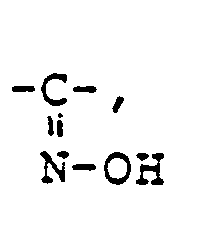

- A is a C2-C6 alkylene group;
- X is an oxygen atom, a sulfur atom, a group of the formula -SO- or a group of the formula -S02-; n is 0 or 1; and
- the carbon-carbon bond between 3- and 4-positions in the carbostyril skeleton is a single or double bond in the preparation of a medicament for treatment and prevention of arteriosclerosis, ischemic heart disease, chronic arterial obstruction, acute or chronic nephritis and treatment during artificial dialysis and implantation of an articifial organ.
- According to a further embodiment the invention comprises a carbostyril derivative or salt thereof represented by the general formula 1 a),

- R2 is a hydrogen atom, a halogen atom, a C1-C6 alkylsulfonyloxy group, a C1-C6 alkoxy group or a hydroxyl group;
- Z is an oxygen atom, a sulfur atom, a group of the formula


- A is a C2-C6 alkylene group;
- X is an oxygen atom, a sulfur atom, a group of the formula -SO- or a group of the formula -S02-;
- Further embodiments are comprised in the subclaims.
- The proviso in claim 2 excludes the portions being known from DE-A-2806721.
- The provisio in new claim 3 excludes the portions being known from Japanese Kokai patents (laid open) Nos.: 57-154129 and 54-12384.
- The provisios (i), (ii) and (iii) and (iv) in claim 4 are intended to exclude the portions from the following prior art references:
- (i) is inserted for excluding the portion being known from Japanese patent Kokai (laid-open) Nos. 54-30183 and 54-30180;
- (ii) is inserted for excluding the portions being known from US-A 4,277,479;
- (iii) is inserted for excluding the portions being known from Japanese patent Kokai (laid-open) No. 57-9780; and
- (iv) is inserted for excluding the portions being known from Japanese Patent Kokai No. 57-159778.
- In the present specification, the specific examples of the groups being defined in the respective symbols of R, R1, R2, R3, Z and A are shown below.
- The term "a lower alkyl group" means a straight or branched alkyl group having 1 to 6 carbon atoms, and the examples including, methyl, ethyl, propyl, isopropyl, butyl, tert-butyl, pentyl and hexyl groups and the like.
- The term "a halo-lower alkyl group" means a straight or branched alkyl group having 1 to 6 carbon atoms having 1 to 3 halogen atoms as the substituents, and the examples including, chloromethyl, bromomethyl, iodomethyl, trifluoromethyl, 2-fluoroethyl, 2,2-difluoroethyl, 2,2,2-trifluoroethyl, 3-chloropropyl, 4-chlorobutyl, 3,4-dichlorobutyl, 3-fluoropentyl, 2,3,4-trifluoropentyl, 2,3-dichlorohexyl and 6,6-dibromohexyl groups.
- The term "a halogen atom" means a fluorine atom, a chlorine atom, a bromine atom and an iodine atom.
- The term "a lower alkylamino group" means an amino group having 1 or 2 straight or branched alkyl groups having 1 to 6 carbon atoms as the substituents, and the examples including, methylamino, ethylamino, propylamino, tert-butylamino, pentylamino, hexylamino, dimethylamino, diethylamino, di-n-propylamino, di-n-butylamino, dipentylamino, dihexylamino, N-methyl-N-n-butylamino, N-methyl-N-pentylamino and N-ethyl-N-hexylamino groups.
- The term "a lower alkoxy group" means a straight or branched alkoxy group having 1 to 6 carbon atoms, and examples including, methoxy, ethoxy, propoxy, isopropoxy, butoxy, tert-butoxy, pentyloxy and hexyloxy groups.
- The term "a cycloalkyl group" means a cycloalkyl group having 3 to 8 carbon atoms, and the examples including, cyclopropyl, cyclobutyl, cyclopentyl, cyclohexyl, cycloheptyl and cyclooctyl groups.
- The term "a lower alkyl group having 1 or 2 substituents selected from the group consisting of an amino group, a lower alkylamino group and a carboxyl group" means a straight or branched alkyl group having 1 to 6 carbon atoms having 1 to 2 substituents selected from the group consisting of an amino group, a straight or branched alkylamino group having 1 to 6 carbon atoms and a carboxyl group, and the examples including, aminomethyl, 2-methylamino, 1-ethylaminoethyl, 3-propylaminopropyl, 4-tert-butylaminobutyl, 1,1-dimethy!-2-penty!aminoethy!, 5-hexylaminopentyl, 6-dimethylaminohexyl, dimethylaminomethyl, 2-diethylaminoethyl, 1-di-n-propylaminoethyl, 3-di-n-butylaminopropyl, 4-dipen- tylaminobutyl, 1,1-dimethyl-2-dihexylaminoethyl, 5-(N-methyl-N-n-butylamino)pentyl, 6-(N-methyl-N-pentylamino)hexyl, 2-methyl-3-(N-ethyl-N-hexylamino)propyl, carboxymethyl, 2-carboxyethyl, 1-carboxyethyl, 3-carboxypropyl, 4-carboxybutyl, 1,1-dimethyl-2-carboxyethyl, 5-carboxypentyl, 6-carboxyhexyl, 2-methyl-3-carboxypropyl, 2-amino-2-carboxyethyl, 1-dimethylamino-1-carboxymethyl and 3-amino-2-carboxypropyl groups.
- The term "a lower alkoxycarbonyl group" means a straight or branched alkoxycarbonyl group having 1 to 6 carbon atoms, and the examples including, methoxycarbonyl, ethoxycarbonyl, propoxycarbonyl, isopropoxycarbonyl, butoxycarbonyl, pentyloxycarbonyl and hexyloxycarbonyl groups.
- The term "a phenyl-lower alkyl group" means a phenylalkyl group in which the alkyl moiety is a straight or branched alkyl group having 1 to 6 carbon atoms, and the examples including, benzyl, 2-phenylethyl, 1-phenylethyl, 3-phenylpropyl, 4-phenylbutyl, 1,1-dimethyl-2-phenylethyl,5-phenylpentyl and 6-phenylhexyl and 2-methyl-3-phenylpropyl groups.
- The term "a lower alkoxy-substituted-phenyl-lower alkyl group" means a phenylalkyl group in which the alkyl moiety is a straight or branched alkyl group having 1 to 6 carbon atoms, and 1 to 3 straight or branched alkoxy groups having 1 to 6 carbon atoms are substituted on the phenyl ring, and the examples including, 3-methoxybenzyl, 2-(3,4-dimethoxyphenyl)ethyl, 1-(4-ethoxyphenyl)ethyl, 3-(2-propoxyphenyl)-propyl, 4-(3-buthoxyphenyl)butyl, 1,1-dimethyl-2-(4-pentyloxyphenyl)ethyl, 5-(4-hexyloxyphenyl)pentyl, 6-(3,4,5-trimethoxyphenyl)hexyl and 2-methyl-3-(2,5-dimethoxyphenyl)propyl groups.
- The term "a lower alkylthio group" means a straight or branched alkylthio group having 1 to 6 carbon atoms, and the examples including, methylthio, ethylthio, propylthio, isopropylthio, butylthio, tert-butylthio, pentylthio and hexylthio groups.
- The term "a lower alkenyl group" means a straight or branched alkenyl group having 2 to 6 carbon atoms, and the examples including, vinyl, allyl, 2-butenyl, 3-butenyl, 1-methylallyl, 2-pentenyl and 2-hexenyl group.
- The term "a phenyl group having 1 to 3 substituents selected from the group consisting of a lower alkyl group, a halo-lower alkyl group, a halogen atom, a hydroxyl group, an amino group, a lower alkylamino group and a lower alkoxy group" means a phenyl group having 1 to 3 substituents selected from a straight of branched alkyl group having 1 to 6 carbon atoms, a straight or branched alkyl group having 1 to 6 carbon atoms having 1 to 3 halogen atoms as the substituents, a halogen atom, a hydroxyl group, an amino group, an amino group having 1 or 2 straight or branched alkyl group having 1 to 6 carbon atoms as the substituents, and a straight or branched alkoxy group having 1 to 6 carbon atoms, and the examples including, 2-chlorophenyl, 3-chlorophenyl, 4-chlorophenyl, 2-fluorophenyl, 3-fluorophenyl, 4-fluorophenyl, 2-bromophenyl, 3-bromophenyl, 4-bromophenyl, 2-iodophenyl, 3-iodophenyl, 4-iodophenyl, 3,5-dichlorophenyl, 2,6-dichlorophenyl, 3,4-dichlorophenyl, 3,4-difluorophenyl, 3,5-dibromophenyl, 3,4,5-trichlorophenyl, 2-methylphenyl, 3-methylphenyl, 4-methylphenyl, 2-ethylphenyl, 3-ethylphenyl, 4-ethylphenyl, 3-isopropylphenyl, 4-hexylphenyl, 3,4-dimethylphenyl, 2,5-dimethylphenyl, 3,4,5-trimethylphenyl, 2-methoxyphenyl, 3-methoxyphenyl, 4-methoxyphenyl, 2-ethoxyphenyl, 3-ethoxyphenyl, 4-ethoxyphenyl, 4-isopropoxyphenyl, 4-hexyloxyphenyl, 3,4-dimethoxyphenyl, 3,4-diethoxyphenyl, 3,4,5-trimethoxyphenyl, 2,5-dimethoxyphenyl, 3-methyl-4-chlorophenyl, 2-chloro-6-methylphenyl, 2-methoxy-3-chlorophenyl, 2-hydroxyphenyl, 3-hydroxyphenyl, 4-hydroxyphenyl, 3,4-dihydroxyphenyl, 3,4,5-trihydroxyphenyl, 2-aminophenyl, 3-aminophenyl, 4-aminophenyl, 2,4-diaminophenyl, 2-methylaminophenyl, 3-methylaminophenyl, 4-methylaminophenyl, 2-ethylaminophenyl, 3-ethylaminophenyl, 4-ethylaminophenyl, 4-isopropylaminophenyl, 4-hexylaminophenyl, 3,4-dimethylaminophenyl, 2-(dimethylamino)phenyl, 3-(dimethylamino)phenyl, 4-(dimethylamino)phenyl, 2-(diethylamino)phenyl, 3-(N-methyl-N-ethylamino)phenyl, 4-(N-methyl-N-isopropylamino)phenyl, 4-(N-isopropyl-N-hexylamino)phenyl, 2-(di-n-buty!amino)pheny!, 2-trifluoromethylphenyl, 3-(3-chloropropyl)phenyl, 4-(2-fluoroethyl)phenyl, 2-(4-chlorobutyl)phenyl, 3-(3-bromopentyl)phenyl, 2-(iodomethyl)phenyl, 4-(2,3-dichlorohexyl)phenyl, and 3-(2,2,2-trifluoroethyl)phenyl groups.
- The unsaturated heterocyclic goup is selected from 1,2,4-triazolyl, imidazolyl, 1,2,3,5-tetrazolyl, 1,2,3,4-tetrazolyl, pyrrolyl, benzimidazolyl, 1,3,4-triazolyl, imidazolynyl, pyridyl, pyrimidinyl, pyrazolyl, pyrazolinyl, thiazolyl, thiazolinyl, 1,3,4-oxadiazolyl, 1,3,4-thiadiazolyl, thienyl, furyl, pyranyl, isothiazolyl, isooxazolyl, pyrazinyl, pyridazinyl, indolyl, isoindolyl, 3H-indolyl, indolizinyl, indazolyl, quinolyl, isoquinolyl, phthalazinyl, naphthyridinyl, quinoxalinyl, qininazolinyl, cinnolinyl, pyrrolinyl, pyrazolinyl, indolinyl and isoindolinyl groups.
- The term "said unsaturated heterocyclic residual group which may have 1 to 3 substituents, on the heterocyclic residual ring, selected from an oxo group; a thio group; a phenyl group; a phenyl group having 1 to 3 substituents, on the phenyl ring, selected from the group consisting of a lower alkyl group, a halo-lower alkyl group, a halogen atom, a hydroxyl group, an amino group, a lower alkylamino group, a carboxy group and a lower alkoxy group; a cycloalkyl group; a phenylthio group; a lower alkyl group; a lower alkyl group having 1 to 2 substituents selected from the group consisting of an amino group, a lower alkylamino group and a carboxyl group; an amino group; a hydroxyl group; a cyano group; a carboxyl group; a lower alkoxycarbonyl group; a phenyl-lower alkyl group which may have hydroxyl groups as the substituents on the phenyl ring; a phenylsulfonyl group which may have lower alkyl groups as the substituents on the phenyl ring; a lower alkoxy-substituted phenyl-lower alkyl group; a lower alkylthio group; a lower alkenyl group; a lower alkoxy group and a pyridyl group" means an unsaturated heterocyclic residual group which may have 1 to 3 substituents, on the heterocyclic residual ring, selected from the group consisting of an oxo group; a thio group; a phenyl group; a phenyl group having 1 to 3 substituents, on the phenyl ring, selected from the group consisting of the above-mentioned lower alkyl group, the above-mentioned halo-lower alkyl group, the above-mentioned halogen atom, a hydroxyl group, an amino group, the above-mentioned lower alkylamino group, a carboxy group and the above-mentioned lower alkoxy group; the above-mentioned cycloalkyl group; a phenylthio group; the above-mentioned lower alkyl group; the above-mentioned lower alkyl group having 1 to 2 substituents selected from the group consisting of an amino group, the above-mentioned lower alkylamino group and a carboxyl group; an amino group; a hydroxyl group; a cyano group; a carboxyl group; the above-mentioned lower alkoxycarbonyl group; the above-mentioned phenyl-lower alkyl group which may have hydroxyl groups as the substituents on the phenyl ring; the above-mentioned phenylsulfonyl group which may have lower alkyl groups as the substituents on the phenyl ring, the above-mentioned lower alkoxy-substituted phenyl-lower alkyl group; the above-mentioned lower alkylthio group; the above-mentioned lower alkenyl group; the above-mentioned lower alkoxy group and a pyridyl group, and the examples including, 2-phenylthiopyrrolyl, 2-methylimidazolyl, 2-ethylimidazolyl, 2-propylimidazolyl, 4-n-buty!imidazo!y!, 4-pentylimidazolyl, 4-hexylimidazolyl, 2-phenylimidazolyl, 2-phenylthioimidazolyl, 2-phenylthio-1,3,5-triazolyl, 3-phenylthio-1,2,4-triazolyl, 1-phenylimidazolyl, 1-ethylimidazolyl, 5-methylimidazolyl, 5-methoxybenzimidazolyl, 1-ethylbenzimidazolyl, 6- ethoxybenzimidazolyl, 7-propoxybenzimidazolyl, 4-n-butoxybenzimidazo!y!, 5-pentyloxybenzimidazolyl, 6-hexyloxybenzimidazolyl, 1-phenyl-1,3,4-triazolyl, 1-phenyl-1,2,3,4-tetrazolyl, 1-(3-pyridyl)imidazolyl, 1-(2-methylphenyl)imidazolyl, 1-(2-methoxyphenyl)imidazolyl, 1-(4-methylphenyl)imidazolyl, 1-(3-ethylphenyl)-imidazolyl, 1-(4-propylphenyl)imidazolyl, 1-(2-n-butylphenyl)imidazolyl, 1-(3-pentylphenyl)imidazolyl, 1-(4-hexylphenyl)imidazolyl, 1-(3-ethoxyphenyl)imidazolyl, 1-(4-methoxyphenyl)imidazolyl, 1-(4-propoxyphenyl)-imidazolyl, 1-(2-n-butoxyphenyl)imidazolyl, 1-(3-pentyloxyphenyl)imidazolyl, 1-(4-hexyloxyphenyl)imidazolyl, 1-allylimidazolyl, 1-(2-butenyl)imidazolyl, 1-(3-butenyl)imidazolyl, 1-(1-methylallyl)imidazolyl, 1-(2-pentenyl)-imidazolyl, 1-(2-hexenyl)imidazolyl, 1-benzylimidazolyl, 1-(2-phenylethyl)imidazolyl, 1-(1-phenylethyl)-imidazolyl, 1-(3-phenylpropyl)imidazolyl, 1-(4-phenylbutyl)imidazolyl, 1-(6-phenylhexyl)imidazolyl, 1-(5-phenylpentyl)imidazolyl, 1-ethyl-1,3,4-triazolyl, 4-ethyl-1,3,4-triazolyl, 1-methyl-1,3,4-triasolyl, 4-propyl-1,3,4-triazolyl, 1-benzyl-1,3,4-triazolyl, 4-benzyl-1,3,4-triazolyl, 1-(2-phenylethyl)-1,3,4-triazolyl, 3-methylpyrazolyl, 4-ethylpyrazolyl, 3-propylpyrazolyl, 3-n-butylpyrazolyl, 1-ethylpyrrolyl, 1-methylpyrrolyl, 1-propylpyrrolyl, 1-n-butylpyrrolyl, 1-allylbenzimidazolyl, 1-(2-butenyl)benzimidazolyl, 1-(3-butenyl)benzimidazolyl, 1-(1-methylallyl)benzimidazolyl, 1-(2-pentenyl)benzimidazolyl, 1-(2-hexenyl)benzimidazolyl, 1-(2-trifluoromethylphenyl)imidazolyl, 1-(4-chlorophenyl)imidazolyl, 1-(4-hydroxyphenyl)imidazolyl, 1-(4-dimethylaminophenyl)-imidazolyl, 1-(3,4-difluorophenyl)imidazolyl, 1-(3,4,5-trichlorophenyl)imidazolyl, 1-[4-(2-fluoroethyl)phenyl]-imidazolyl, 1-[4-(2,3-dichlorohexyl)phenyl]imidazolyl, 1-[3-(3-chloropropyl)phenyl]imidazolyl, 1-(2-aminophenyl)imidazolyl, 1-(2-ethylaminophenyl)imidazolyl, 1-(4-isopropylaminophenyl)imidazolyl, 1-[4-(N-methyl-N-hexylamino)phenyl]imidazolyl, 2-cyclopropyl-1,3,4-oxadiazolyl, 2-cyclohexyl-1,3,4-oxadiazolyl, 2-cycloheptyl-1,3,4-oxadiazolyl, 2-cycloctyl-1,3,4-oxadiazolyl, 1-cyclohexylimidazolyl, 1-cyclopentyl-1,3,4-triazolyl, 1-cyclopropylbenzimidazolyl, 2-methylthioimidazolyl, 4-ethylthioirnidazolyl, 2-propylthioimidazolyl, 4-n-butyrylthioimidazolyl, 4-pentylthioimidazolyl, 2-hexylthioimidazolyl, 1-ethyl-5,6-dimethoxy-benzimidazolyl, 2-phenyl-3,4-dimethylpyrrolyl, 1,2,3-trimethylimidazolyl, 2,4,5-trichloropyridyl, 3,4,5-trimethox- ypyridyl, 2-(2-amino-2-carboxyethyl)imidazolyl, 2-methyl-3-dimethylaminomethylimidazolyl, 2-carboxymethyl-3-methylimidazolyl, 3-methyl-5-pyrazolinyl, 3-methyl-4-hydroxypyrazolyl, 4-amino-5-cyanoimidazolyl, 4-methyl-5-ethoxycarbonylimidazolyl, 4-methyl-5-carboxyimidazolyl, 1-[2-(3,4-dihydrophenyl)ethyl]-1,2,3,4-tetrazolyl, 1-(3-pyridyl)-5-thio-1,2,3,4-tetrazolyl, 1-phenyl-5-1,2,3,4-tetrazolyl, 1-(4-phenylsulfonyl)pyrrolyl and 1-(4-carboxyphenyl)imidazolyl groups.
- The term "a lower alkylene group: mean a straight or branched alkylene group having 1 to 6 carbon atoms, and the examples including, methylene, ethylene, trimethylene, 2-methyltrimethylene, 2,2-dimethyl- trimethylene, 1-methyltrimethylene, methylmethylene, ethylmethylene, tetramethylene, pentamethylene and hexamethylene groups.
- The term "a phenyl-lower alkyl group which may have hydroxyl groups as the substituents on the phenyl ring" means a phenyl alkyl group in which the alkyl moiety is a straight of branched alkyl group having 1 to 6 carbon atoms, and the phenyl ring may have 1 to 3 hydroxyl group as the substituents, and the examples including, in addition to the above-mentioned phenyl-lower alkyl group, 3-hydroxybenzyl, 2-(3,4-dihydroxyphenyl)ethyl, 1-(4-hydroxyphenyl)ethyl, 3-(2-hydroxyphenyl)propyl, 4-(3-hydroxyphenyl)butyl, 1,1-dimethyl-2-(4-hydroxyphenyl)ethyl, 5-(4-hydroxyphenyl)pentyl, 6-(3,4,5-trihydroxyphenyl)hexyl and 2-methyl-3-(2,5-dihydroxyphenyl)propyl groups.
- The term "a phenylsulfonyl group which may have lower alkyl groups as the substituents on the phenyl ring" means a phenylsulfonyl group which may have 1 to 3 straight or branched alkyl groups having 1 to 6 carbon atoms as the substituents on the phenyl ring, and the examples including, phenylsulfonyl, 2-methylphenylsulfonyl, 3-methylphenylsulfonyl, 4-methylphenylsulfonyl, 2-ethylphenylsulfonyl, 3-isopropyl- phenylsulfonyl, 4-hexylphenylsulfonyl, 2-pentylphenylsulfonyl, 3,4-dimethylphenylsulfonyl, 2,5-dimethylphenylsulfonyl and 3,4,5-trimethylphenylsulfonyl groups.
- The term "a lower alkylsulfonyloxy group" means a straight or branched alkylsulfonyloxy group having 1 to 6 carbon atoms, and the examples including, methylsulfonyloxy, ethylsulfonyloxy, propylsulfonyloxy, isopropylsulfonyloxy, butylsulfonyloxy, tert-butylsulfonyloxy, pentylsulfonyloxy and hexylsulfonyloxy groups.
- The side-chain of the formula -Z-A-(X)n-R may be substituted any one of 3-, 4-, 5-, 6-, 7- or 8-position in the carbostyril skeleton.
- Carbostyril derivative and salts thereof represented by the general formula (1) according to the present invention can be prepared by various methods, and preferable methods can be exemplified by reaction process formulas as follows.
- Reaction process formula - 1

- Among the substituents represented by the symbol X1, as to the lower alkanesulfonyloxy group, the examples including, methanesulfonyloxy, ethanesulfonyloxy, propanesulfonyloxy, isopropanesulfonyloxy, butanesulfonyloxy, tert-butanesulfonyloxy, pentanesulfonyloxy and hexanesulfonyloxy groups and the like; as to the arylsulfonyloxy group, the examples including, phenylsulfonyloxy, 4-methylphenylsulfonyloxy, 2-methylphenylsulfonyloxy, 4-nitrophenylsulfonyloxy, 4-methoxyphenylsulfonyloxy, 3-chlorophenylsulfonyloxy and a-naphthylsulfonyloxy groups and the like; further as to the aralkylsulfonyloxy group, the examples including, benzylsulfonyloxy, 2-phenylethylsulfonyloxy, 4-phenylbutylsulfonyloxy, 4-methylbenzylsulfonyloxy, 2-methylbenzylsulfonyloxy, 4-nitrobenzylsulfonyloxy, 4-methoxybenzylsulfonyloxy, 4-chlorobenzyl- sulfonyloxy and a-naphthylsulfonyloxy groups.
- The reaction of a compound of the general formula (2) with a compound of the general formula (3) can be carried out in a suitable solvent or without solvent, in the presence of a basic compound. As to the basic compound, any known basic compound can be selected from a wide range, and the examples including, inorganlc basic compounds such as sodium hydroxide, potassium hydroxide, sodium carbonate, sodium hydrogen carbonate, potassium hydrogen carbonate and silver carbonate and the like; alkali metals such as sodium metal, potassium metal and the like; alcoholates such as sodium methylate, sodium ethylate and the like; organic basic compounds such as triethylamine, pyridine, N,N-dimethylamine, N-methylmorpholine, 4-dimethylaminopyridine, 1,5-diazabicyclo[4.3.0]nonene (DBN), 1,8-diazabicyclo [5.4.0]undecene-7 (DBU) and 1,4-diazabicyclo[2.2.2]octane (DABCO) and the like. As to the solvent, any inert solvent which does not give any adverse effect to the reaction can be used, and the examples alcohols such as methanol, ethanol, propanol, butanol and ethylene glycol and the like; ethers such as dimethyl ether, tetrahydrofuran, dioxane, ethylene glycol dimethyl ether and diethylene glycol dimethyl ether and the like; ketones such as acetone, methyl ethyl ketone and the like; aromatic hydrocarbons such as benzene, toluene and xylene and the like; esters such as methyl acetate, ethyl acetate and the like; aprotic polar solvents such as N,N-dimethylformamide (DMF), dimethyl sulfoxide (DMSO), hexamethylphosphoric triamide (HMPA) and the like. The reaction can also be carried out in the presence of a metal iodide such as sodium iodide, potassium iodide or the like.
- Ratio of the amount of a compound of the general formula (2) to the amount of a compound of the general formula (3) is not specifically restricted, and it can be selected from a wide range, and generally an equimolar quantity to 5 times the molar quantity, preferably an equimolar quantity to 2 times the molar quantity of the latter may be used to the former. Temperature of the above-mentioned reaction is not specifically restricted, and generally the reaction can be carried out at about room temperature to 200 °C, preferably at about 50 to 150°C, and completes generally in about 5 minutes to 30 hours.
- Reaction process formula - 2

- The reaction of a compound of the general formula (4) with a compound of the general formula (5) can be carried out under the reaction conditions similar to those employed in the reaction of a compound of the general formula (2) with a compound of the general formula (3) as in the Reaction process formula - 1.
- Reaction process formula - 3


- The reaction of a compound of the general formula (6) with a compound of the general formula (7) can be carried out in the presence or absence of a basic compound, preferably in the presence of a basic compound in a suitable solvent. As to the basic compound, any known basic compound can be selected from a wide range and can be used, for example metal hydroxides such as sodium hydroxide, potassium hydroxide and the like; alkali metal alcoholates such as sodium methylate, sodium ethylate, potassium methylate, potassium ethylate and the like; alkali metal amides such as sodium amide, potassium amide and the like; alkali metals such as sodium metal, potassium metal and the like; alkali metal hydride such as sodium hydride, potassium hydride and the like; and DBU can be exemplified.
- The amount of the basic compound is not specifically restricted, and can be selected from a wide range, generally an equimolar quantity to a large excess quantity, preferably 1 to 3 times the molar quantity of the basic compound may be used to a compound of the general formula (6). As to the solvent, any common inert solvent can be selected from a wide range and used, examples including, lower alcohols such as methanol, ethanol, isopropanol and the like; ethers such as diethyl ether, tetrahydrofuran, dioxane and the like; ketones such as acetone, methyl ethyl ketone, cyclohexane, acetophenone and the like; aromatic hydrocarbons such as benzene, toluene, xylene and the like; esters such as methyl acetate, ethyl acetate and the like; polar solvents such as dimethylformamide, hexanethylphosphoric triamide, acetonitrile and the like. The reaction can also be carried out in the presence of a metal iodide such as sodium iodide, potassium iodide or the like. Ratio of the amount of a compound of the general formula (6) to the amount of a compound of the general formula (7) is not specifically restricted and can be selected from a wide range, and generally an equimolar quantity to a large excess quantity, preferably 1 to 2 times the molar quantity of the latter may be used to the former. The reaction can be proceeds generally at 0 ° C to about 200 °C, preferably from room temperature to about 150°C, and the reaction completes in 10 minutes to about 24 hours.
- In the above-mentioned reaction, when a compound of the general formula (6) in which Z is a group of the formula
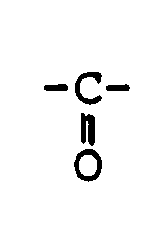


- The above-mentioned protecting reaction can be carried out in the presence of an acid in a suitable solvent. As to the acid used in this protecting reaction, mineral acids such as hydrochloric acid, hydrobromic acid, sulfuric acid and the like, organic acid such as p-toluenesulfonic acid, pyridine p-toluenesulfonate, acetic acid, propionic acid and the like can be exemplified. As to the solvent, lower alcohols such as methano, ethanol, isopropanol and the like; ethers such as diethyl ether, tetrahydrofuran, dioxane and the like; ketones such as acetone and the like; aromatic hydrocarbons such as benzene, toluene, xylene and the like, aliphatic hydrocarbons such as n-hexane, n-octane and the like; alkane acids such as acetic acid, propionic acid and the like; acetonitrile or mixed solvents thereof can be exemplified.
- Ratio of the amount of dihydroxy-lower alkylene to the amount of a compound of the general formula (6) may be generally at least an equimolar quantity, preferably in about 1 to 5 times the molar quantity of the former to the latter. The reaction is generally carried out at 0 to about 150°C, preferably at 0 to 100 ° C, and completes in about 0.5 to 10 hours.
- Removal reaction of the protecting group is carried out in the presence of an acid in the presence or absence of a suitable solvent. As to the acid used in this removal reaction, any acid as mentioned above can be used. The amount of the acid is at least an equimolar quantity, preferably a large excess quantity of the acid may be used to the starting material. As to solvent, water, dimethylformamide and dimethyl sulfoxide may be exemplified in addition to the solvents mentioned above. The reaction is generally proceeded at -30 to 200 ° C, and preferably at about -30 to 100 ° C, and completes in about 0.5 to 12 hours.
- Reaction process formula - 4

- The reduction of a compound of the general formula (1 d) can be carried out by a reducing method using a hydrogenating reducing agent, or catalytic reducing method.
- In case of carrying out the reducing method by using a hydrogenating reducing agent, sodium borohydride, lithium aluminum hydride or the like, preferably sodium borohydride can be used as the hydrogenating reducing agent. The hydrogenating reducing agent may be used generally in an amount at least an equimolar quantity, preferably 1 to 3 times the molar quantity thereof to a compound of the general formula (1 d). The hydrogenating reduction is carried out in a solvent, for example water, a lower alcohol such as methanol, ethanol, isopropanol or the like; an ether such as tetrahydrofuran, diethyl ether or the like; dimethylformamide or the like; or a mixed solvent thereof, and at about -60 to 100 ° C, preferably at about -30 to 70 °C, and the reaction complete in 10 minutes to 3 hours. In case of using lithium aluminum hydride as the reducing agent, an anhydrous solvent, such as diethyl ether, tetrahydrofuran or the like may be used as the solvent.
- In case of employing catalytic reducing method, platinum oxide, palladium black, palladium-carbon, Raney-nickel or the like can be used as the reducing catalyst. The amount of the catalyst may be generally 0.2 to 0.5 times the part by weight to a compound of the general formula (1 d). The catalytic reducing method is carried out in a solvent for example, water; a lower alcohol such as methanol, ethanol, isopropanol or the like an ether such as tetrahydrofuran, diethyl ether or the like, and under 1 to 10 atmospheric pressure, preferably under 1 to 3 atmospheric pressure of hydrogen atmosphere with a sufficient shaking condition. The catalytic reduction is carried out generally at -30 ° C to the boiling point of the solvent, preferably at 0 ° C to about room temperature.
- Reaction process formula - 5


- The reaction of a compound of the general formula (1f) with a compound of the general formula (8) can be carried out in the presence of a basic substance, in a suitable solvent. As to the basic substance, examples including, sodium hydride, potassium metal, sodium metal, sodium amide, potassium amide, sodium hydroxide, potassium hydroxide and the like. As to the solvent, examples including, ethers such as dioxane, diethylene glycol dimethyl ether and the like; aromatic hydrocarbons such as toluene, xylene and the like; polar solvents such as dimethylformamide, dimethyl sulfoxide, hexamethylphosphoric triamide and the like. The reaction may also be carried out, if necessary, by adding a copper halide such as copper iodide; metal iodide such as sodium iodide, potassium iodide and the like; copper powder and the like to the reaction system.
- Ratio of the amount of a compound of the general formula (1f) to the amount of a compound of the general formula (8) is not specifically restricted, and can be selected from a wide range, generally at least an equimolar quantity, preferably 1 to 3 times the molar quantity of the latter may be used to the former. The reaction is generally proceeded at 0 to 100 ° C, preferably at about 0 to 70 °C, and completes in 5 minutes to 12 hours.
- Reaction process formula - 6

- The reaction of a compound of the general formula (9) with a compound of the general formual (10) can be easily carried out under conditions similar to those known in amino-bond formation reactions. In the present invention, the reaction can be carried out by using a compound in which the carboxyl group being activated, in place of a compound of the general formula (9). As to typical methods are, for example, (a) mixed acid anhydride method: by reacting a carboxylic acid (9) with an alkylhalocarboxylic acid to form the corresponding mixed acid anhydride, then reacting said mixed acid anhydride with a hydrazine derivative (10); (b) activated ester method: by converting a carboxylic acid (9) into the corresponding activated ester thereof, such as p-nitrophenyl ester, N-hydroxysuccinimide ester, 1-hydroxybenzotriazol ester or the like, then reacting said activated ester of carboxylic acid (9) with a hydrazine derivative (10); (c) carbodiimide method: by condensing a carboxylic acid (9) with a hydrazine derivative (10) in the presence of an activating agent, such as dicyclohexylcarbodiimide, carbonyldiimidazol or the like; (d) other methods: by reacting a carboxylic acid (9) with a dehydrating agent such as acetic anhydride to prepare the corresponding carboxylic anhydride, then reacting said carboxylic acid anhydride with a hydrazine derivative (10); by reacting a carboxylic acid (9) with a lower alcohol to form the ester, then reacting said ester with a hydrazine derivative (10) under a high pressure at a high temperature; by reacting an acid halide of a carboxylic acid (9), i.e., a carboxylic halide with a hydrazine derivative (10). Among the above-mentioned methods, the mixed acid anhydride method is the most preferable.
- In carrying out the mixed acid anhydride method, as to the alkylhalocarboxylic acid used in the reaction, examples including methyl chloroformate, methyl bromoformate, ethyl chloroformate, ethyl bromoformate, isobutyl chloroformate and the like. Said mixed acid anhydride can be obtained generally by Schotten-Baumann reaction, generally said mixed acid anhydride is reacted with a hydrazine derivative (10), without separated from the reaction system, to obtain a compound of the general formula (11).
- Schotten-Baumann reaction is carried out in the presence of a basic compound. As to the basic compound, any basic compound used in Schotten-Baumann reaction can be used, the examples including, organic basic compounds such as triethylamine, trimethylamine, pyridine, dimethylaniline, N-methylmorpholine, 1,5-diazabicyclo-[4.3.0]nonene-5 (DBN), 1,8-diazabicyclo[5.4.0]undecene-7 (DBU), 1,4-diazabicyclo-[2.2.2]octane (DABCO) and the like; and inorganic basic compounds such as potassium carbonate, sodium carbonate, potassium hydrogen carbonate, sodium hydrogen carbonate and the like. The Schotten-Baumann reaction is carried out generally at -20 to 100 ° C, preferably at 0 to 50 °C, and completes generally in about 5 minutes to 10 hours.
- The reaction of the mixed acid anhydride thus obtained above with a compound (10) is generally carried out in a solvent. As to the solvent used in the reaction, any usual solvent employed in mixed acid anhydride method can also be used, and the examples including, halogenated hydrocarbons such as methylene chloride, chloroform, dichloroethane and the like; aromatic hydrocarbons such as benzene, toluene, xylene and the like; ethers such as diethyl ether, tetrahydrofuran, dimethoxyethane and the like; esters such as methyl acetate, ethyl acetate and the like; aprotic polar solvents such as dimethylformamide, dimethyl sulfoxide, hexamethylphosphoric triamide and the like. The reaction is generally carried out at -20 to 150°C, preferably at 10 to 50 ° C, and completes generally in about 5 minutes to 10 hours.
- Ratio of the amount of a compound (9) to the amount of the alkylhalocarboxylic acid and a compound (10) in the above-mentioned reaction is generally an equimolar quantity each of these compounds, and there may be used 1 to 1.5 times the molar quantity of the alkylhalocarboxylic acid and the compound (10) may be used to the compound (9).
- The reaction for obtaining a compound of the general formual (1 h) by ring-closing a compound of the general formula (11) cart be carried out according to various methods known in usual ring-closing reactions. For example, method by heating, ring-closing methods by using dehydrating agents such as phosphorus oxychloride, phosphorus pentachloride, phosphorus trichloride, acetyl chloride, p-toluenesulfonic acid, benzenesulfonic acid, thionyl chloride, concentrated sulfuric acid, hydrochloric acid, acetic anhydride, polyphosphoric acid and the like. In carrying out a method by heating, the reaction is carried out by using a high boiling point-hydrocarbon or a high boiling point ether, as the solvent, and the examples including tetrahydronaphthalene, diphenyl ether, diethylene glycol dimethyl ether, decaline, tetraline, toluene, xylene, mesitylene, chlorobenzene, bromobenzene and the like, and the reaction can be carried out under heating conditions at about 100 to 250 ° C, preferably, at about 150 to 200 ° C. In carrying out ring-closing method by using a dehydrating agent, the use of polyphosphoric acid as the dehydrating agent is the most desirable. Said polyphosphoric acid is generally used in an equimolar quantity to a large excess quantity, preferably 10 to 20 times of the quantity may be used to the compound (11), and the reaction is generally carried out at about 100 to 250 ° C, and completes, generally in about 5 minutes to 6 hours.
- In the above-mentioned Reaction process formula - 6, a compound (9) being used as the starting material is a known compound, and compounds (10) contain partially known compounds and including some novel compounds.
- Such novel compounds can be prepared by method similar to those employed in the preparation of known compounds, for example they can be prepared by method of the following Reaction process formula - 7.
- Reaction process formula - 7

- The reaction of a compound of the general formula (12) with a compound of the general formula (13) can be carried out by methods similar to those employed in the reaction of a compound (9) with a compound (10).
- Reaction process formula - 8

- The reaction of a compound of the general formula (14) with a compound of the general formula (15) is carried out in the absence or presence of a suitable solvent. As to the solvent used in the reaction, the examples including, high boiling point solvents, for example, aromatic hydrocarbons such as benzene, toluene, xylene or the like; ethers such as dimethoxyethane, diphenyl ether, dioxane or the like.
- Ratio of the amount of the compound (14) to the amount of the compound (15) may be generally an equimolar quantity to a large excess quantity, preferably 2 to 50 times the molar quantity of the latter to the former. The reaction is carried out, generally at 50 to 250 ° C, preferably at 80 to 200 ° C, and completes generally in about 1 to 40 hours.
- Reaction process formula - 9

- The dehydrogenation of a compound of the general formula (1j) is carried out, by a conventional method, in a suitable solvent by using an oxidizing agent. As to the oxidising agent, the examples including, benzoquinones such as 2,3-dichloro-5,6-dicyanobenzoquinone (DDQ), chloranil (2,3,5,6-tetrachloroben- zoquinone) and the like; selenium dioxide; metal catalysts such as palladiumcarbon and the like; brominating agents such as N-bromosuccinimide, bromine and the like. As to amount of the oxidizing agent, in case of using a benzoquinone or a brominating agent, generally an equimolar to 5 times the molar quantity, preferably an equimolar to 2 times the molar quantity of the oxidizing agent may be used to a compound of the general formula (1j). As to the solvent used in the reaction, the examples including, ethers such as dioxanem tetrahydrofuran, 2-methoxyethanol, dimethoxyethane and the like; aromatic hydrocarbons such as benzene, toluene, xylene and the like; halogenated hydrocarbons such as dichloromethane, dichloroethane, chloroform, carbon tetrachloride and the like; alcohols such as butanol, amyl alcohol, hexanol and the like; aprotic polar solvents such as dimethylformamide, dimethyl sulfoxide, hexamethylphosphoric triamide or the like. The reaction is carried out generally at room temperature to 300 ° C, preferably at about 50 to 200 ° C, and completes, generally in about 1 to 48 hours.
- The catalytic reduction of a compound of the general formula (1k) is carried out by conventional method, in a suitable solvent in the presence of a catalyst by hydrogenation. As to the catalyst used in the hydrogenation, any known catalyst may be selected and used, the examples including, platinum catalysts such as platinum wire, paltinum plate, platinum sponge, platinum black, platinum oxide, colloidal platinum and the like; palladium catalysts such as palladium sponge, palladium black, palladium oxide, palladium-barium sulfate, palladium-barium carbonate, palladium-carbon, palladium-silica gel, colloidal palladium and the like; platinum group catalysts such as asbestos with rhodium, iridium, colloidal rhodium, ruthenium catalyst, colloidal iridium and the like; nickel catalysts such as reduced nickel, nickel oxide, Raney-nickel, Urushibara-nickel, nickel catalyst formed by thermal decomposition of nickel formate, nickel boride and the like; cobalt catalysts such as reduced cobalt, Raney cobalt, Urushibara cobalt and the like; iron catalysts such as reduced iron, Raney iron and the like; reduced copper, Raney copper, Ullmann copper and the like; and other metallic catalysts such as zinc and the like. As to the solvents, the examples including, lower alcohol such as methanol, ethanol, isopropanol and the like; water; acetic acid; acetate esters such as methyl acetate, ethyl acetate and the like; ethers such as ethylene glycol diethyl ether, diethyl ether, tetrahydrofuran, dioxane and the like; aromatic hydrocarbons such as benzene, toluene, xylene and the like; cycloalkanes such as cyclopentane, cyclohexane and the like; n-alkanes such as n-hexane, n-pentane and the like.
- The above reaction can be carried out generally under atmospheric pressure or pressurized hydrogen atmosph atmosphere, and preferably at 1 to 20 atmospheric pressure, and the reaction is generally proceeds at room temperature to the boiling temperature of the solvent used, preferably at room temperature to 100 ° C.
- Reaction process formula - 10

- The reaction of a compound of the general formula (11) with a compound of the general formula (16) can be carried out under conditions similar to those employed in the reaction of compound (1f) with compound (8) in the above-mentioned Reaction process formula - 5.
- In this reaction, among compounds represented by the general formula (11) in which the heterocyclic residual group as indicated by the symbol R having a group of -NH- in said heterocyclic residual group may be reacted with a compound represented by the general formula (16), however the resulting product can be separated easily from the desired compound represented by the general formula (1 m).
- Reaction process formula - 11

- The reaction of a compound represented by the general formula (1 n) with hydroxylamine (17) can be carried out in a suitable solvent, and in the presence or absence of a basic compound. As to the basic compound used in the reaction, the examples including, inorganic basic compounds such as sodium hydroxide, potassium hydroxide, sodium carbonate, potassium carbonate and the like; organic basic compounds such as piperidine, pyridine, triethylamine, 1,5-diazabicyclo[4.3.0]nonene-5 (DBN), 1,8-diazabicyclo[5.4.0]undecene-7 (DBU), 1,4-diazabicyclo[2.2.2.]octane (DABCO) and the like. As to the solvent used in the reaction, water; alcohols such as methanol, ethanol, isopropanol and the like; ethers such as dioxane, tetrahydrofuran, diethyl ether, ethylene glycol dimethyl ether and the like; aromatic hydrocarbons such as benzene, toluene, xylene and the like; halogenated hydrocarbons such as dichloremethane, dichloroethane, chloroform, carbon tetrachloride and the like; polar solvents such as dimethylformamide (DMF), dimethyl sulfoxide (DMSO), hexamethylphosphoric triamide (HMPA) and the like.
- Ratio of the amount of compound (1 n) with hydroxylamine (17) may be generally at least an equimolar quantity, preferably 1 to 5 times the molar quantity of the latter to the former. The reaction is generally carried out at 0 to 150 ° C, preferably at 0 to 100 ° C, and generally completes in 10 minutes to 10 hours.
- Reaction process formula - 12

- The halogenation of a compound of the general formula (1 p) is carried out in the presence of a halogenating agent, and in the absence or presence of a suitable solvent. As to the halogenating agent, the examples including, hydrohalogenic acids such as hydrochloric acid, hydrobromic acid and the like; N,N-diethyl-1,2,2-trichlorovinylamide, phosphorus pentachloride, phosphorus pentabromide, phosphorus oxychloride, thionyl chloride.
- The halogenating agent may be used at least an equimolar quantity, generally in a large excess quantity to a compound of the general formula (1 p). As to the solvent, the examples including, ethers such as dioxane, tetrahydrofuran, diethyl ether and the like; halogenated hydrocarbons such as chloroform, methylene chloride, carbon tetrachloride and the like. The halogenation is carried out generally at -20 to 150 ° C, preferably at -20 to 80 ° C, and completes in about 10 minutes to 6 hours.
- The reaction of a compound of the general formula (1 q) with a compound of the general formula (18) can be carried out in the absence or presence of a basic compound, in a suitable solvent or without the solvent. As to the basic compound used in the reaction, the examples including, inorganic basic compounds such as sodium hydroxide, potassium hydroxide, sodium carbonate, potassium carbonate, sodium hydrogen carbonate, potassium hydrogen carbonate, sodium amide, sodium hydride and the like; alcoholates such as sodium methylate, sodium ethylate and the like; and organic basic compounds such as triethylamine, pyridine, N,N-dimethylaniline and the like. As to the solvents used in the reaction, water; lower alcohols such as methanol, ethanol, isopropanol, and the like; halogenated hydrocarbons such as dichloromethane, dichloroethane, chloroform, carbon tetrachloride and the like; ethers such as diethyl ether, tetrahydrofuran, dioxane and the like; aliphatic hydrocarbons such as n-hexane, octane, cyclohexane and the like; aromatic hydrocarbons such as benzene, toluene, xylene and the like; polar solvents such as acetone, acetonitrile, dimethylformamide (DMF), dimethyl sulfoxide (DMSO), hexamethylphosphoric triamide (HMPA) and the like, and mixed solvents thereof. Ratio of the amount of a compound (1 q) to the amount of a compound (18) may be at least an equimolar quantity, generally a large excess quantity of the latter to the former. The reaction is generally proceeds at 0 to 150 ° C, preferably at 0 to 100 ° C, and completes in about 10 minutes to 10 hours.
- Reaction process formula - 13

- The reaction for obtaining a compound of the general formula (1t) by oxidizing a compound of the general formula (1 s), the reaction for preparing a compound of the general formula (1u) by oxidizing a compound of the general formula (1 s), and the reaction for obtaining a compound of the general formula (1u) by oxidizing a compound of the general formula (1t) can be carried out in the presence of a oxidizing agent in a suitable solvent. As to the oxidizing agent used in these reactions, any known oxidizing agent for obtaining sulfoxide group or sulfone group by oxidising sulfide group can be used, the examples including, peracids such as performic acid, peracetic acid, pertrifluoroacetic acid, perbenzoic acid, m-chloroperbenzoic acid, o-carboxylperbenzoic acid and the like; hydrogen peroxide; bichromic acid; bichromates such as sodium bichromate, potassium bichromate and the like; permanganic acid; permangantes such as sodium permanganate, potassium permanganate and the like. As to the solvents, the examples including, water, organic acids such as formic acid, acetic acid, trifluoroacetic acid and the like; alcohols such as methanol, ethanol and the like; halogenated hydrocarbons such as chloroform, dichloromethane and the like; and mixed solvents thereof.
- The above-mentioned reaction is proceeded generally at -20 to 40 ° C, preferably at about -20 to room temperature, and the reaction completes generally in about 0.5 to 50 hours.
- In case of to obtain compound (1t) by oxidizing compound (1s), generally at least an equimolar quantity, preferably 1 to 1.5 times the molar quantity of the oxidizing agent may be used to compound (1 s). In case of to obtain compound (1u) by oxidizing compound (1 s), generally at least 2 times the molar quantity, preferably 2 to 4 times the molar quantity of the oxidizing agent may be used to compound (1 s). In case of to obtain comp compound (1u) by oxidizing compound (1t), generally at least an equimolar quantity, preferably 1 to 4 times the molar quantity of the oxidizing agent may be used to compound (1t).
- Reaction process formula - 14

- The reaction of a compound of the general formula (19) with a compound of the general formula (20) is called generally as Friedel-Crafts reaction, can be carried out in the presence of a Lewis acid, in a suitable solvent. As to the Lewis acid used in this reaction, the examples including, aluminum chloride, zinc chloride, ferric chloride, stannic chloride, boron tribromide, boron trifluoride, concentrated sulfuric acid and the like. The amount of the Lewis acid used in this reaction is generally an equimolar quantity of 6 times the molar quantity, preferably 1 to 4 times the molar quantity to a compound of the general formula (19). As to the solvent used in the reaction, the examples including, carbon disulfide; aromatic hydrocarbons such as nitrobenzene, chlorobenzene and the like; halogenated hydrocarbons such as dichloromethane, dichloroethane, chloroform, carbon tetrachloride, trichloroethane, tetrachloroethane and the like. Ratio of trichloroethane, tetrachloroethane and the like. Ratio of the amount of compound (19) to the amount of compound (20) may be generally at least an equimolar quantity, preferably 1 to 4 times the molar quantity of the latter to the former. The reaction generally proceeds at 0 to 120 ° C, preferably at about 0 to 70 °C, and completes generally in 0.5 to 6 hours.
- Compound of the general formula (6) which is used as the starting material in the above-mentioned Reaction process formula - 3, and compound of the general formula (9) which is used as the starting material in the above-mentioned Reaction process formula - 6 can be prepared by the methods respectively shown in the following Reaction process formulas -15 and -16.
- Reaction process formula - 15

- The reduction of a compound of the general formula (6a) can be carried out under the conditions similar to those employed in the reduction of a compound of the general formula (1d) in Reaction process formula - 4.
- The halogenation of a compound of the general formula (6b) can be carried out under conditions similar to those employed in the halogenation of a compound of (1 p) in Reaction process formula - 12.
- The reaction of a compound of the general formula (6d) with a compound of the general formula (18) can be carried out under conditions similar to those employed in the reaction of a compound (1q) with a compound of the general formula (18) in Reaction process formula (12). In this reaction, compound of the general formula (6d) in which X1 is substituted with a group of the formula -OR3, and also compound of the general formula (6d) in which each of X1 and X4 is substituted with a group of the formula -OR3 may be formed, and these products can be easily separated from the desired compound of the general formula (6e).
- The reaction of compound of the general formula (6a) with hydroxylamine (17) can be carried out under conditions similar to those employed in the reaction of compound (1 n) with hydroxylamine (17) in Reaction process formula - 11. In this reaction, compound of the general formula (6a) in which X1 is reacted with hydroxylamine (17) may be formuld, and such compound can easily be separated from the desired product of the general formula (6c).
- Reaction process formula - 16


- The reaction of a compound of the general formula (6f) with a compound of the general formula (23) is carried out in a suitable solvent. As to the compound of the general formula (23), the examples including cyanides such as potassium cyanide, sodium cyanide, silver cyanide, copper cyanide, calcium cyanide and the like. As to the solvent, the examples including water; alcohols such as methanol, ethanol, isopropanol and the like; and mixed solvents thereof.
- Ratio of the amount of compound (1f) to the amount of compound (23) may be at least an equimolar quantity, preferably 1 to 1.5 times the molar quantity of of the latter to the former. The reaction is carried out at room temperature to 150°C, preferably at about 50 to 120°C, and completes generally in 30 minutes to 10 hours.
- The hydrolysis of compound of the general formula (24) is carried out in the presence of a hydrolysis catalyst, the examples including, mineral acids for example hydrohalogenic acids such as hydrochloric acid, hydrobromic acid and the like; sulfuric acid; phosphoric acid and the like; alkali metal hydroxides such as sodium hydroxide, potassium hydroxide and the like; alkali metal carbonates and hydrogen carbonates such as sodium carbonate, potassium carbonate, sodium hydrogen carbonate and the like, and in the absence or presence of a suitable solvent. As to the solvent used in the hydrolysis, the examples including, water, alcohols such as methanol, ethanol and the like and mixtures of these solvents. The hydrolysis is carried out generally at 50 to 150°C, preferably at about 70 to 100 ° C, and completes generally in 1 to 24 hours, and thus compound of the general formula (9a) can be obtained.
- The reaction of a compound of the general formula (6f) with a compound of the general formula (21) can be carried out in the presence of a basic compound, in a suitable solvent. As to the basic compound used in the reaction, the examples including, inorganic basic compounds such as calcium carbonate, sodium carbonate, potassium carbonate, sodium hydrogen carbonate, sodium hydroxide, potassium hydroxide, sodium amide, sodium hydride, potassium hydride, sodium methylate, sodium ethylate and the like; amines such as triethylamine, tripropylamine, pyridine, quinoline and the like. As to the solvent used in the reaction, ethers such as dioxane, tetrahydrofuran, ethylene glycol dimethyl ether, diethyl ether and the like; aromatic hydrocarbons such as benzene, toluene, xylene and the like; lower alcohols such as methanol, ethanol, isopropanol and the like; polar solvents such as dimethylformamide (DMF), dimethyl sulfoxide (DMSO), and the like. The reaction can advantageously be proceeded in the presence of an alkali metal iodide, the examples including, potassium iodide, sodium iodide and the like in the reaction system.
- Ratio of the amount of compound (6f) to the amount of compound (19) may be generally be in an equimolar quantity to a large excess quantity, preferably 1 to 5 times the molar quantity, more preferably 1 to 1.2 times the molar quantity of the latter to the former. The reaction is carried out generally at room temperature to 200 ° C, preferably at about 60 to 120°C, and completes in 1 to 24 hours.
- The hydrolysis of a compound of the general formula (22) can be carried out under conditions similar to those employed in the hydrolysis of a compound of the general formula (24), thus a compound of the general formula (9b) can be obtained.
- The reaction of a compound of the general formula (9a) or a compound of the general formula (9b) with a compound of the general formula (25) can be carried out under conditions similar to those employed in a usual esterification reaction, for example, method (1) by reacting in a suitable solvent in the presence of a dehydrating agent; and method (2) by reacting in a suitable solvent in the presence of an acid or a basic compounds and the like.
- In carrying out the above-mentioned method (1), as to the solvents, the examples including, halogenated hydrocarbons such as dichloromethane, chloroform, dichloroethane, carbon tetrachloride and the like; aromatic hydrocarbons such as benzene, toluene, xylene and the like; ethers such as diethyl ether, tetrahydrofuran, dioxane, ethylene glycol momomethyl ether, dimethoxyethane and the like; polar solvents such as dimethylformamide (DMF), dimethyl sulfoxide (DMSO), hexamethylphosphoric triamide (HMPA) and the like. As to the dehydrating agent, the examples including, dicyclohexylcarbodiimide, carbonyldiimidazol and the like. An amount of the dehydrating agent used in this reaction may be generally at least an equimolar quantity, preferably 1 to 1.5 times the molar quantity to a compound (9a) or (9b). Ratio of the amount of compound (9a) or (9b) to the amount of compound (25) may be generally at least an equimolar quantity, preferably 1 to 1.5 times the molar quantity of the latter to the former. The reaction can be carried out generally at room temperature to 150°C, preferably at about 50 to 100°C, and completed generally in 1 to 10 hours.
- In carrying out the above-mentioned method (2), as to the acid used in the reaction, the examples including, inorganic acids such as hydrogen chloride, sulfuric acid, phosphoric acid, polyphosphoric acid, boron trifluoride, perchloric acid and the like; organic acids such as trifluoroacetic acid, trifluoromethanesulfonic acid, naphthalenesulfonic acid, p-toluenesulfonic acid, benzenesulfonic acid, ethanesulfonic acid and the like; acid anhydrides such as trichloromethanesulfonic anhydride, trifluoromethanesulfonic anhydride and the like; thionyl chloride; acetonedimethylacetal and the like. Further, acidic ion-exchange resins can also be used. As to the basic compounds, inorganic basic compounds such as sodium hydroxide, potassium hydroxide, sodium carbonate, potassium carbonate, sodium hydrogen carbonate, potassium hydrogen carbonate, silver carbonate and the like; alcoholates such as sodium methylate, sodium ethylate and the like. This reaction can be carried out in the absence of a solvent, while the reaction can advantageously be carried out in the solvent as mentioned in the above-mentioned method (1). Further, the reaction can advantageously be carried out by using a drying agent such as, anhydrous calcium chloride, anhydrous copper sulfate, anhydrous calcium sulfate, phosphorus pentoxide or the like.
- An amount of compound of the general formula (25) may be a large excess quantity when the reaction is carried out in the absence of the solvent, while, when the reaction is carried out in the presence of the solvent, it may be used generally at least an equimolar to 5 times the molar quantity, preferably generally 1 to 2 times the molar quantity. The reaction can be carried out generally at -20 to 200 ° C, preferably at about 0 to 150 ° C, and completes generally in 1 to 20 hours. The reduction of compound (9a), compound (9b), compound (26) or compound (28) can be carried out in a suitable solvent, in the presence of a hydrogenating reducing agent. As to the reducing agent, the examples including, sodium borohydride, lithium aluminum hydride, diborane and the like. An amount of the reducing agent may be at least an equimolar quantity, preferably 1 to 3 times the molar quantity to the compound to be treated. Particularly, in case of using lithium aluminum hydride as the reducing agent, an equivalent part by weight of the reducing agent may preferably be used to the compound to be treated. As to the solvent used in the reaction, the examples including, water, lower alcohols such as methanol, ethanol and isopropanol and the like; ethers such as tetrahydrofuran, diethyl ether, diethylene glycol dimethyl ether and the like. The reaction can be generally carried out at -60 to 50 ° C, preferably at about -30 ° C to room temperature, and completes generally in 10 minutes to 5 hours.
- The halogenation of a compound of the general formula (27) or a compound of the general formula (29) can be carried out under conditions similar to those employed in the halogenation of a compound of the general formula (1 p).
- By repeating the above-mentioned Reaction process formula - 16, a compound of the general formula (6) or (9) can be prepared.
- Carbostyril derivatives represented by the general formula (1) can be converted into salts form by reacting with a pharmaceutically acceptable acid. As to the acid, the examples including, inorganic acids such as hydrochloric acid, hydrobromic acid, sulfuric acid, phosphoric acid and the like; organic acid such as oxalic acid, succinic acid, maleic acid, fumaric acid, acetic acid, malic acid, citric acid, lactic acid and the like.
- Among carbostyril derivatives represented by the general formula (1), those having acidic groups can be converted into salt form by reacting with a pharmaceutically acceptable basic compound, the examples including, alkali metals and alkaline earth metals hydroxides such as sodium hydroxidem potassium hydroxide, calcium hydroxide and the like.
- Compounds according to the present invention inevitably contain their optical isomers.
- Carbostyril derivatives and salts thereof represented by the general formula (1) according to the present invention can be used in any form of usual pharmaceutical compositions which are prepared by using usual pharmaceutically acceptable carriers. Examples of such pharmaceutically acceptable carriers are selected depending on the desired form of pharmaceutical compositions including diluents and excepients such as fillers, diluents, binders, wetting agents, disintegrating agents, surface active agents, lubricants, and the like. The pharmaceutical compositions can be selected from any desired form depending on the purpose of therapy, including tablets, pills, powders, liquors, suspensions, emulsions, granules, capsules, supositories, injection preparations (e.g., solutions and suspensions, and thers), etc.
- For the purpose of to prepare tablet form compositions, carriers which are widely used in this field can be used, for example, excipients such as lactose, sucrose, sodium chloride, gluocose, urea, starch, calcium carbonate, kaolin, crystalline cellulose, silicic acid, etc.; binding agents such as water, ethanol, propanol, simple syrup, glucose solutions, starch solutions, gelatin solutions, carboxymethyl cellulose, shelac, methyl cellulose, calcium phosphate, polyvinylpyrrolidone, etc.; disintegrating agents such as dried starch, sodium alginate, agar-agar powder, laminalia power, sodium hydrogen carbonate, calcium carbonate, esters of polyoxyethylene sorbitan fatty acids, monoglyceride of stearic acid, starch, lactose, etc.; disintegration inhibitors such as sucrose, stearin, coconut butter, hydrogenated oils, etc.; absorption accelerators such as quaternary ammonium bases, sodium laurylsulfonate, etc.; wetting agents such as glycerin, starch, etc.; adsorbing agents such as lactose, kaolin, bentonite, colloidal silicic acid, etc.; and lubricants such as purified talc, stearic acid salts, boric acid powder, polyethylene glycols, etc. if necessary, the tablets can further be coated with usual coating materials to make the tablets into the form of coated tablets, for example, tablets coated with sugar, tablets coated with gelatin film, tablets coated with enteric coating layers, tablets coated with films or double layered tablets and multi-layered tablets.
- For the purpose of to shape in the form of pills, carriers which are known and widely used in this field can also be used, for example, excipients such as glucose, lactose, starch, coconut butter, hydrogenated vegetable oils, kaolin and talc; binders such as powdered Gummi Arabicum, powdered tragacanth, gelatin and ethanol; disintegrators, such as laminaria and agar-agar are included.
- For the purpose of to shape in the form of suppositories, carriers, which are known and widely used in this field can also be used, for example, polyethylene glycols, coconut butter, higher alcohols, esters of higher alcohols, gelatin and semi-synthesized glycerides are included.
- For the purpose of to make in the form of injection preparations, solutions and suspensions are sterilized and are prederably isotonic to blood. In making injection preparations in the form of solutions, emulsions and suspensions, every diluents which are commonly used in this field can also be used, for example, water, aqueous solution of lactose, ethyl alcohol, propylene glycol, ethoxylated isostearyl alcohol, polyoxylated isostearyl alcohol and polyoxyethylene sorbitan fatty acid esters are included. In these instances, an adequate amount of sodium chloride, glucose or glycerin can be added to contain in the desired preparations for the purpose of to have them isotonic. Furthermore, usual dissolving agents, buffers, analgesic agents and other agents can be added, as well as coloring agents, preservatives, perfumes, seasoning agents, sweetning agents and other medicines can also be added into the desired preparations, if necessary.
- For the purpose of to make in the form of pastes, creams and gels, white petrolatum, paraffin, glycerin, cellulose derivatives, polyethylene glycols, silicones, bentonite can be used as the diluents.
- Amount of compound of the general formula (1) or salt thereof to be contained in the pharmaceutical compositions according to the present invention is not specifically restricted and can suitably be selected from wide range, and generally, 1 to 70% by weight of the whole composition is used.
- Method for administering the pharmaceutical compositions according to the present invention are not specifically restricted, and the compositions can be used in various forms of preparations depending upon the age, the distinction of gender, the degree of symptoms and other conditions of the patient without any restriction. For example, tablets, pills, solutions, suspensions, emulsions, granules and capsules are administered orally; injection preparations are administered intraveneously singly, or administered with usual injectable transfusions such as glucose solutions, amino acid solutions and others; if necessary the injection preparations are administered singly intramuscularly, intracutaneously, subcutaneously or intraperitoneally. The suppositories are administered into rectum.
- The dosage of carbostyril derivative or salt thereof represented by the general formula (1) according to the present invention can be selected suitably depend pm the method for administrations, the age of the patient, the distinction of gender and other conditions, as well as a degree of the symptoms, and generally a pharmaceutical composition containing a carbostyril derivative or salt thereof represented by the general formual (1), as the active ingredient, in an amount of 0.06 to 100 mg/kg of the body weight per day may used. Such pharmaceutical composition can be administered 2 to 4 times a day, separately.
- The present invention will be illustrated more in detail by referring to Examples of Pharmaceutical Preparations, Pharmacological Test Results, Reference Examples and Examples, however.
-

- By using an usual procedure, 1,000 tablets having the above-mentioned formulation were prepared by admixing 6-[2-(1-phenyl-2-imidazolyl)thioacetyl]-3,4-dihydrocarbostyril, lactose, corn starch and crystalline cellulose throughly, then the mixture was shaped in granular by adding 55-methylcellulose aqueous solution, and the granules were passed through a 200 mesh sieve and dried carefully. The dried granules were shaped as in the form of tablets by usual procedure.
-

- Each of the above-mentioned ingredients were ground finely to make them uniform mixture by agitating thoroughly, then the mixture was filled in a capsule having desired size for oral administration. 1,000 Capsules filled with the mixture were prepared.
-

- The above-mentioned methyl p-hydroxybenzoate, propyl p-hydroxybenzoate, sodium metabisulfite and sodium chloride were dissolved in a half volume of the distilled water for injection at 80 ° C with stirring. Thus obtained solution was cooled to 40 °C, then 6-[2-(1-phenyl-2-imidazolyl)thioacetyl]-3,4-dihydrocar- bostyril, polyethylene glycol and polyoxyethylene sorbitan monooleate were dissolved therein. Then the remaining volume of the distilled water was added to the solution so as to adjust the final volume of the injection solution. Thus prepared solution was sterilized by a suitable filter paper, then the sterilized solution was filled in an amplule to prepare the desired injection preparation.
- Activities for inhibiting of thrombocyte adhesion performed by carbostyril derivative and salt thereof represented by the general formula (1) were determined by "Salzman glass beads method".
- Each of test compounds was suspended in 1 %-gum arabi aqueous solution, and orally administered to Wister strain male rate (weighing 150 - 200 g) in the rate of 100 mg/kg/5 ml. 3 Hours after the administration, the rate was anesthetized with ether and laparotomized, then the blood was sampled, in the rate of 1 ml/min, from the abdominal descending aorta, by using an apparatus for fixed-time sampling of blood (manufactured by Igaku-Shoin Kikai Sha), through a column packed with glass-beads (manufactured by Igaku-Shoin Kikai Sha). Similar to rats in the test group, rats in the control group were orally administered 1 %-gum arabi aqueous solution without containing test compound, and the blood was also sampled.
- The sample of blood was then instantaneously transferred into a plastic bottle (Model Sysmex SB-41, manufactured by Toa lyoh-Denshi Sha) containing EDTA, and the sample of blood was mixed rotationally by using a rolling mixer (manufactured by Thermal Scientific Co., Ltd.). The number of thrombocytes in the blood sample was counted by using an automatic blood corpuscule conter (Model ELT-8, manufactured by Orthodiagnostic Co.). The thrombocytes adhesion rate (%) was calculated from the following formula,

- A: the number of thrombocytes in blood passed through the reference column, without packed with glass-beads.
- B: the number of thrombocytes in blood passed through the test column packed with glass-beads. Thrombocytes adhesion inhibitory rate (%) was calculated from the following formula.
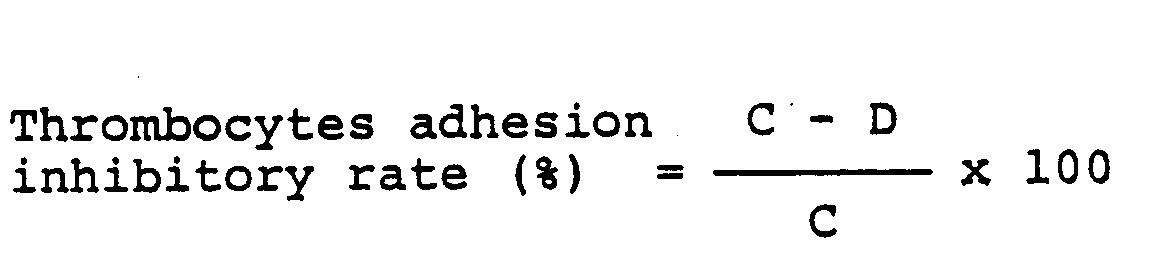
- C: thrombocytes adhesion rate (%) of control group
- D: thrombocytes adhesion rate (%) of test group.
- Test results are shown in the following Table 1.
-


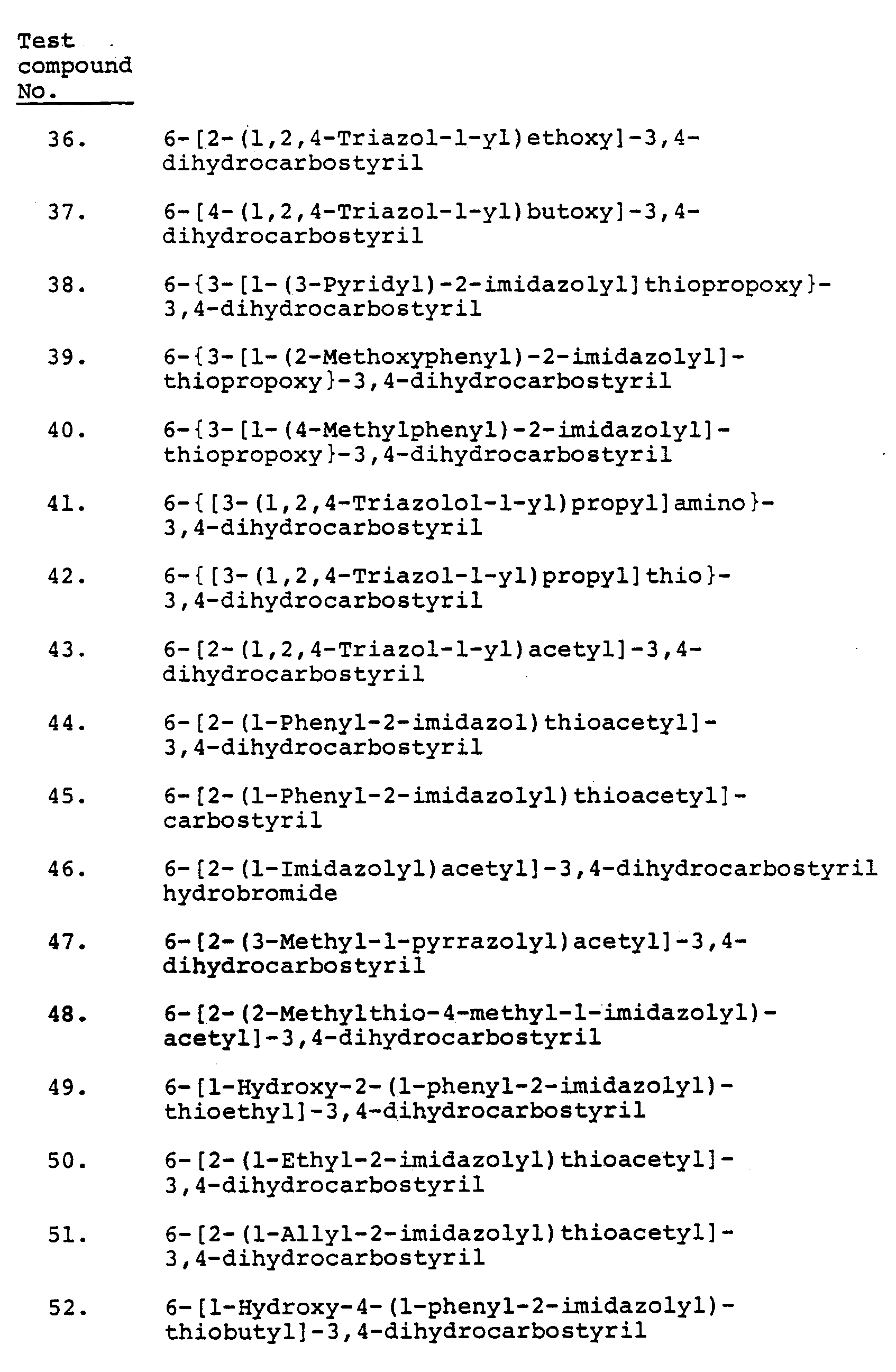


- 10 Grams (39.7 mM) of 6-(4-chlorobutyryl)-3,4-dihydrocarbostyril was dissolved in 300 ml of benzene, then to this solution was added 7.4 g (120 mM) of ethylene glycol and 300 mg of p-toluenesulfonic acid, and the whole mixture was refluxed by heating under dehydrating in Dean-Stark extractor for 6 hours. The reaction mixture was cooled and neutralized with an aqueous solution saturated with sodium hyfrogen carbonate, then extracted with chloroform. The chloroform extract was washed with water then dried with anhydrous magnesium sulfate, then concentrated by removing the solvent by evaporation. The residue thus obtained was purified by means of a silica-gel column chromatography (eluent: chloroform:methanol = 40:1) to yield 10.5 g of 6-(1-ethylenedioxy-4-chlorobutyl)-3,4-dihydrocarbostyriI.
- 28 Grams of methyl cyclohexylcarboxylate and 15 g of 85%-NH2NH2• H2O were dissolved in 50 ml of isopropyl alcohol, and the solution was refluxed by heating for 10 hours. The reaction mixture was concentrated, and the crystals precipitated by adding water were collected by filtration, then the crystals were washed with water, then recrystallized from water to yield 20 g of cyclohexanecarbohydrazide in the form of colorless needle-like crystals. Melting point: 155.5 - 156.5 ° C.
- 2.0 Grams (7.0 mM) of 6-(3-bromopropoxy)-3,4-dihydrocarbostyril, 2.2 g (7.7 mM) of 2-methylimidazol and 1.3 ml (8.4 mM) of DBU were dissolved in 80 ml of isopropanol, and the resulting solution was refluxed by heating for 20 hours. The reaction mixture was concentrated, and to the resulting residue was added water, then extracted with chloroform. The chloroform extract was washed with water, dried with anhydrous sodium sulfate, then concentrated. The resulting residue was purified by means of a silica gel column chromatography (eluent: dichloromethane: methanol = 20:1), and recrystallized from ethanol-n-hexane to yield 1.0 g of 6-[3-(2-methyl-1-imidazolyl)propoxy]-3,4-dihydrocarbostyril. White powdery substance. Melting point: 141.5 - 142.5 ° C.
- 2.4 Grams (13.4 mM) of 6-mercapto-3,4-dihydrocarbostyril, 3,3 g (17.4 mM) of 1-(3-bromopropyl)-1,2,4-triazol, and 2.6 ml (17.4 mM) of DBU were added to 60 ml of isopropanol, and the whole mixture was refluxed by heating for 2 hours. After the reaction was completed, the reaction mixture was concentrated, the resulting residue was extracted with chloroform. The chloroform extract was washed with water, an aqueous solution saturated with sodium hydrogen carbonate, and water in this order, then dried with anhydrous sodium sulfate. The dried extract was concentrated by removing the solvent by evaporation, the residue was purified by means of a silica gel column chromatography (eluent: dichloromethane: methanol = 20:1), and recrystallized from ethanol-n-hexane to yield 2.5 g of 6-[3-(1 H-1 ,2,4-triazol-1-yl)-propylthio]-3,4-dihydrocarbostyril. Colorless needle-like crystals. Melting point: 114.5 - 115.5°C.
- By using suitable starting materials, and by procedures similar to those of described in Examples 1 and 2, there were prepared compounds shown in the following Table 2.
-


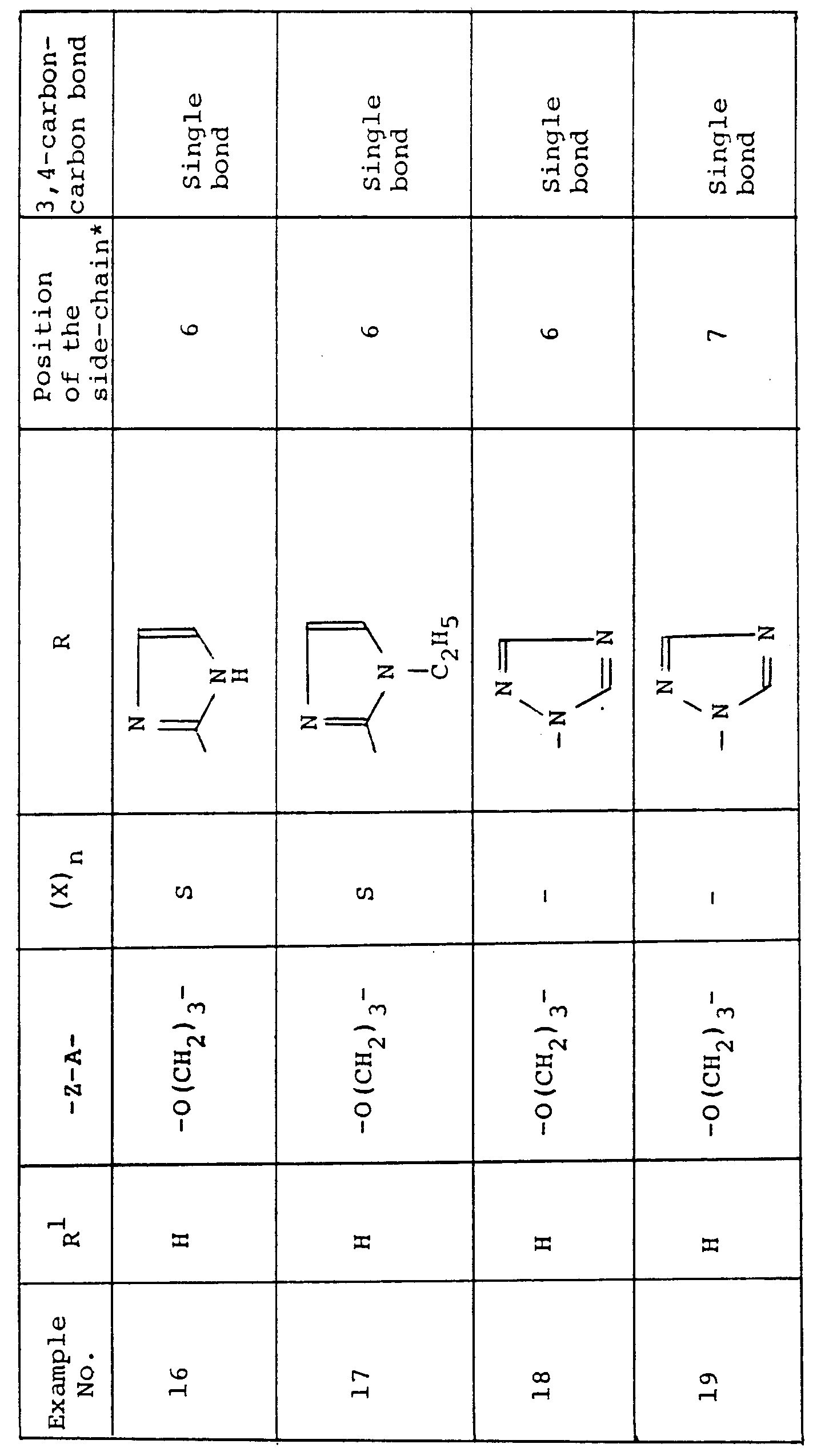


- 10.5 Grams (35.5 mM) of 6-(1-ethylenedioxy-4-chlorobutyl)-3,4-dihydrocarbostyril was dissolved in 10.6 g (71 mM) of dimethylformamide, to this solution was added 10.6 g (71 mM) of sodium iodide, 5.4 g (78.1 mM) of 1H-1,2,4-triazol and 6.5 ml (46.2 mM) of DBU, and the whole mixture was heated at 80 ° C for 7 hours with stirring. The reaction mixture was concentrated by removing the solvent by evaporation under reduced pressure, the residue was extracted with chloroform. The chloroform extract was washed with water, dried with anhydrous magnesium sulfate, then concentrated. The resulting residue was purified by means of a silica gel column chromatography (eluent: chloroform : methanol = 40 : 1), and recrystallized from ethanol-n-hexane to yield 8.0 g of 6-[1-ethylenedioxy-4-(1H-1,2,4-triazol-1-yl)butyl]-3,4-dihydrocar- bostyril. Next, to a solution of 1 g (3.0 mM) of 6-[1-ethylenedioxy-4-(1H-1,2,4-triazol-1-yl)butyl]-3,4-dihydrocarbostyril with 10 ml of DMF was added 3 ml of 5%-hydrochloric acid and stirred for 2 hours at room temperature. After concentration by removal of the solvent, the residue was extracted with chloroform : methanol = 3 : 1. The extract was washed with water, dried with an anhydrous magnesium sulfate, then concentrated by removal of the solvent. The resulting residue was recrystallized from chloroform-ethanol to yield 6-[4-(1 H-1 ,2,4-triazol-1-yl)butyryl]-3,4-dihydrocarbostyril. Colorless needle-like crystals. Melting point: 194.0 - 195.0 C.
- By using suitable starting materials, and by using procedures similar to those described in Example 69, there were prepared compounds of the above-mentioned Examples 5, 7 - 12, 14, 18 - 20, 26, 28, 34, 36, 37, 41, 43 - 51 and compounds of Examples 169 - 170, as well as prepared compounds of Examples 70 - 84 shown in the Tables 3 as follows.
-


- 2.24 Grams (10 mM) of 6- -chloroacetyl-3,4-dihydrocarbostyril, 1.94 g (11 mM) of 1-phenyl-2-mercap- toimidazol and 1.75 ml (12 mM) of DBU were added to 80 ml of isopropanol, then the mixture was refluxed by heating for 10 minutes. After cooling the reaction mixture, the crystals formed in the reaction mixture were collected by filtration, and washed with isopropanol. Recrystallized from ethanol to yield 6-[2-(1-phenyl-2-imidazolyl)thioacetyl]-3,4-dihydrocarbostyril. Light yellow needle-like crystals. Melting point: 209.0 - 210.0 C.
- 2.0 Grams (6.8 mM) of 6-(2-bromobutyryl)-3,4-dihydrocarbostyril, 1.4 g (8.1 mM) of 1-phenyl-2-mercaptoimidazol and 1.1 ml (8.1 mM) of DBU were added to 60 ml of isopropanol and the mixture was refluxed by heating for 3 hours. After the reaction was completed, the reaction mixture was concentrated by removal of the solvent, the residue thus obtained was extracted with chloroform. The chloroform extract was washed with water, then dried with anhydrous sodium sulfate and concentrated by removing of the solvent. The residue thus obtained was purified by means of a silica gel column chromatography (eluent: dichloromethane : methanol = 20 : 1), recrystallized from chloroform-n hexane to yield 2 g of 6-[2-(1-phenyl-2-imidazolul)thiobutyryl]-3,4-dihydrocarbostyril. Colorless needle-like crystals. Melting point: 82.0 - 84.5 C.
- By using suitable starting materials and by procedures similar to those described in Examples 85 and 86, there were prepared compounds of Examples 3, 13, 15 - 17, 21 - 25, 27, 29 - 33, 38 - 40, 42, 52 - 65, and compound of Examples 175 - 178, 179 - 184, 185 186, 187 - 191 - 202. Furthermore, there were prepared compound of Examples 87 - 140 as shown in the following Table 4.
-


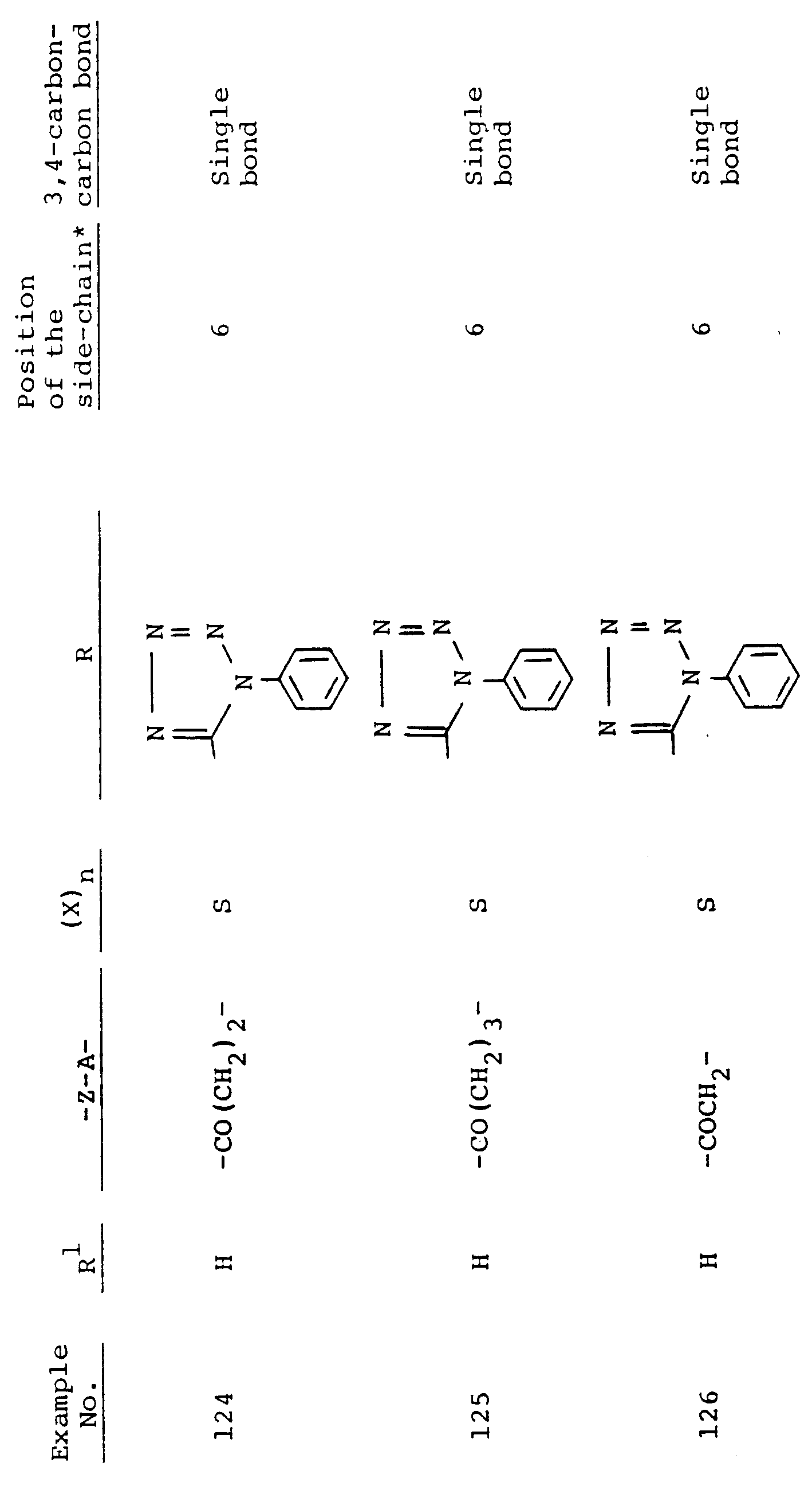


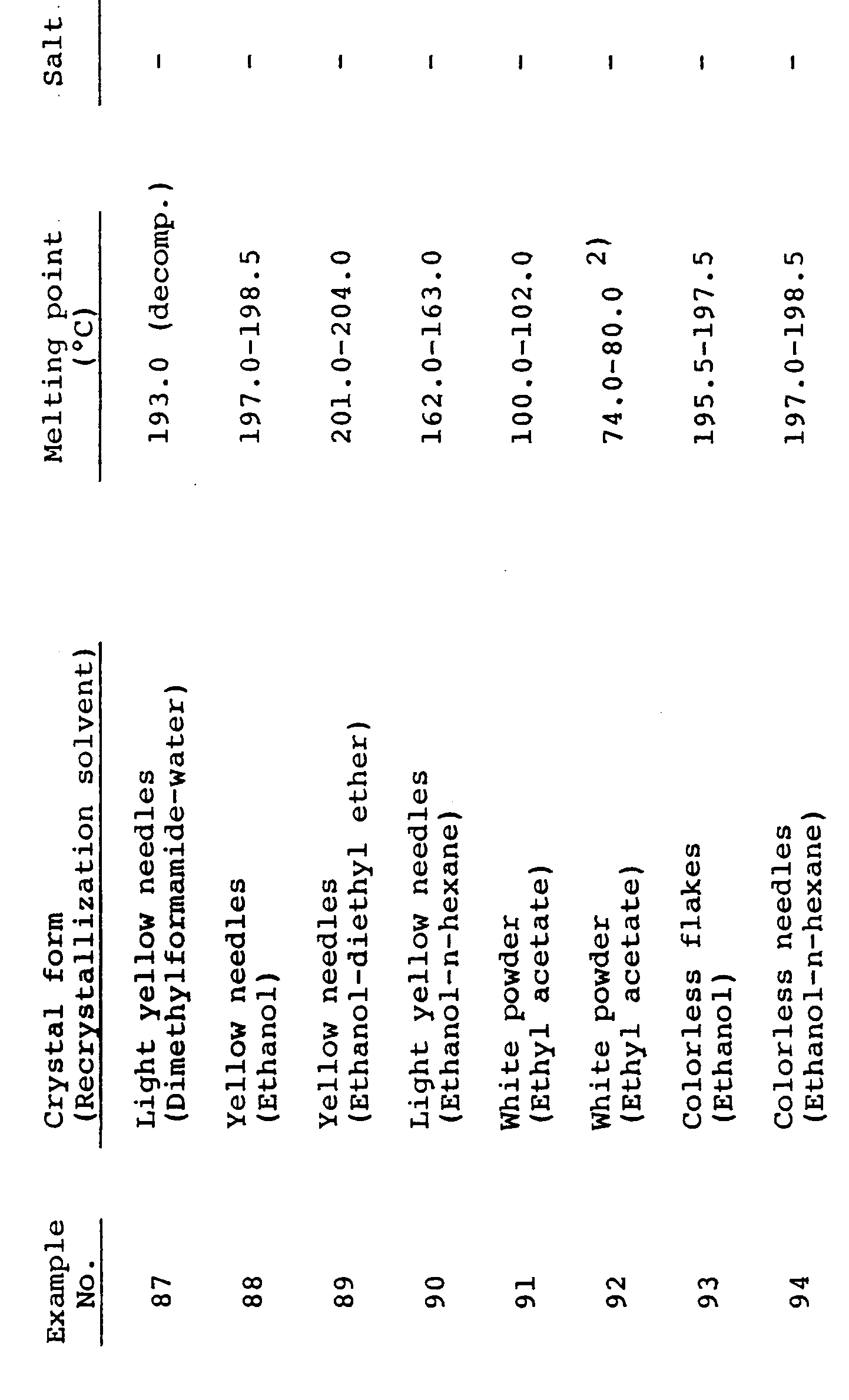


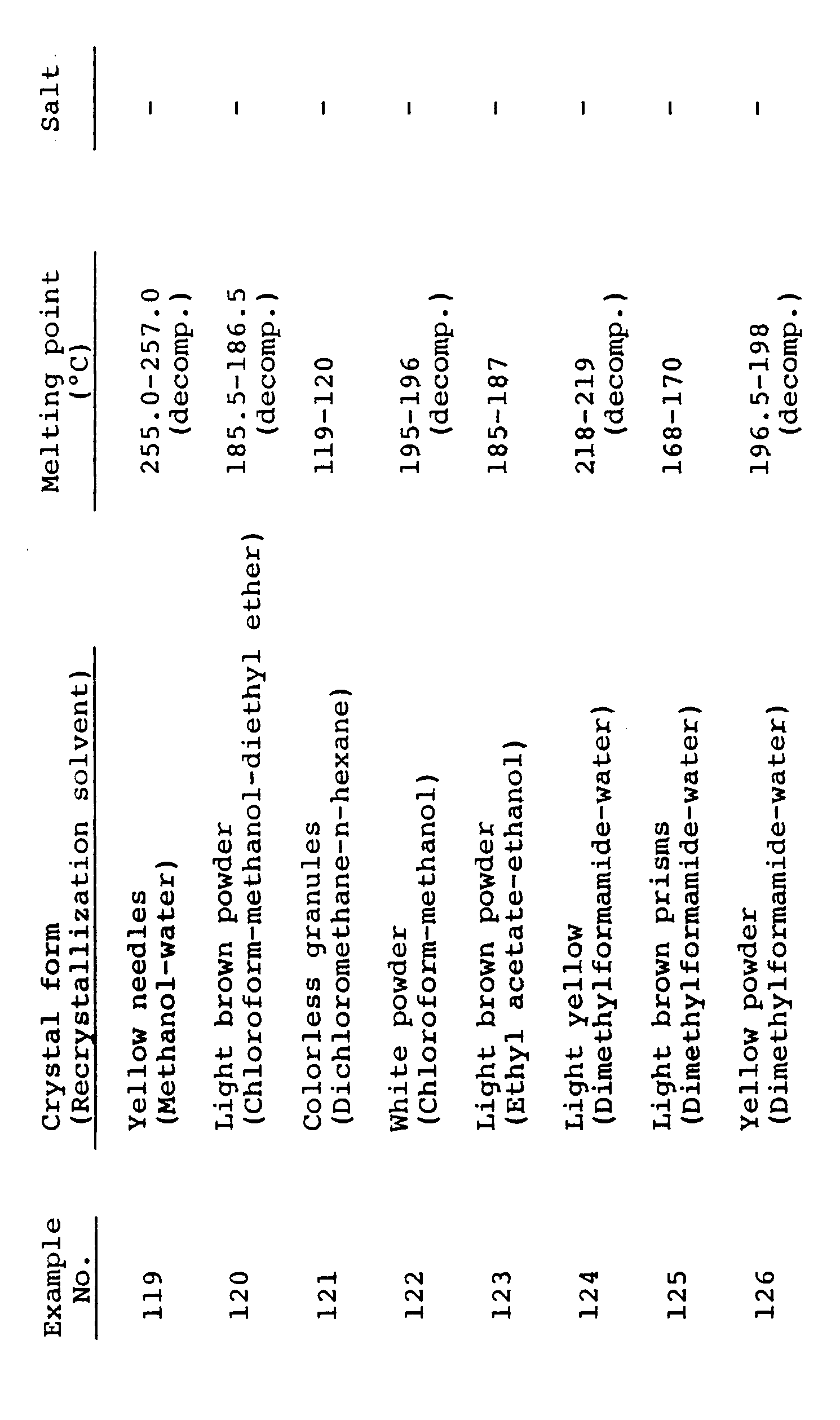


- To a solution of 2 g (6.6 mM) of 6-[3-(2-imisazolyl)thiopropoxy]-3,4-dihydrocarbostyril with 50 ml of DMF was added 520 mg (7.9 mM) of potassium hydroxide and the mixture was stirred at room temperature for 20 minutes. Next, to this reaction mixture was added dropwise 1.5 ml (19.8 mM) of ethyl bromide under ice-cooling condition. The reaction mixture was stirred at 49 - 50 ° C for 10 minutes. The reaction mixture was concentrated under reduced pressure to remove the solvent by evaporation. To this residue was added water, then extracted with chloroform, the chloroform extract was washed with water, and dried with anhydrous sodium sulfate and concentrated by removing the solvent. The residue thus obtained was purified by means of a silica gel column chromatography (eluent: chloroform : methanol : ethyl acetate = 10 : 1 : 20), then recrystallized from ethanol-n-hexane to yield 1.2 g of 6-[3-(1-ethyl-2-imidazolyl)-thiopropoxy]-3,4-dihydrocarbostyril. Colorless needle-like crystals. Melting point: 120.5 - 121.0°C.
- By using suitable starting materials and by procedures similar to those described in Example 108, there were prepared compounds of Examples 13, 15, 25, 29, 30, 31, 32, 35, 38 - 40, 42, 55 - 65, 85 - 103, 107, 109 - 110, 112 - 137, as well as there were prepared compounds of Examples 173 - 179, 182, 185 - 188, 190, 191, 195 - 199 and 202.
- To a solution of 2 g (5.5 mM) of 6-[2-(1-phenyl-2-imidazolyl)thioacetyl]-3,4-dihydrocarbostyril with 80 ml of a mixture of DMF : methanol = 3 : 1 was added 208 mg (5.5 mM) of sodium borohydride, and the mixture was heated at 50 - 60 ° C for 1 hour with stirring. The reaction mixture was concentrated by removing the solvent, and the residue was poured in 50 ml of 1 N-hydrochloric acid. The mixture was made alkanline with 1 N-sodium hydroxide aqueous solution, then the crystals formed were collected by filtration, washed with water, and dried. Recrystallization from ethanol to yield 1.5 g of 6-[1-hydroxy-2-(1-phenyl-2-imidazolyl)thioethyl]-3,4-dihydrocarbostyril. Yellow needle-like crystals. Melting point: 197.0 - 198.5°C.
- By using suitable starting materials, and by procedures similar to those described in Example 142, there were prepared compounds of the above-mentioned Examples 91 and 92, as well as compounds of Examples 172, 185 and 190.
- To 3 g of N'-cyclohexylcarbonyl-4-[6-(1,2-dihydro-2-oxoquinolyloxy]butyrohydrazide was added 120 g of polyphosphoric acid, and the mixture was heated at 190 - 210 ° C in an oil bath for 10 minutes with stirring. After cooled the reaction mixture, the mixture was poured in 400 ml of ice-water, then extracted with chloroform. The chloroform layer was washed with water and dried with anhydrous sodium sulfate. The dried extract was concentrated, and the residue was purified by means of a silica gel column chromatography (eluent: chloroform : methanol = 20 : 1). Recrystallized from chloroform-petroleum ether to yield 0.4 g of 6-[3-(2-cyclohexyl-1,3,4-oxadiazol-5-yl)propoxy]carbostyril. Yellow needle-like crystals. Melting point: 160 - 161.5 ° C.
- By using suitable starting materials, and by procedures similar to those described in Example 143, there was prepared compound of Example 4, as well as prepared compounds of Examples 150 - 166.
- To a solution of 2 g (7.35 mM) of 6-[3-(1,2,4-triazol-1-yl)propoxy]-3,4-dihydrocarbostyril with 20 ml of DMF was added 350 mg (8.8 mM) of sodium hydride (60% in oil) and the mixture was heated at 60 ° C for 30 minutes. Then under ice-cooling condition, 0.6 ml (8.1 mM) of ethyl bromide was added dropwise, further the reaction mixture was stirred at room temperature for 3 hours. To the reaction mixture was added water, then extracted with chloroform, the chloroform layer was washed with water, dried with anhydrous sodium sulfate, and concentrated by removing the solvent by evaporation. The resulting residue was purified by means of a silica gel column chromatography (eluent: dichloromethane : methanol = 30 : 1), then recrystallized from ethyl acetate-n-hexane to yield 1.8 g of 1-ethyl-6-[3-(1,2,4-triazol-1-yl)propoxy]-3,4-dihydrocarbostyril. Colorless needle-like crystals. Melting point: 97.0 - 98.0 ° C.
- By using a suitable starting material, and by procedures similar to those described in Example 144, there were prepared compounds of Examples 44 and 100.
- 3.63 Grams (10 mM) of 6-[2-(1-phenyl-2-imidazolyl)thioacetyl]-3,4-dihydrocarbostyril and 1.09 g (15 mM) of hydroxylamine hydrochloride were suspended in a mixture of 100 ml of ethanol with 20 ml of water, then 2.0 g (50 mM) of sodium hydroxide powder was added with stirring vigorously and further stirred at room temperature for 30 minutes. After the reaction was completed, the reaction mixture was neutralized with 5%-hydrochloric acid, and extracted with chloroform : methanol = 8 : 1 mixture and the extract was dried with anhydrous magnesium sulfate, then concentrated by removing the solvent. The residue was purified by means of a silica gel column chromatography (eluent: chloroform : methanol = 20 : 1), then recrystallized from ethanol to yield 3.34 g of 6-[1-hydroxyimino-2-(1-phenyl-2-imidazolyl)thioethyl]-3,4-dihydrocarbostyril. White powdery substance. Melting point: 201.0 - 202.0 ° C.
- 3.0 Grams (8.17 mM) of 6-[1-hydroxy-2-(1-phenyl-2-imidazolyl)thioethyl]-3,4-dihydrocarbostyril was added in 9 ml of thionyl chloride at -10 ° C, and stirred at the same temperature for 30 minutes. Then 50 ml of methanol was added dropwise to the reaction mixture and stirred at room temperature for 30 minutes. After the reaction was completed, the reaction mixture was made an alkaline with sodium hydrogen carbonate, then extracted with chloroform. The extract was dried with anhydrous magnesium sulfate, and concentrated by removing the solvent. The residue was recrystallized from ethanol to yield 1.5 g of 6-[1-methoxy-2-(1-phenyl-2-imidazolyl)-3,4-dihydrocarbostyril. Colorless prism-like crystals. Melting point: 193.0 - 194.0 ° C.
- 4.47 Grams (12.3 mM) of 6-[2-(1-phenyl-2-imidazolyl)thioacetyl]-3,4-dihydrocarbostyril was dissolved in 200 ml of chloroform and 45 ml of acetic acid, then under ice-cooling condition, 3.0 g (15.0 mM) of m-chlorobenzoic acid was added thereto, and stirred at the same temperature for 1 hour. After the reaction was completed, the reaction mixture was made an alkaline with sodium hydrogen carbonate and extracted with chloroform. The crystals formed in the chloroform layer were collected by filtration, washed with ethanol to yield 4.0 g of 6-[2-(1-phenyl-2-imidazolyl)sulfinylacetyl]-3,4-dihydrocarbostyril. White powdery substance. Melting point: 195°C. (decomp.)
- By using suitable starting materials and by procedures similar to those described in Example 147, there were prepared compounds of Examples 191, 193, 196, 199 - 200.
- 3.79 Grams (10 mM) of 6-[2-(1-phenyl-2-imidazolyl)sulfinylacetyl]-3,4-dihydrocarbostyril was dissolved in a mixture of 240 ml of acetic acid with 100 ml of water, then 5.06 g (32 mM) of potassium permanganate was added thereto. This mixture was stirred at room temperature for 2 days. After the reaction was completed, chloroform was added to the reaction mixture and filtered with Celite (a trademark for distomaceous earth product, manufactured by Johns-Manville Proudcts Corp.). The filtrate was washed with water and dried with anhydrous magnensium sulfate. The residue obtained by removing the solvent was purified by means of a silica gel column chromatography (eluent: chloroform : methanol = 30 : 1), and recrystallized from ethanol-chloroform to yield 0.6 g of 6-[2-(1-phenyl-2-imidazolyl)sulfonylacetyl]-3,4-dihydrocarbostyril. Light yellow granular substance. Melting point: 199 - 201 °C.
- By using suitable starging materials, and by procedures similar to those described in Example 148, there were prepared compounds of Examples 194, 195, 197, 201 and 202.
- To a solution of 60 ml of carbon disulfide with 23.3 g (0.096 M) of 2-(1-phenyl-2-imidazolyl)thioacetyl chloride and 12.8 g (0.096 M) of aluminum chloride was added gradually 3.5 g (0.024 M) of 3,4-hydrocarbostyril at room temperature under stirring condition. After the addition was finished, the reaction mixture was refluxed by heating for 2.5 hours. Carbon disulfide was removed by decantation, and the residue was poured in ice-water. The crystals formed were collected by filtration, and recrystallized from ethanol to yield 17 g of 6-[2-(1-phenyl-2-imidazolyl)thioacetyl]-3,4-dihydrocarbostyril. Light yellow needle-like crystals. Melting point: 209.0 - 210.0 ° C.
- By using suitable starting materials and by using procedures similar to those described in Example 149, there were prepared compounds of Examples 69 - 84, 86 - 87, 89 - 90, 93 - 94 and 97 - 140. As well as there were prepared compounds of Examples 171, 173, 174, 175 - 184, 186, 187 - 189, 191 - 202.


- By using suitable starting materials and unsing procedures similar to those described in Example 69, there were prepared compounds of Examples 171 - 174 as shown in Table 6 as follows.


- By using suitable starting materials and by using procedures similar to those described in Examples 85 and 86, there were prepared compounds of Examples 175 - 202 as shown in Table 7 as follows.


the carbon-carbon bond between 3- and 4-positions in the carbostyril skeleton is a single or double bond with the proviso that when Z is an oxygen atom and X is a sulfur atom, a group of the formula -SO- or -S02- , then R is not a pyridyl, benzimidazolyl, 1,2,4-triazolyl, 1,2,3,4-tetrazolyl, quinolyl or thiazolyl group,
Claims (78)
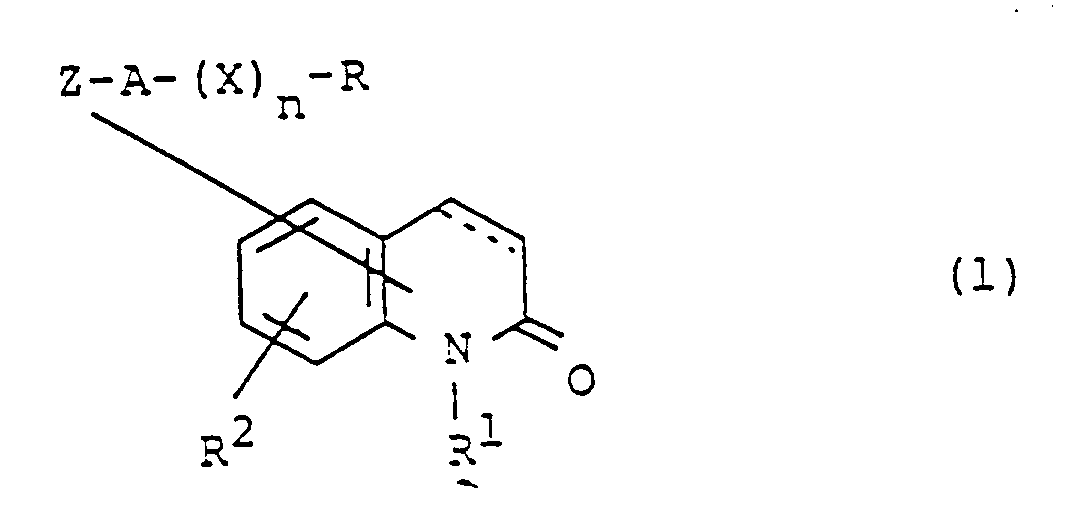


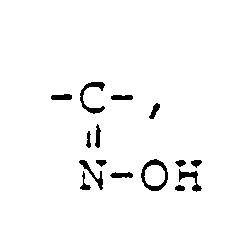


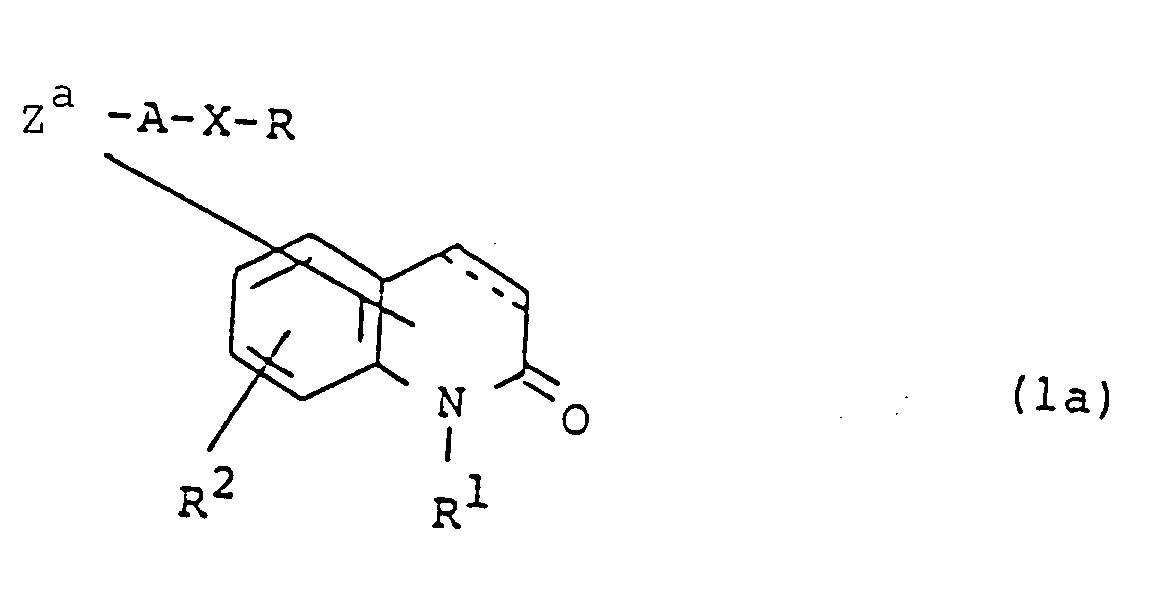


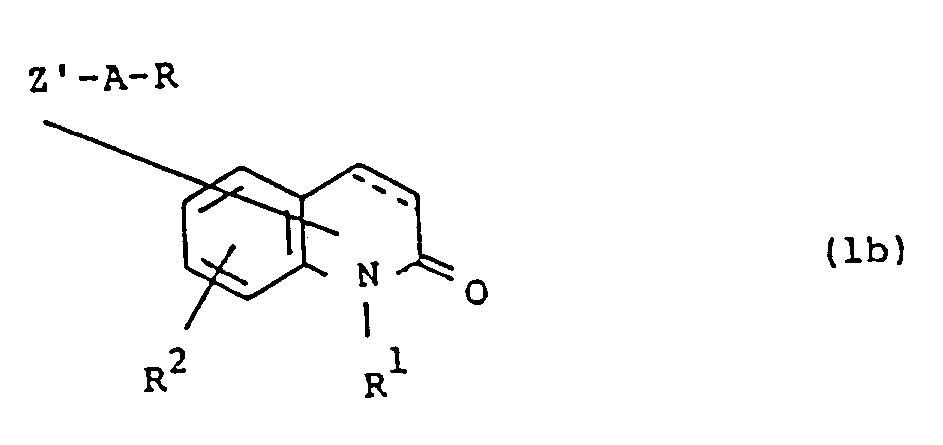


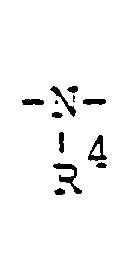


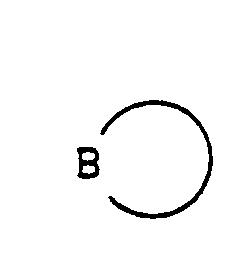


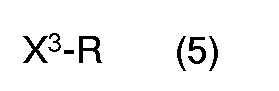


Applications Claiming Priority (6)
| Application Number | Priority Date | Filing Date | Title |
|---|---|---|---|
| JP76089/86 | 1986-04-02 | ||
| JP7608986 | 1986-04-02 | ||
| JP62043457A JPH0681727B2 (en) | 1986-04-02 | 1987-02-25 | Platelet adhesion inhibitor |
| JP43457/87 | 1987-02-25 | ||
| JP60770/87 | 1987-03-16 | ||
| JP62060770A JPH0681752B2 (en) | 1986-04-02 | 1987-03-16 | Carbostyril derivative |
Publications (3)
| Publication Number | Publication Date |
|---|---|
| EP0240015A2 EP0240015A2 (en) | 1987-10-07 |
| EP0240015A3 EP0240015A3 (en) | 1990-10-24 |
| EP0240015B1 true EP0240015B1 (en) | 1994-12-28 |
Family
ID=27291549
Family Applications (1)
| Application Number | Title | Priority Date | Filing Date |
|---|---|---|---|
| EP87104873A Expired - Lifetime EP0240015B1 (en) | 1986-04-02 | 1987-04-02 | Carbostyril derivatives, process for preparing them, pharmaceutical composition, and use |
Country Status (5)
| Country | Link |
|---|---|
| US (1) | US5008274A (en) |
| EP (1) | EP0240015B1 (en) |
| DE (1) | DE3750913T2 (en) |
| DK (1) | DK167187A (en) |
| ES (1) | ES2068807T3 (en) |
Families Citing this family (26)
| Publication number | Priority date | Publication date | Assignee | Title |
|---|---|---|---|---|
| US5227381A (en) * | 1988-05-02 | 1993-07-13 | Otsuka Pharmaceutical Co., Ltd. | Carbostyril derivative |
| JP2753622B2 (en) | 1988-05-02 | 1998-05-20 | 大塚製薬株式会社 | Carbostyril derivative |
| US5064837A (en) * | 1989-11-13 | 1991-11-12 | Schering Corporation | 3-substituted-1-aryl-2(h)-quinolones and their pharmaceutical compositions |
| CA2071497A1 (en) * | 1989-12-12 | 1991-06-13 | Andrew William Bridge | 2-substituted 4,5-diphenyl-imidazoles |
| KR927003576A (en) * | 1990-01-12 | 1992-12-18 | 로오느-푸우랜크 로레르 소시에테 아노님 | 2-substituted 4,5-diphenyl-imidazole |
| EP0544958A1 (en) * | 1990-08-09 | 1993-06-09 | Tanabe Seiyaku Co., Ltd. | Cephalosporin compounds and processes for preparing the same |
| KR930702307A (en) * | 1991-08-23 | 1993-09-08 | 오오쓰까 아끼히꼬 | Carbostyril derivatives and platelet aggregation inhibitors |
| JP3141051B2 (en) * | 1992-10-09 | 2001-03-05 | 日清製粉株式会社 | Anti-atherosclerotic agent |
| CN1052224C (en) * | 1993-04-07 | 2000-05-10 | 大塚制药株式会社 | Peripheral Vasodilating agent containing N-acylated 4-amino piperidine derivatives as active ingredients |
| TW289019B (en) * | 1993-05-19 | 1996-10-21 | Otsuka Pharma Co Ltd | |
| IL110280A0 (en) * | 1993-07-27 | 1994-10-21 | Zeneca Ltd | Thiazole derivatives |
| ZA945250B (en) * | 1993-07-27 | 1995-01-27 | Zeneca Ltd | Thiazole derivatives |
| EP0636624A1 (en) * | 1993-07-27 | 1995-02-01 | Zeneca Limited | Thiazole derivatives as lipoxygenase inhibitors |
| US5780480A (en) * | 1996-02-28 | 1998-07-14 | Merck & Co., Inc. | Fibrinogen receptor antagonists |
| WO1998046593A1 (en) * | 1997-04-16 | 1998-10-22 | Otsuka Pharmaceutical Co., Ltd. | Novel carbostyril derivative |
| FR2812548B1 (en) * | 2000-08-01 | 2002-09-20 | Sanofi Synthelabo | USE OF QUINOLEIN-2 (1H) -ONE DERIVATIVES OR ONE OF THEIR PHARMACEUTICALLY ACCEPTABLE SALTS FOR THE PREPARATION OF A MEDICINAL PRODUCT FOR THE TREATMENT OF KIDNEY DEFICIENCY |
| US6660864B2 (en) | 2001-06-29 | 2003-12-09 | Grayson Walker Stowell | Polymorphic forms of 6-[4-(1-cyclohexyl-1H-tetrazol-5-yl)butoxy]-3,4-dihydro-2(1H)-quinolinone |
| US6657061B2 (en) | 2001-06-29 | 2003-12-02 | Grayson Walker Stowell | Polymorphic forms of 6-[4-1(1-cyclohexyl-1H-tetrazol-5-yl)butoxy]-3,4-dihydro-2(1H)-quinolinone |
| US6531603B1 (en) | 2001-06-29 | 2003-03-11 | Grayson Walker Stowell | Polymorphic forms of 6-[4-(1-cyclohexyl-1H-tetrazol-5-yl)butoxy]-3,4-dihydro-2(1H)-quinolinone |
| US6573382B2 (en) | 2001-06-29 | 2003-06-03 | Grayson Walker Stowell | Polymorphic forms of 6-[4-(1-cyclohexyl-1H-tetrazol-5-yl)butoxy]-3,4-dihydro-2(1H)-quinolinone |
| US6388080B1 (en) | 2001-06-29 | 2002-05-14 | Grayson Walker Stowell | Polymorphic forms of 6-[4-(1-cyclohexyl-1H-tetrazol-5-yl)butoxy]-3,4-dihydro-2(1H)-quinolinone |
| US6596871B2 (en) | 2001-06-29 | 2003-07-22 | Grayson Walker Stowell | Polymorphic forms of 6-[4-(1-cyclohexyl-1h-tetraol-5-yl)butoxy]-3,4-dihydro-2(1H)-quinolinone |
| MY142362A (en) * | 2004-01-29 | 2010-11-30 | Otsuka Pharma Co Ltd | Pharmaceutical composition for promoting angiogenesis |
| TW201039822A (en) | 2009-02-06 | 2010-11-16 | Taisho Pharmaceutical Co Ltd | Dihydroquinolinone derivatives |
| GB202019475D0 (en) | 2020-12-10 | 2021-01-27 | Cancer Research Tech Ltd | Therapeutic compounds and their use |
| CN115974850B (en) * | 2023-02-16 | 2024-08-06 | 中国药科大学 | A class of compounds as AKR1C3 inhibitors and their preparation methods and uses |
Family Cites Families (27)
| Publication number | Priority date | Publication date | Assignee | Title |
|---|---|---|---|---|
| GB1496768A (en) | 1973-12-26 | 1978-01-05 | Otsuka Pharma Co Ltd | 5-substituted ethyl-8-hydroxycarbostyril derivatives and production thereof |
| US4022776A (en) | 1974-01-31 | 1977-05-10 | Otsuka Pharmaceutical Company Limited | 5-[1-Hydroxy-2-(substituted-amino)]ethyl-8-hydroxycarbostyril derivatives |
| GB1496875A (en) | 1974-06-13 | 1978-01-05 | Otsuka Pharma Co Ltd | 5-substituted alkanoyl-8-hydroxycarbostyril derivatives and production thereof |
| US3994901A (en) | 1974-06-13 | 1976-11-30 | Otsuka Pharmaceutical Company Limited | 5-[1-Hydroxy-2-(substituted-amino)]alkyl-8-hydroxy-3,4-dihydrocarbostyril derivatives |
| FI59246C (en) | 1974-06-24 | 1981-07-10 | Otsuka Pharma Co Ltd | FOERFARANDE FOER FRAMSTAELLNING AV BENSCYKLOAMIDDERIVAT ANVAENDBARA VID TROMBOS- OCH EMBOLITERAPIN |
| GB1496871A (en) | 1974-11-08 | 1978-01-05 | Otsuka Pharma Co Ltd | 5-(alpha-aminoalkanoyl)-8-substituted-carbostyrils and their preparation |
| GB1496770A (en) | 1974-11-08 | 1978-01-05 | Otsuka Pharma Co Ltd | 5-substituted alkyl-8-substituted-carbostyrils and-3,4-dihydrocarbostyril derivatives and production thereof |
| JPS5412384A (en) | 1977-06-24 | 1979-01-30 | Otsuka Pharmaceut Co Ltd | Carbostyril derivative |
| JPS5430183A (en) | 1977-08-10 | 1979-03-06 | Otsuka Pharmaceut Co Ltd | 3,4-dihydrocarbostyril derivative |
| JPS5430180A (en) | 1977-08-10 | 1979-03-06 | Otsuka Pharmaceut Co Ltd | 3,4-dihydrocarbostyril derivative |
| DE2806721A1 (en) * | 1978-02-17 | 1979-08-23 | Thomae Gmbh Dr K | Substd. alkoxy-carbostyril derivs. - useful as antithrombotic and cardioactive agents, used for treating thromboembolic disorders and arteriosclerosis |
| US4329347A (en) * | 1978-02-17 | 1982-05-11 | Boehringer Ingelheim Gmbh | Cardiotonic and antithrombotic sulfur-containing derivatives of carbostyril |
| JPS54130587A (en) * | 1978-03-30 | 1979-10-09 | Otsuka Pharmaceut Co Ltd | Carbostyryl derivative |
| JPS5535019A (en) | 1978-09-01 | 1980-03-11 | Otsuka Pharmaceut Co Ltd | Carbostyryl derivative |
| DE2928583A1 (en) * | 1979-07-14 | 1981-01-29 | Thomae Gmbh Dr K | Substd. alkoxy-carbostyril derivs prodn. - e.g. by cyclising 2-carboxyethyl-1-aminobenzene derivs., useful as antithrombotic and positive inotropic agents |
| JPS5645414A (en) * | 1979-09-19 | 1981-04-25 | Otsuka Pharmaceut Co Ltd | Phosphodiesterase inhibitor |
| PH17194A (en) * | 1980-03-06 | 1984-06-19 | Otsuka Pharma Co Ltd | Novel carbostyril derivatives,and pharmaceutical composition containing the same |
| JPS56156263A (en) * | 1980-05-08 | 1981-12-02 | Otsuka Pharmaceut Co Ltd | Carbostyril derivative |
| JPS5632471A (en) * | 1980-05-08 | 1981-04-01 | Otsuka Pharmaceut Co Ltd | Tetrazole derivative |
| JPS579780A (en) | 1980-06-21 | 1982-01-19 | Otsuka Pharmaceut Co Ltd | Carbostyril derivative |
| JPS57154129A (en) | 1981-03-16 | 1982-09-22 | Otsuka Pharmaceut Co Ltd | Cardiotonic drug |
| JPS57159778A (en) | 1981-03-27 | 1982-10-01 | Otsuka Pharmaceut Co Ltd | Carbostyril derivative |
| JPS5859980A (en) * | 1981-10-05 | 1983-04-09 | Otsuka Pharmaceut Co Ltd | Carbostyril derivative |
| JPS5877880A (en) * | 1981-11-05 | 1983-05-11 | Otsuka Pharmaceut Co Ltd | Tetrazole derivative |
| CH655110A5 (en) * | 1982-09-03 | 1986-03-27 | Otsuka Pharma Co Ltd | CARBOSTYRILE DERIVATIVES, METHOD FOR THE PRODUCTION THEREOF AND MEDICINAL PRODUCTS CONTAINING THEM. |
| FR2539413A1 (en) * | 1983-01-17 | 1984-07-20 | Pos Lab | CARBOSTYRILOXIMINOPROPANOLAMINES USEFUL AS MEDICAMENTS AND PROCESS FOR THEIR PREPARATION |
| US4792561A (en) * | 1986-05-29 | 1988-12-20 | Syntex (U.S.A.) Inc. | Carbostyril derivatives as combined thromboxane synthetase and cyclic-AMP phosphodiesterase inhibitors |
-
1987
- 1987-04-01 DK DK167187A patent/DK167187A/en not_active IP Right Cessation
- 1987-04-02 ES ES87104873T patent/ES2068807T3/en not_active Expired - Lifetime
- 1987-04-02 EP EP87104873A patent/EP0240015B1/en not_active Expired - Lifetime
- 1987-04-02 DE DE3750913T patent/DE3750913T2/en not_active Expired - Fee Related
-
1988
- 1988-08-16 US US07/232,524 patent/US5008274A/en not_active Expired - Fee Related
Also Published As
| Publication number | Publication date |
|---|---|
| US5008274A (en) | 1991-04-16 |
| EP0240015A3 (en) | 1990-10-24 |
| DE3750913T2 (en) | 1995-06-01 |
| DK167187D0 (en) | 1987-04-01 |
| EP0240015A2 (en) | 1987-10-07 |
| ES2068807T3 (en) | 1995-05-01 |
| DE3750913D1 (en) | 1995-02-09 |
| DK167187A (en) | 1987-10-03 |
Similar Documents
| Publication | Publication Date | Title |
|---|---|---|
| EP0240015A2 (en) | Carbostyril derivatives, process for preparing them, pharmaceutical composition, and use | |
| AU646519B2 (en) | Pyridine and pyridine N-oxide derivatives of diaryl methyl piperidines or piperazines, and compositions and methods of use thereof | |
| EP3283077B1 (en) | Bromodomain inhibitors | |
| EP0882717B1 (en) | Nitrogenous heterocyclic compounds | |
| EP0148623A2 (en) | Quinolone inotropic agents | |
| AU2007235132A1 (en) | Quinolones useful as inducible nitric oxide synthase inhibitors | |
| CN102131801A (en) | 1, 2 disubstituted heterocyclic compounds | |
| TW381092B (en) | Novel benzimidazole derivatives for use in treating arteriosclerotic diseases | |
| JP2000512623A (en) | Dopamine D (4) 2,4-Diaminopyrimidine derivatives as receptor antagonists | |
| KR20120081973A (en) | Nitrogen-containing compounds and pharmaceutical compositions thereof for the treatment of atrial fibrillation | |
| JPS6320235B2 (en) | ||
| EP0187977A1 (en) | Tetrahydroquinoline derivatives, process for preparing the same and anti-peptic ulcer compositions containg the same | |
| JPH06135946A (en) | Pyrazine derivative | |
| KR940000785B1 (en) | Method for preparing carbostyryl derivatives and salts thereof | |
| JPH0747574B2 (en) | Pyridine derivative and psychotropic agent containing the same | |
| JPS60149576A (en) | Substituted 5-hydroxy-2,3-dihydrobenzofuran and analogue useful as antiinflammatory | |
| JPH0681727B2 (en) | Platelet adhesion inhibitor | |
| JPH0681752B2 (en) | Carbostyril derivative | |
| JPH01160985A (en) | Benzo-heterocyclic compound | |
| JPH01193275A (en) | Benzoheterocyclic compound | |
| EP0755930A1 (en) | Benzoxazepine derivatives, salts thereof, and drugs containing the same | |
| JPH0114911B2 (en) | ||
| JP2531962B2 (en) | Benzoheterocycle derivative | |
| WO1994011355A1 (en) | 3,4-dihydro-1-(2-hydroxyphenyl)-2(1h)-quinoxalinone derivative and related compound | |
| JPH07304740A (en) | Carbostyril derivative |
Legal Events
| Date | Code | Title | Description |
|---|---|---|---|
| PUAI | Public reference made under article 153(3) epc to a published international application that has entered the european phase |
Free format text: ORIGINAL CODE: 0009012 |
|
| AK | Designated contracting states |
Kind code of ref document: A2 Designated state(s): CH DE ES FR GB IT LI NL SE |
|
| PUAL | Search report despatched |
Free format text: ORIGINAL CODE: 0009013 |
|
| AK | Designated contracting states |
Kind code of ref document: A3 Designated state(s): CH DE ES FR GB IT LI NL SE |
|
| 17P | Request for examination filed |
Effective date: 19910228 |
|
| 17Q | First examination report despatched |
Effective date: 19920716 |
|
| GRAA | (expected) grant |
Free format text: ORIGINAL CODE: 0009210 |
|
| AK | Designated contracting states |
Kind code of ref document: B1 Designated state(s): CH DE ES FR GB IT LI NL SE |
|
| ITF | It: translation for a ep patent filed | ||
| EAL | Se: european patent in force in sweden |
Ref document number: 87104873.2 |
|
| REF | Corresponds to: |
Ref document number: 3750913 Country of ref document: DE Date of ref document: 19950209 |
|
| ET | Fr: translation filed | ||
| REG | Reference to a national code |
Ref country code: ES Ref legal event code: FG2A Ref document number: 2068807 Country of ref document: ES Kind code of ref document: T3 |
|
| PLBE | No opposition filed within time limit |
Free format text: ORIGINAL CODE: 0009261 |
|
| STAA | Information on the status of an ep patent application or granted ep patent |
Free format text: STATUS: NO OPPOSITION FILED WITHIN TIME LIMIT |
|
| 26N | No opposition filed | ||
| PGFP | Annual fee paid to national office [announced via postgrant information from national office to epo] |
Ref country code: GB Payment date: 19990401 Year of fee payment: 13 |
|
| PGFP | Annual fee paid to national office [announced via postgrant information from national office to epo] |
Ref country code: SE Payment date: 19990406 Year of fee payment: 13 |
|
| PGFP | Annual fee paid to national office [announced via postgrant information from national office to epo] |
Ref country code: FR Payment date: 19990409 Year of fee payment: 13 Ref country code: DE Payment date: 19990409 Year of fee payment: 13 |
|
| PGFP | Annual fee paid to national office [announced via postgrant information from national office to epo] |
Ref country code: CH Payment date: 19990413 Year of fee payment: 13 |
|
| PGFP | Annual fee paid to national office [announced via postgrant information from national office to epo] |
Ref country code: ES Payment date: 19990420 Year of fee payment: 13 |
|
| PGFP | Annual fee paid to national office [announced via postgrant information from national office to epo] |
Ref country code: NL Payment date: 19990426 Year of fee payment: 13 |
|
| PG25 | Lapsed in a contracting state [announced via postgrant information from national office to epo] |
Ref country code: GB Free format text: LAPSE BECAUSE OF NON-PAYMENT OF DUE FEES Effective date: 20000402 |
|
| PG25 | Lapsed in a contracting state [announced via postgrant information from national office to epo] |
Ref country code: SE Free format text: LAPSE BECAUSE OF NON-PAYMENT OF DUE FEES Effective date: 20000403 Ref country code: ES Free format text: THE PATENT HAS BEEN ANNULLED BY A DECISION OF A NATIONAL AUTHORITY Effective date: 20000403 |
|
| PG25 | Lapsed in a contracting state [announced via postgrant information from national office to epo] |
Ref country code: LI Free format text: LAPSE BECAUSE OF NON-PAYMENT OF DUE FEES Effective date: 20000430 Ref country code: CH Free format text: LAPSE BECAUSE OF NON-PAYMENT OF DUE FEES Effective date: 20000430 |
|
| PG25 | Lapsed in a contracting state [announced via postgrant information from national office to epo] |
Ref country code: NL Free format text: LAPSE BECAUSE OF NON-PAYMENT OF DUE FEES Effective date: 20001101 |
|
| GBPC | Gb: european patent ceased through non-payment of renewal fee |
Effective date: 20000402 |
|
| EUG | Se: european patent has lapsed |
Ref document number: 87104873.2 |
|
| REG | Reference to a national code |
Ref country code: CH Ref legal event code: PL |
|
| PG25 | Lapsed in a contracting state [announced via postgrant information from national office to epo] |
Ref country code: FR Free format text: LAPSE BECAUSE OF NON-PAYMENT OF DUE FEES Effective date: 20001229 |
|
| NLV4 | Nl: lapsed or anulled due to non-payment of the annual fee |
Effective date: 20001101 |
|
| PG25 | Lapsed in a contracting state [announced via postgrant information from national office to epo] |
Ref country code: DE Free format text: LAPSE BECAUSE OF NON-PAYMENT OF DUE FEES Effective date: 20010201 |
|
| REG | Reference to a national code |
Ref country code: FR Ref legal event code: ST |
|
| REG | Reference to a national code |
Ref country code: ES Ref legal event code: FD2A Effective date: 20020204 |
|
| PG25 | Lapsed in a contracting state [announced via postgrant information from national office to epo] |
Ref country code: IT Free format text: LAPSE BECAUSE OF NON-PAYMENT OF DUE FEES;WARNING: LAPSES OF ITALIAN PATENTS WITH EFFECTIVE DATE BEFORE 2007 MAY HAVE OCCURRED AT ANY TIME BEFORE 2007. THE CORRECT EFFECTIVE DATE MAY BE DIFFERENT FROM THE ONE RECORDED. Effective date: 20050402 |