EP0232829A2 - Verfahren zum Herstellen eines Polymerfilms - Google Patents
Verfahren zum Herstellen eines Polymerfilms Download PDFInfo
- Publication number
- EP0232829A2 EP0232829A2 EP87101419A EP87101419A EP0232829A2 EP 0232829 A2 EP0232829 A2 EP 0232829A2 EP 87101419 A EP87101419 A EP 87101419A EP 87101419 A EP87101419 A EP 87101419A EP 0232829 A2 EP0232829 A2 EP 0232829A2
- Authority
- EP
- European Patent Office
- Prior art keywords
- group
- film
- high polymer
- carbon atoms
- langmuir
- Prior art date
- Legal status (The legal status is an assumption and is not a legal conclusion. Google has not performed a legal analysis and makes no representation as to the accuracy of the status listed.)
- Granted
Links
- 0 C(C1)C2CC*CC1C2 Chemical compound C(C1)C2CC*CC1C2 0.000 description 19
- RIRARCHMRDHZAR-UHFFFAOYSA-N CC1C(C)CCC1 Chemical compound CC1C(C)CCC1 RIRARCHMRDHZAR-UHFFFAOYSA-N 0.000 description 1
Images




Classifications
-
- B—PERFORMING OPERATIONS; TRANSPORTING
- B05—SPRAYING OR ATOMISING IN GENERAL; APPLYING FLUENT MATERIALS TO SURFACES, IN GENERAL
- B05D—PROCESSES FOR APPLYING FLUENT MATERIALS TO SURFACES, IN GENERAL
- B05D1/00—Processes for applying liquids or other fluent materials
- B05D1/18—Processes for applying liquids or other fluent materials performed by dipping
- B05D1/20—Processes for applying liquids or other fluent materials performed by dipping substances to be applied floating on a fluid
- B05D1/202—Langmuir Blodgett films (LB films)
-
- B—PERFORMING OPERATIONS; TRANSPORTING
- B01—PHYSICAL OR CHEMICAL PROCESSES OR APPARATUS IN GENERAL
- B01D—SEPARATION
- B01D69/00—Semi-permeable membranes for separation processes or apparatus characterised by their form, structure or properties; Manufacturing processes specially adapted therefor
- B01D69/12—Composite membranes; Ultra-thin membranes
- B01D69/122—Separate manufacturing of ultra-thin membranes
-
- B—PERFORMING OPERATIONS; TRANSPORTING
- B82—NANOTECHNOLOGY
- B82Y—SPECIFIC USES OR APPLICATIONS OF NANOSTRUCTURES; MEASUREMENT OR ANALYSIS OF NANOSTRUCTURES; MANUFACTURE OR TREATMENT OF NANOSTRUCTURES
- B82Y30/00—Nanotechnology for materials or surface science, e.g. nanocomposites
-
- B—PERFORMING OPERATIONS; TRANSPORTING
- B82—NANOTECHNOLOGY
- B82Y—SPECIFIC USES OR APPLICATIONS OF NANOSTRUCTURES; MEASUREMENT OR ANALYSIS OF NANOSTRUCTURES; MANUFACTURE OR TREATMENT OF NANOSTRUCTURES
- B82Y40/00—Manufacture or treatment of nanostructures
Definitions
- the present invention relates to a process for forming a film of a high polymer and, more particularly, to a process for forming a film of a modified high polymer by the Langmuir-Blodgett process.
- heat-resistant films have been produced from polyimides.
- polyimide films prepared by the spin coat method or the like usually have a thickness greater than 1 ⁇ m, or at best 1,000 A. It is therefore very difficult to produce a heat-resistant film 0 having a thickness of 1,000 A or less and, at the same time, free from pin holes.
- a process for forming a film according to the present invention comprises the steps of modifying a high polymer so as to enable film formation by the Langmuir-Blodgett process by introducing a substituent group for imparting a hydrophobic property to a recurring unit of the high polymer, and mixing the thus-modified high polymer with a known Langmuir-Blodgett film compound for film formation by the Langmuir-Blodgett process.
- a process for forming a film comprising the step of forming a built-up film of a mixture of a high polymer and a known Langmuir-Blodgett film compound by the Langmuir-Blodgett process, said high polymer including linear recurring units each of which is composed of an at least divalent first organic group R 1 having at least two carbon atoms and an at least divalent second organic group R 2 having at least two carbon atoms, said first organic group R 1 and said second organic group R 2 being connected with each other by a divalent bonding group, and at least one hydrocarbon-containing group R 3 which has 10 to 30 carbon atoms and optionally contains a substituent group, and which is covalently bonded to the same recurring units.
- a material of an LB film used in the present invention is a high polymer which includes linear recurring units composed of an at least divalent first organic group R 1 having at least two carbon atoms, an at least divalent second organic group R 2 having at least two carbon atoms, R 1 and R 2 being connected with each other through a divalent bonding group; and at least one hydrocarbon-containing group R 3 having 10 to 30 carbon atoms which may contain substituent groups and which is covalently bonded to the same recurring units.
- the high polymer of this invention comprises as a basic skeleton a linear recurring unit represented by one of the following formulae.
- R l represents an organic group having a valency of at least two and containing at lest two carbon atoms
- R2 represents an organic group having a valency of at least two and containing at least two carbon atoms, at least one of the groups R 1 and R 2 being preferably a group comprising a benzenoid structure containing at least 6 carbon atoms.
- AB and BA represent a divalent connecting group formed by a reaction between acidic group A and basic group B wherein both groups contain hetero atoms such as O, N, S, P and B.
- hetero atoms such as O, N, S, P and B.
- the high polymer of this invention is modified by introducing into any basic skeleton of the recurring units (1) to (3) at least one, preferably two, covalently bonded hydrocarbon-containing groups R 3 containing 10 to 30, preferably 14 to 22 carbon atoms, in order to make it possible to form a thin film in accordance with Langmuir-Blodgett technique.
- R 3 is directly introduced into R 1 and/or R 2 to form, for example, recurring units shown below.
- those comprising R 1 and R 2 groups having a valency of up to 4 can be particularly preferable, although the valencies of the groups are not limited thereto.
- R 3 is introduced into such groups, for example, by substituting atoms or groups contained in A by such groups as -COOR 3 , -CONHR 3 , -NHCOOR 3 and -NHCSOR 3 , etc. or by substituting atoms or groups contained in B by such groups as -NHR 3 , -OR 3 and -SR 3 etc.
- R 1 is a group having a valency of at least 2 and containing at least 2, preferably 5 to 20, carbon atoms. It may be an aromatic group; an aliphatic group; an alicyclic group; a group in which an aromatic group is combined with an aliphatic group; a group in which one of the above-mentioned groups is combined with a monovalent group having 1 to 30 carbon atoms selected from the group consisting of an aliphatic group, an alicyclic group, an aromatic group and a group in which an aliphatic group is combined with an alicyclic group or an aromatic group; or a group wherein each of the preceding groups is substituted by a monovalent group such as a halogen atom, nitro group, amino group, cyano group, methoxyl group or acetoxyl group, or by a group in which the above monovalent group bonds to -O-, -COO-, -NHCO
- benzenoid structure refers herein to the structure of carbocyclic compounds as contained in ordinary aromatic compounds, as contrasted with quinoid structures.
- R 4 represents (in which R 5 represents an alkyl group or an aryl group). (wherein R 4 is as defined before) (wherein R 4 is as defined before)
- R 1 and R 2 mention may be made of the followings: (R 4 is as defined before)
- R 3 may be a hydrocarbon containing group having 10 to 30, preferably 14 to 22, carbon atoms.
- a preferred example thereof is a monovalent group selected from an aliphatic group, a connecting group of alicyclic group and aliphatic group, a connecting group of aromatic group and aliphatic group, or substituents thereof.
- R 3 mention may be made of the followings:
- These groups may be substituted with substitutional groups, such as a halogen atom, nitro group, an amino group, a cyano group, a methoxyl group and an acetoxyl group and the like, however, these are not critical. Fluorine can be preferable as a substituent in some cases since it is capable of imparting stronger hydrophobicity to the polymer than hydrogen.
- alkyl groups having shorter chain can be employed when fluorine atoms are contained therein.
- k 2 will be sufficient to obtain a high polymer capable of forming a film.
- the high polymer of the present invention may be substituted by groups containing 1 to 9 carbon atoms according to the processes of [I], [II] or [III].
- a film can be formed in accordance with the film-forming process of this invention even when its molecular weight is relatively small. In such a case, however, it may not be possible to attain good heat resistance, mechanical strength and chemical resistance. On the other hand, an excessively high molecular weight is undesirable since it may become difficult to form a film because of increase of viscosity.
- a weight average molecular weight of from ca. 2,000 to 300,000 can be preferable, and from 10,000 to 150,000 can be more preferable.
- the present invention includes both cases in which each of (78-1) and (78-2) exists alone or in combination.
- reaction temperature over 20°C is favorable to complete the reaction.
- the acylation and the amidation are usually carried out at a temperature between about 0°C to -10°C, but as the substituent groups such as long chain alkyl groups, etc. have the tendency of freeze solidifying in this invention, they should preferably be carried out at a temperature of not lower than -10°C.
- either raw materials having different substituent groups may also be mixed to give copolymers, or tetracarboxylic acid dianhydride or diamine having no substituent group or having substituent groups not more than 10 carbon atoms may be mixed in an amount of about 0 to 50%.
- amphiphilic polyimide precursor can be used as a material for forming a film after having been isolated and purified, or can be added with a solvent, such as chloroform and benzene, so as to directly make a spreading solution for forming a polymeric film.
- a solvent such as chloroform and benzene
- a film-forming material is spread on the surface of water, and the thus spread material is compressed at a certain surface pressure to form a monomolecular film, which is then transferred or laminated onto a substrate by passing the substrate through the film.
- This is known as the vertical dipping method.
- Other known processes for forming a Langmuir-Blodgett film include the horizontal dipping method, the revolving cylindrical method, etc. (See “Shin Jikken Kagaku Koza", Vol.18, (Surface and Colloids), pp. 498-508. Any conventional processes can be applied to this invention without any particular restrictions.
- the Langmuir-Blodgett process is an excellent method for forming oriented thin film of not less than 0 0 0 1000 A, or of several hundreds A or several tens A.
- the thickness of the thin films can be controlled with an 0 accuracy of some tens A and the films formed on a substrate in accordance with this invention also have the same characteristic. However, it is possible in this invention to form a film having a thickness greater than 0 10,000 A.
- the known Langmuir-Blodgett film compound disclosed herein is a compound known to those skilled in the art which is described in the above-described literatures.
- the mixing ratio of at least one of the above mentioned compounds and the high polymer is not limited.
- a solvent such as benzene l chloroform and the like, which is insoluble to water and vaporizable into the gaseous phase.
- a polar organic solvent in combination with a volatile solvent, in order to attain an increased solubility.
- preferable polar organic solvents mention may be made of N,N-dimethylformamide, N,N-dimethylacetamide, N,N-diethyl- form-amide, N,N-diethylacetamide, N,N-dimethylmeth- oxy-acetamide, dimethylsulfoxide, N-methyl-2-pyrrolidone, pyridine, dimethylsulfone, hexamethylphosphoramide, tetramethylenesulfone, dimethyltetramethylenesulfone and the like.
- substrates there is no particular limitation on the kind of substrate to be used in this invention. It depends only on the use or application of the film.
- substrates usable in this invention include those made of ordinary inorganic substrances, such as glass, alumina and quarz; those made of metals, plastics, and semiconductors of, e.g., Groups IV, III-V and II-VI of the Periodic Table, such as Si, GaAs and ZnS; and those made of magnetic materials or ferroelectric materials, such as PbTi0 3 , BaTi0 3 , LiNbO 3 , and LiTa0 3 . It is also possible to use a substrate subjected to a conventional surface treatment.
- the adhesion between the high polymer film of this invention and the substrate can also be improved by applying a silicone coupling agent (in particular, a silicone coupling agent containing amino and epoxy groups) or an aluminium chelate to a substrate and then subjecting it to a heat treatment.
- a silicone coupling agent in particular, a silicone coupling agent containing amino and epoxy groups
- an aluminium chelate to a substrate and then subjecting it to a heat treatment.
- the substrate may be treated in a plurality of layers with metal salts of fatty acids as conventionally applied in this field.
- a thin film of a high polymer having a good heat resistance can be formed on a substrate in accordance with the Langmuir-Blodgett process. It is another feature of this invention that some of the films can be subjected to a partial or complete ring-closing treatment, in order to further improve the heat resistance of the thin film formed on the substrate.
- the polymers (78) to (90) can be produced through partial or complete ring closure of a five-membered or six-membered ring containing a hetero-atom.
- the structures of the polymers (78) to (90) after the complete ring closure will be as shown below.
- a thin film of the present invention is characterized in that it is a very thin film having efficient heat resistance, chemical resistance and mechanical properties. Owing to such characteristics, it is applicable to various fields such as electronics, energy conversion and material separation.
- the film may be used as an optical recording film, resist film, insulating film, thin film for a capacitor, liquid crystal orientation film, polarizing film, sensor film, etc.
- an insulating film it can be used as an insulation layer in the electrical and electronic elements having the structure of MIS, MIM, etc. in which various kinds of semiconductors or metals have been intended therewith as an insulation layer of an IC or an LSI, and a field-effect transistor device, photoelectric device, light emitting device, light receiving device, light detecting device, hot electron transistor, etc.
- a thin film of the present invention is effective for MIS and MIM devices which utilize a tunnelling effect, and is also usable as the insulating film of a JJ (Josephson Junction).
- the film may be applied to a cladding material or an optical circuit element for a waveguide.
- the film may also be suitable as a protective coating material in various fields.
- a mixed material of the present invention in place of a fatty acid in the technique of forming a mixed film or a laminated film of a functional LB material and a fatty acid, which technique is generally adopted in the field of an LB film, brings about various functions, and such a mixed film and a laminated film are considered to have many uses. For instance, it is possible to produce a photoelectric device and a biosensor by preparing a film containing a dye and an enzyme, respectively.
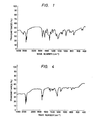
- the IR chart taken by the KBr disc process is as shown in Fig. 1, in which the characteristic absorptions of ester, amides I, II and III, alkyl chain and ether are seen.
- the number-average molecular weight which was measured in a mixed solvent of chloroform and N,N-dimethylacetamide (8 : 2) was about 15,000 calculated in terms of polystyrene.
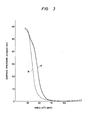
- the relationship between the surface pressure and the area per repeating unit was measured on the surface of redistilled water at 20°C. The result is as shown in Fig. 3.
- the surface pressure rose rapidly at around 65 A 2 /unit, and a good condensed film was formed.
- the limiting area was about 55 A 2 /unit and the collapsing pressure was about 45 dyne/cm (Fig. 3 - A).
- a built-up film on a glass substrate with aluminum deposited thereon was a good Y-type film whether stearyl alcohol had been added or not.
- the pressure surface vs. area curves were evaluated in the same way as in Example 2 by using stearic acid, ⁇ -heptadecenic acid, and octadecane in place of stearyl alcohol, respectively. It was found that the rise of the curve was steep and the collapsing pressure rose in any case.
- the films formed by adding stearic acid, ⁇ -heptadecenic acid and octadecane, respectively, were built up in the form of a Y-type on a glass substrate with aluminum deposited thereon, whereby good built-up films were obtained.
- the number average molecular weight which was measured in the same way as in Example 1 was about 7,000 calculated in terms of polystyrene.
- the relationship between the surface pressure and the area per recurring unit was measured on the surface of redistilled water at 22°C.
- the curve represents the characteristic of an expanded film, as indicated by A in Fig. 6, and the film collapsed at a surface pressure of 30 dyne/cm.
- the film was built up at a surface pressure of 20 dyne/cm and at a built-up speed of 10 mm/min, the film was built up only when a substrate was move upward.
- the surface pressure vs. area curve was then measured by mixing the spreading solution with stearyl alcohol in the same way as in Example 2. The rise of the curve was steep as indicated by B in Fig. 6. It was confirmed from the area-time curve that a Y-type film would be obtained on a glass substrate by mixing the solution with stearyl alcohol in a molar ratio of 1 : 1.
- a polyimide precursor was synthesized in the same manner as in Example 1, except that n-decyl alcohol (n-C lO H 21 0H) was used instead of stearyl alcohol.
- n-decyl alcohol n-C lO H 21 0H
- the polyimide precursor showed the same characteristics as those of the polyimide obtained in Example 1.
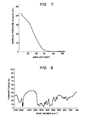
- the surface pressure-area curve of the precursor shown in Fig. 7, indicates the presence of a liquid expansion phase and denies the existence of a condensed phase. It would, therefore, be apparent that an alkyl group containing only 10 carbon atoms would be too short to give a polymer capable of forming a stable condensed film. No good built-up film was obtained even adding prior known Langmuir-Blodgett film compound.
- a polyimide precursor was synthesized in the same manner as in Example 1, except that straight chain alcohols, having 14, 16 and 22 carbon atoms respectively, were used instead of stearyl alcohol. As far as IR spectrum, thermal analysis, molecular weight measured by GPC and surface pressure-area curve are concerned, the polyimide precursor showed the almost same characteristics as those of the polyimide obtained in Example 1.
- the polyimide precursors having 14 and 22 carbon atoms also formed stable condensed film and were capable of forming built-up films according to an LB process. Especially, good built-up film of Y-type was obtained simultaneously using straight chain alcohol.
- an acid chloride was prepared from trimellitic acid monostearyl ester (2.31 g, 5.00 millimoles), HMPA (30 m2), and thionyl chloride (1.19 g, 10.0 millimoles).
- 2,5-diaminobenzamide 0.756 g, 5.00 millimoles
- Stirring was further continued for more than one hour, and the temperature was slowly restored to room temperature.
- the resulting red-brown reaction liquid was poured in 500 ml of ethanol, while stirring by the use of a mechanical stirrer, when a white precipitate was formed.
- TGA-DTA Thermal Analvsis
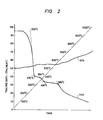
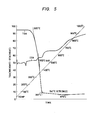
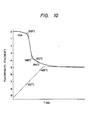
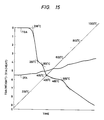
- Fig. 10 shows the result obtained when the product was heated up to 450°C at rate of 10°C/min, and maintained at 450°C for one hour. Although the weight slowly decreases by heating at 450°C for one hour, heat-resistant at around 400 to 450°C may be expected.
- the product obtained in this example was dissolved in a 5 : 5 mixture (volume ratio) of distilled chloroform and distilled dimethylacetamide to prepare 25 ml of LB film spreading solution.
- the 61 layers deposited film obtained in the above described way had a thickness of ca. 1800 ⁇ , and the electrical insulation characteristic was found to be excellent by the measurement of capacitance.
- an acid chloride solution was prepared at room temperature from pyromellitic acid distearyl ester (3.80 g, 5.00 millimoles), thionyl chloride (1.19 g, 10.0 millimoles), and HMPA (50 ml), and thereto was dropwise added 2,5-diaminobenzamide (0.765 g, 5.00 millimoles) dissolved in dimethylacetamide (30 ml) at about 5°C with stirring by the use of a mechanical stirrer, and stirring was further continued for more than one hour, and then the temperature was slowly restored to room temperature.
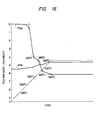
- Fig. 16 shows the result obtained when the product was heated up to 500°C at a rate of 10°C/min, and maintained at 500°C for one hour. Even when heating was made at 500°C for one hour, there was found almost no decrease in the weight, indicating the heat stability, so that heat resistance can be expected at a temperature above 500°C.
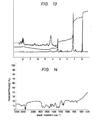
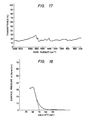
- the IR spectrum of the compound obtained by the ring closure of the amphiphilic high polymer in this example as above is low in the percent transmission as shown in Fig. 17, the absorption resembling that of the imide linkage can be observed. Also, the weight decrease observed after the heating at 500°C for one hour is 64.7%, which is well in conformity with the theoretical decrease 64.1% in the case where polyimidoisoindroquinazolinedione is formed by the elimination of stearyl alcohol and water.
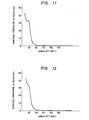
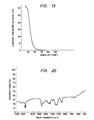
- the relationship between surface pressure and area per recurring unit was measured at 20°C on the surface of redistilled water. The result obtained is shown in Fig. 18.
- the surface pressure rose steeply from about 90 A /unit, forming a good condensed film.
- the limiting area was 75 ⁇ 2 /unit, and the collapse pressure was 30 dyne/cm.
- the 61 layers accumulated film obtained in the above described way had a thickness of ca. 1800 ⁇ , and the electric insulation characteristic was found to be excellent by the measurement of capacitance.
- TGA-DTA Thermal Analvsis
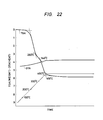
- Fig. 22 shows the result obtained when the product was heated up to 400°C at a rate of 10°C/min, and maintained at 400°C for one hour. By heating at 400°C for one hour an almost constant weight was attained. Heat resistance may be expected up to about 400 to 450°C.
- the product obtained in this example was dissolved in an 8 : 2 mixture (volume ratio) of distilled chloroform and distilled dimethylacetamide to prepare 25 mi of LB film spreading solution.
- the relationship between surface pressure and area per recurring unit was measured at 20°C on the surface of twice-distilled water, and the result obtained is as shown in Fig. 23.
- the surface pressure rose steeply from about 75 ⁇ 2 /unit, forming a good condensed film.
- the limiting area was 63 ⁇ 2 /unit and the collapse pressure was 35 d y ne/cm.
- the 61 layers accumulated film obtained in the above described way had a thickness of ca. 1800 ⁇ , and the insulation characteristic was found to be excellent by the measurement of capacitance.
- the present invention it is possible to form, on the surface of water more stable films of so modified polymer to be capable of film formation by the Langmuir-Blodgett process, and to build up the film on a substrate in a better state.
Landscapes
- Engineering & Computer Science (AREA)
- Chemical & Material Sciences (AREA)
- Nanotechnology (AREA)
- Condensed Matter Physics & Semiconductors (AREA)
- Crystallography & Structural Chemistry (AREA)
- General Physics & Mathematics (AREA)
- Physics & Mathematics (AREA)
- Materials Engineering (AREA)
- Chemical Kinetics & Catalysis (AREA)
- Composite Materials (AREA)
- Manufacturing & Machinery (AREA)
- Application Of Or Painting With Fluid Materials (AREA)
- Manufacture Of Macromolecular Shaped Articles (AREA)
- Separation Using Semi-Permeable Membranes (AREA)
- Compositions Of Macromolecular Compounds (AREA)
- Polymers With Sulfur, Phosphorus Or Metals In The Main Chain (AREA)
- Macromolecular Compounds Obtained By Forming Nitrogen-Containing Linkages In General (AREA)
Applications Claiming Priority (2)
| Application Number | Priority Date | Filing Date | Title |
|---|---|---|---|
| JP61023278A JPS62180777A (ja) | 1986-02-04 | 1986-02-04 | 製膜の方法 |
| JP23278/86 | 1986-02-04 |
Publications (3)
| Publication Number | Publication Date |
|---|---|
| EP0232829A2 true EP0232829A2 (de) | 1987-08-19 |
| EP0232829A3 EP0232829A3 (en) | 1987-09-30 |
| EP0232829B1 EP0232829B1 (de) | 1993-05-05 |
Family
ID=12106130
Family Applications (1)
| Application Number | Title | Priority Date | Filing Date |
|---|---|---|---|
| EP87101419A Expired - Lifetime EP0232829B1 (de) | 1986-02-04 | 1987-02-03 | Verfahren zum Herstellen eines Polymerfilms |
Country Status (5)
| Country | Link |
|---|---|
| US (1) | US4740396A (de) |
| EP (1) | EP0232829B1 (de) |
| JP (1) | JPS62180777A (de) |
| CA (1) | CA1280866C (de) |
| DE (1) | DE3785683T2 (de) |
Cited By (5)
| Publication number | Priority date | Publication date | Assignee | Title |
|---|---|---|---|---|
| EP0284314A1 (de) * | 1987-03-25 | 1988-09-28 | K & V LICENCING OY | Aggregate von Langmuir-Blodgett-Filmen |
| EP0268370A3 (en) * | 1986-10-13 | 1989-05-31 | Canon Kabushiki Kaisha | Switching device |
| EP0246602A3 (de) * | 1986-05-20 | 1991-01-02 | Kanegafuchi Kagaku Kogyo Kabushiki Kaisha | Anordnung mit Polymer-Dünnschicht |
| EP0362689A3 (de) * | 1988-10-01 | 1991-01-16 | Hoechst Aktiengesellschaft | Polyharnstoff und Film aus mindestens einer monomolekularen Schicht eines Polyharnstoffs |
| EP0354432A3 (de) * | 1988-08-12 | 1991-04-10 | Bayer Ag | Beschichtete Träger mit ultradünner, ein- oder mehrlagiger Beschichtung, Verfahren zu ihrer Herstellung und Polyurethane als Zwischenprodukte für die beschichteten Träger |
Families Citing this family (11)
| Publication number | Priority date | Publication date | Assignee | Title |
|---|---|---|---|---|
| US4988570A (en) * | 1985-09-11 | 1991-01-29 | Kanegafuchi Kagaku Kogyo Kabushiki Kaisha | Process for forming a film |
| JPS62183881A (ja) * | 1986-02-07 | 1987-08-12 | Res Dev Corp Of Japan | 複素芳香族高分子超薄膜の製造方法 |
| US4943471A (en) * | 1986-05-20 | 1990-07-24 | Kanegafuchi Kagaku Kogyo Kabushiki Kaisha | Patterned thin film and process for preparing the same |
| JPH0792570B2 (ja) * | 1988-03-25 | 1995-10-09 | 株式会社日立製作所 | 液晶表示素子及びその製造方法 |
| JPH0761428B2 (ja) * | 1989-03-09 | 1995-07-05 | 松下電器産業株式会社 | 選択透過性膜およびその製造方法 |
| JPH0761427B2 (ja) * | 1988-06-03 | 1995-07-05 | 松下電器産業株式会社 | 選択透過性膜およびその製造方法 |
| US5166307A (en) * | 1988-09-07 | 1992-11-24 | Hoechst Aktiengesellschaft | Polyamide and film made from at least one monomolecular layer of a polyamide |
| US4992244A (en) * | 1988-09-27 | 1991-02-12 | The United States Of America As Represented By The Secretary Of The Navy | Films of dithiolene complexes in gas-detecting microsensors |
| CA2010169A1 (en) * | 1989-02-21 | 1990-08-21 | Masakazu Uekita | Multi-layer resist |
| JP2952346B2 (ja) * | 1997-03-11 | 1999-09-27 | 東京商船大学長 | ラングミュア・ブロジェット膜およびその製造方法 |
| CN103224637B (zh) * | 2013-03-21 | 2015-02-25 | 京东方科技集团股份有限公司 | 一种液晶取向膜及其制备方法与应用 |
Family Cites Families (4)
| Publication number | Priority date | Publication date | Assignee | Title |
|---|---|---|---|---|
| FR2564004B1 (fr) * | 1984-05-10 | 1993-04-09 | Commissariat Energie Atomique | Procede de fabrication d'un film mince comportant au moins une couche monomoleculaire de molecules non amphiphiles |
| US4643125A (en) * | 1984-11-13 | 1987-02-17 | Vickers Public Limited Company | Barriers |
| JPS6261673A (ja) * | 1985-09-11 | 1987-03-18 | Kanegafuchi Chem Ind Co Ltd | 製膜方法 |
| CA1290490C (en) * | 1985-11-20 | 1991-10-08 | Masakazu Uekita | Amphiphilic high polymer and process for producing the same |
-
1986
- 1986-02-04 JP JP61023278A patent/JPS62180777A/ja active Granted
-
1987
- 1987-02-03 EP EP87101419A patent/EP0232829B1/de not_active Expired - Lifetime
- 1987-02-03 CA CA000528898A patent/CA1280866C/en not_active Expired - Lifetime
- 1987-02-03 DE DE87101419T patent/DE3785683T2/de not_active Expired - Fee Related
- 1987-02-03 US US07/010,502 patent/US4740396A/en not_active Expired - Fee Related
Cited By (6)
| Publication number | Priority date | Publication date | Assignee | Title |
|---|---|---|---|---|
| EP0246602A3 (de) * | 1986-05-20 | 1991-01-02 | Kanegafuchi Kagaku Kogyo Kabushiki Kaisha | Anordnung mit Polymer-Dünnschicht |
| EP0268370A3 (en) * | 1986-10-13 | 1989-05-31 | Canon Kabushiki Kaisha | Switching device |
| EP0284314A1 (de) * | 1987-03-25 | 1988-09-28 | K & V LICENCING OY | Aggregate von Langmuir-Blodgett-Filmen |
| EP0354432A3 (de) * | 1988-08-12 | 1991-04-10 | Bayer Ag | Beschichtete Träger mit ultradünner, ein- oder mehrlagiger Beschichtung, Verfahren zu ihrer Herstellung und Polyurethane als Zwischenprodukte für die beschichteten Träger |
| EP0362689A3 (de) * | 1988-10-01 | 1991-01-16 | Hoechst Aktiengesellschaft | Polyharnstoff und Film aus mindestens einer monomolekularen Schicht eines Polyharnstoffs |
| US5081212A (en) * | 1988-10-01 | 1992-01-14 | Hoechst Aktiengesellschaft | Polyurea and film composed of at least one monomolecular layer of a polyurea |
Also Published As
| Publication number | Publication date |
|---|---|
| CA1280866C (en) | 1991-03-05 |
| DE3785683D1 (de) | 1993-06-09 |
| US4740396A (en) | 1988-04-26 |
| DE3785683T2 (de) | 1993-12-09 |
| EP0232829B1 (de) | 1993-05-05 |
| EP0232829A3 (en) | 1987-09-30 |
| JPS62180777A (ja) | 1987-08-08 |
| JPH0419911B2 (de) | 1992-03-31 |
Similar Documents
| Publication | Publication Date | Title |
|---|---|---|
| US4897461A (en) | Amphiphilic polyimide precursor and process for preparing the same | |
| US4740396A (en) | Process for forming film | |
| EP0230539A2 (de) | Amphiphile Hochpolymere und Verfahren zu deren Herstellung | |
| EP0246602B1 (de) | Anordnung mit Polymer-Dünnschicht | |
| EP0218114B1 (de) | Folie und Verfahren zu deren Herstellung | |
| EP0247358A2 (de) | Amphiphiler Polyimidcopolyer Vorläufer, Verfahren zu seiner Herstellung und dünne Folie | |
| EP0262446B1 (de) | Hoch molekulare, amphiphile, photoempfindliche Photopolymere und Herstellungsverfahren | |
| US4868281A (en) | Ionic bond containing condensation polymers | |
| US4988570A (en) | Process for forming a film | |
| US5171829A (en) | Copolymeric and amphiphilic polyimide precursor, process for preparing the same and thin film | |
| JPH0611419B2 (ja) | 製膜法 | |
| EP0247637A1 (de) | Copolymerisierte Polyamidkarbonsäuresalze und Verfahren zu deren Herstellung | |
| JPS63126578A (ja) | 薄膜を含む複合物品 | |
| JPS63218728A (ja) | 両性高分子化合物およびその製造法 | |
| JPH03121128A (ja) | 両性ポリイミド前駆体およびその単分子薄膜 | |
| JPH03121127A (ja) | ポリイミド単分子薄膜 | |
| JPH01103629A (ja) | 機能性両性高分子化合物およびその製造法 | |
| JPH03121130A (ja) | 両性ポリイミド前駆体およびその単分子膜もしくは累積膜 | |
| JPH01232037A (ja) | 感光性両性高分子化合物の薄膜を含む複合物品 | |
| JPS6322831A (ja) | 両性ポリイミド前駆体およびその製法 |
Legal Events
| Date | Code | Title | Description |
|---|---|---|---|
| PUAI | Public reference made under article 153(3) epc to a published international application that has entered the european phase |
Free format text: ORIGINAL CODE: 0009012 |
|
| PUAL | Search report despatched |
Free format text: ORIGINAL CODE: 0009013 |
|
| AK | Designated contracting states |
Kind code of ref document: A2 Designated state(s): BE DE FR GB |
|
| AK | Designated contracting states |
Kind code of ref document: A3 Designated state(s): BE DE FR GB |
|
| 17P | Request for examination filed |
Effective date: 19880127 |
|
| 17Q | First examination report despatched |
Effective date: 19880824 |
|
| RTI1 | Title (correction) | ||
| GRAA | (expected) grant |
Free format text: ORIGINAL CODE: 0009210 |
|
| AK | Designated contracting states |
Kind code of ref document: B1 Designated state(s): BE DE FR GB |
|
| REF | Corresponds to: |
Ref document number: 3785683 Country of ref document: DE Date of ref document: 19930609 |
|
| ET | Fr: translation filed | ||
| PLBE | No opposition filed within time limit |
Free format text: ORIGINAL CODE: 0009261 |
|
| STAA | Information on the status of an ep patent application or granted ep patent |
Free format text: STATUS: NO OPPOSITION FILED WITHIN TIME LIMIT |
|
| 26N | No opposition filed | ||
| PGFP | Annual fee paid to national office [announced via postgrant information from national office to epo] |
Ref country code: GB Payment date: 19960125 Year of fee payment: 10 Ref country code: FR Payment date: 19960125 Year of fee payment: 10 |
|
| PGFP | Annual fee paid to national office [announced via postgrant information from national office to epo] |
Ref country code: DE Payment date: 19960215 Year of fee payment: 10 |
|
| PGFP | Annual fee paid to national office [announced via postgrant information from national office to epo] |
Ref country code: BE Payment date: 19960326 Year of fee payment: 10 |
|
| PG25 | Lapsed in a contracting state [announced via postgrant information from national office to epo] |
Ref country code: GB Effective date: 19970203 |
|
| PG25 | Lapsed in a contracting state [announced via postgrant information from national office to epo] |
Ref country code: BE Effective date: 19970228 |
|
| BERE | Be: lapsed |
Owner name: KANEGAFUCHI KAGAKU KOGYO K.K. Effective date: 19970228 |
|
| GBPC | Gb: european patent ceased through non-payment of renewal fee |
Effective date: 19970203 |
|
| PG25 | Lapsed in a contracting state [announced via postgrant information from national office to epo] |
Ref country code: FR Effective date: 19971030 |
|
| PG25 | Lapsed in a contracting state [announced via postgrant information from national office to epo] |
Ref country code: DE Effective date: 19971101 |
|
| REG | Reference to a national code |
Ref country code: FR Ref legal event code: ST |