EP0225482B1 - Papierverbrauchsüberwachungssystem - Google Patents
Papierverbrauchsüberwachungssystem Download PDFInfo
- Publication number
- EP0225482B1 EP0225482B1 EP86115304A EP86115304A EP0225482B1 EP 0225482 B1 EP0225482 B1 EP 0225482B1 EP 86115304 A EP86115304 A EP 86115304A EP 86115304 A EP86115304 A EP 86115304A EP 0225482 B1 EP0225482 B1 EP 0225482B1
- Authority
- EP
- European Patent Office
- Prior art keywords
- waste
- weight
- scale
- press
- signal
- Prior art date
- Legal status (The legal status is an assumption and is not a legal conclusion. Google has not performed a legal analysis and makes no representation as to the accuracy of the status listed.)
- Expired
Links
- 238000012544 monitoring process Methods 0.000 title claims description 20
- 239000002699 waste material Substances 0.000 claims description 117
- 238000000034 method Methods 0.000 claims description 17
- 238000010586 diagram Methods 0.000 description 14
- 238000003860 storage Methods 0.000 description 9
- 239000000463 material Substances 0.000 description 6
- 238000001514 detection method Methods 0.000 description 5
- 230000008569 process Effects 0.000 description 5
- 238000005303 weighing Methods 0.000 description 5
- 230000008878 coupling Effects 0.000 description 4
- 238000010168 coupling process Methods 0.000 description 4
- 238000005859 coupling reaction Methods 0.000 description 4
- 230000000694 effects Effects 0.000 description 4
- 239000010893 paper waste Substances 0.000 description 4
- 230000007704 transition Effects 0.000 description 4
- 230000008859 change Effects 0.000 description 3
- 238000004519 manufacturing process Methods 0.000 description 3
- 230000001186 cumulative effect Effects 0.000 description 2
- 238000013461 design Methods 0.000 description 2
- 238000009825 accumulation Methods 0.000 description 1
- 230000003213 activating effect Effects 0.000 description 1
- 238000013459 approach Methods 0.000 description 1
- 239000003990 capacitor Substances 0.000 description 1
- 125000004122 cyclic group Chemical group 0.000 description 1
- 230000001419 dependent effect Effects 0.000 description 1
- 238000001914 filtration Methods 0.000 description 1
- 230000008014 freezing Effects 0.000 description 1
- 238000007710 freezing Methods 0.000 description 1
- 230000000670 limiting effect Effects 0.000 description 1
- 238000012986 modification Methods 0.000 description 1
- 230000004048 modification Effects 0.000 description 1
- 238000004806 packaging method and process Methods 0.000 description 1
- 238000011084 recovery Methods 0.000 description 1
- 238000005096 rolling process Methods 0.000 description 1
- 238000005070 sampling Methods 0.000 description 1
- 230000011664 signaling Effects 0.000 description 1
- 239000004753 textile Substances 0.000 description 1
- 230000001960 triggered effect Effects 0.000 description 1
Images



Classifications
-
- G—PHYSICS
- G01—MEASURING; TESTING
- G01G—WEIGHING
- G01G19/00—Weighing apparatus or methods adapted for special purposes not provided for in the preceding groups
-
- G—PHYSICS
- G01—MEASURING; TESTING
- G01G—WEIGHING
- G01G15/00—Arrangements for check-weighing of materials dispensed into removable containers
-
- G—PHYSICS
- G01—MEASURING; TESTING
- G01G—WEIGHING
- G01G17/00—Apparatus for or methods of weighing material of special form or property
- G01G17/02—Apparatus for or methods of weighing material of special form or property for weighing material of filamentary or sheet form
Definitions
- the present invention relates in general to a paper monitoring system and pertains, more particularly, to an automatic system for the monitoring of paper products.
- the system of the present invention may be used in the monitoring of paper in conjunction with a printing press or may also be used in other industries in which material is consumed in web form such as in the textile and packaging industries.
- the rolls of paper are typically provided with a weight stamped on the outer wrapper by the maker of the paper.
- One technique is to use a separate small capacity scale in which all scraps from a particular roll are weighed. After all of the waste from the roll is weighed on this small scale a button is pushed to record the waste as an entry pertaining to a particular roll and then the paper is removed from the scale into a waste bin. This technique is troublesome in that it requires an extra step for the operator and it also requires that all waste be disposed on this small scale. It is quite easy to circumvent the technique because people will tend to put waste directly into the waste bin.
- US-A-4,015,676 teaches a recording scale for the recovery of waste material. It is provided with weighing means for determining the weight of materials presented, and means for recording the weight. An operating member actuates ejecting means for transferring the weighed material into a storage chamber, and operation of the weight-recording means is dependent on operation of the ejecting means and provides the operator with a readout of the weight of the waste.
- a further object of the present invention is to provide an improved system for the monitoring of paper particularly waste paper from a roll of paper that is introduced into a printing press.
- Another object of the present invention is to provide an improved paper monitoring system in which both total roll weight is accounted for as well as the signatures from the press so as to provide a final basis weight or weight per unit area of the output signatures.
- the weight per unit area of the output signatures may also be expressed as signatures produced per kilogram of paper.
- Still another object of the present invention is to provide an improved automatic monitoring system for paper in connection with a web printing process and which readily takes into account paper consumed due to web breaks.
- the above-cited objects are achieved by a method for monitoring paper consumption in association with a web printing press, as defined in claim 11.
- a system for monitoring paper consumption in association with a web printing press that has the capability of monitoring paper delivery to the press from multiple rolls.
- an input waste scale and an input waste bin adapted to be disposed on the input waste scale.
- the input waste scale provides for the continuous registration of waste in sequence from the multiple rolls and has an output signal that is continuously representative of input weight.
- Separate means are provided, each responsive to the scale signal for sensing separate increments in scale weight for each respective roll to provide a total of waste weight per roll.
- Control means are provided including means operator initiated, such as at a keyboard of the system for enabling only one of the these separate means for sensing, so as to accumulate waste weight only associated with a selected rolls.
- the net weight of paper that is delivered to the printing press is equal to the weight of paper placed in the machine minus the roll weight at removal. If all waste associated with a particular roll is kept track of, on a per roll basis, then, knowing the original weight stamped on the roll, one can then easily determine the net weight of paper that is used by the press.
- the means for sensing increments in scale weight may comprise a difference means.
- means for determining the number of gross signatures delivered from the press Means are provided for determining the weight of paper delivered to the press by subtracting the waste weight per roll from the total initial weight of the corresponding roll. Means are provided for also determining the basis weight by providing a division between gross press signatures and weight of paper delivered to the press. Means are also provided for determining web break waste by comparing gross signatures with weight of paper delivered to the press.
- FIG. 1 is a schematic diagram of a paper monitoring system in accordance with the present invention
- FIG. 2 is a sectional diagram illustrating paper waste consumption and individual categories thereof
- FIG. 3 is a schematic diagram showing a portion of one embodiment of weight detection circuitry
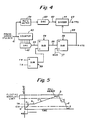
- FIG. 4 is a schematic diagram showing an additional part of the system as it relates to FIG. 3
- FIG. 5 is a time-weight graph useful in association with the diagrams of FIGS. 3 and 4
- FIG. 6 is a block diagram associated with the input waste detection electronics for providing at the output thereof individual waste signals for each roll
- FIG. 7 is a block diagram of a circuit for providing, inter alia, a basis weight.
- an input waste bin 100 which is disposed on an input waste scale 102.
- the approach is to place the waste bin directly onto the scale and to record the weight of waste put into it in association with each roll on an individual roll basis.
- the net paper placed into the press is equal to the initial roll weight such as marked on the roll by the roll manufacturer reduced by the total waste weight.
- the paper remaining when the roll is removed from the web printing machine may be counted as core waste and may also be put into the input waste bin. Alternatively, the core waste may be accounted for separately.
- the final net weight of paper used in the press is equal to the weight of paper placed in the machine reduced by the roll weight at removal.
- FIG. 1 shows the printing press 110 having at its input end a stack 111 of rolls 112.
- rolls #1 - #4 there are provided four rolls identified as rolls #1 - #4. Although four rolls are illustrated usually only a single roll is fed to the printing press at a time.
- FIG. 1 also shows the output waste bin 12 disposed on the output waste scale 10.
- An output line 11 couples the output waste scale 10 to the control electronics 120.
- the control electronics 120 is described in FIG. 1 as part of the overall console 122.
- the console 122 also includes a keyboard 124 and display screen 126. It is noted that there is also a further input on line 125 from the printing press to the control electronics 120.
- the signal on line 125 gives the press gross signatures, a count that is available at the output of the printing press.
- FIG. 1 there is also shown a line 103 coupling from the input waste scale to the control electronics 120. This is a signal that is representative of the weight on the input scale at any one period in time.
- FIG. 2 is a diagram helpful in illustrating the different types of waste that are produced in association with a printing process.
- the total circle is representative of the total weight of paper that is purchased and that is to be kept track of in association with the printing process. Of this total paper weight portions of it are waste that occur both at the input of the printing operation and at the output thereof in the form of waste signatures S.
- segment A' represents wrapper and strip waste from the roll.
- Segment B' represents core waste.
- Segment C' may be used to represent web break waste.
- Segment D' represents waste signatures at the output of the press.
- segment E' in FIG. 2 is representative of the good product.
- the segments E' and D' together (arrow G') represent the paper that is delivered to the press. It is noted in FIG. 2 that some of these segments are represented perhaps in larger percentage slices than might be the actual case simply for the purpose of explanation.
- FIGS. 3-5 All of the discussion relating to FIGS. 3-5 pertains to waste at the output end of the printing press.
- FIGS. 3 and 4 together illustrate a portion of the control electronics 120 associated with the output detection.
- FIG. 5 is a graph of weight vs. time that is helpful in explaining the control.
- the graph of FIG. 5 may be broken down into different segments. Segment A represents the time over which a storage bin or cart is placed upon the scale. This segment is shown as perhaps being somewhat erratic which occurs when a cart is rolled on to a scale. For at least a short segment B the weight is constant. This thus represents the tare weight as illustrated in FIG. 5. There is then a relatively long curve segment C which is representative of a period over which the waste paper is being deposited in the storage bin on the scale. The next segment is segment D which is shown as being cyclic representing erratic behavior that occurs as the storage cart is about to be removed from the scale. This erratic behavior is one of the parameters that is being sensed with the circuitry of FIG. 3.
- segment E When the first set of wheels from the cart passes from the scale this is represented by the drop in the graph at segment E. There is also shown a segment F which represents the transition off of the scale when the last wheel of the cart is removed from the scale.
- FIG. 3 there is shown the scale 10 with the storage bin 12 shown schematically above the scale 10.
- the scale 10 is of conventional design and is considered in FIG. 3 as having an analog output on line 11 that couples to an amplifier or driver 14 with the output thereof coupling to the common line 16 where the signal SA (scale analog) is generated.
- the bin 12 is for containing waste paper coming from a printing press or possibly from other like apparatus.
- the circuit of FIG. 3 is adapted to provide certain control signals particularly providing an automatic signal representative of tare weight. This is the signal TR shown in FIG. 3.
- the circuitry includes analog network 20 which has an output coupling to comparator 22.
- Another circuit that couples from the common line 16 is the sample and hold circuit 24. The output of this circuit provides the signal FW (full weight).
- Still another circuit that couples from the common line 16 is the comparator 30. This circuit provides the signal WB (waste bin on scale) and may also provide the negation of that signal.
- WB waste bin on scale
- the sample and hold circuit 36 is for generation of the tare weight signal TR.
- detection circuitry including a monostable multi-vibrator or one-shot 50 and flip-flop 52.
- the one-shot 50 receives the signal ERR (erratic). This is the signal taken from the output of the comparator 22.
- Circuitry is also provided associated with the comparator 22 and the sample and hold network 24.
- This circuitry includes a multi-vibrator or one-shot 64 and flip-flops 66 and 68.
- the comparator 22 is coupled to the common line 16 by way of the analog network 20.
- This network provides filtering by means of capacitor 21 and resistor 23 which essentially function as a differentiator to detect any appreciable change in weight sensed at the line 16.
- the signal LIMIT at the reference input to the comparator 22 is set at a level corresponding to 0.66Kg (0.30 pounds) so that if there is a change of weight of at least 0.66Kg (0.30 pounds), then the comparator 22 is activated indicating an erratic condition. This may occur when the cart is placed on the scale (segment A, FIG. 5) or is removed (segment D, FIG. 5) from the scale, or when an operator stands upon the scale to retrieve the waste bin.
- the operator's weight is not included since it is normally difficult for the operator to keep his movement to less than 0.66Kg (0.3 pounds).
- the signal FW is held to be the value just before the operator stepped on the scale and the signal FW resumes when the operator gets off the scale.
- the signal ERR sets the flip-flop 66 and this signal also couples to the one-shot 64.
- Both the one-shot 64 and the one-shot 50 are retriggerable one-shots and the output shown in FIG. 3 from each of these has a five second duration.
- the purpose of the one-shots is to have a five second stable period. At the end of this period, at the falling edge 65 of the waveform, the flip-flop 68 is triggered by this negative going edge.
- the data input to the flip-flop 68 is the signal WB.
- the output of the flip-flop 68 couples to the reset input of the flip-flop 66.
- the assertion output of the flip-flop 66 in turn couples to the control input of the track and hold circuit 24.
- the signal ERR taken from the output of the comparator 22, as indicated previously, is generated whenever a change in weight is detected at the scale greater than the limit reference at the reference input to the comparator 22.
- this LIMIT reference is set at a voltage corresponding to 0.66Kg (0.30 pounds) of paper.
- the signal ERR also couples to the one-shot 64 which is a retriggerable one-shot.
- the one-shot 64 is retriggered.
- a predetermined time interval such as 5 seconds
- the flip-flop 68 senses the state of the signal WB. It is noted that it is the affirmative of this signal that couples to the data input of the flip-flop 68.
- the flip-flop 68 determines whether the waste bin is on the scale or not. If the waste bin is on the scale as represented by the signal WB, then the flip-flop 68 is set by the falling edge 65 and this signal couples back to the flip-flop 66 to reset the flip-flop 66.
- the bin removal or erratic signals may be used as an indication to carry out other tasks in the weighing system such as use in conjunction with conveyor control.
- FIGS. 1 and 3 it can be assumed that operation commences by rolling the storage bin 12 onto the scale 10. This is shown in FIG. 5 by the segment A. Note that during the segment A, the signal WB transitions high. Now, it is noted that the segment B in FIG. 5 is representative of a level that corresponds to the tare weight.
- the tare weight is detected by the sample and hold or tracking circuit 36 in combination with the one shot 50 and the flip-flop 52.
- the signal ERR is generated and this is coupled to the one shot 50.
- the output of the one shot 50 has a negative transition 51 that couples to the clock input of the flip-flop 52.
- the output of the flip-flop at its output Q is low and this enables tracking of the circuit 36.
- the erratic signal that occurs during segment A once it has settled down for 5 seconds, the signal WB is high because the waste bin is then on the scale.
- the Q output goes low and this holds the circuit 36 essentially holding the analog signal SA which becomes the tare weight signal representative of the weight of the cart alone prior to any filling of the cart as occurs along segment C in FIG. 5.
- the tare weight has been measured automatically and there is no need to keep track of tare weight for each different cart that may be employed.
- the output of the flip-flop 68 is high causing a resetting of the flip-flop 66. This has the effect of resuming the tracking because the output Q from the flip-flop 66 now goes low which is indicative of its tracking mode. Furthermore, the tracking is resumed without having taken into effect that weight was added when the operator got onto the scale. As far as a system is concerned, the operator's weight is ignored.
- FIG. 3 also shows the comparator 30 which receives the signal ESR shown as a threshold level H in FIG. 5.
- the signal ESR refers to an empty scale reference. When the analog signal from line 16 exceeds this reference, then the signal WB is generated, indicating that the waste bin is on the scale. It is noted that there is also provided in FIG. 3 an inverter 31 for providing the negation of the signal WB, i.e. WB-.
- alarm means for signaling when the weight reaches a point close to where bin removal would be advisable.
- alarm comparator 34 refers to the alarm comparator 34 and the output signal AL. This is a signal that would be generated when the weight reaches a point close to the end of the segment C in FIG. 5.
- FIG. 5 there is shown the segment D which is illustrative of a point wherein the bin is removed from the scale again causing the erratic signal to be generated, namely, the signal ERR.
- This erratic signal also has the effect of setting the flip-flop 66 to provide a holding of the signal which in this case will be the true and final full weight signal.
- the signal at the output of the one-shot 64 transitions at the falling edge 65 to clock the flip-flop 68.
- the signal WB is then low and thus the output from the flip-flop 68 does not reset the flip-flop 66. This thus means that the full weight signal is temporarily held.
- the common occurrence of the clocking of the flip-flop 68 along with the WB signal being low is an indication that one is at a full weight condition and thus the signal at the output of the circuit 24 can then be detected to determine what this full weight condition is.
- FIG. 4 shows a counter 40, digital to analog converter 42, analog networks 54 and 56, rate meter 58, digital to analog converter 60, and divider network 44.
- the counter 40 is shown as having a clock input at line 41. This is a pulse input from the printing press indicating the gross output from the press.
- the output of the counter 40 couples to the digital to analog converter 42 and thus the output of the converter 42 is an analog signal at line 53 representative of the present gross output of signatures from the press.
- This analog signal couples to the analog network 54 which is a difference or subtraction network. It is noted that this network also receives the signal FW which is the full weight signal.
- the signal on line 53 is one representative of a gross (total) count of signatures from the press while the signal FW is representative of the full weight.
- an inversion circuit 59 which provides for subtraction of the tare weight.
- the waste count is actually represented by the full weight minus the tare weight and thus those two inputs to the subtraction network provide for a waste count.
- the gross count minus the waste count is representative of good signatures.
- the network 54 being a difference network thus provides at its output 55 an analog signal representative of the gross signatures minus waste signatures which provides an indication of the good signatures that have occurred from the press.
- This signal couples to the second analog network 56 which also receives a signal on line 57 referred to as the signal NGD (net good desired).
- NGD network good desired
- This is a reference signal that may be set in a predetermined manner and is a signal of a magnitude representative of the net good signatures that are desired.
- the network 56 is also a difference or subtraction network and thus the output at line 49 is the signal NTG (needed-to-go) which is a signal indicative of the number of good signatures that are still required before the total number of good signatures is reached.
- the pulse input signal on line 41 couples to a rate meter 58 which may be of conventional design providing a digital output that couples to the digital to analog converter 60.
- This arrangement provides for an analog signal at the output line 62 from the converter which is a signal representative of press speed.
- the signal on line 62 couples to the divider network 44.
- the divider network 44 receives the signal on line 59 mentioned previously.
- the output of the divider network is the signal TTG (time-to-go).
- the time-to-go until the job is finished is represented by the ration of the number of signatures that are still needed divided by the press speed. This division is carried out by the divider 44 which receives the signal representative of the press speed on line 62 and the second signal on line 59 which is representative of the number of signatures that are required to go. Thus, as indicated on the output line 63 from the divider 44 there is the signal TTG which is representative of the time-to-go until the desired number of total good signatures is obtained.
- FIGS. 3-5 have been explained in connection with the accountability of waste at the output end of the web printing press.
- the network 54 provides at its output at line 55 an analog signal representative of the gross signatures minus waste signatures which provides an indication of the good signatures or the good product from the press.
- a corresponding analog signal is also provided at line 53 in FIG. 4.
- the signal on line 53 in FIG. 4 is a signal that is representative of a gross count of signatures from the press. This signal may be represented and processed as either a digital or analog signal.
- FIG. 1 On the input side of the printing operation as identified previously, there is an input waste bin 100 disposed upon input waste scale 102.
- FIG. 1 reference has been made to the output at line 103 from the input waste scale 102 to the control electronics 120.
- FIG. 6 which also shows the input waste scale 102 along with the output line 103.
- FIG. 6 shows further details of the control electronics 120 of FIG. 1.
- the waste bin itself directly on a scale to record the weight of waste.
- the operator determines from which roll the waste is coming and then manually provides control via the keyboard 124 to direct the electronics to accumulate waste only as being derived from a single roll at a time.
- the control electronics can determine the total quantity of waste associated with a particular roll. Also knowing the original weight of the roll as typically marked on the roll by the manufacturer, the control electronics can then determine the net weight of paper that is used in the printing operation.
- FIG. 2 shows in segments A, B and C the particular types of waste that occur in association with the input waste scale.
- FIG. 7 which is discussed in further detail hereinafter and which shows circuit 150 for providing a signal representative of weight of product delivered to the press.
- the input waste scale 102 which has an output on line 103 representative of the weight on the scale.
- Digital scales are well-known and the output signal on line 103 may in fact be a multi-line signal representative of a count corresponding to weight.
- This signal is coupled to a series of gates G1, G2, G3 and G4.
- These gates are represented in FIG. 6 as AND gates that also receive the respective selection signals S1, S2, S3 and S4.
- the gates G1-G4 carry out the demarcation of weight increments and are enabled on a mutually exclusive basis by the selection signals S1-S4.
- the keyboard 124 which shows corresponding selection buttons S1, S2, S3 and S4.
- the buttons S1-S4 are only shown for illustration, it being understood that other combinations of entries may be used to provide the desired roll selection.
- the operator of the apparatus selects via the keyboard which of the rolls is the particular roll that is in operation and for which waste is to be accumulated. This is typically the roll that is now being used as an input roll to the printing press. In FIG. 1 this may be roll #1. If it is the roll identified as roll #1 and each of these rolls is so identified, then the selection signal S1 occurs enabling only the gate G1.
- the gates G2, G3 and G4 are not enabled by their respective signals S2, S3 and S4 because the system operates so that only one waste weight accumulation occurs for a specific roll at a time. All waste is accumulated in the single bin even though the electronic house-keeps which roll is being monitored.
- the output of the gates G1-G4 couple to respective difference devices or subtractors D1, D2, D3 and D4.
- the output of the adders A1-A4 couple to respective display devices B1, B2, B3 and B4.
- the output at the displays is representative of waste weight for the respective rolls identified herein as rolls #1-#4.
- the difference device D1 as well as the other devices D2-D4 may be conventional devices in the form of a subtractor or the like device. It may have a clock input and also has storage capability. There may also be included some type of a sample and hold circuit therein. The difference device simply stores an indication of the present count which occurs when the signal S1 first occurs and then compares that with a subsequent count under control of some type of an input clock (not shown). Each of these devices thus provide an output therefrom that is representative of the increment in weight in the form of an increment count corresponding to the waste weight associated with a particular roll. This increment count may be provided in either analog or digital form.
- the output of the difference device couples to an adder which simply adds all of the increments in weight detected by the difference device.
- Each of the adders essentially provides a cumulative weight storage associated with a particular roll. The displays then display this waste weight on a per roll basis.
- the other gates and associated circuits operate in the same manner as the gate G1. Only one of the signals S1-S4 is provided at any one time because the system is keeping track of only waste from a single roll at a time. Interlock circuitry may be provided as part of the control to assure that only one of the signals S1-S4 can be activated at a time.
- FIG. 7 shows the divider 140.
- the purpose of the diagram of FIG. 7 is to illustrate, inter alia, the calculation of basis weight or weight per unit area of paper or per signature. This may also be expressed as the alternate ratio of impressions or signatures produced in a kilogram (pound) of paper delivered to the press.
- the input signals include weight delivered to the press at line 141 and the gross signatures input at line 142.
- the output is at line 143.
- the divider can operate to divide the signal on line 141 by the signal on line 142 or alternatively divide the signal on line 142 by the signal on line 141. If the total weight delivered to the press is divided by the number of gross signatures this provides an output indicating kilograms or other weight unit per area of paper or per signature. The alternate division that divides the number of gross signatures by weight delivery to the machine provides a signal of the number of signatures per pound or other weight parameter.
- the output at line 143 may either read 100 signatures per kilogram or 0.01 kilograms per signature.
- the total delivery into the machine is the segment in FIG. 2 illustrated by the arrow G'. This represent the total roll weight minus the input waste.
- the input waste may be considered as the sum of segments A', B' and C' in FIG. 2.
- the signal on line 142 which is the gross signatures this is the signal in FIG. 4 which may be the signal at line 53 which is representative of the gross output of signatures of the press. Again this can be represented as an analog or digital signal.
- segment C' in the diagram accounts for web break waste.
- continuity of paper flow in the machine is interrupted. Most of the paper is removed from the machine and may be discarded.
- the paper may be disposed in the waste bin to be accumulated as waste associated with the particular roll that is being fed.
- the paper lost in a web break may be accounted for by recognizing when paper is entering the machine as recorded at the splices between rolls with no paper leaving the machine at the output delivery.
- sensors in the press detect the absence of a taut paper web on some part of the web path.
- the sensor signal acts to minimize loss of material and to prevent damage by activating the press drive emergency stop function and causing security devices to cut the web at selected points to prevent paper from wrapping up on press cylinders.
- part or all of the papers in the press may be removed and discarded. After clean-up, paper is threaded through the press from the splicer and operation is resumed.
- the paper monitoring occurs by measuring all paper fed into the press and also all paper fed out of the delivery from the time of the break until the rate of paper delivery is equal to the rate of entry. The difference between the paper delivered to the press and the output from the press is accounted as paper lost in the web break.
- FIG. 7 shows, in addition to the divider 140, also subtractors 150 and 160.
- the subtractor 150 simply receives a signal indicating the total roll weight which is constant for each roll and also an input signal indicating waste weight.
- the output of the subtractor 150 is a signal at line 151 that indicates weight of product delivered to the press. Reference has been made previously to this signal coupled on line 141 to the divider 140.
- FIG. 7 shows the input signal on line 142 indicating gross signatures.
- the subtractor 160 receives the signal from line 151 indicating the weight of product delivered to the press and also receives a signal indicating gross signatures.
- the subtractor 160 makes a composition between these two signals to thus provide at its output 161 a signal representative of paper lost in the web break identified in FIG. 7 as web break waste.
- input signals may have to be normalized so that a comparison can be made between the weight delivered to the press and gross signatures.
- the number of signatures correlates to the weight by virtue of the signal indicating basis weight. In this way the subtractor 160 can be nulled so as to indicate an output parameter or output count indicating the magnitude of web break waste as it relates to the two inputs.
- the gross signature signal is essentially equal to the signal on line 151 and there is no output from the subtractor 160. However, if there is a web break, then the number of gross signatures will decrease because waste has occurred in the printing operation and this will be indicated at the output on line 161.
Landscapes
- Physics & Mathematics (AREA)
- General Physics & Mathematics (AREA)
- Inking, Control Or Cleaning Of Printing Machines (AREA)
- Controlling Sheets Or Webs (AREA)
- Controlling Rewinding, Feeding, Winding, Or Abnormalities Of Webs (AREA)
Claims (10)
- Anordnung zum überwachen von Papierverbrauch,
bei der ein Eingangsabfallkasten (100) auf eine Eingangsabfallwaage (102) stellbar ist, die zur Registrierung von Abfall vorgesehen ist, dadurch gekennzeichnet, daß vorgesehen sind
Mittel, um Abfall fortlaufend und der Reihe nach von vielen Rollen (112) zu registrieren und die ein Ausgangssignal (SA) haben, das beständig Abfallgewicht vertritt, gesonderte Mittel, die jeweils auf das Waagen-Ausgangs-signal ansprechen, um für jede Rolle Zunahmen an Waagengewicht zu ermitteln, um für jede Rolle ein gesondertes Abfail-Gewicht zu schaffen, und
Steuermittel (120) mit einem Mitteloperator, der in Gang gesetzt ist, um es nur einem der gesonderter Mittel zu ermöglichen, so zu ermitteln, daß nur Abfallgewicht, das einer ausgewählten Rolle zugeordnet ist, gesammelt wird, wobei die Vorrichtung gewöhnlich in Verbindung mit einer Papierbahn-Druckmaschine (110) vorgesehen ist, die dazu ausgerüstet ist, die Papierzulieferung zu der Druckmaschine (110) von vielen Rollen (112) zu überwachen. - Anordnung nach Anspruch 1, dadurch gekennzeichnet, daß die gesonderten Mittel zum Ermitteln von Zunahmen an Waagengewicht ein Differenzmittel aufweisen.
- Anordnung nach Anspruch 1 oder 2, dadurch gekennzeichnet, daß zusätzlich eine Ausgangsabfallwaage (10) und ein Ausgangsabfallkasten (12), der auf die Ausgangsabfallwaage (10) stellbar ist, vorgesehen sind.
- Anordnung nach Anspruch 3, dadurch gekennzeichnet, daß die Ausgangsabfallwaage (10) für die fortlaufende Registrierung von Abfall in Form von Abfallbogen von der Druckmaschine (110) vorgesehen ist.
- Anordnung nach einem oder mehreren der vorhergehenden Ansprüche, dadurch gekennzeichnet, daß weiterhin Mittel zum Feststellen der Bruttozahl von von der Druckmaschine (110) gelieferten Bogen vorgesehen sind.
- Anordnung nach Anspruch 5, dadurch gekennzeichnet, daß sie weiterhin Mittel zum festlegen des Gewichtes des zu der Druckmaschine (110) gelieferten Papiers aufweist, welche das Abfallgewicht pro Rolle von dem Gesamtanfangsgewicht der entsprechenden Rolle abziehen.
- Anordnung nach Anspruch 1, 2, 3, 4, 5, oder 6, dadurch gekennzeichnet, daß sie weiterhin Mittel zum Festlegen eines Gewichtes pro Papierflächeneinheit aufweist, welche eine Teilung zwischen Bruttodruckbogen und dem Gewicht von an die Druckmaschine (110) geliefertem Papier schaffen.
- Verfahren zum überwachen von Papierverbrauch, bei dem die Schritte vorgesehen sind, daß eine Eingangsabfallwaage (102) vorgesehen wird und Abfallgewicht gemessen wird, dadurch gekennzeichnet, daß es die Schritte aufweist, daß eine fortlaufende Registrierung von Abfall der Reihe nach von vielen Rollen (112) vorgesehen wird und gesonderte Zunahme an Waagengewicht für jede entsprechende Rolle festgestellt wird, um das Abfallgewicht pro Rolle insgesamt festzustellen, wobei dieses Verfahren in Verbindung mit einer Papierbahn-Druckmaschine (110) anwendbar ist, um die Papierzulieferung zu der Druckmaschine (110) von vielen Rollen (112) zu überwachen.
- Verfahren nach Anspruch 8, dadurch gekennzeichnet, daß es weiterhin den Schritt umfaßt, daß das Gewicht des der Druckmaschine (110) zugelieferten Papiers bestimmt wird, indem das Abfallgewicht pro Rolle von dem Gesamtanfangsgerwicht der entsprechenden Rolle abgezogen wird.
- Verfahren nach Anspruch 8 oder 9, dadurch gekennzeichnet, daß es weiterhin den Schritt umfaßt, daß das Gewicht pro Papierflächeneinheit des zu der Druckmaschine (110) gelieferten Papiers festgestellt wird, indem eine Teilung zwischen Bruttodruckbogen und dem Gewicht von an die Druckmaschine (110) geliefertem Papier vorgesehen wird.
Applications Claiming Priority (2)
| Application Number | Priority Date | Filing Date | Title |
|---|---|---|---|
| US807541 | 1985-12-11 | ||
| US06/807,541 US4716978A (en) | 1985-12-11 | 1985-12-11 | Paper monitoring system |
Publications (3)
| Publication Number | Publication Date |
|---|---|
| EP0225482A2 EP0225482A2 (de) | 1987-06-16 |
| EP0225482A3 EP0225482A3 (en) | 1988-06-01 |
| EP0225482B1 true EP0225482B1 (de) | 1991-04-24 |
Family
ID=25196622
Family Applications (1)
| Application Number | Title | Priority Date | Filing Date |
|---|---|---|---|
| EP86115304A Expired EP0225482B1 (de) | 1985-12-11 | 1986-11-05 | Papierverbrauchsüberwachungssystem |
Country Status (5)
| Country | Link |
|---|---|
| US (1) | US4716978A (de) |
| EP (1) | EP0225482B1 (de) |
| JP (1) | JPH0777944B2 (de) |
| CA (1) | CA1266315A (de) |
| DE (1) | DE3678911D1 (de) |
Families Citing this family (9)
| Publication number | Priority date | Publication date | Assignee | Title |
|---|---|---|---|---|
| US6098063A (en) * | 1994-02-15 | 2000-08-01 | R. R. Donnelley & Sons | Device and method for identifying causes of web breaks in a printing system on web manufacturing attributes |
| US6507832B1 (en) | 1994-02-15 | 2003-01-14 | R.R. Donnelley & Sons Company | Using ink temperature gain to identify causes of web breaks in a printing system |
| US6336106B1 (en) | 1994-02-15 | 2002-01-01 | R.R. Donnelley & Sons Company | System and method for partitioning a real-valued attribute exhibiting windowed data characteristics |
| US5694524A (en) * | 1994-02-15 | 1997-12-02 | R. R. Donnelley & Sons Company | System and method for identifying conditions leading to a particular result in a multi-variant system |
| US20020128990A1 (en) * | 1997-05-01 | 2002-09-12 | Kaminskas Paul A. | Control methodology and apparatus for reducing delamination in a book binding system |
| FI110343B (fi) * | 1999-02-25 | 2002-12-31 | Honeywell Oy | Paperikoneen ratakatkojen monitorointijärjestelmä |
| ITMI20111547A1 (it) * | 2011-08-25 | 2013-02-26 | Alberto Rovetta | Piattaforma sensorizzata per la misura nella raccolta dei rifiuti per ogni contenitore |
| CN103397411A (zh) * | 2013-07-25 | 2013-11-20 | 常熟市世博机械有限公司 | 一种自动充绒机的计量系统 |
| US9505572B1 (en) | 2016-01-06 | 2016-11-29 | International Business Machines Corporation | Printer with automatic paper sheet count discovery |
Family Cites Families (9)
| Publication number | Priority date | Publication date | Assignee | Title |
|---|---|---|---|---|
| GB791581A (en) * | 1955-05-12 | 1958-03-05 | Australian Paper Manufacturers | Apparatus and method for continuous measurement of basis weight of paper, board or like fibrous material |
| US3708027A (en) * | 1972-01-31 | 1973-01-02 | Ramsey Eng Co | Batching system utilizing digital-to-analog subtraction to denote the amount of batched material |
| US3863724A (en) * | 1973-09-20 | 1975-02-04 | Jr Nichola Dalia | Inventory control system |
| CH583411A5 (de) * | 1974-05-25 | 1976-12-31 | Pittet Henri | |
| US4419734A (en) * | 1981-01-09 | 1983-12-06 | Indata Corporation | Inventory control system |
| FR2519582A1 (fr) * | 1981-10-21 | 1983-07-18 | Groult Emile | Installation de surveillance et de commande de fabrication, notamment d'une machine d'imprimerie |
| US4425974A (en) * | 1982-04-21 | 1984-01-17 | Eds-Idab, Inc. | Method for counting signatures employing a weighing technique |
| US4479559A (en) * | 1983-01-21 | 1984-10-30 | Langdon Wales R | Method and apparatus for weighing material |
| US4563739A (en) * | 1983-07-18 | 1986-01-07 | Impulse Computer Systems, Inc. | Inventory and business management system which accounts for the contents of full and partially filled product containers |
-
1985
- 1985-12-11 US US06/807,541 patent/US4716978A/en not_active Expired - Lifetime
-
1986
- 1986-11-05 DE DE8686115304T patent/DE3678911D1/de not_active Expired - Lifetime
- 1986-11-05 EP EP86115304A patent/EP0225482B1/de not_active Expired
- 1986-12-11 JP JP61295712A patent/JPH0777944B2/ja not_active Expired - Lifetime
- 1986-12-11 CA CA000525066A patent/CA1266315A/en not_active Expired - Lifetime
Also Published As
| Publication number | Publication date |
|---|---|
| JPH0777944B2 (ja) | 1995-08-23 |
| EP0225482A3 (en) | 1988-06-01 |
| US4716978A (en) | 1988-01-05 |
| JPS62191356A (ja) | 1987-08-21 |
| EP0225482A2 (de) | 1987-06-16 |
| CA1266315A (en) | 1990-02-27 |
| DE3678911D1 (de) | 1991-05-29 |
Similar Documents
| Publication | Publication Date | Title |
|---|---|---|
| EP0225482B1 (de) | Papierverbrauchsüberwachungssystem | |
| US4709770A (en) | Device for correcting dynamic weight signal from conveyer weigher | |
| JP3117220B2 (ja) | 連続計量メータ | |
| US3825734A (en) | Monitor for moving vehicles | |
| US6594597B1 (en) | Press residual life monitor | |
| JPS625585B2 (de) | ||
| US5167287A (en) | Process and devices for dynamic measurement of a load in displacement in a vertical plane | |
| JPS5879120A (ja) | 製造機械または製造ラインを監視、制御するための装置 | |
| EP0939306A1 (de) | Vorrichtung und Verfahren zur Überwachung des Kraftstoffverbrauches in einem Kraftfahrzeug | |
| US4667757A (en) | System for determining axle spacing | |
| EP0134492B1 (de) | Apparat zum Wiegen von Material | |
| US3508035A (en) | Roll average computing method and apparatus | |
| US4828056A (en) | Method and apparatus for weighing material | |
| JP2868865B2 (ja) | 流量率測定装置のための積算装置 | |
| JP3123811B2 (ja) | 粉末原料搬出装置 | |
| JPH07125730A (ja) | 小物供給数量監視装置 | |
| JP2996382B2 (ja) | 積載重量表示装置 | |
| EP0111805B1 (de) | Methode und Apparat zum Wiegen von Material | |
| JPS58198732A (ja) | 減算演算式はかり | |
| JP2546961B2 (ja) | 電子秤装置 | |
| SU1687659A1 (ru) | Устройство дл контрол производительности батареи хлопкоперерабатывающих машин | |
| JP2003267500A (ja) | タンクの自動管理システム | |
| JPH0678929B2 (ja) | 計量装置 | |
| JPH0510790A (ja) | 記録計 | |
| JPH04207B2 (de) |
Legal Events
| Date | Code | Title | Description |
|---|---|---|---|
| PUAI | Public reference made under article 153(3) epc to a published international application that has entered the european phase |
Free format text: ORIGINAL CODE: 0009012 |
|
| AK | Designated contracting states |
Kind code of ref document: A2 Designated state(s): DE FR GB IT NL SE |
|
| PUAL | Search report despatched |
Free format text: ORIGINAL CODE: 0009013 |
|
| AK | Designated contracting states |
Kind code of ref document: A3 Designated state(s): DE FR GB IT NL SE |
|
| 17P | Request for examination filed |
Effective date: 19881110 |
|
| 17Q | First examination report despatched |
Effective date: 19890330 |
|
| GRAA | (expected) grant |
Free format text: ORIGINAL CODE: 0009210 |
|
| AK | Designated contracting states |
Kind code of ref document: B1 Designated state(s): DE FR GB IT NL SE |
|
| PG25 | Lapsed in a contracting state [announced via postgrant information from national office to epo] |
Ref country code: IT Free format text: LAPSE BECAUSE OF FAILURE TO SUBMIT A TRANSLATION OF THE DESCRIPTION OR TO PAY THE FEE WITHIN THE PRE;WARNING: LAPSES OF ITALIAN PATENTS WITH EFFECTIVE DATE BEFORE 2007 MAY HAVE OCCURRED AT ANY TIME BEFORE 2007. THE CORRECT EFFECTIVE DATE MAY BE DIFFERENT FROM THE ONE RECORDED.SCRIBED TIME-LIMIT Effective date: 19910424 Ref country code: NL Effective date: 19910424 Ref country code: SE Effective date: 19910424 |
|
| REF | Corresponds to: |
Ref document number: 3678911 Country of ref document: DE Date of ref document: 19910529 |
|
| NLV1 | Nl: lapsed or annulled due to failure to fulfill the requirements of art. 29p and 29m of the patents act | ||
| EN | Fr: translation not filed | ||
| PG25 | Lapsed in a contracting state [announced via postgrant information from national office to epo] |
Ref country code: FR Effective date: 19910920 |
|
| PLBE | No opposition filed within time limit |
Free format text: ORIGINAL CODE: 0009261 |
|
| STAA | Information on the status of an ep patent application or granted ep patent |
Free format text: STATUS: NO OPPOSITION FILED WITHIN TIME LIMIT |
|
| 26N | No opposition filed | ||
| REG | Reference to a national code |
Ref country code: FR Ref legal event code: ST |
|
| REG | Reference to a national code |
Ref country code: GB Ref legal event code: IF02 |
|
| PGFP | Annual fee paid to national office [announced via postgrant information from national office to epo] |
Ref country code: GB Payment date: 20051024 Year of fee payment: 20 |
|
| PGFP | Annual fee paid to national office [announced via postgrant information from national office to epo] |
Ref country code: DE Payment date: 20051110 Year of fee payment: 20 |
|
| PG25 | Lapsed in a contracting state [announced via postgrant information from national office to epo] |
Ref country code: GB Free format text: LAPSE BECAUSE OF EXPIRATION OF PROTECTION Effective date: 20061104 |
|
| REG | Reference to a national code |
Ref country code: GB Ref legal event code: PE20 |