EP0215367A2 - Method of inhibiting voltage suppression lithium/fluorinated carbon batteries - Google Patents
Method of inhibiting voltage suppression lithium/fluorinated carbon batteries Download PDFInfo
- Publication number
- EP0215367A2 EP0215367A2 EP86112087A EP86112087A EP0215367A2 EP 0215367 A2 EP0215367 A2 EP 0215367A2 EP 86112087 A EP86112087 A EP 86112087A EP 86112087 A EP86112087 A EP 86112087A EP 0215367 A2 EP0215367 A2 EP 0215367A2
- Authority
- EP
- European Patent Office
- Prior art keywords
- voltage
- percent
- additive
- bulk
- discharge
- Prior art date
- Legal status (The legal status is an assumption and is not a legal conclusion. Google has not performed a legal analysis and makes no representation as to the accuracy of the status listed.)
- Withdrawn
Links
- 230000001629 suppression Effects 0.000 title claims abstract description 44
- QLOAVXSYZAJECW-UHFFFAOYSA-N methane;molecular fluorine Chemical compound C.FF QLOAVXSYZAJECW-UHFFFAOYSA-N 0.000 title claims description 24
- WHXSMMKQMYFTQS-UHFFFAOYSA-N Lithium Chemical compound [Li] WHXSMMKQMYFTQS-UHFFFAOYSA-N 0.000 title claims description 10
- 229910052744 lithium Inorganic materials 0.000 title claims description 10
- 238000000034 method Methods 0.000 title claims description 6
- 230000002401 inhibitory effect Effects 0.000 title 1
- 239000000654 additive Substances 0.000 claims abstract description 60
- 230000000996 additive effect Effects 0.000 claims abstract description 58
- 239000000203 mixture Substances 0.000 claims abstract description 49
- 239000000571 coke Substances 0.000 claims abstract description 31
- 238000002156 mixing Methods 0.000 claims abstract description 6
- 239000013590 bulk material Substances 0.000 claims abstract description 4
- 230000008030 elimination Effects 0.000 claims 1
- 238000003379 elimination reaction Methods 0.000 claims 1
- 208000028659 discharge Diseases 0.000 abstract description 58
- 239000000463 material Substances 0.000 abstract description 32
- 230000002411 adverse Effects 0.000 abstract description 2
- OKTJSMMVPCPJKN-UHFFFAOYSA-N Carbon Chemical class [C] OKTJSMMVPCPJKN-UHFFFAOYSA-N 0.000 description 13
- YCKRFDGAMUMZLT-UHFFFAOYSA-N Fluorine atom Chemical compound [F] YCKRFDGAMUMZLT-UHFFFAOYSA-N 0.000 description 13
- 229910052731 fluorine Inorganic materials 0.000 description 13
- 239000011737 fluorine Substances 0.000 description 13
- 229910052799 carbon Inorganic materials 0.000 description 7
- 229910002804 graphite Inorganic materials 0.000 description 6
- 239000010439 graphite Substances 0.000 description 6
- NLKNQRATVPKPDG-UHFFFAOYSA-M potassium iodide Chemical compound [K+].[I-] NLKNQRATVPKPDG-UHFFFAOYSA-M 0.000 description 5
- 239000006229 carbon black Substances 0.000 description 4
- 235000019241 carbon black Nutrition 0.000 description 4
- 238000007599 discharging Methods 0.000 description 4
- 239000003575 carbonaceous material Substances 0.000 description 3
- 150000001875 compounds Chemical class 0.000 description 3
- 238000004519 manufacturing process Methods 0.000 description 3
- KLZUFWVZNOTSEM-UHFFFAOYSA-K Aluminium flouride Chemical compound F[Al](F)F KLZUFWVZNOTSEM-UHFFFAOYSA-K 0.000 description 2
- XAGFODPZIPBFFR-UHFFFAOYSA-N aluminium Chemical compound [Al] XAGFODPZIPBFFR-UHFFFAOYSA-N 0.000 description 2
- 230000002939 deleterious effect Effects 0.000 description 2
- 238000010438 heat treatment Methods 0.000 description 2
- 230000002687 intercalation Effects 0.000 description 2
- 238000009830 intercalation Methods 0.000 description 2
- 229910052751 metal Inorganic materials 0.000 description 2
- 239000002184 metal Substances 0.000 description 2
- 230000001590 oxidative effect Effects 0.000 description 2
- 239000002006 petroleum coke Substances 0.000 description 2
- 239000007858 starting material Substances 0.000 description 2
- 239000000126 substance Substances 0.000 description 2
- 238000002441 X-ray diffraction Methods 0.000 description 1
- 238000004833 X-ray photoelectron spectroscopy Methods 0.000 description 1
- 229910052782 aluminium Inorganic materials 0.000 description 1
- 239000006182 cathode active material Substances 0.000 description 1
- 239000013078 crystal Substances 0.000 description 1
- 230000000694 effects Effects 0.000 description 1
- 238000005516 engineering process Methods 0.000 description 1
- 239000000835 fiber Substances 0.000 description 1
- 230000005484 gravity Effects 0.000 description 1
- 238000010348 incorporation Methods 0.000 description 1
- OCVXZQOKBHXGRU-UHFFFAOYSA-N iodine(1+) Chemical compound [I+] OCVXZQOKBHXGRU-UHFFFAOYSA-N 0.000 description 1
- 230000005923 long-lasting effect Effects 0.000 description 1
- 229910001635 magnesium fluoride Inorganic materials 0.000 description 1
- 230000000873 masking effect Effects 0.000 description 1
- 239000011159 matrix material Substances 0.000 description 1
- 230000007246 mechanism Effects 0.000 description 1
- 229910021382 natural graphite Inorganic materials 0.000 description 1
- 239000011255 nonaqueous electrolyte Substances 0.000 description 1
- 239000003208 petroleum Substances 0.000 description 1
- 239000002994 raw material Substances 0.000 description 1
- 230000035484 reaction time Effects 0.000 description 1
- 150000003839 salts Chemical class 0.000 description 1
- 239000007787 solid Substances 0.000 description 1
- 230000000087 stabilizing effect Effects 0.000 description 1
Images


Classifications
-
- H—ELECTRICITY
- H01—ELECTRIC ELEMENTS
- H01M—PROCESSES OR MEANS, e.g. BATTERIES, FOR THE DIRECT CONVERSION OF CHEMICAL ENERGY INTO ELECTRICAL ENERGY
- H01M4/00—Electrodes
- H01M4/02—Electrodes composed of, or comprising, active material
- H01M4/36—Selection of substances as active materials, active masses, active liquids
- H01M4/58—Selection of substances as active materials, active masses, active liquids of inorganic compounds other than oxides or hydroxides, e.g. sulfides, selenides, tellurides, halogenides or LiCoFy; of polyanionic structures, e.g. phosphates, silicates or borates
- H01M4/583—Carbonaceous material, e.g. graphite-intercalation compounds or CFx
- H01M4/5835—Comprising fluorine or fluoride salts
-
- Y—GENERAL TAGGING OF NEW TECHNOLOGICAL DEVELOPMENTS; GENERAL TAGGING OF CROSS-SECTIONAL TECHNOLOGIES SPANNING OVER SEVERAL SECTIONS OF THE IPC; TECHNICAL SUBJECTS COVERED BY FORMER USPC CROSS-REFERENCE ART COLLECTIONS [XRACs] AND DIGESTS
- Y02—TECHNOLOGIES OR APPLICATIONS FOR MITIGATION OR ADAPTATION AGAINST CLIMATE CHANGE
- Y02E—REDUCTION OF GREENHOUSE GAS [GHG] EMISSIONS, RELATED TO ENERGY GENERATION, TRANSMISSION OR DISTRIBUTION
- Y02E60/00—Enabling technologies; Technologies with a potential or indirect contribution to GHG emissions mitigation
- Y02E60/10—Energy storage using batteries
Definitions
- This invention relates to an improved lithium/ fluorinated carbon (Li/CF x ) battery. More particularly, the invention relates to a composition and method for substantially eliminating the suppression of the closed circuit voltage of a Li/fluorinated carbon battery during the initial part of its discharge by incorporating into the fluorinated carbon composition of the Li/CF x battery a different CF x such that the reformulated blend of at least two fluorinated carbons does not exhibit voltage suppression.
- the blending of the different fluorinated carbons provides the desired mixture with no appreciable voltage suppression while at the same time retaining good capacity.
- (C 2 F) n is distinguished in several respects from CF X ; by X-ray diffraction (see line 57, col. 4): IR (see line 59, col. 5); ESCA(see line 31, col. 5), and specific gravity (see line 26, col. 6). Other physical and chemical differences are also enumerated at line 32, column 6, et seq.
- the starting carbon which must be used to prepare (C 2 F) n is described at col. 8, line 26 et. seq. That patent specifies that any carbon having a Franklin's P-valve of from 0 to about 0.6 will be acceptable starting material from which (C 2 F) n can be prepared.
- the Franklin's P-valves for the cokes used in the present invention see examples I, II and IV are primarily outside this range.
- starting at line 43 of U.S. Patent 4,139,474 natural graphite is the preferred starting carbon to prepare (C 2 F) n and that while petroleum cokes can be used, they must be heat-treated (or calcined) at temperatures between 2000°C and 3000°C.
- the materials are petroleum-based coke products prepared normally by heat treatment below 2000°C, or at most about a maximum of about 2000°C. (Example III).
- Carbon, which includes coke, is made from carbonaceous material which is heat-treated at temperatures between 800°C and 1400°C; graphite is prepared by further heat treatment at temperatures in excess of 2400 degrees.
- the starting carbons must be carbonaceous materials heat-treated at a temperture between about 800°C and 2000°C.
- Japanese Kokai No. 77 10,519 discloses that graphite fluoride which reacts with potassium iodide (KI) to produce greater than 1.25 x 10 -6 mole of free iodine (I) per gram of CF x can be used in a cell and that this material gives a cell which does not undergo voltage lowering (i.e., voltage suppression) during the initial part of discharge.
- the example given in that reference is for a graphite fluoride which liberates 4 x 10- 6 mole of I per gram of material. This reference does not disclose the desirability of blending this material with CF x nor does it address the deleterious effects of using a material with such a large content of a highly oxidizing species in a lithium battery.
- Japanese Kokai No. 84 31,564 discloses the use of carbon containing adsorbed fluorine in the CF x electrode to replace the carbons which are typically used to enhance the electronic conductivity of the electrode matrix.
- Adsorbed fluorine because of its strongly oxidizing nature, may be very deleterious and is regarded as disadvantageous.
- fluorinated carbon black is disclosed in Japanese Kokai No. 83 05,967.
- the carbon black which is prescribed is that which has a surface area greater than 800 m2/g.
- Use of this material in mixtures with CF x is disclosed as improving the initial discharge voltage of the lithium cell.
- N. Watanabe, et al., SOLID STATE IONICS, page 503 (1980) has shown that fluorinated carbon blacks perform more poorly, particularly at high rates of discharge, than do coke-based fluorinated materials. In light of this disclosure, it cannot be expected that fluorinated carbon black would be effective in curing the voltage suppression phenomenon as is a coke-based fluorinated material.
- Japanese Kokai No. 83 206,057 discloses the incorporation of a noncovalent graphite fluoride intercalation compound into a graphite fluoride cathode for the purpose of improving the initial discharge voltage.
- Examples are graphite intercalates of AlF 3 or MgF 2 and fluorine.
- the disclosure of this publication differs from the present invention in that the additive is a noncovalent intercalation compound of graphite and that the major cathode active material is graphite fluoride as distinguished from fluorinated carbon.
- Japanese Kokai No. 83 123,663 discloses the addition of aluminum powder
- Japanese Kokai No. 83 206,058 discloses the addition of aluminum fiber to CF x cathode compositions for the purpose of stabilizing the intial discharge voltage
- Japanese Kokai No. 83 161,260 discloses the addition of compounds of the form Cr x Oy where 15 ⁇ y/x ⁇ 3. Examples given are Cr 3 0 6 and Cr 2 0 5 and these additives are claimed to improve the initial drop in cell voltage.
- a metal or metal salt is added to the cell and therefore differ from our invention.
- Japanese Kokai No. 82 124,865 discloses that L i/CF x cells can be partially discharged ( ⁇ 10% of the cell capacity is removed) to improve the initial discharge voltage. This practice minimizes the problem but suffers from several disadvantages; an additional step is required in the production process, processing time is increased, and additional equipment is required.
- the invention obviates the prior art practice of pre-discharging a battery to eliminate voltage suppression and provides a system which has a flat discharge curve, with voltage at the beginning of discharge substantially the same as voltage during the bulk of the discharge period of the battery.
- any coke-based CF x which has an initial closed circuit voltage of about 150 mv above the plateau voltage of the bulk CF x material and has a specific capacity above 600 mAH/gram, may be suitably employed as the additive CF X .
- CF x By use of a blended combination of at least two different CF x compositions according to the invention, voltage sup- pressions commonly occurring with CF x , of the kinds that are normally used in Li/CF X batteries can be eliminated or substantially reduced.
- the improved system is effected by blending into a typical CF X employed in LiCF x systems, from about 5 to 20% of a different (additive) CF x which has no voltage suppression.
- the additive CF x generally a coke-based fluorinated carbon should preferably have a closed circuit voltage (CCV) of at least 150 mV but no more than about 350 mV above the plateau voltage of the commonly used CF x , and have a specific capacity of at least 600 mAH/g.
- CCV closed circuit voltage
- pre-discharging of a Li/CF x battery is obviated by utilizing in the CF x composition an additive CF x which provides a flat discharge curve and so that voltage at the beginning of discharge is substantially the same level as voltage during the bulk of the discharge.
- the CF x material other than the additive CF x , of course also discharges to the conventional "reduced" extent during this early stage of discharge.
- the voltage discharge from the small percentage of additive is depleted, the bulk CF has discharged to the point that it no longer shows voltage suppression.
- the additive CF x may be present in amounts of from about 0.5% to about 50% but preferably in amounts of about 2% to about 30% and most advantageously in amounts of 5% to 20% of the combined weight of additive CF x and bulk C F x .
- the advantageous ability of the invention is due to the fact that the closed circuit voltage of a Li/CF battery during the initial 10% of discharge is lower than the closed circuit voltage during the later stages. This characteristic adversely impacts applications. For example, a bulb powered by a Li/CF x battery would appear dim when powered by a fresh cell. Further, the voltage at beginning of life can be as low as the voltage indicating end of life; this complicates the design of circuitry to indicate a condition of the battery near end of life and in some cases of sensitive analytical apparatus, e.g. medical devices, may give misleading results.
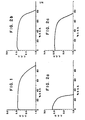
- Fig. 1 The discharge curve for this commercially available CF x is illustrated in Fig. 1 in which the change in closed circuit voltage (CCV) relative to the percent depth of discharge (DOD) is plotted.
- CCV closed circuit voltage
- DOD percent depth of discharge
- the CF x material used as an additive in the practice of the invention to obviate the undesirable initial voltage suppression was mixed or blended into the bulk CF x in two different ratios and the discharge performances of the bulk CF x , alone, the additive, alone, and two blends of each additive with the bulk CF x were determined.
- Discharge was effected by making the CF x or CF x blend into a battery electrode (cathode) using a lithium anode non-aqueous electrolyte cell incorporating these cathodes, and then discharging the cell across a fixed 1 Kohm resistive load. Cell voltage was monitored and cell capacity was calculated from the discharge curve.
- Additive CF x material having a specific capacity of 259 mAH/g was prepared by reacting 100 g of coke with fluorine at 350°C in a 5% fluorine atmosphere flowing at 150 sccm for a period of six hours.
- This coke-based fluorinated CF x additive was blended with the bulk CF x .
- the performance of the additive, CF x by itself before it was mixed with the bulk CF x , and a 10% and 20% blend are shown in figures 2A, 2B and 2C respectively.
- the CCV of the 10% blend (figure 2B) during the early stages of discharge is suppressed, although not to the same extent as that of the bulk CF X without the additive, (Fig. 1).
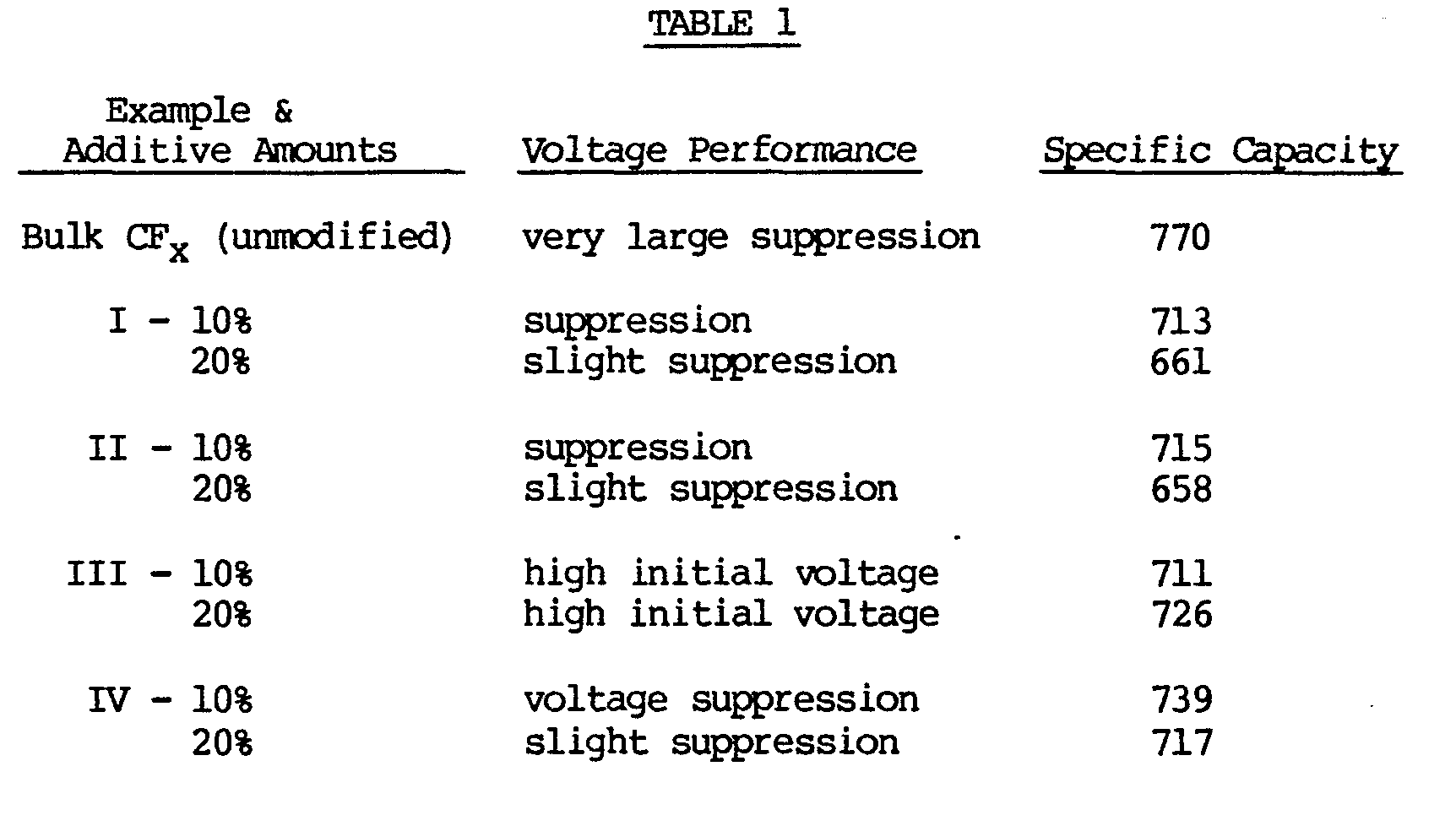
- the closed circuit voltage (CCV) of the 20% blend (figure 2C) is only slightly suppressed during the initial stages of discharge. This 20% blend is 14% lower in specific capacity as shown in Table I.
- the coke-based CF x additive used has a specific capacity of about 358 mAH/g.
- This material was prepared by reacting 100 g of coke in a 15% fluorine atmosphere flowing at 150sccm at a temperature of 350°C for a period of 6 hours. This material has a higher initial voltage and appreciable greater specific capacity as compared to the coke-based CF additive in Example 1.
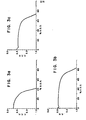
- Fig. 3A shows the discharge of the additive CF x material above.
- the performances of the 10% and 20% coke-based CF x in bulk CF X blends are shown in Figures 3B and 3C. Both blends (figures 3B and 3C) show voltage suppression. Since the voltage of this additive is higher than the voltage of the additive in Example 1, it is more preferentially discharged during the initial stages, i.e. the first 5 percent. This blended material even with additive has somewhat greater capacity, but is not as advantageous as the blend of Examples IV.
- the CF x additive has a suitable capacity and very high initial voltage.
- This material was made from a coke which is more difficult to fluorinate (i.e., requires higher temperatures and/or higher concentrations of fluorine in the gas stream to make a product with a C:F of 1:1) than the coke used in Examples I, II and IV.
- a 5 gram sample of this coke was fluorinated at 400°C for a period of 10 hours in a 2.5% fluorine atmosphere flowing at 5.3 sccm.
- Fig. 4A shows the discharge performance of the additive CF x material alone.
- Figures 4B and 4C show the performance of the 10% and 20% blends. The effect of this additive is readily discernable in the blends.
- the CF x additive prepared as follows best demonstrates the characteristics of a preferred additive.
- This coke-based CF x additive was prepared by reacting 50 grams of coke at 350°C in a 15% fluorine atmosphere flowing at 150 sccm for a period of 6 hours.
- the initial voltage of this additive by itself is about 170 mV plateau above the voltage of the bulk CF x by itself (Fig. 1) in the initial parts of the discharge plateau (i.e., the initial voltage of the additive in this example is about 2.6V and the voltage of the bulk CF x in the plateau area, at about 20% DOD, is about 2.43V; l70mV below that of the additive).
- This difference in voltage is sufficient to cause the additive to discharge preferentially, masking the voltage suppression in the bulk CF x , yet the voltage difference of the additive CF x is not so large as to cause a high initial voltage (as in Example 3).
- the specific capacity of this additive is high compared to those in Examples 1 and 2, therefore a large sacrifice in capacity is not incurred when even 20% of this additive is blended with the bulk CF x .
- Fig. 5A shows the discharge performance of the additive (unblended) coke-based CF x material of this example alone.
- Figs. 5B and 5C show the performance of the 10% and 20% blends. The 20% blend shows only slight voltage suppression and a specific capacity only 7% lower than that of the unblended bulk CF X .
- the coke-based CF x additive provides an initial CCV of about 150 mV higher than the plateau voltage of the bulk CF x .
- the preferred blend is that which gives minimal voltage suppression while retaining the highest specific capacity, e.g. that of Example IV with 20% CF additive.
- the initial CCV of the additive should not be any higher than about 250-300 mV above the plateau voltage of the bulk CF x if a high initial voltage condition in the blend is to be avoided.
- the specific capacity of the additive should be at least about 600 mAH/g with higher capacities being preferable. Using additives with specific capacities below about 600 mAH/g will mean that higher loading of the additive may be required and lower specific capacity of the blend will result.
Landscapes
- Chemical & Material Sciences (AREA)
- Inorganic Chemistry (AREA)
- Chemical Kinetics & Catalysis (AREA)
- Electrochemistry (AREA)
- General Chemical & Material Sciences (AREA)
- Battery Electrode And Active Subsutance (AREA)
- Secondary Cells (AREA)
- Primary Cells (AREA)
Abstract
Description
- This invention relates to an improved lithium/ fluorinated carbon (Li/CFx) battery. More particularly, the invention relates to a composition and method for substantially eliminating the suppression of the closed circuit voltage of a Li/fluorinated carbon battery during the initial part of its discharge by incorporating into the fluorinated carbon composition of the Li/CFx battery a different CFx such that the reformulated blend of at least two fluorinated carbons does not exhibit voltage suppression. The blending of the different fluorinated carbons provides the desired mixture with no appreciable voltage suppression while at the same time retaining good capacity.
- Numerous disclosures have been made in the prior art with the aim of improving the initial discharge voltage of the lithium/fluorinated carbon batteries. Illustrative of such prior art efforts to eliminate or reduce initial voltage suppression are the disclosures in the following references wherein admixtures of different fluorinated carbonaceous materials are used for the purpose of achieving some improvement in discharge voltage:
- Japanese Kokai No. 82 84,570 discloses a mixture of fluorinated carbon (CFn) and fluorinated graphite (C2F)n with the relative proportions of (C2F)n ranging from 10:100 to 100:100. Mixtures of (C2F)n and fluorinated carbon are disclosed as giving lithium batteries with improved discharge characteristics. The (C2F)n additive in that reference is distinguished from fluorinated carbon (CF)n (i.e., CFx) by its stoichiometry and completely different crystal structure. These differences in structure are described in U.S. Patent 4,139,474. (C2F)n must be prepared by reacting graphite for long times with fluorine with 100-200 hours being typical reaction times. The coke based CF with which the present invention is concerned, and which is distinct from the fluorinate graphite of Japanese Kokai 82 84,570 can be made in less than 24 hours by reacting the coke starting material with fluorine at from 300°C to 600°C. Use of the coke-based material, CFx is otherwise relatively generally advantageous over the graphite- based material, (C2F)n.
- In U.S. Patent 4,139,474, (C2F)n is distinguished in several respects from CFX; by X-ray diffraction (see line 57, col. 4): IR (see line 59, col. 5); ESCA(see line 31, col. 5), and specific gravity (see line 26, col. 6). Other physical and chemical differences are also enumerated at line 32, column 6, et seq. The starting carbon which must be used to prepare (C2F)n is described at col. 8, line 26 et. seq. That patent specifies that any carbon having a Franklin's P-valve of from 0 to about 0.6 will be acceptable starting material from which (C2F)n can be prepared. The Franklin's P-valves for the cokes used in the present invention, see examples I, II and IV are primarily outside this range. Furthermore, as seen at column 8, starting at line 43 of U.S. Patent 4,139,474 natural graphite is the preferred starting carbon to prepare (C2F)n and that while petroleum cokes can be used, they must be heat-treated (or calcined) at temperatures between 2000°C and 3000°C. In the present invention, the materials are petroleum-based coke products prepared normally by heat treatment below 2000°C, or at most about a maximum of about 2000°C. (Example III). Basis supporting a distinction of the invention from Japanese Kokai No. 82 84,570 is also found in Kirk-Othmer's Encyclopedia of Chemical Technology, page 557, wherein the differences between carbon and graphite are described. Carbon, which includes coke, is made from carbonaceous material which is heat-treated at temperatures between 800°C and 1400°C; graphite is prepared by further heat treatment at temperatures in excess of 2400 degrees. In the present invention, the starting carbons must be carbonaceous materials heat-treated at a temperture between about 800°C and 2000°C. Further, as indicated by reference to U.S. Patent 4,139,474 particularly concerning the starting carbons used in that patent, it is clear that the carbons used in Japanese Reference 82 84,570 are clearly different from those the petroleum cokes employed in the invention.
- The disclosures in the above-mentioned Japanese Kokai (82 84,570) indicate that the addition of amounts (C2F)n to (CF)n improves the drop in the initial voltage over that of (CF)n alone, because the two materials are similar in nature and discharge via similar mechanisms. We have discovered, however, that undesirable results in the initial stages of the discharge curve still occur when similar materials are blended and that other and more important criteria must be used to guide the selection of the best additive material to suitably eliminate the undesirable initial voltage suppression. Accordingly, it is important according to our discovery that the CFx material added to the bulk CFx material be different from the bulk material.
- Japanese Kokai No. 77 10,519 discloses that graphite fluoride which reacts with potassium iodide (KI) to produce greater than 1.25 x 10⁻⁶ mole of free iodine (I) per gram of CFx can be used in a cell and that this material gives a cell which does not undergo voltage lowering (i.e., voltage suppression) during the initial part of discharge. The example given in that reference is for a graphite fluoride which liberates 4 x 10⁻⁶ mole of I per gram of material. This reference does not disclose the desirability of blending this material with CFx nor does it address the deleterious effects of using a material with such a large content of a highly oxidizing species in a lithium battery. In fact, a later Japanese Kokai No. 77 21,621 to the same assignee claims that a graphite fluoride which reacts with KI to give less than 1.25 x 10⁻⁶ mole of I per gram of material can be used in a lithium cell to give one with good voltage after storage. In the example described, two cells are compared; one made from a graphite fluoride with liberates 2.9 x 10⁻⁷ mole of I per gram and one that liberates 1 x 10⁻⁶ mole of I per gram of material. After storage at 70°C for 1 month, the cells were discharged at 20°C on a 8 ohm load. After 10 hours, the first cell gave 2.3 V compared to the second cell which gave 1.3 V. In light of Japanese Kokai No. 77 21,621, the graphite fluoride described in Japanese Kokai 77 10,519 may eliminate voltage suppression but suffers from the fact that a long lasting, i.e., durable lithium battery cannot be made with it.
- Japanese Kokai No. 84 31,564 discloses the use of carbon containing adsorbed fluorine in the CFx electrode to replace the carbons which are typically used to enhance the electronic conductivity of the electrode matrix. Adsorbed fluorine, because of its strongly oxidizing nature, may be very deleterious and is regarded as disadvantageous.
- The use of fluorinated carbon black is disclosed in Japanese Kokai No. 83 05,967. The carbon black which is prescribed is that which has a surface area greater than 800 m2/g. Use of this material in mixtures with CFx is disclosed as improving the initial discharge voltage of the lithium cell. However, N. Watanabe, et al., SOLID STATE IONICS, page 503 (1980), has shown that fluorinated carbon blacks perform more poorly, particularly at high rates of discharge, than do coke-based fluorinated materials. In light of this disclosure, it cannot be expected that fluorinated carbon black would be effective in curing the voltage suppression phenomenon as is a coke-based fluorinated material.
- Japanese Kokai No. 83 206,057 discloses the incorporation of a noncovalent graphite fluoride intercalation compound into a graphite fluoride cathode for the purpose of improving the initial discharge voltage. Examples are graphite intercalates of AlF3 or MgF2 and fluorine. The disclosure of this publication differs from the present invention in that the additive is a noncovalent intercalation compound of graphite and that the major cathode active material is graphite fluoride as distinguished from fluorinated carbon.
- Other Japanese patent publications disclose the use of a variety of materials which do not contain fluorine and have been claimed to eliminate or reduce the severity of voltage suppression in Li/CFx cells. Thus, Japanese Kokai No. 83 123,663 discloses the addition of aluminum powder; Japanese Kokai No. 83 206,058 discloses the addition of aluminum fiber to CFx cathode compositions for the purpose of stabilizing the intial discharge voltage; and Japanese Kokai No. 83 161,260 discloses the addition of compounds of the form CrxOy where 15< y/x <3. Examples given are Cr306 and Cr205 and these additives are claimed to improve the initial drop in cell voltage. In each case, a metal or metal salt is added to the cell and therefore differ from our invention.
- Additionally, Japanese Kokai No. 82 124,865 discloses that Li/CFx cells can be partially discharged (< 10% of the cell capacity is removed) to improve the initial discharge voltage. This practice minimizes the problem but suffers from several disadvantages; an additional step is required in the production process, processing time is increased, and additional equipment is required.
- In summary, with respect to the prior art, while it is known that various blends and admixtures of fluorinated carbon compositions have been employed to improve performance, a need exists for an improved practical fluorinated carbon composition which substantially and effectively eliminates the voltage suppression which occurs in the initial discharge of Li/CFx batteries.
- In accordance with the invention, we have discovered a method of eliminating the initial voltage suppression which occurs in the discharge of LiCFx batteries. More particularly, the invention obviates the prior art practice of pre-discharging a battery to eliminate voltage suppression and provides a system which has a flat discharge curve, with voltage at the beginning of discharge substantially the same as voltage during the bulk of the discharge period of the battery.
- In accordance with the discovery of the invention, the addition of a minor amount of a different CFx, which has no significant voltage suppression, to the CFx normally used to prepare Li/CFX batteries, provides a blend which has little or no voltage suppression, and which introduces only a negligible loss in capacity. In preparing the improved composition, any coke-based CFx which has an initial closed circuit voltage of about 150 mv above the plateau voltage of the bulk CFx material and has a specific capacity above 600 mAH/gram, may be suitably employed as the additive CFX. By use of a blended combination of at least two different CFx compositions according to the invention, voltage sup- pressions commonly occurring with CFx, of the kinds that are normally used in Li/CFX batteries can be eliminated or substantially reduced. The improved system is effected by blending into a typical CFX employed in LiCFx systems, from about 5 to 20% of a different (additive) CFx which has no voltage suppression. The additive CFx, generally a coke-based fluorinated carbon should preferably have a closed circuit voltage (CCV) of at least 150 mV but no more than about 350 mV above the plateau voltage of the commonly used CFx, and have a specific capacity of at least 600 mAH/g.
-
- Fig. 1 shows a discharge curve for bulk CFx illustrating a relatively substantial suppression at the initial part of the battery discharge occurs.
- Fig. 2A illustrates the discharge curve for a specific additive CFx and Figs. 2B and 2C are discharge curves for 10% and 20% blends thereof with bulk CFX.
- Fig. 3A illustrates the discharge curve for another specific additive CFx and Figs. 2B and 2C are the discharge curves for 10% and 20% blends, respectively, of this CFx with bulk CFx.
- Fig. 4A illustrates the discharge curve of still another specific additive CFX and Figs. 4B and 4C are discharge curves for 10% and 20% blends, respectively, of this CFx with bulk CFx.
- Fig. 5A illustrates the discharge curve of a further specific additive CFx "material and Figs. 5B and 5C are the discharge curves for 10% and 20% blends, respectively, of this CFx with bulk CFx.
- In accordance with the invention, pre-discharging of a Li/CFx battery is obviated by utilizing in the CFx composition an additive CFx which provides a flat discharge curve and so that voltage at the beginning of discharge is substantially the same level as voltage during the bulk of the discharge.
- We have discovered that the addition of a small percentage of CFx which has no substantial voltage suppression to the CFx normally used to prepare Li/CFX batteries and has substantial voltage suppression leads to a combined composition which has little or no voltage suppression, and only a slight loss in capacity. As the additive, a coke-based CFx which has an initial closed circuit voltage 150 mV above the plateau voltage of the bulk material and a specific capacity above 600 mAH/g can be used. This additive CFx has no significant voltage suppression discharges at the beginning of discharge. The impact of the additive CFx which provides a relatively high initial voltage in the CFx blend results in higher combined voltage and substantially obviates the disadvantageous initial voltage suppression. The bulk CFx material, i.e. the CFx material, other than the additive CFx, of course also discharges to the conventional "reduced" extent during this early stage of discharge. When the voltage discharge from the small percentage of additive is depleted, the bulk CF has discharged to the point that it no longer shows voltage suppression.
- The additive CFx may be present in amounts of from about 0.5% to about 50% but preferably in amounts of about 2% to about 30% and most advantageously in amounts of 5% to 20% of the combined weight of additive CFx and bulk CF x.
- The advantageous ability of the invention is due to the fact that the closed circuit voltage of a Li/CF battery during the initial 10% of discharge is lower than the closed circuit voltage during the later stages. This characteristic adversely impacts applications. For example, a bulb powered by a Li/CFx battery would appear dim when powered by a fresh cell. Further, the voltage at beginning of life can be as low as the voltage indicating end of life; this complicates the design of circuitry to indicate a condition of the battery near end of life and in some cases of sensitive analytical apparatus, e.g. medical devices, may give misleading results.
- Present commerical practice as indicated in the above-mentioned Japanese Kokai No. 82 124,865, for example, attempts to minimize the initial voltage suppression problem by discharging batteries as much as 10%, at the time of manufacture. This preliminary expenditure of energy minimizes but does not eliminate the problem of low voltage during the initial stage of discharge. The present, i.e. prior art attempts at avoidance of the voltage suppression thus suffer from several disadvantages: such as requiring additional steps in production of the batteries; or expensive CFx raw material is lost in the pre-discharge step.
- The criticality in selecting an additive that is sufficiently different from the bulk CFx and provides an effective blend in accordance with the present invention, is demonstrated by the way of the examples which follow. In each example, the same bulk CFx, available commerically from Allied Corporation as Accufluor® CFx grade 1000, having a fluorine content greater than 61% is used.
- The discharge curve for this commercially available CFx is illustrated in Fig. 1 in which the change in closed circuit voltage (CCV) relative to the percent depth of discharge (DOD) is plotted. The suppression of the voltage in the early stages using this unmodified CFx lowers the cell voltage by approximately 150 mV. For many applications, this suppression would be disadvantageous.
- The invention will be further described by the following specific examples. It will be understood that although these examples may describe in detail certain preferred operating conditions of the invention, they are given primarily for purposes of illustration and the invention in its broader aspects is not to be regarded as limited thereto.
- The CFx material used as an additive in the practice of the invention to obviate the undesirable initial voltage suppression was mixed or blended into the bulk CFx in two different ratios and the discharge performances of the bulk CFx, alone, the additive, alone, and two blends of each additive with the bulk CFx were determined. Discharge was effected by making the CFx or CFx blend into a battery electrode (cathode) using a lithium anode non-aqueous electrolyte cell incorporating these cathodes, and then discharging the cell across a fixed 1 Kohm resistive load. Cell voltage was monitored and cell capacity was calculated from the discharge curve.
- Additive CFx material having a specific capacity of 259 mAH/g was prepared by reacting 100 g of coke with fluorine at 350°C in a 5% fluorine atmosphere flowing at 150 sccm for a period of six hours. This coke-based fluorinated CFx additive was blended with the bulk CFx. The performance of the additive, CFx by itself before it was mixed with the bulk CFx, and a 10% and 20% blend are shown in figures 2A, 2B and 2C respectively. The CCV of the 10% blend (figure 2B) during the early stages of discharge is suppressed, although not to the same extent as that of the bulk CFX without the additive, (Fig. 1). The closed circuit voltage (CCV) of the 20% blend (figure 2C) is only slightly suppressed during the initial stages of discharge. This 20% blend is 14% lower in specific capacity as shown in Table I.
- In this example, the coke-based CFx additive used has a specific capacity of about 358 mAH/g. This material was prepared by reacting 100 g of coke in a 15% fluorine atmosphere flowing at 150sccm at a temperature of 350°C for a period of 6 hours. This material has a higher initial voltage and appreciable greater specific capacity as compared to the coke-based CF additive in Example 1. Fig. 3A shows the discharge of the additive CFx material above. The performances of the 10% and 20% coke-based CFx in bulk CFX blends are shown in Figures 3B and 3C. Both blends (figures 3B and 3C) show voltage suppression. Since the voltage of this additive is higher than the voltage of the additive in Example 1, it is more preferentially discharged during the initial stages, i.e. the first 5 percent. This blended material even with additive has somewhat greater capacity, but is not as advantageous as the blend of Examples IV.
- In this example, the CFx additive has a suitable capacity and very high initial voltage. This material was made from a coke which is more difficult to fluorinate (i.e., requires higher temperatures and/or higher concentrations of fluorine in the gas stream to make a product with a C:F of 1:1) than the coke used in Examples I, II and IV. A 5 gram sample of this coke was fluorinated at 400°C for a period of 10 hours in a 2.5% fluorine atmosphere flowing at 5.3 sccm. Fig. 4A shows the discharge performance of the additive CFx material alone. Figures 4B and 4C show the performance of the 10% and 20% blends. The effect of this additive is readily discernable in the blends. It should be noted, however, that while voltage suppression during the initial stages of discharge has been eliminated, the initial voltage may be excessive for use with some electronic devices. Also, the relatively extreme sloping character of the voltage during the initial stages of discharge may make it, comparatively less advantageous for some applications than the blend set forth in
- The CFx additive prepared as follows best demonstrates the characteristics of a preferred additive. This coke-based CFx additive was prepared by reacting 50 grams of coke at 350°C in a 15% fluorine atmosphere flowing at 150 sccm for a period of 6 hours. The initial voltage of this additive by itself is about 170 mV plateau above the voltage of the bulk CFx by itself (Fig. 1) in the initial parts of the discharge plateau (i.e., the initial voltage of the additive in this example is about 2.6V and the voltage of the bulk CFx in the plateau area, at about 20% DOD, is about 2.43V; l70mV below that of the additive). This difference in voltage is sufficient to cause the additive to discharge preferentially, masking the voltage suppression in the bulk CFx, yet the voltage difference of the additive CFx is not so large as to cause a high initial voltage (as in Example 3). The specific capacity of this additive is high compared to those in Examples 1 and 2, therefore a large sacrifice in capacity is not incurred when even 20% of this additive is blended with the bulk CFx.
- Fig. 5A shows the discharge performance of the additive (unblended) coke-based CFx material of this example alone. Figs. 5B and 5C show the performance of the 10% and 20% blends. The 20% blend shows only slight voltage suppression and a specific capacity only 7% lower than that of the unblended bulk CFX.
- From the foregoing, it is seen that the coke-based CFx additive provides an initial CCV of about 150 mV higher than the plateau voltage of the bulk CFx. The preferred blend is that which gives minimal voltage suppression while retaining the highest specific capacity, e.g. that of Example IV with 20% CF additive. The initial CCV of the additive should not be any higher than about 250-300 mV above the plateau voltage of the bulk CFx if a high initial voltage condition in the blend is to be avoided.
- The specific capacity of the additive should be at least about 600 mAH/g with higher capacities being preferable. Using additives with specific capacities below about 600 mAH/g will mean that higher loading of the additive may be required and lower specific capacity of the blend will result.
- It will be understood that a wide range of compositions and resulting products may be made within the ranges disclosed herein and, therefore, the proportions and conditions disclosed for illustrative purpose should not be construed as limitations on the invention except as set forth in the claims which follow.
Claims (8)
Applications Claiming Priority (2)
| Application Number | Priority Date | Filing Date | Title |
|---|---|---|---|
| US06/776,546 US4686161A (en) | 1985-09-16 | 1985-09-16 | Method of inhibiting voltage suppression lithium/fluorinated carbon batteries |
| US776546 | 1985-09-16 |
Publications (2)
| Publication Number | Publication Date |
|---|---|
| EP0215367A2 true EP0215367A2 (en) | 1987-03-25 |
| EP0215367A3 EP0215367A3 (en) | 1987-09-30 |
Family
ID=25107695
Family Applications (1)
| Application Number | Title | Priority Date | Filing Date |
|---|---|---|---|
| EP86112087A Withdrawn EP0215367A3 (en) | 1985-09-16 | 1986-09-02 | Method of inhibiting voltage suppression lithium/fluorinated carbon batteries |
Country Status (4)
| Country | Link |
|---|---|
| US (1) | US4686161A (en) |
| EP (1) | EP0215367A3 (en) |
| JP (1) | JPS6297260A (en) |
| GB (1) | GB2211653B (en) |
Families Citing this family (9)
| Publication number | Priority date | Publication date | Assignee | Title |
|---|---|---|---|---|
| US4765968A (en) * | 1985-09-16 | 1988-08-23 | Allied-Signal Inc. | Fluorinated carbon composition for use in fabricating a Li/CFx battery cathode |
| US4908198A (en) * | 1986-06-02 | 1990-03-13 | The Electrosynthesis Company, Inc. | Fluorinated carbons and methods of manufacture |
| JP3052314B2 (en) * | 1989-08-31 | 2000-06-12 | 三菱化学株式会社 | Lithium battery |
| US8377586B2 (en) * | 2005-10-05 | 2013-02-19 | California Institute Of Technology | Fluoride ion electrochemical cell |
| US20070281213A1 (en) * | 2006-06-02 | 2007-12-06 | Gentcorp Ltd. | Carbon Monofluoride Cathode Materials Providing Simplified Elective Replacement Indication |
| WO2008113023A1 (en) * | 2007-03-14 | 2008-09-18 | California Institute Of Technology | High discharge rate batteries |
| EP2167228B1 (en) * | 2007-05-09 | 2015-07-08 | California Institute of Technology | Lithium fluoropolymer and fluoro-organic batteries |
| US8961833B2 (en) | 2010-11-24 | 2015-02-24 | The United States Of America As Represented By The Secretary Of The Army | Fluorinated carbon composite cathode for a high-energy lithium battery |
| US9130229B2 (en) | 2013-01-02 | 2015-09-08 | Medtronic, Inc. | Carbon fluoride cathodes and batteries made therefrom |
Family Cites Families (13)
| Publication number | Priority date | Publication date | Assignee | Title |
|---|---|---|---|---|
| DE2140207C3 (en) * | 1971-08-11 | 1975-11-27 | Farbenfabriken Bayer Ag, 5090 Leverkusen | Stabilized aromatic polycarbonate |
| SU584369A1 (en) * | 1975-08-01 | 1977-12-15 | Предприятие П/Я В-2763 | Chemical source of current |
| JPS5924497B2 (en) * | 1975-08-12 | 1984-06-09 | 松下電器産業株式会社 | organic electrolyte battery |
| JPS53102893A (en) * | 1977-02-22 | 1978-09-07 | Ouyou Kagaku Kenkiyuushiyo | Graphite fluoride having new structure and method of making same |
| JPS549730A (en) * | 1977-06-24 | 1979-01-24 | Matsushita Electric Industrial Co Ltd | Active material on positive electrode of battery |
| JPS5784570A (en) * | 1980-11-14 | 1982-05-26 | Matsushita Electric Ind Co Ltd | Battery |
| JPS57124865A (en) * | 1981-01-27 | 1982-08-03 | Matsushita Electric Ind Co Ltd | Production method of cell using nonaqueous electrolyte |
| JPS585967A (en) * | 1981-07-02 | 1983-01-13 | Matsushita Electric Ind Co Ltd | battery |
| JPS58123663A (en) * | 1982-01-19 | 1983-07-22 | Matsushita Electric Ind Co Ltd | Nonaqueous electrolyte battery |
| JPS58161260A (en) * | 1982-03-19 | 1983-09-24 | Matsushita Electric Ind Co Ltd | battery |
| JPS58206057A (en) * | 1982-05-25 | 1983-12-01 | Matsushita Electric Ind Co Ltd | non-aqueous electrolyte battery |
| JPS58206058A (en) * | 1982-05-26 | 1983-12-01 | Matsushita Electric Ind Co Ltd | non-aqueous electrolyte battery |
| JPS5931564A (en) * | 1982-08-12 | 1984-02-20 | Matsushita Electric Ind Co Ltd | Organic electrolyte battery |
-
1985
- 1985-09-16 US US06/776,546 patent/US4686161A/en not_active Expired - Fee Related
-
1986
- 1986-09-02 EP EP86112087A patent/EP0215367A3/en not_active Withdrawn
- 1986-09-16 JP JP61217856A patent/JPS6297260A/en active Pending
-
1987
- 1987-10-29 GB GB8725420A patent/GB2211653B/en not_active Expired - Lifetime
Also Published As
| Publication number | Publication date |
|---|---|
| GB8725420D0 (en) | 1987-12-02 |
| GB2211653B (en) | 1990-10-31 |
| US4686161A (en) | 1987-08-11 |
| GB2211653A (en) | 1989-07-05 |
| JPS6297260A (en) | 1987-05-06 |
| EP0215367A3 (en) | 1987-09-30 |
Similar Documents
| Publication | Publication Date | Title |
|---|---|---|
| US5308714A (en) | Method for preventing gas formation in electrochemical cells | |
| US4271242A (en) | Active material for positive electrode of battery | |
| US4085259A (en) | Light metal galvanic element | |
| US4686161A (en) | Method of inhibiting voltage suppression lithium/fluorinated carbon batteries | |
| CA1149448A (en) | Non-aqueous li/mn0.sub.2cell | |
| EP0394917A1 (en) | Nonaqueous electrolyte secondary cell | |
| EP0931365A1 (en) | Electrolyte comprising fluoro-ethylene carbonate and propylene carbonate, for alkali metal-ion secondary battery | |
| US4770959A (en) | Lithium-fluorinated graphite cell | |
| EP0247434A1 (en) | Lithium/fluorinated carbon battery with no voltage delay at the beginning of the discharge | |
| US4765968A (en) | Fluorinated carbon composition for use in fabricating a Li/CFx battery cathode | |
| JP2711545B2 (en) | Non-aqueous battery | |
| JPH0251220B2 (en) | ||
| EP1289044B1 (en) | Nonaqueous electrolyte secondary battery | |
| FR2531574A1 (en) | ELECTROCHEMICAL AND ELECTROLYTE BATTERIES FOR THESE BATTERIES | |
| US4737423A (en) | Cathode active material for metal of CFX battery | |
| EP0459451B1 (en) | Solid-state voltage storage cell | |
| EP0128560B1 (en) | Active materials for batteries | |
| US4248946A (en) | Cell having an alkali metal anode, a fluorinated carbon cathode and an electrolyte which includes an alkali metal halide salt and a solvent system consisting of an ether solvent and a cyclic carbonate cosolvent | |
| GB2146835A (en) | Cell solvent | |
| US4548881A (en) | High energy density battery with cathode composition | |
| US5017445A (en) | Dry cell | |
| US4560631A (en) | Organic electrolyte cells | |
| US4791038A (en) | Inhibiting voltage suppression in lithium/fluorinated carbon batteries | |
| US4401737A (en) | Protective active nitrides as additives to nonaqueous cathode materials | |
| US6346225B1 (en) | Preparation of modified cokes and/or blacks |
Legal Events
| Date | Code | Title | Description |
|---|---|---|---|
| PUAI | Public reference made under article 153(3) epc to a published international application that has entered the european phase |
Free format text: ORIGINAL CODE: 0009012 |
|
| AK | Designated contracting states |
Kind code of ref document: A2 Designated state(s): CH DE FR GB LI |
|
| PUAL | Search report despatched |
Free format text: ORIGINAL CODE: 0009013 |
|
| AK | Designated contracting states |
Kind code of ref document: A3 Designated state(s): CH DE FR GB LI |
|
| 17P | Request for examination filed |
Effective date: 19880304 |
|
| 17Q | First examination report despatched |
Effective date: 19881116 |
|
| STAA | Information on the status of an ep patent application or granted ep patent |
Free format text: STATUS: THE APPLICATION IS DEEMED TO BE WITHDRAWN |
|
| 18D | Application deemed to be withdrawn |
Effective date: 19890530 |
|
| RIN1 | Information on inventor provided before grant (corrected) |
Inventor name: FRIEDLAND, DAVID JOEL Inventor name: SHIA, GEORGE ANTHONY |