EP0212301A2 - Verfahren zur Herstellung von 2-Aminophenyl-thioethern - Google Patents
Verfahren zur Herstellung von 2-Aminophenyl-thioethern Download PDFInfo
- Publication number
- EP0212301A2 EP0212301A2 EP86110101A EP86110101A EP0212301A2 EP 0212301 A2 EP0212301 A2 EP 0212301A2 EP 86110101 A EP86110101 A EP 86110101A EP 86110101 A EP86110101 A EP 86110101A EP 0212301 A2 EP0212301 A2 EP 0212301A2
- Authority
- EP
- European Patent Office
- Prior art keywords
- oder
- alkyl
- formula
- die
- und
- Prior art date
- Legal status (The legal status is an assumption and is not a legal conclusion. Google has not performed a legal analysis and makes no representation as to the accuracy of the status listed.)
- Granted
Links
- 238000000034 method Methods 0.000 title claims abstract description 17
- WRRQKFXVKRQPDB-UHFFFAOYSA-N 2-(2-aminophenyl)sulfanylaniline Chemical class NC1=CC=CC=C1SC1=CC=CC=C1N WRRQKFXVKRQPDB-UHFFFAOYSA-N 0.000 title claims abstract description 6
- 239000000203 mixture Substances 0.000 claims abstract description 19
- UHGULLIUJBCTEF-UHFFFAOYSA-N 2-aminobenzothiazole Chemical class C1=CC=C2SC(N)=NC2=C1 UHGULLIUJBCTEF-UHFFFAOYSA-N 0.000 claims abstract description 12
- 125000000217 alkyl group Chemical group 0.000 claims abstract description 11
- 229940100198 alkylating agent Drugs 0.000 claims abstract description 9
- 239000002168 alkylating agent Substances 0.000 claims abstract description 9
- 125000002947 alkylene group Chemical group 0.000 claims abstract description 9
- 125000005843 halogen group Chemical group 0.000 claims abstract description 9
- -1 Hydroxyl- Chemical group 0.000 claims abstract description 8
- 150000001340 alkali metals Chemical class 0.000 claims abstract description 8
- 150000003839 salts Chemical class 0.000 claims abstract description 8
- 239000002904 solvent Substances 0.000 claims abstract description 8
- 239000000725 suspension Substances 0.000 claims abstract description 7
- 238000007142 ring opening reaction Methods 0.000 claims abstract description 6
- 229910000272 alkali metal oxide Inorganic materials 0.000 claims abstract description 5
- 229910001860 alkaline earth metal hydroxide Inorganic materials 0.000 claims abstract description 5
- 125000003545 alkoxy group Chemical group 0.000 claims abstract description 5
- 125000000449 nitro group Chemical group [O-][N+](*)=O 0.000 claims abstract description 5
- UFHFLCQGNIYNRP-UHFFFAOYSA-N Hydrogen Chemical compound [H][H] UFHFLCQGNIYNRP-UHFFFAOYSA-N 0.000 claims abstract description 3
- 239000003513 alkali Substances 0.000 claims abstract description 3
- 229910052783 alkali metal Inorganic materials 0.000 claims abstract description 3
- 229910052784 alkaline earth metal Inorganic materials 0.000 claims abstract description 3
- 150000001342 alkaline earth metals Chemical group 0.000 claims abstract description 3
- 125000003342 alkenyl group Chemical group 0.000 claims abstract description 3
- 125000003178 carboxy group Chemical group [H]OC(*)=O 0.000 claims abstract description 3
- 229910052739 hydrogen Inorganic materials 0.000 claims abstract description 3
- 239000001257 hydrogen Substances 0.000 claims abstract description 3
- 125000002887 hydroxy group Chemical group [H]O* 0.000 claims abstract description 3
- 125000001997 phenyl group Chemical group [H]C1=C([H])C([H])=C(*)C([H])=C1[H] 0.000 claims abstract description 3
- LBYYVWSJNWSDQJ-UHFFFAOYSA-N 3h-1,2-benzothiazol-2-amine Chemical compound C1=CC=C2SN(N)CC2=C1 LBYYVWSJNWSDQJ-UHFFFAOYSA-N 0.000 abstract 1
- HEMHJVSKTPXQMS-UHFFFAOYSA-M Sodium hydroxide Chemical compound [OH-].[Na+] HEMHJVSKTPXQMS-UHFFFAOYSA-M 0.000 description 15
- 239000000047 product Substances 0.000 description 14
- XLYOFNOQVPJJNP-UHFFFAOYSA-N water Substances O XLYOFNOQVPJJNP-UHFFFAOYSA-N 0.000 description 14
- LYCAIKOWRPUZTN-UHFFFAOYSA-N Ethylene glycol Chemical compound OCCO LYCAIKOWRPUZTN-UHFFFAOYSA-N 0.000 description 13
- CFZAFRWTQQPEDX-UHFFFAOYSA-N (2-sulfanylphenyl)urea Chemical compound NC(=O)NC1=CC=CC=C1S CFZAFRWTQQPEDX-UHFFFAOYSA-N 0.000 description 9
- PEDCQBHIVMGVHV-UHFFFAOYSA-N Glycerine Chemical compound OCC(O)CO PEDCQBHIVMGVHV-UHFFFAOYSA-N 0.000 description 9
- 238000006243 chemical reaction Methods 0.000 description 7
- 238000002844 melting Methods 0.000 description 7
- 238000006193 diazotization reaction Methods 0.000 description 6
- 230000008018 melting Effects 0.000 description 6
- 230000015572 biosynthetic process Effects 0.000 description 5
- 239000011541 reaction mixture Substances 0.000 description 5
- 235000011121 sodium hydroxide Nutrition 0.000 description 5
- 159000000000 sodium salts Chemical class 0.000 description 5
- VRVRGVPWCUEOGV-UHFFFAOYSA-N 2-aminothiophenol Chemical class NC1=CC=CC=C1S VRVRGVPWCUEOGV-UHFFFAOYSA-N 0.000 description 4
- YXFVVABEGXRONW-UHFFFAOYSA-N Toluene Chemical compound CC1=CC=CC=C1 YXFVVABEGXRONW-UHFFFAOYSA-N 0.000 description 4
- NEHMKBQYUWJMIP-UHFFFAOYSA-N chloromethane Chemical compound ClC NEHMKBQYUWJMIP-UHFFFAOYSA-N 0.000 description 4
- 150000001875 compounds Chemical class 0.000 description 4
- 238000001914 filtration Methods 0.000 description 4
- 239000000243 solution Substances 0.000 description 4
- VYTMVFIWLHIPEW-UHFFFAOYSA-N (4-chloro-2-sulfanylphenyl)urea Chemical compound NC(=O)NC1=CC=C(Cl)C=C1S VYTMVFIWLHIPEW-UHFFFAOYSA-N 0.000 description 3
- CZFRTRCAEGVMRY-UHFFFAOYSA-N 2-(2-aminophenyl)sulfanyloxysulfanylaniline Chemical compound NC1=CC=CC=C1SOSC1=CC=CC=C1N CZFRTRCAEGVMRY-UHFFFAOYSA-N 0.000 description 3
- WKBOTKDWSSQWDR-UHFFFAOYSA-N Bromine atom Chemical group [Br] WKBOTKDWSSQWDR-UHFFFAOYSA-N 0.000 description 3
- KZBUYRJDOAKODT-UHFFFAOYSA-N Chlorine Chemical compound ClCl KZBUYRJDOAKODT-UHFFFAOYSA-N 0.000 description 3
- RWSOTUBLDIXVET-UHFFFAOYSA-N Dihydrogen sulfide Chemical class S RWSOTUBLDIXVET-UHFFFAOYSA-N 0.000 description 3
- VEXZGXHMUGYJMC-UHFFFAOYSA-N Hydrochloric acid Chemical compound Cl VEXZGXHMUGYJMC-UHFFFAOYSA-N 0.000 description 3
- KWYUFKZDYYNOTN-UHFFFAOYSA-M Potassium hydroxide Chemical compound [OH-].[K+] KWYUFKZDYYNOTN-UHFFFAOYSA-M 0.000 description 3
- 239000002253 acid Substances 0.000 description 3
- 230000029936 alkylation Effects 0.000 description 3
- 238000005804 alkylation reaction Methods 0.000 description 3
- 229910052799 carbon Inorganic materials 0.000 description 3
- 239000000460 chlorine Substances 0.000 description 3
- 229910052801 chlorine Inorganic materials 0.000 description 3
- 239000000543 intermediate Substances 0.000 description 3
- 238000004519 manufacturing process Methods 0.000 description 3
- 238000003756 stirring Methods 0.000 description 3
- 238000003786 synthesis reaction Methods 0.000 description 3
- 0 *C(CC1)[C@@](*)(CC2SN)C1(*)CC2N=C Chemical compound *C(CC1)[C@@](*)(CC2SN)C1(*)CC2N=C 0.000 description 2
- NXCKJENHTITELM-UHFFFAOYSA-N 1-nitro-2-[(2-nitrophenyl)disulfanyl]benzene Chemical compound [O-][N+](=O)C1=CC=CC=C1SSC1=CC=CC=C1[N+]([O-])=O NXCKJENHTITELM-UHFFFAOYSA-N 0.000 description 2
- LHKFFORGJVELPC-UHFFFAOYSA-N 2,3-bis(bromomethyl)quinoxaline Chemical compound C1=CC=C2N=C(CBr)C(CBr)=NC2=C1 LHKFFORGJVELPC-UHFFFAOYSA-N 0.000 description 2
- YOLYJTSQMGIQOP-UHFFFAOYSA-N 2-benzylsulfanylaniline Chemical compound NC1=CC=CC=C1SCC1=CC=CC=C1 YOLYJTSQMGIQOP-UHFFFAOYSA-N 0.000 description 2
- WBRPQQSADOCKCH-UHFFFAOYSA-N 2-methylsulfanylaniline Chemical compound CSC1=CC=CC=C1N WBRPQQSADOCKCH-UHFFFAOYSA-N 0.000 description 2
- JKIFPWHZEZQCQA-UHFFFAOYSA-N 2-nitrobenzenethiol Chemical class [O-][N+](=O)C1=CC=CC=C1S JKIFPWHZEZQCQA-UHFFFAOYSA-N 0.000 description 2
- GRIATXVEXOFBGO-UHFFFAOYSA-N 4-methyl-1,3-benzothiazol-2-amine Chemical compound CC1=CC=CC2=C1N=C(N)S2 GRIATXVEXOFBGO-UHFFFAOYSA-N 0.000 description 2
- QGZKDVFQNNGYKY-UHFFFAOYSA-N Ammonia Chemical compound N QGZKDVFQNNGYKY-UHFFFAOYSA-N 0.000 description 2
- CURLTUGMZLYLDI-UHFFFAOYSA-N Carbon dioxide Chemical compound O=C=O CURLTUGMZLYLDI-UHFFFAOYSA-N 0.000 description 2
- RTZKZFJDLAIYFH-UHFFFAOYSA-N Diethyl ether Chemical compound CCOCC RTZKZFJDLAIYFH-UHFFFAOYSA-N 0.000 description 2
- LFQSCWFLJHTTHZ-UHFFFAOYSA-N Ethanol Chemical compound CCO LFQSCWFLJHTTHZ-UHFFFAOYSA-N 0.000 description 2
- DNIAPMSPPWPWGF-UHFFFAOYSA-N Propylene glycol Chemical compound CC(O)CO DNIAPMSPPWPWGF-UHFFFAOYSA-N 0.000 description 2
- 239000007864 aqueous solution Substances 0.000 description 2
- KCXMKQUNVWSEMD-UHFFFAOYSA-N benzyl chloride Chemical class ClCC1=CC=CC=C1 KCXMKQUNVWSEMD-UHFFFAOYSA-N 0.000 description 2
- 238000009835 boiling Methods 0.000 description 2
- MVPPADPHJFYWMZ-UHFFFAOYSA-N chlorobenzene Chemical compound ClC1=CC=CC=C1 MVPPADPHJFYWMZ-UHFFFAOYSA-N 0.000 description 2
- DENRZWYUOJLTMF-UHFFFAOYSA-N diethyl sulfate Chemical compound CCOS(=O)(=O)OCC DENRZWYUOJLTMF-UHFFFAOYSA-N 0.000 description 2
- 229940008406 diethyl sulfate Drugs 0.000 description 2
- 238000001035 drying Methods 0.000 description 2
- 239000007789 gas Substances 0.000 description 2
- WGCNASOHLSPBMP-UHFFFAOYSA-N hydroxyacetaldehyde Natural products OCC=O WGCNASOHLSPBMP-UHFFFAOYSA-N 0.000 description 2
- ZXEKIIBDNHEJCQ-UHFFFAOYSA-N isobutanol Chemical compound CC(C)CO ZXEKIIBDNHEJCQ-UHFFFAOYSA-N 0.000 description 2
- 229940050176 methyl chloride Drugs 0.000 description 2
- 230000007935 neutral effect Effects 0.000 description 2
- YPFDHNVEDLHUCE-UHFFFAOYSA-N propane-1,3-diol Chemical compound OCCCO YPFDHNVEDLHUCE-UHFFFAOYSA-N 0.000 description 2
- 239000007787 solid Substances 0.000 description 2
- 238000005406 washing Methods 0.000 description 2
- 239000002351 wastewater Substances 0.000 description 2
- XQKNBLCTENHTHM-UHFFFAOYSA-N (2-methyl-6-sulfanylphenyl)urea Chemical compound CC1=CC=CC(S)=C1NC(N)=O XQKNBLCTENHTHM-UHFFFAOYSA-N 0.000 description 1
- NAWXUBYGYWOOIX-SFHVURJKSA-N (2s)-2-[[4-[2-(2,4-diaminoquinazolin-6-yl)ethyl]benzoyl]amino]-4-methylidenepentanedioic acid Chemical compound C1=CC2=NC(N)=NC(N)=C2C=C1CCC1=CC=C(C(=O)N[C@@H](CC(=C)C(O)=O)C(O)=O)C=C1 NAWXUBYGYWOOIX-SFHVURJKSA-N 0.000 description 1
- XHVUPSNPKMZXAH-UHFFFAOYSA-N 2-(2-aminophenyl)-2-sulfanylacetic acid Chemical compound NC1=CC=CC=C1C(S)C(O)=O XHVUPSNPKMZXAH-UHFFFAOYSA-N 0.000 description 1
- XNWFRZJHXBZDAG-UHFFFAOYSA-N 2-METHOXYETHANOL Chemical compound COCCO XNWFRZJHXBZDAG-UHFFFAOYSA-N 0.000 description 1
- GOJUJUVQIVIZAV-UHFFFAOYSA-N 2-amino-4,6-dichloropyrimidine-5-carbaldehyde Chemical group NC1=NC(Cl)=C(C=O)C(Cl)=N1 GOJUJUVQIVIZAV-UHFFFAOYSA-N 0.000 description 1
- ZNQVEEAIQZEUHB-UHFFFAOYSA-N 2-ethoxyethanol Chemical compound CCOCCO ZNQVEEAIQZEUHB-UHFFFAOYSA-N 0.000 description 1
- OBTJYVQYCJYACZ-UHFFFAOYSA-N 2-methyl-6-methylsulfanylaniline Chemical compound CSC1=CC=CC(C)=C1N OBTJYVQYCJYACZ-UHFFFAOYSA-N 0.000 description 1
- MOTOSAGBNXXRRE-UHFFFAOYSA-N 2-phenylsulfanylacetic acid Chemical compound OC(=O)CSC1=CC=CC=C1 MOTOSAGBNXXRRE-UHFFFAOYSA-N 0.000 description 1
- DHXNZYCXMFBMHE-UHFFFAOYSA-N 3-bromopropanoic acid Chemical compound OC(=O)CCBr DHXNZYCXMFBMHE-UHFFFAOYSA-N 0.000 description 1
- DDWLGVICMPLEOM-UHFFFAOYSA-N 4a,5-dihydro-4h-1,2-benzothiazin-3-one Chemical compound C1C=CC=C2SNC(=O)CC21 DDWLGVICMPLEOM-UHFFFAOYSA-N 0.000 description 1
- OYPRJOBELJOOCE-UHFFFAOYSA-N Calcium Chemical compound [Ca] OYPRJOBELJOOCE-UHFFFAOYSA-N 0.000 description 1
- OKTJSMMVPCPJKN-UHFFFAOYSA-N Carbon Chemical compound [C] OKTJSMMVPCPJKN-UHFFFAOYSA-N 0.000 description 1
- BVKZGUZCCUSVTD-UHFFFAOYSA-L Carbonate Chemical compound [O-]C([O-])=O BVKZGUZCCUSVTD-UHFFFAOYSA-L 0.000 description 1
- VGGSQFUCUMXWEO-UHFFFAOYSA-N Ethene Chemical compound C=C VGGSQFUCUMXWEO-UHFFFAOYSA-N 0.000 description 1
- 239000005977 Ethylene Substances 0.000 description 1
- DGAQECJNVWCQMB-PUAWFVPOSA-M Ilexoside XXIX Chemical compound C[C@@H]1CC[C@@]2(CC[C@@]3(C(=CC[C@H]4[C@]3(CC[C@@H]5[C@@]4(CC[C@@H](C5(C)C)OS(=O)(=O)[O-])C)C)[C@@H]2[C@]1(C)O)C)C(=O)O[C@H]6[C@@H]([C@H]([C@@H]([C@H](O6)CO)O)O)O.[Na+] DGAQECJNVWCQMB-PUAWFVPOSA-M 0.000 description 1
- FYYHWMGAXLPEAU-UHFFFAOYSA-N Magnesium Chemical group [Mg] FYYHWMGAXLPEAU-UHFFFAOYSA-N 0.000 description 1
- 238000007126 N-alkylation reaction Methods 0.000 description 1
- ZLMJMSJWJFRBEC-UHFFFAOYSA-N Potassium Chemical compound [K] ZLMJMSJWJFRBEC-UHFFFAOYSA-N 0.000 description 1
- GOOHAUXETOMSMM-UHFFFAOYSA-N Propylene oxide Chemical compound CC1CO1 GOOHAUXETOMSMM-UHFFFAOYSA-N 0.000 description 1
- XSQUKJJJFZCRTK-UHFFFAOYSA-N Urea Chemical compound NC(N)=O XSQUKJJJFZCRTK-UHFFFAOYSA-N 0.000 description 1
- 238000005903 acid hydrolysis reaction Methods 0.000 description 1
- 238000005904 alkaline hydrolysis reaction Methods 0.000 description 1
- 150000001350 alkyl halides Chemical class 0.000 description 1
- 230000002152 alkylating effect Effects 0.000 description 1
- 125000003277 amino group Chemical group 0.000 description 1
- 229910021529 ammonia Inorganic materials 0.000 description 1
- 150000008064 anhydrides Chemical class 0.000 description 1
- 229940073608 benzyl chloride Drugs 0.000 description 1
- 239000006227 byproduct Substances 0.000 description 1
- 229910052791 calcium Inorganic materials 0.000 description 1
- 239000011575 calcium Substances 0.000 description 1
- 239000004202 carbamide Substances 0.000 description 1
- 125000003917 carbamoyl group Chemical group [H]N([H])C(*)=O 0.000 description 1
- 239000001569 carbon dioxide Substances 0.000 description 1
- 229910002092 carbon dioxide Inorganic materials 0.000 description 1
- 239000007795 chemical reaction product Substances 0.000 description 1
- FOCAUTSVDIKZOP-UHFFFAOYSA-N chloroacetic acid Chemical compound OC(=O)CCl FOCAUTSVDIKZOP-UHFFFAOYSA-N 0.000 description 1
- 229940106681 chloroacetic acid Drugs 0.000 description 1
- 238000001816 cooling Methods 0.000 description 1
- 150000008050 dialkyl sulfates Chemical class 0.000 description 1
- 238000010790 dilution Methods 0.000 description 1
- 239000012895 dilution Substances 0.000 description 1
- VAYGXNSJCAHWJZ-UHFFFAOYSA-N dimethyl sulfate Chemical compound COS(=O)(=O)OC VAYGXNSJCAHWJZ-UHFFFAOYSA-N 0.000 description 1
- 238000004821 distillation Methods 0.000 description 1
- 239000003814 drug Substances 0.000 description 1
- 239000000975 dye Substances 0.000 description 1
- 238000000605 extraction Methods 0.000 description 1
- 238000005194 fractionation Methods 0.000 description 1
- 150000004820 halides Chemical class 0.000 description 1
- 238000010438 heat treatment Methods 0.000 description 1
- 230000007062 hydrolysis Effects 0.000 description 1
- 238000006460 hydrolysis reaction Methods 0.000 description 1
- 239000012535 impurity Substances 0.000 description 1
- 239000007788 liquid Substances 0.000 description 1
- 229910052749 magnesium Inorganic materials 0.000 description 1
- GXVXLFNLTPWUBW-UHFFFAOYSA-N n-(4-chloro-2-ethylphenyl)thiohydroxylamine Chemical compound CCC1=CC(Cl)=CC=C1NS GXVXLFNLTPWUBW-UHFFFAOYSA-N 0.000 description 1
- 238000005580 one pot reaction Methods 0.000 description 1
- 230000003647 oxidation Effects 0.000 description 1
- 238000007254 oxidation reaction Methods 0.000 description 1
- 238000005191 phase separation Methods 0.000 description 1
- 229910052700 potassium Inorganic materials 0.000 description 1
- 239000011591 potassium Substances 0.000 description 1
- 239000002243 precursor Substances 0.000 description 1
- 235000013772 propylene glycol Nutrition 0.000 description 1
- 239000011814 protection agent Substances 0.000 description 1
- 238000006798 ring closing metathesis reaction Methods 0.000 description 1
- 238000000926 separation method Methods 0.000 description 1
- 238000007086 side reaction Methods 0.000 description 1
- 229910052708 sodium Inorganic materials 0.000 description 1
- 239000011734 sodium Substances 0.000 description 1
- VVPALUQFGPXJSV-UHFFFAOYSA-M sodium 2-(2-aminophenyl)-2-sulfanylacetate Chemical compound [Na+].NC1=CC=CC=C1C(S)C([O-])=O VVPALUQFGPXJSV-UHFFFAOYSA-M 0.000 description 1
- 239000000126 substance Substances 0.000 description 1
- 150000003568 thioethers Chemical class 0.000 description 1
- 230000007704 transition Effects 0.000 description 1
- 239000008096 xylene Substances 0.000 description 1
- 150000003738 xylenes Chemical class 0.000 description 1
Classifications
-
- C—CHEMISTRY; METALLURGY
- C07—ORGANIC CHEMISTRY
- C07C—ACYCLIC OR CARBOCYCLIC COMPOUNDS
- C07C319/00—Preparation of thiols, sulfides, hydropolysulfides or polysulfides
- C07C319/14—Preparation of thiols, sulfides, hydropolysulfides or polysulfides of sulfides
-
- C—CHEMISTRY; METALLURGY
- C07—ORGANIC CHEMISTRY
- C07D—HETEROCYCLIC COMPOUNDS
- C07D279/00—Heterocyclic compounds containing six-membered rings having one nitrogen atom and one sulfur atom as the only ring hetero atoms
- C07D279/10—1,4-Thiazines; Hydrogenated 1,4-thiazines
- C07D279/14—1,4-Thiazines; Hydrogenated 1,4-thiazines condensed with carbocyclic rings or ring systems
- C07D279/16—1,4-Thiazines; Hydrogenated 1,4-thiazines condensed with carbocyclic rings or ring systems condensed with one six-membered ring
Definitions
- the present application relates to a process for the production of 2-aminophenyl thioethers which is improved with regard to industrial hygiene and waste water disposal and with regard to the yield, which are valuable intermediates for the production of dyes, crop protection agents and pharmaceuticals.
- the 2-aminophenyl-thioethers of the above-mentioned general formula (1) can be prepared while completely avoiding the disadvantages of the known processes mentioned, by converting EP-PS 0 039 483 in a known manner by reacting 2 -Aminobenzthiazoles of the general Formula (3) in which X and Y have the meanings given above, with alkali metal or alkaline earth metal hydroxides in an alkali-resistant anhydrous or virtually anhydrous solvent, such as ethanol, isobutanol, 1,2-dihydroxypropane or 1,3-dihydroxypropane, preferably ethylene glycol, glycerol, ethylene glycol monomethyl ether or ethylene glycol monoethyl ether, salts of the general formula (4) obtainable as intermediates in high yields in which X and Y have the meanings given above and Me denotes an alkali metal atom or the equivalent amount of an alkaline earth metal atom, preferably a sodium,
- the technically easily accessible 2-aminobenzothiazoles DE-PS 2 801 991 are achieved in a one-pot reaction by reaction with alkali metal or alkaline earth metal hydroxides and subsequent treatment with an alkylating agent of the formulas (2), (2a), (2b) ) or with an alkylene oxide in high yield and purity in 2-aminophenylthioether.
- the process according to the invention avoids the use of free mercaptans and therefore offers no ecological or industrial hygiene problems. Thereby and combined with the higher yield that can be achieved, the process according to the invention also represents a considerable technical advance.
- the process of the invention is carried out in detail in such a way that the 2-mercaptophenylurea salt of the general formula (4) mentioned, which is obtainable, for example, according to EP-PS 0 039 483, Example 1, paragraph 1, in the form of the aqueous solution resulting from dilution of the ring opening mixture with water Solution (or optionally suspension) at temperatures of 0-100 ° C, preferably 20-70 ° C, with an alkylating agent of the general formulas (2), (2a) or (2b) mentioned, for example a dialkyl sulfate, an alkylene dihalide or a Alkyl halide, or with an alkylene oxide, for example ethylene or propylene oxide, in at least a molar amount, preferably in an excess of 5-25%, within 0 to 5, preferably 0.5 to 2 hours, the 2-aminophenyl thioether formed separated from the reaction mixture by phase separation, filtration or extraction and subsequently freed of the adhering water or extractant.
- the reaction mixture consisting of the salt of the 2-mercaptophenylurea of the formula (4) mentioned and the solvent used for ring opening (alkanol, glycol, glycerol, glycol monoether), or a reaction mixture consisting of an isolated 2-mercaptophenylurea Salt of the formula (4) mentioned
- the solvent used for ring opening alkanol, glycol, glycerol, glycol monoether
- a reaction mixture consisting of an isolated 2-mercaptophenylurea Salt of the formula (4) mentioned [EP-PS 0 039 483, Examples 6-101 and one of the solvents used for ring opening, or another solvent which is inert under the reaction conditions to the alkylating agent (formulas 2)) or the alkylene oxide (toluene, xylenes, Chlorobenzene, chlorotoluenes, gasoline, chloroaliphates) prepared starting mixture with the alkylating agent (formulas 2)) or the alkylene oxide at temperatures from
- the target product (formula 1) is isolated by filtration, washing out the solvent and the salt formed with water and drying, or, in particular in the case of liquid or low-melting or products which are readily soluble in the solvent, if appropriate after filtration of the salt formed, concentrated by distillation and then obtained in pure form by filtration, washing and drying or particularly advantageously by fractionation, preferably in a vacuum of 0.1 to 100 torr.
- the organic lower phase (density 1.15 g / ml) is separated and fractionated through a short column. After a slight flow (water), 72 parts of 3-methylmercapto-2-aminotoluene of the formula go at 20 torr / 132 ° C. about, which corresponds to a yield of 94.1% of theory, based on the 4-methyl-2-aminobenzothiazole used.
- the product is practically free of impurities, shows a purity> 99% in the gas chromatogram, which is also confirmed by the diazotization value of 99.5%.
- the product has a diazotization value of 99.6% and proves to be uniform in the gas chromatogram.
- the product is chromatographically uniform and has a diazotization value of 99.7%.
- Example 9 the sodium salt of 4-chloro-2-mercaptophenylurea is replaced by aliquots of the salts of 2-mercaptophenylureas of the formula (7) listed in Table 2 below. and the diethyl sulfate by aliquots of the alkylating agent also listed in Table 2, the 2-alkylmercaptoanilines of the formula (8) are obtained with the stated melting or boiling points in the yields shown in the table:
- a mixture of 150 parts of 2-aminobenzothiazole, 150 parts of solid sodium hydroxide and 300 parts of ethylene glycol is stirred for 6 hours at 130-140 ° C (Example 1 of EP-PS 0 039 483), then cooled to 70 ° C and at this temperature in Evenly mixed with 158 parts of benzyl chloride for 30 minutes.
- the mixture is stirred at 70 to 80 ° C for 2 hours, the reaction mixture is rapidly run into 3000 parts of water with stirring and cooled to 0 ° C.
- the granulated 2-benzylmercaptoaniline of the formula is filtered off, washed with water and dried in vacuo at room temperature. 190 parts of product with a melting point of 44 ° C. are obtained, which corresponds to a yield of 88.4% of theory, based on the 2-amino-benzothiazole used.
- the product is chromatographically uniform and shows a diazotization value of 99.3%.
- Example 16 the 2-aminobenzothiazole is replaced by aliquots of the 2-aminobenzothiazoles of the formula (9) listed in Table 3 below and otherwise works in the manner indicated, the 2-benzylmercaptoanilines of the formula (10) listed in Table 3 below are obtained with the melting points and yields given therein.
- a mixture of 150 parts of 2-aminobenzothiazole, 150 parts of solid sodium hydroxide and 300 parts of ethylene glycol is stirred for 6 hours at 130-140 ° C. (Example 1 of EP-PS 0 039 483).
- the mixture is cooled to 40 ° C., 113 parts of chloroacetic acid are then added so that the internal temperature does not exceed 50 ° C., and the mixture is subsequently stirred at this temperature for 2 hours.
- the mixture is then heated to 80 to 90 ° C., held at this temperature for 1 hour and the suspension of the sodium salt of 2-aminophenylthioglycolic acid of the formula (11) formed is then run into a mixture of 2500 parts of water and 550 parts of 30% hydrochloric acid, where the temperature rises to 60 ° C.
- the released 2-amino cyclizes phenylthioglycolic acid rapidly to 3-oxodihydrobenzthiazine of the formula (12), which is the stable anhydride of the unstable free acid:
- the mixture is stirred at 60 to 70 ° C for 30 minutes, cooled to room temperature, the precipitated product is filtered off, washed neutral with water and dried at 120 ° C in a circulating air cabinet.
- the product is chromatographically pure and can be opened by heating with sodium hydroxide solution to give a clear aqueous solution of the 2-aminophenylthioglycolic acid sodium salt, which, determined by indirect diazotization, has a purity of 99.4%.
Landscapes
- Chemical & Material Sciences (AREA)
- Organic Chemistry (AREA)
- Organic Low-Molecular-Weight Compounds And Preparation Thereof (AREA)
- Thiazole And Isothizaole Compounds (AREA)
Abstract

- R eine Alkyl
C1-C6 gruppe, die durch Hydroxyl-, Alko- xyC1-C4 , Carboxyl-, -COO-AlkyC1-C4 , AlkenylC2-C6 oder Phenylgruppen oder den Rest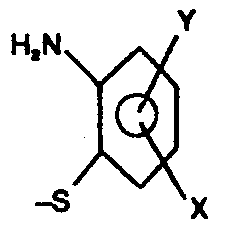
C1-C6 , AlkoxyC1-C6 oder Nitrogruppe darstellen, indem man die in bekannter Weise durch Umsetzung von 2-Aminobenzthiazolen der Formel (3)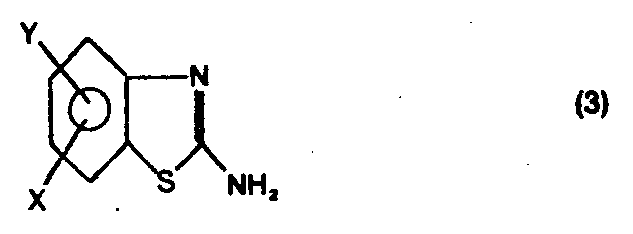



C1-C4 gruppe bedeutet, oder der Formel (2b)
C2-C3 oxid bei 0° bis 100°C umsetzt.
Description
- Gegenstand der vorliegenden Anmeldung ist ein hinsichtlich Gewerbehygiene und Abwasserentsorgung sowie hinsichtlich der Ausbeute verbessertes Verfahren zur Herstellung von 2-Aminophenyl-thioethern, welche wertvolle Zwischenprodukte zur Herstellung von Farbstoffen, Pflanzenschutzmitteln und Pharmazeutika sind.
- 2-Aminophenyl-thioether der allgemeinen Formel (1)

C1-C6 gruppe, die durch Hydroxyl-, AlkoxyC1-C4 , Carboxyl-, -COO-AlkylC1-C4 , AlkenylC2-C6 oder Phenylgruppen oder den Rest
C1-C6 oder Nitrogruppe dar- stellen, konnten bisher technisch durch Alkylierung entsprechender 2-Nitrophenyl-mercaptane mit Verbindungen der allgemeinen Formel (2)

C1-C4 gruppe bedeutet. oder mit Verbindungen der allgemeinen Formel (2b)
C2-C3 oxid und anschließende Reduktion der Nitrogruppe, oder durch entsprechende Alkylierung der zugrundeliegenden 2-Aminophenylmercaptane, die durch Reduktion der vorstehend genannten Nitrovorstufen, in Einzelfällen auch durch alkalische Totalhydrolyse von 2-Aminobenzthiazolen oder Benzthiazthioniumhalogeniden erhalten werden. - Diese Synthesevarianten verlaufen somit über freie Arylmercaptane, wodurch sich erhebliche Probleme hinsichtlich Gewerbehygiene und Abwasserentsorgung ergeben. Außerdem bestand auch aus chemischer Sicht aus folgenden Gründen ein Bedürfnis nach einem effektiveren Verfahren zur technisch praktikablen Herstellung der Zielverbindungen:
- a) Die Ausgangsprodukte der ersten Synthesevariante, die 2-Nitrophenyl-mercaptane, sind sehr oxidationsempfindlich und machen durch Übergang in 2-Nitrophenyldisulfide Ausbeuteminderungen unvermeidbar.
- b) Die Alkylierung der 2-Aminophenylmercaptane ist in der Regel wenig selektiv, sodaß eine aufwendige Abtrennung von N-Alkylaminophenyl-mercaptanen bzw. -thioethern vom Zielprodukt unabdingbar ist, wodurch ebenfalls Ausbeuteverluste in Kauf genommen werden müssen.
- Es wurde nun überraschenderweise gefunden, daß man die 2-Aminophenyl-thioether der vorstehend genannten allgemeinen Formel (1) unter vollständiger Vermeidung der erwähnten Nachteile der bekannten Verfahren herstellen kann, indem man die in bekannter Weise EP-PS 0 039 483 durch Umsetzung von 2-Aminobenzthiazolen der allgemeinen Formel (3)


C1-C4 gruppe bedeutet, oder der allgemeinen Formel (2b)
- Die hierbei intermediär gebildeten 2-Alkylmercaptophenylharnstoffe der allgemeinen Formel (5)


- Somit gelingt es nach dem erfindungsgemäßen Verfahren, die technisch leicht zugänglichen 2-Aminobenzthiazole DE-PS 2 801 991 in einer Eintopfreaktion durch Umsetzung mit Alkalimetall- oder Erdalkalimetallhydroxiden und nachfolgende Behandlung mit einem Alkylierungsmittel der genannten Formeln (2), (2a), (2b) oder mit einem Alkylenoxid in hoher Ausbeute und Reinheit in 2-Aminophenylthioether zu überführen. Das erfindungsgemäße Verfahren vermeidet den Einsatz freier Mercaptane und bietet daher keinerlei ökologische oder gewerbehygienische Probleme. Dadurch und verbunden mit der erzielbaren höheren Ausbeute stellt das erfindungsgemäße Verfahren auch einen erheblichen technischen Fortschritt dar.
- Es ist zudem überraschend, daß beim erfindungsgemäßen Verfahren keine merkliche Bildung von Nebenprodukten beobachtet wird. Zwar ist das Fehlen jeglicher N-Alkylierung infolge des durch die Carbamoylgruppe bewirkten Schutzes der Aminogruppe erklärbar, doch war zu erwarten, daß beim Alkylierungsschritt (in Gegenwart von Wasser), wenn auch nur in Spuren und örtlich begrenzt freiwerdende Säure den sehr leicht ablaufenden, sauer katalysierten Ringschluß des 2-Mercaptophenylharnstoffs zum entsprechenden 2-Hydroxybenzthiazol gemäß EP-PS 0 039 483 bzw. die ebenfalls sauer katalysierte Hydrolyse der Harnstoffgruppierung zum 2-Aminothiophenol ermöglicht und dadurch durch 2-Hydroxybenzthiazol und/oder 2-(Alkyl)aminothiophenol-(ether) verunreinigte 2-Aminophenyl-thioether resultieren.
- Daß diese erwarteten Nebenreaktionen beim erfindungsgemäßen Verfahren allenfalls in Spuren ablaufen, somit eine praktisch einheitliche Reaktion zu den gewünschten Zielprodukten der Formel (1) resultiert, war nicht vorauszusehen und erscheint auf Grund des komplexen Reaktionsgeschehens in mehreren Syntheseschritten äußerst überraschend.
- Das erfindungsgemäße Verfahren wird im einzelnen in der Weise durchgeführt, daß man das beispielsweise gemäß EP-PS 0 039 483, Beispiel 1, Absatz 1 erhältliche 2-Mercaptophenylharnstoffsalz der genannten allgemeinen Formel (4) in Form der beim Verdünnen des Ringöffnungsansatzes mit Wasser resultierenden wäßrigen Lösung (oder ggf. Suspension) bei Temperaturen von 0-100°C, vorzugsweise 20-70°C, mit einem Alkylierungsmittel der genannten allgemeinen Formeln (2), (2a) oder (2b), beispielsweise einem Dialkylsulfat, einem Alkylendihalogenid oder einem Alkylhalogenid, oder mit einem Alkylenoxid, z.B. Ethylen-oder Propylenoxid, in mindest molarer Menge, vorzugsweise in einem Überschuß von 5 - 25 %, innerhalb von 0 bis 5, vorzugsweise 0,5 bis 2 Stunden versetzt, den gebildeten 2-Aminophenyl-thioether durch Phasentrennung, Filtration oder Extraktion vom Reaktionsgemisch abtrennt und nachfolgend vom anhaftenden Wasser oder Extraktionsmittel befreit.
- Selbstverständlich kann man auch von gemäß EP-PS 0 039 483, Beispiel 1, (Absatz 1) herstellbarem isoliertem freiem 2-Mercaptophenylharnstoff ausgehen, diesen nach Suspendieren in Wasser mit molarer Menge Alkalimetall- oder Erdalkalimetallhydroxid oder -carbonat zum Salz der genannten allgemeinen Formel (4) neutralisieren und von da aus in das erfindungsgemäße Verfahren eintreten. Wegen der eingangs geschilderten Problematik bei der Verwendung freier Mercaptane stellt diese Variante jedoch keine bevorzugte dar.
- Besonders bevorzugt ist dagegen die nachfolgende Variante, bei welcher die aus dem Salz des 2-Mercaptophenylharnstoffes der genannten Formel (4) und dem zur Ringöffnung verwandten Lösungsmittel (Alkanol, Glykol, Glycerin, Glykolmonoether) bestehende Reaktionsmischung, oder ein aus einem isolierten 2-Mercaptophenylharnstoff-Salz der genannten Formel (4) [EP-PS 0 039 483, Beispiele 6-101 und einem der zur Ringöffnung verwandten, oder einem anderen unter Reaktionsbedingungen gegenüber dem Alkylierungsmittel (Formeln 2)) oder dem Alkylenoxid inerten Lösungsmittel (Toluol, Xylole, Chlorbenzol, Chlortoluole, Benzin, Chloraliphaten) hergestelltes Ausgangsgemisch mit dem Alkylierungsmittel (Formeln 2)) oder dem Alkylenoxid bei Temperaturen von 0 bis 200°C, vorzugsweise 20 bis 120°C, in mindestens molarer Menge, vorzugsweise in einem Überschuß von 5 bis 50 %, innerhalb von 1 bis 10, vorzugsweise 2 bis 6 Stunden, gegebenenfalls unter Druck, umgesetzt wird. Zur Aufarbeitung wird das Zielprodukt (Formel 1) durch Filtration, Auswaschen des Lösungsmittels und des gebildeten Salzes mit Wasser und Trocknen isoliert, oder, insbesondere bei flüssigen oder niedrig-schmelzenden oder im Lösungsmittel zu gut löslichen Zielprodukten, ggf. nach Filtration vom gebildeten Salz,destillativ konzentriert und dann durch Filtration, Wäsche und Trocknung oder besonders vorteilhaft durch Fraktionierung, vorzugsweise im Vakuum von 0,1 bis 100 Torr, in reiner Form gewonnen.
- Die nachfolgenden Beispiele sollen das erfindungsgemäße Verfahren näher erläutern, ohne es zu beschränken. Die angegebenen Teile sind Gewichtsteile.
- Die gemäß Beispiel 3 der EP-PS 0 039 483 beim Umsatz von 82 Teilen 4-Methyl-2-aminobenzthiazol mit 50 Teilen Ätznatron in Glycerin erhaltene, mit Kohle geklärte Lösung des Natriumsalzes des 6-Methyl-2-mercapto-phenylharn- stoffes wird innerhalb von 15 Minuten unter Rühren bei 20 bis 25°C mit 82 Teilen Dimethylsulfat versetzt. Anschließend läßt man 45 Minuten nachregieren.
- Man trennt die gebildete organische Unterphase (Dichte 1,15 g/ml) und fraktioniert sie über eine kurze Kolonne. Nach einem geringen Vorlauf (Wasser) gehen bei 20 Torr/ 132°C 72 Teile 3-Methylmercapto-2-aminotoluol der Formel

- Das Produkt ist praktisch frei von Verunreinigungen, zeigt im Gaschromatogramm einen Reingehalt > 99 %, der sich auch durch den Diazotierwert von 99,5 % bestätigt..
- 168 Teile des gemäß Beispiel 1, Absatz 1 der EP-PS 0 039 483 zugänglichen 2-Mercaptophenylharnstoffes werden in 500 Teilen Wasser suspendiert, mit 60 Teilen Kaliumhydroxid versetzt und die erhaltene Mischung in einen 1 1-Autoklav überführt. Man verschließt den Autoklav, drückt 75 Teile Methylchlorid auf und heizt in 1 Stunde auf 80°C, wobei sich ein Innendruck von ca. 2 bar einstellt, der sich beim 1-stündigen Nachrühren bei 80°C fast vollständig abbaut. Nach Abkühlen wird der Autoklav entleert, die gebildete organische Unterphase (Dichte 1,14 g/ml) abgetrennt und über eine kurze Kolonne fraktioniert. Als Hauptlauf gehen bei 15 Torr/134°C 130 Teile 2-Methylmercaptoanilin der Formel

- Das Produkt hat einen Diazotierwert von 99,6 % und erweist sich im Gaschromatogramm als einheitlich.
- Arbeitet man nach den Angaben des Beispiels 2, ersetzt aber das Methylchlorid durch aliquote Teile der in der nachstehenden Tabelle 1 angegebenen Alkylierungsmittel, so erhält man ebenfalls erfindungsgemäß 2-Aminophenyl-alkylether der Formel (6)


- 112, 25 Teile des gemäß Beispiel 6 der EP-PS 0 039 483 erhältlichen Natriumsalzes des 4-Chlor-2-mercaptophenylharnstoffes werden in 500 Teilen Wasser von Raumtemperatur suspendiert. Anschließend tropft man unter Rühren innerhalb von 30 Minuten 100 Teile Diethylsulfat zu, wobei die Innentemperatur 25°C nicht übersteigen soll. Dann heizt man in 45 Minuten auf 80°C, rührt 30 Minuten nach, trennt die gebildete organische Unterphase ab und fraktioniert sie im Vakuum. Nach einem unbedeutenden wäßrigen Vorlauf gehen bei 20 Torr/167°C 90,0 Teile 2-Ethyl-mercapto-4- chloranilin der Formel

- über, was einer Ausbeute von 96,0 % der Theorie, bezogen auf eingesetztes Natriumsalz des 4-Chlor-2-mercaptophenylharnstoffes, entspricht.
- Das Produkt ist chromatografisch einheitlich und hat einen Diazotierwert von 99, 7 %.
- Ersetzt man in Beispiel 9 das Natriumsalz des 4-Chlor-2-mercaptophenyl-harnstoffes durch aliquote Teile der in der nachstehenden Tabelle 2 aufgeführten Salze von 2-Mercaptophenylharnstoffen der Formel (7)


- Eine Mischung aus 150 Teilen 2-Aminobenzthiazol, 150 Teilen festem Natriumhydroxid und 300 Teilen Ethylenglykol wird 6 Stunden bei 130-l40°C gerührt (Beispiel 1 der EP-PS 0 039 483), dann auf 70°C abgekühlt und bei dieser Temperatur in 30 Minuten gleichmäßig mit 158 Teilen Benzylchlorid versetzt. Man rührt 2 Stunden bei 70 bis 80°C nach, läßt die Reaktionsmischung unter Rühren in 3000 Teile Wasser zügig einlaufen und kühlt auf 0°C ab. Das dabei ausgranulierte 2-Benzylmercaptoanilin der Formel

- Das Produkt ist chromatographisch einheitlich und zeigt einen Diazotierwert von 99, 3 %.
- Ersetzt man in Beispiel 16 das 2-Aminobenzthiazol durch aliquote Teile der in der nachstehenden Tabelle 3 aufgeführten 2-Aminobenzthiazole der Formel (9)


- 168 Teile des gemäß Beispiel 1, Absatz 1 der EP-PS 0 039 483 zugänglichen 2-Mercaptophenylharnstoffs werden in 500 Volumenteilen 1 n Natronlauge bei Raumtemperatur gelöst, auf einmal mit 195 Teilen ß-Brompropionsäure versetzt und 2 Stunden bei Raumtemperatur verrührt. Dann heizt man innerhalb 1 Stunde auf 100°C, rührt 30 Minuten bei dieser Temperatur nach, kühlt auf 20°C, stellt mit verdünnter Salzsäure auf pH 3,0 und filtriert die ausgefallene 2-Aminophenyl-ß-thiopropionsäure der Formel

- Eine Mischung aus 150 Teilen 2-Aminobenzthiazol, 150 Teilen festem Natriumhydroxid und 300 Teilen Ethylenglykol wird 6 Stunden bei 130 - 140°C gerührt (Beispiel 1 der EP-PS 0 039 483). Man kühlt auf 40°C ab, versetzt dann so mit 113 Teilen Chloressigsäure, daß die Innentemperatur 50°C nicht übersteigt und rührt anschließend 2 Stunden bei dieser Temperatur nach. Dann heizt man auf 80 bis 90°C, hält 1 Stunde bei dieser Temperatur und läßt nachfolgend die gebildete Suspension des Natriumsalzes der 2-Aminophenylthioglykolsäure der Formel (11) in eine Mischung aus 2500 Teilen Wasser und 550 Teilen 30 %iger Salzsäure einlaufen, wobei die Temperatur bis auf 60°C ansteigt. Bei dieser Prozedur cyclisiert die freigesetzte 2-Aminophenylthioglykolsäure rasch zum 3-Oxo-dihydrobenzthiazin der Formel (12), welche das stabile Anhydrid der instabilen freien Säure darstellt:

- Man rührt 30 Minuten bei 60 bis 70°C nach, kühlt auf Raumtemperatur ab, filtriert das ausgefallene Produkt ab, wäscht mit Wasser neutral und trocknet bei 120°C im Umluftschrank.
- Man erhält 150 Teile 3-0xo-dihydrobenzthiazin vom Schmelzpunkt 175°C, was einer Ausbeute von 90,0 % der Theorie, bezogen auf eingesetztes 2-Aminobenzthiazol, entspricht.
- Das Produkt ist chromatographisch rein und läßt sich durch Erwärmen mit Natronlauge zu einer klaren wäßrigen Lösung des 2-Aminophenylthioglykolsäure-Natriumsalzes öffnen, das, durch indirekte Diazotierung bestimmt, einen Reingehalt von 99,4 % aufweist.
- Ersetzt man in Beispiel 23 das 2-Aminobenzthiazol durch aliquote Mengen seiner in der nachstehenden Tabelle 4 aufgeführten Derivate der Formel (13) und arbeitet im übrigen in der angegebenen Weise, so erhält man die mit Ausbeute und Schmelzpunkt in der Tabelle angegebenen 3-0xo-dihydrobenzthiazine (14) in vergleichbarer Reinheit:


Claims (1)
- Verfahren zur Herstellung von 2-Aminophenyl-thioethern der allgemeinen Formel (1)

C1-C6 gruppe, die durch Hydroxyl-, AlkoxyC1-C4 , Carboxyl-, -COO-AlkylC1-C4 , AlkenylC2-C6 oder Phenylgruppenoder den Rest
C1-C6 , AlkoayC1-C6 oder Nitrogruppe darstellen, dadurch gekennzeichnet, daß man die in bekannter Weise durch Umsetzung von 2-Aminobenzthiazolen der allgemeinen Formel (3)


C1-C4 gruppe bedeutet, oder der allgemeinen Formel (2b)
C2-C3 oxid bei Temperaturen von 0° bis 100°C umsetzt.
Applications Claiming Priority (2)
| Application Number | Priority Date | Filing Date | Title |
|---|---|---|---|
| DE3528033 | 1985-08-05 | ||
| DE19853528033 DE3528033A1 (de) | 1985-08-05 | 1985-08-05 | Verfahren zur herstellung von 2-aminophenyl-thioethern |
Publications (3)
| Publication Number | Publication Date |
|---|---|
| EP0212301A2 true EP0212301A2 (de) | 1987-03-04 |
| EP0212301A3 EP0212301A3 (en) | 1988-07-20 |
| EP0212301B1 EP0212301B1 (de) | 1990-10-24 |
Family
ID=6277719
Family Applications (1)
| Application Number | Title | Priority Date | Filing Date |
|---|---|---|---|
| EP86110101A Expired - Lifetime EP0212301B1 (de) | 1985-08-05 | 1986-07-23 | Verfahren zur Herstellung von 2-Aminophenyl-thioethern |
Country Status (4)
| Country | Link |
|---|---|
| US (1) | US4808752A (de) |
| EP (1) | EP0212301B1 (de) |
| JP (1) | JPS6236353A (de) |
| DE (2) | DE3528033A1 (de) |
Cited By (1)
| Publication number | Priority date | Publication date | Assignee | Title |
|---|---|---|---|---|
| EP0269434A1 (de) * | 1986-11-26 | 1988-06-01 | Hoechst Celanese Corporation | Verfahren zur Herstellung von Aminothiophenolen und deren Derivate |
Families Citing this family (5)
| Publication number | Priority date | Publication date | Assignee | Title |
|---|---|---|---|---|
| US4818273A (en) * | 1983-11-14 | 1989-04-04 | The Dow Chemical Company | Substituted 1,2,4-triazolo[1,5-a]pyrimidine-2-sulfonamides, compositions containing them, and their utility as herbicides |
| JP2679522B2 (ja) * | 1992-04-27 | 1997-11-19 | タイガー魔法瓶株式会社 | 高周波加熱装置 |
| FR2696455B1 (fr) * | 1992-10-02 | 1994-11-25 | Oreal | Nouveaux métaaminophénols soufrés, leur application, notamment en teinture. |
| PL319692A1 (en) * | 1994-10-17 | 1997-08-18 | Ciba Geigy Ag | Method of obtaining substituted 3-amino benzonitriles |
| DE19543475A1 (de) * | 1995-11-22 | 1997-05-28 | Bayer Ag | Verfahren zur Herstellung von 2-Amino-6-chlorphenyl-alkylsulfanen und 2-Amino-6-chlorphenyl-isopropylsulfan |
Family Cites Families (7)
| Publication number | Priority date | Publication date | Assignee | Title |
|---|---|---|---|---|
| FR657183A (fr) * | 1927-07-09 | 1929-05-17 | Ig Farbenindustrie Ag | Procédé de production d'ortho-aminoarylmercaptans |
| US2007335A (en) * | 1930-09-17 | 1935-07-09 | Du Pont | Process of producing o-aminoaryl mercaptans and derivatives thereof |
| US2034459A (en) * | 1934-09-24 | 1936-03-17 | Du Pont | Process of preparing aryl-mercaptans and derivatives thereof |
| US3102142A (en) * | 1959-05-01 | 1963-08-27 | Gen Aniline & Film Corp | Preparation of aminothiols and aminoselenols by improved alkali fusion and their derivatives |
| US3920617A (en) * | 1970-08-03 | 1975-11-18 | Furane Plastics | Sulfur-containing polyamine curing agents for polyurethanes and method for making and using the same |
| DE3017153A1 (de) * | 1980-05-05 | 1981-11-12 | Hoechst Ag, 6000 Frankfurt | Verfahren zur herstellung von 2-hydroxybenzthiazolen |
| JPH0678959A (ja) * | 1992-08-31 | 1994-03-22 | Aoki Corp | リカバリークリーンブース |
-
1985
- 1985-08-05 DE DE19853528033 patent/DE3528033A1/de not_active Withdrawn
-
1986
- 1986-07-23 EP EP86110101A patent/EP0212301B1/de not_active Expired - Lifetime
- 1986-07-23 DE DE8686110101T patent/DE3675107D1/de not_active Expired - Fee Related
- 1986-07-31 US US06/892,598 patent/US4808752A/en not_active Expired - Fee Related
- 1986-08-04 JP JP61182060A patent/JPS6236353A/ja active Pending
Cited By (1)
| Publication number | Priority date | Publication date | Assignee | Title |
|---|---|---|---|---|
| EP0269434A1 (de) * | 1986-11-26 | 1988-06-01 | Hoechst Celanese Corporation | Verfahren zur Herstellung von Aminothiophenolen und deren Derivate |
Also Published As
| Publication number | Publication date |
|---|---|
| EP0212301A3 (en) | 1988-07-20 |
| JPS6236353A (ja) | 1987-02-17 |
| US4808752A (en) | 1989-02-28 |
| DE3675107D1 (de) | 1990-11-29 |
| DE3528033A1 (de) | 1987-02-05 |
| EP0212301B1 (de) | 1990-10-24 |
Similar Documents
| Publication | Publication Date | Title |
|---|---|---|
| DE19708782C1 (de) | Verfahren zur Herstellung von 2-Aminoethansulfonylazid-säureadditionssalzen, 2-Aminoethansulfonylazid-hydrochlorid sowie dessen Verwendung | |
| EP0115328B1 (de) | Verfahren zur Herstellung von 4-Chlorphenylsulfonylverbindungen | |
| EP0212301B1 (de) | Verfahren zur Herstellung von 2-Aminophenyl-thioethern | |
| EP0089517B1 (de) | Verfahren zur Herstellung von Diphenyläthern | |
| EP0214423B1 (de) | Verfahren zur Herstellung 2-substituierter Benzthiazole | |
| EP0040398B1 (de) | Verfahren zur Herstellung von in 3-Stellung substituierten 2(3H)-Benzthiazolonen oder 2(3H)-Naphthothiazolonen | |
| EP0039483B1 (de) | Verfahren zur Herstellung von 2-Hydroxybenzthiazolen | |
| EP0202511A1 (de) | Verfahren zur Herstellung von Benzothiazolsulfenamiden | |
| EP0658544B1 (de) | Verbessertes Verfahren zur Herstellung von 2,2'-Dinitrodiphenyldisulfid | |
| EP0085181A1 (de) | Verfahren zur Herstellung von o,o'-Dithiodibenzoesäuren | |
| CH615168A5 (de) | ||
| EP0146007B1 (de) | Verfahren zur Herstellung von 5-Oxethylsulfonyl-2-amino-phenol(-ethern) | |
| DE4123608C1 (de) | ||
| EP0043573B1 (de) | Verfahren zur Herstellung von 2,6-Dichlorbenzoxazol bzw. 2,6-Dichlorbenzthiazol | |
| EP0043013B1 (de) | Verfahren zur Herstellung von 2-Chlor-benzthiazolen | |
| EP0150411A1 (de) | Verfahren zur Herstellung substituierter Chinazolin-2.4(1H.3H)-dione | |
| DE1445547C3 (de) | Verfahren zur Herstellung von 3-Amino-2,1-benzoisothiazolen | |
| EP0420815B1 (de) | Verfahren zur Herstellung von 2-(2-Halogenethylthio)-phenylsulfonamiden | |
| DE1670711B2 (de) | Verfahren zur herstellung von thionothiolphosphor-(-phosphon-, phosphin-)saeureestern | |
| EP0102055A2 (de) | Verfahren zur Herstellung halogensubstituierter 2-Aminobenzthiazole | |
| DE2637580C2 (de) | Verfahren zur herstellung von n-substituierten oxazolidinen | |
| DE2101359C3 (de) | Verfahren zur Herstellung von 4-Mercaptophenolen | |
| EP0221494A1 (de) | Verfahren zur Herstellung von Glykolsäureamiden | |
| AT258264B (de) | Verfahren zur Herstellung von 5-(3'-Methylaminopropyl)-5H-dibenzo[a,d] cyclohepten | |
| DE3504966A1 (de) | Verfahren zur herstellung von thiocyanatomethylthiobenzothiazolen |
Legal Events
| Date | Code | Title | Description |
|---|---|---|---|
| PUAI | Public reference made under article 153(3) epc to a published international application that has entered the european phase |
Free format text: ORIGINAL CODE: 0009012 |
|
| AK | Designated contracting states |
Kind code of ref document: A2 Designated state(s): CH DE FR GB IT LI |
|
| PUAL | Search report despatched |
Free format text: ORIGINAL CODE: 0009013 |
|
| AK | Designated contracting states |
Kind code of ref document: A3 Designated state(s): CH DE FR GB IT LI |
|
| 17P | Request for examination filed |
Effective date: 19880926 |
|
| 17Q | First examination report despatched |
Effective date: 19900309 |
|
| GRAA | (expected) grant |
Free format text: ORIGINAL CODE: 0009210 |
|
| AK | Designated contracting states |
Kind code of ref document: B1 Designated state(s): CH DE FR GB IT LI |
|
| REF | Corresponds to: |
Ref document number: 3675107 Country of ref document: DE Date of ref document: 19901129 |
|
| ITF | It: translation for a ep patent filed | ||
| ET | Fr: translation filed | ||
| GBT | Gb: translation of ep patent filed (gb section 77(6)(a)/1977) | ||
| ITTA | It: last paid annual fee | ||
| PLBE | No opposition filed within time limit |
Free format text: ORIGINAL CODE: 0009261 |
|
| STAA | Information on the status of an ep patent application or granted ep patent |
Free format text: STATUS: NO OPPOSITION FILED WITHIN TIME LIMIT |
|
| 26N | No opposition filed | ||
| PGFP | Annual fee paid to national office [announced via postgrant information from national office to epo] |
Ref country code: DE Payment date: 19920921 Year of fee payment: 7 |
|
| PGFP | Annual fee paid to national office [announced via postgrant information from national office to epo] |
Ref country code: GB Payment date: 19930628 Year of fee payment: 8 Ref country code: FR Payment date: 19930628 Year of fee payment: 8 |
|
| PGFP | Annual fee paid to national office [announced via postgrant information from national office to epo] |
Ref country code: CH Payment date: 19930629 Year of fee payment: 8 |
|
| PG25 | Lapsed in a contracting state [announced via postgrant information from national office to epo] |
Ref country code: DE Effective date: 19940401 |
|
| PG25 | Lapsed in a contracting state [announced via postgrant information from national office to epo] |
Ref country code: GB Effective date: 19940723 |
|
| PG25 | Lapsed in a contracting state [announced via postgrant information from national office to epo] |
Ref country code: LI Effective date: 19940731 Ref country code: CH Effective date: 19940731 |
|
| GBPC | Gb: european patent ceased through non-payment of renewal fee |
Effective date: 19940723 |
|
| PG25 | Lapsed in a contracting state [announced via postgrant information from national office to epo] |
Ref country code: FR Effective date: 19950331 |
|
| REG | Reference to a national code |
Ref country code: CH Ref legal event code: PL |
|
| REG | Reference to a national code |
Ref country code: FR Ref legal event code: ST |
|
| PG25 | Lapsed in a contracting state [announced via postgrant information from national office to epo] |
Ref country code: IT Free format text: LAPSE BECAUSE OF NON-PAYMENT OF DUE FEES;WARNING: LAPSES OF ITALIAN PATENTS WITH EFFECTIVE DATE BEFORE 2007 MAY HAVE OCCURRED AT ANY TIME BEFORE 2007. THE CORRECT EFFECTIVE DATE MAY BE DIFFERENT FROM THE ONE RECORDED. Effective date: 20050723 |