EP0209850B1 - Oxalkylierte Polyesteramine,Verfahren zu deren Herstellung und deren Verwendung - Google Patents
Oxalkylierte Polyesteramine,Verfahren zu deren Herstellung und deren Verwendung Download PDFInfo
- Publication number
- EP0209850B1 EP0209850B1 EP86109807A EP86109807A EP0209850B1 EP 0209850 B1 EP0209850 B1 EP 0209850B1 EP 86109807 A EP86109807 A EP 86109807A EP 86109807 A EP86109807 A EP 86109807A EP 0209850 B1 EP0209850 B1 EP 0209850B1
- Authority
- EP
- European Patent Office
- Prior art keywords
- formula
- ethylene oxide
- acid
- mol
- condensed
- Prior art date
- Legal status (The legal status is an assumption and is not a legal conclusion. Google has not performed a legal analysis and makes no representation as to the accuracy of the status listed.)
- Expired - Lifetime
Links
- 150000001412 amines Chemical class 0.000 title description 15
- 238000000034 method Methods 0.000 title description 5
- 229920000728 polyester Polymers 0.000 title description 3
- 238000002360 preparation method Methods 0.000 title description 3
- IAYPIBMASNFSPL-UHFFFAOYSA-N Ethylene oxide Chemical group C1CO1 IAYPIBMASNFSPL-UHFFFAOYSA-N 0.000 description 25
- GOOHAUXETOMSMM-UHFFFAOYSA-N Propylene oxide Chemical group CC1CO1 GOOHAUXETOMSMM-UHFFFAOYSA-N 0.000 description 11
- 238000006243 chemical reaction Methods 0.000 description 10
- 239000010779 crude oil Substances 0.000 description 10
- -1 dicarboxylic acids Chemical class 0.000 description 10
- XLYOFNOQVPJJNP-UHFFFAOYSA-N water Substances O XLYOFNOQVPJJNP-UHFFFAOYSA-N 0.000 description 10
- REYJJPSVUYRZGE-UHFFFAOYSA-N Octadecylamine Chemical compound CCCCCCCCCCCCCCCCCCN REYJJPSVUYRZGE-UHFFFAOYSA-N 0.000 description 9
- OFOBLEOULBTSOW-UHFFFAOYSA-N Malonic acid Chemical compound OC(=O)CC(O)=O OFOBLEOULBTSOW-UHFFFAOYSA-N 0.000 description 8
- 239000000839 emulsion Substances 0.000 description 7
- WNLRTRBMVRJNCN-UHFFFAOYSA-N adipic acid Chemical compound OC(=O)CCCCC(O)=O WNLRTRBMVRJNCN-UHFFFAOYSA-N 0.000 description 6
- 238000005886 esterification reaction Methods 0.000 description 6
- 239000002253 acid Substances 0.000 description 5
- 150000001875 compounds Chemical class 0.000 description 5
- 150000003839 salts Chemical class 0.000 description 5
- 230000032050 esterification Effects 0.000 description 4
- XXMIOPMDWAUFGU-UHFFFAOYSA-N hexane-1,6-diol Chemical compound OCCCCCCO XXMIOPMDWAUFGU-UHFFFAOYSA-N 0.000 description 4
- 238000006068 polycondensation reaction Methods 0.000 description 4
- 229920000642 polymer Polymers 0.000 description 4
- CXMXRPHRNRROMY-UHFFFAOYSA-N sebacic acid Chemical compound OC(=O)CCCCCCCCC(O)=O CXMXRPHRNRROMY-UHFFFAOYSA-N 0.000 description 4
- YXFVVABEGXRONW-UHFFFAOYSA-N Toluene Chemical compound CC1=CC=CC=C1 YXFVVABEGXRONW-UHFFFAOYSA-N 0.000 description 3
- 239000001361 adipic acid Substances 0.000 description 3
- 235000011037 adipic acid Nutrition 0.000 description 3
- 125000004432 carbon atom Chemical group C* 0.000 description 3
- 150000001991 dicarboxylic acids Chemical class 0.000 description 3
- 150000002009 diols Chemical class 0.000 description 3
- 239000000203 mixture Substances 0.000 description 3
- 238000000926 separation method Methods 0.000 description 3
- IJGRMHOSHXDMSA-UHFFFAOYSA-N Atomic nitrogen Chemical compound N#N IJGRMHOSHXDMSA-UHFFFAOYSA-N 0.000 description 2
- VZCYOOQTPOCHFL-OWOJBTEDSA-N Fumaric acid Chemical compound OC(=O)\C=C\C(O)=O VZCYOOQTPOCHFL-OWOJBTEDSA-N 0.000 description 2
- TWRXJAOTZQYOKJ-UHFFFAOYSA-L Magnesium chloride Chemical compound [Mg+2].[Cl-].[Cl-] TWRXJAOTZQYOKJ-UHFFFAOYSA-L 0.000 description 2
- FAPWRFPIFSIZLT-UHFFFAOYSA-M Sodium chloride Chemical compound [Na+].[Cl-] FAPWRFPIFSIZLT-UHFFFAOYSA-M 0.000 description 2
- 150000003973 alkyl amines Chemical class 0.000 description 2
- WERYXYBDKMZEQL-UHFFFAOYSA-N butane-1,4-diol Chemical compound OCCCCO WERYXYBDKMZEQL-UHFFFAOYSA-N 0.000 description 2
- 239000007789 gas Substances 0.000 description 2
- 125000002887 hydroxy group Chemical group [H]O* 0.000 description 2
- ROBFUDYVXSDBQM-UHFFFAOYSA-N hydroxymalonic acid Chemical compound OC(=O)C(O)C(O)=O ROBFUDYVXSDBQM-UHFFFAOYSA-N 0.000 description 2
- QJGQUHMNIGDVPM-UHFFFAOYSA-N nitrogen group Chemical group [N] QJGQUHMNIGDVPM-UHFFFAOYSA-N 0.000 description 2
- 239000003921 oil Substances 0.000 description 2
- ACVYVLVWPXVTIT-UHFFFAOYSA-N phosphinic acid Chemical compound O[PH2]=O ACVYVLVWPXVTIT-UHFFFAOYSA-N 0.000 description 2
- 229920001223 polyethylene glycol Polymers 0.000 description 2
- 229920001451 polypropylene glycol Polymers 0.000 description 2
- 239000011541 reaction mixture Substances 0.000 description 2
- 239000002904 solvent Substances 0.000 description 2
- 239000007858 starting material Substances 0.000 description 2
- 239000003760 tallow Substances 0.000 description 2
- VZCYOOQTPOCHFL-UHFFFAOYSA-N trans-butenedioic acid Natural products OC(=O)C=CC(O)=O VZCYOOQTPOCHFL-UHFFFAOYSA-N 0.000 description 2
- BJEPYKJPYRNKOW-REOHCLBHSA-N (S)-malic acid Chemical compound OC(=O)[C@@H](O)CC(O)=O BJEPYKJPYRNKOW-REOHCLBHSA-N 0.000 description 1
- QGLWBTPVKHMVHM-KTKRTIGZSA-N (z)-octadec-9-en-1-amine Chemical compound CCCCCCCC\C=C/CCCCCCCCN QGLWBTPVKHMVHM-KTKRTIGZSA-N 0.000 description 1
- RTBFRGCFXZNCOE-UHFFFAOYSA-N 1-methylsulfonylpiperidin-4-one Chemical compound CS(=O)(=O)N1CCC(=O)CC1 RTBFRGCFXZNCOE-UHFFFAOYSA-N 0.000 description 1
- HSFWRNGVRCDJHI-UHFFFAOYSA-N Acetylene Chemical group C#C HSFWRNGVRCDJHI-UHFFFAOYSA-N 0.000 description 1
- UXVMQQNJUSDDNG-UHFFFAOYSA-L Calcium chloride Chemical compound [Cl-].[Cl-].[Ca+2] UXVMQQNJUSDDNG-UHFFFAOYSA-L 0.000 description 1
- FEWJPZIEWOKRBE-JCYAYHJZSA-N Dextrotartaric acid Chemical compound OC(=O)[C@H](O)[C@@H](O)C(O)=O FEWJPZIEWOKRBE-JCYAYHJZSA-N 0.000 description 1
- VGGSQFUCUMXWEO-UHFFFAOYSA-N Ethene Chemical compound C=C VGGSQFUCUMXWEO-UHFFFAOYSA-N 0.000 description 1
- 239000005977 Ethylene Substances 0.000 description 1
- 238000011993 High Performance Size Exclusion Chromatography Methods 0.000 description 1
- CTQNGGLPUBDAKN-UHFFFAOYSA-N O-Xylene Chemical compound CC1=CC=CC=C1C CTQNGGLPUBDAKN-UHFFFAOYSA-N 0.000 description 1
- 239000002202 Polyethylene glycol Substances 0.000 description 1
- KDYFGRWQOYBRFD-UHFFFAOYSA-N Succinic acid Natural products OC(=O)CCC(O)=O KDYFGRWQOYBRFD-UHFFFAOYSA-N 0.000 description 1
- FEWJPZIEWOKRBE-UHFFFAOYSA-N Tartaric acid Natural products [H+].[H+].[O-]C(=O)C(O)C(O)C([O-])=O FEWJPZIEWOKRBE-UHFFFAOYSA-N 0.000 description 1
- 239000003377 acid catalyst Substances 0.000 description 1
- 150000007513 acids Chemical class 0.000 description 1
- 230000001154 acute effect Effects 0.000 description 1
- 125000000217 alkyl group Chemical group 0.000 description 1
- BJEPYKJPYRNKOW-UHFFFAOYSA-N alpha-hydroxysuccinic acid Natural products OC(=O)C(O)CC(O)=O BJEPYKJPYRNKOW-UHFFFAOYSA-N 0.000 description 1
- DTOSIQBPPRVQHS-PDBXOOCHSA-N alpha-linolenic acid Chemical compound CC\C=C/C\C=C/C\C=C/CCCCCCCC(O)=O DTOSIQBPPRVQHS-PDBXOOCHSA-N 0.000 description 1
- 235000020661 alpha-linolenic acid Nutrition 0.000 description 1
- JFCQEDHGNNZCLN-UHFFFAOYSA-N anhydrous glutaric acid Natural products OC(=O)CCCC(O)=O JFCQEDHGNNZCLN-UHFFFAOYSA-N 0.000 description 1
- 239000008346 aqueous phase Substances 0.000 description 1
- 238000010533 azeotropic distillation Methods 0.000 description 1
- 230000015572 biosynthetic process Effects 0.000 description 1
- 229920001400 block copolymer Polymers 0.000 description 1
- 238000009835 boiling Methods 0.000 description 1
- KDYFGRWQOYBRFD-NUQCWPJISA-N butanedioic acid Chemical compound O[14C](=O)CC[14C](O)=O KDYFGRWQOYBRFD-NUQCWPJISA-N 0.000 description 1
- 239000001110 calcium chloride Substances 0.000 description 1
- 229910001628 calcium chloride Inorganic materials 0.000 description 1
- 238000009833 condensation Methods 0.000 description 1
- 230000005494 condensation Effects 0.000 description 1
- 229920001577 copolymer Polymers 0.000 description 1
- 230000007797 corrosion Effects 0.000 description 1
- 238000005260 corrosion Methods 0.000 description 1
- 238000010790 dilution Methods 0.000 description 1
- 239000012895 dilution Substances 0.000 description 1
- 238000004821 distillation Methods 0.000 description 1
- 238000009826 distribution Methods 0.000 description 1
- 150000002148 esters Chemical class 0.000 description 1
- 239000013505 freshwater Substances 0.000 description 1
- 239000001530 fumaric acid Substances 0.000 description 1
- 150000004820 halides Chemical class 0.000 description 1
- 238000010438 heat treatment Methods 0.000 description 1
- 238000004128 high performance liquid chromatography Methods 0.000 description 1
- 239000012442 inert solvent Substances 0.000 description 1
- 229960004488 linolenic acid Drugs 0.000 description 1
- KQQKGWQCNNTQJW-UHFFFAOYSA-N linolenic acid Natural products CC=CCCC=CCC=CCCCCCCCC(O)=O KQQKGWQCNNTQJW-UHFFFAOYSA-N 0.000 description 1
- 229910001629 magnesium chloride Inorganic materials 0.000 description 1
- VZCYOOQTPOCHFL-UPHRSURJSA-N maleic acid Chemical compound OC(=O)\C=C/C(O)=O VZCYOOQTPOCHFL-UPHRSURJSA-N 0.000 description 1
- 239000011976 maleic acid Substances 0.000 description 1
- 230000007257 malfunction Effects 0.000 description 1
- 239000001630 malic acid Substances 0.000 description 1
- 235000011090 malic acid Nutrition 0.000 description 1
- 238000004519 manufacturing process Methods 0.000 description 1
- 239000000155 melt Substances 0.000 description 1
- 229910052757 nitrogen Inorganic materials 0.000 description 1
- 239000012299 nitrogen atmosphere Substances 0.000 description 1
- 229920001281 polyalkylene Polymers 0.000 description 1
- 229920000768 polyamine Polymers 0.000 description 1
- 150000003141 primary amines Chemical class 0.000 description 1
- 230000001681 protective effect Effects 0.000 description 1
- 230000035484 reaction time Effects 0.000 description 1
- 238000010992 reflux Methods 0.000 description 1
- 239000011780 sodium chloride Substances 0.000 description 1
- 239000003381 stabilizer Substances 0.000 description 1
- 239000000126 substance Substances 0.000 description 1
- 239000011975 tartaric acid Substances 0.000 description 1
- 235000002906 tartaric acid Nutrition 0.000 description 1
- 239000007762 w/o emulsion Substances 0.000 description 1
- 239000008096 xylene Substances 0.000 description 1
Classifications
-
- C—CHEMISTRY; METALLURGY
- C10—PETROLEUM, GAS OR COKE INDUSTRIES; TECHNICAL GASES CONTAINING CARBON MONOXIDE; FUELS; LUBRICANTS; PEAT
- C10G—CRACKING HYDROCARBON OILS; PRODUCTION OF LIQUID HYDROCARBON MIXTURES, e.g. BY DESTRUCTIVE HYDROGENATION, OLIGOMERISATION, POLYMERISATION; RECOVERY OF HYDROCARBON OILS FROM OIL-SHALE, OIL-SAND, OR GASES; REFINING MIXTURES MAINLY CONSISTING OF HYDROCARBONS; REFORMING OF NAPHTHA; MINERAL WAXES
- C10G33/00—Dewatering or demulsification of hydrocarbon oils
- C10G33/04—Dewatering or demulsification of hydrocarbon oils with chemical means
-
- C—CHEMISTRY; METALLURGY
- C08—ORGANIC MACROMOLECULAR COMPOUNDS; THEIR PREPARATION OR CHEMICAL WORKING-UP; COMPOSITIONS BASED THEREON
- C08G—MACROMOLECULAR COMPOUNDS OBTAINED OTHERWISE THAN BY REACTIONS ONLY INVOLVING UNSATURATED CARBON-TO-CARBON BONDS
- C08G63/00—Macromolecular compounds obtained by reactions forming a carboxylic ester link in the main chain of the macromolecule
- C08G63/68—Polyesters containing atoms other than carbon, hydrogen and oxygen
- C08G63/685—Polyesters containing atoms other than carbon, hydrogen and oxygen containing nitrogen
- C08G63/6854—Polyesters containing atoms other than carbon, hydrogen and oxygen containing nitrogen derived from polycarboxylic acids and polyhydroxy compounds
- C08G63/6856—Dicarboxylic acids and dihydroxy compounds
Definitions
- the invention relates to oxyalkylated polyester amines, a process for their preparation and their use as demulsifiers for crude oil emulsions.
- a demulsifier has the task of breaking the emulsion at the lowest possible application concentration and, in the course of this separation process, causing complete water separation without or with minimal additional use of heat and reducing the salt content to a minimum.
- the quality criteria for delivered crude oil are the residual salt and the water content.
- the crude oils have different compositions depending on their provenance.
- the natural emulsion stabilizers have a complicated, differentiated, chemical structure, for which splitters have to be specifically developed.
- Various requirements for conveying and processing make the requirements placed on a demulsifier even more diverse. By constantly opening up new crude oil fields and changing the production conditions of older crude oil fields, the development of optimal demulsifiers remains an acute problem and a large number of different types of demulsifiers or demulsifier mixtures are required.
- Nitrogen-containing demulsifiers are known in particular from US Pat. No. 3,009,884. There, alkoxylated polyalkylene polyamines esterified with polycarboxylic acids, including dicarboxylic acids, are described which are effective as demulsifiers. However, these compounds have the disadvantage of insufficient hydrophobicity, that is, their oil solubility is too low. However, since the effectiveness of demulsifiers for the refraction of crude oil emulsions depends on the degree of presence at the oil / water interface, this property is disadvantageous because too much of the demulsifier is distributed over the entire aqueous phase.
- R 1 is an alkyl radical of 12 to 18 carbon atoms
- R 2 is H and a and b, the same or different, are whole or fractional numbers from 1 to 8
- R 3 is the remainder of a block copolymer, consisting of at least one block of ethylene oxide units and at least one block of propylene oxide units, the total number of ethylene oxide units being a whole or fractional number from 15 to 35 and that of propylene oxide units it is from 20 to 40 and the sum of both is at most 60
- R 5 is an alkylene radical of the formula - (CH 2 ) y ⁇ , where y is an integer from 1 to 8
- n is an integer from 2 to 20.
- the numbers a, b, and c represent mean values.
- the compounds of formula I are prepared by using an oxyalkylated primary fatty amine of the formula wherein R 1 , R 2 , a and b have the meaning given in formula I, and a diol compound of the formula HO - R 3 OH (III), wherein R 3 has the meaning given in formula I, with a dicarboxylic acid of the formula wherein R 5 has the meaning given in formula 1, esterified with polycondensation, the molar ratio of oxyalkylated primary fatty amine to diol compound being 1: to 3: 1 1 and the molar ratio of the total of oxyalkylated primary fatty amine plus diol compound to dicarboxylic acid 0.8: 1 to 1: 0.8.
- the oxyalkylated primary fatty amine and the diol compound are preferably used in a molar ratio of 1: 1 to 3: 1.
- the molar ratio of the sum of the moles of oxyalkylated primary fatty amine plus diol compound to the number of moles of dicarboxylic acid is preferably 1: 0.8 to 1: 0.95.
- the oxyalkylated primary fatty amines which serve as starting compounds of the formula II are obtained by known processes for the oxyalkylation of primary fatty amines.
- An overview of methods for producing this well-known class of compounds is given in Schönfeldt, "Surface Active Ethylene Oxide Adducts",ticianliche Verlagsgesellschaft, Stuttgart, 1976, pages 70 to 73.
- the oxyalkylated products can comprise units of propylene oxide, but preferably those of ethylene oxide or chains wear two units, in the latter case the two different units are arranged in blocks.
- Preferred primary amines which can be alkoxylated to give starting compounds of the formula II are the industrially available products stearylamine or cocosamine. However, it is equally possible according to the invention to use other monoamines with a more or less wide alkyl chain distribution or amines with a uniform chain. Fatty amines can also be used individually or in a mixture, the chains of which contain one or more double bonds, such as the residues of 01-, elaidic, unolic or linolenic acid.
- Such oxyalkylated fatty amines represent a nitrogen-containing, esterifiable diol component.
- This diol of the formula HO-R 3 -OH in which R 3 is an alkylene radical of the formula - (CH 2 ) x - and therein x is an integer from 1 to 6, is represented, for example, by butane-1,4-diol or Hexane-1,6-diol, by polyethylene glycols or polypropylene glycols or by copolymers of ethylene and propylene oxide, that is R 3 is a radical of the formula wherein R 4 is H or CH 3 and c is an integer or fraction from 2 to 80.
- R 4 can also assume the meaning of H and CH 3 within the chain, that is to say the radical R 3 contains ethylene oxide and propylene oxide units. These can be arranged statistically. However, these are preferably residues of block polymers consisting of at least one block of ethylene oxide units and at least one block of propylene oxide units, the total number of ethylene oxide units being a whole or fractional number from 15 to 35 and that of propylene oxide units is from 20 to 40 and the sum of both is at most 60.
- Block polymers in which ethylene oxide blocks are bonded on both sides to a propylene oxide block are particularly preferred, the total numbers of units given above being valid for this.
- Both diol components - Formula II and Formula III - are esterified with a dicarboxylic acid of Formula IV.
- Dicarboxylic acids suitable for the esterification are aliphatic dicarboxylic acids with C 1 - to C s -alkylene groups, such as malonic acid, succinic acid, glutaric acid, adipic acid, sebacic acid or aliphatic dicarboxylic acids, which are substituted by 1 to 2 OH groups, such as malic acid, tartronic acid, tartaric acid and others also fumaric acid or maleic acid.
- Aliphatic dicarboxylic acids with 4 to 8 carbon atoms in the alkylene radical, ie the homologous series from adipic to sebacic acid are particularly suitable. Derivatives of such dicarboxylic acids, in particular their esters and acid halides, can also be used in the esterification reaction.
- the polycondensation esterification of the compounds of the formula II and III is carried out by known methods with a dicarboxylic acid of the formula IV in higher-boiling inert solvents, such as toluene or xylene, or preferably without solvent in the melt and covered with a protective gas.
- a dicarboxylic acid of the formula IV in higher-boiling inert solvents, such as toluene or xylene, or preferably without solvent in the melt and covered with a protective gas.
- the reflux temperature of the reaction mixture is expediently chosen as the reaction temperature and the water of reaction formed is removed by azeotropic distillation. In the case of esterification in bulk, the water of reaction is distilled off directly from the reaction mixture.
- the reaction temperatures here are 140 to 220 ° C, preferably 150 to 180 ° C.
- an acid catalyst such as p-totoluenesulfonic acid or hypophosphorous acid is used. The completeness of the reaction is
- the analytical determination of the average degree of polycondensation of the products obtained and thus the average molecular weight can be carried out chromatographically by HPLC or HPSEC.
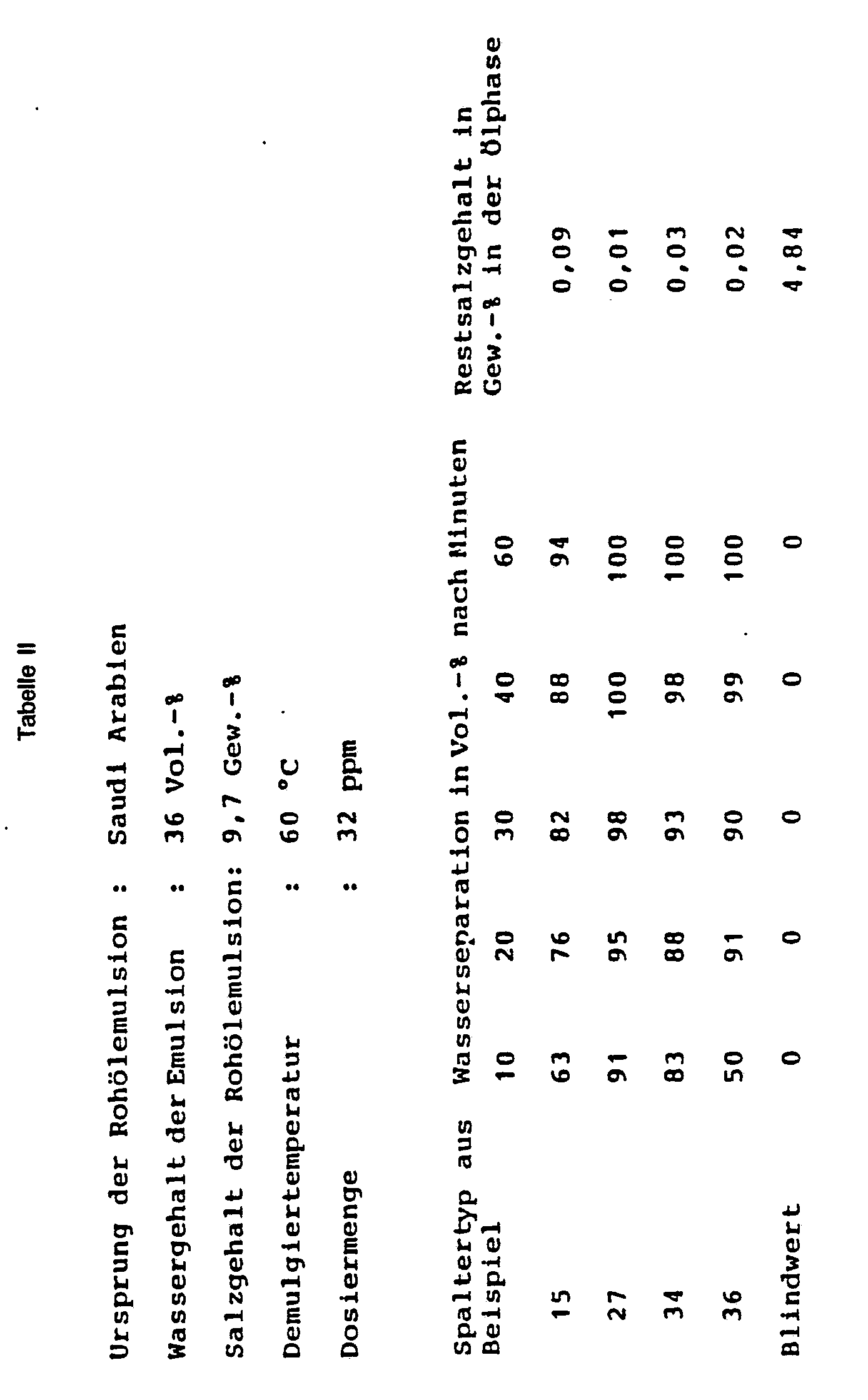
- the products according to the invention are distinguished by an excellent demulsifying action, as is shown in Tables II to IV.
Landscapes
- Chemical & Material Sciences (AREA)
- Organic Chemistry (AREA)
- Chemical Kinetics & Catalysis (AREA)
- Oil, Petroleum & Natural Gas (AREA)
- Engineering & Computer Science (AREA)
- Polymers & Plastics (AREA)
- Health & Medical Sciences (AREA)
- General Chemical & Material Sciences (AREA)
- Medicinal Chemistry (AREA)
- Polyesters Or Polycarbonates (AREA)
- Organic Low-Molecular-Weight Compounds And Preparation Thereof (AREA)
- Cosmetics (AREA)
- Polymers With Sulfur, Phosphorus Or Metals In The Main Chain (AREA)
Description
- Die Erfindung betrifft oxalkylierte Polyesteramine, ein Verfahren zu deren Herstellung und deren Verwendung als Demulgatoren für RohöJemulsionen.
- Bei der Förderung von Rohölemulsionen tritt eine zunehmende Verwässerung der geförderten Rohöle ein. Dieses mitgeförderte Wasser bildet mit dem Rohöl eine Wasser-in-ÖI-Emulsion. In dem einemulgierten Wasser können Salze wie Natriumchlorid, Calciumchlorid und Magnesiumchlorid gelöst sein. Dieses Emulsionswasser muß vor dem Transport abgetrennt weroen. In den Raffinerien wird vor der Destillation der Salzgehalt durch eine erneute Emulsionsbildung mit Süßwasser und Demulgierung weiter abgesenkt. Ein zu hoher Salzgehalt im Rohöl kann zu Störungen und Korrosion in den Raffinerien führen.
- Ein Demulgator hat die Aufgabe, bei möglichst geringer Anwendungskonzentration die Emulsion zu brechen und bei diesem Separationsprozeß möglichst ohne oder mit minimaler zusätzlicher Aufwendung von Wärme eine vollständige Wasserabscheidung zu bewirken und den Salzgehalt auf ein Minimum zu reduzieren. Die Qualitätskriterien für geliefertes Rohöl sind das Restsalz und der Wassergehalt.
- Die Rohöle sind je nach ihrer Provenienz unterschiedlich zusammengesetzt. Die natürlichen Emulsionsstabilisatoren besitzen einen komplizierten, differenzierten, chemischen Aufbau, für die gezielt Spalter entwickelt werden müssen. Durch verschiedene Förder- und Aufbereitungsbedingungen werden die Anforderungen, die an einen Demulgator gestellt werden, noch vielfältiger. Durch das ständige Erschließen neuer Rohölfelder und die Änderung der Förderbedingungen älterer Rohölfelder bleibt die Entwicklung optimaler Demulgatoren ein akutes Problem und es werden eine große Anzahl verschiedenartig aufgebauter Demulgatoren oder Demulgatormischungen benötigt.
- Stickstoffhaltige Demulgatoren sind insbesondere aus der US-PS 3 009 884 bekannt. Dort werden oxalkylierte Polyalkylenpolyamine, verestert mit Polycarbonsäuren, unter anderen auch mit Dicarbonsäuren, beschrieben, die als Demulgatoren wirksam sind. Jedoch besitzen diese Verbindungen den Nachteil einer unzureichenden Hydrophobie, das heißt, ihre Öllöslichkeit ist zu gering. Da jedoch die Wirksamkeit von Demulgatoren für die Brechung von Rohölemulsionen von dem Grad der Anwesenheit an der Grenzfläche ÖI/Wasser abhängt, ist diese Eigenschaft nachteilig, weil sich ein zu hoher Anteil des Demulgators über die gesamte wäßrige Phase verteilt.
- Für den genannten Zweck stellt die vorliegende Erfindung verbesserte Mittel zur Verfügung. Es sind dies oxalkylierte Polyesteramine der allgemeinen Formel

- R1 ein Alkylrest oder Alkenylrest von 8 bis 23 C-Atomen ist,
- R2 H oder CH3 ist und innerhalb der Kette des Polyoxalkylenrestes, in Blöcken angeordnet, auch beide Bedeutungen annehmen kann,
- R3 einen Alkylenrest der Formel ―(CH2)x, in der x eine ganze Zahl von 1 bis 6 ist, oder einen Polyoxalkylenrest der Formel

- R5 ein Alkylenrest der Formel ―(CH2)y―, in der y eine ganze Zahl von 1 bis 8 bedeutet, wobei dieser Alkylenrest gegebenenfalls 1 bis 2 OH-Gruppen tragen kann oder ein Vinylenrest ist,
- a und b, gleich oder verschieden, eine ganze oder gebrochene Zahl von 1 bis 15 ist, und
- n eine ganze Zahl von 2 bis 50 ist.
- In bevorzugten Ausführungsformen der Erfindung nehmen die Definitionen in der Formel I die folgende Bedeutung an : R1 ist ein Alkylrest von 12 bis 18 C-Atomen; R2 ist H und a und b, gleich oder verschieden, sind ganze oder gebrochene Zahlen von 1 bis 8; R3 ist der Rest eines Block-Mischpolymerisates, bestehend aus mindestens einem Block von Ethyienoxid-Linheiten und mindestens einem Block von Propylenoxid-Einheiten, wobei die Gesamtzahl der Ethylenoxid-Einheiten eine ganze oder gebrochene Zahl von 15 bis 35, die der Propylenoxid-Einheiten eine solche von 20 bis 40 ist und die Summe aus beiden höchstens 60 beträgt ; R5 ist ein Alkylenrest der Formel ―(CH2)y―, worin y eine ganze Zahl von 1 bis 8 bedeutet ; und n ist eine ganze Zahl von 2 bis 20. Die Zahlen a, b, und c stellen Mittelwerte dar.
- Die Verbindungen der Formel I werden hergestellt, indem man ein oxalkyliertes primäres Fettamin der Formel


- Bevorzugt werden das oxalkylierte primäre Fettamin und die Diolverbindung in einem Molverhältnis von 1 : 1 bis 3: 1 eingesetzt. Das Molverhältnis der Summe der Mole oxalkyliertes primäres Fettamin plus Diolverbindung zu der Molzahl an Dicarbonsäure beträgt vorzugsweise 1 : 0,8 bis 1 : 0,95.
- Die als Ausgangsverbindungen der Formel II dienenden oxalkylierten primären Fettamine werden erhalten nach bekannten Verfahren der Oxalkylierung von primären Fettaminen. Eine Übersicht über Methoden zur Herstellung dieser wohlbekannten Verbindungsklasse wird gegeben in Schönfeldt, «Surface Active Ethyleneoxide Adducts», Wissenschaftliche Verlagsgesellschaft, Stuttgart, 1976, Seiten 70 bis 73. Die oxalkylierten Produkte können Einheiten des Propylenoxids, vorzugsweise aber solche des Ethylenoxids oder aber Ketten aus beiden Einheiten tragen, wobei im letzteren Fall die beiden verschiedenen Einheiten in Blöcken angeordnet sind.
- Bevorzugte primäre Amine, die zu Ausgangsverbindungen der Formel il oxalkyliert werden können, sind die technisch verfügbaren Produkte Stearylamin oder Cocosamin. Es ist aber gemäß der Erfindung ebensogut möglich, andere Monoamine mit mehr oder weniger breiter Alkylkettenverteilung oder auch Amine mit einheitlicher Kette zu verwenden. Es können auch Fettamine einzeln oder im Gemisch eingesetzt werden, deren Ketten eine oder mehrere Doppelbindungen enthalten, wie beispielsweise die Reste der 01-, Elaidin-, Unol- oder Linolensäure.
- Solche oxalkylierten Fettamine stellen eine stickstoffhaltige, veresterungsfähige Diolkomponente dar.
- Im Gemisch damit wird eine weitere Diolverbindung eingesetzt, die keinen Stickstoff enthält. Dieses Diol der Formel HO-R3-OH, worin R3 einen Alkylenrest der Formel ―(CH2)x― bedeutet und darin x eine ganze Zahl von 1 bis 6 ist, wird repräsentiert beispielsweise durch Butan-1,4-diol oder Hexan-1,6- diol, durch Polyethylenglykole oder Polypropylenglykole oder durch Mischpolymerisate von Ethylen- und Propylenoxid, das heißt R3 ist ein Rest der Formel

- Besonders bevorzugt sind Blockpolymerisate, in denen an einen Propylenoxid-Block beidseitig Ethylenoxid-Blöcke gebunden sind, wobei dafür die vorstehend angegebenen Gesamtzahlen an Einheiten gelten. Beide Diolkomponenten - der Formel II und der Formel III - werden mit einer Dicarbonsäure der Formel IV verestert.
- Zur Veresterung geeignete Dicarbonsäuren sind aliphatische Dicarbonsäuren mit C1- bis Cs-Alkylengruppen, wie Malonsäure, Bemsteinsäure, Glutarsäure, Adipinsäure, Sebacinsäure oder aliphatische Dicarbonsäuren, die durch 1 bis 2 OH-Gruppen substituiert sind, wie Äpfesäure, Tartronsäure, Weinsäure sowie ferner auch die Fumarsäure oder die Maleinsäure. Besonders geeignet sind die aliphatischen Dicarbonsäuren mit 4 bis 8 C-Atomen im Alkylenrest, also die homologe Reihe von der Adipin- bis zur Sebacinsäure. Bei der Veresterungsreaktion können auch Derivate solcher Dicarbonsäuren, insbesondere deren Ester und Säurehalogenide, eingesetzt werden.
- Die unter Polykondensation verlaufende Veresterung der Verbindungen der Formel II und III erfolgt nach bekannten Methoden mit einer Dicarbonsäure der Formel IV in höhersiedenden inerten Lösungsmitteln, wie Toluol oder Xylol, oder bevorzugt ohne Lösungsmittel in der Schmelze und unter Abdeckung mit einem Schutzgas. Bei Veresterung in einem Lösungsmittel wählt man als Reaktionstemperatur zweckmäßigerweise die Rückflußtemperatur des Reaktionsgemisches und entfernt das gebildete Reaktionswasser durch azeotrope Destillation. Bei Veresterung in Substanz wird das Reaktionswasser direkt aus der Reaktionsmischung abdestilliert. Die Reaktionstemperaturen liegen hier bei 140 bis 220 °C, bevorzugt bei 150 bis 180°C. Zur Beschleunigung der Reaktion verwendet man einen sauren Katalysator, wie zum Beispiel p-Totuolsulfonsäure oder hypophosphorige Säure. Die Vollständigkeit der Reaktion wird über die Bestimmung der Amin- und Säurezahl kontrolliert.
- Die analytische Bestimmung des mittleren Polykondensationsgrades der erhaltenen Produkte und damit der mittleren Molmasse kann chromatographisch durch HPLC oder HPSEC erfolgen.
- Die erfindungsgemäßen Produkte zeichnen sich durch eine ausgezeichnete Demulgierwirkung aus, wie in den Tabellen II bis IV gezeigt wird.
- Die Erfindung wird durch folgende Beispiele erläutert :
- In einem 1 I-Reaktionskolben, versehen mit Wasserabscheider, Gaseinleitungsrohr und Heizung werden 451 g (0,5 mol) eines Stearylamins kondensiert mit 15 mol Ethylenoxid, 59,1 g (0,5 mol) Hexan-1,6- diol, 100,5 g (0,85 mol) Adipinsäure und 1,5 g 50 gew.-%ige hypophosphorige Säure vorgelegt, unter Stickstoff-Atmosphäre auf 160°C gebracht und unter kontinuierlicher Wasserabscheidung die Veresterungsreaktion bei dieser Temperatur fortgesetzt.
- Nach 20stündiger Reaktionszeit wird nach Bestimmung der Säure- und Aminzahl ein praktisch vollständiger Kondensationsumsatz ermittelt.
- Unter den in Beispiel 1 beschriebenen Reaktionsbedingungen werden weiterhin die in der folgenden Tabelle I, Beispiele 2 bis 36, angegebenen Verbindungen der Formel I zur Umsetzung gebracht, wobei die aufgeführten Umsetzungsgrade erzielt werden :
-
- Die in Tabelle I gebrauchten Abkürzungen haben folgende Bedeutung:
- A = Stearylamin, kondensiert mit 2 mol Ethylenoxid
- B = Stearylamin, kondensiert mit 3 mol Ethylenoxid
- C = Stearylamin, kondensiert mit 5 mol Ethylenoxid
- D = Stearylamin, kondensiert mit 8 mol Ethylenoxid
- E = Stearylamin, kondensiert mit 10 mol Ethylenoxid
- F = Stearylamin, kondensiert mit 15 mol Ethylenoxid
- G = Oleylamin, kondensiert mit 12 mol Ethylenoxid
- H = Talgfettalkylamin, kondensiert mit 2 mol Ethylenoxid
- 1 = Talgfettalkylamin, kondensiert mit 10 mol Ethylenoxid
- J = Cocosalkylamin, kondensiert mit 2 mol Ethylenoxid
- K = Cocosalkylamin, kondensiert mit 5 mol Ethylenoxid
- L = Cocosalkylamin, kondensiert mit 10 mol Ethylenoxid
- M = Cocosalkylamin, kondensiert mit 2 mol Ethylenoxid und 5 mol Propylenoxid
- N = Blockpolymeres aus 32 mol Propylenoxid und 4 mol Ethylenoxid
- O = Blockpolymeres aus 32 mol Propylenoxid und 28 mol Ethylenoxid
- P = Polypropylenglykol, Molgewicht 400
- Q = Polyethylenglykol, Molgewicht 400
- R = Hexan-1,6-diol




Claims (8)



Priority Applications (1)
| Application Number | Priority Date | Filing Date | Title |
|---|---|---|---|
| AT86109807T ATE50784T1 (de) | 1985-07-25 | 1986-07-17 | Oxalkylierte polyesteramine,verfahren zu deren herstellung und deren verwendung. |
Applications Claiming Priority (2)
| Application Number | Priority Date | Filing Date | Title |
|---|---|---|---|
| DE3526601 | 1985-07-25 | ||
| DE19853526601 DE3526601A1 (de) | 1985-07-25 | 1985-07-25 | Oxalkylierte polyesteramine, verfahren zu deren herstellung und deren verwendung |
Publications (2)
| Publication Number | Publication Date |
|---|---|
| EP0209850A1 EP0209850A1 (de) | 1987-01-28 |
| EP0209850B1 true EP0209850B1 (de) | 1990-03-07 |
Family
ID=6276725
Family Applications (1)
| Application Number | Title | Priority Date | Filing Date |
|---|---|---|---|
| EP86109807A Expired - Lifetime EP0209850B1 (de) | 1985-07-25 | 1986-07-17 | Oxalkylierte Polyesteramine,Verfahren zu deren Herstellung und deren Verwendung |
Country Status (9)
| Country | Link |
|---|---|
| US (1) | US4734523A (de) |
| EP (1) | EP0209850B1 (de) |
| JP (1) | JPS6227427A (de) |
| AR (1) | AR241467A1 (de) |
| AT (1) | ATE50784T1 (de) |
| BR (1) | BR8603494A (de) |
| CA (1) | CA1281034C (de) |
| DE (2) | DE3526601A1 (de) |
| NO (1) | NO165639C (de) |
Cited By (1)
| Publication number | Priority date | Publication date | Assignee | Title |
|---|---|---|---|---|
| WO2022008416A1 (en) * | 2020-07-09 | 2022-01-13 | Basf Se | Compositions and their applications |
Families Citing this family (13)
| Publication number | Priority date | Publication date | Assignee | Title |
|---|---|---|---|---|
| DE3638743A1 (de) * | 1986-11-13 | 1988-05-26 | Hoechst Ag | Verzweigte polyoxalkylenmischpolyester, verfahren zu ihrer herstellung und ihre verwendung |
| DE3723068A1 (de) * | 1987-07-11 | 1989-01-19 | Hoechst Ag | Verfahren zur herstellung von polykondensationsverbindungen aus oxalkylierten fettaminen, diolen und aliphatischen dicarbonsaeuren |
| DE3732340A1 (de) * | 1987-09-25 | 1989-04-13 | Hoechst Ag | Aminogruppen enthaltende alkenylbernsteinsaeureester |
| US4874837A (en) * | 1988-01-11 | 1989-10-17 | Owens-Corning Fiberglas Corporation | Aminated hydroxylated polyester polyol resin and molding compositions comprised thereof |
| DE3809065A1 (de) * | 1988-03-18 | 1989-09-28 | Hoechst Ag | Veresterte glycidylether-additionsprodukte und deren verwendung |
| DE3927638A1 (de) * | 1989-08-22 | 1991-02-28 | Hoechst Ag | Aminfreie veresterte glycidylether-additionsprodukte und deren verwendung |
| DE4217985A1 (de) * | 1992-05-30 | 1993-12-02 | Hoechst Ag | Verfahren zum Trennen von Erdölemulsionen vom Wasser-in-Öl-Typ |
| US5284495A (en) * | 1992-09-17 | 1994-02-08 | Mobil Oil Corporation | Oligomeric/polymeric multifunctional additives to improve the low-temperature properties of distillate fuels |
| US5510452A (en) * | 1994-07-11 | 1996-04-23 | Rheox, Inc. | Pourable liquid polyesteramide rheological additives and the use thererof |
| US7101538B1 (en) * | 2002-12-30 | 2006-09-05 | Avon Products, Inc. | Polyesteramine ingredient and use of same |
| US11472919B2 (en) * | 2018-06-08 | 2022-10-18 | Huntsman Petrochemical Llc | Alkoxylated alkyl amine polyesters as pour point depressants for fuels |
| WO2020120635A1 (en) | 2018-12-11 | 2020-06-18 | Nouryon Chemicals International B.V. | Polyester demulsifier |
| EP3894519A1 (de) | 2018-12-11 | 2021-10-20 | Nouryon Chemicals International B.V. | Polyesterdemulgator |
Family Cites Families (7)
| Publication number | Priority date | Publication date | Assignee | Title |
|---|---|---|---|---|
| US2652407A (en) * | 1951-05-14 | 1953-09-15 | Petrolite Corp | Fractional esters of polyoxyalkylated furfurylamine |
| US2626914A (en) * | 1951-05-14 | 1953-01-27 | Petrolite Corp | Process for breaking petroleum emulsions |
| US2647104A (en) * | 1951-07-30 | 1953-07-28 | Du Pont | Linear polyester composition |
| US3009884A (en) * | 1957-07-29 | 1961-11-21 | Petrolite Corp | Process for breaking emulsions of the oil-in-water class |
| DE3007930A1 (de) * | 1980-03-01 | 1981-09-24 | Henkel KGaA, 4000 Düsseldorf | Neue polyesterverbindungen, ein verfahren zu ihrer herstellung und ihre verwendung als textilweichmacher |
| US4442237A (en) * | 1982-11-22 | 1984-04-10 | Texaco Inc. | Novel aromatic amide polyols from the reaction of phthalic acid residues, alkylene glycols and amino alcohols |
| DE3345156A1 (de) * | 1983-12-14 | 1985-06-27 | Hoechst Ag, 6230 Frankfurt | Quaternaere oxalkylierte polyester, verfahren zu deren herstellung und deren verwendung |
-
1985
- 1985-07-25 DE DE19853526601 patent/DE3526601A1/de not_active Withdrawn
-
1986
- 1986-07-17 AT AT86109807T patent/ATE50784T1/de not_active IP Right Cessation
- 1986-07-17 DE DE8686109807T patent/DE3669320D1/de not_active Expired - Lifetime
- 1986-07-17 EP EP86109807A patent/EP0209850B1/de not_active Expired - Lifetime
- 1986-07-23 US US06/889,316 patent/US4734523A/en not_active Expired - Fee Related
- 1986-07-23 JP JP61171932A patent/JPS6227427A/ja active Pending
- 1986-07-24 AR AR86304621A patent/AR241467A1/es active
- 1986-07-24 BR BR8603494A patent/BR8603494A/pt not_active IP Right Cessation
- 1986-07-24 CA CA000514524A patent/CA1281034C/en not_active Expired - Lifetime
- 1986-07-24 NO NO862976A patent/NO165639C/no not_active IP Right Cessation
Cited By (1)
| Publication number | Priority date | Publication date | Assignee | Title |
|---|---|---|---|---|
| WO2022008416A1 (en) * | 2020-07-09 | 2022-01-13 | Basf Se | Compositions and their applications |
Also Published As
| Publication number | Publication date |
|---|---|
| NO862976L (no) | 1987-01-26 |
| DE3526601A1 (de) | 1987-01-29 |
| JPS6227427A (ja) | 1987-02-05 |
| EP0209850A1 (de) | 1987-01-28 |
| BR8603494A (pt) | 1987-03-04 |
| AR241467A1 (es) | 1992-07-31 |
| NO165639C (no) | 1991-03-13 |
| DE3669320D1 (de) | 1990-04-12 |
| NO862976D0 (no) | 1986-07-24 |
| NO165639B (no) | 1990-12-03 |
| CA1281034C (en) | 1991-03-05 |
| ATE50784T1 (de) | 1990-03-15 |
| US4734523A (en) | 1988-03-29 |
Similar Documents
| Publication | Publication Date | Title |
|---|---|---|
| EP0549918B1 (de) | Erdölemulsionsspalter auf der Basis eines Alkoxilats und Verfahren zur Herstellung dieses Alkoxilats | |
| EP0209850A1 (de) | Oxalkylierte Polyesteramine,Verfahren zu deren Herstellung und deren Verwendung | |
| EP0212265B1 (de) | Quaternäre oxalkylierte Polykondensate, Verfahren zu deren Herstellung und deren Verwendung | |
| EP0541018A2 (de) | Erdölemulsionsspalter | |
| DE2721493A1 (de) | Verbessertes verfahren zur einschraenkung der korrosion in chemischen aufarbeitungsanlagen unter verwendung von methoxypropylamin (mopa) | |
| EP0074592A2 (de) | Bisamide, Verfahren zu deren Herstellung und deren Verwendung | |
| EP0267517A2 (de) | Verzweigte Polyoxalkylenmischpolyester, Verfahren zu ihrer Herstellung und ihre Verwendung | |
| DE69530032T2 (de) | Demulgator für Öl-in-Wasser-Emulsionen und Verfahren zu seiner Anwendung | |
| EP0572881B1 (de) | Verfahren zum Trennen von Erdölemulsionen vom Wasser-in-Öl-Typ | |
| EP0493693B1 (de) | Spaltung von Wasser-in-Öl-Emulsionen | |
| DE3338923C1 (de) | Verwendung von Copolymerisaten von Polyoxyalkylenethern des Allyl- und/oder Methallylalkohols und Vinylestern als Dismulgatoren fuer Wasser enthaltendes Rohoel | |
| EP0264755B1 (de) | Alkoxylierte amidgruppenhaltige Polyamine und deren Verwendung zum Brechen von Öl-in-Wasser- und Wasser-in-Öl-Emulsionen | |
| EP0333135B1 (de) | Veresterte Glycidylether-Additionsprodukte und deren Verwendung | |
| EP0444515B1 (de) | Als Demulgatoren von Öl-in-Wasser-Emulsionen geeignete Kondensationsprodukte | |
| EP0147743B1 (de) | Vernetzte oxalkylierte Polyalkylenpolymaine und ihre Verwendung als Erdölemulsionsspalter | |
| EP1527120A1 (de) | Emulsionsspalter | |
| EP0074077B1 (de) | Bisimidazoline, Verfahren zu deren Herstellung und deren Verwendung | |
| EP1904554B1 (de) | Aminocarbonsäureester mit eo/po/buo-blockpolymerisaten und deren verwendung als emulsionsspalter | |
| EP0414174A2 (de) | Aminfreie veresterte Glycidylether-Additionsprodukte und deren Verwendung | |
| EP0192999B1 (de) | Verwendung von Kondensationsprodukten von Thioalkylenoxiden oder Polythioalkylenoxiden mit Polyalkylenoxiden als Spalter für Wasser-in-Öl-Emulsionen | |
| EP0073479A1 (de) | Alkylenoxydpolymerisate, Verfahren zu deren Herstellung und deren Verwendung | |
| EP0299348A2 (de) | Verfahren zur Herstellung von Polykondensationsverbindungen aus oxalkylierten Fettaminen, Diolen und aliphatischen Dicarbonsäuren | |
| DD151175B1 (de) | VERFAHREN ZUR HERSTELLUNG VOM DEMULGATOREN FUER DiE EROOELAUFBcRElTUNG | |
| DD151175A1 (de) | Verfahren zur herstellung von demulgatoren fuer die erdoelaufbereitung | |
| DE2238994A1 (de) | Korrosionsinhibitor und erdoelemulsionsspalter |
Legal Events
| Date | Code | Title | Description |
|---|---|---|---|
| PUAI | Public reference made under article 153(3) epc to a published international application that has entered the european phase |
Free format text: ORIGINAL CODE: 0009012 |
|
| AK | Designated contracting states |
Kind code of ref document: A1 Designated state(s): AT BE CH DE FR GB IT LI NL SE |
|
| 17P | Request for examination filed |
Effective date: 19870718 |
|
| 17Q | First examination report despatched |
Effective date: 19890412 |
|
| GRAA | (expected) grant |
Free format text: ORIGINAL CODE: 0009210 |
|
| AK | Designated contracting states |
Kind code of ref document: B1 Designated state(s): AT BE CH DE FR GB IT LI NL SE |
|
| REF | Corresponds to: |
Ref document number: 50784 Country of ref document: AT Date of ref document: 19900315 Kind code of ref document: T |
|
| ITF | It: translation for a ep patent filed | ||
| REF | Corresponds to: |
Ref document number: 3669320 Country of ref document: DE Date of ref document: 19900412 |
|
| ET | Fr: translation filed | ||
| GBT | Gb: translation of ep patent filed (gb section 77(6)(a)/1977) | ||
| PLBE | No opposition filed within time limit |
Free format text: ORIGINAL CODE: 0009261 |
|
| STAA | Information on the status of an ep patent application or granted ep patent |
Free format text: STATUS: NO OPPOSITION FILED WITHIN TIME LIMIT |
|
| 26N | No opposition filed | ||
| ITTA | It: last paid annual fee | ||
| PGFP | Annual fee paid to national office [announced via postgrant information from national office to epo] |
Ref country code: FR Payment date: 19930628 Year of fee payment: 8 |
|
| PGFP | Annual fee paid to national office [announced via postgrant information from national office to epo] |
Ref country code: CH Payment date: 19930629 Year of fee payment: 8 |
|
| PGFP | Annual fee paid to national office [announced via postgrant information from national office to epo] |
Ref country code: SE Payment date: 19930701 Year of fee payment: 8 |
|
| PGFP | Annual fee paid to national office [announced via postgrant information from national office to epo] |
Ref country code: AT Payment date: 19930708 Year of fee payment: 8 |
|
| PGFP | Annual fee paid to national office [announced via postgrant information from national office to epo] |
Ref country code: NL Payment date: 19930731 Year of fee payment: 8 |
|
| PGFP | Annual fee paid to national office [announced via postgrant information from national office to epo] |
Ref country code: BE Payment date: 19930810 Year of fee payment: 8 |
|
| PG25 | Lapsed in a contracting state [announced via postgrant information from national office to epo] |
Ref country code: AT Effective date: 19940717 |
|
| PG25 | Lapsed in a contracting state [announced via postgrant information from national office to epo] |
Ref country code: SE Effective date: 19940718 |
|
| PG25 | Lapsed in a contracting state [announced via postgrant information from national office to epo] |
Ref country code: LI Effective date: 19940731 Ref country code: CH Effective date: 19940731 Ref country code: BE Effective date: 19940731 |
|
| BERE | Be: lapsed |
Owner name: HOECHST A.G. Effective date: 19940731 |
|
| EUG | Se: european patent has lapsed |
Ref document number: 86109807.7 Effective date: 19950210 |
|
| PG25 | Lapsed in a contracting state [announced via postgrant information from national office to epo] |
Ref country code: NL Effective date: 19950201 |
|
| NLV4 | Nl: lapsed or anulled due to non-payment of the annual fee | ||
| PG25 | Lapsed in a contracting state [announced via postgrant information from national office to epo] |
Ref country code: FR Effective date: 19950331 |
|
| REG | Reference to a national code |
Ref country code: CH Ref legal event code: PL |
|
| EUG | Se: european patent has lapsed |
Ref document number: 86109807.7 |
|
| REG | Reference to a national code |
Ref country code: FR Ref legal event code: ST |
|
| REG | Reference to a national code |
Ref country code: GB Ref legal event code: 732E |
|
| REG | Reference to a national code |
Ref country code: GB Ref legal event code: IF02 |
|
| PGFP | Annual fee paid to national office [announced via postgrant information from national office to epo] |
Ref country code: DE Payment date: 20050615 Year of fee payment: 20 |
|
| PGFP | Annual fee paid to national office [announced via postgrant information from national office to epo] |
Ref country code: GB Payment date: 20050616 Year of fee payment: 20 |
|
| PG25 | Lapsed in a contracting state [announced via postgrant information from national office to epo] |
Ref country code: IT Free format text: LAPSE BECAUSE OF NON-PAYMENT OF DUE FEES;WARNING: LAPSES OF ITALIAN PATENTS WITH EFFECTIVE DATE BEFORE 2007 MAY HAVE OCCURRED AT ANY TIME BEFORE 2007. THE CORRECT EFFECTIVE DATE MAY BE DIFFERENT FROM THE ONE RECORDED. Effective date: 20050717 |
|
| PG25 | Lapsed in a contracting state [announced via postgrant information from national office to epo] |
Ref country code: GB Free format text: LAPSE BECAUSE OF EXPIRATION OF PROTECTION Effective date: 20060716 |
|
| REG | Reference to a national code |
Ref country code: GB Ref legal event code: PE20 |