EP0202437A2 - Ionenaustauschchromatographie mit indirekter photometrischer Wahrnehmung - Google Patents
Ionenaustauschchromatographie mit indirekter photometrischer Wahrnehmung Download PDFInfo
- Publication number
- EP0202437A2 EP0202437A2 EP86104465A EP86104465A EP0202437A2 EP 0202437 A2 EP0202437 A2 EP 0202437A2 EP 86104465 A EP86104465 A EP 86104465A EP 86104465 A EP86104465 A EP 86104465A EP 0202437 A2 EP0202437 A2 EP 0202437A2
- Authority
- EP
- European Patent Office
- Prior art keywords
- ions
- sample
- displacing
- eluent
- monitor
- Prior art date
- Legal status (The legal status is an assumption and is not a legal conclusion. Google has not performed a legal analysis and makes no representation as to the accuracy of the status listed.)
- Withdrawn
Links
- 238000001514 detection method Methods 0.000 title claims description 26
- 238000004255 ion exchange chromatography Methods 0.000 title description 11
- 150000002500 ions Chemical class 0.000 claims abstract description 177
- 238000005342 ion exchange Methods 0.000 claims abstract description 37
- 238000002835 absorbance Methods 0.000 claims abstract description 36
- 238000000034 method Methods 0.000 claims abstract description 28
- 238000012544 monitoring process Methods 0.000 claims abstract description 19
- 239000003480 eluent Substances 0.000 claims description 87
- 238000004458 analytical method Methods 0.000 claims description 23
- 150000001450 anions Chemical class 0.000 claims description 23
- 150000001768 cations Chemical class 0.000 claims description 20
- 230000005526 G1 to G0 transition Effects 0.000 claims description 13
- 230000035945 sensitivity Effects 0.000 claims description 13
- -1 benzene disulfonate anion Chemical class 0.000 claims description 7
- 239000007788 liquid Substances 0.000 claims description 7
- 238000004811 liquid chromatography Methods 0.000 claims description 5
- RYGMFSIKBFXOCR-UHFFFAOYSA-N Copper Chemical compound [Cu] RYGMFSIKBFXOCR-UHFFFAOYSA-N 0.000 claims description 4
- 239000010949 copper Substances 0.000 claims description 4
- 229910052802 copper Inorganic materials 0.000 claims description 4
- 230000006872 improvement Effects 0.000 claims description 4
- XNGIFLGASWRNHJ-UHFFFAOYSA-L phthalate(2-) Chemical compound [O-]C(=O)C1=CC=CC=C1C([O-])=O XNGIFLGASWRNHJ-UHFFFAOYSA-L 0.000 claims description 4
- LBLYYCQCTBFVLH-UHFFFAOYSA-M 2-methylbenzenesulfonate Chemical compound CC1=CC=CC=C1S([O-])(=O)=O LBLYYCQCTBFVLH-UHFFFAOYSA-M 0.000 claims description 3
- 238000006073 displacement reaction Methods 0.000 claims description 3
- JUJWROOIHBZHMG-UHFFFAOYSA-O pyridinium Chemical compound C1=CC=[NH+]C=C1 JUJWROOIHBZHMG-UHFFFAOYSA-O 0.000 claims description 3
- 238000011896 sensitive detection Methods 0.000 claims description 3
- 239000003153 chemical reaction reagent Substances 0.000 claims description 2
- 230000007480 spreading Effects 0.000 claims description 2
- 238000003892 spreading Methods 0.000 claims description 2
- 125000003118 aryl group Chemical group 0.000 claims 4
- 238000005259 measurement Methods 0.000 abstract description 2
- 239000000523 sample Substances 0.000 description 66
- 238000000926 separation method Methods 0.000 description 23
- 239000002585 base Substances 0.000 description 16
- 239000000243 solution Substances 0.000 description 15
- 238000010828 elution Methods 0.000 description 11
- 238000002347 injection Methods 0.000 description 11
- 239000007924 injection Substances 0.000 description 11
- 230000004044 response Effects 0.000 description 10
- 238000002474 experimental method Methods 0.000 description 9
- 239000011347 resin Substances 0.000 description 8
- 229920005989 resin Polymers 0.000 description 8
- 239000003792 electrolyte Substances 0.000 description 7
- 239000004816 latex Substances 0.000 description 7
- 229920000126 latex Polymers 0.000 description 7
- NWUYHJFMYQTDRP-UHFFFAOYSA-N 1,2-bis(ethenyl)benzene;1-ethenyl-2-ethylbenzene;styrene Chemical compound C=CC1=CC=CC=C1.CCC1=CC=CC=C1C=C.C=CC1=CC=CC=C1C=C NWUYHJFMYQTDRP-UHFFFAOYSA-N 0.000 description 6
- 238000006243 chemical reaction Methods 0.000 description 6
- 230000003287 optical effect Effects 0.000 description 5
- 230000001629 suppression Effects 0.000 description 5
- 239000011800 void material Substances 0.000 description 5
- XLYOFNOQVPJJNP-UHFFFAOYSA-N water Chemical compound O XLYOFNOQVPJJNP-UHFFFAOYSA-N 0.000 description 5
- MYRTYDVEIRVNKP-UHFFFAOYSA-N 1,2-Divinylbenzene Chemical compound C=CC1=CC=CC=C1C=C MYRTYDVEIRVNKP-UHFFFAOYSA-N 0.000 description 4
- QXNVGIXVLWOKEQ-UHFFFAOYSA-N Disodium Chemical compound [Na][Na] QXNVGIXVLWOKEQ-UHFFFAOYSA-N 0.000 description 4
- JUJWROOIHBZHMG-UHFFFAOYSA-N Pyridine Chemical compound C1=CC=NC=C1 JUJWROOIHBZHMG-UHFFFAOYSA-N 0.000 description 4
- FAPWRFPIFSIZLT-UHFFFAOYSA-M Sodium chloride Chemical compound [Na+].[Cl-] FAPWRFPIFSIZLT-UHFFFAOYSA-M 0.000 description 4
- KGBXLFKZBHKPEV-UHFFFAOYSA-N boric acid Chemical compound OB(O)O KGBXLFKZBHKPEV-UHFFFAOYSA-N 0.000 description 4
- 239000004327 boric acid Substances 0.000 description 4
- 239000003729 cation exchange resin Substances 0.000 description 4
- 238000004587 chromatography analysis Methods 0.000 description 4
- 230000009977 dual effect Effects 0.000 description 4
- 230000000694 effects Effects 0.000 description 4
- 239000000463 material Substances 0.000 description 4
- 239000000203 mixture Substances 0.000 description 4
- VWDWKYIASSYTQR-UHFFFAOYSA-N sodium nitrate Chemical compound [Na+].[O-][N+]([O-])=O VWDWKYIASSYTQR-UHFFFAOYSA-N 0.000 description 4
- UXVMQQNJUSDDNG-UHFFFAOYSA-L Calcium chloride Chemical compound [Cl-].[Cl-].[Ca+2] UXVMQQNJUSDDNG-UHFFFAOYSA-L 0.000 description 3
- DGAQECJNVWCQMB-PUAWFVPOSA-M Ilexoside XXIX Chemical compound C[C@@H]1CC[C@@]2(CC[C@@]3(C(=CC[C@H]4[C@]3(CC[C@@H]5[C@@]4(CC[C@@H](C5(C)C)OS(=O)(=O)[O-])C)C)[C@@H]2[C@]1(C)O)C)C(=O)O[C@H]6[C@@H]([C@H]([C@@H]([C@H](O6)CO)O)O)O.[Na+] DGAQECJNVWCQMB-PUAWFVPOSA-M 0.000 description 3
- 229910019142 PO4 Inorganic materials 0.000 description 3
- HEMHJVSKTPXQMS-UHFFFAOYSA-M Sodium hydroxide Chemical compound [OH-].[Na+] HEMHJVSKTPXQMS-UHFFFAOYSA-M 0.000 description 3
- 239000002253 acid Substances 0.000 description 3
- 230000003321 amplification Effects 0.000 description 3
- 238000005349 anion exchange Methods 0.000 description 3
- 239000001110 calcium chloride Substances 0.000 description 3
- 229910001628 calcium chloride Inorganic materials 0.000 description 3
- 239000008367 deionised water Substances 0.000 description 3
- 229910021641 deionized water Inorganic materials 0.000 description 3
- 230000008030 elimination Effects 0.000 description 3
- 238000003379 elimination reaction Methods 0.000 description 3
- 238000003199 nucleic acid amplification method Methods 0.000 description 3
- 238000012856 packing Methods 0.000 description 3
- 239000002245 particle Substances 0.000 description 3
- NBIIXXVUZAFLBC-UHFFFAOYSA-K phosphate Chemical compound [O-]P([O-])([O-])=O NBIIXXVUZAFLBC-UHFFFAOYSA-K 0.000 description 3
- 239000010452 phosphate Substances 0.000 description 3
- AOJFQRQNPXYVLM-UHFFFAOYSA-N pyridin-1-ium;chloride Chemical compound [Cl-].C1=CC=[NH+]C=C1 AOJFQRQNPXYVLM-UHFFFAOYSA-N 0.000 description 3
- 230000009467 reduction Effects 0.000 description 3
- 239000011734 sodium Substances 0.000 description 3
- 239000000758 substrate Substances 0.000 description 3
- 230000001052 transient effect Effects 0.000 description 3
- UAGAQPUIDMGOLD-UHFFFAOYSA-N 4-pyridin-1-ium-4-ylpyridin-1-ium;dichloride Chemical compound Cl.Cl.C1=NC=CC(C=2C=CN=CC=2)=C1 UAGAQPUIDMGOLD-UHFFFAOYSA-N 0.000 description 2
- OYPRJOBELJOOCE-UHFFFAOYSA-N Calcium Chemical compound [Ca] OYPRJOBELJOOCE-UHFFFAOYSA-N 0.000 description 2
- JPVYNHNXODAKFH-UHFFFAOYSA-N Cu2+ Chemical compound [Cu+2] JPVYNHNXODAKFH-UHFFFAOYSA-N 0.000 description 2
- TWRXJAOTZQYOKJ-UHFFFAOYSA-L Magnesium chloride Chemical compound [Mg+2].[Cl-].[Cl-] TWRXJAOTZQYOKJ-UHFFFAOYSA-L 0.000 description 2
- VYPSYNLAJGMNEJ-UHFFFAOYSA-N Silicium dioxide Chemical compound O=[Si]=O VYPSYNLAJGMNEJ-UHFFFAOYSA-N 0.000 description 2
- ZMZDMBWJUHKJPS-UHFFFAOYSA-M Thiocyanate anion Chemical compound [S-]C#N ZMZDMBWJUHKJPS-UHFFFAOYSA-M 0.000 description 2
- 239000006096 absorbing agent Substances 0.000 description 2
- 150000007513 acids Chemical class 0.000 description 2
- 239000003957 anion exchange resin Substances 0.000 description 2
- 230000008901 benefit Effects 0.000 description 2
- 230000008033 biological extinction Effects 0.000 description 2
- 230000003139 buffering effect Effects 0.000 description 2
- 229910052791 calcium Inorganic materials 0.000 description 2
- 239000011575 calcium Substances 0.000 description 2
- 239000003990 capacitor Substances 0.000 description 2
- 238000010586 diagram Methods 0.000 description 2
- 208000016253 exhaustion Diseases 0.000 description 2
- 238000005206 flow analysis Methods 0.000 description 2
- 239000003456 ion exchange resin Substances 0.000 description 2
- 229920003303 ion-exchange polymer Polymers 0.000 description 2
- 238000005457 optimization Methods 0.000 description 2
- 229920001467 poly(styrenesulfonates) Polymers 0.000 description 2
- 229920000768 polyamine Polymers 0.000 description 2
- UMJSCPRVCHMLSP-UHFFFAOYSA-N pyridine Natural products COC1=CC=CN=C1 UMJSCPRVCHMLSP-UHFFFAOYSA-N 0.000 description 2
- 239000000741 silica gel Substances 0.000 description 2
- 229910002027 silica gel Inorganic materials 0.000 description 2
- 229910052708 sodium Inorganic materials 0.000 description 2
- JHJLBTNAGRQEKS-UHFFFAOYSA-M sodium bromide Chemical compound [Na+].[Br-] JHJLBTNAGRQEKS-UHFFFAOYSA-M 0.000 description 2
- 239000011780 sodium chloride Substances 0.000 description 2
- 229910001415 sodium ion Inorganic materials 0.000 description 2
- 239000004317 sodium nitrate Substances 0.000 description 2
- 235000010344 sodium nitrate Nutrition 0.000 description 2
- LPXPTNMVRIOKMN-UHFFFAOYSA-M sodium nitrite Chemical compound [Na+].[O-]N=O LPXPTNMVRIOKMN-UHFFFAOYSA-M 0.000 description 2
- 239000002904 solvent Substances 0.000 description 2
- LXMSZDCAJNLERA-ZHYRCANASA-N spironolactone Chemical compound C([C@@H]1[C@]2(C)CC[C@@H]3[C@@]4(C)CCC(=O)C=C4C[C@H]([C@@H]13)SC(=O)C)C[C@@]21CCC(=O)O1 LXMSZDCAJNLERA-ZHYRCANASA-N 0.000 description 2
- 125000000542 sulfonic acid group Chemical group 0.000 description 2
- 230000000007 visual effect Effects 0.000 description 2
- CHRJZRDFSQHIFI-UHFFFAOYSA-N 1,2-bis(ethenyl)benzene;styrene Chemical compound C=CC1=CC=CC=C1.C=CC1=CC=CC=C1C=C CHRJZRDFSQHIFI-UHFFFAOYSA-N 0.000 description 1
- BHPQYMZQTOCNFJ-UHFFFAOYSA-N Calcium cation Chemical compound [Ca+2] BHPQYMZQTOCNFJ-UHFFFAOYSA-N 0.000 description 1
- BVKZGUZCCUSVTD-UHFFFAOYSA-L Carbonate Chemical compound [O-]C([O-])=O BVKZGUZCCUSVTD-UHFFFAOYSA-L 0.000 description 1
- VEXZGXHMUGYJMC-UHFFFAOYSA-M Chloride anion Chemical compound [Cl-] VEXZGXHMUGYJMC-UHFFFAOYSA-M 0.000 description 1
- KRKNYBCHXYNGOX-UHFFFAOYSA-K Citrate Chemical compound [O-]C(=O)CC(O)(CC([O-])=O)C([O-])=O KRKNYBCHXYNGOX-UHFFFAOYSA-K 0.000 description 1
- PIICEJLVQHRZGT-UHFFFAOYSA-N Ethylenediamine Chemical compound NCCN PIICEJLVQHRZGT-UHFFFAOYSA-N 0.000 description 1
- VTLYFUHAOXGGBS-UHFFFAOYSA-N Fe3+ Chemical compound [Fe+3] VTLYFUHAOXGGBS-UHFFFAOYSA-N 0.000 description 1
- UEEJHVSXFDXPFK-UHFFFAOYSA-N N-dimethylaminoethanol Chemical compound CN(C)CCO UEEJHVSXFDXPFK-UHFFFAOYSA-N 0.000 description 1
- 229910002651 NO3 Inorganic materials 0.000 description 1
- NHNBFGGVMKEFGY-UHFFFAOYSA-N Nitrate Chemical compound [O-][N+]([O-])=O NHNBFGGVMKEFGY-UHFFFAOYSA-N 0.000 description 1
- PMZURENOXWZQFD-UHFFFAOYSA-L Sodium Sulfate Chemical compound [Na+].[Na+].[O-]S([O-])(=O)=O PMZURENOXWZQFD-UHFFFAOYSA-L 0.000 description 1
- QAOWNCQODCNURD-UHFFFAOYSA-L Sulfate Chemical compound [O-]S([O-])(=O)=O QAOWNCQODCNURD-UHFFFAOYSA-L 0.000 description 1
- 239000000654 additive Substances 0.000 description 1
- 230000000996 additive effect Effects 0.000 description 1
- 150000001298 alcohols Chemical class 0.000 description 1
- 229910052783 alkali metal Inorganic materials 0.000 description 1
- 230000004075 alteration Effects 0.000 description 1
- 150000001412 amines Chemical class 0.000 description 1
- 238000012442 analytical experiment Methods 0.000 description 1
- 239000007864 aqueous solution Substances 0.000 description 1
- 239000011324 bead Substances 0.000 description 1
- 230000009286 beneficial effect Effects 0.000 description 1
- MIAUJDCQDVWHEV-UHFFFAOYSA-N benzene-1,2-disulfonic acid Chemical compound OS(=O)(=O)C1=CC=CC=C1S(O)(=O)=O MIAUJDCQDVWHEV-UHFFFAOYSA-N 0.000 description 1
- QMKYBPDZANOJGF-UHFFFAOYSA-K benzene-1,3,5-tricarboxylate(3-) Chemical compound [O-]C(=O)C1=CC(C([O-])=O)=CC(C([O-])=O)=C1 QMKYBPDZANOJGF-UHFFFAOYSA-K 0.000 description 1
- KCXMKQUNVWSEMD-UHFFFAOYSA-N benzyl chloride Chemical compound ClCC1=CC=CC=C1 KCXMKQUNVWSEMD-UHFFFAOYSA-N 0.000 description 1
- 229940073608 benzyl chloride Drugs 0.000 description 1
- UUZYBYIOAZTMGC-UHFFFAOYSA-M benzyl(trimethyl)azanium;bromide Chemical compound [Br-].C[N+](C)(C)CC1=CC=CC=C1 UUZYBYIOAZTMGC-UHFFFAOYSA-M 0.000 description 1
- 229910001417 caesium ion Inorganic materials 0.000 description 1
- 229910001424 calcium ion Inorganic materials 0.000 description 1
- 238000011088 calibration curve Methods 0.000 description 1
- 229910052799 carbon Inorganic materials 0.000 description 1
- 125000004432 carbon atom Chemical group C* 0.000 description 1
- 125000002091 cationic group Chemical group 0.000 description 1
- 230000008859 change Effects 0.000 description 1
- 238000013375 chromatographic separation Methods 0.000 description 1
- 229920006026 co-polymeric resin Polymers 0.000 description 1
- GVPFVAHMJGGAJG-UHFFFAOYSA-L cobalt dichloride Chemical compound [Cl-].[Cl-].[Co+2] GVPFVAHMJGGAJG-UHFFFAOYSA-L 0.000 description 1
- 229940097267 cobaltous chloride Drugs 0.000 description 1
- 150000001875 compounds Chemical class 0.000 description 1
- 230000002153 concerted effect Effects 0.000 description 1
- 229910001431 copper ion Inorganic materials 0.000 description 1
- 229910000365 copper sulfate Inorganic materials 0.000 description 1
- ORTQZVOHEJQUHG-UHFFFAOYSA-L copper(II) chloride Chemical compound Cl[Cu]Cl ORTQZVOHEJQUHG-UHFFFAOYSA-L 0.000 description 1
- ARUVKPQLZAKDPS-UHFFFAOYSA-L copper(II) sulfate Chemical compound [Cu+2].[O-][S+2]([O-])([O-])[O-] ARUVKPQLZAKDPS-UHFFFAOYSA-L 0.000 description 1
- 239000003431 cross linking reagent Substances 0.000 description 1
- 229960002887 deanol Drugs 0.000 description 1
- 238000013461 design Methods 0.000 description 1
- 230000001627 detrimental effect Effects 0.000 description 1
- 239000012972 dimethylethanolamine Substances 0.000 description 1
- 238000004090 dissolution Methods 0.000 description 1
- 239000008151 electrolyte solution Substances 0.000 description 1
- 229940021013 electrolyte solution Drugs 0.000 description 1
- 238000011067 equilibration Methods 0.000 description 1
- 230000002349 favourable effect Effects 0.000 description 1
- 229910001447 ferric ion Inorganic materials 0.000 description 1
- 239000011521 glass Substances 0.000 description 1
- 238000004128 high performance liquid chromatography Methods 0.000 description 1
- 239000012510 hollow fiber Substances 0.000 description 1
- ZMZDMBWJUHKJPS-UHFFFAOYSA-N hydrogen thiocyanate Natural products SC#N ZMZDMBWJUHKJPS-UHFFFAOYSA-N 0.000 description 1
- 229910001629 magnesium chloride Inorganic materials 0.000 description 1
- 239000012528 membrane Substances 0.000 description 1
- VLTRZXGMWDSKGL-UHFFFAOYSA-M perchlorate Inorganic materials [O-]Cl(=O)(=O)=O VLTRZXGMWDSKGL-UHFFFAOYSA-M 0.000 description 1
- VLTRZXGMWDSKGL-UHFFFAOYSA-N perchloric acid Chemical compound OCl(=O)(=O)=O VLTRZXGMWDSKGL-UHFFFAOYSA-N 0.000 description 1
- 238000005375 photometry Methods 0.000 description 1
- 239000002798 polar solvent Substances 0.000 description 1
- 229910001414 potassium ion Inorganic materials 0.000 description 1
- 230000003389 potentiating effect Effects 0.000 description 1
- 238000002360 preparation method Methods 0.000 description 1
- 238000004886 process control Methods 0.000 description 1
- 238000005086 pumping Methods 0.000 description 1
- 238000004445 quantitative analysis Methods 0.000 description 1
- 238000010791 quenching Methods 0.000 description 1
- 230000000171 quenching effect Effects 0.000 description 1
- 230000035484 reaction time Effects 0.000 description 1
- 239000012492 regenerant Substances 0.000 description 1
- 230000008929 regeneration Effects 0.000 description 1
- 238000011069 regeneration method Methods 0.000 description 1
- 230000033458 reproduction Effects 0.000 description 1
- 229910001419 rubidium ion Inorganic materials 0.000 description 1
- 239000012488 sample solution Substances 0.000 description 1
- 238000007086 side reaction Methods 0.000 description 1
- 235000010288 sodium nitrite Nutrition 0.000 description 1
- 239000001488 sodium phosphate Substances 0.000 description 1
- 229910000162 sodium phosphate Inorganic materials 0.000 description 1
- 235000011008 sodium phosphates Nutrition 0.000 description 1
- 229910052938 sodium sulfate Inorganic materials 0.000 description 1
- 235000011152 sodium sulphate Nutrition 0.000 description 1
- KVCGISUBCHHTDD-UHFFFAOYSA-M sodium;4-methylbenzenesulfonate Chemical compound [Na+].CC1=CC=C(S([O-])(=O)=O)C=C1 KVCGISUBCHHTDD-UHFFFAOYSA-M 0.000 description 1
- 229910001220 stainless steel Inorganic materials 0.000 description 1
- 239000010935 stainless steel Substances 0.000 description 1
- 238000006277 sulfonation reaction Methods 0.000 description 1
- QAOWNCQODCNURD-UHFFFAOYSA-N sulfuric acid Substances OS(O)(=O)=O QAOWNCQODCNURD-UHFFFAOYSA-N 0.000 description 1
- RYFMWSXOAZQYPI-UHFFFAOYSA-K trisodium phosphate Chemical compound [Na+].[Na+].[Na+].[O-]P([O-])([O-])=O RYFMWSXOAZQYPI-UHFFFAOYSA-K 0.000 description 1
- WFKWXMTUELFFGS-UHFFFAOYSA-N tungsten Chemical compound [W] WFKWXMTUELFFGS-UHFFFAOYSA-N 0.000 description 1
- 229910052721 tungsten Inorganic materials 0.000 description 1
- 239000010937 tungsten Substances 0.000 description 1
- 229920002554 vinyl polymer Polymers 0.000 description 1
- 239000002699 waste material Substances 0.000 description 1
Images


Classifications
-
- G—PHYSICS
- G01—MEASURING; TESTING
- G01N—INVESTIGATING OR ANALYSING MATERIALS BY DETERMINING THEIR CHEMICAL OR PHYSICAL PROPERTIES
- G01N30/00—Investigating or analysing materials by separation into components using adsorption, absorption or similar phenomena or using ion-exchange, e.g. chromatography or field flow fractionation
- G01N30/96—Investigating or analysing materials by separation into components using adsorption, absorption or similar phenomena or using ion-exchange, e.g. chromatography or field flow fractionation using ion-exchange
-
- G—PHYSICS
- G01—MEASURING; TESTING
- G01N—INVESTIGATING OR ANALYSING MATERIALS BY DETERMINING THEIR CHEMICAL OR PHYSICAL PROPERTIES
- G01N30/00—Investigating or analysing materials by separation into components using adsorption, absorption or similar phenomena or using ion-exchange, e.g. chromatography or field flow fractionation
- G01N30/02—Column chromatography
- G01N30/62—Detectors specially adapted therefor
- G01N30/74—Optical detectors
-
- G—PHYSICS
- G01—MEASURING; TESTING
- G01N—INVESTIGATING OR ANALYSING MATERIALS BY DETERMINING THEIR CHEMICAL OR PHYSICAL PROPERTIES
- G01N30/00—Investigating or analysing materials by separation into components using adsorption, absorption or similar phenomena or using ion-exchange, e.g. chromatography or field flow fractionation
- G01N30/96—Investigating or analysing materials by separation into components using adsorption, absorption or similar phenomena or using ion-exchange, e.g. chromatography or field flow fractionation using ion-exchange
- G01N2030/965—Investigating or analysing materials by separation into components using adsorption, absorption or similar phenomena or using ion-exchange, e.g. chromatography or field flow fractionation using ion-exchange suppressor columns
-
- G—PHYSICS
- G01—MEASURING; TESTING
- G01N—INVESTIGATING OR ANALYSING MATERIALS BY DETERMINING THEIR CHEMICAL OR PHYSICAL PROPERTIES
- G01N30/00—Investigating or analysing materials by separation into components using adsorption, absorption or similar phenomena or using ion-exchange, e.g. chromatography or field flow fractionation
- G01N30/02—Column chromatography
Definitions
- the invention relates to the field of ion exchange chromatography and particularly to an improved detection scheme for use therein.
- Ion Chromatography comprises a two column arrangement followed by a conductance detector.
- the first column serves to separate the ions of interest while the second column, "the suppressor”, serves to lower the conductance of the eluent while not significantly affecting the conductance of the eluted sample species.
- the suppressor column in IC disadvantageously becomes exhausted in the course of normal usage and must be periodically regenerated or replaced -usually regenerated. Whereas the regeneration step has been automated in commercial instruments so that it is less obtrusive, it would nevertheless be desirable for the following reasons, to develop single column (suppressorless) methods for the many ions that lack chromophores:
- the invention relates to an improved method for the flow analysis of photometrically differen- tiable sample and non-sample ions in a solution of photometrically monitorable liquid effluent wherein, generally, sample which is in or placed in solution is contacted with a flow-through ion exchange medium and anion or altematively cation sample ions are exchanged at the active ion exchange sites thereof, and eluted through said ion exchange medium using a liquid eluent which contains displacing ions which displace sample ions off the ion exchange medium, eventually causing displaced sample ions to appear in the effluent of the ion exchange medium, the improvement which comprises using eluent containing light-absorbing displacing ions which are or are made detectably light-absorbing in said effluent, photometrically monitoring said effluent using light which is detectably absorbed by said light-absorbing displacing ions and which photometrically distinguishes transient sample ions sufficiently to produce an effluent
- the ion exchange medium is selected to produce a chromatographic separation of cation or anion species, whichever is of interest, using displacing ions which differentially displace sample ions off the separating medium, causing the displaced ions to appear chromatographically resolved in the effluent of the separated medium and in a form whereby all or selected ion species of interest may be individually quantified indirectly according to the inventive practice.
- a basic feature of the invention is in the use of light (usually U.V.) absorbing eluents which essentially include light-absorbing ions, i.e., said displacing ions, of the same charge (but not necessarily same valence) as the ions to be separated.
- light usually U.V.
- eluents which essentially include light-absorbing ions, i.e., said displacing ions, of the same charge (but not necessarily same valence) as the ions to be separated.
- monitoring/displacing This dual functionality is recognized by the term "monitoring/displacing", and, in this respect, departs from characteristic eluents used in prior techniques which employed the displacing function, but not the monitoring function.
- the monitoring function takes unique advantage of the fact that the concentration of light-absorbing displacing ions in the ion exchange effluent varies inversely with the concentration of displaced sample ions eluting off the ion exchange medium and that this relationship or phenomenon may be applied through effluent absorbance monitoring to quite accurately determine, in a very convenient and in an indirect fashion, the concentration of displaced sample ions of interest.
- the monitoring/displacing function may be obtained by way of either (a) the selection of critical displacing ions inherently possessing the proper dual functionality, or alternatively (b) ions made to possess that functionality by a conversion step during the analytical experiment, e.g., such as by use of a post-column reaction effective to convert displacing ions in the effluent to a photometrically "visible" species.
- the invention includes the selection of critical light-absorbing displacing ions and the preparation of eluent solutions possessing a sufficient quantity of such critical ions such that an effective chromatographic displacement of the sample ions is achieved within practical and operable time limits (sometimes with the assist of a major or minor amount of non-light-absorbing displacing ions optionally added to prepare optimum forms of eluent respecting specific separations) and such that the critical ions are present in sufficient quantity to produce detectable light absorbance in the ion exchange effluent.
- the concentration of the light-absorbing displacing ions in the ion exchange effluent varies inversely to the concentration of displaced sample ions
- the appearance of displaced sample ions in the effluent is revealed by fluctuations in the effluent absorbance. These fluctuations are most generally in the form of decrements or dips or troughs appearing in the absorbance base line, at the intervals expected for the consecutive elution of the sample ion species.
- the dips or troughs reveal that the concentration of the light-absorbing displacing ions have given way to an increase in displaced sample ions which appear in transient fashion in the effluent corresponding to their respective elution times, producing a temporary "void" of light-absorbing displacing ions.
- the extent of the void indirectly reveals the concentration of displaced sample ions causing the "void". Whether the sample ions are greater or lesser light absorbers than the displacing ions, determines generally whether a "dip" or "peak" is registered in the absorbance response. Since strong light-absorbing sample ions may be deter-mined quite easily by conventional photometric detection, the invention has its greatest application in the quantitative analysis of heretofore difficult "transparent" sample ion species which produce the mentioned characteristic dip in the effluent absorbance as detected by photometric monitoring.
- the principle is unchanged, except the invention envisions that the photometric detectability of the displacing ions is a feature either achieved, or enhanced, by a conversion step occurring most often in the effluent stream between the separating medium and the photometric detector.
- photometric analysis it has been known to use such reactions to produce detectable or visible sample ions.
- the technique as used here is substantially different in concept in that the sample ions are unaffected in order to retain optimum transparent or "non-visible" characteristics.
- the displacing ion form is modified to take on or to enhance its light absorbance properties at the monitored wavelength(s) or wavelength band, whereby a depletion or reduction of such displacing ions in the effluent can be monitored with good efficiency.
- the "transparency" of the sample ions is critical to the invention, and departs substantially from the photometric monitoring techniques and - schemes proposed in the area of prior photometric detection methods having the opposite purpose of making sample ions of interest visible.
- the separating medium used in the analytic methods and apparatus of the invention is an ion-exchange material or medium, of any type effective, in separating ionic species in combination with eluents containing displacing ions.
- This area of the prior art is well developed, and may be called upon for a range of materials useful in conjunction with the invention.
- the materials may be either in the form of "packings" (the current most preferred form), or may be of such other form as can be usefully applied to achieve sample ion separations by the principle of ion-exchange elution chromatography. Exemplary of the latter is the use of hollow fiber membranes or capillary tubes to perform separations with the aid of eluents of the basic type specified herein (i.e., eluents containing displacing ions).
- the medium is also sometimes referred to herein more broadly as an "ion exchange medium" in connection with samples or types of analysis which do not require a chromatographic resolution, e.g., certain forms of total ion analysis. It may nevertheless comprise beneficially the same materials as where a resolution of species is required or practiced.
- the liquid eluent is normally prepared using as the solvent deionized water.
- Other highly polar solvents known for ion exchange chromatography such as the lower alcohols of 1-4 carbon atoms, may be admixed with water or used solely to dissolve the electrolyte component(s). It is necessary, of course, to select eluent solvents, which permit the light-absorbing displacing ion concentration of the eluent (in the effluent of the ion exchange medium) to be photometrically determined.
- the selection of the photometric detector is chosen according to the wavelength(s) or wavelength band being monitored, and is thus selected depending on the light absorbance characteristics of the displacing ions. More specifically, visible or U.V. photometric detectors of the various types known in the art, for use with liquid chromatography, can be suitably applied to applications involving the invention.
- sample ions be transparent at all wavelengths. It is required only that the same be nonabsorbing at the select wavelength(s) or wavelength band monitored; or alternatively, of characteristically different absorbance, vis-a-vis the displacing or monitored ions, at the monitored wavelength(s), such that the presence of sample ions, reducing the concentration of the displacing ions in the effluent, produces a fluctuation in the absorbance base line which is proportional to the reduction of monitored displacing ions. The fluctuation must, of course, be sufficient to quantify, at the desired sensitivity level, the concentration of sample ions of interest, based on the departure from base line absorbance levels.
- a chromatographic separating means comprising a chromatographic column 10 which is packed with an ion-exchange separating medium (not shown) in the form of pellicular or micro-particulate ion-exchange resins.
- the invention may also employ, however, any other form of ion-exchange separating medium useful in separating cations or anions, such as capillary tubes or separating medium useful to perform ion separations by eluting a sample therethrough using an eluent which contains displacing ions.
- a photometric detector 12 preferably a flow-through U.V. photometer with micro-volume cell design for liquid chromatographic applications.
- the photometer may be modified to incorporate a tungsten lamp light source.
- the analytical stream is ultimately dispelled from the photometer to waste vessel 14 or to a recycle or return line 16, whereby the spent eluent/sample is returned to a reservoir 18 containing a supply of eluent or mobile phase.
- the return to the reservoir of the eluent is considered a unique feature of the invention permitted by the fact that the sample species in the eluent is insignificant for a number of subsequent analyses.
- a sample is added into the apparatus through injection valve 20 and is swept through the apparatus by eluent solution containing light-absorbing ions.
- the eluent solution 22 is conveyed by a pump 24, monitored by a pressure gauge 26, and is then passed through the sample injection valve 20 to column 10.
- the eluent solution may also be added manually to column 10 as by pouring the solution from a container into an open end of the column. However, the solution is preferably added in a continuous stream to obtain greater uniformity and reproducibility of results.
- the solution leaving column 10 with the ionic species resolved is conveyed by a conduit to the photometric detector.
- the presence of light-absorbing, displacing ions in the effluent produces an electrical signal proportional to the amount of such ions present in the effluent.
- the signal is directed from the detector to a visual recorder such as a strip chart recorder 28, which continually reproduces the detector signal.
- the decrements (or troughs) observed in the base line absorbance are ultimately related to sample ion species, to produce sample species concentration data as is described more fully below.
- the apparatus of the invention preferably includes a sample injection valve controller 30, which automates the operation of the injection valve, and which is also used to superimpose a transient signal on the detector output to recorder 28 to mark the strip chart with a spike to indicate the injection event.
- a further optional feature of the apparatus is an electronic interface module 32 which is adapted to: (1) provide additional base line biasing voltage to offset the elevated detector base line that exists because of the use of absorbing displacing ions, and (2) provide impedance buffering to interface multiple types of recorders to various photometric detectors regardless of their peculiar input/output specifications.
- the electronic interface module comprises high-performance operational amplifiers, 40 through 46 which are operated by a power supply (not shown).
- Amplifier 40 is connected through electrical lead 48 to the detector output terminal.
- the output signal originating in the detector is transmitted through amplifier 40 without amplification and with impedance buffering to avoid overloading of the detector output circuit.
- a potentiometer 50 operated in a voltage divider mode is used to select a biasing reference voltage of between 0 and -5 V DC, which is transmitted to amplifier 42 operating in the same mode as amplifier 40.
- a positive voltage signal from amplifier 40 and a negative voltage signal from amplifier 42 are combined at junction 52 to produce a voltage that equals one-half the sum of the combined amplifier outputs.
- Resistors 54, 56 provide current limiting functionality in accordance with standard practice.
- the combined signal is transmitted through a low pass filter comprising resistor 58 and capacitor 60 to remove high frequency noise.
- the signal is conducted to amplifier 44 which is again arranged in a non-inverting mode, whereby the signal from amplifiers 40, 42 is doubled through the selection of equal value resistors 62 and 64.
- the resulting output signal from amplifier 44 reduces, without net amplification, the detector output on a suppressed or reduced base line level, i.e., the detector output is compensated for without affecting small order base line disturbances, and may then be fed directly to a conventionally designed strip chart recorder through lead 66.
- the amplifier 46 may be optionally employed to receive output signal from amplifier 44 and convert this signal to a form whereby the same may be used to operate signal processors which require relatively high input voltage levels, e.g., an integrator or microcomputer. To this end, the input signal to amplifier 46 is processed in a non-inverting mode that yields an amplification factor of 100 through the selection of the ratio of resistors 68 and 70. A capacitor 72 is connected in the circuit to remove high frequency output components in the signal. The amplified signal is conducted by lead 74 to the integrator or similar device.
- Figure 3 is a depiction of an anion exchange medium (stationary phase) in the operating condition of being pumped and equilibrated with mobile phase or liquid eluent comprising C + E- electrolyte, where C * is the co-ion to a light-absorbing displacing eluent anion E-.
- C * is the co-ion to a light-absorbing displacing eluent anion E-.
- a concentration monitor capable of sensing all ionic species and placed at the outlet of the ion exchange column would thus reveal a steady level of C + and E- if the feed concentration of the eluent is maintained constant as shown in the photometrically derived chromatogram of Figure 5.
- the sample anion S- is chromatographically retarded by attraction to the active ion exchange sites of the stationary phase and will exit in the ion exchange effluent at a characteristic elution volume determined by such factors generally as the capacity of the exchange medium, the concentration of the eluent and the affinity of the ion exchange sites or stationary phase for S- relative to E-. These factors are well known in the art.
- the invention is based on the principle that accompanying the appearance of S- sample ions in the effluent, there must be a concerted and equivalent change in the concentration of E- light absorbing displacing ions. This relationship is predetermined by the principles of electro-neutrality and equivalence of exchange which require that the total equivalent concentrations of anions (S- and E-) must remain fixed since the concentration of co-ions C + is fixed. Consequently, by monitoring effluent absorbance under conditions which permit the light-absorbing displacing ions to be photometrically distinguished from the sample, fluctuations are produced in the effluent absorbance signal as the concentration of the monitored displacing ions periodically gives way to eluting sample ions in the effluent.
- Cation analysis is essentially identical in principle using as the stationary phase a suitable and equilibrated cation ion exchange medium, and as the mobile phase, electrolyte supplying light-absorbing cations as the displacing ions.
- the sensitivity of detection will be determined in larger part by how the trough depth (or peak height) compares to base line noise. Hence, the larger the fractional disturbance in base line caused by the sample, the greater the precision.
- Mathematical analysis generally shows that the precision in determining trough depth, and hence the sensitivity of detection, will be improved the lower the concentration of eluent employed. However, there is a practical limit to how low the concentration of the eluent may be used since too low a concentration will impose long run times and loss of sensitivity due to band spreading. Ideally, the run time should be no longer than the time necessary for adequate resolution of the peaks.
- Sample concentration also predetermines the strength of the eluent concentration.
- the source of this limitation resides in the inability of the eluent to satisfactorily displace sample ions at a higher concentration than the displacing ions of the eluent.
- Using relatively small dilute samples, - (10-' to 10- 6 molar) experience has generally established that most workable displacing ion concentration in the eluent will be in the range of about 10-' to 10- 6 molar.
- the optical absorbance of the eluent in the effluent must also be sufficiently greater than noise to insure sensitive detection of the eluted species. This in turn calls for the use of light-absorbing displacing ions of high molar extinction coefficients since dilute eluent solutions are ordinarily used in typical analysis. From experience, a desirable level of optical density is in the range of from 0.01 to 3, and preferably from 0.5 to 1.5 absorbance units at the monitored wavelength(s) or wavelength band.
- Preferred eluents are thus selected on the combined basis of capability to elute sample ions within practical times, and adequate optical density.
- the monitoring/displacing function can be found in ions with aromaticity.
- the aromaticity leads to high molar extinction coefficients in the U.V. and confers on the ions a relatively high affinity for the ion exchange separating mediums commonly used.
- phthalate specifically phthalate, trimesate (1,3,5 benzene tricarboxylate), toluene sulfonate, and benzene disulfonate are preferred for use as light-absorbing displacing ions - the phthalate especially so.
- trimesate at pH 10 an exceptional sensitivity is observed relative to temperature changes in the column. Where such is manifested, the column is desirably encased in thermostated jacket, e.g., a circulating water jacket, maintained at a constant temperature.
- suitable eluents may be prepared using electrolyte solutions of pyridinium halides such as pyridinium chloride and bipyridinium dissociable compounds such as 4,4'-bipyridinium dihydrochloride (preferred for divalent cation separations) as the light-absorbing cation.
- pyridinium halides such as pyridinium chloride and bipyridinium dissociable compounds such as 4,4'-bipyridinium dihydrochloride (preferred for divalent cation separations) as the light-absorbing cation.
- Divalent copper such as copper sulfate and aromatic quaternary ammonium ions such as are obtained from the dissolution of benzyl trimethyl ammonium bromide are also suitable for cation separations and indirect photometric detection.
- Anion separations may also be performed using a non-light-absorber such as thiocyanate ion to which may be added, such as by constant flow addition to the ion exchange effluent, ferric ion to produce a visible species for photometric monitoring purposes.
- a non-light-absorber such as thiocyanate ion to which may be added, such as by constant flow addition to the ion exchange effluent, ferric ion to produce a visible species for photometric monitoring purposes.
- protonated polyamine ions such as ethylene diamine or diethylene amine may be used for cation separations and complexed with divalent copper ion under controlled pH conditions for photometric detection.
- divalent copper may be used for cation separations, and complexed with a polyamine additive for enhanced photometric detectability.
- the eluent solution may also require buffer ions added to control either the valence of the monitor-displacing ion or the sample ions or both.
- the monitor- displacing ion may occasionally act as its own buffer.
- the displacing electrolyte may incorporate a major or minor portion of non-light-absorbing ions added for displacing functionality but which lack monitoring properties. The eluting power of the eluent may thus be derived solely from the monitor displacing ion or shared between the monitored ion and other ions in the system.
- Ion exchange separating media used with the described eluent systems are preferably (for anion separations) the low specific capacity, surface agglomerated form of anion exchange resin as described in U.S. Patent Nos. 4,101,460 and 4,119,580.
- the preferred separating media and eluent parameters are almost suited to typical case analysis of dilute relatively small samples, in turn, beneficially calling for dilute eluent electrolytes and low specific capacity forms of separating media.
- Directly injected more concentrated or larger samples can be analyzed according to the method of the invention using corresponding stronger eluents and higher capacity separating media, as required in accordance with the principles of ion exchange chromatography.
- the optical density of the monitored ion is adjusted, e.g., by wavelength selection, to achieve a desirable optical density level to insure sensitive detection.
- Two 2.8 x 250 mm Altex glass columns packed with a surface agglomerated resin form of separating medium are prepared according to the method of U.S. Patent 4,119,580, using as the substrate, 8 percent cross-linked styrene divinyl benzene strong acid cation exchange resin (BioRad@ AG-50WX8, 37-44u.m Na+ form resin); and as the anion exchange latex deposit, a latex prepared by contacting polyvinyl benzyl chloride latex resin, containing about 5 weight percent divinylbenzene cross-linking agent, with excess dimethylethanolamine to form latex particles with active anion exchange sites.
- the latex is characterized as having a volume average diameter of about 0.6 micron.
- the packed columns are connected in series and eluent is pumped through the column at a rate of 2 mis/min.
- a sample injection valve with a 20 u.1 sample loop is used to inject a sample to the head of the columns.
- the outlet of the columns is coupled to an LDC Model 1203 U.V. detector operating at a wavelength of 254 nm.
- the output stage of the detector is connected to the above-described electronic suppressor 32, which impresses a voltage potential counter to that developed by the detector.
- the resulting suppressed output signal is applied to a Linear@ Model 156 strip chart recorder.
- Eluent is pumped through the columns until the effluent absorbance is stable and equal to that of the eluent (1.124 absorbance units).
- the sensitivity of the detector is then set at 0.064 absorbance units full scale (A.U.F.S.) and the background suppressor circuit of the detector is adjusted so that the base line response on the recorder (set at 10 mv full scale) reads about 90-100 percent of full scale.
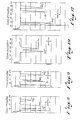
- a sample solution of 10-' M sodium chloride is injected and the recorder solid line trace of Figure 7 is obtained -trough 1 being a disturbance at the void volume of the column while trough 2 at approximately 7.4 mls is due to elution of the chloride ion.
- Eluent is pumped through the columns of Example I at a rate of 2 mlsimin with the eluent having a slightly different composition of 10- 3 M disodium ortho-phthalate and + 10 -3 M boric acid adjusted to pH 9 with sodium hydroxide.
- Eluent is pumped through the columns at a rate of 2 mls/min with the eluent having a composition of 10 -3 disodium ortho-phthalate + 10- 3 boric acid adjusted to pH 8.
- the effluent absorbance when the columns reach equilibrium is 1.083 A.U.
- Various mixtures of nitrate, sulfate and phosphate are injected (20 ⁇ l injections) and the depths of their resulting troughs are measured.
- the sensitivity (A.U.F.S.) of the detector and the background suppressor are adjusted so as to keep the troughs on scale. The results are as follows:
- Example 3 The experimental conditions of Example 3 are used in this example and separate injections made of sodium nitrate, sodium sulfate and sodium phosphate.
- a single column is prepared in the manner of Example I and eluent is pumped through the column at a rate of 2 mls/min with a solution of 2 x 10 -3 M sodium toluene sulfonate and 10- 3 M boric acid adjusted to pH 8.
- the toluene sulfonate ion is the monitor ion and the major displacing ion.
- Samples containing various anions are injected and elution volumes determined as follows: '
- This example illustrates how more tightly held ions such as thiocyanate, perchlorate and citrate may be effectively displaced by a more potent displacing ion such as the trimesate ion which is also the monitor ion.
- a sample of 10- 3 molar of each of sodium nitrite and sodium chloride and 2 ⁇ 10- 3 molar of each of sodium bromide and sodium nitrate is injected into a 4.1 ⁇ 250 mm stainless steel column packed with a surface agglomerated form of anion exchange resin as described in Example 1, except substituting as the substrate, Dowex@ 50 ⁇ 8 20 ⁇ m, Na + form cation exchange resin.
- Eluent of 10 -3 molar disodium ortho-phthalate + 10- 3 molar boric acid, adjusted to pH 8, is pumped at a rate of 2 ml/min through the column, and by way of a stream splitter T-fitting, is simultaneously pumped at a rate of about 1.25 mi/min to the reference cell of an LDC 1203 photometer set at 254 nm.
- An illustration of the resulting chromatogram is shown in Figure 12.
- Reference cell suppression to electronic suppression
- Reference cell suppression also beneficially adjusts for drifts in base line absorbance cause by eluent factors, and would be desirably used when spent eluent is recycled to the eluent reservoir.
- An Altex photometric detector, Model 153 is set at a wavelength of 254 nm and operates with reference cell suppression.
- a pump feeds eluent directly from the eluent reservoir to the reference cell of the detector.
- the detector is used under the following varied "Conditions" A through F for anion analysis.
- Table 3 summarizes the results achieved, in terms of elution volumes of various tested anion species, using the eluent/separating medium Combinations A-F described above.
- This experiment illustrates the separation and detection of mixed sodium and calcium ions, using as the eluent, an aqueous solution of 5 x 10- 3 M pyridine adjusted to pH 4.5 by the addition of HCI. Weakly basic pyridine is thus converted to cationic pyridinium ion (pKa 5.25) with the dual role of displacing ion in the separating column and monitor ion in the UV detector.
- the chromatographic column is a commercially available Whatman Partisil-10 SCX s.s. column of 250 mm length and 4.6 mm I.D. Its 10 micron particle packing is a silica gel with siloxane-bonded sulfonic acid functional groups.
- the eluent is pumped at a rate of 2 mls/min - (2,350 psig) consecutively through a sample valve - (20 microliter injection), Partisil-SCX column and Perkin-Elmer Model 75 HPLC/UV detector set for 265 nm analysis wavelength.
- This Example is used to illustrate the effect various eluents have on detection limits of a given sample standard of mixed alkali metal cations.
- the experiment uses as the separating medium, a low specific capacity cation exchange resin prepared by the surface sulfonation of 2 percent cross-linked sytrene divinyl benzene copolymer resin, 180-400 U.S. standard mesh size, using 5 minutes reaction time of preheated (93°C) resin in preheated - (93°C) concentrated sulfuric acid, followed by rapid quenching in deionized water (the method of U.S. Patent 3,966,596).
- the experiment uses the following common conditions:
- Table 4 defines the variable conditions of the experiment also giving the calculated detection limit for each resolved cation species using the criterion of a signal/noise ratio of 2.
- the resulting chromatogram, using the preferred pyridinium chloride eluent is reproduced in the drawing as Figure 14 and illustrates the favorable separation of the K + , Rb + and Cs + ion species from Na + and Li + .
- This experiment illustrates the separation and detection of tightly bound divalent cations using an eluent of high displacing power, comprising a solution of 5 x 10 -3 M 4,4'-bipyridinium dihydrochloride in deionized water.
- Two samples are analyzed, specifically, a sample of 10- 2 M of each of copper chloride, magnesium chloride and calcium chloride; and a sample of 10- 2 M of each of cobaltous chloride and calcium chloride.
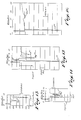
- the analysis wavelength is set at 307.2 nm using the further conditions of analysis described with respect to Example 9. Base line separation and detection of all divalent ion species is achieved. Reproductions of the chromatograms are shown in the drawing as Figures 15 and 16. The cause for an observed disturbance "A" between the Cu ++ and Mg ++ troughs of the Figure 15 chromatogram is not yet explained.
- the detection limit is defined as that concentration of sample giving a trough depth only twice as large as the noise or a signal-to-noise ratio of 2.
- Detection limit is equivalent to "sensitivity”.
- Detector Perkin-Elmer LC-75 variable wavelength single beam visible/ ⁇ V detector for liquid chromatography; 8 microliter, 6 mm cell.
- the analysis wavelength is varied as shown in Table 5 of the recorded data below. Absorbance values are in relation to zero absorbance defined at 280 nm wavelength reference.
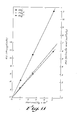
- Example 11 illustrates that sensitivity optimization is obtained by balancing the competing effects of noise, which increases with increasing base line absorbance; and in this case trough depth, which to an optimum value increases with base line absorbance increases, and thereafter diminishes. It also shows that over an absorbance range of about .5 to 1.5 absorbance units, sensitivity performance is essentially equivalently good.
Landscapes
- Physics & Mathematics (AREA)
- Biochemistry (AREA)
- Health & Medical Sciences (AREA)
- Life Sciences & Earth Sciences (AREA)
- Chemical & Material Sciences (AREA)
- Analytical Chemistry (AREA)
- General Health & Medical Sciences (AREA)
- General Physics & Mathematics (AREA)
- Immunology (AREA)
- Pathology (AREA)
- Spectroscopy & Molecular Physics (AREA)
- Investigating Or Analysing Materials By Optical Means (AREA)
- Investigating Or Analysing Materials By The Use Of Chemical Reactions (AREA)
Applications Claiming Priority (2)
| Application Number | Priority Date | Filing Date | Title |
|---|---|---|---|
| US15381480A | 1980-05-27 | 1980-05-27 | |
| US153814 | 1980-05-27 |
Related Parent Applications (2)
| Application Number | Title | Priority Date | Filing Date |
|---|---|---|---|
| EP81103847.0 Division | 1981-05-19 | ||
| EP81103847A Division EP0040798B1 (de) | 1980-05-27 | 1981-05-19 | Ionenaustauschchromatographie mit indirekter photometrischer Wahrnehmung |
Publications (2)
| Publication Number | Publication Date |
|---|---|
| EP0202437A2 true EP0202437A2 (de) | 1986-11-26 |
| EP0202437A3 EP0202437A3 (de) | 1987-04-01 |
Family
ID=22548845
Family Applications (2)
| Application Number | Title | Priority Date | Filing Date |
|---|---|---|---|
| EP86104465A Withdrawn EP0202437A3 (de) | 1980-05-27 | 1981-05-19 | Ionenaustauschchromatographie mit indirekter photometrischer Wahrnehmung |
| EP81103847A Expired EP0040798B1 (de) | 1980-05-27 | 1981-05-19 | Ionenaustauschchromatographie mit indirekter photometrischer Wahrnehmung |
Family Applications After (1)
| Application Number | Title | Priority Date | Filing Date |
|---|---|---|---|
| EP81103847A Expired EP0040798B1 (de) | 1980-05-27 | 1981-05-19 | Ionenaustauschchromatographie mit indirekter photometrischer Wahrnehmung |
Country Status (5)
| Country | Link |
|---|---|
| EP (2) | EP0202437A3 (de) |
| JP (1) | JPS5720662A (de) |
| AU (1) | AU539724B2 (de) |
| CA (1) | CA1168705A (de) |
| DE (1) | DE3176499D1 (de) |
Cited By (2)
| Publication number | Priority date | Publication date | Assignee | Title |
|---|---|---|---|---|
| EP0359322A3 (de) * | 1988-09-16 | 1991-09-11 | Koninklijke Philips Electronics N.V. | Flüssigchromatographie |
| EP0504948A1 (de) * | 1987-04-10 | 1992-09-23 | The Flinders University Of South Australia | Nachweis von Ionen in Flüssigkeiten |
Families Citing this family (7)
| Publication number | Priority date | Publication date | Assignee | Title |
|---|---|---|---|---|
| AU550730B2 (en) * | 1982-03-09 | 1986-04-10 | Commonwealth Of Australia, The | Automated metal detection |
| US4629705A (en) * | 1984-05-31 | 1986-12-16 | The Dow Chemical Company | Indirect-photometric chromatography done in and with a variable capacity weakly basic or acidic ion exchange column |
| JPS6166146A (ja) * | 1984-09-07 | 1986-04-04 | Yokogawa Hokushin Electric Corp | イオン種分析方法 |
| US4567753A (en) * | 1984-12-12 | 1986-02-04 | The Dow Chemical Company | Independent analysis of anions and cations using indirect photometric chromatography |
| GB2171328B (en) * | 1985-01-07 | 1988-10-19 | Loughborough Consult Ltd | Improvements in or relating to gas chromatography |
| JPH0715467B2 (ja) * | 1985-03-30 | 1995-02-22 | 株式会社島津製作所 | 陰イオン分析法 |
| US4734377A (en) * | 1986-03-31 | 1988-03-29 | Sujit Banerjee | Method for indirect detection of nonelectrolytes in liquid chromatography |
Citations (3)
| Publication number | Priority date | Publication date | Assignee | Title |
|---|---|---|---|---|
| US3966596A (en) | 1973-08-06 | 1976-06-29 | The Dow Chemical Company | High performance, cation-exchange chromatography on surface-sulfonated compositions |
| US4101460A (en) | 1973-10-02 | 1978-07-18 | The Dow Chemical Company | High performance ion exchange composition |
| US4119580A (en) | 1977-11-07 | 1978-10-10 | Dionex Corporation | Method for forming agglomerated ion exchange resin |
Family Cites Families (5)
| Publication number | Priority date | Publication date | Assignee | Title |
|---|---|---|---|---|
| GB1173996A (en) * | 1967-05-10 | 1969-12-10 | Hitachi Ltd | Automatic Liquid Chromatography and Chromatograph |
| SE342510B (de) * | 1970-06-04 | 1972-02-07 | Haessle Ab | |
| US4128399A (en) * | 1976-03-15 | 1978-12-05 | Liotta Lance A | Device and method for detecting phenothiazine-type drugs in urine |
| DE2732288A1 (de) * | 1977-07-16 | 1979-02-01 | Projektierung Chem Verfahrenst | Verfahren zur automatischen trennung und quantitativen bestimmung von furfurolen und/oder niederen aliphatischen aldehyden, gegebenenfalls im gemisch mit zuckern |
| US4238196A (en) * | 1979-11-01 | 1980-12-09 | Isolab, Inc. | Methods to determine a diagnostic indicator of blood sugar conditions, and, liquid chromatographic columns therefor (cyanide free) |
-
1981
- 1981-05-06 CA CA000376926A patent/CA1168705A/en not_active Expired
- 1981-05-13 AU AU70540/81A patent/AU539724B2/en not_active Ceased
- 1981-05-19 EP EP86104465A patent/EP0202437A3/de not_active Withdrawn
- 1981-05-19 EP EP81103847A patent/EP0040798B1/de not_active Expired
- 1981-05-19 DE DE8181103847T patent/DE3176499D1/de not_active Expired
- 1981-05-27 JP JP8066281A patent/JPS5720662A/ja active Granted
Patent Citations (3)
| Publication number | Priority date | Publication date | Assignee | Title |
|---|---|---|---|---|
| US3966596A (en) | 1973-08-06 | 1976-06-29 | The Dow Chemical Company | High performance, cation-exchange chromatography on surface-sulfonated compositions |
| US4101460A (en) | 1973-10-02 | 1978-07-18 | The Dow Chemical Company | High performance ion exchange composition |
| US4119580A (en) | 1977-11-07 | 1978-10-10 | Dionex Corporation | Method for forming agglomerated ion exchange resin |
Cited By (2)
| Publication number | Priority date | Publication date | Assignee | Title |
|---|---|---|---|---|
| EP0504948A1 (de) * | 1987-04-10 | 1992-09-23 | The Flinders University Of South Australia | Nachweis von Ionen in Flüssigkeiten |
| EP0359322A3 (de) * | 1988-09-16 | 1991-09-11 | Koninklijke Philips Electronics N.V. | Flüssigchromatographie |
Also Published As
| Publication number | Publication date |
|---|---|
| AU7054081A (en) | 1981-12-03 |
| EP0040798A3 (en) | 1983-05-04 |
| EP0202437A3 (de) | 1987-04-01 |
| AU539724B2 (en) | 1984-10-11 |
| DE3176499D1 (en) | 1987-12-03 |
| CA1168705A (en) | 1984-06-05 |
| JPS5720662A (en) | 1982-02-03 |
| EP0040798B1 (de) | 1987-10-28 |
| EP0040798A2 (de) | 1981-12-02 |
| JPH0127386B2 (de) | 1989-05-29 |
Similar Documents
| Publication | Publication Date | Title |
|---|---|---|
| Small et al. | Indirect photometric chromatography | |
| CA1154282A (en) | Chromatographic separation and quantitative analysis of ionic species | |
| US4699718A (en) | Ion chromatography method and apparatus | |
| Molnar et al. | High-performance liquid chromatography of ions | |
| US5149661A (en) | Fluid analysis with particulate reagent suspension | |
| US4414842A (en) | Ion exchange chromatography with indirect photometric detection | |
| US4751189A (en) | Method for balancing background conductivity for ion chromatography | |
| EP0040798B1 (de) | Ionenaustauschchromatographie mit indirekter photometrischer Wahrnehmung | |
| Verheggen et al. | Feasibility of capillary zone electrophoresis with suppression of electroendosmotic flow in completely closed systems | |
| Tabatabai et al. | Liquid chromatography | |
| Lin et al. | Measurement of stability constants for complexes of divalent cations with tartaric acid by ion chromatography | |
| US4567753A (en) | Independent analysis of anions and cations using indirect photometric chromatography | |
| Morin et al. | Capillary electrophoresis of alkali and alkaline-earth cations with imidazole or benzylamine buffers | |
| Crommen et al. | Indirect UV detection of hydrophilic ionized compounds in reversed-phase liquid chromatography by use of a UV-absorbing ion of the same charge | |
| Sherman et al. | Indirect cationic chromatography with fluorometric detection | |
| US5132018A (en) | Isoconductive gradient ion chromatography | |
| Lockridge et al. | Potentiometric detection of halides and pseudohalides in anion chromatography | |
| EP0453604B1 (de) | Verfahren zur chromatographischen Bestimmung von Ionen | |
| Krejči et al. | Enrichment techniques and trace analysis with microbore columns in liquid chromatography | |
| Janoš et al. | An ion-exchange separation of Cu2+, Cd2+, Pb2+ and Tl+ on silica gel with polarographic detection | |
| US4679428A (en) | Independent analysis of anions and cations using indirect photometric chromatography | |
| Ramstad et al. | Electrosorptive detection based on double-layer capacitance for selective anion monitoring in ion chromatography: Part 1. Mercury Electrodes | |
| JPH0443235B2 (de) | ||
| Gjerde et al. | Determination of analytes at extreme concentration ratios by gradient ion chromatography with solid-phase reaction detection | |
| Jun et al. | A study of a permanently coated polymeric column for simultaneous separation of inorganic anions and mono-carboxylic acids |
Legal Events
| Date | Code | Title | Description |
|---|---|---|---|
| PUAI | Public reference made under article 153(3) epc to a published international application that has entered the european phase |
Free format text: ORIGINAL CODE: 0009012 |
|
| 17P | Request for examination filed |
Effective date: 19860402 |
|
| AC | Divisional application: reference to earlier application |
Ref document number: 40798 Country of ref document: EP |
|
| AK | Designated contracting states |
Kind code of ref document: A2 Designated state(s): BE DE FR GB IT NL |
|
| PUAL | Search report despatched |
Free format text: ORIGINAL CODE: 0009013 |
|
| AK | Designated contracting states |
Kind code of ref document: A3 Designated state(s): BE DE FR GB IT NL |
|
| 17Q | First examination report despatched |
Effective date: 19871026 |
|
| STAA | Information on the status of an ep patent application or granted ep patent |
Free format text: STATUS: THE APPLICATION IS DEEMED TO BE WITHDRAWN |
|
| 18D | Application deemed to be withdrawn |
Effective date: 19891005 |
|
| RIN1 | Information on inventor provided before grant (corrected) |
Inventor name: MILLER, THEODORE EDWARD, JR. Inventor name: SMALL, HAMISH |