EP0453604B1 - Verfahren zur chromatographischen Bestimmung von Ionen - Google Patents
Verfahren zur chromatographischen Bestimmung von Ionen Download PDFInfo
- Publication number
- EP0453604B1 EP0453604B1 EP90108022A EP90108022A EP0453604B1 EP 0453604 B1 EP0453604 B1 EP 0453604B1 EP 90108022 A EP90108022 A EP 90108022A EP 90108022 A EP90108022 A EP 90108022A EP 0453604 B1 EP0453604 B1 EP 0453604B1
- Authority
- EP
- European Patent Office
- Prior art keywords
- mobile phase
- process according
- ions
- modifier
- counterion
- Prior art date
- Legal status (The legal status is an assumption and is not a legal conclusion. Google has not performed a legal analysis and makes no representation as to the accuracy of the status listed.)
- Expired - Lifetime
Links
Images

Classifications
-
- B—PERFORMING OPERATIONS; TRANSPORTING
- B01—PHYSICAL OR CHEMICAL PROCESSES OR APPARATUS IN GENERAL
- B01J—CHEMICAL OR PHYSICAL PROCESSES, e.g. CATALYSIS OR COLLOID CHEMISTRY; THEIR RELEVANT APPARATUS
- B01J39/00—Cation exchange; Use of material as cation exchangers; Treatment of material for improving the cation exchange properties
- B01J39/26—Cation exchangers for chromatographic processes
-
- B—PERFORMING OPERATIONS; TRANSPORTING
- B01—PHYSICAL OR CHEMICAL PROCESSES OR APPARATUS IN GENERAL
- B01D—SEPARATION
- B01D15/00—Separating processes involving the treatment of liquids with solid sorbents; Apparatus therefor
- B01D15/08—Selective adsorption, e.g. chromatography
- B01D15/26—Selective adsorption, e.g. chromatography characterised by the separation mechanism
- B01D15/32—Bonded phase chromatography
- B01D15/325—Reversed phase
-
- B—PERFORMING OPERATIONS; TRANSPORTING
- B01—PHYSICAL OR CHEMICAL PROCESSES OR APPARATUS IN GENERAL
- B01D—SEPARATION
- B01D15/00—Separating processes involving the treatment of liquids with solid sorbents; Apparatus therefor
- B01D15/08—Selective adsorption, e.g. chromatography
- B01D15/26—Selective adsorption, e.g. chromatography characterised by the separation mechanism
- B01D15/36—Selective adsorption, e.g. chromatography characterised by the separation mechanism involving ionic interaction, e.g. ion-exchange, ion-pair, ion-suppression or ion-exclusion
- B01D15/366—Ion-pair, e.g. ion-pair reversed phase
-
- B—PERFORMING OPERATIONS; TRANSPORTING
- B01—PHYSICAL OR CHEMICAL PROCESSES OR APPARATUS IN GENERAL
- B01J—CHEMICAL OR PHYSICAL PROCESSES, e.g. CATALYSIS OR COLLOID CHEMISTRY; THEIR RELEVANT APPARATUS
- B01J41/00—Anion exchange; Use of material as anion exchangers; Treatment of material for improving the anion exchange properties
- B01J41/20—Anion exchangers for chromatographic processes
-
- G—PHYSICS
- G01—MEASURING; TESTING
- G01N—INVESTIGATING OR ANALYSING MATERIALS BY DETERMINING THEIR CHEMICAL OR PHYSICAL PROPERTIES
- G01N30/00—Investigating or analysing materials by separation into components using adsorption, absorption or similar phenomena or using ion-exchange, e.g. chromatography or field flow fractionation
- G01N30/96—Investigating or analysing materials by separation into components using adsorption, absorption or similar phenomena or using ion-exchange, e.g. chromatography or field flow fractionation using ion-exchange
-
- G—PHYSICS
- G01—MEASURING; TESTING
- G01N—INVESTIGATING OR ANALYSING MATERIALS BY DETERMINING THEIR CHEMICAL OR PHYSICAL PROPERTIES
- G01N30/00—Investigating or analysing materials by separation into components using adsorption, absorption or similar phenomena or using ion-exchange, e.g. chromatography or field flow fractionation
- G01N30/02—Column chromatography
- G01N30/62—Detectors specially adapted therefor
-
- G—PHYSICS
- G01—MEASURING; TESTING
- G01N—INVESTIGATING OR ANALYSING MATERIALS BY DETERMINING THEIR CHEMICAL OR PHYSICAL PROPERTIES
- G01N30/00—Investigating or analysing materials by separation into components using adsorption, absorption or similar phenomena or using ion-exchange, e.g. chromatography or field flow fractionation
- G01N30/02—Column chromatography
- G01N30/62—Detectors specially adapted therefor
- G01N30/74—Optical detectors
Definitions
- the invention relates to a process for the chromatographic determination of ions, particularly anions on a reversed-phase column in which sample ions are introduced into a mobile phase containing a modifier and a counterion, the mobile phase with the modifier, conterion and sample ion is passed through the column and, after the separation with the aid of a suitable detection method the individual sample ions are quantitatively determined via the decrease in the concentration of the counterion in the eluate and in which the mobile phase is a mixture of water and an organic solvent and the modifier is constituted by a quaternary ammonium hydroxide of formula in which the rests R1, R2, R3 and R4 are alkyl chains, which are the same or different and have 1 to 20 C-atoms and in which at least one rest is a straight-chain or branched alkyl rest with at least 8 and up to 20, particularly 12 to 18 C-atoms.
- Andrew describes the use of quaternary ammonium compounds for the ion chromatography of anions. Tetraalkyl ammonium hydroxides are used as ammonium compounds and the straight-chain alkyl radical can contain 1 to 5 C-atoms. In the ion chromatographic determination according to Andrew, system peaks occur in the chromatogram and it is not possible to analyse the anions in one chromatographic run. Andrew also pointed out that a variation in the chain length of the alkyl chains led to no advantages regarding the performance of the process.
- the problem of the present invention is to make an ion chromatographic process available, which permits a quantitative determination of ions with a high selectivity. There must be no disturbing system peaks or peak deformations in the chromatogram.
- the particular problem of the invention is to develop a process for the chromatographic determination of anions and preferably inorganic anions, in which the anions can be simultaneously quantified in a single chromatographic run.
- the phthalate ion is used as the counterion and the mobile phase has a pH-value between 7 and 9.
- the concentration of the ions to be quantitatively determined in the sample is no greater than 500 ppm.
- the process according to the invention has the advantages that, by using an inexpensive, stable column and with low overall costs, it is possible to separate in a single chromatographic operation all the ions to be determined and in particular anions and can be quantitatively determined with high sensitivity, without disturbing peaks or peak deformations occuring.
- standard columns and standard HPLC equipment can be used, so that chromatographic determination is possible in a short time with easy handling. Due to the fact that the modifier is used in the hydroxide form, apart from the counterions, no further impurity ions are present, which could disturb the detection of the sample ions.
- the inventive process can be carried out on known reversed-phase columns, particularly those conventionally having carbon chains with 8 to below 20 C-atoms and in particular reversed-phase columns with C8, C12 and C18-chains are commercially available. Particularly reversed-phase columns with a C18-chain can be used in the inventive process.
- the number of carbon atoms of the reversed-phase column need not coincide with the number of carbon atoms of the modifier, i.e. the alkyl rest of the packing material of the column need not be the same as the alkyl rest of the modifier.
- other standard reversed-phase column types can be used.
- These can be columns based on polyacrylamide, which have a C18-chain, or a column based on carbon, whose behaviour largely corresponds to a conventional reversed-phase column. Preference is given to the use of columns based on silica. It is possible to use spherical material with a diameter of e.g. 5 ⁇ m, but also irregular material.
- the length of the column used in the inventive process is more than 2 and is normally less than 20 cm, preference being given to a range of 10 to 15 cm. A length below 2 cm is not advantageous, because with such small column length no complete separation of the ions to be determined is possible.
- a preferred column length is e.g. 12.5 cm.
- the flow rate of the mobile phase through the column is not critical. In the case of a 4 mm column diameter, the flow rate is e.g. 0.2 to 5 ml/min, a range of 1 to 3 ml/min being preferred.
- the detection limit of the inventive process without enrichment is in the lower ppb (parts per billion) range, so that the process is also suitable for the highest demands.
- the mobile phase is preferably allowed to be recycled.
- the column can be brought into equilibrium, stable conditions are created and solvent consumption is reduced.
- the reversed-phase column can be brought into equilibrium with the modifier, particularly the modifier and the counterion, prior to the passing through of the mobile phase containing the sample ions.
- the equilibrium setting is performed with a mobile phase which, apart from the sample ion content, has the same composition as the mobile phase used for determining the sample ions.
- a preferred embodiment of the inventive process occurs if a quaternary ammonium hydroxide is used, in which the rests R1, R2 and R3 are the same or different and have 1 to 10 C-atoms and the rest R4 has between 8 and up to 20, and in particular 12 to 18 C-atoms.
- the rests R1, R2 and R3 are the same and have 1 to 5 C-atoms and the R4 rest has a straight-chain form and has between 14 and 18, in particular 16 C-atoms.
- the process performed using said quaternary ammonium hydroxides leads to chromatograms, which permit a particularly good quantitative determination of anions in a single chromatographic run. Particular preference is given to a process in which trimethyl hexadecyl ammonium hydroxide is used as the quaternary ammonium hydroxide.
- the modifier quantity contained in the mobile phase can be varied within a wide range and is only dependent on a favourable performance of the process.
- the modifier is contained in the mobile phase in a concentration of 0.05 to 1.5 mmole.
- An indirect detection method can be used for the detection of the sample ions and the latter can be quantitatively determined via the decrease of the counterion concentration in the eluate.
- Conductivity, indirect fluoresence and electrochemical measurements are also possible and for the two former methods the increase in the conductivity or the decrease in the fluorescence of the counterion is determined, whilst in the latter method oxidizable or reduceable sample ions are measured.
- the phthalate ion is particularly suitable for performing the inventive process, in conjunction with the indirect determination of the sample ions in the UV-spectral range.
- the counterion concentration in the mobile phase can be varied over a wide range. A too high concentration increase leads to a sensitivity loss and to a poorer separation of the indiviual ions. If the concentration is excessively reduced, the column capacity may be low.
- a preferred concentration range for the counterion in the mobile phase is between 6 x 10 ⁇ 3 to 1 x 10 ⁇ 4 and in particular 6 x 10 ⁇ 3 to 4 x 10 ⁇ 4 mole.
- the mobile phase containing the modifier and the counterion comprises a mixture of water and an organic solvent. It is possible to use various organic solvents, such as e.g. acetonitrile, methanol, dimethyl formamide and dimethyl sulphoxide. The use of less polar organic solvents is possible, the first-mentioned polar, organic solvents and more especially acetonitrile being preferred. Particularly good results are obtained when using a mobile phase comprising a mixture of 65 to 95 and in particular approximately 80 vol % of water and 5 to 35 and in particular approximately 20 vol % of organic solvent.
- the mobile phase has a pH-value between 7 and 9. If the pH-value is in the alkaline range, it can be adjusted with the aid of a base, particularly sodium hydroxide solution. Through the choice of the pH-value, it is possible to control the inventive process in such a way that under all circumstances the simultaneous detection of all the ions to be determined in a single chromatographic operation is possible.
- the process according to the invention can be performed at elevated temperature, at ambient temperature and also at lower than ambient temperatures.
- the temperature is between 0 and 80°C, particularly between 20 and 50°C.
- Thermostatic control can e.g. take place at higher than ambient temperatures by placing the column in a thermostatically controlled area (oven). It is advantageous if the chosen temperature is kept constant during the process, preferably with a variation of max. ⁇ 1°C. This temperature constancy is necessary if the chromatogram has a different appearance at different temperatures. Thus, it is possible that the time intervals with which the anions are eluted by the column will vary with the temperature, or for there even to be a peak sequence reversal.
- the temperature is kept constant with a variation of max. ⁇ 0.5°C and in particular ⁇ 0.2°C. If e.g. the precision with regards to the reproducibility of the times at which the individual ions are eluted by the column is to be better than 1%, then the set temperature is kept constant with a temperature fluctuation of max. ⁇ 0,5°C. If several chromatographic operations are performed successively, the temperature at which the process is performed is not only kept constant during the individual analyses, but also between said analyses, so that reproducible and comparable results are obtained.
- the embodiments of the inventive process, in which the temperature is kept constant are particularly suitable for use in an automated and in particular a computer-controlled operation, evaluated with the aid of a computer.
- the hydraulic pressure under which the mobile phase is passed through the column is dependent on the packing material and can be varied within wide limits. If spherical packing materials are used as the column material, a hydraulic pressure of 50 to 200 bar is preferred at a particle diameter of e.g. 5 ⁇ m. If smaller diameter particles, e.g. 3 ⁇ m are used, it can be appropriate to use a higher pressure, the pressure rising quadratically with decreasing particle diameter.
- the invention inter alia relates to the quantitative determinatin of ions, particularly anions, in water, such as e.g. in waste or drinking water, in food stuffs, such as e.g. beer, wine, juices or vegetables, as well as in biotechnological and physiological substances, such as blood and urine, or in liquids used in the electrical industry, such as e.g. plating baths.
- the invention relates more particularly to the determination of inorganic ions in a single chromatographic operation and preferably at least fluoride, chloride, bromide, nitrite, nitrate, phosphate and sulphate are simultaneously quantified.
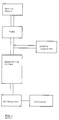
- Fig. 1 is the flow chart of an apparatus for performing an embodiment of the process according to the invention.
- the mobile phase is pumped through the chromatrographic column and the counterions contained in the mobile phase are visible by a UV-detector.
- the inventive process is normally performed as follows. A mobile phase of a mixture of water and an organic solvent is prepared, which contains a modifier and a counterion in a concentrate of 0.05 to 1.5 mmole or 6 x 10 ⁇ 3 to 1 x 10 ⁇ 4 mole and which has a pH-value of more than 5.
- This mobile phase is pumped through the chromatograhic column using a liquid pressure pump at a pressure of 50 to 200 bar, the column being kept at a temperature between 20 and 80°C with a variation of max. ⁇ 1°C by means of a suitable thermostating device. After approximately 2 to 4 hours an equilibrium has established between the stationary and mobile phase.
- the sample ions to be determined are then applied to the chromatographic column and are successivley eluted by the latter, accompanied by a further continuous passage of the mobile phase.
- the individual ions are quantiatively determined via the concentration decrease of the counterion in the eluate.
- a 200 mm long and diameter 4.6 mm chromatographic column is filled with Hypersil ODS, of 5 ⁇ m spherical particles.
- This column is conditioned with a mobile phase of 73% water and 27% acetonitrile, which contains 0.8 mmole of a hexadecyl trimethyl ammonium ion and 2 mmole of phthalic acid and is set to a pH-value of 7.2 with a sodium hydroxide solution.
- the mobile phase flow rate is 2 ml/min.
- the phthalate counterion is detected at 254 nm.
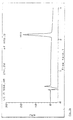
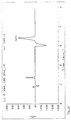
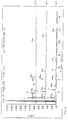
- Fig. 2a shows the chromatogram when using hexadecyl trimethyl ammonium hydroxide as the modifier. Roughly 2 minutes after the application of the sample solution, a symmetrical peak appears from which the content of nitrate ions can be quantitatively determined.
- Fig. 2b shows the chromatogram when hexadecyl trimethyl ammonium bromide is used as the modifier. After roughly 3 minutes a disturbing system peak appears, which does not occur when performing the inventive process.
- the column described in example 1 is conditioned with the mobile phase containing hexadecyl trimethyl ammonium hydroxide as the modifier.
- the other conditions are as in example 1.
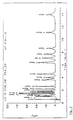
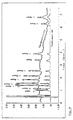
- a sample solution containing 17 anions is introduced into the mobile phase.
- the chromatogram shown in fig. 3 is obtained within 15 minutes. Thus, in a single chromatographic operation all 17 anions are separated from one another and can be quantitatively determined.
- a 100 mm long, diameter 4.6 mm column is filled with Hypersil ODS. This column is then conditioned with a mobile phase of 82% water and 18% acetonitrile for 3 hours for obtaining an equilibrium.
- the mobile phase contained 0.8 mmole of hexadecyl trimethyl ammonium hydroxide and 2 mmole of phthalic acid and is set to a pH-value of 8.4 with a sodium hydroxide solution.
- the flow rate of the mobile phase is 2 ml/min.
- the phthalic counterions are detected at a wavelength of 266 nm.
- the chromatographic column is thermostated to 3 different temperatures, namely 19°C, 30°C and 40°C, the temperature being kept constant with an accuracy of ⁇ 0.5°C or less.
- 50 ⁇ l of sample solution containing 8 different anions are injected. These anions are eluted by the column through the mobile phase and determined with the aid of the indirect UV-method.
- Fig. 4 shows the results of 3 chromatographic determinations at the 3 different temperatures.
- 19°C there is a complete separation of all the anions, so that a separate quantitative determination of the anions is possible.
- the bromide and phosphate ions are not completely separated from one another, but the other six anions can be quantified.
- the nitrate and phosphate ions are not completely separated from one another, but the other six anions can be quantified.
- Fig. 4 shows that through the choice of suitable conditions and in particular the temperature setting, it is possible to achieve a simultaneous determination of all the anions in a single chromatographic step.
- a 125 mm long, diameter 4.0 mm chromatographic column is filled with Lichrospher 100 RP-18 and is conditioned with a mobile phase of 82% water and 18% acetonitrile, which contains 0.8 mmole of hexadecyl trimethyl ammonium hydroxide and 2 mmole of phthalic acid and is adjusted to a pH-value of 8.6 with a sodium hydroxide solution.
- the flow rate is 2.0 ml/min. Conditioning takes place for approximately 2 to 4 hours and is performed in three different passages at 38°C, 40°C and 46°C. The temperature is kept constant with an accuracy of ⁇ 1°C by a suitable thermostat (oven). After setting the equilibrium, 50 ⁇ l of a sample solution containing 8 different anions is introduced into the mobile phase. The counterions are detected at a wavelength of 266 nm.
- Fig. 5 shows the results of the determinations performed at said 3 temperatures. It can be seen that all 3 temperatures there is a complete separation of the individual anions and a quantitative determination of the individual ions is possible.
- a column filled with Hypersil ODS according to example 2 is conditioned as in the latter.
- a sample solution containing 11 different anions is then introduced into the mobile phase.
- the individual ions are eluted by the column and detected once with the indirect UV-method and on a further occasion with the conductivity method.
- the results of these two determinations are given in fig. 6.
- the latter shows that both with the conductivity method and with the indirect UV-method, a determination of the anions contained in the sample solution is possible in one chromatographic run.
Landscapes
- Chemical & Material Sciences (AREA)
- Analytical Chemistry (AREA)
- Chemical Kinetics & Catalysis (AREA)
- Organic Chemistry (AREA)
- Biochemistry (AREA)
- Life Sciences & Earth Sciences (AREA)
- Health & Medical Sciences (AREA)
- General Health & Medical Sciences (AREA)
- General Physics & Mathematics (AREA)
- Immunology (AREA)
- Pathology (AREA)
- Physics & Mathematics (AREA)
- Treatment Of Liquids With Adsorbents In General (AREA)
- Investigating Or Analyzing Non-Biological Materials By The Use Of Chemical Means (AREA)
Claims (14)
- Verfahren zur chromatographischen Bestimmung von Ionen, insbesondere Anionen an einer reversed-phase-Säule, bei dem Probeionen in eine mobile Phase, die einen Modifier und ein Gegenion enthält, eingebracht werden, die mobile Phase mit Modifier, Gegenion und Probeion durch die Säule geleitet wird und die einzelnen Probeionen nach der Auftrennung mit Hilfe einer geeigneten Detektionsmethode über die Abnahme der Konzentration des Gegenions im Eluat quantitativ bestimmt werden, und bei dem die mobile Phase eine Mischung aus Wasser und einem organischen Lösungsmittel ist, und als Modifier ein quartäres Ammoniumhydroxid der Formel

- Verfahren nach Anspruch 1, dadurch gekennzeichnet, daß die reversed-phase-Säule vor dem Hindurchleiten der die Probeionen enthaltenden mobilen Phase mit dem Modifier, insbesondere mit dem Modifier und dem Gegenion, ins Gleichgewicht gebracht wird.
- Verfahren nach Anspruch 2, dadurch gekennzeichnet, daß die Gleichgewichtseinstellung mit einer mobilen Phase durchgeführt wird, die bis auf den Gehalt an Probeionen die gleiche Zusammensetzung besitzt wie die zur Bestimmung der Probeionen verwendete mobile Phase.
- Verfahren nach einem der vorhergehenden Ansprüche, dadurch gekennzeichnet, daß ein quartäres Ammoniumhydroxid eingesetzt wird, bei dem die Reste R₁, R₂ und R₃ gleich oder verschieden sind und 1 bis 10 C-Atome aufweisen und der Rest R₄ zwischen 8 bis 20, insbesondere 12 bis 18 C-Atome aufweist.
- Verfahren nach einem der vorhergehenden Ansprüche, dadurch gekennzeichnet, daß die Reste R₁, R₂ und R₃ gleich sind und zwischen 1 bis 5 C-Atome aufweisen und der Rest R₄ geradkettig ist und zwischen 14 und 18, insbesondere 16 C-Atome aufweist.
- Verfahren nach einem der vorhergehenden Ansprüche, dadurch gekennzeichnet, daß als quartäres Ammoniumhydroxid Trimethylhexadecylammoniumhydroxid eingesetzt wird.
- Verfahren nach einem der vorhergehenden Ansprüche, dadurch gekennzeichnet, daß der Modifier in der mobilen Phase in einer Konzentration von 0,05 x 10⁻³ Mol bis 1,5 x 10⁻³ Mol enthalten ist.
- Verfahren nach einem der vorhergehenden Ansprüche, dadurch gekennzeichnet, daß die Probeionen mit Hilfe einer indirekten UV-Detektionsmethode bestimmt werden.
- Verfahren nach einem der vorhergehenden Ansprüche, dadurch gekennzeichnet, daß das Gegenion in der mobilen Phase in einer Konzentration von 6 x 10⁻³ Mol bis 1 x 10⁻⁴ Mol, insbesondere 6 x 10⁻³ Mol bis 4 x 10⁻⁴ Mol enthalten ist.
- Verfahren nach einem der vorhergehenden Ansprüche, dadurch gekennzeichnet, daß als organisches Lösungsmittel in der mobilen Phase ein polares organisches Lösungsmittel, insbesondere Acetonitril eingesetzt wird.
- Verfahren nach einem der vorhergehenden Ansprüche, dadurch gekennzeichnet, daß als mobile Phase eine Mischung aus 65 bis 95 Vol.-%, vorzugsweise 80 Vol.-% Wasser und 5 bis 35 Vol.-%, insbesondere 20 Vol.-% organischem Lösungsmittel eingesetzt wird.
- Verfahren nach einem der vorhergehenden Ansprüche, dadurch gekennzeichnet, daß es bei einer Temperatur zwischen 0 °C und 80 °C, insbesondere zwischen 20 °C und 50 °C durchgeführt wird.
- Verfahren nach einem der vorhergehenden Ansprüche, dadurch gekennzeichnet, daß die Temperatur während des Verfahrens mit einer Abweichung von höchstens ± 0,5 °C, insbesondere ± 0,2 °C konstant gehalten wird.
- Verfahren nach einem der vorhergehenden Ansprüche zur Bestimmung von Fluorid, Chlorid, Bromid, Nitrit, Nitrat, Phosphat und Sulfat in einem einzigen chromatographischen Arbeitsgang.
Priority Applications (4)
| Application Number | Priority Date | Filing Date | Title |
|---|---|---|---|
| DE69013888T DE69013888T2 (de) | 1990-04-27 | 1990-04-27 | Verfahren zur chromatographischen Bestimmung von Ionen. |
| EP90108022A EP0453604B1 (de) | 1990-04-27 | 1990-04-27 | Verfahren zur chromatographischen Bestimmung von Ionen |
| US07/653,018 US5167827A (en) | 1990-04-27 | 1991-02-08 | Chromatographic determination of ions |
| JP3125421A JPH04230850A (ja) | 1990-04-27 | 1991-04-26 | クロマトグラフによる試料イオンの定量的決定方法及びクロマトグラフ・カラム |
Applications Claiming Priority (1)
| Application Number | Priority Date | Filing Date | Title |
|---|---|---|---|
| EP90108022A EP0453604B1 (de) | 1990-04-27 | 1990-04-27 | Verfahren zur chromatographischen Bestimmung von Ionen |
Publications (2)
| Publication Number | Publication Date |
|---|---|
| EP0453604A1 EP0453604A1 (de) | 1991-10-30 |
| EP0453604B1 true EP0453604B1 (de) | 1994-11-02 |
Family
ID=8203918
Family Applications (1)
| Application Number | Title | Priority Date | Filing Date |
|---|---|---|---|
| EP90108022A Expired - Lifetime EP0453604B1 (de) | 1990-04-27 | 1990-04-27 | Verfahren zur chromatographischen Bestimmung von Ionen |
Country Status (4)
| Country | Link |
|---|---|
| US (1) | US5167827A (de) |
| EP (1) | EP0453604B1 (de) |
| JP (1) | JPH04230850A (de) |
| DE (1) | DE69013888T2 (de) |
Families Citing this family (5)
| Publication number | Priority date | Publication date | Assignee | Title |
|---|---|---|---|---|
| JP3351572B2 (ja) * | 1992-10-05 | 2002-11-25 | 井上 聰一 | イオンクロマトグラフィーによる分析体の分離・分析方法、イオンクロマトグラフィー用両荷電具備固定相及び多機能液体クロマトグラフィーによる分析体の分離・分析方法 |
| US5385654A (en) * | 1993-07-07 | 1995-01-31 | Thermo Separation Products Inc. | Controlled temperature anion separation by capillary electrophoresis |
| EP2950904A1 (de) * | 2013-01-29 | 2015-12-09 | Neuland Health Sciences Private Limited | Reinigung von organischen verbindungen mit stationären surrogatphasen bei umkehrphasensäulen |
| KR102578578B1 (ko) | 2016-02-03 | 2023-09-14 | 삼성전자주식회사 | 암모니아수 내의 불순물 검출방법 |
| CN115684412B (zh) * | 2022-11-01 | 2025-02-11 | 科笛生物医药(无锡)有限公司 | 乳膏制剂中4种阴离子的定量分析方法 |
Family Cites Families (6)
| Publication number | Priority date | Publication date | Assignee | Title |
|---|---|---|---|---|
| US3315002A (en) * | 1962-09-24 | 1967-04-18 | Dow Chemical Co | Method of separation of lower alkyl mono-and dialcohols, acetone and methylethylketone, and ethylamine and butyl amine with novel ion exchange resin derivatives |
| US4042327A (en) * | 1976-01-15 | 1977-08-16 | Waters Associates, Inc. | Ion-pairing chromatography |
| US4265634A (en) * | 1980-03-10 | 1981-05-05 | Dionex Corporation | Chromatographic separation and quantitative analysis of ionic species |
| US4927539A (en) * | 1983-05-02 | 1990-05-22 | The Dow Chemical Company | High performance anion-exchange chromatographic packing composition consisting of low porosity synthetic resin gel particle substrate coated with liquid water-soluble aminated resin |
| US4455233A (en) * | 1983-08-12 | 1984-06-19 | Dionex Corporation | Method and apparatus for ion analysis and detection using reverse mode suppression |
| US4925567A (en) * | 1989-03-02 | 1990-05-15 | Basf Corporation | Baseline stabiilty in gradient ion chromatography by using a nonionic modifier |
-
1990
- 1990-04-27 DE DE69013888T patent/DE69013888T2/de not_active Expired - Fee Related
- 1990-04-27 EP EP90108022A patent/EP0453604B1/de not_active Expired - Lifetime
-
1991
- 1991-02-08 US US07/653,018 patent/US5167827A/en not_active Expired - Lifetime
- 1991-04-26 JP JP3125421A patent/JPH04230850A/ja active Pending
Also Published As
| Publication number | Publication date |
|---|---|
| JPH04230850A (ja) | 1992-08-19 |
| DE69013888T2 (de) | 1995-03-09 |
| DE69013888D1 (de) | 1994-12-08 |
| EP0453604A1 (de) | 1991-10-30 |
| US5167827A (en) | 1992-12-01 |
Similar Documents
| Publication | Publication Date | Title |
|---|---|---|
| Hamilton et al. | Introduction to high performance liquid chromatography | |
| Novič et al. | On-column processes in ion chromatographic determination of nitrite and nitrate in heavy mineralised samples | |
| US4265634A (en) | Chromatographic separation and quantitative analysis of ionic species | |
| Reuhs et al. | High-performance liquid chromatography | |
| Horvath et al. | Enhancement of retention by ion-pair formation in liquid chromatography with nonpolar stationary phases | |
| Larson et al. | Determination of alkyl quaternary ammonium compounds by liquid chromatography with indirect photometric detection | |
| Mays et al. | High-performance liquid chromatographic determination of kanamycin | |
| Giorgetti et al. | Mixed mobile phases and pressure programming in packed and capillary column supercritical fluid chromatography: a unified approach | |
| Jones et al. | Determination of trace amounts of aluminium by ion chromatography with fluorescence detection | |
| Carlqvist et al. | Determination of amoxicillin in body fluids by reversed-phase liquid chromatography coupled with a post-column derivatization procedure | |
| EP0453604B1 (de) | Verfahren zur chromatographischen Bestimmung von Ionen | |
| Ding et al. | Simultaneous determination of organic acids, inorganic anions and cations in beverages by ion chromatography with a mixed-bed stationary phase of anion and cation exchangers | |
| Kozlov et al. | Systematic evaluation of selected supercritical fluid chromatography diol‐and diethylamine‐based columns for application in hydrophilic interaction liquid chromatography | |
| CA1168705A (en) | Ion exchange chromatography with indirect photometric detection | |
| Tabatabai et al. | Liquid chromatography | |
| Sato | Retention volume and intensity of analyte and system peaks in ion-exchange chromatography with bulk-property detectors | |
| Thomas et al. | Adsorption liquid chromatography on columns: A rational method of mobile phase optimization based on the use of isohydric solvents | |
| Crommen et al. | Indirect UV detection of hydrophilic ionized compounds in reversed-phase liquid chromatography by use of a UV-absorbing ion of the same charge | |
| Grushka et al. | Separation of amino acids on reversed-phase columns as their copper (II) complexes | |
| Mouchere et al. | Determination of inorganic cations and anions by ion-exchange chromatography with evaporative light-scattering detection | |
| Vera-Avila et al. | RP-IPC with a lactic acid modified eluent for separation and determination of lanthanide ions | |
| de Kleijn et al. | Determination of nitrite and nitrate in meat products by high-performance liquid chromatography | |
| Krejči et al. | Enrichment techniques and trace analysis with microbore columns in liquid chromatography | |
| GB2070964A (en) | Analysis of ionic species using a chromatographic separation medium | |
| Jonker et al. | Adaption of the ninhydrin reactor to highly efficient columns for amino acid analysis by chromatography |
Legal Events
| Date | Code | Title | Description |
|---|---|---|---|
| PUAI | Public reference made under article 153(3) epc to a published international application that has entered the european phase |
Free format text: ORIGINAL CODE: 0009012 |
|
| 17P | Request for examination filed |
Effective date: 19901217 |
|
| AK | Designated contracting states |
Kind code of ref document: A1 Designated state(s): CH DE FR GB IT LI NL |
|
| 17Q | First examination report despatched |
Effective date: 19921019 |
|
| GRAA | (expected) grant |
Free format text: ORIGINAL CODE: 0009210 |
|
| AK | Designated contracting states |
Kind code of ref document: B1 Designated state(s): CH DE FR GB IT LI NL |
|
| PG25 | Lapsed in a contracting state [announced via postgrant information from national office to epo] |
Ref country code: IT Free format text: LAPSE BECAUSE OF FAILURE TO SUBMIT A TRANSLATION OF THE DESCRIPTION OR TO PAY THE FEE WITHIN THE PRESCRIBED TIME-LIMIT;WARNING: LAPSES OF ITALIAN PATENTS WITH EFFECTIVE DATE BEFORE 2007 MAY HAVE OCCURRED AT ANY TIME BEFORE 2007. THE CORRECT EFFECTIVE DATE MAY BE DIFFERENT FROM THE ONE RECORDED. Effective date: 19941102 Ref country code: NL Effective date: 19941102 |
|
| REF | Corresponds to: |
Ref document number: 69013888 Country of ref document: DE Date of ref document: 19941208 |
|
| ET | Fr: translation filed | ||
| NLV1 | Nl: lapsed or annulled due to failure to fulfill the requirements of art. 29p and 29m of the patents act | ||
| PLBE | No opposition filed within time limit |
Free format text: ORIGINAL CODE: 0009261 |
|
| STAA | Information on the status of an ep patent application or granted ep patent |
Free format text: STATUS: NO OPPOSITION FILED WITHIN TIME LIMIT |
|
| 26N | No opposition filed | ||
| PGFP | Annual fee paid to national office [announced via postgrant information from national office to epo] |
Ref country code: CH Payment date: 20000403 Year of fee payment: 11 |
|
| REG | Reference to a national code |
Ref country code: GB Ref legal event code: 732E |
|
| REG | Reference to a national code |
Ref country code: FR Ref legal event code: TP |
|
| REG | Reference to a national code |
Ref country code: CH Ref legal event code: NV Representative=s name: BOVARD AG PATENTANWAELTE Ref country code: CH Ref legal event code: PUE Owner name: HEWLETT-PACKARD GMBH TRANSFER- AGILENT TECHNOLOGIE |
|
| PG25 | Lapsed in a contracting state [announced via postgrant information from national office to epo] |
Ref country code: CH Free format text: LAPSE BECAUSE OF NON-PAYMENT OF DUE FEES Effective date: 20010526 Ref country code: LI Free format text: LAPSE BECAUSE OF NON-PAYMENT OF DUE FEES Effective date: 20010526 |
|
| REG | Reference to a national code |
Ref country code: CH Ref legal event code: PL |
|
| REG | Reference to a national code |
Ref country code: GB Ref legal event code: IF02 |
|
| PGFP | Annual fee paid to national office [announced via postgrant information from national office to epo] |
Ref country code: FR Payment date: 20020401 Year of fee payment: 13 |
|
| PG25 | Lapsed in a contracting state [announced via postgrant information from national office to epo] |
Ref country code: FR Free format text: LAPSE BECAUSE OF NON-PAYMENT OF DUE FEES Effective date: 20031231 |
|
| REG | Reference to a national code |
Ref country code: FR Ref legal event code: ST |
|
| PGFP | Annual fee paid to national office [announced via postgrant information from national office to epo] |
Ref country code: GB Payment date: 20040421 Year of fee payment: 15 |
|
| PGFP | Annual fee paid to national office [announced via postgrant information from national office to epo] |
Ref country code: DE Payment date: 20040601 Year of fee payment: 15 |
|
| PG25 | Lapsed in a contracting state [announced via postgrant information from national office to epo] |
Ref country code: GB Free format text: LAPSE BECAUSE OF NON-PAYMENT OF DUE FEES Effective date: 20050427 |
|
| PG25 | Lapsed in a contracting state [announced via postgrant information from national office to epo] |
Ref country code: DE Free format text: LAPSE BECAUSE OF NON-PAYMENT OF DUE FEES Effective date: 20051101 |
|
| GBPC | Gb: european patent ceased through non-payment of renewal fee |
Effective date: 20050427 |