EP0201622B1 - Procédé de traitement des cheveux, et notamment de leurs pointes - Google Patents
Procédé de traitement des cheveux, et notamment de leurs pointes Download PDFInfo
- Publication number
- EP0201622B1 EP0201622B1 EP85110670A EP85110670A EP0201622B1 EP 0201622 B1 EP0201622 B1 EP 0201622B1 EP 85110670 A EP85110670 A EP 85110670A EP 85110670 A EP85110670 A EP 85110670A EP 0201622 B1 EP0201622 B1 EP 0201622B1
- Authority
- EP
- European Patent Office
- Prior art keywords
- hair
- drying
- process according
- conditioning stage
- initial
- Prior art date
- Legal status (The legal status is an assumption and is not a legal conclusion. Google has not performed a legal analysis and makes no representation as to the accuracy of the status listed.)
- Expired - Lifetime
Links
Images
Classifications
-
- A—HUMAN NECESSITIES
- A45—HAND OR TRAVELLING ARTICLES
- A45D—HAIRDRESSING OR SHAVING EQUIPMENT; EQUIPMENT FOR COSMETICS OR COSMETIC TREATMENTS, e.g. FOR MANICURING OR PEDICURING
- A45D20/00—Hair drying devices; Accessories therefor
-
- A—HUMAN NECESSITIES
- A45—HAND OR TRAVELLING ARTICLES
- A45D—HAIRDRESSING OR SHAVING EQUIPMENT; EQUIPMENT FOR COSMETICS OR COSMETIC TREATMENTS, e.g. FOR MANICURING OR PEDICURING
- A45D19/00—Devices for washing the hair or the scalp; Similar devices for colouring the hair
- A45D19/16—Surface treatment of hair by steam, oil, or the like
-
- A—HUMAN NECESSITIES
- A45—HAND OR TRAVELLING ARTICLES
- A45D—HAIRDRESSING OR SHAVING EQUIPMENT; EQUIPMENT FOR COSMETICS OR COSMETIC TREATMENTS, e.g. FOR MANICURING OR PEDICURING
- A45D7/00—Processes of waving, straightening or curling hair
- A45D7/02—Processes of waving, straightening or curling hair thermal
Definitions
- the present invention relates to a new method for carrying out a treatment of the hair making it possible to obtain an improved state of the latter and in particular of their tips.
- the process according to the invention finds its application when drying hair which has been subjected to wetting with water or a shampoo. Furthermore, it is intended for hair which, once wet or moistened, is left free for drying, that is to say is not wound on curlers or styling rollers. For convenience of language, we will speak, in the remainder of this description, of "free hairstyles" or "free hair”.
- the current technique which is generally used for drying loose hairstyles, consists in exposing the hair to the heat produced by one or more lamps with infrared radiation. This drying takes place without ventilation or with very little ventilation.
- This drying method is the cause of drying of the hair and the succession of drying of this type quickly leads to a degradation of the appearance of the hairstyle.
- This drawback is particularly unpleasant in the case of curly hairstyles which are obtained by a treatment of the permanent type and which, most of the time, are dried using this technique.
- the present invention overcomes this drawback because it relates to a particular drying technique making it possible to avoid or compensate for excessive dehydration of the hair as it occurs with the usual drying techniques.
- the wet treatment to which a hair is subjected during wetting with water or a shampoo causes an increase in the weight of the hair, the relative variation in weight being of the order of 35%.
- the drying of the hair results in a loss of water, which is greater than the weight gain of the hair during the wet treatment, and, at the end of drying, the relative variation of the weight of the hair relative to the weight before wet treatment is generally close to -9%: this weight loss is, of course, essentially a function of drying and, in particular, of its duration and the temperature practiced.
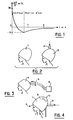
- this behavior of the hair has been shown in FIG. 1 of the appended drawing; generally the return of the hair to the weight they had initially before the wet treatment takes place in several hours.
- this phenomenon could consist of a rearrangement of the constituent molecules of the hair and, without this explanation being in any way limiting, it has been postulated that the wet treatment of the hair allows the penetration of the 'water in the hair and increases the dielectric constant of the medium existing between the charged sites of the constituent molecules of the hair, so that the hydrogen bonds no longer exist for wet hair.
- the water molecules are extracted from the hair in an amount such that there is a loss in weight relative to the initial weight; the charged sites of the constituent molecules of the hair which had been discarded due to the presence of the water molecules, remain relatively spaced apart and do not allow instantaneously at room temperature, the reformation of the hydrogen bonds, this reformation only taking place gradually with relatively low speed.
- the water molecules, which return to the hair at room temperature to ensure water uptake after the end of drying, are in the form of agglomerates the larger the lower the temperature and the rearrangement of these molecules d water in the hair is carried out slowly.
- the conditioning phase takes place (begins) on completely dried hair.
- the drying is pushed to a point where the hair has a loss of water compared to its initial condition; the conditioning phase necessarily ensures a resumption of water in the hair and the expected rapid rearrangement takes place completely, that is to say to the heart of the fibers.
- the present invention therefore relates to a method for drying the hair after a wet treatment in which, after said wet treatment the hair is dried at a temperature between about 35 and 75 ° C., the last part of the drying being a conditioning phase using humid blown air with a relative humidity of between 40 and 80% approximately, characterized in that the hair is dried in the free state and that, to improve the condition and appearance of hair after drying and, in particular of their ends, they are first subjected to an initial drying until the hair has lost 100% of the amount of water absorbed during the wet treatment and the weight of the hair is less than their initial weight before wet treatment and then, in the humid air conditioning phase until the desired water content of the hair is obtained.
- the hair is shaped according to the usual technique for free drying: the hair in the wet state is shaped, for example, with a comb according to the desired hairstyle.
- the hair before subjecting the hair to said conditioning phase, it is subjected to an initial drying. Drying occurs therefore in two phases; the first phase corresponds to a normal initial drying, so as not to displace the hair or to move it only slightly sensitive; the second phase corresponds to the sending of a current of hot air (from 35 to 75 ° C), also of moderate force and having a relative humidity included in the above-mentioned value range.
- the conditioning phase is started at a chosen time in a time interval beginning when the hair has been sufficiently dried to present a loss of water compared to its initial state before the wet treatment.
- said time interval ends at the time when the hair has undergone weight loss, relative to the weight of the hair before the wet treatment, of approximately 15%.
- the temperature is maintained during the conditioning phase at a value between 35 and 60 ° C, preferably close to 50 ° C; maintaining the temperature of the atmosphere, where the hair is located during the conditioning phase, at a value close to the temperature practiced during the initial drying phase of the hair; the conditioning phase is maintained for a time of between 5 and 60 minutes approximately, and preferably 10 and 20 minutes approximately; the conditioning phase is carried out by injecting water vapor into the atmosphere, where the hair is located.
- treatment product means a product ordinarily used in cosmetics, such as anti-seborrheic, anti-dandruff agents, anti-hair loss, film-forming resins, deodorants, disinfectants, perfumes, brilliantine and the like.
- the hair is dried until a weight loss is obtained relative to the weight of the hair before wet treatment, of between 1 and 15%, and preferably between 5 % and 15%; the initial drying of the hair is carried out at a temperature between 40 and 75 ° C for a time between 10 and 60 minutes.
- an aqueous or hydroalcoholic solution for example a solution of reinforcing agents such as only resins
- the hair treated by the method according to the invention can be natural hair, bleached, colored or permed.
- the keratin fibers are rearranged quickly, at least on the surface, which improves the shine and the general appearance of the hairstyle, in particular the appearance of the tips. Furthermore, there has been a surprising effect with regard to the movements or undulations which can, if necessary, be given to the hair. Under the aforementioned conditions, these movements or undulations appear more aesthetic and have a more natural appearance, the hair then appearing in better condition. The hair thus treated has a great shine, without any bleaching of the ends.
- the device intended for the implementation of the process defined above comprises means for adjusting the relative humidity of the atmosphere where the hair, means for ensuring said drying.
- such a device consists of two separate devices, one ensuring the initial drying of the hair and the other ensuring the conditioning phase in a more humid atmosphere; the device ensuring the drying of the hair can be a drier or lamps with infrared radiation of conventional type; the device ensuring the conditioning phase can be an oven-enclosure with low air circulation.
- such a device consists of a single device operating in two successive cycles, one corresponding to the initial drying and the other to the conditioning phase.
- the device consists of a flexible cap placed on the hair to be treated and supplied with hot air by a pipe connected to a heating and / or humidifier.
- the device consists of a dryer hood of the conventional type equipped with an element allowing an injection of vapor into the blown air during the conditioning phase; the start of the steam injection can be triggered automatically either after a predetermined drying time, or when a predetermined relative humidity is reached in the drying atmosphere; the injection of steam can be controlled by a regulator keeping the value of the relative humidity of this air at a constant value.
- FIG. 1 shows that a hair undergoes an increase in weight of 35% at the time of its wetting and then returns by drying in 45 min at 60 ° C to a lower weight. 9% of its initial weight. The hair left in an atmosphere at 26 ° C and 56% relative humidity roughly returns to its initial weight about 2 hours after the end of drying.
- the first type of device is shown diagrammatically in FIG. 2. It comprises a conventional type 1 dryer intended to carry out the drying phase of the method according to the invention and an oven-enclosure 2, distinct from the dryer 1, said oven-enclosure being supplied by the pipe 3 so that a constant relative humidity is maintained there.
- the temperature inside the oven enclosure 2 is also kept constant.
- the user who has undergone wetting of the hair, either with water or with the aid of a shampoo followed by rinsing, optionally with the application of a polymerizable reinforcing agent, puts her hair in shape by example by an appropriate combing and possibly placed under the dryer 1.
- the user places her hair in the oven-enclosure 2 and maintains it there for the expected conditioning time.
- the user carries out a finishing combing if she wishes.
- FIG. 3 A second type of device is shown diagrammatically in FIG. 3.
- the user whose hair has been wetted and shaped as indicated above and who wishes to dry her hair beforehand, places it in the inside of a flexible cap 4, made for example of plastic material, said cap being connected by a pipe 5 to a heating and / or humidifier member 6.
- the member 6 sends hot air in the cap 4 and the air is evacuated through the pipe 5 which is used both for the supply and the evacuation of said air; the initial drying air is exhausted to the outside.
- the air circulation provided by the member 6 is no longer in an open circuit but in a closed circuit and the member 6 adds to the circulation air a sufficient amount of water to maintain inside the cup 4 a constant relative humidity.
- water it is possible to introduce into the air during the conditioning phase an aqueous or hydroalcoholic liquid for treating the hair or the scalp.
- the device for implementing the invention consists of a dryer hood 7 of the modified conventional type.
- the dryer hood 7 is equipped with a fan 8, which draws in the outside air according to the arrow F and the pulse after heating in the direction of the hair, the forced air emerging from the helmet around the wearer's head according to the arrows F1.
- the helmet 7 is equipped with a device 9 allowing the injection into the pulsed hot air flow of a quantity of steam intended to maintain a constant relative humidity.
- the hair is put under the helmet 7 and the initial drying phase of the process is started.
- water vapor or a treatment liquid in the vapor state
- the quantity of steam being regulated so as to to maintain a constant relative humidity around the hair.
Landscapes
- Physics & Mathematics (AREA)
- Thermal Sciences (AREA)
- Health & Medical Sciences (AREA)
- Chemical & Material Sciences (AREA)
- Dermatology (AREA)
- General Health & Medical Sciences (AREA)
- Oil, Petroleum & Natural Gas (AREA)
- Cosmetics (AREA)
- Cleaning And Drying Hair (AREA)
Priority Applications (1)
| Application Number | Priority Date | Filing Date | Title |
|---|---|---|---|
| AT85110670T ATE72384T1 (de) | 1982-08-16 | 1983-07-21 | Verfahren zur behandlung von haaren, insbesondere ihrer spitzen. |
Applications Claiming Priority (2)
| Application Number | Priority Date | Filing Date | Title |
|---|---|---|---|
| FR8214178 | 1982-08-16 | ||
| FR8214178A FR2531617A1 (fr) | 1982-08-16 | 1982-08-16 | Procede de traitement des cheveux, et notamment de leurs pointes, et dispositif pour la mise en oeuvre dudit procede |
Related Parent Applications (1)
| Application Number | Title | Priority Date | Filing Date |
|---|---|---|---|
| EP83401499.5 Division | 1983-07-21 |
Publications (3)
| Publication Number | Publication Date |
|---|---|
| EP0201622A2 EP0201622A2 (fr) | 1986-11-20 |
| EP0201622A3 EP0201622A3 (en) | 1990-03-14 |
| EP0201622B1 true EP0201622B1 (fr) | 1992-02-05 |
Family
ID=9276893
Family Applications (2)
| Application Number | Title | Priority Date | Filing Date |
|---|---|---|---|
| EP85110670A Expired - Lifetime EP0201622B1 (fr) | 1982-08-16 | 1983-07-21 | Procédé de traitement des cheveux, et notamment de leurs pointes |
| EP83401499A Expired EP0101355B1 (fr) | 1982-08-16 | 1983-07-21 | Procédé de traitement des cheveux, et notamment de leurs pointes |
Family Applications After (1)
| Application Number | Title | Priority Date | Filing Date |
|---|---|---|---|
| EP83401499A Expired EP0101355B1 (fr) | 1982-08-16 | 1983-07-21 | Procédé de traitement des cheveux, et notamment de leurs pointes |
Country Status (6)
| Country | Link |
|---|---|
| US (1) | US4610261A (OSRAM) |
| EP (2) | EP0201622B1 (OSRAM) |
| AT (2) | ATE72384T1 (OSRAM) |
| CA (1) | CA1198373A (OSRAM) |
| DE (4) | DE3366825D1 (OSRAM) |
| FR (1) | FR2531617A1 (OSRAM) |
Families Citing this family (13)
| Publication number | Priority date | Publication date | Assignee | Title |
|---|---|---|---|---|
| US5002076A (en) * | 1988-04-06 | 1991-03-26 | Altobella Hair Products, Inc. | Hair treatment composition and method |
| CH681848A5 (OSRAM) * | 1991-01-28 | 1993-06-15 | Juergen E Sahm | |
| FR2713920B1 (fr) * | 1993-12-22 | 1996-01-26 | Oreal | Procédé de déformation temporaire des fibres kératiniques humaines. |
| FR2713922B1 (fr) * | 1993-12-22 | 1996-01-26 | Oreal | Procédé de déformation non permanente des fibres kératiniques humaines. |
| FR2713921B1 (fr) * | 1993-12-22 | 1996-01-26 | Oreal | Procédé de déformation non remanente des fibres kératiniques humaines. |
| DE102005012246A1 (de) * | 2005-03-15 | 2006-09-21 | Wella Ag | Vorrichtung zum Behandeln von Kopfhaar mit Dampf |
| US8800163B2 (en) | 2007-08-21 | 2014-08-12 | Heidi Schmid | Hair care appliance and method of using same |
| US8136263B2 (en) * | 2007-08-21 | 2012-03-20 | Heidi Schmid | Hair care appliance and method of using same |
| FR2921805B1 (fr) * | 2007-10-03 | 2011-04-01 | Oreal | Procede de traitement des cheveux a l'aide de vapeur d'eau |
| FR2938190B1 (fr) * | 2008-11-07 | 2011-01-07 | Oreal | Procede de traitement de la chevelure comprenant l'application d'une source de vapeur et d'un polymere cationique non colorant, non derive d'un sucre ou d'une silicone |
| FR2938189B1 (fr) * | 2008-11-07 | 2010-12-31 | Oreal | Procede de traitement de la chevelure comprenant l'application d'une source de vapeur et d'une molecule non colorante, non polymerique, contenant au moins un motif cationique |
| EP2295029A1 (en) * | 2009-09-14 | 2011-03-16 | The Procter & Gamble Company | Method of chemically modifying the internal region of a hair shaft |
| EP2990796A1 (en) | 2014-08-29 | 2016-03-02 | The Procter and Gamble Company | Device for testing the properties of hair fibres |
Family Cites Families (3)
| Publication number | Priority date | Publication date | Assignee | Title |
|---|---|---|---|---|
| CH357161A (de) * | 1958-04-28 | 1961-09-30 | Ronzi Carl | Verfahren zum Färben, Bleichen und dergleichen Behandeln der Kopfhaare und Vorrichtung zur Durchführung des Verfahrens |
| US4205692A (en) * | 1978-06-26 | 1980-06-03 | Losenno Luigi G | Vapor hood |
| FR2483200A1 (fr) * | 1980-05-30 | 1981-12-04 | Oreal | Procede de mise en forme de cheveux et dispositif pour la mise en oeuvre dudit procede |
-
1982
- 1982-08-16 FR FR8214178A patent/FR2531617A1/fr active Granted
-
1983
- 1983-07-21 DE DE8383401499T patent/DE3366825D1/de not_active Expired
- 1983-07-21 DE DE8585110670T patent/DE3382508D1/de not_active Expired - Lifetime
- 1983-07-21 EP EP85110670A patent/EP0201622B1/fr not_active Expired - Lifetime
- 1983-07-21 EP EP83401499A patent/EP0101355B1/fr not_active Expired
- 1983-07-21 AT AT85110670T patent/ATE72384T1/de not_active IP Right Cessation
- 1983-07-21 DE DE198585110670T patent/DE201622T1/de active Pending
- 1983-07-21 DE DE198383401499T patent/DE101355T1/de active Pending
- 1983-07-21 AT AT83401499T patent/ATE22784T1/de active
- 1983-08-11 US US06/522,216 patent/US4610261A/en not_active Expired - Fee Related
- 1983-08-15 CA CA000434581A patent/CA1198373A/fr not_active Expired
Also Published As
| Publication number | Publication date |
|---|---|
| ATE22784T1 (de) | 1986-11-15 |
| CA1198373A (fr) | 1985-12-24 |
| EP0201622A3 (en) | 1990-03-14 |
| ATE72384T1 (de) | 1992-02-15 |
| EP0101355B1 (fr) | 1986-10-15 |
| FR2531617B1 (OSRAM) | 1985-01-11 |
| DE201622T1 (de) | 1987-04-30 |
| EP0101355A2 (fr) | 1984-02-22 |
| DE101355T1 (de) | 1984-12-20 |
| EP0201622A2 (fr) | 1986-11-20 |
| DE3366825D1 (en) | 1986-11-20 |
| DE3382508D1 (de) | 1992-03-19 |
| EP0101355A3 (en) | 1984-03-28 |
| FR2531617A1 (fr) | 1984-02-17 |
| US4610261A (en) | 1986-09-09 |
Similar Documents
| Publication | Publication Date | Title |
|---|---|---|
| EP0201622B1 (fr) | Procédé de traitement des cheveux, et notamment de leurs pointes | |
| CA1059001A (fr) | Procede de mise en plis et de traitement des cheveux et appareillage pour la mise en oeuvre de ce procede | |
| JP5491401B2 (ja) | 毛髪の蒸気処理のための携帯用装置 | |
| CN1167370C (zh) | 头发修复、发型设计及直发化的方法 | |
| EP2205119B1 (en) | Method for treating the hair using steam | |
| FR2821250A1 (fr) | Dispositif pour chauffer les cheveux et procede de traitement capillaire utilisant ce dispositif | |
| FR2713895A1 (fr) | Ensemble destiné au travail des cheveux à la vapeur. | |
| WO2002041857A1 (en) | Method of repairing or restoring damaged or defective hair | |
| EP0041446B1 (fr) | Procédé de mise en forme de cheveux | |
| WO2000025623A1 (fr) | Accessoire pour le lissage des cheveux | |
| KR101419718B1 (ko) | 모발 손상 없이 건식 및 습식 퍼머시술이 가능하게 하는 헤어아이론 | |
| US1671177A (en) | Method and means for waving hair | |
| KR200270330Y1 (ko) | 퍼머용 아이롱 | |
| FR3010305A1 (fr) | Procede de traitement pour permanente. | |
| US3565083A (en) | Method for setting hair | |
| WO2024245842A1 (en) | Process for shaping the hair using uv-visible radiation | |
| KR20100099023A (ko) | 스트레이트 퍼머시술방법 | |
| TWI728891B (zh) | 燙髮方法 | |
| CA2159681A1 (fr) | Procede pour la deformation non permanente des fibres keratiniques humaines | |
| KR20220056320A (ko) | 화장대 드라이기 | |
| JPS6344B2 (OSRAM) | ||
| JPH0325162B2 (OSRAM) | ||
| FR3075579A1 (fr) | Procede de traitement des fibres capillaires | |
| JPS6122809A (ja) | スチ−ム式ヘア−カ−ル器 | |
| US1592150A (en) | Method and means for hair waving |
Legal Events
| Date | Code | Title | Description |
|---|---|---|---|
| PUAI | Public reference made under article 153(3) epc to a published international application that has entered the european phase |
Free format text: ORIGINAL CODE: 0009012 |
|
| AC | Divisional application: reference to earlier application |
Ref document number: 101355 Country of ref document: EP |
|
| AK | Designated contracting states |
Kind code of ref document: A2 Designated state(s): AT BE CH DE FR GB IT LI NL |
|
| ITCL | It: translation for ep claims filed |
Representative=s name: JACOBACCI CASETTA & PERANI S.P.A. |
|
| DET | De: translation of patent claims | ||
| PUAL | Search report despatched |
Free format text: ORIGINAL CODE: 0009013 |
|
| AK | Designated contracting states |
Kind code of ref document: A3 Designated state(s): AT BE CH DE FR GB IT LI NL |
|
| 17P | Request for examination filed |
Effective date: 19900302 |
|
| 17Q | First examination report despatched |
Effective date: 19910412 |
|
| GRAA | (expected) grant |
Free format text: ORIGINAL CODE: 0009210 |
|
| AC | Divisional application: reference to earlier application |
Ref document number: 101355 Country of ref document: EP |
|
| AK | Designated contracting states |
Kind code of ref document: B1 Designated state(s): AT BE CH DE FR GB IT LI NL |
|
| PG25 | Lapsed in a contracting state [announced via postgrant information from national office to epo] |
Ref country code: NL Effective date: 19920205 Ref country code: AT Effective date: 19920205 |
|
| REF | Corresponds to: |
Ref document number: 72384 Country of ref document: AT Date of ref document: 19920215 Kind code of ref document: T |
|
| ITF | It: translation for a ep patent filed | ||
| GBT | Gb: translation of ep patent filed (gb section 77(6)(a)/1977) | ||
| REF | Corresponds to: |
Ref document number: 3382508 Country of ref document: DE Date of ref document: 19920319 |
|
| NLV1 | Nl: lapsed or annulled due to failure to fulfill the requirements of art. 29p and 29m of the patents act | ||
| PLBE | No opposition filed within time limit |
Free format text: ORIGINAL CODE: 0009261 |
|
| STAA | Information on the status of an ep patent application or granted ep patent |
Free format text: STATUS: NO OPPOSITION FILED WITHIN TIME LIMIT |
|
| 26N | No opposition filed | ||
| ITTA | It: last paid annual fee | ||
| PGFP | Annual fee paid to national office [announced via postgrant information from national office to epo] |
Ref country code: GB Payment date: 19960701 Year of fee payment: 14 |
|
| PGFP | Annual fee paid to national office [announced via postgrant information from national office to epo] |
Ref country code: FR Payment date: 19960705 Year of fee payment: 14 |
|
| PGFP | Annual fee paid to national office [announced via postgrant information from national office to epo] |
Ref country code: DE Payment date: 19960826 Year of fee payment: 14 |
|
| PGFP | Annual fee paid to national office [announced via postgrant information from national office to epo] |
Ref country code: BE Payment date: 19960904 Year of fee payment: 14 |
|
| PGFP | Annual fee paid to national office [announced via postgrant information from national office to epo] |
Ref country code: CH Payment date: 19961016 Year of fee payment: 14 |
|
| PG25 | Lapsed in a contracting state [announced via postgrant information from national office to epo] |
Ref country code: GB Free format text: LAPSE BECAUSE OF NON-PAYMENT OF DUE FEES Effective date: 19970721 |
|
| PG25 | Lapsed in a contracting state [announced via postgrant information from national office to epo] |
Ref country code: LI Free format text: LAPSE BECAUSE OF NON-PAYMENT OF DUE FEES Effective date: 19970731 Ref country code: CH Free format text: LAPSE BECAUSE OF NON-PAYMENT OF DUE FEES Effective date: 19970731 Ref country code: BE Free format text: LAPSE BECAUSE OF NON-PAYMENT OF DUE FEES Effective date: 19970731 |
|
| BERE | Be: lapsed |
Owner name: L' OREAL Effective date: 19970731 |
|
| GBPC | Gb: european patent ceased through non-payment of renewal fee |
Effective date: 19970721 |
|
| REG | Reference to a national code |
Ref country code: CH Ref legal event code: PL |
|
| PG25 | Lapsed in a contracting state [announced via postgrant information from national office to epo] |
Ref country code: FR Free format text: LAPSE BECAUSE OF NON-PAYMENT OF DUE FEES Effective date: 19980331 |
|
| PG25 | Lapsed in a contracting state [announced via postgrant information from national office to epo] |
Ref country code: DE Free format text: LAPSE BECAUSE OF NON-PAYMENT OF DUE FEES Effective date: 19980401 |
|
| REG | Reference to a national code |
Ref country code: FR Ref legal event code: ST |