EP0200834B1 - Removal of ammonia from wastewater - Google Patents
Removal of ammonia from wastewater Download PDFInfo
- Publication number
- EP0200834B1 EP0200834B1 EP85308709A EP85308709A EP0200834B1 EP 0200834 B1 EP0200834 B1 EP 0200834B1 EP 85308709 A EP85308709 A EP 85308709A EP 85308709 A EP85308709 A EP 85308709A EP 0200834 B1 EP0200834 B1 EP 0200834B1
- Authority
- EP
- European Patent Office
- Prior art keywords
- ammonia
- zeolite
- wastewater
- stationary
- ammonium
- Prior art date
- Legal status (The legal status is an assumption and is not a legal conclusion. Google has not performed a legal analysis and makes no representation as to the accuracy of the status listed.)
- Expired - Lifetime
Links
- QGZKDVFQNNGYKY-UHFFFAOYSA-N Ammonia Chemical compound N QGZKDVFQNNGYKY-UHFFFAOYSA-N 0.000 title claims abstract description 197
- 229910021529 ammonia Inorganic materials 0.000 title claims abstract description 91
- 239000002351 wastewater Substances 0.000 title claims abstract description 61
- 239000010457 zeolite Substances 0.000 claims abstract description 82
- 229910021536 Zeolite Inorganic materials 0.000 claims abstract description 68
- HNPSIPDUKPIQMN-UHFFFAOYSA-N dioxosilane;oxo(oxoalumanyloxy)alumane Chemical compound O=[Si]=O.O=[Al]O[Al]=O HNPSIPDUKPIQMN-UHFFFAOYSA-N 0.000 claims abstract description 68
- 238000000034 method Methods 0.000 claims abstract description 66
- 230000008569 process Effects 0.000 claims abstract description 62
- 230000008929 regeneration Effects 0.000 claims abstract description 45
- 238000011069 regeneration method Methods 0.000 claims abstract description 45
- QGZKDVFQNNGYKY-UHFFFAOYSA-O Ammonium Chemical compound [NH4+] QGZKDVFQNNGYKY-UHFFFAOYSA-O 0.000 claims abstract description 40
- 239000000463 material Substances 0.000 claims abstract description 40
- -1 ammonium ions Chemical class 0.000 claims abstract description 27
- 239000012530 fluid Substances 0.000 claims abstract description 27
- 238000001179 sorption measurement Methods 0.000 claims abstract description 16
- 238000004891 communication Methods 0.000 claims abstract description 8
- 230000000737 periodic effect Effects 0.000 claims abstract description 7
- 239000000243 solution Substances 0.000 claims description 33
- 230000003993 interaction Effects 0.000 claims description 25
- 238000005406 washing Methods 0.000 claims description 19
- 238000006243 chemical reaction Methods 0.000 claims description 6
- 239000002253 acid Substances 0.000 claims description 5
- QAOWNCQODCNURD-UHFFFAOYSA-N Sulfuric acid Chemical compound OS(O)(=O)=O QAOWNCQODCNURD-UHFFFAOYSA-N 0.000 claims description 4
- 239000012670 alkaline solution Substances 0.000 claims description 3
- 230000000694 effects Effects 0.000 claims description 3
- 238000005342 ion exchange Methods 0.000 claims description 3
- VHUUQVKOLVNVRT-UHFFFAOYSA-N Ammonium hydroxide Chemical compound [NH4+].[OH-] VHUUQVKOLVNVRT-UHFFFAOYSA-N 0.000 claims description 2
- 238000007599 discharging Methods 0.000 claims description 2
- 230000001172 regenerating effect Effects 0.000 claims description 2
- NLXLAEXVIDQMFP-UHFFFAOYSA-N Ammonium chloride Substances [NH4+].[Cl-] NLXLAEXVIDQMFP-UHFFFAOYSA-N 0.000 claims 1
- 235000011114 ammonium hydroxide Nutrition 0.000 claims 1
- 239000012527 feed solution Substances 0.000 claims 1
- 238000002203 pretreatment Methods 0.000 claims 1
- 239000003463 adsorbent Substances 0.000 abstract description 16
- MNNHAPBLZZVQHP-UHFFFAOYSA-N diammonium hydrogen phosphate Chemical compound [NH4+].[NH4+].OP([O-])([O-])=O MNNHAPBLZZVQHP-UHFFFAOYSA-N 0.000 abstract description 10
- 239000004254 Ammonium phosphate Substances 0.000 abstract description 7
- 229910000148 ammonium phosphate Inorganic materials 0.000 abstract description 7
- 235000019289 ammonium phosphates Nutrition 0.000 abstract description 7
- 230000002378 acidificating effect Effects 0.000 abstract description 6
- 238000000926 separation method Methods 0.000 abstract description 5
- 239000007795 chemical reaction product Substances 0.000 abstract description 4
- 239000010842 industrial wastewater Substances 0.000 abstract description 4
- 239000010841 municipal wastewater Substances 0.000 abstract description 4
- 238000013461 design Methods 0.000 abstract description 3
- 238000013386 optimize process Methods 0.000 abstract 1
- 239000000047 product Substances 0.000 description 23
- XLYOFNOQVPJJNP-UHFFFAOYSA-N water Substances O XLYOFNOQVPJJNP-UHFFFAOYSA-N 0.000 description 19
- HEMHJVSKTPXQMS-UHFFFAOYSA-M Sodium hydroxide Chemical compound [OH-].[Na+] HEMHJVSKTPXQMS-UHFFFAOYSA-M 0.000 description 12
- NBIIXXVUZAFLBC-UHFFFAOYSA-N Phosphoric acid Chemical compound OP(O)(O)=O NBIIXXVUZAFLBC-UHFFFAOYSA-N 0.000 description 10
- 239000007789 gas Substances 0.000 description 8
- IJGRMHOSHXDMSA-UHFFFAOYSA-N Atomic nitrogen Chemical compound N#N IJGRMHOSHXDMSA-UHFFFAOYSA-N 0.000 description 7
- 235000008733 Citrus aurantifolia Nutrition 0.000 description 6
- 235000011941 Tilia x europaea Nutrition 0.000 description 6
- 239000004571 lime Substances 0.000 description 6
- 235000011007 phosphoric acid Nutrition 0.000 description 6
- PMZURENOXWZQFD-UHFFFAOYSA-L Sodium Sulfate Chemical compound [Na+].[Na+].[O-]S([O-])(=O)=O PMZURENOXWZQFD-UHFFFAOYSA-L 0.000 description 5
- 229910000147 aluminium phosphate Inorganic materials 0.000 description 5
- 238000011068 loading method Methods 0.000 description 5
- 238000005201 scrubbing Methods 0.000 description 5
- 229910052938 sodium sulfate Inorganic materials 0.000 description 5
- 239000000126 substance Substances 0.000 description 5
- 229910019142 PO4 Inorganic materials 0.000 description 4
- FAPWRFPIFSIZLT-UHFFFAOYSA-M Sodium chloride Chemical compound [Na+].[Cl-] FAPWRFPIFSIZLT-UHFFFAOYSA-M 0.000 description 4
- AXCZMVOFGPJBDE-UHFFFAOYSA-L calcium dihydroxide Chemical compound [OH-].[OH-].[Ca+2] AXCZMVOFGPJBDE-UHFFFAOYSA-L 0.000 description 4
- 235000019838 diammonium phosphate Nutrition 0.000 description 4
- 230000007613 environmental effect Effects 0.000 description 4
- 159000000011 group IA salts Chemical class 0.000 description 4
- 150000002500 ions Chemical class 0.000 description 4
- 235000021317 phosphate Nutrition 0.000 description 4
- 235000011152 sodium sulphate Nutrition 0.000 description 4
- 239000002699 waste material Substances 0.000 description 4
- ZAMOUSCENKQFHK-UHFFFAOYSA-N Chlorine atom Chemical compound [Cl] ZAMOUSCENKQFHK-UHFFFAOYSA-N 0.000 description 3
- 239000005696 Diammonium phosphate Substances 0.000 description 3
- 239000003153 chemical reaction reagent Substances 0.000 description 3
- 239000000460 chlorine Substances 0.000 description 3
- 229910052801 chlorine Inorganic materials 0.000 description 3
- 239000000356 contaminant Substances 0.000 description 3
- 238000010586 diagram Methods 0.000 description 3
- 229910000388 diammonium phosphate Inorganic materials 0.000 description 3
- 229910001873 dinitrogen Inorganic materials 0.000 description 3
- 239000003456 ion exchange resin Substances 0.000 description 3
- 229920003303 ion-exchange polymer Polymers 0.000 description 3
- 229910000069 nitrogen hydride Inorganic materials 0.000 description 3
- 238000010979 pH adjustment Methods 0.000 description 3
- NBIIXXVUZAFLBC-UHFFFAOYSA-K phosphate Chemical compound [O-]P([O-])([O-])=O NBIIXXVUZAFLBC-UHFFFAOYSA-K 0.000 description 3
- 239000010452 phosphate Substances 0.000 description 3
- 230000002411 adverse Effects 0.000 description 2
- 150000001447 alkali salts Chemical class 0.000 description 2
- 229910052784 alkaline earth metal Inorganic materials 0.000 description 2
- 230000008901 benefit Effects 0.000 description 2
- 239000000920 calcium hydroxide Substances 0.000 description 2
- 229910001861 calcium hydroxide Inorganic materials 0.000 description 2
- 239000003054 catalyst Substances 0.000 description 2
- 238000005660 chlorination reaction Methods 0.000 description 2
- 150000001875 compounds Chemical class 0.000 description 2
- 239000010840 domestic wastewater Substances 0.000 description 2
- 150000002222 fluorine compounds Chemical class 0.000 description 2
- BHEPBYXIRTUNPN-UHFFFAOYSA-N hydridophosphorus(.) (triplet) Chemical class [PH] BHEPBYXIRTUNPN-UHFFFAOYSA-N 0.000 description 2
- 238000004519 manufacturing process Methods 0.000 description 2
- 229910052757 nitrogen Inorganic materials 0.000 description 2
- 238000000746 purification Methods 0.000 description 2
- 238000011084 recovery Methods 0.000 description 2
- 239000011347 resin Substances 0.000 description 2
- 229920005989 resin Polymers 0.000 description 2
- 239000002002 slurry Substances 0.000 description 2
- 239000011780 sodium chloride Substances 0.000 description 2
- NWUYHJFMYQTDRP-UHFFFAOYSA-N 1,2-bis(ethenyl)benzene;1-ethenyl-2-ethylbenzene;styrene Chemical compound C=CC1=CC=CC=C1.CCC1=CC=CC=C1C=C.C=CC1=CC=CC=C1C=C NWUYHJFMYQTDRP-UHFFFAOYSA-N 0.000 description 1
- OYPRJOBELJOOCE-UHFFFAOYSA-N Calcium Chemical compound [Ca] OYPRJOBELJOOCE-UHFFFAOYSA-N 0.000 description 1
- BVKZGUZCCUSVTD-UHFFFAOYSA-L Carbonate Chemical compound [O-]C([O-])=O BVKZGUZCCUSVTD-UHFFFAOYSA-L 0.000 description 1
- VEXZGXHMUGYJMC-UHFFFAOYSA-M Chloride anion Chemical compound [Cl-] VEXZGXHMUGYJMC-UHFFFAOYSA-M 0.000 description 1
- 241000195493 Cryptophyta Species 0.000 description 1
- KRHYYFGTRYWZRS-UHFFFAOYSA-M Fluoride anion Chemical compound [F-] KRHYYFGTRYWZRS-UHFFFAOYSA-M 0.000 description 1
- FYYHWMGAXLPEAU-UHFFFAOYSA-N Magnesium Chemical compound [Mg] FYYHWMGAXLPEAU-UHFFFAOYSA-N 0.000 description 1
- 239000007832 Na2SO4 Substances 0.000 description 1
- VYPSYNLAJGMNEJ-UHFFFAOYSA-N Silicium dioxide Chemical compound O=[Si]=O VYPSYNLAJGMNEJ-UHFFFAOYSA-N 0.000 description 1
- 238000010521 absorption reaction Methods 0.000 description 1
- 230000004913 activation Effects 0.000 description 1
- 239000000654 additive Substances 0.000 description 1
- 230000000996 additive effect Effects 0.000 description 1
- 239000003513 alkali Substances 0.000 description 1
- JYIBXUUINYLWLR-UHFFFAOYSA-N aluminum;calcium;potassium;silicon;sodium;trihydrate Chemical compound O.O.O.[Na].[Al].[Si].[K].[Ca] JYIBXUUINYLWLR-UHFFFAOYSA-N 0.000 description 1
- BIGPRXCJEDHCLP-UHFFFAOYSA-N ammonium bisulfate Chemical compound [NH4+].OS([O-])(=O)=O BIGPRXCJEDHCLP-UHFFFAOYSA-N 0.000 description 1
- 239000000908 ammonium hydroxide Substances 0.000 description 1
- BFNBIHQBYMNNAN-UHFFFAOYSA-N ammonium sulfate Chemical compound N.N.OS(O)(=O)=O BFNBIHQBYMNNAN-UHFFFAOYSA-N 0.000 description 1
- 229910052921 ammonium sulfate Inorganic materials 0.000 description 1
- 235000011130 ammonium sulphate Nutrition 0.000 description 1
- 238000013459 approach Methods 0.000 description 1
- 239000007864 aqueous solution Substances 0.000 description 1
- QVGXLLKOCUKJST-UHFFFAOYSA-N atomic oxygen Chemical compound [O] QVGXLLKOCUKJST-UHFFFAOYSA-N 0.000 description 1
- 230000015572 biosynthetic process Effects 0.000 description 1
- 239000006227 byproduct Substances 0.000 description 1
- 229910052791 calcium Inorganic materials 0.000 description 1
- 239000011575 calcium Substances 0.000 description 1
- 239000003518 caustics Substances 0.000 description 1
- 229910001603 clinoptilolite Inorganic materials 0.000 description 1
- 238000012864 cross contamination Methods 0.000 description 1
- 230000018044 dehydration Effects 0.000 description 1
- 238000006297 dehydration reaction Methods 0.000 description 1
- 230000001419 dependent effect Effects 0.000 description 1
- 238000003795 desorption Methods 0.000 description 1
- 238000009826 distribution Methods 0.000 description 1
- 238000010410 dusting Methods 0.000 description 1
- 239000003792 electrolyte Substances 0.000 description 1
- 230000008030 elimination Effects 0.000 description 1
- 238000003379 elimination reaction Methods 0.000 description 1
- 229960004887 ferric hydroxide Drugs 0.000 description 1
- 239000003337 fertilizer Substances 0.000 description 1
- 238000005469 granulation Methods 0.000 description 1
- 230000003179 granulation Effects 0.000 description 1
- IEECXTSVVFWGSE-UHFFFAOYSA-M iron(3+);oxygen(2-);hydroxide Chemical compound [OH-].[O-2].[Fe+3] IEECXTSVVFWGSE-UHFFFAOYSA-M 0.000 description 1
- 239000007788 liquid Substances 0.000 description 1
- 229910052749 magnesium Inorganic materials 0.000 description 1
- 239000011777 magnesium Substances 0.000 description 1
- 239000000203 mixture Substances 0.000 description 1
- 230000003647 oxidation Effects 0.000 description 1
- 238000007254 oxidation reaction Methods 0.000 description 1
- 239000001301 oxygen Substances 0.000 description 1
- 229910052760 oxygen Inorganic materials 0.000 description 1
- 239000002245 particle Substances 0.000 description 1
- 150000003013 phosphoric acid derivatives Chemical class 0.000 description 1
- 150000003016 phosphoric acids Chemical class 0.000 description 1
- 239000002244 precipitate Substances 0.000 description 1
- 238000001556 precipitation Methods 0.000 description 1
- 238000012545 processing Methods 0.000 description 1
- 239000011541 reaction mixture Substances 0.000 description 1
- 230000009467 reduction Effects 0.000 description 1
- 239000012266 salt solution Substances 0.000 description 1
- 150000003839 salts Chemical class 0.000 description 1
- 229920006395 saturated elastomer Polymers 0.000 description 1
- 239000010865 sewage Substances 0.000 description 1
- 239000000741 silica gel Substances 0.000 description 1
- 229910002027 silica gel Inorganic materials 0.000 description 1
- 239000007787 solid Substances 0.000 description 1
- 239000002594 sorbent Substances 0.000 description 1
- 239000007921 spray Substances 0.000 description 1
- 238000003860 storage Methods 0.000 description 1
- 235000011149 sulphuric acid Nutrition 0.000 description 1
- 238000012360 testing method Methods 0.000 description 1
- 238000004065 wastewater treatment Methods 0.000 description 1
- 239000003643 water by type Substances 0.000 description 1
Images

Classifications
-
- C—CHEMISTRY; METALLURGY
- C02—TREATMENT OF WATER, WASTE WATER, SEWAGE, OR SLUDGE
- C02F—TREATMENT OF WATER, WASTE WATER, SEWAGE, OR SLUDGE
- C02F1/00—Treatment of water, waste water, or sewage
- C02F1/58—Treatment of water, waste water, or sewage by removing specified dissolved compounds
-
- C—CHEMISTRY; METALLURGY
- C02—TREATMENT OF WATER, WASTE WATER, SEWAGE, OR SLUDGE
- C02F—TREATMENT OF WATER, WASTE WATER, SEWAGE, OR SLUDGE
- C02F1/00—Treatment of water, waste water, or sewage
- C02F1/58—Treatment of water, waste water, or sewage by removing specified dissolved compounds
- C02F1/586—Treatment of water, waste water, or sewage by removing specified dissolved compounds by removing ammoniacal nitrogen
-
- B—PERFORMING OPERATIONS; TRANSPORTING
- B01—PHYSICAL OR CHEMICAL PROCESSES OR APPARATUS IN GENERAL
- B01J—CHEMICAL OR PHYSICAL PROCESSES, e.g. CATALYSIS OR COLLOID CHEMISTRY; THEIR RELEVANT APPARATUS
- B01J39/00—Cation exchange; Use of material as cation exchangers; Treatment of material for improving the cation exchange properties
- B01J39/08—Use of material as cation exchangers; Treatment of material for improving the cation exchange properties
- B01J39/14—Base exchange silicates, e.g. zeolites
-
- B—PERFORMING OPERATIONS; TRANSPORTING
- B01—PHYSICAL OR CHEMICAL PROCESSES OR APPARATUS IN GENERAL
- B01J—CHEMICAL OR PHYSICAL PROCESSES, e.g. CATALYSIS OR COLLOID CHEMISTRY; THEIR RELEVANT APPARATUS
- B01J47/00—Ion-exchange processes in general; Apparatus therefor
- B01J47/10—Ion-exchange processes in general; Apparatus therefor with moving ion-exchange material; with ion-exchange material in suspension or in fluidised-bed form
- B01J47/11—Ion-exchange processes in general; Apparatus therefor with moving ion-exchange material; with ion-exchange material in suspension or in fluidised-bed form in rotating beds
-
- C—CHEMISTRY; METALLURGY
- C02—TREATMENT OF WATER, WASTE WATER, SEWAGE, OR SLUDGE
- C02F—TREATMENT OF WATER, WASTE WATER, SEWAGE, OR SLUDGE
- C02F1/00—Treatment of water, waste water, or sewage
- C02F1/28—Treatment of water, waste water, or sewage by sorption
-
- C—CHEMISTRY; METALLURGY
- C02—TREATMENT OF WATER, WASTE WATER, SEWAGE, OR SLUDGE
- C02F—TREATMENT OF WATER, WASTE WATER, SEWAGE, OR SLUDGE
- C02F1/00—Treatment of water, waste water, or sewage
- C02F1/28—Treatment of water, waste water, or sewage by sorption
- C02F1/281—Treatment of water, waste water, or sewage by sorption using inorganic sorbents
-
- C—CHEMISTRY; METALLURGY
- C02—TREATMENT OF WATER, WASTE WATER, SEWAGE, OR SLUDGE
- C02F—TREATMENT OF WATER, WASTE WATER, SEWAGE, OR SLUDGE
- C02F1/00—Treatment of water, waste water, or sewage
- C02F1/42—Treatment of water, waste water, or sewage by ion-exchange
Definitions
- the present invention relates to a process for the removal of ammonia from wastewater and more particularly, to a process wherein ammonium ions are adsorbed onto zeolite and subsequently recovered as ammonia gas.
- ammonia in wastewater is undesirable since the nitrogen contained therein acts as a fertilizer for aquatic plant life thereby resulting in the phenomenon commonly known as "algae bloom".
- methods have been proposed for removing ammonia from wastewater.
- One such method involves liming of a body of water which converts the ammonium ions to gaseous ammonia which is then liberated, via air stripping into the atmosphere. Rather than eliminate the adverse environmental effects of ammonia however, liming merely transfers the problem from the water to the atmosphere. Additionally, since useful products may be produced from ammonia as a starting reagent, the liberation of ammonia into the atmosphere represents a significant economic loss.
- US 2,617,986 discloses a rotatable adsorption apparatus for treating liquids or gases.
- the apparatus comprises an annular drum divided into a plurality of compartments in which are supported containers for adsorbent such as silica gel. As the drum rotates, the adsorbent successively passes through three stages which permit dehydration or activation of the fluid applied to each stage.
- FR-A-2114715 discloses use of a synthetic zeolite for removal of ammonia from an aqueous solution containing one or more alkali or alkaline earth metal cations in which the solution is applied to a column of the zeolite to adsorb the ammonia.
- a regeneration cycle using a lime solution may be applied to the column to remove ammonia therefrom.
- U.S. Patent No. 4,011,156 a method of eliminating organic and inorganic bound nitrogen from domestic and industrial wastewater is disclosed.
- the process is generally carried out by passing the wastewater, an alkaline substance, and oxygen through a fixed bed reactor containing a catalyst whereby the ammonia is converted to harmless nitrogen gas.
- the alkaline substance is added since a marked decrease in pH occurs as the NH4 + is oxidized to N2 and since such a pH decrease was observed to adversely affect efficiency of the reaction as well as the catalyst.
- zeolites have a high affinity for ammonium ions and would therefore be quite effective as adsorbents for removing the ions from wastewater solutions. Since zeolites have no affinity for ammonia gas, the ammonium ions initially adsorbed onto the zeolite could be desorbed merely by increasing the pH enough to convert the bound ammonium ions to unbound gaseous ammonia. Such a process would prove highly desirable from both an economic and environmental viewpoint since the bulk of the ammonium ions would be removed from the wastewater and since the ammonia subsequently released is not only a commercially valuable material as is, but also may be converted relatively easily to a host of other commercially valuable materials such as ammonium phosphate.
- zeolites have not proven completely effective when used in conjunction with conventional purification techniques such as fixed or pulsed beds.
- One reason for this lack of effectiveness is the low loading capacity of zeolites, i.e., the amount of ammonium ion which can be adsorbed per unit of zeolite.
- an inordinate amount of zeolite would be required thus resulting in increased costs in terms of materials, equipment, energy expenditures, and down-time.
- Yet another object of this invention is to provide a process for the removal of ammonia from wastewater wherein wastewater treated in a first zeolite stage and having reduced levels of ammonium therein may be circulated countercurrently and combined with fresh wastewater being fed to a second zeolite stage so as to maximize the process efficiency.
- Still another object of this invention is to provide a process for the removal of ammonia from wastewater wherein the pH of the fluid to be treated may be controlled in an intra-stage fashion such as during the adsorption stage.
- Another object of this invention is to provide a process for the removal of ammonia from wastewater which is compatible with existing wastewater treatment technology.
- the present invention provides a process for the removal of ammonia from wastewater wherein ammonium ions are adsorbed onto zeolite and subsequently recovered as ammonia gas, which process comprises (a) arranging a plurality of zeolite-filled chambers moving about a circular path in periodic fluid communication with stationary feed ports and stationary discharge ports at an end of the chambers opposite to that of the stationary feed ports; (b) adsorbing ammonium ions onto the zeolite by supplying wastewater containing ammonium ions to one or more first stationary feed ports, said wastewater being supplied in sequence to said plurality of zeolite-filled chambers to form an ammonium-loaded zeolite and an interaction product comprising wastewater with substantially reduced amounts of ammonium, said interaction product being discharged through a first adsorption stage discharge port for entry into a second stationary adsorption stage feed port and (c) regenerating ammonia from said zeolite-filled chambers by supplying an alkaline regeneration fluid to a stationary regeneration stage feed port to a
- a plurality of zeolite-filled chambers moving about a circular path under four stationary fluid feed ports the first port supplying wastewater containing ammonium ions, the second optional port supplying washwater which removes any entrained wastewater after the zeolite is exhausted, the third port supplying an alkaline regeneration fluid which converts the adsorbed ammonium into desorbed ammonia and the fourth optional port which supplies washwater which cleans the zeolite for repetition of the cycle. All four ports operate continuously to supply feed materials to the particular chamber in fluid communication with each port at any given moment.
- Four stationary discharge ports corresponding to the stationary feed ports are also provided. It should be noted that, depending on the nature of the wastewater stream being treated one, or possibly both, of the washwater streams could be eliminated.
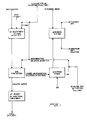
- Figure 1 is a flow diagram illustrating the general ammonia removal concept
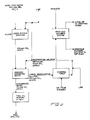
- Figure 2 is a flow diagram illustrating the ammonia removal concept as applied to phosphoric chemical complex wastewater
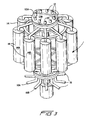
- Figure 3 is a perspective view of an exemplary Advanced Separation Device
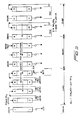
- Figures 4 and 5 are flow sheets illustrating specific ammonia removing processes using the Advanced Separation Device.
- the process of the present invention is carried out in the Advanced Separation Device (ASD) which enables continuous contacting of a fluid stream and sorbent which, when incorporated with the overall process, allows for efficient removal of ammonia from wastewater.
- ASD Advanced Separation Device
- ammonia-containing wastewater treated according to the present invention may vary considerably in pH, it is first treated with an alkaline salt e.g., lime or an acid to adjust the pH to between about 4 and 6 since this is an ideal range of operation for the zeolite adsorbent.
- an alkaline salt e.g., lime or an acid to adjust the pH to between about 4 and 6 since this is an ideal range of operation for the zeolite adsorbent.
- the treated wastewater is then directed to the ASD where ammonium ions are adsorbed onto the zeolite.
- the adsorbed zeolite is then treated with an alkaline regeneration solution fed into the ASD which converts the adsorbed amonium ions to unadsorbed ammonia which is then carried out of the ASD along with the alkaline material (loaded regeneration solution). That solution is then treated in a stripping tower with air which acts to displace the ammonia gas from the alkaline material.
- the alkaline material may then be fortified with lime or other alkaline or alkali salt and circulated back to the ASD.
- ammonia may be reacted with any suitable scrubbing media, e.g., phosphoric acid, to yield ammonium phosphate, which is a commercially useful end product.
- scrubbing media e.g., phosphoric acid
- ammonium depleted wastewater can be subjected, if necessary, to a final ammonium removal, pH adjustment or additional treatment process before it is discharged.
- the ASD comprises a plurality of fixed feed ports 12, to each of which may be supplied various feed materials.
- these materials include the ammonium containing wastewater, the alkaline regeneration fluid, and the washwater feeds.
- adsorbent which interacts with the feed fluids.
- the effluent i.e., the fluid which results from the interaction of the feed materials with the exchange material will hereinafter be referred to as the interaction product.
- the adsorbent is zeolite.
- each feed port 12 has a corresponding discharge port 16. After the interaction product passes through a given fixed discharge port, it may be purged from the system, recirculated back to a selected feed port, or a combination of both.
- the pond waters or wastewaters under consideration typically originate from the processing steps involved in producing ammonium salt compounds, for example diammonium phosphate.
- ammonium salt compounds for example diammonium phosphate.
- phosphoric acid is reacted with ammonia to produce a partially ammoniated slurry.
- This slurry is then pumped to a standard granulation system where it is sprayed onto a bed of recycled diammonium phosphate particles. Additional ammonia is sparged into the bed of material in order to achieve the proper ammonia/phosphate ratio.
- the material is then dried, sized, and sent to product storage. Some loss of material, i.e., ammonia, phosphate, etc., can be expected to occur. To avoid atmospheric discharge of such material, scrubbers are utilized.
- the scrubbing media is typically recirculated pond water. After a period of time, the concentration of ammonium and other contaminating ions builds up to an apparent steady-state concentration. Due to water balance considerations, it is sometimes necessary to discharge a portion of this pond water which may then be treated for removal of the objectionable ions such as fluorides, phosphorous compounds and the like. This is usually accomplished in a liming system.
- the present invention may be used to recover ammonia in conjunction with existing treatment systems.
- the typical composition of the wastewater feeding existing treatment systems and the ionic content at each stage of liming is as follows:
- the pond water in a phosphate complex has a pH of 1.5 to 2.2 which is too acidic to be contacted with zeolite material.
- the acidic pond water is first contacted with lime to increase the pH to between 5 and 6 in order to reduce the soluble fluoride content.
- This addition of lime causes a precipitation of various salts, especially fluorides which leave the system as precipitates in a settling basin or clarifyer. In normal practice, this water would be transferred to the second stage of liming. If ammonia recovery is desired however, this first stage liming effluent would serve as the feed to the ASD system.
- the first stage liming effluent is sent to the ASD and contacted with a solid adsorbent which consists of naturally occurring zeolites, specifically that zeolite known as clinoptilolite. It has been found that in other applications these particular zeolites have an affinity for ammonium ion over those typically "preferred" ion exchange resins, e.g. calcium, magnesium, etc.
- a solid adsorbent which consists of naturally occurring zeolites, specifically that zeolite known as clinoptilolite. It has been found that in other applications these particular zeolites have an affinity for ammonium ion over those typically "preferred" ion exchange resins, e.g. calcium, magnesium, etc.
- typically "preferred" ion exchange resins e.g. calcium, magnesium, etc.
- a zeolite found particularly advantageous for carrying out the process according to the present invention is that known as PDZ-150 marketed by the PDZ Corporaton.
- the properties of that zeolite are as follows: The above zeolite comprises the following components:
- the ammonium-containing wastewater is supplied to one or more of the fixed feed ports 12 shown in Fig. 3.
- the zeolite/wastewater interaction product being discharged from the fixed discharge port may be supplied to the next fixed feed port i.e., countercurrently circulated.
- Fig. 3 for example, if fresh wastewater is supplied to feed port 12A to yield an interaction product which is discharged through discharge port 16A, that product may then be circulated countercurrently i.e., to fixed feed port 12B, where the wastewater interaction product, containing reduced levels of NH4+, will be fed into chamber 14B. If desired, this can be repeated so that the interaction product discharged from 16B, containing wastewater with further reduced levels of NH4+, can be circulated to fixed feed port 12C.
- an intra-stage addition of sulfuric acid may be used to maintain the pH at 5.0 - 5.5.
- This capability of adjusting the pH of the solution during the loading stage allows the maintenence of high, efficient loading of ammonium onto the zeolite material in the ASD.
- acid may be added prior to the addition of the interaction product to fixed feed port 12B.
- the treated water now containing significantly less ammonium ion, is then sent to a final ammonia removal process if required.
- This process could consist of the addition of ground zeolite material for final (ppm) removal of any residual ammonium or the water could be treated in a conventionally as by "break-point chlorination".
- break-point chlorination gaseous chlorine is added to the waste stream which results in the eventual oxidation of the ammonia to compounds which deteriorate to a nitrogen gas and are thus liberated from the waste product stream.
- the amount of chlorine required for this type of operation is about 10 parts chlorine for each part of ammonia removed.
- the washing stage is carried out by supplying a washing fluid to one or more fixed feed ports of the ASD whereby zeolites containing residual amounts of entrained material as well as untreated water are cleaned.
- the adsorbent then moves into the regeneration stage of the ASD where it is contacted with a solution consisting of an alkaline salt such as calcium hydroxide, sodium hydroxide, etc., which may contain a small amount of an alkali salt to serve as an electrolyte, e.g., sodium sulfate.
- an alkaline salt such as calcium hydroxide, sodium hydroxide, etc.
- This regeneration media is supplied to one or more of the fixed feed ports of the ASD for distribution into the rotating chambers containing the zeolite -NH4+ adsorption complex.
- the regeneration media passing through the zeolite strips the ammonium from the zeolite by ion exchange and conversion of ammonium to ammonia for which the zeolite has no affinity.
- a counter-current technique using intra-stage pH control is employed to minimize reagent usage and optimize zeolite utilization during the regeneration stage. More specifically, as ammonia is removed from the zeolite by regeneration solution, the pH of the regenerate tends to decrease to a point where its capacity for removing ammonia from the zeolite is significantly reduced.
- the ASD lends itself to the addition of a caustic material at various points during the regeneration process, so as to maintain the pH at an optimum level.
- the loaded regeneration solution i.e., the alkaline/NH3 interaction product is then transferred to a stripping tower where it is contacted with a stream of air, or recycled gas.
- a recycled gas stream is utilized in order to minimize the build-up of carbonate in the regeneration solution.
- the stripping gas removes the ammonia from the regeneration solution and results in ammonia-rich gas phase and an ammonia-depleted regeneration solution containing less than 50 ppm ammonia.
- the regeneration solution is then fortified with additional alkaline material, as required, and recycled to the ASD unit. Losses of the regeneration solution are therefore minimal.
- the ammonia-rich stripping gas can then be transferred to an acid scrubbing system which consists of venturi scrubbers, spray towers and the like.
- an acid scrubbing system which consists of venturi scrubbers, spray towers and the like.
- phosphoric acid is utilized as the scrubbing media to react with the ammonia in the stripping gas and produce an acidic, ammonium phosphate solution.
- This material is then returned to the existing diammonium phosphate operation.
- the ammonia which was at one point considered an objectionable waste material, is now converted to a usable ammonium phosphate compound resulting in improved, overall plant ammonia utilization efficiency.
- the ammonia depleted stripping gas is then recycled to the stripping tower.
- air is utilized as the stripping media, on a once-through basis and is passed through the stripping tower.
- This air containing the ammonia gas from the regeneration solution, is then scrubbed with sulfuric or phosphoric acids.
- the regeneration solution which is now substantially ammonia free, is recirculated to the ASD system.
- the ammonium phosphate or ammonia sulfate produced by the scrubbing of the air can then be used in the manufacture of di-ammonium phosphate in the case of ammonium phosphate or crystallized to an ammonium sulfate product.
- the next stage of the process involves the washing of the zeolite.
- the second washing stage is carried out by supplying a washing fluid to one or more fixed feed ports of the ASD whereby zeolites containing residual amounts of entrained material as well as ammonia are cleaned and made ready for another cycle of wastewater purification.
- one or more of the fixed feed ports has no material being delivered therethrough so that the zeolite-filled chamber in fluid communication with the feed port will simply drain.
- the number of chambers 14, fixed feed ports 12 and fixed discharge ports 16 in the ASD is a matter of design choice dependent on the types of feed and regeneration materials, the type of adsorbent used, and the size of the ASD.
- Adsorption chambers filled with (18 to 24 inches) 45,72-60,96cm of zeolite are effective.
- the flow rates of feed materials are likewise a matter of design choice. With the above-described chambers, flow rates of 1.36-13.6 l/s m2 (2-20 gpm/ft2) of ammonium containing wastewater and 1.36-13.6 l/s m2 (2-20 gpm/ft2) of alkaline solution are acceptable.
- the chambers can be rotated at between 2 and 120 minutes per rotation depending on the exact nature of the process.
- the amount of fresh feed materials added to the interaction product streams should be in an amount sufficient to maintain the pH at between 5.0 and 6.0.
- the process of the present invention achieves removal of a significant amount of the ammonia from the wastewater.
- industrial pond water resulting from the production of ammonium salt compound and containing as much as 600-800 ppm ammonia can be treated by the process of the present invention so as to contain from 2-5 ppm NH3.
- the process is not limited to the treatment of these concentrations of ammonia but rather, is effective at virtually any concentration.
- the process can be used for removing ammonia from municipal wastes which might contain 50 ppm ammonia. It also finds application in specific processes wherein the concentration is significantly greater than 800 ppm.
- the process of the present invention was carried out using phosphoric chemical plant pond water at a pH of 5.9 containing 645 ppm NH3 and is illustrated in Fig. 4.
- the ASD itself comprised 12 total fixed feed ports and 14 chambers filled with standard PDZ 150 zeolite. Each chamber was filled with a 406mm (16 inch) bed of zeolite for a zeolite volume per chamber of 1.3 liters. Each chamber was approximately 51mm (two inches)in diameter.
- An ammonia-containing pond water was fed into feed port 4T, a first stream of washwater fed into fixed feed port 2T, a regeneration solution containing sodium hydroxide in a solution of sodium sulfate fed into fixed feed port 10T, and a second stream of washwater fed into fixed feed port 8T.
- the feed rate of pond water was about 4.35 l/s m2 (6.4 gpm/ft2).
- the feed rate of the two washwater streams varied but were typically between 1.36 and 2.72 l/s m 2 (2 and 4 gpm/ft2).
- the regeneration fluid was recirculated from a surge tank at a rate of 3.4 to 6.8 l/s m2 (5 to 10 gpm/ft2). A small amount of fluid was fed forward.
- the fresh regeneration solution had a pH between 11 and 11.5 and a sodium sulfate concentration of 10% by weight.
- the wastewater/zeolite interaction product being discharged through fixed port 4B contained 182 ppm ammonium solution at a pH of 6.0.
- That solution was then fed to fixed port 5T for delivery to another chamber.
- the second interaction product being discharged from port 5B contained 104 ppm of ammonium ion. Because the removal of ammonium ion from the wastewater causes an increase in the pH, H2SO4 was added to the product discharged from port 5B to reduce the pH.
- the pH adjusted solution was then fed to fixed port 6T for final ammonium removal.
- the product discharged from fixed port 6B contained 72 ppm ammonium at a pH of 6.0.
- the device was rotated at a rate of one rotation per every twenty-four minutes.
- the chambers were filled with 406mm (16 inches) of zeolite in the present example, it will be appreciated that by increasing the bed depth or the number of zeolite-containing chambers, there will result further reductions in ammonia levels.
- Example 5 The same ASD which was used in Example 1 was used again. This time, however, a municipal wastewater containing 50 ppm ammonia was treated rather than the industrial wastewater treated in Example 1. The process is illustrated in Fig. 5.
- the municipal wastewater having a pH of 6.0 was fed into fixed port 2T' at a rate of about 8.16 l/s m 2 (12 gpm/ft 2 ).
- the interaction products discharged from fixed ports 2B', 3a' and 4B' were fed to successive feed ports without intra-stage addition of an acidic material.
- the alkaline regeneration fluids which comprised a 2N solution of Na2SO 4 and NaOH at an initial pH of 11.5 were added to ports 10T' and 12T' at a rate of 5.44-6.8 l/s m 2 (8-10 gpm/ft 2 ) without being fortified with additional alkaline material.
- the example demonstrates that municipal wastewater ammonium levels could be reduced to 2 ppm.
- the concentration of the regeneration solution increased to 70 ppm.
Landscapes
- Chemical & Material Sciences (AREA)
- Organic Chemistry (AREA)
- Environmental & Geological Engineering (AREA)
- Life Sciences & Earth Sciences (AREA)
- Hydrology & Water Resources (AREA)
- Engineering & Computer Science (AREA)
- Water Supply & Treatment (AREA)
- Chemical Kinetics & Catalysis (AREA)
- Inorganic Chemistry (AREA)
- Water Treatment By Sorption (AREA)
- Physical Water Treatments (AREA)
- Treatment Of Water By Ion Exchange (AREA)
- Removal Of Specific Substances (AREA)
Abstract
Description
- The present invention relates to a process for the removal of ammonia from wastewater and more particularly, to a process wherein ammonium ions are adsorbed onto zeolite and subsequently recovered as ammonia gas.
- The presence of ammonia in wastewater is undesirable since the nitrogen contained therein acts as a fertilizer for aquatic plant life thereby resulting in the phenomenon commonly known as "algae bloom". Heretofore, methods have been proposed for removing ammonia from wastewater. One such method involves liming of a body of water which converts the ammonium ions to gaseous ammonia which is then liberated, via air stripping into the atmosphere. Rather than eliminate the adverse environmental effects of ammonia however, liming merely transfers the problem from the water to the atmosphere. Additionally, since useful products may be produced from ammonia as a starting reagent, the liberation of ammonia into the atmosphere represents a significant economic loss.
- US 2,617,986 discloses a rotatable adsorption apparatus for treating liquids or gases. The apparatus comprises an annular drum divided into a plurality of compartments in which are supported containers for adsorbent such as silica gel. As the drum rotates, the adsorbent successively passes through three stages which permit dehydration or activation of the fluid applied to each stage.
- FR-A-2114715 discloses use of a synthetic zeolite for removal of ammonia from an aqueous solution containing one or more alkali or alkaline earth metal cations in which the solution is applied to a column of the zeolite to adsorb the ammonia. A regeneration cycle using a lime solution may be applied to the column to remove ammonia therefrom.
- In U.S. Patent No. 4,011,156, a method of eliminating organic and inorganic bound nitrogen from domestic and industrial wastewater is disclosed. The process is generally carried out by passing the wastewater, an alkaline substance, and oxygen through a fixed bed reactor containing a catalyst whereby the ammonia is converted to harmless nitrogen gas. The alkaline substance is added since a marked decrease in pH occurs as the NH₄+ is oxidized to N₂ and since such a pH decrease was observed to adversely affect efficiency of the reaction as well as the catalyst.
- While the conversion of wastewater ammonia to nitrogen gas is highly desirable from an environmental viewpoint, it is not very economical since a potentially valuable material is being converted into a useless form and expelled into the atmosphere. Additionally, the process itself is cumbersome, requiring a practitioner to evaluate the pH values of the reaction mixture along different points of the fixed bed.
- In U.S. Patent No. 3,984,313, sewage water containing ammonia as well as phosphates is purified by using a ferric hydroxide loaded ion exchange resin. While the proposed process is desirable economically since ammonium hydroxide, which is a commercially useful end product, is produced from the ammonia contaminant, the process itself suffers from the disadvantage that it is not continuous since the wastewater feed must be temporarily shut down and the spent resin replaced with fresh resin.
- It has been observed that zeolites have a high affinity for ammonium ions and would therefore be quite effective as adsorbents for removing the ions from wastewater solutions. Since zeolites have no affinity for ammonia gas, the ammonium ions initially adsorbed onto the zeolite could be desorbed merely by increasing the pH enough to convert the bound ammonium ions to unbound gaseous ammonia. Such a process would prove highly desirable from both an economic and environmental viewpoint since the bulk of the ammonium ions would be removed from the wastewater and since the ammonia subsequently released is not only a commercially valuable material as is, but also may be converted relatively easily to a host of other commercially valuable materials such as ammonium phosphate.
- Despite their high affinity for ammonium ions as well as the environmental and economic advantages discussed above, zeolites have not proven completely effective when used in conjunction with conventional purification techniques such as fixed or pulsed beds. One reason for this lack of effectiveness is the low loading capacity of zeolites, i.e., the amount of ammonium ion which can be adsorbed per unit of zeolite. Thus, in order to effectively use zeolites as adsorbents in conjunction with ammonia removal processes, an inordinate amount of zeolite would be required thus resulting in increased costs in terms of materials, equipment, energy expenditures, and down-time. Such drawbacks would be in addition to those already described with respect to prior art fixed bed processes utilizing other adsorbents or ion exchange resins. Such drawbacks include difficulties in carrying out the reaction continuously as well as difficulties in maintaining the optimum pH as material is reacted or adsorbed.
- In view of the foregoing limitations and shortcomings of prior art processes, as well as other disadvantages not specifically mentioned above, it should be apparent that there exists a need in the art for a process for removing ammonia from wastewater which may be carried out at optimum efficiency and which not only removes ammonium ions from wastewater but also enables the removed ammonia to be subsequently used as a commercial end product. It is, therefore, a primary objective of this invention to fulfill that need by providing a process wherein ammonium contained in wastewater is continuously and efficiently removed therefrom and subsequently recovered using zeolite adsorbent in conjunction with an advanced separation device.
- More particularly, it is an object of this invention to provide a process for the removal of ammonia from wastewater which achieves optimum utilization of the zeolite adsorbent.
- It is a further object of this invention to provide a process for the removal of ammonia from wastewater which produces no harmful by-products.
- Yet another object of this invention is to provide a process for the removal of ammonia from wastewater wherein wastewater treated in a first zeolite stage and having reduced levels of ammonium therein may be circulated countercurrently and combined with fresh wastewater being fed to a second zeolite stage so as to maximize the process efficiency.
- Still another object of this invention is to provide a process for the removal of ammonia from wastewater wherein the pH of the fluid to be treated may be controlled in an intra-stage fashion such as during the adsorption stage.
- Another object of this invention is to provide a process for the removal of ammonia from wastewater which is compatible with existing wastewater treatment technology.
- The present invention provides a process for the removal of ammonia from wastewater wherein ammonium ions are adsorbed onto zeolite and subsequently recovered as ammonia gas, which process comprises (a) arranging a plurality of zeolite-filled chambers moving about a circular path in periodic fluid communication with stationary feed ports and stationary discharge ports at an end of the chambers opposite to that of the stationary feed ports; (b) adsorbing ammonium ions onto the zeolite by supplying wastewater containing ammonium ions to one or more first stationary feed ports, said wastewater being supplied in sequence to said plurality of zeolite-filled chambers to form an ammonium-loaded zeolite and an interaction product comprising wastewater with substantially reduced amounts of ammonium, said interaction product being discharged through a first adsorption stage discharge port for entry into a second stationary adsorption stage feed port and (c) regenerating ammonia from said zeolite-filled chambers by supplying an alkaline regeneration fluid to a stationary regeneration stage feed port to adsorb a substantial portion of the ammonium ions from the ammonium-loaded zeolite by ion exchange conversion of the ammonium ions to ammonia, and discharging from said plurality of chambers ammonia gas in a substantially continuous stream.
- There may be further provided a plurality of zeolite-filled chambers moving about a circular path under four stationary fluid feed ports, the first port supplying wastewater containing ammonium ions, the second optional port supplying washwater which removes any entrained wastewater after the zeolite is exhausted, the third port supplying an alkaline regeneration fluid which converts the adsorbed ammonium into desorbed ammonia and the fourth optional port which supplies washwater which cleans the zeolite for repetition of the cycle. All four ports operate continuously to supply feed materials to the particular chamber in fluid communication with each port at any given moment. Four stationary discharge ports corresponding to the stationary feed ports are also provided. It should be noted that, depending on the nature of the wastewater stream being treated one, or possibly both, of the washwater streams could be eliminated.
- A preferred embodiment of the invention is illustrated and described with reference to the accompanying drawings, in which:
- Figure 1 is a flow diagram illustrating the general ammonia removal concept;
- Figure 2 is a flow diagram illustrating the ammonia removal concept as applied to phosphoric chemical complex wastewater;
- Figure 3 is a perspective view of an exemplary Advanced Separation Device; and
- Figures 4 and 5 are flow sheets illustrating specific ammonia removing processes using the Advanced Separation Device.
- The process of the present invention is carried out in the Advanced Separation Device (ASD) which enables continuous contacting of a fluid stream and sorbent which, when incorporated with the overall process, allows for efficient removal of ammonia from wastewater. The ASD is described in detail in assignee's copending application S.N. 713,493 filed March 19, 1985, the disclosure of which is hereby incorporated by reference.
- Before describing the application of the ASD device to this process, the overall process concept for the removal of ammonia from wastewater by zeolites utilizing the ASD is set forth in block diagrams, Figs. 1 and 2.
- Since the ammonia-containing wastewater treated according to the present invention may vary considerably in pH, it is first treated with an alkaline salt e.g., lime or an acid to adjust the pH to between about 4 and 6 since this is an ideal range of operation for the zeolite adsorbent.
- The treated wastewater is then directed to the ASD where ammonium ions are adsorbed onto the zeolite. The adsorbed zeolite is then treated with an alkaline regeneration solution fed into the ASD which converts the adsorbed amonium ions to unadsorbed ammonia which is then carried out of the ASD along with the alkaline material (loaded regeneration solution). That solution is then treated in a stripping tower with air which acts to displace the ammonia gas from the alkaline material. The alkaline material may then be fortified with lime or other alkaline or alkali salt and circulated back to the ASD. The ammonia may be reacted with any suitable scrubbing media, e.g., phosphoric acid, to yield ammonium phosphate, which is a commercially useful end product. The ammonium depleted wastewater can be subjected, if necessary, to a final ammonium removal, pH adjustment or additional treatment process before it is discharged.
- For convenience, a brief description of the ASD, illustrated in Fig. 3, will now be provided.
- The ASD comprises a plurality of
fixed feed ports 12, to each of which may be supplied various feed materials. In the case of the present invention, these materials include the ammonium containing wastewater, the alkaline regeneration fluid, and the washwater feeds. - Moving about a circular path in periodic fluid communication with each of the above-described stationary feed ports are a plurality of
chambers 14 filled with an exchange material such as an adsorbent which interacts with the feed fluids. The effluent i.e., the fluid which results from the interaction of the feed materials with the exchange material will hereinafter be referred to as the interaction product. In the process of the present invention, the adsorbent is zeolite. - It will be appreciated that the feed materials are supplied continuously to their
respective feed ports 12 for periodic interaction with the adsorbent in each of thechambers 14. In similar fashion, a plurality ofstationary discharge ports 16 are provided at an end of the chambers opposite to that of thefixed feed ports 12. Eachfeed port 12 has acorresponding discharge port 16. After the interaction product passes through a given fixed discharge port, it may be purged from the system, recirculated back to a selected feed port, or a combination of both. - The pond waters or wastewaters under consideration typically originate from the processing steps involved in producing ammonium salt compounds, for example diammonium phosphate. In this process phosphoric acid is reacted with ammonia to produce a partially ammoniated slurry. This slurry is then pumped to a standard granulation system where it is sprayed onto a bed of recycled diammonium phosphate particles. Additional ammonia is sparged into the bed of material in order to achieve the proper ammonia/phosphate ratio. The material is then dried, sized, and sent to product storage. Some loss of material, i.e., ammonia, phosphate, etc., can be expected to occur. To avoid atmospheric discharge of such material, scrubbers are utilized. The scrubbing media is typically recirculated pond water. After a period of time, the concentration of ammonium and other contaminating ions builds up to an apparent steady-state concentration. Due to water balance considerations, it is sometimes necessary to discharge a portion of this pond water which may then be treated for removal of the objectionable ions such as fluorides, phosphorous compounds and the like. This is usually accomplished in a liming system. The present invention may be used to recover ammonia in conjunction with existing treatment systems.
- The typical composition of the wastewater feeding existing treatment systems and the ionic content at each stage of liming is as follows:

- It will be appreciated that although the concentrations of a number of contaminants are substantially reduced, ammonia levels nonetheless remain relatively high.
- Normally, the pond water in a phosphate complex has a pH of 1.5 to 2.2 which is too acidic to be contacted with zeolite material. In the typical liming system, the acidic pond water is first contacted with lime to increase the pH to between 5 and 6 in order to reduce the soluble fluoride content. This addition of lime causes a precipitation of various salts, especially fluorides which leave the system as precipitates in a settling basin or clarifyer. In normal practice, this water would be transferred to the second stage of liming. If ammonia recovery is desired however, this first stage liming effluent would serve as the feed to the ASD system.
- Thus, the first stage liming effluent is sent to the ASD and contacted with a solid adsorbent which consists of naturally occurring zeolites, specifically that zeolite known as clinoptilolite. It has been found that in other applications these particular zeolites have an affinity for ammonium ion over those typically "preferred" ion exchange resins, e.g. calcium, magnesium, etc. The process concept is shown in Figure 2.
- A zeolite found particularly advantageous for carrying out the process according to the present invention is that known as PDZ-150 marketed by the PDZ Corporaton. The properties of that zeolite are as follows:


- The ammonium-containing wastewater is supplied to one or more of the fixed
feed ports 12 shown in Fig. 3. In order to maximize process efficiency, the zeolite/wastewater interaction product being discharged from the fixed discharge port may be supplied to the next fixed feed port i.e., countercurrently circulated. Referring to Fig. 3, for example, if fresh wastewater is supplied to feedport 12A to yield an interaction product which is discharged throughdischarge port 16A, that product may then be circulated countercurrently i.e., to fixedfeed port 12B, where the wastewater interaction product, containing reduced levels of NH₄+, will be fed into chamber 14B. If desired, this can be repeated so that the interaction product discharged from 16B, containing wastewater with further reduced levels of NH₄+, can be circulated to fixedfeed port 12C. - Since the removal of the ammonia from the wastewater by the zeolite will cause the pH level to rise to a point where the zeolite efficiency is significantly reduced, an intra-stage addition of sulfuric acid may be used to maintain the pH at 5.0 - 5.5. This capability of adjusting the pH of the solution during the loading stage allows the maintenence of high, efficient loading of ammonium onto the zeolite material in the ASD. Thus, as the wastewater/zeolite interaction product is discharged from
discharge port 16A, acid may be added prior to the addition of the interaction product to fixedfeed port 12B. - The treated water, now containing significantly less ammonium ion, is then sent to a final ammonia removal process if required. This process could consist of the addition of ground zeolite material for final (ppm) removal of any residual ammonium or the water could be treated in a conventionally as by "break-point chlorination". In break-point chlorination, gaseous chlorine is added to the waste stream which results in the eventual oxidation of the ammonia to compounds which deteriorate to a nitrogen gas and are thus liberated from the waste product stream. The amount of chlorine required for this type of operation is about 10 parts chlorine for each part of ammonia removed. In the dusting operation a very fine powdered zeolite material is mixed with the effluent from the zeolite system which adsorbs the ammonia and is simply discarded. The partially treated water from the ASD sysem would then be sent to the second stage of liming wherein additional contaminants, especially phosphorous, are removed.
- After the zeolite adsorbent is loaded with ammonia it moves into the washing stage. As with the adsorption stage, the washing stage is carried out by supplying a washing fluid to one or more fixed feed ports of the ASD whereby zeolites containing residual amounts of entrained material as well as untreated water are cleaned. The adsorbent then moves into the regeneration stage of the ASD where it is contacted with a solution consisting of an alkaline salt such as calcium hydroxide, sodium hydroxide, etc., which may contain a small amount of an alkali salt to serve as an electrolyte, e.g., sodium sulfate. In the conventional practice of ammonia adsorption in fixed-beds, use is made of an alkaline salt solution containing sodium chloride. However, for phosphoric acid applications, chloride ions must be kept segregated from the existing pond system, and it would be advantageous to eliminate the need for sodium chloride altogether in the event of spills, etc. It has been found that sodium sulfate will function as a suitable additive in an alkaline solution of, for instance, sodium hydroxide. It has also been discovered that a solution of clarified "lime-water" i.e. a solution of water saturated with calcium hydroxide, will function as a suitable regenerate. This approach is particularly advantageous in a phosphoric acid pond situation since the water leaving the ammonia recovery circuit is typically sent to a second stage liming system. Use of "lime-water" therefore, optimizes reagent consumption since lime used in the ammonia regeneration process is not used in the second stage of liming i.e. minimized costs.
- This regeneration media is supplied to one or more of the fixed feed ports of the ASD for distribution into the rotating chambers containing the zeolite
-NH₄+
adsorption complex. The regeneration media passing through the zeolite strips the ammonium from the zeolite by ion exchange and conversion of ammonium to ammonia for which the zeolite has no affinity. As with the adsorption stage, a counter-current technique using intra-stage pH control is employed to minimize reagent usage and optimize zeolite utilization during the regeneration stage. More specifically, as ammonia is removed from the zeolite by regeneration solution, the pH of the regenerate tends to decrease to a point where its capacity for removing ammonia from the zeolite is significantly reduced. The ASD lends itself to the addition of a caustic material at various points during the regeneration process, so as to maintain the pH at an optimum level. - The loaded regeneration solution i.e., the alkaline/NH₃ interaction product is then transferred to a stripping tower where it is contacted with a stream of air, or recycled gas. In one embodiment, a recycled gas stream is utilized in order to minimize the build-up of carbonate in the regeneration solution. The stripping gas removes the ammonia from the regeneration solution and results in ammonia-rich gas phase and an ammonia-depleted regeneration solution containing less than 50 ppm ammonia. The regeneration solution is then fortified with additional alkaline material, as required, and recycled to the ASD unit. Losses of the regeneration solution are therefore minimal.
- The ammonia-rich stripping gas can then be transferred to an acid scrubbing system which consists of venturi scrubbers, spray towers and the like. In the case of a DAP operation, phosphoric acid is utilized as the scrubbing media to react with the ammonia in the stripping gas and produce an acidic, ammonium phosphate solution. This material is then returned to the existing diammonium phosphate operation. Hence the ammonia, which was at one point considered an objectionable waste material, is now converted to a usable ammonium phosphate compound resulting in improved, overall plant ammonia utilization efficiency. The ammonia depleted stripping gas is then recycled to the stripping tower.
- In another embodiment, air is utilized as the stripping media, on a once-through basis and is passed through the stripping tower. This air, containing the ammonia gas from the regeneration solution, is then scrubbed with sulfuric or phosphoric acids. The regeneration solution, which is now substantially ammonia free, is recirculated to the ASD system. The ammonium phosphate or ammonia sulfate produced by the scrubbing of the air can then be used in the manufacture of di-ammonium phosphate in the case of ammonium phosphate or crystallized to an ammonium sulfate product.
- It should be noted that no regeneration solution is discharged into the environment and the air can be circulated within the system so that no air is discharged into the atmosphere. This results in an environmentally clean operation and forms a basis for minimum chemical costs.
- The next stage of the process involves the washing of the zeolite. As with the adsorption, first washing, and regeneration stages previously described, the second washing stage is carried out by supplying a washing fluid to one or more fixed feed ports of the ASD whereby zeolites containing residual amounts of entrained material as well as ammonia are cleaned and made ready for another cycle of wastewater purification. Optionally, one or more of the fixed feed ports has no material being delivered therethrough so that the zeolite-filled chamber in fluid communication with the feed port will simply drain.
- The number of
chambers 14, fixedfeed ports 12 and fixeddischarge ports 16 in the ASD is a matter of design choice dependent on the types of feed and regeneration materials, the type of adsorbent used, and the size of the ASD. Adsorption chambers filled with (18 to 24 inches) 45,72-60,96cm of zeolite are effective. - The flow rates of feed materials are likewise a matter of design choice. With the above-described chambers, flow rates of 1.36-13.6 l/s m² (2-20 gpm/ft²) of ammonium containing wastewater and 1.36-13.6 l/s m² (2-20 gpm/ft²) of alkaline solution are acceptable. The chambers can be rotated at between 2 and 120 minutes per rotation depending on the exact nature of the process.
- The amount of fresh feed materials added to the interaction product streams should be in an amount sufficient to maintain the pH at between 5.0 and 6.0.
- The process of the present invention achieves removal of a significant amount of the ammonia from the wastewater. Thus, industrial pond water resulting from the production of ammonium salt compound and containing as much as 600-800 ppm ammonia can be treated by the process of the present invention so as to contain from 2-5 ppm NH₃. However, it should be noted that the process is not limited to the treatment of these concentrations of ammonia but rather, is effective at virtually any concentration. Thus, the process can be used for removing ammonia from municipal wastes which might contain 50 ppm ammonia. It also finds application in specific processes wherein the concentration is significantly greater than 800 ppm.
- The following examples are given for illustrative purposes only and should in no way be construed as limiting the scope of the process disclosed and claimed.
- The purpose of this test was to determine if industrial wastewater containing 645 ppm of ammonia could be treated to contain between 50 and 100 ppm ammonia, which corresponds to the ammonia content of typical domestic wastewater.
- The process of the present invention was carried out using phosphoric chemical plant pond water at a pH of 5.9 containing 645 ppm NH₃ and is illustrated in Fig. 4. The ASD itself comprised 12 total fixed feed ports and 14 chambers filled with standard PDZ 150 zeolite. Each chamber was filled with a 406mm (16 inch) bed of zeolite for a zeolite volume per chamber of 1.3 liters. Each chamber was approximately 51mm (two inches)in diameter. An ammonia-containing pond water was fed into
feed port 4T, a first stream of washwater fed into fixedfeed port 2T, a regeneration solution containing sodium hydroxide in a solution of sodium sulfate fed into fixed feed port 10T, and a second stream of washwater fed into fixedfeed port 8T. The feed rate of pond water was about 4.35 l/s m² (6.4 gpm/ft²). The feed rate of the two washwater streams varied but were typically between 1.36 and 2.72 l/s m₂ (2 and 4 gpm/ft²). The regeneration fluid was recirculated from a surge tank at a rate of 3.4 to 6.8 l/s m² (5 to 10 gpm/ft²). A small amount of fluid was fed forward. The fresh regeneration solution had a pH between 11 and 11.5 and a sodium sulfate concentration of 10% by weight. - As is evident from Fig. 4, the wastewater/zeolite interaction product being discharged through fixed
port 4B contained 182 ppm ammonium solution at a pH of 6.0. - That solution was then fed to fixed
port 5T for delivery to another chamber. The second interaction product being discharged fromport 5B contained 104 ppm of ammonium ion. Because the removal of ammonium ion from the wastewater causes an increase in the pH,
H₂SO₄
was added to the product discharged fromport 5B to reduce the pH. The pH adjusted solution was then fed to fixedport 6T for final ammonium removal. The product discharged from fixedport 6B contained 72 ppm ammonium at a pH of 6.0. - As with the wastewater absorption stage, there was intra-stage pH adjustment carried out in conjunction with the regeneration stage. More specifically, the interaction product of the alkaline regeneration solution and the ammonium-loaded zeolite was discharged from port 10B where it was fortified in a surge tank with additional alkaline material prior to being fed to fixed
ports 11T and 12T. Enough alkaline material was added so as to adjust the pH of the streams entering the ports 10T-12T to a value above 10.5. The concentration of ammonia in the spent regeneration solution was 560 ppm. The solution itself had a pH of 9.4. - The device was rotated at a rate of one rotation per every twenty-four minutes. Although the chambers were filled with 406mm (16 inches) of zeolite in the present example, it will be appreciated that by increasing the bed depth or the number of zeolite-containing chambers, there will result further reductions in ammonia levels.
- The process of removing ammonia from wastewater using the ASD was carried out without the intra-stage addition of pH adjusting materials in order to demonstrate the benefits accruing therefrom.
- The same ASD which was used in Example 1 was used again. This time, however, a municipal wastewater containing 50 ppm ammonia was treated rather than the industrial wastewater treated in Example 1. The process is illustrated in Fig. 5.
- The municipal wastewater having a pH of 6.0 was fed into fixed
port 2T' at a rate of about 8.16 l/s m2 (12 gpm/ft2). The interaction products discharged from fixed ports 2B', 3a' and 4B' were fed to successive feed ports without intra-stage addition of an acidic material. Likewise, the alkaline regeneration fluids, which comprised a 2N solution of
Na₂SO4
and
NaOH
at an initial pH of 11.5 were added to ports 10T' and 12T' at a rate of 5.44-6.8 l/s m2 (8-10 gpm/ft2) without being fortified with additional alkaline material. - In order to assess the ammonia removal process on a differential basis, an excess of washwater was fed into fixed
feed port 8T' since such insures a minimization of cross-contamination. - It can be seen that without intra-stage pH adjustment of the countercurrently circulated wastewater, there was an overall increase in the pH as the wastewater containing ammonium passed through the four chambers. Thus, the pH of the effluent being discharged through adsorption stage discharge ports 2B', 3B', 4B' and 5B' was 9.1, 10.1, 10.0 and 10.6 respectively which translates into an overall increase of 1.5.
- Because of the pH increase between for example, positions 4 and 5, the formation of unadsorbed ammonia becomes more and more favored over the ammonium ion contained in the wastewater. This phenomenon leads to the release of residual amounts of ammonium left over from the regeneration stage and thus accounts for the observed increase in the ammonia content from 3.6 to 6.7 ppm between
stages - The example demonstrates that municipal wastewater ammonium levels could be reduced to 2 ppm. The concentration of the regeneration solution increased to 70 ppm.
Claims (10)
- A process for the removal of ammonia from wastewater wherein ammonium ions are adsorbed onto zeolite and subsequently recovered as ammonia gas, which process comprises (a) arranging a plurality of zeolite-filled chambers moving about a circular path in periodic fluid communication with stationary feed ports and stationary discharge ports at an end of the chambers opposite to that of the stationary feed ports; (b) adsorbing ammonium ions onto the zeolite by supplying wastewater containing ammonium ions to one or more first stationary feed ports, said wastewater being supplied in sequence to said plurality of zeolite-filled chambers to form an ammonium-loaded zeolite and an interaction product comprising wastewater with subtantially reduced amounts of ammonium, said interaction product being discharged through a first adsorption stage discharge port for entry into a second stationary adsorption stage feed port and (c) regenerating ammonia from said zeolite-filled chambers by supplying an alkaline regeneration fluid to a stationary regeneration stage feed port to adsorb a substantial portion of the ammonium ions from the ammonium-loaded zeolite by ion exchange conversion of the ammonium ions to ammonia, and discharging from said plurality of chambers ammonia gas in a substantially continuous stream.
- A process as claimed in Claim 1, wherein the interaction product is combined with at least acid or additonal wastewater to form a second feed solution before entry into the second stationary adsorption stage feed port.
- A process as claimed in Claim 2, wherein the acid is
H₂SO4
- A process as claimed in Claim 1, further comprising the step of post-treating the interaction product of the first, second, or additional purged adsorption stage to remove residual amounts of ammonium ions.
- A process as claimed in Claim 4, wherein the post-treatment step comprises adding ground zeolite which adsorbs the residual amounts of ammonium ions.
- A process as claimed in any one of Claims 1 to 5, further comprising a pre-treatment step wherein the pH of the wastewater is adjusted to between 4 and 6.
- A process as claimed in any one of Claims 1 to 6, wherein the alkaline regeneration solution supplied to the stationary regeneration stage feed port and delivered to the chambers containing said ammonium-loaded zeolite, forms a second interaction product comprising an alkaline/ammonia solution, which second interaction product is discharged through said stationary regeneration stage discharge port for entry into a second stationary regeneration stage feed port.
- A process as claimed in Claim 7, wherein the second interaction product is combined with an alkaline material before entry into the second stationary regeneration stage feed port.
- A process as claimed in any one of Claims 1 to 8, further comprising washing the ammonium-loaded zeolite by supplying a washing fluid to a stationary washing stage feed port for delivery into the plurality of zeolite-filled chambers, which stationary washing stage feed port and a corresponding stationary washing stage discharge port are in periodic fluid communication with the chambers, and which washing fluid effects removal of residual amounts of entrained material.
- A process as claimed in any one of Claims 1 to 9, further comprising washing the zeolite by supplying a second washing fluid to a second stationary washing stage feed port for delivery into said chambers containing zeolite with residual amounts of ammonia, which second stationary washing stage feed port and a corresponding second stationary washing stage discharge port are in periodic fluid communication with the chambers, which second washing fluid effects removal of said ammonia so as to provide substantially fresh zeolite.
Priority Applications (1)
| Application Number | Priority Date | Filing Date | Title |
|---|---|---|---|
| AT85308709T ATE60870T1 (en) | 1985-05-07 | 1985-11-29 | AMMONIA REMOVAL FROM WASTEWATER. |
Applications Claiming Priority (2)
| Application Number | Priority Date | Filing Date | Title |
|---|---|---|---|
| US06/731,281 US4695387A (en) | 1985-05-07 | 1985-05-07 | Removal of ammonia from wastewater |
| US731281 | 1985-05-07 |
Publications (3)
| Publication Number | Publication Date |
|---|---|
| EP0200834A2 EP0200834A2 (en) | 1986-11-12 |
| EP0200834A3 EP0200834A3 (en) | 1988-04-06 |
| EP0200834B1 true EP0200834B1 (en) | 1991-02-13 |
Family
ID=24938850
Family Applications (1)
| Application Number | Title | Priority Date | Filing Date |
|---|---|---|---|
| EP85308709A Expired - Lifetime EP0200834B1 (en) | 1985-05-07 | 1985-11-29 | Removal of ammonia from wastewater |
Country Status (12)
| Country | Link |
|---|---|
| US (1) | US4695387A (en) |
| EP (1) | EP0200834B1 (en) |
| JP (1) | JPH084785B2 (en) |
| KR (1) | KR900000905B1 (en) |
| CN (1) | CN85108745A (en) |
| AT (1) | ATE60870T1 (en) |
| AU (1) | AU573054B2 (en) |
| CA (1) | CA1258543A (en) |
| DE (1) | DE3581756D1 (en) |
| ES (1) | ES8702865A1 (en) |
| IL (1) | IL77058A (en) |
| IN (1) | IN165188B (en) |
Families Citing this family (38)
| Publication number | Priority date | Publication date | Assignee | Title |
|---|---|---|---|---|
| DE3530498C2 (en) * | 1985-08-27 | 1995-07-13 | Miljoevern Umwelt Technik Inge | Process for the removal of ammonium ions from waste water |
| US5110578A (en) * | 1989-10-05 | 1992-05-05 | Monomeros Colombo Venezolanos, S.A. (E.M.A.) | Continuous production of potassium nitrate via ion exchange |
| AT396206B (en) * | 1991-03-08 | 1993-07-26 | Techform Engineering Gmbh | REDUCTION, CONVERSION, AND / OR REMOVAL OF POLLUTANTS RESULTING FROM COMBUSTION AND / OR INDUSTRIAL AND / OR ENVIRONMENTAL RELIEF PROCESSES |
| US5512182A (en) * | 1991-12-12 | 1996-04-30 | American Laboratories | Process for removing trace amounts of ammonia-containing compounds from aqueous streams |
| DE4231628C1 (en) * | 1992-09-22 | 1994-02-17 | Forschungszentrum Juelich Gmbh | Nitrogen elimination purificn. process by ion exchange adsorption of ammonium and ions, and an appts. - by intensive airing and washing with water in a separate nitrification reactor unit |
| US6080314A (en) * | 1994-06-20 | 2000-06-27 | Rose; Jane Anne | Zeolite bed leach septic system and method for wastewater treatment |
| WO1998043738A1 (en) * | 1997-03-31 | 1998-10-08 | Battelle Memorial Institute | Apparatus and method for ammonia removal from waste streams |
| DE19747444A1 (en) * | 1997-10-28 | 1999-04-29 | Preussenelektra Ag | Process for the selective elimination of ammonia or ammonium ions from an aqueous solution |
| US6171503B1 (en) * | 1998-03-16 | 2001-01-09 | Dalhousie University | Use of tetraphenyloborate for extraction of ammonium ions and amines from water |
| ES2154973B1 (en) * | 1998-04-29 | 2001-11-16 | Consejo Superior Investigacion | PROCEDURE FOR THE FILTRATION OF EFFLUENTS OF BIOLOGICAL TREATMENTS OF URBAN WASTEWATER. |
| SE0100371L (en) * | 2001-02-07 | 2002-08-08 | Bmt Bio Mineral Technologies A | Filter department and process for purification of wastewater containing inorganic, organic pollutants and / or pathogens |
| US7476311B2 (en) * | 2001-09-26 | 2009-01-13 | Wrt International Llc | Arsenic removal from aqueous media using chemically treated zeolite materials |
| US9908788B1 (en) | 2001-09-26 | 2018-03-06 | Wrt International Llc | Radium removal from aqueous media using zeolite materials |
| US7108784B1 (en) * | 2001-09-26 | 2006-09-19 | Wrt International Llc | Apparatus for removal and destruction of ammonia from an aqueous medium |
| US6960301B2 (en) * | 2002-03-15 | 2005-11-01 | New Earth Systems, Inc. | Leachate and wastewater remediation system |
| CN1246262C (en) * | 2002-07-05 | 2006-03-22 | 华南农业大学 | Process for preparing efficient ammonium phosphate |
| US7105087B2 (en) * | 2002-09-17 | 2006-09-12 | Wrt International Llc | Hexa-valent chromium removal from aqueous media using ferrous-form zeolite materials |
| US7390414B2 (en) * | 2002-09-25 | 2008-06-24 | Wrt International Llc | Regeneration of chemically treated zeolite |
| US7326347B2 (en) * | 2003-10-29 | 2008-02-05 | Wrt International Llc | Dynamic up-flow zeolite system and method |
| US20060034669A1 (en) * | 2004-08-10 | 2006-02-16 | Mcmahon James P | Aboveground Modular, Permeable Reactive Barrier System for Rainfall Runoff Treatment |
| US8256995B2 (en) * | 2004-08-10 | 2012-09-04 | Mcmahon James P | Aboveground modular, permeable reactive barrier system for liquid runoff treatment |
| CN1312063C (en) * | 2005-03-28 | 2007-04-25 | 哈尔滨工业大学 | Method for removing ammonia nitrogen from sewage in subzone |
| CN100497174C (en) * | 2005-04-21 | 2009-06-10 | 中国石油化工股份有限公司 | Synthesis of zeolite molecular sieves |
| US20070215552A1 (en) * | 2005-09-16 | 2007-09-20 | Wrt International Llc. | Systems and methods for removal of contaminates from an aqueous media in the absence of modified nitrate levels |
| US7520987B1 (en) | 2005-11-15 | 2009-04-21 | Wrt International Llc | System and apparatus for purging absorptive materials used in the removal of contaminates from an aqueous medium |
| US8663479B2 (en) * | 2006-11-20 | 2014-03-04 | Wrt International Llc | Method for removing cationic contaminants from water using natural zeolite underloaded with transition metal ions to limit leakage of intrinsic arsenic therefrom |
| WO2010019116A1 (en) * | 2008-08-14 | 2010-02-18 | Basin Water, Inc. | Ammonia removal apparatus and method |
| ITVR20090152A1 (en) * | 2009-09-30 | 2011-04-01 | Giovanni Bonometti | PLANT AND PROCEDURE FOR THE EXTRACTION OF AMMONIACAL NITROGEN FROM LIQUID WASTE |
| JP5562606B2 (en) * | 2009-09-30 | 2014-07-30 | 株式会社東芝 | Method for treating radioactive ammonia-containing effluent |
| EP2902368B1 (en) | 2010-11-17 | 2016-08-31 | Technion Research & Development Foundation Ltd. | A physico-chemical process for removal of nitrogen species from recirculated aquaculture systems |
| WO2013032484A2 (en) * | 2011-09-01 | 2013-03-07 | Chen Kenneth Yat-Yi | Conversion of seawater to drinking water at room temperature |
| JP2013094700A (en) * | 2011-10-28 | 2013-05-20 | Dowa Hightech Co Ltd | Hexamine-containing waste water treatment method |
| CN109153587A (en) | 2016-03-08 | 2019-01-04 | 技术研究及发展基金有限公司 | Disinfection and removal of nitrogen species from saltwater aquaculture systems |
| DE102016119887A1 (en) * | 2016-10-19 | 2018-04-19 | Prometimpex Gmbh | FCC catalysts as NH3 binder |
| US10906827B2 (en) * | 2016-10-24 | 2021-02-02 | Koos Jan Baas | Systems and methods for reducing algae blooms and microbial growth by phosphorus removal from aqueous systems |
| CN107162254B (en) * | 2017-05-17 | 2020-08-28 | 安徽得奇环保科技股份有限公司 | Electroplating wastewater treatment process |
| US10961142B1 (en) | 2017-12-13 | 2021-03-30 | University Of South Florida | Systems and processes for wastewater treatment |
| US20220387964A1 (en) * | 2019-11-13 | 2022-12-08 | Rensselaer Polytechnic Institute | NaA ZEOLITE MEMBRANE FOR RECOVERY OF AMMONIA |
Family Cites Families (16)
| Publication number | Priority date | Publication date | Assignee | Title |
|---|---|---|---|---|
| US2617986A (en) * | 1949-01-24 | 1952-11-11 | Jefferson Lake Sulphur Co | Rotatable adsorption apparatus |
| US3475330A (en) * | 1967-12-05 | 1969-10-28 | Continental Products Of Texas | Methods of removing and reclaiming ammonia ions from water |
| US3723308A (en) * | 1970-11-16 | 1973-03-27 | D Breck | Process for removal of ammonia from waste water streams |
| JPS49106891A (en) * | 1973-02-12 | 1974-10-09 | ||
| US3984313A (en) * | 1973-09-18 | 1976-10-05 | Chemical Separations Corporation | Preferential removal of ammonia and phosphates |
| JPS50130686A (en) * | 1974-04-03 | 1975-10-16 | ||
| US3948769A (en) * | 1974-04-08 | 1976-04-06 | The United States Of America As Represented By The United States Environmental Protection Agency | Ligand exchange process for removal of ammonia |
| US3929600A (en) * | 1974-04-09 | 1975-12-30 | Iwao Engineering Co Inc | Process of removing ammoniacal nitrogen from waste water |
| US3985859A (en) * | 1974-07-03 | 1976-10-12 | Ecodyne Corporation | Vacuum stripping of ammonia |
| US4344851A (en) * | 1974-07-15 | 1982-08-17 | Union Carbide Corporation | Phillipsite-type zeolites for ammonia adsorption |
| US3971842A (en) * | 1974-08-08 | 1976-07-27 | Atlantic Richfield Company | Continuous displacement chromatographic separation |
| JPS51126987A (en) * | 1975-04-30 | 1976-11-05 | Shokubai Kasei Kogyo Kk | Process for regenrating zeolite which has absorbed ammonical |
| JPS5397254A (en) * | 1977-02-04 | 1978-08-25 | Unitika Ltd | Method of removing ammonia nitrogen |
| JPS54104649A (en) * | 1978-02-06 | 1979-08-17 | Hitachi Ltd | Removal of ammoniac nitrogen in waste water |
| US4522726A (en) * | 1984-07-30 | 1985-06-11 | Progress Equities Incorporated | Advanced separation device and method |
| US4522727A (en) * | 1984-10-22 | 1985-06-11 | Atec Inc. | Process for continuous removal of ammoniacal nitrogen from aqueous streams |
-
1985
- 1985-05-07 US US06/731,281 patent/US4695387A/en not_active Expired - Fee Related
- 1985-11-14 IL IL77058A patent/IL77058A/en unknown
- 1985-11-15 CA CA000495479A patent/CA1258543A/en not_active Expired
- 1985-11-20 IN IN975/DEL/85A patent/IN165188B/en unknown
- 1985-11-21 ES ES549131A patent/ES8702865A1/en not_active Expired
- 1985-11-28 CN CN198585108745A patent/CN85108745A/en active Pending
- 1985-11-29 KR KR1019850008939A patent/KR900000905B1/en not_active Expired
- 1985-11-29 EP EP85308709A patent/EP0200834B1/en not_active Expired - Lifetime
- 1985-11-29 DE DE8585308709T patent/DE3581756D1/en not_active Expired - Fee Related
- 1985-11-29 AT AT85308709T patent/ATE60870T1/en not_active IP Right Cessation
- 1985-12-02 AU AU50546/85A patent/AU573054B2/en not_active Ceased
- 1985-12-05 JP JP60272617A patent/JPH084785B2/en not_active Expired - Lifetime
Also Published As
| Publication number | Publication date |
|---|---|
| IN165188B (en) | 1989-08-26 |
| JPH084785B2 (en) | 1996-01-24 |
| US4695387A (en) | 1987-09-22 |
| IL77058A (en) | 1989-06-30 |
| JPS61257288A (en) | 1986-11-14 |
| KR860008943A (en) | 1986-12-19 |
| KR900000905B1 (en) | 1990-02-19 |
| CN85108745A (en) | 1986-12-24 |
| EP0200834A2 (en) | 1986-11-12 |
| ATE60870T1 (en) | 1991-02-15 |
| AU5054685A (en) | 1986-11-13 |
| EP0200834A3 (en) | 1988-04-06 |
| ES8702865A1 (en) | 1987-01-16 |
| CA1258543A (en) | 1989-08-15 |
| DE3581756D1 (en) | 1991-03-21 |
| IL77058A0 (en) | 1986-04-29 |
| ES549131A0 (en) | 1987-01-16 |
| AU573054B2 (en) | 1988-05-26 |
Similar Documents
| Publication | Publication Date | Title |
|---|---|---|
| US4695387A (en) | Removal of ammonia from wastewater | |
| AU724141B2 (en) | Apparatus and method for ammonia removal from waste streams | |
| EP0240143A2 (en) | A process for removing fluoride and phosphorus type contaminants from acidic waste water | |
| CN115362134A (en) | Method and apparatus | |
| US4102981A (en) | Removal of acidic impurity from chlorofluoromethanes | |
| JPH04293553A (en) | Method for regenerating condensed water treating mixed bed type ion exchange apparatus | |
| US4219441A (en) | Aqueous alkali or alkaline treat and heat regeneration of NH4+ ad | |
| WO2002079087A1 (en) | Recovery of ammonium nitrogen from wastewater | |
| JP2012192341A (en) | Treating method of fluoroborate-containing waste liquid | |
| EP0987221B1 (en) | Method of purification of salt solutions for electrolysis by removing iodine- and/or silicate anions by anion exchange, using zirconium hydroxide as anion exchanger | |
| CN109748444B (en) | Method for recycling ammonia nitrogen resource in washing wastewater of heavy metal deep processing pulverizing system | |
| JPH0251672B2 (en) | ||
| JP3963101B2 (en) | Vanadium-containing water ion exchange method and apparatus | |
| JPH0975921A (en) | Recovering method of phosphorus from contaminated water | |
| JPS622875B2 (en) | ||
| JPH11169843A (en) | Method for selectively removing ammonia or ammonium ion from aqueous solution | |
| JPS5855838B2 (en) | Method for removing ammonia nitrogen from wastewater | |
| JPH0417118B2 (en) | ||
| JPH04131188A (en) | Treatment of waste water | |
| JPH0142753B2 (en) | ||
| JPH05269460A (en) | Treatment of water containing ammonia and alkaline earth metal ion | |
| JP2000144472A (en) | Refining treatment of salt water for electrolysis | |
| JPH09206745A (en) | Method for treating water containing ammonium ions | |
| JPH05269472A (en) | Method for treating water containing ammonia and fluorine ions | |
| JP2001162277A (en) | How to remove ammoniacal nitrogen from wastewater |
Legal Events
| Date | Code | Title | Description |
|---|---|---|---|
| PUAI | Public reference made under article 153(3) epc to a published international application that has entered the european phase |
Free format text: ORIGINAL CODE: 0009012 |
|
| AK | Designated contracting states |
Kind code of ref document: A2 Designated state(s): AT CH DE FR GB IT LI NL SE |
|
| RAP1 | Party data changed (applicant data changed or rights of an application transferred) |
Owner name: ADVANCED SEPARATION TECHNOLOGIES INCORPORATED |
|
| PUAL | Search report despatched |
Free format text: ORIGINAL CODE: 0009013 |
|
| AK | Designated contracting states |
Kind code of ref document: A3 Designated state(s): AT CH DE FR GB IT LI NL SE |
|
| 17P | Request for examination filed |
Effective date: 19880526 |
|
| 17Q | First examination report despatched |
Effective date: 19890524 |
|
| GRAA | (expected) grant |
Free format text: ORIGINAL CODE: 0009210 |
|
| AK | Designated contracting states |
Kind code of ref document: B1 Designated state(s): AT CH DE FR GB IT LI NL SE |
|
| PG25 | Lapsed in a contracting state [announced via postgrant information from national office to epo] |
Ref country code: SE Effective date: 19910213 Ref country code: NL Effective date: 19910213 Ref country code: LI Effective date: 19910213 Ref country code: IT Free format text: LAPSE BECAUSE OF FAILURE TO SUBMIT A TRANSLATION OF THE DESCRIPTION OR TO PAY THE FEE WITHIN THE PRESCRIBED TIME-LIMIT;WARNING: LAPSES OF ITALIAN PATENTS WITH EFFECTIVE DATE BEFORE 2007 MAY HAVE OCCURRED AT ANY TIME BEFORE 2007. THE CORRECT EFFECTIVE DATE MAY BE DIFFERENT FROM THE ONE RECORDED. Effective date: 19910213 Ref country code: CH Effective date: 19910213 Ref country code: AT Effective date: 19910213 |
|
| REF | Corresponds to: |
Ref document number: 60870 Country of ref document: AT Date of ref document: 19910215 Kind code of ref document: T |
|
| REF | Corresponds to: |
Ref document number: 3581756 Country of ref document: DE Date of ref document: 19910321 |
|
| REG | Reference to a national code |
Ref country code: CH Ref legal event code: PL |
|
| EN | Fr: translation not filed | ||
| PG25 | Lapsed in a contracting state [announced via postgrant information from national office to epo] |
Ref country code: FR Effective date: 19910705 |
|
| NLV1 | Nl: lapsed or annulled due to failure to fulfill the requirements of art. 29p and 29m of the patents act | ||
| PG25 | Lapsed in a contracting state [announced via postgrant information from national office to epo] |
Ref country code: GB Effective date: 19911129 |
|
| PLBE | No opposition filed within time limit |
Free format text: ORIGINAL CODE: 0009261 |
|
| STAA | Information on the status of an ep patent application or granted ep patent |
Free format text: STATUS: NO OPPOSITION FILED WITHIN TIME LIMIT |
|
| 26N | No opposition filed | ||
| GBPC | Gb: european patent ceased through non-payment of renewal fee | ||
| PG25 | Lapsed in a contracting state [announced via postgrant information from national office to epo] |
Ref country code: DE Effective date: 19920801 |
|
| REG | Reference to a national code |
Ref country code: FR Ref legal event code: ST |