EP0200472A2 - Fasern und Verbundfasern aus vollaromatischen Polyamiden, Verfahren zur Herstellung und Anwendung derselben - Google Patents
Fasern und Verbundfasern aus vollaromatischen Polyamiden, Verfahren zur Herstellung und Anwendung derselben Download PDFInfo
- Publication number
- EP0200472A2 EP0200472A2 EP86303073A EP86303073A EP0200472A2 EP 0200472 A2 EP0200472 A2 EP 0200472A2 EP 86303073 A EP86303073 A EP 86303073A EP 86303073 A EP86303073 A EP 86303073A EP 0200472 A2 EP0200472 A2 EP 0200472A2
- Authority
- EP
- European Patent Office
- Prior art keywords
- aromatic polyamide
- wholly aromatic
- temperature
- fiber
- zone
- Prior art date
- Legal status (The legal status is an assumption and is not a legal conclusion. Google has not performed a legal analysis and makes no representation as to the accuracy of the status listed.)
- Granted
Links
- 239000000835 fiber Substances 0.000 title claims abstract description 232
- 239000004760 aramid Substances 0.000 title claims abstract description 124
- 229920003235 aromatic polyamide Polymers 0.000 title claims abstract description 124
- 238000000034 method Methods 0.000 title claims abstract description 67
- 239000002131 composite material Substances 0.000 title claims abstract description 48
- 230000008569 process Effects 0.000 title claims abstract description 32
- 230000009477 glass transition Effects 0.000 claims abstract description 29
- 239000002798 polar solvent Substances 0.000 claims abstract description 25
- YCGKJPVUGMBDDS-UHFFFAOYSA-N 3-(6-azabicyclo[3.1.1]hepta-1(7),2,4-triene-6-carbonyl)benzamide Chemical group NC(=O)C1=CC=CC(C(=O)N2C=3C=C2C=CC=3)=C1 YCGKJPVUGMBDDS-UHFFFAOYSA-N 0.000 claims abstract description 22
- 238000010438 heat treatment Methods 0.000 claims description 100
- 229920000642 polymer Polymers 0.000 claims description 47
- 238000009987 spinning Methods 0.000 claims description 23
- 238000002844 melting Methods 0.000 claims description 17
- 230000008018 melting Effects 0.000 claims description 17
- 239000000203 mixture Substances 0.000 claims description 14
- 238000001125 extrusion Methods 0.000 claims description 12
- 230000000717 retained effect Effects 0.000 claims description 10
- 125000001989 1,3-phenylene group Chemical group [H]C1=C([H])C([*:1])=C([H])C([*:2])=C1[H] 0.000 claims description 3
- 239000004952 Polyamide Substances 0.000 claims description 3
- 229920002647 polyamide Polymers 0.000 claims description 3
- 229920000889 poly(m-phenylene isophthalamide) Polymers 0.000 description 146
- 239000002245 particle Substances 0.000 description 24
- 239000002904 solvent Substances 0.000 description 23
- 238000000748 compression moulding Methods 0.000 description 14
- 238000004519 manufacturing process Methods 0.000 description 13
- 230000000694 effects Effects 0.000 description 11
- WYURNTSHIVDZCO-UHFFFAOYSA-N Tetrahydrofuran Chemical compound C1CCOC1 WYURNTSHIVDZCO-UHFFFAOYSA-N 0.000 description 10
- 238000001816 cooling Methods 0.000 description 10
- 239000007858 starting material Substances 0.000 description 9
- 238000004458 analytical method Methods 0.000 description 8
- -1 poly(m-phenylene isophthalamide) Polymers 0.000 description 7
- 239000000843 powder Substances 0.000 description 7
- 239000013557 residual solvent Substances 0.000 description 7
- ZMXDDKWLCZADIW-UHFFFAOYSA-N N,N-Dimethylformamide Chemical compound CN(C)C=O ZMXDDKWLCZADIW-UHFFFAOYSA-N 0.000 description 6
- SECXISVLQFMRJM-UHFFFAOYSA-N N-Methylpyrrolidone Chemical compound CN1CCCC1=O SECXISVLQFMRJM-UHFFFAOYSA-N 0.000 description 6
- 230000008901 benefit Effects 0.000 description 6
- 238000005498 polishing Methods 0.000 description 6
- FXHOOIRPVKKKFG-UHFFFAOYSA-N N,N-Dimethylacetamide Chemical compound CN(C)C(C)=O FXHOOIRPVKKKFG-UHFFFAOYSA-N 0.000 description 5
- 238000005452 bending Methods 0.000 description 5
- 230000007423 decrease Effects 0.000 description 5
- 230000001965 increasing effect Effects 0.000 description 5
- 239000000463 material Substances 0.000 description 5
- 238000002074 melt spinning Methods 0.000 description 5
- 238000000465 moulding Methods 0.000 description 5
- 238000011084 recovery Methods 0.000 description 5
- YLQBMQCUIZJEEH-UHFFFAOYSA-N tetrahydrofuran Natural products C=1C=COC=1 YLQBMQCUIZJEEH-UHFFFAOYSA-N 0.000 description 5
- XLYOFNOQVPJJNP-UHFFFAOYSA-N water Substances O XLYOFNOQVPJJNP-UHFFFAOYSA-N 0.000 description 5
- 238000012695 Interfacial polymerization Methods 0.000 description 4
- PNEYBMLMFCGWSK-UHFFFAOYSA-N aluminium oxide Inorganic materials [O-2].[O-2].[O-2].[Al+3].[Al+3] PNEYBMLMFCGWSK-UHFFFAOYSA-N 0.000 description 4
- 238000009835 boiling Methods 0.000 description 4
- 230000003028 elevating effect Effects 0.000 description 4
- 238000011835 investigation Methods 0.000 description 4
- 239000000047 product Substances 0.000 description 4
- 239000000725 suspension Substances 0.000 description 4
- WZCQRUWWHSTZEM-UHFFFAOYSA-N 1,3-phenylenediamine Chemical compound NC1=CC=CC(N)=C1 WZCQRUWWHSTZEM-UHFFFAOYSA-N 0.000 description 3
- PXHVJJICTQNCMI-UHFFFAOYSA-N Nickel Chemical compound [Ni] PXHVJJICTQNCMI-UHFFFAOYSA-N 0.000 description 3
- 238000002441 X-ray diffraction Methods 0.000 description 3
- 238000002425 crystallisation Methods 0.000 description 3
- 230000008025 crystallization Effects 0.000 description 3
- 238000000354 decomposition reaction Methods 0.000 description 3
- 238000001938 differential scanning calorimetry curve Methods 0.000 description 3
- 238000004455 differential thermal analysis Methods 0.000 description 3
- 239000004744 fabric Substances 0.000 description 3
- 239000012467 final product Substances 0.000 description 3
- 235000013305 food Nutrition 0.000 description 3
- 238000004817 gas chromatography Methods 0.000 description 3
- 229940018564 m-phenylenediamine Drugs 0.000 description 3
- 230000002829 reductive effect Effects 0.000 description 3
- 150000003839 salts Chemical class 0.000 description 3
- 229910010271 silicon carbide Inorganic materials 0.000 description 3
- 229910052712 strontium Inorganic materials 0.000 description 3
- CIOAGBVUUVVLOB-UHFFFAOYSA-N strontium atom Chemical compound [Sr] CIOAGBVUUVVLOB-UHFFFAOYSA-N 0.000 description 3
- 229910000859 α-Fe Inorganic materials 0.000 description 3
- IJGRMHOSHXDMSA-UHFFFAOYSA-N Atomic nitrogen Chemical compound N#N IJGRMHOSHXDMSA-UHFFFAOYSA-N 0.000 description 2
- VYZAMTAEIAYCRO-UHFFFAOYSA-N Chromium Chemical compound [Cr] VYZAMTAEIAYCRO-UHFFFAOYSA-N 0.000 description 2
- IAZDPXIOMUYVGZ-UHFFFAOYSA-N Dimethylsulphoxide Chemical compound CS(C)=O IAZDPXIOMUYVGZ-UHFFFAOYSA-N 0.000 description 2
- XEEYBQQBJWHFJM-UHFFFAOYSA-N Iron Chemical compound [Fe] XEEYBQQBJWHFJM-UHFFFAOYSA-N 0.000 description 2
- 239000003082 abrasive agent Substances 0.000 description 2
- 230000002411 adverse Effects 0.000 description 2
- 230000006399 behavior Effects 0.000 description 2
- FDQSRULYDNDXQB-UHFFFAOYSA-N benzene-1,3-dicarbonyl chloride Chemical compound ClC(=O)C1=CC=CC(C(Cl)=O)=C1 FDQSRULYDNDXQB-UHFFFAOYSA-N 0.000 description 2
- 230000008859 change Effects 0.000 description 2
- 230000006835 compression Effects 0.000 description 2
- 238000007906 compression Methods 0.000 description 2
- 238000005520 cutting process Methods 0.000 description 2
- 230000003247 decreasing effect Effects 0.000 description 2
- 238000000113 differential scanning calorimetry Methods 0.000 description 2
- 238000001035 drying Methods 0.000 description 2
- 238000002474 experimental method Methods 0.000 description 2
- 239000007789 gas Substances 0.000 description 2
- 239000011521 glass Substances 0.000 description 2
- 230000001788 irregular Effects 0.000 description 2
- QQVIHTHCMHWDBS-UHFFFAOYSA-N isophthalic acid Chemical compound OC(=O)C1=CC=CC(C(O)=O)=C1 QQVIHTHCMHWDBS-UHFFFAOYSA-N 0.000 description 2
- KWGKDLIKAYFUFQ-UHFFFAOYSA-M lithium chloride Chemical compound [Li+].[Cl-] KWGKDLIKAYFUFQ-UHFFFAOYSA-M 0.000 description 2
- 229910052751 metal Inorganic materials 0.000 description 2
- 239000002184 metal Substances 0.000 description 2
- 238000002156 mixing Methods 0.000 description 2
- 230000009467 reduction Effects 0.000 description 2
- HBMJWWWQQXIZIP-UHFFFAOYSA-N silicon carbide Chemical compound [Si+]#[C-] HBMJWWWQQXIZIP-UHFFFAOYSA-N 0.000 description 2
- 238000009628 steelmaking Methods 0.000 description 2
- 238000012360 testing method Methods 0.000 description 2
- AVQQQNCBBIEMEU-UHFFFAOYSA-N 1,1,3,3-tetramethylurea Chemical compound CN(C)C(=O)N(C)C AVQQQNCBBIEMEU-UHFFFAOYSA-N 0.000 description 1
- RNFJDJUURJAICM-UHFFFAOYSA-N 2,2,4,4,6,6-hexaphenoxy-1,3,5-triaza-2$l^{5},4$l^{5},6$l^{5}-triphosphacyclohexa-1,3,5-triene Chemical compound N=1P(OC=2C=CC=CC=2)(OC=2C=CC=CC=2)=NP(OC=2C=CC=CC=2)(OC=2C=CC=CC=2)=NP=1(OC=1C=CC=CC=1)OC1=CC=CC=C1 RNFJDJUURJAICM-UHFFFAOYSA-N 0.000 description 1
- 239000005995 Aluminium silicate Substances 0.000 description 1
- 239000005997 Calcium carbide Substances 0.000 description 1
- UXVMQQNJUSDDNG-UHFFFAOYSA-L Calcium chloride Chemical compound [Cl-].[Cl-].[Ca+2] UXVMQQNJUSDDNG-UHFFFAOYSA-L 0.000 description 1
- OKTJSMMVPCPJKN-UHFFFAOYSA-N Carbon Chemical compound [C] OKTJSMMVPCPJKN-UHFFFAOYSA-N 0.000 description 1
- RYGMFSIKBFXOCR-UHFFFAOYSA-N Copper Chemical compound [Cu] RYGMFSIKBFXOCR-UHFFFAOYSA-N 0.000 description 1
- YCKRFDGAMUMZLT-UHFFFAOYSA-N Fluorine atom Chemical compound [F] YCKRFDGAMUMZLT-UHFFFAOYSA-N 0.000 description 1
- 239000005909 Kieselgur Substances 0.000 description 1
- OFOBLEOULBTSOW-UHFFFAOYSA-N Malonic acid Chemical compound OC(=O)CC(O)=O OFOBLEOULBTSOW-UHFFFAOYSA-N 0.000 description 1
- 229920000784 Nomex Polymers 0.000 description 1
- 239000004677 Nylon Substances 0.000 description 1
- VYPSYNLAJGMNEJ-UHFFFAOYSA-N Silicium dioxide Chemical compound O=[Si]=O VYPSYNLAJGMNEJ-UHFFFAOYSA-N 0.000 description 1
- 229910052775 Thulium Inorganic materials 0.000 description 1
- GWEVSGVZZGPLCZ-UHFFFAOYSA-N Titan oxide Chemical compound O=[Ti]=O GWEVSGVZZGPLCZ-UHFFFAOYSA-N 0.000 description 1
- RTAQQCXQSZGOHL-UHFFFAOYSA-N Titanium Chemical compound [Ti] RTAQQCXQSZGOHL-UHFFFAOYSA-N 0.000 description 1
- 229910021536 Zeolite Inorganic materials 0.000 description 1
- 239000002253 acid Substances 0.000 description 1
- 230000009471 action Effects 0.000 description 1
- XAGFODPZIPBFFR-UHFFFAOYSA-N aluminium Chemical compound [Al] XAGFODPZIPBFFR-UHFFFAOYSA-N 0.000 description 1
- 235000012211 aluminium silicate Nutrition 0.000 description 1
- 150000001412 amines Chemical class 0.000 description 1
- 150000004984 aromatic diamines Chemical class 0.000 description 1
- 125000003118 aryl group Chemical group 0.000 description 1
- QVGXLLKOCUKJST-UHFFFAOYSA-N atomic oxygen Chemical compound [O] QVGXLLKOCUKJST-UHFFFAOYSA-N 0.000 description 1
- 230000009286 beneficial effect Effects 0.000 description 1
- 230000015572 biosynthetic process Effects 0.000 description 1
- 239000001110 calcium chloride Substances 0.000 description 1
- 229910001628 calcium chloride Inorganic materials 0.000 description 1
- 229910052799 carbon Inorganic materials 0.000 description 1
- 239000006229 carbon black Substances 0.000 description 1
- 239000000919 ceramic Substances 0.000 description 1
- 229910010293 ceramic material Inorganic materials 0.000 description 1
- 239000003795 chemical substances by application Substances 0.000 description 1
- 238000004587 chromatography analysis Methods 0.000 description 1
- 229910052804 chromium Inorganic materials 0.000 description 1
- 239000011651 chromium Substances 0.000 description 1
- 239000004927 clay Substances 0.000 description 1
- 239000011248 coating agent Substances 0.000 description 1
- 238000000576 coating method Methods 0.000 description 1
- 235000004879 dioscorea Nutrition 0.000 description 1
- HNPSIPDUKPIQMN-UHFFFAOYSA-N dioxosilane;oxo(oxoalumanyloxy)alumane Chemical compound O=[Si]=O.O=[Al]O[Al]=O HNPSIPDUKPIQMN-UHFFFAOYSA-N 0.000 description 1
- 239000006185 dispersion Substances 0.000 description 1
- 239000010433 feldspar Substances 0.000 description 1
- 239000002657 fibrous material Substances 0.000 description 1
- 239000003063 flame retardant Substances 0.000 description 1
- 239000011737 fluorine Substances 0.000 description 1
- 229910052731 fluorine Inorganic materials 0.000 description 1
- 238000005187 foaming Methods 0.000 description 1
- 229910002804 graphite Inorganic materials 0.000 description 1
- 239000010439 graphite Substances 0.000 description 1
- 230000005484 gravity Effects 0.000 description 1
- 150000004820 halides Chemical class 0.000 description 1
- 238000009998 heat setting Methods 0.000 description 1
- GNOIPBMMFNIUFM-UHFFFAOYSA-N hexamethylphosphoric triamide Chemical compound CN(C)P(=O)(N(C)C)N(C)C GNOIPBMMFNIUFM-UHFFFAOYSA-N 0.000 description 1
- 229910010272 inorganic material Inorganic materials 0.000 description 1
- 239000011147 inorganic material Substances 0.000 description 1
- 239000012212 insulator Substances 0.000 description 1
- QZUPTXGVPYNUIT-UHFFFAOYSA-N isophthalamide Chemical compound NC(=O)C1=CC=CC(C(N)=O)=C1 QZUPTXGVPYNUIT-UHFFFAOYSA-N 0.000 description 1
- NLYAJNPCOHFWQQ-UHFFFAOYSA-N kaolin Chemical compound O.O.O=[Al]O[Si](=O)O[Si](=O)O[Al]=O NLYAJNPCOHFWQQ-UHFFFAOYSA-N 0.000 description 1
- 238000004898 kneading Methods 0.000 description 1
- 230000000670 limiting effect Effects 0.000 description 1
- 230000005389 magnetism Effects 0.000 description 1
- 238000005259 measurement Methods 0.000 description 1
- 150000002739 metals Chemical class 0.000 description 1
- 239000010445 mica Substances 0.000 description 1
- 229910052618 mica group Inorganic materials 0.000 description 1
- CWQXQMHSOZUFJS-UHFFFAOYSA-N molybdenum disulfide Chemical compound S=[Mo]=S CWQXQMHSOZUFJS-UHFFFAOYSA-N 0.000 description 1
- 229910052982 molybdenum disulfide Inorganic materials 0.000 description 1
- 238000006386 neutralization reaction Methods 0.000 description 1
- 229910052759 nickel Inorganic materials 0.000 description 1
- 229910052757 nitrogen Inorganic materials 0.000 description 1
- 229920001778 nylon Polymers 0.000 description 1
- 239000003960 organic solvent Substances 0.000 description 1
- 239000001301 oxygen Substances 0.000 description 1
- 229910052760 oxygen Inorganic materials 0.000 description 1
- 238000004806 packaging method and process Methods 0.000 description 1
- 230000000737 periodic effect Effects 0.000 description 1
- 239000003495 polar organic solvent Substances 0.000 description 1
- 238000006068 polycondensation reaction Methods 0.000 description 1
- 229920000728 polyester Polymers 0.000 description 1
- 230000000379 polymerizing effect Effects 0.000 description 1
- 230000002265 prevention Effects 0.000 description 1
- 238000000746 purification Methods 0.000 description 1
- 230000005855 radiation Effects 0.000 description 1
- 239000011347 resin Substances 0.000 description 1
- 229920005989 resin Polymers 0.000 description 1
- 230000004044 response Effects 0.000 description 1
- 230000000630 rising effect Effects 0.000 description 1
- 238000005245 sintering Methods 0.000 description 1
- 239000007787 solid Substances 0.000 description 1
- 229910001220 stainless steel Inorganic materials 0.000 description 1
- 239000010935 stainless steel Substances 0.000 description 1
- 230000003068 static effect Effects 0.000 description 1
- 239000000126 substance Substances 0.000 description 1
- 239000000758 substrate Substances 0.000 description 1
- 239000000454 talc Substances 0.000 description 1
- 229910052623 talc Inorganic materials 0.000 description 1
- MHSKRLJMQQNJNC-UHFFFAOYSA-N terephthalamide Chemical compound NC(=O)C1=CC=C(C(N)=O)C=C1 MHSKRLJMQQNJNC-UHFFFAOYSA-N 0.000 description 1
- CLZWAWBPWVRRGI-UHFFFAOYSA-N tert-butyl 2-[2-[2-[2-[bis[2-[(2-methylpropan-2-yl)oxy]-2-oxoethyl]amino]-5-bromophenoxy]ethoxy]-4-methyl-n-[2-[(2-methylpropan-2-yl)oxy]-2-oxoethyl]anilino]acetate Chemical compound CC1=CC=C(N(CC(=O)OC(C)(C)C)CC(=O)OC(C)(C)C)C(OCCOC=2C(=CC=C(Br)C=2)N(CC(=O)OC(C)(C)C)CC(=O)OC(C)(C)C)=C1 CLZWAWBPWVRRGI-UHFFFAOYSA-N 0.000 description 1
- 238000002076 thermal analysis method Methods 0.000 description 1
- 238000005979 thermal decomposition reaction Methods 0.000 description 1
- 238000002411 thermogravimetry Methods 0.000 description 1
- 238000001757 thermogravimetry curve Methods 0.000 description 1
- 230000000930 thermomechanical effect Effects 0.000 description 1
- OGIDPMRJRNCKJF-UHFFFAOYSA-N titanium oxide Inorganic materials [Ti]=O OGIDPMRJRNCKJF-UHFFFAOYSA-N 0.000 description 1
- 238000012546 transfer Methods 0.000 description 1
- 230000007704 transition Effects 0.000 description 1
- 238000005406 washing Methods 0.000 description 1
- 238000002166 wet spinning Methods 0.000 description 1
- 239000010457 zeolite Substances 0.000 description 1
Images


Classifications
-
- D—TEXTILES; PAPER
- D01—NATURAL OR MAN-MADE THREADS OR FIBRES; SPINNING
- D01F—CHEMICAL FEATURES IN THE MANUFACTURE OF ARTIFICIAL FILAMENTS, THREADS, FIBRES, BRISTLES OR RIBBONS; APPARATUS SPECIALLY ADAPTED FOR THE MANUFACTURE OF CARBON FILAMENTS
- D01F8/00—Conjugated, i.e. bi- or multicomponent, artificial filaments or the like; Manufacture thereof
- D01F8/04—Conjugated, i.e. bi- or multicomponent, artificial filaments or the like; Manufacture thereof from synthetic polymers
- D01F8/12—Conjugated, i.e. bi- or multicomponent, artificial filaments or the like; Manufacture thereof from synthetic polymers with at least one polyamide as constituent
-
- D—TEXTILES; PAPER
- D01—NATURAL OR MAN-MADE THREADS OR FIBRES; SPINNING
- D01D—MECHANICAL METHODS OR APPARATUS IN THE MANUFACTURE OF ARTIFICIAL FILAMENTS, THREADS, FIBRES, BRISTLES OR RIBBONS
- D01D5/00—Formation of filaments, threads, or the like
-
- D—TEXTILES; PAPER
- D01—NATURAL OR MAN-MADE THREADS OR FIBRES; SPINNING
- D01D—MECHANICAL METHODS OR APPARATUS IN THE MANUFACTURE OF ARTIFICIAL FILAMENTS, THREADS, FIBRES, BRISTLES OR RIBBONS
- D01D5/00—Formation of filaments, threads, or the like
- D01D5/28—Formation of filaments, threads, or the like while mixing different spinning solutions or melts during the spinning operation; Spinnerette packs therefor
- D01D5/30—Conjugate filaments; Spinnerette packs therefor
- D01D5/32—Side-by-side structure; Spinnerette packs therefor
-
- D—TEXTILES; PAPER
- D01—NATURAL OR MAN-MADE THREADS OR FIBRES; SPINNING
- D01F—CHEMICAL FEATURES IN THE MANUFACTURE OF ARTIFICIAL FILAMENTS, THREADS, FIBRES, BRISTLES OR RIBBONS; APPARATUS SPECIALLY ADAPTED FOR THE MANUFACTURE OF CARBON FILAMENTS
- D01F6/00—Monocomponent artificial filaments or the like of synthetic polymers; Manufacture thereof
- D01F6/58—Monocomponent artificial filaments or the like of synthetic polymers; Manufacture thereof from homopolycondensation products
- D01F6/60—Monocomponent artificial filaments or the like of synthetic polymers; Manufacture thereof from homopolycondensation products from polyamides
- D01F6/605—Monocomponent artificial filaments or the like of synthetic polymers; Manufacture thereof from homopolycondensation products from polyamides from aromatic polyamides
-
- Y—GENERAL TAGGING OF NEW TECHNOLOGICAL DEVELOPMENTS; GENERAL TAGGING OF CROSS-SECTIONAL TECHNOLOGIES SPANNING OVER SEVERAL SECTIONS OF THE IPC; TECHNICAL SUBJECTS COVERED BY FORMER USPC CROSS-REFERENCE ART COLLECTIONS [XRACs] AND DIGESTS
- Y10—TECHNICAL SUBJECTS COVERED BY FORMER USPC
- Y10T—TECHNICAL SUBJECTS COVERED BY FORMER US CLASSIFICATION
- Y10T428/00—Stock material or miscellaneous articles
- Y10T428/29—Coated or structually defined flake, particle, cell, strand, strand portion, rod, filament, macroscopic fiber or mass thereof
- Y10T428/2913—Rod, strand, filament or fiber
-
- Y—GENERAL TAGGING OF NEW TECHNOLOGICAL DEVELOPMENTS; GENERAL TAGGING OF CROSS-SECTIONAL TECHNOLOGIES SPANNING OVER SEVERAL SECTIONS OF THE IPC; TECHNICAL SUBJECTS COVERED BY FORMER USPC CROSS-REFERENCE ART COLLECTIONS [XRACs] AND DIGESTS
- Y10—TECHNICAL SUBJECTS COVERED BY FORMER USPC
- Y10T—TECHNICAL SUBJECTS COVERED BY FORMER US CLASSIFICATION
- Y10T428/00—Stock material or miscellaneous articles
- Y10T428/29—Coated or structually defined flake, particle, cell, strand, strand portion, rod, filament, macroscopic fiber or mass thereof
- Y10T428/2913—Rod, strand, filament or fiber
- Y10T428/2929—Bicomponent, conjugate, composite or collateral fibers or filaments [i.e., coextruded sheath-core or side-by-side type]
- Y10T428/2931—Fibers or filaments nonconcentric [e.g., side-by-side or eccentric, etc.]
-
- Y—GENERAL TAGGING OF NEW TECHNOLOGICAL DEVELOPMENTS; GENERAL TAGGING OF CROSS-SECTIONAL TECHNOLOGIES SPANNING OVER SEVERAL SECTIONS OF THE IPC; TECHNICAL SUBJECTS COVERED BY FORMER USPC CROSS-REFERENCE ART COLLECTIONS [XRACs] AND DIGESTS
- Y10—TECHNICAL SUBJECTS COVERED BY FORMER USPC
- Y10T—TECHNICAL SUBJECTS COVERED BY FORMER US CLASSIFICATION
- Y10T428/00—Stock material or miscellaneous articles
- Y10T428/29—Coated or structually defined flake, particle, cell, strand, strand portion, rod, filament, macroscopic fiber or mass thereof
- Y10T428/2913—Rod, strand, filament or fiber
- Y10T428/2973—Particular cross section
Definitions
- This invention relates to fibers and composite fibers, of wholly aromatic polyamides, a process for production thereof, and uses of these fibers.
- Wholly aromatic polyamides of the poly(m-phenylene isophthalamide) type have superior heat resistance and fire retardancy because they have a glass transition point of about 280°C, a melting point and a heat decomposition point each of about 420°C and a limiting oxygen index of about 30. Furthermore, they have moderate rigidity. For this reason, these aromatic polyamides have been produced and marketed in quantities as fibers under registered trademarks Nomex @ (Du Pont), Conex 0 (Teijin Limited), etc. These commercial fibers are known to be produced by, for example, the wet method or dry method described in Japanese Patent Publications Nos.
- a second point is that the organic solvent and the inorganic salts as a dissolving aid used in solution spinning remain in the final fibers.
- Aprotic polar solvents such as dimethylformamide, dimethylacetamide or N-methylpyrrolidone are used as the solvent in the solution spinning of PMIA, and halides of metals of Group I or II af the periodic table, such as lithium chloride and calcium chloride, are used as the inorganic salts.
- halides of metals of Group I or II af the periodic table such as lithium chloride and calcium chloride
- a third problem of the solution spinning method is that as the denier size of a fiber produced by this method increases, its cross-sectional surface tends to become irregular.
- the bristles There are various uses of the bristles, but for use as a material for advanced industrial fields, the circularity of the fiber cross section is frequently regarded as an important factor. Hence, the irregular shape of the fiber cross-section is a serious problem.
- the present inventor together with coworkers, previously proposed a method of producing bristles by melt-spinning a wholly aromatic polyamide (U. S. Patent No. 4,399,084 and European Laid-Open Patent Publication No. 0047091).
- This method comprises instantaneously melting a substantially solid wholly aromatic polyamide on an electrically heated thin mesh spinneret, extruding the molten polyamide through many fine openings of the mesh spinneret before it substantially loses fiber-forming ability, and immediately then solidifying the filaments by cooling while forcibly taking them up.
- This method is innovative in the melt spinning of wholly aromaic polyamides, and gives wholly aromatic polyamide fibers free from a spinning solvent since it does not use the solvent. Later investigations of the present inventor have revealed some disadvantages of this method.
- the present inventor also proposed a method of melt-spinning a wholly aromatic polyamide in which the fiber-forming polymer is fed in the form of a shaped mass to a die equipped with a spinneret having numerous closely spaced small openings such as a mesh spinneret and then spun (see U. S. Patent No. 4,526,735 and European Laid-Open Patent Publication No. 0086112).
- the characteristic feature of this method is to feed the fiber-forming polymer to the die after it is converted into a shaped mass.
- the above patent documents fail to describe a stretched filaments obtained by stretching and orienting the resulting unstretched filaments.
- Another object of this invention is to provide novel wholly aromatic polyamide fibers which do not substantially contain an aprotic polar solvent, or in other words, are quite different from wholly aromatic polyamide fibers obtained by solution-spinning of a solution of a wholly aromatic polyamide in an aprotic polar solvent.
- Another object of this invention is to provide wholly aromatic polyamide fibers which do not substantially contain an aprotic polar solvent and are substantially amorphous.
- Another object of this invention is to provide stretchable wholly aromatic polyamide fibers which clearly shows the glass transition temperature of a wholly aromatic polyamide, and when stretched at the glass transition temperature, show a very high heat shrinkage.
- Another object of this invention is to provide stretched wholly aromatic polyamide fibers which are oriented but are substantially amorphous and are not crystallized.
- Another object of this invention is to provide wholly aromatic polyamide fibers which have a small cross-sectional area variation in the longitudinal direction of the fibers, a substantially circular cross section, and superior toughness, bending fatigue resistance and elastic recovery.
- Another object of this invention is to provide wholly aromatic polyamide fibers having a size of at least 50 denier which are very difficult to produce, or cannot substantially be produced, by solution spinning.
- Another object of this invention is to provide unstretched wholly aromatic polyamide fibers which unlike conventional unstretched wholly aromatic polyamide fibers produced by solution spinning, cannot substantially be stretched in hot water.
- Another object of this invention is to provide wholly aromatic polyamide fibers which unlike conventional unstretched wholly aromatic polyamide fibers produced by solution spinning or stretched products thereof, can be substantially crystallized only at temperatures near the crystallization temperature of the wholly aromatic polyamide itself.
- Another object of this invention is to provide a process for producing the aforesaid wholly aromatic polyamide fibers of the invention.
- Another object of this invention is to provide a brush having excellent fatigue resistance at high temperatures comprising the wholly aromatic polyamide fibers of the invention as bristles.
- the stretchable wholly aromatic polyamide fiber is produced by a process which comprises
- the wholly aromatic polyamide used in step - (1) in the process of this invention is a homo-or copolyamide containing at least 85 mole%, based on the entire recurring units, of m-phenylene isophthalamide units (to be referred) to as the poly(m-phenylene isophthalamide) type wholly aromatic polyamide or PMIA.
- PMIA is obtained by polycondensing m-phenylenediamine with or without another aromatic diamine as an amine component and isophthalic acid with or without another aromatic dicarboxylic acid or its derivative as an acid component.
- PMIA used in the process of this invention is preferably produced, for example, by the interfacial polymerization method described in Japanese Patent Publication No. 10863/1972 because this method easily gives PMIA which is in the form of porous aggregated particles very suitable for the formation of the shaped article used as a material for the production of the thick fibers of this invention and does not substantially contain aprotic polar solvent.
- PMIA in the form of porous aggregated particles contains an aprotic polar solvent such as tetraydrofuran, N,N-dimethylformamide, N,N-dimethylacetamide, tetramethylurea, N-methylpyrrolidone, dimethyl sulfoxide and hexamethyl phosphoramide basically depends upon the method of polycondensation and the method of purification, but in practice, analytical methods such as gas chromatography will give this knowledge.
- an aprotic polar solvent such as tetraydrofuran, N,N-dimethylformamide, N,N-dimethylacetamide, tetramethylurea, N-methylpyrrolidone, dimethyl sulfoxide and hexamethyl phosphoramide
- tetrahydrofuran is preferably used as a solvent for m-phenylenediamine and isophthaloyl chloride, but tetrahydrofuran having a low boiling point (66°C) is not found to be present in the final polymer particles obtained by washing the interfacial polymerization product with water and drying it (a gas chromatographic analysis shows that less than 1 ppm of tetrahydrofuran remains). Since the fibers of this invention can be produced without using a solvent at all in the production process, there is.
- substantially solvent-free fibers can be obtained by the process of this invention even if the starting PMIA particles contain some amount of a solvent having a low boiling point such as tetrahydrofuran.
- the PMIA fibers of this invention are characterized by being substantially free from an aprotic polar solvent as stated above.
- the "substantial freedom from an aprotic polar solvent”, as used herein, should be understood to mean that the amount of the solvent in the PMIA fibers which is detected by an analyzing method such as gas chromatography is not more than 0.01 % by weight, preferably not more than 0.001 % by weight.
- the content of the solvent is desirably not more than 0.001 % by weight, but from the standpoint of obtaining amorphous orientation by stretching the fibers themselves, the content of the residual solvent should be limited to 0.01 % by weight or below.
- solvents remaining in PMIA fibers produced by the solution spinning method are high-boiling solvents such as N,N-dimethylacetamide and N-methylpyrrolidone.
- An accurate analysis shows that even a fabric of the PMIA fibers which is dyed and finished contains about 0.3% of the residual solvent, and ordinary fibers contain it in an amount of 1 to 5%.
- the homogeneous shaped article composed of the wholly aromatic polyamide as a main component can be produced, for example, by compression-molding the wholly aromatic polyamide particles.
- the homogeneous shaped article has a porosity of not more than 5% and such a shape that it has a predetermined uniform section in at least one direction. As shown in Figures 1 and 2 of the accompanying drawings, the shaped article has a uniform section in at least one direction (the Z direction in the drawings).
- the porosity (e, %) is defined by the following formula
- Va is the apparent volume of the shaped article and Vr is the true volume of the PMIA component and a second component constituting the shaped article.
- the shaped article should have a porosity of not more than 5%, preferably not more than 1 %. If its porosity exceeds 5%, much gas gets into the fibers during the production process and the mechanical properties of he fibers are reduced. Thus, it is difficult to produce the desired fibers.
- the compression molding conditions for the shaped article vary depending upon the shape of the shaped article.
- the compression molding is preferably carried out at the glass transition temperature of PMIA or higher temperature but not exceeding its melting point under a pressure of 20 to 100 kg/cm z , especially 50 to 100 kg/cm 2.
- the uniform section of the shaped article may be rectangular as shown in Figure 1 or circular as shown in Figure 2, or may be in any other shape such as a triangular, hexagonal or elliptical. It is necessary however that the sectional shape should be substantially uniform in the longitudinal direction. Except in special cases, this shaped article has a definite length. Hence, the shapes and areas of the uniform sections of two or more shaped articles used as the starting materials should be substantially the same.
- plate-like shaped articles as shown in Figure 1 can be produced by a compression molding machine as shown in Figure 3 in the following manner.
- a PMIA powder as a starting material is fed into the compression molding machine having an open top portion with the sliding of an upper heating plate 2 in the direction extending toward the back of the sheet in Figure 3, preferably after it is pre-heated to about 200°C. Then, the upper heating plate 2 is caused to slide toward the sheet surface to close the machine. By actuating the piston of a hydraulic cylinder 8 upwardly, the pressure is gradually elevated.
- a heater is built in all of the upper heating plate 2, a heating frame 3 and a lower heating plate 4 which define the outside wall of the compression molding machine, and the temperature of the molding machine is adjusted to 300 to 350°C.
- This temporary suspension at a compression pressure of 1 to 20 kg/cm 2 is very important for heat conduction to the inside of the powdery PMIA, uniform containment of moisture in the inside of the PMIA and removal of air and excessive moisture.
- This suspension must be effected at least once, preferably 2 times, more preferably 3 to 7 times.
- this state is maintained for a certain predetermined period of time to make the density of the shaped article uniform before compression molding is completed.
- the shaped article is taken out by sliding the upper heating plate 2 in the direction extending to the back of the sheet to open the top of the machine, and actuating the piston 7 upwardly to move the shaped article out of the machine. Since the adhesion of the shaped article to the inside wall of the molding machine makes it dificult to withdraw the shaped article from the machine, it is desirable to take measures for mold releasing by, for example, coating the inside wall of the molding machine with a fluorine resin.
- step (2) of the process of this invention the shaped article is fed to a spinning area.
- the spinning area has a pre-heating zone, a softening zone and a heat keeping zone.
- the pre-heating zone has such a passage that the shaped article can move therethrough while its form is substantially retained in a direction perpendicular to its predetermined section.
- the shaped article is forcibly stuffed into the pre-heating zone while its form is substantially retained.
- the shaped article stuffed into the pre- heating zone is moved to the other end of the pre- heating zone in step (3), and during this time, it is gradually pre-heated to a temperature not exceeding a temperature 20°C higher than the glass transition temperature (Tg, °C) of the wholly aromatic polyamide forming the shaped article.
- Tg, °C glass transition temperature
- the pre- heated shaped article is forced into the softening zone in step (4).
- the softening zone has attenuating passages formed of orifices at its terminal portion in the advancing direction of the shaped article.
- the shaped article forced into the softening zone and pre-heated to the preheating temperature (Tp, °C) is rapidly heated to a softening temperature (Ts, °C) which is between a temperature 400C higher than the glass transition temperature (Tg, °C) of the wholly aromatic polyamide and a temperature 20°C lower than the melting point (Tm, °C) of the wholly aromatic polyamide, and extruded from the orifices into the heat keeping zone to form filaments of the wholly aromatic polyamides in step (5).
- step (6) the filaments are taken up under a draft from the heat keeping zone in which the vicinity of the extrusion openings is kept at a temperature (Tk, °C) between the glass transition temperature (Tg) of the wholly aromatic polyamide and a temperature 20°C lower than its melting point.
- a plurality of shaped PMIA articles 10 are laid on a sliding plate 20 with the perpendicular direction (Z direction) of their predetermined unifrom sections directed upwardly.
- the first of the shaped articles 10 is moved upwardly by an upwardly moving plate 30 attached to an air cylinder 30, further moved upwardly by delivery rollers 32, and fed to stuffing rollers 40.
- the operation of the air cylinder for successively moving the shaped articles 10 upwardly is controlled by a photoelectric tube 33. Specifically, when the shaped article 10 is sent by the delivery rollers 32 and shuts off the light of the photoelectric tube, the piston 34 of the air cylinder 30 is actuated downwardly to lower the upward moving plate 31.
- the shaped articles on the sliding plate move downwardly by a distance corresponding to one shaped article, and one shaped article is placed on the upwardly moving plate 31.
- the piston 34 is moved upwardly, and one shaped article is again fed to the delivery rollers 32.
- the delivery rollers 32 should be rotated under a torque at a higher speed than the stuffing rollers 40 until the newly fed shaped article is held by the stuffing rollers 40, catches up the preceding shaped article already held by the stuffing rollers 40 and comes into close contact with it, and after close contact, the delivery rollers 32. should be rotated under a torque at a speed corresponding to the speed of the stuffing rollers 40.
- the shaped article 10 moving at a fixed velocity while being held firmly by the stuffing rollers 40 (five sets of a pair of rollers in Figure 4) is then fed into the preheating zone (Zp).
- the passage in the apparatus shown in Figure 4 is formed of a first pre-heating box 50 and a second preheating box 51 having a symmetrical sectional space having a size slightly larger than the uniform section (a x b) of the shaped article.
- Heaters H are embedded in the wall of the first pre-heating box 50, and the temperature of the passage is accurately controlled.
- a cooling fin is attached to the outside wall of the second pre-heating box 51.
- the PMIA shaped article is moved to the terminal portion of the pre-heating zone (Zp) while it is gradually pre-heated to a pre-heating temperature (Tp, °C) not exceeding a temperature 20°C higher than the glass transition point (Tg, °C) of PMIA.
- the pre-heating temperature (Tp, °C) should be controlled by measuring the temperature of the inside of the PMIA shaped article. It can, however, be controlled indirectly by making the length of the pre-heating zone, namely the length of the pre- heating boxes, sufficiently long, and adjusting the temperature of the passage to Tp.
- the preferred pre-heating temperature (Tp) shouid be adjusted to a maximum temperature at which the section of the shaped article in the pre- heating zone does not substantially vary even under a high stuffing pressure.
- Tp is too high, the shaped article in the pre- heating zone is softened by heat, and its sectional shape varies greatly. Thus, the shaped article will stick to the inside wall of the pre-heating boxes or buckle and clog up the passage. Conversely, when Tp is too low, the temperature should be raised too rapidly in the next softening zone, and non-uniformity in temperature elevation occurs undesirably.
- the suitable ranges of the pre-heating tenm- perature Tp and the softening temperature Ts in the next step have been found in accordance with this invention by carefully studying the various behaviors of PMIA fibers substantially free from an aprotic polar solvent incident to thermal changes.
- the glass' transition point (Tg) and melting point (Tm) can be learned by differential thermal analysis (DTA) or differential scanning calorimetry (DSC). Glass transition points or melting points obtained by DTA or DSC may vary slightly depending upon the measuring conditions.
- a DSC curve is drawn by using THERMOFLEX DSC-8230 (made by Rigaku Denki Co., Ltd.) and elevating the temperature of 2 mg of a sample in nitrogen at a rate of 2°C/min. From the curve in the glass transition temperature region (in the vicinity of 280°C), Tg + and Tg- are read, and a middle point between them is defined as Tg. The endothermic peak in the melting temperature region (in the vicinity of 420°C) is defined as Tm. It has also been found from this DSC curve that the crystallization peak (Tc) of PMIA exists in the vicinity of 360°C.
- the heat decomposition point of PMIA can be determined by thermogravimetric analysis, and is found to be nearly the same as Tm.
- Tm thermogravimetric analysis
- thermomechanical analysis device makes it possible to learn the responses of the dynamical properties of PMIA incident to its thermal changes.
- results of the measurement show that at about (Tg-10°C), the reduction of the modulus of elasicity begins to increase.
- the present inventor has conducted a stuffing experiment at varying pre-heating temperatures, Tp, for the PMIA shaped article. It has consequently been found that when the pre-heating temperature exceeds Tg+20"C, the shaped article is compressed and deformed within the pre-heating zone even under the minimum pressure required for extruding PMIA (about 20 kg/cm 2 ) and may increase in sectional area, buckle, or stick to the inside wall of the passage of the pre-heating zone to fail to move smoothly through the passage.
- the temperature should be below that temperature at which the reduction of the modulus of elasticity begins to increase (preferably Tg-10°C).
- Tg-10°C that temperature at which the reduction of the modulus of elasticity begins to increase
- the preferred pre-heating temperature is (Tg-30°C) to (Tg-10°C).
- the length Zp of the pre-heating zone in this invention is one sufficient for elevating the temperature of the inside of the shaped article to the aforesaid pre-heating temperature.
- the sufficient length Zp can be set by actually measuring it by introducing a temperature measuring device into the inside of the shaped article, or by theoretically calculating heat conduction to obtain the theoretical value and multiplying it by a safety coefficient.
- the terminal portion of the pre-heating zone denotes that terminal portion of the pre-heating zone which measures about 10 mm and leads to the inlet of the next softening zone.
- measures should be taken so that the pre-heating temperature Tp does not exceed (Tg+20) ° C to a point as immediately before the softening zone as possible.
- the first pre-heating box 50 is controlled to a temperature 20 to 40° C lower than Tg by the heaters H, and the second pre-heating box 51 is thermally balanced by heat conduction from the softening zone (spinneret) 60, heat radiation by the fin and heat conduction to the first pre-heating box 50.
- the average temperature of the pre-heating zone is kept at Tg or in its vicinity.
- the softening zone is arranged over the pre-heating zone. Another measure is to minimize the area of contact between the second pre-heating box 51 and the spinneret 60 constituting the softening zone.
- the shaped article which has thus been pre- heated to the pre-heating temperature Tp is forced into the softening zone 60 having a length Zs in Figures 4 and 5.
- the softening zone is a softening and extruding section with a length of at least 3 mm having attenuating passages constructed of orifices at at least its terminal portion.
- the softening zone serves firstly to heat the pre-heated PMIA shaped article rapidly to a uniform softening temperature Ts; secondly to convert many discontinuous PMIA shaped articles into a continuous softened article by imparting fine shear deformation or elongation deformation to the inside of the softened PMIA shaped articles and bringing the molecules into intimate contact with each other, and thirdly to extrude the continuous softened article uniformly from the orifice.
- FIG. 5 is an enlarged view of the softening zone and its vicinity shown in Figure 4.
- the shaped article pre-heated to Tp in the preheating zone is forced into the softening zone having attenuating passages consisting as the spinnert 60 of an inverted V-shaped inlet portion I and a plurality of orifice portions 0 closely spaced from each other in a direction perpendicular to the sheet surface of Figure 5.
- Cartridge heaters H having a circular cross-section are embedded in the spinneret 60 and supply heat necessary for rapidly heating the forced shaped article to a softening temperature (Tg+40°C ⁇ Ts ⁇ Tm-20°C).
- the inlet angle 0 and the length Zs of the softening zone are of much importance to the performance of the second and third functions mentioned above. It has been found in accordance with this invention, the suitable inlet angle is 20° ⁇ B ⁇ 60°, and the suitable length Zs of the softening zone is at least 3 mm, preferably 5 to 20 mm. If Zs is shorter than 3 mm, the adjoining portions of the shaped articlees are broken by drafting upon being extruded from the orifices.
- the degree of attenuation, a, of the attenuating passages of the softening zone, defined by the following formula, is important for smooth narrowing.
- the degree of attenuation is too large, the PMIA cannot attain uniform Ts at its inside, and the adhesion of the adjoining portions of the shaped articles with each other becomes weak so that filament breakage tends to occur. If, on the other hand, the degree of attenuation is too small, the back pressure in the passage becomes too high. Consequently, extrusion of the shaped articles from the orifices becomes unstable, and the coefficient of sectional variation of the filament, CV, increases.
- the preferred range of the degree of attenuation is 0.01 ⁇ 0.3, and the more preferred range is 0.02 ⁇ 0.1.
- the diameter of the orifices may be preset according to the denier size of the filaments to be produced.
- the orifice diameter is in the range of 0.3 to 5.0 mm.
- the softening temperature Ts of PMIA should be preset at Tg+40°C ⁇ Ts ⁇ Tm-20°C as can be clearly sen from the various behaviors of PMIA incident to its thermal changes.
- the preferred range is Tg+50*C:5 Ts5Tm-50°C.
- the softening temperature Ts of PMIA is the temperature of that portion of PMIA which has attained a nearly uniform temperature in the softening zone, and is, for example, the temperature measured by introducing a temperature measuring device into the end portion of the inlet portion in the embodiment shown in Figure 5.
- Ts is controlled by the heaters H of the spinneret.
- Ts of PMIA can be controlled indirectly by measuring the temperature of the spinneret. Since, however, the corresponding relation of the temperature of the spinneret and the temperature of PMIA changes depending upon the preheating temperature Tp of the PMIA shaped article, the size of the shaped article, the stuffing speed and the shape of the attenuating passage, it is naturally necessary to examine the corresponding tetation in advance.
- the draft ratio is preferably at least 1.2, more preferably at least 1.5, especially preferably at least 2.0, and above all 2 to 20.
- the draft ratio Dr is defined by the following formula.
- the temperature (Tk °C) of the vicinity of the extrusion opening of each of the orifices should be maintained at Tg ⁇ Tk ⁇ (Tm-20)°C.
- the temperature of the vicinity of the extrusion opening of each orifice means the temperature of a space in a region 3 mm to 10 mm apart from the orifice extrusion opening. If Tk is lower than the glass transition point Tg of PMIA, non-uniformity in exrusion may occur owing to the cooling of the surface of the orifice plate. Furthermore, the draft cannot be increased owing to rapid cooling, and nonuniformity of the cross-sectional area of the fibers tends to occur.
- Tk exceeds Tm-20°C, the aromatic polyamide tends to decompose thermally in the heat keeping zone, and fibers having the properties intended by this invention cannot be obtained.
- the preferred range of Tk is Tg+50°C ⁇ Tk ⁇ Tm-50°C and is desirably set at a temperature almost equal to the softening temperature Ts in the softening zone.
- the heating effect of the heat keeping zone kept at this temperature is to increase greatly the draftability of PMIA extruded at the softening temperature Ts.
- the length (Zk) of the heat keeping zone is at least 10 mm, preferably 30 mm to 100 mm. If temperature control is exercised rigorously, it may permissibly exceed 100 mm. Where Zk is long, it is necessary, for example, to decrease the temperature gradually from the surface (at Tk) of the orifice plate toward the outlet of the heat keeping zone.
- the effect of drafting in the heat keeping zone is to attenuate, making uniform and to molecularly orient the fibers. Since in the process of this invention, PMIA is extruded at the softening temperature which is much lower than the melting point of PMIA, the viscosity of the polymer during extrusion is not high. The molecules of the polymer are oriented by flowing within the spinneret, and also after it has left the spinneret, some molecular orientation occurs at a relatively low draft ratio.
- the filaments 11 to be taken up after passage through the heat keeping zone should be fully cooled before they reach the take-up rollers 80.
- positive cooling means for air cooling or water cooling may be provided as required. If the filaments are held by the take-up rollers before cooling, their cross-sectional shape may change.
- stretchable wholly aromatic polyamide fibers having the requirements (A), (B), (C), (D) and (E).
- the stretchable wholly aromatic polyamide fibers of this invention are particularly characterized by being able to be very easily stretched because they do not substantially contain an aprotic polar solvent and have some molecular orientation for taking-up under a draft.
- Stretching of these fibers in this invention is carried out by introducing the filaments obtained from the heat keeping zone, i.e. the stretchable . wholly aromatic polyamide fibers, into a stretching zone kept at a temperature satisfying the following expression wherein Tg (°C) is the glass transition temperature of the wholly aromatic polyamide, and Td (°C) is the stretching temperature, and subjecting them to dry stretching.
- the stretching zone Zd is comprised of a pair of take-up rollers 80, a pair of stretch rollers 90 and a hot stretching plate 100 and a cover 101 therefor interposed between the roller pairs.
- the stretching temperature Td is set between the temperature (Tg-20)°C and the temperature (Tg+40)OC.
- Td is lower than the lower limit specified, it is difficult to stretch filaments containing no aprotic polar solvent. If the temperature is higher than the upper limit specified, the wholly aromatic polyamide becomes liable to flow, and during the stretching operation, the filaments may break by their own weight, or crystallization rather than orientation proceeds in the filaments.
- the preferred Td (°C) range is represented by (Tg-10)°C ⁇ Td ⁇ (Tg+20)°C.
- the stretch ratio in the stretching step is usually at least 1.2, preferably at least 1.5, and especially preferably 2.0 to 4.0.
- the temperature of the stretching plate 100 heated by the cartridge heaters H is preset at (Tg-20)°C to - (Tg+40)°C and the temperature of the filaments is substantially adjusted to the temperature of the plate during the stretching operation. It is important that in the stretching operation, the filaments should attain the desired stretching temperature as early as possible. Since the filaments spun from the spinneret in Figure 4 are aligned, they conveniently make uniform contact with the stretching plate.
- the stretching zone may also be a noncontacting box-type zone instead of using the hot plate. In any case, the filaments should be heated uniformly to the stretching temperature, and the length of the heating zone should be sufficiently large.
- rod-like shaped articles 110 as shown in Figure 2 are aligned in series in a hopper 120, and are successively fed to a front fixed cylinder 140 by being held on supply rollers 130.
- the supply rollers 130 serve to cause the rod-like shaped articles 110 to bite into the internal threaded portion of a forcibly rotated cylinder 150 to be described, and are not essential when one continuous rod-like shaped article is used.
- the inside diameter of the front fixed cylinder 140 should be larger than the outside diameter of each rod-like shaped article 110.
- Three protrusions 200 are provided inside the front fixed cylinder 140 to prevent rotation of the rod-like shaped articlees. The protrusions 200 are received by grooves 111 of the rod-like shaped article to prevent rotation.
- the rod-like shaped articles 110 which have passed through the front fixed cylinder 140 reach a rotating cylinder 150 provided coaxially immediately rearwardly of the front fixed cyclinder.
- the rotating cylinder 150 is supported by an upper bearing 160 and a lower bearing 170 and forcibly rotated by a motor (not shown) connected to a sprocket 180 fixed to the rotating cylinder 150.
- the inside of the rotating cylinder 150 has an internal threaded structure having a diameter smaller than the inside diameter of the front fixed cylinder 140.
- the internal threaded structure is divided into two portions.
- a first internal threaded structural member 151 (inside of the front end portion of the rotaing cylinder) assumes the structure of a threading die which is basically the same as a tool for providing an external thread in an ordinary metallic round rod.
- a second intemal threaded structural member 152 is formed next to the first internal threaded structural member 151.
- the second internal threaded structural member 152 needs not to be of the threading die structure, but assumes an ordinary internal threaded structure having the same specification as the first internal threaded structural member 151.
- the rod-like shaped articles metered from the rotating cylinder 150 reach a rear fixed cylinder 190 provided coaxially immediately rearwardly of the rotating cylinder 150.
- the rear fixed cylinder 190 may have substantially the same structure as the front fixed cylinder 140.
- the same protrusions 201 as in the front fixed cylinder 140 are provided inside the rear fixed cylinder 190 to prevent rotation of the rod-fike shaped article fed from the rotating cylinder 150.
- the shape and positions of the protrusions 201 should be substantially the same.
- the protrusions 201 are essential when the rod-like shaped articles are a discontinuous. If the trailing end of one rod-like shaped article has gone past the protrusions in the front fixed cylinder 140, the leading end of this shaped article should be fixed tightly by the protrusions 201 in the rear fixed cylinder 190. Otherwise, the rod-like shaped article rotates incident to the rotation of the rotating cylilnder 150 and quite fails to advance. It will be understood from this that the length of the rod-like shaped article should be larger than the distance from the rear end of each protrusion 200 in the front cylilnder to the front end of each protrusion 201 in the rear cylinder.
- the rod-like shaped article which has passeed through the rear fixed cylinder 190 is introduced into a preheating cylinder 230 including a heater H forming a preheating zone via a heat insulating ring 220.
- the shaped article is pre-heated to a preheating temperature Tp represented by Tp ⁇ (Tg + 20) ° C , preferably (Tg-30)°C to (Tg-10)OC.
- the rod-like shaped article pre-heated to Tp is then forced into the softening zone having a length Zs in Figure 6.
- the softening zone is composed of an inlet portion 1 shown by Zs in Figure 6 and an orifice portion 0 and is constructed of an electrially heated nozzle 240 to which the next heat keeping zone (Zk) is connected.
- the electrically heated nozzle 240 is made of stainless steel, nickel, chromium, etc., and terminals 250 and 251 from a current passing device (not shown) constructed of a fixed transformer, a variable transformer and a current control device are connected to the inlet of the nozzle, i.e. the inlet of the softening zone Zs, and the outlet of the nozzle, i.e.
- the outlet of the heat keeping zone Zk By passing an electric current, the Joule's heat can be freely produced. Since the amounts of heat generated in various parts of the nozzle differ according to the electrical resistance of the nozzle wall, i.e. the shape of the nozzle wall, the nozzle wall should be designed accurately so that the amount of heat necessary and sufficient for elevating the temperature of PMIA forced into the softening zone to the desired softening temperature Ts from Tp will be generated.
- the temperature of PMIA in the softening zone is detected by a temperature measuring device 260 and fed back to the current passing device.
- the advantage of using the electrically heated nozzle is that by decreasing the thickness of the nozzle wall and keeping the heat of the entire nozzle, only an energy required to raise the temperature of PMIA from Tp to Ts is supplied from Joule's heat. Consequently, dissipation of the excess heat to the outside is reduced, and the temperatures of the pre-heating zone and the softening zone are easy to control independently.
- PMIA extruded from the orifice opening while undergoing shear deformation in the softening zone formed in the electrically heated nozzle is taken up at a draft ratio of at least 1.2 by take-up rollers 260 via the heat keeping zone Zk at the forward end portion of the same nozzle.
- the process of this invention described above thus gives the stretchable wholly aromatic polyamide fibers of this invention having the requirements (A), (B), (C), (D) and (E).
- the stretched wholly aromatic polyamide fibers of this invention having the aforesaid requirements (A'), - (B'), (C'), (D') and (E') can be obtained.
- These fibers are in the form of monofilaments.
- the stretchable PMIA fibers of this invention are composed of a wholly aromatic polyamide containing at least 85 mole%, based on the entire recurring units, of m-phenylene isophthalamide as a main component [requirement (A)] as described hereinabove with regard to the starting PMIA.
- these PMIA fibers do not substantially contain an aprotic polar solvent - [requirement (B)].
- PMIA fibers are characterized by the fact that the amount of solvent detected therefrom by analytical methods such as gas chromatography is not more than 0.01% by weight, preferably not more than 0.001 % by weight.
- the content of solvent in the PMIA fibers is desirably not more than 0.001 % by weight, but in view of addverse effects on the viscoelastic properties of the PMIA fibers themselves, the content of the residual solvent should be adjusted to not more than 0.01% by weight.
- Many of the solvents remaining in the PMIA fibers produced by the solution method are high-boiling solvents such as N,N-dimethylacetamide and N-methylpyrrolidone.
- a dyed and finished fabric is found to contain about 0.3% of the residual solvent.
- Even ordinary fibers are found to contain 1 to 5% of the residual solvent. It has been found that the residual solvent in an amount of about 1% exerts adverse effects on the viscodynamic properties of PMIA fibers.
- a dynamic testing method is used as means for generally evaluating the viscoelastic property of a polymeric substance over a long time scale and a broad temperature region.
- a method is employed which comprises imparting static elastic strain in advance to a sample, imparting forced vibratory strain of a fixed frequency on this basis, and measuring a complex elastic modulus.
- the viscoelasticity measuring de- viced used in this invention is Spectrometer VES-F made by Iwamoto Works, Co., Ltd. under the following measuring conditions.
- the PMIA fibers of this invention are used suitably in fields requiring heat resistance, for example, as bristles of heat-resistant brushes.
- elastic recovery and fatigue resistance over a temperature range and a long period of time can be evaluated by dynamic loss E" or loss tangent tan 3 as is well known generally.
- the stretched PMIA fibers obtained by the solution method have a tan ⁇ at 260°C of about 0.04, and the unstretched PMIA fibers obtained by the solution method rapidly flow at 230°C, and the tan ⁇ at 260°C cannot be measured (the tan ⁇ at 230°C is 0.05).
- the PMIA fibers of this invention have a tan 5 at 260°C of about 0.02.
- the stretchable PMIA fibers of this invention have a loss tangent at 30°C [tan 5 (30)] and a loss tangent at 260°C [tan ⁇ (260)] satisfying the following formulae:
- the tan ⁇ values of PMIA fibers produced by methods other than the process of this invention described above do not satisfy the above formulae. For example, they have a tan ⁇ (30) of not more than 0.005 but a tan ⁇ (260) of more than 0.035. or they have a tan ⁇ (260) of not more than 0.035, but a tan5 (30) of more than 0.005.
- the stretchable PMIA fibers of this invention have an average denier size of 50 to 50,000 denier [requirement (C)]. It is not impossible to produce PMIA fibers having a denier size of 50 denier but near 50 denier by the solution ethod, but the fibers obtained by the solution method do not have the other excellent advantages intended by this invention. Fibers having a size of more than 50,000 denier are too large, and cannot effectively exhibit the characteristic features of the present invention. Such fibers rather fall into the category of the rod-like shaped article. It is not impossible to produce such rod-like shaped articles by compression molding or the like.
- the stretchable PMIA fiber of this invention has a maximum heat shrinkage under a fixed load, defined by the following formula (I), of at least 30% when stretched to two times at the glass transition temperature of the wholly aromatic polyamide [requirement (D)].
- S° is the maximum heat shrinkage (%) under a fixed load
- L o o is the length of the sample fiber stretched as above at room temperature
- L p is the length of the stretched sample fiber measured when its shrinkage which occurs when it is placed under a fixed load of 5 mg per denier and heated from room temperature at a rate of 2°C/min. is maximum.
- the fourth requirement above of the PMIA fibers of this invention has close correlation to the fifth requirement that the fiber is substantially amorphous (E).
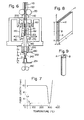
- Figure 7 of the accompanying drawings show the relation between the fiber length and the temperature when the stretchable PMIA fiber of this invention is treated by the testing method defining formula (I) above.
- formula (I) formula (I) above.
- S° shrinkage
- the fact that the PMIA fibers of this invention are substantially amorphous can be ascertained by the broad angle X-ray diffraction method.
- the "substantial amorphousness", as referred to in this invention, means that the fibers have crystallinity, measured by X-ray diffractometry, of not more than 10%. In many cases, hardly any analysis peak appears in the X-ray diffraction pattern of the PMIA fibers of this invention, and it is difficult to calculate their crystallinity. Evidently, therefore, the fibers of this invention have a crystallinity of not more than 10%.
- the stretchable PMIA fibers of this invention further have the following marked characteristics in addition to the aforesaid characteristic features (A) to (E) which define them.
- PMIA fibers of this invention have a coefficient of variation of a section perpendicular to the longitudinal direction of the fibers [to be simply referred to as a coefficient of sectional variation (CV) hereinafter] of at most 0.05.
- the coefficient of sectional variation (CV) is a measure of variation in the denier size of the fiber in its longitudinal direction, i.e. denier unevenness.
- the PMIA fibers of this invention may be in the form of very long monofilaments, a bundle of monofilaments, or such a bundle cut to a fixed length.
- the coefficient of sectional variation in this invention can be determined by selecting a filament (i) having a length of 3 cm from the aforesaid fibers in various forms, cutting it crosswise at 1 mm intervals, measuring the individual cross-sectional areas, calculating the average ( A i) of the 30 cross-sectional areas and the standard deviation (ai), and calculating the variation coefficient of the filament (i), CVi, in accordance with the following equation.
- the coefficient of sectional variation (CV) of the PMIA fibers of this invention so determined is preferably 0.05 at most, more preferably 0.01 at most.
- PMIA fibers of such a low coefficient of sectional variation cannot be produced by the process disclosed in U. S. Patent No. 4,399,084 and European Laid-Open Patent Publication No. 0047091 previously proposed by the present inventor and his coworkers. It has now been found that such fibers can be produced by the process of this invention. The main reason for this is that the process of this invention obviates the need for taking measures against the thermal decomposition of the polymer in the spinneret.
- the thickness of the spinneret can be increased, and there can be used an orifice plate or a nozzle which is precision- worked by most properly designing the inlet angle or the land length. Furthermore, the PMIA filaments extruded from the orifices can be drafted slowly and smoothly in the heat keeping zone.
- the PMIA fibers of this invention further have a circle coefficient represented by the following formula of preferably at least 0.9, more preferably at least 0.95. wherein f is the circle coefficient, and fj is the value Aj/,B (dl2) 2 calculated from the cross-sectional area (Aj) and the diameter (d) of a circumscribing circle with regard to ten sections of a filament taken in its longitudinal direction.
- the circle coefficient is determined by selecting an arbitrary filament from an assembly of PMIA filaments as in the case of determining the coefficient of sectional vairations, measuring its cross-sectional area (Ai) and the diameter (d) of a circle circumscribing about it, and calculating the circle coefficient (fj) of its section (j) in accordance with the following formula.
- Fibers having a high circularity with a circle coefficient (f) of at least 0.90 can be produced for the first time by the process of this invention in which PMIA is extruded at the softening temperature (Ts, °C). This is partly for the same reason as that given to the achievement of a sectional variation coefficient of not more than 0.05.
- the softened PMIA extruded from a precision- worked orifice having a high circularity has a very high viscosity, it hardly undergoes the effects of gravity or atmospheric air and the extruded PMIA is solidified under a draft while maintaining its high circularity.
- the stretched PMIA fibers of this invention are composed of a wholly aromatic polyamide containing at least 85%, based on the entire recurring units, of m-phenylene isophthlamide units (requirement A'); do not substantially contain an aprotic polar solvent (requirement B'); and are substantially amorphous (requirement E'). They have an average denier size of 20 to 20,000 - (requirement C'), and a maximum heat shrinkage under a fixed load of at least 20% (requirement D'). They also have the same sectional variation coefficient (CV), circle coefficient (f), tan (30) and tan ⁇ - (260) as the strechable PMIA fibers of the invention.
- CV sectional variation coefficient
- CV circle coefficient
- tan tan
- tan ⁇ - (260) as the strechable PMIA fibers of the invention.
- the stretched PMIA fiber of this invention has a silk factor (SF), defined by the following formula wherein St is the tenacity (g/de) of the wholly aromatic polyamide fiber and EI is its elongation - (%). of at least 10.
- SF silk factor
- composite fibers composed of a wholly aromatic polyamide polymer layer containing fine inorganic pieces and a wholly aromatic polyamide polymer layer not containing fine inorganic pieces, the two layers being laid side by side.
- the above composite fibers can be produced by the process described above for producing the PMIA fibers not containing fine inorganic pieces by preparing a laminated shaped article composed of a polymer layer having a wholly aromatic polyamide containing at least 85 mole%, based on the entire recurring units, of m-phenylene isophthalamide units as a main component and a polymer layer composed mainly of a mixture of a wholly aromatic polyamide containing at least 85 mole%, based on the entire recurring units, of m-phenylene isophthalamide units and fine inorganic pieces in the first step instead of preparing a homogeneous shaped article composed of a wholly aromatic polyamide containing at least 85 mole%, based on the entire recurring units, of m-phenylene isophthalamide units as a main component.
- Examples of the fine inorganic pieces used in this invention are calcium carbide, titanium oxide, kaolin, clay, talc, diatomaceous earth, potasstum titanate, feldspar, mica, glass powder, graphite, carbon black, molybdenum disulfide, metal powders - (such as copper powder, aluminum powder, iron powder, chromium powder, nickel powder), gdmma-Fe 2 0,, silicon carbide, alumina, zeolite, and ceramic materials for sintering.
- the fine inorganic pieces are selected according to the purpose for which the final fibers of the invention are used. For example, for use in polishing brushes, fine inorganic pieces having a high hardness such as silicon carbide or fused alumina are preferred.
- the fine inorganic pieces used in this invention may be spherical, polygonal, acicular, or irregularly shaped. Preferably, they have such a particle size that they pass at least a 20-mesh seive, more preferably a 500 mesh sieve. Particles which are apparently large but are pulverized to the above mesh size in the step of mixing with the aromatic polyamide powder may be used.
- the smallest particle size of the fine inorganic pieces is usually about 50,000 mesh.
- Fine inorganic pieces which are slender, for example, in the form of needles have a minimum sectional area of 1 mm 2 to 2.5x10- 7 mm 2 , preferably 2.5x10-' mm 2 to 2.5x10-', and a maximum length of 5 mm to 0.0005 mm, preferably 0.25 mm to 0.0005 mm.
- the composite shaped article may be plate-like as shown in Figure 8 or cylindrical as shown in Figure 9.
- the plate-like composite shaped article shown in Figure 8 can be produced as follows by a compression molding machine as shown in Figure 2.
- PMIA powder (A) and a mixture (B) of PMIA powder and fine inorganic pieces are used as starting materials.
- these powders are preheated to about 200°C.
- a first component A (A-1) is first fed into the compression molding machine with an open top as a result of sliding the upper heating plate 2 toward the back of the sheet of Figure 2.
- component B and then a second component A (A-2) are suces- sively fed.
- the heating plate 2 is then caused to slide toward the surface of the sheet in Figure 2 to close the machine. Thereafter, the same operation as in the production of the shaped article in Figure 1 is carried out.
- the resulting shaped article has such a shape that it has a uniform section in at least one direction (Z-direction in Figure 8), and in this uniform section, the layer A and the layer B are positioned side by side.
- Figure 9 shows a cylindrical composite shaped article.
- Figure 10 shows a spinning apparatus which can be applied to the spinning of not only the composite shaped article but also the homogeneous shaped article not containing fine inorganic pieces.
- the process of producing the composite fibers of this invention from the cpmposite plate-like shaped article shown in Figure 8 will be described.
- a plurality of shaped articles 10 are aligned on a sliding stand 20 with the perpendicular direction - (Z-direction) of their predetermined uniform section directed upwardly. They are fed successively downwardly along a guide wall 35 and reach a group of stuffing rollers (three sets of a pair of roller in the drawing). They are then forcibly stuffed into a pre-heating zone (Zp) while being held between the rollers.
- the pre-heating zone should have a passage through which the shaped article 10 can move in the perpendicular direction (Z-direction) of the predetermined uniform section of the shaped article while substantially retaining its form.
- the passage is formed of a pre-heating box 50 having a symmetrical sectional space which is slightly larger than the predetermined uniform section (a x b) of the shaped article.
- Heaters H are embedded in the wall of the pre-heating box, and the temperature of the passage is accurately controlled.
- This passage need not always to be box- shaped as shown in Figure 10. It is only necessary for the passage to permit accurate movement of the shaped articles within the pre-heating zone always through a fixed path.
- the inside wall of the box-like pre-heating zone may be corrugated.
- the composite shaped article is moved to the end portion of the pre-heating zone - (Zp) while being gradually pre-heated to the pre- heating temperature (Tp, °C) not exceeding a temperature 20°C higher than the glass transition point (Tg, ° C) of PMIA.
- the shaped article pre-heated to the pre-heating temperature Tp is then forced into a softening zone (Zs) of a heated spinneret.
- the softening zone is a softening and extruding section having a length of at least 3 mm having an attenuating passage constructed of orifices at least at its end portion.
- a heat insulator 52 is provided in the boundary between the pre-heating zone Zp and the softening zone Zs.
- the softening zone serves firstly to heat the pre-heated PMIA shaped article rapidly to a uniform softening temperature Ts; secondly to convert many discontinuous PMIA shaped articles into a single continuous softened article by imparting fine shear deformation or elongation deformation to the inside of the softened PMIA shaped articles and bringing the molecules into intimate contact with each other, and thirdly to extrude the continuous softened article uniformly from the orifices.
- the shaped article pre-heated in the pre-heating zone to Tp reaches a softening zone in which an electrically heated wire mesh M is provided at its inlet as shown in Figure 11.
- an inlet I and orifices O are provided in an orifice plate C composed of electrically insulating ceramics. PMIA softened to Ts are extruded from the orifice openings through these attenuating passages.
- the second function of the softening zone is performed mainly while the polymer layers pass through the attenuating passages, for example through the openings of the wire mesh, the inlet portion, the land portion of orifices, etc.
- the third function is performed by the relatively small inlet angle 0 (5°-45°) and the LID (1-5) of the relatively long orifice land and the non- tackifying finish of the surface of the inlet and the land for the uniform temperature of PMIA attributed to kneading by the second function, and the prevention of melt fracture.
- the softening zone should have a length Zs of at least 3 mm, preferably 5 to 20 mm. If the Zs is shorter than 3 mm, the adjoining portions of the shaped articles will be broken by drafting when extruded from the orifices.
- the PMIA softened in the softening zone is extruded from the orifices into a heat keeping zone having a length Zk and surrounded by a thermally insulating wall 70, and forcibly taken up at a draft ratio of at least 12 by take-up rollers 80.
- the composite fibers of this invention containing fine inroganic pieces are produced. These composite fibers are stretchable and give the stretched composite fibers of this invention by stretching.
- the composite fibers of this invention assume a composite structure in which in a fiber section taken perpendicularly to the longitudinal direction of the fibers, the polymer layer composed mainly of PMIA (layer A) and the layer composed of a mixture of PMIA and the fine inorganic pieces (layer B) are positioned side by side.
- Figure 12 is a schematic sectional view of a bristle showing a typical example of this composite structure.
- Figures 13 and 14 are other examples of the composite structure. Selection of the composite structure depends upon the ultimate usage of the resulting composite fibers. But in many cases, the characteristics of the composite fibers of this invention are conspicuously exhibited when the sandwich structure as in Figure 13 or the multiláyer structure as shown in Figure 14 are taken.
- the wholly aromatic polyamide fibers and composite fibers provided by this invention are used in various fields requiring heat resistance because of their excellent characteristics described hereinabove.
- the fibers of this invention are suitably used as bristles of a brush (see Figure 15) since they have excellent toughness, bending fatigue resistance and elastic recovery.
- the composite fibers above all those having such a structure that as shown in Figure 13 or 14, a layer composed of a mixture of PMIA and fine pieces of an inorganic material such as alumina or carborundum (layer B) is sandwiched between polymer layers (layers A) composed of PMIA are preferred.
- fibers for polishing having such a structure is that since the extent of surface exposure of the inorganic layer is small, dropping of a polishing agent (fine inorganic pieces) from the surfaces of the fibers which are not directly involved in the polishing action is very little. This effect is advantageous not only during use of the fibers as a polishing brush but also during packaging and transportion of the fibrous product.
- Another advantage of the composite fibers of this invention in which layers A and B are positioned side by side is that they have higher tensile strength and bending durability than a simple random mixture of PMIA and fine inorganic pieces.
- the wholly aromatic polyamide has a hard skeleton in its molecular structure, fibers from it generally tend to be hard and brittle.
- the fine inorganic pieces are mixed randomly with such PMIA, this tendency increases and the fibers will be easily broken even under a relatively low external strain.
- the simple random structure is very liable to break in the case of the fibers of this invention which have a sectional area of as large as 0.01 MM 2 to 10 MM 2 because a strain under bending on the surface portions of the fibers is considerably high. This phenomenon increases with increasing proportion of the fine inorganic pieces.
- the total number of the polymer layers (layers A) and the inorganic layers (layers B) in the composite fibers of this invention is desirably 3 as shown in Figure 13 from the viewpoint of flexural durability.
- the provision of 2 layers is effective.
- the provision of about 7 layers as shown in Figure 14 has been found to,be useful. If the number of the layers is increased too much, the molding of the shaped article becomes complex, and if 10 or more layers are provided, there is a limit to the effect of providing multiple layers.
- the proportion of the fine inorganic pieces in layer B of the composite fibers of this invention can be changed as desired.
- the characteristics of the composite fibers of this invention are exhibited to a greater extent when the proportion of the fine inorganic pieces is 90 to 95% by weight.
- Such a high mixing proportion can be used for the first time by the process of this invention.
- the ratio of the area of layer A to that of layer B in a fiber section taken perpendicularly to the longitudinal direction of the composite fibers can be varied as desired.
- the characteristics of the composite fibers of this invention are advantageously exhibited when this area ratio is in the range of from 20:80 to 95:5.
- Porous aggregated particles of poly(m-phenylene isophthalamide) obtained by polymerizing m-phenylenediamine and isophthaloyl chloride on the interface of tetrahydrofuran and water and having an average particle diameter of 50 micrometers and an inherent viscosity, measured in N-methylpyrrolidone, of 1.35) were used as a starting material.
- the PMIA particles had a glass transition piont Tg, measured by a differential scanning calorimeter, of 277°C. By measuring the melting point Tm of the fibers obtained as shown below, it was confirmed that the melting point of PMIA was 423°C.
- the PMIA particles had a glass transition temperature Tg, measured by a diffrential scanning calorimeter, of 273°C.
- the melting point Tm of the PMIA particles were determined to be 420°C by measuring the melting point of the unstretched fibers (obtained therefrom by the following method) by a differential scanning calorimeter.
- the shaped articles were used as a starting material, and spun and stretched by the apparatus shown in Figure 4 under the conditions shown in Table 3.
- the resulting bundle of fibers was cut to a length of 40 mm, and a channel brush as shown'in Figure 8 was produced by using the cut fibers as a material.
- the brush was mounted on a stretch heat-setting roller (surface temperature 240°C) used in the process of producing polyester staple fibers, and used for removing naps.
- the brush withstood continuous use over 6 months without breakage, and retained a sufficient nap removing effect.
- Stretched PMIA fibers were produced from the same plate-like shaped articles used in Example 2 by the apparatus shown in Figure 4 under the conditions indicated in Table 5. The properties of the resulting fibers were measured, and the results are shown in Table 6.
- the resulting assembly of bristles were divided into four bundles and twisted into filament yams - (1250 de-25 fil).
- the filament yarns were found to be useful, for example, as a material for heat-resistant fabrics such as canvas, and a pile substrate for flame retardant carpets.
- a PMIA monofilament was produced in the same manner as in Example 1 under the conditions indicated in Table 9. The properties of the resulting monofilament are shown in Table 10.
- the monofilament had a circle coefficient - (obtained by dividing the cross-sectional area of the monofilament by the area of a circle circumscribing the crosssection of the monofilament) of at least 0.98 and its circularity is very high. Because of the self-lubricating properties of PMIA, the resulting monofilament could be applied to various small-sized machine parts.
- Example 1 The same PMIA particles as used in Example 1 (component A) and a mixture of the same PMIA particles and 60% of white alumina having an average particle diameter of 34 micrometers (a product of Fujimi Abrasive Material Industry Co., Ltd.) - (component B) were used as starting materials.
- component A a mixture of the same PMIA particles and 60% of white alumina having an average particle diameter of 34 micrometers (a product of Fujimi Abrasive Material Industry Co., Ltd.) - (component B) were used as starting materials.
- a roller brush was produced by using the resulting composite fibers as bristles, and tested as an abrasive brush for steel-making. Since its heat resistance was greatly improved over a conventional abrasive brush (composed of bristles from a mixture of nylon and an abrasive material), means for cooling the brush, for example, by water cooling became unnecessary, and the use of the brush so produced contributed greatly to the curtailment of the cost in the steel-making process.
- Example 1 The same PMIA particles as used in Example 1 (component A) and a random mixture of the same PMIA particles and 70% of strontium ferrite having an average particle diameter of 20 micrometers (component B) were used as starting materials.
- component A a random mixture of the same PMIA particles and 70% of strontium ferrite having an average particle diameter of 20 micrometers
- component B strontium ferrite having an average particle diameter of 20 micrometers
- Magnetic bristles were produced by magnetizing the resulting fibers so that an N-pole and an S-pole polarized in a direction parallel to the layers A and B. These magnetic bristles had better dynamical properties than those obtained from a random mixture of the PMIA particles and strontium ferrite. In addition, presumably because of the effect of strontium ferrite to increase density, the magnetic bristles obtained in accordance with this example showed stronger magnetism than the latter.
Landscapes
- Engineering & Computer Science (AREA)
- Textile Engineering (AREA)
- Mechanical Engineering (AREA)
- Chemical & Material Sciences (AREA)
- Chemical Kinetics & Catalysis (AREA)
- General Chemical & Material Sciences (AREA)
- Artificial Filaments (AREA)
Applications Claiming Priority (4)
| Application Number | Priority Date | Filing Date | Title |
|---|---|---|---|
| JP85376/85 | 1985-04-23 | ||
| JP8537685A JPS61245305A (ja) | 1985-04-23 | 1985-04-23 | 全芳香族ポリアミド剛毛及びその製造方法 |
| JP12089/86 | 1986-01-24 | ||
| JP1208986A JPS62170518A (ja) | 1986-01-24 | 1986-01-24 | 無機細片混合全芳香族ポリアミド剛毛及びその製造方法 |
Publications (3)
| Publication Number | Publication Date |
|---|---|
| EP0200472A2 true EP0200472A2 (de) | 1986-11-05 |
| EP0200472A3 EP0200472A3 (en) | 1988-01-27 |
| EP0200472B1 EP0200472B1 (de) | 1990-12-05 |
Family
ID=26347644
Family Applications (1)
| Application Number | Title | Priority Date | Filing Date |
|---|---|---|---|
| EP86303073A Expired - Lifetime EP0200472B1 (de) | 1985-04-23 | 1986-04-23 | Fasern und Verbundfasern aus vollaromatischen Polyamiden, Verfahren zur Herstellung und Anwendung derselben |
Country Status (3)
| Country | Link |
|---|---|
| US (1) | US4751760A (de) |
| EP (1) | EP0200472B1 (de) |
| DE (1) | DE3675976D1 (de) |
Cited By (3)
| Publication number | Priority date | Publication date | Assignee | Title |
|---|---|---|---|---|
| US4917950A (en) * | 1987-02-25 | 1990-04-17 | E. I. Du Pont De Nemours And Companyv | Large diameter oriented monofilaments |
| US4985304A (en) * | 1987-02-25 | 1991-01-15 | E. I. Du Pont De Nemours And Company | Coated large diameter oriented monofilaments |
| EP0568912A1 (de) * | 1992-05-07 | 1993-11-10 | Teijin Limited | Aromatische Polyamidfäden mit verbesserter Wetterwiderstandsfähigkeit |
Families Citing this family (6)
| Publication number | Priority date | Publication date | Assignee | Title |
|---|---|---|---|---|
| US5240770A (en) * | 1988-03-02 | 1993-08-31 | Teijin Limited | Surface-modified wholly aromatic polyamide fiber and method of producing same |
| CA2068551A1 (en) * | 1991-05-15 | 1992-11-16 | Akira Morii | Abrasive brush |
| JPH05163610A (ja) * | 1991-12-18 | 1993-06-29 | Teijin Ltd | 芳香族ポリアミド偏平繊維 |
| EP0923420A1 (de) * | 1996-12-26 | 1999-06-23 | J & L Specialty Steel, Inc. | Bürstverfahren zur verbesserung des korrosions- und oxydationswiderstandes |
| GB9716394D0 (en) * | 1997-08-01 | 1997-10-08 | Unilever Plc | Toothbrush |
| KR20130141725A (ko) * | 2006-01-31 | 2013-12-26 | 데이진 가부시키가이샤 | 고온 가공성이 우수한 메타형 전방향족 폴리아미드 섬유 및 그 제조 방법 |
Family Cites Families (9)
| Publication number | Priority date | Publication date | Assignee | Title |
|---|---|---|---|---|
| CA697541A (en) * | 1960-04-29 | 1964-11-10 | Cenzato Lorenzo | Melt-spinning process |
| DE2037254A1 (de) * | 1970-07-28 | 1972-02-03 | Farbwerke Hoechst AG, vorm. Meister Lucius & Brüning, 6000 Frankfurt | Verfahren zur Herstellung von Fäden aus hochschmelzenden Polyamiden |
| US3850889A (en) * | 1972-12-29 | 1974-11-26 | Monsanto Co | Ordered polymeric amides |
| JPS53122817A (en) * | 1977-03-30 | 1978-10-26 | Teijin Ltd | Wholly aromatic polyamide fibers having improved flame resistance |
| US4245066A (en) * | 1978-07-31 | 1981-01-13 | Teijin Limited | Wholly aromatic polyamide blend composition |
| JPS5521406A (en) * | 1978-07-31 | 1980-02-15 | Teijin Ltd | Aromatic polyamide composition |
| DE3163504D1 (en) * | 1980-08-18 | 1984-06-14 | Teijin Ltd | Process and molding apparatus for producing a fibrous assembly by melt extrusion |
| JPS58136829A (ja) * | 1982-02-09 | 1983-08-15 | Teijin Ltd | 繊維状物とその製造法 |
| US4526735A (en) * | 1982-02-09 | 1985-07-02 | Teijin Limited | Process for producing fibrous assembly |
-
1986
- 1986-04-23 DE DE8686303073T patent/DE3675976D1/de not_active Expired - Lifetime
- 1986-04-23 EP EP86303073A patent/EP0200472B1/de not_active Expired - Lifetime
- 1986-04-23 US US06/854,839 patent/US4751760A/en not_active Expired - Lifetime
Cited By (4)
| Publication number | Priority date | Publication date | Assignee | Title |
|---|---|---|---|---|
| US4917950A (en) * | 1987-02-25 | 1990-04-17 | E. I. Du Pont De Nemours And Companyv | Large diameter oriented monofilaments |
| US4985304A (en) * | 1987-02-25 | 1991-01-15 | E. I. Du Pont De Nemours And Company | Coated large diameter oriented monofilaments |
| EP0568912A1 (de) * | 1992-05-07 | 1993-11-10 | Teijin Limited | Aromatische Polyamidfäden mit verbesserter Wetterwiderstandsfähigkeit |
| US5688596A (en) * | 1992-05-07 | 1997-11-18 | Teijin Limited | Aromatic polyamide filament having an enhanced weathering resistance |
Also Published As
| Publication number | Publication date |
|---|---|
| EP0200472B1 (de) | 1990-12-05 |
| US4751760A (en) | 1988-06-21 |
| EP0200472A3 (en) | 1988-01-27 |
| DE3675976D1 (de) | 1991-01-17 |
Similar Documents
| Publication | Publication Date | Title |
|---|---|---|
| CA1061994A (en) | Multifilament yarn having novel configuration and a method for producing the same | |
| EP0352749B1 (de) | Polytetrafluorethylenfilament und Verfahren zur Herstellung derselben | |
| US7790282B2 (en) | Self-crimping fully drawn high bulky yarns and method of producing thereof | |
| US20090035568A1 (en) | Polytrimethylene terephthalate hollow composite staple fibers and process for producing same | |
| US3567569A (en) | Synthetic fibers having novel shape | |
| US5928589A (en) | Processing for producing shaped wholly aromatic polyamide resin composition article and shaped article produced thereby | |
| EP0527489A1 (de) | Vliesstoff aus Polyethyleneterephthalate zerblasen und Verfahren zur Herstellung | |
| EP0200472B1 (de) | Fasern und Verbundfasern aus vollaromatischen Polyamiden, Verfahren zur Herstellung und Anwendung derselben | |
| EP0648869B1 (de) | Fadenförmiges Material aus Polytetrafluoroethylen | |
| TWI841993B (zh) | 具有改善的後加工性之聚乙烯紗線以及包括其之布料 | |
| EP0780498A1 (de) | Schmelzgesponnene Fasern aus Acrylonitril und olefinischen ungesättigten Verbindungen und Herstellungsverfahren | |
| EP3497272B1 (de) | Ein verfahren und eine vorrichtung zur herstellung von groben - und dreidimensional gekräuselten multifilament-bcf-garnen, so erhaltenen garnen und anwendungen davon | |
| Galanti et al. | Polypropylene fibers and films | |
| CA1120675A (en) | Polyamide spin-texture process | |
| EP0322838A1 (de) | Verfahren zur Herstellung geformter Gegenstände aus einer voll-aromatischen Polyamidharz-Zusammensetzung | |
| EP0086112A2 (de) | Verfahren und Apparat zur Herstellung von Fasern | |
| CA1233009A (en) | High speed process for forming fully drawn polyester yarn | |
| EP0330212A2 (de) | Polypropylenfaser mit sehr guter Elastizität | |
| JPH045768B2 (de) | ||
| JP7647550B2 (ja) | ポリアミド46マルチフィラメント | |
| JPH0413443B2 (de) | ||
| US20090197080A1 (en) | Self-crimping fluoropolymer and perfluoropolymer filaments and fibers | |
| JPH0437163B2 (de) | ||
| JPH0373655B2 (de) | ||
| Savov et al. | DSC studies on polyester‐polyamide biconstituent fibers |
Legal Events
| Date | Code | Title | Description |
|---|---|---|---|
| PUAI | Public reference made under article 153(3) epc to a published international application that has entered the european phase |
Free format text: ORIGINAL CODE: 0009012 |
|
| AK | Designated contracting states |
Kind code of ref document: A2 Designated state(s): DE FR GB NL |
|
| PUAB | Information related to the publication of an a document modified or deleted |
Free format text: ORIGINAL CODE: 0009199EPPU |
|
| RA1 | Application published (corrected) |
Date of ref document: 19861210 Kind code of ref document: A2 |
|
| PUAL | Search report despatched |
Free format text: ORIGINAL CODE: 0009013 |
|
| AK | Designated contracting states |
Kind code of ref document: A3 Designated state(s): DE FR GB NL |
|
| 17P | Request for examination filed |
Effective date: 19880613 |
|
| 17Q | First examination report despatched |
Effective date: 19890512 |
|
| GRAA | (expected) grant |
Free format text: ORIGINAL CODE: 0009210 |
|
| AK | Designated contracting states |
Kind code of ref document: B1 Designated state(s): DE FR GB NL |
|
| REF | Corresponds to: |
Ref document number: 3675976 Country of ref document: DE Date of ref document: 19910117 |
|
| ET | Fr: translation filed | ||
| PLBE | No opposition filed within time limit |
Free format text: ORIGINAL CODE: 0009261 |
|
| STAA | Information on the status of an ep patent application or granted ep patent |
Free format text: STATUS: NO OPPOSITION FILED WITHIN TIME LIMIT |
|
| 26N | No opposition filed | ||
| PGFP | Annual fee paid to national office [announced via postgrant information from national office to epo] |
Ref country code: FR Payment date: 19990318 Year of fee payment: 14 |
|
| PGFP | Annual fee paid to national office [announced via postgrant information from national office to epo] |
Ref country code: NL Payment date: 19990324 Year of fee payment: 14 |
|
| PGFP | Annual fee paid to national office [announced via postgrant information from national office to epo] |
Ref country code: GB Payment date: 19990325 Year of fee payment: 14 |
|
| PGFP | Annual fee paid to national office [announced via postgrant information from national office to epo] |
Ref country code: DE Payment date: 19990630 Year of fee payment: 14 |
|
| PG25 | Lapsed in a contracting state [announced via postgrant information from national office to epo] |
Ref country code: GB Free format text: LAPSE BECAUSE OF NON-PAYMENT OF DUE FEES Effective date: 20000423 |
|
| PG25 | Lapsed in a contracting state [announced via postgrant information from national office to epo] |
Ref country code: NL Free format text: LAPSE BECAUSE OF NON-PAYMENT OF DUE FEES Effective date: 20001101 |
|
| GBPC | Gb: european patent ceased through non-payment of renewal fee |
Effective date: 20000423 |
|
| PG25 | Lapsed in a contracting state [announced via postgrant information from national office to epo] |
Ref country code: FR Free format text: LAPSE BECAUSE OF NON-PAYMENT OF DUE FEES Effective date: 20001229 |
|
| NLV4 | Nl: lapsed or anulled due to non-payment of the annual fee |
Effective date: 20001101 |
|
| PG25 | Lapsed in a contracting state [announced via postgrant information from national office to epo] |
Ref country code: DE Free format text: LAPSE BECAUSE OF NON-PAYMENT OF DUE FEES Effective date: 20010201 |
|
| REG | Reference to a national code |
Ref country code: FR Ref legal event code: ST |