EP0199047B1 - Neue Iodpropargylether, ein Verfahren zu ihrer Herstellung und ihre Verwendung - Google Patents
Neue Iodpropargylether, ein Verfahren zu ihrer Herstellung und ihre Verwendung Download PDFInfo
- Publication number
- EP0199047B1 EP0199047B1 EP86103196A EP86103196A EP0199047B1 EP 0199047 B1 EP0199047 B1 EP 0199047B1 EP 86103196 A EP86103196 A EP 86103196A EP 86103196 A EP86103196 A EP 86103196A EP 0199047 B1 EP0199047 B1 EP 0199047B1
- Authority
- EP
- European Patent Office
- Prior art keywords
- denotes
- alkyl
- ethers
- formula
- hydrogen
- Prior art date
- Legal status (The legal status is an assumption and is not a legal conclusion. Google has not performed a legal analysis and makes no representation as to the accuracy of the status listed.)
- Expired
Links
- LKYMWFDXBHLYNJ-UHFFFAOYSA-N 3-iodo-3-(1-iodoprop-2-ynoxy)prop-1-yne Chemical class C#CC(I)OC(I)C#C LKYMWFDXBHLYNJ-UHFFFAOYSA-N 0.000 title claims description 15
- 238000000034 method Methods 0.000 title claims description 8
- 238000002360 preparation method Methods 0.000 title claims description 7
- 125000004432 carbon atom Chemical group C* 0.000 claims description 17
- UFHFLCQGNIYNRP-UHFFFAOYSA-N Hydrogen Chemical compound [H][H] UFHFLCQGNIYNRP-UHFFFAOYSA-N 0.000 claims description 16
- 229910052739 hydrogen Inorganic materials 0.000 claims description 15
- 239000001257 hydrogen Substances 0.000 claims description 15
- 229910052760 oxygen Inorganic materials 0.000 claims description 13
- 239000001301 oxygen Substances 0.000 claims description 13
- 125000001570 methylene group Chemical group [H]C([H])([*:1])[*:2] 0.000 claims description 11
- 125000001997 phenyl group Chemical group [H]C1=C([H])C([H])=C(*)C([H])=C1[H] 0.000 claims description 11
- 239000002904 solvent Substances 0.000 claims description 11
- 125000003342 alkenyl group Chemical group 0.000 claims description 10
- QVGXLLKOCUKJST-UHFFFAOYSA-N atomic oxygen Chemical group [O] QVGXLLKOCUKJST-UHFFFAOYSA-N 0.000 claims description 9
- 125000002837 carbocyclic group Chemical group 0.000 claims description 8
- HRDCVMSNCBAMAM-UHFFFAOYSA-N 3-prop-2-ynoxyprop-1-yne Chemical class C#CCOCC#C HRDCVMSNCBAMAM-UHFFFAOYSA-N 0.000 claims description 7
- 150000002431 hydrogen Chemical class 0.000 claims description 7
- 241000233866 Fungi Species 0.000 claims description 5
- 239000003085 diluting agent Substances 0.000 claims description 5
- 239000012336 iodinating agent Substances 0.000 claims description 5
- 239000002855 microbicide agent Substances 0.000 claims description 4
- 239000002023 wood Substances 0.000 claims description 4
- 239000012770 industrial material Substances 0.000 claims description 3
- 125000004169 (C1-C6) alkyl group Chemical group 0.000 claims 6
- 150000002170 ethers Chemical class 0.000 claims 1
- 238000004321 preservation Methods 0.000 claims 1
- 239000000203 mixture Substances 0.000 description 20
- 125000000217 alkyl group Chemical group 0.000 description 17
- HEMHJVSKTPXQMS-UHFFFAOYSA-M Sodium hydroxide Chemical compound [OH-].[Na+] HEMHJVSKTPXQMS-UHFFFAOYSA-M 0.000 description 15
- 150000001875 compounds Chemical class 0.000 description 12
- -1 Chlorphenyl Chemical group 0.000 description 10
- 238000006243 chemical reaction Methods 0.000 description 10
- XLYOFNOQVPJJNP-UHFFFAOYSA-N water Substances O XLYOFNOQVPJJNP-UHFFFAOYSA-N 0.000 description 10
- YXFVVABEGXRONW-UHFFFAOYSA-N Toluene Chemical compound CC1=CC=CC=C1 YXFVVABEGXRONW-UHFFFAOYSA-N 0.000 description 9
- 239000000243 solution Substances 0.000 description 9
- 239000004480 active ingredient Substances 0.000 description 8
- 239000000463 material Substances 0.000 description 8
- 235000015097 nutrients Nutrition 0.000 description 8
- 229910052736 halogen Inorganic materials 0.000 description 7
- 150000002367 halogens Chemical class 0.000 description 7
- 150000002440 hydroxy compounds Chemical class 0.000 description 7
- WYURNTSHIVDZCO-UHFFFAOYSA-N tetrahydrofuran Substances C1CCOC1 WYURNTSHIVDZCO-UHFFFAOYSA-N 0.000 description 7
- YMWUJEATGCHHMB-UHFFFAOYSA-N Dichloromethane Chemical compound ClCCl YMWUJEATGCHHMB-UHFFFAOYSA-N 0.000 description 6
- OKKJLVBELUTLKV-UHFFFAOYSA-N Methanol Chemical compound OC OKKJLVBELUTLKV-UHFFFAOYSA-N 0.000 description 6
- ZMXDDKWLCZADIW-UHFFFAOYSA-N N,N-Dimethylformamide Chemical compound CN(C)C=O ZMXDDKWLCZADIW-UHFFFAOYSA-N 0.000 description 6
- 244000005700 microbiome Species 0.000 description 6
- LFQSCWFLJHTTHZ-UHFFFAOYSA-N Ethanol Chemical compound CCO LFQSCWFLJHTTHZ-UHFFFAOYSA-N 0.000 description 5
- 239000013543 active substance Substances 0.000 description 5
- DKJUYYRGJJGNDE-UHFFFAOYSA-N 2-ethyl-4-[iodo(prop-2-ynoxy)methyl]-2-methyl-1,3-dioxolane Chemical compound CCC1(C)OCC(C(I)OCC#C)O1 DKJUYYRGJJGNDE-UHFFFAOYSA-N 0.000 description 4
- DYEKUANGUUKLNZ-UHFFFAOYSA-N 4-[iodo(prop-2-ynoxy)methyl]-2,2-dimethyl-1,3-dioxolane Chemical compound CC1(C)OCC(C(I)OCC#C)O1 DYEKUANGUUKLNZ-UHFFFAOYSA-N 0.000 description 4
- BDUCQGKYFLPGII-UHFFFAOYSA-N 4-[iodo(prop-2-ynoxy)methyl]-2-methyl-1,3-dioxolane Chemical compound CC1OCC(C(I)OCC#C)O1 BDUCQGKYFLPGII-UHFFFAOYSA-N 0.000 description 4
- CBMUOHXOYMHCHU-UHFFFAOYSA-N 4-[iodo(prop-2-ynoxy)methyl]-2-methyl-2-phenyl-1,3-dioxolane Chemical compound C=1C=CC=CC=1C1(C)OCC(C(I)OCC#C)O1 CBMUOHXOYMHCHU-UHFFFAOYSA-N 0.000 description 4
- KHJCWHZXUSOFCM-UHFFFAOYSA-N 4-[iodo(prop-2-ynoxy)methyl]-2-phenyl-1,3-dioxolane Chemical compound O1C(C(OCC#C)I)COC1C1=CC=CC=C1 KHJCWHZXUSOFCM-UHFFFAOYSA-N 0.000 description 4
- CSCPPACGZOOCGX-UHFFFAOYSA-N Acetone Chemical compound CC(C)=O CSCPPACGZOOCGX-UHFFFAOYSA-N 0.000 description 4
- NLXLAEXVIDQMFP-UHFFFAOYSA-N Ammonia chloride Chemical compound [NH4+].[Cl-] NLXLAEXVIDQMFP-UHFFFAOYSA-N 0.000 description 4
- RTZKZFJDLAIYFH-UHFFFAOYSA-N Diethyl ether Chemical compound CCOCC RTZKZFJDLAIYFH-UHFFFAOYSA-N 0.000 description 4
- MYMOFIZGZYHOMD-UHFFFAOYSA-N Dioxygen Chemical compound O=O MYMOFIZGZYHOMD-UHFFFAOYSA-N 0.000 description 4
- CSNNHWWHGAXBCP-UHFFFAOYSA-L Magnesium sulfate Chemical compound [Mg+2].[O-][S+2]([O-])([O-])[O-] CSNNHWWHGAXBCP-UHFFFAOYSA-L 0.000 description 4
- 241000589516 Pseudomonas Species 0.000 description 4
- WQDUMFSSJAZKTM-UHFFFAOYSA-N Sodium methoxide Chemical compound [Na+].[O-]C WQDUMFSSJAZKTM-UHFFFAOYSA-N 0.000 description 4
- 230000015572 biosynthetic process Effects 0.000 description 4
- 150000001728 carbonyl compounds Chemical class 0.000 description 4
- 150000004862 dioxolanes Chemical class 0.000 description 4
- 238000004519 manufacturing process Methods 0.000 description 4
- VWDWKYIASSYTQR-UHFFFAOYSA-N sodium nitrate Chemical compound [Na+].[O-][N+]([O-])=O VWDWKYIASSYTQR-UHFFFAOYSA-N 0.000 description 4
- 0 *C(*)(OC1)OCC1O*#C Chemical compound *C(*)(OC1)OCC1O*#C 0.000 description 3
- RYHBNJHYFVUHQT-UHFFFAOYSA-N 1,4-Dioxane Chemical compound C1COCCO1 RYHBNJHYFVUHQT-UHFFFAOYSA-N 0.000 description 3
- ZWEHNKRNPOVVGH-UHFFFAOYSA-N 2-Butanone Chemical compound CCC(C)=O ZWEHNKRNPOVVGH-UHFFFAOYSA-N 0.000 description 3
- 229920001817 Agar Polymers 0.000 description 3
- WVDDGKGOMKODPV-UHFFFAOYSA-N Benzyl alcohol Chemical compound OCC1=CC=CC=C1 WVDDGKGOMKODPV-UHFFFAOYSA-N 0.000 description 3
- 241000195493 Cryptophyta Species 0.000 description 3
- WSFSSNUMVMOOMR-UHFFFAOYSA-N Formaldehyde Chemical compound O=C WSFSSNUMVMOOMR-UHFFFAOYSA-N 0.000 description 3
- PEDCQBHIVMGVHV-UHFFFAOYSA-N Glycerine Chemical compound OCC(O)CO PEDCQBHIVMGVHV-UHFFFAOYSA-N 0.000 description 3
- 239000008272 agar Substances 0.000 description 3
- 150000001298 alcohols Chemical class 0.000 description 3
- 229910052799 carbon Inorganic materials 0.000 description 3
- 230000026045 iodination Effects 0.000 description 3
- 238000006192 iodination reaction Methods 0.000 description 3
- 239000007788 liquid Substances 0.000 description 3
- 239000012071 phase Substances 0.000 description 3
- FVAUCKIRQBBSSJ-UHFFFAOYSA-M sodium iodide Chemical compound [Na+].[I-] FVAUCKIRQBBSSJ-UHFFFAOYSA-M 0.000 description 3
- 239000000126 substance Substances 0.000 description 3
- OMNGRPHPKWAMSY-UHFFFAOYSA-N 1-chloroprop-1-yne Chemical compound CC#CCl OMNGRPHPKWAMSY-UHFFFAOYSA-N 0.000 description 2
- XSFDIUOTZKUUCJ-UHFFFAOYSA-N 2-(4-chlorophenyl)-5-iodo-2-prop-2-ynoxy-1,3-dioxane Chemical compound C1=CC(Cl)=CC=C1C1(OCC#C)OCC(I)CO1 XSFDIUOTZKUUCJ-UHFFFAOYSA-N 0.000 description 2
- FJZNTVAFRRVDLS-UHFFFAOYSA-N 2-iodo-2-(prop-2-ynoxymethyl)oxane Chemical compound C#CCOCC1(I)CCCCO1 FJZNTVAFRRVDLS-UHFFFAOYSA-N 0.000 description 2
- KIOKAVGATXNYJX-UHFFFAOYSA-N 2-iodo-2-(prop-2-ynoxymethyl)oxolane Chemical compound C#CCOCC1(I)CCCO1 KIOKAVGATXNYJX-UHFFFAOYSA-N 0.000 description 2
- BWMDSPHSDMRGQQ-UHFFFAOYSA-N 3-ethyl-3-iodo-2-(prop-2-ynoxymethyl)oxetane Chemical compound CCC1(I)COC1COCC#C BWMDSPHSDMRGQQ-UHFFFAOYSA-N 0.000 description 2
- WVINLIJIZJSRPL-UHFFFAOYSA-N 3-iodo-3-methyl-2-(prop-2-ynoxymethyl)oxetane Chemical compound CC1(I)COC1COCC#C WVINLIJIZJSRPL-UHFFFAOYSA-N 0.000 description 2
- HGYGTQVOYVPFSI-UHFFFAOYSA-N 4-(4-iodo-4-prop-2-ynoxybutyl)-2,2-dimethyl-1,3-dioxolane Chemical compound CC1(C)OCC(CCCC(I)OCC#C)O1 HGYGTQVOYVPFSI-UHFFFAOYSA-N 0.000 description 2
- CFKMVGJGLGKFKI-UHFFFAOYSA-N 4-chloro-m-cresol Chemical compound CC1=CC(O)=CC=C1Cl CFKMVGJGLGKFKI-UHFFFAOYSA-N 0.000 description 2
- SPESEFUPLOTNQC-UHFFFAOYSA-N 5-ethyl-5-iodo-2,2-dimethyl-4-(prop-2-ynoxymethyl)-1,3-dioxane Chemical compound CCC1(I)COC(C)(C)OC1COCC#C SPESEFUPLOTNQC-UHFFFAOYSA-N 0.000 description 2
- RNTSTUJCGRIRKM-UHFFFAOYSA-N 5-ethyl-5-iodo-2-(prop-2-ynoxymethyl)-1,3-dioxane Chemical compound CCC1(I)COC(COCC#C)OC1 RNTSTUJCGRIRKM-UHFFFAOYSA-N 0.000 description 2
- RIBCKQRLQDPCAG-UHFFFAOYSA-N 5-iodo-2,2,5-trimethyl-4-(prop-2-ynoxymethyl)-1,3-dioxane Chemical compound CC1(C)OCC(C)(I)C(COCC#C)O1 RIBCKQRLQDPCAG-UHFFFAOYSA-N 0.000 description 2
- ZCYVEMRRCGMTRW-UHFFFAOYSA-N 7553-56-2 Chemical compound [I] ZCYVEMRRCGMTRW-UHFFFAOYSA-N 0.000 description 2
- 241000223600 Alternaria Species 0.000 description 2
- 241000223602 Alternaria alternata Species 0.000 description 2
- 241000228212 Aspergillus Species 0.000 description 2
- 241000228245 Aspergillus niger Species 0.000 description 2
- 241000223651 Aureobasidium Species 0.000 description 2
- 241000223678 Aureobasidium pullulans Species 0.000 description 2
- 241000894006 Bacteria Species 0.000 description 2
- UXVMQQNJUSDDNG-UHFFFAOYSA-L Calcium chloride Chemical compound [Cl-].[Cl-].[Ca+2] UXVMQQNJUSDDNG-UHFFFAOYSA-L 0.000 description 2
- 241000221955 Chaetomium Species 0.000 description 2
- 241001515917 Chaetomium globosum Species 0.000 description 2
- ZAMOUSCENKQFHK-UHFFFAOYSA-N Chlorine atom Chemical compound [Cl] ZAMOUSCENKQFHK-UHFFFAOYSA-N 0.000 description 2
- 241001600093 Coniophora Species 0.000 description 2
- 241001600095 Coniophora puteana Species 0.000 description 2
- 241000588722 Escherichia Species 0.000 description 2
- 241000588724 Escherichia coli Species 0.000 description 2
- 239000004606 Fillers/Extenders Substances 0.000 description 2
- MHAJPDPJQMAIIY-UHFFFAOYSA-N Hydrogen peroxide Chemical compound OO MHAJPDPJQMAIIY-UHFFFAOYSA-N 0.000 description 2
- KFZMGEQAYNKOFK-UHFFFAOYSA-N Isopropanol Chemical compound CC(C)O KFZMGEQAYNKOFK-UHFFFAOYSA-N 0.000 description 2
- 241000222418 Lentinus Species 0.000 description 2
- 241000222451 Lentinus tigrinus Species 0.000 description 2
- 241000228143 Penicillium Species 0.000 description 2
- 241001123663 Penicillium expansum Species 0.000 description 2
- 241000222640 Polyporus Species 0.000 description 2
- KEAYESYHFKHZAL-UHFFFAOYSA-N Sodium Chemical compound [Na] KEAYESYHFKHZAL-UHFFFAOYSA-N 0.000 description 2
- 241000191940 Staphylococcus Species 0.000 description 2
- 241000191967 Staphylococcus aureus Species 0.000 description 2
- 241000907561 Sydowia polyspora Species 0.000 description 2
- 241000222355 Trametes versicolor Species 0.000 description 2
- 241000223259 Trichoderma Species 0.000 description 2
- 241000223261 Trichoderma viride Species 0.000 description 2
- 239000000853 adhesive Substances 0.000 description 2
- 230000001070 adhesive effect Effects 0.000 description 2
- 235000019270 ammonium chloride Nutrition 0.000 description 2
- LLEMOWNGBBNAJR-UHFFFAOYSA-N biphenyl-2-ol Chemical compound OC1=CC=CC=C1C1=CC=CC=C1 LLEMOWNGBBNAJR-UHFFFAOYSA-N 0.000 description 2
- 239000001110 calcium chloride Substances 0.000 description 2
- 229910001628 calcium chloride Inorganic materials 0.000 description 2
- 239000000460 chlorine Substances 0.000 description 2
- 229910052801 chlorine Inorganic materials 0.000 description 2
- 239000005068 cooling lubricant Substances 0.000 description 2
- 238000002425 crystallisation Methods 0.000 description 2
- 230000008025 crystallization Effects 0.000 description 2
- 238000004042 decolorization Methods 0.000 description 2
- 230000005595 deprotonation Effects 0.000 description 2
- 238000010537 deprotonation reaction Methods 0.000 description 2
- 150000002012 dioxanes Chemical class 0.000 description 2
- ZPWVASYFFYYZEW-UHFFFAOYSA-L dipotassium hydrogen phosphate Chemical compound [K+].[K+].OP([O-])([O-])=O ZPWVASYFFYYZEW-UHFFFAOYSA-L 0.000 description 2
- 238000004821 distillation Methods 0.000 description 2
- JBKVHLHDHHXQEQ-UHFFFAOYSA-N epsilon-caprolactam Chemical compound O=C1CCCCCN1 JBKVHLHDHHXQEQ-UHFFFAOYSA-N 0.000 description 2
- 239000003292 glue Substances 0.000 description 2
- 230000012010 growth Effects 0.000 description 2
- 229930195733 hydrocarbon Natural products 0.000 description 2
- 230000002401 inhibitory effect Effects 0.000 description 2
- 239000011630 iodine Substances 0.000 description 2
- 229910052740 iodine Inorganic materials 0.000 description 2
- FBAFATDZDUQKNH-UHFFFAOYSA-M iron chloride Chemical compound [Cl-].[Fe] FBAFATDZDUQKNH-UHFFFAOYSA-M 0.000 description 2
- 239000010985 leather Substances 0.000 description 2
- 229910052943 magnesium sulfate Inorganic materials 0.000 description 2
- 235000019341 magnesium sulphate Nutrition 0.000 description 2
- 239000002609 medium Substances 0.000 description 2
- 125000002496 methyl group Chemical group [H]C([H])([H])* 0.000 description 2
- 210000003097 mucus Anatomy 0.000 description 2
- 239000003960 organic solvent Substances 0.000 description 2
- 239000003973 paint Substances 0.000 description 2
- LJZPPWWHKPGCHS-UHFFFAOYSA-N propargyl chloride Chemical compound ClCC#C LJZPPWWHKPGCHS-UHFFFAOYSA-N 0.000 description 2
- 238000000926 separation method Methods 0.000 description 2
- 239000012312 sodium hydride Substances 0.000 description 2
- 229910000104 sodium hydride Inorganic materials 0.000 description 2
- 239000004317 sodium nitrate Substances 0.000 description 2
- 235000010344 sodium nitrate Nutrition 0.000 description 2
- 239000008223 sterile water Substances 0.000 description 2
- 238000003786 synthesis reaction Methods 0.000 description 2
- JRMUNVKIHCOMHV-UHFFFAOYSA-M tetrabutylammonium bromide Chemical compound [Br-].CCCC[N+](CCCC)(CCCC)CCCC JRMUNVKIHCOMHV-UHFFFAOYSA-M 0.000 description 2
- YLQBMQCUIZJEEH-UHFFFAOYSA-N tetrahydrofuran Natural products C=1C=COC=1 YLQBMQCUIZJEEH-UHFFFAOYSA-N 0.000 description 2
- JOXIMZWYDAKGHI-UHFFFAOYSA-N toluene-4-sulfonic acid Chemical compound CC1=CC=C(S(O)(=O)=O)C=C1 JOXIMZWYDAKGHI-UHFFFAOYSA-N 0.000 description 2
- WSLDOOZREJYCGB-UHFFFAOYSA-N 1,2-Dichloroethane Chemical compound ClCCCl WSLDOOZREJYCGB-UHFFFAOYSA-N 0.000 description 1
- XEZNGIUYQVAUSS-UHFFFAOYSA-N 18-crown-6 Chemical compound C1COCCOCCOCCOCCOCCO1 XEZNGIUYQVAUSS-UHFFFAOYSA-N 0.000 description 1
- 238000005160 1H NMR spectroscopy Methods 0.000 description 1
- XZXYQEHISUMZAT-UHFFFAOYSA-N 2-[(2-hydroxy-5-methylphenyl)methyl]-4-methylphenol Chemical compound CC1=CC=C(O)C(CC=2C(=CC=C(C)C=2)O)=C1 XZXYQEHISUMZAT-UHFFFAOYSA-N 0.000 description 1
- KUEXBKBZEFQYCC-UHFFFAOYSA-N 2-iodo-2-(prop-2-ynoxymethyl)-1,3-dioxolane Chemical compound IC1(OCCO1)COCC#C KUEXBKBZEFQYCC-UHFFFAOYSA-N 0.000 description 1
- 229940061334 2-phenylphenol Drugs 0.000 description 1
- PBGQALIOYYRQLL-UHFFFAOYSA-N 3-(1-iodoprop-2-ynoxy)propane-1,2-diol Chemical compound OCC(O)COC(I)C#C PBGQALIOYYRQLL-UHFFFAOYSA-N 0.000 description 1
- KCIPPSRDFCSKLJ-UHFFFAOYSA-N 3-(3-iodoprop-2-ynoxy)propane-1,2-diol Chemical compound OCC(O)COCC#CI KCIPPSRDFCSKLJ-UHFFFAOYSA-N 0.000 description 1
- BMVHZOFGEAEKSI-UHFFFAOYSA-N 3-iodo-2-prop-2-ynoxyoxolane Chemical compound IC1CCOC1OCC#C BMVHZOFGEAEKSI-UHFFFAOYSA-N 0.000 description 1
- CPACJVSRHMTWAD-UHFFFAOYSA-N 4-iodo-2-(prop-2-ynoxymethyl)-1,3-dioxolane Chemical compound IC1COC(COCC#C)O1 CPACJVSRHMTWAD-UHFFFAOYSA-N 0.000 description 1
- HBAQYPYDRFILMT-UHFFFAOYSA-N 8-[3-(1-cyclopropylpyrazol-4-yl)-1H-pyrazolo[4,3-d]pyrimidin-5-yl]-3-methyl-3,8-diazabicyclo[3.2.1]octan-2-one Chemical class C1(CC1)N1N=CC(=C1)C1=NNC2=C1N=C(N=C2)N1C2C(N(CC1CC2)C)=O HBAQYPYDRFILMT-UHFFFAOYSA-N 0.000 description 1
- 241000206761 Bacillariophyta Species 0.000 description 1
- 241000221198 Basidiomycota Species 0.000 description 1
- WKBOTKDWSSQWDR-UHFFFAOYSA-N Bromine atom Chemical compound [Br] WKBOTKDWSSQWDR-UHFFFAOYSA-N 0.000 description 1
- BMTAFVWTTFSTOG-UHFFFAOYSA-N Butylate Chemical compound CCSC(=O)N(CC(C)C)CC(C)C BMTAFVWTTFSTOG-UHFFFAOYSA-N 0.000 description 1
- VPPLTHIBUOYVAI-FIFLTTCUSA-N CC(/C(/C)=C/C)(/C(/C)=C/C)ON=C Chemical compound CC(/C(/C)=C/C)(/C(/C)=C/C)ON=C VPPLTHIBUOYVAI-FIFLTTCUSA-N 0.000 description 1
- ZKQDCIXGCQPQNV-UHFFFAOYSA-N Calcium hypochlorite Chemical compound [Ca+2].Cl[O-].Cl[O-] ZKQDCIXGCQPQNV-UHFFFAOYSA-N 0.000 description 1
- 239000004215 Carbon black (E152) Substances 0.000 description 1
- 244000249214 Chlorella pyrenoidosa Species 0.000 description 1
- 235000007091 Chlorella pyrenoidosa Nutrition 0.000 description 1
- XTHFKEDIFFGKHM-UHFFFAOYSA-N Dimethoxyethane Chemical compound COCCOC XTHFKEDIFFGKHM-UHFFFAOYSA-N 0.000 description 1
- 241000195619 Euglena gracilis Species 0.000 description 1
- PXGOKWXKJXAPGV-UHFFFAOYSA-N Fluorine Chemical compound FF PXGOKWXKJXAPGV-UHFFFAOYSA-N 0.000 description 1
- 241000761677 Jaaginema geminatum Species 0.000 description 1
- 241000215468 Leptolyngbya foveolarum Species 0.000 description 1
- 239000001888 Peptone Substances 0.000 description 1
- 108010080698 Peptones Proteins 0.000 description 1
- 241000206744 Phaeodactylum tricornutum Species 0.000 description 1
- 239000004952 Polyamide Substances 0.000 description 1
- ZLMJMSJWJFRBEC-UHFFFAOYSA-N Potassium Chemical compound [K] ZLMJMSJWJFRBEC-UHFFFAOYSA-N 0.000 description 1
- 240000004808 Saccharomyces cerevisiae Species 0.000 description 1
- VMHLLURERBWHNL-UHFFFAOYSA-M Sodium acetate Chemical compound [Na+].CC([O-])=O VMHLLURERBWHNL-UHFFFAOYSA-M 0.000 description 1
- 239000005708 Sodium hypochlorite Substances 0.000 description 1
- 241001504046 Stichococcus bacillaris Species 0.000 description 1
- DHXVGJBLRPWPCS-UHFFFAOYSA-N Tetrahydropyran Chemical compound C1CCOCC1 DHXVGJBLRPWPCS-UHFFFAOYSA-N 0.000 description 1
- FZNCGRZWXLXZSZ-CIQUZCHMSA-N Voglibose Chemical compound OCC(CO)N[C@H]1C[C@](O)(CO)[C@@H](O)[C@H](O)[C@H]1O FZNCGRZWXLXZSZ-CIQUZCHMSA-N 0.000 description 1
- 230000005791 algae growth Effects 0.000 description 1
- 229940107816 ammonium iodide Drugs 0.000 description 1
- 230000000845 anti-microbial effect Effects 0.000 description 1
- 244000052616 bacterial pathogen Species 0.000 description 1
- JBIROUFYLSSYDX-UHFFFAOYSA-M benzododecinium chloride Chemical compound [Cl-].CCCCCCCCCCCC[N+](C)(C)CC1=CC=CC=C1 JBIROUFYLSSYDX-UHFFFAOYSA-M 0.000 description 1
- 235000019445 benzyl alcohol Nutrition 0.000 description 1
- 125000001797 benzyl group Chemical group [H]C1=C([H])C([H])=C(C([H])=C1[H])C([H])([H])* 0.000 description 1
- HTZCNXWZYVXIMZ-UHFFFAOYSA-M benzyl(triethyl)azanium;chloride Chemical compound [Cl-].CC[N+](CC)(CC)CC1=CC=CC=C1 HTZCNXWZYVXIMZ-UHFFFAOYSA-M 0.000 description 1
- GDTBXPJZTBHREO-UHFFFAOYSA-N bromine Substances BrBr GDTBXPJZTBHREO-UHFFFAOYSA-N 0.000 description 1
- 229910052794 bromium Inorganic materials 0.000 description 1
- 125000000484 butyl group Chemical group [H]C([*])([H])C([H])([H])C([H])([H])C([H])([H])[H] 0.000 description 1
- AXCZMVOFGPJBDE-UHFFFAOYSA-L calcium dihydroxide Chemical compound [OH-].[OH-].[Ca+2] AXCZMVOFGPJBDE-UHFFFAOYSA-L 0.000 description 1
- 239000000920 calcium hydroxide Substances 0.000 description 1
- 229910001861 calcium hydroxide Inorganic materials 0.000 description 1
- 150000001722 carbon compounds Chemical class 0.000 description 1
- 239000011111 cardboard Substances 0.000 description 1
- 239000000969 carrier Substances 0.000 description 1
- 230000015556 catabolic process Effects 0.000 description 1
- 238000006555 catalytic reaction Methods 0.000 description 1
- 239000003153 chemical reaction reagent Substances 0.000 description 1
- 125000000068 chlorophenyl group Chemical group 0.000 description 1
- CRQQGFGUEAVUIL-UHFFFAOYSA-N chlorothalonil Chemical compound ClC1=C(Cl)C(C#N)=C(Cl)C(C#N)=C1Cl CRQQGFGUEAVUIL-UHFFFAOYSA-N 0.000 description 1
- 238000004587 chromatography analysis Methods 0.000 description 1
- 230000000052 comparative effect Effects 0.000 description 1
- 238000001816 cooling Methods 0.000 description 1
- 239000000498 cooling water Substances 0.000 description 1
- 150000003983 crown ethers Chemical class 0.000 description 1
- 125000004122 cyclic group Chemical group 0.000 description 1
- 230000006378 damage Effects 0.000 description 1
- 238000006731 degradation reaction Methods 0.000 description 1
- YSSSPARMOAYJTE-UHFFFAOYSA-N dibenzo-18-crown-6 Chemical compound O1CCOCCOC2=CC=CC=C2OCCOCCOC2=CC=CC=C21 YSSSPARMOAYJTE-UHFFFAOYSA-N 0.000 description 1
- USIUVYZYUHIAEV-UHFFFAOYSA-N diphenyl ether Chemical compound C=1C=CC=CC=1OC1=CC=CC=C1 USIUVYZYUHIAEV-UHFFFAOYSA-N 0.000 description 1
- CZZYITDELCSZES-UHFFFAOYSA-N diphenylmethane Chemical compound C=1C=CC=CC=1CC1=CC=CC=C1 CZZYITDELCSZES-UHFFFAOYSA-N 0.000 description 1
- 239000002270 dispersing agent Substances 0.000 description 1
- 239000012990 dithiocarbamate Substances 0.000 description 1
- 150000004659 dithiocarbamates Chemical class 0.000 description 1
- 230000000694 effects Effects 0.000 description 1
- 230000008030 elimination Effects 0.000 description 1
- 238000003379 elimination reaction Methods 0.000 description 1
- 239000003995 emulsifying agent Substances 0.000 description 1
- 239000000839 emulsion Substances 0.000 description 1
- 125000001495 ethyl group Chemical group [H]C([H])([H])C([H])([H])* 0.000 description 1
- 230000002349 favourable effect Effects 0.000 description 1
- 229910052731 fluorine Inorganic materials 0.000 description 1
- 239000011737 fluorine Substances 0.000 description 1
- 238000009472 formulation Methods 0.000 description 1
- 239000008187 granular material Substances 0.000 description 1
- 239000001963 growth medium Substances 0.000 description 1
- 150000008282 halocarbons Chemical class 0.000 description 1
- 238000010438 heat treatment Methods 0.000 description 1
- 125000004051 hexyl group Chemical group [H]C([H])([H])C([H])([H])C([H])([H])C([H])([H])C([H])([H])C([H])([H])* 0.000 description 1
- 150000002430 hydrocarbons Chemical class 0.000 description 1
- XMBWDFGMSWQBCA-UHFFFAOYSA-N hydrogen iodide Chemical compound I XMBWDFGMSWQBCA-UHFFFAOYSA-N 0.000 description 1
- 230000001771 impaired effect Effects 0.000 description 1
- 150000007529 inorganic bases Chemical class 0.000 description 1
- PNDPGZBMCMUPRI-UHFFFAOYSA-N iodine Chemical compound II PNDPGZBMCMUPRI-UHFFFAOYSA-N 0.000 description 1
- 125000000959 isobutyl group Chemical group [H]C([H])([H])C([H])(C([H])([H])[H])C([H])([H])* 0.000 description 1
- 125000004491 isohexyl group Chemical group C(CCC(C)C)* 0.000 description 1
- 125000001972 isopentyl group Chemical group [H]C([H])([H])C([H])(C([H])([H])[H])C([H])([H])C([H])([H])* 0.000 description 1
- 125000001449 isopropyl group Chemical group [H]C([H])([H])C([H])(*)C([H])([H])[H] 0.000 description 1
- 230000003641 microbiacidal effect Effects 0.000 description 1
- 230000000813 microbial effect Effects 0.000 description 1
- 238000002156 mixing Methods 0.000 description 1
- 150000007530 organic bases Chemical class 0.000 description 1
- 239000012074 organic phase Substances 0.000 description 1
- 235000010292 orthophenyl phenol Nutrition 0.000 description 1
- 239000007800 oxidant agent Substances 0.000 description 1
- 239000000123 paper Substances 0.000 description 1
- 239000011087 paperboard Substances 0.000 description 1
- 239000006072 paste Substances 0.000 description 1
- 125000001147 pentyl group Chemical group C(CCCC)* 0.000 description 1
- 235000019319 peptone Nutrition 0.000 description 1
- 239000003208 petroleum Substances 0.000 description 1
- 238000003408 phase transfer catalysis Methods 0.000 description 1
- 239000003444 phase transfer catalyst Substances 0.000 description 1
- 239000004033 plastic Substances 0.000 description 1
- 229920002647 polyamide Polymers 0.000 description 1
- 239000011591 potassium Substances 0.000 description 1
- 229910052700 potassium Inorganic materials 0.000 description 1
- LPNYRYFBWFDTMA-UHFFFAOYSA-N potassium tert-butoxide Chemical compound [K+].CC(C)(C)[O-] LPNYRYFBWFDTMA-UHFFFAOYSA-N 0.000 description 1
- 239000000843 powder Substances 0.000 description 1
- 230000035755 proliferation Effects 0.000 description 1
- YORCIIVHUBAYBQ-UHFFFAOYSA-N propargyl bromide Chemical compound BrCC#C YORCIIVHUBAYBQ-UHFFFAOYSA-N 0.000 description 1
- 125000001436 propyl group Chemical group [H]C([*])([H])C([H])([H])C([H])([H])[H] 0.000 description 1
- 238000000746 purification Methods 0.000 description 1
- 239000011541 reaction mixture Substances 0.000 description 1
- 230000009257 reactivity Effects 0.000 description 1
- 239000001632 sodium acetate Substances 0.000 description 1
- 235000017281 sodium acetate Nutrition 0.000 description 1
- ODZPKZBBUMBTMG-UHFFFAOYSA-N sodium amide Chemical compound [NH2-].[Na+] ODZPKZBBUMBTMG-UHFFFAOYSA-N 0.000 description 1
- SUKJFIGYRHOWBL-UHFFFAOYSA-N sodium hypochlorite Chemical compound [Na+].Cl[O-] SUKJFIGYRHOWBL-UHFFFAOYSA-N 0.000 description 1
- 235000009518 sodium iodide Nutrition 0.000 description 1
- AKHNMLFCWUSKQB-UHFFFAOYSA-L sodium thiosulfate Chemical compound [Na+].[Na+].[O-]S([O-])(=O)=S AKHNMLFCWUSKQB-UHFFFAOYSA-L 0.000 description 1
- 235000019345 sodium thiosulphate Nutrition 0.000 description 1
- JYCDILBEUUCCQD-UHFFFAOYSA-N sodium;2-methylpropan-1-olate Chemical compound [Na+].CC(C)C[O-] JYCDILBEUUCCQD-UHFFFAOYSA-N 0.000 description 1
- 239000007787 solid Substances 0.000 description 1
- 241000894007 species Species 0.000 description 1
- 238000003756 stirring Methods 0.000 description 1
- 238000003860 storage Methods 0.000 description 1
- 239000004094 surface-active agent Substances 0.000 description 1
- 239000000725 suspension Substances 0.000 description 1
- 150000005621 tetraalkylammonium salts Chemical class 0.000 description 1
- 239000004753 textile Substances 0.000 description 1
- 125000000335 thiazolyl group Chemical group 0.000 description 1
- 229960002447 thiram Drugs 0.000 description 1
- KUAZQDVKQLNFPE-UHFFFAOYSA-N thiram Chemical compound CN(C)C(=S)SSC(=S)N(C)C KUAZQDVKQLNFPE-UHFFFAOYSA-N 0.000 description 1
- 238000006276 transfer reaction Methods 0.000 description 1
- 150000003751 zinc Chemical class 0.000 description 1
Classifications
-
- C—CHEMISTRY; METALLURGY
- C07—ORGANIC CHEMISTRY
- C07D—HETEROCYCLIC COMPOUNDS
- C07D317/00—Heterocyclic compounds containing five-membered rings having two oxygen atoms as the only ring hetero atoms
- C07D317/08—Heterocyclic compounds containing five-membered rings having two oxygen atoms as the only ring hetero atoms having the hetero atoms in positions 1 and 3
- C07D317/72—Heterocyclic compounds containing five-membered rings having two oxygen atoms as the only ring hetero atoms having the hetero atoms in positions 1 and 3 spiro-condensed with carbocyclic rings
-
- A—HUMAN NECESSITIES
- A01—AGRICULTURE; FORESTRY; ANIMAL HUSBANDRY; HUNTING; TRAPPING; FISHING
- A01N—PRESERVATION OF BODIES OF HUMANS OR ANIMALS OR PLANTS OR PARTS THEREOF; BIOCIDES, e.g. AS DISINFECTANTS, AS PESTICIDES OR AS HERBICIDES; PEST REPELLANTS OR ATTRACTANTS; PLANT GROWTH REGULATORS
- A01N43/00—Biocides, pest repellants or attractants, or plant growth regulators containing heterocyclic compounds
- A01N43/02—Biocides, pest repellants or attractants, or plant growth regulators containing heterocyclic compounds having rings with one or more oxygen or sulfur atoms as the only ring hetero atoms
- A01N43/04—Biocides, pest repellants or attractants, or plant growth regulators containing heterocyclic compounds having rings with one or more oxygen or sulfur atoms as the only ring hetero atoms with one hetero atom
- A01N43/06—Biocides, pest repellants or attractants, or plant growth regulators containing heterocyclic compounds having rings with one or more oxygen or sulfur atoms as the only ring hetero atoms with one hetero atom five-membered rings
- A01N43/08—Biocides, pest repellants or attractants, or plant growth regulators containing heterocyclic compounds having rings with one or more oxygen or sulfur atoms as the only ring hetero atoms with one hetero atom five-membered rings with oxygen as the ring hetero atom
-
- A—HUMAN NECESSITIES
- A01—AGRICULTURE; FORESTRY; ANIMAL HUSBANDRY; HUNTING; TRAPPING; FISHING
- A01N—PRESERVATION OF BODIES OF HUMANS OR ANIMALS OR PLANTS OR PARTS THEREOF; BIOCIDES, e.g. AS DISINFECTANTS, AS PESTICIDES OR AS HERBICIDES; PEST REPELLANTS OR ATTRACTANTS; PLANT GROWTH REGULATORS
- A01N43/00—Biocides, pest repellants or attractants, or plant growth regulators containing heterocyclic compounds
- A01N43/02—Biocides, pest repellants or attractants, or plant growth regulators containing heterocyclic compounds having rings with one or more oxygen or sulfur atoms as the only ring hetero atoms
- A01N43/04—Biocides, pest repellants or attractants, or plant growth regulators containing heterocyclic compounds having rings with one or more oxygen or sulfur atoms as the only ring hetero atoms with one hetero atom
- A01N43/14—Biocides, pest repellants or attractants, or plant growth regulators containing heterocyclic compounds having rings with one or more oxygen or sulfur atoms as the only ring hetero atoms with one hetero atom six-membered rings
- A01N43/16—Biocides, pest repellants or attractants, or plant growth regulators containing heterocyclic compounds having rings with one or more oxygen or sulfur atoms as the only ring hetero atoms with one hetero atom six-membered rings with oxygen as the ring hetero atom
-
- A—HUMAN NECESSITIES
- A01—AGRICULTURE; FORESTRY; ANIMAL HUSBANDRY; HUNTING; TRAPPING; FISHING
- A01N—PRESERVATION OF BODIES OF HUMANS OR ANIMALS OR PLANTS OR PARTS THEREOF; BIOCIDES, e.g. AS DISINFECTANTS, AS PESTICIDES OR AS HERBICIDES; PEST REPELLANTS OR ATTRACTANTS; PLANT GROWTH REGULATORS
- A01N43/00—Biocides, pest repellants or attractants, or plant growth regulators containing heterocyclic compounds
- A01N43/02—Biocides, pest repellants or attractants, or plant growth regulators containing heterocyclic compounds having rings with one or more oxygen or sulfur atoms as the only ring hetero atoms
- A01N43/04—Biocides, pest repellants or attractants, or plant growth regulators containing heterocyclic compounds having rings with one or more oxygen or sulfur atoms as the only ring hetero atoms with one hetero atom
- A01N43/20—Biocides, pest repellants or attractants, or plant growth regulators containing heterocyclic compounds having rings with one or more oxygen or sulfur atoms as the only ring hetero atoms with one hetero atom three- or four-membered rings
-
- A—HUMAN NECESSITIES
- A01—AGRICULTURE; FORESTRY; ANIMAL HUSBANDRY; HUNTING; TRAPPING; FISHING
- A01N—PRESERVATION OF BODIES OF HUMANS OR ANIMALS OR PLANTS OR PARTS THEREOF; BIOCIDES, e.g. AS DISINFECTANTS, AS PESTICIDES OR AS HERBICIDES; PEST REPELLANTS OR ATTRACTANTS; PLANT GROWTH REGULATORS
- A01N43/00—Biocides, pest repellants or attractants, or plant growth regulators containing heterocyclic compounds
- A01N43/02—Biocides, pest repellants or attractants, or plant growth regulators containing heterocyclic compounds having rings with one or more oxygen or sulfur atoms as the only ring hetero atoms
- A01N43/24—Biocides, pest repellants or attractants, or plant growth regulators containing heterocyclic compounds having rings with one or more oxygen or sulfur atoms as the only ring hetero atoms with two or more hetero atoms
- A01N43/26—Biocides, pest repellants or attractants, or plant growth regulators containing heterocyclic compounds having rings with one or more oxygen or sulfur atoms as the only ring hetero atoms with two or more hetero atoms five-membered rings
- A01N43/28—Biocides, pest repellants or attractants, or plant growth regulators containing heterocyclic compounds having rings with one or more oxygen or sulfur atoms as the only ring hetero atoms with two or more hetero atoms five-membered rings with two hetero atoms in positions 1,3
-
- A—HUMAN NECESSITIES
- A01—AGRICULTURE; FORESTRY; ANIMAL HUSBANDRY; HUNTING; TRAPPING; FISHING
- A01N—PRESERVATION OF BODIES OF HUMANS OR ANIMALS OR PLANTS OR PARTS THEREOF; BIOCIDES, e.g. AS DISINFECTANTS, AS PESTICIDES OR AS HERBICIDES; PEST REPELLANTS OR ATTRACTANTS; PLANT GROWTH REGULATORS
- A01N43/00—Biocides, pest repellants or attractants, or plant growth regulators containing heterocyclic compounds
- A01N43/02—Biocides, pest repellants or attractants, or plant growth regulators containing heterocyclic compounds having rings with one or more oxygen or sulfur atoms as the only ring hetero atoms
- A01N43/24—Biocides, pest repellants or attractants, or plant growth regulators containing heterocyclic compounds having rings with one or more oxygen or sulfur atoms as the only ring hetero atoms with two or more hetero atoms
- A01N43/26—Biocides, pest repellants or attractants, or plant growth regulators containing heterocyclic compounds having rings with one or more oxygen or sulfur atoms as the only ring hetero atoms with two or more hetero atoms five-membered rings
- A01N43/28—Biocides, pest repellants or attractants, or plant growth regulators containing heterocyclic compounds having rings with one or more oxygen or sulfur atoms as the only ring hetero atoms with two or more hetero atoms five-membered rings with two hetero atoms in positions 1,3
- A01N43/30—Biocides, pest repellants or attractants, or plant growth regulators containing heterocyclic compounds having rings with one or more oxygen or sulfur atoms as the only ring hetero atoms with two or more hetero atoms five-membered rings with two hetero atoms in positions 1,3 with two oxygen atoms in positions 1,3, condensed with a carbocyclic ring
-
- A—HUMAN NECESSITIES
- A01—AGRICULTURE; FORESTRY; ANIMAL HUSBANDRY; HUNTING; TRAPPING; FISHING
- A01N—PRESERVATION OF BODIES OF HUMANS OR ANIMALS OR PLANTS OR PARTS THEREOF; BIOCIDES, e.g. AS DISINFECTANTS, AS PESTICIDES OR AS HERBICIDES; PEST REPELLANTS OR ATTRACTANTS; PLANT GROWTH REGULATORS
- A01N43/00—Biocides, pest repellants or attractants, or plant growth regulators containing heterocyclic compounds
- A01N43/02—Biocides, pest repellants or attractants, or plant growth regulators containing heterocyclic compounds having rings with one or more oxygen or sulfur atoms as the only ring hetero atoms
- A01N43/24—Biocides, pest repellants or attractants, or plant growth regulators containing heterocyclic compounds having rings with one or more oxygen or sulfur atoms as the only ring hetero atoms with two or more hetero atoms
- A01N43/32—Biocides, pest repellants or attractants, or plant growth regulators containing heterocyclic compounds having rings with one or more oxygen or sulfur atoms as the only ring hetero atoms with two or more hetero atoms six-membered rings
-
- C—CHEMISTRY; METALLURGY
- C07—ORGANIC CHEMISTRY
- C07D—HETEROCYCLIC COMPOUNDS
- C07D305/00—Heterocyclic compounds containing four-membered rings having one oxygen atom as the only ring hetero atoms
- C07D305/02—Heterocyclic compounds containing four-membered rings having one oxygen atom as the only ring hetero atoms not condensed with other rings
- C07D305/04—Heterocyclic compounds containing four-membered rings having one oxygen atom as the only ring hetero atoms not condensed with other rings having no double bonds between ring members or between ring members and non-ring members
- C07D305/06—Heterocyclic compounds containing four-membered rings having one oxygen atom as the only ring hetero atoms not condensed with other rings having no double bonds between ring members or between ring members and non-ring members with only hydrogen atoms, hydrocarbon or substituted hydrocarbon radicals, directly attached to the ring atoms
-
- C—CHEMISTRY; METALLURGY
- C07—ORGANIC CHEMISTRY
- C07D—HETEROCYCLIC COMPOUNDS
- C07D307/00—Heterocyclic compounds containing five-membered rings having one oxygen atom as the only ring hetero atom
- C07D307/02—Heterocyclic compounds containing five-membered rings having one oxygen atom as the only ring hetero atom not condensed with other rings
- C07D307/04—Heterocyclic compounds containing five-membered rings having one oxygen atom as the only ring hetero atom not condensed with other rings having no double bonds between ring members or between ring members and non-ring members
- C07D307/10—Heterocyclic compounds containing five-membered rings having one oxygen atom as the only ring hetero atom not condensed with other rings having no double bonds between ring members or between ring members and non-ring members with substituted hydrocarbon radicals attached to ring carbon atoms
- C07D307/12—Radicals substituted by oxygen atoms
-
- C—CHEMISTRY; METALLURGY
- C07—ORGANIC CHEMISTRY
- C07D—HETEROCYCLIC COMPOUNDS
- C07D307/00—Heterocyclic compounds containing five-membered rings having one oxygen atom as the only ring hetero atom
- C07D307/02—Heterocyclic compounds containing five-membered rings having one oxygen atom as the only ring hetero atom not condensed with other rings
- C07D307/04—Heterocyclic compounds containing five-membered rings having one oxygen atom as the only ring hetero atom not condensed with other rings having no double bonds between ring members or between ring members and non-ring members
- C07D307/18—Heterocyclic compounds containing five-membered rings having one oxygen atom as the only ring hetero atom not condensed with other rings having no double bonds between ring members or between ring members and non-ring members with hetero atoms or with carbon atoms having three bonds to hetero atoms with at the most one bond to halogen, e.g. ester or nitrile radicals, directly attached to ring carbon atoms
- C07D307/20—Oxygen atoms
-
- C—CHEMISTRY; METALLURGY
- C07—ORGANIC CHEMISTRY
- C07D—HETEROCYCLIC COMPOUNDS
- C07D309/00—Heterocyclic compounds containing six-membered rings having one oxygen atom as the only ring hetero atom, not condensed with other rings
- C07D309/02—Heterocyclic compounds containing six-membered rings having one oxygen atom as the only ring hetero atom, not condensed with other rings having no double bonds between ring members or between ring members and non-ring members
- C07D309/04—Heterocyclic compounds containing six-membered rings having one oxygen atom as the only ring hetero atom, not condensed with other rings having no double bonds between ring members or between ring members and non-ring members with only hydrogen atoms, hydrocarbon or substituted hydrocarbon radicals, directly attached to ring carbon atoms
- C07D309/06—Radicals substituted by oxygen atoms
-
- C—CHEMISTRY; METALLURGY
- C07—ORGANIC CHEMISTRY
- C07D—HETEROCYCLIC COMPOUNDS
- C07D317/00—Heterocyclic compounds containing five-membered rings having two oxygen atoms as the only ring hetero atoms
- C07D317/08—Heterocyclic compounds containing five-membered rings having two oxygen atoms as the only ring hetero atoms having the hetero atoms in positions 1 and 3
- C07D317/10—Heterocyclic compounds containing five-membered rings having two oxygen atoms as the only ring hetero atoms having the hetero atoms in positions 1 and 3 not condensed with other rings
- C07D317/14—Heterocyclic compounds containing five-membered rings having two oxygen atoms as the only ring hetero atoms having the hetero atoms in positions 1 and 3 not condensed with other rings with substituted hydrocarbon radicals attached to ring carbon atoms
- C07D317/18—Radicals substituted by singly bound oxygen or sulfur atoms
- C07D317/22—Radicals substituted by singly bound oxygen or sulfur atoms etherified
-
- C—CHEMISTRY; METALLURGY
- C07—ORGANIC CHEMISTRY
- C07D—HETEROCYCLIC COMPOUNDS
- C07D319/00—Heterocyclic compounds containing six-membered rings having two oxygen atoms as the only ring hetero atoms
- C07D319/04—1,3-Dioxanes; Hydrogenated 1,3-dioxanes
- C07D319/06—1,3-Dioxanes; Hydrogenated 1,3-dioxanes not condensed with other rings
Definitions
- the invention relates to new iodopropargyl ethers, a process for their preparation and their use in microbicidal compositions.
- lower alkyl generally means a straight-chain or branched hydrocarbon radical having 1 to 6 carbon atoms, preferably 1 to 4 carbon atoms.
- the following may be mentioned in detail: methyl, ethyl, propyl, isopropyl, butyl, isobutyl, pentyl, isopentyl, hexyl and isohexyl.
- the methyl and ethyl radicals are preferred.
- Halogen according to the invention means fluorine, chlorine, bromine and iodine, preferably chlorine.
- R 2 and R 3 together form a carbocyclic ring, a carbocyclic ring having 5 to 6 carbon atoms is preferred.
- Preferred new iodopropargyl ethers are those of the formula
- k 0 or 1
- iodine and / or iodide ion-providing compounds such as sodium iodide and ammonium iodide can be used as iodinating agents in the presence of oxidizing agents such as sodium hypochlorite, calcium hypochlorite and hydrogen peroxide.
- Both inorganic and organic bases such as sodium hydroxide, calcium hydroxide, sodium methylate and potassium tert, are suitable as bases.
- Suitable solvents for the process according to the invention are, for example, water or alcohols, such as methanol and / or ethanol, or mixtures thereof.
- the iodination is preferably carried out at temperatures from -5 ° C. to + 20 ° C.
- 1 mol of propargyl ether of the general formula (III) is reacted with about 1 to 1.5 mol of iodinating agent, preferably 1 to 1.2 mol of iodinating agent.
- bases and of solvents and / or diluents can easily be determined by preliminary tests.
- bases such as sodium hydride, sodium amide and / or potassium tert-butoxide, are suitable as bases for the reaction.
- propargyl halides propargyl chloride and propargyl bromide, preferably propargyl chloride.
- Sol can be used as solvent che solvents that are inert to the bases used; for example dimethylformamide, tetrahydrofuran, dimethoxyethane and / or toluene are suitable.
- reaction of the hydroxy compounds of the formula (IV) is expediently carried out in such a way that the deprotonation is first carried out with the base, in such a way that the reaction is carried out first at low reaction temperatures (approx. 0 to 20 ° C.) by heating to temperatures of about 20 to 60 ° C to the end.
- the reaction temperature required for ether formation generally depends on the reactivity of the alcoholate of the compound (IV) and is generally about 20 to 100 ° C., preferably 20 to 60 ° C. If necessary, the temperature can still be controlled during the reaction.
- phase transfer reaction it may also be advantageous to carry out the reaction of the hydroxy compound of the formula (IV) with a base and a propargyl halide in an aqueous-organic two-phase system using phase transfer catalysis. It is then possible to use sodium hydroxide as the base.
- Suitable organic solvents for the phase transfer reaction are, for example, dichloromethane, tetrahydrofuran and / or toluene.
- tetraalkylammonium salts such as triethylbenzylammonium chloride, tetrabutylammonium bromide and dimethyldodecylbenzylammonium chloride, or crown ethers, such as 18-crown-6 and dibenzo-18-crown-6, can be used as phase transfer catalysts (cf. Dehmlow and Dehmlow, 1983, Phase Catalysis.
- the amount of bases, hydroxy compounds of formula (IV) and propargyl halides to be used can in turn be easily determined by preliminary tests.
- dioxolanes (VII) or dioxanes / VIII) can be formed (see the formula scheme below).
- the iodopropargyl ethers of the formula according to the invention can form stereoisomers.
- the carbon atom marked with an asterisk is chiral if 1 is not equal to m or A is not equal to oxygen. If R 2 is not equal to R 3 in these cases, the carbon atom marked with two stars is also chiral. However, even if the labeled carbon atoms are not chiral, cis / trans isomers can be formed with respect to the ring system; namely when R 2 is not equal to R 3 .
- the possible enantiomers, diastereomers and cis / trans isomers of the iodopropargyl ethers according to the invention can be separated by known methods, for example by crystallization, distillation or reaction with chiral auxiliary reagents (cf. E. Eliel, stereochemistry of carbon compounds, Weinheim 1966).
- the invention encompasses both the pure isomers and their mixtures.
- the new iodopropargyl ethers according to the invention can be used as active ingredients for combating microorganisms, in particular for protecting industrial materials.
- industrial materials are non-living materials that have been prepared for use in technology.
- technical materials which are to be protected against microbial change or destruction by active substances according to the invention can be adhesives, glues, paper and cardboard, textiles, leather, wood, paints and plastic articles, cooling lubricants and other materials which are attacked or decomposed by microorganisms can.
- parts of production plants for example cooling water circuits, may also be mentioned which can be impaired by the multiplication of microorganisms.
- technical materials are preferably adhesives, glues, papers and cartons, leather, wood, paints, cooling lubricants and cooling circuits.
- Bacteria, fungi, yeasts, algae and mucilaginous organisms may be mentioned as microorganisms which can cause degradation or a change in the technical materials.
- the active compounds according to the invention preferably act against fungi, in particular molds, wood-discoloring and wood-destroying fungi (Basidiomycetes) and against slime organisms and algae.
- an active ingredient according to the invention can be converted into the customary formulations, such as solutions, emulsions, suspensions, powders, pastes and granules.
- Liquid solvents for the active ingredients can be, for example, water, alcohols, such as lower aliphatic alcohols, preferably ethanol or isopropanol, or benzyl alcohol, ketones, such as acetone or methyl ethyl ketone, liquid hydrocarbons, such as gasoline fractions, halogenated hydrocarbons, such as 1,2-dichloroethane.
- alcohols such as lower aliphatic alcohols, preferably ethanol or isopropanol, or benzyl alcohol
- ketones such as acetone or methyl ethyl ketone
- liquid hydrocarbons such as gasoline fractions
- halogenated hydrocarbons such as 1,2-dichloroethane.
- Microbicidal agents generally contain the active compounds in an amount of 1 to 95%, preferably 10 to 75%.
- the application concentrations of the active compounds according to the invention depend on the type and the occurrence of the microorganisms to be controlled and on the composition of the material to be protected.
- the optimal amount can be determined by test series.
- the application concentration is in the range from 0.001 to 5% by weight, preferably from 0.05 to 1.0% by weight, based on the material to be protected.
- the active compounds according to the invention can also be present in a mixture with other known active compounds.
- the following active substances may be mentioned: benzyl alcohol mono (poly) hemiformal and other formaldehyde-releasing compounds, benzimidazolyl methyl carbamates, tetramethyl thiuram disulfide, zinc salts of dialkyl dithiocarbamates, 2,4,5,6-tetrachloroisophthalonitrile, thiazolyl benzomobenzyl benzyl compounds, methiazole benzyl benzoyl benzyl benzoyl benzyl benzoyl benzyl benzoyl, benzyl benzoyl benzo such as 2-phenylphenol, (2,2'-dihydroxy-5,5 '- dichloro) diphenylmethane and 3-methyl-4-chlorophenol.
- MIC minimum inhibitory concentrations
- agar which is produced from wort and peptone is mixed with active substances according to the invention in concentrations of 0.1 mg / l to 5000 mg / 1. After the agar solidifies, it is contaminated with pure cultures of the test organisms listed in the table. After 2 weeks of storage at 28 ° C and 60 to 70% rel. Humidity is determined the MIC. MIC is the lowest concentration of active ingredient with no growth due to the microbe species used, it is shown in the table below.
- agar containing broth as the nutrient medium is mixed with active ingredients according to the invention in concentrations of 1 to 5000 ppm.
- the culture medium is then infected with the test organisms listed in Table II and the infected medium is kept at 28 ° C. and 60 to 70% rel. For 2 weeks. Humidity.
- the MIC is the lowest concentration of active ingredient at which no growth occurs due to the type of microbe used. The MIC values are shown in Table II.
- Substances according to the invention are used in concentrations of 0.1 to 100 mg / I in Allen's nutrient solution [Arch. Microbiol. 17, 34-53 (1952)], in 4 l of sterile water, 0.2 g ammonium chloride, 4.0 g sodium nitrate, 1.0 g dipotassium hydrogen phosphate, 0.2 g calcium chloride, 2.05 g magnesium sulfate, 0.02 g Contains iron chloride and 1% caprolactam, dissolved in a little acetone, applied. Shortly beforehand, the nutrient solution is infected with mucus organisms (approx. 10 6 germs / ml) which have been isolated from spin water cycles used in the production of polyamide.
- Nutrient solutions which have the minimum inhibitory concentration (MIC) or larger concentrations of active ingredient are still completely clear after 2 weeks of culture at room temperature, ie the proliferation of microbes and slime formation which is noticeable in active ingredient-free nutrient solutions does not occur after 3 to 4 days.
- MIC minimum inhibitory concentration
- a mixed culture of green, blue, brown and diatoms (Stichococcus bacillaris Naegeli, Euglena gracilis Klebs, Chlorella pyrenoidosa Chick, Phormidium foveolarum Gomont, Oscillatoria geminata Meneghini and Phaeodactylum tricornutum Bohlin) is bubbled with air from Arch in Allen's nutrient solution. Microbiol.
Landscapes
- Organic Chemistry (AREA)
- Chemical & Material Sciences (AREA)
- Life Sciences & Earth Sciences (AREA)
- Health & Medical Sciences (AREA)
- Environmental Sciences (AREA)
- Engineering & Computer Science (AREA)
- Dentistry (AREA)
- General Health & Medical Sciences (AREA)
- Wood Science & Technology (AREA)
- Zoology (AREA)
- Plant Pathology (AREA)
- Pest Control & Pesticides (AREA)
- Agronomy & Crop Science (AREA)
- Agricultural Chemicals And Associated Chemicals (AREA)
- Organic Low-Molecular-Weight Compounds And Preparation Thereof (AREA)
- Heterocyclic Compounds That Contain Two Or More Ring Oxygen Atoms (AREA)
- Furan Compounds (AREA)
- Epoxy Compounds (AREA)
- Pyrane Compounds (AREA)
Description
- Die Erfindung betrifft neue lodpropargylether, ein Verfahren zu ihrer Herstellung und ihre Verwendung in mikrobiziden Mitteln.
- Aus der DE-OS 3 304 899 ist bekannt, lodpropargylether, wie 1-(3-lod-2-propinyloxy)-propan-2,3--diol sowie davon abgeleitete Monoalkyl-alkenyl-und -phenylether, als antimikrobielle Substanzen zu verwenden. Nachteilig ist ihre nicht immer befriedigende Wirksamkeit.
- Aus J. Org. Chem. 47, 729 (1982) ist, ohne Wirkungshinweis, die Verbindung 2-[3-lodoprop-2--ynyl-oxy]tetrahydropyran bekannt.
- Es wurden neue lodpropargylether der Formel

- A für Sauerstoff oder eine Methylengruppe steht,
- R' Wasserstoff oder niederes Alkyl bedeutet,
- R2 und R3 gleich oder verschieden sind und für Wasserstoff, niederes Alkyl, Alkenyl oder für gegebenenfalls durch Halogen substituiertes Phenyl stehen oder zusammen und unter Einschluss des sie tragenden C-Atoms einen carbocyclischen Ring mit 4 bis 7 Kohlenstoffatomes bilden, 1 und m für 0, 1 oder 2 stehen,
- n eine ganze Zahl von 0 bis 4 ist, mit der Massgabe, dass, wenn 1 = 0 ist, n für 1, 2, 3 oder 4 steht und
- k 0 oder 1 bedeutet,
- Erfindungsgemäss bedeutet niederes Alkyl allgemein einen geradkettigen oder verzweigten Kohlenwasserstoffrest mit 1 bis 6 Kohlenstoffatomen, bevorzugt 1 bis 4 Kohlenstoffatomen. Im einzelnen seien genannt: Methyl, Ethyl, Propyl, Isopropyl, Butyl, Isobutyl, Pentyl, Isopentyl, Hexyl und Isohexyl. Bevorzugt sind der Methyl- und der Ethylrest.
- Halogen bedeutet erfindungsgemäss Fluor, Chlor, Brom und lod, bevorzugt Chlor.
- Falls R2 und R3 zusammen einen carbocyclischen Ring bilden, so ist ein carbocyclischer Ring mit 5 bis 6 Kohlenstoffatomen bevorzugt.
- Bevorzugte neue lodpropargylether sind solche der Formel
-

- A für Sauerstoff oder eine Methylengruppe steht,
- R4 Wasserstoff oder niederes Alkyl bedeutet,
- R5 für Wasserstoff, nieders Alkyl, Phenyl oder Chlorphenyl steht,
- 1 und m für 0, 1 oder 2 stehen und
- k 0 oder 1 bedeutet.
- Beispielsweise seien die folgenden neuen lodpropargylether genannt:
- 2-(4-Chlorphenyl)-5-iodpropargyloxy-1,3-dioxan,
- 2,2-Dimethyl-4-(4-iodpropargyloxybutyl)-1,3-dioxolan,
- 5-Ethyl-5-iodpropargyloxymethyl-1,3-dioxan,
- 2,2-Dimethyl-5-ethyl-5-iodpropargyloxymethyl-1,3-dioxan,
- 2,2,5-Trimethyl-5-iodpropargyloxymethyl-1,3--dioxan,
- 3-lodpropargyloxy-tetrahydrofuran,
- 3-Methyl-3-iodpropargyloxymethyl-oxetan,
- 3-Ethyl-3-iodpropargyloxymethyl-oxetan,
- 4-lodpropargyloxymethyl-1,3-dioxolan,
- 2-Methyl-4-(iodpropargyloxymethyl)-1,3-dioxolan,
- 2,2-Dimethyl-4-(iodpropargyloxymethyl)-1,3--dioxolan,
- 2-Methyl-2-ethyl-4-(iodpropargyloxymethyl)-1,3--dioxolan,
- 2,2-Pentamethylen-4-(iodpropargyloxymethyl)--1,3-dioxolan,
- 2-Phenyl-4-(iodpropargyloxymethyl)-1,3-dioxolan,
- 2-lodpropargyloxymethyl-tetrahydrofuran,
- 2-lodpropargyloxymethyl-tetrahydropyran und
- 2-Methyl-2-phenyl-4-(iodpropargyloxymethyl)-1,3-dioxolan,
bevorzugt - 4-(lodpropargyloxymethyl-1,3-dioxolan,
- 2-Methyl-4-(iodpropargyloxymethyl)-1,3-dioxolan,
- 2,2-Dimethyl-4-(iodpropargyloxymethyl)-1,3-dioxolan,
- 2-Methyl-2-ethyl-4-(iodpropargyloxymethyl)-1 ,3--dioxolan,
- 2,2-Pentamethylen-4-(iodpropargyloxymethyl)-1,3-dioxolan,
- 2-Phenyl-4-(iodpropargyloxymethyl)-1,3-dioxolan,
- 2-lodpropargyloxymethyl-tetrahydrofuran,
- 2-lodpropargyloxymethyl-tetrahydropyran und
- 2-Methyl-2-phenyl-4-(iodpropargyloxymethyl)-1,3--dioxolan.
- Weiterhin wurde ein Verfahren zur Herstellung der neuen lodpropargylether der Formel

- A für Sauerstoff oder eine Methylengruppe steht,
- R1 Wasserstoff oder niederes Alkyl bedeutet,
- R2 und R3 gleich oder verschieden sind und für Wasserstoff, niederes Alkyl, Alkenyl oder für gegebenenfalls durch Halogen substituiertes Phenyl stehen oder zusammen einen carbocyclischen Ring mit 4 bis 7 Kohlenstoffatomen bilden, I und m für 0, 1 oder 2 stehen,
- n eine ganze Zahl von 0 bis 4 ist, mit der Massgabe, dass, wenn 1 = 0 ist, n für 1, 2, 3 oder 4 steht und
- k 0 oder 1 bedeutet,
- gefunden, das dadurch gekennzeichnet ist, dass man Propargylether der Formel

- Als lodierungsmittel können in das erfindungsgemässe Verfahren lod und/oder lodidionen liefernde Verbindungen,wie Natriumiodid und Ammoniumiodid, in Gegenwart von Oxidationsmitteln, wie Natriumhypochlorit, Calciumhypochlorit und Wasserstoffperoxid, eingesetzt werden.
- Als Basen eignen sich sowohl anorganische als auch organische Basen, wie Natriumhydroxid, Calciumhydroxid, Natriummethylat, Kalium-tert. butylat und Natriumisobutylat, bevorzugt Natriumhydroxid und Natriummethylat.
- Geeignete Lösungsmittel für das erfindungsgemässe Verfahren sind beispielsweise Wasser oder Alkohole, wie Methanol und/oder Ethanol, oder Gemische derselben.
- Bevorzugt wird die lodierung bei Temperaturen von -5°C bis +20°C durchgeführt.
- Erfindungsgemässsetztman 1 Mol Propargylether der allgemeinen Formel (III) mit etwa 1 bis 1, 5 Mol lodierungsmittel, bevorzugt 1 bis 1,2 Mol lodierungsmittel um.
- Die jeweils günstigsten Mengen an Basen und an Lösungs- und/oder Verdünnungsmittel lassen sich leicht durch Vorversuche ermitteln. Üblicherweise setzt man etwa 1 bis 3, bevorzugt 1, bis 2, Mol Base pro Mol Propargylether der allgemeinen Formel (111) und die gleiche bis fünffache, bevorzugt die doppelte bis dreifache, Gewichtsmenge an Lösungs- und/oder Verdünnungsmittel ein.
- Die zur Herstellung der neuen lodproparghylether der Formel (I) einzusetzenden Propargylether der allgemeinen Formel (III) sind zum Teil bekannt (vgl. US-PS 3 290 388). Sie können analog zu den dort beschriebenen Verfahren hergestellt werden, indem man die entsprechenden Hydroxyverbindungen der allgemeinen Formel

- A Für Sauerstoff oder eine Methylengruppe steht,
- R1 Wasserstoff oder niederes Alkyl bedeutet,
- R2 und R3 gleich oder verschieden sind und für Wasserstoff, niederes Alkyl, Alkenyl oder für gegebenenfalls durch Halogen substituiertes Phenyl stehen oder zusammen einen carbocyclischen Ring mit 4 bis 7 Kohlenstoffatomen bilden, 1 und m für 0, 1 oder 2 stehen,
- n eine ganze Zahl von 0 bis 4 ist, mit der Massgabe, dass, wenn 1 = 0 ist, n für 1, 2, 3 oder 4 steht und
- k 0 oder 1 bedeutet,
mit Propargylhalogeniden in Gegenwart von Basen und in Gegenwart von Lösungs- und/oder Verdünnungsmitteln bei Temperaturen von etwa 0 bis 100°C umsetzt. - Als Basen eignen sich für die Umsetzung besonders starke Basen, wie Natriumhydrid, Natriumamid und/oder Kaliumtert.-butylat.
- Als Propargylhalogenide seien genannt: Propargylchlorid und, Propargylbromid, bevorzugt Propargylchlorid.
- Als Lösungsmittel können eingesetzt werden solche Lösungsmittel, die gegen die eingesetzten Basen inert sind; beispielsweise kommen Dimethylformamid, Tetrahydrofuran, Dimethoxyethan und/oder Toluol in Frage.
- Die Umsetzung der Hydroxyverbindungen der Formel (IV) wird zweckmässigerweise so durchgeführt, dass man zunächst die Deprotonierung mit der Base durchführt, und zwar in der Weise, dass man zuerst bei niedrigen Reaktionstemperaturen arbeitet (ca. 0 bis 20°C) und dann die Reaktionen durch Erwärmen auf Temperaturen von etwa 20 bis 60°C zu Ende führt.
- Nach erfolgter Deprotonierung wird das entsprechende Propargylhalogenid zugesetzt. Die zur Etherbildung erforderliche Reaktionstemperatur hängt im allgemeinen von der Reaktivität des Alkoholats der Verbindung (IV) ab und liegt im allgemeinen bei etwa 20 bis 100°C, bevorzugt 20 bis 60°C. Sollte es erforderlich werden, kann die Temperatur noch während der Umsetzung gesteuert werden.
- Weiterhin kann es von Vorteil sein, die Umsetzung der Hydroxyverbindung der Formel (IV) mit einer Base und einem Propargylhalogenid im wässrig-organischen Zweiphasensystem unter Phasentransferkatalyse durchzuführen. Es ist dann möglich Natriumhydroxid als Base einzusetzen. Geeignete organische Lösungsmittel für die Phasentransferreaktion sind beispielsweise Dichlormethan, Tetrahydrofuran und/oder Toluol. Als Phasentransferkatalysatoren können die bekannten Tetraalkylammoniumsalze, wie Triethylbenzylammoniumchlorid, Tetrabutylammoniumbromid und Dimethyldodecylbenzylammoniumchlorid, oder Kronenether, wie 18-Krone-6 und Dibenzo-18-Krone-6, eingesetzt werden (vgl. Dehmlow u. Dehmlow, Phase Transfer Catalysis, Weinheim 1983).
- Die einzusetzende Menge an Basen, Hydroxyverbindungen der Formel (IV) und Propargylhalogeniden kann wiederum leicht durch Vorversuche ermittelt werden.
- Die Hydroxyverbindungen der allgemeinen Formel (IV) sind teilweise literaturbekannt. Wenn A gleich Sauerstoff und k = 1 ist, können sie analog dem in Organic Syntheses Coll. Vol. 3, Seite 502 beschriebenen Verfahren hergestellt werden, indem man Trihydroxyverbindungen der Formel

- Rl, I, m und n die obengenannte Bedeutung besitzen,
- mit Carbonylverbindungen der Formel
- R 2-CO-R3 (VI), worin
- R2 und R3 die obengenannte Bedeutung haben,
- unter Wasserabspaltung kondensiert.
- Setzt man beispielsweise Glycerin mit Carbonylverbindungen um, so können je nach Art der Carbonylverbindung Dioxolane (VII) oder Dioxane /VIII) entstehen (siehe nachfolgendes Formelschema).

- Bei dieser Umsetzung erhält man gelegentlich Gemische, aus denen die reinen Verbindungen (VII) und (VIII) durch bekannte Trennmethoden, z.B. Destillation oder Chromatographie, isoliert werden können. Es kann auch zweckmässig sein, das Gemisch in die weiteren Syntheseschritte einzusetzen, wodurch man schliesslich ein Gemisch erfindungsgemässer, neuer lodpropargylether erhält.
- Die erfindungsgemässen lodpropargylether der Formel

- Die möglichen Enantiomere, Diastereomere und cis/trans-Isomere der erfindungsgemässen lodpropargylether können durch bekannte Methoden getrennt werden, beispielsweise durch Kristallisation, Destillation oder Umsetzung mit chiralen Hilfsreagentien (vgl. E. Eliel, Stereochemie der Kohlenstoffverbindungen, Weinheim 1966).
- Oft dürfte es aber zweckmässig sein, auf die Trennung zu verzichten und die Isomerengemische zu verwenden.
- Die Erfindung umfasst sowohl die reinen Isomeren als auch deren Gemische.
- Die neuen erfindungsgemässen lodpropargylether können als Wirkstoffe zur Bekämpfung von Mikroorganismen, im besonderen zum Schutz von technischen Materialien, verwendet werden.
- Technische Materialien sind erfindungsgemäss nicht lebende Materialien, die für die Verwendung in der Technik zubereitet worden sind. Beispielsweise können technische Materialien, die durch erfindungsgemässe Wirkstoffe vor mikrobieller Veränderung oder Zerstörung geschützt werden sollen, Klebstoffe, Leime, Papier und Karton, Textilien, Leder, Holz, Anstrichmittel und Kunststoffartikel, Kühlschmierstoffe und andere Materialien sein, die von-Mikroorganismen befallen oder zersetzt werden können. Im Rahmen der zu schützenden Materialien seien auch Teile von Produktionsanlagen, beispielsweise Kühlwasserkreisläufe, genannt, die durch Vermehrung von Mikroorganismen beeinträchtigt werden können. Im Rahmen der vorliegenden Erfindung seien als technische Materialien vorzugsweise Klebstoffe, Leime, Papiere und Kartone, Leder, Holz, Anstrichmittel, Kühlschmiermittel und Kühlkreisläufe genannt.
- Als Mikroorganismen, die einen Abbau oder eine Veränderung der technischen Materialien bewirken können, seien beispielsweise Bakterien, Pilze, Hefen, Algen und Schleimorganismen genannt. Vorzugsweise wirken die erfindungsgemässen Wirkstoffe gegen Pilze, insbesondere Schimmelpilze, holzverfärbende und holzzerstörende Pilze (Basidiomyceten) sowie gegen Schleimorganismen und Algen.
- Es seien beispielsweise Mikroorganismen der folgenden Gattungen genannt:
- Alternaria, wie Alternaria tenuis,
- Aspergillus, wie Aspergillus niger,
- Chaetomium, wie Chaetomium globosum, Coniophora, wie Coniophora puteana,
- Lentinus, wie Lentinus tigrinus,
- Penicillium, wie Penicillium glaucum,
- Polyporus, wie Polyporus versicolor,
- Aureobasidium, wie Aureobasidium pullulans, Sclerophoma, wie Sclerophoma pityophila, Trichoderma, wie Trichoderma viride,
- Escherichia, wie Escherichia coli,
- Pseudomonas, wie Pseudomonas aeroginosa, Staphylococcus, wie Staphylococcus aureus.
- Je nach Anwendungsgebiet kann ein erfindungsgemässer Wirkstoff in die üblichen Formulierungen überführt werden, wie Lösungen, Emulsionen, Suspensionen, Pulver, Pasten und Granulate.
- Diese können in an sich bekannter Weise hergestellt werden, z.B. durch Vermischen der Wirkstoffe mit einem Streckmittel, das aus flüssigem Lösungsmittel und/oder festen Trägerstoffen besteht, gegebenenfalls unter Verwendung von oberflächenaktiven Mitteln, wie Emulgatoren und/oder Dispergiermitteln, wobei gegebenenfalls im Falle der Benutzung von Wasser als Streckmittel organische Lösungsmittel wie Alkohole als Hilfsmittel verwendet werden können.
- Flüssige Lösungsmittel für die Wirkstoffe können beispielsweise Wasser, Alkohole, wie niedere aliphatische Alkohole, vorzugsweise Ethanol oder Isopropanol, oder Benzylalkohol, Ketone, wie Aceton oder Methylethylketon, flüssige Kohlenwasserstoffe, wie Benzinfraktionen, halogenierte Kohlenwasserstoffe, wie 1,2-Dichlorethan, sein.
- Mikrobizide Mittel enthalten die Wirkstoffe im allgemeinen in einer Menge von 1 bis 95%, bevorzugt von 10 bis 75%.
- Die Anwendungskonzentrationen der erfindungsgemässen Wirkstoffe richten sich nach der Art und dem Vorkommen der zu bekämpfenden Mikroorganismen, sowie nach der Zusammensetzung des zu schützenden Materials. Die optimale Einsatzmenge kann durch Testreihen ermittelt werden. Im allgemeinen liegen die Anwendungskonzentration im Bereich von 0,001 bis 5 Gew.-%, vorzugsweise von 0,05 bis 1,0 Gew.-%, bezogen auf das zu schützende Material.
- Die erfindungsgemässen Wirkstoffe können auch in Mischung mit anderen bekannten Wirkstoffen vorliegen. Beispielsweise seien die folgenden Wirkstoffe genannt: Benzylalkoholmono(poly)hemiformal und andere Formaldehyd abspaltende Verbindungen, Benzimidazolyl-methylcarbamate, Tetramethylthiuramdisulfid, Zinksalze von Dialkyldithiocarbamaten, 2,4,5,6-Tetrachlorisophthalonitril, Thiazolylbenzimidazol, Mercaptobenzthiazol, Organo-Zinnverbindungen, Methylenbisthiocyanat, Phenolderivate, wie 2-Phenylphenol, (2,2'-Dihydroxy-5,5'--dichlor)-diphenylmethan und 3-Methyl-4-chlor-phenol.
- 1 Mol der entsprechenden Trihydroxyverbindung, 1 bis 4 Mol der entsprechenden Carbonylverbindung, 300 ml Petrolether und 3 g p-Toluolsulfonsäure wurden am Wasserabscheider bis zur Beendigung der Wasserbildung erhitzt. Man setzte 3 g Natriumacetat zu, rührte 30 Minuten lang, filtrierte, engte ein und destillierte.
- So wurden erhalten:


- a) 1,05 Mol Natriumhydrid wurde in Dimethylformamid suspendiert und 1 Mol Hydroxyverbindung zugetropft. Man rührte bis zur Beendigung der Wasserstoffentwicklung nach. Dann tropfte man 1,1 Mol Chlorpropin zu und rührte nach, bis die Reaktion vollständig abgelaufen war. Man filtrierte, engte ein und destillierte.
- So wurden erhalten:


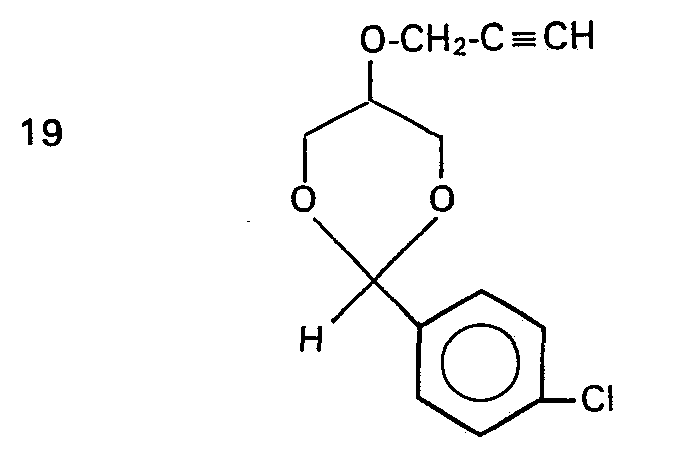
- Schmp. 102°C 44%

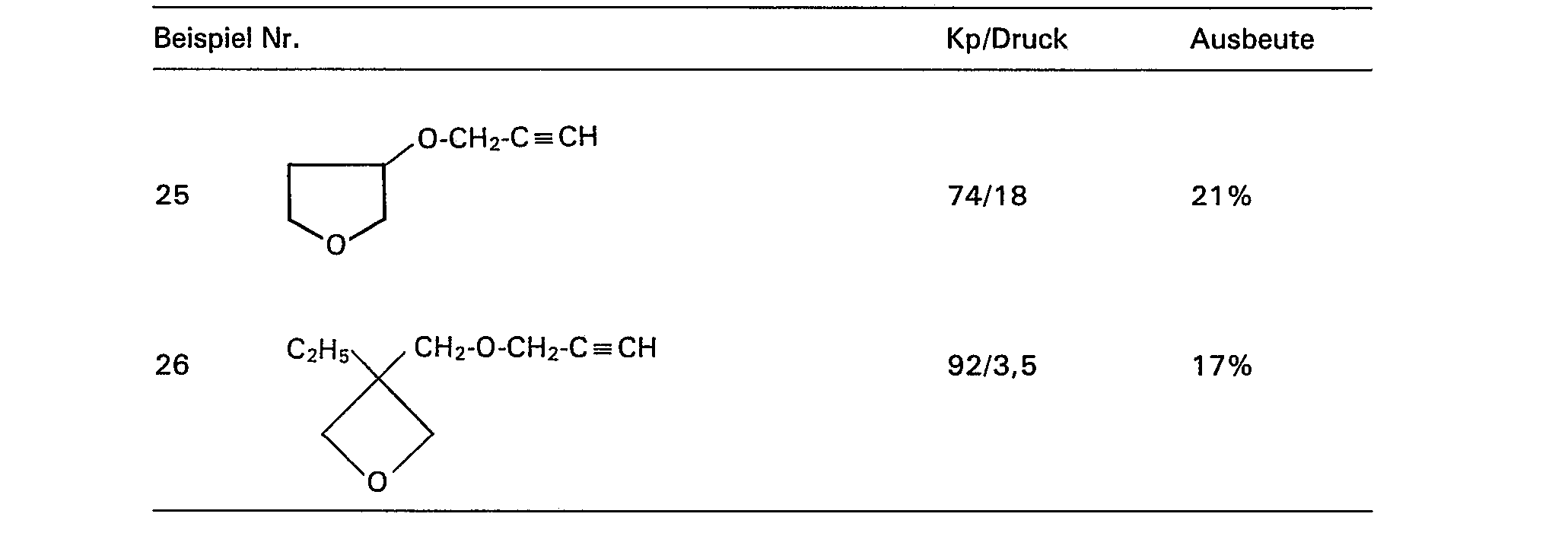
- b) 0,5 Mol Hydroxyverbindung, 0,55 Mol Chlorpropin, 0,025 Mol Tetrabutylammoniumbromid, 150 ml Toluol und 250 ml 50% NaOH wurden zunächst 1 h bei 20°C und dann 1,5 h bei 60°C gerührt. Die organische Phase wurde abgetrennt und eingeengt. Der Rückstand konnte ohne weitere Reinigung in die lodierung eingesetzt werden. So wurden erhalten:

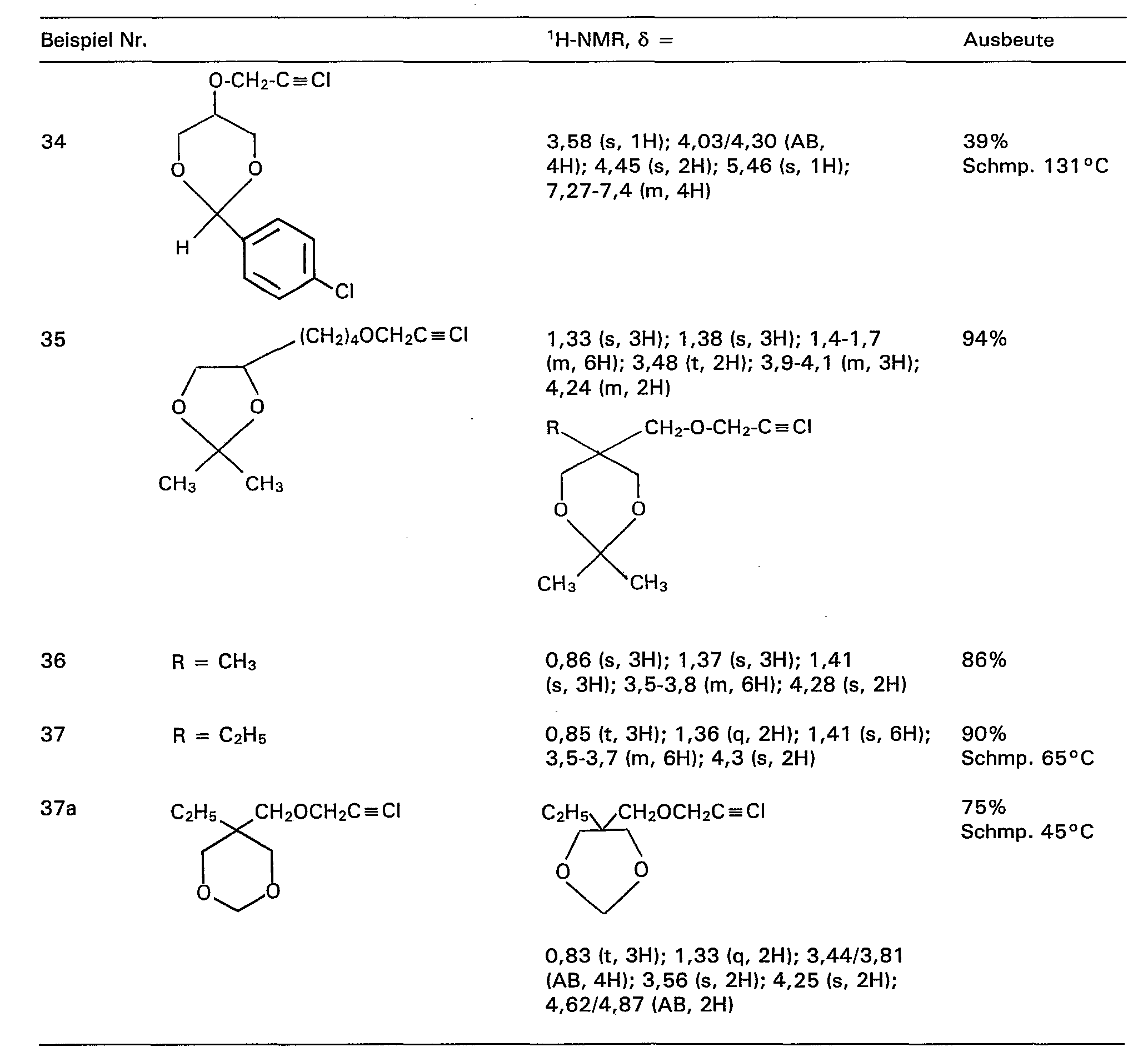
- 1 Mol Propargylether wurde in Methanol gelöst und auf 0°C gekühlt. Man gab 1,5 Mol wässrige Natronlauge und 1,1 Mol lod hinzu und rührte bei 0 bis 5°C nach. Nach beendeter lodierung engte man ein, versetzte das Reaktionsgemisch mit Wasser, entfärbte mit Natriumthiosulfat, nahm in Dichlormethan auf und engte ein. Die Produkte wurden im allgemeinen als Öl isoliert, in einigen Fällen trat Kristallisation ein.
- So wurden erhalten:
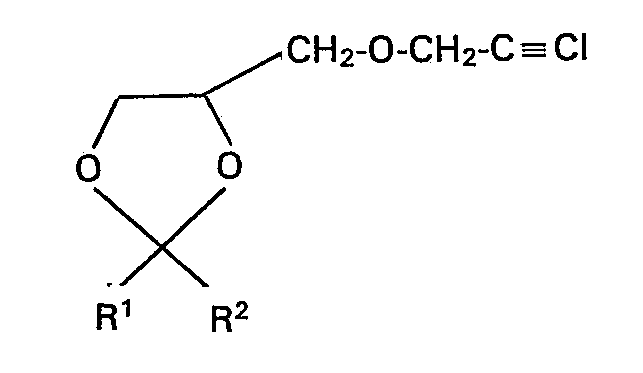


- x) Gemisch mit dem entsprechenden Dioxan


- Als Vergleichssubstanz dient 1-(lodpropargyloxy)-propan-2,3-diol (DE-OS 3 304 899).
- Zum Nachweis der Wirksamkeit gegen Pilze werden die minimalen Hemm-Konzentrationen (MHK) von erfindungsgemässen Wirkstoffen bestimmt:
- Ein Agar, der aus Bierwürze und Pepton hergestellt wird, wird mit erfindungsgemässen Wirkstoffen in Konzentrationen von 0,1 mg/l bis 5000 mg/1 versetzt. Nach Erstarren des Agars erfolgt Kontamination mit Reinkulturen der in der Tabelle aufgeführten Testorganismen. Nach 2-wöchiger Lagerung bei 28°C und 60 bis 70% rel. Luftfeuchtigkeit wird die MHK bestimmt. MHK ist die niedrigste Konzentratrion an Wirkstoff, bei der keinerlei Bewuchs durch die verwendete Mikrobenart erfolgt, sie ist in der nachstehenden Tabelle angegeben.
-


- Ein Agar, der als Nährmedium Bouillon enthält, wird mit erfindungsgemässen Wirkstoffen in Konzentrationen von 1 bis 5000 ppm versetzt. Darauf infiziert man das Nährmedium jeweils mit den in Tabelle II aufgeführten Testorganismen und hält das infizierte Medium 2 Wochen bei 28°C und 60 bis 70% rel. Luftfeuchtigkeit. Die MHK ist die niedrigste Konzentration an Wirkstoff, bei der keinerlei Bewuchs durch die verwendete Mikrobenart erfolgt. Die MHK-Werte sind in Tabelle II wiedergegeben.
-

- Erfindungsgemässe Susbtanzen werden in Konzentrationen von jeweils 0,1 bis 100 mg/I in Allens Nährlösung [Arch. Mikrobiol. 17, 34bis 53 (1952)], die in 4 I sterilem Wasser, 0,2 g Ammoniumchlorid, 4,0 g Natriumnitrat, 1,0 g Dikaliumhydrogenphosphat, 0,2 g Calciumchlorid, 2,05 g Magnesiumsulfat, 0,02 g Eisenchlorid und 1 % Caprolactam enthält, in wenig Aceton gelöst, zur Anwendung gebracht. Kurz vorher wird die Nährlösung mit Schleimorganismen (ca. 106 Keime/ml), die aus bei der Polyamid-Herstellung verwendeten Spinnwasser-Kreisläufen isoliert wurden, infiziert. Nährlösungen, die die minimale Hemmkonzentration (MHK) oder grössere Wirkstoffkonzentrationen aufweisen, sind nach 2-wöchiger Kultur bei Raumtemperatur noch völlig klar, d.h. die in wirkstofffreien Nährlösungen nach 3 bis 4 Tagen bemerkbare starke Vermehrung der Mikroben und Schleimbildung unterbleibt.
-

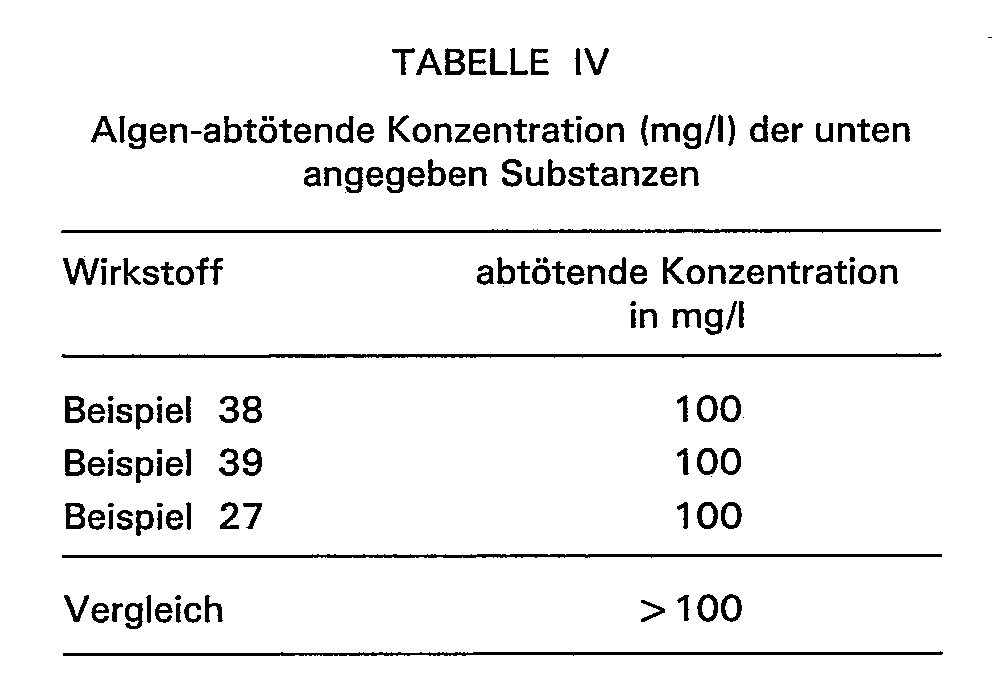
- Eine Mischkultur von Grün-, Blau-, Braun-und Kieselalgen (Stichococcus bacillaris Naegeli, Euglena gracilis Klebs, Chlorella pyrenoidosa Chick, Phormidium foveolarum Gomont, Oscillatoria geminata Meneghini und Phaeodactylum tricornutum Bohlin) wird unter Durchperlen von Luft in Allens Nährlösung [Arch. Mikrobiol. 17, 34 bis 53 (1952)], die auf 4 1 steriles Wasser 0,2 g Ammoniumchlorid, 4,0 g Natriumnitrat, 1,0 g Dikaliumhydrogenphosphat, 0,2 g Calciumchlorid, 2,05 g Magnesiumsulfat und 0,02 g Eisenchlorid enthält, gegeben. Nach 2 Wochen ist die Nährlösung durch intensives Algenwachstum tief grün-blau gefärbt. Das Absterben der Algen nach Zugabe erfindungsgemässer Wirkstoffe erkennt man an dem Entfärben der Nährlösung.
-
Claims (10)


Applications Claiming Priority (2)
| Application Number | Priority Date | Filing Date | Title |
|---|---|---|---|
| DE3510203 | 1985-03-21 | ||
| DE19853510203 DE3510203A1 (de) | 1985-03-21 | 1985-03-21 | Neue iodpropargylether, ein verfahren zu ihrer herstellung und ihre verwendung |
Publications (3)
| Publication Number | Publication Date |
|---|---|
| EP0199047A2 EP0199047A2 (de) | 1986-10-29 |
| EP0199047A3 EP0199047A3 (en) | 1987-04-15 |
| EP0199047B1 true EP0199047B1 (de) | 1988-10-05 |
Family
ID=6265888
Family Applications (1)
| Application Number | Title | Priority Date | Filing Date |
|---|---|---|---|
| EP86103196A Expired EP0199047B1 (de) | 1985-03-21 | 1986-03-10 | Neue Iodpropargylether, ein Verfahren zu ihrer Herstellung und ihre Verwendung |
Country Status (9)
| Country | Link |
|---|---|
| US (2) | US4719227A (de) |
| EP (1) | EP0199047B1 (de) |
| JP (1) | JPH0629279B2 (de) |
| CA (1) | CA1326038C (de) |
| DE (2) | DE3510203A1 (de) |
| DK (1) | DK129386A (de) |
| FI (1) | FI861153A7 (de) |
| NO (1) | NO860844L (de) |
| ZA (1) | ZA862075B (de) |
Families Citing this family (23)
| Publication number | Priority date | Publication date | Assignee | Title |
|---|---|---|---|---|
| CA2054221C (en) * | 1990-10-31 | 1999-09-14 | David Oppong | Synergistic combinations of iodopropargyl compounds with hexahydro-1,3,5-tris(2-hydroxyethyl)-s-triazine in controlling fungal and bacterial growth in aqueous fluids |
| ZA926535B (en) | 1991-11-07 | 1994-09-30 | Buckman Laboraties Internation | Synergistic combinations of iodopropargyl compounds with 1,2-benzisothiazolin-3-one in controlling fungal and bacterial growth in aqueous fluids |
| DE4141953A1 (de) * | 1991-12-19 | 1993-06-24 | Bayer Ag | Mikrobizide mittel |
| DE4217523A1 (de) * | 1992-05-27 | 1993-12-02 | Bayer Ag | Mittel zum Schutz von Schnittholz |
| US5707929A (en) * | 1995-05-08 | 1998-01-13 | Troy Chemical Corporation | Biocidal compositions comprising mixtures of haloproynyl compounds and sulfur containing triazines |
| US6017955A (en) * | 1995-06-07 | 2000-01-25 | Troy Technology Corporation, Inc. | Method of stabilizing biocidal compositions of haloalkynyl compounds |
| US5906981A (en) * | 1996-06-04 | 1999-05-25 | Troy Corporation | Halopropargyl inclusion complexes |
| US6059991A (en) | 1997-12-12 | 2000-05-09 | Troy Technology Corporation, Inc. | Stabilized composition containing halopropynyl compounds |
| US5938825A (en) * | 1998-05-21 | 1999-08-17 | Troy Technology Corporation Inc. | Stabilized antimicrobial compositions containing halopropynyl compounds |
| US6140370A (en) * | 1998-09-21 | 2000-10-31 | Troy Technology Corporation, Inc. | Stabilized alkyd based compositions containing halopropynl compounds |
| US6197805B1 (en) * | 1999-05-27 | 2001-03-06 | Troy Technology Corporation, Inc. | Broad spectrum antimicrobial mixtures |
| US6472424B1 (en) | 2000-06-07 | 2002-10-29 | Troy Technology Corporation, Inc. | Stabilized antimicrobial compositions containing halopropynyl compounds and benzylidene camphors |
| EP2147679B1 (de) | 2001-07-25 | 2014-06-25 | Raptor Pharmaceutical, Inc. | Zusammensetzungen für den Blut-Hirn-Schrankentransport |
| US7320758B2 (en) * | 2003-07-30 | 2008-01-22 | Triosyn Holding, Inc. | Method for control of microorganisms in metalworking fluid |
| WO2005027635A1 (en) * | 2003-09-19 | 2005-03-31 | Arch Chemicals, Inc. | Stabilized halopropynyl compositions as preservatives |
| EP2392258B1 (de) | 2005-04-28 | 2014-10-08 | Proteus Digital Health, Inc. | Pharma-Informatiksystem |
| CN101594878A (zh) | 2006-09-18 | 2009-12-02 | 雷普特药品公司 | 通过给予受体相关蛋白(rap)-缀合物对肝病症的治疗 |
| MY142639A (en) * | 2007-11-21 | 2010-12-15 | Mimos Berhad | Immobilized nitrate ionophore |
| GB2459691B (en) | 2008-04-30 | 2013-05-22 | Arch Timber Protection Ltd | Formulations |
| PL3395372T3 (pl) | 2009-02-20 | 2022-07-25 | EnhanX Biopharm Inc. | Układ do dostarczania leków na bazie glutationu |
| CN102458374A (zh) | 2009-05-06 | 2012-05-16 | 实验室护肤股份有限公司 | 包含活性剂-磷酸钙颗粒复合物的皮肤递送组合物及其使用方法 |
| US20120077778A1 (en) | 2010-09-29 | 2012-03-29 | Andrea Bourdelais | Ladder-Frame Polyether Conjugates |
| KR20220044326A (ko) | 2019-08-09 | 2022-04-07 | 트로이 코포레이션 | 폴리머 베타인 및 카바메이트를 포함하는 상승작용적 목재 보존 조성물 |
Family Cites Families (4)
| Publication number | Priority date | Publication date | Assignee | Title |
|---|---|---|---|---|
| US3290388A (en) * | 1963-07-03 | 1966-12-06 | Dow Chemical Co | Monopropynyl ethers of glycerol |
| US3700698A (en) * | 1971-05-12 | 1972-10-24 | Hoffmann La Roche | 1,2-epoxy-3-(3-iodo-2-propynyloxy)-propane |
| US4338327A (en) * | 1978-10-06 | 1982-07-06 | Janssen Pharmaceutica, N.V. | Substituted 1-(2-aryl-1,3-dioxolan-2-ylmethyl)-1H-1,2,4-triazoles |
| DE3304899A1 (de) * | 1983-02-12 | 1984-08-16 | Henkel KGaA, 4000 Düsseldorf | Substituierte 1-(3-iod-2-propinyloxy-)-2bzw.3-propanole, ihre herstellung und ihre verwendung als antimikrobielle substanzen |
-
1985
- 1985-03-21 DE DE19853510203 patent/DE3510203A1/de not_active Withdrawn
-
1986
- 1986-02-27 US US06/834,287 patent/US4719227A/en not_active Expired - Fee Related
- 1986-03-06 NO NO860844A patent/NO860844L/no unknown
- 1986-03-10 EP EP86103196A patent/EP0199047B1/de not_active Expired
- 1986-03-10 DE DE8686103196T patent/DE3660869D1/de not_active Expired
- 1986-03-19 FI FI861153A patent/FI861153A7/fi not_active Application Discontinuation
- 1986-03-19 CA CA000504515A patent/CA1326038C/en not_active Expired - Fee Related
- 1986-03-20 DK DK129386A patent/DK129386A/da not_active IP Right Cessation
- 1986-03-20 JP JP61061054A patent/JPH0629279B2/ja not_active Expired - Lifetime
- 1986-03-20 ZA ZA862075A patent/ZA862075B/xx unknown
-
1987
- 1987-06-26 US US07/067,674 patent/US4855318A/en not_active Expired - Fee Related
Also Published As
| Publication number | Publication date |
|---|---|
| ZA862075B (en) | 1986-11-26 |
| FI861153A7 (fi) | 1986-09-22 |
| DE3660869D1 (en) | 1988-11-10 |
| CA1326038C (en) | 1994-01-11 |
| DE3510203A1 (de) | 1986-09-25 |
| US4719227A (en) | 1988-01-12 |
| DK129386D0 (da) | 1986-03-20 |
| EP0199047A3 (en) | 1987-04-15 |
| EP0199047A2 (de) | 1986-10-29 |
| DK129386A (da) | 1986-09-22 |
| NO860844L (no) | 1986-09-22 |
| JPS61227577A (ja) | 1986-10-09 |
| FI861153A0 (fi) | 1986-03-19 |
| JPH0629279B2 (ja) | 1994-04-20 |
| US4855318A (en) | 1989-08-08 |
Similar Documents
| Publication | Publication Date | Title |
|---|---|---|
| EP0199047B1 (de) | Neue Iodpropargylether, ein Verfahren zu ihrer Herstellung und ihre Verwendung | |
| EP0212281B1 (de) | 1-Heteroaryl-4-aryl-pyrazol-Derivate | |
| EP0165448A2 (de) | 1-Heteroaryl-4-aryl-pyrozolin-5-one | |
| DE2426653B2 (de) | Derivate des 2-Amino-1,3-thiazins | |
| DE3811302A1 (de) | Derivate des triazolylmethyl-cyclopropyl-carbinols als materialschutzmittel | |
| EP0094539B1 (de) | Halogenpropargylformamide | |
| EP0121054B1 (de) | N-sulfenylierte Hydantoine, ein Verfahren zu ihrer Herstellung und ihre Verwendung als Mikrobizide | |
| EP0057362A1 (de) | Dibenzofuranderivate, Verfahren zu ihrer Herstellung und ihre Verwendung zur Bekämpfung von Pilzen | |
| EP0209819B1 (de) | 3-(3-Iodpropargyloxy)-propionitril, ein Verfahren zu dessen Herstellung und dessen Verwendung | |
| EP0001623B1 (de) | Aryl-thiocarbonsäure-thiocyanmethylester, ihre Herstellung und ihre Verwendung als Pestizide, sowie sie enthaltende Mittel | |
| EP0146774B1 (de) | Verwendung von 3-Amino-1,2-benzisothiazolen als Mikrobizide zum Schutz technischer Materialien | |
| EP0195238B1 (de) | Fluorhaltige N-sulfenylierte Indazole, Verfahren zu ihrer Herstellung sowie ihre Verwendung | |
| EP0148442B1 (de) | Halogenierte Sulfide, Verfahren zu ihrer Herstellung und ihre Verwendung in mikrobiziden Mitteln | |
| EP0142785B1 (de) | Trihaloallylthiocyanate, ein Verfahren zu ihrer Herstellung und ihre Verwendung in mikrobiziden Mitteln | |
| EP0291800B1 (de) | Neue Cyanhydrin-Iodpropargylether, Verfahren zu ihrer Herstellung und ihre Verwendung als Mikrobizide | |
| DE1542798C3 (de) | Pyrazolderivate und deren Verwendung | |
| EP0161480B1 (de) | N-Jodpropargyl-chlormethansulfonamide | |
| EP0257251B1 (de) | Fluoralkyl enthaltende Dimethylolnitromethane, Verfahren zu ihrer Herstellung sowie ihre Verwendung | |
| EP0170168A2 (de) | N,N-Diethyl-N'-aryl-N'-(dichlorfluormethylthio)-sulfamid-Mikrobizide | |
| EP0003975A1 (de) | Dichlormaleinsäurediamid-Derivate, Verfahren zu ihrer Herstellung und ihre Verwendung als Fungizide | |
| EP0066769A1 (de) | Fungizide Mittel für den Materialschutz | |
| EP0008731A1 (de) | N-sulfenylierte Formanilide, ihre Herstellung und ihre Anwendung als Fungizide | |
| DE3243590A1 (de) | Neue dichlorpyrimidincarbonsaeureester mit mikrobizider wirkung | |
| EP0014887A1 (de) | Spiro-Derivate von 3-(3,5-Dihalogenphenyl)-oxazolidin-2-thion-4-onen, Verfahren zu ihrer Herstellung sowie ihre Verwendung als Fungizide | |
| EP0135186A2 (de) | 3,6-Disubstituierte 1,3,5-Thiadiazin-2-thioxo-4-one |
Legal Events
| Date | Code | Title | Description |
|---|---|---|---|
| PUAI | Public reference made under article 153(3) epc to a published international application that has entered the european phase |
Free format text: ORIGINAL CODE: 0009012 |
|
| 17P | Request for examination filed |
Effective date: 19860310 |
|
| AK | Designated contracting states |
Kind code of ref document: A2 Designated state(s): BE CH DE FR GB IT LI NL SE |
|
| PUAL | Search report despatched |
Free format text: ORIGINAL CODE: 0009013 |
|
| AK | Designated contracting states |
Kind code of ref document: A3 Designated state(s): BE CH DE FR GB IT LI NL SE |
|
| 17Q | First examination report despatched |
Effective date: 19880317 |
|
| GRAA | (expected) grant |
Free format text: ORIGINAL CODE: 0009210 |
|
| AK | Designated contracting states |
Kind code of ref document: B1 Designated state(s): BE CH DE FR GB IT LI NL SE |
|
| ITF | It: translation for a ep patent filed | ||
| REF | Corresponds to: |
Ref document number: 3660869 Country of ref document: DE Date of ref document: 19881110 |
|
| GBT | Gb: translation of ep patent filed (gb section 77(6)(a)/1977) | ||
| ET | Fr: translation filed | ||
| PGFP | Annual fee paid to national office [announced via postgrant information from national office to epo] |
Ref country code: BE Payment date: 19890222 Year of fee payment: 4 |
|
| PGFP | Annual fee paid to national office [announced via postgrant information from national office to epo] |
Ref country code: CH Payment date: 19890323 Year of fee payment: 4 |
|
| PLBE | No opposition filed within time limit |
Free format text: ORIGINAL CODE: 0009261 |
|
| STAA | Information on the status of an ep patent application or granted ep patent |
Free format text: STATUS: NO OPPOSITION FILED WITHIN TIME LIMIT |
|
| 26N | No opposition filed | ||
| PG25 | Lapsed in a contracting state [announced via postgrant information from national office to epo] |
Ref country code: LI Effective date: 19900331 Ref country code: CH Effective date: 19900331 Ref country code: BE Effective date: 19900331 |
|
| BERE | Be: lapsed |
Owner name: BAYER A.G. Effective date: 19900331 |
|
| REG | Reference to a national code |
Ref country code: CH Ref legal event code: PL |
|
| ITTA | It: last paid annual fee | ||
| EAL | Se: european patent in force in sweden |
Ref document number: 86103196.1 |
|
| PGFP | Annual fee paid to national office [announced via postgrant information from national office to epo] |
Ref country code: DE Payment date: 19960214 Year of fee payment: 11 |
|
| PGFP | Annual fee paid to national office [announced via postgrant information from national office to epo] |
Ref country code: SE Payment date: 19960216 Year of fee payment: 11 |
|
| PGFP | Annual fee paid to national office [announced via postgrant information from national office to epo] |
Ref country code: FR Payment date: 19960228 Year of fee payment: 11 |
|
| PGFP | Annual fee paid to national office [announced via postgrant information from national office to epo] |
Ref country code: GB Payment date: 19960301 Year of fee payment: 11 |
|
| PGFP | Annual fee paid to national office [announced via postgrant information from national office to epo] |
Ref country code: NL Payment date: 19960331 Year of fee payment: 11 |
|
| PG25 | Lapsed in a contracting state [announced via postgrant information from national office to epo] |
Ref country code: GB Effective date: 19970310 |
|
| PG25 | Lapsed in a contracting state [announced via postgrant information from national office to epo] |
Ref country code: SE Effective date: 19970311 |
|
| PG25 | Lapsed in a contracting state [announced via postgrant information from national office to epo] |
Ref country code: NL Effective date: 19971001 |
|
| GBPC | Gb: european patent ceased through non-payment of renewal fee |
Effective date: 19970310 |
|
| PG25 | Lapsed in a contracting state [announced via postgrant information from national office to epo] |
Ref country code: FR Free format text: LAPSE BECAUSE OF NON-PAYMENT OF DUE FEES Effective date: 19971128 |
|
| NLV4 | Nl: lapsed or anulled due to non-payment of the annual fee |
Effective date: 19971001 |
|
| PG25 | Lapsed in a contracting state [announced via postgrant information from national office to epo] |
Ref country code: DE Effective date: 19971202 |
|
| EUG | Se: european patent has lapsed |
Ref document number: 86103196.1 |
|
| REG | Reference to a national code |
Ref country code: FR Ref legal event code: ST |
|
| PG25 | Lapsed in a contracting state [announced via postgrant information from national office to epo] |
Ref country code: IT Free format text: LAPSE BECAUSE OF NON-PAYMENT OF DUE FEES;WARNING: LAPSES OF ITALIAN PATENTS WITH EFFECTIVE DATE BEFORE 2007 MAY HAVE OCCURRED AT ANY TIME BEFORE 2007. THE CORRECT EFFECTIVE DATE MAY BE DIFFERENT FROM THE ONE RECORDED. Effective date: 20050310 |