EP0194466A2 - Kombination zur antimikrobiellen und antioxidativen Stabilisierung von Externa und Körperpflegemitteln - Google Patents
Kombination zur antimikrobiellen und antioxidativen Stabilisierung von Externa und Körperpflegemitteln Download PDFInfo
- Publication number
- EP0194466A2 EP0194466A2 EP86101946A EP86101946A EP0194466A2 EP 0194466 A2 EP0194466 A2 EP 0194466A2 EP 86101946 A EP86101946 A EP 86101946A EP 86101946 A EP86101946 A EP 86101946A EP 0194466 A2 EP0194466 A2 EP 0194466A2
- Authority
- EP
- European Patent Office
- Prior art keywords
- gew
- weight
- care products
- antimicrobial
- phb
- Prior art date
- Legal status (The legal status is an assumption and is not a legal conclusion. Google has not performed a legal analysis and makes no representation as to the accuracy of the status listed.)
- Withdrawn
Links
- 0 CC*(C1)C1(C)[C@@]1C(C2)C2CC1 Chemical compound CC*(C1)C1(C)[C@@]1C(C2)C2CC1 0.000 description 1
Images


Classifications
-
- A—HUMAN NECESSITIES
- A61—MEDICAL OR VETERINARY SCIENCE; HYGIENE
- A61Q—SPECIFIC USE OF COSMETICS OR SIMILAR TOILETRY PREPARATIONS
- A61Q17/00—Barrier preparations; Preparations brought into direct contact with the skin for affording protection against external influences, e.g. sunlight, X-rays or other harmful rays, corrosive materials, bacteria or insect stings
- A61Q17/005—Antimicrobial preparations
-
- A—HUMAN NECESSITIES
- A01—AGRICULTURE; FORESTRY; ANIMAL HUSBANDRY; HUNTING; TRAPPING; FISHING
- A01N—PRESERVATION OF BODIES OF HUMANS OR ANIMALS OR PLANTS OR PARTS THEREOF; BIOCIDES, e.g. AS DISINFECTANTS, AS PESTICIDES OR AS HERBICIDES; PEST REPELLANTS OR ATTRACTANTS; PLANT GROWTH REGULATORS
- A01N37/00—Biocides, pest repellants or attractants, or plant growth regulators containing organic compounds containing a carbon atom having three bonds to hetero atoms with at the most two bonds to halogen, e.g. carboxylic acids
- A01N37/36—Biocides, pest repellants or attractants, or plant growth regulators containing organic compounds containing a carbon atom having three bonds to hetero atoms with at the most two bonds to halogen, e.g. carboxylic acids containing at least one carboxylic group or a thio analogue, or a derivative thereof, and a singly bound oxygen or sulfur atom attached to the same carbon skeleton, this oxygen or sulfur atom not being a member of a carboxylic group or of a thio analogue, or of a derivative thereof, e.g. hydroxy-carboxylic acids
- A01N37/38—Biocides, pest repellants or attractants, or plant growth regulators containing organic compounds containing a carbon atom having three bonds to hetero atoms with at the most two bonds to halogen, e.g. carboxylic acids containing at least one carboxylic group or a thio analogue, or a derivative thereof, and a singly bound oxygen or sulfur atom attached to the same carbon skeleton, this oxygen or sulfur atom not being a member of a carboxylic group or of a thio analogue, or of a derivative thereof, e.g. hydroxy-carboxylic acids having at least one oxygen or sulfur atom attached to an aromatic ring system
- A01N37/40—Biocides, pest repellants or attractants, or plant growth regulators containing organic compounds containing a carbon atom having three bonds to hetero atoms with at the most two bonds to halogen, e.g. carboxylic acids containing at least one carboxylic group or a thio analogue, or a derivative thereof, and a singly bound oxygen or sulfur atom attached to the same carbon skeleton, this oxygen or sulfur atom not being a member of a carboxylic group or of a thio analogue, or of a derivative thereof, e.g. hydroxy-carboxylic acids having at least one oxygen or sulfur atom attached to an aromatic ring system having at least one carboxylic group or a thio analogue, or a derivative thereof, and one oxygen or sulfur atom attached to the same aromatic ring system
-
- A—HUMAN NECESSITIES
- A01—AGRICULTURE; FORESTRY; ANIMAL HUSBANDRY; HUNTING; TRAPPING; FISHING
- A01N—PRESERVATION OF BODIES OF HUMANS OR ANIMALS OR PLANTS OR PARTS THEREOF; BIOCIDES, e.g. AS DISINFECTANTS, AS PESTICIDES OR AS HERBICIDES; PEST REPELLANTS OR ATTRACTANTS; PLANT GROWTH REGULATORS
- A01N43/00—Biocides, pest repellants or attractants, or plant growth regulators containing heterocyclic compounds
- A01N43/72—Biocides, pest repellants or attractants, or plant growth regulators containing heterocyclic compounds having rings with nitrogen atoms and oxygen or sulfur atoms as ring hetero atoms
- A01N43/80—Biocides, pest repellants or attractants, or plant growth regulators containing heterocyclic compounds having rings with nitrogen atoms and oxygen or sulfur atoms as ring hetero atoms five-membered rings with one nitrogen atom and either one oxygen atom or one sulfur atom in positions 1,2
-
- A—HUMAN NECESSITIES
- A01—AGRICULTURE; FORESTRY; ANIMAL HUSBANDRY; HUNTING; TRAPPING; FISHING
- A01N—PRESERVATION OF BODIES OF HUMANS OR ANIMALS OR PLANTS OR PARTS THEREOF; BIOCIDES, e.g. AS DISINFECTANTS, AS PESTICIDES OR AS HERBICIDES; PEST REPELLANTS OR ATTRACTANTS; PLANT GROWTH REGULATORS
- A01N47/00—Biocides, pest repellants or attractants, or plant growth regulators containing organic compounds containing a carbon atom not being member of a ring and having no bond to a carbon or hydrogen atom, e.g. derivatives of carbonic acid
- A01N47/08—Biocides, pest repellants or attractants, or plant growth regulators containing organic compounds containing a carbon atom not being member of a ring and having no bond to a carbon or hydrogen atom, e.g. derivatives of carbonic acid the carbon atom having one or more single bonds to nitrogen atoms
- A01N47/28—Ureas or thioureas containing the groups >N—CO—N< or >N—CS—N<
- A01N47/36—Ureas or thioureas containing the groups >N—CO—N< or >N—CS—N< containing the group >N—CO—N< directly attached to at least one heterocyclic ring; Thio analogues thereof
-
- A—HUMAN NECESSITIES
- A61—MEDICAL OR VETERINARY SCIENCE; HYGIENE
- A61K—PREPARATIONS FOR MEDICAL, DENTAL OR TOILETRY PURPOSES
- A61K8/00—Cosmetics or similar toiletry preparations
- A61K8/18—Cosmetics or similar toiletry preparations characterised by the composition
- A61K8/30—Cosmetics or similar toiletry preparations characterised by the composition containing organic compounds
- A61K8/33—Cosmetics or similar toiletry preparations characterised by the composition containing organic compounds containing oxygen
- A61K8/34—Alcohols
-
- A—HUMAN NECESSITIES
- A61—MEDICAL OR VETERINARY SCIENCE; HYGIENE
- A61K—PREPARATIONS FOR MEDICAL, DENTAL OR TOILETRY PURPOSES
- A61K8/00—Cosmetics or similar toiletry preparations
- A61K8/18—Cosmetics or similar toiletry preparations characterised by the composition
- A61K8/30—Cosmetics or similar toiletry preparations characterised by the composition containing organic compounds
- A61K8/33—Cosmetics or similar toiletry preparations characterised by the composition containing organic compounds containing oxygen
- A61K8/34—Alcohols
- A61K8/345—Alcohols containing more than one hydroxy group
-
- A—HUMAN NECESSITIES
- A61—MEDICAL OR VETERINARY SCIENCE; HYGIENE
- A61K—PREPARATIONS FOR MEDICAL, DENTAL OR TOILETRY PURPOSES
- A61K8/00—Cosmetics or similar toiletry preparations
- A61K8/18—Cosmetics or similar toiletry preparations characterised by the composition
- A61K8/30—Cosmetics or similar toiletry preparations characterised by the composition containing organic compounds
- A61K8/33—Cosmetics or similar toiletry preparations characterised by the composition containing organic compounds containing oxygen
- A61K8/34—Alcohols
- A61K8/347—Phenols
-
- A—HUMAN NECESSITIES
- A61—MEDICAL OR VETERINARY SCIENCE; HYGIENE
- A61K—PREPARATIONS FOR MEDICAL, DENTAL OR TOILETRY PURPOSES
- A61K8/00—Cosmetics or similar toiletry preparations
- A61K8/18—Cosmetics or similar toiletry preparations characterised by the composition
- A61K8/30—Cosmetics or similar toiletry preparations characterised by the composition containing organic compounds
- A61K8/33—Cosmetics or similar toiletry preparations characterised by the composition containing organic compounds containing oxygen
- A61K8/37—Esters of carboxylic acids
-
- A—HUMAN NECESSITIES
- A61—MEDICAL OR VETERINARY SCIENCE; HYGIENE
- A61K—PREPARATIONS FOR MEDICAL, DENTAL OR TOILETRY PURPOSES
- A61K8/00—Cosmetics or similar toiletry preparations
- A61K8/18—Cosmetics or similar toiletry preparations characterised by the composition
- A61K8/30—Cosmetics or similar toiletry preparations characterised by the composition containing organic compounds
- A61K8/49—Cosmetics or similar toiletry preparations characterised by the composition containing organic compounds containing heterocyclic compounds
- A61K8/494—Cosmetics or similar toiletry preparations characterised by the composition containing organic compounds containing heterocyclic compounds with more than one nitrogen as the only hetero atom
- A61K8/4946—Imidazoles or their condensed derivatives, e.g. benzimidazoles
-
- A—HUMAN NECESSITIES
- A61—MEDICAL OR VETERINARY SCIENCE; HYGIENE
- A61K—PREPARATIONS FOR MEDICAL, DENTAL OR TOILETRY PURPOSES
- A61K8/00—Cosmetics or similar toiletry preparations
- A61K8/18—Cosmetics or similar toiletry preparations characterised by the composition
- A61K8/30—Cosmetics or similar toiletry preparations characterised by the composition containing organic compounds
- A61K8/67—Vitamins
- A61K8/676—Ascorbic acid, i.e. vitamin C
-
- A—HUMAN NECESSITIES
- A61—MEDICAL OR VETERINARY SCIENCE; HYGIENE
- A61K—PREPARATIONS FOR MEDICAL, DENTAL OR TOILETRY PURPOSES
- A61K2800/00—Properties of cosmetic compositions or active ingredients thereof or formulation aids used therein and process related aspects
- A61K2800/40—Chemical, physico-chemical or functional or structural properties of particular ingredients
- A61K2800/52—Stabilizers
- A61K2800/522—Antioxidants; Radical scavengers
-
- A—HUMAN NECESSITIES
- A61—MEDICAL OR VETERINARY SCIENCE; HYGIENE
- A61K—PREPARATIONS FOR MEDICAL, DENTAL OR TOILETRY PURPOSES
- A61K2800/00—Properties of cosmetic compositions or active ingredients thereof or formulation aids used therein and process related aspects
- A61K2800/40—Chemical, physico-chemical or functional or structural properties of particular ingredients
- A61K2800/52—Stabilizers
- A61K2800/524—Preservatives
-
- A—HUMAN NECESSITIES
- A61—MEDICAL OR VETERINARY SCIENCE; HYGIENE
- A61K—PREPARATIONS FOR MEDICAL, DENTAL OR TOILETRY PURPOSES
- A61K2800/00—Properties of cosmetic compositions or active ingredients thereof or formulation aids used therein and process related aspects
- A61K2800/40—Chemical, physico-chemical or functional or structural properties of particular ingredients
- A61K2800/59—Mixtures
Definitions
- the present invention relates to a new combination containing methyl paraben, propyl paraben and propylene glycol for the antimicrobial and antioxidative stabilization of external agents and personal care products, in particular on an aqueous basis, and a process for their preparation.
- esters of p-hydroxybenzoic acid commonly referred to as parabens (HBE)
- HBE parabens
- They are excellent preservatives and sterile preservatives because of their bactericidal and fungostatic effects on a number of microorganisms. They are mostly sour and neutral, however Also effective in an alkaline environment and almost non-toxic. They provide adequate protection even in low concentrations. Because of their lack of color and taste, they quickly found their way into the food, pharmaceutical and cosmetic industries; they are used for many technical purposes and in recent years increasingly as medicines (antifungal therapy). Two of the HBE were even included in the best known pharmacopoeias (BP, USP and DAB).
- esters of p-hydroxybenzoic acid behave largely indifferently when used and do not themselves show any disturbing side effects such as colorations, cloudiness, etc. They are fine, white powders. They are used as methyl, ethyl, n-butyl and propyl esters (methyl paraben, ethyl paraben, butyl paraben and propyl paraben).
- methyl paraben in water is low and is not sufficient for some preservation purposes.
- the parabens are very readily soluble in alkali lye with the formation of a metal salt, they are only used in this form in special cases.
- the parabens are only moderately stable in an alkaline environment. They saponify easily, especially when warm.
- Imidazolidinyl urea is the name for a bactericidal compound whose Production is described, for example, in US Pat. No. 3,248,285.
- the components of the stabilization system intended for product stabilization against microbial and oxidative spoilage are therefore incorporated into body care products of the emulsion type, certain creams and lotions, in separate steps.
- the individual components of the stabilization system each be in a water-soluble alcohol, e.g. Dissolve propylene glycol and triethylene glycol and incorporate the "preliminary solutions" obtained in the personal care product.
- the imidazolidinyl urea is then dissolved in the aqueous phase of the emulsion. This process is also costly and time-consuming.
- the object of the present invention was therefore to find a combination of antimicrobial and antioxidative stabilizers, which both shows an expanded spectrum of activity, is particularly effective against the entire spectrum of microorganisms, and also prevents oxidative degradation.
- the difficulties mentioned at the outset are also to be remedied; the combinations should be particularly easy to incorporate into emulsions and water-based compositions.
- the solution to the problem is based on the knowledge that a combination of stabilizers in external products and personal care products can have a different effect than the individual stabilizer alone.
- the object is achieved with a combination of consists.
- compositions according to the invention contain:
- Combinations consisting of are suitable for particularly heat-intensive manufacturing processes very well.
- the new combinations are easy to incorporate into external and water-based personal care products, although temperatures above 40 ° C should be avoided when incorporating combinations containing isothiazolinones. Temperatures of 35 - 40 ° C are applicable. If the temperature is above 40 ° C over a longer period of time, these combinations lose their effectiveness. In such cases it is therefore advisable to replace isothiazolinones in combinations with 2-phenoxyethanol or to use them together with 2-phenoxyethanol.
- the novel combinations are conveniently prepared so as triethylene glycol and propylene glycol are heated in a reaction vessel to temperatures of 35 to 80 0 C, mixed, where appropriate, in this temperature range with imidazolidinyl urea and mixed after cooling to at least 45 ° C with the remaining components and Room temperature is cooled.
- the new combinations are readily dispersible in amounts of up to about 1.5% by weight in 60 ° hot water, with amounts of 1% by weight, based on the external or personal care product, being sufficient. However, it has been shown that even small amounts can be fully effective. The required amounts are determined depending on the composition of the external and personal care products.
- the new combinations have a synergistic effect. It is believed that the effective, synergistically strengthening effects include is a consequence of the homogeneous distribution. Since effect studies and concentration studies have shown that the components in the concentration ranges according to the invention show both optimal solubilities and effects, it is assumed that the synergistic effect is also a result of the extraordinarily good solubility.
- the combinations can be stirred in shortly after the fat and water phases have been mixed. Solubilizers and other aids are generally not required when the new combinations are incorporated into the paste. However, if the new combinations are used in anhydrous or purely aqueous preparations, the additional use of a conventional emulsifier or solubilizer is expedient.
- the samples containing the preservatives were stored at room temperature until they were contaminated with the test bacterial strains and during the stress test.
- the bacterial count was determined using the plate casting method using preservative antagonists. For this, log 10 dilution series were prepared in sterilized casein-peptone-lecithin-polysorbate broth (Merck company). To improve the solubility, an additional 1% sterilized Tween 80 was added.
Landscapes
- Life Sciences & Earth Sciences (AREA)
- Health & Medical Sciences (AREA)
- General Health & Medical Sciences (AREA)
- Animal Behavior & Ethology (AREA)
- Veterinary Medicine (AREA)
- Public Health (AREA)
- Epidemiology (AREA)
- Birds (AREA)
- Emergency Medicine (AREA)
- Engineering & Computer Science (AREA)
- Environmental Sciences (AREA)
- Zoology (AREA)
- Wood Science & Technology (AREA)
- Dentistry (AREA)
- Plant Pathology (AREA)
- Pest Control & Pesticides (AREA)
- Agronomy & Crop Science (AREA)
- Dermatology (AREA)
- Cosmetics (AREA)
- Agricultural Chemicals And Associated Chemicals (AREA)
- Acyclic And Carbocyclic Compounds In Medicinal Compositions (AREA)
- Pharmaceuticals Containing Other Organic And Inorganic Compounds (AREA)
Abstract
- 15 - 30 Gew.% Methylparaben (PHB-Methylester)
- 5 - 10 Gew.% Propylparaben (PHB-Propylester)
- 20 - 35 Gew.% Propylenglykol
- 25 - 35 Gew.% Triethylenglykol
- 0 - 5 Gew% α- Tocopherolacetat
- 0 - 25 Gew.% Imidazolidinyl-Harnstoff
- 0 - 20 Gew% 2-Phenoxyethanol
- 0 - 5 Gew% Buthylhydroxytoluol (BHT)
- 0 - 10 Gew.% Isothiazolinone
- 0 - 1,5 Gew.% MgCl2.6H2O und/oder Cu(NO3)2.3H2O
- 0,1 - 1,0 Gew.% Buthylhydroxyanisol (BHA)
- 0,1 - 1,0 Gew.% Ascorbylpalmitat
Description
- Gegenstand der vorliegenden Erfindung ist eine neue, Methylparaben, Propylparaben und Propylenglykol enthaltende Kombination zur antimikrobiellen und antioxidativen Stabilisierung von Externa und Körperpflegemitteln, insbesondere auf wäßriger Basis, sowie ein Verfahren zu ihrer Herstellung.
- Es ist seit langem bekannt, daß Bakterien, Hefen und Schimmelpilze organische Materialien während längeren Stehens, insbesondere bei Feuchtigkeits-und Luftzutritt, in unerwünschter Weise verändern. Diese Zersetzung von Eiweißen, Fetten und Kohlenhydraten kann man schon äußerlich durch das Auftreten von Trübungen, Färbungen, fremden Geruch, Gärung oder Schimmelpilzrasen erkennen. Sie beeinträchtigt aber nicht nur das äußere Bild, sondern vermindert auch die Qualität des betreffenden Stoffes. Dabei können die Mikroorganismen sogar gesundheitsschädigende Substanzen produzieren. Ein Konservierungsmittel hat die Aufgabe, diese durch Kleinlebewesen verursachten, unerwünschten Veränderungen zu verhindern oder zu verzögern.
- Die Ester der p-Hydroxybenzoesäure, allgemein als Parabene (HBE) bezeichnet, sind wegen ihrer bakteriziden und fungostatischen Wirkung auf eine Zahl von Mikroorganismen ausgezeichnete Konservierungs- und Sterilhaltungsmittel. Sie sind vor allem im sauren und neutralen, aber auch im alkalischen Milieu wirksam und nahezu ungiftig. Sie geben bereits in niedrigen Konzentrationen eine ausreichenden Schutz. Wegen ihrer Farb- und Geschmacklosigkeit haben sie schnell Eingang in die Lebensmittel, pharmazeutische und kosmetische Industrie gefunden; sie werden für viele technische Zwecke und in den letzten Jahren verstärkt als Arzneimittel ( pilzbekämpfende Therapie ) benutzt. Zwei der HBE wurden sogar in die bekanntesten Pharmacopöen aufgenommen (BP, USP und DAB).
- Chemisch verhalten sich die Ester der p-Hydroxybenzoesäure bei ihrer Verwendung weitgehend indifferent und zeigen selbst keine störenden Nebenerscheinungen wie Färbungen, Trübungen u.ä. Es sind feine, weiße Pulver. Sie werden als Methyl-, Äthyl-, n-Butyl- und Propyl-Ester (Methylparaben, Äthylparaben, Butylparaben und Propylparaben ) eingesetzt.
- Die Löslichkeit des Methylparabens in Wasser ist jedoch gering, und reicht für manche Konservierungszwecke nicht aus. Obwohl die Parabene unter Bildung eines Metallsalzes in Alkalilaugen sehr gut löslich sind, finden sie in dieser Form nur in Sonderfällen Verwendung. Im alkalischen Milieu sind die Parabene nämlich nur mäßig beständig. Sie verseifen, besonders in der Wärme, leicht.
- Es ist weiterhin bekannt, daß organische Materialien, vor allen Dingen Fette und Öle, einem oxidativen Angriff durch Luftsauerstoff ausgesetzt sind. Zur Verhinderung des oxidativen Abbaues werden Oxidationsinhibitoren und/oder Antioxidantien eingesetzt. Beispielhaft wird an dieser Stelle eine Mischung, bestehend aus 10 Teilen Butylhydroxytoluol (BHT), 1 bis 5 Teilen Butylhydroxyanisol (BHA) und 1 bis 2 Teilen Ascorbylpalmitat, genannt.
- Auch sind bereits Kombinationen von Imidazolidinyl-Harnstoff und Parabenen als wirksame Konservierungssysteme gegen Bakterien, Hefen und Schimmel vorgeschlagen worden (J.Soc. Cosmetic Chemists 28 ( 1977),1 83/87. Imidazolidinyl-Harnstoff ist die Bezeichnung für eine bakterizide Verbindung, deren Herstellung z.B. in der US-PS 3 248 285 beschrieben ist. Als Vertreter von Imidazolidinyl-Harnstoffverbindungen sind z.Zt, u.a. auf dem Markt: Germall 115, Germall II, Euxyl K 200, Unicide U-13 und Biopure 100. Im Gegensatz zu den vorerwähnten Parabenen, die in der Ölphase leicht und in der Wasserphase schwerlöslich sind, können Imidazolidinyl-Harnstoffverbindungen in Wasser jedoch leicht gelöst werden. Wegen dieser Löslichkeitsunterschiede ist 'der Einsatz von Kombinationen aus Imidazolidinyl-Harnstoff und Parabenen in Externa und Hautpflegemitteln schwierig und problematisch dann, wenn ihr Einsatz in Produkten auf wäßriger Basis, beispielsweise in Emulsionen, vorgesehen ist.
- Die zur Produktstabilisierung gegen mikrobiellen und oxidativen Verderb bestimmten Komponenten des Stabilisierungssystems werden daher in Körperpflegemittel vom Emulsionstyp, bestimmte Cremes und Lotions, in separaten Schritten eingearbeitet.
- So werden beispielsweise Propylparabenen, Butylhydroxyanisol und Butylhydroxytoluol in der Ölphase der Emulsion gelöst, hingegen Methylparaben und Imidazolidinyl-Harnstoff in der wäßrigen Phase. Ein derartiges Stabilisierungsverfahren ist sowohl kostenintensiv als auch zeitaufwendig, da es unter Erhitzen und intensiver Mischung durchgeführt werden muß.
- Es ist auch schon vorgeschlagen worden, die einzelnen Komponenten des Stabilisierungssystems jeweils in einem wasserlöslichen Alkohol, z.B. Propylenglykol und Triethylenglykol, zu lösen und die erhaltenen " Vorlösungen " in das Körperpflegemittel einzuarbeiten. Anschließend wird der Imidazolidinyl-Harnstoff in der wäßrigen Phase der Emulsion aufgelöst. Auch dieses Verfahren ist kosten- und zeitaufwendig.
- Es hat sich weiterhin herausgestellt, daß die auf dem Markt befindlichen antimikrobiellen und antioxidativen Stabilisatoren bzw. Kombinationen dieser Verbindungen manche Externa und Körperpflegemittel nicht ausreichend stabilisieren. Sie können in verschiedenen Mitteln ihre Wirkung nicht voll entfalten,insbesondere zeigen viele nur ein begrenztes Wirkungsspektrum, sind also nicht imstande sowohl grampositive als auch gramnegative Bakterien, Hefen und Schimmel an der Vermehrung zu hemmen bzw. abzutöten.
- Aufgabe der vorliegenden Erfindung war es daher, eine Kombination von antimikrobiellen und antioxidativen Stabilisatoren zu finden, die sowohl ein erweitertes Wirkungsspektrum zeigt, insbesondere gegen das gesamte Spektrum von Mikroorganismen wirksam ist, als auch einen oxidativen Abbau, verhindert. Auch sollen die eingangs erwähnten Schwierigkeiten behoben werden, die Kombinationen sollen sich besonders leicht in Emulsionen und Mittel auf Wasserbasis einarbeiten lassen.
- Die Lösung der gestellten Aufgabe basiert auf der Erkenntnis, daß eine Kombination von Stabilisatoren in Externa und Körperpflegemitteln anders wirksam sein kann als der einzelne Stabilisator allein.
- Erfindungsgemäß wird die gestellte Aufgabe mit einer Kombination gelöst, die aus

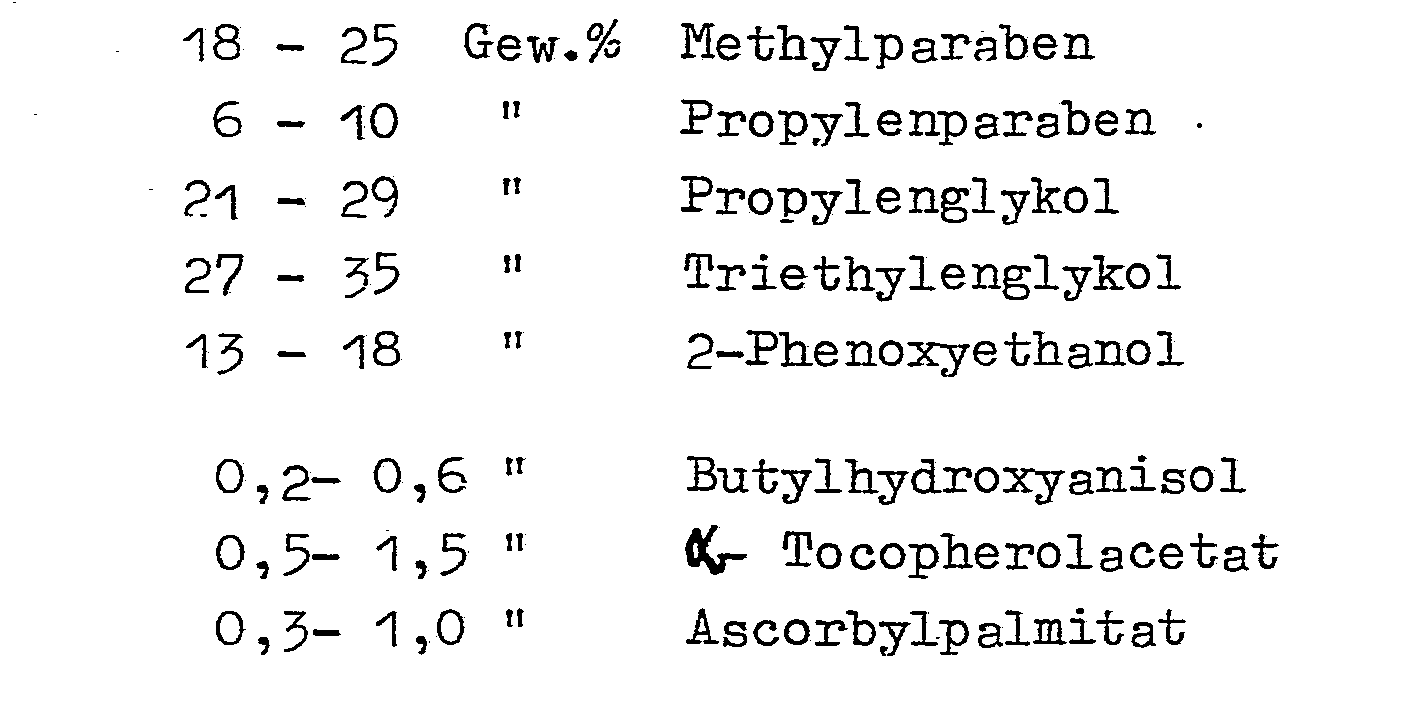
- Bevorzugte erfindungsgemäße Zusammensetzungen enthalten:

- Für besonders hitzeintensive Herstellungsverfahren eignen sich Kombinationen, bestehend aus

- Daß Isothiazolinone in so geringer Konzentration in den Parabene und Glykole enthaltenden Kombinationen gemäß vorliegender Erfindung eine derart effektive Wirkung gegen das gesamte Spektrum von Mikroorganismen zeigen, muß als überraschend bezeichnet werden und war nicht vorhersehbar. Überraschend war auch, daß sowohl Isothiazolinone als auch 2-Phenoxyethanol mit Antioxidantien so erfolgreich kombiniert werden kann.
- Die neuen Kombinationen lassen sich leicht in Externa und Körperpflegemittel auf Wasserbasis einarbeiten, wobei beim Einarbeiten von Isothiazolinone enthaltenden Kombinationen allerdings Temperaturen oberhalb 40°C vermieden werden sollten. Temperaturen von 35 - 40°C sind anwendbar. Bei Temperatureinwirkung von über 40°C über einen längeren Zeitraum verlieren nämlich diese Kombinationen deutlich an Wirkung. Es empfiehlt sich daher in solchen Fällen Isothiazolinone in Kombinationen durch 2-Phenoxyethanol zu ersetzen oder zusammen mit 2-Phenoxyethanol einzusetzen.
- Die neuen Kombinationen werden zweckmäßigerweise so hergestellt, daß Triethylenglykol und Propylenglykol in einem Reaktionsgefäß auf Temperaturen von 35 bis 800C erhitzt werden, gegebenenfalls in diesem Temperaturbereich mit Imidazolidinyl-Harnstoff vermischt und nach Abkühlung auf mindestens 45°C mit den restlichen Komponenten vermischt und auf Raumtemperatur abgekühlt wird. Die neuen Kombinationen sind in Mengen bis zu etwa 1,5 Gew.% in 60° heißem Wasser gut dispergierbar, wobei Mengen von 1 Gew.%, bezogen auf das Externum oder Körperpflegemittel, ausreichend sind. Es hat sich allerdings gezeigt, daß auch geringere Mengen bereits voll wirksam sein können. Die erforderlichen Mengen werden in Abhängigkeit von der Zusammensetzung der Externa und Körperpflegemittel bestimmt.
- Der Vorteil der neuen, Methylparaben, Propylparaben und Propylenglykol enthaltenden Kombinationen zur antimikrobiellen und antioxidativen Stabilisierung von Körperpflegemitteln, wird vor allem darin gesehen, daß die hierfür erforderlichen Komponenten nunmehr in einem einzigen Arbeitsgang in die Körperpflegemittel und Externa eingearbeitet werden können, eine Vielzahl von Einzelschritten damit entfällt. Dadurch wird die Herstellung der Körperpflegemittel wesentlich erleichtert. Außerdem wird die notwendige homogene Verteilung der Komponenten in den Externa und Körperpflegemittel viel rascher erzielt. Die dadurch erzielte Zeitersparnis ist beträchtlich.
- Wie sich überraschenderweise weiterhin-gezeigt hat, zeigen die neuen Kombinationen eine synergistische Wirkung. Es wird vermutet, daß die effektive, sich synergistisch verstärkende Wirkung u.a. eine Folge der homogenen Verteilung ist. Da Wirkungsuntersuchungen und Konzentrationsuntersuchungen gezeigt haben, daß die Komponenten in den erfindungsgemäßen Konzentrationsbereichen sowohl optimale Löslichkeiten als auch Wirkungen zeigen, wird vermutet, daß die synergistische Wirkung auch eine Folge der außerordentlich guten Löslichkeit ist.
- Schließlich ist an dieser Stelle noch erwähnenswert, daß eine fehlerfreie Dosierung mit den neuen Kombinationen wesentlich leichter ist als eine fehlerfreie Dosierung mit vielen Einzelkomponenten. Die Auffindbarkeitskontrolle der Einzelkomponenten im Endprodukt ist durch Leitsubstanzen, z.B. 2-Phenoxyethanol, möglich, was ebenfalls vorteilhaft ist. Außerdem wird durch die Kombinationen die Lagerhaltung erleichtert bzw. vereinfacht.
- Bei der Herstellung von Emulsionen können die Kombinationen kurz nach der Vermischung der Fett-und Wasserphase eingerührt werden. Lösungvermittler und andere Hilfsmittel sind in der Regel beim Einemnulgieren der neuen Kombinationen nicht erforderlich. Werden jedoch die neuen Kombinationen in wasserfreien oder rein wäßrigen Präparationen eingesetzt, ist die zusätzliche Verwendung eines üblichen Emulgators bzw. Lösungsvermittlers zweckmäßig.
- Anhand der nachstehenden Beispiele und Diagramme soll nun der Gegenstand der Erfindung näher erläutert werden.
- 31 kg Triethylenglykol und 25,7 kg Propylenglykol werden in einem heiz- und kühlbaren Rührkessel auf 70°C erhitzt. Zu dieser heißen Lösung gibt man 15 kg Imidazolidinyl-Harnstoff und 2 kg BHT bis zur vollständigen Lösung langsam zu. Dann kühlt man die erhaltene klare Lösung auf 45°C ab und rührt nacheinander 20 kg Methylparaben,5,2kg Propylparaben, 0,2 kg BHA, 0,2 kg Ascorbylpalmitat und 1,0 kg Isothiazolinone ein. Anschließend wird zur Wirkungsstabilisierung noch 1,5 kg Cu(NO3)2. 3 H20 ( in anderen Formulierungen wurden anstelle von Cu(NO3)2. 3 H20 600 g MgCl2 . 6 H20) zugegeben. Zum Schluß wird auf Zimmertemperatur abgekühlt.
- 35 kg Triethylenglykol und 27,7 kg Propylenglykol werden wie im Beispiel 1 erhitzt. In die Lösung werden

- Wie im Beispiel 2 werden die nachstehenden Komponenten miteinander vermischt und zwar:

- Die mit den Konservierungsmitteln versetzten Proben wurden bis zur Kontamination mit den Test-Bakterienstämmen und während des Belastungstests bei Zimmertemperatur gelagert.
- Die Prüfung der antimikrobiellen Wirksamkeit wurde mit den Stämmen:

- 18 Stunden bei 37°C in Casein-Soja-Bouillon inkubierte Kulturen wurden mit steriler phosphatgepufferter physiologischer Kochsalzlösung so eingestellt, daß nach gleichmäßiger Vermengung mit destilliertem Wasser eine mikrobielle Belastungskonzentration von 106 bis 107 lebenden Keimen pro ml Probematerial resultierte. Sterile Probenahmen erfolgten aus Wasser nach 3, 24 und 48 Stunden bzw. nach 7 Tagen und bei Creme-Proben nach 1, 2, 7, 14, 21 und 28 Tagen; die Proben wurden unmittelbar untersucht.
- Die Keimzahlen wurden mit dem Plattengußverfahren unter Verwendung von Konservierungsmittel-Antagonisten bestimmt. Dazu wurden log 10-Verdünnungsreihen in sterilisierter Casein-Pepton-Lezithin-Polysorbat-Bouillon hergestellt (Firma Merck). Zur Verbesserung der Löslichkeit wurde zusätzlich 1% sterilisiertes Tween 80 beigemengt.
- Pro Verdünnungsstufe wurde jeweils 1 ml in 2 Casein-Soja-Agarplatten gegossen und bei 37°C 72 bis 96 Stunden bebrütet, damit auch verzögert wachsende Kolonien erfaßt werden konnten.
- Gleichzeitig wurden Anreicherungen in antagonistenhaltiger Bouillon mit anschließender Subkultur zur Prüfung auf Keimfreiheit durchgeführt.
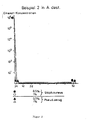
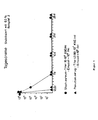
- Nach dieser Methode wurden die gemäß den Beispielen 1 und 2 hergestellten Kombinationen getestet. Das mit den erfindungsgemäßen Kombinationen erzielte ausgezeichnete Ergebnis kann den beiliegenden 4 Diagrammen entnommen werden.
Claims (4)


Applications Claiming Priority (2)
| Application Number | Priority Date | Filing Date | Title |
|---|---|---|---|
| DE3508928 | 1985-03-13 | ||
| DE19853508928 DE3508928A1 (de) | 1985-03-13 | 1985-03-13 | Kombination zur antimikrobiellen und antioxidativen stabilisierung von externa und koerperpflegemitteln |
Publications (2)
| Publication Number | Publication Date |
|---|---|
| EP0194466A2 true EP0194466A2 (de) | 1986-09-17 |
| EP0194466A3 EP0194466A3 (de) | 1987-12-09 |
Family
ID=6265052
Family Applications (1)
| Application Number | Title | Priority Date | Filing Date |
|---|---|---|---|
| EP86101946A Withdrawn EP0194466A3 (de) | 1985-03-13 | 1986-02-15 | Kombination zur antimikrobiellen und antioxidativen Stabilisierung von Externa und Körperpflegemitteln |
Country Status (2)
| Country | Link |
|---|---|
| EP (1) | EP0194466A3 (de) |
| DE (1) | DE3508928A1 (de) |
Cited By (5)
| Publication number | Priority date | Publication date | Assignee | Title |
|---|---|---|---|---|
| EP0327220A1 (de) * | 1988-02-03 | 1989-08-09 | Lonza, Inc. | Synergistische biozide Zusammensetzung |
| EP0342924A3 (en) * | 1988-05-16 | 1990-04-11 | Protech Incorporated | Stabilizer composition and stabilized aqueous systems |
| EP0450916A1 (de) * | 1990-04-05 | 1991-10-09 | Rohm And Haas Company | Phénoxyalkanol als Stabilisator für Isothiazolone |
| US6511673B1 (en) * | 2000-05-10 | 2003-01-28 | Rohm And Haas Company | Microbicidal composition |
| EP3087837A1 (de) * | 2015-04-30 | 2016-11-02 | Ueno Fine Chemicals Industry, Ltd. | Flüssige antiseptische zusammensetzung und verfahren zur herstellung davon |
Families Citing this family (1)
| Publication number | Priority date | Publication date | Assignee | Title |
|---|---|---|---|---|
| US6255331B1 (en) * | 1999-09-14 | 2001-07-03 | Rohm And Haas Company | Stable biocidal compositions |
Family Cites Families (1)
| Publication number | Priority date | Publication date | Assignee | Title |
|---|---|---|---|---|
| GB2126089B (en) * | 1982-08-06 | 1985-11-06 | Sutton Lab Inc | Composition of matter containing imidazolidinyl urea and parabens |
-
1985
- 1985-03-13 DE DE19853508928 patent/DE3508928A1/de active Granted
-
1986
- 1986-02-15 EP EP86101946A patent/EP0194466A3/de not_active Withdrawn
Cited By (13)
| Publication number | Priority date | Publication date | Assignee | Title |
|---|---|---|---|---|
| EP0327220A1 (de) * | 1988-02-03 | 1989-08-09 | Lonza, Inc. | Synergistische biozide Zusammensetzung |
| AU606260B2 (en) * | 1988-02-03 | 1991-01-31 | Lonza Inc. | Synergistic biocidal composition |
| CN1041989C (zh) * | 1988-02-03 | 1999-02-10 | 伦萨公司 | 协同杀菌组合物 |
| EP0342924A3 (en) * | 1988-05-16 | 1990-04-11 | Protech Incorporated | Stabilizer composition and stabilized aqueous systems |
| EP0450916A1 (de) * | 1990-04-05 | 1991-10-09 | Rohm And Haas Company | Phénoxyalkanol als Stabilisator für Isothiazolone |
| AU643766B2 (en) * | 1990-04-05 | 1993-11-25 | Rohm And Haas Company | Phenoxyalkanol as a stabilizer for isothiazolones |
| US6511673B1 (en) * | 2000-05-10 | 2003-01-28 | Rohm And Haas Company | Microbicidal composition |
| EP3087837A1 (de) * | 2015-04-30 | 2016-11-02 | Ueno Fine Chemicals Industry, Ltd. | Flüssige antiseptische zusammensetzung und verfahren zur herstellung davon |
| US20160317663A1 (en) * | 2015-04-30 | 2016-11-03 | Ueno Fine Chemicals Industry, Ltd. | Liquid antiseptic composition and method for producing the same |
| CN106070214A (zh) * | 2015-04-30 | 2016-11-09 | 上野制药株式会社 | 液体抗菌组合物以及生产该组合物的方法 |
| US9700625B2 (en) | 2015-04-30 | 2017-07-11 | Ueno Fine Chemicals Industry, Ltd. | Liquid antiseptic composition and method for producing the same |
| CN106070214B (zh) * | 2015-04-30 | 2020-06-26 | 上野制药株式会社 | 液体抗菌组合物以及生产该组合物的方法 |
| TWI706722B (zh) * | 2015-04-30 | 2020-10-11 | 日商上野製藥股份有限公司 | 液態抗菌組成物及其製法 |
Also Published As
| Publication number | Publication date |
|---|---|
| DE3508928C2 (de) | 1987-08-06 |
| EP0194466A3 (de) | 1987-12-09 |
| DE3508928A1 (de) | 1986-09-18 |
Similar Documents
| Publication | Publication Date | Title |
|---|---|---|
| DE69837348T2 (de) | Verfahren zur inaktivierung von bakterien mit einbegriff von bakteriensporen | |
| DE69325450T2 (de) | Potenzierung von antimikrobiellen wirkungen | |
| DE68913239T2 (de) | Konservierungszusammensetzung für nasse Wischer. | |
| DE2749750C2 (de) | Leicht wasserlösliches, von Zerstreubarkeit freies Nahrungsmittelkonservierungszusatzpulver oder -granulat | |
| DE69012268T2 (de) | Mittel zur Hemmung der alpha-Amylase Aktivität. | |
| DE60008868T2 (de) | Flüssiger konzentrate wie kosmetisches konservierungsmittel | |
| EP0297310A2 (de) | Desodorierende und antimikrobielle Zusammensetzung zur Verwendung in kosmetischen oder topischen Zubereitungen | |
| DE69932939T2 (de) | Fulvinsäure und dessen verwendung zur behandlung von diversen krankheitszuständen | |
| DE3702983A1 (de) | Desinfektionsmittel und ihre verwendung zur haut- und schleimhautdesinfektion | |
| DD146893A1 (de) | Verfahren zur herstellung von cyclodextrin-kamillen-inklusionskomplexen | |
| DE69633178T2 (de) | Eisenverbindungen, zusammensetzungen, herstellungsverfahren und verwendungen davon | |
| DE3244321C2 (de) | Zusammensetzung für die weibliche Intimhygiene | |
| DE3508928C2 (de) | ||
| DE69809435T2 (de) | Inhibitor- und konservierungsmittelzusammensetzung | |
| AT389816B (de) | Verfahren zur herstellung eines elixiers auf basis von wachteleiern | |
| DE3003096A1 (de) | Verwendung von o-methoxyzimtaldehyd als schutzmittel fuer materialien oder produkte, die durch die wirkung von mikroorganismen denaturiert werden | |
| DE1931466C3 (de) | Kupfer (Il)-komplexe von 6-Niederalkoxy-1-phenazinol- 5,10 - dioxiden | |
| DE2813714C2 (de) | Verfahren zur Herstellung eines trockenen Bakterienpräparates von Milchsäurebakterien | |
| WO1998023245A2 (de) | 1,6-hexandiol enthaltendes konservierungsmittel | |
| DE2426393C3 (de) | Gebrauchsfertiges flüssiges Gurgelmittel mit antimikrobieller Wirksamkeit | |
| DE3147311C2 (de) | ||
| DE3104282C2 (de) | ||
| DE68910220T2 (de) | Veterinäre Zusammensetzungen zur Verwendung gegen Endoparasiten und Verfahren zu ihrer Herstellung. | |
| DE69528922T2 (de) | Herstellung von 2-Bromo-5-(2-bromo-2-nitro-vinyl)-furan und deren Verwendung als Microzide | |
| EP0152860B1 (de) | Verwendung von Cephemverbindungen zur Herstellung eines Arzneimittels für die Modulation des Immunsystems |
Legal Events
| Date | Code | Title | Description |
|---|---|---|---|
| PUAI | Public reference made under article 153(3) epc to a published international application that has entered the european phase |
Free format text: ORIGINAL CODE: 0009012 |
|
| AK | Designated contracting states |
Kind code of ref document: A2 Designated state(s): AT BE CH DE FR GB IT LI LU NL SE |
|
| PUAL | Search report despatched |
Free format text: ORIGINAL CODE: 0009013 |
|
| AK | Designated contracting states |
Kind code of ref document: A3 Designated state(s): AT BE CH DE FR GB IT LI LU NL SE |
|
| 17P | Request for examination filed |
Effective date: 19871216 |
|
| 17Q | First examination report despatched |
Effective date: 19880506 |
|
| STAA | Information on the status of an ep patent application or granted ep patent |
Free format text: STATUS: THE APPLICATION IS DEEMED TO BE WITHDRAWN |
|
| 18D | Application deemed to be withdrawn |
Effective date: 19881118 |
|
| RIN1 | Information on inventor provided before grant (corrected) |
Inventor name: WALLNER, ANGELIKA Inventor name: VOELLER, HEINRICH, DR.DIPL.-CHEM. |