EP0189072A2 - Urethangruppen aufweisende Diisocyanate, ein Verfahren zu ihrer Herstellung und ihre Verwendung als Bindemittel bzw. Bindemittelkomponente in Polyurethanlacken - Google Patents
Urethangruppen aufweisende Diisocyanate, ein Verfahren zu ihrer Herstellung und ihre Verwendung als Bindemittel bzw. Bindemittelkomponente in Polyurethanlacken Download PDFInfo
- Publication number
- EP0189072A2 EP0189072A2 EP86100292A EP86100292A EP0189072A2 EP 0189072 A2 EP0189072 A2 EP 0189072A2 EP 86100292 A EP86100292 A EP 86100292A EP 86100292 A EP86100292 A EP 86100292A EP 0189072 A2 EP0189072 A2 EP 0189072A2
- Authority
- EP
- European Patent Office
- Prior art keywords
- diisocyanates
- optionally
- polyisocyanates
- formula
- groups
- Prior art date
- Legal status (The legal status is an assumption and is not a legal conclusion. Google has not performed a legal analysis and makes no representation as to the accuracy of the status listed.)
- Granted
Links
Classifications
-
- C—CHEMISTRY; METALLURGY
- C08—ORGANIC MACROMOLECULAR COMPOUNDS; THEIR PREPARATION OR CHEMICAL WORKING-UP; COMPOSITIONS BASED THEREON
- C08G—MACROMOLECULAR COMPOUNDS OBTAINED OTHERWISE THAN BY REACTIONS ONLY INVOLVING UNSATURATED CARBON-TO-CARBON BONDS
- C08G18/00—Polymeric products of isocyanates or isothiocyanates
- C08G18/06—Polymeric products of isocyanates or isothiocyanates with compounds having active hydrogen
- C08G18/70—Polymeric products of isocyanates or isothiocyanates with compounds having active hydrogen characterised by the isocyanates or isothiocyanates used
- C08G18/72—Polyisocyanates or polyisothiocyanates
- C08G18/80—Masked polyisocyanates
- C08G18/8003—Masked polyisocyanates masked with compounds having at least two groups containing active hydrogen
- C08G18/8006—Masked polyisocyanates masked with compounds having at least two groups containing active hydrogen with compounds of C08G18/32
- C08G18/8009—Masked polyisocyanates masked with compounds having at least two groups containing active hydrogen with compounds of C08G18/32 with compounds of C08G18/3203
Definitions
- the invention relates to new diisocyanates containing urethane groups, soluble in hydrocarbon solvents, a process for their preparation and their use as binders or binder components in one- or two-component polyurethane lacquers.
- Polyisocyanates containing urethane groups based on aromatic or aliphatic diisocyanates and low molecular weight polyhydric alcohols represent an important group of paint polyisocyanates used in practice (cf. plastic manual by GW Becker and D. Braun, Carl Hanser Verlag Kunststoff (1983), volume 7 " Polyurethane ", 2nd edition, in particular chapter 3.3.2.1).
- Such polyisocyanates containing urethane groups have the advantage over the monomeric diisocyanates on which they are based that they are non-volatile and therefore easier and safer to handle.
- low molecular weight polyols such as glycerol, trimethylolpropane, hexanetriol and / or pentaerythritol, which may be in a mixture with diols, are produced with excess amounts of simple diisocyanates such as, for example, 2,4-diisocyanatotoluene, 1-isocyanato-3,3,5- trimethyl-5-isocyanatomethylcyclohexane (isophorone diisocyanate, abbreviated: IPDI) or 1,6-diisocyanatohexane reacted with urethane formation, followed by removal of the excess, unreacted starting diisocyanate by distillation.
- IPDI isophorone diisocyanate
- the polyisocyanates containing urethane groups are generally resinous substances which are used in dissolved form in solvents.
- polar solvents such as esters of acetic acid, for example ethyl acetate or ethyl glycol acetate, are used as solvents, which can optionally be blended in a mixture with less polar solvents such as hydrocarbons.
- hydrocarbons The exclusive use of hydrocarbons as a solvent is generally not possible since the solutions become very cloudy when standing or when diluting concentrated solutions to the processing concentration and are therefore unusable for an application.
- polyester polyols and alkyd resins which can be used as potential reactants for the coating polyisocyanates in two-component polyurethane coatings, are also used in practice in a form dissolved in hydrocarbons. Due to the poor solubility or incompatibility of the paint polyisocyanates mentioned The state of the art with hydrocarbon solvents then often results in turbidity or precipitation even when the polyol component dissolved in hydrocarbon solvents is mixed with solutions of the lacquer polyisocyanates, even if the polyisocyanate component was previously dissolved in a mixture of polar and apolar solvents. Such clouding or precipitation lead to a drop in gloss and to surface damage of the coatings produced from the paints.
- polar solvents such as e.g. the esters of acetic acid, which are mainly used, are held in the hardened lacquer film for a long time in small quantities.
- esters hydrolyze in paints that are used for outdoor applications and are therefore exposed to weather conditions.
- the resulting acetic acid has two very disadvantageous effects: it catalyzes the degradation of the paint film and it deteriorates the corrosion protection of the paint in paints on metal. Both lead to a lower durability of the paint.
- the object of the invention was therefore to provide lacquer polyisocyanates which are clearly soluble in less polar aromatic hydrocarbons and their Solutions with other non-polar solvents such as aromatic or aliphatic hydrocarbons can be further diluted to the respective processing concentration.
- the invention optionally relates to a mixture of up to 90% by weight, preferably up to 50% by weight, based on the total weight, of polyisocyanates of the formula containing urethane groups
- the invention also relates to a process for the preparation of these diisocyanates according to the invention, which is characterized in that diisocyanates of the formula with dihydric alcohols of the formula or with their mixtures with alcohols of the formula while maintaining an NCO / OH equivalent ratio of 1.7: 1 to 15: 1 with the formation of urethane and then starting diisocyanate still present, optionally up to a residual content of the urethane group-containing polyisocyanates in urethane group-free starting diisocyanates of a maximum of 2%, with R 1 , R 2 , R 3 , R 4 , m and n have the meaning given above.
- the invention also relates to the use of the diisocyanates according to the invention or the mixtures of diisocyanates according to the invention with polyisocyanates, optionally in a form blocked with blocking agents for isocyanate groups, optionally in a mixture with other, optionally blocked polyisocyanates, as binders or binder components in one- or two-component polyurethane lacquers .
- the radical R 3 is particularly preferably the isocyanate groups of 1,6-diisocyanatohexane, isophorone diisocyanate or 2,4- or 2,6-diisocyanatotoluene-connecting hydrocarbon radicals. Any mixtures of corresponding diisocyanates can also be used as starting materials.
- suitable starting diisocyanates are 1,4-diisocyanatobutane, 1,5-diisocyanatopentane, 1,6-diisocyanatohexane, 1,8-diisocyanatooctane, 1,10-diisocyanatodecane, 1,12-diisocyanatododecane, isomer mixtures of 2,2,4-trimethyl -1,6-diisocyanatohexane and 2,4,4-trimethyl-1,6-diisocyanatohexane, 2-methyl-1,5-diisocyanato-pentane, 2,2-dimethyldiisocyanato-pentane, ⁇ -isocyanato-caproic acid- (2- isocyanatoethyl) ester, cf, ⁇ -diisocyanatocaproic acid ethyl ester, 1,4- and 1,3-diisocyanato
- 2,4-Diiso are particularly preferred cyanatotoluene, its technical mixtures with 2,6-diisocyanatotoluene, 1,6-diisocyanatohexane and isophorone diisocyanate used as starting materials in the process according to the invention.
- the technical mixtures of 2,4- and 2,6-diisocyanatotoluene are particularly preferred.
- Particularly preferred diols of the general formula mentioned are those for which n is 0.
- Typical examples of such alcohols are the particularly preferred 2,2,4-trimethylpentanediol-1,3, its ethoxylation and / or propoxylation products containing ether groups, which (on average) can have up to four ether oxygen atoms per molecule or its addition compounds containing ester groups with up to 4 moles of ⁇ -caprolactone per mole of diol free from ester groups.
- the dihydric alcohols mentioned under 2 may optionally be mixed with polyhydric alcohols of the formula are used, where R 4 and m have the meaning already mentioned.
- polyhydric alcohols examples include 1,2-dihydroxyethane, 1,2- and 1,3-dihydroxypropane, 1,2-, 2,3- and 1,4-dihydroxybutane, 1,6-dihydroxyhexane, neopentyl glycol, 1,1 , 1-tris (hydroxymethyl) propane, (trimethylolpropane), glycerol or ethoxylation and / or propoxylation products of the simple polyhydric alcohols mentioned, of the type corresponding to the definition of R 4 given above. Any mixtures of such alcohols can of course also be used.
- polyhydric alcohols mentioned here are used in the process according to the invention, if at all, in amounts such that mixtures of the type mentioned above result as process products.
- the polyhydric alcohols mentioned here are used in amounts of up to 300 mol%, preferably up to 100 mol%, based on the diols mentioned under 2, which are essential to the invention.
- the diisocyanates mentioned by way of example in 1 are used to carry out the process according to the invention with the diols exemplified under 2. and optionally the polyhydric alcohols mentioned under 3. while maintaining an equivalent ratio of isocyanate groups to hydroxyl groups of 1.7: 1 to 15: 1, preferably 3: 1 to 8: 1 at 0 to 150, preferably 40 to 120 ° C implemented with urethane formation.
- the alcohol component is preferably added to the isocyanate component.
- the reaction is preferably carried out in the absence of catalysts, in particular in the presence of trimerization catalysts for isocyanate groups.
- the reaction also produces small amounts of oligomeric, ie chain-extended, urethane-containing polyisocyanates which do not impair the usability of the process products and are then likewise present in a mixture with the diisocyanates according to the invention.
- Their proportion based on the total weight of the process products freed from excess monomeric starting diisocyanate, is generally below 30, preferably below 20, percent by weight.
- any excess, monomeric starting diisocyanate still present is optionally, generally by thin-layer distillation, for example using a thin-film evaporator, or by extraction, for example using n-hexane as an extractant, except for a residual product of the reaction product containing monomeric diisocyanate containing urethane groups a maximum of 2, preferably a maximum of 1% by weight removed.
- the preferred diisocyanates or polyisocyanate mixtures according to the invention are those which only have a residual monomer starting diisocyanate content of at most 2, preferably at most 1% by weight, based on the total amount of all urethane-modified di- and polyisocyanates.
- lacquer polyisocyanates according to the invention containing urethane groups are clearly soluble and dilutable in hydrocarbons such as benzene, toluene, xylene or other alkylbenzenes. They also have a solubilizing effect, so that they can be used in a mixture with per se insoluble, ie not dilutable with aromatic hydrocarbons, and this mixture is then also soluble in aromatic hydrocarbons and can be diluted with them without clouding. Accordingly, not only do the pure diisocyanates according to the invention containing urethane groups, but also their mixtures with diisocyanates of the formula said solubility in or dilutability with aromatic hydrocarbons of the type mentioned by way of example.
- Suitable blocking agents for the Invention modern diisocyanates or their mixtures with polyisocyanates of the last-mentioned general formula are, for example, monophenols such as phenol, the cresols, the trimethylphenols, the tert. Butylphenols; tertiary alcohols such as tert.
- the diisocyanates according to the invention are valuable binders or binder components for one- and two-component polyurethane coatings.
- one-component polyurethane lacquers are to be understood as meaning both moisture-curing coating compositions based on NCO prepolymers and heat-crosslinkable coating compositions based on compounds with groups that are reactive toward isocyanate groups (which may be reversibly blocked) and polyisocyanates with blocked isocyanate groups.
- the possibly mixed with others Diisocyanates according to the invention present in the isocyanates can be used in the production of the moisture-curing coating compositions as isocyanate components in the production of NCO prepolymers or as crosslinking agents in a mixture with NCO prepolymers based on other organic polyisocyanates.
- the diisocyanates according to the invention can be used in blocked form as the isocyanate component or as part of the isocyanate component.
- two-component polyurethane lacquers are to be understood as meaning those coating compositions whose binders are composed of a polyisocyanate component with free isocyanate groups and a polyol component, the diisocyanates according to the invention being able to form the polyisocyanate component or part of the polyisocyanate component.
- the essential binder component generally consists of a high molecular weight, free isocyanate group-containing prepolymer based on a) simple diisocyanates of the type mentioned above under example 1 and b) deficient amounts of higher molecular weight polyhydroxyl compounds.
- these higher molecular weight polyhydroxyl Compounds are generally polyester or polyether polyols in the molecular weight range 500 to 4000, which generally have an average functionality of 2 to 4. Tert are particularly well suited.
- a suitable polyether polyol can be obtained by propoxylating ethylenediamine.
- the above-mentioned one-component lacquers generally also contain low-molecular lacquer polyisocyanates, since the required mechanical properties of the hardened lacquer layer can only be achieved by their simultaneous use in the one-component binder.
- polyisocyanates containing urethane groups such as the reaction product of 3 moles of 2,4-diisocyanatotoluene with 1 mole of trimethylolpropane, have been used for this purpose.
- moisture-curing one-component paints are obtained.
- the diisocyanates according to the invention with the higher molecular weight polyhydroxyl compounds mentioned by way of example, moisture-curing one-component lacquers are obtained which can be dissolved in aromatic hydrocarbons and processed from an aromatic solution.
- diisocyanates according to the invention or their abovementioned mixtures with polyisocyanates of the last-mentioned general formula in "two-component paints" instead of or in combination with the paint polyisocyanates previously used for this purpose or by using the corresponding blocked polyisocyanates in heat-sensitive one-component paints to also process these varnishes from aromatic solvents, or to make them dilutable with aromatic solvents.
- the diisocyanates or polyisocyanate mixtures according to the invention are used, apart from the (partial) replacement of the paint polyisocyanates used to date with the products according to the invention, the known starting materials and auxiliaries are used, so that reference can be made to the relevant prior art in this regard (see e.g. H. Kittel's textbook on paints and coatings; volume III; WA Colomb 1976).
- the diisocyanates or polyisocyanate mixtures according to the invention in particular in two-component paints, can be combined not only with the polyester and polyether polyols mentioned above by way of example but also with the polyhydroxy polyacrylates known from polyurethane paint chemistry.
- Low molecular weight, polyhydric alcohols with a molecular weight below 500 can also be part of the polyol component in such two-component paints.
- the polyisocyanate component and the polyol component are preferably present in amounts such that 0.8 to 3, preferably 0.9 to 1.1, are present for each optionally blocked isocyanate group Hydroxyl groups are eliminated.
- the diisocyanates or polyisocyanate mixtures according to the invention in those coating systems which are examples of compounds which are reactive toward isocyanate groups, optionally in addition to compounds containing hydroxyl groups have mentioned type amine chain extenders. These amine chain extenders are generally blocked polyamines, for example polyketemines or oxazolidines, which form free amino groups under the influence of atmospheric moisture. Even in the case of the use of such compounds with groups which are reactive toward isocyanate groups, the statements made above with regard to the equivalent ratios apply, the (blocked) amino groups being able to replace the hydroxyl groups in whole or in part.
- the lacquers containing the diisocyanates or polyisocyanate mixtures according to the invention as a binder component are particularly suitable for lacquering wood, but they are also well suited for lacquering metallic substrates.
- the paint films are heat-color stable, have excellent abrasion resistance and are also characterized by high hardness, very good elasticity and chemical resistance as well as a high gloss.
- 1750 g of residue are obtained as a viscous resin, which is triggered with anhydrous xylene to form a 75% solution in xylene.
- the clear solution has an NCO content of 13.4%, an APHA color number of 30 (DIN 53 409) and a residual free diisocyanate content of 0.1%.
- the viscosity of the solution is 2300 mPas / 23 ° C, it can be diluted with xylene, toluene or alkylbenzene mixtures.
- a gel chromatographic analysis shows that the solids of this solution are approximately 55.5% from the adduct according to the invention from 1 mol of 2,2,4-trimethylpentanediol-1,3 and 2 mol of tolylene diisocyanate, approximately 29.3% from the adduct consists of 1 mole of trimethylolpropane and 3 moles of tolylene diisocyanate and approximately 15.2% of higher molecular weight components.
- This example shows the production of a two-component paint that is soluble in xylene and meets all the requirements placed on high-quality furniture paint.
- An alkyd resin is used as the polyol component, which is prepared by conventional melt condensation from 298 parts of peanut oil fatty acid, 350 parts of phthalic anhydride, 7 parts of maleic anhydride, 88 parts of triethylene glycol and 320 parts of trimethylolpropane. It is dissolved 70% in xylene. The solution has a hydroxyl number of 93 and an acid number of 15.
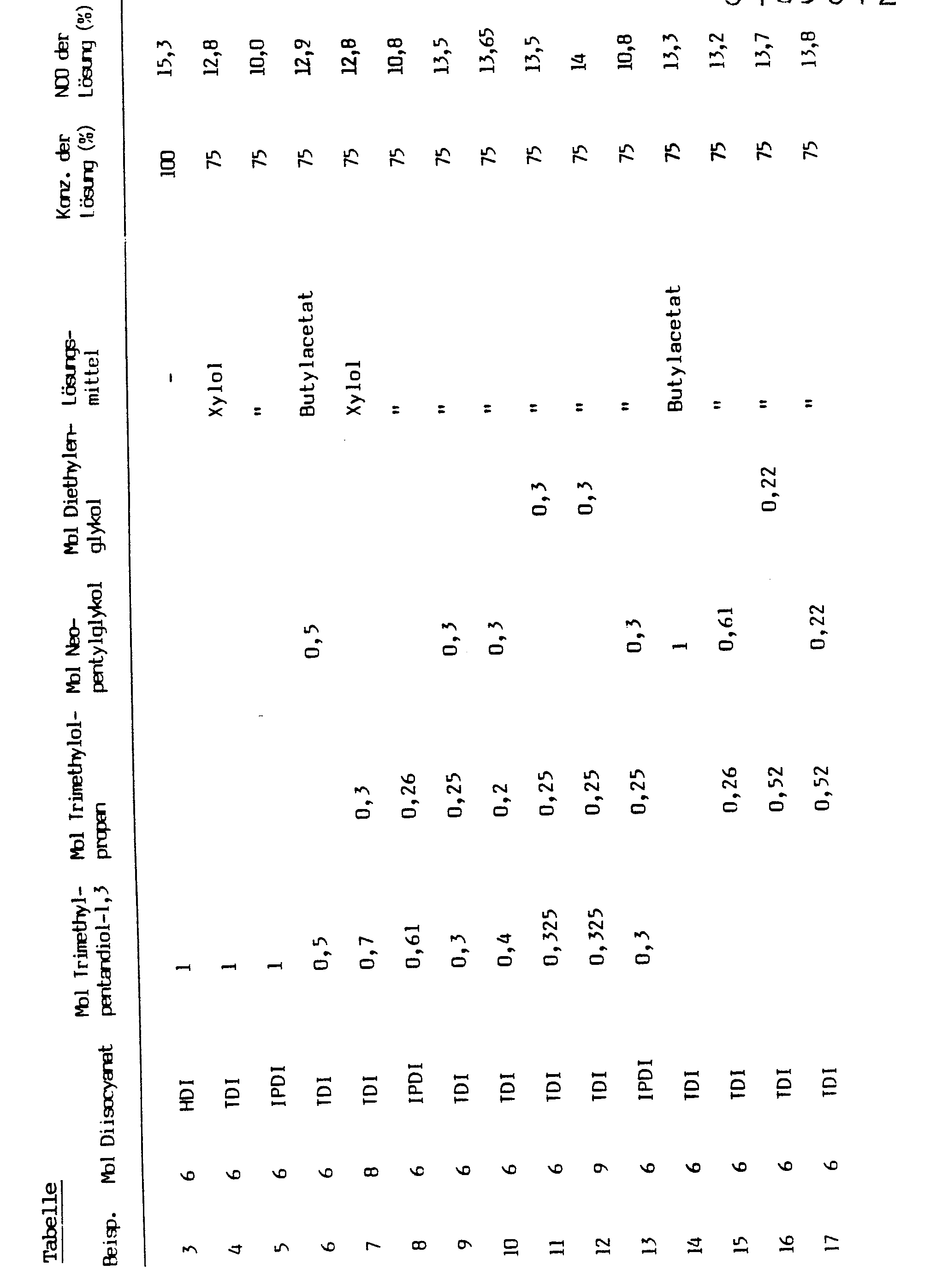
- Examples 3 to 17 are summarized in the table below. Examples 3 to 13 represent examples according to the invention, Examples 14 to 17 represent comparative examples.
- reaction products listed in the table are prepared in a completely analogous manner to the procedure according to Example 1: reaction of the polyols with excess diisocyanate, removal of the excess diisocyanate not required for the reaction by thin-layer distillation and subsequent dissolution of the process product obtained as a distillation residue.
- the products according to Examples 14 to 17 are not soluble in xylene or toluene; their solutions in polar solvents can only be diluted to a very small extent with these hydrocarbons.
- the products according to the invention are soluble in hydrocarbons of the type mentioned and can be diluted with them. This can cause solid concentrations can be achieved that meet all, even extreme, requirements in this regard. (The dilutability reported relates to the achievable solids content).
- This example describes the production and the properties of a moisture-curing one-component lacquer, which can be produced and transported in high concentration in xylene as the only solvent and can be diluted to the processing concentration with xylene or other hydrocarbons at the processing location.
- NCO content 7.8% viscosity at 23 ° C: 500 mPas xylene thinnability: ⁇ 10% thinnability with technical alkylbenzene mixture: ⁇ 10% color number (DIN 1662): 1
- the varnish is adjusted to a processing concentration of 45% with xylene, mixed with 0.5% dibutyltin dilaurate as a catalyst and applied to glass plates with a varnish dumbbell (gap width 0.12 mm).
Landscapes
- Chemical & Material Sciences (AREA)
- Health & Medical Sciences (AREA)
- Chemical Kinetics & Catalysis (AREA)
- Medicinal Chemistry (AREA)
- Polymers & Plastics (AREA)
- Organic Chemistry (AREA)
- Polyurethanes Or Polyureas (AREA)
- Organic Low-Molecular-Weight Compounds And Preparation Thereof (AREA)
- Paints Or Removers (AREA)
- Saccharide Compounds (AREA)
Abstract
Description
- Die Erfindung betrifft neue, Urethangruppen aufweisende, in Kohlenwasserstofflösungsmitteln lösliche Diisocyanate, ein Verfahren zu ihrer Herstellung und ihre Verwendung als Bindemittel bzw. Bindemittelkomponente in Ein- oder Zweikomponenten-Polyurethanlacken.
- Urethangruppen aufweisende Polyisocyanate auf Basis von aromatischen oder aliphatischen Diisocyanaten und niedermolekularen mehrwertigen Alkoholen stellen eine wichtige Gruppe der in der Praxis eingesetzten Lackpolyisocyanate dar (vgl. Kunststoff-Handbuch von G.W. Becker und D. Braun, Carl Hanser Verlag München (1983), Band 7 "Polyurethane", 2. Auflage, insbesondere Kapitel 3.3.2.1).
- Derartige Urethangruppen aufweisende Polyisocyanate haben gegenüber den ihnen zugrundeliegenden monomeren Diisocyanaten den Vorteil, daß sie nicht flüchtig und deshalb einfacher und gefahrloser zu handhaben sind. Zu ihrer Herstellung werden im allgemeinen niedermolekulare Polyole wie beispielsweise Glycerin, Trimethylolpropan, Hexantriol und/oder Pentaerythrit, die evtl. im Gemisch mit Diolen vorliegen, mit überschüssigen Mengen einfacher Diisocyanate wie z.B. 2,4-Diisocyanatotoluol, 1-Isocyanato-3,3,5-trimethyl-5-isocyanatomethylcyclohexan (Isophorondiisocyanat, abgekürzt: IPDI) oder 1,6-Diisocyanatohexan unter Urethanbildung zur Reaktion gebracht, worauf sich die Entfernung des überschüssigen, nicht umgesetzten Ausgangsdiisocyanats durch Destillation anschließt. Die Urethangruppen aufweisenden Polyisocyanate stellen im allgemeinen harzartige Substanzen dar, die in Lösungsmitteln gelöster Form zur Anwendung gelangen. Als Lösungsmittel werden im allgemeinen polare Lösungsmittel wie Ester der Essigsäure beispielsweise Ethylacetat oder Ethylglykolacetat eingesetzt, die gegebenenfalls im Gemisch mit wenig polaren Lösungsmitteln wie Kohlenwasserstoffen verschnitten sein können. Die ausschließliche Verwendung von Kohlenwasserstoffen als Lösungsmittel ist im allgemeinen nicht möglich, da die Lösungen beim Stehen oder beim Verdünnen von konzentrierten Lösungen auf Verarbeitungskonzentration stark eintrüben und damit für eine Anwendung unbrauchbar werden. Viele Polyesterpolyole und Alkydharze , die als potentielle Reaktionspartner für die Lackpolyisocyanate in Zweikomponenten-Polyurethanlacken eingesetzt werden können, werden in der Praxis ebenfalls in in Kohlenwasserstoffen gelöster Form verwendet. Bedingt durch die schlechte Löslichkeit bzw. Unverträglichkeit der genannten Lackpolyisocyanate des Standes der Technik mit Kohlenwasserstofflösungsmitteln entstehen dann auch beim Vermischen der in Kohlenwasserstofflösungsmitteln gelösten Polyolkomponente mit Lösungen der Lackpolyisocyanate oftmals Trübungen oder Niederschläge, selbst dann wenn die Polyisocyanatkomponente vorher in einem Gemisch aus polaren und apolaren Lösungsmitteln gelöst vorlag. Derartige Trübungen oder Niederschläge führen zu einem Glanzabfall und zu Oberflächenschäden der aus den Lacken hergestellten Beschichtungen.
- Die aus den genannten Gründen zwingend erforderliche (Mit)Verwendung von polaren Lösungsmitteln, insbesondere auf Esterbasis, in Zweikomponenten-Polyurethanlacken gemäß Stand der Technik ist im übrigen noch mit dem Nachteil behaftet, daß polare Lösungsmittel wie z.B. die hauptsächlich zur Anwendung gelangenden Ester der Essigsäure im ausgehärteten Lackfilm lange Zeit in kleinen Mengen festgehalten werden. Bei Lacken, die für Außenanwendungen eingesetzt werden und deshalb den Witterungsbedingungen ausgesetzt sind, hydrolysieren diese Ester. Die dabei entstehende Essigsäure hat zwei sehr nachteilige Wirkungen: Sie katalysiert den Abbau des Lackfilms und sie verschlechtert bei Lacken auf Metall den Korrosionsschutz des Lacks. Beides führt zu einer geringeren Haltbarkeit der Lackierung.
- Aufgabe der Erfindung war es deshalb, Lackpolyisocyanate zur Verfügung zu stellen, die in wenig polaren aromatischen Kohlenwasserstoffen klar löslich sind und deren Lösungen mit weiteren unpolaren Lösungsmitteln wie aromatischen oder aliphatischen Kohlenwasserstoffen auf die jeweilige Verarbeitungskonzentration weiter verdünnbar sind.
- Diese Aufgabe konnte durch die Bereitstellung der nachstehend näher beschriebenen erfindungsgemäßen, Urethangruppen aufweisenden Diisocyanate bzw. dem nachstehend näher beschriebenen erfindungsgemäßen Verfahren zu ihrer Herstellung gelöst werden.
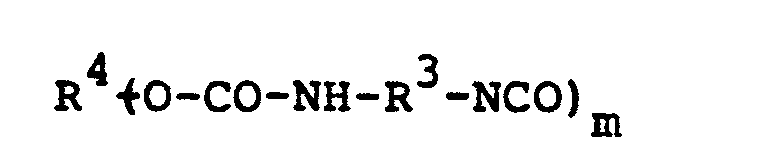
- Gegenstand der Erfindung sind gegebenenfalls im Gemisch mit bis zu 90 Gew.-%, vorzugsweise bis zu 50 Gew.-%, bezogen auf Gesamtgewicht, an Urethangruppen aufweisenden Polyisocyanaten der Formel
-

- und gegebenenfalls untergeordneten Mengen an oligomeren, Urethangruppen aufweisenden Polyisocyanaten vorliegende Diisocyanate der Formel

- R1 für einen Rest der Formel

- R 2 für Reste der Formeln -CH2-CH2-,

- R 3 für einen difunktionellen, die Isocyanatgruppen eines organischen Diisocyanats des Molekulargewichts 140 bis 336 verbindenden, gegebenenfalls Estergruppen aufweisenden Kohlenwasserstoffrest,
- R4 für einen m-wertigen, vom Rest R verschiedenen, gegebenenfalls Ethergruppen aufweisenden aliphatischen Kohlenwasserstoffrest mit 2 bis 10 Kohlenstoffatomen, m für 2 oder 3 und n für 0, 1 oder 2 stehen.
- Gegenstand der Erfindung ist auch ein Verfahren zur Herstellung dieser erfindungsgemäßen Diisocyanate, welches dadurch gekennzeichnet ist, daß man Diisocyanate der Formel


- Gegenstand der Erfindung ist auch die Verwendung der erfindungsgemäßen Diisocyanate bzw. der erfindungsgemäßen Gemische von Diisocyanaten mit Polyisocyanaten, gegebenenfalls in mit Blockierungsmitteln für Isocyanatgruppen blockierter Form, gegebenenfalls in Abmischung mit weiteren, gegebenenfalls blockierten Polyisocyanaten, als Bindemittel oder Bindemittelkomponente in Ein- oder Zweikomponenten-Polyurethanlacken.
- Beim erfindungsgemäßen Verfahren werden folgende Ausgangsmaterialien eingesetzt:
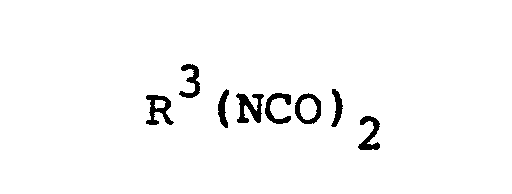
- 1. Diisocyanate der allgemeinen Formel

- Besonders bevorzugt handelt es sich bei dem Rest R3 um die Isocyanatgruppen von 1,6-Diisocyanatohexan, Isophorondiisocyanat oder 2,4- bzw. 2,6-Diisocyanatotoluol verbindenden Kohlenwasserstoffreste. Beliebige Gemische entsprechender Diisocyanate können ebenfalls als Ausgangsmaterialien eingesetzt werden.
- Beispiele für geeignete Ausgangsdiisocyanate sind 1,4-Diisocyanatobutan, 1,5-Diisocyanatopentan, 1,6-Diisocyanatohexan, 1,8-Diisocyanatooctan, 1,10-Diisocyanatodecan, 1,12-Diisocyanatododecan, Isomerengemische aus 2,2,4-Trimethyl-1,6-diisocyanatohexan und 2,4,4-Trimethyl-1,6-diisocyanatohexan, 2-Methyl-1,5-diisocyanato-pentan, 2,2-Dimethyldiisocyanato-pentan, ω-Isocyanato-capronsäure-(2-isocyanatoethyl)-ester, cf, ω-Diisocyanatocapronsäureethylester, 1,4- und 1,3-Diisocyanatocyclohexan, 1-Isocyanato-3,3,5-trimethylisocyanato- methylcyclohexan, 1,4- und 1,3-Diisocyanatomethylcyclohexan, 2,4- und 4,4'-Diisocyanatodicyclohexylmethan, 4,4'-Diisocyanatodicyclohexylpropan-(2,2), 1,3- und 1,4-Diisocyanatobenzol, 2,4-Diisocyanatotoluol, 2,6-Diisocyanatotoluol, 2,4- und 4,4'-Diisocyanatodiphenylmethan, 4,4'-Diisocyanatodiphenylpropan-(2,2), 1,3- und 1,4-Xylylen-diisocyanat oder d, d, d', d'-Tetramethyl-m-oder p-xylylen-diisocyanat, Naphthylen-1,5-diisocyanat, sowie aus diesen Verbindungen bestehende Gemische. Besonders bevorzugt werden 2,4-Diisocyanatotoluol, dessen technischen Gemische mit 2,6-Diisocyanatotoluol, 1,6-Diisocyanatohexan und Isophorondiisocyanat als Ausgangsmaterialien beim erfindungsgemäßen Verfahren eingesetzt. Besonders bevorzugt sind die technischen Gemische aus 2,4- und 2,6-Diisocyanatotoluol.
- 2. Aliphatische Diole der allgemeinen Formel

- Besonders bevorzugt werden solche Diole der genannten allgemeinen Formel eingesetzt, für welche n für 0 steht.
- Typische Beispiele für derartige Alkohole sind das besonders bevorzugte 2,2,4-Trimethylpentandiol-1,3, dessen Ethergruppen aufweisenden Ethoxylierungs-und/oder Propoxylierungsprodukte, die (im statistischen Mittel) bis zu vier Ethersauerstoffatome pro Molekül aufweisen können oder dessen Estergruppen aufweisenden Additionsverbindungen mit bis zu 4 Mol ε -Caprolacton pro Mol an Estergruppen-freiem Diol.
- 3. Die unter 2. genannten zweiwertigen Alkohole können beim erfindungsgemäßen Verfahren gegebenenfalls in Abmischung mit mehrwertigen Alkoholen der Formel

- Beispiele für derartige mehrwertige Alkohole sind 1,2-Dihydroxyethan, 1,2- und 1,3-Dihydroxypropan, 1,2-, 2,3- und 1,4-Dihydroxybutan, 1,6-Dihydroxyhexan, Neopentylglykol, 1,1,1-Tris-(hydroxymethyl)-propan, (Trimethylolpropan), Glycerin oder Ethoxylierungs- und/oder Propoxylierungsprodukte der genannten einfachen mehrwertigen Alkohole, der der oben gemachten Definition von R4 entsprechenden Art. Beliebige Gemische derartiger Alkohole können selbstverständlich auch eingesetzt werden.
- Die hier genannten mehrwertigen Alkohole werden beim erfindungsgemäßen Verfahren, falls überhaupt, in solchen Mengen eingesetzt, daß als Verfahrensprodukte Gemische der oben genannten Art resultieren. Im allgemeinen werden die hier genannten mehrwertigen Alkoholen in Mengen von bis zu 300 Mol-%, vorzugsweise bis zu 100 Mol-%, bezogen auf die erfindungswesentlichen, unter 2. genannten Diole, mitverwendet.
- Zur Durchführung des erfindungsgemäßen Verfahrens werden die unter 1. beispielhaft genannten Diisocyanate mit den unter 2. beispielhaft genannten Diolen und gegebenenfalls den unter 3. genannten mehrwertigen Alkoholen unter Einhaltung eines Äquivalentverhältnisses von Isocyanatgruppen zu Hydroxylgruppen von 1,7:1 bis 15:1, vorzugsweise 3:1 bis 8:1 bei 0 bis 150, vorzugsweise 40 bis 120°C unter Urethanbildung zur Umsetzung gebracht. Hierbei wird vorzugsweise die Alkoholkomponente zu der vorgelegten Isocyanatkomponente gegeben. Die Umsetzung wird vorzugsweise in Abwesenheit von Katalysatoren, insbesondere in Anwesenheit von Trimerisierungskatalysatoren für Isocyanatgruppen durchgeführt. Insbesondere bei niedrigen NCO/OH-Äquivalentverhältnissen innerhalb der genannten Bereiche entstehen bei der Umsetzung auch geringe, die Verwendbarkeit der Verfahrensprodukte jedoch nicht beeinträchtigende Mengen an oligomeren, d.h. kettenverlängerten, Urethangruppen aufweisenden Polyisocyanaten, die dann ebenfalls im Gemisch mit den erfindungsgemäßen Diisocyanaten vorliegen. Ihr Anteil, bezogen auf das Gesamtgewicht der von überschüssigen monomeren Ausgangsdiisocyanat befreiten Verfahrensprodukte, liegt im allgemeinen unter 30, vorzugsweise unter 20 Gewichtsprozent. Im Anschluß an diese Umsetzung wird gegebenenfalls noch vorliegendes überschüssiges, monomeres Ausgangsdiisocyanat gegebenenfalls, im allgemeinen durch Dünnschichtdestillation, beispielsweise mittels eines Dünnschichtverdampfers, oder durch Extraktion, beispielsweise unter Verwendung von n-Hexan als Extraktionsmittel bis auf einen Restgehalt des Urethangruppen aufweisenden Umsetzungsprodukts an monomerem Diisocyanat von maximal 2, vorzugsweise maximal 1 Gew.-% entfernt.
- Bei den bevorzugten erfindungsgemäßen Diisocyanaten bzw. Polyisocyanatgemischen handelt es sich um solche, die nur noch einen Restgehalt an monmeremAusgangsdiisocyanat von maximal 2, vorzugsweise maximal 1 Gew.-%, bezogen auf die Gesamtmenge aller Urethan- modifizierter Di- und Polyisocyanate, aufweisen.
- Die erfindungsgemäßen, Urethangruppen aufweisenden Lackpolyisocyanate sind in Kohlenwasserstoffen wie Benzol, Toluol, Xylol oder anderen Alkylbenzolen klar löslich und verdünnbar. Sie haben zusätzlich eine löslichkeitsvermittelnde Wirkung, so daß sie im Gemisch mit an und für sich unlöslichen, d.h. nicht mit aromatischen Kohlenwasserstoffen verdünnbaren Polyisocyanaten eingesetzt werden können und dieses Gemisch dann ebenfalls im aromatischen Kohlenwasserstoffen löslich und mit diesen ohne Eintrübung verdünnbar ist. Demzufolge weisen nicht nur die reinen erfindungsgemäßen, Urethangruppen aufweisenden Diisocyanate sondern auch ihre Gemische mit Diisocyanaten der Formel

- Aufgrund ihrer ausgezeichneten Löslichkeit in aromatischen Kohlenwasserstoffen handelt es sich bei den erfindungsgemäßen Diisocyanaten um wertvolle Bindemittel bzw. Bindemittelkomponenten für Ein- und Zweikomponenten-Polyurethanlacke.
- Unter "Einkomponenten-Polyurethanlacken" sind in diesem Zusammenhang sowohl feuchtigkeitshärtende Beschichtungsmittel auf Basis von NCO-Prepolymeren als auch hitzevernetzbare Beschichtungsmittel auf Basis von Verbindungen mit gegenüber Isocyanatgruppen reaktionsfähigen Gruppen (die gegebenenfalls reversibel blockiert sein können) und Polyisocyanaten mit blockierten Isocyanatgruppen zu verstehen. Die gegebenenfalls im Gemisch mit anderen Isocyanaten vorliegenden erfindungsgemäßen Diisocyanate können bei der Herstellung der feuchtigkeitshärtenden Beschichtungsmittel als Isocyanatkomponente bei der Herstellung von NCO-Prepolymeren oder aber als Vernetzungsmittel in Abmischung mit NCO-Prepolymeren auf Basis anderer organischer Polyisocyanate verwendet werden. Bei den hitzevernetzbaren Beschichtungsmittel können die erfindungsgemäßen Diisocyanate in blockierter Form als Isocyanatkomponente bzw. als Teil der Isocyanatkomponente zum Einsatz gelangen.
- Unter "Zweikomponenten-Polyurethanlacken" sind in obigem Zusammenhang solche Beschichtungsmittel zu verstehen, deren Bindemittel sich aus einer Polyisocyanatkomponente mit freien Isocyanatgruppen und einer Polyolkomponente zusammensetzt, wobei die erfindungsgemäßen Diisocyanate die Polyisocyanatkomponente oder einen Teil der Polyisocyanatkomponente bilden können.
- Alle diese an sich bekannten Lacktypen werden vorzugsweie in Form lösungsmittelhaltiger Beschichtungsmittel hergestellt und verarbeitet.
- Bei den bevorzugten Einkomponenten-Lacken besteht die wesentliche Bindemittelkomponente im allgemeinen aus einem höhermolekularen, freie Isocyanatgruppen aufweisenden Prepolymeren auf Basis von a) einfachen Diisocyanaten der oben unter 1. beispielhaft genannten Art und b) unterschüssigen Mengen an höhermolekularen Polyhydroxylverbindungen. Bei diesen höhermolekularen Polyhydroxylverbindungen handelt es sich im allgemeinen um Polyester-oder Polyetherpolyole des Molekulargewichtsbereichs 500 bis 4000, die im allgemeinen eine mittlere Funktionalität von 2 bis 4 aufweisen. Besonders gut geeignet sind tert. Stickstoffatome aufweisende Polyetherpolyole des genannten Molekulargewichtsbereichs, die beispielsweise durch Propoxylierung geeigneter, primäre oder sekundäre Aminogruppen aufweisender Startermoleküle zugänglich sind. So kann beispielsweise ein geeignetes Polyetherpolyol durch Propoxylierung von Ethylendiamin erhalten werden.
- Neben dieser wesentlichen Bindemittelkomponente enthalten die genannten Einkomponenten-Lacke im allgemeinen noch niedermolekulare Lackpolyisocyanate, da erst durch deren gleichzeitige Mitverwendung im Einkomponenten-Bindemittel die erforderlichen mechanischen Eigenschaften der ausgehärteten Lackschicht erreicht werden. Bislang setzte man hierfür beispielsweise Urethangruppen aufweisende Polyisocyanate wie z.B. das Reaktionsprodukt von 3 Mol 2,4-Diisocyanatotoluol mit 1 Mol Trimethylolpropan ein. Durch die Verwendung der erfindungsgemäßen, Urethangruppen aufweisenden Diisocyanate bzw. deren, obengenannten Gemische mit Urethangruppen aufweisenden Polyisocyanaten der Formel

- Man erhält auf diesem Wege besonders niedrigviskose hochkonzentrierte, feuchtigkeitshärtende Einkomponentenlacke. Jedoch auch durch Umsetzung der erfindungsgemäßen Diisocyanate mit den beispielhaft genannten höhermolekularen Polyhydroxylverbindungen werden feuchtigkeitshärtende Einkomponentenlacke erhalten, die in aromatischen Kohlenwasserstoffe gelöst und aus aromatischer Lösung verarbeitet werden können.
- Die Verwendung der erfindungsgemäßen Diisocyanate bzw. ihrer obengenannten Gemische mit Polyisocyanaten der zuletzt genannten allgemeinen Formel in "Zweikomponenten-Lacken" anstelle der oder in Kombination mit den bislang hierfür eingesetzten Lackpolyisocyanaten bzw. durch Verwendung der entsprechenden blockierten Polyisocyanate in hitzeverletzbaren Einkomponenten-Lacken ist es möglich, auch diese Lacktypen aus aromatischen Lösungsmitteln zu verarbeiten, bzw. mit aromatischen Lösungsmitteln verdünnbar einzustellen. In diesem Zusammenhang muß hervorgehoben werden, daß es, wie bereits oben ausgeführt, oftmals ausreicht, lediglich einen Teil der Polyisocyanatkomponente in den bekannten Zweikomponenten-Lacken durch die erfindungsgemäßen Diisocyanate bzw. Polyisocyanatgemische zu ersetzen, um den genannten Effekt zu erreichen, da die erfindungsgemäßen Diisocyanate oftmals auch eine löslichkeitsvermittelnde Wirkung auf die an sich nicht in aromatischen Lösungsmitteln klar löslichen Lackpolyisocyanate haben.
- Bei der erfindungsgemäßen Verwendung der erfindungsgemäßen Diisocyanate bzw. Polyisocyanatgemische kommen, vom genannten (teilweisen) Ersatz der bislang eingesetzten Lackpolyisocyanate durch die erfindungsgemäßen Produkte abgesehen, die an sich bekannten Ausgangsmaterialien und Hilfsmittel zum Einsatz, so daß diesbezüglich auf den einschlägigen Stand der Technik verwiesen werden kann (vgl. z.B. H. Kittel-Lehrbuch der Lacke und Beschichtungen; Band III; Verlag W.A. Colomb 1976). Es sei an dieser Stelle lediglich hervorgehoben, daß die erfindungsgemäßen Diisocyanate bzw. Polyisocyanatgemische insbesondere in Zweikomponenten-Lacken nicht nur mit den oben beispielhaft genannten Polyester- und Polyetherpolyolen sondern auch mit den aus der Polyurethanlackchemie bekannten Polyhydroxypolyacrylaten kombiniert werden können. Auch niedermolekulare, mehrwertige Alkohole eines unter 500 liegenden Molekulargewichts können Teil der Polyolkomponente in solchen Zweikomponenten-Lacken sein.
- Sowohl in den genannten Zweikomponenten-Lacken als auch in den hitzevernetzbaren Einkomponenten-Lacken liegen im übrigen die Polyisocyanatkomponente und die Polyolkomponente vorzugsweise in solchen Mengen vor, daß auf jede, gegebenenfalls blockierte Isocyanatgruppe 0,8 bis 3, vorzugsweise 0,9 bis 1,1 Hydroxylgruppen entfallen. Grundsätzlich ist auch möglich, die erfindungsgemäßen Diisocyanate bzw. Polyisocyanatgemische in solchen Lacksystemen einzusetzen, die als gegenüber Isocyanatgruppen reaktionsfähige Verbindungen, gegebenenfalls neben Hydroxylgruppen aufweisenden Verbindungen der beispielhaft genannten Art aminische Kettenverlängerungsmittel aufweisen. Bei diesen aminischen Kettenverlängerungsmittel handelt es sich im allgemeinen um blockierte Polyamine, beispielsweise um Polyketemine oder Oxazolidine, die unter dem Einfluß von Luftfeuchtigkeit freie Aminogruppen bilden. Auch im Falle der Mitverwendung derartiger Verbindungen mit gegenüber Isocyanatgruppen reaktionsfähigen Gruppen gelten die oben gemachten Ausführungen bezüglich der Äquivalentverhältnisse, wobei die (blockierten) Aminogruppen die Hydroxylgruppen ganz oder teilweise ersetzen können.
- Die die erfindungsgemäßen Diisocyanate bzw. Polyisocyanatgemische als Bindemittelkomponente enthaltenden Lacke eignen sich insbesondere gut für die Lackierung von Holz, sie sind jedoch auch gut zur Lackierung von metallischen Substraten geeignet. Die Lackfilme sind wärmefarbstabil, weisen eine ausgezeichnete Abriebfestigkeit auf und zeichnen sich darüber hinaus durch eine hohe Härte, sehr gute Elastizität und Chemikalienbeständigkeit sowie einen hohen Glanz aus.
- In den folgenden Beispielen beziehen sich alle Prozentangaben auf Gewichtsprozente und alle Angaben in "Teilen" auf Gewichtsteile.
- 4002 g Diisocyanatotoluol (Gemisch des 2,4- und 2,6-Isomeren im Verhältnis 4:1) werden auf 60°C erhitzt. In dieses Diisocyanat trägt man ein Gemisch von 134 g Trimethylolpropan und 341,8 g 2,2,4-Trimethylpentandiol-1,3 ein und erhöht die Temperatur innerhalb von 2-3 Stunden auf 100°C. Danach verändert sich der NCO-Gehalt nicht mehr. Das Rohprodukt wird über eine Dünnschichtdestillationsapparatur bei 150°C/0,1 mm vom überschüssigen monomeren Diisocyanat befreit. Man erhält 1750 g Rückstand als ein viskoses Harz, das mit wasserfreiem Xylol zu einer 75 %igen Lösung in Xylol ausgelöst wird. Die klare Lösung hat einen NCO-Gehalt von 13,4 %, eine Farbzahl APHA von 30 (DIN 53 409) und einen Restgehalt an freiem Diisocyanat von 0,1 %.
- Die Viskosität der Lösung beträgt 2300 mPas/23°C, sie ist mit Xylol, Toluol oder Alkylbenzol-Gemischen beliebig verdünnbar.
- Eine gelchromatographische Analyse zeigt, daß der Feststoff dieser Lösung zu ca. 55,5 % aus dem erfindungsgemäßen Addukt aus 1 Mol 2,2,4-Trimethylpentandiol-1,3 und 2 Mol Toluylendiisocyanat, zu ca. 29,3 % aus dem Addukt aus 1 Mol Trimethylolpropan und 3 Mol Toluylendiisocyanat und zu ca. 15,2 % aus höhermolekularen Anteilen besteht.
- Dieses Beispiel zeigt die Herstellung eines in Xylol löslichen Zweikomponenten-Lacks, der allen, an einen hochwertigen Möbellack gestellten Anforderungen genügt.
- Als Polyolkomponente wird ein Alkydharz eingesetzt, das man durch übliche Schmelzkondensation aus 298 Teilen Erdnußölfettsäure, 350 Teilen Phthalsäureanhydrid, 7 Teilen Maleinsäureanhydrid, 88 Teilen Triethylenglykol und 320 Teilen Trimethylolpropan herstellt. Es wird 70 %ig in Xylol gelöst. Die Lösung hat eine Hydroxylzahl von 93 und eine Säurezahl von 15.
- 100 Teile der Polyollösung werden mit 57 Teilen der Polyisocyanatlösung aus Beispiel 1 vermischt und mit 53 Teilen Xylol auf Verarbeitungsviskosität verdünnt. Die Verarbeitungszeit des so hergestellten Klarlacks beträgt 56 Stunden.
- Eigenschaften des Lackfilms:
- Die Ausprüfung erfolgte an Filmen auf Metall, die mit einer 210 µm Lackhantel aufgetragen wurden.Der beschriebene Klarlack eignet sich insbesondere zur Lackierung von Holzgegenständen (Möbeln).

- Die Beispiele 3 bis 17 sind in der nachstehenden Tabelle zusammengefaßt. Die Beispiele 3 bis 13 stellen erfindungsgemäße Beispiele, die Beispiele 14 bis 17 Vergleichsbeispiele dar.
- Die Herstellung der in der Tabelle aufgelisteten Umsetzungsprodukte erfolgt in völliger Analogie zur Verfahrensweise gemäß Beispiel 1: Umsetzung der Polyole mit überschüssigem Diisocyanat, Entfernung des überschüssigen, für die Umsetzung nicht benötigten Diisocyanats durch Dünnschichtdestillation und anschließendes Lösen des als Destillationsrückstand anfallenden Verfahrensprodukts.
- Als Diisocyanate werden eingesetzt:
- HDI: 1,6-Diisocyanatohexan;
- IPDI: Isophorondiisocyanat;
- TDI: 2,4- und 2,6-Diisocyanatotoluol im Gewichtsverhältnis 4:1.
- Wie aus den tabellarisch mitgeteilten Daten ersichtlich, sind die Produkte gemäß Beispielen 14 bis 17 in Xylol bzw. Toluol nicht löslich; auch ihre Lösungen in polaren Lösungsmitteln können nur in sehr geringem Umfang mit diesen Kohlenwasserstoffen verdünnt werden. Die erfindungsgemäßen Produkte sind demgegenüber in Kohlenwasserstoffen der genannten Art löslich und mit diesen verdünnbar. Dabei können Feststoffkonzentrationen erreicht werden, die allen, auch extremen diesbezüglichen Anforderungen genügen. (Die mitgeteilte Verdünnbarkeit bezieht auf den erreichbaren Feststoffgehalt).

- Dieses Beispiel beschreibt die Herstellung und die Eigenschaften eines feuchtigkeitshärtenden Einkomponentenlacks, der hochkonzentriert in Xylol als einzigem Lösungsmittel hergestellt und transportiert und am Verarbeitungsort mit Xylol oder anderen Kohlenwasserstoffen auf Verarbeitungskonzentration verdünnt werden kann.
- Das zur Herstellung des Einkomponenten-Lackes benötigte, höhermolekulare, freie Isocyanatgruppen aufweisende Prepolymere wird wie folgt hergestellt:
- 7400 g eines Polyetherpolyols der Hydroxylzahl 61, hergestellt durch Propoxylierung von Ethylendiamin, werden mit 1330 g 2,4-Diisocyanatotoluol vermischt und bei 60 bis 80°C während 3 Stunden zur Reaktion gebracht. Das resultierende, Isocyanatgruppen aufweisende Polyether-Prepolymer wird 75 %ig in Xylol gelöst.
- 944 g der Prepolymerlösung werden dann mit 1465 g der erfindungsgemäßen Polyisocyanatlösung gemäß Beispiel 7 vermischt und die Mischung mit 130 g Xylol versetzt. Man erhält eine klare, nur sehr schwach gelblich gefärbte ca. 70 %ige Xylol-Lösung eines feuchtigkeitshärtenden Einkomponentenlacks.
- NCO-Gehalt: 7,8 % Viskosität bei 23°C: 500 mPas Xylol-Verdünnbarkeit: < 10 % Verdünnbarkeit mit technischem Alkylbenzolgemisch: <10 % Farbzahl (DIN 1662): 1
- Der Lack wird mit Xylol auf eine Verarbeitungskonzentration von 45 % eingestellt, mit 0,5 % Dibutylzinndilaurat als Katalysator versetzt und mit einer Lackhantel (Spaltbreite 0,12 mm) auf Glasplatten aufgetragen.
- Eigenschaften: Sandtrocknung (DIN 53 150): 2 h Pendelhärte n. König (DIN 53 157): nach 24 h: 150 Anlösbarkeit nach 24 h: (Einwirkung 1 min) Xylol Ethylglykol- Ethylacetat Aceton Superbenzin acetat 0 0 0 1 0 O = Film völlig unverändert 4 = Film wird aufgelöst Abrieb nach DIN 53 109 (CS 10/1000 U/10 N) : 20 mg
- Diese Eigenschaften zeigen, daß mit Hilfe der erfindungsgemäßen Produkte ein hochwertiger Einkomponenten-PUR-Lack hergestellt werden kann, der in aromatischem Kohlenwasserstoff als einzigem Lösemittel verarbeitet werden kann. Besonders günstig ist, daß durch die Möglichkeit nur dieses Lösemittel zu verwenden, auch blasenfreie Dickschichtlacke mit etwa 1 mm Dicke hergestellt werden können.
Claims (5)




Priority Applications (1)
| Application Number | Priority Date | Filing Date | Title |
|---|---|---|---|
| AT86100292T ATE66206T1 (de) | 1985-01-24 | 1986-01-11 | Urethangruppen aufweisende diisocyanate, ein verfahren zu ihrer herstellung und ihre verwendung als bindemittel bzw. bindemittelkomponente in polyurethanlacken. |
Applications Claiming Priority (2)
| Application Number | Priority Date | Filing Date | Title |
|---|---|---|---|
| DE19853502265 DE3502265A1 (de) | 1985-01-24 | 1985-01-24 | Urethangruppen aufweisende diisocyanate, ein verfahren zu ihrer herstellung und ihre verwendung als bindemittel bzw. bindemittelkomponente in polyurethanlacken |
| DE3502265 | 1985-01-24 |
Publications (3)
| Publication Number | Publication Date |
|---|---|
| EP0189072A2 true EP0189072A2 (de) | 1986-07-30 |
| EP0189072A3 EP0189072A3 (en) | 1988-08-03 |
| EP0189072B1 EP0189072B1 (de) | 1991-08-14 |
Family
ID=6260619
Family Applications (1)
| Application Number | Title | Priority Date | Filing Date |
|---|---|---|---|
| EP86100292A Expired - Lifetime EP0189072B1 (de) | 1985-01-24 | 1986-01-11 | Urethangruppen aufweisende Diisocyanate, ein Verfahren zu ihrer Herstellung und ihre Verwendung als Bindemittel bzw. Bindemittelkomponente in Polyurethanlacken |
Country Status (9)
| Country | Link |
|---|---|
| US (1) | US4727128A (de) |
| EP (1) | EP0189072B1 (de) |
| JP (1) | JPH0723352B2 (de) |
| AT (1) | ATE66206T1 (de) |
| AU (1) | AU584160B2 (de) |
| BR (1) | BR8600266A (de) |
| CA (1) | CA1271776A (de) |
| DE (2) | DE3502265A1 (de) |
| ES (1) | ES8702345A1 (de) |
Cited By (2)
| Publication number | Priority date | Publication date | Assignee | Title |
|---|---|---|---|---|
| EP0219131A3 (de) * | 1985-10-18 | 1987-06-24 | Dainippon Ink And Chemicals, Inc. | Verfahren zur Oberflächenbeschichtung |
| EP0252425B1 (de) * | 1986-07-08 | 1992-10-07 | Air Products And Chemicals, Inc. | Mit Urethan substituierte Toluendiisocyanate mit niedrigem Schmelzpunkt |
Families Citing this family (4)
| Publication number | Priority date | Publication date | Assignee | Title |
|---|---|---|---|---|
| DE3613064A1 (de) * | 1986-04-18 | 1987-10-29 | Bayer Ag | Verfahren zur herstellung von freie isocyanatgruppen aufweisenden oligourethanen, die nach diesem verfahren erhaeltlichen oligurethane und ihre verwendung als bindemittel oder bindemittelkomponente in feuchtigkeitshaertenden einkomponentenlacken |
| JPH02191686A (ja) * | 1988-10-11 | 1990-07-27 | Sanyo Chem Ind Ltd | 耐チッピング塗料用組成物 |
| JPH02124990A (ja) * | 1988-11-02 | 1990-05-14 | Kitagawa Kogyo Kk | 炭素繊維配合シール材組成物 |
| KR20100086480A (ko) * | 2007-11-19 | 2010-07-30 | 사이텍 설패이스 스페셜티즈, 에스.에이. | 방사선 경화성 조성물 |
Family Cites Families (8)
| Publication number | Priority date | Publication date | Assignee | Title |
|---|---|---|---|---|
| US3285951A (en) * | 1962-10-16 | 1966-11-15 | Mobay Chemical Corp | Adducts of 2, 3-butanediol and tolylene diisocyanate |
| US3634306A (en) * | 1967-09-01 | 1972-01-11 | Textron Inc | Moisture-curing polyurethanes soluble in mineral spirits |
| US3697485A (en) * | 1969-07-10 | 1972-10-10 | Minnesota Mining & Mfg | Process for preparing polyisocyanurates and polyurethanes using organic orthoborate catalysts |
| DE2547866A1 (de) * | 1975-10-25 | 1977-05-05 | Basf Ag | Waermebestaendige polyurethanelastomere |
| US4169175A (en) * | 1976-06-14 | 1979-09-25 | W. R. Grace & Co. | Removal of unreacted tolylene diisocyanate from urethane prepolymers |
| FR2513642B1 (fr) * | 1981-09-25 | 1985-08-09 | Ugine Kuhlmann | Toluene diisocyanate brut modifie permettant d'obtenir des mousses de polyurethannes a haute resilience ameliorees |
| EP0155559A1 (de) * | 1984-02-29 | 1985-09-25 | Dainippon Ink And Chemicals, Inc. | Verfahren zur Herstellung von isocyanuratringe enthaltendem Polyisocyanat und Harzzusammensetzung für Urethanüberzüge, die dieses Polyisocyanat und ein Acrylpolyol enthalten |
| EP0182996A1 (de) * | 1984-10-26 | 1986-06-04 | American Cyanamid Company | Polyfunktionelle tertiäre Aralkylisocyanat-Verbindungen und Zusammensetzungen |
-
1985
- 1985-01-24 DE DE19853502265 patent/DE3502265A1/de not_active Withdrawn
-
1986
- 1986-01-11 DE DE8686100292T patent/DE3680795D1/de not_active Expired - Lifetime
- 1986-01-11 AT AT86100292T patent/ATE66206T1/de not_active IP Right Cessation
- 1986-01-11 EP EP86100292A patent/EP0189072B1/de not_active Expired - Lifetime
- 1986-01-17 AU AU52513/86A patent/AU584160B2/en not_active Ceased
- 1986-01-21 US US06/820,057 patent/US4727128A/en not_active Expired - Lifetime
- 1986-01-22 CA CA000500141A patent/CA1271776A/en not_active Expired
- 1986-01-23 ES ES551153A patent/ES8702345A1/es not_active Expired
- 1986-01-23 BR BR8600266A patent/BR8600266A/pt not_active IP Right Cessation
- 1986-01-23 JP JP61011236A patent/JPH0723352B2/ja not_active Expired - Lifetime
Cited By (2)
| Publication number | Priority date | Publication date | Assignee | Title |
|---|---|---|---|---|
| EP0219131A3 (de) * | 1985-10-18 | 1987-06-24 | Dainippon Ink And Chemicals, Inc. | Verfahren zur Oberflächenbeschichtung |
| EP0252425B1 (de) * | 1986-07-08 | 1992-10-07 | Air Products And Chemicals, Inc. | Mit Urethan substituierte Toluendiisocyanate mit niedrigem Schmelzpunkt |
Also Published As
| Publication number | Publication date |
|---|---|
| EP0189072B1 (de) | 1991-08-14 |
| JPH0723352B2 (ja) | 1995-03-15 |
| DE3502265A1 (de) | 1986-07-24 |
| US4727128A (en) | 1988-02-23 |
| DE3680795D1 (de) | 1991-09-19 |
| ES8702345A1 (es) | 1987-01-01 |
| JPS61172857A (ja) | 1986-08-04 |
| AU5251386A (en) | 1986-07-31 |
| BR8600266A (pt) | 1986-10-07 |
| AU584160B2 (en) | 1989-05-18 |
| EP0189072A3 (en) | 1988-08-03 |
| CA1271776A (en) | 1990-07-17 |
| ATE66206T1 (de) | 1991-08-15 |
| ES551153A0 (es) | 1987-01-01 |
Similar Documents
| Publication | Publication Date | Title |
|---|---|---|
| EP0548669B1 (de) | Isocyanatocarbonsäuren, ein Verfahren zu ihrer Herstellung und ihrer Verwendung | |
| EP0316738B1 (de) | Verfahren zur Herstellung von Urethangruppen aufweisenden Polyisocyanaten | |
| EP0252346B1 (de) | Verfahren zur Herstellung von Isocyanatgruppen aufweisenden Prepolymeren, die nach diesem Verfahen erhältlichen Prepolymeren und ihre Verwendung als Bindemittel in Einkomponentenlacken | |
| DE2256261C2 (de) | Hitzehärtbare Polyurethan-Lacke | |
| EP0752433B1 (de) | Einkomponenten- und Zweikomponenten-Polyurethanbeschichtungsmassen | |
| EP0336205A2 (de) | Verfahren zur Herstellung von Isocyanuratpolyisocyanaten, die nach diesem Verfahren erhaltenen Verbindungen und ihre Verwendung | |
| EP0720996A2 (de) | Polyesterpolyole und ihre Verwendung in Zweikomponenten-Polyurethanlacken | |
| EP0510438A2 (de) | Polyisocyanatgemische und ihre Verwendung | |
| DE4428107A1 (de) | Lackpolyisocyanate mit aliphatisch und aromatisch gebundenen Isocyanatgruppen | |
| EP0952170A1 (de) | Wässriges Beschichtungssystem aus UV-härtenden Isocyanatgruppen aufweisenden Urethan(meth) acrylatisocyanaten | |
| EP0467153B1 (de) | Bindemittelkombination, ihre Verwendung in Einbrennlacken und ein Verfahren zur Herstellung von Überzügen | |
| DE1283422B (de) | Verfahren zur Herstellung von UEberzuegen auf Polyurethanbasis | |
| EP0868463B1 (de) | Verbindungen mit isocyanatgruppen und verkappten gegenüber isocyanaten reaktiven gruppen | |
| EP0076956A1 (de) | Neue Gemische von tertiären Stickstoff aufweisenden NCO-Prepolymeren mit Hilfs- und Zusatzmitteln, sowie ihre Verwendung als Klebe- bzw. Beschichtungsmittel | |
| DE2436872B2 (de) | 1 -(Bis-äthoxycarbonyO-acetylamino-S-bis-äthoxycarbonyO-acetyl-aminomethyl-333-trimethyl-cyclohexan | |
| EP0406604B1 (de) | Verfahren zur Herstellung eines Beschichtungsmittels | |
| EP0407829B1 (de) | Hitzehärtbare Gemische und ihre Verwendung zur Herstellung von Beschichtungen von hitzeresistenten Substraten | |
| EP0189072B1 (de) | Urethangruppen aufweisende Diisocyanate, ein Verfahren zu ihrer Herstellung und ihre Verwendung als Bindemittel bzw. Bindemittelkomponente in Polyurethanlacken | |
| EP0611752B1 (de) | Urethangruppen enthaltende, olefinisch ungesättigte Isocyanate und ihre Verwendung als Bindemittel in Beschichtungsmaterialien | |
| EP0659795A2 (de) | Polyesterpolyole und ihre Verwendung in Zweikomponenten-Polyurethanlacken | |
| DE4021659A1 (de) | Bisoxazolane, im wesentlichen aus diesen bestehende oxazolangemische, ein verfahren zu deren herstellung und ihre verwendung als haerter fuer isocyanatgruppen aufweisende kunststoffvorlaeufer | |
| EP0623591B1 (de) | Olefinisch ungesättigte Isocyanate und ihre Verwendung als Bindemittel in Beschichtungsmaterialien | |
| EP0919581A2 (de) | 2K-PUR-Beschichtungszusammensetzung | |
| EP0242676B1 (de) | Verfahren zur Herstellung von freie Isocyanatgruppen aufweisenden Oligourethanen, die nach diesem Verfahren erhältlichen Oligourethane und ihre Verwendung als Bindemittel oder Bindemittelkomponente in feuchtigkeitshärtenden Einkomponentenlacken | |
| EP0238992B1 (de) | Polyisocyanat-Zubereitungen, ein Verfahren zu ihrer Herstellung und ihrer Verwendung zur Herstellung von Polyurethan-Kunststoffen oder als lufttrocknende Beschichtungs- oder Klebemittel |
Legal Events
| Date | Code | Title | Description |
|---|---|---|---|
| PUAI | Public reference made under article 153(3) epc to a published international application that has entered the european phase |
Free format text: ORIGINAL CODE: 0009012 |
|
| 17P | Request for examination filed |
Effective date: 19860111 |
|
| AK | Designated contracting states |
Kind code of ref document: A2 Designated state(s): AT BE CH DE FR GB IT LI NL SE |
|
| PUAL | Search report despatched |
Free format text: ORIGINAL CODE: 0009013 |
|
| AK | Designated contracting states |
Kind code of ref document: A3 Designated state(s): AT BE CH DE FR GB IT LI NL SE |
|
| 17Q | First examination report despatched |
Effective date: 19900111 |
|
| GRAA | (expected) grant |
Free format text: ORIGINAL CODE: 0009210 |
|
| AK | Designated contracting states |
Kind code of ref document: B1 Designated state(s): AT BE CH DE FR GB IT LI NL SE |
|
| REF | Corresponds to: |
Ref document number: 66206 Country of ref document: AT Date of ref document: 19910815 Kind code of ref document: T |
|
| REF | Corresponds to: |
Ref document number: 3680795 Country of ref document: DE Date of ref document: 19910919 |
|
| ITF | It: translation for a ep patent filed | ||
| ET | Fr: translation filed | ||
| GBT | Gb: translation of ep patent filed (gb section 77(6)(a)/1977) | ||
| PLBE | No opposition filed within time limit |
Free format text: ORIGINAL CODE: 0009261 |
|
| STAA | Information on the status of an ep patent application or granted ep patent |
Free format text: STATUS: NO OPPOSITION FILED WITHIN TIME LIMIT |
|
| 26N | No opposition filed | ||
| PGFP | Annual fee paid to national office [announced via postgrant information from national office to epo] |
Ref country code: SE Payment date: 19941213 Year of fee payment: 10 |
|
| EAL | Se: european patent in force in sweden |
Ref document number: 86100292.1 |
|
| PG25 | Lapsed in a contracting state [announced via postgrant information from national office to epo] |
Ref country code: SE Effective date: 19960112 |
|
| EUG | Se: european patent has lapsed |
Ref document number: 86100292.1 |
|
| PGFP | Annual fee paid to national office [announced via postgrant information from national office to epo] |
Ref country code: AT Payment date: 20010124 Year of fee payment: 16 |
|
| PGFP | Annual fee paid to national office [announced via postgrant information from national office to epo] |
Ref country code: NL Payment date: 20010131 Year of fee payment: 16 Ref country code: BE Payment date: 20010131 Year of fee payment: 16 |
|
| PGFP | Annual fee paid to national office [announced via postgrant information from national office to epo] |
Ref country code: CH Payment date: 20010208 Year of fee payment: 16 |
|
| REG | Reference to a national code |
Ref country code: GB Ref legal event code: IF02 |
|
| PG25 | Lapsed in a contracting state [announced via postgrant information from national office to epo] |
Ref country code: AT Free format text: LAPSE BECAUSE OF NON-PAYMENT OF DUE FEES Effective date: 20020111 |
|
| PG25 | Lapsed in a contracting state [announced via postgrant information from national office to epo] |
Ref country code: LI Free format text: LAPSE BECAUSE OF NON-PAYMENT OF DUE FEES Effective date: 20020131 Ref country code: CH Free format text: LAPSE BECAUSE OF NON-PAYMENT OF DUE FEES Effective date: 20020131 Ref country code: BE Free format text: LAPSE BECAUSE OF NON-PAYMENT OF DUE FEES Effective date: 20020131 |
|
| BERE | Be: lapsed |
Owner name: BAYER A.G. Effective date: 20020131 |
|
| PG25 | Lapsed in a contracting state [announced via postgrant information from national office to epo] |
Ref country code: NL Free format text: LAPSE BECAUSE OF NON-PAYMENT OF DUE FEES Effective date: 20020801 |
|
| REG | Reference to a national code |
Ref country code: CH Ref legal event code: PL |
|
| NLV4 | Nl: lapsed or anulled due to non-payment of the annual fee |
Effective date: 20020801 |
|
| PGFP | Annual fee paid to national office [announced via postgrant information from national office to epo] |
Ref country code: DE Payment date: 20041211 Year of fee payment: 20 |
|
| PGFP | Annual fee paid to national office [announced via postgrant information from national office to epo] |
Ref country code: IT Payment date: 20041228 Year of fee payment: 20 |
|
| PGFP | Annual fee paid to national office [announced via postgrant information from national office to epo] |
Ref country code: GB Payment date: 20050105 Year of fee payment: 20 |
|
| PGFP | Annual fee paid to national office [announced via postgrant information from national office to epo] |
Ref country code: FR Payment date: 20050113 Year of fee payment: 20 |
|
| PG25 | Lapsed in a contracting state [announced via postgrant information from national office to epo] |
Ref country code: GB Free format text: LAPSE BECAUSE OF EXPIRATION OF PROTECTION Effective date: 20060110 |
|
| REG | Reference to a national code |
Ref country code: GB Ref legal event code: PE20 |