EP0175605B1 - Procédé d'hydrotraitement de charges d'hydrocarbures et catalyseur pour la mise ein oeuvre de ce procédé - Google Patents
Procédé d'hydrotraitement de charges d'hydrocarbures et catalyseur pour la mise ein oeuvre de ce procédé Download PDFInfo
- Publication number
- EP0175605B1 EP0175605B1 EP85401641A EP85401641A EP0175605B1 EP 0175605 B1 EP0175605 B1 EP 0175605B1 EP 85401641 A EP85401641 A EP 85401641A EP 85401641 A EP85401641 A EP 85401641A EP 0175605 B1 EP0175605 B1 EP 0175605B1
- Authority
- EP
- European Patent Office
- Prior art keywords
- catalyst
- weight
- radius
- pores
- pore
- Prior art date
- Legal status (The legal status is an assumption and is not a legal conclusion. Google has not performed a legal analysis and makes no representation as to the accuracy of the status listed.)
- Expired
Links
- 239000003054 catalyst Substances 0.000 title claims description 74
- 238000000034 method Methods 0.000 title claims description 32
- 229930195733 hydrocarbon Natural products 0.000 title claims description 14
- 150000002430 hydrocarbons Chemical class 0.000 title claims description 14
- 239000004215 Carbon black (E152) Substances 0.000 title claims description 13
- 239000011148 porous material Substances 0.000 claims description 44
- PNEYBMLMFCGWSK-UHFFFAOYSA-N aluminium oxide Inorganic materials [O-2].[O-2].[O-2].[Al+3].[Al+3] PNEYBMLMFCGWSK-UHFFFAOYSA-N 0.000 claims description 25
- PXHVJJICTQNCMI-UHFFFAOYSA-N Nickel Chemical compound [Ni] PXHVJJICTQNCMI-UHFFFAOYSA-N 0.000 claims description 18
- 238000009826 distribution Methods 0.000 claims description 18
- ZOKXTWBITQBERF-UHFFFAOYSA-N Molybdenum Chemical compound [Mo] ZOKXTWBITQBERF-UHFFFAOYSA-N 0.000 claims description 15
- 229910052750 molybdenum Inorganic materials 0.000 claims description 13
- 239000011733 molybdenum Substances 0.000 claims description 13
- 229910052720 vanadium Inorganic materials 0.000 claims description 11
- 229910052759 nickel Inorganic materials 0.000 claims description 9
- LEONUFNNVUYDNQ-UHFFFAOYSA-N vanadium atom Chemical compound [V] LEONUFNNVUYDNQ-UHFFFAOYSA-N 0.000 claims description 9
- 229910052500 inorganic mineral Inorganic materials 0.000 claims description 5
- 239000011707 mineral Substances 0.000 claims description 5
- 229910052751 metal Inorganic materials 0.000 description 16
- 239000002184 metal Substances 0.000 description 16
- 229920000297 Rayon Polymers 0.000 description 12
- 239000002964 rayon Substances 0.000 description 12
- 150000002739 metals Chemical class 0.000 description 10
- 238000004821 distillation Methods 0.000 description 7
- UDHXJZHVNHGCEC-UHFFFAOYSA-N Chlorophacinone Chemical compound C1=CC(Cl)=CC=C1C(C=1C=CC=CC=1)C(=O)C1C(=O)C2=CC=CC=C2C1=O UDHXJZHVNHGCEC-UHFFFAOYSA-N 0.000 description 6
- 239000010779 crude oil Substances 0.000 description 6
- WQOXQRCZOLPYPM-UHFFFAOYSA-N dimethyl disulfide Chemical group CSSC WQOXQRCZOLPYPM-UHFFFAOYSA-N 0.000 description 6
- 238000011065 in-situ storage Methods 0.000 description 6
- 239000000243 solution Substances 0.000 description 6
- RWSOTUBLDIXVET-UHFFFAOYSA-N Dihydrogen sulfide Chemical compound S RWSOTUBLDIXVET-UHFFFAOYSA-N 0.000 description 5
- 230000000694 effects Effects 0.000 description 5
- 239000001257 hydrogen Substances 0.000 description 5
- 229910052739 hydrogen Inorganic materials 0.000 description 5
- 229910000476 molybdenum oxide Inorganic materials 0.000 description 5
- PQQKPALAQIIWST-UHFFFAOYSA-N oxomolybdenum Chemical compound [Mo]=O PQQKPALAQIIWST-UHFFFAOYSA-N 0.000 description 5
- 238000002360 preparation method Methods 0.000 description 5
- 150000003464 sulfur compounds Chemical class 0.000 description 5
- 238000005987 sulfurization reaction Methods 0.000 description 5
- 238000000354 decomposition reaction Methods 0.000 description 4
- 238000005470 impregnation Methods 0.000 description 4
- UFHFLCQGNIYNRP-UHFFFAOYSA-N Hydrogen Chemical compound [H][H] UFHFLCQGNIYNRP-UHFFFAOYSA-N 0.000 description 3
- 238000006243 chemical reaction Methods 0.000 description 3
- 229910000037 hydrogen sulfide Inorganic materials 0.000 description 3
- IJGRMHOSHXDMSA-UHFFFAOYSA-N Atomic nitrogen Chemical compound N#N IJGRMHOSHXDMSA-UHFFFAOYSA-N 0.000 description 2
- LFQSCWFLJHTTHZ-UHFFFAOYSA-N Ethanol Chemical compound CCO LFQSCWFLJHTTHZ-UHFFFAOYSA-N 0.000 description 2
- VYPSYNLAJGMNEJ-UHFFFAOYSA-N Silicium dioxide Chemical compound O=[Si]=O VYPSYNLAJGMNEJ-UHFFFAOYSA-N 0.000 description 2
- NINIDFKCEFEMDL-UHFFFAOYSA-N Sulfur Chemical compound [S] NINIDFKCEFEMDL-UHFFFAOYSA-N 0.000 description 2
- QGAVSDVURUSLQK-UHFFFAOYSA-N ammonium heptamolybdate Chemical compound N.N.N.N.N.N.O.O.O.O.O.O.O.O.O.O.O.O.O.O.O.O.O.O.O.O.O.O.O.O.[Mo].[Mo].[Mo].[Mo].[Mo].[Mo].[Mo] QGAVSDVURUSLQK-UHFFFAOYSA-N 0.000 description 2
- 238000001354 calcination Methods 0.000 description 2
- 230000003197 catalytic effect Effects 0.000 description 2
- 150000001875 compounds Chemical class 0.000 description 2
- 238000006477 desulfuration reaction Methods 0.000 description 2
- 230000023556 desulfurization Effects 0.000 description 2
- 238000001035 drying Methods 0.000 description 2
- 238000002347 injection Methods 0.000 description 2
- 239000007924 injection Substances 0.000 description 2
- 239000003921 oil Substances 0.000 description 2
- 230000000737 periodic effect Effects 0.000 description 2
- 239000002904 solvent Substances 0.000 description 2
- 229910052717 sulfur Inorganic materials 0.000 description 2
- 239000011593 sulfur Substances 0.000 description 2
- 150000003568 thioethers Chemical class 0.000 description 2
- 238000011282 treatment Methods 0.000 description 2
- -1 vanadium Chemical class 0.000 description 2
- 238000004876 x-ray fluorescence Methods 0.000 description 2
- QGZKDVFQNNGYKY-UHFFFAOYSA-O Ammonium Chemical compound [NH4+] QGZKDVFQNNGYKY-UHFFFAOYSA-O 0.000 description 1
- 238000004438 BET method Methods 0.000 description 1
- XZMCDFZZKTWFGF-UHFFFAOYSA-N Cyanamide Chemical compound NC#N XZMCDFZZKTWFGF-UHFFFAOYSA-N 0.000 description 1
- XHCLAFWTIXFWPH-UHFFFAOYSA-N [O-2].[O-2].[O-2].[O-2].[O-2].[V+5].[V+5] Chemical compound [O-2].[O-2].[O-2].[O-2].[O-2].[V+5].[V+5] XHCLAFWTIXFWPH-UHFFFAOYSA-N 0.000 description 1
- 230000004913 activation Effects 0.000 description 1
- 239000012072 active phase Substances 0.000 description 1
- HIGRAKVNKLCVCA-UHFFFAOYSA-N alumine Chemical compound C1=CC=[Al]C=C1 HIGRAKVNKLCVCA-UHFFFAOYSA-N 0.000 description 1
- 238000004458 analytical method Methods 0.000 description 1
- 239000007864 aqueous solution Substances 0.000 description 1
- 229910001570 bauxite Inorganic materials 0.000 description 1
- 238000004523 catalytic cracking Methods 0.000 description 1
- 239000003245 coal Substances 0.000 description 1
- 239000007789 gas Substances 0.000 description 1
- 239000007788 liquid Substances 0.000 description 1
- QSHDDOUJBYECFT-UHFFFAOYSA-N mercury Chemical compound [Hg] QSHDDOUJBYECFT-UHFFFAOYSA-N 0.000 description 1
- 229910052753 mercury Inorganic materials 0.000 description 1
- 238000001465 metallisation Methods 0.000 description 1
- 229910000480 nickel oxide Inorganic materials 0.000 description 1
- KBJMLQFLOWQJNF-UHFFFAOYSA-N nickel(ii) nitrate Chemical compound [Ni+2].[O-][N+]([O-])=O.[O-][N+]([O-])=O KBJMLQFLOWQJNF-UHFFFAOYSA-N 0.000 description 1
- 229910052757 nitrogen Inorganic materials 0.000 description 1
- 150000002902 organometallic compounds Chemical class 0.000 description 1
- GNRSAWUEBMWBQH-UHFFFAOYSA-N oxonickel Chemical compound [Ni]=O GNRSAWUEBMWBQH-UHFFFAOYSA-N 0.000 description 1
- 239000002574 poison Substances 0.000 description 1
- 231100000614 poison Toxicity 0.000 description 1
- 231100000572 poisoning Toxicity 0.000 description 1
- 230000000607 poisoning effect Effects 0.000 description 1
- 239000002243 precursor Substances 0.000 description 1
- 150000003839 salts Chemical class 0.000 description 1
- 239000000377 silicon dioxide Substances 0.000 description 1
- 230000001131 transforming effect Effects 0.000 description 1
- 229910001935 vanadium oxide Inorganic materials 0.000 description 1
Images
Classifications
-
- B—PERFORMING OPERATIONS; TRANSPORTING
- B01—PHYSICAL OR CHEMICAL PROCESSES OR APPARATUS IN GENERAL
- B01J—CHEMICAL OR PHYSICAL PROCESSES, e.g. CATALYSIS OR COLLOID CHEMISTRY; THEIR RELEVANT APPARATUS
- B01J35/00—Catalysts, in general, characterised by their form or physical properties
- B01J35/60—Catalysts, in general, characterised by their form or physical properties characterised by their surface properties or porosity
-
- B—PERFORMING OPERATIONS; TRANSPORTING
- B01—PHYSICAL OR CHEMICAL PROCESSES OR APPARATUS IN GENERAL
- B01J—CHEMICAL OR PHYSICAL PROCESSES, e.g. CATALYSIS OR COLLOID CHEMISTRY; THEIR RELEVANT APPARATUS
- B01J23/00—Catalysts comprising metals or metal oxides or hydroxides, not provided for in group B01J21/00
- B01J23/16—Catalysts comprising metals or metal oxides or hydroxides, not provided for in group B01J21/00 of arsenic, antimony, bismuth, vanadium, niobium, tantalum, polonium, chromium, molybdenum, tungsten, manganese, technetium or rhenium
-
- B—PERFORMING OPERATIONS; TRANSPORTING
- B01—PHYSICAL OR CHEMICAL PROCESSES OR APPARATUS IN GENERAL
- B01J—CHEMICAL OR PHYSICAL PROCESSES, e.g. CATALYSIS OR COLLOID CHEMISTRY; THEIR RELEVANT APPARATUS
- B01J23/00—Catalysts comprising metals or metal oxides or hydroxides, not provided for in group B01J21/00
- B01J23/16—Catalysts comprising metals or metal oxides or hydroxides, not provided for in group B01J21/00 of arsenic, antimony, bismuth, vanadium, niobium, tantalum, polonium, chromium, molybdenum, tungsten, manganese, technetium or rhenium
- B01J23/24—Chromium, molybdenum or tungsten
- B01J23/28—Molybdenum
-
- B—PERFORMING OPERATIONS; TRANSPORTING
- B01—PHYSICAL OR CHEMICAL PROCESSES OR APPARATUS IN GENERAL
- B01J—CHEMICAL OR PHYSICAL PROCESSES, e.g. CATALYSIS OR COLLOID CHEMISTRY; THEIR RELEVANT APPARATUS
- B01J23/00—Catalysts comprising metals or metal oxides or hydroxides, not provided for in group B01J21/00
- B01J23/70—Catalysts comprising metals or metal oxides or hydroxides, not provided for in group B01J21/00 of the iron group metals or copper
- B01J23/76—Catalysts comprising metals or metal oxides or hydroxides, not provided for in group B01J21/00 of the iron group metals or copper combined with metals, oxides or hydroxides provided for in groups B01J23/02 - B01J23/36
-
- B—PERFORMING OPERATIONS; TRANSPORTING
- B01—PHYSICAL OR CHEMICAL PROCESSES OR APPARATUS IN GENERAL
- B01J—CHEMICAL OR PHYSICAL PROCESSES, e.g. CATALYSIS OR COLLOID CHEMISTRY; THEIR RELEVANT APPARATUS
- B01J23/00—Catalysts comprising metals or metal oxides or hydroxides, not provided for in group B01J21/00
- B01J23/70—Catalysts comprising metals or metal oxides or hydroxides, not provided for in group B01J21/00 of the iron group metals or copper
- B01J23/76—Catalysts comprising metals or metal oxides or hydroxides, not provided for in group B01J21/00 of the iron group metals or copper combined with metals, oxides or hydroxides provided for in groups B01J23/02 - B01J23/36
- B01J23/84—Catalysts comprising metals or metal oxides or hydroxides, not provided for in group B01J21/00 of the iron group metals or copper combined with metals, oxides or hydroxides provided for in groups B01J23/02 - B01J23/36 with arsenic, antimony, bismuth, vanadium, niobium, tantalum, polonium, chromium, molybdenum, tungsten, manganese, technetium or rhenium
- B01J23/85—Chromium, molybdenum or tungsten
- B01J23/88—Molybdenum
- B01J23/883—Molybdenum and nickel
-
- C—CHEMISTRY; METALLURGY
- C10—PETROLEUM, GAS OR COKE INDUSTRIES; TECHNICAL GASES CONTAINING CARBON MONOXIDE; FUELS; LUBRICANTS; PEAT
- C10G—CRACKING HYDROCARBON OILS; PRODUCTION OF LIQUID HYDROCARBON MIXTURES, e.g. BY DESTRUCTIVE HYDROGENATION, OLIGOMERISATION, POLYMERISATION; RECOVERY OF HYDROCARBON OILS FROM OIL-SHALE, OIL-SAND, OR GASES; REFINING MIXTURES MAINLY CONSISTING OF HYDROCARBONS; REFORMING OF NAPHTHA; MINERAL WAXES
- C10G45/00—Refining of hydrocarbon oils using hydrogen or hydrogen-generating compounds
- C10G45/02—Refining of hydrocarbon oils using hydrogen or hydrogen-generating compounds to eliminate hetero atoms without changing the skeleton of the hydrocarbon involved and without cracking into lower boiling hydrocarbons; Hydrofinishing
- C10G45/04—Refining of hydrocarbon oils using hydrogen or hydrogen-generating compounds to eliminate hetero atoms without changing the skeleton of the hydrocarbon involved and without cracking into lower boiling hydrocarbons; Hydrofinishing characterised by the catalyst used
-
- C—CHEMISTRY; METALLURGY
- C10—PETROLEUM, GAS OR COKE INDUSTRIES; TECHNICAL GASES CONTAINING CARBON MONOXIDE; FUELS; LUBRICANTS; PEAT
- C10G—CRACKING HYDROCARBON OILS; PRODUCTION OF LIQUID HYDROCARBON MIXTURES, e.g. BY DESTRUCTIVE HYDROGENATION, OLIGOMERISATION, POLYMERISATION; RECOVERY OF HYDROCARBON OILS FROM OIL-SHALE, OIL-SAND, OR GASES; REFINING MIXTURES MAINLY CONSISTING OF HYDROCARBONS; REFORMING OF NAPHTHA; MINERAL WAXES
- C10G65/00—Treatment of hydrocarbon oils by two or more hydrotreatment processes only
- C10G65/02—Treatment of hydrocarbon oils by two or more hydrotreatment processes only plural serial stages only
- C10G65/04—Treatment of hydrocarbon oils by two or more hydrotreatment processes only plural serial stages only including only refining steps
-
- B—PERFORMING OPERATIONS; TRANSPORTING
- B01—PHYSICAL OR CHEMICAL PROCESSES OR APPARATUS IN GENERAL
- B01J—CHEMICAL OR PHYSICAL PROCESSES, e.g. CATALYSIS OR COLLOID CHEMISTRY; THEIR RELEVANT APPARATUS
- B01J21/00—Catalysts comprising the elements, oxides, or hydroxides of magnesium, boron, aluminium, carbon, silicon, titanium, zirconium, or hafnium
- B01J21/02—Boron or aluminium; Oxides or hydroxides thereof
- B01J21/04—Alumina
-
- B—PERFORMING OPERATIONS; TRANSPORTING
- B01—PHYSICAL OR CHEMICAL PROCESSES OR APPARATUS IN GENERAL
- B01J—CHEMICAL OR PHYSICAL PROCESSES, e.g. CATALYSIS OR COLLOID CHEMISTRY; THEIR RELEVANT APPARATUS
- B01J35/00—Catalysts, in general, characterised by their form or physical properties
- B01J35/60—Catalysts, in general, characterised by their form or physical properties characterised by their surface properties or porosity
- B01J35/61—Surface area
- B01J35/615—100-500 m2/g
-
- B—PERFORMING OPERATIONS; TRANSPORTING
- B01—PHYSICAL OR CHEMICAL PROCESSES OR APPARATUS IN GENERAL
- B01J—CHEMICAL OR PHYSICAL PROCESSES, e.g. CATALYSIS OR COLLOID CHEMISTRY; THEIR RELEVANT APPARATUS
- B01J35/00—Catalysts, in general, characterised by their form or physical properties
- B01J35/60—Catalysts, in general, characterised by their form or physical properties characterised by their surface properties or porosity
- B01J35/63—Pore volume
- B01J35/635—0.5-1.0 ml/g
-
- B—PERFORMING OPERATIONS; TRANSPORTING
- B01—PHYSICAL OR CHEMICAL PROCESSES OR APPARATUS IN GENERAL
- B01J—CHEMICAL OR PHYSICAL PROCESSES, e.g. CATALYSIS OR COLLOID CHEMISTRY; THEIR RELEVANT APPARATUS
- B01J35/00—Catalysts, in general, characterised by their form or physical properties
- B01J35/60—Catalysts, in general, characterised by their form or physical properties characterised by their surface properties or porosity
- B01J35/66—Pore distribution
-
- B—PERFORMING OPERATIONS; TRANSPORTING
- B01—PHYSICAL OR CHEMICAL PROCESSES OR APPARATUS IN GENERAL
- B01J—CHEMICAL OR PHYSICAL PROCESSES, e.g. CATALYSIS OR COLLOID CHEMISTRY; THEIR RELEVANT APPARATUS
- B01J37/00—Processes, in general, for preparing catalysts; Processes, in general, for activation of catalysts
- B01J37/20—Sulfiding
Definitions
- the present invention relates to a process for hydrotreating and, more particularly, for hydrode-metallization of hydrocarbon feedstocks. It also relates to a hydrotreating catalyst which can be used for the implementation of this process.
- Heavy hydrocarbon feedstocks such as crude oils, distillation residues of said crude oils or feedstocks from coal, for example, contain organometallic compounds, in particular nickel and vanadium. These metals are poisons of the catalysts used in the processes for catalytic treatment of these feeds, such as the processes of hydrodesulfurization or catalytic cracking.
- French Patent No. 2,400,953 describes a demetallization catalyst containing from 0.5 to 3% and, preferably, from 1 to 2% by weight of molybdenum oxide deposited on a macroporous alumina. Metal is necessary to obtain optimal demetallizing activity. Indeed, in the absence of the metal on the alumina, the warm-up period is too long (the warm-up period is the time which elapses between the introduction of the charge and the obtaining of the 'optimal demetallizing activity).
- mesoporous aluminas activated using a sulfur-containing compound and having particular characteristics, are very good demetallization catalysts .
- mesoporous alumina is meant an alumina having a porosity intermediate between a microporous alumina and a macroporous alumina; in the case of this description, the pore volume consisting of pores of radius at least equal to e 1000.10- cm is less than 10%.
- the optimal demetallizing activity takes longer to obtain, which is hardly acceptable from an industrial point of view.
- the time required is three times greater for the original product KIRKOUK than for the original product BOSCAN, this being in agreement with the respective metal contents of these charges (respectively about 150 and 450 ppm).
- the Applicant has established that by incorporating into mesoporous alumina, the subject of EP-A-122 180, small amounts of at least one metal, in proportions significantly lower than those incorporated in the macroporous alumina of French patent n ° 2,400,953, it is possible, after sulfurization of the product obtained, to obtain good demetallization catalysts, having an optimal initial demetallizing activity.
- the object of the present invention is therefore to obtain effective demetallization of hydrocarbon charges, with a very short period of bringing the alumina into operation.
- the pore volume constituted by pores of radius less than or equal to 100 ⁇ 10 -8 cm is measured with nitrogen by the BET method and that constituted by pores with a radius greater than 100.10- 8 cm (and, therefore, that formed by pores with a radius greater than or equal to 100.10- $ cm) using a mercury porosimeter.
- the catalyst is in all cases sulfurized before the implementation of said process and, optionally, during this process.
- the sulfurization of the catalyst consists in transforming the metals which it contains into sulphides, according to methods well known to those skilled in the art.
- Sulfurization can be carried out by contacting the catalyst with hydrogen sulfide.
- the catalyst used can be used in combination with a conventional desulfurization catalyst, such as those comprising an alumina-based refractory support, on which compounds of the metals of Groups VI and VIII of the elements have been deposited. of the periodic table.
- a conventional desulfurization catalyst such as those comprising an alumina-based refractory support, on which compounds of the metals of Groups VI and VIII of the elements have been deposited. of the periodic table.
- the hydrotreating catalyst according to the invention is loaded into a first reactor of a train of several reactors, the other reactors of which contain a hydrodesulfurization catalyst (the role of the first reactor being to remove the metals from the feed and prevent poisoning of the hydrodesulfurization catalyst), at least a fraction of the gas from the reactor train, rich in hydrogen sulfide, can be recycled to the inlet of the first reactor, in order to activate the catalyst according to the invention, during all or part of the duration of the hydrotreatment cycle.
- a hydrodesulfurization catalyst the role of the first reactor being to remove the metals from the feed and prevent poisoning of the hydrodesulfurization catalyst
- the preferred way of implementing the process because the simplest, is that in which the sulfurization of the catalyst is carried out by contacting with hydrogen sulfide generated in situ by decomposition of sulfur compounds present in the feed.
- the Applicant has indeed discovered that the quantity of hydrogen sulphide necessary to initiate the hydrotreatment reaction is low. It subsequently established that it is possible to generate the hydrogen sulphide necessary for the activation of the catalyst in situ, from the sulfur compounds present in the feed, using the minute, but sufficient, desulphurization power of the catalyst.
- the catalyst according to the invention can be used for the hydrodemetallization of a hydrocarbon feed.
- the Applicant attributes the demetallizing properties of the catalyst to the fact that, during the warm-up period, sulphides, mainly vanadium, which are active phases, are deposited on the catalyst.
- the catalysts according to the invention contain, in addition to the support, in free or combined form, relative to the total weight of the catalyst, from 0.01 to 0.7% by weight, calculated as element, of molybdenum.
- the molybdenum content is preferably between 0.2 and 0.6% by weight.
- the catalyst can contain from 0.01 to 0.7% by weight of nickel or vanadium.
- the support is essentially composed of alumina, but it can contain, in addition to alumina, one or more other refractory mineral oxides such as silica, in an amount which can range up to approximately 30% by weight of the support.
- the catalysts according to the invention can be prepared by impregnating the support with at least one solution containing at least the chosen metal or metals.
- Said impregnation can be followed by drying at a temperature between 70 ° C and 130 ° C and calcination at a temperature between 300 and 700 ° C and, preferably, between 450 and 600 ° C.
- This example relates to the preparation of catalysts according to the invention.
- Three catalysts A, B and C according to the invention are prepared from this alumina.
- the alumina is impregnated with an aqueous solution of ammonium heptamolybdate, the solution being in concentration such that the final catalyst contains 0.3% by weight of molybdenum oxide Mo 0 3 .
- the impregnation is carried out by circulation of the ammonium hexamolybdate solution. After impregnation, the product obtained is dried for sixteen hours at 110 ° C, then calcined in air for two hours, at a temperature of 500 ° C.
- the precursor of catalyst A is thus obtained containing 0.3% by weight of molybdenum oxide Mo 0 3 , ie 0.2% by weight of molybdenum.
- Catalyst B is prepared in the same way as Catalyst A, except that the impregnation solution used contains ammonium heptamolybdate and nickel nitrate.
- the catalyst B obtained contains 0.3% by weight of molybdenum oxide Mo 0 3 , or 0.2% by weight of molybdenum, and 0.3% by weight of nickel oxide Ni O, or 0.23% by weight of nickel.
- the alumina is impregnated with a solution in ethanol of molybdenum and vanadium acetylacetonates, the solution containing these salts in concentrations such that the final catalyst contains 0.3% by weight of molybdenum oxide Mo 0 3 , ie 0.2% molybdenum, and 0.2% by weight of vanadium oxide V 2 0 5 , ie 0.1% by weight of vanadium.
- Catalysts A, B and C are sulfurized in the reactor which is used for the hydrodemetallization tests which will be described later.
- Diesel containing dimethyldisulphide (DMDS) (at the rate of a percentage of DMDS of 2% by weight) is sent to the catalyst at 250 ° C., under a hydrogen pressure of 30 bar, with an hourly space velocity of 1 and a hydrogen / hydrocarbon volume ratio of 200.
- DMDS dimethyldisulphide
- the temperature is raised to 300 ° C, the injection of DMDS is stopped and the temperature is raised to 390 ° C; the injection of diesel is stopped.
- Catalysts A, B and C are ready for hydrodemetallization tests.
- the feedstock consists of the residue from the distillation at reduced pressure of a residue from the distillation at atmospheric pressure of a crude oil of “KIRKOUK” origin.
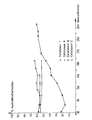
- the percentages of vanadium and nickel contained in the effluents are determined by analysis at regular time intervals. It is thus possible to plot the curves of the hydrometallization percentages (reduction in the rate of metals in the effluent relative to the feed) as a function of time.
Landscapes
- Chemical & Material Sciences (AREA)
- Engineering & Computer Science (AREA)
- Organic Chemistry (AREA)
- Chemical Kinetics & Catalysis (AREA)
- Materials Engineering (AREA)
- Oil, Petroleum & Natural Gas (AREA)
- General Chemical & Material Sciences (AREA)
- Production Of Liquid Hydrocarbon Mixture For Refining Petroleum (AREA)
- Catalysts (AREA)
Description
- La présente invention concerne un procédé d'hydrotraitement et, plus particulièrement, d'hydrodé- métallisation de charges d'hydrocarbures. Elle concerne également un catalyseur d'hydrotraitement utilisable pour la mise en oeuvre de ce procédé.
- Les charges lourdes d'hydrocarbures, telles que les pétroles bruts, les résidus de distillation desdits pétroles bruts ou les charges provenant du charbon, par example, contiennent des composés organométalliques, notamment de nickel et de vanadium. Ces metaux sont des poisons des catalyseurs utilisés dans les procédés de traitement catalytique de ces charges, tels que les procédés d'hydrodésulfuration ou de craquage catalytique.
- Préalablement à ces traitements catalytiques, il convient donc de faire subir à ces charges un hydrotraitement, en vue, notamment, de les démétalliser aussi complètement que possible.
- Pour réaliser cette démétallisation, on a proposé d'utiliser de la bauxite (voir brevet US 2.687.985), de l'alumine (voir brevets US 3.901.792 et FR 2.357.635).
- On a également proposé d'utiliser de l'alumine, sur laquelle est déposé au moins un métal des Groupes VI et VIII de la classification périodique des éléments.
- Ainsi, le brevet français n° 2.400.953 décrit un catalyseur de démétallisation contenent de 0,5 à 3% et, de préference, de 1 à 2% en poids d'oxyde de molybdène déposé sur une alumine macroporeuse. Le métal est nécessaire pour obtenir une activité démétallisante optimale. En effet, en l'absence du métal sur l'alumine, la période de mise en régime est trop longue (la période de mise en régime est le temps qui s'écoule entre l'introduction de la charge et l'obtention de l'activité démétallisante optimale).
- Au cours de ses recherches sur les catalyseurs de démétallisation de charges d'hydrocarbures, la Demanderesse a découvert que des alumines méso- poreuses, activées à l'aide d'un composé soufré et ayant des caractéristiques particulières, sont de très bons catalyseurs de démétallisation. On entend par alumine mésoporeuse une alumine ayant une porosité intermédiaire entre une alumine microporeuse et une alumine macroporeuse; dans le cas de la présente description, le volume poreux constitué par des pores de rayon au moins égal à 1000.10-e cm est inférieur à 10%.
- Ces catalyseurs et leur utilisation dans un procédé d'hydrotraitement de charges d'hydrocarbures sont décrits dans EP-A- 122 180. Dans le cas de certaines charges d'hydrocarbures, l'activité démétallisante optimale est obtenue assez rapidement avec ces alumines, activées à l'aide d'un composé soufré. C'est le cas de charges contenant une quantité suffisante de métaux contaminants (vanadium+nickel), qui autocatalysent la réaction de démétallisation. Il en est ainsi pour l'huile obtenue par désasphaltage au solvant lourd d'un résidu de la distillation sous pression atmosphérique d'un pétrole brut d'origine «BOSCAN». Pour d'autres charges contenant moins de métaux contaminants, comme le résidu de la distillation sous pression réduite d'un résidu de distillation sous pression atmosphérique d'un pétrole brut d'origine «KIRKOUK», l'activité démétallisante optimale est plus longue à obtenir, ce qui est difficilement acceptable au point de vue industriel. Pour les produits cités ci-dessus, le temps nécessaire est trois fois plus important pour le produit d'origine KIRKOUK que pour le produit d'origine BOSCAN, ceci étant en accord avec les teneurs respectives en métaux de ces charges (respectivement environ 150 et 450 ppm).
- La Demanderesse a établi qu'en incorporant dans l'alumine mésoporeuse, objet de EP-A- 122 180, de faibles quantités d'au moins un métal, dans des proportions notablement inférieures à celles incorporées dans l'alumine macroporeuse du brevet français n° 2.400.953, il est possible, après sulfuration du produit obtenu, d'obtenir de bons catalyseurs de démétallisation, ayant une activité initiale démétallisante optimale.
- Le but de la présente invention est donc d'obtenir la démétallisation efficace de charges d'hydrocarbures, avec une période de mise en régime très courte de l'alumine.
- A cet effet, l'invention a pour objet un procédé d'hydrotraitement et, notamment, d'hydrodémétal- lisation d'une charge d'hydrocarbures, consistant, dans des conditions usuelles d'hydrotraitement, à mettre ladite charge en contact avec un catalyseur comprenant un support minéral réfractaire, composé essentiellement par une alumine dont les caractéristiques sont les suivantes:
- - surface spécifique: supérieure à 150 m2/g et, de préference, à 175 m2 /g,
- - volume poreux: supérieur à 0,6 cm3/g et, de préférence, à 0,7 cm 3/g,
- - distribution du volume poreux en fonction du rayon de pore: au moins 50% de pores de rayon au plus égal à 100. 10-8 cm, et moins de 10% de pores de rayon supérieur ou égal à 1000.10-e cm,
- - mode de distribution des rayons de pores en cm (maximum de la courbe de distribution des rayons de pores): rayons compris entre 40 et 70.10-8 cm, ledit catalyseur ayant été sulfuré préalablement à la mise en oeuvre dudit procédé et étant éventuellement sulfuré pendant ledit procédé, ledit procédé étant caractérisé en ce que ledit catalyseur contient, sous forme libre ou combinée, outre le support, rapporté au poids total du catalyseur, de 0,01 à 0,7% en poids, calculé en élément, de molybdène.
- Dans cet objet de l'invention et dans la suite de la présente déscription, il est entendu que le volume poreux constitué par des pores de rayon inférieur ou égal à 100.10-8 cm est mesuré à l'azote par la méthode B.E.T. et celui constitué par des pores de rayon supérieur à 100.10-8 cm (et, par conséquent, celui constitué par des pores de rayon supérieur ou égal à 100.10-$ cm) au porosimètre à mercure.
- L'invention a également pour object un catalyseur d'hydrotraitement de charges d'hydrocarbures utilisable dans le procède d'hydrotraitement qui vient d'être défini, ledit catalyseur comprenant un support minéral réfractaire composé essentiellement par une alumine dont les caractéristiques sont les suivantes: - surface spécifique: supérieure à 150 ml/g et, de préférence, à 175 m2/g,
- - volume poreux: supérieur à 0,6 cm3/g et, de préference, à 0,7 cm3/g,
- - distribution du volume poreux en fonction du rayon de pore: au moins 50% de pores de rayon au plus égal à 100.10-8 cm, et moins de 10% de pores de rayon supérieur ou égal à 1000. 10-8 cm,
- - mode de distribution des rayons de pores en cm (maximum de la courbe de distribution des rayons de pores): rayons compris entre 40 et 70. 10-1 cm, ledit catalyseur ayant été sulfuré préalablement à la mise en oeuvre dudit procédé et étant éventuellement sulfuré pendant ledit procédé, ledit catalyseur étant caractérisé en ce qu'il contient, sous forme libre ou combinée, outre le support, rapporté au poids total du catalyseur, de 0,01 à 0,7% en poids, calculé en élément, de molybdène.
- Dans le procédé d'hydrotraitement selon l'invention, le catalyseur est dans tous les cas sulfuré préalablement à la mise en oeuvre dudit procédé et, even- tuellement, pendant ce prodcédé. La sulfuration du catalyseur consiste à transformer les métaux qu'il contient en sulfures, suivant des procédés bien connus de l'homme de l'art.
- La sulfuration peut être effectuée en mettant en contact le catalyseur avec de l'hydrogène sulfuré.
- Celui-ci peut:
- a. soit provenir d'une source extérieure,
- b. soit provenir d'une réaction de désulfuration de la charge, effectuée en combinaison avec l'hydrotraitement,
- c. soit être engendré in situ, par décomposition d'un composé soufré ajouté à la charge, par exemple par décomposition de diméthyldisulfure,
- d. soit être engendré in situ, par décomposition d'autres composés soufrés présents dans la charge.
- Dans le cas b., le catalyseur utilisé peut être employé en combinaison avec un catalyseur de désulfuration classique, tel que ceux comprenant un support réfractaire à base d'alumine, sur lequel ont été déposés des composés des métaux des Groupes VI et VIII des éléments de la classification périodique.
- Si le catalyseur d'hydrotraitement selon l'invention est chargé dans un premier réacteur d'un train de plusieurs réacteurs, dont les autres réacteurs contiennent un catalyseur d'hydrodésulfuration (le rôle du premier réacteur étant d'éliminer les métaux de la charge et d'empêcher l'empoisonnement du catalyseur d'hydrodésulfuration), au moins une fraction du gaz issu du train de réacteurs, riche en hydrogène sulfuré, peut être recyclée vers l'entrée du premier réacteur, afin d'activer le catalyseur selon l'invention, pendant toute ou partie de la durée du cycle de l'hydrotraitement.
- La façon préférée de mettre en oeuvre le procédé, parce que la plus simple, est celle où la sulfuration du catalyseur est effectuée par mise en contact avec de l'hydrogène sulfuré engendré in situ par décomposition de composés soufrés présents dans la charge. La Demanderesse a en effet découvert que la quantité d'hydrogène sulfuré nécessaire pour amorcer la réaction d'hydrotraitement est faible. Elle a par la suite établi qu'il est possible d'engendrer l'hydrogène sulfuré nécessaire à l'activation du catalyseur in situ, à partir des composés soufrés présents dans la charge, en utilisant le pouvoir infime, mais suffisant, de désulfuration du catalyseur.
- Le catalyseur selon l'invention peut être utilisé pour l'hydrodémétallisation d'une charge d'hydrocarbures.
- La Demanderesse attribue les propriétés démétalli- santes du catalyseur au fait que, dans la période de mise en régime, il se dépose sur le catalyseur des sulfures, principalement de vanadium, qui sont des phases actives.
- Les catalyseurs selon l'invention, contiennent, outre le support, sous forme libre ou combinée, rapporté au poids total du catalyseur, de 0,01 à 0,7% en poids, calculé en élément, de molybdène.
- La teneur en molybdène est de préférence comprise entre 0,2 et 0,6% en poids.
- Outre le molybdène, le catalyseur peut contenir de 0,01 à 0,7% en poids de nickel ou de vanadium.
- Le support est composé essentiellement d'alumine, mais il peut contenir, outre l'alumine, un ou plusieurs autres oxydes minéraux réfractaires comme la silice, dans une quantité qui peut aller jusqu'à environ 30% en poids du support.
- Les catalyseurs selon l'invention peuvent être préparés par une imprégnation du support par au moins une solution contenant au moins le ou les métaux choisis.
- Ladite imprégnation peut être suivie par un séchage à une température comprise entre 70° C et 130° C et une calcination à une température comprise entre 300 et 700° C et, de préférence, entre 450 et 600° C.
- Le procédé d'hydrotraitement selon l'invention peuts' appliquer notamment l'hydrodémétallisation de charges lourdes d'hydrocarbures comme, par example, des résidus dedistillation du pétrole brut, ou d'huile désasphaltée provenant du désasphaltage au solvant d'un tel résidu, et dont les caractéristiques, citées à titre non limitatif, peuvent être les suivantes:
- - masse volumique à 15° C (mésurée selon la Norme AFNOR NFT 60-101): > 800 kg/m3,
- - viscosité à 100° C (mesurée selon la Norme AFNOR NFT 60-100): > 10.10-6 m2/s (10 centistokes)
- - résidu Conradson (mesuré selon la norme AFNOR NFT 60-116): > 0,1% en poids
- - teneur en soufre (mesurée par fluorescence X): > 1 % en poids
- - teneur en vanadium + nickel (mesurée par fluorescence X): > 10 p.p.m.
- Les conditions opératoires dans lesquelles est effectuée l'hydrodémétallisation sont des conditions usuelles telles que les suivantes:
- - température comprise entre 350 et 450° C,
- - pression comprise entre 50 et 200 bar, rapport volumique hydrogène/hydrocarbures compris entre 100 et 5000 normaux litres/litre,
- - vitesse spatiale horaire de la charge (volume de liquide passant par heure sur une unité de volume de catalyseur) comprise entre 0,2 et 5.
- Les exemples qui suivent sont destinés à illustrer l'invention de façon non limitative.
- Cet exemple concerne la préparation de catalyseurs selon l'invention.
- On dispose d'une alumine préparée pour la Demanderesse par la Société AMERICAN CYANAMID.
- Les caractéristiques de cette alumine sont données dans le Tableau 1 ci-après.

- On prepare, à partir de cette alumine, trois catalyseurs A, B et C selon l'invention.
- On imprègne l'alumine par une solution aqueuse d'heptamolybdate d'ammonium, la solution étant en concentration telle que le catalyseur final contienne 0,3% en poids d'oxyde de molybdène Mo 03. L'imprégnation se fait par circulation de la solution d'hep- tamolybdate d'ammonium. Après l'imprégnation, le produit obtenu est séché pendant seize heures à 110° C, puis calciné à l'air pendant deux heures, à une température de 500° C.
- On obtient ainsi le précurseur du catalyseur A contenant 0,3% en poids d'oxyde de molybdène Mo 03, soit 0,2% en poids de molybdène.
- Le catalyseur B est préparé de la même façon que le catalyseur A, à cette différence près que la solution d'imprégnation utilisée contient de l'heptamolyb- date d'ammonium et du nitrate de nickel.
- Le catalyseur B obtenu contient 0,3% en poids d'oxyde de molybdène Mo 03, soit 0,2% en poids de molybdène, et 0,3% en poids d'oxyde de nickel Ni O, soit 0,23% en poids de nickel.
- On imprègne l'alumine par une solution dans l'éthanol d'acétylacétonates de molybdène et de vanadium, la solution contenant ces sels en concentrations telles que le catalyseur final contienne 0,3% en poids d'oxyde de molybdène Mo 03, soit 0,2% de molybdène, et 0,2% en poids d'oxyde de vanadium V2 05, soit 0,1 % en poids de vanadium.
- Les conditions de séchage et de calcination sont les mêmes que pour la préparation des catalyseurs A et B.
- Les catalyseurs A, B et C sont sulfurés dans le réacteur qui sert aux essais d'hydrodémétallisation qui seront décrits plus loin.
- On envoie sur le catalyseur du gazole contenant du diméthyldisulfure (DMDS) (à raison d'un pourcentage de DMDS de 2% en poids) à 250° C, sous une pression d'hydrogène de 30 bar, avec une vitesse spatiale horaire de 1 et un rapport volumique hydrogène/hydrocarbures de 200.
- On élève la température à 300° C, on interrompt l'injection de DMDS et on élève la température à 390° C; on arrête l'injection de gazole.
- Les catalyseurs A, B et C sont prêts pour les essais d'hydrodémétallisation.
- Cet exemple concerne des essais d'hydrodémétal- lisation à l'aide:
- - de l'alumine qui a servi à préparer les catalyseurs A, B et C et sulfurée de la même façon que les catalyseurs A, B et C (voir Exemple 1 ); on obtient ainsi le catalyseur témoin T;
- - des catalyseurs A, et B et C,
- La charge est constituée par le résidu de la distillation à pression réduite d'un résidu de distillation à pression atmosphérique d'un pétrole brut d'origine «KIRKOUK».
- Les caractéristiques de cette charge sont données dans le Tableau Il ci-après:

- Les conditions des essais sont les suivantes:
- - température: 390° C,
- - pression d'hydrogène: 140 bar,
- - rapport volumique hydrogène/charge: 700 normaux litres/litre,
- - vitesse spatiale horaire: 1 v.v.h.
- On détermine par analyse à intervalles de temps réguliers les pourcentages de vanadium et de nickel contenus dans les 35 effluents. On peut ainsi tracer les courbes des pourcentages d'hydrométallisation (réduction du taux des métaux dans l'effluent par rapport à la charge) en fonction du temps.
- Les résultats sont reportés sur la Figure annexée.
- Cette figure permet de constater que l'ajout de métaux à l'alumine réduit pratiquement à néant la période de mise en régime. Avec deux metaux, les résultats d'hydrométallisation sont meilleurs.
Claims (8)
ledit procédé étant caractérisé en ce que ledit catalyseur contient, sous forme libre ou combinée, outre le support, rapporté au poids total du catalyseur, de 0,01 à 0,7% en poids, calculé en élément, de molybdène.
ledit catalyseur étant caractérisé en ce qu'il contient, sous forme libre ou combinée, outre le support, rapporté au poids total du catalyseur, de 0,01 à 0,7% en poids, calculé en élément, de molybdène.
Applications Claiming Priority (2)
| Application Number | Priority Date | Filing Date | Title |
|---|---|---|---|
| FR8414109 | 1984-09-14 | ||
| FR8414109A FR2570385B1 (fr) | 1984-09-14 | 1984-09-14 | Procede d'hydrotraitement de charges d'hydrocarbures et catalyseur pour la mise en oeuvre de ce procede |
Publications (2)
| Publication Number | Publication Date |
|---|---|
| EP0175605A1 EP0175605A1 (fr) | 1986-03-26 |
| EP0175605B1 true EP0175605B1 (fr) | 1988-04-20 |
Family
ID=9307726
Family Applications (1)
| Application Number | Title | Priority Date | Filing Date |
|---|---|---|---|
| EP85401641A Expired EP0175605B1 (fr) | 1984-09-14 | 1985-08-13 | Procédé d'hydrotraitement de charges d'hydrocarbures et catalyseur pour la mise ein oeuvre de ce procédé |
Country Status (5)
| Country | Link |
|---|---|
| US (1) | US4677093A (fr) |
| EP (1) | EP0175605B1 (fr) |
| JP (1) | JPS6174646A (fr) |
| DE (1) | DE3562272D1 (fr) |
| FR (1) | FR2570385B1 (fr) |
Families Citing this family (5)
| Publication number | Priority date | Publication date | Assignee | Title |
|---|---|---|---|---|
| JPH03167292A (ja) * | 1989-11-27 | 1991-07-19 | Kawasaki Steel Corp | 水添脱硫触媒の再生利用方法 |
| CA2093412C (fr) * | 1992-04-20 | 2002-12-31 | Gerald Verdell Nelson | Procede d'hydroconversion mettant en oeuvre un catalyseur a porosimetrie determinee |
| US5837131A (en) * | 1996-04-05 | 1998-11-17 | University Technologies International Inc. | Desulfurization process |
| US7211238B2 (en) * | 2003-03-12 | 2007-05-01 | Abb Lummus Global Inc. | Mesoporous aluminum oxide, preparation and use thereof |
| US20130105357A1 (en) * | 2011-10-27 | 2013-05-02 | Shell Oil Company | Self-activating hydroprocessing catalyst and process for treating heavy hydrocarbon feedstocks |
Family Cites Families (12)
| Publication number | Priority date | Publication date | Assignee | Title |
|---|---|---|---|---|
| US2952644A (en) * | 1958-02-17 | 1960-09-13 | Universal Oil Prod Co | Method for forming alumina particles |
| US4024231A (en) * | 1972-08-10 | 1977-05-17 | Continental Oil Company | Producing alumina having a majority of pore diameters of 35-80A |
| GB1407610A (en) * | 1972-10-13 | 1975-09-24 | Shell Int Research | Hydrocarbon conversion process |
| US4082695A (en) * | 1975-01-20 | 1978-04-04 | Mobil Oil Corporation | Catalyst for residua demetalation and desulfurization |
| JPS5268093A (en) * | 1975-12-04 | 1977-06-06 | Chiyoda Chem Eng & Constr Co Ltd | Catalyst for removing metals in hydrocarbons |
| US4111796A (en) * | 1976-04-02 | 1978-09-05 | Gulf Research & Development Co. | Method for presulfiding hydrodesulfurization catalysts |
| NL187026C (nl) * | 1976-07-08 | 1991-05-01 | Shell Int Research | Werkwijze voor het ontmetalliseren van koolwaterstofolien. |
| NZ184201A (en) * | 1976-08-12 | 1979-10-25 | Mobil Oil Corp | Residium hydroprocessing catalyst of group vi-b and viii metal sulfides and/or oxides on alumina |
| US4119531A (en) * | 1977-06-30 | 1978-10-10 | Standard Oil Company (Indiana) | Large-pore hydrodemetallization catalyst and process employing same |
| JPS5814365B2 (ja) * | 1978-11-06 | 1983-03-18 | 日揮ユニバ−サル株式会社 | 球形アルミナの製造法 |
| NL191763C (nl) * | 1979-09-26 | 1996-07-02 | Shell Int Research | Werkwijze voor ontmetalliseren van een koolwaterstofolie. |
| FR2542754A1 (fr) * | 1983-03-15 | 1984-09-21 | Raffinage Cie Francaise | Procede d'hydrodemetallisation de charges d'hydrocarbures et catalyseur pour la mise en oeuvre de ce procede |
-
1984
- 1984-09-14 FR FR8414109A patent/FR2570385B1/fr not_active Expired
-
1985
- 1985-08-13 EP EP85401641A patent/EP0175605B1/fr not_active Expired
- 1985-08-13 DE DE8585401641T patent/DE3562272D1/de not_active Expired
- 1985-09-13 JP JP60203216A patent/JPS6174646A/ja active Pending
-
1986
- 1986-08-29 US US06/903,856 patent/US4677093A/en not_active Expired - Fee Related
Also Published As
| Publication number | Publication date |
|---|---|
| FR2570385B1 (fr) | 1987-08-21 |
| DE3562272D1 (en) | 1988-05-26 |
| JPS6174646A (ja) | 1986-04-16 |
| US4677093A (en) | 1987-06-30 |
| EP0175605A1 (fr) | 1986-03-26 |
| FR2570385A1 (fr) | 1986-03-21 |
Similar Documents
| Publication | Publication Date | Title |
|---|---|---|
| EP2161076B1 (fr) | Procédé d'hydrogénation sélective mettant en oeuvre un catalyseur sulfuré de composition spécifique | |
| EP3428248B1 (fr) | Catalyseurs partiellement cokes utilisables dans l'hydrotraitement des coupes contenant des composes soufres et des olefines | |
| US7696120B2 (en) | Method of restoring catalytic activity to a spent hydroprocessing catalyst, a spent hydroprocessing catalyst having restored catalytic activity, and a hydroprocessing process | |
| EP0785022B2 (fr) | Procédé d'incorporation de soufre dans la porosité d'un catalyseur de traitement d'hydrocarbures | |
| EP2644683B1 (fr) | Procédé d'hydrogenation selective d'une essence | |
| EP1800748B1 (fr) | Procédé d'hydrogénation sélective mettant en oeuvre un catalyseur sulfuré | |
| FR2876113A1 (fr) | Procede de captation selective de l'arsenic dans les essences riches en soufre et en olefines | |
| EP0559519B1 (fr) | Nouvelle solution aqueuse pour l'imprégnation de supports de catalyseur, catalyseurs préparés à partir de cette solution et applications de ces catalyseurs | |
| FR2895415A1 (fr) | Procede d'hydrogenation selective mettant en oeuvre un catalyseur presentant un support specifique | |
| WO1998020969A1 (fr) | Catalyseur contenant du phosphore et procede d'hydrotraitement de charges petrolieres avec ce catalyseur | |
| EP0175605A1 (fr) | Procédé d'hydrotraitement de charges d'hydrocarbures et catalyseur pour la mise ein oeuvre de ce procédé | |
| FR2895414A1 (fr) | Procede d'hydrogenation selective mettant en oeuvre un catalyseur presentant une porosite controlee | |
| EP0122180A1 (fr) | Procédé d'hydrotraitement de charges d'hydrocarbures et catalyseur pour la mise en oeuvre de ce procédé | |
| US4298458A (en) | Low pressure hydrotreating of residual fractions | |
| EP0246159B1 (fr) | Procédé d'hydrotraitement catalytique d'hydrocarbures | |
| FR2780303A1 (fr) | Procede de sulfuration de catalyseurs en milieu reducteur et utilisation du catalyseur sulfure dans des reactions de raffinage ou d'hydroconversion | |
| EP2606969B1 (fr) | Adsorbant catalytique pour la captation de l'arsenic et l'hydrodésulfuration sélective des esences de craquage catalytique | |
| EP0246160B1 (fr) | Procédé d'hydrotraitement catalytique d'hydrocarbures | |
| FR3109899A1 (fr) | Catalyseur d’hydrogénation comprenant un support et un ratio NiMo spécifique | |
| FR2773814A1 (fr) | Procede de conversion de fractions lourdes petrolieres en lit bouillonnant, avec ajout de catalyseur pre-conditionne | |
| WO2021224171A1 (fr) | Catalyseur d'hydrogenation selective comprenant une repartition particuliere du nickel et du molybdene | |
| EP4004157A1 (fr) | Procédé de production d'une essence a basse teneur en soufre et en mercaptans | |
| HUT76795A (en) | Catalyst, use thereof and process for preparation thereof | |
| FR3109897A1 (fr) | Catalyseur d’hydrogénation sélective comprenant un support spécifique en partie sous forme aluminate | |
| FR2585587A1 (fr) | Procede de regeneration d'un catalyseur usage par une solution aqueuse de peroxyde d'hydrogene stabilisee par au moins un cation ne possedant qu'un seul degre de valence |
Legal Events
| Date | Code | Title | Description |
|---|---|---|---|
| PUAI | Public reference made under article 153(3) epc to a published international application that has entered the european phase |
Free format text: ORIGINAL CODE: 0009012 |
|
| AK | Designated contracting states |
Kind code of ref document: A1 Designated state(s): BE DE GB IT NL |
|
| 17P | Request for examination filed |
Effective date: 19860303 |
|
| 17Q | First examination report despatched |
Effective date: 19870612 |
|
| RAP1 | Party data changed (applicant data changed or rights of an application transferred) |
Owner name: COMPAGNIE DE RAFFINAGE ET DE DISTRIBUTION TOTAL F |
|
| GRAA | (expected) grant |
Free format text: ORIGINAL CODE: 0009210 |
|
| ITF | It: translation for a ep patent filed | ||
| AK | Designated contracting states |
Kind code of ref document: B1 Designated state(s): BE DE GB IT NL |
|
| REF | Corresponds to: |
Ref document number: 3562272 Country of ref document: DE Date of ref document: 19880526 |
|
| GBT | Gb: translation of ep patent filed (gb section 77(6)(a)/1977) | ||
| PLBE | No opposition filed within time limit |
Free format text: ORIGINAL CODE: 0009261 |
|
| STAA | Information on the status of an ep patent application or granted ep patent |
Free format text: STATUS: NO OPPOSITION FILED WITHIN TIME LIMIT |
|
| 26N | No opposition filed | ||
| PGFP | Annual fee paid to national office [announced via postgrant information from national office to epo] |
Ref country code: GB Payment date: 19900810 Year of fee payment: 6 |
|
| PGFP | Annual fee paid to national office [announced via postgrant information from national office to epo] |
Ref country code: BE Payment date: 19900816 Year of fee payment: 6 |
|
| ITTA | It: last paid annual fee | ||
| PGFP | Annual fee paid to national office [announced via postgrant information from national office to epo] |
Ref country code: NL Payment date: 19900831 Year of fee payment: 6 |
|
| PGFP | Annual fee paid to national office [announced via postgrant information from national office to epo] |
Ref country code: DE Payment date: 19900927 Year of fee payment: 6 |
|
| PG25 | Lapsed in a contracting state [announced via postgrant information from national office to epo] |
Ref country code: GB Effective date: 19910813 |
|
| PG25 | Lapsed in a contracting state [announced via postgrant information from national office to epo] |
Ref country code: BE Effective date: 19910831 |
|
| BERE | Be: lapsed |
Owner name: CIE DE RAFFINAGE ET DE DISTRIBUTION TOTAL FRANCE Effective date: 19910831 |
|
| PG25 | Lapsed in a contracting state [announced via postgrant information from national office to epo] |
Ref country code: NL Effective date: 19920301 |
|
| GBPC | Gb: european patent ceased through non-payment of renewal fee | ||
| NLV4 | Nl: lapsed or anulled due to non-payment of the annual fee | ||
| PG25 | Lapsed in a contracting state [announced via postgrant information from national office to epo] |
Ref country code: DE Effective date: 19920501 |