EP0173314A2 - Benzodisultame - Google Patents
Benzodisultame Download PDFInfo
- Publication number
- EP0173314A2 EP0173314A2 EP85110825A EP85110825A EP0173314A2 EP 0173314 A2 EP0173314 A2 EP 0173314A2 EP 85110825 A EP85110825 A EP 85110825A EP 85110825 A EP85110825 A EP 85110825A EP 0173314 A2 EP0173314 A2 EP 0173314A2
- Authority
- EP
- European Patent Office
- Prior art keywords
- und
- alkyl
- formula
- alkenyl
- oder
- Prior art date
- Legal status (The legal status is an assumption and is not a legal conclusion. Google has not performed a legal analysis and makes no representation as to the accuracy of the status listed.)
- Granted
Links
- MANALVIFEWKLPN-UHFFFAOYSA-N O=S(c1ccccc1S(=O)=O)=O Chemical compound O=S(c1ccccc1S(=O)=O)=O MANALVIFEWKLPN-UHFFFAOYSA-N 0.000 description 1
Classifications
-
- C—CHEMISTRY; METALLURGY
- C07—ORGANIC CHEMISTRY
- C07D—HETEROCYCLIC COMPOUNDS
- C07D471/00—Heterocyclic compounds containing nitrogen atoms as the only ring hetero atoms in the condensed system, at least one ring being a six-membered ring with one nitrogen atom, not provided for by groups C07D451/00 - C07D463/00
-
- C—CHEMISTRY; METALLURGY
- C07—ORGANIC CHEMISTRY
- C07D—HETEROCYCLIC COMPOUNDS
- C07D417/00—Heterocyclic compounds containing two or more hetero rings, at least one ring having nitrogen and sulfur atoms as the only ring hetero atoms, not provided for by group C07D415/00
- C07D417/02—Heterocyclic compounds containing two or more hetero rings, at least one ring having nitrogen and sulfur atoms as the only ring hetero atoms, not provided for by group C07D415/00 containing two hetero rings
- C07D417/12—Heterocyclic compounds containing two or more hetero rings, at least one ring having nitrogen and sulfur atoms as the only ring hetero atoms, not provided for by group C07D415/00 containing two hetero rings linked by a chain containing hetero atoms as chain links
-
- A—HUMAN NECESSITIES
- A01—AGRICULTURE; FORESTRY; ANIMAL HUSBANDRY; HUNTING; TRAPPING; FISHING
- A01N—PRESERVATION OF BODIES OF HUMANS OR ANIMALS OR PLANTS OR PARTS THEREOF; BIOCIDES, e.g. AS DISINFECTANTS, AS PESTICIDES OR AS HERBICIDES; PEST REPELLANTS OR ATTRACTANTS; PLANT GROWTH REGULATORS
- A01N43/00—Biocides, pest repellants or attractants, or plant growth regulators containing heterocyclic compounds
- A01N43/72—Biocides, pest repellants or attractants, or plant growth regulators containing heterocyclic compounds having rings with nitrogen atoms and oxygen or sulfur atoms as ring hetero atoms
-
- C—CHEMISTRY; METALLURGY
- C07—ORGANIC CHEMISTRY
- C07D—HETEROCYCLIC COMPOUNDS
- C07D239/00—Heterocyclic compounds containing 1,3-diazine or hydrogenated 1,3-diazine rings
- C07D239/02—Heterocyclic compounds containing 1,3-diazine or hydrogenated 1,3-diazine rings not condensed with other rings
- C07D239/24—Heterocyclic compounds containing 1,3-diazine or hydrogenated 1,3-diazine rings not condensed with other rings having three or more double bonds between ring members or between ring members and non-ring members
- C07D239/28—Heterocyclic compounds containing 1,3-diazine or hydrogenated 1,3-diazine rings not condensed with other rings having three or more double bonds between ring members or between ring members and non-ring members with hetero atoms or with carbon atoms having three bonds to hetero atoms with at the most one bond to halogen, directly attached to ring carbon atoms
-
- C—CHEMISTRY; METALLURGY
- C07—ORGANIC CHEMISTRY
- C07D—HETEROCYCLIC COMPOUNDS
- C07D285/00—Heterocyclic compounds containing rings having nitrogen and sulfur atoms as the only ring hetero atoms, not provided for by groups C07D275/00 - C07D283/00
- C07D285/36—Seven-membered rings
Definitions
- the invention relates to novel benzodisultams, which form a new class of substances, an inventive method for their preparation and their use as herbicides.
- Benzodisultams are not yet known from the literature. The use of similar compounds as herbicides is also not yet known.
- the new benzodisultams of the formula (I) are notable for their potent herbicidal activity.
- the new compounds of the formula (I) have a considerably stronger herbicidal action than many known chemical compounds with the same action.
- the benzene-1,2-disulfonic acid dichloride of the formula (II) to be used as starting material in the process according to the invention is already known (see J. Org. Chem. 31 (1966), 3289-3292).
- Formula (III) provides a general definition of the oxyguanidine derivatives to be used further as starting materials in the process according to the invention.
- R 1 , R 2 and R 3 preferably or in particular have the same meanings as are given above as preferred or as particularly preferred in the context of the definition of the substituent of the formula (I).
- the process according to the invention for the preparation of the new compounds of the formula (I) is preferably carried out using diluents.
- diluents Practically all inert organic solvents, but preferably aprotic polar solvents, are suitable as such.
- This may include halogenated hydrocarbons, such as. B. methylene chloride, chloroform, toluene and chlorobenzene, nitriles, such as. B. acetonitrile and propiononitrile, dimethylformamide, dimethylacetamide, dimethyl sulfoxide, sulfolane, hexamethylphosphoric triamide, 1,2-dimethoxyethane, pyridine and 2-methyl-5-ethyl-pyridine.
- halogenated hydrocarbons such as. B. methylene chloride, chloroform, toluene and chlorobenzene
- nitriles such as. B. acetonitrile and propiononitrile, di
- acid binders can be used as acid acceptors.
- alkali metal and alkaline earth metal hydrides organometallic compounds, such as butyllithium, furthermore aliphatic, aromatic or heterocyclic amines, such as trimethylamine, triethylamine, N, N-dimethylaniline, N, N-dimethylbenzylamine, diazabicyclooctane (DABCO), diazabicycl DBU), pyridine, 2-methyl-5-ethyl-pyridine and 4-dimethylamino-pyridine.
- alkali metal and alkaline earth metal hydrides organometallic compounds, such as butyllithium, furthermore aliphatic, aromatic or heterocyclic amines, such as trimethylamine, triethylamine, N, N-dimethylaniline, N, N-dimethylbenzylamine, diazabicyclooctane (DABCO), diazabicycl DBU), pyridine, 2-methyl-5-
- reaction temperatures can be varied within a substantial range in the process according to the invention. Generally one works between -80 ° C and +100 ° C, preferably between -40 ° C and +50 ° C.
- the process according to the invention is generally carried out at normal pressure.
- the new compounds of the formula (I) can be worked up and isolated by customary methods.
- the reaction mixture - optionally after dilution with a water-immiscible solvent, such as. B. methylene chloride - washed with dilute hydrochloric acid and with water, dried, filtered and concentrated.
- a suitable organic solvent such as. B. ethanol crystallized and isolated by suction.
- the active compounds according to the invention influence plant growth and can therefore be used as defoliants, desiccants, haulm killers, germ inhibitors and in particular as weed killers. Weeds in the broadest sense are understood to mean all plants that grow up in places where they are undesirable. Whether the substances according to the invention act as total or selective herbicides depends essentially on the amount used.
- the compounds are suitable for total weed control, e.g. on industrial and track systems and on paths and squares with and without tree cover.
- the compounds for weed control in permanent crops can e.g. Forestry, ornamental trees, fruit, wine, citrus, nut, banana, coffee, tea, rubber, oil palm, cocoa, berry fruit and hop plants and for selective weed control in annual crops.
- the active compounds according to the invention are suitable for controlling monocotyledonous and dicotyledon weeds in monocotyledonous and dicotyledon crops in the pre- and post-emergence process.
- a control of germinating, emerging and already established weeds in permanent crops is possible as well as the total control of vegetation on non-cultivated land.
- the active compounds can be converted into the customary formulations, such as solutions, emulsions, suspensions, powders, foams, pastes, granules, aerosols, active substance-impregnated natural and synthetic substances, very fine encapsulations in polymeric substances and in coating compositions for seeds, and also in formulations with Fuel sets, such as smoking cartridges, cans, spirals, etc., as well as ULV cold and warm mist formulations.
- customary formulations such as solutions, emulsions, suspensions, powders, foams, pastes, granules, aerosols, active substance-impregnated natural and synthetic substances, very fine encapsulations in polymeric substances and in coating compositions for seeds, and also in formulations with Fuel sets, such as smoking cartridges, cans, spirals, etc., as well as ULV cold and warm mist formulations.
- formulations are prepared in a known manner, for example by mixing the active ingredients with extenders, that is to say liquid solvents, liquefied gases under pressure and / or solid carriers, optionally using surface-active agents, that is to say emulsifiers and / or dispersants and / or foam-generating agents. If water is used as an extender, organic solvents can, for example, also be used as auxiliary solvents.
- extenders that is to say liquid solvents, liquefied gases under pressure and / or solid carriers
- surface-active agents that is to say emulsifiers and / or dispersants and / or foam-generating agents.
- organic solvents can, for example, also be used as auxiliary solvents.
- aromatics such as xylene, toluene, or alkylnaphthalenes
- chlorinated aromatics or chlorinated aliphatic hydrocarbons such as chlorobenzenes, chlorethylenes or methylene chloride
- aliphatic hydrocarbons such as cyclohexane or paraffins, for example petroleum fractions
- alcohols such as butanol or glycol and their ethers and esters
- ketones such as acetone, methyl ethyl ketone, methyl isobutyl ketone or cyclohexanone
- strongly polar solvents such as dimethylformamide and dimethyl sulfoxide, and water.
- solid carriers for example, natural rock powders such as kaolins, clays, talc, chalk, quartz, attapulgite, montmorillonite or diatomaceous earth and synthetic rock powders such as highly disperse silica, aluminum oxide and silicates;
- Possible solid carriers for granules are: broken and fractionated natural rocks such as calcite, marble, pumice, sepiolite, dolomite and synthetic granules made from inorganic and organic flours as well as granules made from organic materials such as sawdust, coconut shells, corn cobs and tobacco stalks;
- suitable emulsifiers and / or foam-generating agents are: for example nonionic and anionic emulsifiers, such as polyoxyethylene fatty acid esters, polyoxyethylene fatty alcohol ethers, for example alkylaryl polyglycol ethers, Alkyl sulfonates, alkyl sulfates, aryl sulfonates and protein
- Adhesives such as carboxymethyl cellulose, natural and synthetic polymers in the form of powders, granules or latices, such as gum arabic, polyvinyl alcohol, polyvinyl acetate, and also natural phospholipids, such as cephalins and lecithins, and synthetic phospholipids can be used in the formulations.
- Other additives can be mineral and vegetable oils.
- Dyes such as inorganic pigments, e.g. Iron oxide, titanium oxide, ferrocyan blue and organic dyes such as alizarin, azo and metal phthalocyanine dyes and trace nutrients such as salts of iron, manganese, boron, copper, cobalt, molybdenum and zinc can be used.
- the formulations generally contain between 0.1 and 95 percent by weight of active compound, preferably between 0.5 and 90%.
- the active compounds according to the invention can also be used for weed control in a mixture with known herbicides, finished formulations or tank mixes being possible.
- Known herbicides such as N- (2-benzothiazolyl) -N, N'-dimethylurea, 3- (3-chloro-4-methylphenyl) -1,1-dimethylurea, 3- (4-isopropyl) are used for the mixtures phenyl) -1,1-dimethylurea, 4-amino-6- (1,1-dimethylethyl) -3-methylthio-1,2,4-triazin-5- (4H) -one, 4-amino-6- ( 1,1-dimethyl-ethyl) -3-ethylthio-1,2,4-triazin-5- (4H) -one, 1-amino-6-ethylthio-3- (2,2-dimethylpropyl) -1,3 , 5-triazine - 2,4- (1H, 3H) -dione, 4-amino-3-methyl-6-phenyl-1,2,4-triazine-5- (4H) -one,
- a mixture with other known active compounds such as fungicides, insecticides, acaricides, nematicides, bird repellants, plant nutrients and agents which improve soil structure, is also possible.
- the active compounds can be used as such, in the form of their formulations or in the use forms prepared therefrom by further dilution, such as ready-to-use solutions, suspensions, emulsions, powders, pastes and granules. They are used in the usual way, e.g. by pouring, spraying, spraying, sprinkling.
- the active compounds according to the invention can be applied both before and after emergence of the plants.
- the amount of active ingredient used can vary over a wide range. It essentially depends on the type of effect desired. In general, the application rates are between 0.001 and 15 kg of active ingredient per hectare of soil, preferably between 0.005 and 10 kg per ha.
- the reaction mixture can also be worked up by evaporating completely after the reaction has ended, taking up the residue in dioxane, filtering, evaporating again and recrystallizing the residue.
- a mixture of 42 g (0.5 mol) of cyanoguanidine ('dicyandiamide') and 50 g (0.5 mol) of 2,4-pentanedione ('acetylacetone') is heated at 120 ° C for 15 hours. Then, after cooling, the reaction mixture is mixed with 500 ml of water and the solution is acidified at 0 ° C. to 10 ° C. with hydrochloric acid. The crystalline product is isolated by suction,
- a solution of 24 g (0.427 mol) of potassium hydroxide in 100 ml of water heated to 100 ° C. is stirred at 100 ° C. to a mixture of 9.2 g (0.043 mol) of N- (4,6-dimethoxy-pyrimidine- 2-yl) thiourea and 70 ml of water.
- the mixture is stirred at 100 ° C for 2 minutes and a solution of 16.2 g (0.05 mol) of lead (II) acetate in 30 ml of water heated to 100 ° C is added.
- the mixture is heated under reflux for a further 5 minutes, then cooled to 0 ° C. to 5 ° C. and 30 ml of glacial acetic acid are added to the aqueous solution.
- the crystalline product is isolated by suction.
- 2- (alkyl-cyano-amino) pyrimidines of the formula (IV) can be prepared, for example, as follows:
- Emulsifier 1 part by weight of alkylaryl polyglycol ether
- active compound 1 part by weight of active compound is mixed with the stated amount of solvent, the stated amount of emulsifier is added and the concentrate is diluted with water to the desired concentration.
- Emulsifier 1 part by weight of alkylaryl polyglycol ether
- active compound 1 part by weight of active compound is mixed with the stated amount of solvent, the stated amount of emulsifier is added and the concentrate is diluted with water to the desired concentration.
- Test plants which have a height of 5-15 cm are sprayed with the active substance preparation in such a way that the desired amounts of active substance are applied per unit area.
- the concentration of the spray liquor is chosen so that the desired amounts of active compound are applied in 2000 l of water / ha.
- the degree of damage to the plants is rated in% damage compared to the development of the untreated control.
Landscapes
- Chemical & Material Sciences (AREA)
- Organic Chemistry (AREA)
- Life Sciences & Earth Sciences (AREA)
- Agronomy & Crop Science (AREA)
- Pest Control & Pesticides (AREA)
- Plant Pathology (AREA)
- Health & Medical Sciences (AREA)
- Engineering & Computer Science (AREA)
- Dentistry (AREA)
- General Health & Medical Sciences (AREA)
- Wood Science & Technology (AREA)
- Zoology (AREA)
- Environmental Sciences (AREA)
- Agricultural Chemicals And Associated Chemicals (AREA)
- Plural Heterocyclic Compounds (AREA)
- Medicinal Preparation (AREA)
- Steroid Compounds (AREA)
- Pyridine Compounds (AREA)
- Pharmaceuticals Containing Other Organic And Inorganic Compounds (AREA)
- Heterocyclic Carbon Compounds Containing A Hetero Ring Having Nitrogen And Oxygen As The Only Ring Hetero Atoms (AREA)
- Peptides Or Proteins (AREA)
- Organic Low-Molecular-Weight Compounds And Preparation Thereof (AREA)
Abstract

in welcher
- R' für einen gegebenenfalls substituierten Rest aus der Reihe Alkyl, Alkenyl, Alkinyl, Cycloalkyl, Cyloalkylalkyl, Aralkyl und Aryl steht,
- R2 für Wasserstoff oder für einen gegebenenfalls substituierten Rest aus der Reihe Alkyl, Alkenyl, Alkinyl und Aralkyl steht und
- R3 für einen gegebenenfalls substituierten und/oder gegebenenfalls anellierten sechsgliedrigen aromatischen Heterocyclus, welcher wenigstens ein Stickstoffatom enthält, steht,
ein Verfahren zu ihrer Herstellung und ihre Verwendung als Herbizide.
Description
- Die Erfindung betrifft neuartige Benzodisultame, welche eine neue Substanzklasse bilden, ein erfinderischen Verfahren zu deren Herstellung und deren Verwendung als Herbizide.
- Benzodisultame sind bisher nicht aus der Literatur bekannt. Die Verwendung ähnlicher Verbindungen als Herbizide ist bisher ebenfalls nicht bekannt.
- Es wurden nun neue Benzodisultame der allgemeinen Formel (I)
-

in welcher - R1 für einen gegebenenfalls substituierten Rest aus der Reihe Alkyl, Alkenyl, Alkinyl, Cycloalkyl, Cyloalkylalkyl, Aralkyl und Aryl steht,
- R2 für Wasserstoff oder für einen gegebenenfalls substituierten Rest aus der Reihe Alkyl, Alkenyl, A1- kinyl und Aralkyl steht und
- R3 für einen gegebenenfalls substituierten und/oder gegebenenfalls anellierten sechsgliedrigen aromatischen Heterocyclus, welcher wenigstens ein Stickstoffatom enthält, steht,
- Man erhält die neuen Verbindungen der Formel (I), wenn man Benzol-1,2-disulfonsäure-dichlorid der Formel (II)

mit Oxyguanidin-Derivaten der Formel (III)
in welcher - R 1, R 2 und R3 die oben angegebenen Bedeutungen haben,
- Die neuen Benzodisultame der Formel (I) zeichnen sich durch starke herbizide Wirksamkeit aus.
- Überraschenderweise zeigen die neuen Verbindungen der Formel (I) erheblich stärkere herbizide Wirkung als viele bekannte chemische Verbindungen gleicher Wirkungsrichtung.
- Gegenstand der Erfindung sind vorzugsweise Verbindungen der Formel (I), in welcher
- R1 für CI-C12-Alkyl [welches gegebenenfalls durch Fluor, Chlor, Cyano, C1-C4-Alkoxy, C1-C4-Alkylthio, C1-C4-Alkylsulfinyl, C1-C4-Alkylsulfonyl, C1-C4-Alkyl-carbonyl, C1-C4-Alkoxy-carbonyl, Cl-C4-Alkyl- amino-carbonyl oder Di-C1-C4-alkyl)-amino-carbonyl substituiert istJ, für C3-C6-Alkenyl [welches gegebenenfalls durch Fluor, Chlor oder Brom substituiert istJ, C3-C6-Alkinyl, C3-C6-Cycloalkyl, C3-C6--Cycloalkyl-Cl-C2-alkyl, Phenyl-Cl-C2-alkyl [welches gegebenenfalls durch Fluor, Chlor, Nitro, Cyano, CI-C4-Alkyl, C1-C4-Alkoxy oder C1-C4-Alkoxy--carbonyl substituiert ist] oder für Phenyl [welches gegebenenfalls durch Fluor, Chlor, Nitro, Cyano, C1-C4-Alkyl, Trifluormethyl, C1-C4-Alkoxy, C1-C2-Fluoralkoxy, C1-C4-Alkylthio, Trifluormethylthio oder C1-C4-Alkoxy-carbonyl substituiert ist] steht, in welcher weiter
- R2 für Wasserstoff, C1-C4-Alkyl [welches gegebenenfalls durch Fluor, Chlor, Cyano, C1-C4-Alkoxy, C1-C4-Alkylthio, CI-C4-Alkylsulfinyl, CI-C4-Alkylsulfonyl, C1-C4-Alkyl-carbonyl, C1-C4-Alkoxy-carbonyl, C1-C4-Alkylamino-carbonyl oder Di-(C1-C4-alkyl)-amino-carbonyl substituiert ist], für C3-C6--Alkenyl, C3-C6-Alkinyl oder Phenyl-C1-C2-alkyl [welches gegebenenfalls durch Fluor, Chlor, Nitro, Cyano, C1-C4-Alkyl, C1-C4-Alkoxy oder C1-C4-Alkoxy--carbonyl substituiert ist] steht, in welcher ferner
- R 3 für den Rest

- R4 für Wasserstoff, Fluor, Chlor, Brom, Hydroxy, C1-C4-Alkyl [welches gegebenenfalls durch Fluor und/oder Chlor substituiert istJ, C1-C4--Alkoxy [welches gegebenenfalls durch Fluor und/oder Chlor substituiert istJ, C1-C4-Alkyl- thio [welches gegebenenfalls durch Fluor und/ oder Chlor substituiert istJ, Amino, C1-C4-Al- kylamino oder Di-(C1-C4-alkyl)-amino steht,
- X für Stickstoff oder eine Methin-brücke (CH) steht,
- Y für Stickstoff oder eine gegebenenfalls substituierte Methin-brücke C-R5 steht, wobei
- R5 für Wasserstoff, Fluor, Chlor, Brom, C1-C4-Alkyl, Cl-C4-Alkylcarbonyl oder C1-C4-Alkoxycarbonyl steht und
- Z für Stickstoff oder eine gegebenenfalls substituierte Methin-brücke C-R6 steht, wobei
- R6 für Wasserstoff, Fluor, Chlor, Brom, Hydroxy, C1-C4-Alkyl [welches gegebenenfalls durch Fluor und/oder Chlor substituiert ist], C1-C4-Alkoxy [welches gegebenenfalls durch Fluor und/oder Chlor substituiert istJ, C1-C4-Alkylthio [welches gegebenenfalls durch Fluor und/oder Chlor substituiert istJ, Amino, C1-C4-Al- kylamino oder Di-(C1-C4-alkyl-amino steht.
- Gegenstand der Erfindung sind insbesondere Verbindungen der Formel (I), in welcher
- R1 für C1-C8-Alkyl [welches gegebenenfalls durch Fluor oder Chlor substituiert istJ, C3-C4-Alkenyl, C1-C2--Alkoxy-carbonylmethyl, Phenyl, Phenylethyl oder Benzyl [welches gegebenenfalls durch Fluor, Chlor, Nitro, Cyano, Methyl, Methoxy oder Methoxy-carbonyl stubstituiert ist] steht,
- R2 für Wasserstoff steht und
- R 3 für den Rest

- R4 für Chlor, Methyl, Ethyl, Methoxy, Ethoxy, Methylthio oder Difluormethoxy steht,
- X für Stickstoff steht,
- Y für eine Methin-brücke (CH) steht, und
- Z für eine gegebenenfalls substituierte Methin--brücke C-R6 steht, wobei
- R6 für Wasserstoff, Chlor, Methyl, Methoxy, Ethoxy, Methylthio, Ethylthio, Dimethylamino oder Diethylamino steht.
- Verwendet man beim erfindungsgemäßen Verfahren beispielsweise N'-(4,6-Dimethyl-pyrimidin-2-yl)-N''-allyl- oxy-guanidin und Benzol-1,2-disulfonsäure-dichlorid als Ausgangsstoffe, so kann der Reaktionsablauf durch folgendes Formelschema skizziert werden:

- Das beim erfindungsgemäßen Verfahren als Ausgangsstoff zu verwendende Benzol-1,2-disulfonsäure-dichlorid der Formel (II) ist bereits bekannt (vergl. J. Org. Chem. 31 (1966), 3289 - 3292).
- Die beim erfindungsgemäßen Verfahren weiter als Ausgangsstoffe zu verwendenden Oxyguanidin-Derivate sind durch die Formel (III) allgemein definiert. In Formel (III) haben R1, R2 und R3 vorzugsweise bzw. insbesondere die gleichen Bedeutungen, wie sie oben im Rahmen der Substituentendefinition der Formel (I) vorzugsweise bzw. als insbesondere bevorzugt angegeben sind.
- Als Ausgangsstoffe der Formel (III) seien beispielsweise genannt:
- N'-(4-Methyl-pyrimidin-2-yl)-,
- N'-(4,6-Dimethyl-pyrimidin-2-yl)-,
- N'-(4-Methoxy-6-methyl-pyrimidin-2-yl)-,
- N'-(4-Ethyl-pyrimidin-2-yl)-,
- N'-(4-Ethoxy-6-methyl-pyrimidin-2-yl)-,
- N'-(4-Chlor-6-methoxy-pyrimidin-2-yl)-,
- N'-(4-Chlor-6-ethoxy-pyrimidin-2-yl)-,
- N'-(4-Chlor-6-dimethylamino-pyrimidin-2-yl)-,
- N'-(4-Methyl-6-methylthio-pyrimidin-2-yl)-,
- N'-(4-Dimethylamino-6-methyl-pyrimidin-2-yl)-,
- N'-(4,6-Dimethoxy-pyrimidin-2-yl)-,
- N'-(4-Difluormethoxy-6-methyl-pyrimidin-2-yl)-,
- N'-(2,6-Dimethyl-pyrimidin-4-yl)- und
- N'-(2,6-Dimethoxy-pyrimidin-4-yl)-N"-methoxy-guanidin,
- -N''-ethoxy-guanidin,
- -N"-propoxy-guanidin,
- -N"-isopropoxy-guanidin,
- -N"-butoxy-guanidin,
- -N"-isobutoxy-guanidin,
- -N"-sec.-butoxy-guanidin,
- -N"-pentoxy-guanidin,
- -N"-isopentoxy-guanidin,
- -N"-hexyloxy-guanidin,
- -N"-octyloxy-guanidin,
- -N"-allyloxy-guanidin,
- -N"-(2-chlor-ethoxy)-guanidin,
- -N"-(2-fluor-ethoxy)-guanidin,
- -N''-(2-chlor-propoxy)-guanidin,
- -N"-(2-fluor-propoxy)-guanidin,
- -N"-(3-chlor-propoxy)-guanidin,
- -N"-(4-chlor-butoxy)-guanidin,
- -N"-methoxycarbonylmethoxy-guanidin,
- -N"-ethoxycarbonylmethoxy-guanidin,
- -N"-(1-methoxy-carbonyl-ethoxy)-guanidin,
- -N"-(1-ethoxy-carbonyl-ethoxy)-guanidin,
- -N"-(dimethylamino-carbonyl-methoxy)-guanidin,
- -N"-(2-phenyl-ethoxy)-guanidin,
- -N"-phenoxy-guanidin,
- -N"-(4-methyl-benzyloxy)-guanidin,
- -N"-(4-fluor-benzyloxy)-guanidin,
- -N"-(4-chlor-benzyloxy)-guanidin,
- -N"-(4-nitro-benzyloxy)-guanidin,
- -N"-(2,6-dichlor-benzyloxy)-guanidin,
- -N''-(4-methoxycarbonyl-benzyloxy)-guanidin und
- -N"-(4-ethoxycarbonyl-benzyloxy)-guanidin.
- Die Ausgangsstoffe der Formel (III) sind zum Teil bekannt (vergl. J. Chem. Soc. 1962, 3915 und EP-A 121 082).
- Man erhält die Verbindungen der Formel (III) wenn man Cyanamid-Derivate der Formel (IV)

in welcher - R2 und R3 die oben angegebenen Bedeutungen haben,
- mit Hydroxylamin-Derivaten der Formel (V)

in welcher - R1 die oben angegebene Bedeutung hat,
- Die Cyanamid-Derivate der Formel (IV) sind zum Teil bekannt (vergl. J. Chem. Soc. 1953, 1725). Man erhält die Verbindungen der Formel (IV) im wesentlichen nach folgenden Synthesewegen:
- (a) durch Umsetzung von Alkalimetall- oder Erdalkalimetall-Salzen von Cyanamid - wie z. B. Natriumcyanamid oder Calciumcyanamid - mit Chlor-hetarenen der Formel (VI)

in welcher- R3 die oben angegebene Bedeutung hat,
- und gegebenenfalls anschließend - wenn R2 nicht für Wasserstoff steht - mit Halogenverbindungen der Formel (VII)

in welcher - R2 für einen gegebenenfalls substituierten Rest aus der Reihe Alkyl, Alkenyl, Alkinyl und Aralkyl steht, und
- Q für Chlor, Brom oder Iod steht,
- gegebenenfalls in Gegenwart von inerten Verdünnungsmitteln, wie z. B. Aceton, Acetonitril oder Dimethylformamid, bei Temperaturen zwischen 0 °C und 100 °C.
- Nach Einengen und Auflösen des Rückstandes in Wasser können die Cyanamid-Derivate der Formel (IV) durch Ansäuern, z. B. mit Salzsäure, ausgefällt und durch Absaugen isoliert werden.
- Alternativ erhält man die Verbindungen der Formel (IV)
- (b) für den Fall, daß R3 für einen substituierten Pyrimidinylrest steht,durch Umsetzung von Cyanoguanidin ('Dicyandiamid') mit ß-Dicarbonylverbindungen oder deren Derivaten, wie z. B. Acetylaceton (vergl. J. Chem. Soc.1953, 1725 - 1730), Acetessigsäureestern (vergl. J. Prakt. Chem. 77 (1908), 542 und J. Chem. Soc. 1948, 586) oder Malonsäureestern (vergl. DE-PS 158 591).
- Die aus Acetessigsäureestern bzw. Malonsäureestern erhaltenen 2-Cyanamino-4-hydroxy-6-methyl- bzw. -4,6-dihydroxy-pyrimidine können auf bekannte Weise durch Umsetzung mit Alkylierungsmitteln, wie z. B. Dimethyl- oder Diethylsulfat, gegebenenfalls in Gegenwart von Verdünnungsmitteln, wie z. B. Wasser, Methanol, Ethanol, n- und iso-Propanol, Aceton, Dioxan oder Dimethylformamid, und in Gegenwart von Säurebindemitteln, wie z. B. Natrium- oder Kalium--hydroxid, Natrium- oder Kalium-carbonat, in entsprechende 2-Cyanamino-4-alkoxy-6-methyl- bzw. -4,6-dialkoxy-pyrimidine umgewandelt werden. Zur Vermeidung einer N-Alkylierung wird gegebenenfalls mit einem Acylierungsmittel, wie z. B. Acetanhydrid oder Acetylchlorid acyliert und nach der Alkylierung mit wässrigen Säuren oder Basen wieder entacyliert.
- In einem weiteren Alternativverfahren erhält man die Verbindungen der Formel (IV), wenn man
- (c) Amino-hetarene der Formel (VIII)

in welcher- R 3 die oben angegebene Bedeutung hat,
- mit Carbonylisothiocyanaten der Formel (IX)

in welcher - R7 für Ethoxy oder Phenyl steht,
- gegebenenfalls in Gegenwart eines inerten Verdünnungsmittels, wie z. B. Aceton, Acetonitril oder Toluol, bei Temperaturen zwischen 0 °C und 100 °C umsetzt, die hierbei gebildeten Carbonylthioharnstoffe der Formel (X)

in welcher - R3 und R7 die oben angegebenen Bedeutungen haben,
- gegebenenfalls nach Einengen durch Absaugen isoliert und mit wässrigen Alkalimetall- oder Erdalkalimetall-hydroxidlösungen, wie z. B. Natronlauge, gegebenenfalls in Gegenwart eines organischen Lösungsmittels, wie z. B. Tetrahydrofuran oder Dioxan, bei Temperaturen zwischen 0 °C und 120 °C umsetzt und die nach Ansäuern, z. B. mit Salzsäure, kristallin erhaltenen Thioharnstoffe der Formel (XI)

in welcher - R3 die oben angegebene Bedeutung hat,
- Die Ausgangsstoffe für die vorausgehend unter (a), (b) und (c) beschriebenen Herstellungsverfahren für die Cyanamid-Derivate der Formel (IV) sind bekannt undloder können nach an sich bekannten Verfahren hergestellt werden.
- Hierzu gehören die Chlor-hetarene der Formel (VI) (vergl. J. Chem. Soc. (C) 1966, 2031; Chem. Pharm. Bull. 11 (1963), 1382 - 1388 und Arch. Pharm. 295 (1962), 649 - 657), die Halogenverbindungen der Formel (VII) (handelsübliche Chemikalien), die Amino-hetarene der Formel (VIII) (vergl. Chem. Pharm. Bull. 11 (1963), 1382 - 1388; J. Chem. Soc. 1946, 81 und US-PS 4 299 960) und die Carbonylisothiocyanate der Formel (IX) (vergl. J. Heterocycl. Chem. 5 (1968), 837 und US-PS 4 160 037).
- Das erfindungsgemäße Verfahren zur Herstellung der neuen Verbindungen der Formel (I) wird vorzugsweise unter Verwendung von Verdünnungsmitteln durchgeführt. Als solche kommen praktisch alle inerten organischen, vorzugsweise jedoch aprotisch polare Solventien in Betracht. Hierzu gehören gegebenenfalls halogenierte Kohlenwasserstoffe, wie z. B. Methylenchlorid, Chloroform, Toluol und Chlorbenzol, Nitrile, wie z. B. Acetonitril und Propionsäurenitril, Dimethylformamid, Dimethylacetamid, Dimethylsulfoxid, Sulfolan, Hexamethylphosphorsäuretriamid, 1,2--Dimethoxyethan, Pyridin und 2-Methyl-5-ethyl-pyridin.
- Als Säureakzeptoren können beim erfindungsgemäßen Verfahren praktisch alle üblicherweise verwendeten Säurebindemittel eingesetzt werden. Hierzu gehören insbesondere Alkalimetall- und Erdalkalimetall-hydride, metallorganische Verbindungen, wie Butyllithium, ferner aliphatische, aromatische oder heterocyclische Amine, wie Trimethylamin, Triethylamin, N,N-Dimethylanilin, N,N-Dimethyl-benzylamin, Diazabicyclooctan (DABCO), Diazabicycloundecen (DBU), Pyridin, 2-Methyl-5-ethyl-pyridin und 4-Dimethylamino-pyridin.
- Die Reaktionstemperaturen können beim erfindungsgemäßen Verfahren innerhalb eines größeren Bereichs variiert werden. Im allgemeinen arbeitet man zwischen -80 °C und +100 °C, vorzugsweise zwischen -40 °C und +50 °C. Das erfindungsgemäße Verfahren wird im allgemeinen bei Hormaldruck durchgefürt.
- Zur Durchführung des erfindungsgemäßen Verfahrens setzt man je Mol Oxyguanidin-Derivat der Formel (III) im allgemeinen zwischen 1,0 und 1,5 Mol, vorzugsweise zwischen 1,0 und 1,2 Mol Benzol-1,2-disulfonsäure-dichlorid der Formel (II) ein. Die Reaktionskomponenten werden gewöhnlich bei Raumtemperatur oder unter Außenkühlung zusammengegeben und das Reaktionsgemisch wird bis zum Reaktionsende gerührt.
- Die Aufarbeitung und Isolierung der neuen Verbindungen der Formel (I) kann nach üblichen Methoden durchgeführt werden. Beispielsweise wird das Reaktionsgemisch - gegebenenfalls nach Verdünnen mit einem mit Wasser praktisch nicht mischbaren Lösungsmittel, wie z. B. Methylenchlorid - mit verdünnter Salzsäure und mit Wasser gewaschen, getrocknet, filtriert und eingeengt. Das im Rückstand verbliebene Produkt der Formel (I) wird durch Verreiben mit einem geeigneten organischen Lösungsmittel, wie z. B. Ethanol zur Kristallisation gebracht und durch Absaugen isoliert.
- Die erfindungsgemäßen Wirkstoffe beeinflussen das Pflanzenwachstum und können deshalb als Defoliants, Desiccants, Krautabtötungsmittel, Keimhemmungsmittel und insbesondere als Unkrautvernichtungsmittel verwendet werden. Unter Unkraut im weitesten Sinne sind alle Pflanzen zu verstehen, die an Orten aufwachsen, wo sie unerwünscht sind. Ob die erfindungsgemäßen Stoffe als totale oder selektive Herbizide wirken, hängt im wesentlichen von der angewendeten Menge ab.
- Die erfindungsgemäßen Wirkstoffe können z.B. bei den folgenden Pflanzen verwendet werden:
- Dikotyle Unkräuter der Gattungen: Sinapis, Lepidium, Galium, Stellaria, Matricaria, Anthemis, Galinsoga, Chenopodium, Urtica, Senecio, Amaranthus, Portulaca, Xanthium, Convolvulus, Ipomoea, Polygonum, Sesbania, Ambrosia, Cirsium, Carduus, Sonchus, Solanum, Rorippa, Rotala, Lindernia, Lamium, Veronica, Abutilon, Emex, Datura, Viola, Galeopsis, Papaver, Centaurea.
- Bikotyle Kulturen der Gattungen : Gossypium, Glycine, Beta, Daucus, Phaseolus, Pisum, Solanum, Linum, Ipomoea, Vicia, Nicotiana, Lycopersicon, Arachis, Brassica, Lactuca, Cucumis, Cuburbita.
- Monokotyle Unkräuter der Gattungen : Echinochloa, Setaria, Panicum, Digitaria, Phleum, Poa, Festuca, Eleusine, Brachiaria, Lolium, Bromus, Avena, Cyperus, Sorghum, Agropyron, Cynodon, Monocharia, Fimbristylis, Sagittaria, Eleocharis, Scirpus, Paspalum, Ischaemum, Spenoclea, Dactyloctenium, Agrostis, Alopecurus, Apera.
- Monokotyle Kulturen der Gattungen : Oryza, Zea, Triticum, Hordeum, Avena, Secale, Sorghum, Panicum, Saccharum, Ananas, Asparagus, Allium.
- Die Verwendung der erfindungsgemäßen Wirkstoffe ist jedoch keineswegs auf diese Gattungen beschränkt, sondern erstreckt sich in gleicher Weise auch auf andere Pflanzen.
- Die Verbindungen eignen sich in Abhängigkeit von der Konzentration zur Totalunkrautbekämpfung z.B. auf Industrie-und Gleisanlagen und auf Wegen und Plätzen mit und ohne Baumbewuchs. Ebenso können die Verbindungen zur Unkrautbekämpfung in Dauerkulturen z.B. Forst-, Ziergehölz-, Obst-, Wein-, Citrus-, Nuß-, Bananen-, Kaffee-, Tee-, Gummi-, Ölpalm-, Kakao-, Beerenfrucht- und Hopfenanlagen und zur selektiven Unkrautbekämpfung in einjährigen Kulturen eingesetzt werden.
- Die erfindungsgemäßen Wirkstoffe eignen sich zur Bekämpfung mono- und dikotoyler Unkräuter in mono- und dikotylen Kulturen im Vor- und im Nachauflaufverfahren. Eine Kontrolle keimender, auflaufender und bereits etablierter Unkräuter in Dauerkulturen ist ebenso möglich, wie die totale Vegetationsbekämpfung auf Nichtkulturland.
- Die Wirkstoffe können in die üblichen Formulierungen überführt werden, wie Lösungen, Emulsionen, Suspensionen, Pulver, Schäume, Pasten, Granulate, Aerosole, Wirkstoff-imprägnierte Natur- und synthetische Stoffe, Feinstverkapselungen in polymeren Stoffen und in Hüllmassen für Saatgut, ferner in Formulierungen mit Brennsätzen, wie Räucherpatronen, -dosen, -spiralen u.ä., sowie ULV-Kalt- und Warmnebel-Formulierungen.
- Diese Formulierungen werden in bekannter Weise hergestellt, z.B. durch Vermischen der Wirkstoffe mit Streckmitteln, also flüssigen Lösungsmitteln, unter Druck stehenden verflüssigten Gasen und/oder festen Trägerstoffen, gegebenenfalls unter Verwendung von oberflächenaktiven Mitteln, also Emulgiermitteln und/oder Dispergiermitteln und/oder schaumerzeugenden Mitteln. Im Falle der Benutzung von Wasser als Streckmittel können z.B. auch organische Lösungsmittel als Hilfslösungsmittel verwendet werden. Als flüssige Lösungsmittel kommen im wesentlichen in Frage: Aromaten, wie Xylol, Toluol, oder Alkylnaphthaline, chlorierte Aromaten oder chlorierte aliphatische Kohlenwasserstoffe, wie Chlorbenzole, Chlorethylene oder Methylenchlorid, aliphatische Kohlenwasserstoffe, wie Cyclohexan oder Paraffine, z.B. Erdölfraktionen, Alkohole, wie Butanol oder Glycol sowie deren Ether und Ester, Ketone, wie Aceton, Methylethylketon, Methylisobutylketon oder Cyclohexanon, stark polare Lösungsmittel, wie Dimethylformamid und Dimethylsulfoxid, sowie Wasser.
- Als feste Trägerstoffe kommen in Frage: z.B. natürliche Gesteinsmehle, wie Kaoline, Tonerden, Talkum, Kreide, Quarz, Attapulgit, Montmorillonit oder Diatomeenerde und synthetische Gesteinsmehle, wie hochdisperse Kieselsäure, Aluminiumoxid und Silikate; als feste Trägerstoffe für Granulate kommen in Frage: z.B. gebrochene und fraktionierte natürliche Gesteine wie Calcit, Marmor, Bims, Sepiolith, Dolomit sowie synthetische Granulate aus anorganischen und organischen Mehlen sowie Granulate aus organischem Material wie Sägemehl, Kokosnußschalen, Maiskolben und Tabakstengel; als Emulgier und/oder schaumerzeugende Mittel kommen in Frage: z.B. nichtionogene und anionische Emulgatoren, wie Polyoxyethylen-Fettsäure-Ester, Polyoxyethylen-Fettalkohol-Ether, z.B. Alkylarylpolyglykol-Ether, Alkylsulfonate, Alkylsulfate, Arylsulfonate sowie Eiweißhydrolysate; als Dispergiermittel kommen in Frage: z.B. Lignin-Sulfitablaugen und Methylcellulose.
- Es können in den Formulierungen Haftmittel wie Carboxymethylcellulose, natürliche und synthetische pulverige, körnige oder latexförmige Polymere verwendet werden, wie Gummiarabicum, Polyvinylalkohol, Polyvinylacetat, sowie natürliche Phospholipide, wie Kephaline und Lecithine, und synthetische Phospholipide. Weitere Additive können mineralische und vegetabile Öle sein.
- Es können Farbstoffe wie anorganische Pigmente, z.B. Eisenoxid, Titanoxid, Ferrocyanblau und organische Farbstoffe, wie Alizarin-, Azo- und Metallphthalocyaninfarbstoffe und Spurennährstoffe wie Salze von Eisen, Mangan, Bor, Kupfer, Kobalt, Molybdän und Zink verwendet werden.
- Die Formulierungen enthalten im allgemeinen zwischen 0,1 und 95 Gewichtsprozent Wirkstoff, vorzugsweise zwischen 0,5 und 90 %.
- Die erfindungsgemäßen Wirkstoffe können als solche oder in ihren Formulierungen auch in Mischung mit bekannten Herbiziden zur Unkrautbekämpfung Verwendung finden, wobei Fertigformulierungen oder Tankmischungen möglich sind.
- Für die Mischungen kommen bekannte Herbizide wie z.B. N-(2-Benzthiazolyl)-N,N'-dimethylharnstoff, 3-(3-Chlor-4-methylphenyl)-1,1-dimethylharnstoff, 3-(4-Isopropylphenyl)-1,1-dimethylharnstoff, 4-Amino-6-(1,1-dimethylethyl)-3-methylthio-1,2,4-triazin-5-(4H)-on, 4-Amino-6-(1,1-dimethyl-ethyl)-3-ethylthio-1,2,4-triazin-5-(4H)-on, 1-Amino-6-ethylthio-3-(2,2-dimethylpropyl)-1,3,5-triazin--2,4-(lH,3H)-dion, 4-Amino-3-methyl-6-phenyl-1,2,4-triazin-5-(4H)-on, 2-Chlor-4-ethylamino-6-isopropylamino-1,3,5--triazin, das R-Enantiomere des 2-[4-(3,5-Dichlor-pyridyl--2-oxy)-phenoxyl-propionsäure-(trimethylsilyl)-methylesters, das R-Enantiomere des 2-[4-(3,5-Dichlorpyridyl-2--oxy)-phenoxy]-propionsäure-(2-benzyloxy)-ethylesters, 2,4-Dichlorphenoxyessigsäure, 2-(2,4-Dichlorphenoxy)-propionsäure, 4-Chlor-2-methyl-phenoxyessigsäure, 2-(2-Methyl-4-chlor-phenoxy)-propionsäure, 3,5-Diiod-4-hydroxy--benzonitril, 3,5-Dibrom-4-hydroxy-benzonitril sowie Diphenylether und Phenylpyridazine, wie z.B. Pyridate. Einige Mischungen zeigen überraschenderweise auch synergistische Wirkung.
- Auch eine Mischung mit anderen bekannten Wirkstoffen, wie Fungiziden, Insektiziden, Akariziden, Nematiziden, Schutzstoffen gegen Vogelfraß, Pflanzennährstoffen und Bodenstrukturverbesserungsmitteln ist möglich.
- Die Wirkstoffe können als solche, in Form ihrer Formulierungen oder den daraus durch weiteres Verdünnen bereiteten Anwendungsformen, wie gebrauchsfertige Lösungen, Suspensionen, Emulsionen, Pulver, Pasten und Granulate angewandt werden. Die Anwendung geschieht in üblicher Weise, z.B. durch Gießen, Spritzen, Sprühen, Streuen.
- Die erfindungsgemäßen Wirkstoffe können sowohl vor als auch nach dem Auflaufen der Pflanzen appliziert werden.
- Sie können auch vor der Saat in den Boden eingearbeitet werden.
- Die angewandte Wirkstoffmenge kann in einem größeren Bereich schwanken. Sie hängt im wesentlichen von der Art des gewünschten Effektes ab. Im allgemeinen liegen die Aufwandmengen zwischen 0,001 und 15 kg Wirkstoff pro Hektar Bodenfläche, vorzugsweise zwischen 0,005 und 10 kg pro ha.
- Die Herstellung und die Verwendung der erfindungsgemäßen Wirkstoffe geht aus den nachfolgenden Beispielen hervor.
-
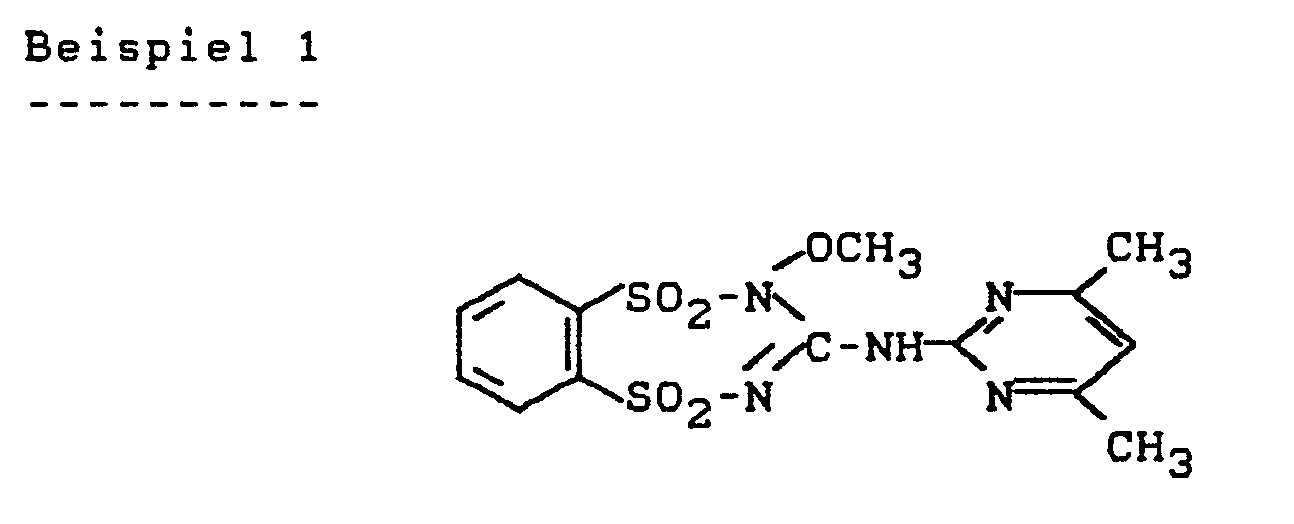
- Man erhält 11,5 g (58 % der Theorie) der Verbindung der oben angegebenen Strukturformel vom Schmelzpunkt 158. °C (Zers.).
- Die Aufarbeitung des Reaktionsgemisches kann auch in der Weise erfolgen, daß man nach beendeter Reaktion vollständig eindampft, den Rückstand in Dioxan aufnimmt, filtriert, erneut eindampft und den Rückstand umkristallisiert.
- Nach dem im vorausgehenden Beispiel exemplarisch beschriebenen Verfahren können die in der nachstehenden Tabelle 1 aufgeführten Verbindungen der Formel (I) hergestellt werden:


-

- Man erhält 131 g (57 % der Theorie) N'-(4,6-Dimethyl-pyrimidin-2-yl)-N"-sec.-butoxy-guanidin vom Schmelzpunkt 78. °C.
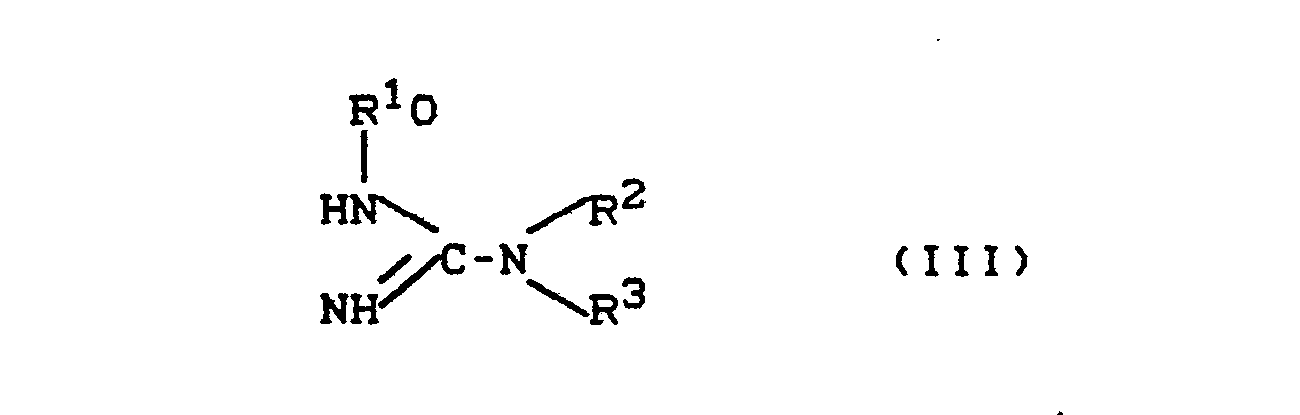
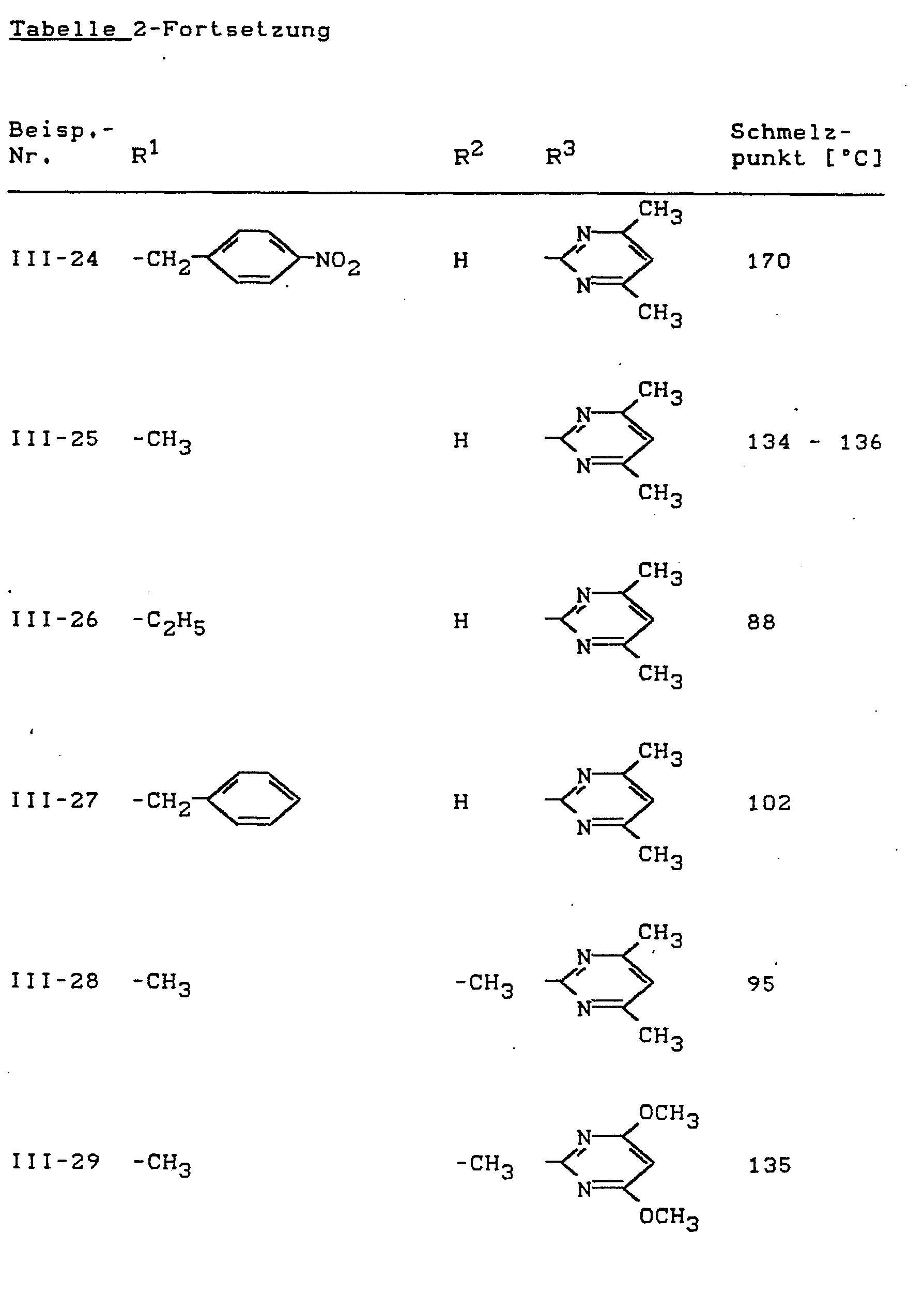
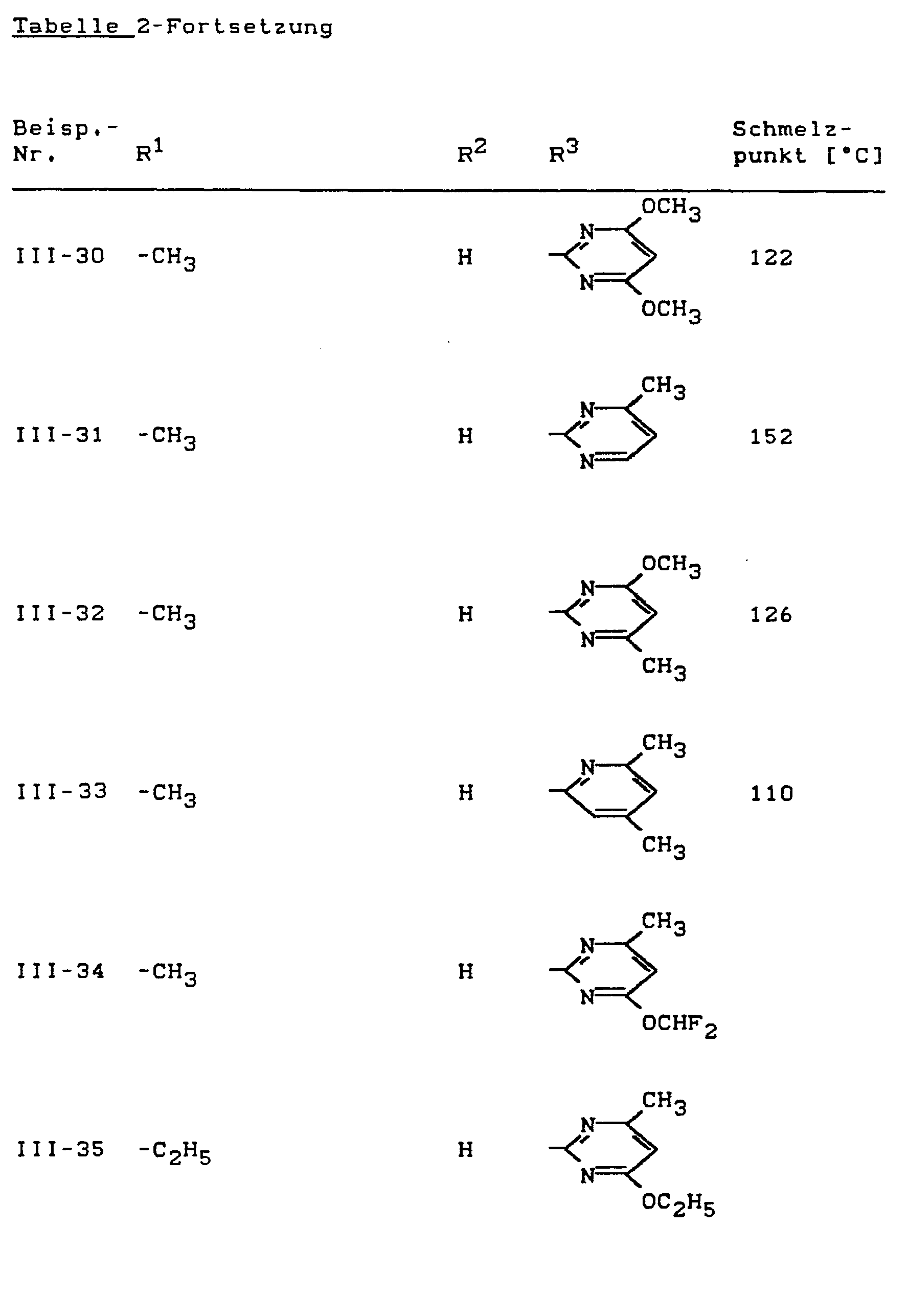
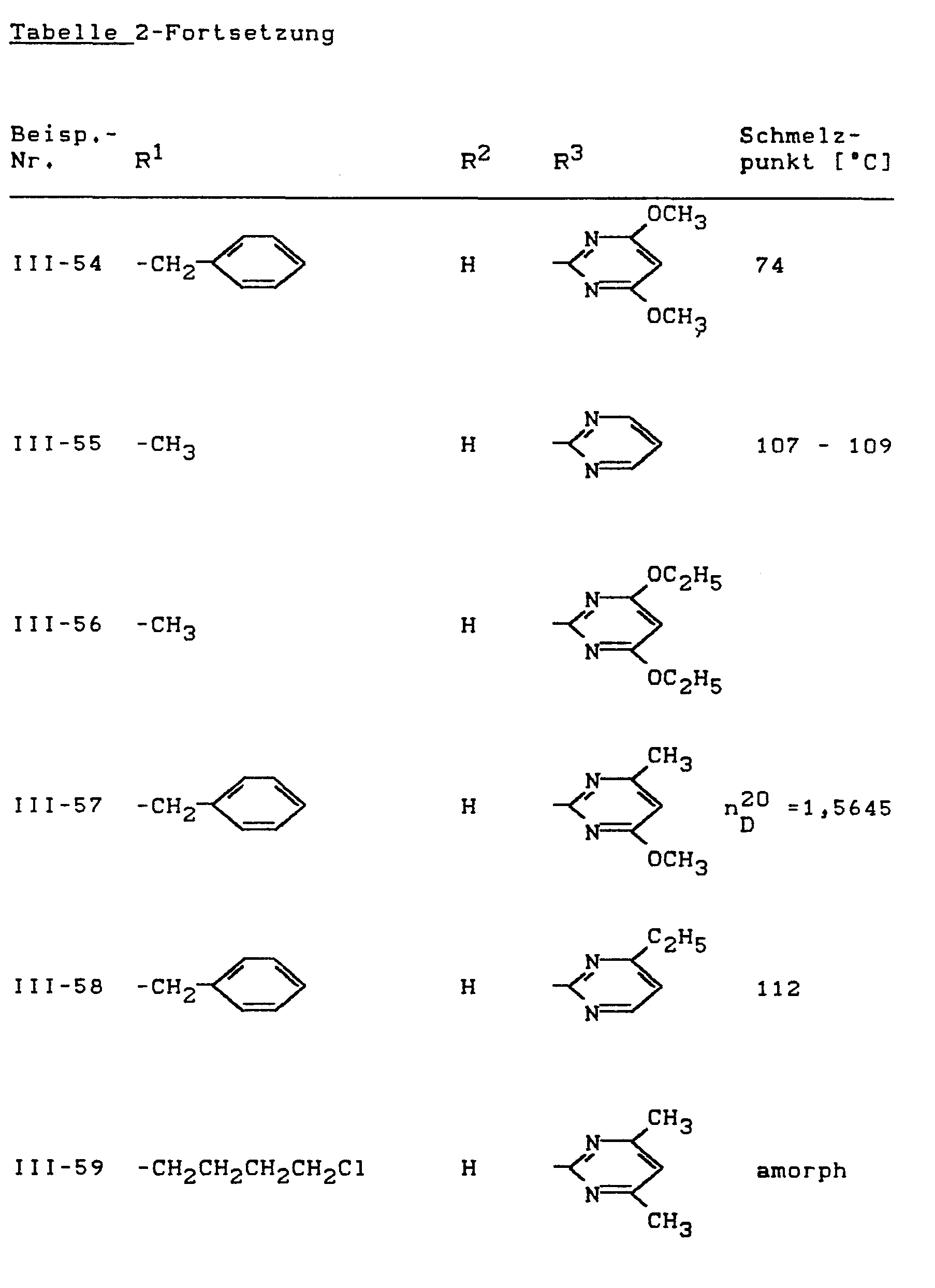
- Analog können die in der nachstehenden Tabelle 2 aufgeführten Verbindungen der Formel (III) hergestellt werden:





-

- Ein Gemisch aus 42 g (0,5 Mol) Cyanoguanidin ('Dicyandiamid') und 50 g (0,5 Mol) 2,4-Pentandion ('Acetylaceton') wird 15 Stunden auf 120 °C erhitzt. Dann wird nach Abkühlen das Reaktionsgemisch mit 500 ml Wasser versetzt und die Lösung bei 0 °C bis 10 °C mit Salzsäure angesäuert. Das hierbei kristallin angefallene Produkt wird durch Absaugen isoliert,
- Man erhält 51,8 g (70 % der Theorie) 2-Cyanamino-4,6-dimethyl-pyrimidin vom Schmelzpunkt 205 °C.

- Eine auf 100 °C erhitzte Lösung von 24 g (0,427 Mol) Kaliumhydroxid in 100 ml Wasser wird bei 100 °C unter Rühren zu einer Mischung aus 9,2 g (0,043 Mol) N-(4,6--Dimethoxy-pyrimidin-2-yl)-thioharnstoff und 70 ml Wasser gegeben. Man rührt 2 Minuten bei 100 °C nach und gibt eine auf 100 °C erwärmte Lösung von 16,2 g (0,05 Mol) Blei(II)-acetat in 30 ml Wasser hinzu. Man erhitzt noch 5 Minuten unter Rückfluß, kühlt dann auf 0 °C bis 5 °C ab und versetzt die wässrige Lösung mit 30 ml Eisessig. Das hierbei kristallin ausfallende Produkt wird durch Absaugen isoliert.
- Man erhält 6,3 g (81,5 % der Theorie) 2-Cyanamino-4,6--dimethoxy-pyrimidin vom Schmelzpunkt 202 °C.
- Zum gleichen Ergebnis kommt man, wenn man in Wasser- Methanol-Gemischen unter sonst gleichen Bedingungen arbeitet.
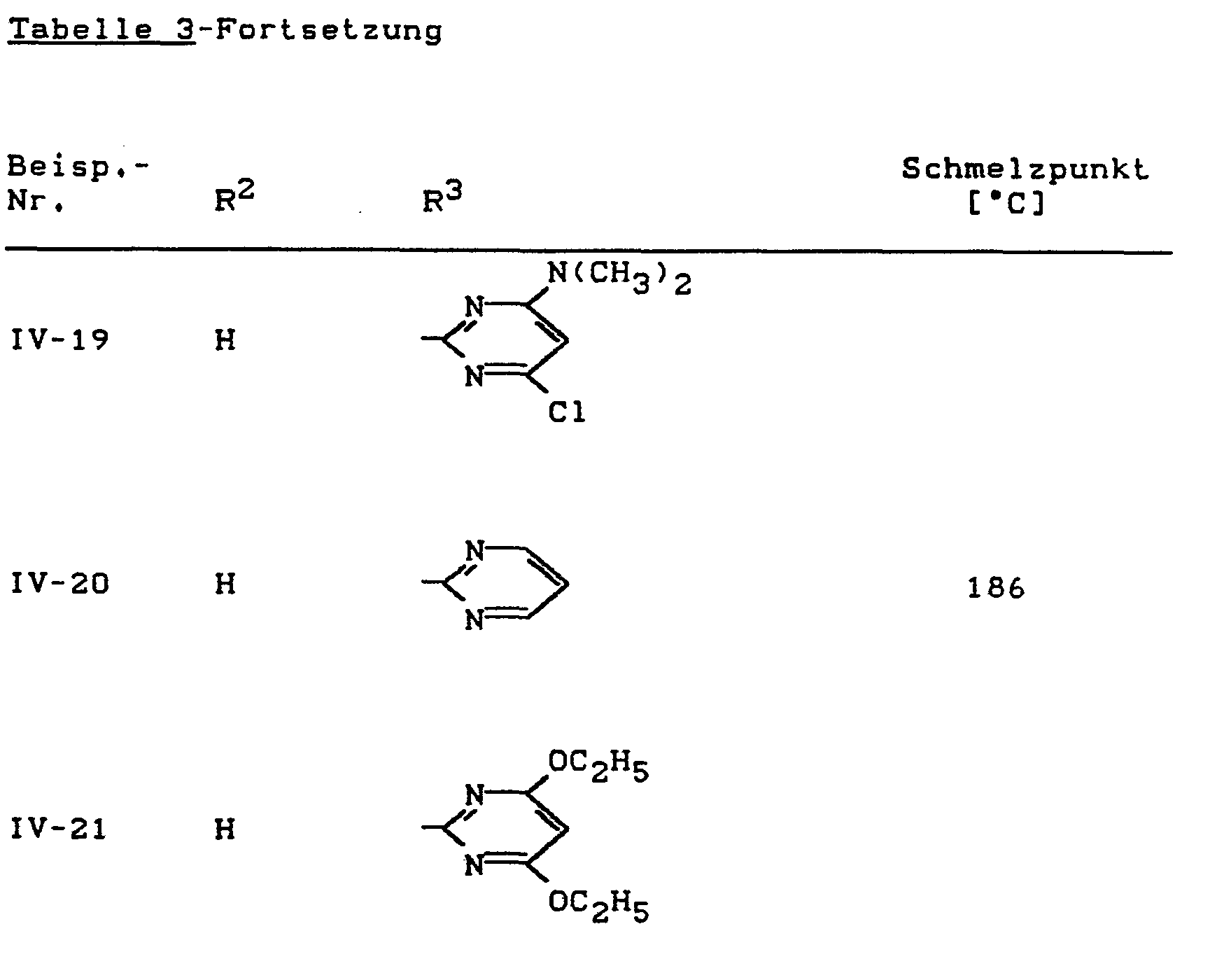
- Nach den in den vorausgehenden Beispielen exemplarisch beschriebenen Verfahren können die in der nachstehenden Tabelle 3 aufgeführten Verbindungen der Formel (IV) hergestellt werden:


- 2-(Alkyl-cyano-amino)-pyrimidine der Formel (IV) können beispielsweise wie folgt hergestellt werden:

- 12,6 g (0,1 Mol) Dimethylsulfat werden zu einer Lösung von 15 g (0,1 Mol) 2-Cyanamino-4-hydroxy-6-methyl-pyrimidin - hergestellt nach Verfahren (b) - und 4,1 g (0,1 Mol) Natriumhydroxid in 60 ml Wasser tropfenweise gegeben, wobei die Reaktionstemperatur von 20 °C auf 40 °C steigt. Nach zweistündigem Rühren bei 20 °C wird das kristallin angefallene Produkt durch Absaugen isoliert.
- Man erhält 11,1 g (68 % der Theorie) 2-(Methyl-cyano--amino)-4-hydroxy-6-methyl-pyrimidin vom Schmelzpunkt 290 °C.
- Analog erhält man:


- 127,5 g (1 Mol) Dimethylsulfat werden zu einer Lösung von 75 g (0,5 Mol) 2-Cyanamino-4-hydroxy-6-methyl-pyrimidin - hergestellt nach Verfahren (b) - und 44 g (1,1 Mol) Natriumhydroxid in 750 ml Wasser tropfenweise gegeben, wobei die Reaktionstemperatur von 20 °C auf 35 °C ansteigt. Nach zwölfstündigem Rühren bei 20 °C wird durch Zugabe von Natronlauge ein pH-Wert zwischen 9 und 10 eingestellt und das kristallin angefallende Produkt durch Absaugen isoliert.
- Man erhält 13 g (15 % der Theorie) 2-(Methyl-cyano--amino)-4-methoxy-6-methyl-pyrimidin vom Schmelzpunkt 123 °C.
- Analog erhält man:


-

- Man erhält 22,5 g (79 % der Theorie) 1-(Ethoxycarbonyl)--3-(4,6-dimethoxy-pyrimidin-2-yl)-thioharnstoff vom Schmelzpunkt 194 °C (Zers.).
- Nach dem im vorausgehenden Beispiel exemplarisch beschriebenen Verfahren können die in der nachstehenden Tabelle 4 aufgeführten Verbindungen der Formel (X) hergestellt werden:


-

- Man erhält 3,5 g (94 % der Theorie) 4,6-Dimethoxy-pyrimidin-2-yl-thioharnstoff vom Schmelzpunkt 245 - 248 °C (Zers.).
- Nach dem im vorausgehenden Beispiel exemplarisch beschriebenen Verfahren können die in der nachstehenden Tabelle 5 aufgeführten Verbindungen der Formel (XI) hergestellt werden:


- Zur Herstellung einer zweckmäßigen Wirkstoffzubereitung vermischt man 1 Gewichtsteil Wirkstoff mit der angegebenen Menge Lösungsmittel, gibt die angegebene Menge Emulgator zu und verdünnt das Konzentrat mit Wasser auf die gewünschte Konzentration.
- Samen der Testpflanzen werden in normalen Boden ausgesät und nach 24 Stunden mit der Wirkstoffzubereitung begossen. Dabei hält man die Wassermenge pro Flächeneinheit zweckmäßigerweise konstant. Die Wirkstoffkonzentration in der Zubereitung spielt keine Rolle, entscheidend ist nur die Aufwandmenge des Wirkstoffs pro Flächeneinheit. Nach drei Wochen wird der Schädigungsgrad der Pflanzen bonitiert in % Schädigung im Vergleich zur Entwicklung der unbehandelten Kontrolle. Es bedeuten:
- 0 % = keine Wirkung (wie unbehandelte Kontrolle)
- 100 % = totale Vernichtung
- Bei diesem Test zeigte z. B. die folgende Verbindung der Herstellungsbeispiele (1) eine sehr gute Wirkung bei der Bekämpfung von mono- und dikotylen Unkräutern.
- Zur Herstellung einer zweckmäßigen Wirkstoffzubereitung vermischt man 1 Gewichtsteil Wirkstoff mit der angegebenen Menge Lösungsmittel, gibt die angegebene Menge Emulgator zu und verdünnt das Konzentrat mit Wasser auf die gewünschte Konzentration.
- Mit der Wirkstoffzubereitung spritzt man Testpflanzen, welche eine Höhe von 5 - 15 cm haben so, daß die jeweils gewünschten Wirkstoffmengen pro Flächeneinheit ausgebracht werden. Die Konzentration der Spritzbrühe wird so gewählt, daß in 2000 1 Wasser/ha die jeweils gewünschten Wirkstoffmengen ausgebracht werden. Nach drei Wochen wird der Schädigungsgrad der Pflanzen bonitiert in % Schädigung im Vergleich zur Entwicklung der unbehandelten Kontrolle.
- Es bedeuten:
- 0 % = keine Wirkung (wie unbehandelte Kontrolle)
- 100 % = totale Vernichtung
- Bei diesem Test zeigte z. B. die folgende Verbindung der Herstellungsbeispiele (1) eine sehr gute Wirksamkeit bei der Bekämpfung von mono- und dikotylen Unkräutern.
gefunden.
in Gegenwart von Säureakzeptoren und gegebenenfalls in Gegenwart von Verdünnungsmitteln umsetzt.
bzw. deren Hydrochloriden,
gegebenenfalls in Gegenwart von Verdünnungsmitteln, wie z. B. Ethanol, Propanol oder Butanol, bei Temperaturen zwischen 20 °C und 120 °C umsetzt und gegebenenfalls die Umsetzungsprodukte mit Säureakzeptoren, wie z, B. Ammoniak, Kaliumcarbonat oder Natriumhydroxid, behandelt.
durch Absaugen isoliert und mit Metallverbindungen, welche Schwefelwasserstoff binden können, wie z. B. mit Blei(II)-acetat, Kupfer(II)-acetat, Quecksilber(II)-acetat oder Eisen (II)-acetat, in Gegenwart von wässrigen Alkalimetall- oder Erdalkalimetall--hydroxidlösungen, wie z. B. Natronlauge, bei Temperaturen zwischen 20 °C und 100 °C umsetzt, nach Ende der Umsetzung filtriert und das Filtrat mit einer Säure, wie z. B. Essigsäure, ansäuert. Die hierbei kristallin anfallenden Produkte der Formel (IV) können durch Absaugen isoliert werden.
Claims (5)

in welcher

mit Oxyguanidin-Derivaten der Formel (III)

in welcher
in Gegenwart von Säureakzeptoren und gegebenenfalls in Gegenwart von Verdünnungsmitteln umsetzt.
Priority Applications (1)
| Application Number | Priority Date | Filing Date | Title |
|---|---|---|---|
| AT85110825T ATE42099T1 (de) | 1984-08-30 | 1985-08-19 | Benzodisultame. |
Applications Claiming Priority (4)
| Application Number | Priority Date | Filing Date | Title |
|---|---|---|---|
| DE3431922 | 1984-08-30 | ||
| DE3431922 | 1984-08-30 | ||
| DE3516616 | 1985-05-09 | ||
| DE19853516616 DE3516616A1 (de) | 1984-08-30 | 1985-05-09 | Benzodisultame |
Publications (3)
| Publication Number | Publication Date |
|---|---|
| EP0173314A2 true EP0173314A2 (de) | 1986-03-05 |
| EP0173314A3 EP0173314A3 (en) | 1986-12-10 |
| EP0173314B1 EP0173314B1 (de) | 1989-04-12 |
Family
ID=25824318
Family Applications (1)
| Application Number | Title | Priority Date | Filing Date |
|---|---|---|---|
| EP85110825A Expired EP0173314B1 (de) | 1984-08-30 | 1985-08-19 | Benzodisultame |
Country Status (16)
| Country | Link |
|---|---|
| US (2) | US4680052A (de) |
| EP (1) | EP0173314B1 (de) |
| JP (1) | JPS6160686A (de) |
| KR (1) | KR920008821B1 (de) |
| AT (1) | ATE42099T1 (de) |
| AU (1) | AU576888B2 (de) |
| BR (1) | BR8504153A (de) |
| CA (1) | CA1244015A (de) |
| DE (2) | DE3516616A1 (de) |
| DK (1) | DK394285A (de) |
| ES (1) | ES8604941A1 (de) |
| GR (1) | GR852088B (de) |
| HU (1) | HU195963B (de) |
| IL (1) | IL76215A (de) |
| NZ (1) | NZ213262A (de) |
| TR (1) | TR22398A (de) |
Cited By (2)
| Publication number | Priority date | Publication date | Assignee | Title |
|---|---|---|---|---|
| EP0217038B1 (de) * | 1985-08-06 | 1989-06-07 | Bayer Ag | Benzo-[b]-1,4,5,7-dithiadiazepin-1,1,4,4-tetraoxydderivate |
| RU2717583C2 (ru) * | 2015-03-31 | 2020-03-24 | Конинклейке Филипс Н.В. | Чистящее устройство для полости рта с регулируемой формой и способ чистки полости рта |
Families Citing this family (3)
| Publication number | Priority date | Publication date | Assignee | Title |
|---|---|---|---|---|
| EP0367149B1 (de) * | 1988-10-28 | 1994-07-13 | Dai Nippon Insatsu Kabushiki Kaisha | Wärmeempfindliche Übertragungsschicht, Etikett und Verfahren zu deren Herstellung |
| DE102009004204A1 (de) * | 2009-01-09 | 2010-07-15 | Christian-Albrechts-Universität Zu Kiel | Verfahren zur verbesserten Bioaktivierung von Arzneistoffen |
| CN110452134B (zh) * | 2019-07-22 | 2021-06-08 | 浙江工业大学 | 一种一氧化氮供体小分子及其制备与应用 |
Family Cites Families (6)
| Publication number | Priority date | Publication date | Assignee | Title |
|---|---|---|---|---|
| US3313811A (en) * | 1963-10-25 | 1967-04-11 | Olin Mathieson | Cyclic n, n'-dimethylurea disulfonimides |
| US3803149A (en) * | 1966-12-19 | 1974-04-09 | Science Union & Cie | 5-piperazinyl-10-dioxo-dibenzo(c,f)thiazepines and process for making them |
| US3671528A (en) * | 1967-06-23 | 1972-06-20 | Upjohn Co | 5-phenyl-1,2,4-benzothiadiazepine-1,1-dioxides |
| US3974155A (en) * | 1972-08-12 | 1976-08-10 | Pfizer Inc. | 2 AND 3-Substituted-4-(heterocyclic-amino-sulfonyl)benzene sulfonamides |
| DK259280A (da) * | 1979-07-20 | 1981-01-21 | Du Pont | Herbicide sulfonamider |
| DE3431930A1 (de) * | 1984-08-30 | 1986-03-06 | Bayer Ag, 5090 Leverkusen | 1-(2-oxyaminosulfonylphenylsulfonyl)-3-heteroaryl-iso(thio)-harnstoffe |
-
1985
- 1985-05-09 DE DE19853516616 patent/DE3516616A1/de not_active Withdrawn
- 1985-08-19 EP EP85110825A patent/EP0173314B1/de not_active Expired
- 1985-08-19 DE DE8585110825T patent/DE3569377D1/de not_active Expired
- 1985-08-19 AT AT85110825T patent/ATE42099T1/de not_active IP Right Cessation
- 1985-08-23 US US06/769,191 patent/US4680052A/en not_active Expired - Fee Related
- 1985-08-23 TR TR36702/85A patent/TR22398A/xx unknown
- 1985-08-26 AU AU46654/85A patent/AU576888B2/en not_active Ceased
- 1985-08-27 IL IL76215A patent/IL76215A/xx unknown
- 1985-08-27 NZ NZ213262A patent/NZ213262A/en unknown
- 1985-08-28 GR GR852088A patent/GR852088B/el unknown
- 1985-08-28 CA CA000489612A patent/CA1244015A/en not_active Expired
- 1985-08-29 BR BR8504153A patent/BR8504153A/pt unknown
- 1985-08-29 JP JP60188709A patent/JPS6160686A/ja active Granted
- 1985-08-29 HU HU853277A patent/HU195963B/hu unknown
- 1985-08-29 DK DK394285A patent/DK394285A/da not_active Application Discontinuation
- 1985-08-29 KR KR1019850006254A patent/KR920008821B1/ko not_active Expired
- 1985-08-30 ES ES546555A patent/ES8604941A1/es not_active Expired
-
1987
- 1987-02-12 US US07/013,611 patent/US4769455A/en not_active Expired - Fee Related
Cited By (2)
| Publication number | Priority date | Publication date | Assignee | Title |
|---|---|---|---|---|
| EP0217038B1 (de) * | 1985-08-06 | 1989-06-07 | Bayer Ag | Benzo-[b]-1,4,5,7-dithiadiazepin-1,1,4,4-tetraoxydderivate |
| RU2717583C2 (ru) * | 2015-03-31 | 2020-03-24 | Конинклейке Филипс Н.В. | Чистящее устройство для полости рта с регулируемой формой и способ чистки полости рта |
Also Published As
| Publication number | Publication date |
|---|---|
| HUT39445A (en) | 1986-09-29 |
| KR870002137A (ko) | 1987-03-30 |
| IL76215A0 (en) | 1986-01-31 |
| JPS6160686A (ja) | 1986-03-28 |
| NZ213262A (en) | 1988-02-29 |
| TR22398A (tr) | 1987-03-25 |
| HU195963B (en) | 1988-08-29 |
| ATE42099T1 (de) | 1989-04-15 |
| IL76215A (en) | 1989-05-15 |
| CA1244015A (en) | 1988-11-01 |
| JPH0566955B2 (de) | 1993-09-22 |
| AU4665485A (en) | 1986-03-06 |
| BR8504153A (pt) | 1986-06-24 |
| DK394285A (da) | 1986-03-01 |
| DE3516616A1 (de) | 1986-03-13 |
| GR852088B (de) | 1985-12-30 |
| DK394285D0 (da) | 1985-08-29 |
| EP0173314A3 (en) | 1986-12-10 |
| DE3569377D1 (de) | 1989-05-18 |
| US4769455A (en) | 1988-09-06 |
| US4680052A (en) | 1987-07-14 |
| ES546555A0 (es) | 1986-03-01 |
| AU576888B2 (en) | 1988-09-08 |
| ES8604941A1 (es) | 1986-03-01 |
| KR920008821B1 (ko) | 1992-10-09 |
| EP0173314B1 (de) | 1989-04-12 |
Similar Documents
| Publication | Publication Date | Title |
|---|---|---|
| EP0121082B1 (de) | Guanidin-Derivate | |
| EP0173958A2 (de) | 1-(2-Oxyaminocarbonylphenylsulfonyl)-3-heteroaryl-harnstoffe | |
| EP0173314B1 (de) | Benzodisultame | |
| EP0173322B1 (de) | (1-(2-Oxyaminosulfonylphenylsulfonyl)-3-heteroaryl-harnstoffe | |
| EP0173312A1 (de) | 1-(2-Trifluormethoxy-phenylsulfonyl)-3-heteroaryl-(thio)-harnstoffe | |
| EP0173957A1 (de) | Sulfonyliso(thio)harnstoff- Derivate | |
| EP0173319A1 (de) | Substituierte Arylsulfonylguanidine | |
| EP0173318A1 (de) | Fluoralkoxyphenylsulfonylguanidine | |
| EP0307753B1 (de) | Sulfonyliso(thio)harnstoffe sowie ein Verfahren und neue Zwischenprodukte zu ihrer Herstellung | |
| EP0217038B1 (de) | Benzo-[b]-1,4,5,7-dithiadiazepin-1,1,4,4-tetraoxydderivate | |
| EP0203220A1 (de) | Benzolactamsultame | |
| EP0431270A1 (de) | Substituierte Sulfonylamidinohydrazone | |
| DE3517842A1 (de) | Sulfonylguanidinopyrimidin-derivate | |
| EP0251079B1 (de) | 3-Substituierte 1-(2-Halogen-alkoxy-benzolsulfonyl)-3-heteroaryl-harnstoffe | |
| EP0173316A2 (de) | 1-(2-Oxyaminosulfonylphenylsulfonyl)-3-heteroaryl-iso-(thio)-harnstoffe | |
| EP0271780A2 (de) | Substituierte 1-Benzylsulfonyl-3-heteroaryl-(thio)harnstoffe | |
| DE3818040A1 (de) | Subsituierte n'-azinyl-n''-amino-n'''-sulfonylguanidine, verfahren zu ihrer herstellung und ihre verwendung in herbiziden mitteln | |
| EP0173313A2 (de) | Heteroarylthioharnstoffe | |
| EP0173323A1 (de) | Amidinoazole | |
| DD237780A5 (de) | Herbizide mittel | |
| EP0234250A2 (de) | Acylierte Sulfonylguanidine | |
| DE3626860A1 (de) | Acylierte 1-(2-oxyaminosulfonylphenylsulfonyl)-3-heteroaryl-harnstoffe | |
| EP0213378A1 (de) | 1-(2-Oxyaminosulfonylphenylsulfonyl)-3-triazinyl-harnstoffe | |
| EP0232723A1 (de) | Herbizide Mittel | |
| EP0173315A1 (de) | Oxyguanidin-Derivate |
Legal Events
| Date | Code | Title | Description |
|---|---|---|---|
| PUAI | Public reference made under article 153(3) epc to a published international application that has entered the european phase |
Free format text: ORIGINAL CODE: 0009012 |
|
| 17P | Request for examination filed |
Effective date: 19850819 |
|
| AK | Designated contracting states |
Kind code of ref document: A2 Designated state(s): AT BE CH DE FR GB IT LI NL SE |
|
| PUAL | Search report despatched |
Free format text: ORIGINAL CODE: 0009013 |
|
| AK | Designated contracting states |
Kind code of ref document: A3 Designated state(s): AT BE CH DE FR GB IT LI NL SE |
|
| 17Q | First examination report despatched |
Effective date: 19880629 |
|
| GRAA | (expected) grant |
Free format text: ORIGINAL CODE: 0009210 |
|
| AK | Designated contracting states |
Kind code of ref document: B1 Designated state(s): AT BE CH DE FR GB IT LI NL SE |
|
| REF | Corresponds to: |
Ref document number: 42099 Country of ref document: AT Date of ref document: 19890415 Kind code of ref document: T |
|
| ITF | It: translation for a ep patent filed | ||
| GBT | Gb: translation of ep patent filed (gb section 77(6)(a)/1977) | ||
| REF | Corresponds to: |
Ref document number: 3569377 Country of ref document: DE Date of ref document: 19890518 |
|
| ET | Fr: translation filed | ||
| PG25 | Lapsed in a contracting state [announced via postgrant information from national office to epo] |
Ref country code: AT Effective date: 19890819 |
|
| PG25 | Lapsed in a contracting state [announced via postgrant information from national office to epo] |
Ref country code: SE Effective date: 19890820 |
|
| PLBE | No opposition filed within time limit |
Free format text: ORIGINAL CODE: 0009261 |
|
| STAA | Information on the status of an ep patent application or granted ep patent |
Free format text: STATUS: NO OPPOSITION FILED WITHIN TIME LIMIT |
|
| 26N | No opposition filed | ||
| ITTA | It: last paid annual fee | ||
| PGFP | Annual fee paid to national office [announced via postgrant information from national office to epo] |
Ref country code: DE Payment date: 19920715 Year of fee payment: 8 |
|
| PGFP | Annual fee paid to national office [announced via postgrant information from national office to epo] |
Ref country code: FR Payment date: 19920730 Year of fee payment: 8 |
|
| PGFP | Annual fee paid to national office [announced via postgrant information from national office to epo] |
Ref country code: GB Payment date: 19920807 Year of fee payment: 8 |
|
| PGFP | Annual fee paid to national office [announced via postgrant information from national office to epo] |
Ref country code: BE Payment date: 19920826 Year of fee payment: 8 |
|
| PGFP | Annual fee paid to national office [announced via postgrant information from national office to epo] |
Ref country code: NL Payment date: 19920831 Year of fee payment: 8 |
|
| PGFP | Annual fee paid to national office [announced via postgrant information from national office to epo] |
Ref country code: CH Payment date: 19920924 Year of fee payment: 8 |
|
| PG25 | Lapsed in a contracting state [announced via postgrant information from national office to epo] |
Ref country code: GB Effective date: 19930819 |
|
| PG25 | Lapsed in a contracting state [announced via postgrant information from national office to epo] |
Ref country code: LI Effective date: 19930831 Ref country code: CH Effective date: 19930831 Ref country code: BE Effective date: 19930831 |
|
| BERE | Be: lapsed |
Owner name: BAYER A.G. Effective date: 19930831 |
|
| PG25 | Lapsed in a contracting state [announced via postgrant information from national office to epo] |
Ref country code: NL Effective date: 19940301 |
|
| NLV4 | Nl: lapsed or anulled due to non-payment of the annual fee | ||
| GBPC | Gb: european patent ceased through non-payment of renewal fee |
Effective date: 19930819 |
|
| PG25 | Lapsed in a contracting state [announced via postgrant information from national office to epo] |
Ref country code: FR Effective date: 19940429 |
|
| REG | Reference to a national code |
Ref country code: CH Ref legal event code: PL |
|
| PG25 | Lapsed in a contracting state [announced via postgrant information from national office to epo] |
Ref country code: DE Effective date: 19940503 |
|
| REG | Reference to a national code |
Ref country code: FR Ref legal event code: ST |
|
| EUG | Se: european patent has lapsed |
Ref document number: 85110825.8 Effective date: 19900418 |