EP0171024B1 - Gentechnologisches Verfahren zur Herstellung von Hirudinen und Mittel zur Durchführung dieses Verfahrens - Google Patents
Gentechnologisches Verfahren zur Herstellung von Hirudinen und Mittel zur Durchführung dieses Verfahrens Download PDFInfo
- Publication number
- EP0171024B1 EP0171024B1 EP85109567A EP85109567A EP0171024B1 EP 0171024 B1 EP0171024 B1 EP 0171024B1 EP 85109567 A EP85109567 A EP 85109567A EP 85109567 A EP85109567 A EP 85109567A EP 0171024 B1 EP0171024 B1 EP 0171024B1
- Authority
- EP
- European Patent Office
- Prior art keywords
- gene
- denotes
- plasmid
- dna sequence
- polypeptide
- Prior art date
- Legal status (The legal status is an assumption and is not a legal conclusion. Google has not performed a legal analysis and makes no representation as to the accuracy of the status listed.)
- Expired - Lifetime
Links
- WQPDUTSPKFMPDP-OUMQNGNKSA-N hirudin Chemical compound C([C@@H](C(=O)N[C@@H](CCC(O)=O)C(=O)N[C@@H](CCC(O)=O)C(=O)N[C@@H]([C@@H](C)CC)C(=O)N1[C@@H](CCC1)C(=O)N[C@@H](CCC(O)=O)C(=O)N[C@@H](CCC(O)=O)C(=O)N[C@@H](CC=1C=CC(OS(O)(=O)=O)=CC=1)C(=O)N[C@@H](CC(C)C)C(=O)N[C@@H](CCC(N)=O)C(O)=O)NC(=O)[C@H](CC(O)=O)NC(=O)CNC(=O)[C@H](CC(O)=O)NC(=O)[C@H](CC(N)=O)NC(=O)[C@H](CC=1NC=NC=1)NC(=O)[C@H](CO)NC(=O)[C@H](CCC(N)=O)NC(=O)[C@H]1N(CCC1)C(=O)[C@H](CCCCN)NC(=O)[C@H]1N(CCC1)C(=O)[C@@H](NC(=O)CNC(=O)[C@H](CCC(O)=O)NC(=O)CNC(=O)[C@@H](NC(=O)[C@@H](NC(=O)[C@H]1NC(=O)[C@H](CCC(N)=O)NC(=O)[C@H](CC(N)=O)NC(=O)[C@H](CCCCN)NC(=O)[C@H](CCC(O)=O)NC(=O)CNC(=O)[C@H](CC(O)=O)NC(=O)[C@H](CO)NC(=O)CNC(=O)[C@H](CC(C)C)NC(=O)[C@H]([C@@H](C)CC)NC(=O)[C@@H]2CSSC[C@@H](C(=O)N[C@@H](CCC(O)=O)C(=O)NCC(=O)N[C@@H](CO)C(=O)N[C@@H](CC(N)=O)C(=O)N[C@H](C(=O)N[C@H](C(NCC(=O)N[C@@H](CCC(N)=O)C(=O)NCC(=O)N[C@@H](CC(N)=O)C(=O)N[C@@H](CCCCN)C(=O)N2)=O)CSSC1)C(C)C)NC(=O)[C@H](CC(C)C)NC(=O)[C@H]1NC(=O)[C@H](CC(C)C)NC(=O)[C@H](CC(N)=O)NC(=O)[C@H](CCC(N)=O)NC(=O)CNC(=O)[C@H](CO)NC(=O)[C@H](CCC(O)=O)NC(=O)[C@H]([C@@H](C)O)NC(=O)[C@@H](NC(=O)[C@H](CC(O)=O)NC(=O)[C@@H](NC(=O)[C@H](CC=2C=CC(O)=CC=2)NC(=O)[C@@H](NC(=O)[C@@H](N)C(C)C)C(C)C)[C@@H](C)O)CSSC1)C(C)C)[C@@H](C)O)[C@@H](C)O)C1=CC=CC=C1 WQPDUTSPKFMPDP-OUMQNGNKSA-N 0.000 title claims abstract description 23
- 108010007267 Hirudins Proteins 0.000 title claims abstract description 18
- 102000007625 Hirudins Human genes 0.000 title claims abstract description 17
- 238000000034 method Methods 0.000 title claims abstract description 16
- 238000010353 genetic engineering Methods 0.000 title abstract description 4
- 238000004519 manufacturing process Methods 0.000 title description 9
- 239000013612 plasmid Substances 0.000 claims abstract description 57
- 108090000623 proteins and genes Proteins 0.000 claims abstract description 51
- 108091028043 Nucleic acid sequence Proteins 0.000 claims abstract description 47
- 229940006607 hirudin Drugs 0.000 claims abstract description 17
- 150000001413 amino acids Chemical class 0.000 claims description 23
- 108090000765 processed proteins & peptides Proteins 0.000 claims description 19
- 229920001184 polypeptide Polymers 0.000 claims description 18
- 102000004196 processed proteins & peptides Human genes 0.000 claims description 17
- 108020004705 Codon Proteins 0.000 claims description 13
- 102000005936 beta-Galactosidase Human genes 0.000 claims description 10
- 108010005774 beta-Galactosidase Proteins 0.000 claims description 10
- 241000588724 Escherichia coli Species 0.000 claims description 8
- 108091033380 Coding strand Proteins 0.000 claims description 7
- 238000010348 incorporation Methods 0.000 claims description 7
- 239000013613 expression plasmid Substances 0.000 claims description 5
- OJMIONKXNSYLSR-UHFFFAOYSA-N phosphorous acid Chemical compound OP(O)O OJMIONKXNSYLSR-UHFFFAOYSA-N 0.000 claims description 4
- 230000001580 bacterial effect Effects 0.000 claims description 3
- 230000000694 effects Effects 0.000 claims description 3
- 238000002360 preparation method Methods 0.000 claims description 3
- 230000004927 fusion Effects 0.000 claims description 2
- 125000003275 alpha amino acid group Chemical group 0.000 claims 2
- 125000001429 N-terminal alpha-amino-acid group Chemical group 0.000 claims 1
- 239000012634 fragment Substances 0.000 abstract description 26
- WYURNTSHIVDZCO-UHFFFAOYSA-N Tetrahydrofuran Chemical compound C1CCOC1 WYURNTSHIVDZCO-UHFFFAOYSA-N 0.000 description 24
- 108091034117 Oligonucleotide Proteins 0.000 description 14
- 108091008146 restriction endonucleases Proteins 0.000 description 14
- 108020004414 DNA Proteins 0.000 description 13
- OKKJLVBELUTLKV-UHFFFAOYSA-N Methanol Chemical compound OC OKKJLVBELUTLKV-UHFFFAOYSA-N 0.000 description 12
- 238000003786 synthesis reaction Methods 0.000 description 12
- YLQBMQCUIZJEEH-UHFFFAOYSA-N tetrahydrofuran Natural products C=1C=COC=1 YLQBMQCUIZJEEH-UHFFFAOYSA-N 0.000 description 12
- JLCPHMBAVCMARE-UHFFFAOYSA-N [3-[[3-[[3-[[3-[[3-[[3-[[3-[[3-[[3-[[3-[[3-[[5-(2-amino-6-oxo-1H-purin-9-yl)-3-[[3-[[3-[[3-[[3-[[3-[[5-(2-amino-6-oxo-1H-purin-9-yl)-3-[[5-(2-amino-6-oxo-1H-purin-9-yl)-3-hydroxyoxolan-2-yl]methoxy-hydroxyphosphoryl]oxyoxolan-2-yl]methoxy-hydroxyphosphoryl]oxy-5-(5-methyl-2,4-dioxopyrimidin-1-yl)oxolan-2-yl]methoxy-hydroxyphosphoryl]oxy-5-(6-aminopurin-9-yl)oxolan-2-yl]methoxy-hydroxyphosphoryl]oxy-5-(6-aminopurin-9-yl)oxolan-2-yl]methoxy-hydroxyphosphoryl]oxy-5-(6-aminopurin-9-yl)oxolan-2-yl]methoxy-hydroxyphosphoryl]oxy-5-(6-aminopurin-9-yl)oxolan-2-yl]methoxy-hydroxyphosphoryl]oxyoxolan-2-yl]methoxy-hydroxyphosphoryl]oxy-5-(5-methyl-2,4-dioxopyrimidin-1-yl)oxolan-2-yl]methoxy-hydroxyphosphoryl]oxy-5-(4-amino-2-oxopyrimidin-1-yl)oxolan-2-yl]methoxy-hydroxyphosphoryl]oxy-5-(5-methyl-2,4-dioxopyrimidin-1-yl)oxolan-2-yl]methoxy-hydroxyphosphoryl]oxy-5-(5-methyl-2,4-dioxopyrimidin-1-yl)oxolan-2-yl]methoxy-hydroxyphosphoryl]oxy-5-(6-aminopurin-9-yl)oxolan-2-yl]methoxy-hydroxyphosphoryl]oxy-5-(6-aminopurin-9-yl)oxolan-2-yl]methoxy-hydroxyphosphoryl]oxy-5-(4-amino-2-oxopyrimidin-1-yl)oxolan-2-yl]methoxy-hydroxyphosphoryl]oxy-5-(4-amino-2-oxopyrimidin-1-yl)oxolan-2-yl]methoxy-hydroxyphosphoryl]oxy-5-(4-amino-2-oxopyrimidin-1-yl)oxolan-2-yl]methoxy-hydroxyphosphoryl]oxy-5-(6-aminopurin-9-yl)oxolan-2-yl]methoxy-hydroxyphosphoryl]oxy-5-(4-amino-2-oxopyrimidin-1-yl)oxolan-2-yl]methyl [5-(6-aminopurin-9-yl)-2-(hydroxymethyl)oxolan-3-yl] hydrogen phosphate Polymers Cc1cn(C2CC(OP(O)(=O)OCC3OC(CC3OP(O)(=O)OCC3OC(CC3O)n3cnc4c3nc(N)[nH]c4=O)n3cnc4c3nc(N)[nH]c4=O)C(COP(O)(=O)OC3CC(OC3COP(O)(=O)OC3CC(OC3COP(O)(=O)OC3CC(OC3COP(O)(=O)OC3CC(OC3COP(O)(=O)OC3CC(OC3COP(O)(=O)OC3CC(OC3COP(O)(=O)OC3CC(OC3COP(O)(=O)OC3CC(OC3COP(O)(=O)OC3CC(OC3COP(O)(=O)OC3CC(OC3COP(O)(=O)OC3CC(OC3COP(O)(=O)OC3CC(OC3COP(O)(=O)OC3CC(OC3COP(O)(=O)OC3CC(OC3COP(O)(=O)OC3CC(OC3COP(O)(=O)OC3CC(OC3COP(O)(=O)OC3CC(OC3CO)n3cnc4c(N)ncnc34)n3ccc(N)nc3=O)n3cnc4c(N)ncnc34)n3ccc(N)nc3=O)n3ccc(N)nc3=O)n3ccc(N)nc3=O)n3cnc4c(N)ncnc34)n3cnc4c(N)ncnc34)n3cc(C)c(=O)[nH]c3=O)n3cc(C)c(=O)[nH]c3=O)n3ccc(N)nc3=O)n3cc(C)c(=O)[nH]c3=O)n3cnc4c3nc(N)[nH]c4=O)n3cnc4c(N)ncnc34)n3cnc4c(N)ncnc34)n3cnc4c(N)ncnc34)n3cnc4c(N)ncnc34)O2)c(=O)[nH]c1=O JLCPHMBAVCMARE-UHFFFAOYSA-N 0.000 description 11
- 230000015572 biosynthetic process Effects 0.000 description 11
- WEVYAHXRMPXWCK-UHFFFAOYSA-N Acetonitrile Chemical compound CC#N WEVYAHXRMPXWCK-UHFFFAOYSA-N 0.000 description 8
- 210000004027 cell Anatomy 0.000 description 8
- 239000002773 nucleotide Substances 0.000 description 8
- 125000003729 nucleotide group Chemical group 0.000 description 8
- OISVCGZHLKNMSJ-UHFFFAOYSA-N 2,6-dimethylpyridine Chemical compound CC1=CC=CC(C)=N1 OISVCGZHLKNMSJ-UHFFFAOYSA-N 0.000 description 6
- IQFYYKKMVGJFEH-XLPZGREQSA-N Thymidine Chemical compound O=C1NC(=O)C(C)=CN1[C@@H]1O[C@H](CO)[C@@H](O)C1 IQFYYKKMVGJFEH-XLPZGREQSA-N 0.000 description 6
- XLYOFNOQVPJJNP-UHFFFAOYSA-N water Chemical compound O XLYOFNOQVPJJNP-UHFFFAOYSA-N 0.000 description 6
- -1 Leu oder Phe Chemical compound 0.000 description 5
- 108020001507 fusion proteins Proteins 0.000 description 5
- 102000037865 fusion proteins Human genes 0.000 description 5
- 239000000499 gel Substances 0.000 description 5
- 230000009466 transformation Effects 0.000 description 5
- 239000013598 vector Substances 0.000 description 5
- WFDIJRYMOXRFFG-UHFFFAOYSA-N Acetic anhydride Chemical compound CC(=O)OC(C)=O WFDIJRYMOXRFFG-UHFFFAOYSA-N 0.000 description 4
- QGZKDVFQNNGYKY-UHFFFAOYSA-N Ammonia Chemical compound N QGZKDVFQNNGYKY-UHFFFAOYSA-N 0.000 description 4
- TWRXJAOTZQYOKJ-UHFFFAOYSA-L Magnesium chloride Chemical compound [Mg+2].[Cl-].[Cl-] TWRXJAOTZQYOKJ-UHFFFAOYSA-L 0.000 description 4
- 108700005078 Synthetic Genes Proteins 0.000 description 4
- VHJLVAABSRFDPM-QWWZWVQMSA-N dithiothreitol Chemical compound SC[C@@H](O)[C@H](O)CS VHJLVAABSRFDPM-QWWZWVQMSA-N 0.000 description 4
- 229910052740 iodine Inorganic materials 0.000 description 4
- LYGJENNIWJXYER-UHFFFAOYSA-N nitromethane Chemical compound C[N+]([O-])=O LYGJENNIWJXYER-UHFFFAOYSA-N 0.000 description 4
- 102000004169 proteins and genes Human genes 0.000 description 4
- QKNYBSVHEMOAJP-UHFFFAOYSA-N 2-amino-2-(hydroxymethyl)propane-1,3-diol;hydron;chloride Chemical compound Cl.OCC(N)(CO)CO QKNYBSVHEMOAJP-UHFFFAOYSA-N 0.000 description 3
- DWRXFEITVBNRMK-UHFFFAOYSA-N Beta-D-1-Arabinofuranosylthymine Natural products O=C1NC(=O)C(C)=CN1C1C(O)C(O)C(CO)O1 DWRXFEITVBNRMK-UHFFFAOYSA-N 0.000 description 3
- 102000004190 Enzymes Human genes 0.000 description 3
- 108090000790 Enzymes Proteins 0.000 description 3
- LFQSCWFLJHTTHZ-UHFFFAOYSA-N Ethanol Chemical compound CCO LFQSCWFLJHTTHZ-UHFFFAOYSA-N 0.000 description 3
- ZMANZCXQSJIPKH-UHFFFAOYSA-N Triethylamine Chemical compound CCN(CC)CC ZMANZCXQSJIPKH-UHFFFAOYSA-N 0.000 description 3
- IQFYYKKMVGJFEH-UHFFFAOYSA-N beta-L-thymidine Natural products O=C1NC(=O)C(C)=CN1C1OC(CO)C(O)C1 IQFYYKKMVGJFEH-UHFFFAOYSA-N 0.000 description 3
- 239000000872 buffer Substances 0.000 description 3
- 238000003776 cleavage reaction Methods 0.000 description 3
- 238000010367 cloning Methods 0.000 description 3
- ATDGTVJJHBUTRL-UHFFFAOYSA-N cyanogen bromide Chemical compound BrC#N ATDGTVJJHBUTRL-UHFFFAOYSA-N 0.000 description 3
- 230000029087 digestion Effects 0.000 description 3
- 230000002255 enzymatic effect Effects 0.000 description 3
- 229940088598 enzyme Drugs 0.000 description 3
- 238000001502 gel electrophoresis Methods 0.000 description 3
- 238000004128 high performance liquid chromatography Methods 0.000 description 3
- 238000003780 insertion Methods 0.000 description 3
- 230000037431 insertion Effects 0.000 description 3
- 239000000203 mixture Substances 0.000 description 3
- 238000012986 modification Methods 0.000 description 3
- 230000004048 modification Effects 0.000 description 3
- 229920002401 polyacrylamide Polymers 0.000 description 3
- 239000000047 product Substances 0.000 description 3
- 230000007017 scission Effects 0.000 description 3
- 239000000126 substance Substances 0.000 description 3
- 229940104230 thymidine Drugs 0.000 description 3
- ZKHQWZAMYRWXGA-KQYNXXCUSA-J ATP(4-) Chemical compound C1=NC=2C(N)=NC=NC=2N1[C@@H]1O[C@H](COP([O-])(=O)OP([O-])(=O)OP([O-])([O-])=O)[C@@H](O)[C@H]1O ZKHQWZAMYRWXGA-KQYNXXCUSA-J 0.000 description 2
- ZKHQWZAMYRWXGA-UHFFFAOYSA-N Adenosine triphosphate Natural products C1=NC=2C(N)=NC=NC=2N1C1OC(COP(O)(=O)OP(O)(=O)OP(O)(O)=O)C(O)C1O ZKHQWZAMYRWXGA-UHFFFAOYSA-N 0.000 description 2
- 229920001817 Agar Polymers 0.000 description 2
- 239000004475 Arginine Substances 0.000 description 2
- UXVMQQNJUSDDNG-UHFFFAOYSA-L Calcium chloride Chemical compound [Cl-].[Cl-].[Ca+2] UXVMQQNJUSDDNG-UHFFFAOYSA-L 0.000 description 2
- 108010054576 Deoxyribonuclease EcoRI Proteins 0.000 description 2
- QOSSAOTZNIDXMA-UHFFFAOYSA-N Dicylcohexylcarbodiimide Chemical compound C1CCCCC1N=C=NC1CCCCC1 QOSSAOTZNIDXMA-UHFFFAOYSA-N 0.000 description 2
- FFEARJCKVFRZRR-BYPYZUCNSA-N L-methionine Chemical compound CSCC[C@H](N)C(O)=O FFEARJCKVFRZRR-BYPYZUCNSA-N 0.000 description 2
- WCUXLLCKKVVCTQ-UHFFFAOYSA-M Potassium chloride Chemical compound [Cl-].[K+] WCUXLLCKKVVCTQ-UHFFFAOYSA-M 0.000 description 2
- VYPSYNLAJGMNEJ-UHFFFAOYSA-N Silicium dioxide Chemical compound O=[Si]=O VYPSYNLAJGMNEJ-UHFFFAOYSA-N 0.000 description 2
- 108090000631 Trypsin Proteins 0.000 description 2
- 102000004142 Trypsin Human genes 0.000 description 2
- XSQUKJJJFZCRTK-UHFFFAOYSA-N Urea Chemical compound NC(N)=O XSQUKJJJFZCRTK-UHFFFAOYSA-N 0.000 description 2
- 239000008272 agar Substances 0.000 description 2
- 239000011543 agarose gel Substances 0.000 description 2
- 229910021529 ammonia Inorganic materials 0.000 description 2
- 230000003321 amplification Effects 0.000 description 2
- 238000000137 annealing Methods 0.000 description 2
- ODKSFYDXXFIFQN-UHFFFAOYSA-N arginine Natural products OC(=O)C(N)CCCNC(N)=N ODKSFYDXXFIFQN-UHFFFAOYSA-N 0.000 description 2
- 239000013599 cloning vector Substances 0.000 description 2
- 239000002299 complementary DNA Substances 0.000 description 2
- 238000010276 construction Methods 0.000 description 2
- OPTASPLRGRRNAP-UHFFFAOYSA-N cytosine Chemical compound NC=1C=CNC(=O)N=1 OPTASPLRGRRNAP-UHFFFAOYSA-N 0.000 description 2
- HPYNZHMRTTWQTB-UHFFFAOYSA-N dimethylpyridine Natural products CC1=CC=CN=C1C HPYNZHMRTTWQTB-UHFFFAOYSA-N 0.000 description 2
- UYTPUPDQBNUYGX-UHFFFAOYSA-N guanine Chemical compound O=C1NC(N)=NC2=C1N=CN2 UYTPUPDQBNUYGX-UHFFFAOYSA-N 0.000 description 2
- 229910001629 magnesium chloride Inorganic materials 0.000 description 2
- 238000002844 melting Methods 0.000 description 2
- 108020004999 messenger RNA Proteins 0.000 description 2
- 229930182817 methionine Natural products 0.000 description 2
- 125000001360 methionine group Chemical group N[C@@H](CCSC)C(=O)* 0.000 description 2
- PSHKMPUSSFXUIA-UHFFFAOYSA-N n,n-dimethylpyridin-2-amine Chemical compound CN(C)C1=CC=CC=N1 PSHKMPUSSFXUIA-UHFFFAOYSA-N 0.000 description 2
- 238000003199 nucleic acid amplification method Methods 0.000 description 2
- 239000002777 nucleoside Substances 0.000 description 2
- 150000003833 nucleoside derivatives Chemical class 0.000 description 2
- 125000002924 primary amino group Chemical group [H]N([H])* 0.000 description 2
- 238000012545 processing Methods 0.000 description 2
- 125000006239 protecting group Chemical group 0.000 description 2
- 239000000741 silica gel Substances 0.000 description 2
- 229910002027 silica gel Inorganic materials 0.000 description 2
- 239000000243 solution Substances 0.000 description 2
- RWQNBRDOKXIBIV-UHFFFAOYSA-N thymine Chemical compound CC1=CNC(=O)NC1=O RWQNBRDOKXIBIV-UHFFFAOYSA-N 0.000 description 2
- 239000012588 trypsin Substances 0.000 description 2
- WYTZZXDRDKSJID-UHFFFAOYSA-N (3-aminopropyl)triethoxysilane Chemical compound CCO[Si](OCC)(OCC)CCCN WYTZZXDRDKSJID-UHFFFAOYSA-N 0.000 description 1
- CPEONABTMRSIKA-UHFFFAOYSA-N 1,4$l^{2}-oxazinane Chemical compound C1COCC[N]1 CPEONABTMRSIKA-UHFFFAOYSA-N 0.000 description 1
- QTWJRLJHJPIABL-UHFFFAOYSA-N 2-methylphenol;3-methylphenol;4-methylphenol Chemical compound CC1=CC=C(O)C=C1.CC1=CC=CC(O)=C1.CC1=CC=CC=C1O QTWJRLJHJPIABL-UHFFFAOYSA-N 0.000 description 1
- 229940082584 3-(triethoxysilyl)propylamine Drugs 0.000 description 1
- WLHCBQAPPJAULW-UHFFFAOYSA-N 4-methylbenzenethiol Chemical compound CC1=CC=C(S)C=C1 WLHCBQAPPJAULW-UHFFFAOYSA-N 0.000 description 1
- BTJIUGUIPKRLHP-UHFFFAOYSA-N 4-nitrophenol Chemical compound OC1=CC=C([N+]([O-])=O)C=C1 BTJIUGUIPKRLHP-UHFFFAOYSA-N 0.000 description 1
- ZCYVEMRRCGMTRW-UHFFFAOYSA-N 7553-56-2 Chemical compound [I] ZCYVEMRRCGMTRW-UHFFFAOYSA-N 0.000 description 1
- HRPVXLWXLXDGHG-UHFFFAOYSA-N Acrylamide Chemical compound NC(=O)C=C HRPVXLWXLXDGHG-UHFFFAOYSA-N 0.000 description 1
- 229930024421 Adenine Natural products 0.000 description 1
- GFFGJBXGBJISGV-UHFFFAOYSA-N Adenine Chemical compound NC1=NC=NC2=C1N=CN2 GFFGJBXGBJISGV-UHFFFAOYSA-N 0.000 description 1
- 241000894006 Bacteria Species 0.000 description 1
- 108010077805 Bacterial Proteins Proteins 0.000 description 1
- 0 C[C@](*)([C@]1C2=*=C2C(CO)CC1)IC Chemical compound C[C@](*)([C@]1C2=*=C2C(CO)CC1)IC 0.000 description 1
- VEXZGXHMUGYJMC-UHFFFAOYSA-M Chloride anion Chemical compound [Cl-] VEXZGXHMUGYJMC-UHFFFAOYSA-M 0.000 description 1
- ZAMOUSCENKQFHK-UHFFFAOYSA-N Chlorine atom Chemical compound [Cl] ZAMOUSCENKQFHK-UHFFFAOYSA-N 0.000 description 1
- 102000012410 DNA Ligases Human genes 0.000 description 1
- 108010061982 DNA Ligases Proteins 0.000 description 1
- KCXVZYZYPLLWCC-UHFFFAOYSA-N EDTA Chemical compound OC(=O)CN(CC(O)=O)CCN(CC(O)=O)CC(O)=O KCXVZYZYPLLWCC-UHFFFAOYSA-N 0.000 description 1
- 241001646716 Escherichia coli K-12 Species 0.000 description 1
- 108700007698 Genetic Terminator Regions Proteins 0.000 description 1
- 241000545744 Hirudinea Species 0.000 description 1
- 241000237902 Hirudo medicinalis Species 0.000 description 1
- 229910019142 PO4 Inorganic materials 0.000 description 1
- 108091081548 Palindromic sequence Proteins 0.000 description 1
- CWRVKFFCRWGWCS-UHFFFAOYSA-N Pentrazole Chemical compound C1CCCCC2=NN=NN21 CWRVKFFCRWGWCS-UHFFFAOYSA-N 0.000 description 1
- 108010021757 Polynucleotide 5'-Hydroxyl-Kinase Proteins 0.000 description 1
- 102000008422 Polynucleotide 5'-hydroxyl-kinase Human genes 0.000 description 1
- 108091036333 Rapid DNA Proteins 0.000 description 1
- 238000012300 Sequence Analysis Methods 0.000 description 1
- NLQUOHDCLSFABG-GUBZILKMSA-N Ser-Arg-Arg Chemical compound NC(N)=NCCC[C@H](NC(=O)[C@H](CO)N)C(=O)N[C@@H](CCCN=C(N)N)C(O)=O NLQUOHDCLSFABG-GUBZILKMSA-N 0.000 description 1
- RZUOXAKGNHXZTB-GUBZILKMSA-N Ser-Arg-Met Chemical compound [H]N[C@@H](CO)C(=O)N[C@@H](CCCNC(N)=N)C(=O)N[C@@H](CCSC)C(O)=O RZUOXAKGNHXZTB-GUBZILKMSA-N 0.000 description 1
- 229910002808 Si–O–Si Inorganic materials 0.000 description 1
- 239000004098 Tetracycline Substances 0.000 description 1
- AYFVYJQAPQTCCC-UHFFFAOYSA-N Threonine Natural products CC(O)C(N)C(O)=O AYFVYJQAPQTCCC-UHFFFAOYSA-N 0.000 description 1
- 239000004473 Threonine Substances 0.000 description 1
- 108090000190 Thrombin Proteins 0.000 description 1
- 239000007983 Tris buffer Substances 0.000 description 1
- KRNYOVHEKOBTEF-YUMQZZPRSA-N Val-Val Chemical compound CC(C)[C@H](N)C(=O)N[C@@H](C(C)C)C(O)=O KRNYOVHEKOBTEF-YUMQZZPRSA-N 0.000 description 1
- 238000010521 absorption reaction Methods 0.000 description 1
- 239000002253 acid Substances 0.000 description 1
- 239000000654 additive Substances 0.000 description 1
- 230000000996 additive effect Effects 0.000 description 1
- 229960000643 adenine Drugs 0.000 description 1
- 238000005377 adsorption chromatography Methods 0.000 description 1
- 238000001042 affinity chromatography Methods 0.000 description 1
- 125000003277 amino group Chemical group 0.000 description 1
- MDFFNEOEWAXZRQ-UHFFFAOYSA-N aminyl Chemical compound [NH2] MDFFNEOEWAXZRQ-UHFFFAOYSA-N 0.000 description 1
- 229960000723 ampicillin Drugs 0.000 description 1
- AVKUERGKIZMTKX-NJBDSQKTSA-N ampicillin Chemical compound C1([C@@H](N)C(=O)N[C@H]2[C@H]3SC([C@@H](N3C2=O)C(O)=O)(C)C)=CC=CC=C1 AVKUERGKIZMTKX-NJBDSQKTSA-N 0.000 description 1
- HOPRXXXSABQWAV-UHFFFAOYSA-N anhydrous collidine Natural products CC1=CC=NC(C)=C1C HOPRXXXSABQWAV-UHFFFAOYSA-N 0.000 description 1
- 230000002429 anti-coagulating effect Effects 0.000 description 1
- 239000003146 anticoagulant agent Substances 0.000 description 1
- 229940127219 anticoagulant drug Drugs 0.000 description 1
- 239000004019 antithrombin Substances 0.000 description 1
- 230000003115 biocidal effect Effects 0.000 description 1
- 239000007853 buffer solution Substances 0.000 description 1
- 239000001110 calcium chloride Substances 0.000 description 1
- 229910001628 calcium chloride Inorganic materials 0.000 description 1
- 239000004202 carbamide Substances 0.000 description 1
- 125000003178 carboxy group Chemical group [H]OC(*)=O 0.000 description 1
- 238000005119 centrifugation Methods 0.000 description 1
- 238000012512 characterization method Methods 0.000 description 1
- 239000003795 chemical substances by application Substances 0.000 description 1
- 239000000460 chlorine Substances 0.000 description 1
- 229910052801 chlorine Inorganic materials 0.000 description 1
- 238000004140 cleaning Methods 0.000 description 1
- UTBIMNXEDGNJFE-UHFFFAOYSA-N collidine Natural products CC1=CC=C(C)C(C)=N1 UTBIMNXEDGNJFE-UHFFFAOYSA-N 0.000 description 1
- 150000001875 compounds Chemical class 0.000 description 1
- 229930003836 cresol Natural products 0.000 description 1
- 239000000287 crude extract Substances 0.000 description 1
- 239000012043 crude product Substances 0.000 description 1
- 238000005520 cutting process Methods 0.000 description 1
- 210000000805 cytoplasm Anatomy 0.000 description 1
- 229940104302 cytosine Drugs 0.000 description 1
- 238000006642 detritylation reaction Methods 0.000 description 1
- 238000001962 electrophoresis Methods 0.000 description 1
- 230000008030 elimination Effects 0.000 description 1
- 238000003379 elimination reaction Methods 0.000 description 1
- ZMMJGEGLRURXTF-UHFFFAOYSA-N ethidium bromide Chemical compound [Br-].C12=CC(N)=CC=C2C2=CC=C(N)C=C2[N+](CC)=C1C1=CC=CC=C1 ZMMJGEGLRURXTF-UHFFFAOYSA-N 0.000 description 1
- 229960005542 ethidium bromide Drugs 0.000 description 1
- 230000029142 excretion Effects 0.000 description 1
- 230000001747 exhibiting effect Effects 0.000 description 1
- 238000001914 filtration Methods 0.000 description 1
- 238000001641 gel filtration chromatography Methods 0.000 description 1
- 238000005227 gel permeation chromatography Methods 0.000 description 1
- 230000002068 genetic effect Effects 0.000 description 1
- ZDXPYRJPNDTMRX-UHFFFAOYSA-N glutamine Natural products OC(=O)C(N)CCC(N)=O ZDXPYRJPNDTMRX-UHFFFAOYSA-N 0.000 description 1
- 238000010438 heat treatment Methods 0.000 description 1
- 239000000411 inducer Substances 0.000 description 1
- PNDPGZBMCMUPRI-UHFFFAOYSA-N iodine Chemical compound II PNDPGZBMCMUPRI-UHFFFAOYSA-N 0.000 description 1
- 239000011630 iodine Substances 0.000 description 1
- 238000004255 ion exchange chromatography Methods 0.000 description 1
- 239000003550 marker Substances 0.000 description 1
- 230000001404 mediated effect Effects 0.000 description 1
- 125000002073 methionyl group Chemical group 0.000 description 1
- 238000010369 molecular cloning Methods 0.000 description 1
- 108020004707 nucleic acids Proteins 0.000 description 1
- 102000039446 nucleic acids Human genes 0.000 description 1
- 150000007523 nucleic acids Chemical class 0.000 description 1
- 230000003287 optical effect Effects 0.000 description 1
- YBYRMVIVWMBXKQ-UHFFFAOYSA-N phenylmethanesulfonyl fluoride Chemical compound FS(=O)(=O)CC1=CC=CC=C1 YBYRMVIVWMBXKQ-UHFFFAOYSA-N 0.000 description 1
- 230000026731 phosphorylation Effects 0.000 description 1
- 238000006366 phosphorylation reaction Methods 0.000 description 1
- 238000002264 polyacrylamide gel electrophoresis Methods 0.000 description 1
- 239000001103 potassium chloride Substances 0.000 description 1
- 235000011164 potassium chloride Nutrition 0.000 description 1
- 125000006308 propyl amino group Chemical group 0.000 description 1
- 238000000746 purification Methods 0.000 description 1
- 238000000163 radioactive labelling Methods 0.000 description 1
- 230000001105 regulatory effect Effects 0.000 description 1
- 238000012552 review Methods 0.000 description 1
- 229920006395 saturated elastomer Polymers 0.000 description 1
- 230000035945 sensitivity Effects 0.000 description 1
- ULVBNYNCYNALAV-UHFFFAOYSA-M sodium;dodecyl sulfate;prop-2-enamide Chemical compound [Na+].NC(=O)C=C.CCCCCCCCCCCCOS([O-])(=O)=O ULVBNYNCYNALAV-UHFFFAOYSA-M 0.000 description 1
- 239000007787 solid Substances 0.000 description 1
- 241000894007 species Species 0.000 description 1
- 238000010186 staining Methods 0.000 description 1
- 239000006228 supernatant Substances 0.000 description 1
- 239000000725 suspension Substances 0.000 description 1
- GFYHSKONPJXCDE-UHFFFAOYSA-N sym-collidine Natural products CC1=CN=C(C)C(C)=C1 GFYHSKONPJXCDE-UHFFFAOYSA-N 0.000 description 1
- 230000002194 synthesizing effect Effects 0.000 description 1
- 125000001302 tertiary amino group Chemical group 0.000 description 1
- 238000012360 testing method Methods 0.000 description 1
- 229960002180 tetracycline Drugs 0.000 description 1
- 229930101283 tetracycline Natural products 0.000 description 1
- 235000019364 tetracycline Nutrition 0.000 description 1
- 150000003522 tetracyclines Chemical class 0.000 description 1
- 150000003536 tetrazoles Chemical class 0.000 description 1
- 229960004072 thrombin Drugs 0.000 description 1
- 229940113082 thymine Drugs 0.000 description 1
- 238000013518 transcription Methods 0.000 description 1
- 230000035897 transcription Effects 0.000 description 1
- 238000013519 translation Methods 0.000 description 1
- LENZDBCJOHFCAS-UHFFFAOYSA-N tris Chemical compound OCC(N)(CO)CO LENZDBCJOHFCAS-UHFFFAOYSA-N 0.000 description 1
- 108010087967 type I signal peptidase Proteins 0.000 description 1
- 108010021889 valylvaline Proteins 0.000 description 1
- VNDYJBBGRKZCSX-UHFFFAOYSA-L zinc bromide Chemical class Br[Zn]Br VNDYJBBGRKZCSX-UHFFFAOYSA-L 0.000 description 1
Images

Classifications
-
- C—CHEMISTRY; METALLURGY
- C12—BIOCHEMISTRY; BEER; SPIRITS; WINE; VINEGAR; MICROBIOLOGY; ENZYMOLOGY; MUTATION OR GENETIC ENGINEERING
- C12N—MICROORGANISMS OR ENZYMES; COMPOSITIONS THEREOF; PROPAGATING, PRESERVING, OR MAINTAINING MICROORGANISMS; MUTATION OR GENETIC ENGINEERING; CULTURE MEDIA
- C12N15/00—Mutation or genetic engineering; DNA or RNA concerning genetic engineering, vectors, e.g. plasmids, or their isolation, preparation or purification; Use of hosts therefor
-
- C—CHEMISTRY; METALLURGY
- C07—ORGANIC CHEMISTRY
- C07H—SUGARS; DERIVATIVES THEREOF; NUCLEOSIDES; NUCLEOTIDES; NUCLEIC ACIDS
- C07H21/00—Compounds containing two or more mononucleotide units having separate phosphate or polyphosphate groups linked by saccharide radicals of nucleoside groups, e.g. nucleic acids
-
- C—CHEMISTRY; METALLURGY
- C07—ORGANIC CHEMISTRY
- C07K—PEPTIDES
- C07K14/00—Peptides having more than 20 amino acids; Gastrins; Somatostatins; Melanotropins; Derivatives thereof
- C07K14/81—Protease inhibitors
- C07K14/815—Protease inhibitors from leeches, e.g. hirudin, eglin
-
- C—CHEMISTRY; METALLURGY
- C12—BIOCHEMISTRY; BEER; SPIRITS; WINE; VINEGAR; MICROBIOLOGY; ENZYMOLOGY; MUTATION OR GENETIC ENGINEERING
- C12N—MICROORGANISMS OR ENZYMES; COMPOSITIONS THEREOF; PROPAGATING, PRESERVING, OR MAINTAINING MICROORGANISMS; MUTATION OR GENETIC ENGINEERING; CULTURE MEDIA
- C12N15/00—Mutation or genetic engineering; DNA or RNA concerning genetic engineering, vectors, e.g. plasmids, or their isolation, preparation or purification; Use of hosts therefor
- C12N15/09—Recombinant DNA-technology
- C12N15/63—Introduction of foreign genetic material using vectors; Vectors; Use of hosts therefor; Regulation of expression
- C12N15/70—Vectors or expression systems specially adapted for E. coli
- C12N15/72—Expression systems using regulatory sequences derived from the lac-operon
-
- A—HUMAN NECESSITIES
- A61—MEDICAL OR VETERINARY SCIENCE; HYGIENE
- A61K—PREPARATIONS FOR MEDICAL, DENTAL OR TOILETRY PURPOSES
- A61K38/00—Medicinal preparations containing peptides
-
- C—CHEMISTRY; METALLURGY
- C07—ORGANIC CHEMISTRY
- C07K—PEPTIDES
- C07K2319/00—Fusion polypeptide
-
- C—CHEMISTRY; METALLURGY
- C07—ORGANIC CHEMISTRY
- C07K—PEPTIDES
- C07K2319/00—Fusion polypeptide
- C07K2319/01—Fusion polypeptide containing a localisation/targetting motif
- C07K2319/02—Fusion polypeptide containing a localisation/targetting motif containing a signal sequence
-
- C—CHEMISTRY; METALLURGY
- C07—ORGANIC CHEMISTRY
- C07K—PEPTIDES
- C07K2319/00—Fusion polypeptide
- C07K2319/01—Fusion polypeptide containing a localisation/targetting motif
- C07K2319/036—Fusion polypeptide containing a localisation/targetting motif targeting to the medium outside of the cell, e.g. type III secretion
-
- C—CHEMISTRY; METALLURGY
- C07—ORGANIC CHEMISTRY
- C07K—PEPTIDES
- C07K2319/00—Fusion polypeptide
- C07K2319/70—Fusion polypeptide containing domain for protein-protein interaction
- C07K2319/74—Fusion polypeptide containing domain for protein-protein interaction containing a fusion for binding to a cell surface receptor
- C07K2319/75—Fusion polypeptide containing domain for protein-protein interaction containing a fusion for binding to a cell surface receptor containing a fusion for activation of a cell surface receptor, e.g. thrombopoeitin, NPY and other peptide hormones
Definitions
- Hirudin is a polypeptide derived from Hirudo medicinalis, which shows a specific antithrombin activity and serves as an anticoagulant.
- the required gene can be synthesized chemically by known methods, isolated from the genome and processed, or the mRNA can be isolated from induced cells by known methods and the cDNA can be obtained therefrom.
- the genetic code is "degenerate”, that is to say that only a single nucleotide sequence codes for two amino acids, while the remaining 18 genetically encodable amino acids are assigned 2 to 6 triplets.
- the host cells of different species do not make use of the possible variations always the same use. There is an unmistakable variety of codon possibilities for the synthesis of the genes.
- DNA sequence I (Appendix), which codes for the entire amino acid sequence, and the DNA partial sequences II A and II B used for the synthesis of the sequence I are particularly advantageous for the genetic engineering synthesis of the particularly preferred form of hirudin are.
- These two Different recognition sequences ensure the insertion of the DNA into plasmids in the desired orientation. (However, it is also possible to choose the same recognition sequences and, after characterizing the plasmid DNA, to carry out a corresponding selection using appropriate restriction or DNA sequence analysis or by expression).
- codon for the amino acid methionine which is numbered 0 in DNA sequence I
- codon for the amino acid methionine which is numbered 0 in DNA sequence I
- there can be a pre-sequence (also called signal or leader sequence) of a bacterial or other host-specific protein (review article: Perlman and Halvorson; J. Mol. Biol. 167 (1983), 391), which secretes the desired polypeptide the cytoplasm and in this excretion process is cleaved from a signal peptidase naturally occurring in the host cell.
- the triplet coding for glutamine is then followed, according to the invention, by a stop codon or, as shown in DNA sequence I, preferably two stop triplets. Between these stop codons and the overhanging SalI end, a nucleotide sequence corresponding to the restriction enzyme SstI is additionally inserted in the DNA sequence I.
- DNA sequence I can be built up from 14 oligonucleotides with a length of 25 to 35 nucleotides (see DNA sequence II) by first synthesizing them chemically and then linking them enzymatically via "sticky ends" of 4 to 6 nucleotides.
- DNA sequence I it was also taken into account that those amino acids to which several codons are assigned are not equivalent, but rather show different preferences in the respective host cell, such as E. coli. Furthermore, palindromic sequences were reduced to a minimum.
- DNA sequence I is thus easily accessible from relatively small building blocks, enables two gene fragments to be subcloned into well-known vectors and allows them to be combined to form the overall gene and, if necessary, to be modified.
- the desired peptide with the amino acid sequence of hirudin is expressed directly (DNA sequence IC) or in the form of a fusion protein with a bacterial protein such as ⁇ -galactosidase or partial sequences of the same.
- fusion proteins can then be cleaved chemically or enzymatically in a known manner. If, for example, the amino acid methionine (DNA sequence IA) is in position 0 of sequence I, chemical cleavage can take place with cyanogen bromide. If the amino acid arginine (DNA sequence IB) is in this position, enzymatic cleavage can be carried out with trypsin .
- amino acid sequences are shown in Table 2, where m and n are zero: Depending on the composition of the synthetic gene at the DNA level, these modifications can easily be implemented by exchanging the corresponding gene fragments for de novo-synthesized DNA sequences using the appropriate restriction enzyme interfaces.
- amino acid sequence is the (known) polypeptide of the formula I, in which m is 1, X and C are Val, A and B are direct bonds, D and E Thr, F Gly, G and H Glu and n mean zero.
- This modification can easily be implemented at the DNA level via the interface corresponding to the restriction enzyme Acc I.
- the synthetic genes or gene fragments are incorporated into cloning vectors, for example into the commercially available plasmids pUC 8, pUC 12 and pBR 322 or other generally accessible plasmids such as ptac 11 and pKK 177.3, in a manner known per se.
- the chemically synthesized genes can also be provided beforehand with suitable chemically synthesized control regions which enable expression of the proteins. Please refer to the textbook by Maniatis (Molecular Cloning, Maniatis et al., Cold Spring Harbor, 1982).
- the transformation of the hybrid plasmids obtained in this way into suitable host organisms, advantageously E. coli, is also per se known and described in detail in the above textbook.
- the expression of the expressed protein and its purification can be carried out according to methods known per se.
- the synthesis of the gene building blocks is explained using the example of the gene building block Ia, which comprises nucleotides 1-32 of the coding strand.
- the nucleoside at the 3 'end in this case thymidine (nucleotide No. 32)
- silica gel (R ) FRACTOSIL, Merck) covalently bound via the 3'-hydroxy function.
- the silica gel is first reacted with 3- (triethoxysilyl) propylamine with the elimination of ethanol, an Si-O-Si bond being formed.
- the thymidine is used as 3'-O-succinoyl-5'-dimethoxytritylether in the presence of paranitrophenol and N, N'-dicyclohexylcarbodiimide with the modified carrier implemented, the free carboxy group of the succinoyl group acylating the amino radical of the propylamino group.
- the base component is used as 5'-O-dimethoxytrityl nucleoside-3'-monomethyl phosphate dialkylamide or chloride, the adenine as the N6-benzoyl compound, the cytosine as the N4-benzoyl compound, the guanine as the N2-isobutyryl compound and no thymine containing no amino group are present without a protective group.
- Phosphite here means deoxyribose-3'-monophosphoric acid monomethyl ester, the third valence is saturated by chlorine or a tertiary amino group, for example a morpholino radical.
- the yields of the individual synthesis steps can each be determined spectrophotometrically after the detritylation reaction b) by measuring the absorption of the dimethoxytrityl cation at a wavelength of 496 nm.
- the methylphosphate protective groups of the oligomer are cleaved off using p-thiocresol and triethylamine.
- the oligonucleotide is then separated from the solid support by treatment with ammonia for 3 hours. A 2-3 day treatment of the oligomers with concentrated ammonia removes the amino protective groups of the bases quantitatively.
- the crude product thus obtained is purified by high pressure liquid chromatography (HPLC) or by polyacrylamide gel electrophoresis.
- the other gene building blocks Ib-IIh are also synthesized in a corresponding manner, the nucleotide sequence of which emerges from DNA sequence II.
- oligonucleotides Ia, If, IIa and IIh, which form the "overhanging" sequence in the DNA sequence IIA and IIB, are not phosphorylated. In the subsequent ligation, this prevents the formation of larger subfragments than they correspond to the DNA sequence IIA or IIB.
- the oligonucleotides Ia-If are ligated to the subfragment HIR-I as follows: 1 mmol each of the oligonucleotides Ia and If and the 5'-phosphates of Ib, Ic, Id and Ie are combined in 45 ⁇ l buffer containing 50 mM Tris-HCl (pH 7.6), 20 mM magnesium chloride, 25 mM potassium chloride and 10 mM DTT.
- the solution of the oligonucleotides is heated to 95 ° C. for 2 minutes and then slowly (2-3 hours) cooled to 20 ° C.
- the oligonucleotides IIb to IIg are phosphorylated and then ligated together with the oligonucleotides IIa and IIh to form the subfragment HIR-II.
- the gene fragments HIR-I and HIR-II are purified by gel electrophoresis on a 10% polyacrylamide gel (without urea additive, 20 ⁇ 40 cm, 1 mm thick), using ⁇ X 174 DNA (BRL), cut with Hinf I, as the marker substance , or pBR 322, cut with Hae III.
- the expression plasmid pCK-5196 (FIG. 4) is a derivative of the plasmid pAT 153 (Twigg and Sherrat), which is itself a “high copy number” derivative of the known plasmid pBR 322. It contains the well-known Lac UV5 promoter with the well-known sequence of ⁇ -galactosidase up to nucleodid No. 1554 (corresponding to amino acid No. 518: Trp), used between the tet R gene (Hind III of pBR 322) and the terminator of the amp R gene (Aha III in item 3231 in pBR 322).
- polylinker sequence which is inserted between the ⁇ -galactosidase sequence and the terminator sequence and which originates from the known plasmid pUC 13.
- the transcription of the lac UV5 promoter takes place against the tet R gene.
- this plasmid contains the polylinker portion Xba I-Bam HI-Sma I-Sst I from plasmid pUC 13, which serves as a cloning site for eukaryotic genes.
- the plasmid pCK-5196 is opened using the restriction enzymes Xba I and Sst I and ligated with the DNA sequence IA, which can be isolated from the plasmid according to FIG. 3 by Xba I-Sst I digestion. 5, which contains the codons for the first 518 amino acids of ⁇ -galactosidase and then the codons for Ser-Arg-Met- (hirudin 1-64) behind the lac UV5 control region.
- a hybrid plasmid according to 6 which contains in plasmid pCK-5196 the insertion with the DNA sequence IB, in which the codon for amino acid No. 1 (threonine) is now preceded by the codon for the amino acid arginine.
- the DNA sequence IB is obtained from the plasmid according to FIG. 3 by cutting it with the restriction enzymes Sst 1 and Acc I and ligating with the following adapter:
- Competent E. coli cells are transformed with 0.1 to 1 ug of the hybrid plasmids, which contain the sequence I or IA, IB or IC, and in the case of the tac plasmids on agar plates containing ampicillin, in the case of the pCK-5196 hybrid plasmids plated on agar plates containing tetracycline. Clones containing the correctly integrated hirudin sequences in the corresponding plasmids can then be identified by rapid DNA processing (Maniatis, op. Cit.).
- a polypeptide is expressed which, in addition to the hirudin amino acid sequence, also carries an additional methionyl group at the amino terminus, but which can be eliminated by cyanogen bromide.
- fusion proteins of 518 amino acids of ⁇ -galactosidase and hirudin are obtained, which are linked to one another via the sequence Ser-Arg-Met or Ser-Arg-Arg are bridged. These fusion proteins can be cleaved with cyanogen bromide or with trypsin to form hirudin and ⁇ -galactosidase fragments.
- the bacterial strains cultured to the desired optical density are treated with a suitable inductor, for example IPTG, incubated for a sufficiently long time, for example 2 hours.
- a suitable inductor for example IPTG
- the cells are then killed with 0.1% cresol and 0.1 mM benzylsulfonyl fluoride.
- the cell mass is taken up in a buffer solution (50 mM Tris, 50 mM EDTA, pH 7.5) and mechanically disrupted, for example with a French press or (R) DYNO mill (Willy Bachofer, Basel ), whereupon the insoluble components are centrifuged off.
- the protein containing the hirudin is purified from the supernatant by customary methods. Ion exchange, adsorption, gel filtration or affinity chromatography on thrombin or antibody columns are suitable. Sodium dodecyl sulfate-acrylamide gel or HPLC analysis controls the enrichment and purity of the product.
- Fusion proteins with a ⁇ -galactosidase component can already be detected in the crude extract of the lysed bacteria based on their different running behavior from the ⁇ -galactosidase (1-518).
- the characterization of the genetically engineered hirudin is carried out by comparison with the authentic substance isolated from leeches or with the help of tests based on the anticoagulant properties of the hirudin.
Landscapes
- Health & Medical Sciences (AREA)
- Chemical & Material Sciences (AREA)
- Genetics & Genomics (AREA)
- Life Sciences & Earth Sciences (AREA)
- Organic Chemistry (AREA)
- Engineering & Computer Science (AREA)
- Molecular Biology (AREA)
- Biotechnology (AREA)
- Biochemistry (AREA)
- General Health & Medical Sciences (AREA)
- Zoology (AREA)
- Biomedical Technology (AREA)
- General Engineering & Computer Science (AREA)
- Wood Science & Technology (AREA)
- Bioinformatics & Cheminformatics (AREA)
- Biophysics (AREA)
- Microbiology (AREA)
- Plant Pathology (AREA)
- Physics & Mathematics (AREA)
- Tropical Medicine & Parasitology (AREA)
- Gastroenterology & Hepatology (AREA)
- Medicinal Chemistry (AREA)
- Proteomics, Peptides & Aminoacids (AREA)
- Preparation Of Compounds By Using Micro-Organisms (AREA)
- Peptides Or Proteins (AREA)
- Medicines That Contain Protein Lipid Enzymes And Other Medicines (AREA)
- Micro-Organisms Or Cultivation Processes Thereof (AREA)
- Saccharide Compounds (AREA)
- Immobilizing And Processing Of Enzymes And Microorganisms (AREA)
- Medicines Containing Material From Animals Or Micro-Organisms (AREA)
- Seal Device For Vehicle (AREA)
- Extrusion Moulding Of Plastics Or The Like (AREA)
- Luminescent Compositions (AREA)
Description
- Hirudin ist ein aus Hirudo medicinalis gewonnenes Polypeptid, das eine spezifische Antithrombin-Aktivität zeigt und als Antikoagulans dient.
- Es wurde nun gefunden, daß sich Polypeptide der allgemeinen Formel I
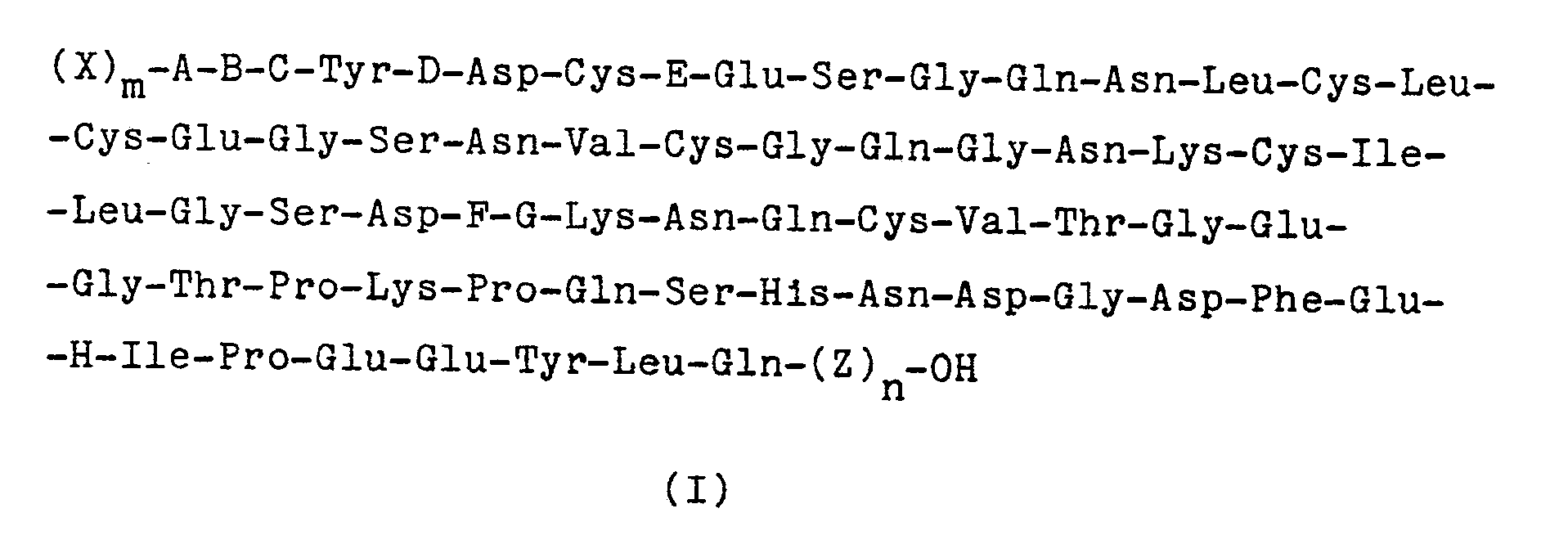
in welcher - m=
- 0 - 50,
- n=
- 0 - 100 und
- X
- für gleiche oder verschiedene Reste genetisch codierbarer Aminosäuren steht,
- A
- Ile oder eine direkte Bindung,
- B
- Ile, Thr oder eine direkte Bindung,
- C
- Thr, Val, Ile, Leu oder Phe,
- D
- Thr oder eine direkte Bindung,
- E
- Thr oder Ile,
- F
- Gly oder eine direkte Bindung,
- G
- Glu oder eine direkte Bindung,
- H
- Glu oder Pro bedeuten, und
- Z
- für gleiche oder verschiedene Reste genetisch codierbarer Aminosäuren steht und
- Das erforderliche Gen kann nach bekannten Methoden chemisch synthetisiert, aus dem Genom isoliert und prozessiert werden oder aus induzierten Zellen nach bekannten Methoden die mRNA isoliert und hieraus die cDNA gewonnen werden.
- Bevorzugt ist der Weg über die cDNA und vor allem die chemische Synthese, insbesondere nach der Phosphit-Methode. Bevorzugt ist weiterhin die Synthese eines Gens, welches für das Polypeptid der Formel I codiert, in welcher m 1 und n Null ist, X für Met oder Arg, B für Thr oder eine direkte Bindung, C für Thr und G für Glu stehen. Eine weitere bevorzugte Ausführungsform der Erfindung betrifft Polypeptide der Formel I, in der (X)m-A-B-C- nicht für Val-Val steht, wenn n Null ist, D und E Thr, F Gly und G und H Glu bedeuten.
- Besonders bevorzugt ist die Synthese von Polypeptiden der Formel I, in denen
m 1 ist, X Met oder Arg, A und B direkte Bindungen, C, D und E Thr, F Gly, G und H Glu und n Null bedeuten. Die hierfür bevorzugte DNA-Sequenz I ist im Anhang wiedergegeben und dient im folgenden zur Erläuterung der Erfindung. - Der genetische Code ist bekanntlich "entartet", d.h. daß nur für zwei Aminosäuren eine einzige Nucleotid-Sequenz codiert, während den restlichen 18 genetisch codierbaren Aminosäuren 2 bis 6 Tripletts zuzuordnen sind. Von den hierdurch gegebenen Variationsmöglichkeiten machen außerdem die Wirtszellen unterschiedlicher Spezies nicht immer den gleichen Gebrauch. Für die Synthese der Gene besteht somit eine unübersehbare Vielfalt von Codon-Möglichkeiten.
- Es wurde nun gefunden, daß die DNA-Sequenz I (Anhang), die für die gesamte Aminosäurensequenz codiert, sowie die zur Synthese der Sequenz I benutzten DNA-Teilsequenzen II A und II B besonders vorteilhaft für die gentechnologische Synthese der besonders bevorzugten Form des Hirudin sind. Am 5'-Ende des codierenden Stranges der DNA-Sequenz I befindet sich eine "überhängende" DNA-Sequenz, entsprechend der Restriktionsendonuclease XbaI, am 3'-Ende des codierenden Stranges dagegen die einzelsträngige, überhängende Sequenz entsprechend dem Restriktionsenzym Sal I. Diese beiden unterschiedlichen Erkennungssequenzen gewährleisten die Insertion der DNA in Plasmide in der gewünschten Orientierung. (Es ist aber auch möglich, gleiche Erkennungssequenzen zu wählen und nach Charakterisierung der Plasmid-DNA mittels entsprechender Restriktions- oder DNA-Sequenzanalyse oder durch Expression eine entsprechende Selektion vorzunehmen).
- Zwischen diesen Erkennungssequenzen und den Codons für die Aminosäurefolge befindet sich am 5'-Ende des codierenden Stranges das Codon für die Aminosäure Methionin (das in der DNA-Sequenz I mit 0 beziffert ist). Alternativ hierzu kann eine Praesequenz (auch Signal- oder leader-Sequenz genannt) eines bakteriellen oder sonstigen wirtseigenen Proteins stehen (Übersichtsartikel: Perlman und Halvorson; J. Mol. Biol. 167 (1983), 391), welche die Sekretion des gewünschten Polypeptids aus dem Cytoplasma bewirkt und bei diesem Exkretionsprozeß von einer in der Wirtszelle natürlich vorkommenden Signal-Peptidase abgespalten wird. Am Ende des codierenden Stranges folgen dann erfindungsgemäß auf das für Glutamin codierende Triplett ein Stop-Codon oder bevorzugt - wie in der DNA-Sequenz I dargestellt - zwei Stop-Tripletts. Zwischen diesen stop-codons und dem überhängenden SalI-Ende ist zusätzlich in der DNA-Sequenz I eine Nucleotidsequenz entsprechend dem Restriktionsenzym SstI eingebaut.
- Eine interne singuläre Schnittstelle für das Restriktionsenzym Bam HI (im Codon 30/31) ermöglicht die Subklonierung zweier Genfragmente HIR-I und HIR-II (siehe DNA-Sequenz II), die in gut untersuchte Klonierungsvektoren, wie etwa pBR 322, pUC 8 oder pUC 12, eingebaut werden können. Zusätzlich wurden innerhalb des Gens eine Reihe von weiteren singulären Erkennungssequenzen für Restriktionsenzyme eingebaut, die einerseits einen Zugang zu Teilsequenzen des Hirudin schaffen und andererseits die Durchführung von Variationen erlauben (Tabelle 1):
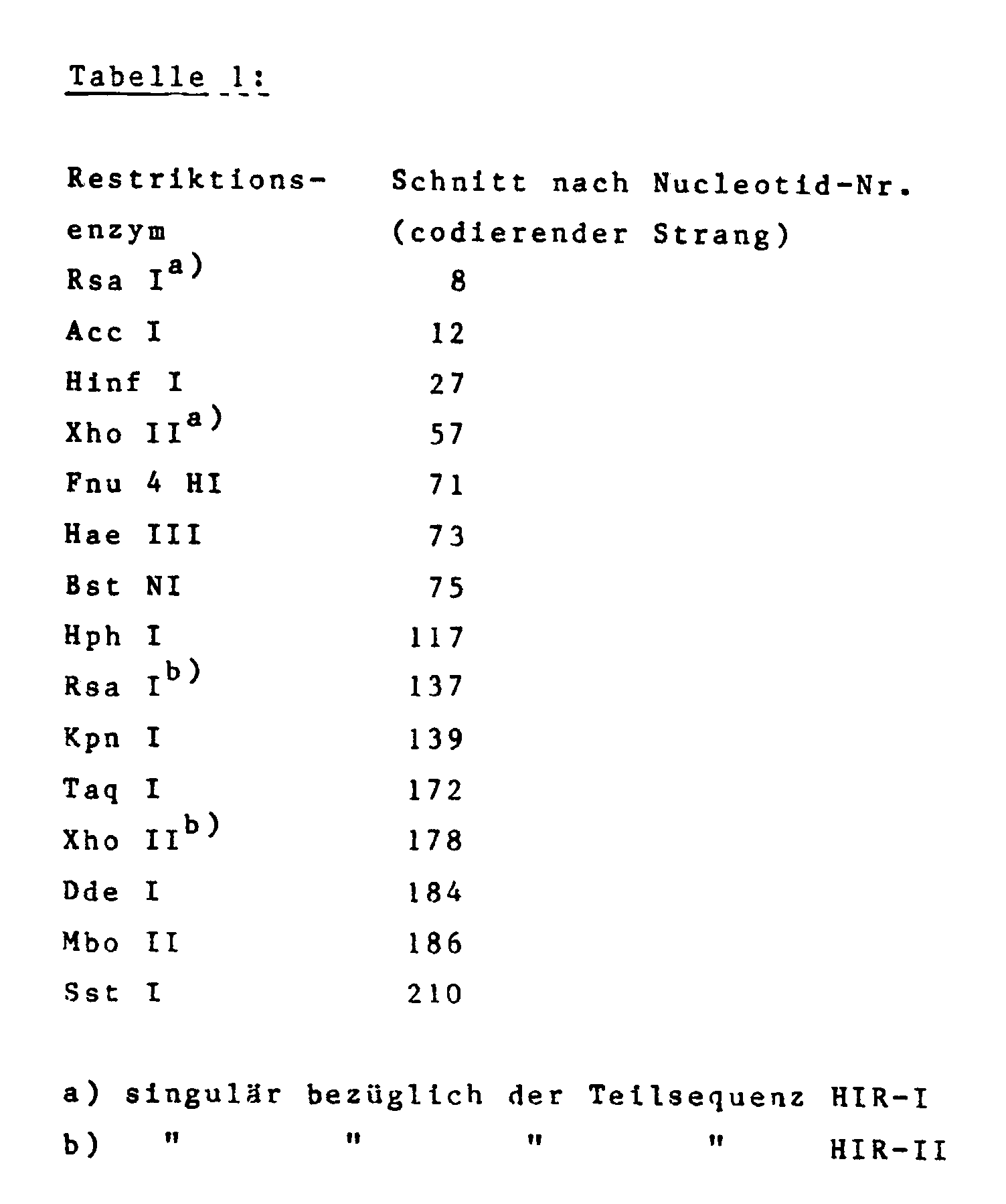
- Die DNA-Sequenz I läßt sich aus 14 Oligonucleotiden mit einer Länge von 25 bis 35 Nucleotiden aufbauen (siehe DNA-Sequenz II),indem diese zunächst chemisch synthetisiert und dann über "sticky ends" von 4 bis 6 Nucleotiden enzymatisch verknüpft werden.
- Bei der DNA-Sequenz I wurde weiterhin berücksichtigt, daß bei denjenigen Aminosäuren, denen mehrere Codons zuzuordnen sind, diese nicht gleichwertig sind, sondern vielmehr in der jeweiligen Wirtszelle wie E. coli unterschiedliche Präferenzen zeigen. Weiterhin wurden palindromische Sequenzen auf ein Mindestmaß reduziert.
- Die Genstruktur der DNA-Sequenz I ist somit leicht aus relativ kleinen Bausteinen zugänglich, ermöglicht die Subklonierung zweier Genfragmente in gut bekannte Vektoren und erlaubt deren Kombination zum Gesamtgen sowie gegebenenfalls Veränderungen derselben.
- Je nach Einbau des synthetischen Gens in den Klonierungsvektor wird das erwünschte Peptid mit der Aminosäuresequenz des Hirudins unmittelbar (DNA-Sequenz IC) oder in Form eines Fusionsproteins mit einem bakteriellen Protein wie β-Galactosidase oder Partialsequenzen desselben exprimiert. Solche Fusionsproteine können dann in bekannter Weise chemisch oder enzymatisch gespalten werden. Steht beispielsweise in der Position 0 der Sequenz I die Aminosäure Methionin (DNA-Sequenz IA), so kann eine chemische Spaltung mit Bromcyan erfolgen, steht in dieser Position die Aminosäure Arginin (DNA-Sequenz IB), so kann eine enzymatische Spaltung mit Trypsin erfolgen.
- Bevorzugte Variationen der Aminosäuresequenzen sind in der Tabelle 2 dargestellt, wobei m und n Null sind:

Diese Modifikationen lassen sich nach Zusammensetzung des synthetischen Gens auf DNA-Ebene leicht durch Austausch der entsprechenden Genfragmente gegen de-novo-synthetisierte DNA-Sequenzen unter Ausnutzung entsprechender Restriktionsenzym-Schnittstellen realisieren. - Als Beispiel für eine Variation der Aminosäuresequenz sei das (bekannte) Polypeptid der Formel I genannt, in der m 1 ist, X und C für Val stehen, A und B direkte Bindungen darstellen, D und E Thr, F Gly, G und H Glu und n Null bedeuten. Diese Modifikation läßt sich auf der DNA-Ebene leicht über die Schnittstelle entsprechend dem Restriktionsenzym Acc I realisieren.
- Der Einbau der synthetischen Gene bzw. Genfragmente in Klonierungsvektoren, beispielsweise in die handelsüblichen Plasmide pUC 8, pUC 12 und pBR 322 bzw. andere allgemein zugängliche Plasmide wie ptac 11 und pKK 177.3, erfolgt in an sich bekannter Weise. Auch können die chemisch synthetisierten Gene zuvor mit geeigneten chemisch synthetisierten Kontrollregionen versehen werden, die eine Expression der Proteine ermöglichen. Hierzu kann auf das Lehrbuch von Maniatis (Molecular Cloning, Maniatis et al., Cold Spring Harbor, 1982) verwiesen werden. Die Transformation der so erhaltenen Hybridplasmide in geeignete Wirtsorganismen, vorteilhaft E. coli, ist ebenfalls an sich bekannt und in dem vorstehend genannten Lehrbuch eingehend beschrieben. Die Gewinnung des exprimierten Proteins und dessen Reinigung können nach an sich bekannten Verfahren erfolgen.
- Die erfindungsgemäß erhaltenen Genfragmente HIR-I und HIR-II, die damit erhaltenen Hybridplasmide und die transformierten Wirtsorganismen sind neu und Gegenstand der Erfindung. Dasselbe gilt für aus der DNA-Sequenz I abgewandelte neue DNA-Sequenzen. Weitere Ausgestaltungen der Erfindung sind in den Patentansprüchen niedergelegt.
- In den folgenden Beispielen werden noch einige Ausgestaltungen der Erfindung im einzelnen erläutert, woraus sich die Vielzahl der möglichen Abwandlungen und Kombinationen für den Fachmann ergeben. Prozentangaben beziehen sich hierbei auf das Gewicht, wenn nichts anderes angegeben ist.
- Am Beispiel des Genbausteins Ia, der die Nucleotide 1-32 des codierenden Strangs umfaßt, wird die Synthese der Genbausteine erläutert. Nach bekannten Methoden (M.J. Gait et al., Nucleic Acids Res. 8 (1980) 1081-1096)) wird das am 3'-Ende stehende Nucleosid, im vorliegenden Falle also Thymidin (Nucleotid Nr. 32), an Kieselgel ((R)FRACTOSIL, Firma Merck) über die 3'-Hydroxyfunktion covalent gebunden. Hierzu wird zunächst das Kieselgel unter Abspaltung von Ethanol mit 3-(Triethoxysilyl)-propylamin umgesetzt, wobei eine Si-O-Si-Bindung entsteht. Das Thymidin wird als 3'-O-Succinoyl-5'-dimethoxytritylether in Gegenwart von Paranitrophenol und N,N'-Dicyclohexylcarbodiimid mit dem modifizierten Träger umgesetzt, wobei die freie Carboxygruppe der Succinoylgruppe den Aminorest der Propylaminogruppe acyliert.
- In den folgenden Syntheseschritten wird die Basenkomponente als 5'-O-Dimethoxytrityl-nucleosid-3'-phosphorigsäuremonomethylester-dialkylamid oder -chlorid eingesetzt, wobei das Adenin als N⁶-Benzoyl-Verbindung, das Cytosin als N⁴-Benzoyl-Verbindung, das Guanin als N²-Isobutyryl-Verbindung und dar keine Aminogruppe enthaltende Thymin ohne Schutzgruppe vorliegen.
- 50 mg des polymeren Trägers, der 2 µmol Thymidin gebunden enthält, werden nacheinander mit den folgenden Agentien behandelt:
- a) Nitromethan,
- b) gesättigte Zinkbromidlösung in Nitromethan mit 1 % Wasser,
- c) Methanol,
- d) Tetrahydrofuran,
- e) Acetonitril,
- f) 40 µmol des entsprechenden Nucleosidphosphits und 200 µmol Tetrazol in 0,5 ml wasserfreiem Acetonitril (5 Minuten),
- g) 20 % Acetanhydrid in Tetrahydrofuran mit 40 % Lutidin und 10 % Dimethylaminopyridin (2 Minuten),
- h) Tetrahydrofuran,
- i) Tetrahydrofuran mit 20 % Wasser und 40 % Lutidin,
- j) 3 % Jod in Kollidin/Wasser/Tetrahydrofuran im Volumenverhältnis 5:4:1,
- k) Tetrahydrofuran und
- l) Methanol.
- Unter "Phosphit" wird hierbei der Desoxyribose-3'-monophosphorigsäure-monomethylester verstanden, wobei die dritte Valenz durch Chlor oder eine tertiäre Aminogruppe, beispielsweise einen Morpholinorest, abgesättigt ist. Die Ausbeuten der einzelnen Syntheseschritte können jeweils nach der Detritylierungsreaktion b) spektrophotometrisch durch Messung der Absorption des Dimethoxytritylkations bei einer Wellenlänge von 496 nm bestimmt werden.
- Nach abgeschlossener Synthese des Oligonucleotids werden die Methylphosphatschutzgruppen des Oligomers mit Hilfe von p-Thiokresol und Triethylamin abgespalten.
- Anschließend wird durch 3-stündige Behandlung mit Ammoniak das Oligonucleotid vom festen Träger abgetrennt. Eine 2- bis 3-tägige Behandlung der Oligomeren mit konzentriertem Ammoniak spaltet die Aminoschutzgruppen der Basen quantitativ ab. Das so erhaltene Rohprodukt wird durch Hochdruckflüssigkeitschromatographie (HPLC) oder durch Polyacrylamid-Gelelektrophorese gereinigt.
- Ganz entsprechend werden auch die übrigen Genbausteine Ib-IIh synthetisiert, deren Nucleotidfolge aus der DNA-Sequenz II hervorgeht.
- Zur Phosphorylierung der Oligonucleotide am 5'-Terminus wurde je 1 nmol der Oligonucleotide Ib bis Ie mit 5 nmol Adenosintriphosphat mit vier Einheiten T4-Polynucleotid-Kinase in 20 µl 50 mM Tris-HCl-Puffer (pH 7,6), 10 mM Magnesiumchlorid und 10 mM Dithiothreitol (DTT) 30 Minuten bei 37°C behandelt. Das Enzym wird durch fünfminütiges Erhitzen auf 95°C desaktiviert. Die Oligonucleotide Ia, If, IIa und IIh, welche in der DNA-Sequenz IIA und IIB die "überhängende" Sequenz bilden, werden nicht phosphoryliert. Dies verhindert bei der nachfolgenden Ligation die Ausbildung größerer Subfragmente als sie der DNA-Sequenz IIA oder IIB entsprechen.
- Die Oligonucleotide Ia-If werden wie folgt zum Subfragment HIR-I ligiert: Je 1 mmol der Oligonucleotide Ia und If sowie der 5'-Phosphate von Ib, Ic, Id und Ie werden zusammen in 45 µl Puffer, enthaltend 50 mM Tris-HCl (pH 7,6), 20 mM Magnesiumchlorid, 25 mM Kaliumchlorid und 10 mM DTT, gelöst. Für das "Annealing" der Oligonucleotide gemäß DNA-Sequenz IIA wird die Lösung der Oligonucleotide 2 Minuten auf 95°C erhitzt und dann langsam (2-3 Stunden) auf 20°C abgekühlt. Zur enzymatischen Verknüpfung setzt man dann 2 µl 0,1 M DTT, 8 µl 2,5 mM Adenosintriphosphat (pH 7) sowie 5 µl T4-DNA-Ligase (2 000 Units) zu und inkubiert 16 Stunden bei 22°C.
- Analog werden die Oligonucleotide IIb bis IIg phosphoryliert und dann mit den Oligonucleotiden IIa und IIh zusammen zum Subfragment HIR-II ligiert.
- Die Reinigung der Genfragmente HIR-I und HIR-II erfolgt durch Gelelektrophorese auf einem 10%igen Polyacrylamidgel (ohne Harnstoffzusatz, 20 · 40 cm, 1 mm Dicke), wobei als Markersubstanz ØX 174 DNA (Fa. BRL), geschnitten mit Hinf I, oder pBR 322, geschnitten mit Hae III, dient.
-
- a) Einbau des Genfragmentes HIR-I in pUC 12
Das handelsübliche Plasmid pUC 12 wird in bekannter Weise mit den Restriktionsendonucleasen Xba I und Bam HI nach den Angaben der Hersteller geöffnet. Der Verdauungsansatz wird auf einem 5%igen Polyacrylamidgel durch Elektrophorese in bekannter Weise aufgetrennt und die Bruchstücke durch Anfärben mit Ethidiumbromid oder durch radioaktive Markierung ("Nick-Translation" nach Maniatis, a.a.O.) sichtbar gemacht. Die Plasmidbande wird anschließend aus dem Acrylamidgel ausgeschnitten und elektrophoretisch vom Polyacrylamid abgetrennt. Die Auftrennung des Verdauungsansatzes kann auch auf 2%igen niedrigschmelzenden Agarosegelen (wie in Beispiel 5a) beschrieben) erfolgen.
1 µg Plasmid wird dann mit 10 ng Genfragment HIR-I, das zuvor wie in Beispiel 2 beschrieben phosphoryliert wurde, über Nacht bei 16°C ligiert. Man erhält das Hybridplasmid gemäß Figur 1. - b) Einbau des Genfragments HIR-II in pUC 8
Analog zu a) wird das handelsübliche Plasmid pUC 8 mit Bam HI und Sal I aufgeschnitten und mit dem Genfragment HIR-II, das zuvor wie in Beispiel 2 beschrieben phosphoryliert wurde, ligiert. Man erhält das Hybridplasmid gemäß Figur 2. -
- a) Transformation und Amplifikation
Die so erhaltenen Hybridplasmide werden in E. coli transformiert. Hierzu wird der Stamm E. coli K 12 durch Behandlung mit einer 70 mM Calciumchloridlösung kompetent gemacht und mit der Suspension des Hybridplasmids in 10 mM Tris-HCl-Puffer (pH 7,5), der 70 mM an Calciumchlorid ist, versetzt. Die transformierten Stämme werden wie üblich unter Ausnutzung der durch das Plasmid vermittelten Antibiotikaresistenzen bzw. -empfindlichkeiten selektioniert und die Hybridvektoren amplifiziert. Nach Abtöten der Zellen werden die Hybridplasmide isoliert, mit den ursprünglich eingesetzten Restriktionsenzymen aufgeschnitten und die Genfragmente HIR-I und HIR-II durch Gelelektrophorese isoliert. - b) Verknüpfung der Genfragmente
Die durch Amplifikation erhaltenen Subfragmente HIR-I und HIR-II werden wie im Beispiel 2 beschrieben (Annealing bei 60°C) enzymatisch verknüpft und das so erhaltene synthetische Gen mit der DNA-Sequenz I in den Klonierungsvektor pUC 12 eingeführt. Man erhält ein Hybridplasmid gemäß Figur 3. - c) Herstellung eines Gens für Val¹, Val² -Hirudin
Aus dem Plasmid gemäß Figur 3 wird wie in Beispiel 5a) beschrieben das AccI-SalI-Fragment (Nucleotide 13-212) erhalten, welches dann mit Hilfe des folgenden Adaptorsin das Plasmid pUC 12, das zuvor mit XbaI und SalI geöffnet wurde, ligiert werden kann.
- d) Herstellung eines Gens für die Variante a) der Tabelle 2
Hierzu wird die folgende DNA-Sequenz synthetisiert:Diese Sequenz kann als SmaI-AccI-Adaptor in die mit den Restriktionsenzymen SmaI und AccI geöffnete DNA aus dem Plamid gemäß Figur 3 eingebaut werden.
- e) Herstellung eines Gens für die Variante b) der Tabelle 2
Zunächst wird die folgende DNA-Sequenz synthetisiert:Diese um das ACA-Triplett verkürzte DNA-Sequenz wird wie unter d) beschrieben eingebaut.
- f) Herstellung eines Gens für die Variante c) der Tabelle 2
Man geht von der DNA-Sequenz aus, wie sie vorstehend unter e) beschrieben ist (Variante b) der Tabelle 2). Nach Spaltung mit AccI und SalI erhält man zwei Fragmente, die isoliert werden. Das AccI-SalI-(Hirudin)-Fragment wird mit dem Enzym HinfI geschnitten und das größere der erhaltenen Fragmente isoliert. Dieses Fragment, die mit AccI-SalI-geöffnete Restplasmid-DNA und die synthetische DNA-Sequenzwerden im gleichen Gefäß ligiert. Das erhaltene Hybridplasmid kodiert für die Variante c) der Tabelle 2.
- g) Herstellung eines Gens für die Variante d) der Tabelle 2
Man geht ebenfalls von der DNA-Sequenz aus, wie sie vorstehend unter e) beschrieben ist (also für die Variante b) der Tabelle 2 kodiert), die mit AccI und SalI geschnitten wird. Das AccI-SalI-(Hirudin)-Fragment wird aber mit TaqI und DdeI umgesetzt und das herausgespaltene Fragment durch die synthetische DNA-Sequenzersetzt. Das derart veränderte AccI-SalI-(Hirudin)-Fragment wird nun mit der Restplasmid-DNA ligiert. Das erhaltene Plasmid kodiert für die Variante d) der Tabelle 2.
- h) Herstellung eines Gens für die Variante g) der Tabelle 2
Aus dem Hybridplasmid gemäß Figur 2 wird das BamHI-SalI-(Hirudin)-Fragment isoliert und mit KpnI nachgeschnitten. Das größere der beiden entstandenen Fragmente wird isoliert und mit der synthetischen DNA-Sequenzligiert. Das Ligationsprodukt wird nun mit dem XbaI-BamHI-(Hirudin)-Fragment, isoliert aus Plasmid-DNA gemäß Figur 1, verknüpft und - wie unter 4b) beschrieben - in pUC 12 eingeführt. Man erhält ein Hybridplasmid, das für die Variante g) der Tabelle 2 kodiert.
- i) Herstellung eines Gens für die Variante f) der Tabelle 2
Aus der DNA, die für die Variante g) der Tabelle 2 kodiert, wird das XbaI-SalI-(Hirudin)-Fragment isoliert und mit HinfI umgesetzt. Das größere der beiden entstandenen Fragmente wird dann mit der synthetischen DNA-Sequenzligiert und das Ligationsprodukt in das mit XbaI und SalI geöffnete Plasmid pUC 12 inseriert. Das Hybridplasmid kodiert für die Variante f) der Tabelle 2.
- j) Herstellung weiterer Varianten
Als Beispiele für weitere mögliche Varianten seien die folgenden angeführt:
Die DNA-Sequenzen, die für die Varianten c) und d) der Tabelle 2 kodieren, enthalten die BamHI-Erkennungsstelle entsprechend Position 97 bp der DNA-Sequenz I. Unter Ausnutzung dieser Schnittstelle lassen sich nun die vorstehend beschriebenen AccI-BamHI- bzw. BamHI-SalI-Teilsequenzen der beiden Varianten beliebig miteinander verknüpfen. - Alle diese Varianten können, analog wie für die DNA-Sequenz I beschrieben, in E. coli transformiert und exprimiert werden.
-
- a) Einbau der DNA-Sequenz IC in pKK 177.3 (Direktexpression)
Das Expressionsplasmid pKK 177.3 (Plasmid ptac 11, Amman et al., Gene 25 (1983) 167, bei dem in die Eco RI-Erkennungsstelle synthetisch eine Sequenz eingebaut wurde, die eine Sal I-Schnittstelle enthält) wird mit den Restriktionsenzymen Eco RI und Sal I geöffnet. Aus dem Plasmid gemäß Figur 3 wird die DNA-Sequenz IC folgendermaßen gewonnen. Man schneidet das Plasmid zuerst mit dem Restriktionsenzym Sal I, dann mit dem Enzym Acc I und trennt dann das kleine Acc I - Sal I-Fragment durch Gelelektrophorese auf einem 2%igen niedrig schmelzenden Agarosegel von der Plasmidbande ab, indem man die DNA durch Auflösen des Gels bei erhöhter Temperatur (nach Maßgabe der Hersteller) wiedergewinnt. Dieses DNA-Fragment läßt sich mit Hilfe des folgenden AdaptorsDurch Ligation des aufgeschnittenen Plasmids pKK 177.3 mit dem Gen IC wird ein Hybridplasmid geschaffen, bei dem der Insertion eine Expressions- bzw. Regulationsregion vorgeschaltet ist. Nach Zugabe eines geeigneten Induktors wie Isopropyl-β-thiogalactopyranosid (IPTG) wird eine mRNA gebildet, die zur Expression des Methionyl-Polypeptids entsprechend der DNA-Sequenz IC führt.
- b) Einbau der Hirudin-Gene IA bzw. IB in das Expressionsplasmid pCK-5196 (Fusionskonstruktion)
- Das Expressionsplasmid pCK-5196 (Fig. 4) ist ein Derivat des Plasmids pAT 153 (Twigg u. Sherrat), welches selbst ein "high-copy-number"-Derivat des bekannten Plasmids pBR 322 darstellt. Es enthält den bekannten Lac UV⁵-Promotor mit der bekannten Sequenz der β-Galaktosidase bis Nukleodid Nr. 1554 (entsprechend Aminosäure Nr. 518:Trp), eingesetzt zwischen das tetR-Gen (Hind III von pBR 322) und den Terminator des ampR-Gens (Aha III in Pos. 3231 in pBR 322). Ein weiteres Merkmal dieses Vektors ist die zwischen die β-Galaktosidasesequenz und die Terminatorsequenz eingesetzte, aus dem bekannten Plasmid pUC 13 stammende Polylinker-Sequenz. Die Transkription des lac UV⁵-Promoters läuft gegen das tetR-Gen ab.
- Dieses Plasmid enthält bei der Aminosäure Nr. 518 der β-Galactosidase den Polylinkeranteil Xba I-Bam HI-Sma I-Sst I aus dem Plasmid pUC 13, der als Klonierungsstelle für eukaryotische Gene dient. Das Plasmid pCK-5196 wird mit Hilfe der Restriktionsenzyme Xba I und Sst I geöffnet und mit der DNA-Sequenz IA ligiert, welche man aus dem Plasmid gemäß Fig. 3 durch Xba I-Sst I-Verdauung isolieren kann. Man erhält ein Hybridplasmid gemäß Fig. 5, das hinter der lac UV⁵-Kontrollregion die Codons für die ersten 518 Aminosäuren der β-Galactosidase und daran anschließend die Codons für Ser-Arg-Met-(Hirudin 1-64) enthält.
- Auf gleiche Weise kann man ein Hybridplasmid gem. Fig. 6 erhalten, welches im Plasmid pCK-5196 die Insertion mit der DNA-Sequenz IB enthält, bei welcher dem Codon für die Aminosäure Nr. 1 (Threonin) nun aber das Codon für die Aminosäure Arginin vorangestellt ist. Die DNA-Sequenz IB erhält man aus dem Plasmid gemäß Fig. 3, indem man dieses mit den Restriktionsenzymen Sst 1 und Acc I schneidet und mit dem folgenden Adaptor ligiert:

- Kompetente E. coli-Zellen werden mit 0,1 bis 1 µg der Hybridplasmide, die die Sequenz I bzw. IA, IB oder IC enthalten, transformiert und im Falle der tac-Plasmide auf Ampicillin enthaltenden Agarplatten, im Falle der pCK-5196 Hybridplasmide auf Tetracyclin enthaltenden Agarplatten plattiert. Anschließend lassen sich Klone, die die korrekt integrierten Hirudin-Sequenzen in den entsprechenden Plasmiden enthalten, durch DNA-Schnellaufarbeitung identifizieren (Maniatis, a.a.O.).
- Nach Transformation der genannten tac-Hybridplasmide in E. coli wird ein Polypeptid exprimiert, das außer der Hirudin-Aminosäuresequenz am Aminoterminus noch eine zusätzliche Methionylgruppe trägt, welche aber durch Bromcyanspaltung eliminierbar ist. Dagegen erhält man nach der Transformation von E. coli mit dem Hybridplasnid gemäß Fig. 5 bzw. Fig. 6 Fusionsproteine aus 518 Aminosäuren der β-Galactosidase und Hirudin, die über die Sequenz Ser-Arg-Met bzw. Ser-Arg-Arg miteinander verbrückt sind. Diese Fusionsproteine lassen sich mit Bromcyan bzw. mit Trypsin zu Hirudin und β-Galactosidase-Fragmenten spalten.
- Die zur gewünschten optischen Dichte kultivierten Bakterienstämme werden mit einem geeigneten Induktor, beispielsweise IPTG, hinreichend lange, beispielsweise 2 Stunden, inkubiert. Anschließend werden die Zellen mit 0,1 % Kresol und 0,1 mM Benzylsulfonylfluorid abgetötet.
- Nach Zentrifugieren oder Filtrieren wird die Zellmasse in einer Pufferlösung (50 mM Tris, 50 mM EDTA, pH 7,5) aufgenommen und mechanisch aufgeschlossen, beispielsweise mit einer French-Presse bzw. (R)DYNO-Mühle (Fa. Willy Bachofer, Basel), worauf die unlöslichen Bestandteile abzentrifugiert werden. Aus dem Überstand wird das das Hirudin enthaltende Protein nach üblichen Verfahren gereinigt. Geeignet sind Ionenaustauscher-, Adsorptions-, Gelfiltrationssäulen oder Affinitätschromatographie an Thrombin- oder Antikörpersäulen. Durch Natriumdodecylsulfat-Acrylamidgel-oder HPLC-Analytik werden Anreicherung und Reinheit des Produktes kontrolliert. Fusionsproteine mit einem β-Galactosidase-Anteil lassen sich bereits im Rohextract der lysierten Bakterien anhand ihres unterschiedlichen Laufverhaltens von der β-Galactosidase (1-518) nachweisen. Die Charakterisierung des gentechnologisch erzeugten Hirudins erfolgt durch Vergleich mit der aus Blutegeln isolierten, authentischen Substanz bzw. mit Hilfe von Tests, die auf den blutgerinnungshemmenden Eigenschaften des Hirudins beruhen.


Claims (9)
- Verfahren zur Herstellung eines Polypeptids mit Hirudinaktivität der allgemeinen Formel Iin welcher
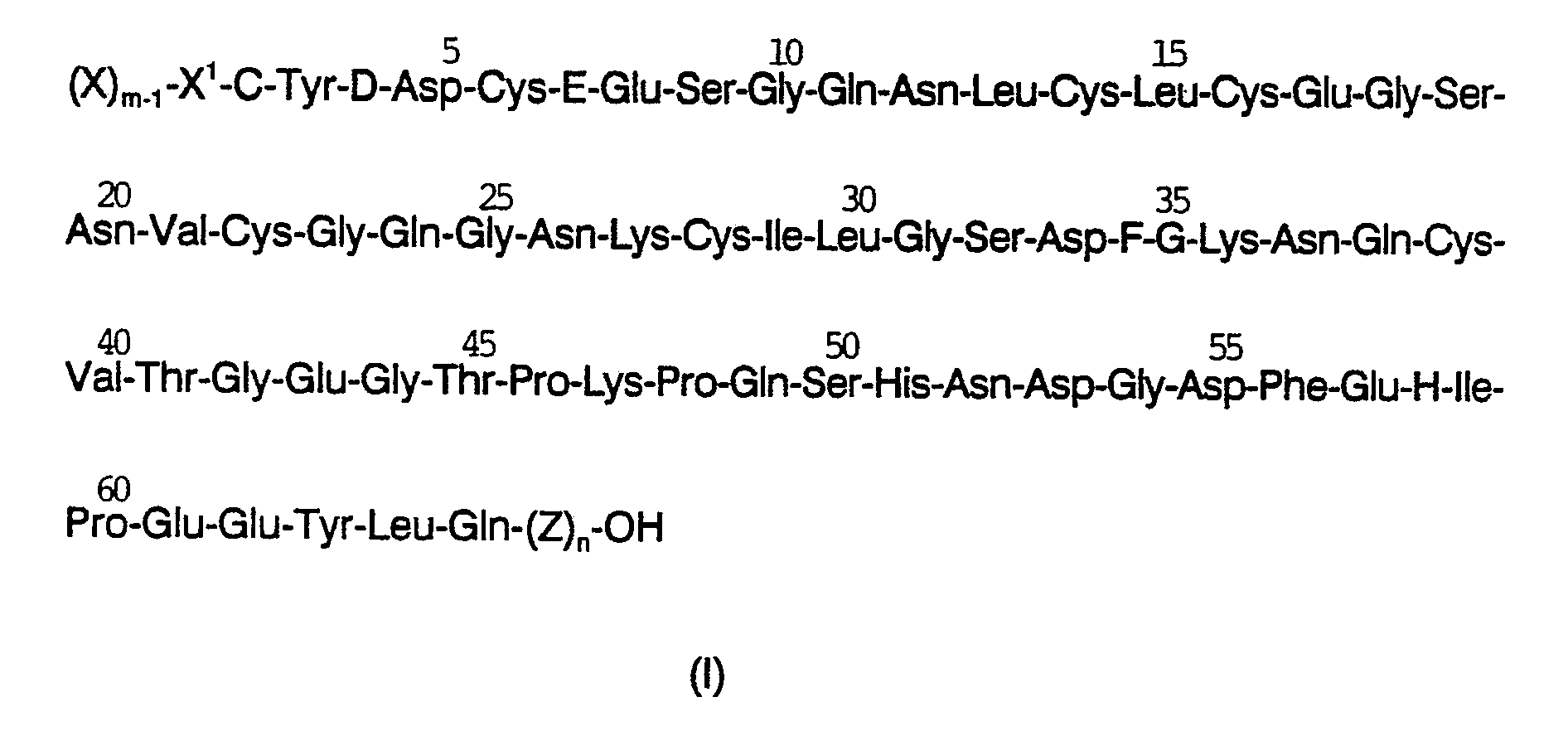 m = 0 - 50,n = 0 - 100 undX und X¹ für gleiche oder verschiedene Reste genetisch codierbarer Aminosäuren stehen,C Thr, Val, Ile, Leu oder Phe,D Thr,E Thr,F Gly,G Glu,H Glu bedeuten, undZ für gleiche oder verschiedene Reste genetisch codierbarer Aminosäuren steht,dadurch gekennezeichnet, daß man in ein Expressionsplasmid ein Gen einbaut, das für ein Polypetid der Formel I codiert, wobei weitere der Aminosäuren entfallen oder durch (eine) andere genetisch codierbare Aminosäure(n) ersetzt werden kann (können), wobei die Herstellung der folgenden Polypeptide ausgenommen ist, in denena) X¹ und C beide Val oderb) X¹ Ile und C Thr bedeuten oderc) N-terminal Aminosäuren bis zu Position 10 eliminiert sind.
 - Verfahren nach Anspruch 1, dadurch gekennzeichnet, daß man ein Gen einbaut, dessen nicht-codierbarer Strang mit dem codierenden Strang des für das Polypeptid der Formel I codierenden Gens hybridisiert.
- Verfahren nach Anspruch 1 oder 2, dadurch gekennzeichnet, daß das Gen chemisch, vorzugsweise nach dem Phosphitverfahren, synthetisiert wird.
- Verfahren nach einem oder mehreren der vorhergehenden Ansprüche, dadurch gekennzeichnet, daß das Gen im Anschluß an das Codon für die carboxyterminale Aminosäure zwei Stop-Codons enthält.
- Verfahren nach einem oder mehreren der vorhergehenden Ansprüche, dadurch gekennzeichnet, daß das Gen der DNA-Sequenz I in Tabelle 1 entspricht.
Priority Applications (1)
| Application Number | Priority Date | Filing Date | Title |
|---|---|---|---|
| AT85109567T ATE67245T1 (de) | 1984-08-10 | 1985-07-30 | Gentechnologisches verfahren zur herstellung von hirudinen und mittel zur durchfuehrung dieses verfahrens. |
Applications Claiming Priority (2)
| Application Number | Priority Date | Filing Date | Title |
|---|---|---|---|
| DE3429430 | 1984-08-10 | ||
| DE19843429430 DE3429430A1 (de) | 1984-08-10 | 1984-08-10 | Gentechnologisches verfahren zur herstellung von hirudin und mittel zur durchfuehrung dieses verfahrens |
Publications (2)
| Publication Number | Publication Date |
|---|---|
| EP0171024A1 EP0171024A1 (de) | 1986-02-12 |
| EP0171024B1 true EP0171024B1 (de) | 1991-09-11 |
Family
ID=6242746
Family Applications (1)
| Application Number | Title | Priority Date | Filing Date |
|---|---|---|---|
| EP85109567A Expired - Lifetime EP0171024B1 (de) | 1984-08-10 | 1985-07-30 | Gentechnologisches Verfahren zur Herstellung von Hirudinen und Mittel zur Durchführung dieses Verfahrens |
Country Status (18)
| Country | Link |
|---|---|
| EP (1) | EP0171024B1 (de) |
| JP (1) | JPH0811073B2 (de) |
| KR (1) | KR930009337B1 (de) |
| AT (1) | ATE67245T1 (de) |
| AU (1) | AU584628B2 (de) |
| CA (1) | CA1341124C (de) |
| DE (2) | DE3429430A1 (de) |
| DK (1) | DK175337B1 (de) |
| ES (1) | ES8605040A1 (de) |
| FI (1) | FI91883C (de) |
| GR (1) | GR851962B (de) |
| HU (1) | HU206135B (de) |
| IE (1) | IE58485B1 (de) |
| IL (1) | IL76059A (de) |
| NO (1) | NO177434C (de) |
| NZ (1) | NZ213049A (de) |
| PT (1) | PT80930B (de) |
| ZA (1) | ZA856026B (de) |
Cited By (35)
| Publication number | Priority date | Publication date | Assignee | Title |
|---|---|---|---|---|
| WO1986003517A1 (en) * | 1984-12-13 | 1986-06-19 | Gen-Bio-Tec Gesellschaft Für Gentechnologische Und | Dna sequence encoding a hirudin-like protein and process for preparing such protein |
| EP0252854A1 (de) * | 1986-07-10 | 1988-01-13 | Transgene S.A. | Funktioneller DNS-Block und für Hirudin kodierendes Plasmid, transformierte Hefe aud Verfahren zur Herstellung von Hirudin. |
| FR2601383A2 (fr) * | 1985-05-02 | 1988-01-15 | Transgene Sa | Vecteurs perfectionnes d'expression de l'hirudine dans les levures, procede et produit obtenu |
| FR2607517A2 (fr) * | 1986-12-01 | 1988-06-03 | Transgene Sa | Vecteurs d'expression de variants de l'hirudine dans les levures, procede et produit obtenu |
| FR2607516A2 (fr) * | 1986-12-01 | 1988-06-03 | Transgene Sa | Vecteurs perfectionnes d'expression d'un variant de l'hirudine dans les levures, procede et produit obtenu |
| EP0158986A3 (en) * | 1984-04-18 | 1988-09-21 | Hoechst Aktiengesellschaft | Peptides having an anticoagulant activity, process for their preparation, their isolation and use, and agents containing them |
| EP0227938A3 (en) * | 1985-11-27 | 1988-11-23 | Hoechst Aktiengesellschaft | Eucaryotic fusion proteins, their preparation and use, and agents for carrying out the process |
| EP0225633A3 (en) * | 1985-12-12 | 1988-11-30 | Ciba-Geigy Ag | Production of thrombin inhibitors |
| EP0209061A3 (en) * | 1985-07-17 | 1989-03-15 | Hoechst Aktiengesellschaft | Peptides having an anticoagulant activity, process for their preparation, obtention, their use and agents containing them |
| EP0244627A3 (de) * | 1986-04-10 | 1989-03-22 | Bayer Ag | Expressionsvektoren zur Gewinnung von Polypeptiden |
| EP0238993A3 (en) * | 1986-03-26 | 1989-03-22 | Bayer Ag | Aprotinin homologues produced by genetic engineering |
| WO1989003422A1 (en) * | 1987-10-08 | 1989-04-20 | British Bio-Technology Limited | Synthetic gene |
| WO1989003424A1 (en) * | 1987-10-08 | 1989-04-20 | British Bio-Technology Limited | Synthetic gene |
| EP0332523A1 (de) * | 1988-03-08 | 1989-09-13 | Transgene S.A. | Hirudin-Varianten, deren Verwendung und Verfahren zu deren Herstellung |
| EP0278112A3 (en) * | 1987-01-07 | 1990-01-10 | Bayer Ag | Pancreatic secretory trypsin inhibitor and its variants produced by genetic engineering |
| EP0316650A3 (en) * | 1987-11-13 | 1990-07-25 | Hoechst Aktiengesellschaft | Process for the separation and purification of hirudin |
| US5032573A (en) * | 1987-03-23 | 1991-07-16 | Bayer Aktiengesellschaft | Homologs of aprotinin produced from a recombinant host, process, expression vector and recombinant host therefor and pharmaceutical use thereof |
| WO1991017250A1 (en) * | 1990-05-10 | 1991-11-14 | Farmitalia Carlo Erba S.R.L. | Method for the recombinant production of hiridius and hirudin-like polypeptides |
| US5112615A (en) * | 1988-08-03 | 1992-05-12 | New England Deaconess Hospital Corporation | Soluble hirudin conjugates |
| US5167960A (en) * | 1988-08-03 | 1992-12-01 | New England Deaconess Hospital Corporation | Hirudin-coated biocompatible substance |
| US5192745A (en) * | 1987-05-21 | 1993-03-09 | Merrell Dow Pharmaceuticals Inc. | Cyclic anticoagulant peptides |
| US5192747A (en) * | 1989-10-03 | 1993-03-09 | Merrell Dow Pharmaceuticals Inc. | Anticoagulant peptides |
| US5236898A (en) * | 1987-05-21 | 1993-08-17 | Merrell Dow Pharmaceuticals Inc. | Cyclic anticoagulant peptides |
| US5256559A (en) * | 1988-03-04 | 1993-10-26 | Biogen, Inc. | Methods and compositions for inhibiting platelet aggregation |
| US5286714A (en) * | 1991-12-07 | 1994-02-15 | Hoechst Aktiengesellschaft | Synthetic isohirudins with improved stability |
| US5322926A (en) * | 1988-10-21 | 1994-06-21 | Hoechst Aktiengesellschaft | Isohirudins |
| US5538946A (en) * | 1988-06-04 | 1996-07-23 | Hoechst Aktiengesellschaft | Hirudin derivatives with delayed action |
| US5674838A (en) * | 1994-02-10 | 1997-10-07 | Hoechst Aktiengesellschaft | Hirudin derivatives and a process for their preparation |
| US5866399A (en) * | 1995-08-16 | 1999-02-02 | Hoechst Aktiengesellschaft | Process for inactivating carboxypeptidase Y in hirudin-containing culture broths |
| US5866371A (en) * | 1995-11-28 | 1999-02-02 | Hoechst Aktiengesellschaft | Process for using the yeast ADH II promoter system for the production of heterologous proteins in high yields |
| US5919895A (en) * | 1990-03-22 | 1999-07-06 | Consortium Fur Elektrochemische Industrie Gmbh | Secretion of hirudin derivatives |
| US5972648A (en) * | 1993-09-28 | 1999-10-26 | Japan Energy Corporation | Hirudin analogs, methods of manufacture thereof and anticoagulant compositions having these as active ingredients |
| US6103502A (en) * | 1995-11-24 | 2000-08-15 | Aventis Pharma Deutschland Gmbh | Ultrafiltration process for desalination and concentration of a peptide in a cell-free fermentation medium |
| US6410272B1 (en) | 1985-12-12 | 2002-06-25 | Ciba-Geigy Corporation A Corp. Of New York | Production of thrombin inhibitors |
| US6514730B1 (en) | 1991-03-21 | 2003-02-04 | Consortium für elektrochemische Industrie GmbH | Secretion of hirudin derivatives |
Families Citing this family (4)
| Publication number | Priority date | Publication date | Assignee | Title |
|---|---|---|---|---|
| DE19607239A1 (de) | 1996-02-27 | 1997-08-28 | Behringwerke Ag | Pharmazeutische Zusammensetzung, enthaltend Hirudin und Verfahren zu deren Herstellung |
| DE19944870A1 (de) * | 1999-09-18 | 2001-03-29 | Aventis Pharma Gmbh | Signalsequenzen zur Herstellung von Leu-Hirudin über Sekretion durch E. coli in das Kulturmedium |
| DE10149678A1 (de) | 2001-10-09 | 2009-03-12 | Novel Science International Gmbh | Organische Verbindungen mit biologischer Wirkung als Thrombinhemmer und ihre Verwendung |
| DE10301255A1 (de) | 2003-01-15 | 2004-07-29 | Cpi Creative Pharma International Gmbh | Organische Verbindungen mit biologischer Wirkung als Thrombinhemmer und ihre Verwendung |
Citations (3)
| Publication number | Priority date | Publication date | Assignee | Title |
|---|---|---|---|---|
| EP0142860A2 (de) * | 1983-11-22 | 1985-05-29 | Ciba-Geigy Ag | Desulfatohirudine, Verfahren zu ihrer Herstellung und pharmazeutische Mittel |
| EP0158564A1 (de) * | 1984-03-27 | 1985-10-16 | Transgene S.A. | Expressionsvektoren für Hirudin, transformierte Zellen und Verfahren zur Herstellung von Hirudin |
| EP0168342A1 (de) * | 1984-06-14 | 1986-01-15 | Ciba-Geigy Ag | Verfahren zur Herstellung von Thrombin-Inhibitoren |
Family Cites Families (1)
| Publication number | Priority date | Publication date | Assignee | Title |
|---|---|---|---|---|
| IE53166B1 (en) * | 1980-08-05 | 1988-08-03 | Searle & Co | Synthetic urogastrone gene,corresponding plasmid recombinants,transformed cells,production thereof and urogastrone expression |
-
1984
- 1984-08-10 DE DE19843429430 patent/DE3429430A1/de not_active Withdrawn
-
1985
- 1985-07-09 IL IL76059A patent/IL76059A/xx not_active IP Right Cessation
- 1985-07-30 EP EP85109567A patent/EP0171024B1/de not_active Expired - Lifetime
- 1985-07-30 DE DE8585109567T patent/DE3584053D1/de not_active Expired - Lifetime
- 1985-07-30 AT AT85109567T patent/ATE67245T1/de not_active IP Right Cessation
- 1985-08-05 HU HU852980A patent/HU206135B/hu unknown
- 1985-08-08 NZ NZ213049A patent/NZ213049A/en unknown
- 1985-08-08 ES ES545994A patent/ES8605040A1/es not_active Expired
- 1985-08-08 FI FI853056A patent/FI91883C/fi not_active IP Right Cessation
- 1985-08-09 JP JP60174404A patent/JPH0811073B2/ja not_active Expired - Lifetime
- 1985-08-09 AU AU45977/85A patent/AU584628B2/en not_active Expired
- 1985-08-09 DK DK198503645A patent/DK175337B1/da not_active IP Right Cessation
- 1985-08-09 ZA ZA856026A patent/ZA856026B/xx unknown
- 1985-08-09 PT PT80930A patent/PT80930B/pt unknown
- 1985-08-09 IE IE197385A patent/IE58485B1/en not_active IP Right Cessation
- 1985-08-09 NO NO853155A patent/NO177434C/no not_active IP Right Cessation
- 1985-08-09 CA CA000488468A patent/CA1341124C/en not_active Expired - Fee Related
- 1985-08-09 GR GR851962A patent/GR851962B/el unknown
- 1985-08-10 KR KR1019850005776A patent/KR930009337B1/ko not_active Expired - Lifetime
Patent Citations (3)
| Publication number | Priority date | Publication date | Assignee | Title |
|---|---|---|---|---|
| EP0142860A2 (de) * | 1983-11-22 | 1985-05-29 | Ciba-Geigy Ag | Desulfatohirudine, Verfahren zu ihrer Herstellung und pharmazeutische Mittel |
| EP0158564A1 (de) * | 1984-03-27 | 1985-10-16 | Transgene S.A. | Expressionsvektoren für Hirudin, transformierte Zellen und Verfahren zur Herstellung von Hirudin |
| EP0168342A1 (de) * | 1984-06-14 | 1986-01-15 | Ciba-Geigy Ag | Verfahren zur Herstellung von Thrombin-Inhibitoren |
Cited By (41)
| Publication number | Priority date | Publication date | Assignee | Title |
|---|---|---|---|---|
| EP0158986A3 (en) * | 1984-04-18 | 1988-09-21 | Hoechst Aktiengesellschaft | Peptides having an anticoagulant activity, process for their preparation, their isolation and use, and agents containing them |
| WO1986003517A1 (en) * | 1984-12-13 | 1986-06-19 | Gen-Bio-Tec Gesellschaft Für Gentechnologische Und | Dna sequence encoding a hirudin-like protein and process for preparing such protein |
| FR2601383A2 (fr) * | 1985-05-02 | 1988-01-15 | Transgene Sa | Vecteurs perfectionnes d'expression de l'hirudine dans les levures, procede et produit obtenu |
| EP0209061A3 (en) * | 1985-07-17 | 1989-03-15 | Hoechst Aktiengesellschaft | Peptides having an anticoagulant activity, process for their preparation, obtention, their use and agents containing them |
| EP0468539A1 (de) * | 1985-11-27 | 1992-01-29 | Hoechst Aktiengesellschaft | Hirudinderivate |
| EP0227938A3 (en) * | 1985-11-27 | 1988-11-23 | Hoechst Aktiengesellschaft | Eucaryotic fusion proteins, their preparation and use, and agents for carrying out the process |
| EP0225633A3 (en) * | 1985-12-12 | 1988-11-30 | Ciba-Geigy Ag | Production of thrombin inhibitors |
| US6410272B1 (en) | 1985-12-12 | 2002-06-25 | Ciba-Geigy Corporation A Corp. Of New York | Production of thrombin inhibitors |
| US4894436A (en) * | 1986-03-26 | 1990-01-16 | Bayer Aktiengesellschaft | Homologs of aprotinin produced from a recombinant host, process expression vector and recombinant host therefor and pharaceutical use thereof |
| EP0238993A3 (en) * | 1986-03-26 | 1989-03-22 | Bayer Ag | Aprotinin homologues produced by genetic engineering |
| EP0244627A3 (de) * | 1986-04-10 | 1989-03-22 | Bayer Ag | Expressionsvektoren zur Gewinnung von Polypeptiden |
| EP0252854A1 (de) * | 1986-07-10 | 1988-01-13 | Transgene S.A. | Funktioneller DNS-Block und für Hirudin kodierendes Plasmid, transformierte Hefe aud Verfahren zur Herstellung von Hirudin. |
| US5650301A (en) * | 1986-12-01 | 1997-07-22 | Transgene S.A. | Hirudin HV2 having a SN7LYS substitution, method of making, and method of use |
| FR2607517A2 (fr) * | 1986-12-01 | 1988-06-03 | Transgene Sa | Vecteurs d'expression de variants de l'hirudine dans les levures, procede et produit obtenu |
| FR2607516A2 (fr) * | 1986-12-01 | 1988-06-03 | Transgene Sa | Vecteurs perfectionnes d'expression d'un variant de l'hirudine dans les levures, procede et produit obtenu |
| EP0273800A3 (en) * | 1986-12-01 | 1988-07-20 | Transgene S.A. | Hirudine variants, their use and preparation |
| EP0278112A3 (en) * | 1987-01-07 | 1990-01-10 | Bayer Ag | Pancreatic secretory trypsin inhibitor and its variants produced by genetic engineering |
| US5032573A (en) * | 1987-03-23 | 1991-07-16 | Bayer Aktiengesellschaft | Homologs of aprotinin produced from a recombinant host, process, expression vector and recombinant host therefor and pharmaceutical use thereof |
| US5192745A (en) * | 1987-05-21 | 1993-03-09 | Merrell Dow Pharmaceuticals Inc. | Cyclic anticoagulant peptides |
| US5236898A (en) * | 1987-05-21 | 1993-08-17 | Merrell Dow Pharmaceuticals Inc. | Cyclic anticoagulant peptides |
| WO1989003424A1 (en) * | 1987-10-08 | 1989-04-20 | British Bio-Technology Limited | Synthetic gene |
| WO1989003422A1 (en) * | 1987-10-08 | 1989-04-20 | British Bio-Technology Limited | Synthetic gene |
| EP0316650A3 (en) * | 1987-11-13 | 1990-07-25 | Hoechst Aktiengesellschaft | Process for the separation and purification of hirudin |
| US5256559A (en) * | 1988-03-04 | 1993-10-26 | Biogen, Inc. | Methods and compositions for inhibiting platelet aggregation |
| FR2628429A1 (fr) * | 1988-03-08 | 1989-09-15 | Transgene Sa | Variants de l'hirudine, leurs utilisations et les procedes pour les obtenir |
| EP0332523A1 (de) * | 1988-03-08 | 1989-09-13 | Transgene S.A. | Hirudin-Varianten, deren Verwendung und Verfahren zu deren Herstellung |
| US5538946A (en) * | 1988-06-04 | 1996-07-23 | Hoechst Aktiengesellschaft | Hirudin derivatives with delayed action |
| US5112615A (en) * | 1988-08-03 | 1992-05-12 | New England Deaconess Hospital Corporation | Soluble hirudin conjugates |
| US5167960A (en) * | 1988-08-03 | 1992-12-01 | New England Deaconess Hospital Corporation | Hirudin-coated biocompatible substance |
| US5322926A (en) * | 1988-10-21 | 1994-06-21 | Hoechst Aktiengesellschaft | Isohirudins |
| US5192747A (en) * | 1989-10-03 | 1993-03-09 | Merrell Dow Pharmaceuticals Inc. | Anticoagulant peptides |
| US5919895A (en) * | 1990-03-22 | 1999-07-06 | Consortium Fur Elektrochemische Industrie Gmbh | Secretion of hirudin derivatives |
| WO1991017250A1 (en) * | 1990-05-10 | 1991-11-14 | Farmitalia Carlo Erba S.R.L. | Method for the recombinant production of hiridius and hirudin-like polypeptides |
| US6514730B1 (en) | 1991-03-21 | 2003-02-04 | Consortium für elektrochemische Industrie GmbH | Secretion of hirudin derivatives |
| US5316947A (en) * | 1991-12-07 | 1994-05-31 | Hoechst Aktiengesellschaft | Synthetic isohirudins with improved stability |
| US5286714A (en) * | 1991-12-07 | 1994-02-15 | Hoechst Aktiengesellschaft | Synthetic isohirudins with improved stability |
| US5972648A (en) * | 1993-09-28 | 1999-10-26 | Japan Energy Corporation | Hirudin analogs, methods of manufacture thereof and anticoagulant compositions having these as active ingredients |
| US5674838A (en) * | 1994-02-10 | 1997-10-07 | Hoechst Aktiengesellschaft | Hirudin derivatives and a process for their preparation |
| US5866399A (en) * | 1995-08-16 | 1999-02-02 | Hoechst Aktiengesellschaft | Process for inactivating carboxypeptidase Y in hirudin-containing culture broths |
| US6103502A (en) * | 1995-11-24 | 2000-08-15 | Aventis Pharma Deutschland Gmbh | Ultrafiltration process for desalination and concentration of a peptide in a cell-free fermentation medium |
| US5866371A (en) * | 1995-11-28 | 1999-02-02 | Hoechst Aktiengesellschaft | Process for using the yeast ADH II promoter system for the production of heterologous proteins in high yields |
Also Published As
| Publication number | Publication date |
|---|---|
| ZA856026B (en) | 1986-03-26 |
| FI91883B (fi) | 1994-05-13 |
| ATE67245T1 (de) | 1991-09-15 |
| FI853056A0 (fi) | 1985-08-08 |
| NO177434C (no) | 1995-09-13 |
| ES8605040A1 (es) | 1986-02-16 |
| NO853155L (no) | 1986-02-11 |
| DK175337B1 (da) | 2004-08-30 |
| IE58485B1 (en) | 1993-09-22 |
| NO177434B (no) | 1995-06-06 |
| DE3584053D1 (de) | 1991-10-17 |
| IE851973L (en) | 1986-02-10 |
| IL76059A (en) | 1993-08-18 |
| CA1341124C (en) | 2000-10-24 |
| DK364585A (da) | 1986-02-11 |
| PT80930B (pt) | 1987-11-11 |
| HU206135B (en) | 1992-08-28 |
| HUT38968A (en) | 1986-07-28 |
| JPH0811073B2 (ja) | 1996-02-07 |
| ES545994A0 (es) | 1986-02-16 |
| KR870002257A (ko) | 1987-03-30 |
| PT80930A (de) | 1985-09-01 |
| FI91883C (fi) | 1994-08-25 |
| DK364585D0 (da) | 1985-08-09 |
| KR930009337B1 (ko) | 1993-09-27 |
| DE3429430A1 (de) | 1986-02-20 |
| JPS6147198A (ja) | 1986-03-07 |
| FI853056L (fi) | 1986-02-11 |
| AU584628B2 (en) | 1989-06-01 |
| EP0171024A1 (de) | 1986-02-12 |
| AU4597785A (en) | 1986-02-13 |
| IL76059A0 (en) | 1985-12-31 |
| GR851962B (de) | 1985-12-03 |
| NZ213049A (en) | 1988-05-30 |
Similar Documents
| Publication | Publication Date | Title |
|---|---|---|
| EP0171024A1 (de) | Gentechnologisches Verfahren zur Herstellung von Hirudinen und Mittel zur Durchführung dieses Verfahrens | |
| EP0211299B1 (de) | Fusionsproteine, Verfahren zu ihrer Herstellung und ihre Verwendung | |
| EP0161504B1 (de) | Herstellung von Polypeptiden mit Human-Gammainterferon-Aktivität | |
| EP0347781B1 (de) | Mini-Proinsulin, seine Herstellung und Verwendung | |
| EP0163249B1 (de) | Gentechnologisches Verfahren zur Herstellung von Human-Interleukin-2 und Mittel zur Durchführung dieses Verfahrens | |
| EP0115613B1 (de) | DNA-Sequenzen, deren Herstellung, diese Sequenzen enthaltende Plasmide und deren Verwendung zur Synthese eukaryotischer Genprodukte in Prokaryoten | |
| EP0133282B1 (de) | Herstellung von Polypeptiden mit einem Säureamid-Carboxyterminus | |
| EP0291804A2 (de) | Proteine mit TNF-Wirkung | |
| DE3751100T2 (de) | Erhöhte Produktion von Proteinen in Bakterien durch Verwendung einer neuen Ribosombindungsstelle. | |
| EP0292763A2 (de) | Gentechnologisches Verfahren zur Herstellung von Angiogeninen | |
| EP0173149B1 (de) | Synthetische Regulationsregion | |
| EP0177827B1 (de) | Synthetische Signalsequenz zum Transport von Proteinen in Expressionssystemen | |
| DE3587205T2 (de) | Verfahren zur herstellung eines proteins und dafuer zu verwendender vektor, rekombinante dns und transformierte zelle. | |
| EP0136472B1 (de) | Herstellung von Sekretin | |
| EP0198415B1 (de) | Veränderung der DNA-Sequenz zwischen Shine-Dalgarno-Sequenz und Startcodon des trp-Operons zur Steigerung der Proteinexpression | |
| EP0155590A2 (de) | Gentechnologisches Verfahren zur Herstellung von Human-Gamma-interferon und Mitter zur Durchfürung dieses Verfahrens | |
| EP0261552A1 (de) | Gentechnisches Verfahren zur Herstellung von Salm-Calcitonin sowie Mittel zur Durchführung dieses Verfahrens | |
| EP0292803A2 (de) | Verfahren zur Herstellung eines HMG-CoA-Reduktase-ähnlichen Proteins | |
| HU200366B (en) | Process for producing modified hygromycin resistance gene |
Legal Events
| Date | Code | Title | Description |
|---|---|---|---|
| PUAI | Public reference made under article 153(3) epc to a published international application that has entered the european phase |
Free format text: ORIGINAL CODE: 0009012 |
|
| AK | Designated contracting states |
Designated state(s): AT BE CH DE FR GB IT LI LU NL SE |
|
| 17P | Request for examination filed |
Effective date: 19860415 |
|
| 17Q | First examination report despatched |
Effective date: 19880307 |
|
| GRAA | (expected) grant |
Free format text: ORIGINAL CODE: 0009210 |
|
| AK | Designated contracting states |
Kind code of ref document: B1 Designated state(s): AT BE CH DE FR GB IT LI LU NL SE |
|
| REF | Corresponds to: |
Ref document number: 67245 Country of ref document: AT Date of ref document: 19910915 Kind code of ref document: T |
|
| REF | Corresponds to: |
Ref document number: 3584053 Country of ref document: DE Date of ref document: 19911017 |
|
| ITF | It: translation for a ep patent filed | ||
| ET | Fr: translation filed | ||
| GBT | Gb: translation of ep patent filed (gb section 77(6)(a)/1977) | ||
| PLBE | No opposition filed within time limit |
Free format text: ORIGINAL CODE: 0009261 |
|
| STAA | Information on the status of an ep patent application or granted ep patent |
Free format text: STATUS: NO OPPOSITION FILED WITHIN TIME LIMIT |
|
| 26N | No opposition filed | ||
| EPTA | Lu: last paid annual fee | ||
| EAL | Se: european patent in force in sweden |
Ref document number: 85109567.9 |
|
| REG | Reference to a national code |
Ref country code: CH Ref legal event code: PUE Owner name: HOECHST AKTIENGESELLSCHAFT TRANSFER- AVENTIS PHARM |
|
| REG | Reference to a national code |
Ref country code: GB Ref legal event code: IF02 |
|
| NLS | Nl: assignments of ep-patents |
Owner name: AVENTIS PHARMA DEUTSCHLAND GMBH |
|
| REG | Reference to a national code |
Ref country code: CH Ref legal event code: PUE Owner name: AVENTIS PHARMA DEUTSCHLAND GMBH TRANSFER- SCHERING |
|
| NLS | Nl: assignments of ep-patents |
Owner name: SCHERING AKTIENGESELLSCHAFT |
|
| REG | Reference to a national code |
Ref country code: GB Ref legal event code: 732E |
|
| REG | Reference to a national code |
Ref country code: FR Ref legal event code: TP |
|
| PGFP | Annual fee paid to national office [announced via postgrant information from national office to epo] |
Ref country code: AT Payment date: 20040608 Year of fee payment: 20 |
|
| PGFP | Annual fee paid to national office [announced via postgrant information from national office to epo] |
Ref country code: FR Payment date: 20040610 Year of fee payment: 20 |
|
| PGFP | Annual fee paid to national office [announced via postgrant information from national office to epo] |
Ref country code: CH Payment date: 20040611 Year of fee payment: 20 |
|
| PGFP | Annual fee paid to national office [announced via postgrant information from national office to epo] |
Ref country code: NL Payment date: 20040614 Year of fee payment: 20 Ref country code: GB Payment date: 20040614 Year of fee payment: 20 |
|
| PGFP | Annual fee paid to national office [announced via postgrant information from national office to epo] |
Ref country code: SE Payment date: 20040616 Year of fee payment: 20 Ref country code: LU Payment date: 20040616 Year of fee payment: 20 |
|
| PGFP | Annual fee paid to national office [announced via postgrant information from national office to epo] |
Ref country code: DE Payment date: 20040621 Year of fee payment: 20 |
|
| PGFP | Annual fee paid to national office [announced via postgrant information from national office to epo] |
Ref country code: BE Payment date: 20040713 Year of fee payment: 20 |
|
| PG25 | Lapsed in a contracting state [announced via postgrant information from national office to epo] |
Ref country code: GB Free format text: LAPSE BECAUSE OF EXPIRATION OF PROTECTION Effective date: 20050729 |
|
| PG25 | Lapsed in a contracting state [announced via postgrant information from national office to epo] |
Ref country code: NL Free format text: LAPSE BECAUSE OF EXPIRATION OF PROTECTION Effective date: 20050730 |
|
| BE20 | Be: patent expired |
Owner name: *SCHERING A.G. Effective date: 20050730 |
|
| REG | Reference to a national code |
Ref country code: GB Ref legal event code: PE20 |
|
| EUG | Se: european patent has lapsed | ||
| REG | Reference to a national code |
Ref country code: CH Ref legal event code: PL |
|
| NLV7 | Nl: ceased due to reaching the maximum lifetime of a patent |
Effective date: 20050730 |
|
| BE20 | Be: patent expired |
Owner name: *SCHERING A.G. Effective date: 20050730 |