EP0169119B1 - Alliage à phase austénitique contenant du chrome et de l'aluminium; application dans les fours de craquage, les tubes et câbles de forage - Google Patents
Alliage à phase austénitique contenant du chrome et de l'aluminium; application dans les fours de craquage, les tubes et câbles de forage Download PDFInfo
- Publication number
- EP0169119B1 EP0169119B1 EP85401247A EP85401247A EP0169119B1 EP 0169119 B1 EP0169119 B1 EP 0169119B1 EP 85401247 A EP85401247 A EP 85401247A EP 85401247 A EP85401247 A EP 85401247A EP 0169119 B1 EP0169119 B1 EP 0169119B1
- Authority
- EP
- European Patent Office
- Prior art keywords
- alloy
- alloy according
- weight percent
- coking
- alloys
- Prior art date
- Legal status (The legal status is an assumption and is not a legal conclusion. Google has not performed a legal analysis and makes no representation as to the accuracy of the status listed.)
- Expired
Links
- XAGFODPZIPBFFR-UHFFFAOYSA-N aluminium Chemical compound [Al] XAGFODPZIPBFFR-UHFFFAOYSA-N 0.000 title claims description 28
- 229910052782 aluminium Inorganic materials 0.000 title claims description 27
- VYZAMTAEIAYCRO-UHFFFAOYSA-N Chromium Chemical compound [Cr] VYZAMTAEIAYCRO-UHFFFAOYSA-N 0.000 title claims description 24
- 229910052804 chromium Inorganic materials 0.000 title claims description 21
- 239000011651 chromium Substances 0.000 title claims description 21
- 238000005336 cracking Methods 0.000 title claims description 7
- 238000005553 drilling Methods 0.000 title claims description 5
- 239000004411 aluminium Substances 0.000 title description 2
- RZJQYRCNDBMIAG-UHFFFAOYSA-N [Cu].[Cu].[Cu].[Cu].[Cu].[Cu].[Cu].[Cu].[Cu].[Cu].[Cu].[Cu].[Cu].[Cu].[Cu].[Cu].[Cu].[Cu].[Zn].[Ag].[Ag].[Ag].[Ag].[Ag].[Ag].[Ag].[Ag].[Ag].[Ag].[Ag].[Ag].[Ag].[Ag].[Ag].[Ag].[Ag].[Ag].[Ag].[Ag].[Ag].[Ag].[Ag].[Ag].[Ag].[Ag].[Ag].[Ag].[Ag].[Ag].[Ag].[Ag].[Ag].[Ag].[Ag].[Ag].[Ag].[Ag].[Ag].[Ag].[Ag].[Ag].[Ag].[Ag].[Ag].[Ag].[Ag].[Ag].[Ag].[Ag].[Ag].[Ag].[Ag].[Ag].[Ag].[Ag].[Ag].[Ag].[Ag].[Ag].[Ag].[Ag].[Sn].[Sn].[Sn].[Sn].[Sn].[Sn].[Sn].[Sn].[Sn].[Sn].[Sn].[Sn].[Sn].[Sn].[Sn].[Sn].[Sn].[Sn] Chemical class [Cu].[Cu].[Cu].[Cu].[Cu].[Cu].[Cu].[Cu].[Cu].[Cu].[Cu].[Cu].[Cu].[Cu].[Cu].[Cu].[Cu].[Cu].[Zn].[Ag].[Ag].[Ag].[Ag].[Ag].[Ag].[Ag].[Ag].[Ag].[Ag].[Ag].[Ag].[Ag].[Ag].[Ag].[Ag].[Ag].[Ag].[Ag].[Ag].[Ag].[Ag].[Ag].[Ag].[Ag].[Ag].[Ag].[Ag].[Ag].[Ag].[Ag].[Ag].[Ag].[Ag].[Ag].[Ag].[Ag].[Ag].[Ag].[Ag].[Ag].[Ag].[Ag].[Ag].[Ag].[Ag].[Ag].[Ag].[Ag].[Ag].[Ag].[Ag].[Ag].[Ag].[Ag].[Ag].[Ag].[Ag].[Ag].[Ag].[Ag].[Ag].[Sn].[Sn].[Sn].[Sn].[Sn].[Sn].[Sn].[Sn].[Sn].[Sn].[Sn].[Sn].[Sn].[Sn].[Sn].[Sn].[Sn].[Sn] RZJQYRCNDBMIAG-UHFFFAOYSA-N 0.000 title 1
- 229910045601 alloy Inorganic materials 0.000 claims description 113
- 239000000956 alloy Substances 0.000 claims description 113
- PXHVJJICTQNCMI-UHFFFAOYSA-N Nickel Chemical compound [Ni] PXHVJJICTQNCMI-UHFFFAOYSA-N 0.000 claims description 52
- 238000004939 coking Methods 0.000 claims description 38
- XEEYBQQBJWHFJM-UHFFFAOYSA-N Iron Chemical compound [Fe] XEEYBQQBJWHFJM-UHFFFAOYSA-N 0.000 claims description 30
- 229910052759 nickel Inorganic materials 0.000 claims description 25
- 239000000203 mixture Substances 0.000 claims description 20
- 238000000034 method Methods 0.000 claims description 18
- OKTJSMMVPCPJKN-UHFFFAOYSA-N Carbon Chemical compound [C] OKTJSMMVPCPJKN-UHFFFAOYSA-N 0.000 claims description 17
- 229910052799 carbon Inorganic materials 0.000 claims description 17
- 229910052742 iron Inorganic materials 0.000 claims description 15
- XUIMIQQOPSSXEZ-UHFFFAOYSA-N Silicon Chemical compound [Si] XUIMIQQOPSSXEZ-UHFFFAOYSA-N 0.000 claims description 13
- 230000008569 process Effects 0.000 claims description 13
- 229910052710 silicon Inorganic materials 0.000 claims description 13
- 239000010703 silicon Substances 0.000 claims description 13
- 229910052727 yttrium Inorganic materials 0.000 claims description 13
- VWQVUPCCIRVNHF-UHFFFAOYSA-N yttrium atom Chemical compound [Y] VWQVUPCCIRVNHF-UHFFFAOYSA-N 0.000 claims description 13
- 238000005269 aluminizing Methods 0.000 claims description 10
- 239000000126 substance Substances 0.000 claims description 9
- PWHULOQIROXLJO-UHFFFAOYSA-N Manganese Chemical compound [Mn] PWHULOQIROXLJO-UHFFFAOYSA-N 0.000 claims description 8
- 229910052748 manganese Inorganic materials 0.000 claims description 8
- 239000011572 manganese Substances 0.000 claims description 8
- 239000002344 surface layer Substances 0.000 claims description 6
- 229930195733 hydrocarbon Natural products 0.000 claims description 4
- 150000002430 hydrocarbons Chemical class 0.000 claims description 4
- WPBNNNQJVZRUHP-UHFFFAOYSA-L manganese(2+);methyl n-[[2-(methoxycarbonylcarbamothioylamino)phenyl]carbamothioyl]carbamate;n-[2-(sulfidocarbothioylamino)ethyl]carbamodithioate Chemical compound [Mn+2].[S-]C(=S)NCCNC([S-])=S.COC(=O)NC(=S)NC1=CC=CC=C1NC(=S)NC(=O)OC WPBNNNQJVZRUHP-UHFFFAOYSA-L 0.000 claims description 4
- 238000004519 manufacturing process Methods 0.000 claims description 4
- 239000004215 Carbon black (E152) Substances 0.000 claims description 3
- NINIDFKCEFEMDL-UHFFFAOYSA-N Sulfur Chemical compound [S] NINIDFKCEFEMDL-UHFFFAOYSA-N 0.000 claims description 3
- 238000000151 deposition Methods 0.000 claims description 3
- 230000008021 deposition Effects 0.000 claims description 3
- 238000009792 diffusion process Methods 0.000 claims description 3
- 238000010348 incorporation Methods 0.000 claims description 3
- 229910052758 niobium Inorganic materials 0.000 claims description 3
- 239000010955 niobium Substances 0.000 claims description 3
- GUCVJGMIXFAOAE-UHFFFAOYSA-N niobium atom Chemical compound [Nb] GUCVJGMIXFAOAE-UHFFFAOYSA-N 0.000 claims description 3
- WFKWXMTUELFFGS-UHFFFAOYSA-N tungsten Chemical compound [W] WFKWXMTUELFFGS-UHFFFAOYSA-N 0.000 claims description 3
- 229910052721 tungsten Inorganic materials 0.000 claims description 3
- 239000010937 tungsten Substances 0.000 claims description 3
- 239000012535 impurity Substances 0.000 claims description 2
- 230000001590 oxidative effect Effects 0.000 claims description 2
- 238000005255 carburizing Methods 0.000 claims 2
- 239000005864 Sulphur Substances 0.000 claims 1
- BHEPBYXIRTUNPN-UHFFFAOYSA-N hydridophosphorus(.) (triplet) Chemical compound [PH] BHEPBYXIRTUNPN-UHFFFAOYSA-N 0.000 claims 1
- 230000003647 oxidation Effects 0.000 description 15
- 238000007254 oxidation reaction Methods 0.000 description 15
- 239000010410 layer Substances 0.000 description 13
- 229910052751 metal Inorganic materials 0.000 description 10
- 239000002184 metal Substances 0.000 description 10
- 239000000446 fuel Substances 0.000 description 9
- 238000012360 testing method Methods 0.000 description 8
- 230000015572 biosynthetic process Effects 0.000 description 6
- 239000000571 coke Substances 0.000 description 4
- 230000032798 delamination Effects 0.000 description 4
- 230000000694 effects Effects 0.000 description 4
- VNWKTOKETHGBQD-UHFFFAOYSA-N methane Chemical compound C VNWKTOKETHGBQD-UHFFFAOYSA-N 0.000 description 4
- 229910000831 Steel Inorganic materials 0.000 description 3
- 238000007792 addition Methods 0.000 description 3
- 238000006243 chemical reaction Methods 0.000 description 3
- 239000011248 coating agent Substances 0.000 description 3
- 238000000576 coating method Methods 0.000 description 3
- 239000010941 cobalt Substances 0.000 description 3
- GUTLYIVDDKVIGB-UHFFFAOYSA-N cobalt atom Chemical compound [Co] GUTLYIVDDKVIGB-UHFFFAOYSA-N 0.000 description 3
- TWNQGVIAIRXVLR-UHFFFAOYSA-N oxo(oxoalumanyloxy)alumane Chemical compound O=[Al]O[Al]=O TWNQGVIAIRXVLR-UHFFFAOYSA-N 0.000 description 3
- 238000011160 research Methods 0.000 description 3
- 239000010959 steel Substances 0.000 description 3
- NLXLAEXVIDQMFP-UHFFFAOYSA-N Ammonia chloride Chemical compound [NH4+].[Cl-] NLXLAEXVIDQMFP-UHFFFAOYSA-N 0.000 description 2
- IJGRMHOSHXDMSA-UHFFFAOYSA-N Atomic nitrogen Chemical compound N#N IJGRMHOSHXDMSA-UHFFFAOYSA-N 0.000 description 2
- RYGMFSIKBFXOCR-UHFFFAOYSA-N Copper Chemical compound [Cu] RYGMFSIKBFXOCR-UHFFFAOYSA-N 0.000 description 2
- RWSOTUBLDIXVET-UHFFFAOYSA-N Dihydrogen sulfide Chemical compound S RWSOTUBLDIXVET-UHFFFAOYSA-N 0.000 description 2
- CPLXHLVBOLITMK-UHFFFAOYSA-N Magnesium oxide Chemical compound [Mg]=O CPLXHLVBOLITMK-UHFFFAOYSA-N 0.000 description 2
- OAICVXFJPJFONN-UHFFFAOYSA-N Phosphorus Chemical compound [P] OAICVXFJPJFONN-UHFFFAOYSA-N 0.000 description 2
- RTAQQCXQSZGOHL-UHFFFAOYSA-N Titanium Chemical compound [Ti] RTAQQCXQSZGOHL-UHFFFAOYSA-N 0.000 description 2
- 239000003054 catalyst Substances 0.000 description 2
- 239000003153 chemical reaction reagent Substances 0.000 description 2
- 229910017052 cobalt Inorganic materials 0.000 description 2
- 238000002485 combustion reaction Methods 0.000 description 2
- 229910052802 copper Inorganic materials 0.000 description 2
- 239000010949 copper Substances 0.000 description 2
- 239000007789 gas Substances 0.000 description 2
- 239000008246 gaseous mixture Substances 0.000 description 2
- 230000009931 harmful effect Effects 0.000 description 2
- 238000010438 heat treatment Methods 0.000 description 2
- 229910052739 hydrogen Inorganic materials 0.000 description 2
- 239000001257 hydrogen Substances 0.000 description 2
- 229910000037 hydrogen sulfide Inorganic materials 0.000 description 2
- -1 iron-nickel-chromium-aluminum-yttrium Chemical compound 0.000 description 2
- 239000011133 lead Substances 0.000 description 2
- 239000000463 material Substances 0.000 description 2
- 239000011159 matrix material Substances 0.000 description 2
- 229910052698 phosphorus Inorganic materials 0.000 description 2
- 239000011574 phosphorus Substances 0.000 description 2
- 238000001556 precipitation Methods 0.000 description 2
- 229910052717 sulfur Inorganic materials 0.000 description 2
- 239000011593 sulfur Substances 0.000 description 2
- 239000010936 titanium Substances 0.000 description 2
- 229910052719 titanium Inorganic materials 0.000 description 2
- 229910052720 vanadium Inorganic materials 0.000 description 2
- GPPXJZIENCGNKB-UHFFFAOYSA-N vanadium Chemical compound [V]#[V] GPPXJZIENCGNKB-UHFFFAOYSA-N 0.000 description 2
- 229910000851 Alloy steel Inorganic materials 0.000 description 1
- UGFAIRIUMAVXCW-UHFFFAOYSA-N Carbon monoxide Chemical compound [O+]#[C-] UGFAIRIUMAVXCW-UHFFFAOYSA-N 0.000 description 1
- 229910001018 Cast iron Inorganic materials 0.000 description 1
- 229910052684 Cerium Inorganic materials 0.000 description 1
- 229910000531 Co alloy Inorganic materials 0.000 description 1
- 229910000640 Fe alloy Inorganic materials 0.000 description 1
- UFHFLCQGNIYNRP-UHFFFAOYSA-N Hydrogen Chemical compound [H][H] UFHFLCQGNIYNRP-UHFFFAOYSA-N 0.000 description 1
- 229910001122 Mischmetal Inorganic materials 0.000 description 1
- ZOKXTWBITQBERF-UHFFFAOYSA-N Molybdenum Chemical compound [Mo] ZOKXTWBITQBERF-UHFFFAOYSA-N 0.000 description 1
- 229910000990 Ni alloy Inorganic materials 0.000 description 1
- ATJFFYVFTNAWJD-UHFFFAOYSA-N Tin Chemical compound [Sn] ATJFFYVFTNAWJD-UHFFFAOYSA-N 0.000 description 1
- 208000021017 Weight Gain Diseases 0.000 description 1
- HCHKCACWOHOZIP-UHFFFAOYSA-N Zinc Chemical compound [Zn] HCHKCACWOHOZIP-UHFFFAOYSA-N 0.000 description 1
- 230000009471 action Effects 0.000 description 1
- 239000000654 additive Substances 0.000 description 1
- 230000000996 additive effect Effects 0.000 description 1
- 238000005275 alloying Methods 0.000 description 1
- PNEYBMLMFCGWSK-UHFFFAOYSA-N aluminium oxide Inorganic materials [O-2].[O-2].[O-2].[Al+3].[Al+3] PNEYBMLMFCGWSK-UHFFFAOYSA-N 0.000 description 1
- 235000019270 ammonium chloride Nutrition 0.000 description 1
- 230000004888 barrier function Effects 0.000 description 1
- 230000009286 beneficial effect Effects 0.000 description 1
- 229910002091 carbon monoxide Inorganic materials 0.000 description 1
- 230000003197 catalytic effect Effects 0.000 description 1
- 238000006555 catalytic reaction Methods 0.000 description 1
- 239000004568 cement Substances 0.000 description 1
- 238000005119 centrifugation Methods 0.000 description 1
- ZMIGMASIKSOYAM-UHFFFAOYSA-N cerium Chemical compound [Ce][Ce][Ce][Ce][Ce][Ce][Ce][Ce][Ce][Ce][Ce][Ce][Ce][Ce][Ce][Ce][Ce][Ce][Ce][Ce][Ce][Ce][Ce][Ce][Ce][Ce][Ce][Ce][Ce][Ce][Ce][Ce][Ce][Ce][Ce][Ce][Ce][Ce] ZMIGMASIKSOYAM-UHFFFAOYSA-N 0.000 description 1
- 150000001875 compounds Chemical class 0.000 description 1
- 238000001816 cooling Methods 0.000 description 1
- 125000004122 cyclic group Chemical group 0.000 description 1
- 238000000354 decomposition reaction Methods 0.000 description 1
- 230000001627 detrimental effect Effects 0.000 description 1
- 239000008187 granular material Substances 0.000 description 1
- 150000002431 hydrogen Chemical class 0.000 description 1
- 230000006872 improvement Effects 0.000 description 1
- 238000011065 in-situ storage Methods 0.000 description 1
- 239000003701 inert diluent Substances 0.000 description 1
- 238000005339 levitation Methods 0.000 description 1
- 239000000395 magnesium oxide Substances 0.000 description 1
- 150000002739 metals Chemical class 0.000 description 1
- 238000005555 metalworking Methods 0.000 description 1
- 238000013508 migration Methods 0.000 description 1
- 230000005012 migration Effects 0.000 description 1
- 229910052750 molybdenum Inorganic materials 0.000 description 1
- 239000011733 molybdenum Substances 0.000 description 1
- 229910052757 nitrogen Inorganic materials 0.000 description 1
- 239000011368 organic material Substances 0.000 description 1
- 238000013021 overheating Methods 0.000 description 1
- 238000007747 plating Methods 0.000 description 1
- 239000002574 poison Substances 0.000 description 1
- 231100000614 poison Toxicity 0.000 description 1
- 239000000843 powder Substances 0.000 description 1
- 238000012545 processing Methods 0.000 description 1
- 230000001681 protective effect Effects 0.000 description 1
- 238000000197 pyrolysis Methods 0.000 description 1
- 229910000753 refractory alloy Inorganic materials 0.000 description 1
- 238000003303 reheating Methods 0.000 description 1
- 230000035945 sensitivity Effects 0.000 description 1
- 238000000926 separation method Methods 0.000 description 1
- 229910052709 silver Inorganic materials 0.000 description 1
- 239000004332 silver Substances 0.000 description 1
- 230000002195 synergetic effect Effects 0.000 description 1
- 229910052714 tellurium Inorganic materials 0.000 description 1
- PORWMNRCUJJQNO-UHFFFAOYSA-N tellurium atom Chemical compound [Te] PORWMNRCUJJQNO-UHFFFAOYSA-N 0.000 description 1
- 238000005382 thermal cycling Methods 0.000 description 1
- 238000007669 thermal treatment Methods 0.000 description 1
- 229910052718 tin Inorganic materials 0.000 description 1
- 239000011135 tin Substances 0.000 description 1
- 238000012546 transfer Methods 0.000 description 1
- 230000004584 weight gain Effects 0.000 description 1
- 235000019786 weight gain Nutrition 0.000 description 1
- 229910052725 zinc Inorganic materials 0.000 description 1
- 239000011701 zinc Substances 0.000 description 1
Classifications
-
- C—CHEMISTRY; METALLURGY
- C22—METALLURGY; FERROUS OR NON-FERROUS ALLOYS; TREATMENT OF ALLOYS OR NON-FERROUS METALS
- C22C—ALLOYS
- C22C19/00—Alloys based on nickel or cobalt
- C22C19/03—Alloys based on nickel or cobalt based on nickel
- C22C19/05—Alloys based on nickel or cobalt based on nickel with chromium
- C22C19/058—Alloys based on nickel or cobalt based on nickel with chromium without Mo and W
Definitions
- the present invention essentially relates to a new alloy with an austenitic phase containing aluminum and possibly yttrium, a furnace for treating fuel or coking medium working at high temperature comprising such an alloy and the use or application of this alloy or ovens in fuel or coking medium treatment processes, or in the manufacture of cables or drilling tubes.
- the size of the coke deposit thus formed progressively limits heat transfer, leads to overheating of the internal wall of the tube and thereby promotes the carburization of the metal or of the refractory alloy constituting the tube.
- German patent No. 709215 to combat coking by incorporating into an alloy of approximately 0.5 to 3% of titanium and approximately 5 to 8% of aluminum.
- the examples given relate to alloys containing no nickel and possibly a low chromium content.
- page 2, lines 19 to 23 gives a list of elements which can be incorporated alone or in combination, namely tungsten, molybdenum, vanadium, silicon, nickel, cobalt, copper, manganese, tin, zinc, lead, silver, beryllyum.
- tungsten, molybdenum, vanadium, silicon, nickel, cobalt, copper, manganese, tin, zinc, lead, silver, beryllyum The citation of such a large number of possible elements leads to the fact that this document is not directly usable by a person skilled in the art since the latter is in fact led to carry out his own research to find suitable alloys.
- the alloys described in this document can be used at low temperature but we are currently moving towards a rise as high as possible in the cracking temperature, for example at least 800 ° C, for which these known alloys are not not usable due to the fact that the alloys described are of ferritic phase and especially the mechanical properties of these alloys, in particular the creep resistance, are much too bad to be able to be used at high temperatures.
- the possibility of carbon deposition would be reduced by treating the metal surface of the reactor beforehand with substances which poison the catalytic influence of the metal surface and substantially inactivate it.
- sulfur, phosphorus, silicon and tellurium and derivatives of these elements are recommended.
- hydrogen sulfide is recommended.
- Example 8 of this document page 5 page 5 that the use of hydrogen sulfide results in a loss of activity of the catalyst.
- the reactor can be made of steel or iron, the internal surface of which has been coated with aluminum. It is therefore considered according to this document that a reactor thus coated with an aluminum layer is not satisfactory and that an additional treatment must be carried out, this being confirmed by the passage from page 3, lines 2 to 6. where it is stated that all the materials tested catalyze the formation of carbon from organic materials at high temperatures, and this naturally applies to reactors made of steel, iron or cast iron with an internal surface coated with a layer of aluminum.
- British patent 1,149,163 recommends a method for combating carburetion by producing an oven from an alloy of iron, nickel and / or cobalt containing at least 15% by weight of chromium, the surface of which exposed to fuel environment is coated with a substantially inert material which forms a barrier to prevent or prevent carburetion of the alloy (page 1, lines 65 to 74).
- This coating can be non-metallic (page 2, lines 21 to 27) or be metallic and in particular be made of aluminum, chrome or nickel (page 2, lines 20 to 32).
- this document relates to a process for aluminizing or chroming the internal surfaces of the tubes (page 2, lines 43 to 47).
- the aluminization treatment is not in itself really suitable for solving the problem of coking because it leads to the formation of a surface layer of aluminum sensitive to delamination.
- the inventors of the present invention have discovered that this sensitivity to delamination is increased in alloys containing nickel under the effect of the migration of nickel to the surface which is greedy for aluminum, by the vacancies of the 'alloy. There is therefore a creation of gaps under the surface layer which then flakes off quickly.
- the nickel on the surface catalyzes the formation of a coke deposit.
- the aluminization processes are not satisfactory because they only lead to the formation of a thin layer on the surface which is easily broken.
- French patent 2184003 recommends a solution of this type by treatment with a mixture comprising aluminum and a small amount of an additive selected from the group formed by mischmetal and cerium.
- French patent 2065263 recommends an aluminizing or chromium plating treatment which can be carried out in the presence of an inert diluent such as magnesia. Another aluminizing process is described in American patent 3 827 867.
- the inventors then carried out research with a view to creating a new alloy having excellent cold mechanical characteristics while being capable in itself of radically reducing the risks of coking whatever the starting conditions for processing a fuel or coking medium while having excellent weldability.
- This research focused more particularly on alloys containing chromium and aluminum possibly containing yttrium with nickel or iron as a balance.
- the carbon content is indicated as being able to go up to 0.25% but all the examples contain carbon only in trace amounts.
- alloys are indicated as being able to be used to produce forged articles, in particular for heat treatment furnace.
- these alloys have very modest cold mechanical properties, the hot mechanical properties, that is to say at a temperature at least equal to 843 °, being modest, in particular the elongation.
- their ability to avoid carburetion or coking is also modest or insufficient.
- the base alloy includes iron-nickel-chromium-aluminum-yttrium.
- additions of manganese and / or copper, carbon and nitrogen will provide austenitic alloys having a lower nickel content, and higher strength than the above base composition.
- the present invention aims to solve the new technical problem of finding a solution avoiding coking whatever the starting conditions for treatment of a fuel or coking medium.
- the present invention also aims to provide a new alloy avoiding coking whatever the starting conditions for treatment of a fuel or coking medium while simultaneously having excellent mechanical characteristics, in particular excellent resistance to creep and also having excellent weldability, preferably with excellent cold elongation.
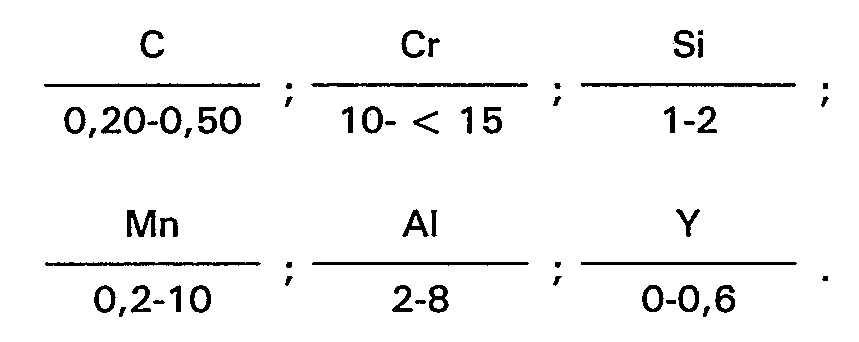
- this solution consists of a new alloy with an austenitic phase containing carbon, chromium, silicon, manganese, aluminum and possibly yttrium, balance of nickel or iron, characterized in that it has the following chemical composition (in percentage by weight): nickel or iron balance, provided that the nickel content is always at least equal to 40% of the total composition.
- this alloy necessarily includes yttrium, in a content of about 0.10% by weight.
- this new alloy is characterized in that its chromium content is between 5 and less than 15%.
- the new alloy according to the invention is characterized in that it has the following chemical composition (in percentage by weight):
- this new alloy it is characterized in that it has the following chemical composition (in percentage by weight):
- the manganese content is between 0.2 and 2%.
- its silicon content is between 1.5 and 2% by weight.
- this new alloy is characterized in that its nickel content is between 40 and 45%, the balance being iron.
- the chromium content is limited to a maximum of 15% because from 15% the ability of the alloy to prevent coking drops drastically.
- a minimum chromium content is required to obtain the anti-coking property, as well as the resistance to oxidation of the alloy. Its minimum content is 5%.
- the optimum chromium content varies between 8 and 12% or 10 to less than 15 or 14% depending on the carbon content of the alloy between a low carbon and a higher carbon.
- the aluminum content must be at least 4% to obtain a sufficient anti-coking property. Below 4%, excessive coking of the alloy occurs.
- the maximum aluminum content is 8%, because above this value, there is a precipitation of nickel-rich phase of NiAI composition resulting in excessive embrittlement of the alloy.
- the carbon content is a function of the chromium content.
- the carbon content is between 0.01 and 0.5%. If the carbon content is high, more chromium is required and vice versa, in order to avoid the precipitation of chromium carbides which are to be avoided in order to obtain the sufficient oxidation resistance as well as the desired anti-coking property.
- a minimum content of 0.5% silicon is required to increase the resistance to coking of the alloy.
- the maximum content is 2% because beyond that silicon has a detrimental effect on other properties, in particular on the weldability.
- At least 1% of silicon and even at least 1.5% are preferred in order to increase the resistance to coking and also the resistance to internal oxidation.
- a minimum content of 0.2% manganese is required to also obtain an increase in the coking behavior of the alloy. Above 10%, manganese has very specific harmful effects on resistance to oxidation. A more limited manganese content of 0.2 to 2% is therefore preferred, more preferably 0.2 to 1.5% to obtain the best balance of properties.
- Yttrium is a possible element which can be present up to 1%. Yttrium improves the adhesion of oxide layers that form.
- a preferred yttrium content is at least 150 ppm up to 0.6 and more preferably around 0.1% to obtain an optimum of the adhesion effect.
- Nickel normally constitutes the balance which can be achieved by iron. In all cases, a minimum nickel content of at least 40% of the total composition is required in order to obtain a rough matrix which is essentially or entirely austenitic.
- the new alloy according to the invention is coated with a surface layer of aluminum by any process of aluminization, preferably comprising a process of deposit by diffusion in the box.
- this base alloy is applied to a base alloy with high mechanical strength, preferably improved by incorporation of niobium and tungsten. More preferably, this base alloy has the following chemical composition (in percentage by weight): phosphorus and sulfur each less than 0.05%, the balance being iron with the usual unavoidable impurities.
- the alloy according to the present invention is applied to this base alloy in the form of a bi-metal comprising two layers, preferably joined without separation by any suitable method, and preferably by the centrifugation method.
- the present invention also relates to fuel or coking medium treatment ovens, working at high temperature, characterized in that the surfaces in contact with the reagents are produced from the new alloy according to the invention as defined above.
- the alloy according to the invention can be coated with a respectively internal layer intended to come into contact with the reagents, formed by the above-mentioned aluminum surface layer while this alloy according to the invention can also be applied to a base alloy with high mechanical resistance, constituting an external layer of the oven serving to improve the mechanical resistance of the assembly, so as to obtain a synergistic effect between the various layers.
- the present invention also relates to a use and an application of the new alloy according to the invention where furnaces in methods of treatment of fuel or coking medium, in particular a method of cracking of hydrocarbon, in order to effectively fight against coking.
- the new alloy of the present invention makes it possible, unexpectedly, to effectively fight against coking in a remarkably superior manner compared to the other previously known alloys.
- the new alloy according to the invention has a remarkable resistance to internal oxidation. Also, its cold mechanical properties are remarkable. Finally, this new alloy also has excellent weldability, thus facilitating its use on a large scale.
- various alloys according to the invention are prepared in an austenitic phase, in a conventional manner by adding the individual elements and controlling their proportion so as to result in the final composition indicated.
- alloys 1 ′ and 4 ′ were obtained in a high frequency levitation oven with the addition of yttrium to the basic compositions 1 to 4, respectively.
- the breaking load Rm is in all cases greater than 800 MPa whereas according to this document, at a temperature greater than 800 ° C, the breaking load is at most equal to approximately 550 MPa.
- the elongation at break is very low even at a temperature above 800 ° C compared to the elongation obtained cold according to the present invention which is remarkable.
- the cold mechanical properties are similar to those obtained by the alloy prior described in document FR-A-2496705 this being remarkable since the alloy contains niobium in order to improve its mechanical properties, while the alloys according to the invention have a higher elongation at break.
- composition of the alloy is recalled below in Table II simultaneously with that of the HK 40 and Manaurite 36XS® alloys well known for their resistance to high temperature.
- the new alloys of the invention will be compared with the previously known alloys HK 40, 36 XS® and by being subjected to coking, oxidation and finally carburation tests.
- the carbon deposition is obtained by passing a gaseous mixture containing hydrogen, carbon monoxide and methane over the metal samples brought to high temperature.
- the new alloy according to the invention is remarkable in anti-coking resistance even without an aluminizing treatment, this anti-coking resistance is considerably increased, as in the case of the other invention of the applicant, by making an aluminizing treatment on a base alloy containing aluminum of the XA type, compared with the prior art.
- the alloys are subjected to a cyclic oxidation by subjecting them to 20 thermal cycles (24 hours at 1000 ° C., followed by rapid cooling to approximately 200 ° C., then rapid reheating to 1000 ° C and so on).
- the alloys according to the invention 1 to 4 and l 'to 4' of Example 1 as well as the reference alloys HK 4o Manaurite 36 XS and XA 4 , known for their resistance to carburetion were subjected to the action because - burante of a gaseous mixture of hydrogen and methane at 1100 ° C.
- austenitic phase used for the new alloy according to the invention means that the austenitic phase of this new al bonding is preponderant and preferably means that this phase is entirely austenitic.
- the alloy according to the invention is also advantageously used or applied to the manufacture of instrumentation down cables in wells, or of drilling tubes in an oxidizing or sulfurizing medium.
Landscapes
- Chemical & Material Sciences (AREA)
- Engineering & Computer Science (AREA)
- Materials Engineering (AREA)
- Mechanical Engineering (AREA)
- Metallurgy (AREA)
- Organic Chemistry (AREA)
- Production Of Liquid Hydrocarbon Mixture For Refining Petroleum (AREA)
- Pens And Brushes (AREA)
- Materials For Medical Uses (AREA)
- Continuous Casting (AREA)
- Curing Cements, Concrete, And Artificial Stone (AREA)
Description
- La présente invention concerne essentiellement un nouvel alliage à phase austénitique contenant de l'aluminium et éventuellement de l'yttrium, un four de traitement de milieu carburant ou cokant travaillant à température élevée comportant un tel alliage et l'utilisation ou application de cet alliage ou des fours dans des procédés de traitement de milieu carburant ou cokant, ou à la fabrication de câbles ou tubes de forage.
- On sait que au cours des réactions de craquage par pyrolyse de produits organiques tels que des hydrocarbures, il se produit généralement la formation de carbone de décomposition qui se rassemble en granules entraînées par le débit de gaz, mais qui peuvent cependant s'agglomérer sur la paroi des tubes de réaction dont la température est plus forte que l'effluent, car les réactions sont généralement endothermiques.
- En des multiples occasions l'importance du dépôt de coke ainsi formé limite progressivement le transfert thermique, conduit à une surchauffe de la paroi interne du tube et favorise de ce fait la cémentation du métal ou de l'alliage réfractaire constituant le tube.
- Dans les cas extrêmes, il peut se produire une obturation totale qui arrête naturellement le procédé. On élimine alors le coke formé par une combustion in situ en remplaçant les gaz du procédé par un mélange air-vapeur passant dans les tubes à une température de 650-750°C environ.
- Mais, ceci conduit à un cyclage thermique du métal des tubes et donc à une fatigue thermique et à une carburation plus profonde.
- Ce problème technique est connu depuis de nombreuses années et de multiples solutions ont été proposées pour tenter de le résoudre.
- Par exemple, dès 1930, on a proposé dans le brevet allemand n° 709215 de lutter contre la cokéfaction en incorporant dans un alliage d'environ 0,5 à 3% de titane et d'environ 5 à 8% d'aluminium. Les exemples donnés sont relatifs à des alliages ne contenant pas de nickel et éventuellement une faible teneur en chrome. On donne cependant page 2, lignes 19 à 23 une liste d'éléments que l'on peut incorporer seul ou en combinaison, à savoir le tungstène, le molybdène, le vanadium, le silicium, le nickel, le cobalt, le cuivre, le manganèse, l'étain, le zinc, le plomb, l'argent, le béryllyum. La citation d'un si grand nombre d'éléments éventuels aboutit au fait que ce document n'est pas directement utilisable par l'homme du métier puisque celui-ci est amené en fait à effectuer ses propres recherches pour trouver des alliages convenables.
- En fait, les alliages décrits dans ce document sont utilisables à basse température mais on s'achemine actuellement vers une augmentation aussi élevée que possible de la température de craquage, par exemple d'au moins 800°C, pour laquelle ces alliages connus ne sont pas utilisables en raison du fait que les alliages décrits sont de phase ferritique et surtout les propriétés mécaniques de ces alliages, en particulier la résistance au fluage, sont beaucoup trop mauvaises pour pouvoir être utilisées aux températures élevées.
- Selon le brevet américain 2056914, également du même déposant que le brevet précédent, on propose au contraire de réaliser le traitement thermique de l'hydrocarbure dans un espace défini par un métal thermiquement résistant qui est revêtu à l'intérieur d'une couche consistant essentiellement d'un élément choisi parmi le groupe du silicium et du titane, obtenue par combustion du métal sous forme pulvérulente. On cite comme alliage de base un alliage contenant 71 % de fer, 7% de nickel et 20% de chrome dénommé acier V2A.
- Selon le brevet américain 2168840 on indique qu'on a proposé de nombreux alliages pour lutter contre la cokéfaction dont la plupart consistent à faire un acier allié avec un ou plusieurs métaux tels que le vanadium, le chrome, le manganèse, le nickel et le cobalt. On indique qu'aucun de ces alliages proposés n'a permis de résoudre ce problème technique (page 1, lignes 13 à 17).
- Selon l'invention décrite dans ce document, on diminuerait la possibilité de dépôt de carbone en traitant la surface métallique du réacteur préalablement avec des substances qui empoisonnent l'influence catalytique de la surface métallique et l'inactivent sensiblement. On préconise comme telle substance le soufre, le phosphore, le silicium et le tellure et des dérivés de ces éléments. On préconise de préférence le sulfure d'hydrogène.
- La solution préconisée dans ce document n'est pas très efficace d'autre part on s'interdit en pratique d'utiliser des composés de ce type qui ont toujours un effet néfaste sur l'activité du catalyseur utilisé pour effectuer le traitement thermique du milieu carburant.
- On reconnaît d'ailleurs à l'exemple 8 de ce document page 5 que l'utilisation de sulfure d'hydrogène aboutit à une perte d'activité du catalyseur. Il est à noter également qu'en page 2, lignes 68 à 70 on mentionne que le réacteur peut être réalisé en acier ou en fer dont la surface interne a été revêtue d'aluminium. On considère donc selon ce document qu'un réacteur ainsi revêtu d'une couche d'aluminium n'est pas satisfaisant et qu'il doit être réalisé un traitement complémentaire, ceci étant confirmé par le passage de la page 3, lignes 2 à 6 où il est indiqué que tous les matériaux testés catalysent la formation de carbone à partir de matériaux organiques à des températures élevées, et ceci s'applique naturellement aux réacteurs en acier, fer ou fonte à surface interne revêtue d'une couche d'aluminium.
- Plus récemment, le brevet britannique 1 149163 préconise un procédé pour lutter contre la carburation en réalisant un four à partir d'un alliage de fer, nickel et/ou cobalt contenant au moins 15% en poids de chrome dont la surface exposée à l'environnement carburant est enrobée d'un matériau sensiblement inerte qui forme une barrière pour prévenir ou empêcher la carburation de l'alliage (page 1, lignes 65 à 74). Ce revêtement peut être non métallique (page 2, lignes 21 à 27) ou être métallique et être en particulier réalisé en aluminium, chrome ou nickel (page 2, lignes 20 à 32). Ainsi, ce document concerne un procédé d'aluminisation ou de chromage des surfaces internes des tubes (page 2, lignes 43 à 47).
- Le traitement d'aluminisation n'est pas en soi réellement adapté pour résoudre le problème de la cokéfaction car il conduit à la formation d'une couche superficielle d'aluminium sensible au décollement. D'autre part, les inventeurs de la présente invention ont découvert que cette sensibilité au décollement est accrue dans les alliages contenant du nickel sous l'effet de la migration du nickel à la surface qui est avide d'aluminium, par les lacunes de l'alliage. Il y a donc une création de lacunes sous la couche superficielle qui s'écaille alors rapidement. En outre, il est clair qu'après ce décollement le nickel en surface catalyse la formation d'un dépôt de coke.
- Ainsi, les procédés d'aluminisation ne sont pas satisfaisants car ils ne conduisent qu'à la formation d'une couche mince en surface qui se rompt facilement.
- Dans de nombreux cas, on a pensé qu'en utilisant des mélanges particuliers pour réaliser l'aluminisa- tion, on pouvait obtenir une couche superficielle moins sensible au décollement. Le brevet français 2184003 préconise une solution de ce type par un traitement avec un mélange comportant de l'aluminium et une faible quantité d'un additif sélectionné parmi le groupe formé d'un mischmetal et de cérium. De même, le brevet français 2065263 préconise un traitement d'aluminisation ou de chromage qui peut être réalisé en présence d'un diluant inerte comme la magnésie. Un autre procédé d'aluminisation est décrit dans le brevet américain 3827867.
- On observera d'autre part que tous les procédés de lutte contre la cokéfaction qui utilisent une alumini- sation de surface n'ont été appliqués qu'à des alliages sans aluminium.
- D'autre part, on a tenté de remédier à l'inconvénient de l'écaillement du décollement de la couche d'aluminium obtenue par le traitement d'aluminisa- tion en utilisant pour lutter contre la cokéfaction un alliage contenant de l'aluminium incorporé au centre de la matrice lors de sa fabrication (voir la demande de brevet français antérieur des demandeurs publiée sous le n° 2496705).
- Dans ce cas, on obtient des résultats satisfaisants lorsque les conditions de traitement de début de craquage sont telles qu'une couche d'oxyde d'aluminium se forme en surface.
- Cependant, il arrive souvent pour des raisons techniques inhérentes au procédé de craquage que ces conditions ne soient pas remplies et qu'il ne se forme par conséquent qu'une couche d'oxyde d'aluminium discontinue, ce qui provoque la catalyse du dépôt de carbone aux endroits non protégés.
- On a pensé à augmenter la teneur en aluminium pour remédier à cet inconvénient mais cette solution aboutit à une perte radicale de résistance mécanique de l'alliage, notamment la résistance au fluage, de sorte que cette solution a été abandonnée.
- Les inventeurs ont alors réalisé des recherches en vue de créer un nouvel alliage présentant des caractéristiques mécaniques à froid excellentes tout en étant apte en lui-même à diminuer de manière radicale les risques de cokéfaction quelles que soient les conditions de départ de traitement d'un milieu carburant ou cokant tout en présentant une excellente soudabilité.
- Ces recherches se sont orientées plus particulièrement relativement à des alliages contenant du chrome et de l'aluminium éventuellement contenant de l'yttrium ayant pour solde du nickel ou du fer.
- Relativement à de tels alliages ainsi définis présentant d'excellentes propriétés mécaniques, en particulier une excellente résistance à l'oxydation, l'état de la technique est la suivante:
- la demande de brevet français Cabot 2 527 224 concerne un alliage contenant du chrome, de l'aluminium et de l'yttrium et dont le solde est constitué par du nickel (page 1, lignes 1 à 10);
- la teneur en fer est de 1,5 à 8% (page 1, lignes 37-38) en vue d'améliorer l'aptitude au façonnage de l'alliage (page 2, lignes 14 à 16). Cet alliage contient une quantité relativement élevée de chrome, soit de 14 à 18%, tous les exemples montrant une teneur en chrome supérieure à 15% (tableaux et Il pages 4 et 5).
- D'autre part, bien qu'il soit mentionné que la teneur en manganèse et en silicium peut atteindre 20%, tous les alliages expérimentés ne contiennent le silicium et le manganèse qu'à l'état de trace.
- En outre, la teneur en carbone est indiquée comme pouvant aller jusqu'à 0,25% mais tous les exemples ne contiennent le carbone qu'à l'état de trace.
- Ces alliages sont indiqués comme pouvant être utilisés pour réaliser des articles forgés, notamment pour four de traitement thermique.
- Cependant, ces alliages présentent des propriétés mécaniques à froid très modestes, les propriétés mécaniques à chaud, c'est-à-dire à une température au moins égale à 843°, étant modestes, en particulier l'allongement. D'autre part, leur capacité à éviter une carburation ou une cokéfaction est également modeste ou insuffisante.
- Egalement, il est connu par le brevet US Mac-GURTY N° 3754898 un alliage austénitique contenant du fer, du nickel, du chrome, de l'aluminium et de l'yttrium ayant une résistance à l'oxydation basée sur la formation d'un film protecteur d'oxyde d'aluminium, pouvant être aisément travaillé pour produire des produits standards en utilisant des moyens conventionnels présentement employés dans l'industrie automobile et dans des industries de travail des métaux similaires (voir colonne 1, lignes 22 à 31 et colonne 2, lignes 15 à 19).
- On ne décrit pas ni ne suggère dans ce document qu'un tel alliage austénitique puisse être utilisé pour lutter contre la carburation ou, de manière plus importante, contre la cokéfaction ou les dépôts de coke.
- L'alliage de base comprend du fer-nickel-chrome- aluminium-yttrium.
- Dans des modes de réalisation spécifiques, des additions de manganèse et/ou de cuivre, de carbone et d'azote fourniront des alliages austénitiques ayant une teneur en nickel inférieure, et une résistance supérieure à la composition de base ci-dessus.
- Ces éléments sont en conséquence ajoutés pour abaisser la teneur en nickel en dessous de 15% (voir colonne 2 lignes 48 à 64 et colonne 3 lignes 48 à 52).
- En outre, on ne révèle pas ni ne suggère l'incorporation de silicium comme élément alliant bénéfique.
- On connaît également d'autres alliages beaucoup plus éloignés par les documents suivants:
FR-A-2284683; FR-A-2472028; FR-A-2263637; FR-A-2441665; FR-A-2377456; FR-A-2430985; FR-A-2 526 046; FRA-2414561; FR-A-2 370106; FR-A-2177329; FR-A-2 406 000; FR-A-2436823; FR-A-2520858; FR-A-2414562; FR-A-2249963; FR-A-2 377 458; FR-A-2 467 243; FR-A-2 503189; EP-A-0093661; EP-A-0068628; WO-79/00343; WO-81/00861. - Ainsi, la présente invention a pour but de résoudre le nouveau problème technique consistant à trouver une solution évitant la cokéfaction quelles que soient les conditions de départ de traitement d'un milieu carburant ou cokant.
- Selon un autre aspect, la présente invention a également pour objet de fournir un nouvel alliage évitant la cokéfaction quelles que soient les conditions de départ de traitement d'un milieu carburant ou cokanttout en présentant simultanément d'excellentes caractéristiques mécaniques, notamment une excellente résistance au fluage et présentant en outre une excellente soudabilité, avec de préférence un allongement excellent à froid.
- Cette solution consiste selon la présente invention en un nouvel alliage à phase austénitique contenant du carbone, du chrome, du silicium, du manganèse, de l'aluminium et éventuellement de l'yttrium, solde du nickel ou fer, caractérisé en ce qu'il a la composition chimique suivante (en pourcentage en poids):

- Selon une autre caractéristique préférée de cet alliage, celui-ci comprend obligatoirement de l'yttrium, suivant une teneur d'environ 0,10% en poids.
- Selon encore une autre caractéristique préférée de ce nouvel alliage, celui-ci est caractérisé en ce que sa teneur en chrome est comprise entre 5 et moins de 15%.
- Selon un mode de réalisation particulièrement préféré du nouvel alliage selon l'invention, celui-ci est caractérisé en ce qu'il a la composition chimique suivante (en pourcentage en poids):

- Selon un autre mode de réalisation particulier de ce nouvel alliage, celui-ci est caractérisé en ce qu'il a la composition chimique suivante (en pourcentage en poids):

- Selon une caractéristique particulière de l'alliage selon l'invention, la teneur en manganèse est comprise entre 0,2 et 2%.
- Selon encore une autre caractéristique préférée du nouvel alliage selon l'invention, sa teneur en silicium est comprise entre 1,5 et 2% en poids.
- Selon encore une autre caractéristique particulièrement préférée de ce nouvel alliage, celui-ci est caractérisé en ce que sa teneur en nickel est comprise entre 40 et 45%, le solde étant le fer.
- La teneur en chrome est limitée à un maximum de 15% car à partir de 15% l'aptitude de l'alliage à empêcher le cokage baisse de manière drastique. Une teneur minimum en chrome est exigée pour obtenir la propriété anti-cokage, ainsi que la résistance à l'oxydation de l'alliage. Sa teneur minimale est de 5%. La teneur optimale de chrome varie entre 8 et 12% ou 10 à moins de 15 ou 14% en fonction de la teneur en carbone de l'alliage entre un bas carbone et un carbone plus élevé.
- La teneur en aluminium doit être au minimum de 4% pour obtenir une propriété anti-cokage suffisante. En dessous de 4%, il se produit un cokage excessif de l'alliage. La teneur maximale en aluminium est de 8%, car au-delà de cette valeur, il se produit une précipitation de phase riche en nickel de composition NiAI aboutissant à une fragilisation excessive de l'alliage.
- La teneur en carbone est fonction de la teneur en chrome.
- La teneur en carbone est comprise entre 0,01 et 0,5%. Si la teneur en carbone est élevée, il faut davantage de chrome et inversement, afin d'éviter la précipitation de carbures de chrome qui sont à éviter pour obtenir la résistance à l'oxydation suffisante ainsi que la propriété anti-cokage recherchée.
- Il faut une teneur minimale de 0,5% de silicium pour augmenter la tenue au cokage de l'alliage. La teneur maximale est de 2% car au-delà le silicium a un effet néfaste sur d'autres propriétés, en particulier sur la soudabilité. On préfère au moins 1 % en silicium et même au moins 1,5% en vue d'augmenter la tenue au cokage et également la résistance à l'oxydation interne.
- Une teneur minimale de 0,2% en manganèse est exigée pour obtenir également une augmentation de la tenue au cokage de l'alliage. Au-delà de 10%, le manganèse a des effets néfastes bien particuliers sur la résistance à l'oxydation. On préfère donc une teneur plus restreinte en manganèse de 0,2 à 2% encore de préférence 0,2 à 1,5% pour obtenir le meilleur équilibre de propriétés. L'yttrium est un élément éventuel qui peut être présent jusqu'à 1 %. L'yttrium améliore l'adhérence des couches d'oxyde qui se forment. Une teneur préférée en yttrium est d'au moins 150 ppm jusqu'à 0,6 et encore de préférence d'environ 0,1% pour obtenir un optimum de l'effet d'adhérence.
- Le nickel constitue normalement le solde qui peut être réalisé par le fer. Dans tous les cas, une teneur minimale en nickel d'au moins 40% de la composition totale est exigée afin d'obtenir une matrice brute essentiellement ou entièrement austénitique.
- Selon un mode de réalisation particulier du nouvel alliage selon l'invention, celui-ci est revêtu d'une couche superficielle d'aluminium par tout procédé d'aluminisation, de préférence comprenant un procédé de dépôt par diffusion en caisse.
- Selon encore un autre mode de réalisation particulier de l'alliage selon l'invention, celui-ci est appliqué sur un alliage de base à résistance mécanique élevée, de préférence améliorée par incorporation de niobium et de tungstène. Encore de préférence, cet alliage de base a la composition chimique suivante (en pourcentage en poids):

- De préférence, l'alliage selon la présente invention est appliqué sur cet alliage de base sous forme d'un bi-métal comportant deux couches de préférence jointes sans séparation par tout procédé approprié, et de préférence par le procédé de centrifugation.
- La présente invention concerne également des fours de traitement de milieu carburant ou cokant, travaillant à température élevée, caractérisés en ce que les surfaces en contact avec les réactifs sont réalisés à partir du nouvel alliage selon l'invention tel que précédemment défini. Ainsi, l'alliage selon l'invention peut être revêtu d'une couche respectivement interne destinée à venir en contact avec les réactifs, formée par la couche superficielle d'aluminium précitée tandis que cet alliage selon l'invention peut être également appliqué sur un alliage de base à résistance mécanique élevée, constituant une couche externe du four servant à améliorer la résistance mécanique de l'ensemble, de manière à obtenir un effet de synergie entre les diverses couches.
- La présente invention concerne également une utilisation et une application du nouvel alliage selon l'invention où des fours dans des procédés de traitement de milieu carburant ou cokant, en particulier un procédé de craquage d'hydrocarbure, afin de lutter efficacement contre la cokéfaction.
- On a en effet pu observer que le nouvel alliage de la présente invention tel que précédemment défini permet, de manière inattendue, de lutter efficacement contre la cokéfaction d'une manière remarquablement supérieure par rapport aux autres alliages antérieurement connus. D'autre part, le nouvel alliage selon l'invention, comme précédemment indiqué, présente une résistance remarquable à l'oxydation interne. Egalement, ses propriétés mécaniques à froid sont remarquables. Enfin, ce nouvel alliage présente aussi une excellente soudabilité, facilitant ainsi son emploi à grande échelle.
- D'autres buts, caractéristiques et avantages de l'invention apparaîtront clairement à la lumière de la description explicative qui va suivre faite en référence à divers exemples donnés simplement à titre d'illustration qui ne sauraient donc en aucune façon limiter la portée de la présente invention. Dans les exemples, tous les pourcentages sont donnés en poids, sauf indication contraire.
- Dans cet exemple, on prépare divers alliages selon l'invention à phase austénitique, de manière classique par addition des éléments individuels et contrôle de leur proportion de manière à aboutir à la composition finale indiquée.
- Les alliages conformes à l'invention avec leur composition et leurs propriétés mécaniques à froid sont indiqués au tableau 1 ci-dessous.

- On observera que les alliages 1' et 4' ont été obtenus au four haute fréquence à liévitation avec ajout d'yttrium aux compositions de base 1 à 4, respectivement.
- Ces propriétés mécaniques à froid sont à comparer avec les propriétés obtenues avec les alliages décrits dans le document FR-A-2 527 224 tableaux Il et III, qui ont une faible teneur en carbone; soit les alliages 1, 2 et 1', 2' de l'invention.
- Selon la présente invention, la charge à la rupture Rm est dans tous les cas supérieure à 800 MPa alors que selon ce document, à température supérieure à 800°C, la charge à la rupture est au maximum égale à environ 550 MPa. D'autre part, l'allongement à la rupture est très faible même à une température supérieure à 800°C par rapport à l'allongement obtenu à froid selon la présente invention qui est remarquable. D'autre part, les propriétés mécaniques à froid sont similaires à celles obtenues par l'alliage


- La composition de l'alliage


- A l'exemple suivant, les nouveaux alliages de l'invention vont être comparés aux alliages antérieurement connus HK 40, 36 XS® et

- Des essais de cokage ont été effectués à 900°C sur les alliages selon l'invention 1 à 4 et l' à 4' ainsi que sur les alliages de comparaison antérieurement connus

- Dans cet exemple, le dépôt de carbone est obtenu par passage d'un mélange gazeux contenant de l'hydrogène, de l'oxyde de carbone et du méthane sur les échantillons métalliques portés à haute température.
- Les résultats obtenus sont répertoriés au tableau III ci-dessous:


- Les mêmes essais de cokage effectués après un traitement d'oxydation des échantillons métalliques à la vapeur d'eau à 900°C pendant 12 h donne les résultats suivants indiqués au tableau IV.

- On peut observer l'amélioration tout à fait inattendue pour un homme du métier de la résistance au cokage des nouveaux alliages selon l'invention même sans revêtement aluminisé.
- A ce sujet, un traitement d'aluminisation de surfaces améliore considérablement la résistance au cokage des alliages selon l'invention.
- Ainsi, tous les alliages selon l'invention 1 à 4 et 1 ' à 4' ont été traités par le procédé de dépôt par diffusion en caisse pour obtenir un revêtement aluminisé. Après 4 heures detraitement à 1050°C dans un cément comprenant en poids 3% de poudre d'aluminium, 0,5% de chlorure d'ammonium, le reste étant de l'alumine, des alliages précités étaient revêtus d'une couche de NiAI d'environ 50 µm d'épaisseur.
- Ce traitement d'aluminisation est celui faisant l'objet d'une autre invention des demandeurs faisant l'objet d'une demande de brevet déposée le même jour que la présente invention.
- Ainsi, ce traitement d'aluminisation est réalisé sur l'alliage contenant de l'aluminium XA4 conformément à l'autre invention des demandeurs de cette autre demande de brevet déposée le même jour.
- On réalise également à titre de comparaison le même traitement d'aluminisation sur les alliages antérieurement connus HK40 et 36 XS.
- Dans ces conditions, après une oxydation préalable à la vapeur d'eau à 900°C, les mêmes essais de cokage ont donné les résultats suivants, indiqués au tableau V.

- On peut donc observer que le nouvel alliage selon l'invention est remarquable en résistance anti-cokage même sans traitement d'aluminisation, cette résistance anti-cokage est considérablement accrue, comme dans le cas de l'autre invention de la demanderesse, en réalisant un traitement d'alumini- sation sur un alliage de base contenant de l'aluminium du type XA, par rapport à l'art antérieur.
- Dans ces essais d'oxydation, on soumet les alliages à une oxydation cyclique en les soumettant à 20 cycles thermiques (24 heures à 1000°C, suivi d'un refroidissement rapide jusqu'à environ 200°C, puis réchauffage rapide jusqu'à 1000°C et ainsi de suite).
- Les résultats obtenus sont donnés au tableau VI suivant indiqué ci-dessous.

- On observe une résistance à l'oxydation remarquable des alliages selon l'invention par rapport aux alliages antérieurement connus HK40, 36 XS et XA4. D'autre part, on peut également observer que l'addition d'yttrium, réalisée dans les alliages l' à 4' par rapport aux alliages 1 à 4 (voir exemple 1 ci-dessus) permet d'augmenter radicalement l'adhésion des oxydes et d'améliorer encore la résistance à l'oxydation des alliages selon l'invention.
- Les alliages selon l'invention 1 à 4 et l' à 4' de l'exemple 1 ainsi que les alliages de référence HK4o Manaurite 36 XS et XA4, réputés pour leur résistance à la carburation ont été soumis à l'action car- burante d'un mélange gazeux d'hydrogène et de méthane à 1100°C.
- Les prises de poids AP après 19 h de traitement sont répertorisées au tableau VII.

- On peut observer que la résistance à la carburation du nouvel alliage selon l'invention est accrue de manière remarquable relativement aux autres alliages de l'état de la technique HK 40, 36 XS et XA4.
- Il est à noter que l'expression «phase austénitique» utilisée pour le nouvel alliage selon l'invention signifie que la phase austénitique de ce nouvel alliage est prépondérante et de préférence signifie que cette phase est entièrement austénitique.
- L'alliage selon l'invention est aussi avantageusement utilisé ou appliqué à la fabrication de câbles de descente d'instrumentation dans les puits de forage, ou de tubes de forage en milieu oxydant ou sulfurant.
Claims (13)



Applications Claiming Priority (2)
| Application Number | Priority Date | Filing Date | Title |
|---|---|---|---|
| FR8410393 | 1984-06-29 | ||
| FR8410393A FR2566803B1 (fr) | 1984-06-29 | 1984-06-29 | Nouvel alliage a phase austenitique contenant de l'aluminium et eventuellement de l'yttrium, four de traitement de milieu carburant ou cokant travaillant a temperature elevee comportant un tel alliage et utilisation ou application de cet alliage ou des fours dans des procedes de traitement de milieu carburant ou cokant, ou a la fabrication de cables ou tubes de forage |
Publications (2)
| Publication Number | Publication Date |
|---|---|
| EP0169119A1 EP0169119A1 (fr) | 1986-01-22 |
| EP0169119B1 true EP0169119B1 (fr) | 1988-03-30 |
Family
ID=9305650
Family Applications (1)
| Application Number | Title | Priority Date | Filing Date |
|---|---|---|---|
| EP85401247A Expired EP0169119B1 (fr) | 1984-06-29 | 1985-06-21 | Alliage à phase austénitique contenant du chrome et de l'aluminium; application dans les fours de craquage, les tubes et câbles de forage |
Country Status (6)
| Country | Link |
|---|---|
| EP (1) | EP0169119B1 (fr) |
| JP (1) | JPS6184349A (fr) |
| DE (1) | DE3562023D1 (fr) |
| ES (1) | ES8604654A1 (fr) |
| FR (1) | FR2566803B1 (fr) |
| NO (1) | NO852606L (fr) |
Families Citing this family (3)
| Publication number | Priority date | Publication date | Assignee | Title |
|---|---|---|---|---|
| US4762681A (en) * | 1986-11-24 | 1988-08-09 | Inco Alloys International, Inc. | Carburization resistant alloy |
| DE4002839A1 (de) * | 1990-02-01 | 1991-08-08 | Forschungszentrum Juelich Gmbh | Wandstruktur mit kernschicht auf eisen/nickellegierungsbasis mit oxidbildender oberflaechenschicht |
| RU2125110C1 (ru) * | 1996-12-17 | 1999-01-20 | Байдуганов Александр Меркурьевич | Жаропрочный сплав |
Family Cites Families (3)
| Publication number | Priority date | Publication date | Assignee | Title |
|---|---|---|---|---|
| US3754898A (en) * | 1972-01-07 | 1973-08-28 | Gurty J Mc | Austenitic iron alloys |
| US4312682A (en) * | 1979-12-21 | 1982-01-26 | Cabot Corporation | Method of heat treating nickel-base alloys for use as ceramic kiln hardware and product |
| US4439248A (en) * | 1982-02-02 | 1984-03-27 | Cabot Corporation | Method of heat treating NICRALY alloys for use as ceramic kiln and furnace hardware |
-
1984
- 1984-06-29 FR FR8410393A patent/FR2566803B1/fr not_active Expired
-
1985
- 1985-06-21 DE DE8585401247T patent/DE3562023D1/de not_active Expired
- 1985-06-21 EP EP85401247A patent/EP0169119B1/fr not_active Expired
- 1985-06-28 ES ES544732A patent/ES8604654A1/es not_active Expired
- 1985-06-28 NO NO852606A patent/NO852606L/no unknown
- 1985-06-29 JP JP60143829A patent/JPS6184349A/ja active Pending
Also Published As
| Publication number | Publication date |
|---|---|
| EP0169119A1 (fr) | 1986-01-22 |
| NO852606L (no) | 1985-12-30 |
| ES544732A0 (es) | 1986-02-01 |
| ES8604654A1 (es) | 1986-02-01 |
| JPS6184349A (ja) | 1986-04-28 |
| FR2566803B1 (fr) | 1987-11-27 |
| DE3562023D1 (en) | 1988-05-05 |
| FR2566803A1 (fr) | 1986-01-03 |
Similar Documents
| Publication | Publication Date | Title |
|---|---|---|
| JP4805523B2 (ja) | 高温用ステンレス鋼のためのコーティングシステム | |
| KR101738390B1 (ko) | 니켈 크롬 합금 | |
| US6602483B2 (en) | Increasing production in hydrocarbon conversion processes | |
| JP4607092B2 (ja) | 熱安定性かつ耐食性の鋳造ニッケル−クロム合金 | |
| CH644401A5 (fr) | Superalliage a base de nickel contenant des metaux du groupe platine. | |
| EP2099943B2 (fr) | Alliage de zirconium resistant a la corrosion en ombres portees pour composant d'assemblage de combustible pour reacteur a eau bouillante, composant realise en cet alliage, assemblage de combustible et son utilisation | |
| CH625836A5 (fr) | ||
| FR2660938A1 (fr) | Systemes de revetement pour la protection du titane envers l'oxydation. | |
| FR2472035A1 (fr) | Procede pour traiter a temperature elevee des matieres contenant un hydrocarbure afin d'eviter des depots de carbone a la surface des reacteurs | |
| US4976932A (en) | Carbon containing compound treating apparatus with resistance to carbon deposition | |
| FR2500468A1 (fr) | Tube pour le craquage ou le reformage thermiques des hydrocarbures | |
| FR2799210A1 (fr) | Alliage a base de zirconium et procede de fabrication de composant pour assemblage de combustible nucleaire en un tel alliage | |
| US5242665A (en) | Carbon containing compound treating apparatus with resistance to carbon deposition | |
| WO1997001522A1 (fr) | Accroissement du rendement des procedes de conversion des hydrocarbures | |
| EP0169119A1 (fr) | Alliage à phase austénitique contenant du chrome et de l'aluminium; application dans les fours de craquage, les tubes et câbles de forage | |
| CA2357407C (fr) | Systeme de revetement pour les aciers inoxydables refractaires | |
| EP0718415B1 (fr) | Aciers anti-cokage | |
| EP0055180B1 (fr) | Procédé de protection principalement contre la cokéfaction des surfaces en alliage réfractaire en contact avec les réactifs dans des fours de pyrolyse et fours obtenus par ce procédé | |
| US3865634A (en) | Heat resistant alloy for carburization resistance | |
| EP0688889B1 (fr) | Méthode de passivation de pièces métalliques en super-alliage à base de nickel et de fer | |
| US3268306A (en) | Titanium pretreatment for protective coating of refractory alloys | |
| JP2009520172A (ja) | 金属管および該金属管の使用 | |
| EP0112206B1 (fr) | Procédé de revêtement en carbures de surfaces métalliques | |
| WO2005021813A1 (fr) | Alliage de cuivre resistant a l'effusement de l'acier et son utilisation | |
| EP0170546A1 (fr) | Acier nitrurable à haute résistance et bonne usinabilité, utilisable comme acier de construction et procédé pour sa fabrication |
Legal Events
| Date | Code | Title | Description |
|---|---|---|---|
| PUAI | Public reference made under article 153(3) epc to a published international application that has entered the european phase |
Free format text: ORIGINAL CODE: 0009012 |
|
| AK | Designated contracting states |
Designated state(s): BE DE GB IT NL SE |
|
| 17P | Request for examination filed |
Effective date: 19860217 |
|
| 17Q | First examination report despatched |
Effective date: 19861125 |
|
| GRAA | (expected) grant |
Free format text: ORIGINAL CODE: 0009210 |
|
| AK | Designated contracting states |
Kind code of ref document: B1 Designated state(s): BE DE GB IT NL SE |
|
| PG25 | Lapsed in a contracting state [announced via postgrant information from national office to epo] |
Ref country code: IT Free format text: LAPSE BECAUSE OF FAILURE TO SUBMIT A TRANSLATION OF THE DESCRIPTION OR TO PAY THE FEE WITHIN THE PRESCRIBED TIME-LIMIT;WARNING: LAPSES OF ITALIAN PATENTS WITH EFFECTIVE DATE BEFORE 2007 MAY HAVE OCCURRED AT ANY TIME BEFORE 2007. THE CORRECT EFFECTIVE DATE MAY BE DIFFERENT FROM THE ONE RECORDED. Effective date: 19880330 Ref country code: NL Effective date: 19880330 |
|
| PG25 | Lapsed in a contracting state [announced via postgrant information from national office to epo] |
Ref country code: SE Effective date: 19880331 |
|
| REF | Corresponds to: |
Ref document number: 3562023 Country of ref document: DE Date of ref document: 19880505 |
|
| NLV1 | Nl: lapsed or annulled due to failure to fulfill the requirements of art. 29p and 29m of the patents act | ||
| GBV | Gb: ep patent (uk) treated as always having been void in accordance with gb section 77(7)/1977 [no translation filed] | ||
| PG25 | Lapsed in a contracting state [announced via postgrant information from national office to epo] |
Ref country code: GB Free format text: LAPSE BECAUSE OF NON-PAYMENT OF DUE FEES Effective date: 19881124 |
|
| BERE | Be: lapsed |
Owner name: FONDERIES ET ACIERIES DU MANOIR Effective date: 19880630 Owner name: ELF FRANCE Effective date: 19880630 |
|
| PLBE | No opposition filed within time limit |
Free format text: ORIGINAL CODE: 0009261 |
|
| STAA | Information on the status of an ep patent application or granted ep patent |
Free format text: STATUS: NO OPPOSITION FILED WITHIN TIME LIMIT |
|
| PG25 | Lapsed in a contracting state [announced via postgrant information from national office to epo] |
Ref country code: DE Effective date: 19890301 |
|
| 26N | No opposition filed | ||
| PG25 | Lapsed in a contracting state [announced via postgrant information from national office to epo] |
Ref country code: BE Effective date: 19890630 |